Posts Tagged With: Conspiracy Trial

Cloak and Daggers: Cutting Through the Confusion of the Assassination Knives

In the aftermath of Lincoln’s assassination, the authorities (both federal and local) took up the task of hunting down and collecting conspirators and evidence. Lincoln’s own wartime policies gave investigators unprecedented power to arrest and confiscate persons and things relating to his assassination. While casting such a wide net did succeed in capturing the members of Booth’s inner circle, it also inundated the War Department with mountains of evidence. Secretary of War Edwin Stanton appointed three army officers; Colonel Henry Wells, Colonel Henry Olcott, and Lieutenant Colonel John Foster, to help manage and assess the ever increasing paraphernalia. In turn, they reported to Colonel Henry Burnett, who sifted through their materials to find the key evidence to be used in the trial of the conspirators.[1] The voluminous paper materials can be found in the edited book, The Lincoln Assassination: The Evidence by William Edwards and Ed Steers, while the original documents can be viewed online (and for free) at Fold3.com. This investigation, however, centers more on some of the collected artifacts found by the War Department: the knives.

During the initial round of evidence gathering, many edged weapons entered the War Department. A knife was collected from the home of a Ms. Mary Cook, a known Confederate sympathizer, who continually celebrated after the assassination and tore down the mourning crepe placed upon her abode.[2] Another knife was taken from a Sergeant Samuel Streett, an acquaintance of Michael O’Laughlen, who was accused of passing two women through his lines at Camp Stoneman on the night of April 14th.[3] A sword was removed from above the mantle at the home of Mary Surratt.[4] In addition to these unrelated weapons, the investigation also managed to acquire the weapons of the conspirators. A knife was found hidden underneath the sheets of a bed at the Kirkwood rented to George Atzerodt. Samuel Arnold was arrested with a knife. Knives belonging to both Lewis Powell and George Atzerodt were recovered on the streets of D.C. the morning after the assassination. Finally, the lead conspirator himself gave up a knife when he was shot in the Garrett’s barn. All of these knives, along with others not mentioned or as fervently documented, left the members of the War Department up to their knees in knives. Therefore, Colonel Burnett began his process of identifying the important items he would need in the trial of the conspirators.

In the end, Colonel Burnett would choose five knives to use in the trial. Four of those knives would be entered as exhibits for the trial, while one knife, Powell’s, was used merely for identification purposes. The handwritten exhibit list for the trial has the following knives listed:

“23. Knife (Atzerodt’s room Kirkwood House)”
“28. Booth’s knife”
“41. Atzerodt’s knife”
“62. Knife found at Mrs. Surratt’s house.”[5]

The selection of which knives to use as exhibits was done very skillfully. With the evidence before him, Burnett realized that, out of those involved in the actual assassination plot, the government’s case was weakest against George Atzerodt and Mary Surratt. Therefore, their blades were touted right along side that of the assassin’s.

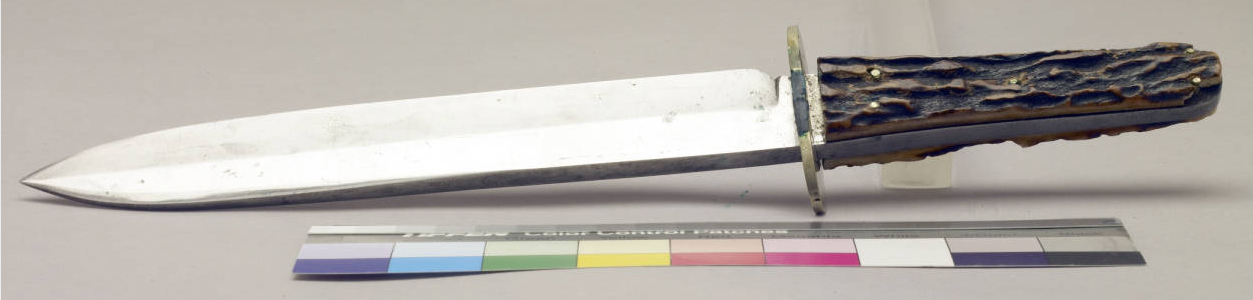
During the trial, the first three knives were identified by their finders. Detective John Lee discovered the knife pictured above at Atzerodt’s room in the Kirkwood house. It was hidden, “between the sheets and the mattress.” [6] While found in his rented room and bed, the contents of Atzerodt’s “lost” statement indicate that the knife, along with the other contents found in the room, belonged to David Herold.[7] Further, the statement of Mrs. R. R. Jones (the wife of a bookkeeper at the Kirkwood) notes that, a little after ten o’clock on the night of the assassination, a man ran rapidly past her room, towards Atzerodt’s, and tried to open the door of a room “three different times”. Not being able to get in, the man ran back past her room and down the stairs.[8] This man is supposed to have been Davy Herold. He left his coat, knife, and pistol in Atzerodt’s room, and came to retrieve them for his flight south. Upon finding the room locked and empty, Davy assumed correctly that Atzerodt had lacked the courage to complete his task, and fled. This could explain why, at the Surratt Tavern later that night, Booth bragged to John Lloyd that, “we have assassinated the President and Secretary Seward.” He did not include the death of Vice President Johnson in his boast, as Davy had likely reported the locked and empty room. While the above scenario is just a theory, it is safe to say that the bulk of the contents in Atzerodt’s room at the Kirkwood were under the care of Davy Herold, including the bowie knife recovered. From this point on, the knife found by Detective Lee, probably belonging to Davy Herold, will be referred to as the “Kirkwood knife”. This will eliminate confusion between that knife, and the knife pictured below that Atzerodt himself tossed into the gutter after hearing the news of the successful assassination.

By the afternoon of July 7, 1865, all of the owners of the knives used in the trial were dead. The knives, along with the other pieces of physical evidence, were boxed up and stored. A year later, a request came in to the War Department from Secretary Seward’s former male nurse, Private George F. Robinson. Robinson was asking for a unique keepsake: he wanted the knife Lewis Powell used to stab him and three others. After being approved by Edwin Stanton, the knife was turned over to Robinson, the lone hero on that night of villainy, in July of 1866. Even though Powell’s knife was given to Robinson, this did not affect the four exhibit knives as Powell’s was not one of them. This fact is important to note. Much of the later confusion regarding the assassination knives comes from the assumption that the government retained possession of Powell’s knife. They did not. From 1866 to 1961 the knife was in the possession of the Robinson family. In 1961, the knife pictured below, along with other papers belonging to Private Robinson, were donated to the Huntington Library in San Marino, California. The knife still resides there today. Many journalists and researchers would include Powell’s knife in the government’s holdings during the late 1800’s and early 1900’s, and all would be incorrect in this matter.
In 1867, the trial of John H. Surratt, the escaped conspirator, began. The evidence boxes were reopened and many of the same witnesses from the initial conspiracy trial were recalled. The civil trial ended in a hung jury and Surratt was set free. About six months later, another trial was held and the assassination of Abraham Lincoln was relived in that court room as well. That trial also acquits its defendant, President Johnson, who narrowly avoided impeachment. The assassination evidence, now having been taken out, examined, and disorganized twice since the conspiracy trial, was boxed up and stored again. This time, the storage lasted quite awhile.

In 1880, Representative William Springer of Illinois was one of the first to try to claim some of the Lincoln assassination artifacts. He introduced House Resolution 178 on January 23, 1880 calling for, “certain books and mementos in possession of the government to be placed in Memorial Hall of the National Lincoln Monument at Springfield, IL.”[9] It was quickly passed in the House and a Chicago Times journalist reported that it “will no doubt pass the Senate in a few days. The articles called for by the resolution are now in the office of Judge Advocate General Drum, in the War Department, and upon the passage of the resolution will be shipped to Springfield.”[10] While the resolution was eventually passed in both the House and Senate, the annual reports from the National Lincoln Monument Association in 1882 reflect what little became of it: “Concerning relics to be sent from the War and State Departments to Memorial Hall, the only article received thus far is one copy of, ‘Tributes of the Nations to the memory of Abraham Lincoln,’ and is the only one that can be spared. Hon. W. M. Springer has been untiring in his efforts to have the provisions in the joint resolution complied with, but obstacles have presented themselves at various points, and the probability is that we will never receive half of what was ordered in that resolution.”[11] Despite a resolution from Congress, the artifacts and knives stayed in storage as they were deemed too important to let go of, at least for now.

In May of 1899, Judge Advocate General Guido Lieber, was in the mood to do some spring cleaning. Particularly, he wanted to be rid of the trial relics: “These relics are now in a locked cabinet, in a storeroom of this office, in the sub-basement. Very frequently visitors obtain permission to see them, but, owing to the storeroom being filled with files, there are no facilities for showing them, and it takes the time of an employee of this office from his official duties for the purpose.”[12] Lieber contacted the Smithsonian (then called the National Museum) and they were “very agreeable” to receive the relics. Lieber then received permission from the Secretary of War, Russell Alger, to transfer the relics under one condition: the artifacts would forever remain “subject to the control of the War Department.” The Smithsonian did not care for this condition and, during the confrontation that followed, the War Department decided that, “the law did not authorize even a temporary removal of the exhibits.”[13] Again the relics stayed in the Judge Advocate General’s office.

The exhibits of the assassination trials displayed for a reporter in 1908.

The artifacts would not be freed from their tomb until 1940, 75 years after the assassination. By this time the National Parks Service was in control of Ford’s Theatre and the Petersen House, using the space to exhibit Osborn Oldroyd’s collection of Lincolniana. The official exchange happened on February 5, 1940 when the office of the Judge Advocate General transferred over their materials to the Lincoln Museum (Ford’s). In the list of artifacts, there are four knives mentioned:

“Dagger with which Booth attacked Major Rathbone, and which he carried in his hand as he fled across the stage.”
“Knife used by Payne in his attempt to assassinate Seward.”
“Two knives secured from the effects of the conspirators”[14]

Under the control of thirteen different Judge Advocate Generals, the identities of the knives became scrambled and confused. Powell’s knife was not in the government’s possession and therefore was not turned over to Ford’s. The four knives that Ford’s received are the same four listed in the trial exhibit list. While, at times, it seemed that they were going to be transferred elsewhere, they never left the JAG’s office and the number of assassination knives being held by the government remained unchanged since Robinson was granted Powell’s knife in 1866. Since 1940, the National Parks Service has been trying to sort through this mess of knives with varying degrees of success.

Of all of the knives, the NPS has consistently been correct with their identification of Atzerodt’s knife and the Kirkwood knife. This is partially owing to the fact that the 1940 inventory correctly, but vaguely, lists these two as “Two knives secured from the effects of the conspirators”. If you would visit Ford’s today, you would see Atzerodt’s knife (FOTH 3234) and the Kirkwood knife (FOTH 3231) on display and correctly identified. The main problem and confusion with the knives lies with the assassin’s blade.
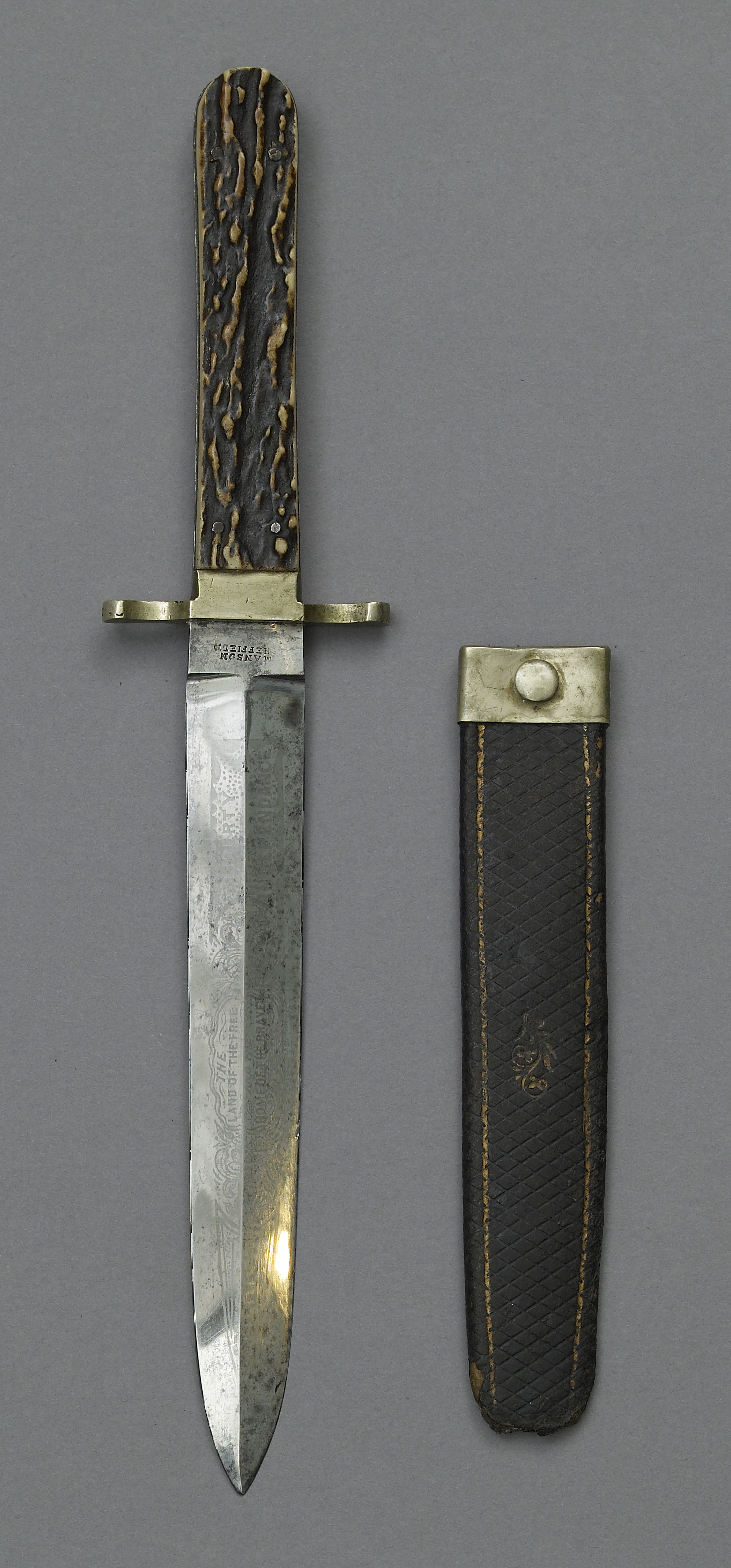
At Ford’s there is the above pictured, ornately etched, double edged knife, manufactured by Manson Sheffield Co. of England. It is just less than 12 inches long with a textured bone handle. This beautiful knife has the words, “America”, “The Land of the Free and the Home of the Brave”, and “Liberty and Independence” etched on the blade. Due to this, Ford’s refers to it as the Liberty knife along with its artifact number FOTH 3235. Most visitors, however, know it by another name: Booth’s knife. According to the tag underneath it, this, “horn-handled dagger was used by John Wilkes Booth to stab Major Rathbone after shooting Abraham Lincoln.” No doubt, many have seen the irony of such a patriotic knife helping to commit such an atrocious crime. It makes a poignant impact on those who have seen it. Unfortunately, it’s also a lie. This is not the knife Booth used to stab Major Rathbone. This knife was not recovered from Booth at Garrett’s barn. This knife did not even belong to John Wilkes Booth.

To explain this confusion, it is crucial to look back at the statements and testimonies of those who were with, and captured, Booth. After Davy Herold was caught at the Garrett’s he was transferred to the monitor, Montauk. Here, he gave a statement skillfully trying to conceal his guilt. Though much of Davy’s statement must be taken with a grain of salt, he does produce the following about his traveling companion’s act: “[Booth said] he struck him [Rathbone] in the stomach or belly with a knife. He said that was the knife (pointing to the one which had been shown to the prisoner).”[15] Davy is stating that the knife recovered from Booth at the Garrett’s is the same knife he used to stab Rathbone. While Davy commits to this, he makes no mention of any ornate etchings on the blade of the knife. In fact, Davy, Everton Conger, Luther B. Baker, John “Jack” Garrett, and Boston Corbett all make mention of Booth’s knife in statements and testimonies, but merely describe it as a “bowie knife”. No mention is made of any noteworthy markings on the blade. The term “bowie knife” was used to describe any large hunting knife usually with a crossbar. It is similar to how a derringer, originally the specific maker of the firearm, came to refer to any small pocket pistol.

It is not until the John Surratt trial that a notable description of Booth’s knife is made. Everton Conger gives the following testimony:

“Q: Will you state what articles you took from him?
A: …He had a large bowie-knife, or hunting knife, and a sheath.
Q: Do you know whose make that was?
A: No, sir; the knife has a name on it, but I do not know what it is.”

At this point Conger is going from memory. He has not seen any of the weapons, but recalls the knife had a name on it. He is then shown the weapons:

“(A bowie-knife and sheath and a compass were shown to witness, and identified by him as being taken from the body of Booth. A piece of map was also identified by witness as having been taken from Herold…”

Conger examines the knife and then later is asked how he can be sure it is the same one he recovered from Booth:

“Q: How do you identify the knife?
A: The knife has a spot of rust on it, about two-thirds the way from the hilt to the point, right where the bevel of the knife commences at the end.  It was said to be blood, but I have never thought it was myself.  It is the same shape and style of knife.
Q: Have you not seen other knives like it?
A: Yes, sir.
Q: Have you not seen a great many like it?
A: No, sir; only a few.
Q: You put no marks on it?
A: No.  I have no means of identifying it except by the description I have given.
Q: You did not look at the name of the maker?
A: I do not know that the name of the maker is on it.  I have looked at it since and noticed the words “Rio Grand camp-knife” on it.  I have no means of identifying it except what I have stated, and my general recollection of the style of the knife”[16]

This blade does not bear any engravings or patriotic slogans. It is identified with the name “Rio Grand Camp Knife” and a “spot of rust” said to be blood. This testimony identifying Booth’s knife raises a question. Since Booth’s knife is not the Liberty knife, from where does the Liberty knife come from? This question can be answered by looking at the exhibit list from the conspiracy trial. The Atzerodt knife and the Kirkwood knife are identified and accounted for, so that leaves just two: “Booth’s knife” and “Knife found at Mrs. Surratt’s House”. Since, through Conger’s identification of the knife he helped take from Booth, we know that the Liberty knife is not Booth’s knife, it has to be the “Knife taken from Mrs. Surratt’s house”.

Aside from the description in the exhibit list and its corresponding tag from the JAG’s office, this Liberty knife from Mrs. Surratt’s is very elusive. The conclusion that this author has drawn, is that this knife was likely taken from Mrs. Surratt’s and never properly inventoried. This is not as unlikely as it seems. The Surratt boardinghouse was stripped of anything that could be used as evidence. In an inventory list dated April 24, 1865, the final item mentioned is a “Trunk and contents from Surratt House”. It is written in a different pen and lacks the numeration and specificity of the other items in that list.[17] In fact, the only record of what was in the trunk comes from its return to Anna Surratt on August 18, 1865. The receipt, noting the return of three pistol cases, a sword, one box of caps and other items, does not mention a knife. However it should not mention it because the knife, as an exhibit, would have been retained by the government.[18] While this is a theory, with the mounds of evidence procured during those days, a knife from Mrs. Surratt’s could have easily been overlooked and not inventoried. Therefore, the Liberty knife currently on display at Ford’s as Booth’s knife is not the assassin’s blade but likely an ornate knife recovered from Mrs. Surratt’s. It never belonged to the assassin, and, conceivably, it was never used to harm anyone.

What then, became of the assassin’s blade? According to the 1940 transfer list, four knives were turned over to Ford’s and yet only three are on display. Two of those are correctly identified, while the Liberty knife continues its impersonation of Booth’s knife. The current fate of Booth’s true knife is identical to what it was for over 75 years. Booth’s knife is in storage.

Stored as a generic “knife” with the rest of Ford’s overflow items, it is currently held in the National Parks Service Museum Resource Center in Landover, MD. There it sits, FOTH 3218, encased in protective foam, accompanied by its sheath. While the knife has been found, there is still a mystery to be solved.

Booth’s knife has not always been hidden away in storage. There was a time when it was displayed by Ford’s accurately as Booth’s knife. Books from the 1950s and 60s have pictures of the real, Rio Grand Camp knife, with a spot of rust on the blade, endorsed by the NPS as Booth’s. But suddenly, and inexplicably, it was replaced with the Liberty knife. With the worsening budget cuts the NPS has suffered over the years, the paperwork on the knives at Ford’s is disorganized and, most importantly, they lack a historian to sort it all out. No one seems to know why the knives were switched, but they all trust the unknown predecessor who did so. If the switch was made due to a mere clerical error, the knife doesn’t deserve to sit in storage for another 75 years. It is this author’s hope that this article will merit a re-examination of the knives and the evidence regarding their identification. Hopefully, Booth’s true knife will escape from storage once again and be restored to the Ford’s Theatre Museum.
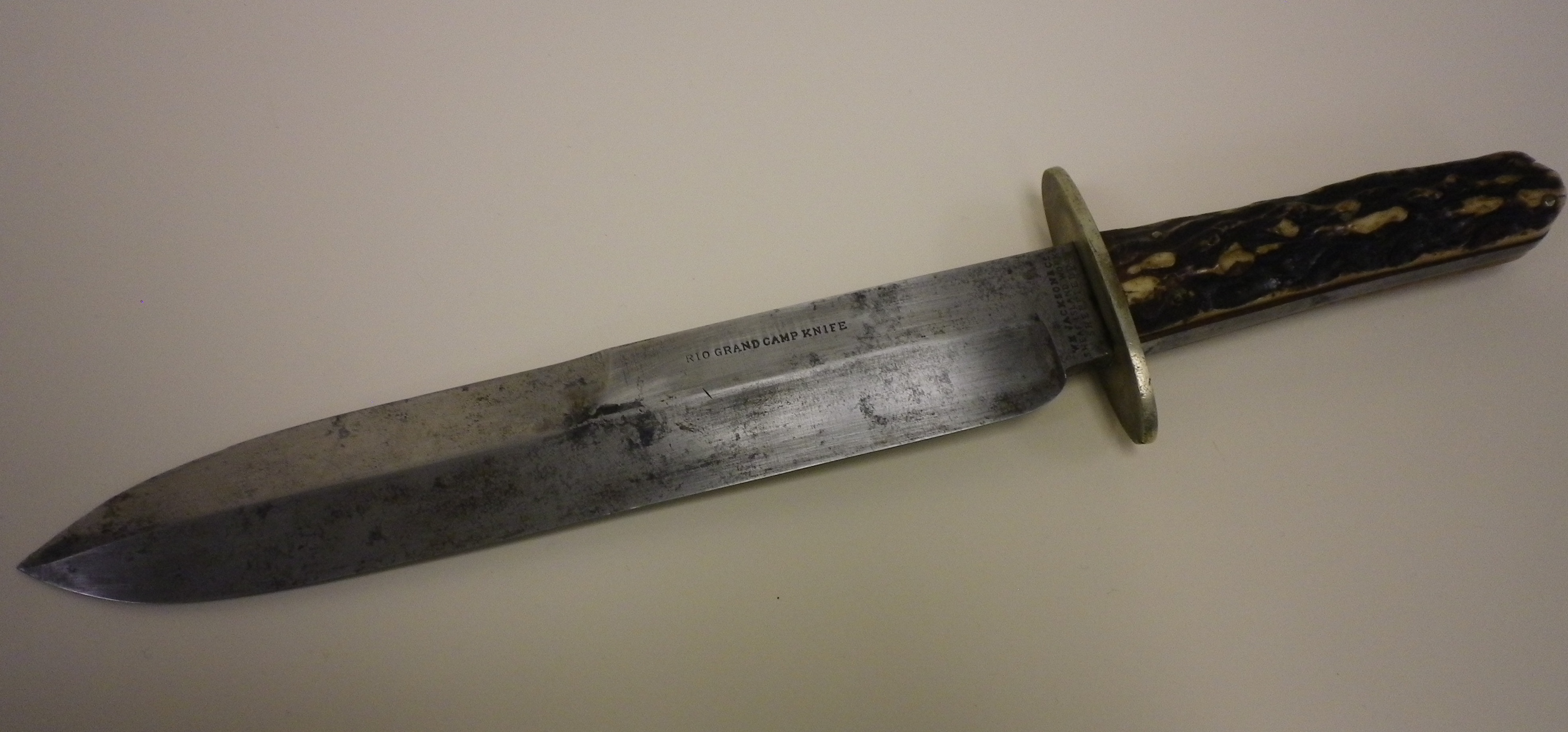
Booth’s real knife: FOTH 3218
Currently being held in Landover, MD
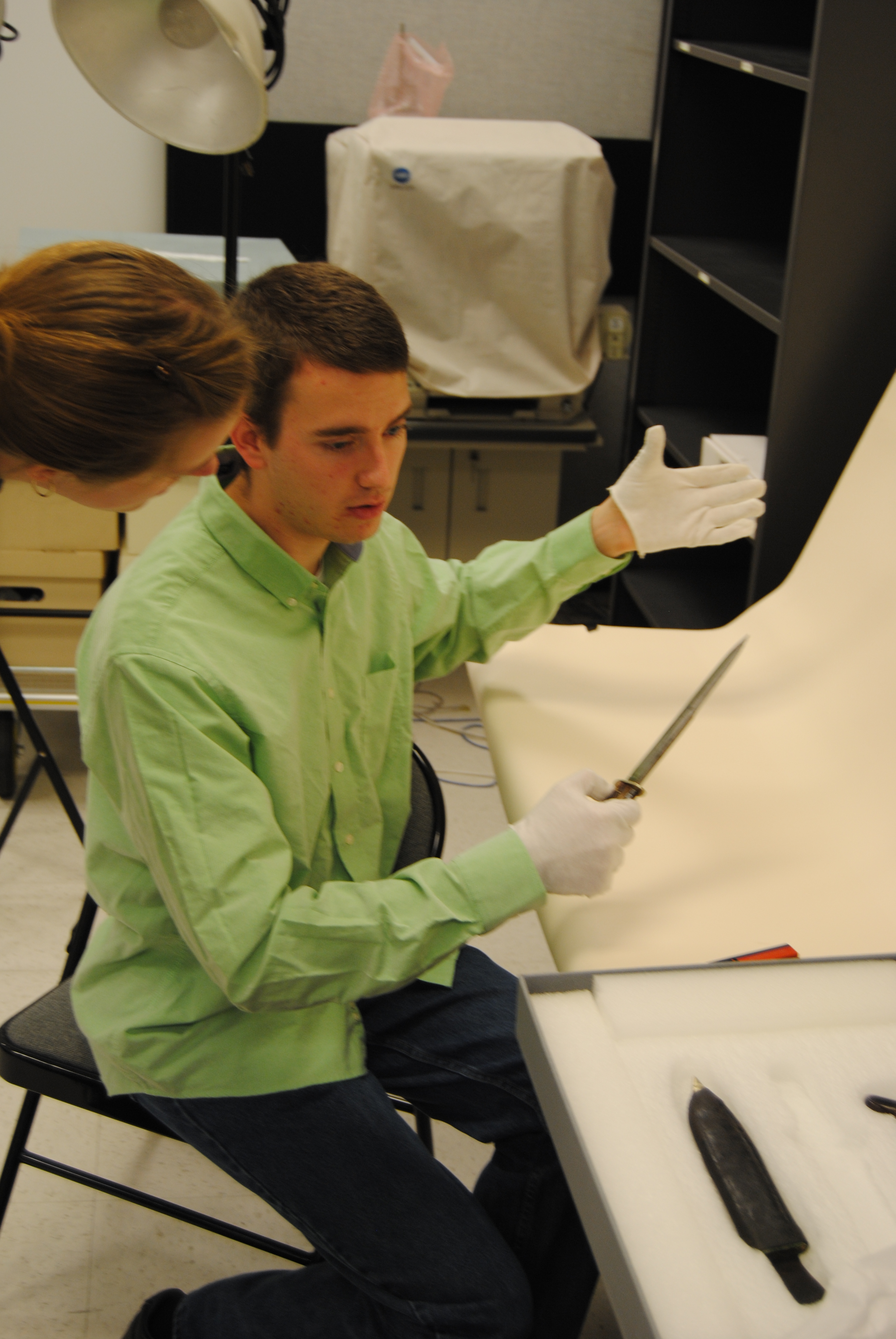
Dave Taylor examining Booth’s true knife in 2012.
Photographs by Jim Garrett.


[1] Edwards, W.C., & Steers, E. (2010). The Lincoln assassination, the evidence. (pp. xxii – xxiii).  Illinois: University of Illinois Press.

[2] Ibid, (p. 545).

[3] Ibid, (p. 1207).

[4] Ibid, (p. 1165).

[5] NARA. Trial exhibit list. Retrieved from website: https://www.fold3.com/image/249/7390964

[6] Poore, B. P. (Ed.), (1865). The conspiracy trial for the murder of the president, and the attempt to overthrow the government by the assassination of its principal officers. Vol. 1. (pp. 66) Boston, MA: J. E. Tilton and Company.

[7] Steers, E. (1997). His name is still Mudd: The case against Dr. Samuel Alexander Mudd. (p. 122). Gettysburg, PA: Thomas Publications.

[8] Edwards & Steers. (p. 758).

[9] U.S. House of Representatives. (1880). Journal of the House of Representatives of the United States, being the second session of the forty-sixth congress, begun held at the city of Washington, December 1, 1879, in the one hundred and fourth year of the independence of the United States. (p. 297) Washington City, DC: Government Printing Office.

[10] (1880, January 31). Assassination relics: A description of some of the articles Congress will order sent to Springfield. The Cleveland Leader, p. 3.

[11] Power, J. C. (1884). Annual reports of the custodian to the executive committee of the national Lincoln monument association, reports for nine years, from 1875 to 1883 inclusive. (p. 35) Springfield, IL: H. W. Rokker.

[12] (1899, May 24). The Booth relics, they are to be transferred to the national museum. The Minneapolis Journal.

[13] (1904, December 18). The first photographs of the mementos of Lincoln’s assassin. The Washington Times, p. 5.

[14] Copy of a list from the Judge Advocate Generals’ office dated February 5, 1940 in the files of James O. Hall.  From the James O. Hall Research Center, Clinton, MD.

[15] Edwards & Steers. (p. 682)

[16] (1867) Trial of John H. Surratt in criminal court for the District of Columbia. Vol. 1. (p. 308) Washington City, DC: Government Printing Office.

[17] Edwards & Steers. (p. 1166).  The handwritten page is viewable here: https://www.fold3.com/image/249/7361960

[18]Edwards & Steers. (p. 698).

Author’s note: A version of this article was originally published in the March 2012 issue of the Surratt Courier
Categories: History | Tags: , , , , , , | 22 Comments

Grave Thursday: Mary Van Tyne

On select Thursdays we are highlighting the final resting place of someone related to the Lincoln assassination story. It may be the grave of someone whose name looms large in assassination literature, like a conspirator, or the grave of one of the many minor characters who crossed paths with history. Welcome to Grave Thursday.


NOTE: I know today isn’t Thursday. I’ve been swamped with getting ready for the new school year to begin and though I tried to get this out yesterday, I found I had to do a bit more research. Rather than wait another week to post it, I figured I’d just post it tonight instead. So enjoy this Friday edition of Grave Thursday.
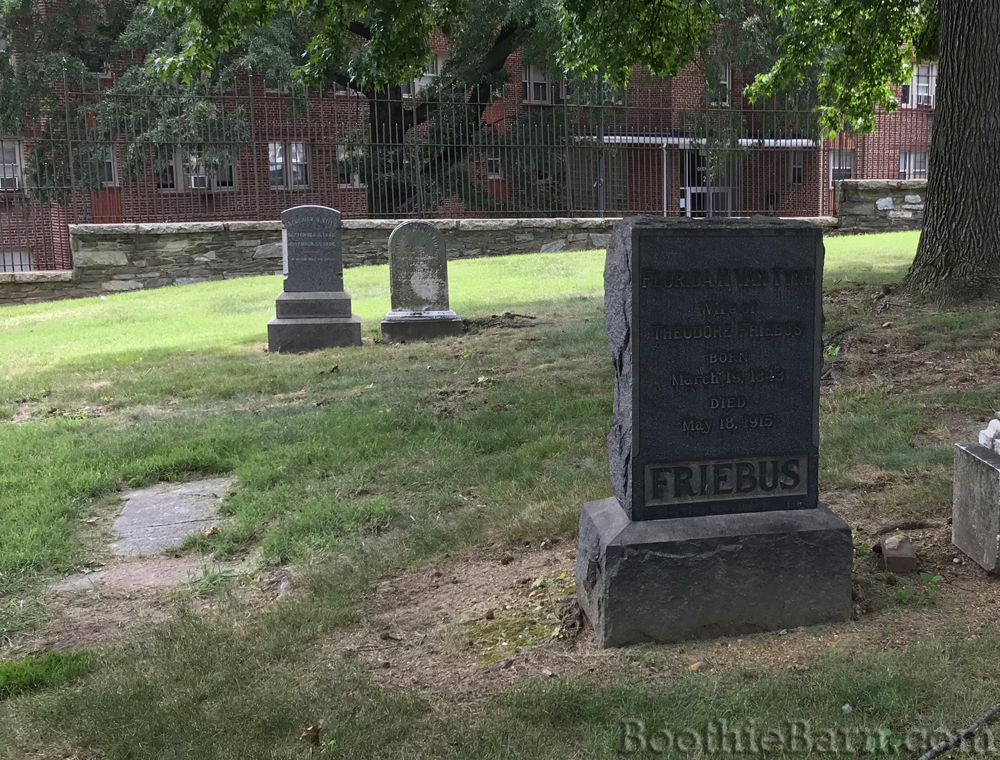
Mary Ann Van Tyne

Burial Location: Glenwood Cemetery, Washington, D.C.

Connection to the Lincoln assassination:

Mary Van Tyne, whose maiden name was Ricard, was originally born in England. We know she had moved to the  United States by 1833 for it was during that year that she married Dr. John P. Van Tyne in Maryland. By 1840, the pair had relocated to Washington City and quickly began building their family. By 1850, Mary and John were the parents of at least 5 children. In February of 1851, John Van Tyne died at the age of 44, leaving Mary a widow. She supported her family financially by working as a seamstress and dressmaker. As time went on, Mrs. Van Tyne even advertised her talents as a seamstress.

In 1857, Mary’s only remaining son, Charles, died at the age of 21. In the 1860 census, Mary Van Tyne is shown as a widow, working as a dressmaker with her four daughters: Mary, Kate, Florida, and Ellen.

During the Civil War, the population of D.C. boomed. Many homeowners made supplemental incomes by renting out rooms. Conspirator Mary Surratt would follow this route after relocating from her Maryland tavern to her D.C. town home. Mrs. Van Tyne, likewise started to rent out rooms and advertised her spaces in the D.C. papers.

In February of 1865, two men took up Mrs. Van Tyne’s offer of lodging and began renting one of her rooms. Their names were Samuel Arnold and Michael O’Laughlen and, unbeknownst to Mrs. Van Tyne, they were taking part in John Wilkes Booth’s plan to abduct President Lincoln.

While Mrs. Van Tyne did not have a lot of contact with her new boarders, she did get to know a few things about them. For instance, Mr. O’Laughlen told her that he was also known as McLaughlin, and that if she should receive any mail addressed as such that it should come to him. Once, when cleaning their room, she came upon a pistol but didn’t think much of it and merely placed it in a bureau drawer for safe keeping. Often, the two men would leave and go to Baltimore on a Saturday and not return to the city until Monday or Tuesday.

The two men were also frequently visited by a handsome man. The man would call at all times of day looking for the men and leaving messages for them. Finally, Mrs. Van Tyne inquired with her boarders about who the handsome man was. They informed her that he was John Wilkes Booth, the popular actor. Once, Mrs. Van Tyne overhead something among the men about business and she later asked Arnold what business they were in. Arnold replied that the three men were in the oil business together in Pennsylvania. Booth was a common visitor and often appeared to keep her boarders out late. Mr. Arnold and O’Laughlen had a night key which allowed them to come and go as they pleased. Since they were sleeping in a back bedroom on the first floor, she did not always know whether they were home or not.

Finally, on March 18th, Arnold and O’Laughlen told Mrs. Van Tyne that they were going to be leaving for good on Monday the 20th. They were off to the Pennsylvania oil fields, they told her. They mentioned that while they were anxious to leave that very night, Booth was performing at Ford’s Theatre and they wanted to see him. Mrs. Van Tyne expressed her own desire to see Booth perform. Grateful for the lodging Mrs. Van Tyne had given them, O’Laughlen gave Mrs. Van Tyne three complimentary tickets for Booth’s performance in The Apostate at Ford’s Theatre that night.

Mary Van Tyne neither heard from nor saw Mr. Arnold or Mr. O’Laughlen after they left on March 20th. After the assassination of Lincoln, the identities and movements of John Wilkes Booth’s conspirators were traced. On May 5th, Mrs. Van Tyne was interviewed by Baltimore provost marshal, James McPhail. McPhail and his men were largely responsible for hunting down Arnold and O’Laughlen. Mrs. Van Tyne told all that she knew about the two men who stayed in her home.

Ten days later, Mrs. Van Tyne was among the first to be called to the witness stand at the trial of the conspirators. She testified about Booth’s common visitations to her home in search of Arnold and O’Laughlen. She was also asked to identify a picture of Booth as the man she saw. While she identified it, she also made the observation that the photograph presented to her was a poor likeness of the man and did not truly capture how handsome Booth was. After providing her testimony for the day, Mrs. Van Tyne returned home and back into obscurity.

Mary Van Tyne continued to live in Washington, D.C.. By 1870, she moved out of her D street boardinghouse and began living with her daughter, Florida, who had married a man named Friebus. She would live with her daughter and son-in-law for the rest of her life. On December 18, 1886, Mary Van Tyne died of “valvular disease of [the] heart”. Her age at death is difficult to determine. Her obituary stated that she was “in her eighty-first year.” Her burial records give her an age of “80 years” and “5 months” at time of death. The census records did not really help the matter. Unlike many census records where women miraculously age less than a decade in the ten years span between censuses, Mrs. Van Tyne actually managed to age more than ten years between the 1860 and 1870 census. The 1850 and 1860 census records give her birth at about 1812 which would make her about 74 at her death. The 1870 and 1880 censuses give her birth at about 1806 which puts her back up at 80.

Upon her death, Mrs. Van Tyne was interred in Section P, Lot 202, Site 5 in D.C.’s Glenwood Cemetery. If Mrs. Van Tyne was marked with a gravestone upon her death, it no longer stands. Her burial lot is only marked by the gravestone of her daughter, Florida Friebus nee Van Tyne, who died in 1915.

GPS coordinates for Mary Van Tyne’s unmarked grave: 38.921110, -77.004470

Categories: Grave Thursday, History | Tags: , , , , | 7 Comments

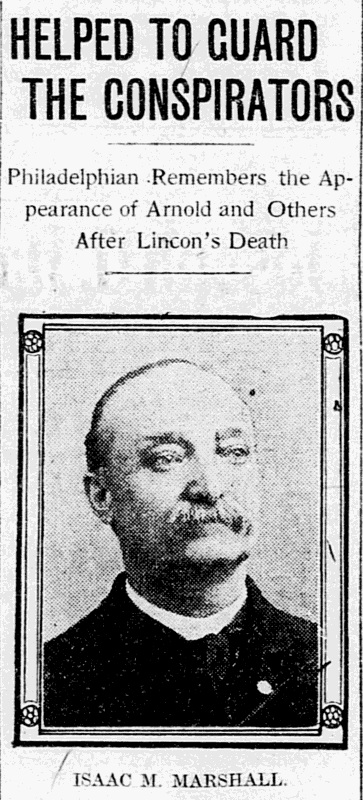
“Helped to Guard the Conspirators”

While doing a little searching tonight, I came across an interesting article from the December 15, 1902 edition of the Philadelphia Inquirer. It highlights a Philadelphia resident named Isaac M. Marshall who claimed to have been among the guards detailed the watch over the Lincoln assassination conspirators during their trial and imprisonment. The article gives some candid thoughts that Corporal Marshall had about the conspirators, which I thought would be worth sharing.

Living at 3213 Mt. Vernon street is a veteran of the Civil War – Isaac M. Marshall – who was one of the guards of the conspirators in the assassination of President Lincoln, and who has still a vivid recollection of how they looked and acted when on trial for their lives at the old Arsenal in Washington. “I was a member of Company I, of the Third Regiment, Hancock’s Veteran Corps, at the time,” he said yesterday to a reporter of The Inquirer. “We were camped outside the capital in 1865, and the morning after the great crime had been committed we got orders to watch all the approaches leading from the city. The entire regiment was given this duty and no one was allowed to go through the lines without establishing his or her identity, and that they had a right to pass on.

“Later on our company was at the Arsenal during the trial of the men and Mrs. Surratt. I remember all of the conspirators well. Lewis Payne, one of those who were hanged, always wore a knit shirt. He was stalwart and of athletic build and had an eagle eye. The stern look on his face never appeared to change. David E. Herold was handsome, and he knew it. He had long black hair and he frequently pushed it above his forehead. There were many young women present – admitted by card – and to some of these he frequently bowed. One of his peculiar actions was to raise his hands so that they could see his manacled wrists.

“Of Samuel B. Arnold, whose story of alleged cruel treatment I have read with deep interest, as it appears from day to day in The Inquirer, I want to say this: Whatever may have happened to him at the Dry Tortugas, he did not look as if he had suffered any before his trial occurred. On the contrary, he appeared to have been well fed and otherwise well cared for. You could scarcely tell what kind of a man he was. At times his countenance wore a look of defiance; then of sternness and again of unconcern. He was neatly attired, as were all the others, save Payne, who managed to change his clothes after the crime, assuming the garb of a laborer.

“Michael O’Laughlin, who also went to the Dry Tortugas, was the only one who seemed to be affected and sorry. George Atzerodt I didn’t pay much attention to. Dr. Mudd did not have the appearance at all of a physician or professional man. Mrs. Surratt was always veiled; sat immovable and looked like a statue. After the trial the Third Regiment was sent to Camp Butler, at Springfield, Ill., and I was there when the lamented Lincoln was buried…”

Marshall’s extended comment about Samuel Arnold is due to the fact that this article came out in 1902, the same year that Arnold allowed his lengthy memoirs to be printed in the newspapers after he had read his own obituary. In his memoir, Arnold complained at length about the treatment he received at the hands of the government. Marshall provides a small rebuff to Arnold’s claims that he was mistreated while in Washington (though considering the hoods Arnold and the others were forced to wear, you can’t blame him too much for complaining). The other descriptions of the Lincoln conspirators are very much in line with what other visitors of the trial observed.

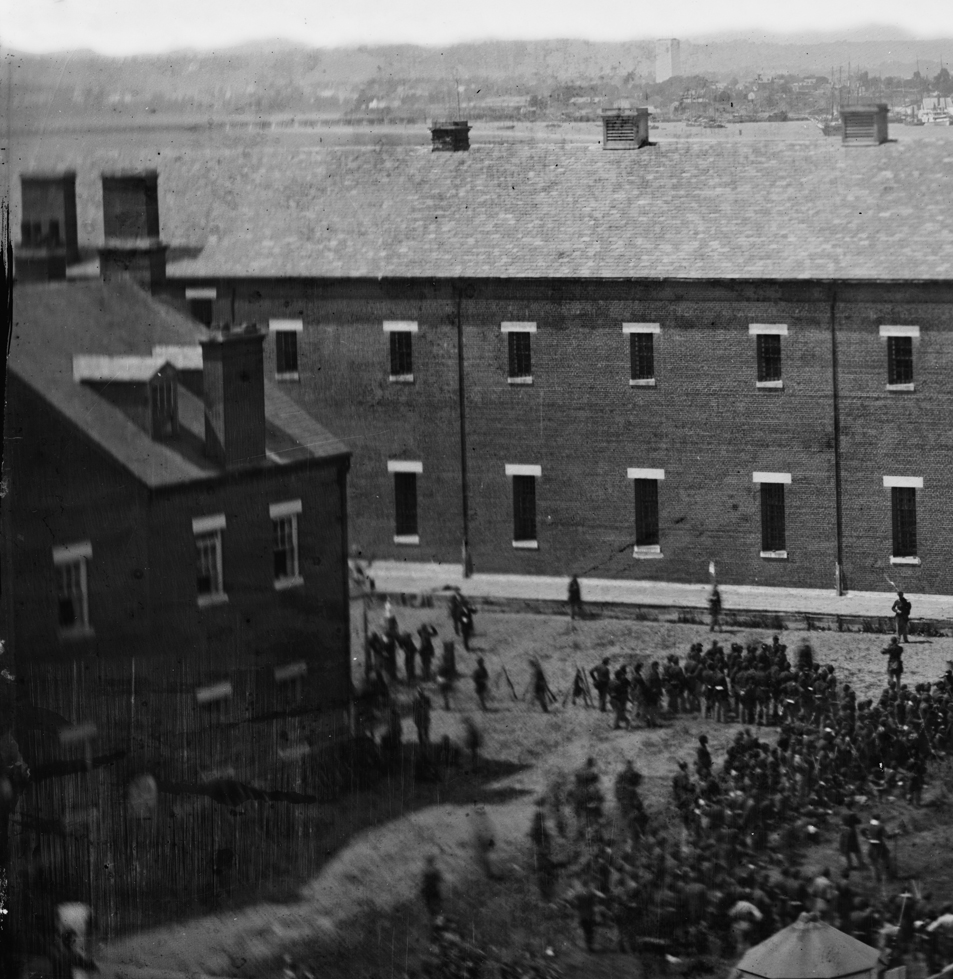
While I can’t positively confirm that Isaac Marshall was one of the guards at the trial of the conspirators, it seems fairly likely he is telling the truth. The Old Arsenal Penitentiary, where the conspirators were imprisoned and tried, was largely manned by members of the Veteran Reserve Corps, which Marshall was a member. On the day of the execution of the conspirators, Marshall’s specific group, the Third Regiment, was assigned duty as sentinels from the northeast corner of the arsenal grounds extending along the east bank of the river. Members of the 3rd regiment were also stationed in a line 100 yards south of the prison grounds. So, at the very least, Marshall did have guard duty on the day of the conspirators’ death. Even Marshall’s claim to have been in Springfield when Lincoln was buried is possible. The Third Regiment wasn’t officially mustered out of service until December of 1865 and Abraham Lincoln’s remains were “buried” in a temporary vault in Oak Ridge Cemetery on December 21, 1865. Isaac Marshall may have had the unique experience of being present at both the execution of the conspirators and at one of Abraham Lincoln’s many burials.

Isaac Marshall died on July 6, 1919 and is buried in Fernwood Cemetery, outside of Philadelphia.

References:
(1902, December 15) Helped to Guard the Conspirators. Philadelphia Inquirer, p 5.

Categories: History | Tags: , , , , , , , , , | 5 Comments

An Interview with Dr. Mudd

On March 20, 1869, Dr. Samuel A. Mudd walked in the front door of his Charles County, Maryland home. Such a return to one’s property would hardly be worth mentioning if not for the fact that it had been almost four years since the doctor had set foot on his farm. The last time Dr. Mudd was able to take in the land around him and the house which he called his home was on April 21, 1865, the day he was arrested for suspicion of complicity in Abraham Lincoln’s death. Since that time, Dr. Mudd had been imprisoned in nearby Bryantown, the Old Capitol Prison in D.C., and finally the Old Arsenal Penitentiary where he was put on trial by military commission. Found guilty, Dr. Mudd barely escaped with his life when he was sentenced to life imprisonment and sent to Fort Jefferson off of the coast of Florida. From July 24, 1865 through March 11, 1869, the desolate Dry Tortugas was the only home the prisoner, Dr. Mudd, had known. During his time on the island, he had tried (and failed) to escape, causing himself and the other Lincoln conspirators to suffer the consequences. In 1867, when a Yellow Fever epidemic swept the Fort causing his companion Michael O’Laughlen to die, Dr. Mudd volunteered his medical services and tended to the ill. With the  common belief of the day being that those infected with Yellow Fever were contagious, Mudd’s assistance to the sick was seen as a selfless and noble act. His actions worked in his favor to help him secure a pardon in the final days of Andrew Johnson’s presidency. Nine days after leaving Fort Jefferson, Dr. Samuel Mudd stepped through the threshold of his home to greet his waiting children.

Less than a week after his homecoming, Dr. Mudd heard an unexpected knock on his door. Though you might expect him to be incredibly wary of unannounced visitors, he opened the door and welcomed a small party of men inside. Among the group was a newspaper reporter from the New York Herald. The reporter and his party had come from Washington and had spent about eight hours making their way down to the isolated Mudd farm. They wanted to speak with Dr. Mudd about his experiences regarding John Wilkes Booth and the Dry Tortugas.

“…His face grew extremely serious and he answered that of all things he wished to avoid it was newspaper publicity, simply because nothing was ever printed in connection with his name that did not misrepresent him.”

Yet, despite his apprehension and claim he did not wish to speak about the events that cost the last four years of his life, in the end, Dr. Mudd and his wife did open up about their most famous visitors and their aftermath. The following is a transcription of part of the New York Herald article that was published on March 31, 1869, just a few days after speaking with Dr. Mudd. The entire article is quite long, with the first half dealing with the author’s slow trek to get to the Mudd farm from Washington. While filled with vivid and sometimes flowery details of the journey, for ease of reading only the parts relating to the interview with Dr. Mudd are featured below. If you are interested in reading the whole article, you can do so by clicking here or the headline below.

The interview (like all the statements and correspondences from Dr. Mudd) contains a variety of truths, half-truths, omissions, and outright falsehoods regarding Booth’s relationship with Mudd and his time at the Mudd farm. Still, this interview provides an interesting and personal view of one of the more debated conspirators in the Lincoln assassination story.

…We knocked for admission at the same door that Booth did after his six hours’ ride –it took us eight – and were promptly answered by a pale and serious looking gentleman, who, in answer to our inquiry if he were Dr. Mudd, replied, “That’s my name.” It was gratifying after so long a journey to find the man you sought directly on hand and apparently prepared to furnish you will the amplest stores of information regarding his connection with Booth, &c. Having stated the object of our visit – that the Herald led an interest in learning some particulars of his experience in the Dry Tortugas and his recollections of the assassination conspirators – his face grew extremely serious and he answered that of all things he wished to avoid it was newspaper publicity, simply because nothing was ever printed in connection with his name that did not misrepresent him.

“A burned child dreads the fire,” he exclaimed, “and I have reason to be suspicious of every one. It was in this way Booth came to my house, representing himself as being on a journey from Richmond to Washington, and that his horse fell on him. Six months or so from now, when my mind is more settled and when I understand that changes have taken place in public opinion regarding me, I shall be prepared to speak freely and fully on these matters you are anxious to know about. At present, for the reason stated, I would rather not say anything.”

Having, however, convinced the doctor that it was with no motive to misrepresent his statements that we paid him this visit and tat between Booth’s case and ours there was no analogy, he invited us to pass the evening at his house and postpone our return to Washington till the morning. Left alone for a while in the parlor, an ample, square apartment, with folding doors separating it from the dining room, we began to feel an irresistible inclination to imagine two strangers on horseback riding up to the door in the dim gray of an April morning, the younger of the two lifting the other from his saddle and bother like evil stars crossing the threshold of an innocent and happy household to blast its peace forever, Dr. Mudd’s return disturbed our reveries.

The Doctor says he is thirty-five years of age, married in 1860 [sic], built the house in which he now lives after his marriage, owned a well stocked farm of about thirty acres, and was in the enjoyment of a pretty extensive practice up to the time of his arrest in 1865. The word went well and smoothly with him previous to that unhappy event. His house was furnished with all the comfort of a country gentleman’s residence. He had his horses and hounds, and in the sporting season was foremost at every fox hunt and at every many outdoor sport. He had robust health and a vigorous, athletic frame in those days, but it is very different with him now. Above the middle height, with a reddish mustache and chin whisker, a high forehead and attenuated nose, his appearance indicates a man of calm and slow reflection, gentle in manner, and of a very domestic turn. He says he was born within a few miles of this house, and has lived all his life in the country. His whole desire now it to be allowed to spend the balance of his days quietly in the bosom of his family. In his sunken, lustreless eye, pallid lips and cold, ashy complexion one can read the words “Dry Tortugas” with a terrible significance. In the prime of his years, looking prematurely old and careworn, there are few indeed who could gaze on the wreck and ravage in the face of this man before them without feeling a sentiment of sympathy and commiseration. “I have come home,” said the Doctor sorrowfully, “to find nothing left me but my house and family. No money, no provisions, no crops in the ground and no clear way before me where to derive the means of support in my present [unintelligible] condition.” There was no deception here. In the scantly furniture of the house and in the pale, sad countenance of the speaker there was evidence enough of poor and altered fortune. It was not evening and growing rapidly dark. A big fire blazed on the ample hearth, and Mrs. Mudd, an intelligent and handsome lady, with one of her children, joined the Doctor and ourselves in the conversation over the events of that memorable April morning after the assassination.

“Did you see Booth, Mrs. Mudd?” we inquired with a feeling of intense interest to hear her reply.

“Yes,” she replied, “I saw himself and Harold after they entered this parlor. Booth stretched himself out on that sofa there and Harold stooped down to whisper something to him.”

“How did Booth look?”

“Very bad. He seemed as though he had been drinking very hard; his eyes were red and swollen and his hair in disorder.”

“Did he appear to suffer much?”

“Not after he laid down on the sofa. In fact, it seemed as if hardly anything was wrong with him then.”

“What kind of a fracture did Booth sustain?” we inquired, addressing the Doctor.

“Well,” said he, “after he was laid down on that sofa and having told me his leg was fractured by his horse falling on him during his journey up from Richmond, I took a knife and split the leg of his boot down to the instep, slipped it off and the sock with it; I then felt carefully with both hands down along his leg, but at first could discover nothing like crepitation till, after a second investigation, I found on the outside, near the ankle, something that felt like indurated flesh, and then for the first time I concluded it was a direct and clean fracture of the bone. I then improvised out of pasteboard a sort of boot that adhered close enough to the leg to keep it rigidly straight below the knee, without at all interfering with the flexure of the leg. A low cut show was substituted for the leather boot, and between five and six o’clock in the morning Booth and his companions started off for a point on the river below.”

“How did Booth’s horse look after his long ride?” we inquired.

“The boy, after putting him up in the stable,” the Doctor replied, “reported that his back underneath the forward part of the saddle was raw and bloody. This circumstance tallied with Booth’s account that he had been riding all day previous from Richmond, and no suspicion arose in my mind for one instant that the man whose leg I was attending to was anything more than what he represented himself.”

“You knew Booth before, Doctor?”

“Yes,” replied the Doctor. “I was first introduced to Booth in November, 1864, at the church yonder, spoke a few words to him and never saw him afterwards until a little while before Christmas, when I happened to be in Washington making a few purchases and waiting for some friends from Baltimore who promised to meet me at the Pennsylvania House and come out here to spend the holidays. I was walking past the National Hotel at the time, when a person tapped me on the shoulder and, on turning round, I discovered it was the gentleman I was introduced to at the church about six weeks previously. He asked me aside for a moment and said he desired an introduction to John H. Surratt, with whom he presumed I was acquainted. I said that I was. Surratt and I became almost necessarily acquainted from the fact of his living on the road I travelled so often on my way to Washington, and having the only tavern on the way that I cared to visit. Booth and I walked along the avenue three or four blocks, when we suddenly came across Surratt and Weichman [sic], and all four having become acquainted we adjourned to the National Hotel and had a round of drinks. The witnesses in my case swore that Booth and I moved to a corner of the room and were engaged for an hour or so in secret conversation. That was a barefaced lie. The whole four of us were in loud and open conversation all the time we were together, and when we separated we four never met again.”

“You told the soldiers, Doctor, the course the fugitives pursued after leaving your house?”

“I did. I told them the route that Booth told me he intended to take; but Booth, it seems, changed his mind after quitting here and went another way. This was natural enough; yet I was straightway accused of seeking to set the soldiers astray, and it was urged against me as proof positive of implication in the conspiracy.”

“You must have felt seriously agitated on being arrested in connection with this matter?”

“No, sir. I was just as self-possessed as I am now. They might have hanged me at the time and I should have faced death just as composedly as I smoke this pipe.”

“What did you think of the military commission?”

“Well, it would take me too long to tell you. Suffice it to say that not a man of them sat on my trial with an unbiased and unprejudiced mind. Before a word of evidence was heard my case was prejudged and I was already condemned on the strength of wild rumor and misrepresentation. The witnesses perjured themselves, and while I was sitting there in that dock, listening to their monstrous falsehoods, I felt ashamed of my species and lost faith forever in all mankind. That men could stand up in that court and take an oath before Heaven to tell the truth and the next moment set themselves to work to swear away by downright perjury the life of a fellow man was a thing that I in my innocence of the world never thought possible. After I was convicted and sent away to the Dry Tortugas a confession was got up by Secretary Stanton, purporting to have been made by me to Captain Dutton on board the steamer, and was afterwards appended to the official report of my trial. This was one of the most infamous dodges practiced against me, and was evidently intended as a justification for the illegality of my conviction. I never made such a confession and never could have made it, even if I tried.”

“How did their treat you down to the Dry Tortugas?”

“Well, I feel indisposed to say much on that head. If I made disclosures of matters with which I am acquainted certain officers in command there might find themselves curiously compromised.”

“You did good service caring the fever plague, Doctor?”

“Well, I can say this, that as long as I acted as post physician not a single life was lost. My whole time was devoted to fighting the spread of disease and investigating its specific nature. I found that the disease does not generate the poison which gives rise to the plague. The difference between contagion and infection which I have discovered is that one generates the poison from which the fever springs and the other does not. Contagion, such a smallpox, measles, &c., generates the poison which spreads the complaint of yellow fever, typhoid fever and other such infectious diseases. It requires contact with the poison and not with the disease to infect a person, and if a thousand cases of fever were removed from the place of the disease no danger whatever need be apprehended. The Fever in the Dry Tortugas was of the same type as typhoid, and the treatment on the expectant plan – that, is watching the case the treating the symptoms as they manifest themselves.”

“Were you untrammelled in your management of the sick?”

“No, sir; there’s where I felt the awkwardness of my position. I was trammelled and consequently could not act with the independence a physician under such circumstances should have.”

The Doctor talked at considerable length on many other topics connected with his imprisonment. In replying to the remark that his feelings must have been greatly exercised at coming within sight of his old home and meeting his wife once more he said, with visible tremor, that words were entirely inadequate to express the overwhelming emotions that filled his mind. It appears that a few days before he left the Dry Tortugas a company of the Third artillery, who were on board a transport about being shipped to some other point, on seeing the Doctor walking on the parapet, set up three cheers for the man who periled his life for them in the heroic fight with the dread visitation of fever. We talked along till midnight, then retired to a comfortable leather bed, and, rising with the sun in the morning, started out homeward journey to Washington.

References:
(1869, March 31) Dr. Mudd. New York Herald, p. 10.

Categories: History | Tags: , , , , | 3 Comments

The Execution of the Lincoln Conspirators

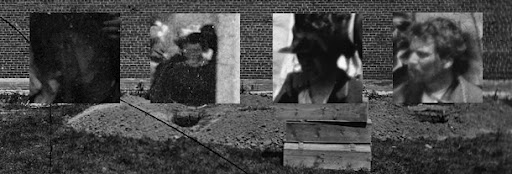
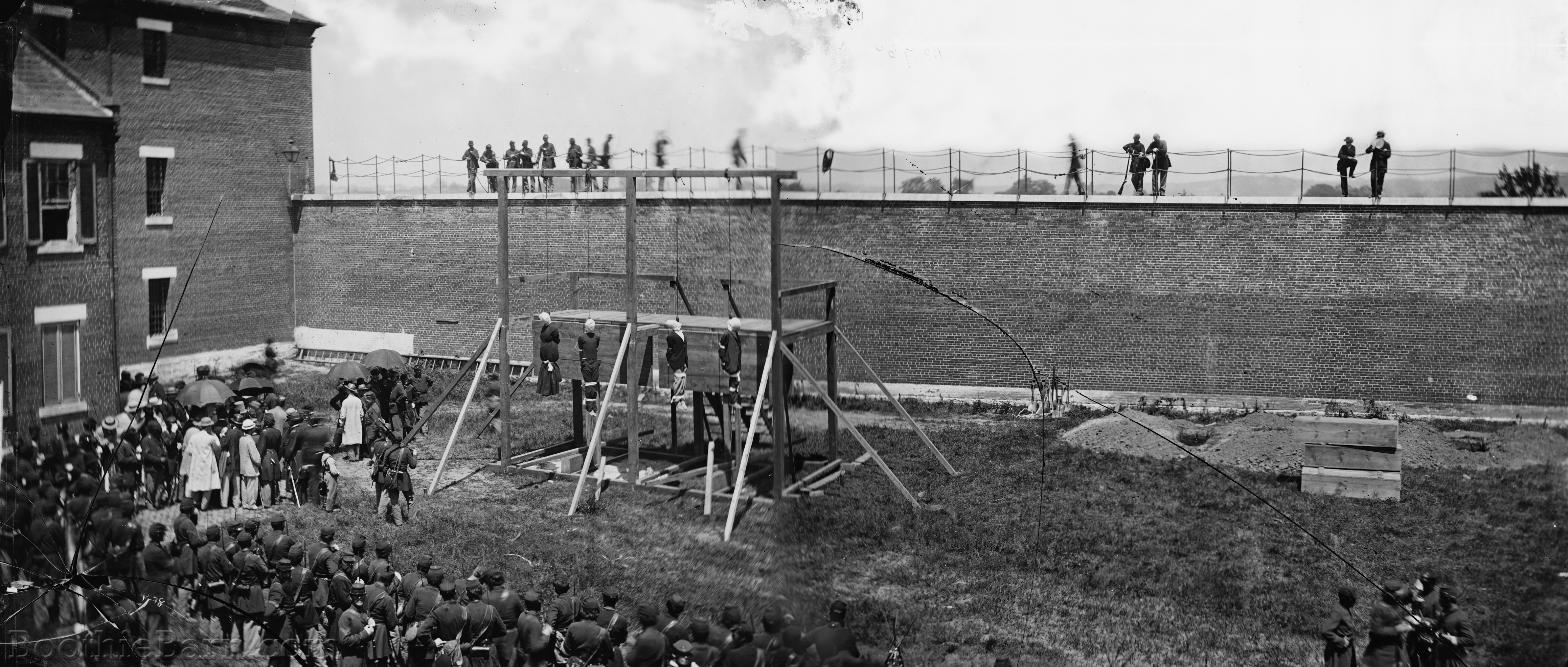
The sun was bright and hot as Alexander Gardner tended to his equipment on July 7, 1865. The noted Civil War photographer had brought two cameras with him, one wet plate and one stereoscopic, with which to capture the day’s event. Gardner was lucky, due to his prestige he was able to set himself up in the cool shade of a nearby building overlooking the scene. From his vantage point, facing out of two windows on the second floor of an old shoe factory on the property, Gardner could take in the entire scene.

Men began trickling into the courtyard below. Most were soldiers on assigned guard duty, but there was also a notable contingent of civilians. Many were newspapermen, here to commit to writing what Gardner would record on glass. A few others had come, in spite of the oppressive heat, to see justice meted out. Gardner focused his cameras on the object around which all the men had gathered – a hastily built gallows. Over the course of the next thirty minutes or so, Gardner would take at least 10 photographs of the proceedings. Through his lens, the execution of Mary Surratt, Lewis Powell, David Herold, and George Atzerodt was recorded in haunting clarity.

By using high resolution versions of Alexander Gardner’s photographs available through the Library of Congress, one can splice most of the execution photographs together to recreate the final moments of the four condemned conspirators in Abraham Lincoln’s assassination in vivid detail. NOTE: The animation is below but is a bit large so it might take a second to load, especially on mobile devices.

Alexander Gardner’s photographs of the hanging provide us with a glimpse of the past that no newspaper report can equally replicate. Combined with modern technology, these photographs bring realism to a story whose epilogue was written 153 years ago today.

Click to view the full sized composite image

References:
The post was inspired by the work of Barry Cauchon and John Elliott

Categories: History | Tags: , , , , , , , | 13 Comments

Grave Thursday: The Spangler Family

On select Thursdays we are highlighting the final resting place of someone related to the Lincoln assassination story. It may be the grave of someone whose name looms large in assassination literature, like a conspirator, or the grave of one of the many minor characters who crossed paths with history. Welcome to Grave Thursday.


The Spangler Family

Burial Location: Prospect Hill Cemetery, York, Pennsylvania

Connection to the Lincoln assassination:

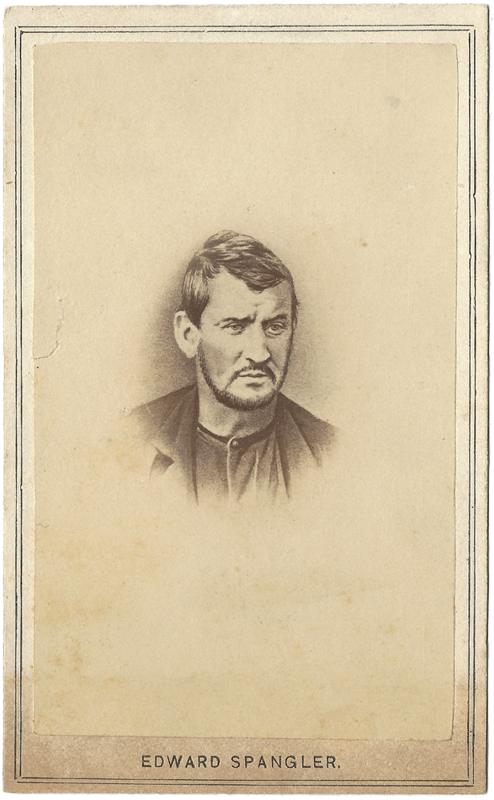
In 1865, Ford’s Theatre carpenter and scene-shifter Edman Spangler was put on trial for his alleged participation in the assassination of Abraham Lincoln. Edman Spangler had known the actor John Wilkes Booth for several years and was one of the carpenters who assisted in the construction of the Booth family home, Tudor Hall, in Harford County, Maryland. Spangler’s friendship with Booth, his pro-Confederate sympathies during the war, and the fact that Booth often asked favors of Spangler (including the request for Spangler to hold his horse on the night of April 14th) caused Edman to be tried alongside the others who were involved in Booth’s plot against the government. In the end, the government could not prove that Spangler had any foreknowledge of the assassination plot but he was still found guilty of, “having feloniously and traitorously aided and abetted J. Wilkes Booth in making his escape.” For this, Edman Spangler received a sentence of 6 years in prison at Fort Jefferson.

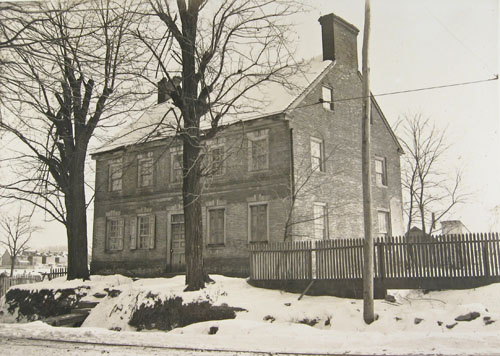
Prior to his friendship with John Wilkes Booth, however, Edman Spangler had been born and raised in York, Pennsylvania. Edman’s family had been in York since his great grandfather, Baltzer Spangler* immigrated to the area from present day Germany in 1732. Baltzer was one of four Spangler brothers who established homes in the York area around this time. In 1760, Baltzer built a two-story brick mansion on what was then the outskirts of York.

The Baltzer Spangler House circa 1904

After Baltzer’s death in 1770, this home was inherited by one of his sons, George Spangler, who was Edman Spangler’s great great uncle. The home stayed in the family until the 1840s when it was sold. By 1850, the home had been transformed into a school run by a British veteran of the War of 1812 named Charles Henry Bland. The school was known as Sherwood’s School and also colloquially as Bland’s Academy. Clarence Cobb, a former student who attended the academy in the former Spangler home later recalled that, “Bland’s boys learned but little and were taught less. There was no system, no regular course of study, nor recitation. Bland’s school failed utterly, at the last. The old gentleman secured employment thereafter, as a steward, at Fairfax Seminary, Va., back of Alexandria. I am informed that he lived to a great age. He believed in corporal punishment and plenty of it. Perhaps his extensive exercise as a whipping-master was the cause of his health, vigor and activity. He never whipped me as I think I may say I was a good boy, but, I thought, he used to whale the bad boys for fun.”

When giving his reminiscences of Bland’s Academy in 1916, Cobb also recalled one of his former classmates at the time.

“John Wilkes Booth, whom we always called Jack, attended school there for only a few weeks in 1853.”

Cobb is the only source we have that John Wilkes Booth spent time at Bland’s Academy. We do know from period sources that Cobb was a classmate of Booth’s when the two boys both attended the Milton Boarding School in Cockeysville, Maryland together from 1849 – 1852. Cobb gives a vivid description of Booth as a student while at the Milton Academy but doesn’t say anything specific about his time at Bland’s. If John Wilkes Booth did attend school in York it would have been in the fall of 1853 and also would have represented the end of his formal educational career. In his authoritative volume, John Wilkes Booth: Day by Day, researcher Art Loux stated that Booth “may have” attended Bland’s Academy, perfectly demonstrating the lack of supporting evidence. So, while it has not been proven with certainty, it is still somewhat eerie that a young John Wilkes Booth may have been educated, albeit briefly, in a home built by the ancestor of a future conspirator.

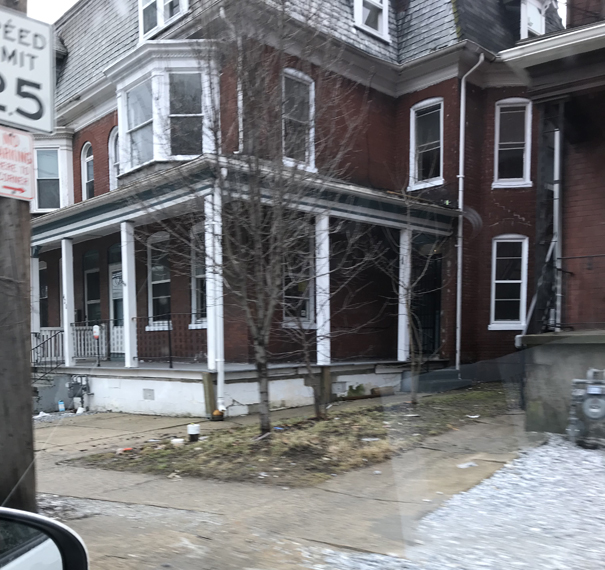
Sadly, the Baltzer Spangler house, home to the short-lived Bland’s Academy, no longer stands today. Instead, the 400 block of Prospect St. in York is the site of rowhouses.

Drive by of the former site of Bland’s Academy, about 420 Prospect Street, York, PA

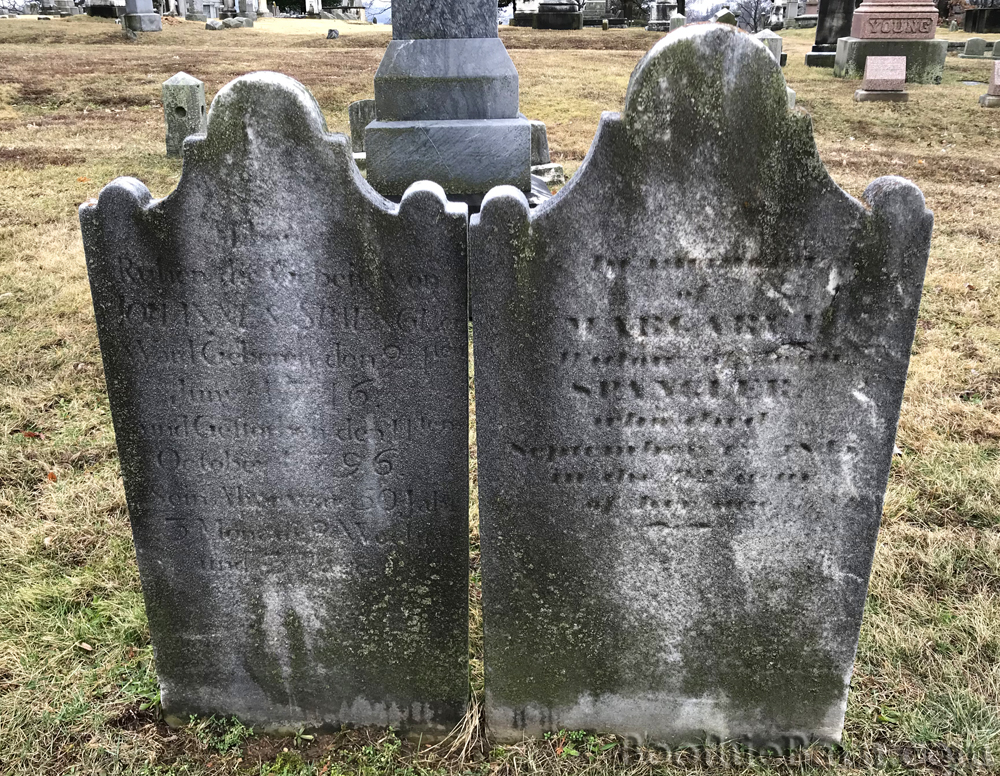
Another son of Baltzer Spangler who inherited some of the property around the Spangler home was Edman Spangler’s grandfather, John Spangler. John and his wife, Margaret Beard, were the parents of eight children before John’s death in 1796. In the 1890s, when a Spangler genealogist was working on a book about his ancestors, he found an extraordinary relic among John Spangler’s belongings:

“In the old and handsome family Bible of John Spengler, was found by the writer a letter in German, alleged to have been written by God Himself and delivered by an angel at Madgeburg, Germany in 1783. It exempted the possessors from lightning, fire and water. A century ago it made a profound impression.”

The letter discovered in John Spangler’s bible was a fairly common document in the Pennsylvania Dutch communities at the time. Called a himmelsbrief or “heaven’s letter”, these papers were a mixture of Christian scripture and magic, claiming to ward off misfortune as long as the owners abided by the moral covenants instructed by the letter. In essence, these letters were an early form of chain letters with a healthy dose of Christian teachings to make them popular. The Madgeburg letter found in John Spangler’s bible was one of the most common versions of himmelsbrief. You can read more about these interesting chain letters here.

The second of John and Margaret Spangler’s children was William Spangler. William was born on September 21, 1785. He likely spent quite a bit of time in the old Baltzer Spangler home owned by his nearby neighbors and cousins. Around 1814, William married a woman named Anna Maria and they began their family together. They would have at least 5 children between the years of 1815 – 1825. The youngest of their children was Edman Spangler, born on August 10, 1825. Less than six months later, on February 12, 1826, Anna Maria Spangler died, leaving William a widower with several young children. To help support his young family, William Spangler became the sheriff of York County in 1827. He served a three year term which ended in 1830. William married again that same year. His new wife was named Sarah “Sally” Spangler. Sarah was a widow herself having been previously married to William’s first cousin once removed. She fulfilled the much needed role of mother to the Spangler children, including Edman. William and Sarah had one child of their own, Maria Jane, who was born in 1834.

As perhaps a harbinger of the misfortune to befall the Spangler family and the nation a few years later, Edman’s older brother Theodore Spangler died on April 15, 1852 at the age of 36. Thirteen years later would see the death of President Lincoln on the same date.

The news of Lincoln’s assassination spread quickly and, in a short while, the Spangler family in York began reading of their son and sibling’s name in connection with the great crime. William Spangler, now an old man of 79 years, wrote a letter to his son asking him to explain the circumstances he found himself in. Below is William Spangler’s letter to Edman with his numerous misspellings and complete lack of punctuation unaltered:

“York April

Dear Son This is to let you no that we are all in good Heath except my selfe I am Getting worse in my leg and Arm I can Scarcily do aney Work but I thank my God That my Bodey heath is Good I have no particulars to wright Onley this that our Family is in grate distres That your name is mentiond In So maney papers About you In this murder of the Chief President now if you Will gratfy us to hear of you The truth of the matter and The reason of your name in Almost everey paper in the Countrey You can certainly Let me no the truth about The Matter I expected A Letter from you as you might have reconsiled our Family much by Sending us the truth of all you no About it there is so much About it in the Nues that We cannot no the truth And as the[re] is So much Suspicen I dont want to wrigh More than I want to no wat you no about it if you Wright and think that your Letter is or may bee Suspicious Take it to the post office and Let it bee red by some of the Members of the post office My hand is so lame that I can scarceley hold the pen Dear Son Do answer this Imediatley From your Affecinate father God bee with you Wm Spangler”

What response, if any, Edman composed to his father is not known. In the end, William and the rest of the Spanglers in York read about the conspiracy trial and Edman’s subsequent six year prison sentence to Fort Jefferson.

Despite his advanced age, William Spangler lived long enough to see his son’s release from prison in March of 1869. Spangler, Dr. Mudd, and Samuel Arnold each received a pardon from outgoing President Andrew Johnson. The forth conspirator sentenced to prison at Fort Jefferson, Michael O’Laughlen, had died of a Yellow Fever epidemic in 1867. Spangler returned home but it’s not clear if he went to York. Shortly after his release he was right back at work as a theater carpenter for John T. Ford. A staunch believer in his employee’s innocence, Ford had bankrolled Spangler’s defense at the conspiracy trial and the efforts to get him released from prison. Likely out of appreciation, Spangler went to work at Ford’s Holliday Street Theatre in Baltimore.

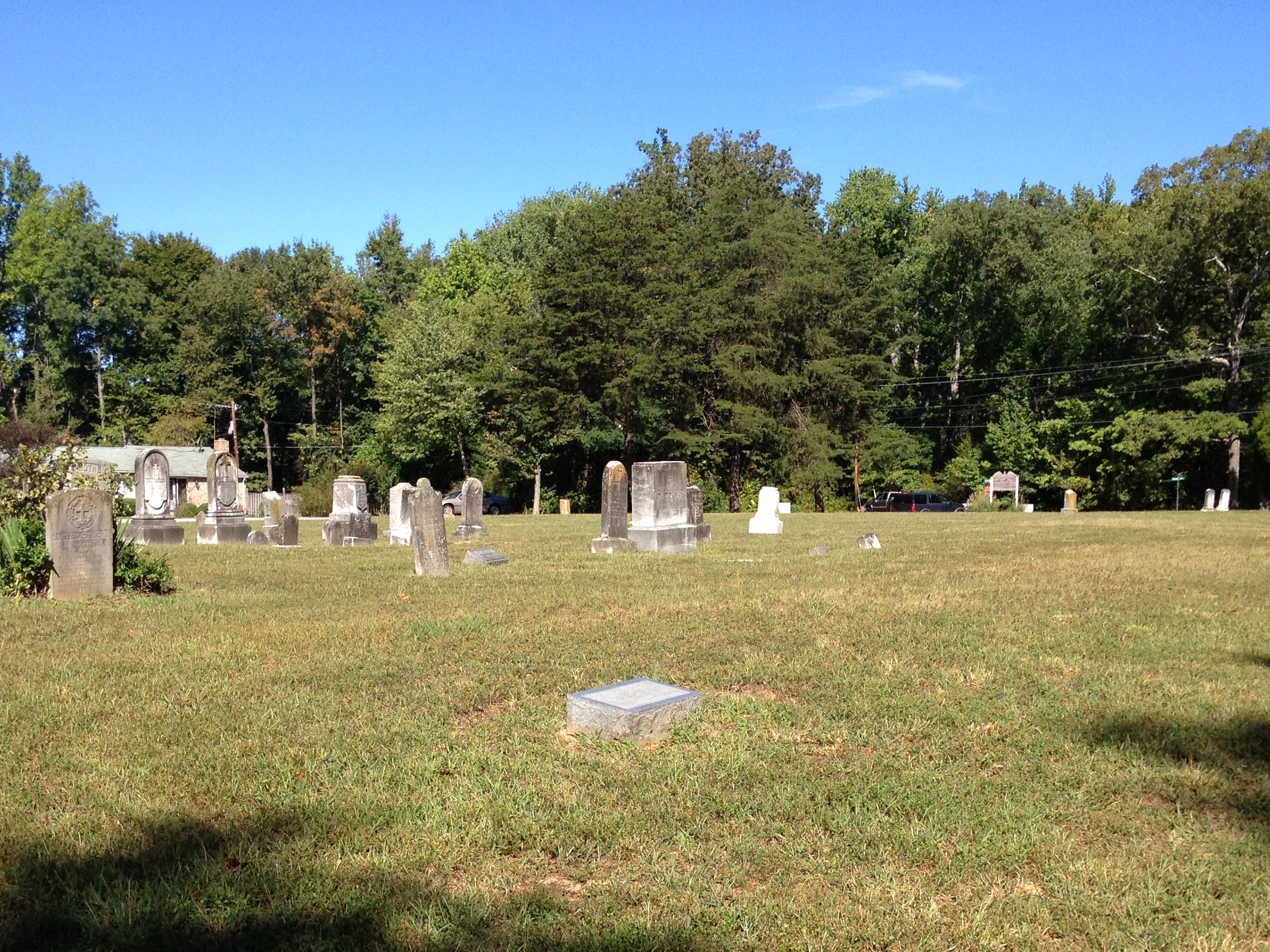
On July 7, 1873, Edman Spangler’s step-mother, Sarah Spangler, died in York at the age of 80. It is unknown if Edman attended her funeral. In September of 1873, the Holliday Street Theatre suffered a devastating fire which destroyed the building. When that happened, Spangler retired from the theater scene and bid goodbye to John T. Ford. Rather than making his way north to York, Spangler headed south to the farm of Dr. Mudd in Charles County, Maryland. Though strangers to each other prior to Lincoln’s death, the two had become friends during their shared imprisonment. Dr. Mudd welcomed Spangler into his home with open arms and even gave Spangler his own piece of land to live on and work. On February 7, 1875, at the age of 49, Edman Spangler died at the Mudd farm . On February 9th, he was buried by the Mudd family at the original St. Peter’s Cemetery.

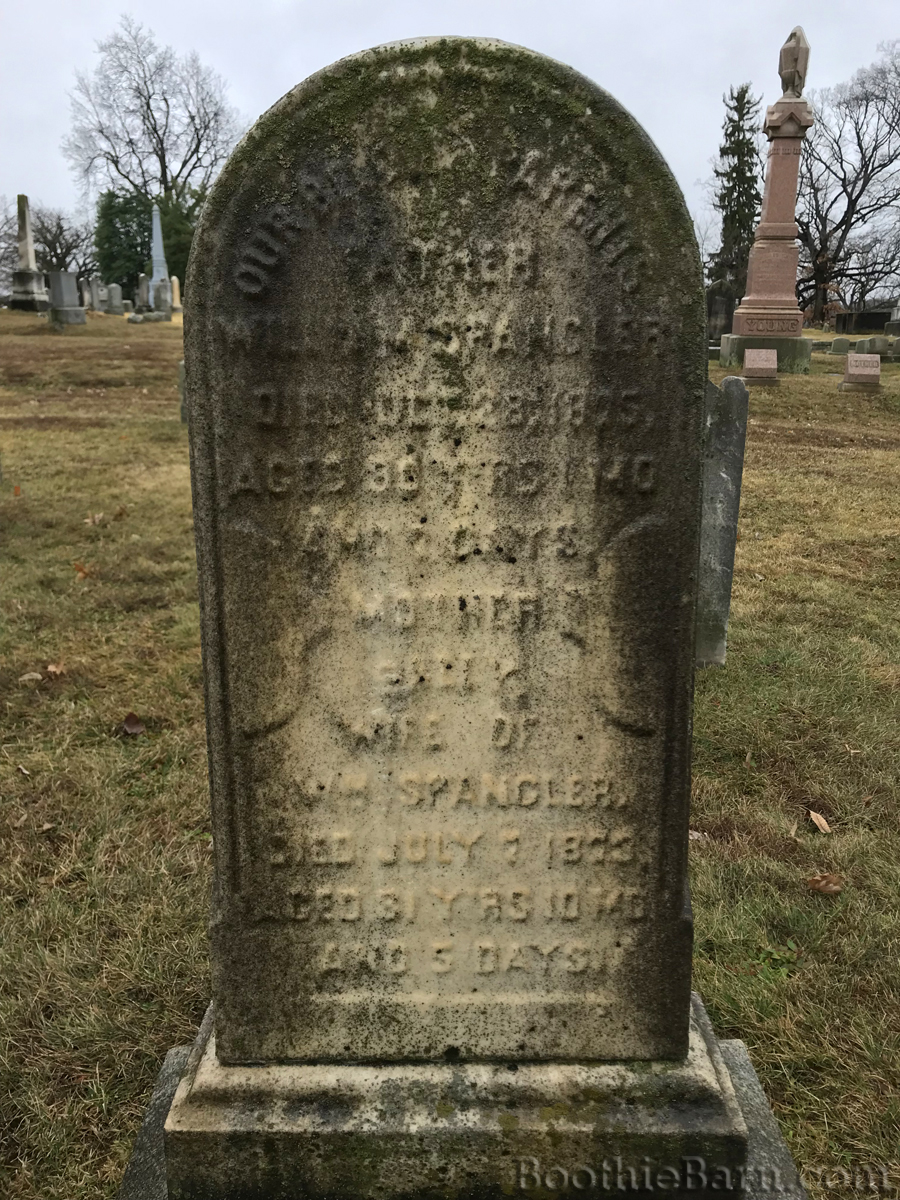
William Spangler actually outlived his infamous son, but only by a few months. The elder Spangler died on October 28, 1875 at the age of 90. In 1882, Maria Spangler, the daughter of William and Sarah and half-sister of Edman Spangler, died and was buried with her parents.

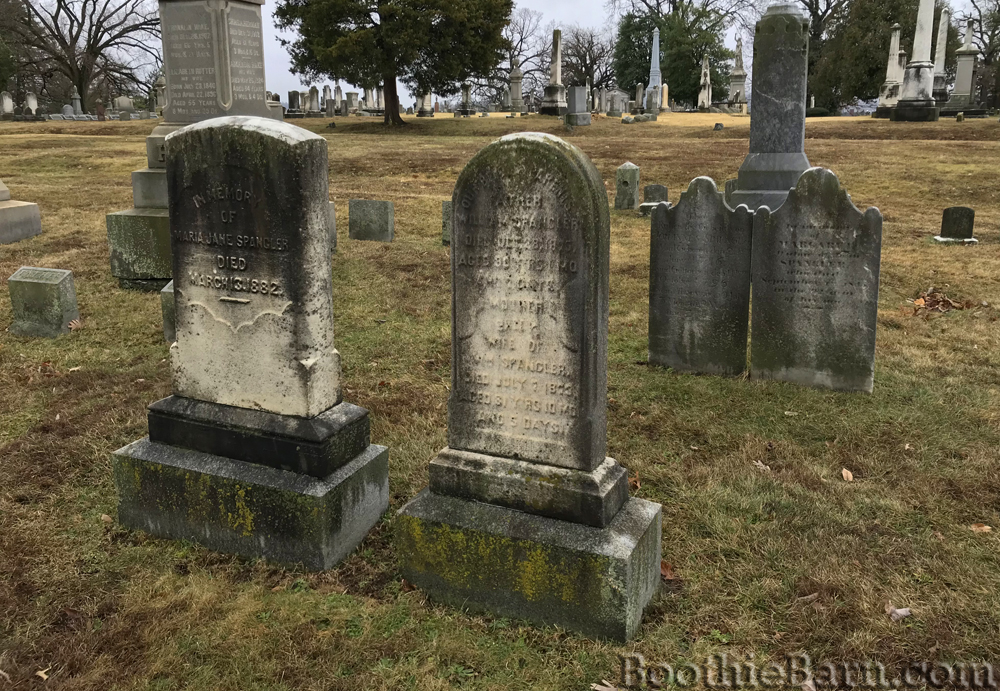
Today, there are four Spangler gravestones standing in Section S, Lot 236 of Prospect Hill Cemetery in York, Pennsylvania, all of whom are related to conspirator Edman Spangler.

Graves of John and Margaret Spangler, Edman Spangler’s grandfather and grandmother.

Grave of Maria Jane Spangler, half-sister of Edman Spangler

Grave of William and Sarah Spangler, Edman’s father and stepmother

There may be other Spangler relatives buried in the same plot as those pictured above such as Edman Spangler’s biological mother and his brother who died on April 15, 1852. Unfortunately, during the Great Depression, a fire destroyed a large chunk of the records at Prospect Hill Cemetery. If additional Spanglers are buried in this plot unmarked, they are known only to God now.

In the end, it’s a bit unfortunate that Edman Spangler is buried so far away from the rest of his kin. York was such a big part of his family’s story and Prospect Hill Cemetery is filled with many more of his cousins, uncles, and aunts. Yet Edman Spangler lies in a small rural cemetery far away from any member of his family. Sent to prison for his alleged involvement in Lincoln’s death, it appears that, in at least one way, Edman Spangler never really came home.

References:
The annals of the families of Caspar, Henry, Baltzer and George Spengler, who settled in York County, respectively, in 1729, 1732, 1732, and 1751 : with biographical and historical sketches, and memorabilia of contemporaneous local events by Edward W. Spangler (1896)
June Lloyd’s research on her Universal York blog
York County Heritage Trust
“J. Wilkes Booth at School: Recollections of a Retired Army Officer Who Knew Him Then” by James W. Shettel, The New York Dramatic Mirror, February 26, 1916 Part 1, Part 2
John Wilkes Booth: Day by Day by Art Loux
Maryland Historical Society, Baltimore, MD
Prospect Hill Cemetery, York, PA
Thanks to Colleen Puterbaugh at the James O. Hall Research Center for confirming Edman Spangler’s death date for me after I found conflicting newspaper obituaries claiming he died a week later.
*As was common at the time, many of Edman Spangler’s ancestors anglicized their names when they immigrated. Baltzer Spangler, for instance, was born, Johann Balthasar Spengler. The last name of “Spengler” would slowly change over a couple generations to “Spangler”. For ease of reading, I have used the anglicized names and modern surname of Spangler.

Categories: Grave Thursday, History | Tags: , , , , , | 8 Comments

The Hidden History of Spencer Clark

On April 1, 2017, I spoke at the annual Surratt Society Conference. The topic of my speech revolved around the hidden histories of some of the minor characters in the Lincoln assassination story. One of the subjects of that talk was Spencer M. Clark, a witness at the conspiracy trial with a very scandalous past. The following text comes from my speech. Click here to read about another subject of the speech, James P. Ferguson.


Spencer Morton Clark

Burial Location: Spring Grove Cemetery, Hartford, Connecticut

Connection to the Lincoln assassination:

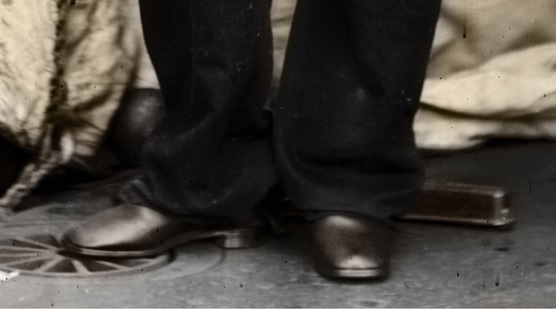
Spencer Morton Clark was the very first superintendent of the U.S. Bureau of Engraving and Printing. At the trial of the conspirators, Clark was called to testify regarding the pair of boots that had been confiscated from conspirator Lewis Powell. The day before Clark gave his testimony, he was given one of Powell’s boots by the Assistant Secretary of the Treasury and was asked to inspect it. Inside one of the boots was a mark of ink. After examining the boot under a microscope, Clark came to the conclusion that the mark of ink had been put there to obscure some sort of writing that lay beneath it. Using a bath of oxalic acid, Clark was able to remove the top layer of ink. He was clearly able to see the letters J W, then a letter that was either a P or a B. He also determined the last two letters were th. Clark concluded that the written word that had been covered up was the name J W Booth. Unfortunately, Clark left the oxalic acid on too long, and the ink from the name was also dissolved away. However, Clark was supported in his assessment by two other treasury workers who were with him. Spencer Clark’s testimony at the trial was brief but worked to prove that the boots worn by Powell had either been owned or purchased by John Wilkes Booth.

Hidden History:

Spencer Clark was born in Brattleboro, Vermont, in 1811. As a young man, Clark entered into many business ventures, all of which failed. He declared bankruptcy twice before gaining employment in D.C. in a position he was not qualified for. In 1860, Clark was made the Acting Engineer in the Bureau of Construction for the U.S. Treasury Department despite the fact that he was not an engineer. However, Clark made a good impression on Treasury Secretary Salmon Chase and was retained.

Salmon P. Chase was Lincoln’s Secretary of the Treasury from 1861 to 1864

Clark’s employment in the Treasury department came at a monumental time. Prior to the Civil War, the only legal tender in the United States was gold and silver coins produced by the Treasury. These coins were known as specie. However, the costs associated with the Civil War were so high, and the amount of gold and silver was limited. Lincoln and his government had to look elsewhere to find a way to finance the war. The decision was finally made to introduce paper notes to serve as legal tender bills. This is commonplace to us now, but back then, it was highly controversial, and even Lincoln only agreed to it as a necessary, yet unfortunate, war effort. The treasury at this time did not have the facilities to print its own notes, and there was great fear that the practice of printing money would fuel corruption within the government. Therefore, these early notes were printed by private companies and then sent to the Treasury in sheets. In his position in the Treasury, Clark and his clerks were charged with cutting out the notes, signing them on behalf of the Treasury officials, and imprinting each note with a seal.

Clark soon required a larger workforce to handle the increased output of the notes. With most able-bodied men off fighting in the war, the Treasury became one of the first government agencies to hire a large number of female clerks. The women who joined the ranks were often teenagers and young women whose fathers were either off fighting or had been killed. The Treasury sought to hire only girls and women who demonstrated a true need for employment to help provide for their families. Over 300 women found employment in the Treasury department before the end of the war.

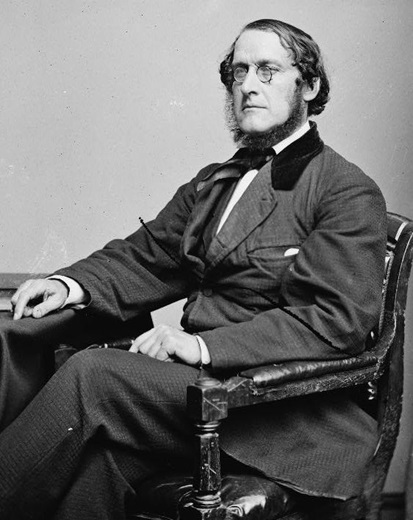
In July of 1862, Clark and his department were investigated by a Congressional committee over the government’s contracts for the notes and qualifications of its workers. The committee determined that the contracts signed by the government with the private printers resulted in an extravagance in the expenditure of public money. They also found that Clark was not qualified for his position and suggested his removal. Clark was retained, however, due to his familiarity with Secretary Chase and his other superior, Francis Spinner, who was the Treasurer of the United States.

Francis Spinner was the Treasurer of the United States from 1861 to 1875

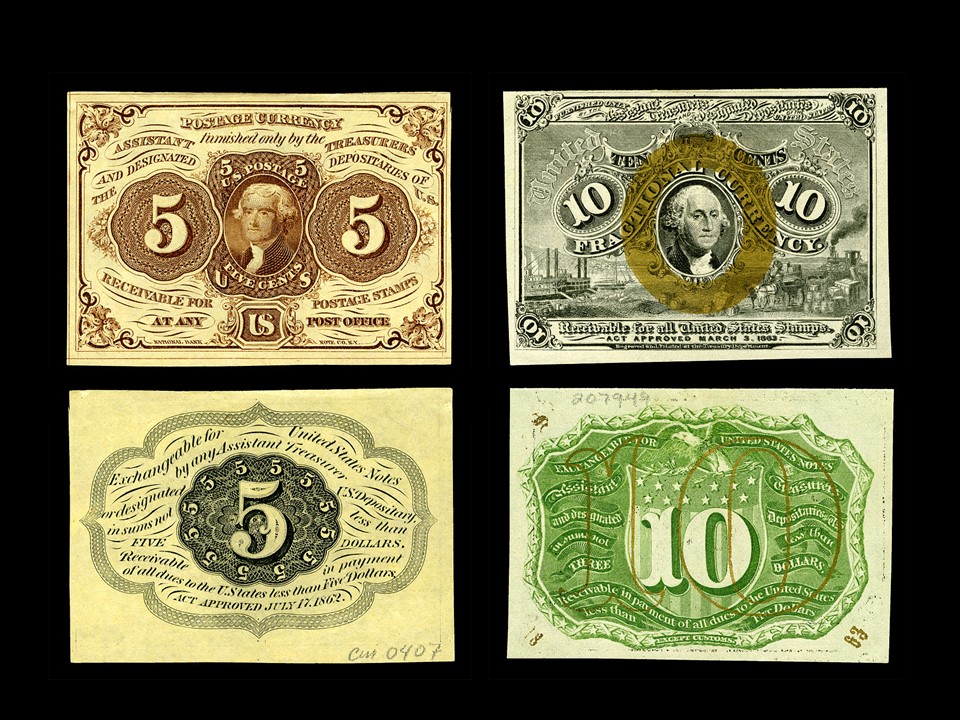
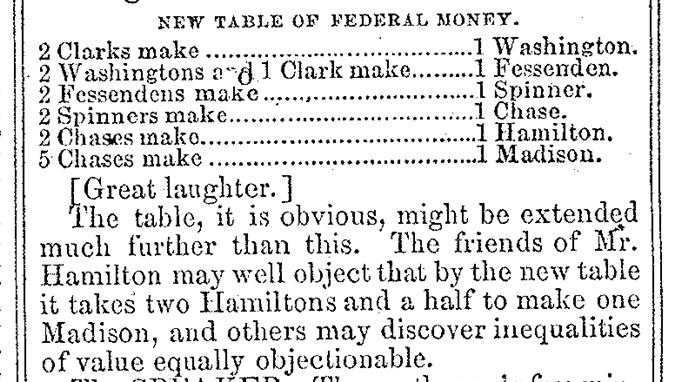
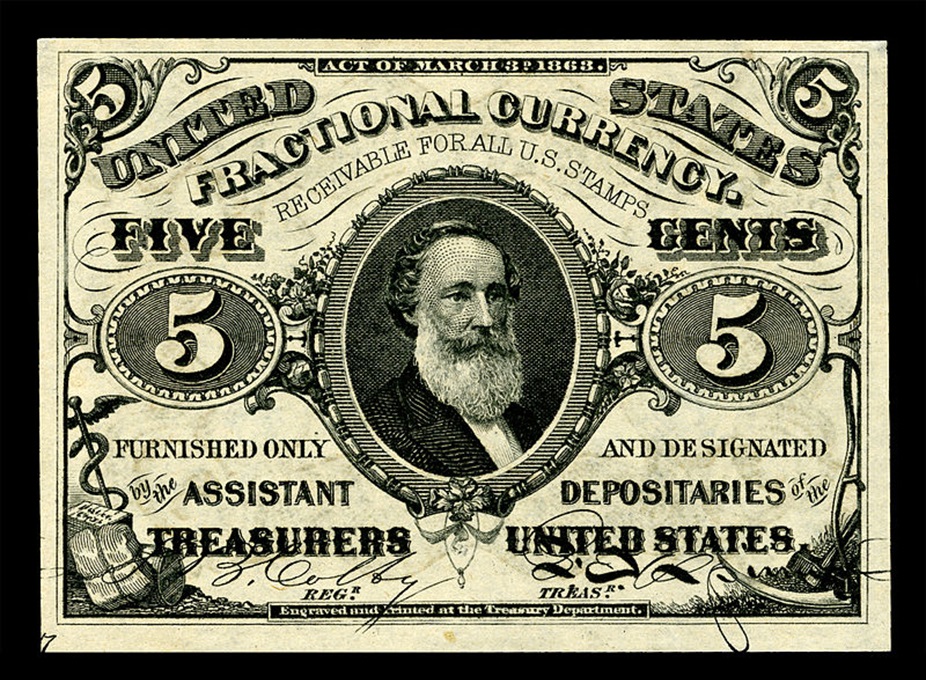
In August of 1862, Clark was authorized to purchase the machines necessary for the government to print some of its own notes rather than buying all of them from private companies. This decision essentially established the Bureau of Engraving and Printing and resulted in Spencer Clark becoming its first Superintendent. Clark supervised the production of the $1 and $2 notes. Clark’s new bureau was also tasked with the printing of the government’s new fractional currency. These bills were worth less than a dollar and were meant to supplement the dwindling supply of specie. In the initial run of fractional notes, only Thomas Jefferson and George Washington appeared.

Examples of U.S. fractional currency

Clark, it should be noted, did a good job of instituting better security measures to impede counterfeiting. In the second issue of fractional currency, Clark had a copper circle placed around the heads of Washington and Jefferson. If the bill were photographed, this ring would come out as black, thwarting the counterfeiter. Yet despite the positive aspects Spencer Clark brought to his position, there were also many negative aspects. Clark’s investment in the government’s printing presses proved to be misplaced. The presses Clark acquired literally came from the lowest bidder, and the quality was lacking. Broken presses were common and delayed their production. Clark was also very poor in his bookkeeping. His incomplete records of production and distribution were troublesome to members of Congress who were already worried about the corruptible nature of printing the country’s money.

In late 1863, Secretary Chase began hearing rumors about his printing department. These rumors were not about poor books or broken machines, however. The rumors being spread were about Clark, his female employees, and “gross immoralities” that were occurring under his supervision. Chase, who still held aspirations of his own to become President, decided to look into the matter in order to prevent any political enemy from discovering something that might damage his future. Chase requested that Secretary of War Edwin Stanton lend him a capable investigator to look into the rumors. Specifically, Chase requested the assistance of Lafayette Baker.

Lafayette Baker

Chase would come to regret his request to have Baker investigate. Baker had served as a detective, special agent, and finally as a special provost marshal under Stanton. While Baker made himself useful to the government, his methods and character were highly questionable. He was notorious for throwing those he believed were guilty of wrongdoing into the Old Capitol Prison without charge. The declaration of martial law during the war gave him the authority to do so. After Lincoln’s assassination in 1865, Stanton would call on Baker again to help manage the manhunt for John Wilkes Booth and his conspirators.

Lafayette Baker committed himself to his investigation into the Treasury, and opponents of the administration could smell the scent of scandal brewing. Salmon Chase had hoped for a quick exoneration of his subordinates, but that was not what Baker had in mind. Baker believed that the public demanded a full and detailed inquiry, and he would not allow himself to be a tool for Chase’s benefit. Baker was far too much of a loose cannon to do Chase’s bidding and wrap up the investigation quietly. While Baker charged a couple of Clark’s clerks with corruption, his biggest accusations were about Clark himself, whom he accused of committing sexual misconduct with his female workers. Baker gathered statements by female employees that added up to a very damning picture against Clark, a married man.

Ella Jackson stated that she and another female clerk had traveled to Philadelphia at the invitation of Clark and another male clerk in the department named Gustavus Henderson. In Philadelphia, Miss Jackson registered at a hotel under an assumed name and spent the weekend with Clark. She also stated that Clark often offered her beer in his private office late at night, though she insisted she never drank more than two glasses and was never drunk at work. Ada Thompson, an actress, provided further details of Clark’s affair with Miss Jackson by informing Baker that, “During the month of December last, Miss Jackson seldom came home before two or three o’clock in the morning. She stated to me that during these times she did not work later than ten or eleven o’clock and that the balance of that time…she spent in Mr. Clark’s private office.” Thompson also stated to Baker that she had “often seen in Miss Jackson’s possession obscene books, pictures, and prints, which she…informed me were given to her by Clark.”

Baker interviewed and received a statement from another young woman named Jennie Germon, who had been in the employ of Mr. Clark. Jennie stated:

“Mr. S M Clark came to me in the office, and asked me to come to his private residence, at the same time informing me that his wife was in the country. I did not at first comply with his request. On the next Saturday night…I went to Mr. Clark’s house about eight o’clock in the evening…Mr. Clark and myself occupied the same room until morning…About two weeks after my first visit to Mr. Clark’s house, he again asked me to go to his house and spend another evening with him; this request I complied with. I recollect distinctly a conversation I had with Mr. Clark. He said his wife was very jealous and at one time told him that she believed the Treasury Department was nothing more nor less than a house of ill-fame…Clark paid me as high as forty dollars; these amounts were independent of my wages earned in the Department…I freely confess my shame and disgrace, trusting that no publicity will be given to my statement.”

Lafayette Baker did not heed Jennie Germon’s request for confidentiality. Slowly, different pieces of Baker’s investigation were being leaked to the public. Secretary Chase was seeing the reputation of his department and himself sullied. Chase suspended Clark but stopped short of firing him. Chase wanted Clark to resign, but the latter would not go so easily. “I think it right that the country should know that your confidence in my official management has not been misplaced,” Clark wrote in an open letter to Chase that was published in the newspaper. Clark claimed that the charges against him were politically motivated since he was a holdout from President Buchanan’s administration. Essentially, Clark set it up that if Chase moved to fire him, it would be far more damaging to Chase and his prospects, as it would be confirmation that he had allowed things to get so out of hand in his department. Chase was trapped. The allegations against Clark were so detailed and extensive that they were undoubtedly true, but Chase had to save face. And so Chase turned to the only thing left of him, partisan politics.

While Baker’s investigation failed to find any major examples of monetary corruption in the Treasury department, the reports surrounding Clark’s sexual malfeasance became blood in the water to opponents of Lincoln’s administration in Congress. An investigative committee was created. Chase, however, was well-connected enough to ensure that the majority of the Congressmen placed on the committee were friends. While there were a few token Democrats to provide the illusion of impartiality, the chairman of the committee was Republican representative and future President James Garfield.

Representative James A. Garfield

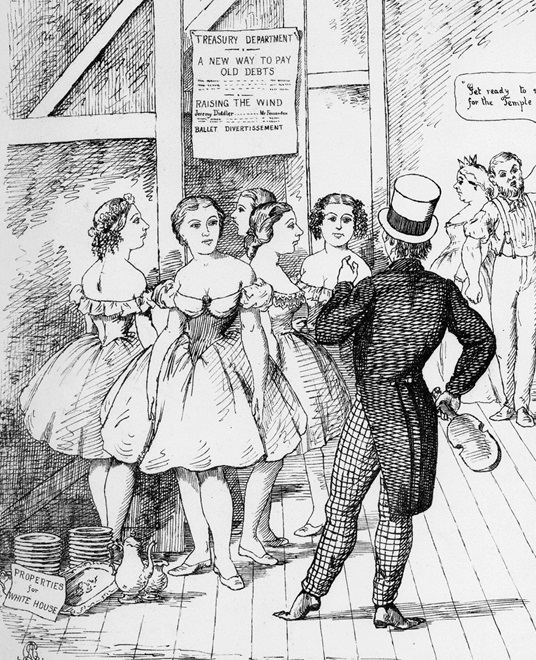
Chase and Garfield had become extremely close, with Chase considering Garfield to be the son he never had.  The Republican majority committee worked extensively to attack Baker’s investigation. Each political party now found itself in a strange place. The Democrats, who loathed Baker and his methods, jumped to Baker’s defense while the Republicans, who had relied on Baker many times to be the shady means to achieve their ends, turned against him. Baker, feeling betrayed by his friends, released all the pages of his scandalous findings to the public. Many newspapers would not print the reports of Clark’s sexual exploitation and abuse of his young female workers, deeming them too depraved to print. Still, others published the ladies’ statements in all their depraved detail. A political cartoon of the day even included the scandal with a brazen gentleman eyeing a group of young ballerinas preparing for the Treasury Department’s production of “A New Way to Pay Old Debts”.

One might think that with all of the uproar that was being caused in the Democratic newspapers over Clark’s misconduct and the release of Baker’s reports, it would be impossible for Chase, Clark, and the Republicans to come out unscathed. However, in the end, Lafayette Baker’s own overzealousness in his investigation would ultimately lead to his downfall.

In early May of 1864, right about when the congressional investigation began, one of the Treasury Department’s female clerks, Maggie Duvall, suddenly died. Maggie was described as “a beautiful and attractive young lady, with auburn hair, somewhat freckled.” Baker did not believe this death was a coincidence. He believed that Maggie had been a victim of Mr. Clark and died as a result of an abortion. Baker was able to collect a statement from another clerk that seemed to support this idea. And so, against the heartrending protests of Maggie’s family, Baker had Maggie’s funeral halted and had her body sent to an examining committee of local physicians to check for signs of an abortion.

In the end, however, Baker’s gamble backfired. It was found that Maggie had died of consumption and that her “virtue” was still intact. When the press heard the news of what Baker had done, they crucified him for it. His desecration of the poor girl’s body against the wishes of her family and the way he had attempted to sully her reputation became more of an outrage than Clark’s actions towards the other women. The Republicans were amazingly able to reframe the issue and turn Baker into the enemy. When Garfield and his majority in the congressional committee released their report, they alleged that most of the charges against Clark were fabrications created by Baker on behalf of private printing companies in New York who were unhappy with having lost their contracts to print the government’s notes with the establishment of Clark’s bureau. In the end, the committee found that Lafayette Baker, “by the aid of coerced testimony” and with the assistance of “female prostitutes associated with him,” had set out to destroy the reputation of Spencer Clark.

Lafayette Baker was livid and challenged Garfield to produce any evidence that he was working on behalf of printing companies, had coerced any testimonies, or had used female prostitutes to make his case. In truth, all of these charges were groundless, but it didn’t matter. Garfield had managed to reframe the issue in the public mind to protect his friends and his party. The Treasury scandal just went away, which is why Spencer Clark was still in his position as superintendent of the printing division when he was asked to examine Lewis Powell’s boot in 1865.

But we’re still not done with Mr. Clark. In fact, we haven’t even touched on the scandal he is most known for and the way in which he changed the course of American currency forever.

In June of 1864, just after the inquiry over Clark’s sexual misconduct ended, Congress approved the creation of a third issue of fractional currency. The first and second issues, which ranged from 5 cents to 50 cents, had only contained the portraits of Washington and Jefferson. The design process was a lengthy affair with dies having to be created by outside companies. During this time, Secretary Chase resigned from his post. He was replaced by Maine Senator William Fessenden, who became the new Secretary of the Treasury.

William Fessenden was Lincoln’s Secretary of the Treasury from 1864 to 1865

Clark was in charge of the creation of the new fractional notes. It’s possible he was trying to curry favor with his new boss when he approached him with his idea for the portraits that should be placed on the new notes. Clark suggested that the notes contain the images of Secretary Fessenden, Assistant Secretary of the Treasury George Harrington, Controller of the Currency Hugh McCullough, and the Treasurer of the United States Francis Spinner.  Secretary Fessenden agreed to have his own face on one of the bills but told Clark to ask the other gentlemen for their consent. The other gentlemen were reluctant to the proposition but eventually agreed to it when they were assured by Clark that Secretary Fessenden wanted it so (which was a lie). In time, Secretary Fessenden’s portrait appeared on the 25-cent note, and Treasurer Spinner’s portrait went on the 50-cent note.

Fractional currency notes bearing the likenesses of William Fessenden and Francis Spinner

These high-value notes went into circulation but were not as common as the lower ones. The die for Controller McCullough’s note was damaged upon delivery to the Treasury, and he, already being uncomfortable with the idea of being on currency, refused to allow Clark to order a new one. The design for Harrington’s note was apparently not yet in production. What occurred next is a little uncertain, but the end result was this:

A 5-cent fractional note bearing the likeness of Spencer Clark

Spencer Clark put his own face on the 5-cent fractional note. The story goes that the demand for 5-cent notes was so high that the treasury was under a time crunch to release the new issue of these bills. Strangely, or perhaps purposefully, Clark had originally planned for Francis Spinner to be on the 5-cent note, but moved him to the less popular 50-cent note. Clark went up to Treasurer Spinner, told him of the almost completed design for the 5-cent note, but lamented he had no portrait to put upon it. According to one story, Clark then said, “What head shall we use?” Clark asked Spinner, “the boys have got up a die with my head, what objection is there to using it?” Spinner then allegedly replied, “I have none”. Clark then went off telling people that he had the authorization of Francis Spinner to use his own image, and he just so happened to have a die with his own portrait on it, ready to go. However, the truth is that Francis Spinner did not have the authority to approve designs, nor did he claim to have such authority. When Secretary Fessenden saw the early proofs of the new 5-cent notes with Clark’s face, he rebuffed Clark. Clark then told him that it was Spinner who had insisted that Clark’s image be put upon the notes due to his years of faithful service to the bureau (which was a lie). The other story surrounding the placement of Spencer Clark’s face states that, when Clark approached Treasurer Spinner inquiring about who to put on the 5-cent note, he said something along the lines of, “Would the likeness of Clark do?” Spinner apparently believed that Spencer was referring to that great American explorer William Clark, of Lewis and Clark fame. Spinner agreed to this, and it was not until after the proofs were made that it was discovered that there had been a “misunderstanding”. Regardless of what really happened, due to the time constraints and demand for the bills, the production of the 5-cent notes with Spencer Clark’s face was allowed to continue.

As you might imagine, when these new 5-cent notes first appeared in public in February of 1866, there was quite an uproar. People had previously talked of the impudence of when Salmon Chase was placed on the $1 notes produced by the treasury, and now here were fractional bills containing the images of three more treasury workers. Though George Washington was retained on the 3-cent and 10-cent notes, Thomas Jefferson had lost his place among our nation’s money completely.

Members of Congress were the most outraged, especially considering the drama that had unfolded around Clark just two years earlier. The man had been rightfully accused of using his position to solicit sexual favors from his female subordinates, and now he was the face of the 5-cent note. So, on March 1, 1866, Representative Martin Thayer of Pennsylvania added the following amendment to an appropriations bill for the Treasury:

“Hereafter no portrait or likeness of any living person shall be engraved or placed upon any of the bonds, securities, notes, or postal currency of the United States.”

Thayer humorously demonstrated how teachers all over the country will have to do away with their old table of Federal currency and learn the one currently promoted by the Treasury.

Rep. James Garfield expressed his disagreement with the amendment, initially citing his belief that money should represent the leaders of the day. However, his argument quickly shifted into a prolonged and flowery defense of Spencer Clark:

“Sir, I take pleasure in saying a word for an abused man, who is not here to answer his accusers; and I say it, too, remembering the declaration of an ancient philosopher, that people love to hear accusation better than defense. I do not hesitate to declare it as my opinion that when the history of our financial struggles during the later war shall have been written; when all passion and prejudice shall have died away; when the events of the present shall be seen in the clear light of veritable history, this man, whose picture is now sneered at; this man, so little known to fame, and so unfavorably spoken of among many members of this House, will stand out in that history as a man most remarkable for genius and ability, for having accomplished a work which will take its place among the wonders of mechanism and useful invention, and for having saved to the Treasury, by his skill and fidelity, millions of money. Whatever people please to say concerning S. M. Clark and his antecedents, he has done his country signal service; and, sir, I believe his merits will some day be recognized by the American people as they have been and still are by those who know what he has done and is still doing in the public service.”

Representative James Brooks from New York, the Congressman who had started the call to investigate Clark two years ago and served as one of Garfield’s token Democrats in the committee, could not let Garfield’s aggrandizement of Clark go without a response.

Rep. James Brooks of New York

“What a eulogy he has pronounced upon a great hero of this war! When the name of Grant shall have faded away; when the magnificent victories of Sherman, from the mountains of Tennessee throughout all George, North and South Carolina, and Virginia, shall have been forgotten; … when even Lincoln shall have been buried with Julius and Augustus Caesar, there will arise one remarkable man; high on the horizon, and that is Clark, the printer of the public money!”

This response was met with laughter from the House. Garfield and Brooks then argued for some time about the past investigation into Clark before Brooks brought the attention back to the matter at hand.

“Sir, the honorable gentleman from Pennsylvania, Mr. Thayer is right. No man should be immortalized upon the public money of the country until the verdict of posterity has been pronounced upon his name, and it can go down upon that record sanctioned by the voices of men of all parties, all politics, and of all religions.”

In the end, the Representatives voted to put Rep. Thayer’s amendment in. When the amendment arrived in the Senate, the only change made was to allow the current plates of notes to be used until their expiration in order to avoid the cost of halting production and purchasing new ones at this time. This was agreed to by both the Senate and House without dissent.

Finally, on April 7, 1866, the appropriations bill was passed, which contained the amendment banning living people from appearing on our money and stamps.

This policy still stands today. Coincidentally, the same appropriations bill that banned portraits of living people on money also approved the expenditure of $100,000 for the purchase of a property in Washington City “for the deposit and safe-keeping of documentary papers relating to the soldiers of the army of the United States, and of the museum of the medical and surgical department of the army.” The property’s name? Ford’s Theatre.

Spencer Clark survived an investigation into his qualifications. He survived an investigation into his immoral and predatory behavior with his female clerks. Spencer Clark even survived the aftermath of the widespread embarrassment he had brought upon his government by putting his own face on money. However, he could not survive one last scandal. On November 17, 1868, Clark tendered his resignation after an investigative committee found him guilty of…improper bookkeeping. After leaving the Treasury, Clark acquired a position in the Department of Agriculture, eventually becoming the head of the Bureau of Vital Statistics. Clark died on December 10, 1890, and is buried in Hartford, Connecticut, next to his wife.

Spencer Clark was a failed businessman, a fake engineer, the Superintendent of the Bureau of Engraving and Printing, a scumbag sexual predator, and a man who put his own face on money. That’s quite a scandalous hidden history.

References:
The Enemy Within: Fears of Corruption in the Civil War North by Michael Thomas Smith – a fascinating book which details Spencer Clark and the Treasury Scandal

Categories: Grave Thursday, History | Tags: , , , , , , , , | 8 Comments

Grave Thursday: Lewis Chubb

On select Thursdays we are highlighting the final resting place of someone related to the Lincoln assassination story. It may be the grave of someone whose name looms large in assassination literature, like a conspirator, or the grave of one of the many minor characters who crossed paths with history. Welcome to Grave Thursday.


Lewis Lorenzo Chubb

Burial Location: Green Oak Union Cemetery, South Lyon, Michigan

Connection to the Lincoln assassination:

On May 18, 1865, two separate military trials were occurring in the city of Washington. The one that garnered the most interest was, of course, the ongoing trial of the conspirators in Abraham Lincoln’s assassination. On that specific day, a total of 26 witnesses testified at the conspiracy trial including Louis Wiechmann, Henry Rathbone, and Eaton Horner. It was a warm day, more summer than spring, and the newspapers covering the trial mentioned the oppressive temperature. George Atzerodt, it was reported, was “listless under the heat.”

Across town, there was another trial going on with a defendant who was undoubtedly feeling the heat as well. This second trial was a court martial hearing for a 13th Michigan Light Artillery sergeant named Lewis Chubb. Chubb faced two charges against him at the court martial: drunkenness on duty and disobedience of orders.

While one trial was for the crime of the century and the other trial was a relatively routine matter of military discipline, these two trials, occurring simultaneously, both involved one key player: listless George Atzerodt.


Lewis Lorenzo Chubb was born on September 24, 1843 in Livingston County, Michigan. He was the fifth of seven children born to Major Sherwood Chubb and Achsa Bennett. On his mother’s side, Chubb was a descendant of John Webster, a settler and one time governor of the Colony of Connecticut. When the Civil War broke out, an almost 18 year old Chubb enlisted in the 13th Michigan Infantry. He served almost a year and then was discharged. He re-enlisted in 1863 in the 13th Michigan Light Artillery Battery for the remainder of the war. He was promoted to Sergeant in 1864.

On the night of April 14, 1865, Lewis Chubb was in command of a picket on the turnpike between Georgetown, D.C. and Rockville, Maryland. At 12:10 am on April 15th, the commander of Chubb’s picket brigade, Col. Charles H. Long, sent out messengers with the news of the shooting of Abraham Lincoln. In addition, he gave his pickets orders to prevent any persons from crossing out of the city of Washington. At 2:55 am, Col. Long received similar orders to the ones he had already given. His pickets were to “arrest every man that comes near or attempts to pass from the City.”

It was in this manner that, in the early morning hours of April 15th, Sgt. Chubb had effectively shut down the turnpike leading out of Washington to Rockville. As morning dawned in Washington and people learned the horrors of the night before, Sgt Chubb followed his orders, preventing anyone from crossing his line. As one might expect however, the continued closure of a main turnpike out of Washington started to cause a bit of a traffic problem. As teams and wagons made their way to the picket, they found themselves stopped, searched, and unable to proceed. Chubb also followed orders in arresting all of those who came to his picket post, but they were not imprisoned in the traditional sense. One of those stopped by Chubb and his men was a man by the name of William Gaither. Gaither was a farmer who had come to D.C. on April 14th with eggs, butter and some other things to sell at market. After spending the night in Georgetown, Gaither was heading with his wagon back to his farm in Montgomery County. Gaither reached Chubb’s picket at about 10 am on April 15th and was not allowed to pass. He, like everyone else who arrived at the picket, was detained by Chubb and his men. Gaither was not under guard however, and testified that he, and the others detained, “went about where we pleased,” around the picket but “couldn’t go outside the line.”

Shortly after Gaither was stopped and detained, the Rockville stagecoach rode up. The stagecoach had a government pass due to its duties with the postal service. Due to this, the stagecoach was allowed to pass through the line, but Chubb ordered the sole passenger out of the coach. Chubb informed the passenger that he was detained until new orders came through. Gaither described the man Chubb took off of the stagecoach:

“…[A]bout five feet, eight or ten inches tall,  – lightish complexion, – sandy mustache, appeared to be very polite to every one, and acted as if he was acquainted with every one. The man’s name was George A. Atzerodt. I did not know the man’s name when we were at the post, but learned his name afterwards.”

Conspirator George Atzerodt had failed to attack his target of Vice President Andrew Johnson the night before and was attempting to make his way out of Washington. He had purchased himself a ticket on the stagecoach only to find himself dropped off and detained by the very forces he was hoping to escape from. Yet, despite being in a very bad position, according to Gaither, Atzerodt did his best to act completely unconcerned about his situation.

“Atzerodt was talking with almost every one. He came to me and entered into conversation – said he had been disappointed in getting a ride, and if I had no load he would like to ride with me… I told him that I had no load, and that some company was better than none. I told him that he could ride so far as I was concerned. I told him neither of us could go until they passed us through. Atzerodt asked me once or twice to go into the store to take a glass of cider with him. I drank with him twice or three times.”

Having secured a possible ride, George chatted with the others who had been detained. Eventually the conspirator in Lincoln’s death began conversing with the head of the picket, Lewis Chubb. Gaither testified about this interaction as well:

“The conversation occurred above the store, by the corner of the fence, – this was an hour or more after the stage passed on. Atzerodt and the accused [Chubb] were talking. I went up and joined them. Atzerodt asked us to go in the store and take a glass. We then went in the store and Atzerodt called for three glasses of cider. We each drank a glass of cider, – we were in the store about ten or fifteen minutes. I can’t say that accused [Chubb] staid so long. I don’t recollect whether we had any conversation or not.”

This casual drink with George Atzerodt and William Gaither was the basis of the drunkeness charge against Lewis Chubb during his court martial. However, as the court martial proceeded, the testimony of Gaither and others who interacted with Chubb easily proved that while Chubb may have consumed one alcoholic drink that day, he maintained his sobriety.

The more problematic charge against Chubb at his trial was based on what occurred next. Unsure what to do with the long line of teams and wagons wishing to depart the city and his growing number of detainees, Chubb sent one of his underlings, a private named Albert Richmond, to his commander, Captain Charles DuPont. At about noon, Private Richmond informed Captain DuPont that the road was blocked up with teams and that Sgt. Chubb requested orders or what to do with them. Following the chain of command, Capt. DuPont went to see Col. Long regarding what instructions he should give. By this time, Col. Long had received the following written orders:

“…[Y]ou will instruct your pickets to pass all persons into town as may wish to come, and the same out again, if recognized. All persons that the picket are acquainted with will be allowed to pass and repass until 9 P.M. each day until further orders”

This order, while helpful in regards to the few people on the Maryland side of the line wanting to come into the city, did not really help in terms of the plethora of wagons still trying to get out of the city. Col. Long, however, seeing the difficulty Chubb was facing, seemed to extrapolate on the order and deduced that he could give permission for the detained teams to make their way out of town as well. Col. Long gave Captain DuPont verbal orders to, “search all the wagons and allow them to pass through arresting all suspicious looking persons, and to take the names of all persons going through.” It was the understanding of both Col. Long and Capt. DuPont that the men who would be allowed to pass out of the city were those with teams and no one else. Capt. DuPont gave the verbal order he had received from Col. Long to Private Richmond who then presented it to Sgt. Chubb at the picket. Chubb then proceeded to send the teams on their way having already searched their wagons and taken the names of those detained.

When the new order came in, William Gaither began preparations to get under way. It was now a little before 2:00 pm and the farmer was anxious to get on the road. Sitting in his wagon, Gaither looked around for the man who had requested to ride with him.

“When I got ready to go Atzerodt was talking to the accused [Chubb], and as I got in my wagon I called to him telling him I was going, and if he was going with me he must come along. I called out loud; loud enough for [Chubb] to hear what I said…[Atzerodt] started immediately in a hurry, like, as if startled, and jumped in the wagon, and took a seat by me.”

According to a statement Gaither gave after being arrested by the authorities, just as Atzerodt was about to hop into his wagon, the conspirator turned to Sgt. Chubb, made a very polite bow and said, “It’s all right so far.” With that, George Atzerodt made his way past the Union picket line and continued his escape.

Atzerodt’s freedom would be short-lived, however. On the morning of April 20th he was found at the Germantown home of his cousin, arrested, and returned to “detainee” status. Gaither’s statement of how he came to unwittingly assist Atzerodt in his escape brought attention onto Chubb and the fact that the sergeant had allowed the conspirator to pass through his picket in disobedience of orders.

The man who acted as prosecutor in Chubb’s court martial case was a Judge Advocate by the name of Charles Underhill. Captain Underhill successfully proved that Chubb was well aware of the fact that George Atzerodt was without his own team. At the court martial, William Gaither testified that Sgt. Chubb had taken Atzerodt off of the stagecoach himself and knew him to be a passenger.

Captain Charles W. Underhill, the Judge Advocate at Lewis Chubb’s court martial. Image courtesy of Rod Coddington.

Underhill called on Col. Long, Capt. DuPont, and Pvt. Richmond to testify. He also had a man named Lt. Frederick Dean testify. Though Lt. Dean was Chubb’s immediate superior that night, Dean was not involved in the transmission of orders. He did testify as to Chubb’s sober condition during the two times he saw him that day, further vindicating the sergeant of the drunkenness charge.

One would think that Sgt. Chubb would be in dire straits in defending himself against the disobedience of orders charge. Though no one accused him of knowing the background of the man who bought him a drink, the fact that Chubb had allowed a man to pass his line without a team of his own, one who was later proven to be an accomplice in Lincoln’s death, would seem like a career ending decision for Chubb. Luckily for Lewis Chubb, however, Judge Advocate Underhill was curious as to the specific orders that Chubb apparently disobeyed.

During Capt. DuPont’s testimony at the court martial trial, Underhill questioned the captain’s interpretation of Col. Long’s order and the way in which he then communicated this order to Private Richmond:

“Q. Did you understand that order to mean to pass anyone not suspicious looking – with or without teams?
A. No, Sir. I understood the order to mean to pass only those with teams.
Q. Why did you so understand it?
A. On the grounds that it had been reported to me that teams were waiting there.
Q. Was it so stated or given?
A. I think not.
Q. Why was not the order so worded by you as to convey your true meaning?
A. I thought I gave it so that he could understand what I meant.”

While Captain DuPont had assumed it was implied that only those with teams could exit the city, neither Col. Long nor himself had specifically stated such. The only distinct part of the order given from Long to DuPont to Richmond to Chubb, was that any suspicious looking people were to be arrested. When receiving the order, Private Richmond had asked Capt. DuPont to clarify what he considered to be suspicious. Capt. DuPont responded, “Tell Sergeant Chubb to search the wagons and see that there are no persons concealed in them or no government property.” Private Richmond passed the order to Chubb as stated. Though it may have been implied and expected that only those with their own wagons could pass the line, this was never an explicitly stated part of the order. Therefore, Sgt. Chubb could not be held liable for disobeying part of an order that he never received.

In the end, the six commission members of the court martial found Sgt. Chubb not guilty of the two charges against him. He was acquitted and returned to duty:

On July 1, 1865, Sgt. Lewis Chubb left the army when he was mustered out with the rest of his company in Jackson, Michigan. Six days later, the cause of all of Chubb’s grief, George Atzerodt, left this world when he was executed for his role in Lincoln’s assassination.


Though much of Chubb’s life after the Civil War is unknown, he did marry Catharine “Kittie” Wood on September 12, 1888 when he was 44 years old and Kittie was about 26. This was Kittie’s second marriage and her first husband recounted that Kittie had a “bad temper” and that he “could not live with her.” It appears that Kittie may have maintained her temperamental disposition as she also separated from Lewis Chubb after only a year of so of marriage.

In either the 1880s or 1890s, Lewis Chubb found employment in the railroad business. In 1893, he was living temporarily in Willow Hill, Illinois working on the Peoria, Decatur and Evansville Railway. In Willow Hill, Chubb married a woman named Louisa. Shortly after the wedding, in January of 1894, Lewis whisked Louisa back up to his native state of Michigan where Lewis worked for the Chicago and Grand Trunk Railway in Battle Creek, Michigan.

Things were going well in Battle Creek for a while, until Chubb suffered an accident at work:

While working as the yard master for the Chicago and Grand Trunk railroad, Lewis Chubb got his leg crushed after his foot was caught in a railroad V-switch (also known as a frog). His right leg was crushed just below the knee from the cars of an oncoming train. An additional newspaper report stated that Chubb lost his leg due to the accident, but it is not clear if the accident removed his leg or if it was amputated in an attempt to save his life.

Unfortunately for Chubb, the trauma of the accident ultimately proved to be fatal. Lewis Chubb died on May 25, 1895 from blood poisoning caused by the crushing of his leg. He was 51 years old.

In addition to the death of her husband, further troubles were in store for Chubb’s widow, Louisa. Lewis had died without a will causing his estate to enter probate. Louisa applied to become the executor of her husband’s estate. However, three of Lewis’ siblings brought suit against Louisa and her attempt to gain control over the estate. It wasn’t until after her husband was dead that Louisa learned that her husband had been previously married. More importantly, however, was the fact that Lewis had apparently never actually divorced his first wife, Kittie. Though Lewis and Kittie had separated around 1890, there did not seem to be an official divorce on the books. To his credit, Chubb did start the divorce proceedings and Kittie even wrote a reply to the suit, but they never actually went through with the full process. Since Lewis and Kittie never truly divorced, Lewis and Louisa were not technically married, despite the marriage certificate and ceremony that claimed so. The attorneys from both sides of the case sought out Kittie Wood. In the end, it was found that Kittie had, herself, died in August of 1894. With the legal wife having predeceased Chubb, the judge in the case decided to move in favor of Louisa. He cited the deceased’s intention of legal marriage and cohabitation with Louisa as cause to find in her favor.

Despite the legal unpleasantness between Louisa and Chubb’s siblings, it appears that Louisa did agree with the idea that Lewis should be buried back with his own parents. Chubb’s body was transported, likely via railroad, from Battle Creek to a small cemetery in South Lyon, Michigan which held his mother and father’s grave. In the back corner of Green Oak Union Cemetery in South Lyon is the military headstone of Lewis Chubb next to the gravestone of his mother.

GPS coordinates for Sgt. Lewis Chubb’s grave: 42.430558, -83.690699


Epilogue

As someone who studies history, I am used to coming across instances in which the stories surrounding an individual change over time. Humans are, of course, imperfect, and that is why it is very important to question sources that come so long after an event. One of the sources I used in composing this post was a genealogical book containing information about the descendants of Gov. John Webster of Connecticut. The book gave me a small biography on Chubb with most of the information regarding dates and other family members being correct. However, sometime between 1865 and the publication of the genealogy book in 1915, the family story surrounding Chubb’s interaction with Lincoln’s assassination became extremely altered. Rather than telling about how Chubb unwittingly allowed conspirator George “Port Tobacco” Atzerodt to escape Washington and the subsequent court martial it caused, the genealogy book erroneously states the following:

Good grief!

References:
Court Martial of Sgt. Lewis L. Chubb Proceedings, May 18 & 19, 1865 (starts on page 153 in this PDF) accessed courtesy of Karen Needles’ Lincoln Archives Digital Project
History and genealogy of the Gov. John Webster family of Connecticut, with numerous portraits and illustrations
by William H. Webster
Image of Capt. Underhill courtesy of Rod Coddington
Newspaper articles accessed via GenealogyBank.com
The suit over Lewis Chubb’s estate can be accessed via Ancestry.com
Evening Star, May 18, 1865

Categories: Grave Thursday, History | Tags: , , , , | 7 Comments

Blog at WordPress.com.