Posts Tagged With: Abraham Lincoln

The Lincoln Assassination On This Day (January 1 – January 31)

On the first of 2022, I started back up with my daily On This Day (OTD) tweets over on my Twitter account, @LinConspirators. While I know it’s not the same as more regular postings here on the blog of in-depth research, with my busy work, life, and family responsibilities it’s been hard to find time to really research. Hopefully these collective tidbits from the last month will be enough to appease you all.


Taking inspiration from one of my favorite books, John Wilkes Booth: Day by Day by Art Loux, I’m documenting a different Lincoln assassination or Booth family event each day on my Twitter account. In addition to my daily #OTD (On This Day) tweets, each Sunday I’ll be posting them here for the past week. If you click on any of the pictures in the tweet, it will take you to its individual tweet page on Twitter where you can click to make the images larger and easier to see. Since Twitter limits the number of characters you can type in a tweet, I often include text boxes as pictures to provide more information. I hope you enjoy reading about the different events that happened over the last week.

NOTE: After weeks of creating posts with multiple embedded tweets, this site’s homepage now tends to crash from trying to load all the different posts with all the different tweets at once. So, to help fix this, I’ve made it so that those viewing this post on the main page have to click the “Continue Reading” button below to load the full post with tweets. Even after you open the post in a separate page, it may still take awhile for the tweets to load completely. Using the Chrome browser seems to be the best way to view the tweets, but may still take a second to switch from just text to the whole tweet with pictures.

Continue reading

Categories: History, News, OTD | Tags: , , , , , , , , , , , , , , , , , , , , , , , , , , , , , , , , , , , , , , , , , , , , , | Leave a comment

The Lincoln Assassination On This Day (October 25 – October 31)

Taking inspiration from one of my favorite books, John Wilkes Booth: Day by Day by Art Loux, I’m documenting a different Lincoln assassination or Booth family event each day on my Twitter account. In addition to my daily #OTD (On This Day) tweets, each Sunday I’ll be posting them here for the past week. If you click on any of the pictures in the tweet, it will take you to its individual tweet page on Twitter where you can click to make the images larger and easier to see. Since Twitter limits the number of characters you can type in a tweet, I often include text boxes as pictures to provide more information. I hope you enjoy reading about the different events that happened over the last week.

NOTE: After weeks of creating posts with multiple embedded tweets, this site’s homepage now tends to crash from trying to load all the different posts with all the different tweets at once. So, to help fix this, I’ve made it so that those viewing this post on the main page have to click the “Continue Reading” button below to load the full post with tweets. Even after you open the post in a separate page, it may still take awhile for the tweets to load completely. Using the Chrome browser seems to be the best way to view the tweets, but may still take a second to switch from just text to the whole tweet with pictures.

Continue reading

Categories: History, OTD | Tags: , , , , , , , , , , , , , , | 1 Comment

The Lincoln Assassination On This Day (October 11 – October 17)

Taking inspiration from one of my favorite books, John Wilkes Booth: Day by Day by Art Loux, I’m documenting a different Lincoln assassination or Booth family event each day on my Twitter account. In addition to my daily #OTD (On This Day) tweets, each Sunday I’ll be posting them here for the past week. If you click on any of the pictures in the tweet, it will take you to its individual tweet page on Twitter where you can click to make the images larger and easier to see. Since Twitter limits the number of characters you can type in a tweet, I often include text boxes as pictures to provide more information. I hope you enjoy reading about the different events that happened over the last week.

NOTE: After weeks of creating posts with multiple embedded tweets, this site’s homepage now tends to crash from trying to load all the different posts with all the different tweets at once. So, to help fix this, I’ve made it so that those viewing this post on the main page have to click the “Continue Reading” button below to load the full post with tweets. Even after you open the post in a separate page, it may still take awhile for the tweets to load completely. Using the Chrome browser seems to be the best way to view the tweets, but may still take a second to switch from just text to the whole tweet with pictures.

Continue reading

Categories: History, OTD | Tags: , , , , , , , , , , , , , | Leave a comment

The Lincoln Assassination On This Day (September 20 – September 26)

Taking inspiration from one of my favorite books, John Wilkes Booth: Day by Day by Art Loux, I’m documenting a different Lincoln assassination or Booth family event each day on my Twitter account. In addition to my daily #OTD (On This Day) tweets, each Sunday I’ll be posting them here for the past week. If you click on any of the pictures in the tweet, it will take you to its individual tweet page on Twitter where you can click to make the images larger and easier to see. Since Twitter limits the number of characters you can type in a tweet, I often include text boxes as pictures to provide more information. I hope you enjoy reading about the different events that happened over the last week.

NOTE: After weeks of creating posts with multiple embedded tweets, this site’s homepage now tends to crash from trying to load all the different posts with all the different tweets at once. So, to help fix this, I’ve made it so that those viewing this post on the main page have to click the “Continue Reading” button below to load the full post with tweets. Even after you open the post in a separate page, it may still take awhile for the tweets to load completely. Using the Chrome browser seems to be the best way to view the tweets, but may still take a second to switch from just text to the whole tweet with pictures.

Continue reading

Categories: History, OTD | Tags: , , , , , , , , , , , , , , | Leave a comment

The Lincoln Assassination On This Day (August 30 – September 5)

Taking inspiration from one of my favorite books, John Wilkes Booth: Day by Day by Art Loux, I’m documenting a different Lincoln assassination or Booth family event each day on my Twitter account. In addition to my daily #OTD (On This Day) tweets, each Sunday I’ll be posting them here for the past week. If you click on any of the pictures in the tweet, it will take you to its individual tweet page on Twitter where you can click to make the images larger and easier to see. Since Twitter limits the number of characters you can type in a tweet, I often include text boxes as pictures to provide more information. I hope you enjoy reading about the different events that happened over the last week.

NOTE: After weeks of creating posts with multiple embedded tweets, this site’s homepage now tends to crash from trying to load all the different posts with all the different tweets at once. So, to help fix this, I’ve made it so that those viewing this post on the main page have to click the “Continue Reading” button below to load the full post with tweets. Even after you open the post in a separate page, it may still take awhile for the tweets to load completely. Using the Chrome browser seems to be the best way to view the tweets, but may still take a second to switch from just text to the whole tweet with pictures.

Continue reading

Categories: History, OTD | Tags: , , , , , , , , , | 3 Comments

Malcolm X and Abraham Lincoln

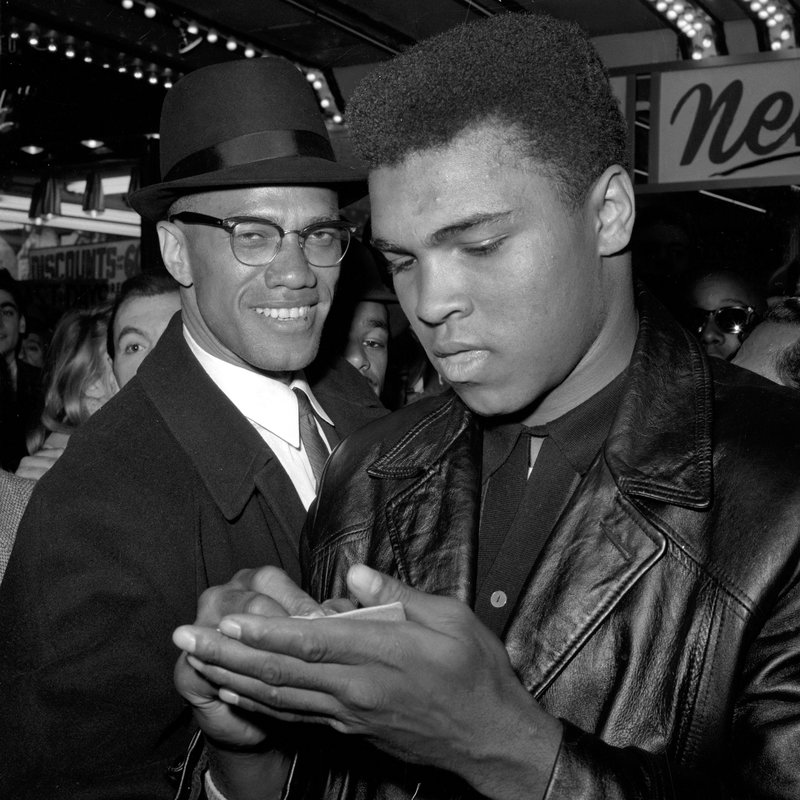
As I have noted before, I am in the process of getting my Master’s degree in American History. Slowly but surely, I’m getting closer to being an actual historian rather than just an elementary school teacher who knows a bit about Lincoln’s assassination. My most recent class was titled The Revolutionary Lives of Malcolm X and Martin Luther King, Jr. and it was taught by Dr. Peniel Joseph who is pictured above. Dr. Joseph is the author of a new dual biography of X and King titled, The Sword and the Shield: The Revolutionary Lives of Malcolm X and Martin Luther King, Jr. This was one of the main texts we used in the course and I highly recommend this book for anyone looking to learn more about these two hugely influential figures in the Civil Rights movement.

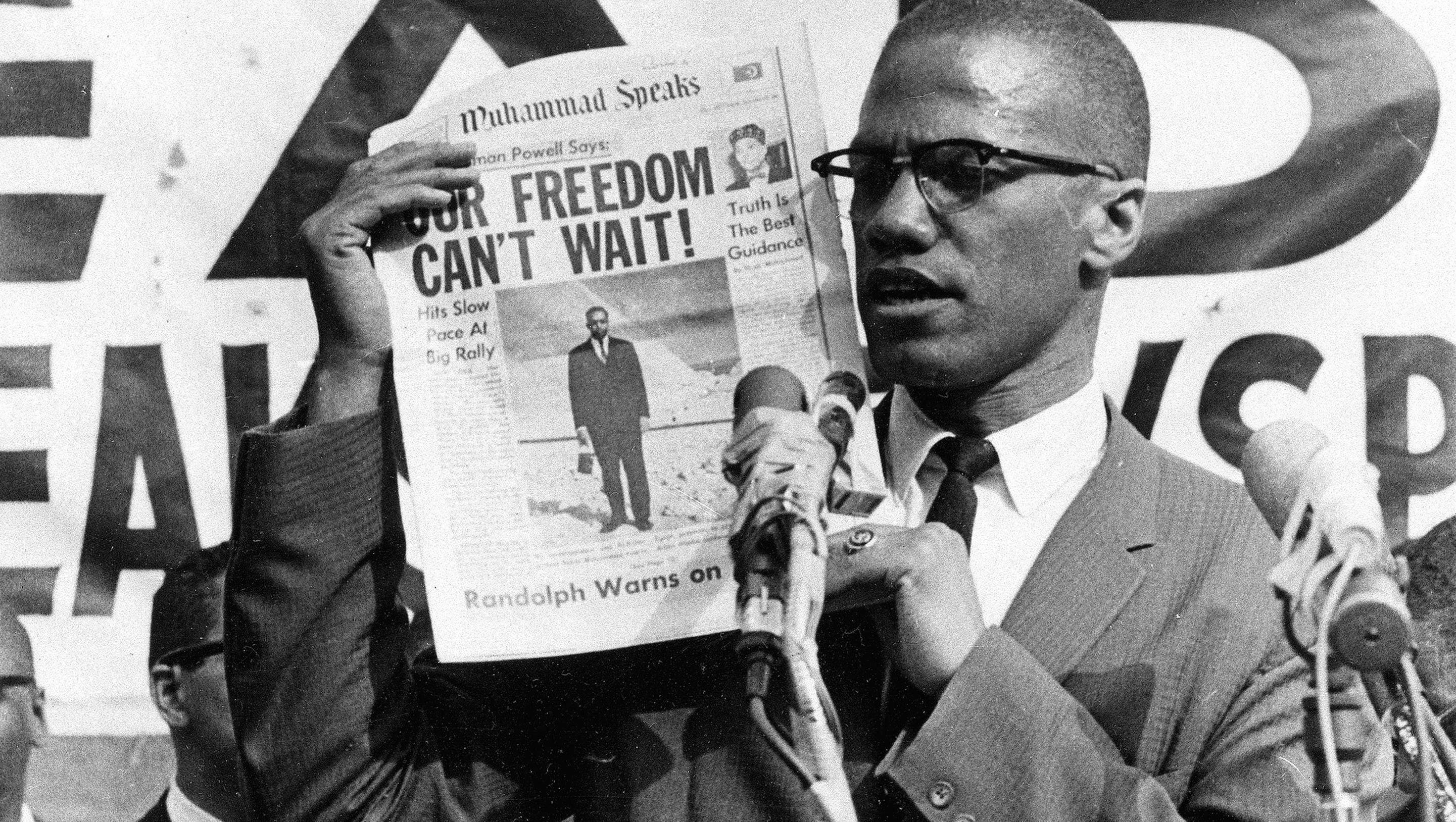
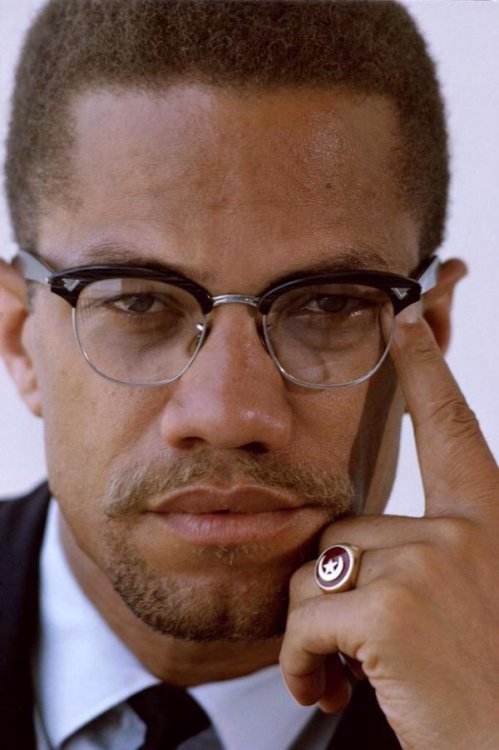
As the course progressed, I found myself fascinated by the life story of Malcolm X, a man that I sadly knew very little about. Due to this, I ended up writing most of my papers and discussion posts about this “sword” of a man who was active during the heroic period of the Civil Rights movement in the 1960s. Early on, I decided that my final paper for the class would somehow revolve around Malcolm X. I’m always trying to connect my different classes to aspects of Lincoln’s assassination and while I could have written a comparative piece about Malcolm X’s own assassination, the details of that killing are too unclear and still too recent to be fully understood. In the end, I decided to explore how Malcolm X used the legacy of Abraham Lincoln in his own activism. Many pieces have been written comparing Martin Luther King’s use of Abraham Lincoln’s legacy and words, yet I was not able to find any detailed account of how Malcolm X related to Lincoln. What follows is my analysis of Malcolm X’s often controversial relationship with the legacy of the 16th President.

I do not claim to be an expert on Malcolm X (nor Abraham Lincoln for that matter), so please forgive any egregious errors you may come across. I have tried my best to accurately portray Malcolm X and his views, but I am well aware that I am incapable of truly understanding the lived experiences and struggles of a Black man in 1960s America (and today). At the very least, I hope that this paper may motivate some of you to learn more about Malcolm X and his massive impact on the ongoing fight for Civil Rights.


Malcolm X and Abraham Lincoln

By Dave Taylor

In 1964, author Robert Penn Warren was in the process of collecting material for an upcoming book entitled, Who Speaks for the Negro? The volume was Warren’s attempt to learn more about the ongoing Civil Rights movement and those on the ground working to promote equality and fairness for all Americans. During his research, Warren met with many activists and leaders of the movement. On June 2, Warren found himself interviewing the noted firebrand, Malcolm X, born Malcolm Little. Warren asked the 39-year-old his opinions of politicians, living and dead. Never one to mince his words, Malcolm X spoke honestly of the many ways in which politicians and his fellow Civil Rights leaders had failed the Black community time and time again. Warren then posed the question, “What do you think of Abraham Lincoln?” Malcolm X replied, “I think that he probably did more to trick Negroes than any other man in history.”[1] As one of the most celebrated presidents in American history, often referred to after his death as The Great Emancipator, this harsh generalization of Abraham Lincoln’s legacy in regard to race was a shocking statement. While other Civil Rights leaders like Martin Luther King, Jr. often sought out the words and legacy of Abraham Lincoln in their unifying messages, Malcolm X provided an almost startling contrast, actively calling out and challenging the legacy of Abraham Lincoln, a man considered by many white and Black Americans as an untouchable martyr for liberty. By analyzing the few other times that Malcolm X’s views on Abraham Lincoln were recorded and by doing an exploration into the source of Malcolm X’s education on the 16th President, it becomes clear that X’s criticisms of Lincoln were the product of valid historical inquiry. In addition, there is strong evidence to support the idea that Malcolm X embraced the idea of creating controversy over Lincoln’s legacy as a means of promoting his own views of Black self-determination and autonomy.

Just a few months prior to Warren’s interview with him, Malcolm X had been a high-ranking member of the Nation of Islam (NOI). However, X’s increased devotion to political matters and his internal conflicts with the NOI’s religious leader, Elijah Muhammad, had caused X’s ousting from the organization. Yet his dismissal from the Nation of Islam had done little to impede X’s involvement in the Civil Rights movement. Rather, it unshackled him in many ways to be more open with his views as he no longer had to worry about whether they conflicted in anyway with the NOI’s teachings. Warren’s interview with X, dealt mostly with the role and viewpoints of Black Muslims in regards to the greater Civil Rights movement. Though removed from the NOI, X was still a devote Muslim, having converted to the Sunni faith. Warren pressed Malcolm to talk more about the non-violence movement endorsed by other members of the Civil Rights movement like Dr. King. This interview came just a few months after Malcolm X delivered one of his most famous speeches, The Ballot or the Bullet, in which he supported the power of voting in order to enact change, but also warned that Black Americans were tired of having to “turn the other cheek” while their rights and lives were threatened. The Ballot or the Bullet was a clarion call to all Black Americans that appeasement towards white supremacy was to stop, one way or the other.

While many of X’s answers to Warren’s questions did not end up making it into Warren’s finished product, the line about Abraham Lincoln having “tricked the Black man” did. In 1985, over twenty years after this interview, Black historian John Hope Franklin took exception to X’s categorization of Lincoln writing in his essay, “The Use and Misuse of the Lincoln Legacy” that X was, “not at all clear on what the trick was.”[2] Yet, perhaps unknown to Franklin was the fact that X had expanded on his thoughts regarding Lincoln during his interview with Warren and it was Warren who failed to include this additional material in his book. In continuing his explanation of how Lincoln had tricked the Black Americans, X stated:

“He was interested in saving the Union. Well, more Negroes have been tricked into thinking that Lincoln was a Negro lover whose primary aim was to free them and he died because he freed them. I think Lincoln did more to deceive the Negroes and to make the race problem in this country worse than any man in history.”[3]

From this extended response it is clear that Malcolm X put forth some supporting evidence for his view that Lincoln had tricked Black people. For Malcolm, Abraham Lincoln had unjustly been given the role as a white savior to the Black race. Malcolm was engaging in a form of historical analysis by actively questioning whether the veneration Lincoln had received in the period since his death was based on the actions and views of the man, or the mythology that had formed around him. While this off the cuff remark to Warren helps lay the groundwork of his views, additional sources help to define Malcolm X’s analysis further.

Malcolm X’s interview with Robert Penn Warren was not the first (nor the last) recorded example of his views on Abraham Lincoln. A few months earlier, at the end of February, 1964, Malcolm X was in Miami acting as a spiritual advisor of sorts to one of the Nation of Islam’s most high profile converts, Cassius Clay, soon to rename himself Muhammad Ali.

Malcolm X was already in the process of being pushed out of the Nation of Islam at this point but still had hopes that his service in helping to convert Clay would put him back into good graces with Elijah Muhammad. In the hours leading up to Clay’s famous bout with Sonny Liston, where Clay would become one of the youngest heavyweight champions ever, Malcolm X sat at a lunch table with sports journalist George Plimpton who found himself fascinated by X. Plimpton asked many questions to X about Islam, Clay’s conversion, and the overall condition of Black Americans. Plimpton got onto the topic of X’s ongoing troubles with the Nation of Islam, which X claimed were due to remarks about the recently assassinated John F. Kennedy which the NOI deemed in poor taste. But Malcolm did not believe he was wrong in stating that Kennedy had not been a friend to Black Americans. He reminded Plimpton that Kennedy was, above all, “a cold-blooded politician,” and that, “there never had been a politician who was the Negro’s friend.”[4] In Plimpton’s recollections of the discussion, which were published in Harper’s Magazine in June of that year, X then started began talking about Abraham Lincoln stating, “Lincoln? A crooked, deceitful hypocrite, claiming championship to the cause of the Negro who, one hundred years later, finds himself singing, ‘We Shall Overcome.’”[5] Like his later comments to Warren, Malcolm X expresses his frustration at the disparity he feels exists between Lincoln the man and Lincoln the legacy. While, on the face of it, Malcolm’s words may seem like – to use the vernacular of boxing – a sucker punch to Abraham Lincoln, his harsh words stem from legitimate criticisms on Lincoln views and policies on race.

The best source we have for understanding Malcolm X’s thought process on Abraham Lincoln comes from a recorded interview he did with a yet undetermined interviewer around 1960. A short, 29 second clip of what appears to be a televised interview can be found online. Narration starts the clip noting that the, “news media had begun to take notice” of Malcolm X,  before we see the interviewer hold out his microphone to X. While we do not know the exact phrasing of the interviewer’s question, the response makes it clear that Malcolm X was asked directly about Abraham Lincoln. Malcolm X then gives the following response:

“Abraham Lincoln tricked the so-called Negro into thinking that he was free and when you read some of the books that were written by the so-called Negro historian J. A. Rogers, one of his books Africa’s Gift to America, he points out plainly how Abraham Lincoln did nothing but trick the Negro, fool the Negro, and use the Negro the same as every other politician who has been in the White House has been tricking and fooling and using the Negro as a political football ever since America has been America.”[6]

This interview very much echoes Malcolm X’s words to George Plimpton in 1964 as the Civil Rights leader equates Lincoln to generations of politicians who have used and misused Black Americans for their own benefit. However, the key to this interview is that X provides the source of his material. He essentially advertises for the Black historian Joel A. Rogers, specifically mentioning his book, Africa’s Gift to America.

Joel Augustus Rogers was a groundbreaking Black historian who, “dedicated over fifty years of his life to writing about and debunking the fallacies of racist European and American scholarship that denied people of African descent had a history worth writing about.”[7] Among Roger’s numerous works were books and articles titled, “What are We, Negroes or Americans?”, “The Negro in European History”, World’s Greatest Men and Women of African Descent, “The Suppression of Negro History”, and the aforementioned Africa’s Gift to America: The Afro-American in the Making and Saving of the United States. This last volume was one of Roger’s final books, having been published originally in 1959 with an updated version coming out two years later in 1961. Joel Rogers was also a regular contributor to the Pittsburgh Courier, a leading Black newspaper of the day, in which he wrote a column entitled History Shows. Malcolm X had a long familiarity with Rogers. On January 1, 1959, Malcolm X invited Rogers to speak to over 1,600 Nation of Islam members at New York’s Temple No. 7, where he was the leader. While not a Muslim himself, Rogers spoke glowingly of the NOI and how its followers were educating themselves about their history. “Not only do they, themselves, want to learn, but they want to spread this knowledge to the rest of our people,” Rogers stated to Malcolm X’s audience.[8] Joel Rogers was one of the pioneers of what we would now refer to as African American Studies.

In many ways, Joel Rogers was a kindred spirit to Malcolm X. When asked about his writing on the topic of Black history, Rogers stated that his motivation stemmed from his, “early childhood when it was firmly impressed on me by the ruling class that black people were inherently inferior and that their sole purpose for being was to be servants to white people and the lighter-colored mulattoes.”[9] Rogers rejected the white supremacist doctrine of his youth that Blacks were inherently inferior to whites. Similarly, Malcolm X vividly recalled his own childhood memories of being called by racial epithets and being treated poorly by whites of all classes. Yet, like Rogers, Malcolm witnessed the inherent strength and promise of the Black race, even while a white supremacist society tried to keep him down. Malcolm had the benefit of having been born to activist parents and in his autobiography, Malcolm recalled being transfixed by meetings his father organized: “I remember how the meetings always closed with my father saying, several times, and the people chanting after him, ‘Up, you mighty race, you can accomplish what you will!”[10] It is no surprise then that Malcolm X was a firm proponent of Joel Rogers’ work. Rogers helped to provide Malcolm with a historical basis for the strength and self-dignity that Malcolm X knew Black people possessed, despite the attempts of white supremacy to deny them this heritage.

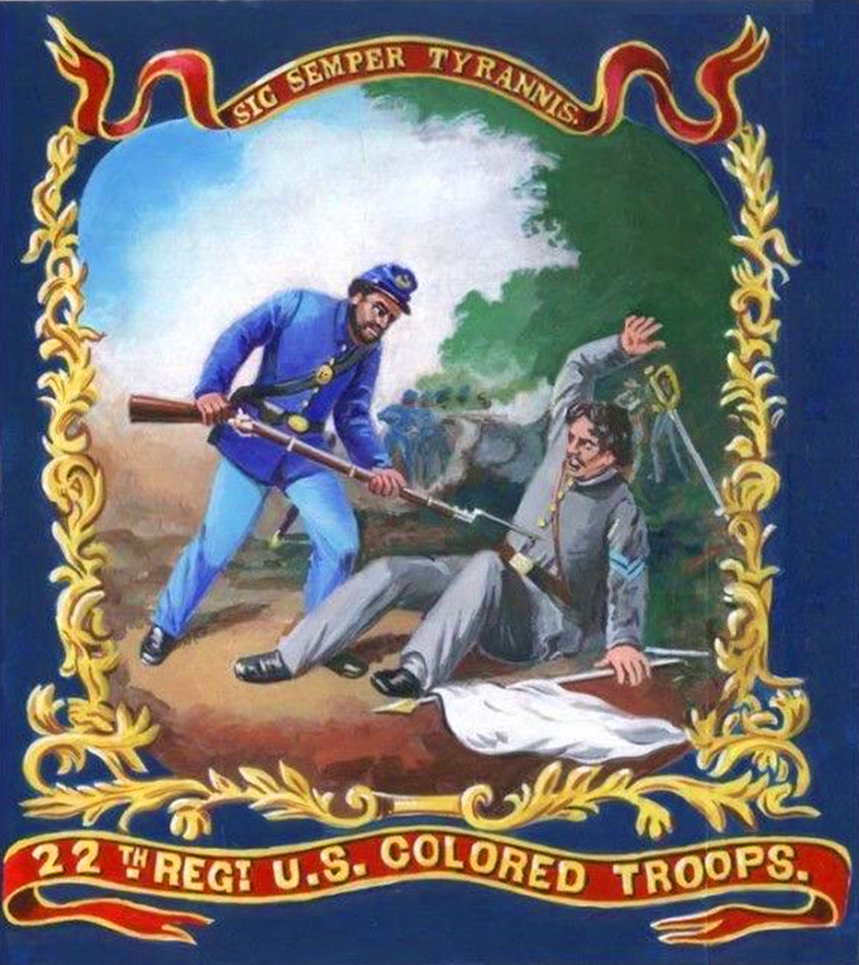
Therefore, to understand Malcolm X’s views on Abraham Lincoln, it is important to analyze the historiographical work of Joel Rogers on the subject. In Africa’s Gift to America, Roger heads the corresponding chapter on the Civil War as, “The Negro In the Saving of America” and this perfectly encapsulates his overall thesis. Rogers recalls the process of the Civil War and the struggles the Union had in gaining the upper hand over the Confederate states. When describing the Emancipation Proclamation, Rogers quickly dismisses the oft held idea that the true purpose of the decree was to end slavery. Rogers writes, “Did it free the slaves? Definitely not. It was a gesture rather than a reality since it ‘freed’ only those slaves Lincoln had no power to free and kept in slavery those he had the power to free.”[11] While other historians made find exception with Rogers’ directness and candor on this, he is not incorrect with his assessment of the direct effect of the Emancipation Proclamation. The order only claimed to free the slaves in the states then in rebellion, and had no effect on the enslaved people still held in bondage in the Union border states. Granted, it did result in the freeing of those held in bondage in Union occupied areas of the South, but direct emancipation as a result of the proclamation was very minimal. Rogers opines the mythology of Lincoln’s Emancipation Proclamation as having singlehandedly freed the slaves, writing, “Perhaps no other important document in all history has been more misinterpreted.”[12] Yet, Rogers does acknowledge that the Emancipation Proclamation was incredibly vital for the survival of the United States, for, while it did little to free those still held in bondage, it created a pathway for Black men to become part of the Union army and fight for the freedom of their brothers and sisters. Rogers spends most of the remaining chapter demonstrating how the tireless devotion and bravery of the newly formed United States Colored Troops helped the Union emerge victorious after four long years of fighting. Rogers recounts moments of both regimental and individual acts of selflessness and sacrifice on the part of Black soldiers even in the face of incredible adversity and racism on the part of white Confederate and Union citizens alike. Malcolm X no doubt appreciated and valued Rogers’ work in showing how men who were once enslaved themselves, fought and freed those still held in bondage.

While Rogers’ accounts of glory personified Malcolm X’s views on Black power, his critical assessment of the legacy of Abraham Lincoln also spoke to X’s distaste of white savior myths which disregarded Black autonomy and self-determination. In his efforts to bring the mighty image of Father Abraham off of his pedestal, Rogers spends a considerable amount of space in his book quoting Lincoln’s distasteful racial views. Rogers recalls how, in his debates with Stephen Douglas in 1858, Lincoln stated, “there must be the position of superior and inferior, and I as much as any other man am in favor of having the superior position assigned to the white race.”[13] For Rogers, this was evidence that the image of Abraham Lincoln as a benevolent friend of all Black people was misguided. Rogers also criticized the delayed nature of Lincoln’s issuance of the Emancipation Proclamation after years of war. Since the beginning there had been the near constant call of abolitionists, both white and Black, asking for the chief executive to make it explicitly known that the cause of the war was to end slavery. From the abolitionists’ point of view, this was what the Confederate states had understood it to be when they seceded in the first place. Included in the Lincoln portion of Rogers’ book is a quote from Frederick Douglass. At the unveiling of the Emancipation Memorial in Washington, D.C. in 1876, the famous Black abolitionist and orator recalled that Lincoln, “was preeminently the white man’s President, entirely devoted to the welfare of white men. He was ready and willing at any time during the first years of his administration to deny, postpone, and sacrifice the rights of humanity in the colored people in order to promote the welfare of the white people.”[14] When Rogers presented these quotes and wrote about Lincoln in Africa’s Gift to America, he was not breaking new ground in Lincoln research. Lincoln’s record on race relations and devotion to the preservation to the Union were well documented in other Lincoln texts of the day. One of the sources Joel Rogers uses for his book was the groundbreaking series by Carl Sandburg’s called Abraham Lincoln: The War Years. The first volume in this series contains a letter Lincoln wrote to abolitionist newspaper editor Horace Greeley in 1862 in which the President stated:

“My paramount object in this struggle is to save the Union, and is not either to save or destroy slavery. If I could save the Union without freeing any slave, I would do it; if I could save it by freeing all the slaves, I would do it, and if I could save it by freeing some and leaving others alone, I would also do that. What I do about slavery and the colored race, I do because I believe it helps to save the Union.”[15]

This assertion that the preservation of the Union was the first and foremost goal in Lincoln’s mind during the Civil War is also combined with Lincoln’s support, even during his time as President, for colonization movements. Believing that the different races could not live together in harmony, Lincoln proposed for Black Americans to be sent to Africa and establish colonies there. When told of this plan in person, Frederick Douglass and many others balked at the idea of being sent from their homeland to a continent they knew nothing of. In recounting Lincoln’s words and opinions on race, Joel Rogers makes a compelling argument that humanizes Lincoln as a complicated man which disassociates him from the otherwise held myth of Father Abraham, patron saint of the Black race.

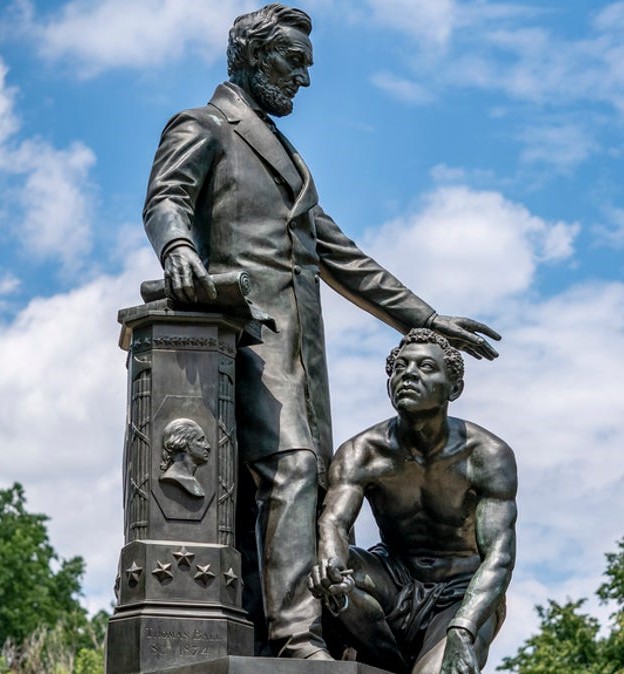
Yet, even as Joel Rogers uses Lincoln’s own words to criticize the 16th President, the historian is not unfeeling or ignorant of the circumstances Lincoln found himself in. Rogers writes, “There is much I admire about Lincoln and I sympathize greatly with him for the many trying problems he had to face but in all fairness it must be said that he owed vastly more to the Negro than the Negro to him.”[16] As Rogers posited, it was the Black troops that helped to turn the tide of war in the Union’s favor. The increased manpower brought about by the enlistment of Black soldiers and the devotion with which they fought for the cause of freedom, saved Lincoln from suffering the fate as vanquished Confederate President Jefferson Davis. But, more importantly, Rogers defends his criticisms of Lincoln’s words and personal views even if it seems contrary to the popularly accepted interpretation of the Great Emancipator. Rogers writes, “Lincoln became the bible of the great Negrophobes.”[17] According to Rogers, Black Americans put too much stock in Lincoln the politician who only directly freed a miniscule amount of enslaved people in order to win a war. This mythology caught on so much that the power of Black Civil War soldiers was diminished so as to essentially remove them from the narrative. Black Americans were expected to bow and pay reverence to Lincoln for their freedom rather than acknowledge their own success. Perhaps this idea is personified best by the nature of the statue Frederick Douglass helped to unveil in 1876 which shows a formerly enslaved man kneeling at the feet of Lincoln who is beckoning him to stand up.

Joel Rogers and Malcolm X could both see the way in which this legacy of Abraham Lincoln could be weaponized against Black people. In his autobiography, Malcolm spoke of the way in which he worked to change the narrative in order to include the stories of Black strength completely independent of white savior imagery. There was a considerable backlash to Malcolm’s refusal to pay heed or enough reverence to the man the white press thought should be an icon to the Civil Rights leader. Malcolm recalled:

“I can remember those hot telephone sessions with those reporters as if they were yesterday. The reporters were angry. I was angry. When I’d reach into history, they’d try to pull me back to the present…They would unearth Lincoln and his freeing of the slaves. I’d tell them things Lincoln said in speeches, against the blacks.”[18]

It was in this way that Malcolm sought to engage his interviewers in the process of historical analysis but was met with anger due to his perceived disrespect for an American icon.

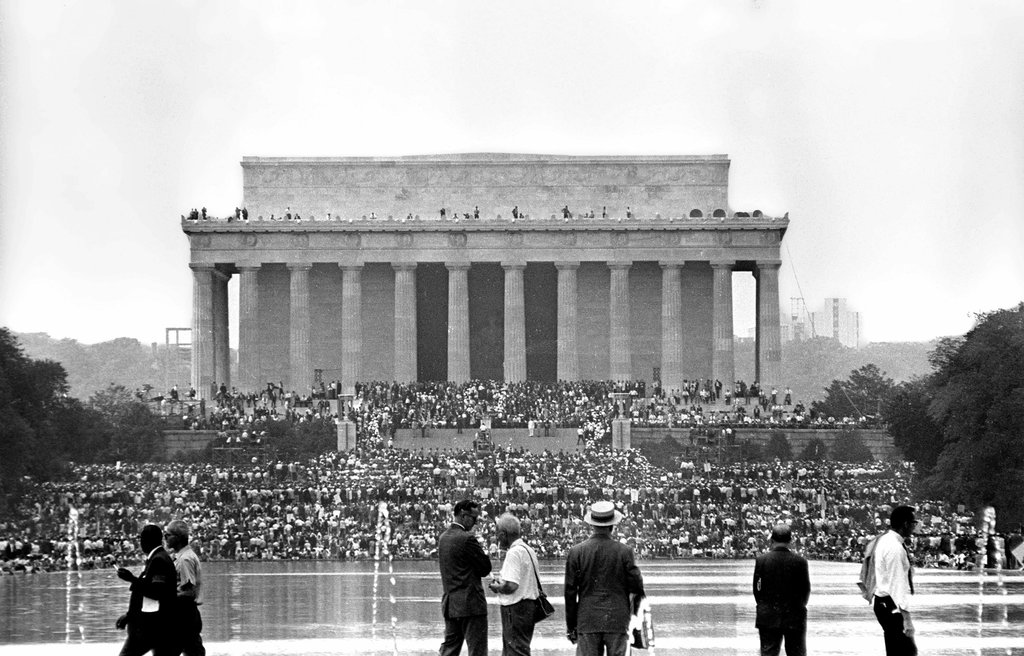
In August of 1963, many Civil Rights leaders and activists were busy preparing for the March on Washington for Jobs and Freedom. The march would culminate at the Lincoln Memorial in Washington, D.C. with Martin Luther King giving his now timeless, “I Have a Dream” speech. Malcolm X, the ever-reliable contrarian, took issue with the ways in which the planned march had been co-opted by the government. He stated that when the, “white man heard about this mass demonstration in the beginning which was to consist of sit-ins etc. on the White House lawn, airports and other public grounds, he decided to control it.”[19] A proponent of Black strength in the face of white supremacy, Malcolm regularly criticized the Civil Rights movement for failing to act in what he considered to be the proper, revolutionary way. He felt that King and other leaders spent too much time capitulating to white supremacists and their laws rather than actively fighting against them. At this point in his life, X did not see integration as a feasible or desired outcome. His lived experience as a Black man in America, his religious conversion to the Nation of Islam, and his readings from historians like Joel A. Rogers, had collectively taught him that white America would not accept true integration and social equality. Malcolm sought Black autonomy as a means of protection for his people. The hard lessons of life had trained him to be suspicious of most white people, especially those who claimed to be liberal minded and on the side of Civil Rights. Thus, King’s inclusion of white activists and leaders into the March on Washington was seen by X as a neutering element. X echoed this idea in the months after the March on Washington:

“It’s just like when you’ve got some coffee that’s too black, which means it’s too strong. What you do? You integrate it with cream; you make it weak. If you pour too much cream in, you won’t even know you ever had coffee. It used to be hot, it becomes cool. It used to be strong, it becomes weak. It used to wake you up, now it’ll put you to sleep. This is what they did with the march on Washington.”[20]

Malcolm X’s compelling criticisms of the non-violence and non-confrontational nature of the march in response to acts of violence and discrimination against Black Americans was perfectly aligned to his overall opposition to Dr. King’s vision for the Civil Rights movement in general. Malcolm was tired of acquiescing any ground to white supremacists and those who supporting their agenda, whether knowingly or otherwise. He was tired of the strength and ability of Black people being ignored or diminished. For X, Civil Rights would only be gained when Black people actively rejected all forms of white supremacist indoctrination, including the internalized kind. By understanding this, it is easier to address why Malcolm X vehemently rejected what he believed to be a mythicized interpretation of Abraham Lincoln and his legacy.

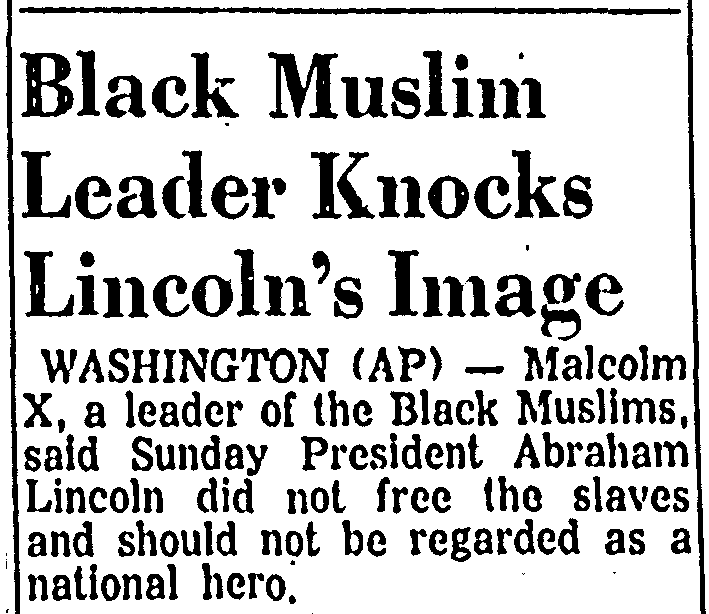
In an Associated Press article that was published in newspapers around the country just two days before the March on Washington, X repeated his message charging that King was allowing the government to co-opt what should otherwise be a revolutionary act. He lamented that the march was now being, “controlled by the government and is being used for political expediency.”[21] However, this larger message was overshadowed in the press due to X’s decision to make mention of Abraham Lincoln and the fact that the march was to end at the Lincoln Memorial. Instead of headlines for the article highlighting the Civil Rights leader’s critique of outside influence on the march, many of the nation’s leading newspapers carried the article under headlines like, “Black Muslim Leader Knocks Lincoln’s Image”, “Lincoln No Hero, Malcolm X Insists”, and “Lincoln Didn’t Free Slaves – Malcolm X”. In Abraham Lincoln’s former hometown of Springfield, Illinois, the Illinois State Journal titled the story with “Abe Failed Negroes: Malcolm X”. The change of focus away from the march and onto Abraham Lincoln was due to X, once again, engaging in a form of historical analysis on Lincoln’s legacy. In the article Malcolm X stated:

“For all these Negro leaders to bring Negroes from all over the country and go down to a dead man’s statue, a dead president’s monument who was supposed to have issued an Emancipation Proclamation 100 years ago, and if what he had issued had any authenticity or sincerity and had gotten the job done this whole problem wouldn’t exist now.”[22]

By reading this quote closely, it appears that X was actually using Lincoln as a metaphor for the generational failures that prevented those freed from slavery from achieving any sort of equality in the century of so-called progress that followed. This criticism was as much a condemnation of X’s time as it was a shot across Lincoln’s bow. Malcolm X seemed to be challenging everyone to look at the world around them and decide whether the condition of Black Americans in his time could easily be rectified if Lincoln’s mythicized legacy of the white savior was to be believed. In this way, X was engaging in his common pattern of trying to get his audience to question long held and internalized views of white supremacy in order to help them find their own power.

When further pressed about his personal opinion of Lincoln, Malcolm stated, “I don’t think anyone who reads the true history of Lincoln, his motives, regards him as any hero.”[23] Malcolm is once again showing his acceptance of Joel Rogers’ thesis that Abraham Lincoln’s actions on behalf of African Americans was a result of political necessity rather than higher moral conviction. However, as noted above, even Rogers tended to give Lincoln a bit more sympathy and understanding than Malcolm X did in his public comments. Malcolm X, would not dispense any such sympathy with Lincoln, at least not publicly, because it wasn’t really Lincoln that Malcolm X was sparring against, but the way in which the legacy of Lincoln had been used to the benefit of white supremacy. By putting the end of slavery solely on the shoulders of Abraham Lincoln, the contributions of others, namely the sacrifice of thousands of African American troops and the enslaved themselves, were dismissed and buried. Lincoln’s legacy as the Great Emancipator had been used against Malcolm X and his call for Black autonomy. Even though Lincoln had done well in helping to bring about the end of slavery, Malcolm X saw how the adulation of Lincoln could have a negative effect when it stripped Black Americans of knowledge of their own contributions and reinforced the idea that a white savior was needed for any significant change to their circumstances to happen.

Lincoln historians have long taken issue with Malcolm X’s criticisms of the 16th President. They acknowledge the truth contained in Rogers’ book in so far as Lincoln did express racial views that would not be acceptable today. They also acknowledge that Lincoln was, at one time, a proponent of the colonization movement which aimed to send Black Americans to Africa. However, most Lincoln historians will also be quick to point out that Lincoln was capable of great change and growth. Part of the reason Lincoln is admired in the way that he is, is due to the way he continually adapted to changing circumstances and evolved in his views. This was also true when it came to his views on race. This is evident in the last speech he gave from the balcony of the White House on April 11, 1865. In that speech, Lincoln discussed how the former Confederate states were to be allowed back into the Union. He discussed the new state Constitution of Louisiana, taking a moment to touch on the concept of Black suffrage. Lincoln stated, “It is also unsatisfactory to some that the elective franchise is not given to the colored man. I would myself prefer that it were now conferred on the very intelligent, and on those who serve our cause as soldiers.”[24] While the enfranchisement solely of Black soldiers and those arbitrarily deemed “very intelligent” would not have satisfied Malcolm X, the gesture helps to demonstrate the evolution that X often denied Lincoln in his comments. It can be argued that Lincoln’s racial evolution contributed to his death as John Wilkes Booth was in the audience of that last speech and allegedly took such umbrage at the idea of Black citizenship that he then vowed to murder Lincoln. Still, while historians are quick to come to Abraham Lincoln’s defense with examples of Lincoln’s complexity and growth, it appears that few are willing to accord the same level of detail to understanding the context behind Malcolm X’s criticisms.

In a 2000 article by Eric Foner entitled, “Was Abraham Lincoln a Racist”, the noted historian lamented the “full scale assault on Lincoln’s reputation” by Black author Lerone Bennett who presented an updated version of Joel Rogers’ thesis. Foner provided the context for many of Lincoln’s more egregious racial comments and laid the groundwork to show Lincoln’s growth on racial issues. In this way, Foner falls in around Lincoln, helping to defend the 16th President’s legacy from what he believes are misguided misinterpretations of a far more complex individual. The Lincoln field is full of both professional and amateur historians, always ready to defend Lincoln’s legacy from any perceived slights. However, Foner should be noted for his likewise ability to analyze and engage with Malcolm X’s criticisms rather than tossing them aside. Foner becomes one of the few historians to provide Malcolm X with the same degree of understanding as scholars generally give Abraham Lincoln. Foner noted that, “In the early 1960s, Malcolm X urged blacks to ‘take down the picture’ of Lincoln – that is, to place their trust in their own efforts to secure racial justice rather than waiting for a new white emancipator.”[25] Unlike the press and white public in Malcolm X’s time, Foner acknowledged that Malcolm X’s criticisms of Lincoln were a product of his own lived experiences and activism.

From Malcolm X’s study of history, the widely held view that Abraham Lincoln was a true abolitionist with a lifelong devotion to the freedom and elevation of African Americans was at odds with the evidence shown in the historical record. While Lincoln’s actions did help bring about the end of slavery and such a step was crucial in the advancement of civil rights in the United States, Malcolm X took exception to the elevation of Abraham Lincoln above all others in the cause of abolition. Malcolm X observed that the veneration for Lincoln could sometimes produce toxic results as it overshadowed the acknowledgment of Black Americans who fought for their own freedom and future. Lincoln was also sometimes used against those in the Civil Rights movement as even white supremacists invoked Lincoln as a way of demanding obedience, as if Black Americans still owed the white race for Lincoln’s magnanimous actions a hundred years earlier. It was for all these reasons that Malcolm X rejected and spoke out against the mythicized Abraham Lincoln. He knowingly created controversy through his criticisms of Lincoln in order to reframe the discussion away from the century dead, white marble martyr seated in his shrine and towards the conditions Black citizens faced in the U.S. in the 1960s.

While he gave interviews to white reporters and authors, Malcolm X’s audience was always his Black brothers and sisters. When Malcolm X referenced Lincoln’s racist views, he did so to start conversations among Black Americans about their own form of internalized white supremacy. During his short time on earth, X channeled the words he heard as a child, doing all that he could to motivate Black citizens to rise up and, “accomplish what you will.” Malcolm X rejected the internalization of Abraham Lincoln as a white savoir. He rejected this mythicized view of Lincoln and sought to replace it with stories of Black autonomy and strength. In the end, Malcolm X’s criticisms of Abraham Lincoln were based on legitimate historical evidence. This evidence was provided through the lens of historian Joel Rogers who shared in Malcolm X’s view that the accomplishments of Black Americans had been drastically overshadowed and rejected. Malcolm X had grown up with a legacy of Abraham Lincoln which, through his study, he came to see as a myth. As a result, Malcolm X fought against that mythology because he came to see Lincoln’s legacy as a form of white supremacy. By challenging Lincoln’s legacy through historical analysis, Malcolm X worked to counter the mythology that he felt detracted from the accomplishments of Black Americans in shaping and claiming their own destinies.


Notes

[1] Malcolm X, Interview by Robert Penn Warren, June 2, 1964, tape 2, transcript and recording, University of Kentucky, https://whospeaks.library.vanderbilt.edu/interview/malcolm-x.
[2] John H. Franklin, “The Use and Misuse of the Lincoln Legacy,” Journal of the Abraham Lincoln Association 7, no. 1 (1985): 35.
[3] Malcolm X, Interview by Robert Penn Warren, June 2, 1964, tape 2, transcript and recording, University of Kentucky, https://whospeaks.library.vanderbilt.edu/interview/malcolm-x.
[4] Malcolm X, The Portable Malcolm X Reader edited by Manning Marable and Garrett Felber, (New York: Penguin Books, 2013), 290.
[5] Ibid.
[6] Malcolm X in interview by unknown reporter, 1960, Budget Films, http://www.budgetfilms.com/clip/13991/.
[7] Thabiti Asulkile, “J. A. Rogers: The Scholarship of an Organic Intellectual” The Black Scholar 36, no. 2-3 (Summer/Fall 2006): 35.
[8] Pittsburgh Courier, Jan. 10, 1959, p6
[9] Thabiti Asulkile, “J. A. Rogers: The Scholarship of an Organic Intellectual”, 38
[10] Malcolm X, The Autobiography of Malcolm X, (New York: Ballantine Books, 1964), 9.
[11] Joel A. Rogers, Africa’s Gift to America: The Afro-American in the Making and Saving of the United States, (New York: Futuro Press, 1961), 157.
[12] Ibid.
[13] Joel A. Rogers, Africa’s Gift to America, 202.
[14] Joel A. Rogers, Africa’s Gift to America, 198.
[15] Carl Sandburg, Abraham Lincoln: The War Years Vol. One, (Philadelphia: C. Scribner’s Sons, 1926), 567.
[16] Joel A. Rogers, Africa’s Gift to America, 203.
[17] Joel A. Rogers, Africa’s Gift to America, 203 – 205.
[18] Malcolm X, The Autobiography of Malcolm X, 264.
[19] Malcolm X, The Portable Malcolm X Reader, 243.
[20] Malcolm X, The Portable Malcolm X Reader, 272.
[21] Malcolm X, “Abe Failed Negroes: Malcolm X” Daily Illinois State Journal (Springfield, IL), Aug. 26, 1963.
[22] Ibid.
[23] Ibid.
[24] Isaac Arnold, The Life of Abraham Lincoln, (Chicago: Jansen, McClurg, & Company, 1885), 415.
[25] Eric Foner, “Was Abraham Lincoln a Racist?” Los Angeles Times (CA), Apr. 9, 2000.

Categories: History | Tags: , | 6 Comments

An Update Regarding John Wilkes Booth’s Knife

Back in December, I put up a post here on LincolnConspirators that contained my research on the knife John Wilkes Booth used to stab Major Rathbone following the assassination of Abraham Lincoln. By consulting the period evidence that came out during the trial of the conspirators, it is my firm belief that Ford’s Theatre has been displaying the incorrect knife for years and that the correct knife is locked away at the NPS storage facility in Landover, MD.

If you haven’t read the piece, please take a few minutes to read the article and look at the evidence for yourself: https://lincolnconspirators.com/2018/12/31/cloak-and-daggers-cutting-through-the-confusion-of-the-assassination-knives/

The post itself was actually just a reprint of my original article on the subject, which had been published in the Surratt Courier in March of 2012. Since that time, I have been trying to get Ford’s Theatre to acknowledge its unintentional error. In 2012, I sent the article to the National Park Service rangers at Ford’s and to representatives of the Ford’s Theatre Society. While I had a few individuals tell me that they found the evidence compelling, none felt they had the authority to make any changes. And so, for the past seven years, each time I take a group or a bus tour to Ford’s Theatre, I am compelled to point out to the group that they should disregard the knife on display. When asked why Ford’s Theatre doesn’t make an effort to correct its mistake, I can only shrug my shoulders in reply.

Recently, however, there has actually been some progress regarding John Wilkes Booth’s knife. The Ford’s Theatre Society and the National Park Service felt motivated to do their own investigating and last month they published an article on their blog regarding their exploration into the knives. I highly recommend you read their post before continuing with this one: https://www.fords.org/blog/post/which-knife-did-john-wilkes-booth-use-disentangling-the-lincoln-assassination-knives/

By looking at their accession and cataloging records, the Ford’s Theatre team discovered what those of us who study some of these artifacts already knew – their records are incomplete and, at times, incorrect. Remember that after the trials of the conspirators, John Surratt, and the impeachment proceedings against President Johnson, the pieces of evidence (like the knives) were locked away in the Judge Advocate General’s office. They stayed in the possession of the JAG for over 70 years, but there was a distinct lack of orderly care and documentation of those artifacts. The items were regularly removed from their boxes in the JAG and shown off to visitors and reporters. When moths were discovered infesting some of the trial exhibits, the JAG carted the clothing of the assassins into a courtyard and burned it. Some pieces, such as Booth’s diamond stick pin, just mysteriously disappeared from the collection. The JAG was simply not a good steward of the trial exhibits. When the artifacts were finally turned over to The Lincoln Museum (Ford’s) in 1940, the people in the JAG didn’t really know what they had anymore. They wrote up a list which was filled with inaccuracies, and that is what Ford’s has had to rely on for many years. Ford’s inherited messy records and a faulty catalog through no fault of their own.

My research, however, doesn’t rely on those faulty records. I drew my conclusions based on the period evidence of 1865 and 1867, which describes the knife Booth used on Major Rathbone. Those descriptions clearly show that the Liberty knife on display at Ford’s Theatre is not correct. Even the two authors of Ford’s article, David McKenzie and Janet Folkerts, seem to accept that my research on this is sound:

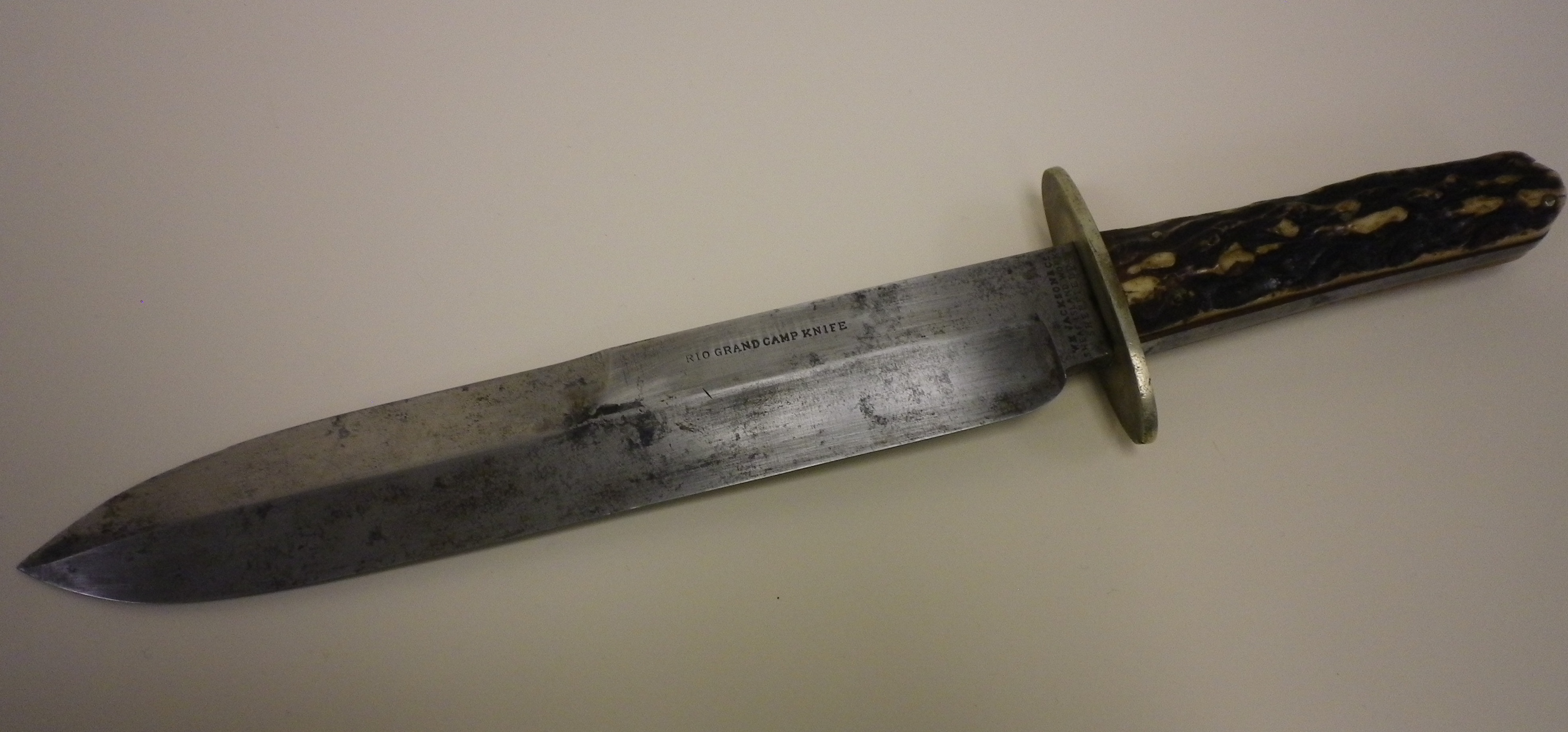
“In his post, Taylor presents additional evidence that the knife currently on display at the Ford’s Theatre Museum, FOTH 3235 (the Liberty knife), is not the actual knife. He cites testimony of witnesses in the assassination investigation, the 1865 military tribunal and the 1867 trial of John Surratt to argue that FOTH 3218 (the Rio Grande knife) is the knife that Booth used to stab Rathbone, and not FOTH 3235 (the Liberty knife), the knife that is currently on display at the Ford’s Theatre Museum.

Between that evidence and what is in the curatorial files described above, we’re inclined to say, at the very least, that a good amount of evidence points to that conclusion.”

The Ford’s Theatre blog post addresses their messy records (which, again, is not their fault as they were originally given erroneous records regarding these artifacts) and acknowledges that the period evidence regarding the knives points to the conclusion that they have the incorrect knife on display.

And yet, the very next sentence in the post is, “But because the evidence is so messy, as Taylor notes, we aren’t prepared to make a definitive declaration.” I have a couple of problems with this sentence. First of all, as I have already stated, the evidence that is “messy” is not historical but curatorial. The accession records regarding the artifacts are inherently messy due to the manner in which they were stored for over 70 years. That is why it is so crucial to take the time to return to the historical evidence for these artifacts. While my article addresses the messy curatorial records, all of my conclusions are based on the historical records, which are clear. John Wilkes Booth stabbed Major Rathbone with a Rio Grande Camp Knife that bore a small spot of rust that looked like blood on the blade.

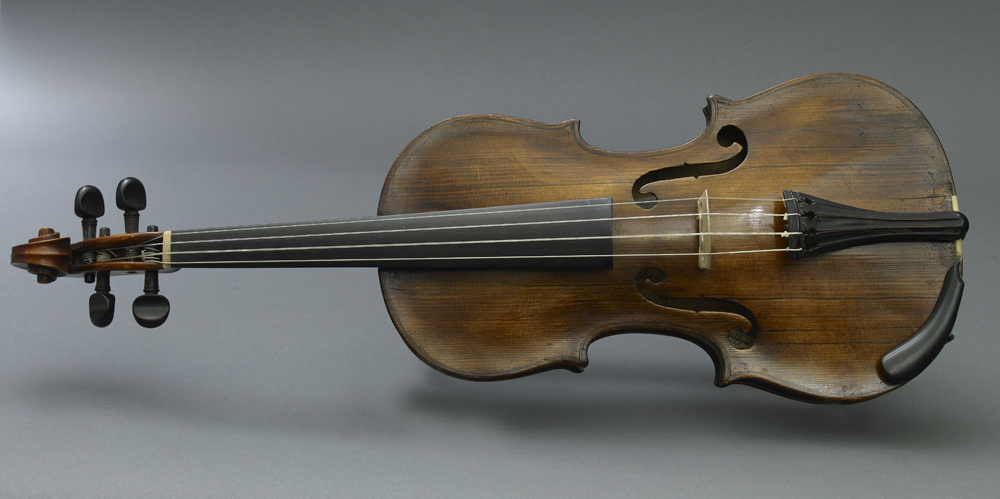
The Liberty knife (shown below), currently on display at Ford’s Theatre, does not fit that description. The Rio Grande Camp knife, known as FOTH 3218, currently in storage in the Museum Resource Center in Landover, does fit this description. While there is a bit of uncertainty regarding where the Liberty knife came from and its place in the trial exhibits, it is clear that it was not the knife Booth used to stab Rathbone.

Secondly, the claim that they “aren’t prepared to make a definitive declaration” is, in itself, a declaration. It’s a declaration that when faced with choosing between incomplete accession and cataloging records or compelling historical evidence, Ford’s Theatre will choose the former if it keeps the status quo. In the course of their post, Ford’s Theatre does not provide any historical evidence to support the Liberty knife as being the one that Booth used. Other than some newspaper accounts from the 1900s from journalists who went to see the artifacts in storage and were told inaccurate information by the clerks in the JAG office, I have never come across any historical evidence that attributes the Liberty knife to Booth. Without true historical evidence, how can Ford’s Theatre only commit that at some unspecified “future” the “on-site and online labels at Ford’s Theatre will reflect the ambiguity of the knives”? Even their claim that “Perhaps a future display could, like Taylor’s post and ours suggest, showcase both knives and lay out evidence to show our visitors how ambiguous historical evidence often is,” creates a false equivalency between Ford’s messy curatorial records and actual historical evidence from the period.

The historical evidence in support of FOTH 3218 as being the knife John Wilkes Booth used on the night of Lincoln’s assassination and as the one that was recovered from his body at the Garrett farm is not ambiguous. Messy accession and cataloging records should not supersede historical evidence at an institution committed to educating the public on the life and legacy of Abraham Lincoln. While John Wilkes Booth’s knife may not rise to the same level of other artifacts like Lincoln’s stovepipe hat, the weapons and possessions of the assassins tell a crucial story of Lincoln’s effect on his fellow man.

I know that the employees of the Ford’s Theatre NPS and the Ford’s Theatre Society are good people. I have worked with them on projects and on Booth tours. I follow many of them on Twitter and know that they are professionals who value education and public history. I appreciate greatly that Ford’s Theatre has chosen to address this part of their collection in such a public way. As David and Janet state in their closing line, “transparency about artifacts like these knives can lead to discussions about what makes visitor experiences in museums ‘real’ and how the history of objects and places affect us in the present day.” Ford’s is to be commended for their professionalism and their ongoing work in acknowledging the complications in their own collection. But acknowledgement without subsequent action is meaningless. It’s the “thoughts and prayers” of the museum world.

To my friends at Ford’s Theatre NPS and the Ford’s Theatre Society: The wrong artifact is on display and has been for many years. With the historical evidence solely in favor of FOTH 3218 and your cataloging records expectantly inconclusive, the correct remedy is to remove the Liberty knife from display and replace it with FOTH 3218. By doing so, you will show your visitors that Ford’s Theatre is an institution that actively improves its exhibits based on sound research, is open about the history of its collection and the uncertainties that exist, and demonstrates a commitment to using historical evidence to guide your public outreach.

In September, I will be taking my next busload of guests to Ford’s Theatre for the John Wilkes Booth escape route tour. My sincerest hope is that I will finally be able to point to FOTH 3218 in the case and rave about the wonderful professionals at Ford’s Theatre who acknowledged an error in their collection and used historical evidence to rectify it. The research has been done, and the error has been acknowledged. All that’s left to do now is to fix it.


For those who are interested, what follows is the fairly long series of tweets I wrote shortly after I read the Ford’s Theatre blog post in May. I have expressed many of the same sentiments in what I wrote above, but I thought I’d include my original thoughts as well.


Categories: History, News | Tags: , , , , , | 9 Comments

The Ford’s Theatre Orchestra

“More is probably known about the people who were at work in Ford’s Theatre on the night of April 14, 1865, and about the topography of the theatre itself than of any other house in the world. We know the names, habits, and duties of every actor, stagehand, ticket-taker, box-office man, and usher*, and we know who many of the audience were.”

This quote comes from the doctoral dissertation of John Ford Sollers, the grandson of Ford’s Theatre owner, John T. Ford. While Sollers’ claim wasn’t quite true when he wrote it in 1962, thanks to modern scholarship, we now really do know a lot about the actors and stagehands of Ford’s Theatre on the night of Lincoln’s assassination. However, despite the wealth of information historians have discovered, we still have one blind spot in our knowledge of the inner workings of the theater that night. This blind spot was even acknowledged by Sollers in his day, forcing him to add a footnote after the word “usher” in the quote above. The footnote attached to it admitted that:

“Unless further information has been found, we do not know the names or even the number of the orchestra”
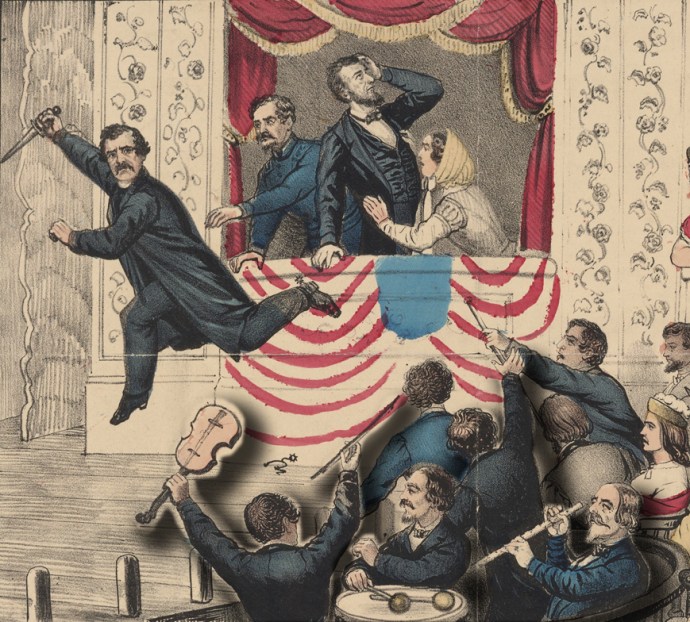
Music was a crucial part of the theater experience in the Civil War era. Even during non-musical performances (like the comedic play Our American Cousin), an overture and entr’acte music were expected by audiences. Theaters were houses of entertainment, and an orchestra was part of what you paid for when you bought your ticket. We know that Ford’s Theatre had an orchestra. We know that President Lincoln’s party, arriving late to the theater, was greeted by that orchestra. But how much do we really know about the musicians who played that fateful night?

The big challenge when it comes to determining the identities of the orchestra members at Ford’s Theatre is that we lack any sort of list from the period. When John Ford Sollers was writing his dissertation about his grandfather, he had access to documents that had belonged to John T. Ford, and even he could not come up with the names of any members of the orchestra aside from its director. Over the past week, with the assistance of fellow researcher Rich Smyth, I have assembled a partial list of those who were said to have been in the orchestra the night Lincoln was killed. The evidence supporting their attendance is, overall, extremely weak and varies greatly from man to man. Every name must be taken with a grain of salt, and aside from William Withers, we cannot guarantee that any of these men were actually present. With that being said, what follows is the list of the possible Ford’s Theatre orchestra members on April 14, 1865:

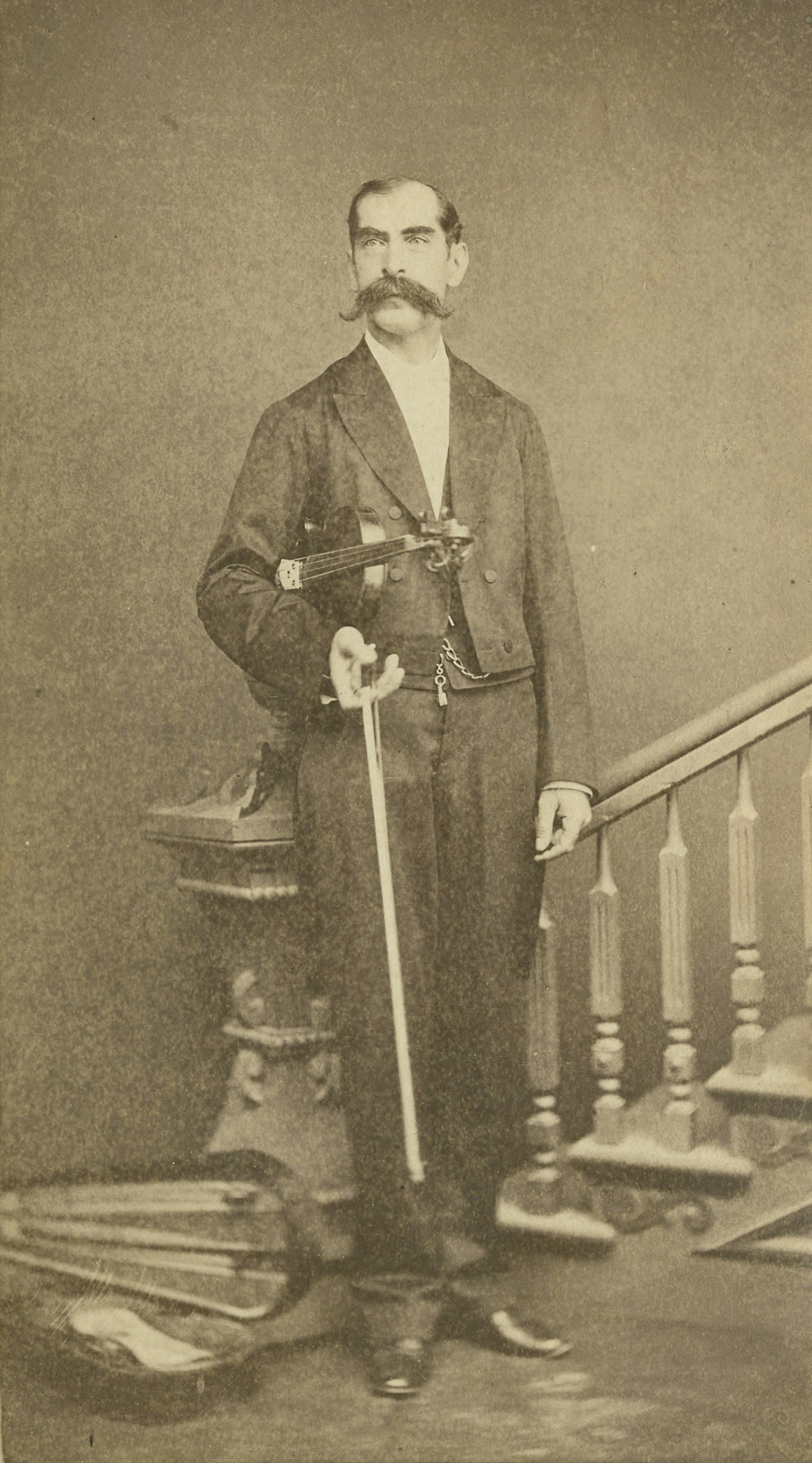
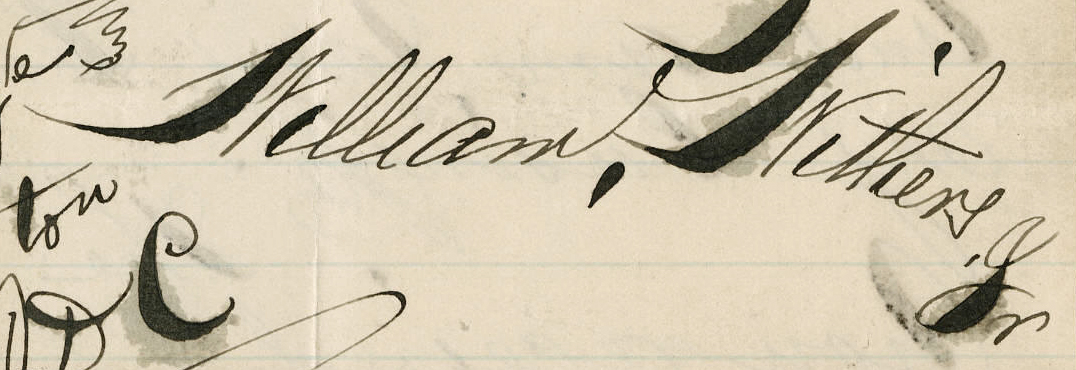
William Withers – orchestra director
George M. Arth – double bass
Scipione Grillo – baritone horn
Louis Weber – bass
William Musgrif – cello
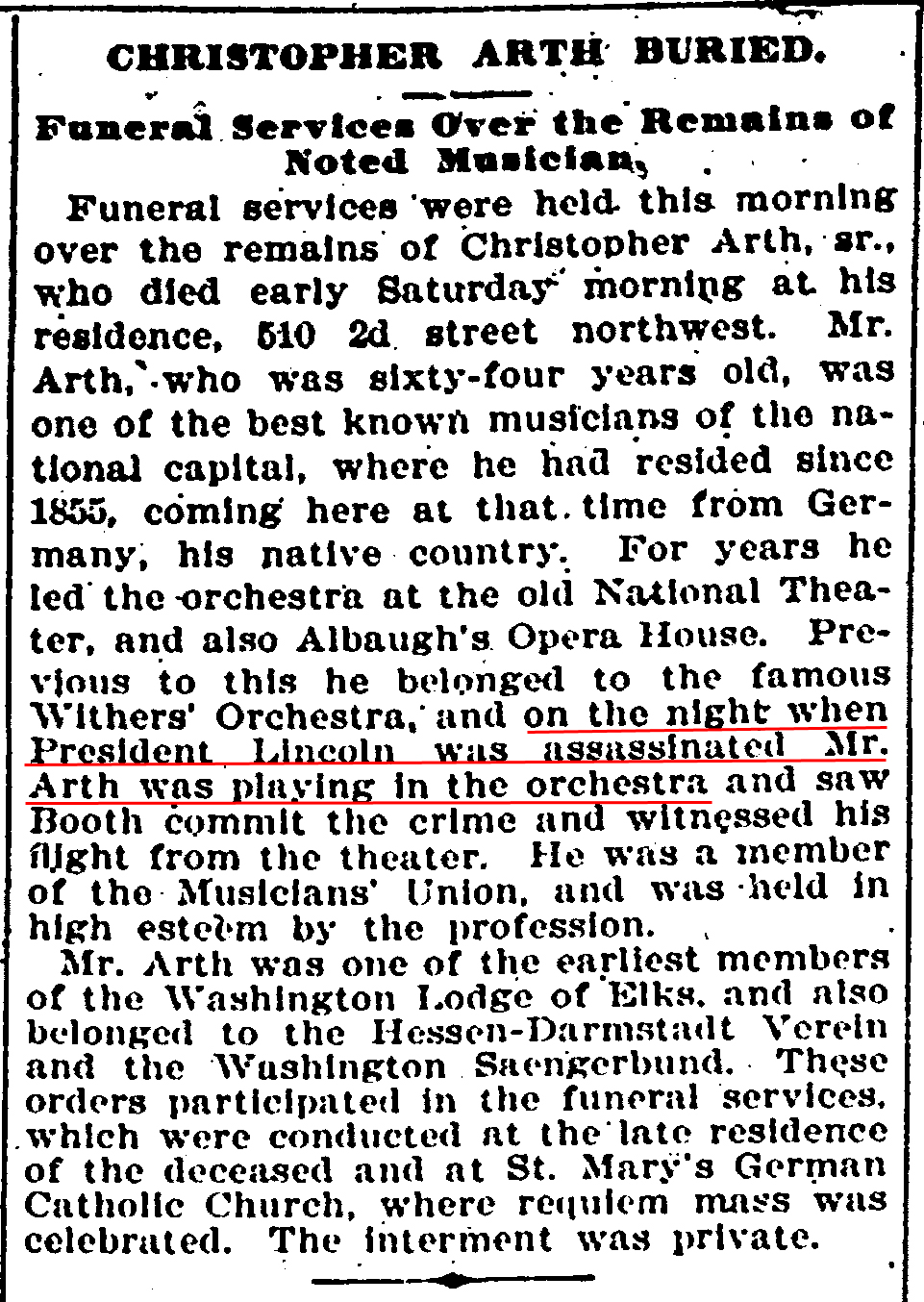
Christopher Arth, Sr. – violin
Henry Donch – clarinet
Reuben Withers – drums
Henry Steckelberg – cello
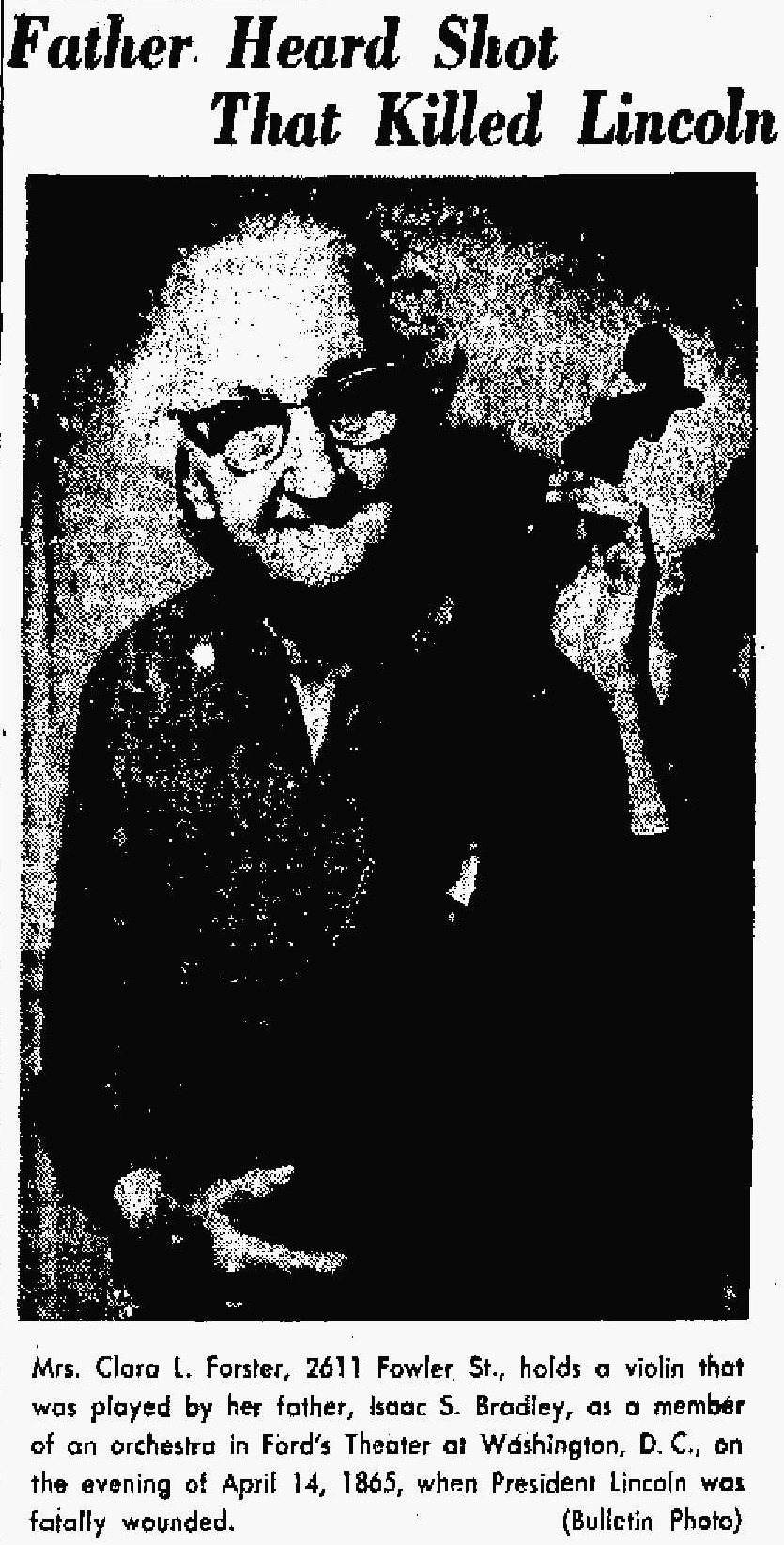
Isaac S. Bradley – violin
Salvadore Petrola – cornet
Joseph A. Arth – drums
Paul S. Schnieder – possibly violin or trumpet
Samuel Crossley – violin
Luke Hubbard – triangle and bells

Below you will find little biographies of each man and the evidence we have about their presence at Ford’s Theatre. I’ve placed them in an order that arranges them from more likely to have been at Ford’s to less likely to have been at Ford’s. Judge the evidence for yourself as we explore the boys in the band.


William “Billy” Withers, Jr. – orchestra director

In 1862, when John T. Ford first remodeled the Tenth Street Baptist Church and opened it up as Ford’s Atheneum, he hired a musician named Eugene Fenelon to be his orchestra director. As director, Fenelon not only conducted the orchestra on a nightly basis, but was also tasked with the duty of recruiting and hiring musicians to ensure that Ford would have an ample-sized band each night. In this capacity, Fenelon recruited local D.C. musicians. Fenelon remained as Ford’s orchestra director until a fire struck Ford’s Atheneum in December of 1862. The loss was a hefty one for John Ford at about $20,000. Consumed in the fire was a bulk of the orchestra’s instruments and music. While Fenelon stayed in D.C. during the process of rebuilding that followed, when the new theatrical season opened in the fall of 1863, Fenelon took a job as the orchestra leader of the recently opened New York Theatre in NYC. Ford was then tasked with finding a new orchestra leader for his new theater. He chose to put his faith in a 27-year-old violinist and Union veteran, William “Billy” Withers, Jr.
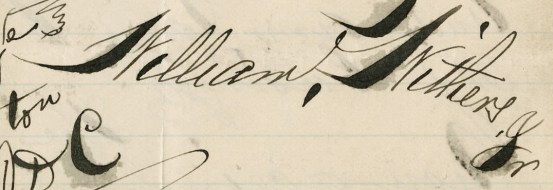
Withers was from a musical family, and at the beginning of the war, he, his father, and his brothers had joined the Union army and served as members of a regimental band. The bands provided music during marching and aided with the morale of the men. In the late summer of 1862, however, Congress passed a law abolishing regimental bands, feeling that the service had been abused by non-musical men trying to avoid regular duty and that the bands were not worth the cost during wartime. Though Withers stayed on for some time after the dissolution of his band and acted as a medic, he was eventually discharged. Withers excitedly took up John T. Ford’s offer to be his new band leader. When the new Ford’s Theatre opened in August of 1863, Withers’ orchestra and his experience playing patriotic music were complemented.

“The music under the leadership of Prof. Wm. Withers was highly pleasing, and the execution of the national airs gave a spice to the entertainment, which was fully appreciated.”

Ford’s Theatre had always had a healthy competition with its Washington rival, Leonard Grover’s National Theatre. As the two leading theaters in the city, the press abounded in making comparisons between the two houses. One way the theaters rivaled each other was with their orchestras. While a normal theater orchestra at the time would contain about ten musicians on a nightly basis, both Ford’s and Grover’s began advertising that their orchestras had been “augmented” to include more musicians. It appears that Withers continued to augment the orchestra during his tenure and found his growing of the band to be a point of pride. “Our orchestra under the Brilliant Leader Prof. William Withers, Jr., is considered second to no theatre South of New York,” proclaimed one Ford’s Theatre advertisement. Another highlighted the fact that the orchestra, “has lately been increased and numbers now nearly a Quarter of a Hundred first class Instruments,” and that it had been, “lately largely augmented and is now unsurpassed in numerical and artistic strength.” Billy Withers was a great asset to Ford during his first theatrical season. In addition to his duties as conductor of the orchestra, Withers would occasionally volunteer his services as a solo violinist for special occasions.

Theatrical seasons ended during the hot months, which left many musicians without jobs during the summer. Without the steady (albeit small) income from the theaters, musicians had to make their own arrangements. During this time, many teamed up with other musicians to play small concerts in music halls. With his connections, Withers was able to rent out bigger venues. During the summer of 1864, Withers and his orchestra played concerts at both Grover’s and Ford’s theaters. On July 10, 1864, Withers presented a “Concert of Sacred Music” at Ford’s, for which he brought in two vocalists and “forty musicians of the best talent in the city, forming an array of talent such as has never before appeared jointly in Washington.” The concert was well received, and the proceeds helped the D.C. music scene make it through the lean summer.
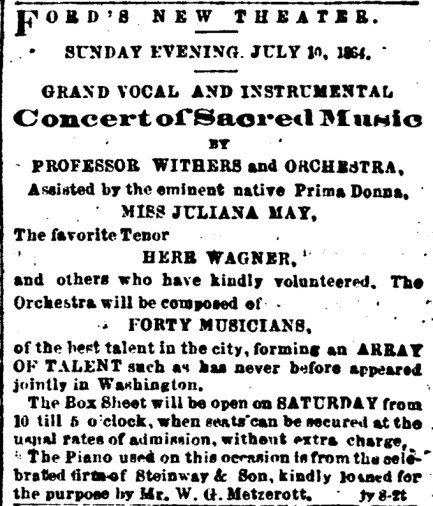
When the 1864-65 theatrical season opened in the fall, Withers was rehired by Ford to be his orchestra director. The season started without a hitch, but in January of 1865, Withers experienced some unaccustomed criticism of his orchestra in the press. In comparing the two main D.C. theaters, a reviewer from the National Intelligencer stated that, “In some respects, Mr. Ford has done better. His theater has been uniformly dignified, and he has succeeded in procuring a different class of stars from those played by his competitor…but his stock company has not by any means been all that it should be, and his orchestra needs improvement.” It appears that, perhaps due to this critique, Withers began the process of augmenting the Ford’s Theatre orchestra again. His attention on the theater orchestra was a bit distracted, however, as Withers was chosen to provide some of the music for President Abraham Lincoln’s second inauguration ball. He entered into a contract in which he would be paid $1,000 for forty pieces of music. Withers not only used the local talent at his disposal but also brought in musicians from New York. After the inauguration was over, it’s likely that a few of these musicians from New York were hired by Withers to augment the Ford’s Theatre band.

As much as John T. Ford liked being the best, he and Leonard Grover had realized the costly arms race that dueling orchestras would cause them. It appears that sometime over the last two years, the two theater owners had come to a mutual understanding regarding the size of their orchestras. Rather than continuing to attempt to one-up each other, they had put an unknown limit on each other in order to keep the houses equal. When Withers began increasing the size of the orchestra in early 1865, Ford objected, fearing it would break the truce with Grover. On April 2, 1865, Ford wrote a letter to his stage manager, John B. Wright:

“Respecting the orchestra I have promised and wish to keep my word to make my orchestra the same number that Grover has in his – will you notify Withers that for the rest of the season, I wish it reduced. The necessity of this I will explain and stisfy you – If Grover wants Withers – he can go – O can easily supply his place. Let us have the same Instruments that Grover has – my honor is pledged to this.”

Rather than run off to Grover’s National Theatre, as Ford thought might occur, William Withers stayed at Ford’s Theatre and likely reduced his orchestra as ordered.

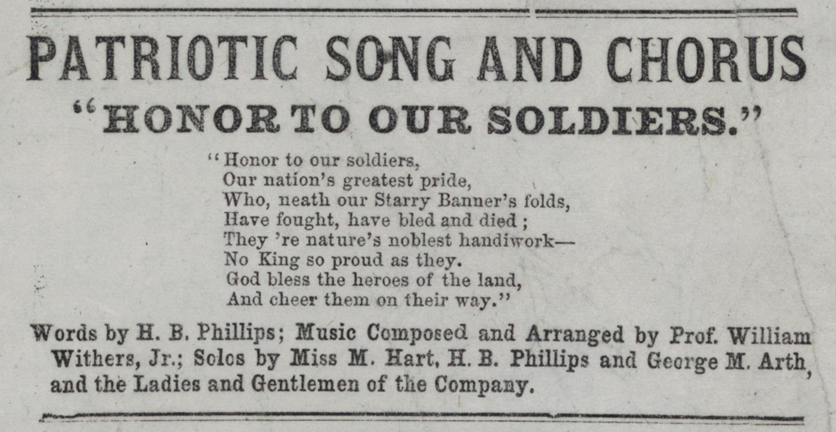
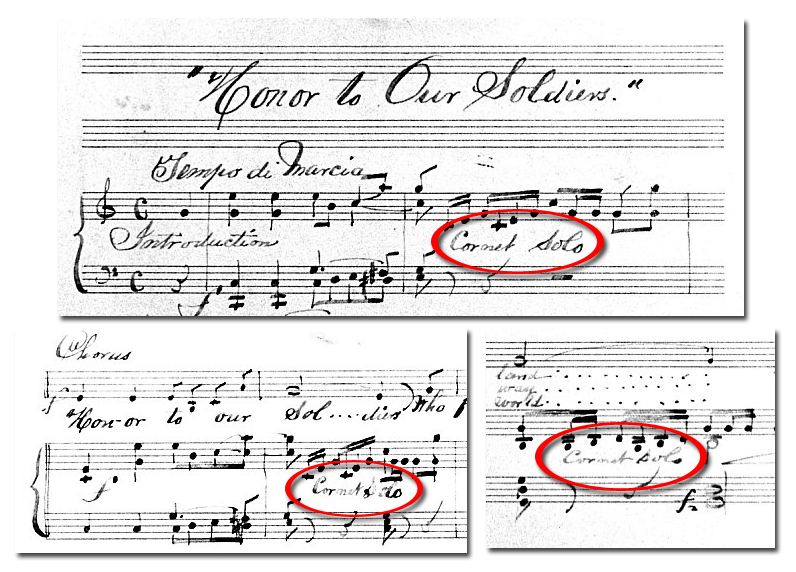
In addition to being a band leader and talented violinist, Withers also composed music. He wrote several polkas and instrumental pieces, which were sold by local music shops. Another piece that he composed that he had not published was a song called “Honor to Our Soldiers”.
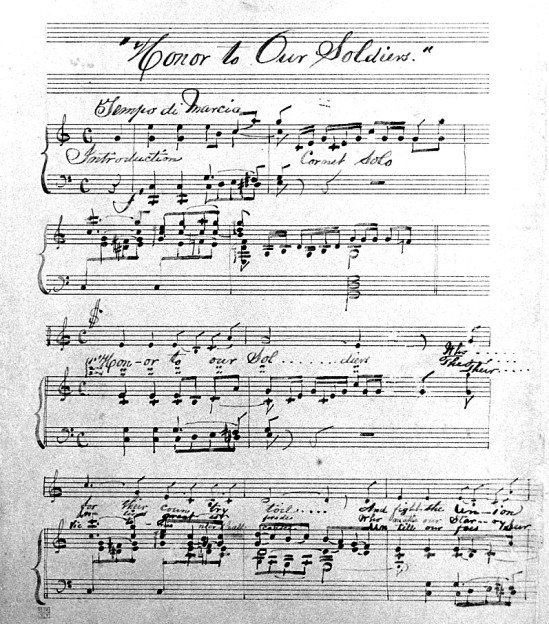
With the Civil War coming to an end in April of 1865, Withers was looking for a chance to perform his own patriotic air, which featured vocalists. He had arranged for a quartet of vocalists to perform the song on the evening of April 15th. However, during the morning rehearsal for Our American Cousin on April 14th, Withers heard the news that the Lincolns, possibly joined by the Grants, were coming to the show that night. Performing his song in front of the President and General Grant would make for a much better debut, and so he decided to perform the piece that night instead. Not having time to arrange for formal vocalists for that night, Withers was forced to rely on the talent around him. Withers tapped three of his coworkers to sing solos in the song: May Hart, Henry B. Phillips, and George M. Arth. May Hart was a new member of the Ford’s Theatre stock company, having been recently transferred from the Holliday Street Theatre in Baltimore. She was performing the minor role of Georgina that night. H. B. Phillips was the acting manager at Ford’s, and it was his job to improve the quality of the stock actors. Phillips is credited as having written the lyrics for “Honor to Our Soldiers”. George Arth was actually a member of the Ford’s Theatre orchestra, who is discussed later. In addition to these soloists, lead actress Laura Keene said she and other members of her company would be happy to sing along as backup.
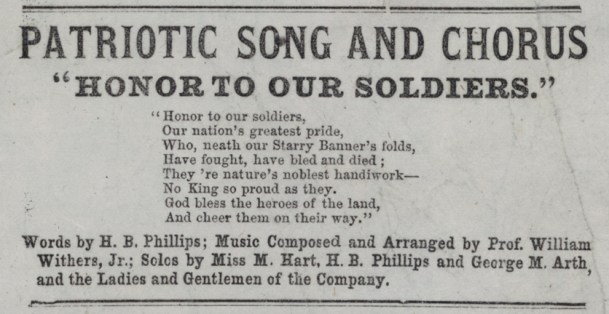
As we know, the Lincoln party did not arrive at the theater on time. Knowing they were on their way, Withers was given instructions to play a longer-than-average overture in hopes they would appear. After 15 minutes had elapsed without the Presidential party, the play began without them. When the Lincolns, Major Rathbone, and Clara Harris did make their appearance, the play was halted, and Withers and his orchestra began playing “Hail to the Chief”. This was followed by a rendition of “See, the Conquering Hero Comes” as the Lincolns and their guests took their seats in the Presidential box. With that, the play went on.

Withers was initially promised that the performance of his song would occur during the intermission between the first and second acts. However, when the intermission came, he was told by stage manager John Wright that Laura Keene was not prepared to perform during this break and that the orchestra should play his normal intermission music instead. Though slightly annoyed, Withers was assured the song would be performed during the next act break. When the second act break came, however, Withers was once again informed that Laura Keene was not ready. When the third act began, Withers made his way out of the orchestra pit by means of the passageway that led under the stage. He was miffed that his song had been delayed twice. He made his way up one of the two trapdoors on either side of the stage and went to converse with John Wright backstage. Wright said that Withers should plan to perform the song at the conclusion of the play and that Laura Keene had already sent word to the Presidential party to please remain after the curtain fell. Angry at Wright, Withers spied Ford’s stock actress Jeannie Gourlay also backstage and went over to talk with her. It was while Withers was conversing quietly with Jeannie Gourlay about his troubles that the shot rang out.

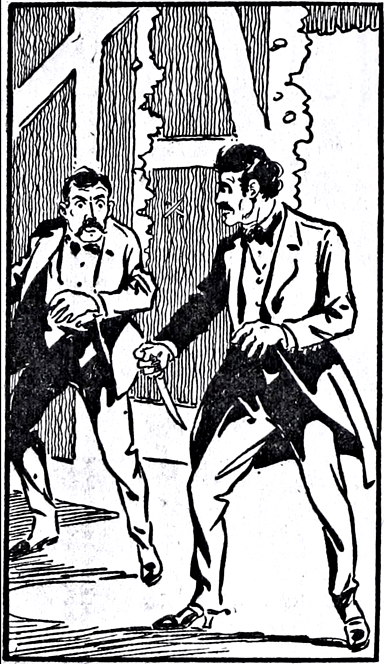
What occurred next has been well documented. After shooting the President and slashing away Major Rathbone with his knife, John Wilkes Booth jumped from the Presidential box onto the stage. The only actor on stage at the time, Harry Hawk, turned and ran out of Booth’s path. Upon reaching the backstage, it was William Withers and Jeannie Gourlay who stood in the way of Booth’s exit.

“Let me pass!” Booth yelled as he slashed at Withers with his knife, cutting his coat in two places. Booth pushed past Withers and Gourlay, made his exit out the back door, and escaped on horseback into the Washington streets. Withers’ backstage encounter with Booth became a well-known part of the assassination story, and up until his death in 1916, the orchestra leader never passed up an opportunity to tell his tale. As far as evidence goes, William Withers’ attendance at Ford’s Theatre that night is airtight, and even his slashed coat is on display in the Ford’s Theatre museum.

To read more on William Withers, pick up Tom Bogar’s book, Backstage at the Lincoln Assassination, or check out the following articles by Richard Sloan and Norman Gasbarro.


George M. Arth – double bass

Like William Withers, George Arth came from a musical family. At least two of his brothers and his cousin were active in the D.C. music scene. In August of 1861, George Arth joined the U.S. Marine Band, known as The President’s Own band. Arth could play many instruments, but his role in the Marine Band was that of a bass drummer. With the Marine Band, Arth would perform at important events around Washington, often for the President or other dignitaries. The job wasn’t full-time, however, and many members of the Marine Band had other jobs in the city as music teachers or as theater orchestra members. In 1864, while Laura Keene was renting out and appearing at the Washington Theatre in D.C., she hired George Arth to be her orchestra director for the engagement. The job was temporary, however, and when she left the city, George Arth went back to being just an ordinary orchestra member at Ford’s Theatre.

Arth must have had a good singing voice since, as pointed out earlier, he was one of the Ford’s employees that Withers pegged to help him in the singing of his song, “Honor to Our Soldiers”. While we do not have any record of Arth’s whereabouts during the assassination, we can safely assume he was somewhere on the premises preparing for the song when the shot rang out.

An additional piece of evidence we have that places George Arth at Ford’s that night is a letter he wrote in the days following the assassination. After Lincoln was shot, the theater was shut down and subsequently guarded. Members of the Ford’s Theatre staff were brought in for questions, and some were arrested. On a normal night, it was typical for the musicians to leave their instruments in the theater, especially when they were engaged to play the next day. While Arth likely assumed that the next night’s performance at Ford’s Theatre wasn’t going to occur, in the chaos that ensued after Lincoln was shot he was apparently unable to retrieve his own instrument. Unlike some of the other musicians who may have carried their instruments out of Ford’s with them, Arth played the largest bowed instrument in the orchestra, a double bass. After the government locked down Ford’s and started guarding it, no one was able to take anything out of the premises.

On April 21st, Arth wrote a letter to the general in charge of the guard detail asking for permission to retrieve his trapped instrument.

“Respected Sir,

I beg of you to grant me a permit to enter Fords Theatre & bring from it mu double bass viol & bow belonging to me & used by me as one of the orchestra at said theatre – as it is very necessary to me in my profession & I am suffering for its use.

I am humbly your servant

George M. Arth”

Arth’s request was approved, and he was allowed to retrieve his double bass. Arth remained in D.C. after the war and continued working asa  musician. He died in 1886 at the age of 48 from consumption and was buried in Congressional Cemetery.


Scipione Grillo – baritone horn

A native of Italy, Scipione Grillo became a naturalized citizen in 1860. He originally made his home in Brooklyn, New York, where he offered his services as a music teacher. By 1861, however, he had relocated his wife and kids to Washington, and in July, he joined the Marine Band. In addition to being a musician, Grillo was a bit of a businessman. When John T. Ford rebuilt his theater after the 1862 fire, he devoted space on the first floor just south of the theater lobby to the creation of a tavern. As part of his property, Ford could lease it out for a profit and provide an easily accessible place for patrons to get drinks between acts. The tavern space was eventually leased by two Marine Band members, Peter Taltavul and Scipione Grillo, who co-owned the venture. They called their establishment the Star Saloon after the theatrical stars who would patronize it. On the night of Lincoln’s assassination, it was Taltavul’s time on duty, and he acted as barkeep to the thirsty theater-goers. Taltavul has become famous for pouring John Wilkes Booth his last drink before the actor assassinated Lincoln.

Scipione Grillo’s partnership in the Star Saloon is often overlooked because he was spending that night in the orchestra instead of serving Booth. While Grillo was required to attend the trial of the conspirators during the entire month of May in 1865, he was never called to testify about his acquaintanceship with John Wilkes Booth and David Herold. It wasn’t until two years later, at the trial of John Surratt, that Grillo took the stand to state what he knew. During his routine questioning, Grillo was asked whether he saw anyone out on the pavement of Ford’s during the show. He replied:

“No, sir. I was not out of the place myself. I was in the orchestra between the first and second acts; but in the third act we had nothing to do, (being always dismissed after the curtain is down,) and so I went out and went inside of my place.”

Grillo also stated that he was still inside the Star Saloon when the assassination occurred. So, while he did not witness the assassination firsthand, he was among the members of the orchestra that night. Since it was part of the Ford’s Theatre building, the Star Saloon was also closed by the government, which ended Taltavul and Grillo’s business together.

Scipione Grillo appears to fall off the map after his 1867 testimony. I have not been able to find any trace of him after that, but it is possible that he, his wife, and children traveled back to Italy to live.


Louis Weber – bass
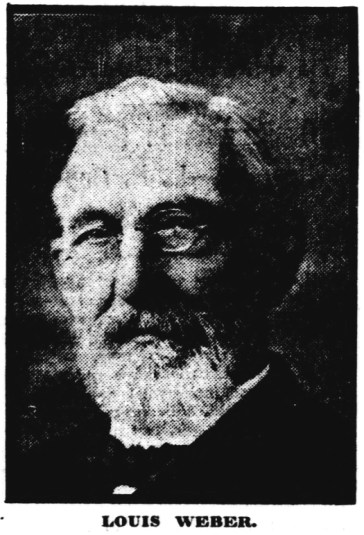
Louis Weber was born in Baltimore in 1834, but his family moved to D.C. when he was four years old. He became a member of the U.S. Marine Band and played at the inauguration ceremonies for Presidents Buchanan and Lincoln. He was an active member of the Marine Band for 25 years.

In the same manner as George Arth, the evidence pointing to Weber being a part of the Ford’s Theatre orchestra was the return of his instrument by the government. While Weber’s original request does not seem to have survived, on April 28th, Col Henry Burnett (later one of the prosecutors at the trial of the conspirators) sent a telegram off to the general in charge of the Ford’s Theatre guards ordering him to “send to this office, one bass violin the property of Louis Weber”. This order was fulfilled, and later that same day, Louis Weber signed a receipt for his bass.

Weber lived out the remainder of his life in Washington. He died in 1910 from a stroke and was buried in Congressional Cemetery.


William Musgrif – cello

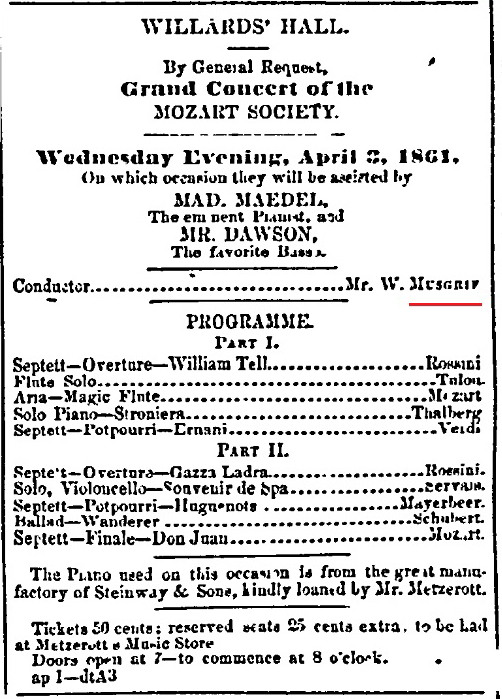
William Musgrif was born in England in 1812. After immigrating to America, he settled in New York. As a musician, Musgrif was skilled in both the violin and the cello, but seemed to have preferred the cello best. In 1842, Musgrif and his cello became founding members of the newly established New York Philharmonic. As part of the Philharmonic, Musgrif mentored younger players in the cello. By 1860, he, along with his wife and son, had moved to D.C., where he offered his skills as a music teacher. Musgrif was also the conductor for his own group in D.C. called the Mozart Society.
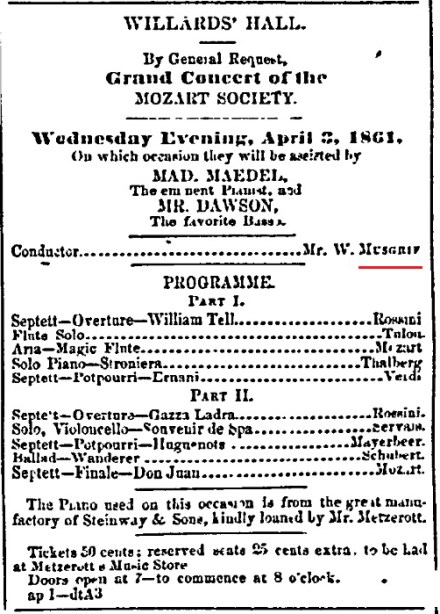
The evidence that William Musgrif also moonlighted as a member of the Ford’s Theatre orchestra comes from yet another letter written in the days after Lincoln’s assassination. William Withers had already written once and received a portion of his instruments that had been left at Ford’s that night, but he had not received all of them. In May of 1865, Withers penned another letter asking for permission to get the “balance of my things,” which included “sleigh bells, triangle, harmonica”. He also requested, “one instrument, violocella, for Mr. Musgrive [sic]”

These items were inspected and then delivered to Withers. On May 7th, Withers signed a form stating he had received, “a lot of sleigh bells, a triangle, harmonica, and violincella being properties left at Fords Theatre on the night of the Assassination of President Lincoln.” Withers signed for both himself “and Mr. Musgive [sic]”.

William Musgrif continued to live in D.C. in the few years following the assassination. In 1868, an unfortunate incident caused Musgrif to make the acquaintance of another person who had been at Ford’s on April 14th. On February 19th, Musgrif was in the billiard room of the National Hotel observing a man named William Rogers, who was drunk. When Musgrif attempted to take the billiard balls away from the drunkard, Rogers “hit him over one of the eyes.” A police officer was summoned, arrested Rogers, and proceeded to take down the 56-year-old musician’s sworn statement. That responding police officer was none other than Officer John F. Parker, the man history has condemned for allegedly leaving Abraham Lincoln unguarded on the night of his assassination.

By the mid-1870s, William Musgrif had moved out to Colorado with his son. It is likely he died and was buried there.


Christopher Arth, Sr. – violin

Chris Arth was the cousin of George M. Arth, the would-be soloist for “Honor to Our Soldiers”. His 1901 obituary, which is also one of the pieces of evidence for his presence at Ford’s Theatre, gives a good description of his life.
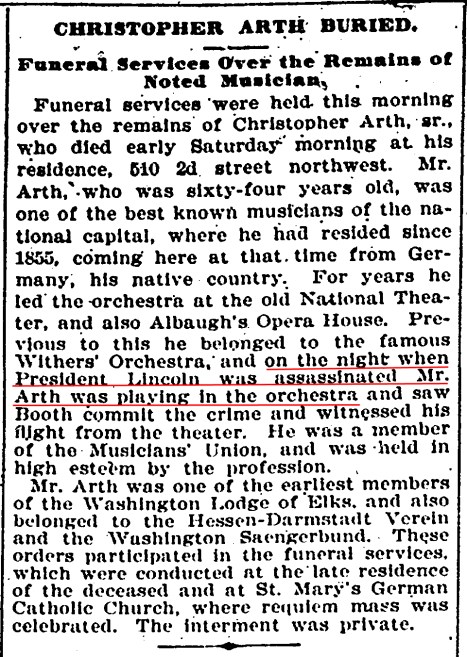
In addition to this obituary’s claim that Chris Arth was a member of the Ford’s Theatre orchestra, there is also a 1925 article from a D.C. correspondent known as the Rambler that supports the idea. I’ve briefly touched on the Rambler before. His real name was John Harry Shannon, and he wrote for the Evening Star newspaper from 1912 to 1927. His stories involved local interest pieces and often involved him travelling around Washington, talking to old timers. In an article he wrote about the history of D.C.’s music scene, the Rambler included a letter that was written to him by John Birdsell, the secretary of the Musicians’ Protective Union. You’ll notice that in the obituary above, it states that Chris Arth was a member of the same union during his lifetime. Birdsell compliments the Rambler’s work and then poses a challenge to him:

“In this connection it may be possible that, during the course of your researches for the preparation of these writings, you may acquire a complete roster of the orchestra which played at Ford’s Theater the night President Lincoln was shot. I have had inquiry for this from several sources. The first came from somewhere in California. I communicated with the Oldroyd Museum, and while they did not possess this information, they expressed a desire to acquire it.”

After this, Birdsell proceeds to give the list of names he has been able to determine.

“To date the partial roster, which I have is as follows: Leader, William Withers; violin, Chris Arth, sr.; bass, George Arth; clarinet, Henry Donch; cornet, Salvatore Petrola.”

After this list, Birdsell makes the final statement that since average orchestras at the time consisted of 10 instruments, he believes he is only half complete. Birdsell was likely unaware of Ford’s and Grover’s mutually agreed-upon augmented orchestras, which were no doubt larger than ten musicians.

If we trust his obituary and Birdsell’s list, then Chris Arth, cousin of George Arth, was in the orchestra at Lincoln’s assassination.


Henry Donch – clarinet

Henry Donch was a native of Germany who moved to the United States in 1854. He lived in Baltimore and was also a member of the Annapolis Naval Academy Band before he moved to Washington. Donch joined the U.S. Marine Band in August of 1864.

The evidence for Donch’s presence at Ford’s Theatre the night Lincoln was shot is the same as Chris Arth’s: the Birdsell list and his obituary.

A second obituary for Donch provided an additional detail regarding his alleged presence at Ford’s:

“Mr. Donch was a member of the orchestra at Ford’s Theater on the night Lincoln was shot. Mr. Donch, who was facing the assassin as he leaped from the box, always declared that Booth never uttered the phrase, ‘Sic Semper Tyrannis,’ which is attributed to him.”

While the general consensus is that Booth did, in fact, utter the phrase “Sic Semper Tyrannis” after shooting the President, Donch’s contrary claim does not, by itself, prove him to be a liar. The eyewitness accounts from Ford’s vary widely, and it’s possible that, in the confusion, Donch truly did not hear or remember Booth stating these words.

Coincidentally, Henry Donch would observe another Presidential assassin, though this time during the period after his crime. After Charles Guiteau shot President James Garfield, Henry Donch was selected as one of the grand jury members in his trial.


Reuben Withers – drums
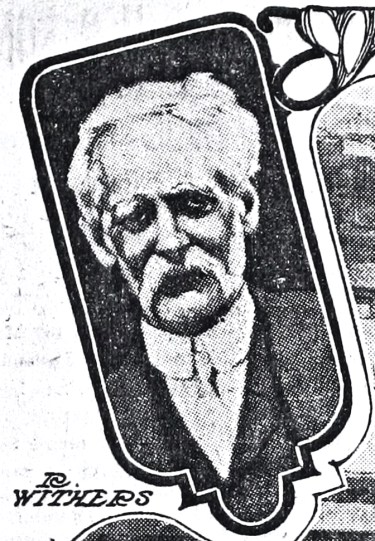
Reuben Withers was the younger brother of Ford’s Theatre orchestra director, William Withers. Reuben had joined the same regimental band as his brothers and father at the start of the Civil War, but similarly was sent back home when such bands were disbanded. He joined the ranks of his brother’s brass band and, it appears, the Ford’s Theatre orchestra.

In his older years, William Withers suffered from paralysis and was cared for by Reuben. The two elderly men shared a home and business together in the Bronx. Even in his paralysis, reporters came to hear the story of William Withers being stabbed by Booth on the night of Lincoln’s assassination. In at least one interview, Reuben recounted his own remembrances of the night of April 14th:

“The President was a little late coming in. We had played the overture and the curtain was just going up when we saw him enter the stage box. Brother William immediately started us playing ‘Hail to the Cheif,’ then ‘Star-Spangled Banner,’ and there was a lot of cheering. Everybody was feeling good and happy…

After we had played the overture I left the theatre to catch the 9.20 train for Zanesville, O., and so I missed the actual scene of the great tragedy. I had been offered a better position to play in the band of Bailey’s circus, and I had fixed that night of April 14, 1865, as the time of my leaving Washington…”

Was Reuben Withers truly in the orchestra that night? After years of hearing his brother tell his tale, perhaps he just wanted to include himself in the narrative. Or perhaps he did tell the truth and left the theater before the crime occurred. We may never really know. Reuben Withers preceded his brother in death, dying in 1913. The house and business the Withers brothers owned still stands, albeit a bit modified, at 4433 White Plains Road in the Bronx.


Henry Steckelberg – cello
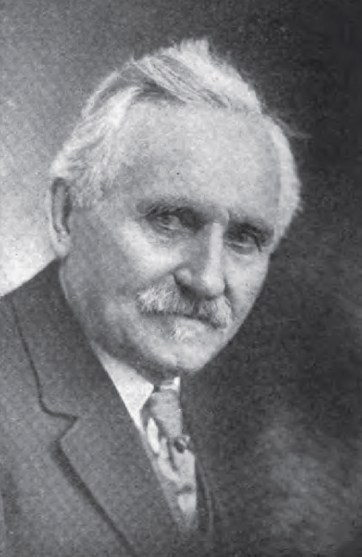
Henry Steckelberg was born in 1834 in Germany. He immigrated to the United States in 1858, residing at first in New York. When the Civil War broke out, he, like the Witherses, joined a regimental band in New York. After returning to civilian life, Steckelberg made his way to Washington and can be found in the 1864 D.C. directory listed as “musician”.

When Steckelberg died in 1917, his obituary stated that, “On the night of Abraham Lincoln’s assassination he was playing at Ford’s Theater. The orchestra was having an intermission when the tragedy occurred.”

An additional piece of evidence comes from the Steckelberg family. The genesis for this entire post was an email from Steckelberg’s great-granddaughter asking if a list of the orchestra members existed. She told me about her family’s belief that her great-grandfather played that night and that the family still owns Steckelberg’s treasured cello that he, presumably, used. In addition, she was kind enough to send along a letter, written by Henry Steckelberg’s sister-in-law, which supplemented his obituary. The relevant part of the letter states:

“On the night of Lincoln’s assassination, he [Steckelberg] was playing in the regular orchestra in Ford’s Theater. The assassin was a regular hanger on around the theater and he (Booth) often played cards with the orchestra members in the rehearsal room below the orchestra pit. His presence in the theater caused no notice. Booth was unemployed at the time, very jealous of his successful brother. He had no personal animosity toward Lincoln but wished to do something to draw attention to himself.”

It’s hard to tell if the writer of this letter was using knowledge she had obtained from Steckelberg or merely adding her own embellishments and beliefs about the Lincoln assassination story to the basic Steckelberg obituary. The latter part of the paragraph is entirely opinion, and the former contains one factual error: there was no rehearsal room “below the orchestra pit” at Ford’s Theatre, as the pit was the lowest you could get.

While there isn’t much to go on regarding Henry Steckelberg, his obituary does recount that the orchestra was on break during (and therefore didn’t witness) Lincoln’s assassination, which is in line with what Scipione Grillo testified to in 1867. It’s possible that Henry Steckelberg was there after all.


Isaac S. Bradley – violin

Isaac S. Bradley was born in 1840 in New York. During the Civil War, Bradley joined the Union army, where he served as a bugler in the 10th New York Cavalry. Bradley was discharged from the service on November 20, 1865. By 1868, he had moved to Dayton, Ohio, where he married and started a family. He lived in Dayton for the remainder of his days, becoming a photographer. Bradley died on July 10, 1904.
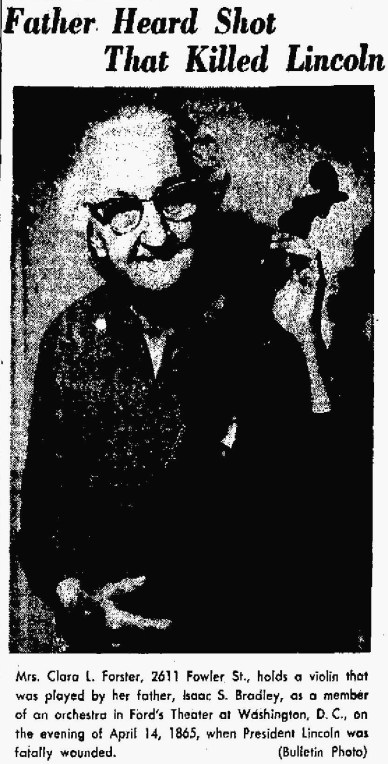
While I have yet to find any period documentation of Bradley’s presence at Ford’s Theatre during his lifetime, in 1960, his elderly daughter Clara Forster was interviewed by a newspaper in her home of Anderson, Indiana. She stated that during her father’s military service, he “fell victim to a rheumatic ailment that hospitalized him for some time in Washington,” and that he, “was ready to accept the offer to play in the orchestra at Ford’s Theater in Washington because he had with him his own Amati violin…”

With her father’s antique violin in her hand, Mrs. Forster then recounted the story her father had told her of that night:

“We were playing very softly when suddenly a messenger came and told us to play louder. We had heard a shot and someone running across the stage above, but we thought nothing of it.

So we played louder, not knowing of the tragedy that had occurred overhead; not knowing that our beloved Abe Lincoln had been shot.”

The article went on to state that “the order to play more loudly was given in an effort to offset commotion caused by the shooting and to avert panic in the audience.” It’s important to note that Mrs. Forster’s account is in contradiction to the testimony of Scipione Grillo, who made it clear that the orchestra was not on duty during the assassination.

Mrs. Forster was very proud of her father’s heirloom violin and described it in detail:

“Mr. Bradley was second violinist in the orchestra, playing with four other young soldiers who had served in the Civil War…

[The violin] had been given to him when he was about 10 or 11 years old. It had been acquired by his grandfather from the Cremonesis family in Italy, reported to have taught the famed Antonius Stradivarius the art of producing priceless violins.

Mr. Bradley was told that the instrument purchased by his grandfather, who served in the Revolutionary War, was made in 1637. A certificate inside the violin bears that date and the name of the maker.

Mrs. Forster reports that her brother, the late Frank Bradley, had the violin in his possession for some time and about 1914 refused an offer of $20,000 for it. During the past few years, Mrs. Forster made her home in Milwaukee, where a concert violinist and teacher became interested in the Amati violin and wrote an article about it for a national music publication. One of the amazing facts was that its owner had carried it with him through much of the Civil War and that it had not been damaged.”

Mrs. Forster appears to be the only source that her father was in Washington and a member of the Ford’s Theatre orchestra that night. She was apparently quite convincing, though, especially with her father’s violin as a witness. In the 1960s, when the National Park Service was preparing a historic structures report about Ford’s Theatre, Mrs. Forster wrote a letter to George Olszewski, the National Capital Region’s chief historian. Olszewski was convinced enough by Mrs. Forster’s letter that he included Isaac S. Bradley’s name in his partial list of orchestra members.


Salvadore Petrola – cornet
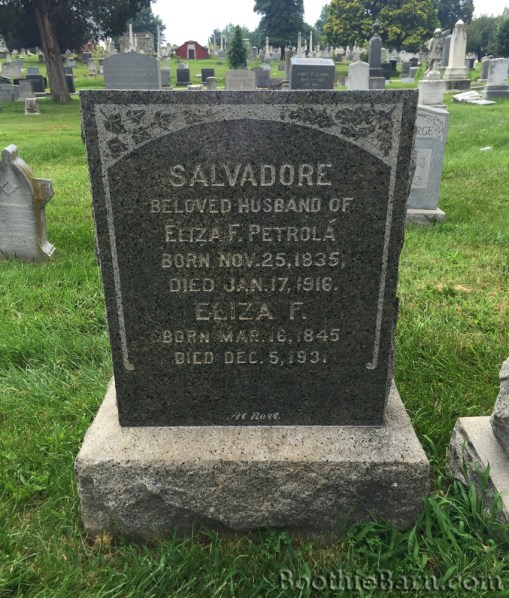
Salvadore Petrola, a native of Italy, came to the United States in 1855 when he was 20 years old. A talented cornet player, Petrola joined the U.S. Marine Band in September of 1861 and remained a member for the maximum time allowed, 30 years. As a band member in the 1880s, Petrola was the assistant conductor of the band, second only to its leader, John Philip Sousa. Petrola assisted Sousa in arranging music for the band and served as its primary cornet soloist for many years.

Despite a lengthy search, the only concrete evidence that I have been able to find to support the idea that Petrola was in the orchestra at Ford’s is the list of names John Birdsell, the secretary of the Musicians’ Protective Union, provided to the Rambler in 1925.

One additional fact could be taken as, perhaps, circumstantial evidence in favor of Petrola’s presence, however. The only instrumental solos contained on William Withers’ handwritten copy of his song, “Honor to Our Soldiers”, is for a cornet. In fact, the cornet gets three solos over the course of the song.

Is it possible that William Withers wrote so many solos for his cornet player because he was working with the very talented, Salvadore Petrola? We’ll never know.


Joseph A. Arth – drums
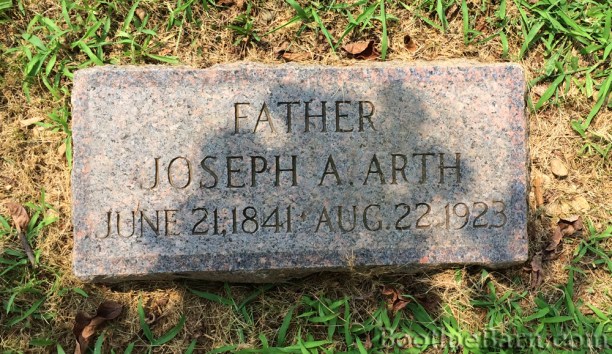
Joseph Arth was the younger brother of Ford’s double bass player, George M. Arth. Like his brother and cousin, Chris Arth, Joseph was a member of the U.S. Marine Band. Like Salvadore Petrola, Joseph stayed in the Marine Band for 30 years.

Our only evidence for Joseph Arth’s presence at Ford’s Theatre comes from his wife’s obituary from 1940. Joseph married Henrietta Scala, the daughter of the one-time Marine Band leader, Francis Scala. Upon Henrietta’s death at 90 years of age, the newspapers highlighted that she was both the daughter and wife of noted Marine Band musicians. In referencing her husband, the obituary stated:

“She was the widow of Joseph A. Arth, drummer with the band during the same period. Files of The [Evening] Star report that Joseph Arth was the drummer in the pit at Ford’s Theater the night President Lincoln was assassinated.”

It’s not much to go on, but perhaps Joseph was playing alongside his older brother George in the Ford’s Theatre orchestra that fateful night.
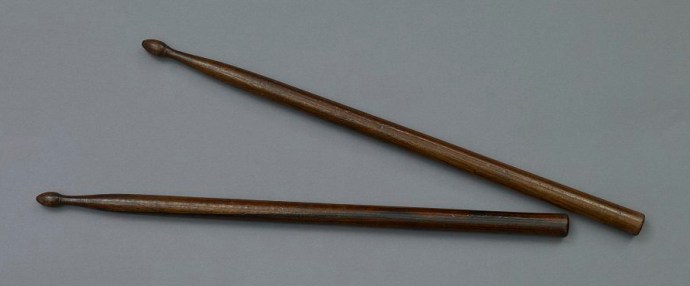
A pair of drumsticks in the Ford’s Theatre collection. These are said to have been present on the night of Lincoln’s assassination. Could they have been used by Reuben Withers or Joseph Arth?


Paul S. Schneider – possibly violin or trumpet
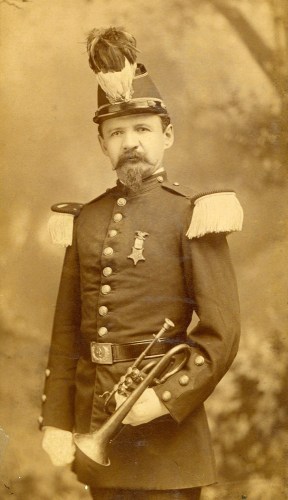
Paul Schneider was born in Germany in 1844 and immigrated to the United States in 1861. During the Civil War, he joined the Union army under the alias Ernst Gravenhorst. He served as a bugler for the 5th U.S. Artillery from January 1863 until December 1865. In the 1870s, Schneider moved to Memphis, Tennessee, initially working as a musician in the New Memphis Theatre before becoming a music teacher. In 1882/3, Schneider became the second director of the Christian Brothers Band, the oldest high school band still in existence. As director of the band, Schneider and his students performed at important events, including playing for President Grover Cleveland in 1887 when he visited Tennessee. In 1892, Schneider was succeeded as director by one of his former students, but remained in Memphis and was involved in the musical life of the city. He died in 1912.

I have been unable to determine the source of the claim that Paul Schneider was a part of the Ford’s Theatre orchestra on the night of Lincoln’s assassination. It appears to have come after his lifetime but is not well-documented. In 2011, Patrick Bolton, the current leader of the Christian Brothers Band, published his doctoral thesis about the history of the band. The dissertation contains a large amount of information about each band leader and the growth of the band over time. While it gives a great biography of Paul Schneider, the information about his connection to Ford’s Theatre is limited:

“Schneider was also known for his skills as a violinist and performed in touring orchestras around the country, including one that performed in Ford’s Theatre in Washington, D.C. On the evening of April 14, 1865 he has been placed in this historic theatre performing Hail to the Chief for President Abraham Lincoln before the fateful performance of the play, ‘Our American Cousin.'”

Bolton was a good researcher, but it appears that even he had difficulty in finding evidence for this claim. His phrasing of “he has been placed” demonstrates a degree of uncertainty. Likewise, the best reference Bolton could find to support this idea was from a 1993 newspaper article about the Christian Brothers Band, which merely mentioned that Schneider had been a member of the Ford’s Theatre orchestra without any supporting evidence.

Without additional period evidence, I have some serious doubts that Paul Schneider was present at Ford’s. However, the idea that one of their band leaders was a part of such a historic event is a point of pride to the Christian Brothers Band. When the band traveled to Washington, D.C. in 2014, they even presented a picture of Professor Schneider to Ford’s Theatre.

Update: Patrick Bolton has continued his research into Paul Schneider and, in 2025, shared the following obituary for Schneider, which mentions his supposed presence at Ford’s Theatre:

Of course, the idea that Paul Schneider narrowly escaped a bullet from John Wilkes Booth’s gun does not fit the known facts of the assassination. Booth only shot one bullet that evening, and that was nearly point-blank at President Lincoln.


Samuel Crossley – violin

Unfortunately, despite my best efforts, I have been unable to find any verifiable information about Samuel Crossley aside from the story I am going to recount. In 1991, the National Park Service received a donation to the Ford’s Theatre collection in the form of this violin.
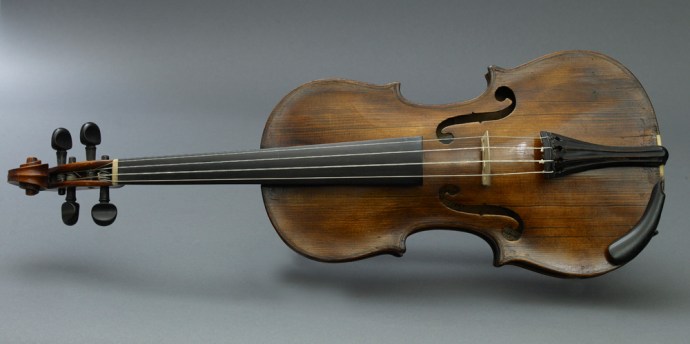
The violin was said to have been played at Ford’s Theatre on the night of Lincoln’s assassination. A label inside the violin identified its previous owner, a Union soldier by the name of Samuel Crossley.

On February 11, 2009, at the grand re-opening ceremony for the newly remodeled Ford’s Theatre museum, noted violinist Joshua Bell played the song, “My Lord, What a Morning” on the Crossley violin. In the audience were President Obama and First Lady Michelle Obama. Though I haven’t been able to find a recording of that performance, in videos of the President’s remarks, Bell can be seen in the background holding the Crossley violin.

More information about Samuel Crossley (and the provenance behind his violin) is needed.


Luke Hubbard – triangle and bells

Luke Hubbard was born in 1848 in Onondaga County, New York. In 1863, Hubbard attempted to join the Union army but was rejected on account of being under the age limit (he was only 15 at the time). Not one to be deterred, Hubbard waited a year and then enlisted again, this time claiming he was 18 years old. Records verify that Hubbard served as a private in Company B of the 22nd New York Cavalry from July 1864 until he was discharged from service on October 18, 1865. Years later, Luke Hubbard claimed that an unexpected series of events during his tour of service caused him to not only be present at Ford’s Theatre on the night of Lincoln’s assassination, but also to be an acting member of the orchestra.

The following comes from two sources: an account that Hubbard gave during his lifetime and his subsequent obituary.

“That fall [1864] I was taken ill with fever and removed to Carver hospital in Washington. After I recovered, instead of being returned to my regiment and probably largely because of my youth as well as being in a weakened state, I was given a position in the Carver hospital band. In the army I had been a bugler. This hospital band furnished the music at Ford’s theater on the memorable night. I was playing the triangles and sat at the end of the orchestra under the box occupied by the presidential party…”

“The actor, John Wilkes Booth, was well known by the president, and when he was not in the piece being presented or when Booth was off the stage for a time, or between acts, he would often call on President Lincoln in his box, when both would witness the performance together, or sit and chat in the most friendly manner, so that he had no trouble gaining access to the box on the night of the conspiracy.”

“Many people have claimed that Booth said this or that when he jumped to the stage from the box, but with thirteen pieces playing at the time. I don’t think he could have been heard had he uttered any remark…

In a moment Mrs. Lincoln appeared at the edge of the box, waved her handkerchief to the leader of the orchestra, who raised his bow, a signal for the music to cease. Mrs. Lincoln was then heard to say, ‘The president has been shot.’

The members of the orchestra meanwhile not understanding the scene before them, saw Booth drag himself across the stage holding in one hand the revolver which had done its fatal work, and in the other grasped a knife for use in case the other weapon failed. As the door at the rear of the stage opened, the orchestra members who sprang to the stage saw two pair of arms sieze [sic] the injured man, the last that was seen of him. When the door was reached it was found to be locked on the outside, and by the time they reached the street through another exit the theater was surrounded by a cordon of soldier, and they were obliged to give their names and business at the theater that night.”

“Mr. Hubbard was the third man to climb over the footlights and rush to the back of the stage, but the door was locked on the outside.”

Ironically, one of the most detailed accounts we have from a person who claimed to have been in the orchestra at Ford’s Theatre is also the least factual and least reliable. Very little of what Hubbard recounted is accurate. The orchestra was not playing when the shot rang out. Booth dropped the derringer pistol he used on Lincoln in the box and therefore did not have it on the stage with him. No one grabbed the injured Booth and pulled him out the rear door of Ford’s. The back door of Ford’s was not found to be locked from the outside after Booth passed through it. And perhaps the most egregious (and somewhat laughable) error of them all: John Wilkes Booth was not a friend of Lincoln’s, nor did he often join the President in his theater box to “chat”.

As entertaining as it is, it’s probably safe to dismiss Hubbard’s account entirely. Still, it’s interesting that the instruments Hubbard claimed to have played that night, the triangle and bells, were two of the instruments William Withers asked permission to retrieve after the assassination.


The stage of Ford’s Theatre taken in the days after Lincoln’s assassination. The orchestra pit with music stands and sheet music still in place can be seen at the bottom of the image.

Compared with the stars who graced the stages of Victorian era theaters, the lives of theater orchestra members were without glamour or fame. While equally talented in their own specific roles, many of the men who provided crucial musical accompaniment led quiet and largely uncelebrated lives.

The names listed above are only possible members of the Ford’s Theatre orchestra, with some having much better evidence than others. We only know them because either they chose during their lifetime or their friends and family chose after death, to connect their names with one of the most notable events in our history. This desire to be remembered and connected to such important events leads some people to exaggerate or outright lie. On the reverse, however, it is possible that there were members who did not wish to have their whole musical careers boiled down to a single, traumatic night. How many orchestra members witnessed Lincoln’s assassination, but never talked about it publicly?

As time goes on, additional people who are claimed to have been in the Ford’s Theatre orchestra will no doubt be found. When that happens, we must judge the reliability of their evidence just like the names above. If you stumble across a new name, I encourage you to add a comment to this post so that others may evaluate the evidence.

The exact identities of those playing at Ford’s Theatre on April 14, 1865, will never be known with certainty. Just like in 1925 and 1962, we still do not have a reliable count of how many musicians were even there, and we likely never will.

Known and unknown, the orchestra members of Ford’s Theatre, under the direction of William Withers, have the distinction of having played the last music President Abraham Lincoln ever heard.
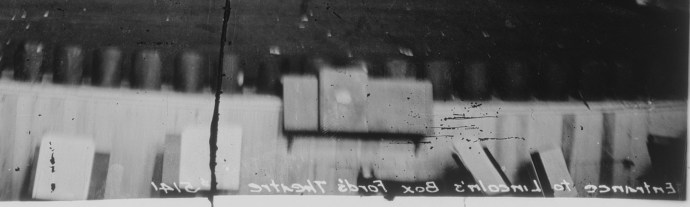
References:
The Theatrical Career of John T. Ford by John Ford Sollers (1962)
Backstage at the Lincoln Assassination by Tom Bogar
The Lincoln Financial Foundation Collection
The Lincoln Assassination: The Evidence edited by William Edwards and Edward Steers
The Trial of John H. Surratt, Vol 1
Catherine Adams – great-granddaughter of Henry Steckelberg
Restoration of Ford’s Theatre – Historic Structures Report by George J. Olszewski
“The Oldest High School Band in America”: The Christian Brothers Band of Memphis, 1872-1947 by Patrick Joseph Bolton
Rich Smyth
The Art Loux Archive
Newspaper articles discovered via GenealogyBank
Most of the biographical information was compiled through the resources available on Ancestry and Fold3
Library of Congress, Prints and Photographs Division

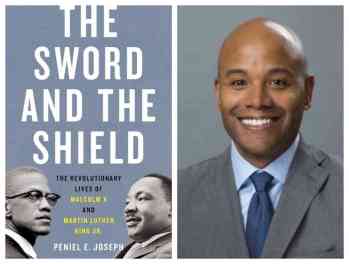
Categories: History | Tags: , , , , , , , | 27 Comments

Blog at WordPress.com.