Artifact History: Nélaton probe

The collection of the National Museum of Health and Medicine (NMHM) contains several objects relating to Presidential health and care.  In regards to the Lincoln assassination, the museum contains items extracted from both the President and his assassin during their subsequent autopsies.  Booth’s vertebrae and a piece of his spinal cord, through which Boston Corbett’s bullet passed, are housed in this collection.  From Lincoln’s autopsy, the museum has pieces of Lincoln’s skull, the bullet that took his life, and some hair clippings taken by the doctors and surgeons as mementoes.  As was previously written, the collection was once housed at Ford’s Theatre from 1865 – 1887 when it was called the Army Medical Museum.   During that time at Ford’s however, the Lincoln relics were not part of the collection, only Booth’s pieces were there.  In fact, the bullet that killed Lincoln was entered as an official exhibit during the Conspiracy Trial and it, along with the skull pieces, were housed with the other evidence in the office of the Judge Advocate General.  In 1940, the exhibits were donated to the Lincoln Museum (Ford’s) who then gave the bullet and pieces of Lincoln to the Medical Museum.  So while pieces of Lincoln and Booth both returned to the venue of their last living meeting, it was not at the same time.

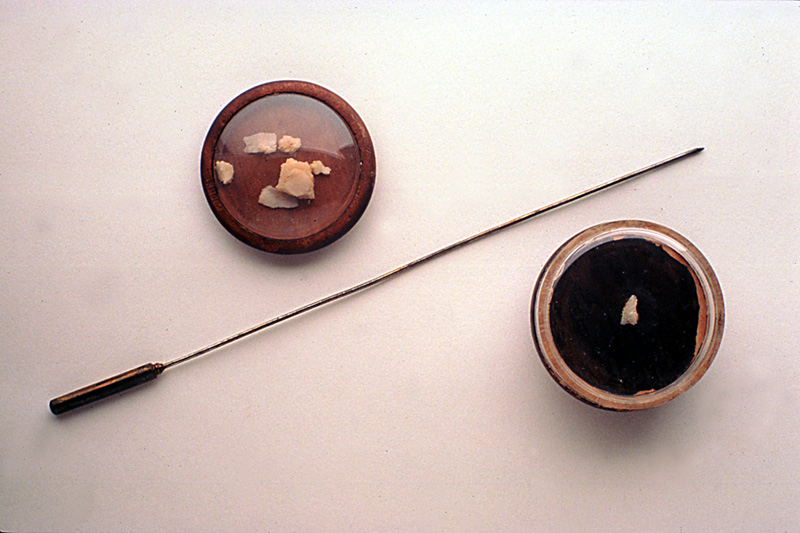
In addition to the bullet and the skull fragments, the National Museum of Health and Medicine also has a rather unassuming instrument housed with these Lincoln relics: a long, medical probe:
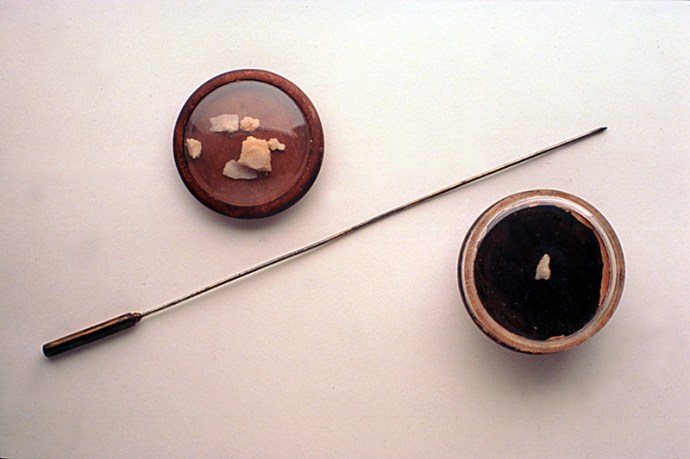
Lincoln’s skull fragments and Nélaton probe
(NMHM)

This probe has a specific name and a specific function.  Called a Nélaton probe (or Nélaton’s probe) it was used by the doctors during Lincoln’s final night to ascertain the depth and path of the bullet in Lincoln’s head.  Before delving into that, however, let’s look at the history behind this medical tool.

In 1862, Italian general Giuseppe Garibaldi, was shot while trying to take control over the city of Rome.  At that time, Italy had just completed a massive unification to create one kingdom.  This kingdom of Italy later became the republic of Italy as we know it now.  However, as of 1862, several cities in Italy did not accept unification and Rome was one of them.  Tired of waiting for them to come around, General Garibaldi decided to raise a volunteer force to take the city of Rome.  The Battle of Aspromonte, as it was called was fought between Garibaldi’s men and the Royal Army of Italy on August 29th, 1862.  Both sides were hesitant to harm the other as they were countrymen and Garibaldi was well liked and supported by the people of Italy.  When the Royal Army “attacked” Garibaldi’s forces, he ordered his forces not to fire on their brothers.  One part of his army did attack though, and during the fire fight, Garibaldi was hit three times.  The battle lasted less than ten minutes with only 15 combined casualties.  Garibaldi and the rest of his volunteers were arrested and imprisoned.

While imprisoned, Garbaldi was still given the respect and medical treatment he deserved.  Two of the three shots Garibaldi received were to the hip and proved easily treatable.  The third shot hit Garibaldi’s right ankle, just a little above and in front of what we would consider the “ankle bone” (scientifically, it was his internal malleolus).  This wound pained him greatly.  When he was on the battlefield, a surgeon had made an incision on the opposite side of the wound when he felt swelling but found nothing inside of it.  A few days after the battle, Garibaldi was re-examined by more than half a dozen doctors who all believed, save one, that the bullet was no longer in his ankle.  Meanwhile, in England, supporters of Garibaldi in the medical field took it upon themselves to see if they could help the general.  In an extremely presumptuous way, the English doctors elected that Dr. Richard Partridge, professor at King’s college, should travel to England and check on Garibaldi’s wound and treatment.  When Dr. Partridge arrived on September 16th, he examined Garibaldi himself, and came to the same conclusion of the Italian physicians: the ball was no longer in his ankle.  He returned back to England and guaranteed his colleagues and the press that, while Garibaldi was still in considerable pain, it was not caused by a bullet being lodged in his ankle.  Dr. Partridge believed his condition would improve in time.

After five weeks, though, no improvement was noted and Garibaldi was still in quite a deal of pain.  This time, the Italian doctors reached out.  They sent for Auguste Nélaton, a Parisian professor of surgery.  He arrived on October 28th and examined Garibaldi himself.  After inserting a normal probe into the wound, he was convinced that the bullet was still in there.  The Italian doctors did not concur, citing Dr. Partridge’s agreement of their initial assessment.  So, Dr. Partridge returned.  Soon, Garibaldi’s sick room became an international conference with the Italian doctors, the Frenchman Nélaton, the Englishman Partridge, and even a Russian physician all prodding and poking General Garibaldi.  Dr. Partridge actually changed his mind and started believing that the bullet was still in the general’s ankle.  Nélaton, believing amputation to be unnecessary, ordered that the wound entrance be widen with sponges so that the bullet could be removed in time.  While the Italian doctors followed this idea, they were still unconvinced that there was a bullet in Garibaldi, and were getting sick of all these foreigners going back and forth on the matter.

Auguste Nélaton attending to General Giuseppe Garibaldi in 1862 (National Library of Medicine)

When Nélaton returned to France, he started working on a way to prove that there was a bullet in Garibaldi.  The problem was that it was impossible for a physician of the time to identify the hard substance met by a probe in a wound.  It could be normal bone or a foreign substance like a bullet.  The bulk of the Italian doctors believed their probes continually hit the normal bone structure of the ankle, while Nélaton thought it was a bullet.  Nélaton began constructing a new probe for his purposes.  In the end, his probe was ingenious in its simplicity.  At the tip of a normal medical probe he attached an unglazed porcelain tip.  When the porcelain touched bone inside a wound, the probe would be unaffected.  When it rubbed against the lead of a bullet however, the tip would become marked identifying it as a foreign substance.

A simple Nélaton probe

Nélaton quickly sent his new instrument to the doctors in Italy.  After using it to confirm Nélaton’s diagnosis that the bullet was, in fact, still in Garibaldi’s ankle, the Italian physicians were able to successfully remove it on November 22nd.  Shortly thereafter General Garibaldi sent a letter to Auguste Nélaton offering his love, gratitude, and thanks.

Nélaton’s probes proved wonderfully efficient.  They started to be produced on mass and were shipped all over the world.  They quickly became an instrument of necessity for any military surgeon and found a market in the surgeons fighting on both sides of the American Civil War.  They continued to be used into the 1900’s before they were essentially replaced by the advent of less intrusive devices like the X-ray.

Let’s return now to the night of April 14th, 1865.  Lincoln was taken to the Petersen House across the street from Ford’s after being shot.  There, he was attended to by several doctors including the Surgeon General Joseph Barnes and the first responder, Dr. Charles Leale.  At first, the doctors introduced regular, silver probes into Lincoln’s wound.  However, like in Garibaldi’s case, they were unsure if the solid mass they encountered was the bullet or a piece of Lincoln’s skull.  A steward was then sent for a Nélaton probe.  From Dr. Leale’s account we can learn how they used the device:

“About 2 AM the Hospital Steward who had been sent for a Nelatons probe, arrived and an examination was made by the Surgeon General, who introduced it to a distance of about 2 ½ inches, when it came in contact with a foreign substance, which laid across the track of the ball.

This being easily passed the probe was introduced several inches further, when it again touched a hard substance, which was at first supposed to be the ball, but as the bulb of the probe on its withdrawal did not indicate the mark of lead, it was generally thought to be another piece of loose bone. The probe was introduced a second time and the ball was supposed to be distinctively felt by the Surgeon General, Surgeon Crane and Dr. Stone.”

Using Nélaton’s probe, the doctors established that the bullet was above and behind Lincoln’s right eye.  Between its use in the early hours of April 15th and today, the Nélaton probe used by the doctors on Lincoln has lost the porcelain tip that marked the bullet.

The end of the probe used by Lincoln’s deathbed physicans, missing the unglazed porcelain tip.

While the first person to utilize Auguste Nélaton’s invention made a full recovery because of it, it was well established before the probe was introduced in Lincoln’s case that he was beyond help. The Nélaton probe did not change Lincoln’s medical prognosis as it did for Garibaldi, but it is still a historically relevant artifact.  Its inclusion in the collection of the National Museum of Health and Medicine is so that it can be a testament to the devotion of the doctors who cared for President Lincoln.  Despite the hopelessness of his situation, doctors like Barnes, Leale, Taft, and others, did all in their power to aid and comfort the fallen President.

References:
National Museum of Health and Medicine 
The details regarding Auguste Nélaton’s invention came from this essay from the National Institute of Health
Dr. Leale’s account
American Brutus by Michael Kauffman

Categories: Uncategorized | Tags: , , | 15 Comments

Samuel Arnold’s Confession

The following is Samuel Arnold’s full confession that he gave following his arrest on April 17th.  This account is copied from William Edwards’ book The Lincoln Assassination – The Rewards Files.  Mr. Edwards is the author behind the trilogy of primary sources regarding the assassination.  The Evidence, The Court Transcripts, and The Rewards Files, are all essential materials for those studying the assassination.  They contain the bulk of the government’s microfilmed records and are priceless to the researcher.  The Evidence can be bought as both a physical book (the Surratt House Museum offers the best value on this) and as a non-searchable ebook.  The Trial Transcript can be purchased as a searchable ebook.  The Rewards Files were previously released on a CD-ROM  (still available through the Surratt House Museum) and will shortly be released as an ebook through Google Books. EDIT: The book is now available for purchase here.

I have previously written my support of Edwards’ Trial Transcripts and I will certainly let you all know when The Reward Files are available for download.  In the meantime, Arnold’s confession provides some of the most reliable information about the original abduction conspiracy:

“To Whom it May Concern,

Know that I, Saml B. Arnold, about the latter part of August or first part of September 1864, was sent for by J. Wilkes Booth, who was a guest at Barnum Hotel, City of Baltimore Md. to come to see him. Had not seen the same J. Wilkes Booth since 1852, when we both were schoolmates together at St. Timothy’s Hall, President L. Van Bokelin then having said Hall as place of tuition. Reception warm calling for wine and cigars conversing a short time upon our former school boy days. We were interrupted by a knock at the door, when Michael O’Laughlen was ushered in. After a formal introduction, we sat sipping our wine, and then smoke a cigar. During smoking he having heard previously of my feelings or sentiments, he spoke in glowing terms of the confederacy and of the number of surplus prisoners in the hands of the United States, and then ensued the proposition by J. Wilkes Booth and which he J. Wilkes Booth thought could be accomplished viz; Kidnapping President Lincoln as he frequently went unguarded out to Soldiers Home, and he thought he could be picked up, carried to Richmond, and for his exchange produce the exchange (for the President) of all the prisoners in the Federal hands. He, J. Wilkes Booth the originator asked if we would enter into it. After the painting of the chance of success in such glowing colors, we consented viz; Michael O’Loughlin and myself. Secrecy bound not to divulge it to a living soul. Saw him no more. Yes I saw him again and then he J. Wilkes Booth left to arrange the business north. First to New York then to the Oil region, from there to Boston and finally to Canada. Was to be back in a month. Received a letter which I destroyed stating he was laid up with Eryeocippolis in the arm and as soon as he was able, he would be with us. Months rolled around, he did not make his appearance until some time in January. In his trunk he had two guns (maker unknown), cap cartridges which were placed in the gun stock (Spencer Rifle I think called) revolver, knife belts, cartridge boxes, cartridge caps, canteen, all fully fixed out which were to be used in case of pursuit, and two pairs handcuffs to handcuff the President. His trunk being so heavy he gave the pistols knives and handcuffs to Michael O’Laughlen and myself to have shipped or bring to Washington to which place he had gone. Bought horse buggy, wagon and harness leaving the team &c. to drive on to Washington. Started from Baltimore about twelve or one o’clock after having shipped the box containing the knives, handcuffs and pistols, arriving in Washington at seven or half past seven. Met him on the street as we were passing theater. We alighted, took a drink and he told us of the theater plan slightly, saying he would wait till we put the horse away and tell us more fully. He had previously as I now remember spoken of the chance in the theater if we could not succeed in the other at Soldiers Home. We went to theater that night, he J. Wilkes Booth telling us about the different back entrances and how feasible the plan was. He, J. Wilkes Booth, had rented a stable in rear of the theater having bought two horses down the country, one in stable behind theater and the other at livery. Met him next day went to breakfast together. He was always pressed with business with a man unknown and then only by name, John Surratt. Most of his Booth’s time was spent with him. We were left entirely in the dark. Michael O’Loughlen and myself rented a room in D Street 420 No. Obtained meals at Franklin House cor of 8th and D St. and there lived for nearly two months, seeing him perhaps three or four times per week and when seen always but a short time still pressing business aleays on hand viz. John Surratt.

Michael O’Laughlen and myself drove out occasionally the horse liveried at Nailor’s Stable drove always (but once) in the city and Georgetown. The once excepted across Eastern Branch Bridge when we went upwards of five miles and returned I suppose. That was the only time I ever went over the Bridge. How often J. Wilkes Booth crossed I cannot state, but from his own words often. Thus was Michael O’Laughlens time spent and mine for the most part down at Ruhlman’s Hotel and Lichau House on Pennsylvania and Louisiana Avenues in drinking and amusements with other Baltimoreans besides ourselves congregating there all of whom knew nothing of our business but selling oil stock. Oil stock was the blind for them as well as my family. During the latter part of March while standing on Ruhlman’s and Lichau’s porch between 11 & 12 o’clock PM a young man name unknown, as I cannot remember names, about 5 feet 5 or 6 inches high thick set, long nose, sharp chin, wide cheek, small eye, I think grey, dark hair, and well dressed, color don’t remember, said called Michael O’Laughlen aside and said J. Wilkes Booth wish to see us both at Gaither’s Saloon on Avenue. I was there for the first time introduced to him, but forgot his name. We walked up together, Michael O’Laughlen, this unknown and myself were ushered into the presence of J. Wilkes Booth who introduced me to John Surratt, Atzerodt (alias Port Tobacco) (alias) Mosby making in all seven persons. J. Wilkes Booth had stated to Michael O’Laughlen to bring me up in good humor (still always in the dark). Then commenced the plan. Each had his part to perform. First I was to rush in the box and seize the President whilst Atzerodt “alias” Port Tobacco and J. Wilkes Booth were to handcuff him and lower him on the stage whilst Mosby was to catch him and hold him until we all got down. Surratt and unknown to be on the other side of Bridge to facilitate escape, afterwards changed to Mosby and Booth to catch him in box throw him down to me on stage, O’Laughlen and unknown to put gas out. Surratt, Atzerodt “alias” Port Tobacco to be on the other side of Bridge. I was opposed to the whole proceeding, said it could not be done or accomplished if even which was of itself an impossibility to get him out of the box and to the Bridge. We would be stopped by sentinel. Shoot the sentinel says Booth. I said that would not do for if an alarm was given then the whole thing was up. As for me I wanted a shadow of a chance. M. O’Laughlen wanted to argue the same thing, whereupon J. Wilkes Booth remarked, you find fault with everything concerned about it. I said no I wanted to have a chance and I intended to have it, that he could be the leader of the party but not my executioner. Whereupon J. Wilkes Booth remarked in a stern commanding and angry voice, do you know you are liable to be shot your oath.[sic] I told him the plan a basis had been changed and a compact broken, on the part of one is broken by all. If you feel inclined to shoot me you have no further to go. I shall defend myself. This if I remember arightly was on a Thursday or a Friday night. When I said Gentlemen if this is not accomplished this week I forever withdraw from it. Staid up till about 6 or 7 o’clock AM Friday or Saturday and then to bed, remained indoors till twelve. I arose and went to get my breakfast. M. O’Laughlen and myself room together both arose at the same time and were always together in a measure. About two or three o’clock J. Wilkes Booth called at Lichau House to see O’Laughlen. What passed I know not. I told him I wanted to see him. Says he speak out. Well John what I said last night I mean if not done this week I withdraw. Went to bed about 7 ½ o’clock PM. Next day twas to be accomplished on the 7th Street road, it failed. Sunday I staid in Washington and Monday or Tuesday I returned to the city of Baltimore and thence to Hookstown. J. Wilkes Booth in meantime went to New York and returned during week, Saturday I think. Said he wished to see me on very urgent business. Father sent for me. I came from country and he had gone to Washington, whereupon I wrote him the letter published. Richmond authorities as far as I know knew nothing of the conspiracy. The letter was written after my return to country, after finding he could not wait to see me in Baltimore. During week I came in City again. Met M. O’Laughlen who asked me to go to Washington to finally arrange his affairs. I went in the morning Friday, returning same day. Cut loose forever from it. Received a letter J. H. Wharton at Fort Monroe giving me employment; went to country got my clothing and Saturday first day of April left Baltimore for Fort Monroe at which place I have remained, never corresponding with Booth or seeing him from above named date to the present writing. The groundwork was to kidnap the President without any violence none other were included therein. He never to me said he would kill him, further than this I know nothing and am innocent of having taken any part whatever in the dark deed committed.

The plan of escape was place Mr. Lincoln in the buggy purchased for that purpose, cross Eastern Branch Bridge, Surratt and Atzerodt “alias” Port Tobacco to pilot them to where a boat was concealed, turn horses loose, place the President in the boat and cross the Potomac to Virginia Shore and thence to make our way to Richmond. Surratt knew the route and was to act as pilot.

A box painted black like unto a sword box was sent to Booth from Hotel by a Porter there, to our room. Next day transferred in wagon, O’Laughlen acting pilot to some place. I was not present. After giving box to driver went to Georgetown and O’Laughlen had the full charge of it. M. O’Laughlen said he took it to a Mr. Heard and from thence the unknown carried it to his house, took guns out and carried them to Peedee. This latter clause Booth told me.

Saml. B. Arnold

Baltimore April 18th 1865

Categories: Uncategorized | Tags: , , , | 15 Comments

The Nine Lives of Sam Arnold

Samuel Bland Arnold was born on September 6, 1834 to Benedict “George” and Mary (Bland) Arnold.  In his early days, he and his brother William attended St. Timothy’s Hall, a military academy in Catonsville, MD.  St. Timothy’s was a firm school requiring the students to wear steel-grey uniforms and maintain strict military discipline.  In 1852, Sam and Billy became introduced to a fellow student, John Wilkes Booth.  Booth was not the best of students, fighting against the regimental nature of the school.  The death of John’s father in November of 1852 put an end to his time at St. Timothy’s.  Sam, on the other hand learned well from his time at the academy.  When John Wilkes Booth was developing his career as an actor, Sam signed up for service in the Confederate States of America.  He joined the First Maryland Infantry in 1861 before he was discharged for illness.  He later joined another brother, George, who was serving in the Nitre and Mining Bureau in Georgia.  He left this position in early 1864 to care for his ailing mother in Baltimore.  In August of 1864, John Wilkes Booth happened to run into his old schoolmate, William Arnold in Washington, D.C.  William said that his brother Sam, a veteran of the CSA, was also in D.C. at the time, and he arranged a meeting with him and Booth.

The two old schoolmates quickly rekindled their friendship over drinks.  During their meeting, another of Booth’s childhood friends, Michael O’Laughlen, appeared, having been invited by Booth.   After a bit, Booth brought the two men into his confidence about his plan to abduct President Lincoln and hold him for ransom.  Arnold and O’Laughlen, both influenced by and sharing in Booth’s dream for a drastic turn in the war, pledged themselves to help Booth fulfill his goal.  This support in the kidnapping plot and an ambiguous letter from Sam found in Booth’s room would prove his undoing.  After the assassination, Sam Arnold was sentenced to life imprisonment at Fort Jefferson, Dry Tortugas.

Fast forward 37 years later.  Arnold was pardoned in 1869 after four years of the most grueling imprisonment possible.  From his day of release, he lived a quiet, reserved life away from public eye.  He denied interviews at every turn.  Then on October 7th, 1902, Sam Arnold died…kind of:

As this article states, Arnold had promised to release a statement regarding his involvement upon his death.  As of a few days later, however, no newspapers had been able uncover any such statement.  The reason for this was discovered by another newspaper that reported the following:

Yes, it appears that the Samuel Arnold that died on October 7th was not the Sam Arnold involved in the conspiracy.  Rather he was just a man that shared the same name as the conspirator.  As Osborn Oldroyd had written, the real Sam Arnold had already died.  He did so quietly and without any statement having been released upon his death.  And so the world was left without ever hearing the words of the last Lincoln conspirator tried by military tribunal in 1865.

All of this breaking news about Sam Arnold’s death proved confusing to a 68 year-old resident of Friendship, MD.

As he read the many obituaries about the Lincoln conspirator, he saw how the newspapers continually perpetrated the same misconceptions and injustices of years past.  Finally, he had seen enough.  This man decided to change his previous arrangement regarding telling his story.  The real, and very much alive, Samuel Bland Arnold decided to release his account:

Arnold’s account became a daily column for two weeks in many national newspapers.  Most of his account detailed his imprisonment at Dry Tortugas.  In 1995, author Michael Kauffman reprinted the account as the book Memoirs of a Lincoln Conspirator.  It is an essential, albeit biased, version of the conspiracy that led to Lincoln’s assassination.

The real Sam Arnold actually died on September 21, 1906 at the home of his sister-in-law Helen Arnold.  He is buried in Greenmount Cemetery in Baltimore.  His nondescript “Arnold” stone rests in the same cemetery as John Wilkes Booth and Michael O’Laughlen, recreating his visit with the two men so many years before.

Post Script – Even after the mistakes that were made when the other Sam Arnold died, the press still made mistakes when the real one passed on.  For example, did you know the conspirators were imprisoned in Hawaii?

References:
My Thoughts Be Bloody by Nora Titone
American Brutus by Michael Kauffman
Memoirs of a Lincoln Conspirator by Michael Kauffman
Newspaper accounts retrieved from Genealogybank.com

Categories: Uncategorized | Tags: , , | 21 Comments

“An old codger like me” – Samuel Seymour, Eyewitness to History

Prologue: This post is dedicated to the memory of my grandfather, Robert James Taylor, who passed away on July 4, 2013, at the age of 95, a year after this post was written. Thanks for sparking my interest in the past, Umpa.


Today, June 20, 2012, my grandfather celebrates his 94th birthday. The son of an Irish immigrant and his Illinois-born wife, my grandfather was educated at Illinois Wesleyan University, served as a Captain in the Marines during WWII and the Korean War, and raised a family of three boys with my grandmother. To me, though, he has always been Umpa: the devoted church going grandfather who would take me fishing and was always working his garden. I never knew until I was older that he was a Marine, and while he would openly tell me stories about the war, it always brought tears to his eyes. My grandfather taught me that war was always a regrettable thing, even when it is justified. He was proud of his service to his country but would never glorify what he had experienced. Nowadays, his life has slowed down considerably. He talks less, sleeps more, but is still the kind and inquisitive grandfather I’ve always known. Unfortunately, he will be spending this birthday in the hospital. I’ve logged about 18 hours with him over the last two days after a recent medical setback. As a 94-year-old, it is to be expected. Nevertheless, he still enjoys sharing one fact about his life with the nurses that always throws them for a loop. When asked where he was born, he answers truthfully, “Nani-Tal, India.” The nurses briefly stare at him, before turning to us, his family members, with a worried look that this characteristically Caucasian man has gone senile. We, of course, respond in the affirmative, and recall how his parents were missionaries and that he and two of his siblings were born in India. My grandfather was almost three years old when the family returned to America. His memory of India is now just a few Christian hymns in the Hindi language that he sang as a child. Nevertheless, he can still recall all the lyrics to “Jesus Loves Me” in Hindi.

My 94-year-old grandfather’s ability to remember one of his earliest experiences mirrors that of another 94-year-old man who recounted his experience of Lincoln’s assassination.

Many of us have seen the following episode of the TV show, I’ve Got a Secret, which aired on February 9, 1956.  In it, the American viewing audience is presented with the last surviving witness to Abraham Lincoln’s assassination, 96-year-old Samuel J. Seymour of Baltimore. You will want to fast forward to the 11:57 mark in the video below:

In the video, the host mentions that they learned about Mr. Seymour due to an article written by him in The American Weekly magazine.  That article was published on February 7th of 1954, when Samuel Seymour was 94 years old.

After some searching, I found the original article by Mr. Seymour and transcribed it from the newspaper record.  Here it is in full:

I Saw Lincoln Shot

By Samuel J. Seymour

As told to Frances Spatz Leighton

The only living witness re-creates the drama of that tragic night

This is an eyewitness account of one of history’s great tragedies – the assassination of Abraham Lincoln – told by the only living witness to the fateful drama enacted at Ford’s Theater on the night of April 14th, 1865 – THE EDITORS

Even if I were to live another 94 years, I’d still never forget my first trip away from home as a little shaver five years old.

My father was overseer on the Goldsboro estate inTalbot County, Maryland, and it seems that he and Mr. Goldsboro has to go to Washington on business – something to do with the legal status of their 150 slaves. Mrs. Goldsboro asked if she couldn’t take me and my nurse, Sarah Cook, along with her and the men, for a little holiday.

We made the 150-mile trip by coach and team and I remember how stubborn those horses were about being loaded onto an old fashioned side-wheeler steamboat for part of the journey.

It was going on toward supper time – on Good Friday, April 14th, 1865 – when we finally pulled up in front of the biggest house I ever had seen. It looked to me like a thousand farmhouses all pushed together, but my father said it was a hotel.

I was scared. I had seen men with guns, all along the street, and every gun seemed to be aimed right at me. I was too little to realize that all of Washington was getting ready to celebrate because Lee has surrendered a few days earlier.

I complained tearfully that I couldn’t get out of the coach because my shirt was torn – anything to delay the dread moment – but Sarah dug into her bag and found a big safety pin.

“You hold still now, Sammy,” she said, “and I’ll fix the tear right away.” I shook so hard, from fright, that she accidentally stabbed me with the pin and I hollered, “I’ve been shot! I’ve been shot!”

When I finally had been rushed upstairs, shushed and scrubbed and put into fresh clothes, Mrs. Goldsboro said she had a wonderful surprise.

“Sammy, you and Sarah and I are going to a play tonight,” she explained. “A real play – and President Abraham Lincoln will be there.”

I thought a play would be a game like tag and I liked the idea. We waited a while outside the Ford Theater for tickets, then walked upstairs and sat in hard rattan-backed chairs.

Mrs. Goldsboro pointed directly across the theater to a colorfully draped box. “See those flags, Sammy?” she asked. “That’s where President Lincoln will sit.” When he finally did come in, she lifted me high so I could see. He was a tall, stern-looking man. I guess I just thought he looked stern because of his whiskers, because he was smiling and waving to the crowd.

When everyone sat down again and the actors started moving and talking, I began to get over the scared feeling I’d had ever since we arrived inWashington. But that was something I never should have done.

All of a sudden a shot rang out – a shot that always will be remembered – and someone in the President’s box screamed. I saw Lincoln slumped forward in his seat. People started milling around and I thought there’d been another accident when one man seemed to tumble over the balcony rail and land on the stage.

“Hurry, hurry, let’s go help the poor man who fell down,” I begged.

But by that time John Wilkes Booth, the assassin, had picked himself up and was running for dear life. He wasn’t caught until 12 days later when he was tracked to a barn where he was hiding.

Only a few people noticed the running man, but pandemonium broke loose in the theater, with everyone shouting:

“Lincoln’s shot! The President’s dead!”

Mrs. Goldsboro swept me into her arms and held me close and somehow we got outside the theater. That night I was shot 50 times, at least in my dreams – and I sometimes still relive the horror of Lincoln’s assassination, dozing in my rocker as an old codger like me is bound to do.”

Of the many firsthand accounts given in books (like We Saw Lincoln Shot by Timothy Good), I prefer this one by Mr. Seymour. There is an innocence in his account that can’t be found anywhere else. While Major Rathbone and others give more details regarding the actual event, young “Sammy” gives a unique perspective. We become more connected to this child and his young life. We can empathize with his sense of uncertain fear and even feel the disappointment he must have had when he experienced what a “play” truly was. Most of all, I marvel at Sammy’s kindness and compassion. Ignorant of the context of what had occurred, this boy only wanted to help the man who had fallen.

Mr. Seymour died two months after his appearance on I’ve Got a Secret, possibly related to his fall the day before the show. He died on April 13, 1956, just a day shy of the anniversary of the event he witnessed.  Mr. Seymour is buried in Loudon Park Cemetery in Baltimore, MD; however, his grave is unmarked.

References:
We Saw Lincoln Shot by Timothy Good
Mr. Seymour’s article in The American Weekly
Roger Norton’s Abraham Lincoln’s Assassination Research Site has a nice picture of Mr. Seymour

Categories: History | Tags: , , , | 8 Comments

The Marking of Frederick Aiken’s Grave

On June 14, 2012, the Surratt Society dedicated a new grave marker for Frederick A. Aiken.

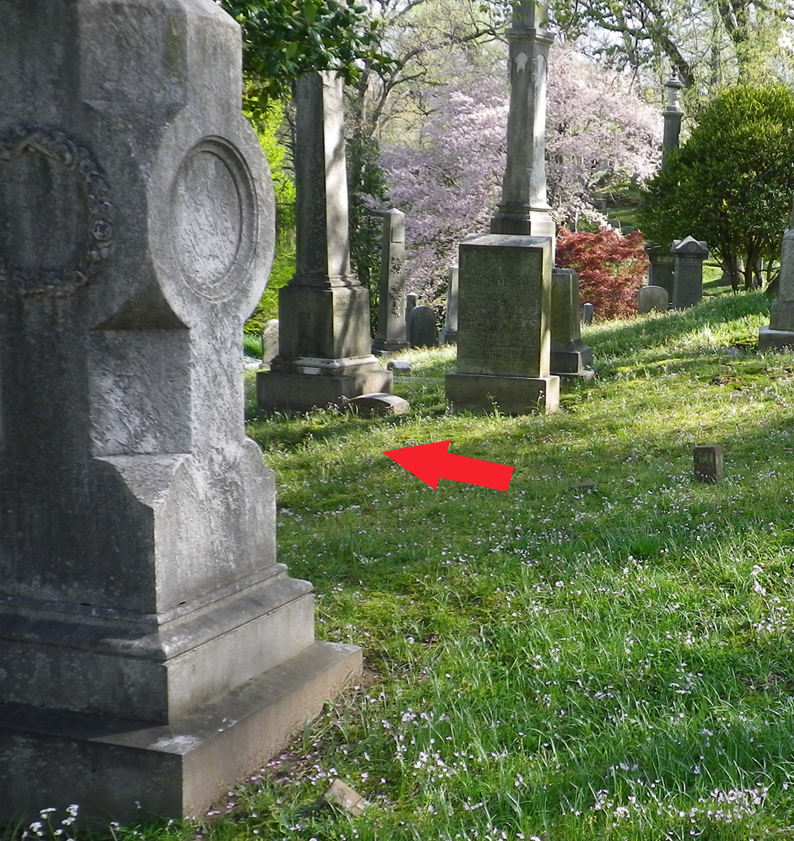
Mr. Aiken was part of Mary Surratt’s legal consul during the Conspiracy trial. The production and release of Robert Redford’s film about Mary Surratt and Frederick Aiken entitled The Conspirator, led to the discovery by researcher Christine Christensen that Mr. Aiken was buried in an unmarked grave in Washington D.C.’s Oak Hill Cemetery.

Aiken’s resting place when it was unmarked

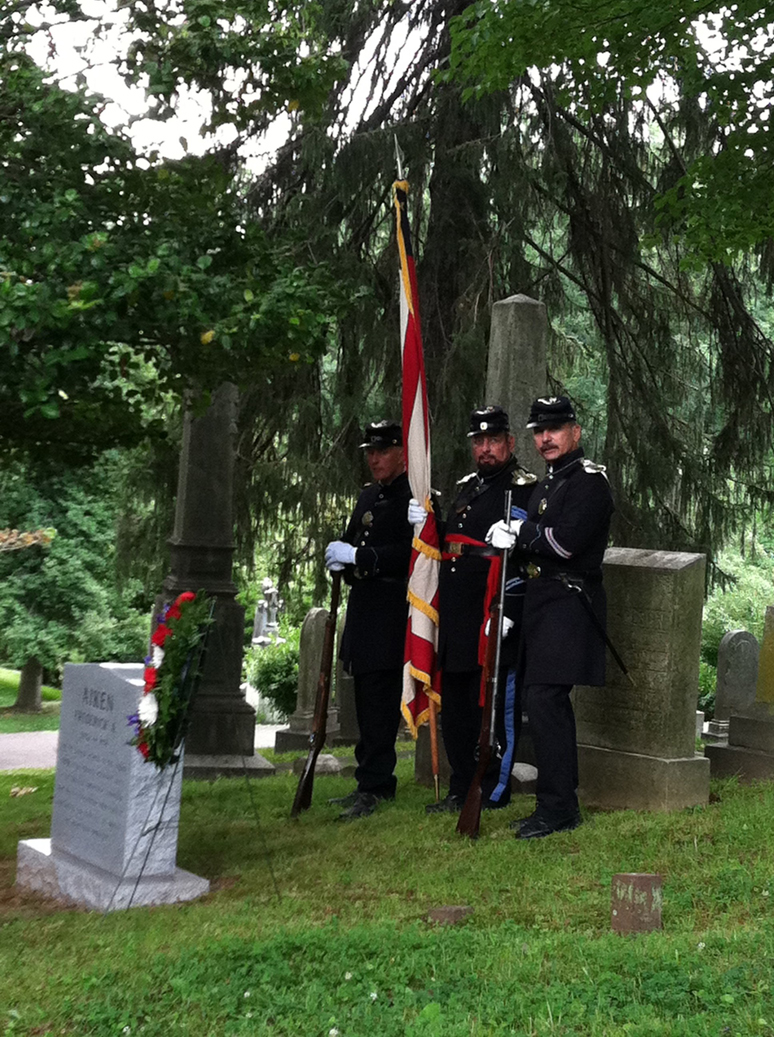
The Surratt Society, having previously taken up funds to mark the graves of Edman Spangler and Elizabeth Keckly, started a fundraising campaign to mark his grave. The dedication service was attended by members of the Surratt Society and Museum, a group of Honor Guard reenactors, and even some descendants of the Aiken and Clampitt family (Aiken’s legal partner in Mary Surratt’s case). Short speeches were given based on the biographical details gained from Christine Christensen’s impressive research (Her 29 page document about Aiken can be read by clicking HERE). The Aiken descendant gave a nice speech while playing a recording he had made of the chimes of a grandfather clock. That grandfather clock was in an Aiken house that Frederick spent time in as a child. You can hear a short recording of them by clicking HERE. At the close of the ceremony, as the group was dispersing, the cemetery was visited by a doe and her fawn. The following are just a few images of that day sent to me by Betty Ownsbey, Lewis Powell’s biographer:

A descendant of the Aiken family (left) and Clampitt family (right). Sadly, Frederick Aiken had no children of his own and so he has no direct line.

The Honor Guard at Aiken’s Grave

Visitors at the Cemetery

References:
Finding Frederick by Christine Christensen
Betty Ownsbey

Categories: Uncategorized | Tags: , , | 11 Comments

On this date: June 16th, 1842

Conspirator David Edgar Herold was born in Washington, D.C.

David Herold was the son of Adam George and Mary (Porter) Herold.  He attended Gonzaga College High School, Rittenhouse Academy, and Georgetown College.  Davy studied pharmacology and was employed as a druggist’s assistant and clerk when he became part of John Wilkes Booth’s plot.  He enjoyed hunting and had learned the routes and trails of Southern Maryland well during his hunting excursions.  This made Davy a perfect guide for Booth’s escape.  At the time of the assassination Davy was just 22 years old.

Davy’s true activities on the night of the 14th are hard to pin down.  It is most commonly written that he escorted Lewis Powell to the Seward house, and then fled when the onslaught began.  Another theory is that he was a point man – directing Powell to Seward’s and then returning to the Kirkwood house to see if Atzerodt had completed his assault on the Vice President.  Lastly, in his confession Atzerodt states that he refused to kill the Vice President, and that it was Davy who was assigned to do so in his place.

What we do know for certain is that stable man John Fletcher saw Davy Herold riding his horse around the time that the assassination occurred.  Fletcher chased after him as Davy was supposed to have returned his rented horse hours ago.  First Fletcher chased him on foot before going to his stables to get a horse for the pursuit.  When Fletcher came to the Navy Yard bridge he learned from the leader of the guard house, Silas Cobb, that Davy had already passed over the bridge.  Cobb told Fletcher he could pass and cross the bridge, but that he would not be allowed to return over it until daybreak.  At this point Fletcher gave up his pursuit.  Davy caught up with Booth who had crossed the bridge before him.  Davy would stay by Booth’s side during their entire escape.  In the end, Davy surrendered himself to the Garrett’s Farm patrol.  Davy was brought back to D.C. and placed on the ironclad ship the Montauk.  Then he was transferred to the Old Arsenal Penitentiary.  Davy celebrated his twenty-third birthday behind those bars and in the midst of the conspiracy trial.  Two of his sisters, Jane and Kate, gained passed to visit him two days later on June, 18th.  They sat and spoke with him in the courtroom from three o’clock until six o’clock.  Davy’s sisters had visited him in prison at least four times prior to this, making him one of the more visited conspirators after Anna Surratt’s attendance of her mother.

David Herold was found guilty on all counts against him except having conspired with Edman Spangler.  He was sentenced to hang and the sentence was carried out on July 7th.

His body was released back to the Herold family in February of 1869 and he was interred in Congressional Cemetery in Washington D.C.  He is buried underneath his sister Jane in the family plot, bearing no headstone of his own.

The press of 1865 was not kind to David Herold.  He was denounced as an idiot boy, with no sense or intelligence of his own.  They portrayed Davy as Booth’s lapdog.  While Davy did display a great deal of devotion to Booth, he was also an intelligent and crafty young man.  Upon his capture, Davy expertly avoided his interrogator’s attempt to implicate him further.  In addition, while on the run, Davy displayed his own creativity and intelligence by co-authoring a poem with Booth.  Instead of an autograph, he and Booth presented Willie Jett the following poem.  Davy wrote the second half:

“He put aside the dainty bribe
The little proffered hand
Albeit he held it in his thought
The dearest in the land
Not sharply nor with sudden heart
But with regretful grace
Meanwhile the shadow of his pain
Fell white upon his face

Dark daughter of the Sultry South
Thy dangerous eyes & lips
Essayed to win the prize and leave
Dear honor we Eclipse
She shyly clung upon his brow
He stayed now at the door
I could not love thee, dear so much
Loved I not Honor more.
Adieu, forever mine, my dear
Adieu forever more!”

Today marks the 170th anniversary of David Herold’s birth.  To me, Davy was a well educated, well off, young man who truly believed in the cause Booth expounded.  Davy was the only surviving son in a home filled with daughters and he longed for adventure.  In Booth’s ideas he found a cause to fight for, an adventure to pursue.  While those ideas were proven to be wrong and misguided, he believed in them nevertheless.  As with the others in Booth’s clan, Davy wanted to make a difference.  So on this, the day of his birth, we remember a man who choose his actions poorly, but do so with the best of intentions.

David Herold’s Signature

References:
Original document images are from Fold3.com
American Brutus by Michael Kauffman

The Lincoln Assassination Conspirators: Their Confinement and Execution, as Recorded in the Letterbook of John Frederick Hartranft by Ed Steers and Harold Holzer

Categories: Uncategorized | Tags: , | 19 Comments

Mail for Mr. Booth

Previously, I posted about one of the letters that was found in Booth’s room at the National Hotel.  As a popular actor, Booth received many letters from friends, fans, and theatre owners.  Another letter found in Booth’s room is the following from McVicker’s Theatre in Chicago:

“Chicago, Dec. 25, 1864

Friend Booth,
What do you say to filling three weeks with me May 29th?  I have not yet filled your time in January and see no chance of doing so with an attraction equal to yourself.  There are plenty of little fish but I don’t want them if I can help it.  So as you can’t come then come at the above date.
With a Merry Christmas and Happy New Year.
Yours Truly,
McVicker”

While Booth’s ability as an actor has been questioned by many authors, he nevertheless had the ability to draw a crowd.  This letter appears to state that Booth was, at one time, asked to play in Chicago in January of 1865 and declined the invitation.  Historically, McVicker’s had been very kind the John Wilkes Booth.  In January of 1862, he made his premiere there selling out the 2,500 seat theatre.  He would return there several times over the next two years.  But, as the years turned from 1864 to 1865, Booth’s mind was on other aspects.  He had suffered large losses in his oil ventures but told family and friends of his success.  He spoke of big plans that would allow him to retire from acting for good.  While wanting of money, an engagement in Chicago would separate him for too long from his new plan and target: Abraham Lincoln.

What makes this letter interesting is not just the content, but also the envelope that held it:

We can see that the letter was originally addressed to “J.Wilkes Booth, 28 East 19th St., New York”.  Written along the left hand side, in McVicker’s handwriting is the note, “forward if from home”.  McVicker had initially sent the letter to the Booth home in New York.

In September of 1863, Edwin Booth purchased the house on 19th St. near Gramercy Park in New York City as a permanent residence for his family.  Mary Ann, Rosalie, and Edwin’s daughter Edwina, lived there year round.  During breaks in touring and when the theatrical season ended, Edwin and John would both reside in the house.  Despite the brothers’ desire to keep the peace in the presence of their mother, the close quarters caused Edwin and John to engage in many arguments, usually stemming from their opposite political beliefs.  In late November of 1864, Edwin finally had enough of his brother’s secessionist talk, and kicked him out of the house.  Booth would briefly stay with his sister Asia in Philadelphia, before moving to Washington.

As the note on the envelope requested, someone in the Booth’s New York house forwarded the letter to John in Washington, D.C.  Specifically, they sent it to Ford’s Theatre.  Noted actors received liberties at theatres and receiving mail was one of them.  Harry Clay Ford, treasurer of the theatre, recounted the morning of April 14th, when Booth, once again, received his mail at the theatre:

“When [Booth] came there I do not know whether he asked for a letter or not, but Mr. Raybold ran into the office and brought him out a letter.  He generally had his letters directed to the theatre…He then commence[d] opening his letter.  Then I left for a while and went into the office.  On coming out again, I found him seated on the steps where he was on Thursday, the steps leading into the office…I think he was reading the letter then.  He did not make any remark in reference to the letter.  I do not know whether the letter consisted of two or three sheets written over.  It was notepaper I think; appeared to be written all over both sheets.  I don’t recollect positively, but I think the writing was rather large.  If I remember right it was zigzag all full of writing.  Did not see any blank on it al all.  He had not finished the letter when I left him.  Was reading it still.”

Harry Ford provides a tremendous amount of detail regarding Booth’s letter.  It seems that this was done to direct attention away from the fact that it was probably him (or someone in his office) that divulged to Booth that Lincolnwas coming.

How our history could be different if, on April 14th, 1865,  Booth had not received a similarly addressed letter like the one above.  He may have continued on past Ford’s never knowing Lincoln was going to be there that night.

References:
My Thoughts Be Bloody by Nora Titone
The Lincoln Assassination – The Evidence by William Edwards and Ed Steers

Categories: Uncategorized | Tags: , , | 1 Comment

Mystery Pictures

Time to test your knowledge of assassination related places and objects.  Look at the mystery pictures below and take a guess as to where/what it is.  When you’ve guessed on all nine of the pictures click the Answer button at the bottom to see how you did.  Good luck!

Mystery Picture #1:

Mystery Picture #2:

Mystery Picture #3:

Mystery Picture #4:

Mystery Picture #5:

Mystery Picture #6:

Mystery Picture #7:

Mystery Picture #8:

Mystery Picture #9:

Got them all figured out?

Check the Answers!

How did you do?

Categories: Uncategorized | Tags: | Leave a comment

Blog at WordPress.com.