After a long career on the American stage, Edwin Thomas Booth retired from the acting in 1888. He spent his declining years in his private room above The Players club that he founded. By 1893, his health had worsened considerably. The events of his life had aged him far beyond his 59 years, with insomnia and lifelong tobacco use taking their toll as well.
In the days prior to his death, Edwin was visited by many of his acting contemporaries. One such visitor was the comedian Joseph Jefferson who found early fame by debuting as Asa Trenchard in the play “Our American Cousin” in 1858. The actor (who was actually 3 years older than Edwin) visited Booth two days before his death:
On June 7th, 1893, Edwin fulfilled his New Year’s Eve prediction that, “You drink tonight to my health. A year from tonight you will drink to my memory.” He passed away at around 1:00 o’clock in the morning – a time he had witnessed often in his solitude. Edwin Booth died during his own “vulture hours” and the world lost the greatest actor of the day. Joseph Jefferson was elected president of The Players following Booth’s death and would serve until his own demise.
References: My Thoughts Be Bloody by Nora Titone
The article was found through Genealogybank.com
The image of Booth in 1892 comes from the Harvard Theatre Collection
Reader littlecoco7 posed the following question under the Quesenberry post:
“This has nothing to do with this topic, but I would like to know out of all the conspirators who had their picture taken from Alexander Gardner, how come there was no photo of Mary Surratt taken?”
Thanks so much for the question littlecoco7. The mug shots of the conspirators are very valuable resources to us now. For George Atzerodt, Michael O’Laughlen, and Edman Spangler, these few shots consist of our entire photographic record of their lives. While engravings and drawings were made of them during their time in the court room, we have yet to find other photographs of these individuals. Even those who we do have additional images of, the mug shots are unique in showing them as they were almost immediately after the crime was committed. Before delving into your question as to why Mary Surratt (and Dr. Mudd for that matter) were not photographed with the rest, let’s look into how and when the conspirators were photographed.
The best resource for information about the images of the conspirators is the team of Barry Cauchon and John Elliott. These talented gentlemen are in the process of writing a highly anticipated book regarding the incarceration of the Lincoln conspirators. One of my links on the side of this blog is to Barry Cauchon’s blog, “A Little Touch of History” while the pairs’ Facebook page about their book, “Inside the Walls” is here. Barry and John presented some of their findings at the 2011 and 2012 Surratt Society Lincoln Assassination Conferences. Their research was remarkable to say the least. To keep their excited fan base content while waiting for the final publication of their book, they produced two supplementary booklets about their talking points. The most recent one that they sold at the 2012 conference was entitled, “13 Days Aboard the Monitors” and delved into the mug shot photo sessions and the hoods worn by the conspirators. All the information in this post can be found in this terrific booklet and is currently available for purchase through Barry and John and the Surratt House Bookstore.
Through the research of Barry Cauchon and John Elliott we believe that three photograph sessions occurred while the conspirators were imprisoned aboard the monitors Saugus and Montauk. The first set of images were all taken of a standing Lewis Powell wearing the clothes he was found in and the clothes he was wearing when he attack Secretary Seward. There were a total of six pictures taken on this day, April 18th.
Carte-de-visites of two of the six photographs taken of Powell on April 18th.
At this point in time, only two of the conspirators were being housed on the monitors; Michael O’Laughlen and Lewis Powell.
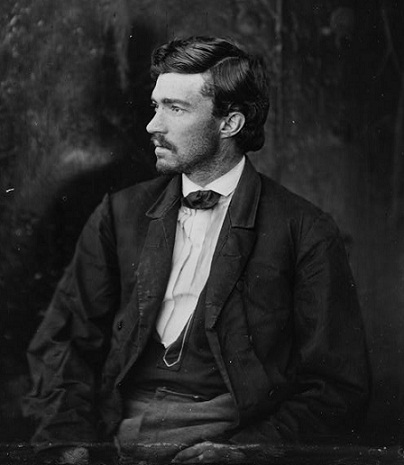
Gardner came back to photograph the conspirators on April 25th. By this point all of the main conspirators except for Booth and Herold had been arrested. Gardner photographed Powell again, along with Michael O’Laughlen, George Atzerodt, Edman Spangler, Sam Arnold and Hartman Richter. Richter was a cousin of George Atzerodt’s and was hiding George in his house when the authorities caught up with him. While Richter would be cleared of any involvement in the conspiracy to kill Lincoln, in these early days of the investigation he was locked up and photographed with the main gang.
One of two O’Laughlen photographs from April 25th
One of two Spangler photographs from April 25th
One of four Powell photographs from April 25th
One of two Arnold photographs from April 25th
One of two Atzerodt photographs from April 25th
One of two Richter photographs from April 25th
Finally, on April 27th, Gardner returned for his last photograph session. Here he took pictures of the recently captured Davy Herold and another conspirator Joao Celestino. Celestino was a Portuguese ship captain with an intense hatred for William Seward. It was thought he was involved with the attempt on the Secretary’s life but was later released as no evidence existed to connect him to Booth’s plan.
One of three Herold photographs from April 27th
One of three Celestino photographs from April 27th
It has also been written that Gardner and his assistant took one photograph of the autopsy of John Wilkes Booth. The single print of the event was apparently turned over the War Department but has never been found. If it was taken, it was either destroyed shortly thereafter, or still remains undiscovered somewhere today.
In the wee hours of April 29th, the conspirators on were transferred off of the monitors and into the Old Arsenal Penitentiary.
So, why didn’t Mary Surratt and Dr. Mudd get their pictures taken? In short, they were not photographed because they weren’t there and their complicity in the affair had yet to be determined. Though Mary Surratt had been arrested when Powell showed up at her boardinghouse at the most inopportune time, she was not imprisoned on the iron clads. Instead, she and her household were sent to the Old Capitol Prison merely as questionable suspects. The same held true for Dr. Mudd who joined others involved in Booth’s escape like Colonel Samuel Cox, Thomas Jones, and Thomas Harbin, at the Old Capitol Prison. In the initial stages of the investigation, Mary Surratt and Dr. Mudd were not seen as conspirators. It was not until more and more evidence arose pointing towards their foreknowledge and association with the assassin that they were treated less like witnesses and more like accomplices.
On May 16th, 1865, Elizabeth Quesenberry gave the following statement to authorities:
“The day that the person I now supposed to be Herold came to my house was on Sunday, the 23rd of April, about one o’clock P.M. He asked my daughter to see the lady of the house, and on being informed that I was absent asked whether I could be sent for. She told him that if he could wait she thought I could. He then remarked to my daughter ‘I suppose you ladies pleasure of good deal on the river.’ my daughter answered ‘No, as we have no boat’. He said that he had crossed the river the night before and had left a very nice little boat by the river bank, which the young ladies could have if they wished. I returned very shortly, and he on seeing me asked if I could not furnish him with a conveyance to take him up the country. I told him no, and asked why he could not walk. She said that he could walk, but his brother was setting down by the river could not, for his horse had fallen and broken his leg; from the way in which he said this, I got the impression that they had both been riding the same horse. He said they were both escaped prisoners, and asked if I could not sell them a horse. I said no, that if I was inclined to assist them I could give them a horse, but that I was not inclined to assist them. He seemed surprised that I was not willing to assist him. I told him that he must go away. He went off very much put out. He went across the field in the direction where I supposed his brother was. I then called to him and asked him if he had anything to eat. He said no and I told him I would go to the house and send him something to eat. I went to the house and after my dinner was over I sent by Thomas Harbin, whom I supposed was a soldier, something to eat. Mr. Harbin, and a Mr. Baden, whom I also suppose was a soldier, came to my house. They had been there before; they had come to my house immediately after the fall of Richmond and they remained there until Mr. Baden was brought to Washington, and Mr. Harbin was there when I left. Harbin returned in about half an hour, and said that she had seen the party the food was for, going on horseback towards Dr. Stewart’s house, and that they told him they were going there. I understood that the horses were furnished by an old man named Bryan never saw the parties afterwards. I became alarmed and suspecting that something was wrong, determined for my own protection to signal to the gunboats, and did hoist a signal and remained there three hours, but they did not come to me. I did not report it to any officer of the government has I had no opportunity to do so and in the meantime I had heard that after they left Dr. Stewart’s they had crossed the Rappahannock at Port Royal and that the soldiers were in pursuit.
E. R. Quesenberry”
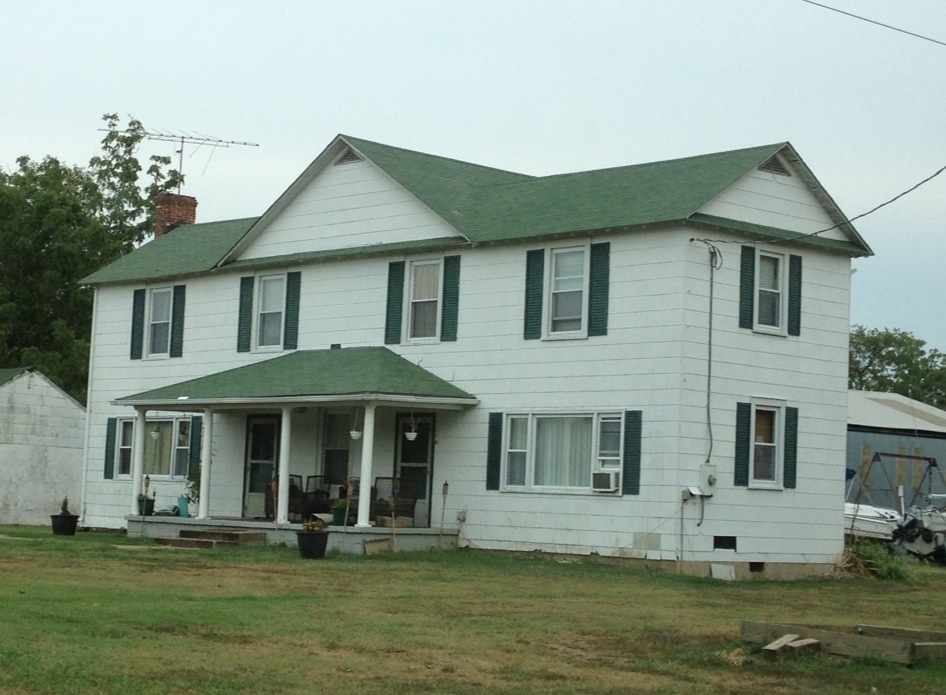
Mrs. Quesenberry’s home then:
Mrs. Quesenberry’s home today:
References:
American Brutus by Michael Kauffman
The Evidence by Edwards and Steers
The assassination of Abraham Lincoln at the hands of John Wilkes Booth was a defining moment of American history. It was a national tragedy the likes of which we had never experienced. It turned Lincoln into a martyr and changed the course our country would take after a devastating Civil War. For this reason, the assassination of Abraham Lincoln has become perfect fodder for the imaginative minds of comic book writers. Through this artful medium, Lincoln’s assassination has been remembered, revised, and completely reinvented to match the worlds in which superheroes like Superman, Batman, The Flash, and others exist. Most references to the assassination in comic books are brief but a select few have devoted serious attention to America’s great drama of April 14th, 1865.
The Assassination Remembered
Several comic books briefly mention the assassination of Abraham Lincoln as it occurred. Occasionally, the main character is somehow thrown back through time or enters a parallel world to witness it. They may interact in the narrative, but the ending is still the same.
Superman’s young photographer friend from the Daily Planet, Jimmy Olsen, is thrown back in time to the night Lincoln is assassinated in this comic from 1968:
The assassination of Lincoln is remembered in a flashback in a Batman comic from 2003:
The Assassination Revised
While reminding us all of the past is nice, it isn’t very superhero-y. More often, the death of President Lincoln is averted due to the help of a hero, or because this is a parallel world where his assassination never occurred in the first place.
Superman saves Lincoln just in time in a comic from 1961. He later discovers he is in a parallel world and history is unchanged in the “real” world.
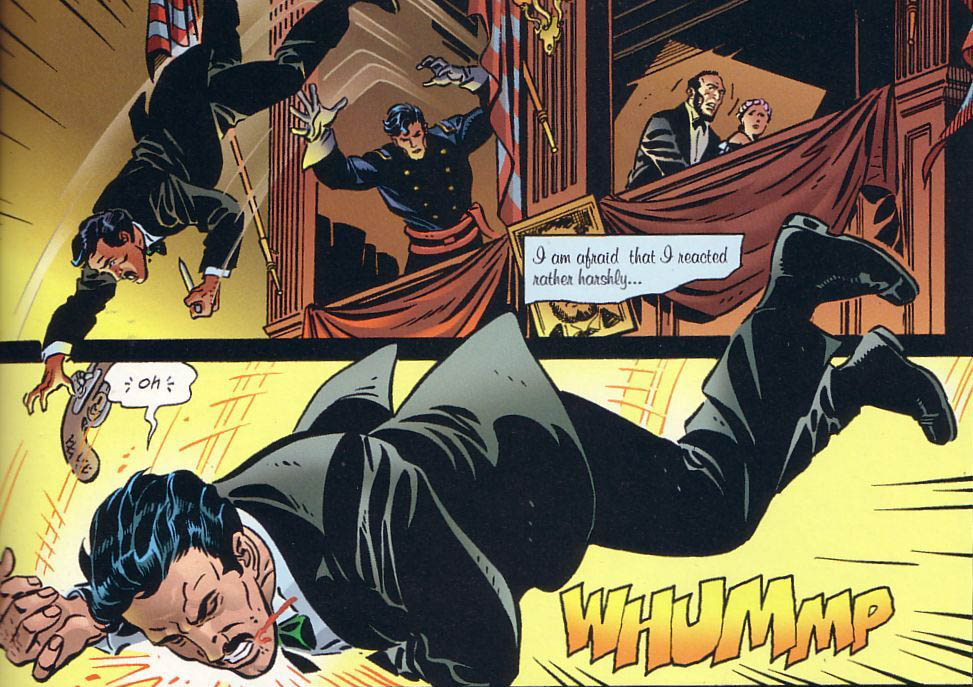
In this West Coast Avengers comic from 1990, Lincoln is able to thwart his own assassination by quick reflexes. Sadly, this is just a parallel world which is destroyed by the man impersonating Major Rathbone.
Quick thinking on Civil War Superman’s part saves the President while Booth is impaled by his own knife in this comic from 2003.
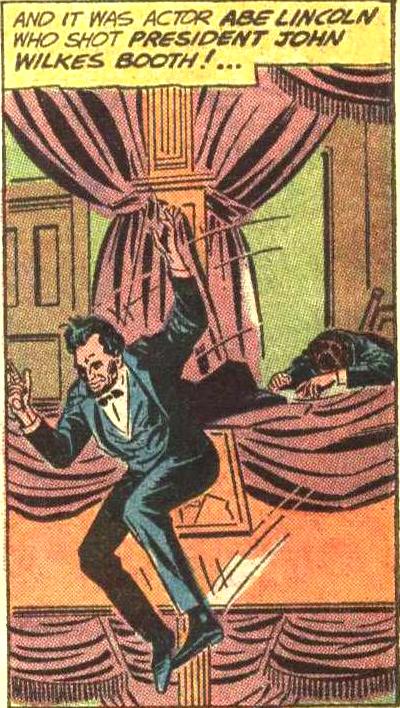
An actor who closely resembles Abraham Lincoln is somehow sent back in history to the most inconvenient time for him in this standalone comic from 1956.
The Assassination Reinvented
In these versions, the normal history is changed drastically for the comic book world.
In a parallel world visited by the Justice League of America in 1964, the villain and victim are switched.
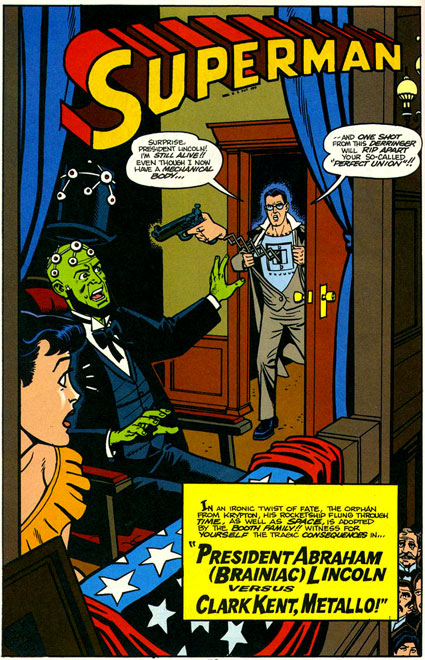
In this one shot cover parody from 1999, an alternate Superman is sent to Earth to be raised by the Booth family. Don’t ask me about the green “Brainiac” Lincoln or the half robot Superman with a derringer in his chest. I don’t get it either.
In this portion of the TV show Batman: The Brave and the Bold, Batman and Abe fight against a “steampunked” John Wilkes Booth:
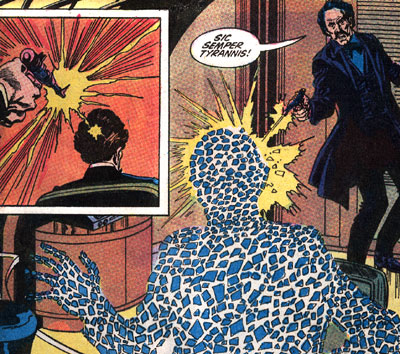
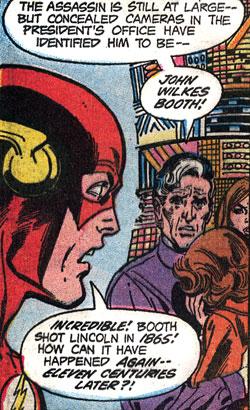
As entertaining as that rendition is, however, my favorite incarnation of the assassination of Abraham Lincoln in the comic book realm is this 1971 issue of The Flash:
From what I can gather from sources online, the Flash travels forward in time to the year 2971. He enters a world which once contained a united Earth. However a dispute has broken out between Earth East and Earth West and there is Civil War once again. The beginning of the comic leads with a future Lincoln getting disintegrated by a future John Wilkes Booth.
The Flash is rightly confused by how this is possible.
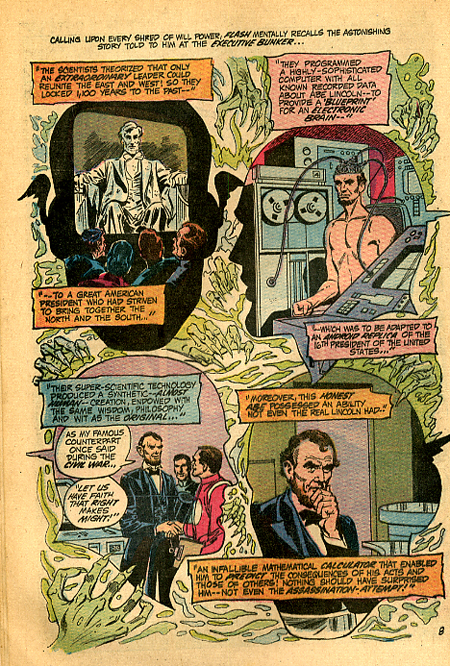
It turns out the future scientists created a robotic Abraham Lincoln to lead them through the Civil War. He contained Lincoln’s wit and wisdom, and also the ability to calculate the consequences of people’s actions.
Booth makes his escape to Earth East using a jet suit.
The Flash chases after him, but gets trapped when Booth ties him up with a future chain that squeezes him harder and harder.
Booth jets off again to meet his master, an evil mastermind named Bekor. He turns over the murder weapon he used to kill Lincoln to Bekor. Bekor betrays Booth and shoots him with the disintegrator. Bye Bye, Booth. When Bekor kills Booth though, Robot Abraham Lincoln remerges out of the gun. Apparently, using his robot brain, Lincoln predicted someone would try to take his life. So he carried around his anti-disintegrator pocket watch.
He turns the table on Bekor using his good old fashioned wrestling skills.
By then, The Flash has managed to escape the squeezing chains and rushes to Bekor’s lair. He manages to get Lincoln out of the lair before it self-destructs. Lincoln continues as President of Earth, using his 19th century wisdom to lead this troubled, 30th century world. This is a fun and entertaining reinvention of the assassination of Lincoln.
There are many other comic books that include references to the assassination of Abraham Lincoln with more coming out every year. As long as Abraham Lincoln continues to be an important part of the American story, his death will continue to find a place within their multicolored pages.
When it comes to researching and writing about the assassination, I am a very visual person. I actively seek out and like to include pictures in as many of my posts as possible. Images contain a life and message all their own. So often though, we as human beings gloss over visual information quickly. As an elementary teacher, I even witness this with my young readers. Children are so eager to read quickly and efficiently like adults, that they start abandoning the pictures in their stories. They ignore the photographs and pictures, opting instead to race through and finish. As adults we do the same. Efficiency runs our lives with nary a moment devoted to the mere act of looking closely at anything. So, from time to time, I will be combating this with a simple post of a photograph. I invite you to take some time to really see it. Take an actual 60 second long minute, and really look at the image. Let it bring questions into your mind. Reflect on the feelings it might draw out of you. Put it in its proper context as a moment in time, and not just as a graphic on a computer screen.
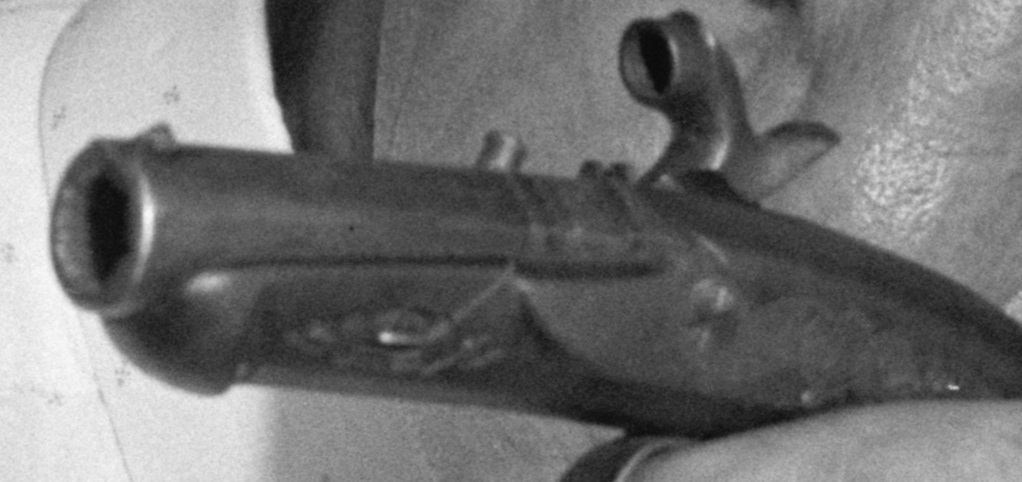
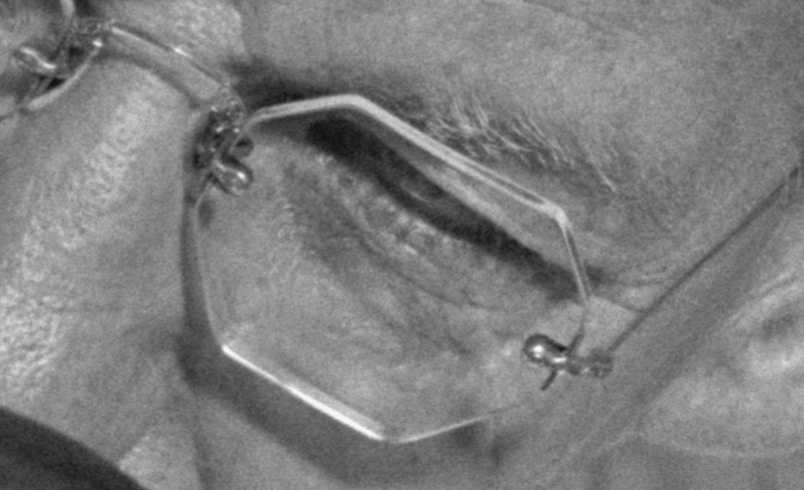
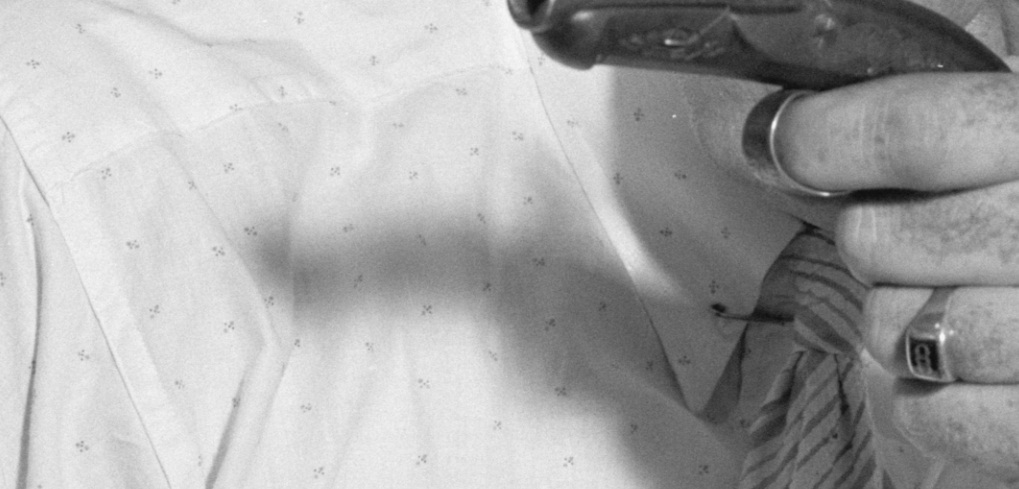
Today, I’m putting up a picture of a man holding John Wilkes Booth’s gun. I’ve seen the gun many times and this specific photo as well, but when I really take the time to see it, this image speaks to me: “This man in the photo chose to hold the gun. With or without prompting, he posed himself into an aiming position with it. This item was used to kill the President and this man is holding it centimeters from his face. His eye is drawing an imaginary line down its barrel. What does he see in its sights? How did he feel when he posed for this? Is the gun like a toy to him? Has he been around it so long that the impact of what it did has worn off? Or is he trying to get into the mindset of the man who pulled the trigger?…”
When you look at this picture, I hope it affects you in some way, if only for a minute.
August 10th, 1937
Edwin B. Pitts, Chief Clerk of the Judge Advocate General’s Office, poses holding Booth’s derringer:
Reader Richard Petersen asked this excellent question on my last post about Silas Cobb:
Question. What was the protocol for Booth and Herold in crossing the bridge? Could they ride across or did they have to dismount and walk?
I believe this to be a very good question and worthy of discussion. The record of what transpired at the Navy Yard Bridge comes from the official statement and the conspiracy trial testimony of Sgt. Silas Cobb. In his statement to authorities specifically, Cobb gives wonderful details about the two riders who crossed his lines. For example, we learn that Booth was wearing a “soft black or dark brown felt hat” and that “his hands were very white, and he had no gloves on”. Cobb even provided details about Booth’s voice stating it was, “rather light, and high-keyed”. For Davy Herold, Cobb described him as wearing, “a light coat, light pants, and a snuff colored felt hat, of rather a light shade.” He even let us know that Davy was, “the heavier of the two”. When it comes to the actual method of crossing the bridge, Cobb does not give specific detail. This is probably due to the fact that crossing people over the bridge was so commonplace to Cobb, that he didn’t consider the way in which Booth and Herold did it to be any more notable than any other person. He does provide a few statements that we can piece together though, to paint a seemingly accurate picture of what the process was.
When both men approached the bridge, the sentry challenged them (assumedly by asking “Halt, who goes there?” or “Friend or Foe”). Booth and Herold both replied “a friend” and Cobb began his interrogation of them. In the trial testimony, Cobb is asked a question about his encounter with Herold:
Q. Did you have a good view of his face? Was there a light?
A. I did. I brought him up before the guard-house door, so that the light shone full in his face and on his horse.
So we know that Cobb moved Davy to be in view of a light. Unfortunately, this statement is inconclusive regarding whether or not Davy was still on horseback, or on foot next to his horse. However, a little while after this, Cobb is asked about Davy’s size:
Q. How would he compare in size with the last man on the row in the prisoner’s dock? [David E. Herold, who stood up for identification.]
A. He is very near the size, but I should think taller, although I could not tell it on the horse; and he had a lighter complexion than that man.
The darken part is very important. Cobb, the man who provided so many details about the men who he crossed over the bridge, was unsure about Davy’s height. It appears his explanation for this is because the Davy stayed on his horse and so Cobb was not able to accurately compare Herold on his horse with Herold on the prisoner dock. This testimony appears to favor Booth and Herold remaining on their horses.
Cobb gives us a bit more (though still not as much as we’d like) with regard to Booth’s crossing:
“He then turned and crossed the bridge; his horse was restive and he held him in and walked him accross the bridge; he was in my sight until after passing the other side of the draw. I do not know with what speed he rode after that.”
During my first few readings of this, I pictured Booth walking his horse as a man would walk a dog. In my eyes it appeared as if Booth (who apparently showed no physical pain supporting Michael Kauffman’s theory that he broke his leg later in a horse fall) kept his horse close to him and acted like a child crossing the street by walking his bicycle. Upon further reading and trying to put myself into the correct 19th century equestrian mindset though, I read this now as Booth riding his horse at a walking pace across the bridge. The last phrase, “I do not know with what speed he rode after that,” implies to me that Booth was already riding his horse and not walking it on foot. I want to believe the detail oriented Cobb would have stated something along the lines of “he remounted his horse” if Booth was actually walking alongside it beforehand.
There is no specific statement by Cobb saying that Booth and Herold ever dismounted their horses. In addition, the few details that Cobb does give regarding the process appears to imply that they remained in their mounts during their entire time they conversed with him. There is no smoking gun or definite answer to Richard’s question, but I believe the majority of the evidence points to Booth and Herold staying on their horses when they crossed the Navy Yard Bridge.
On April 14th, 1865, Sgt. Silas Tower Cobb was in charge of the Army’s guard detail over the Navy Yard bridge leading out of D.C.
The Navy Yard Bridge in 1862
During that night, he was approached by three individual riders all looking to be crossed over the bridge. As a proper guard he interrogated the men asking them where they were going, why they waited until after 9:00 pm to depart, and what their names were. The first man replied he was going to his home in Charles County, MD, “close to Beantown”. He pleaded ignorant of the rule forbidding passage over the bridge after 9:00 and stated that, “It is a dark road, and I thought if I waited a spell I would have the moon”. Sgt Cobb was hesitant to let him pass but the man who gave his name as Booth seemed proper enough and his answers had been satisfactory. While Cobb’s standing orders had been that no person was allowed to cross the bridge between 9:00 pm and sunrise, the enforcement of these orders had been more lax as the war had dwindled down. Sgt. Cobb unwittingly allowed the assassin of Lincoln to cross his line. Not long after this, another man rode up giving his name as Smith. He told Cobb he was heading home to White Plains. Again, Silas Cobb informed the man that passage over the bridge after 9:00 o’clock was forbidden. Smith replied, “I stopped to see a woman on Capitol Hill, and couldn’t get off before.” Though this man did not appear as proper as the first man, he allowed him to cross the bridge as well. Sgt. Cobb had unwittingly allowed David Herold, one of the Booth’s accomplices, to cross his line. History repeated itself as a third horseman appeared. This man asked Cobb if he had passed a man on a horse fitting the description of “Smith”. Cobb replied in the affirmative. The third man told Cobb he was a stableman, and that “Smith” had run off with one of his horses. The stableman, John Fletcher, asked for permission to cross and give chase. Cobb told him that while he would be allowed to cross out of the city, he would not be permitted to return until daybreak. Fletcher decided the idea of spending all night stranded outside of the city looking for a lost horse was an unappealing one and returned to the city to report his loss to the police.
Though Cobb was later in deep dung for allowing two conspirators in Lincoln’s assassination escape over his bridge, he never suffered court martial for his actions. He testified at the trial of the conspirators and was honorably discharged from the army in September of 1865. He assumedly returned to his hometown of Holliston, Massachusetts. Two years later, however he met his end at the age of 29 while traveling in Michigan:
Silas Cobb’s death as reported in the Lowell Daily Citizen on November 11, 1867
Silas Cobb’s death as reported in the Jackson Citizen on November 19th, 1867
It is one of those odd twists of fate that the man who permitted the river crossings of two Lincoln assassination conspirators would meet his end in his own unfortunate attempt.
While searching newspapers today, I stumbled across an article regarding Samuel Arnold’s 1902 newspaper serial about his involvement in the conspiracy to kidnap President Lincoln. The completed serial ran in the Baltimore American and can be purchased in book form as Memoirs of a Lincoln Conspirator edited by Michael Kauffman. What was new to me in this article was not the content, but rather an image of Sam Arnold that I had never seen previously:
Sam Arnold’s image in the December 7th, 1902 edition of the Dallas Morning News
At first, I thought it was a rather poor drawing by a Dallas newspaperman based off of Sam’s mug shot photo:
Sam Arnold’s Mug Shot
After a little bit of searching, I discovered the image in two other papers, both in Illinois, dated the 11th and 28th:
Sam Arnold image in the Rockford, IL Morning Star on December 28th, 1902
Then I found a slightly different, but similiar image of Sam Arnold in another 1902 newspaper:
Sam Arnold in the December 7th, 1902 edition of the Philadelphia Inquirer
To me, this version in the Inquirer appears to be the most lifelike and looks to be taken from a photo. Alterations have been made to it, of course, but not to the same degree as the first few versions. Still I cannot decide whether I think these images are based off a true, unknown image of Sam or if they are just an artist’s interpreation of Sam. I’ve created a poll to get your feedback. What do you think?
















 LincolnConspirators.com
Recent Comments