On this date, January 3rd, in 1866, famed tradegian Edwin Booth returns to the stage for the first time since his brother’s crime.
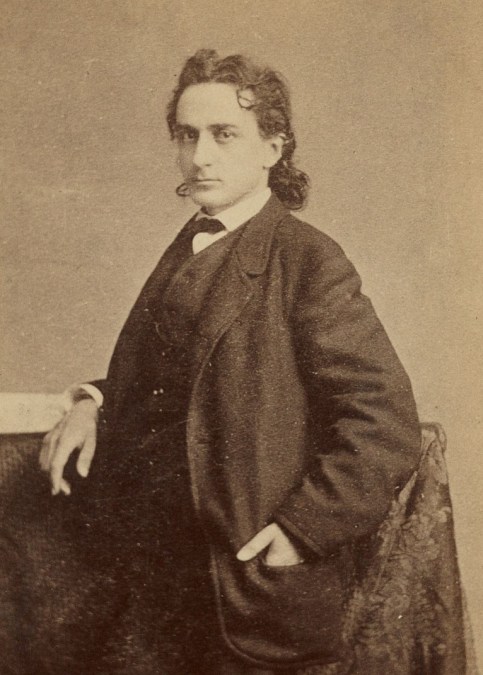
After Lincoln’s assassination Edwin had vowed to end his theatrical careeer forever. However, the allure of the stage was too much for the actor. Edwin’s return appearance as Hamlet at the Winter Garden Theatre envoked an ovation of applause and cheers that lasted four full minutes. The theater going public never blamed him for his brother’s act, and continued to support him for the next twenty five years.
Edwin Booth reciting part of Othello Act I, Scene III:
“Most potent, grave, and reverend signiors,
My very noble and approved good masters,
That I have ta’en away this old man’s daughter,
It is most true; true, I have married her:
The very head and front of my offending
Hath this extent, no more. Rude am I in my speech,
And little bless’d with the soft phrase of peace:
For since these arms of mine had seven years’ pith,
Till now some nine moons wasted, they have used
Their dearest action in the tented field,
And little of this great world can I speak,
More than pertains to feats of broil and battle,
And therefore little shall I grace my cause
In speaking for myself. Yet, by your gracious patience,
I will a round unvarnish’d tale deliver
Of my whole course of love; what drugs, what charms,
What conjuration and what mighty magic,
For such proceeding I am charged withal,
I won his daughter.”
Then Booth skips some dialog from other characters
and finishes with:
“Her father loved me; oft invited me;
Still question’d me the story of my life,
From year to year, the battles, sieges, fortunes,
That I have passed.
I ran it through, even from my boyish days,
To the very moment that he bade me tell it;
Wherein I spake of most disastrous chances,
Of moving accidents by flood and field
Of hair-breadth scapes i’ the imminent deadly breach,
Of being taken by the insolent foe
And sold to slavery, of my redemption thence
And portance in my travels’ history:
Wherein of antres vast and deserts idle,
Rough quarries, rocks and hills whose heads touch heaven
It was my hint to speak,–such was the process;
And of the Cannibals that each other eat,
The Anthropophagi and men whose heads
Do grow beneath their shoulders. This to hear
Would Desdemona seriously incline:
But still the house-affairs would draw her thence:
Which ever as she could with haste dispatch,
She’ld come again, and with a greedy ear
Devour up my discourse: which I observing,
Took once a pliant hour, and found good means
To draw from her a prayer of earnest heart
That I would all my pilgrimage dilate,
Whereof by parcels she had something heard,
But not intentively: I did consent,
And often did beguile her of her tears,
When I did speak of some distressful stroke
That my youth suffer’d. My story being done,
She gave me for my pains a world of sighs:
She swore, in faith, twas strange, ’twas passing strange,
‘Twas pitiful, ’twas wondrous pitiful:
She wish’d she had not heard it, yet she wish’d
That heaven had made her such a man: she thank’d me,
And bade me, if I had a friend that loved her,
I should but teach him how to tell my story.
And that would woo her. Upon this hint I spake:
She loved me for the dangers I had pass’d,
And I loved her that she did pity them.”
References:
My Thoughts Be Bloody: The Bitter Rivalry Between Edwin and John Wilkes Booth that Led to an American Tragedy by Nora Titone (2010) Page 374
Sound recording of Edwin Booth and transcript from Archive.org






 The first is Rich Hill, the home of Samuel Cox in Charles County, MD. Cox was a well-known Confederate sympathizer who held the honorary title of Captain (later Colonel) for commanding a volunteer militia at the start of the Civil War in case Maryland decided to secede from the Union. Booth and Herold made their way to Cox’s plantation after leaving Dr. Mudd’s. Cox gave them food and a chance to rest before having his overseer, Franklin Robey, hide them in a nearby
  The second gallery is devoted to the “Booth” mummy. The mummy is that of Enid, Oklahoma drifter, David E. George who took his own life in 1903. Before his death, George told residents of Enid that he was actually John Wilkes Booth. When the news spread, Memphis attorney Finis L. Bates came to identify the body. Years before in Texas, a man by the name of John St. Helen confided on his assumed deathbed to Bates that he was actually John Wilkes Booth. St. Helen survived his illness, told his whole tale to Bates, and skipped town shortly thereafter. Bates came to Enid and identified David E. George as John St. Helen. The local undertaker embalmed the body and it was a local attraction in Enid for many years. Bates bought the mummy and had it carted around carnival sideshows to expound his theory (and book) about Booth’s escape. While not John Wilkes Booth, the George/St. Helen mummy is an interesting piece of pseudo-history all its own.



 LincolnConspirators.com
Recent Comments