The Son of John Wilkes Booth

At first blush, London may seem far removed from the story of the Lincoln assassination. However, the history of the assassin is very much based in his ancestral London roots. We can document that the Booth family had called London home since at least John Wilkes Booth’s great grandfather’s christening in London in 1723. Junius Brutus Booth, the patriarch of the theatrical dynasty that fathered the assassin, was born in and started his career on the London stages of Covent Garden and Drury Lane. A few years after the assassination, John Sleeper Clarke moved his family, including his wife and sister to the assassin, Asia Booth Clarke, to London. Asia never saw America again except for when her body was returned to Baltimore, and John Sleeper sleeps forever in a London cemetery.

So there are many possible Boothie missions for one to do when visiting London. You could find the location of Junius’ boyhood home, search through the London Metropolitan Archives for Booth birth and death certificates, or visit a theatre library to photograph early Junius playbills. There is also one small connection hidden away in a small cemetery.

hree children of Junius Brutus Booth are buried in London. The first to die, and is safely assumed to be buried in London, was Junius’ first child, Amelia. In my last post in the series regarding Junius’ early theatrical career I hinted about this unborn child conceived with Adelaide Delannoy. Amelia died in infancy and, thus far, an exact date of death and place of burial has yet to be found. The other two Booth children buried in London are Richard Booth, Junius’s other child with Adelaide who lived into adulthood, and Henry Byron Booth, Junius’ son with Mary Ann Holmes who died when the family was visiting London. A further post will document their deaths and burials once I receive paperwork in the mail from the London Metropolitan Archives.

While researching the above however, I came across an interesting letter in the James O. Hall Research Center of another Booth buried in London whose father had a familiar name:

Henry Booth letter

Coincidences occur, of course, and there are likely hundreds of Booths in London today with no connection to the assassin of the President, but the fact that this Henry Wilkes Booth was buried in St. John’s of Clerkenwell, the same neighborhood where our Booth family resided, is worth following up. It appears that James O. Hall, forever investigating every lead, agreed and in another letter he recounts a time when he was in England and attempted to find the above mentioned stone. He was unsuccessful as, “the usual London rain” cut his search short.

The rain however, was probably a blessing as it turns out Mr. Hall was in the wrong cemetery. Just from my slight research into the matter I can tell you that London cemeteries are a nightmare. They are called different names at different times and many smaller cemeteries that existed during the Civil War era were transformed into parks with the grave stones removed. However, as luck would have it, one of the few gravestones that remain in one of those small micro parks is that of Henry Wilkes Booth’s:

Henry Wilkes Booth's grave 1

Henry Wilkes Booth's Grave

So who is this Henry Wilkes Booth, son of John Wilkes Booth anyway? Before you start thinking “escape theory” no, this is not a post-assassination son of “our” John Wilkes Booth. The death date for Henry Wilkes of 1837, a full year before our John Wilkes was born, luckily nips that in the bud. In fact, Henry Wilkes and John Wilkes were second cousins as this partial family tree shows.

Henry Wilkes relation to John Wilkes

What is interesting is how the name John Wilkes Booth was already in the family before the American John Wilkes Booth was born. Many authors have written that our John Wilkes Booth gets his name from the British radical John Wilkes. We know that, in his younger days, Richard Booth attempted to sail off to the colonies in order to fight on behalf of the American Revolution. Richard wrote to John Wilkes asking for his assistance, noting a kinship between them. Richard’s mother was Elizabeth Wilkes who is assumed to be distantly related to John Wilkes. In his book, The Mad Booths of Maryland, author Stanley Kimmel wrote that Richard Booth was given the honor of naming his grandson John Wilkes Booth, though no source is given for this idea.

While it is entirely possible and seemingly appropriate that America loving Richard named his grandson John Wilkes Booth after the British agitator who sided with America during the revolution, the name had already been used in the family. The American Booths had contact with the British Booths and during Junius’ divorce proceedings with Adelaide, the British John Wilkes Booth was brought up as he controlled some of Junius’ assets that were left to him by his grandmother. Perhaps therefore, the assassin of President Lincoln was not named after the great radical John Wilkes, but after his father’s cousin, John Wilkes Booth of London.

Regardless, this one gravestone for Henry Wilkes Booth is one of the very few that remain of the illustrious Booth family in London. Today, it is one of five or so gravestones in the 320 square yard park “St. John’s Churchyard” off of St. John’s Street in London.

2013-07-20 14.00.17

References:
Junius Brutus Booth: Theatrical Prometheus by Stephen M. Archer
James O. Hall Research Center
Art Loux Archives
Lindsey Horn

Categories: Uncategorized | Tags: | 23 Comments

“Scan every face”

In the days following the assassination of Abraham Lincoln, the entire country was on the lookout for the assassin and his conspirators. The wanted posters for Booth, Herold, and Surratt offered generous sums and were allegedly the first in the nation to use photographs:

20130718-100031.jpg

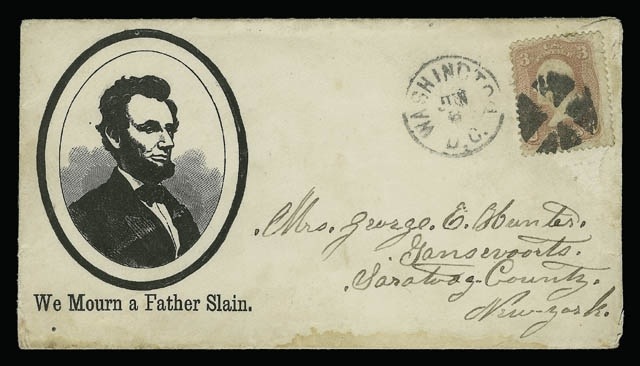
But these wanted posters and broadsides were not the only means put forth to help identify and find the criminals. Quickly stationary store owners sprang into action. They were already producing memorial envelopes (called covers to stamp collectors) to the fallen President:

20130718-101320.jpg

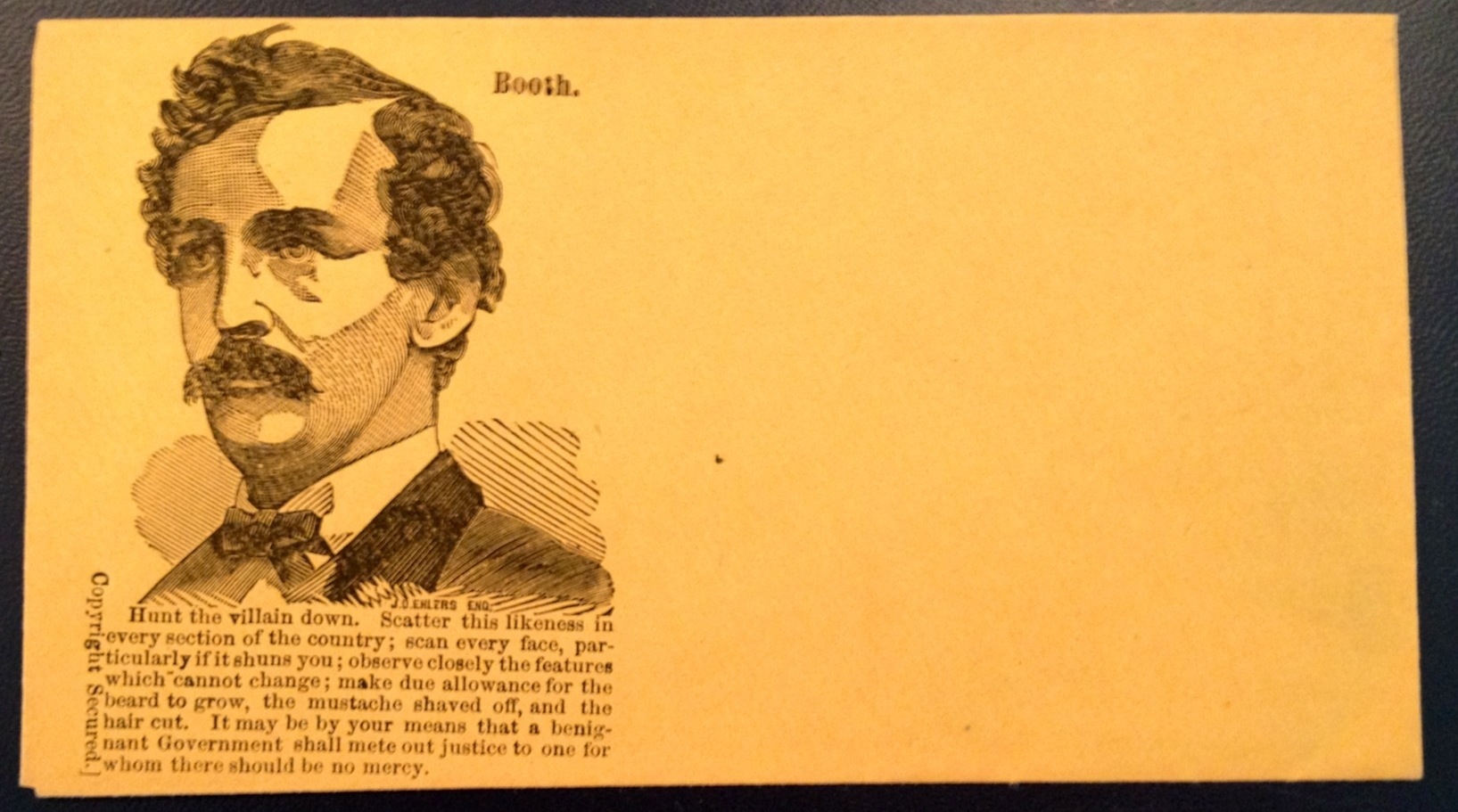
In short order one Washington D.C. stationary maker named C. H. Anderson created an envelope containing the image of John Wilkes Booth:

20130718-105731.jpg

The idea was that covers like this would serve as traveling wanted posters, reminding postal workers and citizens to keep a watchful eye for the assassin. The description under the engraving of Booth gives the following instructions:

“Hunt the villain down. Scatter this likeness in every section of the country; scan every face, particularly if it shuns you; observe closely the features which cannot change; make due allowance for the beard to grow, the mustache shaved off, and the hair cut. It may be by your means that a benignant Government shall mete out justice to one for whom there should be no mercy.”

While a good idea, in the end, Booth was brought down by the cavalry, not a cover.

References:
Lincoln Covers Auction

Categories: Uncategorized | Tags: , | 2 Comments

A Thank You from Spangler

Though sentenced to 6 years in prison (a relative slap on the wrist compared to the execution and life sentences conveyed on the other accused), alleged conspirator Edman Spangler was blessed with the support of a man who continued to fight for his freedom – John Thompson Ford. Ford always believed his employee was completely innocent of any wrong doing. John T. Ford fought valiantly to help Spangler secure his freedom and even put up his own money to publish his defense testimony. While imprisoned on the Dry Tortugas, Spangler wrote the following letter to Ford, which was accompanied with several boxes, to thank him for his continued help:

“Mr. John T. Ford
Baltimore City
Md.
Sir.
I have again sent a box to your care, containing articles to be distributed to my and my roomates friends, which please deliver as directed. You will find a box marked for yourself, also a Cribbage board for yourself, Harry and Dick, each bearing labeled the name to whom they are for. I also send a box for my sister which please forward as directed thereon. Please notify O Laughlins and Arnolds family of the articles for them, which are a small box, directed to each of their familys, and also Cribbage boards apiece for each. Dr. Mudd sends a Cribbage Board which please deliver to his friend Mr. Dyer. Upon the receipt of the box please notify me of it. I trust you will be pleased with the things as I have endeavored to my utmost to make them so. The gift tis true is not much, but a heart of gratitude prompts the bearing of the gift.
We are all well with the exception of Arnold who looks very badly, but receives every kindness both from the officers and soldiers of the Command, which he is grateful for, and which we appreciate. I trust something soon will turn up, for my good and the good of all of us. I see by the papers the prosecution against Surratt are looking for a woman in N.Y. as a witness in his trial – perhaps it is Mrs. Hudspeth, whom Arnold has mentioned to me to write you of, as you know something in regard to her former testimony as told him by his and O Laughlins counsel. Please forward me the National Intelligencer as we are devoid of any paper matter. I have never received the Baltimore Sun since here, and as O Laughlin has that sent, I would be thankful if you would send me the above named paper. I am making a portable ladies writing desk and wish to know the initials of the name you wish placed on it, as the desk is intended for you. Trusting you will still remember me, and this will find you well, I close awaiting your reply.
Yours, etc.
Edman Spangler”

20130717-124814.jpg

Though the exact date of this letter is not given, it is assumedly written in mid 1867, before or during John Surratt’s trial but before Michael O’Laughlen’s death from Yellow Fever in September.

This letter provides us with a good view of the boredom that must have permeated the daily lives of the imprisoned conspirators at Fort Jefferson. With nothing else to do, Spangler was a veritable factory of cribbage boards and other carpentry items, spending his days keeping himself busy and purposeful. The desire for newspapers was strong and it appears each issue of the Baltimore Sun provided by the O’Laughlens was a treasured commodity to all the men. It was this desire for news that led Michael O’Laughlen to disobey Dr. Mudd’s advice when the former was suffering from Yellow Fever. As Dr. Mudd wrote of O’Laughlen’s illness:

“He had passed the first stage of the disease and was apparently convalescent, but, contrary to my earnest advice, he got out of bed a short time after I left in the morning, and was walking about the room looking over some periodicals the greater part of the day. In the evening, about five o’clock, a sudden collapse of the vital powers took place, which in thirty-six hours after terminated his life. He seemed all at once conscious of his impending fate, and the first warning I had of his condition was his exclamation, “Doctor, Doctor, you must tell my mother all!” He called then Edward Spangler, who was present, and extending his hand he said, “Good-by, Ned.” These were his last words of consciousness.”

Due to the continued persistence of people like John T. Ford and the Mudd family, the three remaining Lincoln assassination conspirators, Dr. Mudd, Samuel Arnold, and Edman Spangler, would secure their pardons in the final days of Andrew Johnson’s presidency in 1869.

20130717-124927.jpg

References:
John Thompson Ford Papers at the Library of Congress
Robert Summers’ Dr. Samuel A. Mudd Research site
The Art Loux Archive

Categories: Uncategorized | Tags: , , , | 2 Comments

“Our family is in grate distress”

As I have mentioned before, the assassination of Abraham Lincoln caused both trouble and immense grief for the family members of the conspirators.  Imagine the horror of waking up one morning and reading the name of your son or daughter in connection with such an atrocious crime.  Such was the case for elderly and infirmed William Spangler, the father of 39 year-old Ford’s Theatre stagehand, Edman Spangler.

Spangler Icon

In response to the accusations William read regarding Edman’s alleged role in John Wilkes Booth’s plot, he wrote the following letter to his son asking for the truth:

“York, [Pennsylvania] April [1865]

Dear Son This is to let you no that we are all in good Heath except my selfe.  I am Getting worce in my leg and Arm.  I can scarcily do aney Work but I thank my God That my Body Heath is Good.  I have no particular to wright.  Only this that our Family is in grate distress That your name is mentioned In So Maney papers About you In this murder of the Chief President.  now if you Will gratify us to hear of you the Truth of the matter and The reason of your name in almost every paper in the Country.  You can certainly let me no the truth about The Matter.  I expected A Letter from you as you might have reconciled our Family much by Sending us the truth of all you no About it.   there is so much About it in the News that We cannot no the truth.  And as the[re] is so much suspicen I don’t want to wright here than I want to no wat you no about it.  if you Wright and think that your Letter is or may bee Suspicious Take it to the post office and Let it Bee red by some of the Members of the post office.  My hand is so lame that I can scarcely hold the pen.  Dear Son Do answer this Imediatley.  From your affectinate father.  God bee with you. Wm Spangler”

To his dying day, Edman Spangler declared his innocence regarding Booth’s plot. Therefore, it is likely that his reply to his father would contain the same message.  Spangler easily and truthfully would recount to detectives his introduction to the Booth family during the construction of Tudor Hall and his friendship with John Wilkes during his employment at Ford’s Theatre, but denied any knowledge of what Booth had planned on the night of April 14th, 1865.

References:
Maryland Historical Society
Art Loux Archives

Categories: Uncategorized | Tags: | 7 Comments

When Junius Took the Stage – Part 3

I’m in the midst of reading the book, Junius Brutus Booth: Theatrical Prometheus by Stephen M. Archer. Though I’m only about 40 pages into it, I already have the book brimming with Post-It notes marking items of interest requiring further investigation. The most fascinating things I’ve come across thus far, is the drama that occurred when Junius Brutus Booth made his star debut in the theaters of London. In preparation for a post about the matter, I found myself with a wealth of material on the early theatrical life of Junius Brutus Booth. Instead of summarizing key points of Junius’ initial acting career, I decided to write a series of posts examining the humble acting beginnings of the man who would later father a theatrical dynasty, including the assassin of President Lincoln. What follows is a continuing part of a series of posts entitled, “When Junius Took the Stage”. Click here for Part 1 and here for Part 2 of the series.

Part 3 – When Junius Took a Wife

After a long and arduous journey, Junius Brutus Booth, a mere supporting player in the Jonas-Penley acting troupe, made it across the sea from London to Amsterdam. On Wednesday, May 18th, 1814, the company opened in Amsterdam’s High German Theatre playing the same play Booth had made his professional debut in five months earlier, The Honey Moon. Booth reprised his extremely minor role as the servant Campillo. Though Booth put on a good face and performed as required, his feet still hurt him greatly from his lonely trek the days before. For the next two nights’ performances, Junius did not appear.

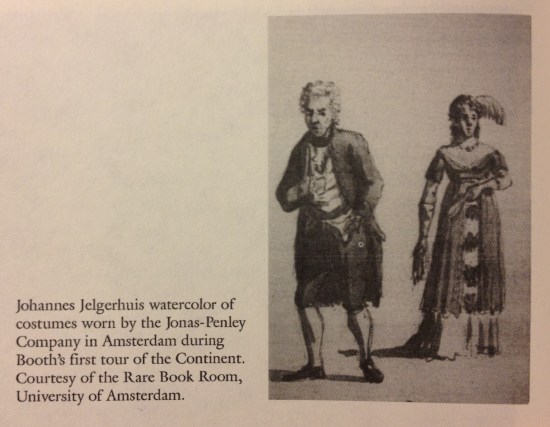
Though appearing in the High German Theatre, the troupe performed in their native English. Therefore, witnessing the troupe’s performances was an interesting experience for many Dutch theatergoers. One non-English speaking theater goer was a man named Johannes Jelgerhuis. Though unable to follow the script, Jelgerhuis judged the troupe by their mannerisms and costumes and felt they were reasonably accomplished. Jelgerhuis was a graphic artist and made sketches of the cast’s wardrobe and notes on their scenery. So, while the Jonas-Penley troupe appealed more to the English tourists and English citizens in the different cities they visited in the continent, non-English speakers still attended their performances for the visual entertainment.

The troupe stayed three months in Amsterdam before moving on to Antwerp on July 22nd. Junius was struck by the beauties of the churches in Antwerp. He felt guilty and sinful about going to perform in a morally contemptuous theatre after visiting such holy structures.

By August the 14th, the troupe moved cities again, this time establishing themselves in Brussels. As Mr. Archer states, “Jonas and Penley had picked a propitious time for a Brussels engagement. Wellington’s defeat of Napoleon at nearby Waterloo on June 18th had swelled pro-British sentiment in the Netherlands; at no period in its history had Brussels so esteemed the English.” While a fortuitously profitable time for an English theatrical troupe, finding lodging in the militarily swollen Brussels became difficult. Left to his own devices, Junius found housing from a widow who lived close to the theatre.

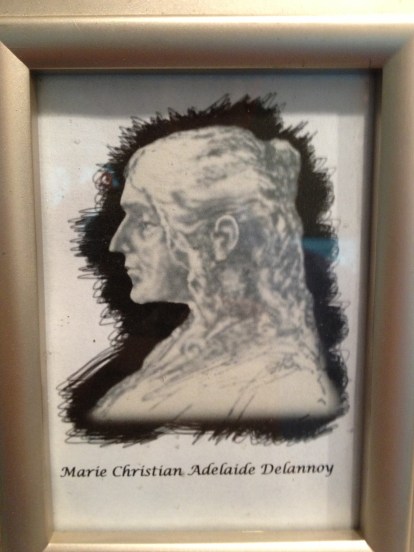
His landlord’s name was Agatha Delannoy. He paid her seventeen francs a month and would ultimately board with her from August 14th until November 25th when the troupe departed for Ghent. The troupe only performed 36 times over the 104 days that Junius stayed under Madam Delannoy’s roof. This gave him ample time to get to know Ms. Delannoy’s four daughters, all of whom were between the ages of 19 and 24. There was Marie Josepha Agatha, Marie Christine Adelaide, Therese Eleonore, and Amelie Francoise Julienne. On August 25th, the birthday of the Prince of Orange, the troupe failed to perform as two of the actors did not show up. Junius foresaw this eventuality and had prearranged for two of Ms. Delannoy’s daughters to accompany him to see the celebration. Though not known with certainty, it is assumed that one of these “fine ladies” Booth escorted was Adelaide Delannoy. “Mimi” as she was nicknamed by her mother and sisters, was four years older than Junius, but the young actor was smitten. A romantic relationship evolved between the two over the course of his stay with the family and, when the troupe was poised to move on to Ghent on November 25th, reckless Adelaide eloped with Junius much to the dismay of her mother.

The only known drawing of Adelaide Delannoy.

The only known drawing of Adelaide Delannoy.

At least twice over the years, Junius recounted, with plenty of flair, the adventure the star crossed lovers experienced while fleeing from Adelaide’s disapproving family. According to one account, on the night of November 25th, the pair decided they would escape Adelaide’s family via a covered stagecoach. At the appointed hour, Junius stood beneath Adelaide’s window, while she lowered down to him a bundle of her favorite keepsakes and relics. While in the process of doing this, one of Adelaide’s sisters discovered Junius in the yard and, while raising the alarm, ejected Junius’ from the property. In the commotion that occurred, Adelaide was able to sneak off and make it to the carriage before it passed by the home. Junius was able to catch up with the stagecoach and join Adelaide. By this time Ms. Delannoy had called on the authorities to find and retrieve her misguided daughter and save her from this actor. Upon seeing the police approaching the wagon, Adelaide bundled herself under the seats of the carriage and covered herself with the large coat of another passenger. Junius, on the other hand, chose not to hide, but used his skill of acting to disguise his appearance: “He knew the perseverance of his opposers, wherefore, casting himself to the part of an invalid at the last extremity, pulling his cap and hat over his forehead, and assuming a cast [squint] in one eye, he sat mutely in a corner of the machine.” When the pursuers searched the stagecoach, they could find no persons matching the descriptions given to them by Ms. Delannoy, and the wagon continued its route to Ghent.

To the benefit of the pair, the Jonas-Penley Company did not stay in Ghent long, leaving the city after only six performances. By December 11th, the couple was in Bruges, having now successfully eluded Adelaide’s family. The troupe stayed in Bruges through New Year’s, departing for the coastal town of Ostend on January 2nd, 1815.

Ostend was too cold for Junius’ tastes. He called it “a most wretched place.” Though it could have undoubtedly happened prior to this time as well, in Ostend, Junius and Adelaide succeeded in using the timeless method of keeping warm in a cold climate: shared body heat. It was about this time in Ostend that Adelaide became pregnant. Though two others had accused and even successfully sued Junius for paternity when he was even younger, there is no doubt that this recently conceived child of Adelaide Delannoy’s was the child of 18 year-old Junius Brutus Booth.

Young Junius Brutus Booth Drawing

A young Junius Brutus Booth

It was while performing in Ostend that the Jonas-Penley Troupe began its round of benefit performances for all of its actors. Junius received his first of many theatrical benefits on Monday, March 13th. Junius performed Richard III and brought in twenty-three pounds. He had to pay the managers twelve pounds for expenses and he was given the remaining eleven.

It had been almost four months since Adelaide ran away with Junius when the latter had his first benefit. During the period in between, Junius had managed to reconnect with Ms. Delannoy, clearly not wanting to excessively worry the woman who would be his mother-in-law. Perhaps understanding the recklessness of youth and that further protests of their relationship would only alienate her daughter further, Ms. Delannoy tried instead to talk sense into Junius in regards to his career. Ms. Delannoy attempted to secure for Junius a more respectable vocation as a clerk’s stationer. In a letter from Junius to Adelaide’s mother dated March 17th, Junius acts interested in the position but is likely humoring the poor woman as he had done many times with his own father. He brags about his salary and prestige as an actor, exaggerating it greatly. Junius writes of wanting to live in Brussels, while he is simultaneously preparing to return to England at the end of the month. He ends the letter with, “I believe you are angry, but there is no cause for it.” I would have to disagree with Junius on that. Ms. Delannoy had justifiable reasons to be angry at the rash young actor who ran off with her daughter.

On March 31st, 1815, the Jonas-Penley Company, Junius, and Adelaide sailed back to England, their continental tour having ceased. His time abroad allowed Junius to act for the first time in some of the roles he would later make famous. Like a child learning to ride a bike, this tour served as Junius’ training wheels. While the continent gave him the skills, it would be the London theaters that would make him a star. But all that would come later.

Junius arrived back to the home of his father Richard. Dr. Archer succinctly states, “What explosions rocked Queen Street when the prodigal son introduced his pregnant Adelaide to Richard we can today only imagine.” No doubt motivated by the growing pregnancy and the urging of his father, Junius and Adelaide were married on May 8th, 1815, one week after Junius’ 19th birthday. The young actor was now married, expecting, and looking to make a name for himself on the London stages.

Stay tuned for the next installment where Junius find himself as one of the key players in a war that rocks the London theatres.

References:
Junius Brutus Booth: Theatrical Prometheus by Stephen Archer
Booth Memorials: Passages and Incidents and Anecdotes in the Life of Junius Brutus Booth by Asia Booth Clark
Memoirs of Junius Brutus Booth from his Birth to the Present Time

Categories: Uncategorized | Tags: | 6 Comments

Horsehead Tavern Regains its Head

Forget the possibility of human head transplants, and say hello to a recently restored Horsehead tavern sign.

20130703-152416.jpg

The sign outside of Horsehead Tavern, a waypoint marking one of the two possible routes Booth and Herold took between the Surratt Tavern and Dr. Mudd’s, had fallen into disrepair over the last few years and was completely missing for awhile.

20130703-154145.jpg

The new sign here at Horsehead is a bit different than the previous one. Instead of the image of the horse being painted onto planks of wood, the entire middle part of the sign seems to be made of a type of ceramic.

You can view more images of Horsehead Tavern and its signs in the Horsehead Tavern Picture Gallery.


Categories: Uncategorized | Tags: | Leave a comment

New Gallery – Garrett House

As most readers of this blog know, I have a deep interest in the Garrett family of Caroline County.  It seems that everyone who studies the Lincoln assassination finds a specific facet of it that appeals to them more than others.  For me, that facet is the Garretts.  In March of this year, I presented at the Surratt Society’s annual conference about my ongoing research into the Garrett family.  I’ve come into contact with many Garrett descendants and a few have even bestowed upon me the title of “honorary Garrett”, much to my delight.  It’s hard to explain why I’m so caught up with this family and their interaction with John Wilkes Booth, but I am.

At the Surratt Conference, I went through a slideshow of pictures that I found of the Garrett house.  It showed the house from its days as the family’s home, to  its subsequent collapse around 1937/38.  As of this posting, I have accumulated 34 pictures of the Garrett house.  Some pictures are well known and seen in books on the assassination.  Others have come from universities, libraries, and private collections.  Since that presentation, I have been asked by a few people to put the pictures up here on my site.  I have been hesitant to do so, but today I am making a compromise.

In the Garrett House Gallery I have just made, I am displaying half of the pictures I have.  Additionally, I’ve done something I haven’t done before in my other galleries, and I’ve watermarked each image.  I’ve done this because I am working on a book about the Garretts and their run in with John Wilkes Booth and, while I love sharing new information and images here on BoothieBarn, I also want to protect these images in case I want to use them in my later publication.  That is also the reason why I have also failed to source where the different images came from.  Until I either use them, or fail to use them, in my future book, I want to keep their origins a mystery.  I hope you all understand.  I am doing this all to protect this Garrett project of mine as it means a great deal to me.

Now, without further ado, click HERE or on the picture above to visit the new Garrett House Picture Gallery.

Categories: Uncategorized | Tags: | 10 Comments

“…The people here are all traitors…”

The following letter, gleaned from the files at the James O. Hall Research Center, describes the search for Booth and Herold in Southern Maryland.  The author was a captain named William Hazelton who served under Major John Waite of the 8th Illinois Cavalry.  His letter recounts accurately the investigation that occurred in and around Bryantown.

“Bryantown, Md. April 27, 1865.

Dear Mother:

I have been endeavoring to get an opportunity to write you but have been so constantly on the move for the last two weeks that I’ve had no chance for writing.

We were first ordered to Washington to form part of the military escort at President Lincoln’s funeral, immediately after which we were sent here into Maryland in pursuit of Booth and some of his accomplices who were known to have come here.  We traced Booth to the house of a Dr. Mudd where he went to have his leg set, a bone in which had been broken by a fall of his horse.  At this Doctor’s he arrived on the morning after the murder.  He had with him a man by the name of Harrold, one of his accomplices and a desperado well known in these parts.  Here he remained until 2:00 o’clock in the afternoon of the same day.  From here we were unable to trace him farther for some days.  In vain we scoured the country in all directions, I was out with my Company night and day.  With us were dozens of the most expert detectives of the Untied States, but all our efforts to trace him further failed until at length a free negro [Oswell Swann] came in and reported that he acted as guide for them to the house of a Captain Cox some fifteen miles from here.  At that time I happened to be the only officer off duty, and at 12:00 o’clock at night started with thirty men, two detectives and this same negro guide for the home of Captain Cox.

We reached there just at daylight, saw Captain Cox (a notorious “secesh”) but he denied all knowledge of the parties.

We obtained evidence, however, that Booth and Harrold remained at his house some four hours in private conversation with him.  They then mounted their horses, Booth being lifted on the horse by the negro guide whom they dismissed, and again we lose all trace of them.  Cox we arrested and he is now in the Old Capitol prison.

The great difficulty is the people here are all traitors, and we can get no information from them.  A report reached us day before yesterday that they had been seen not far from where I am now writing.  They came to the edge of a woods and called for this colored woman (our informant) to bring them some food.  She describes the men and said one of them had crutches.  We immediately surrounded the woods and one hundred of our men searched it through and through, but found nothing.  The country here is all heavily wooded, making it next to impossible to find one who makes any effort to escape.  I hope, however, we will yet find him if he is not across the Potomac.

Yours truly,

William

P.S. I must not forget to tell you that your boy is now Captain.  My commission came some days ago.”

It seems quite obvious that the rebellious nature of the Southern Marylanders caused problems for the soldiers seeking the assassin of President Lincoln, a man for whom the natives had no love lost.

The, "notorious secesh", Samuel Cox.

The, “notorious secesh” mentioned above, Samuel Cox.

Still, through the statements of Dr. Mudd and Oswell Swann the soldiers were able to accurately track Booth until his departure from Cox’s house at around 4:00 am on Sunday, April 16th.  From here, Booth and Herold were escorted into the nearby Pine Thicket by Cox’s adopted son, who subsequently went for Thomas Jones in the morning.  This letter, dated April 27th, was written a day after Booth and Herold were captured at Garrett’s farm, with the former having been killed in the process. Apparently, at the time of his writing the news had not yet reached Captain Hazelton and the other soldiers and detectives stationed at Bryantown.

References:
James O. Hall Research Papers

Categories: Uncategorized | Tags: , | 1 Comment

Blog at WordPress.com.