History

The Attempt on Edwin Booth’s Life

As I wrote two days ago, Edwin Booth was the target of an assassination attempt on April 23, 1879 while he was performing Richard II at McVicker’s Theatre in Chicago. Since two days ago was the anniversary of the attempt, I wanted to put up a quick post highlighting what I considered a mere piece of historical trivia. The more I looked into it however, the more I found myself quickly engulfed in a huge amount of information that is available far beyond what I have read in books. My inspiration for this post was Nora Titone’s Edwin/John Wilkes biography, My Thoughts Be Bloody which devotes a paragraph to the incident. While looking for a bit more background I read about the incident in Eleanor Ruggles’ Prince of Players and Stanley Kimmel’s The Mad Booths of Maryland. These sources gave about a page to the incident. I decided to look at the newspaper sources of the day, and it is from those that I was deluged with information. This attempt on Edwin’s life was a national story. The coverage on it all quickly reminded me of how talented and celebrated Edwin Booth truly was. We all know that newspapers take liberties with the truth from time to time and that we cannot trust them with certainly. Nevertheless, what follows is a look at the aftermath of the attempt on Edwin’s life and the fate of his assassin.

First allow me to summarize the scene of the assassination ttempt, this time pulling from newspaper sources, rather than the books mentioned above.

McVicker's Theatre

In April of 1879, Edwin Booth was at McVicker’s Theatre in Chicago for an engagement. McVicker’s was owned by James H. McVicker, the step-father of Edwin’s second wife, Mary McVicker. She was backstage during that night’s performance. As always, the accounts of the day differ somewhat regarding what happened during the final act of Richard II. The last scenes of the act are set in the prison of Pomfret castle where King Richard is shown cut off from the world. The stage is darkened during this scene, with little more than a pale light masquerading as moonlight shining through a small grated window on the prison flat. Booth, as Richard, was sitting on stage soliloquizing of his isolation. Meanwhile, a man who sat in the second balcony about 30 feet from Booth, was removing a pistol he had concealed in his sleeve. In his left hand, he was said to be holding a copy of the play. He followed along with Booth’s soliloquy, waiting for the right time to act. While speaking onstage, Booth heard a shot ring out.

mark-gray-lyons-vs-edwin-booth-iannone

Booth and the audience remained unmoved; the audience thinking the anachronistic gunshot was the result of an error backstage and Booth thinking an accident prone cowboy had discharged his gun by mistake. When a second shot rang out about three seconds later, Booth arose (or was in the process of rising when the second shot happened) and proceeded to walk calmly towards the direction of the shots. Before walking off of the stage and into the audience, Booth pointed to the left hand upper gallery and men around the assailant grabbed at the man with the revolver, preventing him from firing again. Booth went into his dressing room to comfort his wife, Mary, who was in a state of great distress after hearing the shots.
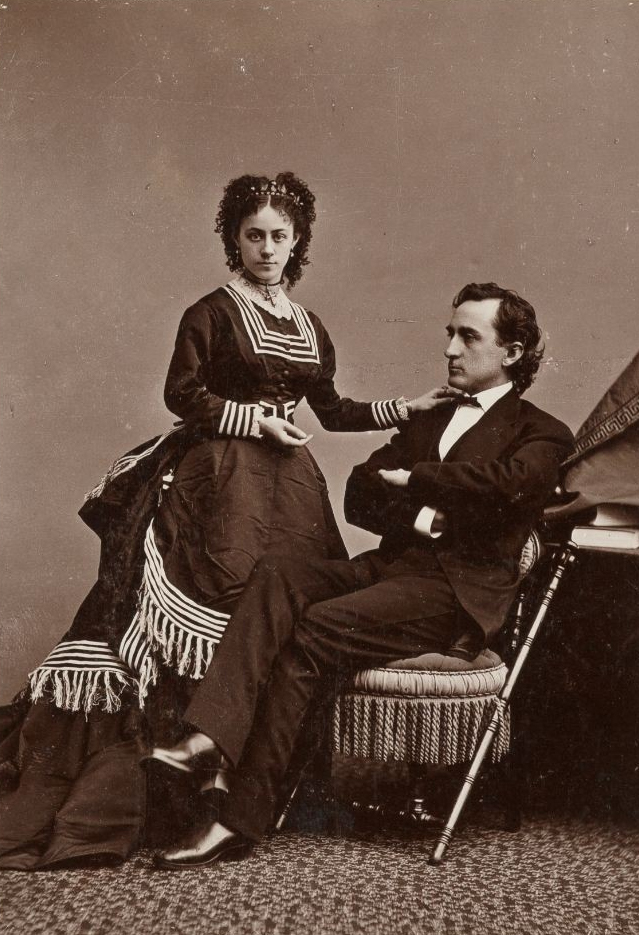
Edwin Booth and his wife Mary McVicker

Edwin Booth and his wife Mary McVicker

It was written that had it not been for the swift response from police officers the assailant would have been, “rather roughly handled” by the rest of the audience when they became aware of what had occurred. The man was seized by the officer of the theatre and James Morgan, a detective who was in the audience. Morgan put handcuffs on the man who gave him little resistance. As Morgan led the man to Chicago’s Central Station, he heard him say, “I don’t see how I happened to miss him,” and, “I am sorry that I didn’t take some lessons in pistol practice before I tried this thing.”
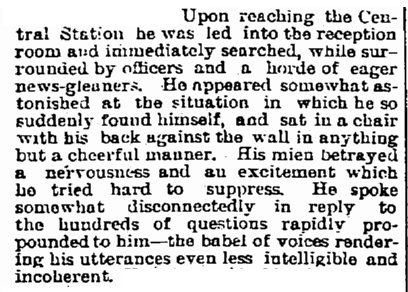
Nervous interrogationWhen searched at Central Station a .32 caliber “True Blue” revolver with three loaded chambers and two chambers containing exploded shells was found on him. Along with some trivial items (scissors,  pawn ticket, pocket knife) the man was found to have a stub for a seat at McVicker’s from the night before, April 22nd. In addition, the man had this letter on him:

“Chicago, April 22, 1879.

Dear Katie:

Forgive these brief but horrible lines, I left St. Louis Monday evening. The firm I was with would not increase my salary, so I made up my mind to return to Keokuk, but being a lover of fine acting I came to Chicago to see Booth, but I was sadly mistaken. It would take Booth one year of constant acting to compete with Lawrence Barrett’s  Richelieu. Tonight he plays Richard II. Katie, if I go tonight he will kill me or I will him. In all Shakespeare’s works I find but one man to compete with Booth, and that is Iago. My judgment ought to foretell me that since I call Booth Iago he could no more play Richelieu than the devil could be an angel. I don’t know what to do. Every line I write I prance the floor as though I was playing Hamlet. I’m sorry I came here, for I think the hangman has a rope for me. Remember me to your mother and sister.”

The man had seen Edwin Booth act before, and seemingly did not believe he was worthy of any of his accolades. The letter was signed, “Yours Truly, Mark Gray”. The name of the failed assassin was known.

When asked, he refused to state his reasons for wanting to kill Edwin Booth, but claimed that when they were made known, they would be deemed sufficient to all.

The next morning, April 24th, Edwin Booth was present when Mark Gray was taken before a judge:

Bail hearing for Gray

It was found that Gray had purchased the revolver used in the shooting only the day before and clearly showed no skill as to its use. Mark Gray was a young man, 26 years of age (though he stated to police he was 23) and was said to bear a striking resemblance to Edwin Booth if not for his mustache.

Theories abounded regarding Gray’s motive behind his attempted assassination of Edwin. Gray’s own ambiguity when questioned only fueled the fire in the nation’s newspapers. Here are a few published theories for the attempt on Booth’s life, some serious, others humorous:

This slideshow requires JavaScript.

While people hypothesized about Gray’s motives, more information was being found regarding his background and character:

Background on gray

suicide attempt gray

Finding no answers in the newspaper accounts and the interviews others had with Gray, Edwin Booth decided to meet with Gray himself and ask him what drove his attempt on his life:

Edwin's chat with Gray

Perhaps desiring the attention for a longer period of time, Gray did not reveal his reasons to Booth at this time.

On May 6th, Mark Gray was brought into court for arraignment and gave a surprising plea:

Gray pleads guilty

Wanting to make sure Edwin Booth was present for the proceedings of the trial before departing Chicago for his next engagement, the pendulum of justice moved swiftly for Mark Gray. On May 10th his trial began, and it was here that he finally revealed his reasoning for attempting to kill Edwin Booth.

Gray's Trial

The mere word “mark”, recited by Edwin Booth as Richelieu and King Richard was the cause for the actor’s misery. The vocalization of this simple English word which is a homograph for a name, and the way in which Booth portrayed his characters, incensed Mark Gray to the point of madness. As stated, Gray was immediately sent to the Northern Illinois Hospital and Asylum for the Insane in Elgin, IL.

Though Gray was locked away, Edwin Booth kept a cautious eye on his would be assassin and wrote the following note to a Chicago attorney a month after Gray was put in the Elgin asylum:

“I trust that our friend Gray may become gray indeed – yea postiviely hoary-headed – in kind but careful confinement, or if earlier released, that his exit may be from this earthly stage of his dramatic exploits to that celestial scene where idiots cease from shooting and actors are at rest. If he be ever again at liberty my own life I shall not value worth a rush. But I hope the Elgin guardians will not be deceived by his seeming helplessness.”

Edwin Booth would be able to sleep easy for a little over three years.  Then, in October of 1882, Mark Gray’s friends made a plea for his release:
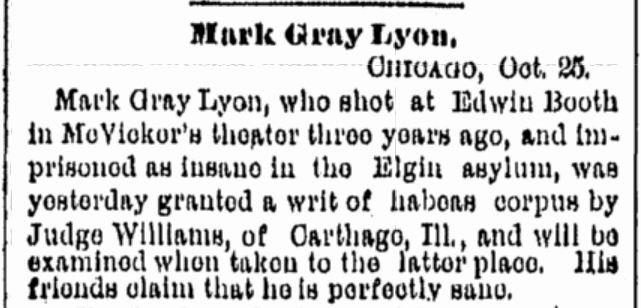
Gray seeks release October 25 1882 Rockford, IL

On November 6, 1882, Gray was successful in his plea:
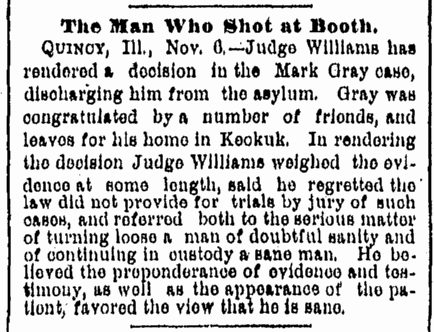
Gray set free November 6 1882 Rockford, IL

Though I have not been able to find an account of Edwin’s reaction to the release of his would be assassin, we can surmise that he was not pleased by the relatively short amount of time Mark Gray spent locked up.

In a worrisome sign of mental relapse, Gray jumped into the spotlight again trying to cash in on his infamy:

New Hamlet November 23 1882 Canton, OH

If Gray ever did play Hamlet, it was just to his neighbors in Keokuk, Iowa. For many years, Mark Gray was forgotten. When Edwin Booth died in 1893, Gray’s attempt was mentioned in a sentence on various newspaper biographies on his life. Just a little over 10 years later, in May of 1904, Mark Gray Lyons died at the age of 51. While Booth’s obituaries contained mentions of Mark Gray, there was a distinct lack of Booth in Mark Gray’s official obituary:
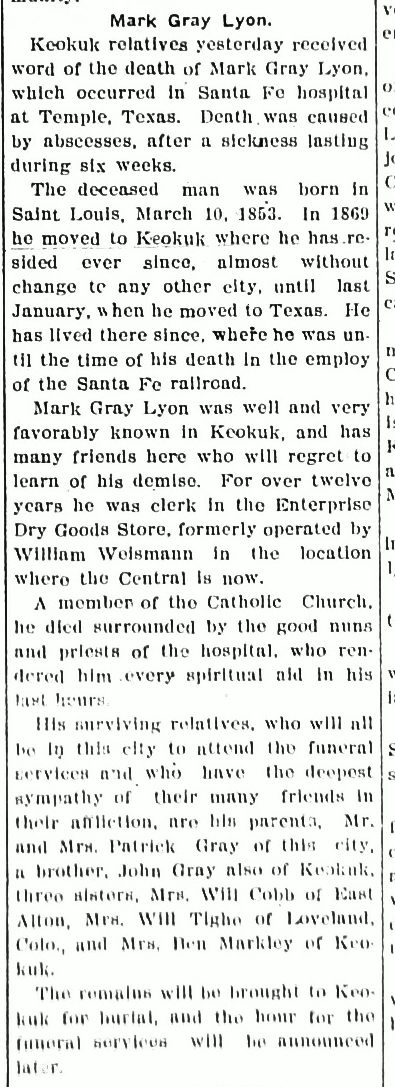
Gray's Obit

Unsurprisingly a bachelor his whole life, Mark Gray was buried with his sister and her husband in the Catholic section of Keokuk’s Oakland Cemetery.

To me Mark Gray Lyons is Edwin Booth’s Mark David Chapman. Gray wanted the fame and life of Edwin Booth. He tried to convince others and himself that he was Edwin Booth’s son. He wanted to be a star of the stage and resented Edwin for the success he had. After the shooting that night in 1879, Edwin Booth returned to the stage and finished Richard II. James McVicker found one of the bullets behind one of the stage flats it had passed through and he gave it to Edwin Booth. Booth later had it set in a gold cartridge and engraved upon it, “From Mark Gray to Edwin Booth, April 23, 1879.” Edwin was above all else, a devoted tragedian and, as history shows, nothing could keep him off that stage for long:

Scene in a theatre

References:
My Thoughts Be Bloody by Nora Titone
Prince of Players by Eleanor Ruggles
The Mad Booths of Maryland by Stanley Kimmel
The Staff of the Keokuk Public Library
Countless newspaper articles garnered from GenealogyBank.com

Categories: History | Tags: | 13 Comments

Conspirator Canes

Prison life at Fort Jefferson, Dry Tortugas was a miserable affair.  From the food, to the weather, to the living conditions, it’s hard to imagine that anyone stationed there, guard or prisoner, found the now tropical paradise hospitable.  All those that sailed to the island fort became prisoners.  It appears that when the lives of the inhabitants were not in danger from disease or malnutrition, extreme boredom prevailed. The Lincoln assassination conspirators Dr. Mudd, Edman Spangler, Samuel Arnold, and Michael O’Laughlen fought against this boredom.  The assigned duties given to the men helped in some ways.  Dr. Mudd, while a trained surgeon who would be a nurse in the hospital and an emergency replacement during the Yellow Fever epidemic, spent a considerable amount of time with Edman Spangler in the carpentry shop on the island.  Through three and a half years, he honed his carpentry skills and created several beautiful items that are currently on display at the Dr. Samuel A. Mudd House Museum in Waldorf, MD.  One set of items that Dr. Mudd became effective at creating were canes.

In addition to these two canes on display at the Mudd house, the good doctor also created a cane for his cousin, Henry A. Clarke. When Dr. Mudd was struggling to find an attorney willing to take his case during the conspiracy trial, he reached out to Clarke who owned a Washington coal company. On May 10th, Col. Henry Burnett sent a letter to Clarke asking if he would be Mudd’s counsel. Clarke responded back truthfully that he was not an attorney but would be happy to help Dr. Mudd in securing counsel. By the time Clarke had responded, Dr. Mudd had already secured Thomas Ewing and Frederick Stone for his defense.

Clarke would later make an appearance at the trial testifying on Dr. Mudd’s behalf. Even though he couldn’t keep his cousin out of prison, the family story is that Clarke continued to advocate for Dr. Mudd’s release. As a result, Dr. Mudd presented a cane to Henry Clarke. A few years ago, the cane made an appearance on Antique Roadshow:

Dr. Mudd was not the only conspirator to make canes for family and friends.  His own mentor in the carpentry world, Edman Spangler, also created canes from the wood at Fort Jefferson:

The canes, cribbage boards, shell decorated boxes, and other feats of craftsmanship were all therapeutic ways for Dr. Mudd to feel productive. Had it not been for these minor, but important, outlets of purposefulness, the Lincoln assassination conspirators could easily have succumbed to insanity.

References:
The Dr. Samuel A. Mudd Research site by Robert Summers
The Evidence by Steers and Edwards
Genealogybank.com

Categories: History | Tags: , , , | 6 Comments

“An old codger like me” – Samuel Seymour, Eyewitness to History

Prologue: This post is dedicated to the memory of my grandfather, Robert James Taylor, who passed away on July 4, 2013, at the age of 95, a year after this post was written. Thanks for sparking my interest in the past, Umpa.


Today, June 20, 2012, my grandfather celebrates his 94th birthday. The son of an Irish immigrant and his Illinois-born wife, my grandfather was educated at Illinois Wesleyan University, served as a Captain in the Marines during WWII and the Korean War, and raised a family of three boys with my grandmother. To me, though, he has always been Umpa: the devoted church going grandfather who would take me fishing and was always working his garden. I never knew until I was older that he was a Marine, and while he would openly tell me stories about the war, it always brought tears to his eyes. My grandfather taught me that war was always a regrettable thing, even when it is justified. He was proud of his service to his country but would never glorify what he had experienced. Nowadays, his life has slowed down considerably. He talks less, sleeps more, but is still the kind and inquisitive grandfather I’ve always known. Unfortunately, he will be spending this birthday in the hospital. I’ve logged about 18 hours with him over the last two days after a recent medical setback. As a 94-year-old, it is to be expected. Nevertheless, he still enjoys sharing one fact about his life with the nurses that always throws them for a loop. When asked where he was born, he answers truthfully, “Nani-Tal, India.” The nurses briefly stare at him, before turning to us, his family members, with a worried look that this characteristically Caucasian man has gone senile. We, of course, respond in the affirmative, and recall how his parents were missionaries and that he and two of his siblings were born in India. My grandfather was almost three years old when the family returned to America. His memory of India is now just a few Christian hymns in the Hindi language that he sang as a child. Nevertheless, he can still recall all the lyrics to “Jesus Loves Me” in Hindi.

My 94-year-old grandfather’s ability to remember one of his earliest experiences mirrors that of another 94-year-old man who recounted his experience of Lincoln’s assassination.

Many of us have seen the following episode of the TV show, I’ve Got a Secret, which aired on February 9, 1956.  In it, the American viewing audience is presented with the last surviving witness to Abraham Lincoln’s assassination, 96-year-old Samuel J. Seymour of Baltimore. You will want to fast forward to the 11:57 mark in the video below:

In the video, the host mentions that they learned about Mr. Seymour due to an article written by him in The American Weekly magazine.  That article was published on February 7th of 1954, when Samuel Seymour was 94 years old.

After some searching, I found the original article by Mr. Seymour and transcribed it from the newspaper record.  Here it is in full:

“I Saw Lincoln Shot

By Samuel J. Seymour

As told to Frances Spatz Leighton

The only living witness re-creates the drama of that tragic night

This is an eyewitness account of one of history’s great tragedies – the assassination of Abraham Lincoln – told by the only living witness to the fateful drama enacted at Ford’s Theater on the night of April 14th, 1865 – THE EDITORS

Even if I were to live another 94 years, I’d still never forget my first trip away from home as a little shaver five years old.

My father was overseer on the Goldsboro estate inTalbot County, Maryland, and it seems that he and Mr. Goldsboro has to go to Washington on business – something to do with the legal status of their 150 slaves. Mrs. Goldsboro asked if she couldn’t take me and my nurse, Sarah Cook, along with her and the men, for a little holiday.

We made the 150-mile trip by coach and team and I remember how stubborn those horses were about being loaded onto an old fashioned side-wheeler steamboat for part of the journey.

It was going on toward supper time – on Good Friday, April 14th, 1865 – when we finally pulled up in front of the biggest house I ever had seen. It looked to me like a thousand farmhouses all pushed together, but my father said it was a hotel.

I was scared. I had seen men with guns, all along the street, and every gun seemed to be aimed right at me. I was too little to realize that all of Washington was getting ready to celebrate because Lee has surrendered a few days earlier.

I complained tearfully that I couldn’t get out of the coach because my shirt was torn – anything to delay the dread moment – but Sarah dug into her bag and found a big safety pin.

“You hold still now, Sammy,” she said, “and I’ll fix the tear right away.” I shook so hard, from fright, that she accidentally stabbed me with the pin and I hollered, “I’ve been shot! I’ve been shot!”

When I finally had been rushed upstairs, shushed and scrubbed and put into fresh clothes, Mrs. Goldsboro said she had a wonderful surprise.

“Sammy, you and Sarah and I are going to a play tonight,” she explained. “A real play – and President Abraham Lincoln will be there.”

I thought a play would be a game like tag and I liked the idea. We waited a while outside the Ford Theater for tickets, then walked upstairs and sat in hard rattan-backed chairs.

Mrs. Goldsboro pointed directly across the theater to a colorfully draped box. “See those flags, Sammy?” she asked. “That’s where President Lincoln will sit.” When he finally did come in, she lifted me high so I could see. He was a tall, stern-looking man. I guess I just thought he looked stern because of his whiskers, because he was smiling and waving to the crowd.

When everyone sat down again and the actors started moving and talking, I began to get over the scared feeling I’d had ever since we arrived inWashington. But that was something I never should have done.

All of a sudden a shot rang out – a shot that always will be remembered – and someone in the President’s box screamed. I saw Lincoln slumped forward in his seat. People started milling around and I thought there’d been another accident when one man seemed to tumble over the balcony rail and land on the stage.

“Hurry, hurry, let’s go help the poor man who fell down,” I begged.

But by that time John Wilkes Booth, the assassin, had picked himself up and was running for dear life. He wasn’t caught until 12 days later when he was tracked to a barn where he was hiding.

Only a few people noticed the running man, but pandemonium broke loose in the theater, with everyone shouting:

“Lincoln’s shot! The President’s dead!”

Mrs. Goldsboro swept me into her arms and held me close and somehow we got outside the theater. That night I was shot 50 times, at least in my dreams – and I sometimes still relive the horror of Lincoln’s assassination, dozing in my rocker as an old codger like me is bound to do.”

Of the many firsthand accounts given in books (like We Saw Lincoln Shot by Timothy Good), I prefer this one by Mr. Seymour. There is an innocence in his account that can’t be found anywhere else. While Major Rathbone and others give more details regarding the actual event, young “Sammy” gives a unique perspective. We become more connected to this child and his young life. We can empathize with his sense of uncertain fear and even feel the disappointment he must have had when he experienced what a “play” truly was. Most of all, I marvel at Sammy’s kindness and compassion. Ignorant of the context of what had occurred, this boy only wanted to help the man who had fallen.

Mr. Seymour died two months after his appearance on I’ve Got a Secret, possibly related to his fall the day before the show. He died on April 13, 1956, just a day shy of the anniversary of the event he witnessed.  Mr. Seymour is buried in Loudon Park Cemetery in Baltimore, MD; however, his grave is unmarked.

References:
We Saw Lincoln Shot by Timothy Good
Mr. Seymour’s article in The American Weekly
Roger Norton’s Abraham Lincoln’s Assassination Research Site has a nice picture of Mr. Seymour

Categories: History | Tags: , , , | 9 Comments

Booth at Lincoln’s Second Inauguration

On March 4, 1865, President Abraham Lincoln was inaugurated for a second time following his reelection in November of 1864. With hopes that an end to the Civil War was in sight, Lincoln gave a historic speech addressing how the practice of slavery had caused the war, and expressing his hopes for a reconciliation between the two sides under a government free from this evil. Lincoln finished his speech with the iconic words:

“With malice toward none, with charity for all, with firmness in the right as God gives us to see the right, let us strive on to finish the work we are in, to bind up the nation’s wounds, to care for him who shall have borne the battle and for his widow and his orphan, to do all which may achieve and cherish a just and lasting peace among ourselves and with all nations.”

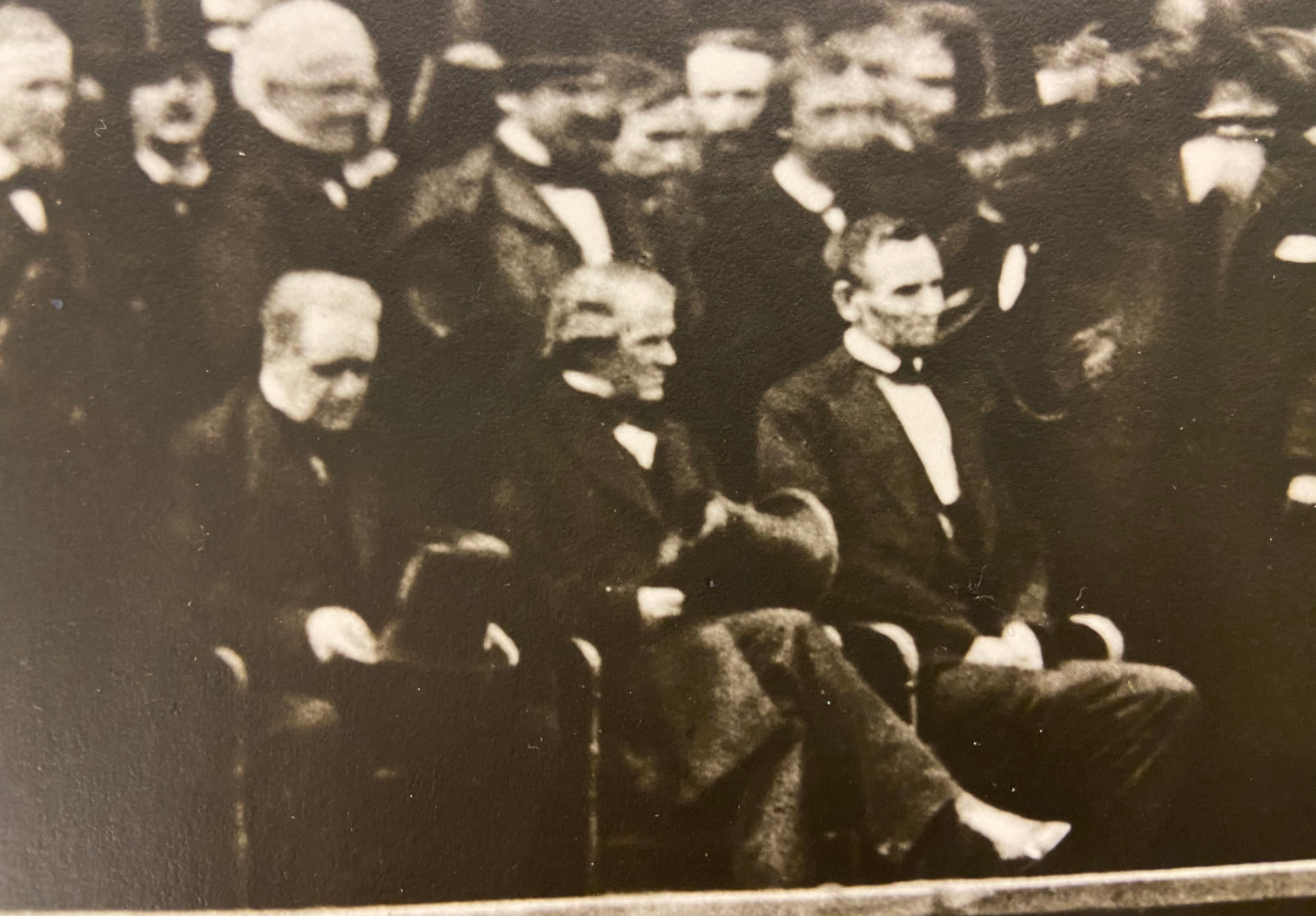
Noted photographer Alexander Gardner documented the scene of Lincoln’s second inauguration, much like he did four years earlier. Yet the circumstances were more difficult this time around. The day was mostly marked with overcast skies and drizzling rain. At some points, the sky would brighten and Gardner would attempt to photograph the scene. Yet, several of Gardner’s attempts resulted in less-than-ideal photographs of the President. Whether it was an incorrect focal length or issues developing the wet plate later, only a limited number of shots captured Lincoln well. As a result, you generally only see the image of Lincoln’s second inaugural that begins this post, as it was the best one that Gardner turned out (and even in that one, Lincoln is a bit blurry).

Yet there are a few other images of Lincoln’s second inauguration. Gardner attempted a series of photographs showing Lincoln seated at the front of the platform. The most successful attempt was the following, which shows the President seated next to his Vice Presidents, Andrew Johnson and Hannibal Hamlin.

This image probably does the best job of capturing Lincoln clearly. We benefit from the fact that Gardner used a large-format camera and wet plate photography, which results in incredible detail when done correctly. In many of Gardner’s images, even those where Lincoln is out of focus or blurred, members of the audience come through very clearly.

Among the crowded audience who gathered about the Capitol steps to hear Lincoln’s now-immortal words was the 26-year-old actor John Wilkes Booth. In a little over a month from when these photographs were taken, Booth would assassinate Lincoln at Ford’s Theatre.

John Wilkes Booth’s attendance at the Capitol during Lincoln’s second inauguration is referenced by the assassin himself. A little over a month later, Booth visited with an actor friend in New York named Samuel Knapp Chester. Booth had attempted to recruit Chester into his initial plot to abduct President Lincoln, but Chester had declined. On this visit, Booth convinced Chester that his plotting days were over. Still, Booth foreshadowed his true intent by saying to Chester, “What a splendid chance I had to kill the President on the 4th of March.” Booth clarified to Chester that he had received a “ticket to the stand on Inauguration day,” from his fiancée, Lucy Hale, the daughter of New Hampshire Senator John P. Hale. Booth was a celebrated actor who rubbed elbows with Washington elite. His presence on the stand at Lincoln’s inauguration would not have been odd in any way, especially if he had secured a ticket by way of a Senator’s daughter.

Combining the fact that John Wilkes Booth was present in the crowd at Abraham Lincoln’s second inauguration and the high level of detail afforded by Alexander Gardner’s photographs, the question becomes, “Can John Wilkes Booth be seen in any of the pictures of the event?”

In 1956, a 90-year-old photography historian and collector named Frederick Hill Meserve believed he had found the assassin amongst the audience. Using images of the inauguration from his private collection, he published his findings in the February 13, 1956, issue of Life Magazine. Meserve, as stated in the article, “spent 60 of his 90 years collecting photographs of the Civil War era” and devoted his entire life to searching for and cataloging all the images of Lincoln that existed. He had previously published his compendium of Lincoln images with author Carl Sandburg in 1944. The image Meserve used in his identification of Booth in the crowd was not one of the ones he had published earlier. Instead, it was one of the lesser-known photographs of the second inauguration that was not widely known because the figure of Lincoln appears to have been accidentally obliterated by a thumbprint during the development process of the original plate. Here is the image:

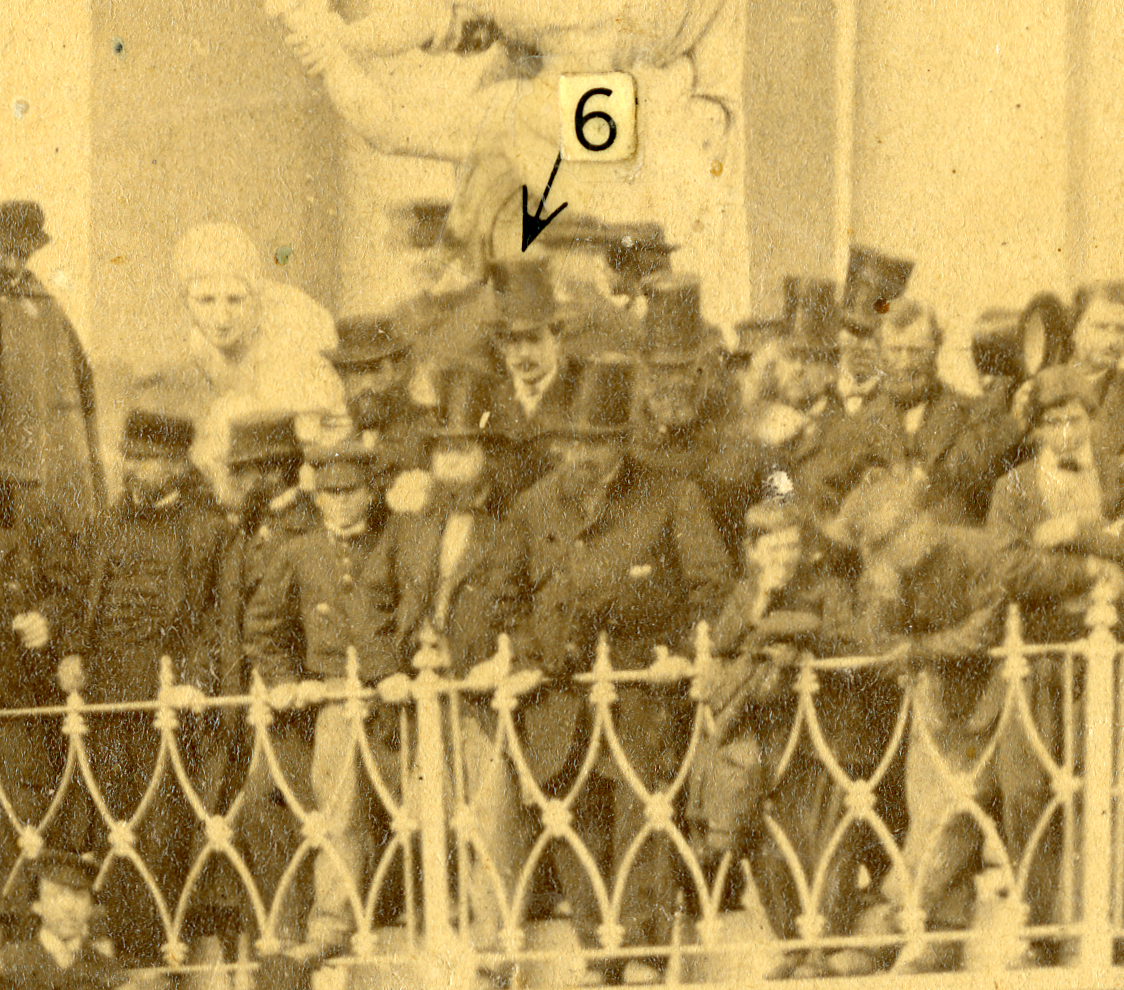
Meserve pointed out one of the figures, located on the platform above the President, wearing a top hat and a mustache:

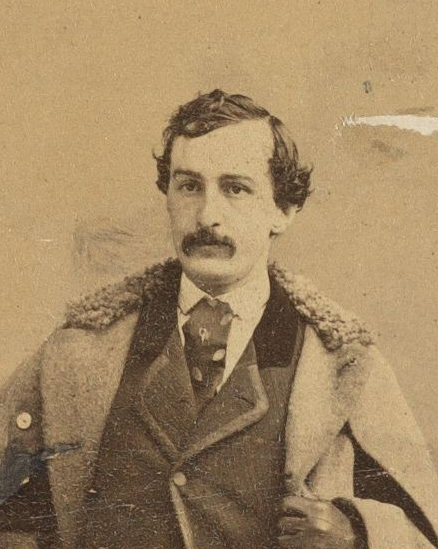
In Meserve’s opinion, this figure was John Wilkes Booth. This was an intriguing idea from one of the country’s foremost experts on Lincoln photography. The figure does bear some resemblance to the actor-turned-assassin. But in the case of this particular image, the level of detail we need is still not quite there. I will also point out that Meserve went beyond identifying Booth in his Life Magazine article. He also identified Mary Todd Lincoln, Vice President Andrew Johnson, Lincoln’s friend and sometimes bodyguard Ward Hill Lamon, theater owner John T. Ford, and conspirator Lewis Powell. While I agree with his identification of Johnson and Lamon, these other identifications are far more questionable. For example, there is no evidence to support the idea that Lewis Powell was in D.C. at the time of the inauguration. While part of Booth’s plot by this time, he was residing in a boardinghouse in Baltimore, and we have no statement that places him amongst the crowd. The figure Meserve points to as Powell looks a fair deal like him, but he is not featured near Booth. Instead, Meserve points to one of the figures against the wall below Lincoln as possibly being the future attempted assassin of Secretary of State William Seward.

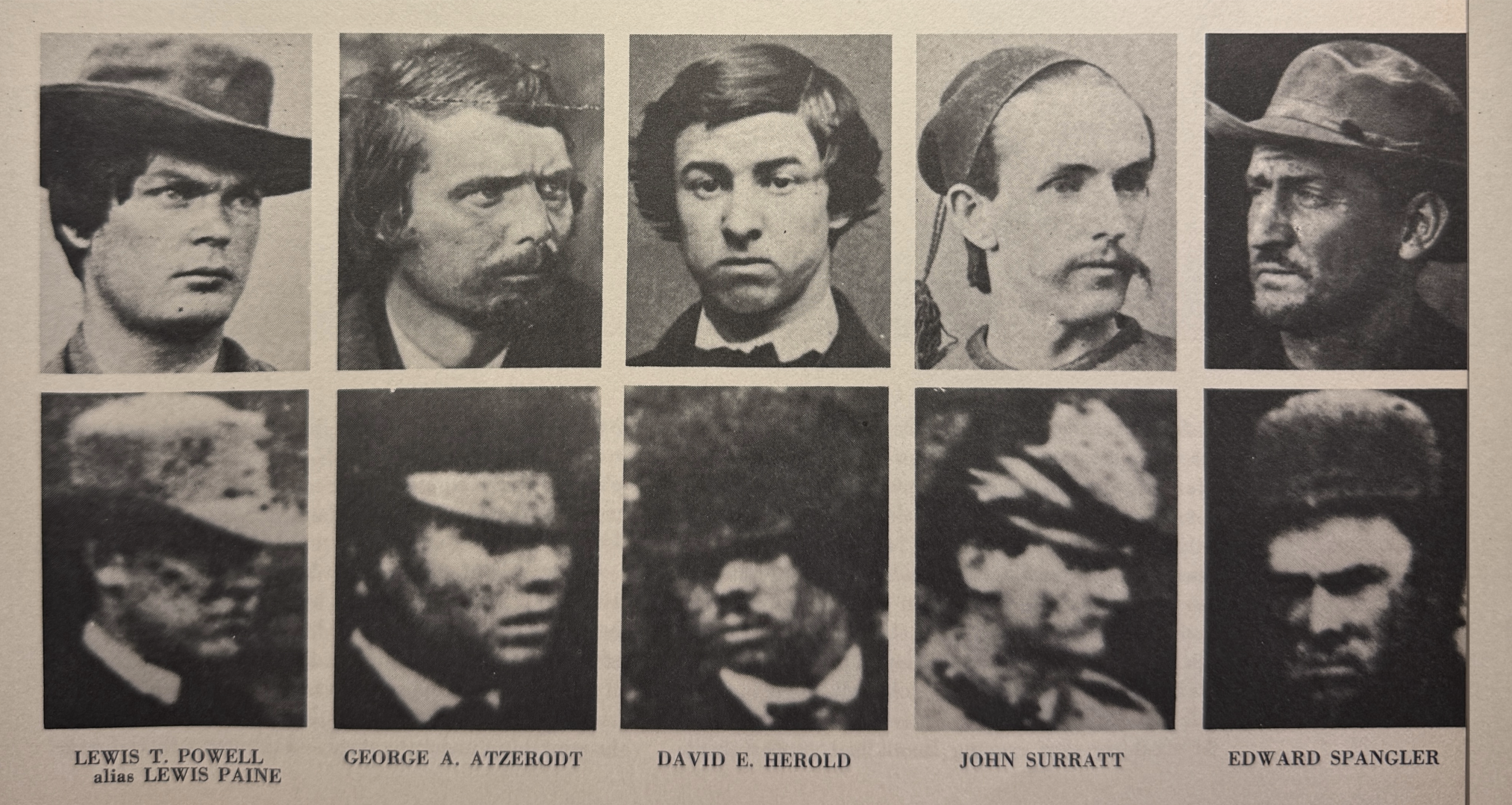
Frederick Meserve died in 1962. Three years later, his daughter. Dorothy Meserve Kunhardt (author of the children’s book Pat the Bunny), released a coffee table-sized book with her husband, Philip, called Twenty Days: A Narrative in Text and Pictures of the Assassination of Abraham Lincoln and the Twenty Days and Nights That Followed… The book utilized her father’s vast photography collection to tell the story of Lincoln’s death through images. In the book, she actually went a bit farther than her father when it came to identifying Booth and Powell at Lincoln’s second inauguration. Dorothy Kunhardt claimed to have identified several other members of Booth’s conspirators among the faces underneath the platform.

While intriguing, Kunhardt’s identification of the conspirators comes without evidence. Aside from Booth, we have no evidence that any of the other conspirators attended Lincoln’s inauguration. Historian Michael Kauffman points out in his book American Brutus that George Atzerodt had spent the previous night in Southern Maryland rowing across the Potomac, making it highly unlikely he would have been in D.C. at the time. Plus, in all the confessions Atzerodt later gave documenting the movements of his fellow conspirators, he never mentioned any of them being at the Capitol on this day. The same applies to John Surratt, who never mentioned witnessing the inauguration, despite later giving speeches about his involvement in Booth’s plot. In addition, most historians today consider Ford’s Theatre stagehand Edman Spangler innocent of any knowledge of Booth’s plot, making his inclusion in this supposed rogue’s gallery grouping fairly preposterous.

In the case of the conspirators, it appears that Meserve and Kunhardt were engaging in a bit of wishful thinking in their identifications. But what about the lead assassin? As we have seen, Booth acknowledged he was present for the event and was supposedly so close to Lincoln that he might have been able to kill the president if he had attempted the act. The figure Frederick Meserve pointed to is a possibility, but the detail is lacking.

Luckily, the image used by Meserve in his article is not the only one that appears to show this same figure. There is another Gardner photograph of the inauguration, one that is very similar to the most famous image of the event, but the focal point is off a bit so that Lincoln appears even blurrier.

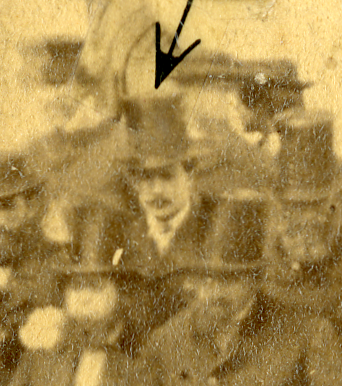
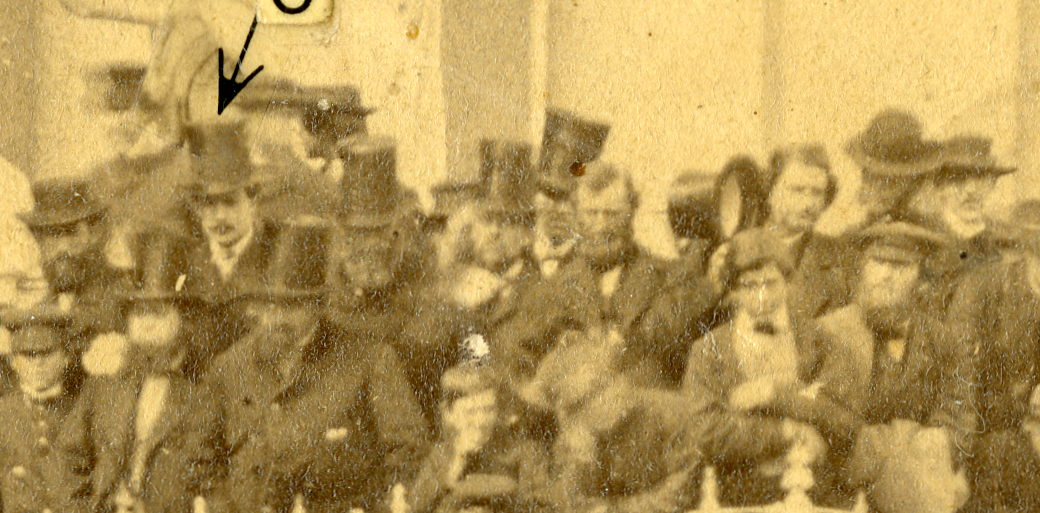
While this makes for a poor image of Lincoln, the focus does give us a clearer image of the man just above Lincoln, whom Frederick Meserve identified as Booth:

This image still isn’t perfect, but it does give us more detail. There are certainly similarities between this man and the dapper, ivory-skinned, mustachioed actor who would later assassinate the President. In truth, it’s impossible to truly verify this man as Booth, but many have accepted Meserve’s identification. The textual evidence supports that John Wilkes Booth was there, and I am personally inclined to believe the basic resemblance in Meserve’s identification makes it possible that this could be John Wilkes Booth.

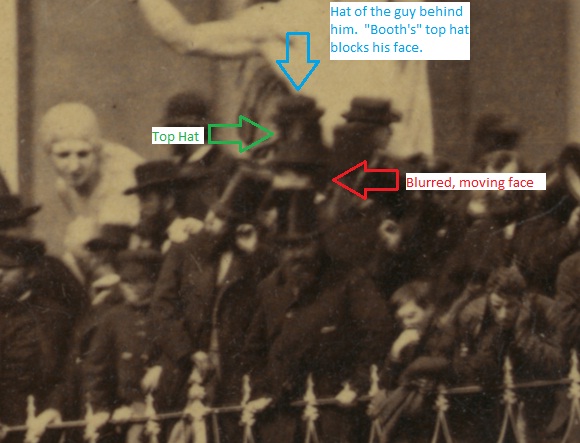
While many people have become aware of Booth’s possible inclusion in images of Abraham Lincoln’s second inaugural, most are unaware that multiple images of the event were taken and that there are differences between them. As a result, many look at the most famous image of the inauguration searching for Booth in the crowd. However, in the most prolific image of the inauguration, the one that begins this article, the man Meserved identified as Booth cannot be seen clearly. The figure is partially obscured by the gentlemen in front of him straining to hear. Only the figure’s hat and the top of his head are visible.

Since the “Booth” figure cannot be readily seen in the most famous image of the inauguration, many sources have selected a different man entirely and highlighted him as Booth. The Ford’s Theatre museum was once guilty of this. For several years, they had a large wall display of Lincoln’s second inauguration and included this inset:

The man they highlighted as Booth is not the same man we have seen in the other photos as being Booth. We know this because in the clearest picture of Meserve’s “Booth” the same man can be seen further down the line.

In my opinion, this figure bears even less resemblance to John Wilkes Booth than Meserve’s figure. This man has longer hair and appears to have a goatee or additional facial hair beyond Booth’s signature mustache. It also seems unlikely to me that Booth would have removed his hat during the proceedings. John Wilkes Booth was stylish and vain, retaining his fashion above all. While others might choose to remove their hats to perhaps better hear Lincoln’s words, such effort does not seem likely for the man who would soon kill him. Yet, it is this figure who is easily visible in the famous image of Lincoln’s second inauguration, who is highlighted on the Wikipedia page for John Wilkes Booth (and many other places online) as showing the future assassin eyeing his target. But you won’t see that insert at the Ford’s Theatre museum anymore. To their credit, they identified that there wasn’t any evidence to support the hatless man as Booth and changed their display. I only wish I could get them to do the same regarding the incorrect knife they have on display as Booth’s.

I hope that this post outlines the misconceptions about John Wilkes Booth at Lincoln’s second inauguration. We know he was there and witnessed the event. There is no guarantee that he is present in any of the inaugural photos, however. The identification made by Frederick Hill Meserve is a theory, like anything else. In my eyes, it is a decent one. The man Meserve says is Booth looks like Booth to me. I wouldn’t bet my life on it, but it’s a harmless enough theory to support.

References:
Frederick Hill Meserve’s original identification of Booth in Life magazine
Twenty Days by Dorothy Meserve Kunhardt and Philip B. Kunhardt, Jr.
The Photographs of Abraham Lincoln by Frederick Hill Meserve and Carl Sandburg

Categories: History | Tags: , , , , | 47 Comments

Blog at WordPress.com.