History

Picture This: A New Image of Michael O’Laughlen

At around 9:00 p.m. on April 17, 1865, a young, mustachioed man in handcuffs was brought to Washington, D.C.’s Navy Yard and placed aboard a ship named the U.S.S. Saugus. The Saugus was lying at anchor in the middle of the water in preparation for its role of becoming an island fortress to hold those arrested as conspirators in Lincoln’s assassination. This 24 year old man, whose presence on board christened the Saugus as a prison ship, was named Michael O’Laughlen.

O'Laughlen from Harper's Weekly

O’Laughlen was a long time friend of John Wilkes Booth. The two grew up as boys together on Exeter St. in Baltimore, where the Booth’s lived across the street from the O’Laughlen family. Though Booth had a more personal relationship with Samuel Williams O’Laughlen, Michael’s older brother, Booth still had fond memories of Michael. As both Booth and O’Laughlen grew up, their lives went in different directions. Booth became a noted Shakespearean star, following in the footsteps of his father and brothers, while O’Laughlen ended up joining a Maryland regiment which fought on the side of the Confederacy. Much of O’Laughlen’s time in the Confederacy was plagued with illness and by 1862 he was back home in Maryland assisting his brother in the hay and feed business.

In the fall of 1864, Booth reconnected with his old friend and the charismatic actor easily convinced O’Laughlen to join his plot to abduct President Lincoln for the benefit of the Confederacy. Delays and inaction continued for several months and O’Laughlen eventually lost interest in the plot and returned to work with his brother. On April 13, 1865, O’Laughlen traveled from Baltimore down to D.C. in order to take in the Grand Illumination celebration with friends. He allegedly made a couple of attempts to meet with Booth on this date, but failed to connect with the actor. When the assassination occurred on April 14th, O’Laughlen was terrified due to his intimate connection with the assassin. O’Laughlen returned to Baltimore but, after a few days, realized that his arrest would be unavoidable and imminent. O’Laughlen was the only conspirator to have turned himself in, arranging his surrender at the home of his sister.

And so it was that Michael O’Laughlen was the first of John Wilkes Booth’s conspirators to be placed aboard the Saugus, confined for his own protection away from mob violence that might do him harm but also in a condition that would prevent him from communicating with anyone. As other conspirators were arrested, they would be place aboard the Saugus as well, until the ship no longer had enough space to adequately isolate them all and the U.S.S. Montauk was brought alongside for additional space. O’Laughlen was kept aboard the Saugus during this time, confined to the ship’s head.

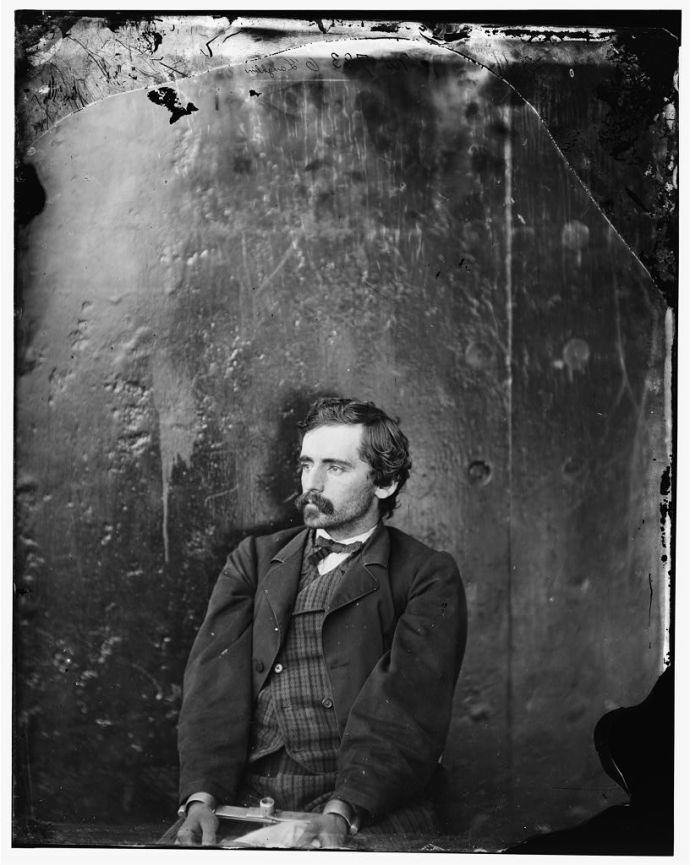
O’Laughlen was on the Saugus from April 17th until April 29th when all the accused aboard the ironclads were transferred to the Arsenal Penitentiary. The research of authors Barry Cauchon and John Elliott has shown pretty conclusively that during this period of confinement, photographer Alexander Gardner made four visits to the ships to photograph the conspirators. O’Laughlen’s mugshots were taken with the bulk of the other conspirators’ images on April 25th. The following are the two images previously known of Michael O’Laughlen:

Michael O'Laughlen Mug Shot Front

Michael O'Laughlen Mug Shot Profile

Until now, these two images were the only images we have ever found of Michael O’Laughlen. Mugshots such as these were used by artists to create engravings for the illustrated newspapers of the day. However as a low interest conspirator and one who was not involved in the actual assassination plot, few took the time to make an engraving of the mild mannered O’Laughlen. The public was far more interested in getting a look at Lewis Powell, the scoundrel who viciously attacked the Secretary of State, so far more impressive engravings were made of him.  One of the lesser known illustrated newspapers, the Washington Weekly Chronicle, contained engravings of most of the conspirators when they published their July 15, 1865 issue:

Washington Weekly Chronicle 7-15-1865

Though Lewis Powell took center stage, the Chronicle also provided this engraving of Michael O’Laughlen:

O'Laughlen Washington Weekly Chronicle

A detailed look will demonstrate that this particular engraving does not actually match either one of the two known mugshot photos of Michael O’Laughlen. It is somewhat similar to the hat-less photo of O’Laughlen, but this engraving shows more of his face than the original source image.

The easiest conclusion to draw is that the engraver added a little bit of their own artistic license when creating the drawing of Michael O’Laughlen. This is not unheard of. As a matter of fact, the large image of Lewis Powell in this edition does not match a known image of Lewis Powell. Despite the tagline that this engraving was based on a photograph taken especially for the Washington Weekly Chronicle, according to author Betty Ownsbey, this engraving of Lewis Powell appears to be a sort of composite between two images of Powell, instead.

Composite Powell Engraving Washington Weekly Chronicle

So it seemed reasonable that the engraving of Michael O’Laughlen in this issue was also not based on an actual photograph, but instead on an artist’s extrapolation of O’Laughlen’s mugshot photographs.

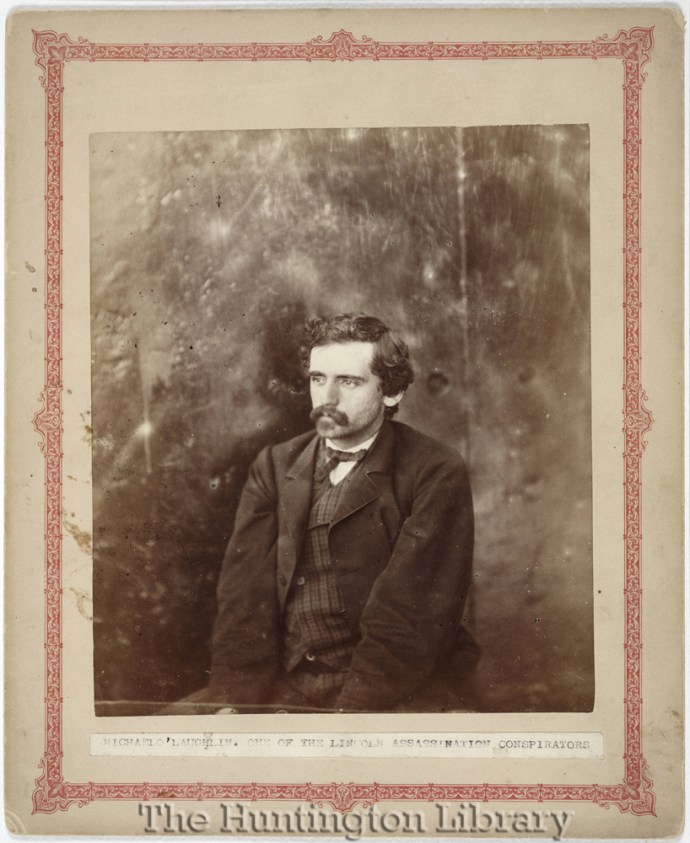
It turns out, however, that this engraving actually isn’t an extrapolation or artistic license. Today, while searching through the online digital collections of the Huntington Library in California, I decided to click on a thumbnail that I assumed was one of the two common mugshot photographs of Michael O’Laughlen.

O'Laughlen Thumbnail Huntington

Immediately I was struck with the suspicion that something was wrong. It was a strange feeling to have. Before me was obviously the hat-less mugshot photo of Michael O’Laughlen, and yet, at the same time, it wasn’t right. As a longtime researcher and reader on the Lincoln assassination I have become so accustomed to seeing the same images over and over again. My accustomed brain was saying, “Yep, this is the same picture of O’Laughlen you always see,” but, at the same time, I couldn’t shake the idea that something was different. Suddenly, I had to see Michael O’Laughlen’s mugshot photographs, I needed to silence the voice saying something was wrong. I opened up my O’Laughlen Picture Gallery and stared at the mugshots. Then it hit me, this image was not the same as the traditional hat-less mugshot. I was surprised and ecstatic to see that this was the photograph that the Washington Weekly Chronicle engraving was based on. Here, at long last, was O’Laughlen’s missing mugshot photograph:

New Michael O'Laughlen Mugshot Huntington Library

New Michael O'Laughlen Mugshot 2 Huntington Library

Unlike the original hat-less photo, O’Laughlen’s face is angled more towards the viewer in this image. The fact that O’Laughlen’s chin is slightly blurry here also hints that he was moving, possibly turning, when the photo was taken.

While Michael O’Laughlen escaped formal execution at the conclusion the trial of the conspirators, his ultimate fate would be equal to it. While serving his life sentence at Fort Jefferson in the Dry Tortugas, O’Laughlen was one of the many souls who contracted Yellow Fever in the fall of 1867. Despite the attentive care provided to him by his fellow prisoners, Dr. Mudd, Edman Spangler, and Samuel Arnold, Michael O’Laughlen perished from Yellow Fever on September 23, 1867. Dr. Mudd lamented that O’Laughlen had become a dear friend to him and that he would miss his, “warm friendly disposition” and, “fine comprehensive intellect.”

This newly discovered mugshot of conspirator Michael O’Laughlen gives us another, much needed angle on a man whose life was tragically cut short due to his involvement in John Wilkes Booth’s plot against Lincoln. It gives us an additional chance to look into the eyes of a young man who has realized that he allowed a charismatic friend to lead him down the path of his own destruction.

New Michael O'Laughlen Mugshot 3 Huntington Library

This image should also remind us that there are still new discoveries to be made. The book of the Lincoln assassination will never be completely written, and, as demonstrated here, it will never be completely illustrated either.

References:
The Huntington Library Digital Collections
A Peek Inside the Walls: 13 Days Aboard the Monitors by John Elliott and Barry Cauchon
Betty Ownsbey
The Assassin’s Doctor by Robert K. Summers
LOC

Categories: History | Tags: , , , , | 31 Comments

The Escape of John Wilkes Booth

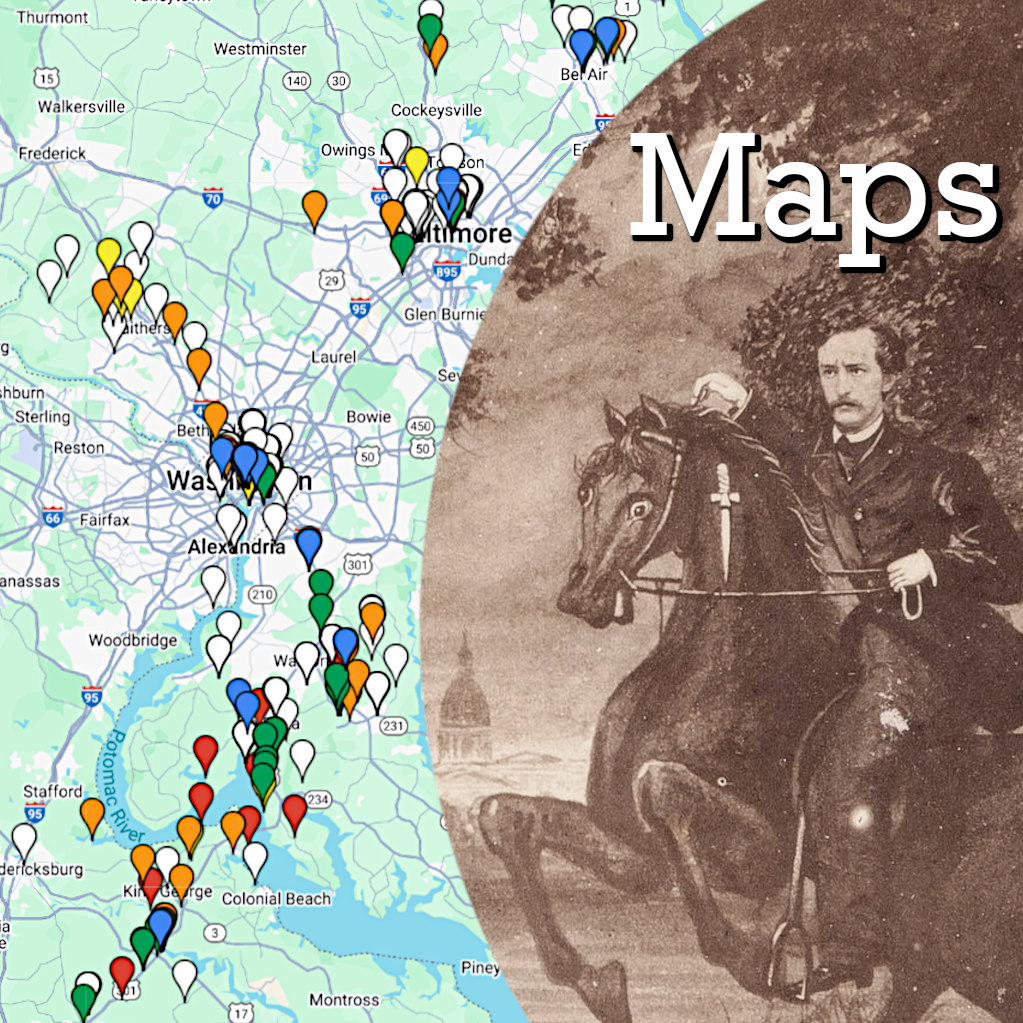
I found this free interactive mapping program online today and decided to see if I could construct a nice little map of John Wilkes Booth’s escape route. Unfortunately, this particular map will not embed straight into my site, but you can click the image below to view it.

The Escape of John Wilkes Booth map image

Categories: History | Tags: , , , , , , | 13 Comments

John Wilkes Booth’s Poetic Envelope

One of the more curious relics belonging to John Wilkes Booth, is a brief poem he wrote on the reverse of an envelope on March 5th, 1865.

Booth Hale Poem Envelope 3-5-1865 Sotheby's

There are some mysteries regarding this poetic envelope. What does Booth’s poem say? Who wrote the second poem beneath Booth’s? Why were these poems written at all? Let’s explore these questions as we analyze this piece on the 150th anniversary of its creation.

What Does Booth’s Poem Say?

This relic was first brought to the attention of the general public thanks to Carl Sandburg’s 1939 book, Abraham Lincoln: The War Years Volume 4. In writing and illustrating his book, Sandburg borrowed heavily from his friend and Lincoln collector, Oliver R. Barrett. Barrett had a massive Lincoln collection and allowed Sandburg to include a small picture of these poems. Sandburg also transcribed the poems and added the following context:

“On March 5 of ’65 signing his name to a verse on an envelope back:

Now, in this hour, that we part,
I will ask to be forgotten never.
But in thy pure and guiltless heart
Consider me thy friend dear Eva
J. Wilkes Booth

And the daughter of a United States Senator, her name protected during ensuing scandals, Eva joined her quoted lines on the same envelope back: ‘For all sad words from tongue or pen – the Saddest are these – It might have been,’ dating it March 5, 1865, In John’s room-“

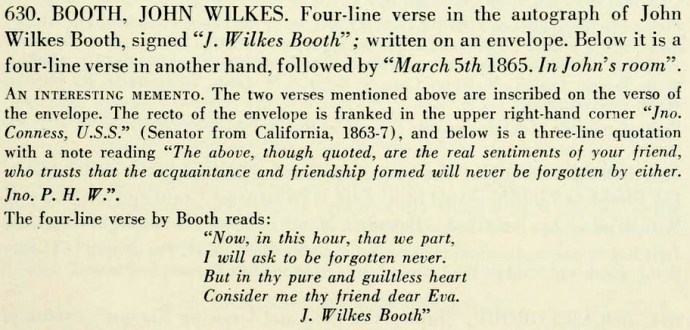
When Barrett died in 1950, his Lincoln collection went up for auction. In the 1952 auction catalog, this envelope was advertised thusly:

Booth Hale poem envelope Barrett catalog

The auction company, which heavily utilized Sandburg for his expertise, again concluded that Booth’s poem stated:

Now, in this hour, that we part,
I will ask to be forgotten never.
But in thy pure and guiltless heart
Consider me thy friend dear Eva
J. Wilkes Booth

A careful analysis, however, will show that this transcription has a few omissions and errors. As knowledgeable as Carl Sandburg was, he was not a Booth expert and was  far more experienced reading the President’s writing as opposed to that of his assassin. The true and complete text of Booth’s poem is as follows:

Now, in this moment
Now, in this hour, that we part,
I will ask to be forgotten, never
But in thy pure and guileless heart,
Consider me thy friend dear, Ever
J Wilkes Booth

Booth’s hasty scrawl pushed the final two letters in “ever” together to create, in lower quality copies, what appeared to be the single letter “a”. However, after consulting a slightly better quality image of the envelope, like the one that begins this post, one can make out the slight gap separating the two letters. “Ever” is also the logical conclusion as it completes the poem’s rhyme, while “Eva” does not.

This accidental, yet completely understandable substitution of the name “Eva” as the final word in the poem instead of the correct word, “Ever”, caused a great deal of confusion and speculation among Booth historians who consulted Sandburg’s book and the Barrett catalog. Theodore Roscoe, author of the 1959 book, The Web of Conspiracy, trusted Sandburg’s account to include his own mention of the nonexistent “Eva” as having, “dallied for some time in a state of betrothal with the amorous actor.” While Roscoe had the name wrong, he was not far off from the truth.

Who Wrote the Second Poem?

The larger poem, comprising the bulk of the envelope back states the following:

“For of all sad words from
tongue or pen.
The saddest are these –
It might have been.”
March 5th 1865
In John’s room –

The text of this poem is a quote from John Greenleaf Whittier’s 1856 poem, “Maud Muller. The individual who wrote these lines on the envelope was John Wilkes Booth’s secret fiancée, Lucy Hale, daughter of United States Senator John Parker Hale.

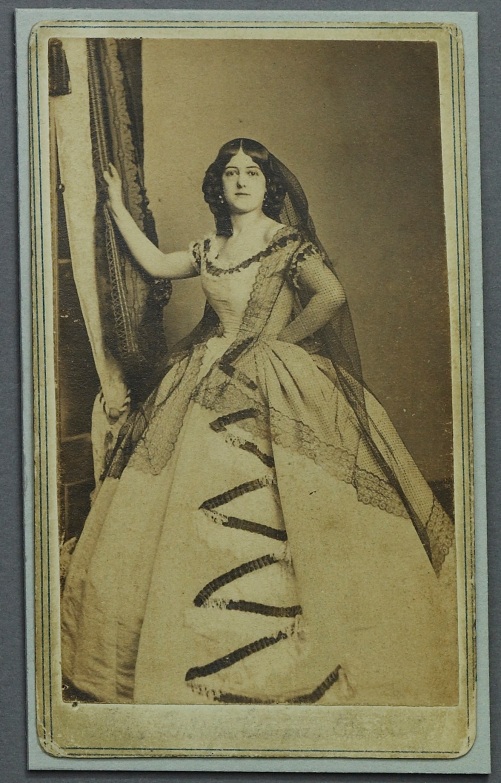
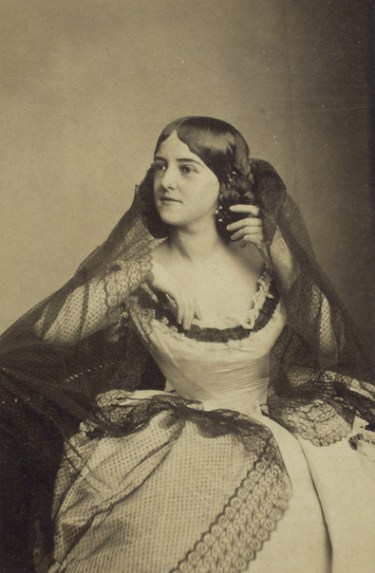
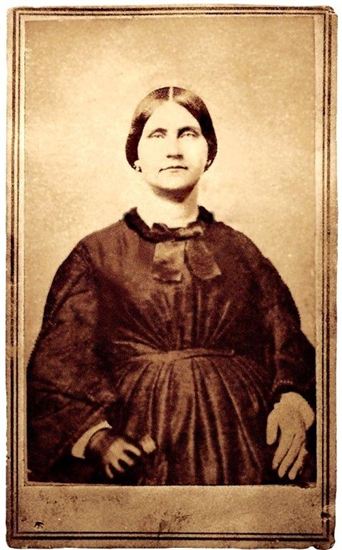
Lucy Hale

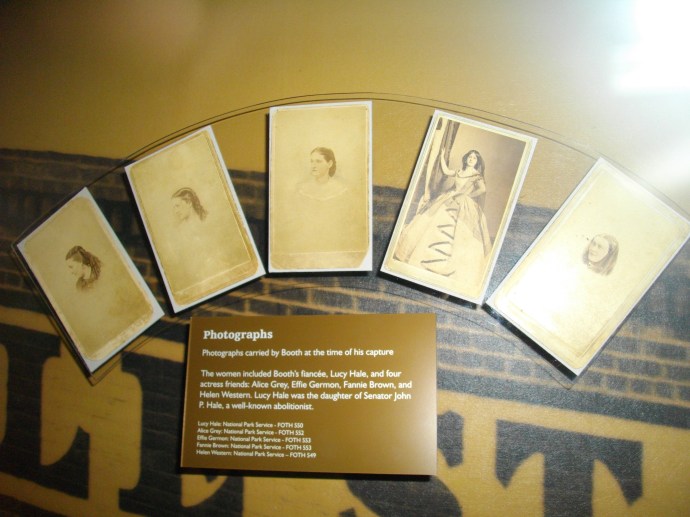
CDV of Lucy Hale that was found in John Wilkes Booth’s possession when he was killed

Though the poem is unsigned, handwriting analysis conducted by researcher James O. Hall concluded that this second poem was indeed written by Lucy Hale. Booth and Miss Hale had been acquainted since 1863, when Miss Hale witnessed the actor perform in Washington and sent him a congratulatory bouquet of flowers. The relationship between the two had flourished after Booth stopped touring and spent more time in Washington in the months leading up the assassination. Both John Wilkes Booth and the Hale family lodged at the National Hotel in Washington. This easily explains Lucy’s presence in his room on March 5th, though it would have still been against social custom. By that date they were engaged, albeit secretly. An actor, even one as famous and acclaimed as Booth, was still considered a poor match for woman of high class such as Miss Hale. Even after the assassination, when Lucy was racked with grief over the actions of her fiancée, the authorities still protected her honor by being careful not to publicly disclose their intimate involvement. She was quickly whisked away to Spain where her father had been appointed as an ambassador.

Why were these Poems Written?

The poems written by John Wilkes Booth and Lucy Hale are heartfelt lines that speak of remembrances and separation. Due to this a couple of authors have written possible explanations for them. Michael Kauffman, author of American Brutus, suggests that these lines were written by John Wilkes and Lucy as they lamented Lucy’s future departure for Spain:

“March 5, the morning after the inauguration, was bleak and cheerless for Booth and Lucy Hale. They sat in Booth’s room at the National Hotel commiserating on life’s troubles and despairing of future happiness. They might not have a life together; Lucy would soon accompany her father to Spain, where he was about to begin his duties as an ambassador. The emptiness of the moment reminded Lucy of Whittier’s “Maud Muller,” and she jotted down some lines on an envelope…Booth added a few lines of his own”

In Terry Alford’s upcoming book, Fortune’s Fool: The Life of John Wilkes Booth, he paints an even sadder picture regarding the circumstances of these poems’ creation:

“The day after the inauguration, Booth and Lucy ended their courtship. The timing suggests that his odd behavior had attracted the notice of her family. Or their parting may have been due to the fact that the Hales were leaving Washington. His term in the Senate having expired, Hale was moving his family to prepare for his new assignment as American minister to Spain.

Booth and McCullough had shared their room during the inaugural crunch with John Parker Hale Wentworth, Lucy’s first cousin. Wentworth proved a handy go-between for their courtship. Now he offered a final service.  He handed Booth an envelope from Lucy. If there was a letter inside, it is long gone. The envelope survives. On it Lucy copied the celebrated lines from John Greenleaf Whittier’s poem “Maud Muller”…Wentworth gave the envelope to Booth, who added his own sentiment just above Lucy’s…”

As much as I respect and admire these two authors, I believe them both to be mistaken in regards to the nature of these poems. The reason I don’t agree with Kauffman and Alford’s theories that the poems are mournful notes between John Wilkes Booth and Lucy Hale is due to the fact that Lucy’s father, John Parker Hale, had not yet been appointed minister of Spain when these poems were written. Senator Hale may have been petitioning for the position on March 5th, but he was not nominated for it until March 10th. In fact, the position was still very much in play on March 7th, two days after these poems were written. On that day, Secretary of the Navy Gideon Welles recalled having a cabinet meeting during which Secretary of State William Seward offered the position of Minister to Spain to anyone in the cabinet. This was intended to be a kind gesture towards Secretary of the Interior John Usher, who had lost his political base and was being forced out of Lincoln’s cabinet. No one, including Usher, responded to the offer. John Usher tendered his resignation to Lincoln on March 9th without inquiring about the ambassador position and so Seward found John Parker Hale for the job.

Senator John Parker Hale, Lucy Hale's father

Senator John Parker Hale, Lucy Hale’s father

Rather than being dejected poems of loss written by John Wilkes Booth and Lucy Hale for each other, I believe these poems are the couple’s farewell messages to Lucy’s cousin, John Parker Hale Wentworth. I believe that Kauffman and Alford are both missing one key piece of evidence regarding this relic: the contents written on the front side of the envelope.

The Front Side of the Envelope

From the 1952 Barrett auction catalog, we know that there is some writing on the front side of this envelope. For one, the envelope is franked with the name of John Conness. Franking was a practice at the time in which members of Congress, the President, cabinet members and other elected officials could send mail without the need of a stamp. The official in question would sign his name in the top right corner of an envelope and that would be as good as a stamp for the postal service. Officials pre-signed hundreds of envelopes for later use in this way. The envelope with Booth and Lucy’s poems was signed by John Conness who was a Senator from California.

The 1952 auction catalog also states that the front of the envelope has, “a three line quotation with a note” on it. While the catalog provides the note, written by John Parker Hale Wentworth, it does not give the quotation. For that we must consult a more recent auction. After being purchased in the 1952 auction for $210, the poetic envelope disappeared for many years. Assassination researcher James O. Hall tried to locate it but to no avail. Finally, in 2004, it popped up in a Sotheby’s auction. From their archived auction page, we finally learn that the full text on the envelope’s front is:

“Touched by change have all things been
Yet I think of thee as when
We had speech of lip and pen.”

Beneath this, in the same hand is the sentiment:

“The above, though quoted, are the real sentiments of your friend, who trusts that the acquaintance and friendship formed will never be forgotten by either, Jno P. M. W.”

The poem John Parker Hale Wentworth quotes from is entitled “Remembrance“. It was written by the poet John Greenleaf Whittier, the same author of Lucy’s, “Maud Miller” excerpt.

Wentworth, Booth, and Lucy

While John Parker Hale Wentworth and Lucy Hale were first cousins, they do not appear to have been particularly close growing up. There was quite an age difference between them with Wentworth having been born in Maine in 1828 and Hale in New Hampshire in 1841. In 1849, Wentworth, then 21, made his way to California to seek his fortune.  He would reside in California for the rest of his life. In about 1862 or so, Wentworth was appointed the Indian Affairs Agent of Southern California by Abraham Lincoln himself. Whether Wentworth wrote to his Senator uncle, John Parker Hale, for some assistance in gaining this position is unknown, but it’s clear that Wentworth was grateful to President Lincoln for the job. He was also apparently well suited for it with newspapers reporting that, “Mr. Wentworth has worked miraculous changes in the condition of the Indians in this district; more particularly of the degenerated, wasting tribes of this vicinity.”

With Lincoln’s re-election in 1864, Wentworth made the decision to travel from California to Washington, D.C. His motives for travelling aren’t known for sure. He may have just desired to be present at Lincoln’s second inauguration and hoped to thank the President for granting him his position. Or, perhaps he was like many other office seekers, looking to advance himself further in California’s political circle. Regardless, he arrived in D.C. and took up lodging at the National Hotel, where his uncle and cousins resided. On February 22, 1865, he checked into a room with John Wilkes Booth and another actor named John McCullough.

John Wilkes Booth Gutman 23

It was probably during this time that Wentworth had his first real opportunity to get to know his younger cousin Lucy, who was 8 years old when he left for California and was now a beautiful lady of 24. Being Booth’s roommate, Wentworth would have undoubtedly been aware of the relationship between his little cousin and the actor. The three of them likely spent time together, with Booth displaying his amazing ability to connect deeply with people.

In his free time leading up to the inauguration, it seems plausible that Wentworth would have wanted to report to his Congressmen on the condition of Indian affairs in his section of the state. This would have put him into the offices of his Senator, John Conness. This, I believe, explains Conness’ franked signature on the poetic envelope.  Perhaps Coness offered Wentworth some franked envelopes with which to send future correspondence, or maybe Wentworth decided to help himself to an envelope. Wentworth seems to be the only logical intermediary between the office of Senator John Conness and John Wilkes Booth.

Though I have not been able to track Wentworth’s movements, it appears he departed Washington right after the inauguration. In those days it was quite a long journey back to California, requiring steamboat travel to Panama, a train ride across the isthmus, and a second long steamboat journey to California. It is not unreasonable to assume that Wentworth decided to begin his journey as soon as possible. Even the very next day after the inauguration.

A Farewell Among Friends

With all of this in mind, I submit that the poetic envelope displayed above initially held John Parker Hale Wentworth’s farewell message to either his cousin, Lucy, his roommate, Booth, or to them both as a couple. In this scenario, Wentworth wrote a note, placed it in an envelope he had received from John Conness’ office, and wrote Whittier’s “Remembrance” poem on the front. He then either presented it or left the note for Lucy & Booth. Lucy opened the envelope and read the contents. She then wrote her own Whittier poem on the back of the envelope. Given its position, it appears that Booth’s response was an after thought. Since Lucy used all of the space on the back of envelope, Booth squeezed his own poem on the top flap. The envelope, but not the contents, was then given back to Wentworth as a representation of the couple’s affection.

The above is, of course, just a theory, but it is a theory that I believe logically explains how poems from John Wilkes Booth, Lucy Hale and John Parker Hale Wentworth all came to be on a single envelope franked by Senator John Conness.

References:
American Brutus by Michael Kauffman
Fortune’s Fool: The Life of John Wilkes Booth by Terry Alford
John Wilkes Booth: Day by Day by Art Loux
The Oliver R. Barrett Lincoln Collection Auction Catalog
The Web of Conspiracy by Theodore Roscoe
Sotheby’s Auctions
Right or Wrong, God Judge Me: The Writings of John Wilkes Booth edited by John Rhodehamel and Louise Taper
Ancestry.com
News Notes of California Libraries, Volume 14
“Indian Affairs in Southern California”, Daily Alta California, January 24, 1863
Mr. Lincoln’s White House: Cabinet
Diary of Gideon Welles
Special thanks to Roger Norton for providing me with Carl Sandburg’s quote in a pinch

Categories: History | Tags: , , | 35 Comments

John Wilkes Booth: Snowbound

Today, as the New England region of the United States recovers from what is being called the “Blizzard of 2015”, I am reminded of another historic winter storm. To many in the Midwest, the winter of 1863/64 became frozen in their minds as one of the worst winters ever experienced. Between December and January, temperatures rarely went above freezing. On December 18, 1863, for example, Fort Kearny, Kansas, reported a temperature of 25 degrees below zero with snow four to five feet deep in places. New Year’s Day, 1864, brought along a massive blizzard for the Midwest, with places like Minneapolis, Minnesota, seeing a high of 25 degrees below zero that day.

It was around this time that John Wilkes Booth, a now successful and celebrated actor, was performing in Leavenworth, Kansas. He had been delayed in arriving at Leavenworth from his former engagement in Cleveland, Ohio, appropriately due to snow. However, this minor delay of a day would amount to nothing compared to what was in store for the actor.

John Wilkes Booth Gutman 24

Booth finished his engagement in Leavenworth on December 31. During his time there, critics spoke of his talents:

“Mr. Booth has not only genius, but careful culture and trained power of intellect. There is no actor now on the stage who displays so much of dramatic force and insight as Mr. J. Wilkes Booth, except, perhaps, for his brother Edwin. There is no imitation on the part of the junior, either to his renowned father or his now famous brother. He has a grace and charm all his own, though resembling them in genius, skill and painstaking care, with which his characters are presented on the stage.”

John Wilkes Booth set off from Leavenworth on January 1, 1864. In the morning, he made a brief visit to Fort Leavenworth, a few miles north of the city, to see some friends. This trip occurred on one of the coldest days on record and at a time when newspapers were describing the terrible winds thusly: “Ah, this is a blessed cold snap! Patient old Job may have seen colder weather, but he never undertook to walk up Sixth street facing such a wind as we felt yesterday. Not he. His reputation for patience would have been blasted. God help the shivering poor.” Booth later wrote of having “an ear frost bitten” by the time he arrived at the Fort.

Accompanying Booth during this western trip was a young, black man, possibly named Leav, about whom practically nothing is known other than he served as Booth’s valet and servant. Upon leaving Fort Leavenworth for the journey back to town in order to catch the ferry, Booth gave Leav some items to carry, including his pocket flask. Booth wrote the sorrowing effects of this decision in a letter to the man with whom he had been boarding with in Leavenworth:

Portion of a John Wilkes Booth letter in which he recounts the loss of his flask in the snow.

Portion of a John Wilkes Booth letter in which he recounts the loss of his flask in the snow.

“After giving my boy my flask to keep for me, I started for a run and made the river (four miles) on foot. I run without a stop all the way. I then found my boy had lost that treasured flask. I had to pay five dollars for a bare-backed horse to hunt for it. I returned within sight of the Fort and judge my dismay upon arriving to see a waggon just crushing my best friend. But I kissed him in his last moments by pressing the snow to my lips over which he had spilled his noble blood.”

Some have tried to use this visual of the actor, mourning the destruction of his flask and sucking the last bit of its spilled contents from the snow, as evidence that Booth was an alcoholic. While possible, I view the scene as entirely appropriate given Booth’s dramatic flair in a moment when the outside conditions so desperately warranted the “warming” effects of alcohol. Saddened as he was, things were still only going to get worse for the actor.

When Booth returned to the boat landing, he found that ice had prevented the ship from reaching the shore. Booth, along with others, helped to cut the ice in order to allow the boat to dock. The ship then took him across the Missouri River, and he slept that night across the river from Leavenworth in the town of Weston, Missouri. His end goal was St. Louis, where he was booked at Ben DeBar’s theater starting on January 5. On the morning of January 2, he boarded a train at Weston and took it north about 35 miles to St. Joseph. From there, he was hoping to catch a train with the Hannibal and St. Joseph Railroad, which would take him eastbound towards St. Louis. The weather, however, had other plans.

The blizzard of 1863/1864, known as “The Big Snow” by those who lived through it, occurred over an area of 3,000 miles, hitting a large portion of Illinois, Iowa, and Missouri. As one Missouri citizen later recalled, “a terrible snow storm set in and continued with unabated fury for forty-eight hours.” Near St. Joseph, the ground was covered with snow to a depth of about 27 inches, but areas east of St. Joseph had been hit even worse. Huge snow drifts occurred, completely covering the railroad tracks. Not one, not two, but eight trains along the Hannibal and St. Joseph Railroad were trapped in the snow, some buried up to thirty feet in it. The closest trapped train was only about 19 miles east of St. Joseph. All were unlikely to be freed anytime soon.

The cover of the January 23, 1864 edition of Harper's Weekly shows the condition of railroads across the Midwest.

The cover of the January 23, 1864, edition of Harper’s Weekly shows the condition of railroads across the Midwest.

By the time Booth had arrived at St. Joseph, no train had traversed the Hannibal and St. Joseph rails for the past week. Booth, like everyone else who came to St. Joseph hoping to go east, was completely snowbound. Local newspapers printed a report, later to be proven entirely too optimistic, that the train line might be up and running again in four days. With no other options available to him, Booth found a room at the now wholly overcrowded Pacific House hotel in St. Joseph.

Booth spent his first full day in St. Joseph on Sunday, January 3. Even after only a day, Booth likely empathized with the local newspaper, which wrote, “We are ‘in the wilderness,’ and can’t see any way to get out.”

On Monday, January 4, Booth’s reputation had caught up to him. After becoming aware that the famous tragedian was effectively stuck in their city, citizens of St. Joseph wrote a letter to Booth asking him to perform for them in some capacity. They wrote:

“J. Wilkes Booth, Esq., Pacific House:
Sir:
The Undersigned, citizens and travelers detained here, having learned that you were making a short visit to this city and entertaining a high appreciation of your ability as a tragedian, would most respectfully but earnestly request that you would favor us with a public reading from any of your favorite authors, at any time and place most convenient for you. When and where we pledge you an appreciative audience”

The request was then signed by 70 citizens and guests of St. Joseph, including the mayor. Booth, later wrote to a friend that he was down to his last cent in St. Joseph, and so he heartily agreed to the public’s demand of him. He wrote the following response to the invitation:

“Gentlemen:
Your flattering request has just been recieved and I endeavor to show my appreciation of it, by the promptness of my compliance. I have gained some little reputation as an actor, but a dramatic reading I have never attempted. I know there is a wide distinction as in the latter case, it is impossible to identify ones-self with any single character. But as I live to please my ones, I will do all in my power to please the kind friends I have met in St. Joseph.
I will therefore designate Tuesday evening, Jan. 5th, at Corby’s Hall. I am
Very Respectfully,
J. Wilkes Booth”

Despite his assertions to the contrary, Booth had, in fact, performed public recitations before. When he ran off with the Richmond Grays to attend the execution of John Brown, he had entertained his fellow soldiers with readings. That was, however, over four years ago when he was still but a novice actor.

The next day’s newspaper advertised the performance as its lead article, with the newspaper’s ironic political sentiments being the only thing preceding it in the issue.
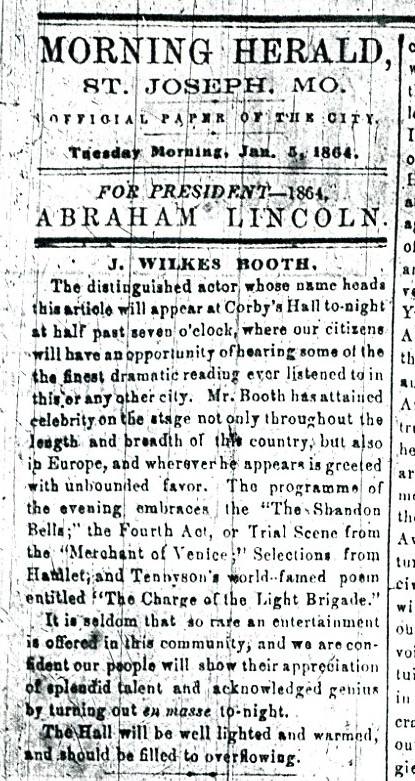
John Wilkes Booth will perfom with Lincoln ad 1-5-1864 St Joseph Morning Herald

In addition to reciting pieces contained in the article above, John Wilkes also took this chance to recite one of his favorite, and entirely appropriate, poems, “Beautiful Snow.” The newspapers hailed the performance the next day, stating:

“The dramatic reading of this celebrated actor last evening was well attended and gave universal satisfaction.  The Hall was well filled, but it was so very cold that everybody found it almost impossible to be comfortable. The selections of the reader were all rendered in a captial style, but we were particularly pleased with ‘Once I was Pure [Beautiful Snow]‘ and the ‘Charge of the Light Brigade.’ Our citizens would greet Mr. Booth with a crowded house could he be persuaded to repeat the entertainment.”

Booth did not perform again in St. Joseph despite the newspaper’s suggestion. It might have had something to do with the condition of the audience, which the newspaper scolded for their behavior during his recitations:

“It is inexplicable why full grown men will go about in a hall on such an occasion as that of last night, stamping like elephants, and moving chairs as though they were anvils. A trifle of good breeding is a capital thing to be used in keeping a hall quiet.  Stupid dolts who go thundering about the world, to the disgust of every sensible person, should be debarred from the privileges of Corby’s Hall during dramatic readings.”

Booth received $150 from the performance, which was greatly needed. Days were still passing with little sign that the trains would start running again. On Thursday, January 7, the temperature in St. Joseph at 9:00 am was twenty-one degrees below zero. Some days were better than others, however, with the newspaper celebrating the reappearance of the sun despite the “crisp, cold day”.

By Friday, January 8, it was clear that everyone was suffering from the prolonged freeze. The newspaper lamented, “Well, this is a big storm. In the memory of man, no such cold weather and no such fall of snow has been known as we are now suffering in. Hundreds of travelers are here, weatherbound.” An earlier report stated, “Our people are in a terrible fix. The snow has effectually shut us out from ‘all the world and the rest of mankind,’ and there is no prospect of relief.” John Wilkes Booth was now three days overdue for his engagement in St. Louis, 300 miles away. A man arrived in St. Joseph and related that he had taken the train west from Macon, the transfer point to St. Louis. The train made it west until Breckenridge, where the other stopped trains and snow prevented it from going further. Booth, realizing that if he could make it to Breckenridge, 60 miles to the east, he could catch the working trains to Macon and then St. Louis, decided to put an end to his snowy vacation in St. Joseph. With $100 of the money he had received from his public reading, Booth hired a four-horse sleigh to take him the 60 miles to Breckenridge. He departed on January 8, after spending about five and a half days in St. Joseph, Missouri.

The exact details of Booth’s journey by sleigh are not known for sure. He later wrote to his friend John Ellsler of the journey:

“[The performance at St. Joseph] gave me $150. with which I hired a sleigh and came 100 miles over the plains. Four days and nights in the largest snow drifts I ever saw Its a long story which I want to tell you when I see you, but I will say this that I never knew what hardship was till then.”

There are two individuals who, many years later, gave accounts regarding Booth’s time in the snow. One of them was William D. Bassett, then a 16-year-old railroad telegraph operator stationed in Cameron, Missouri. Around the turn of the century, various newspaper articles were published featuring Bassett’s recollections of The Big Snow. Bassett stated that he shared his comfortable room at the Cameron depot with Booth after Booth arrived, along with this theatrical troupe, in Cameron by train. The way Bassett portrays it, Booth was never trapped at St. Joseph, but, instead, with him at Cameron. All of this is suspect and is contrary to the facts. However, it is possible that Bassett has some truth in his accounts. Perhaps, Booth, while on his four-day sleigh journey to Breckenridge, stopped in Cameron to rest for a day or two and found hospitality with young Bassett in the depot. Cameron was just about halfway between St. Joseph and Breckenridge, making it an extremely appropriate spot to rest before moving on. In Bassett’s recollections of their time together, he states that Booth was fond of literature and that the pair spent some time reading Victor Hugo’s Les Misérables together. Booth was also apparently quite entertained when, upon visiting the local bar one morning, he found a captive audience of customers waiting patiently as the bartender was attempting to thaw out bottles of whiskey that had frozen solid.

Probably the most entertaining of Bassett’s recollections involves Booth’s interactions with the children of Cameron. From other accounts, we know that John Wilkes Booth was very fond of children and was fairly gifted at conversing with them. According to Bassett:

“Several little children played around the depot everyday while Booth was there, and with these innocent creatures he soon became a prime favorite. He would teach them games and engage in snowball battles with them. Sometimes they would all join against him and give him much the worst of it, but he took it all in perfect good nature, and was as rollicking and boisterous as the best of them. For many weeks after his departure the little girls and boys would ask me when ‘Mr. Boots’ was coming back.”

A newspaper article containing Bassett’s memories, published in 1901, includes this wonderful drawing of the event.

Snowbound John Wilkes Booth The Republic 8-4-1901

Even if Bassett’s accounts are untrue, I have no problem believing that, at some point in his life, whether it be during the many days he spent at St. Joseph or a previous snowy winter, John Wilkes Booth engaged some local children in a snowball fight. His affinity for children makes this a very likely scenario.

One of the other individuals who later spoke of Booth’s time in the snow was an actress named Mrs. McKee Rankin. According to an article by her published in 1909, she heard Booth recount some of the struggles he faced during his sleigh ride to Breckenridge. It is very difficult to put any reliability in her account, however. Not only was it published 45 years after the event, but Mrs. Rankin also admits that she is remembering the story told by Booth to a friend while she was listening through a transom in a different room. The account is filled with factual errors regarding the events and, in truth, is barely worth the paper it is written on. However, it is still an extremely entertaining read. Surprisingly, the one thing Mrs. Rankin does get right is the inclusion of Booth’s otherwise forgotten servant. She recalls an exciting tale in which Booth and Leav hire a horse named “The Girl” to lead their sleigh. At one point, it is so dark that the men went right over a snow drift, sending them flying from the sleigh. As Mrs. Rankin wrote it, after the accident, poor Leav was like a cartoon character with his head and body buried while his legs and feet stuck out of the snow. Booth pulled him out, and together they righted the sleigh. Leav was freezing cold and buried himself under robes and blankets on the sleigh. While Booth recovered himself, he bent down to get a drink of whiskey from a jug they had brought along, only to find that it had broken. After lighting a half-broken cigar, Booth heard footsteps approaching. He tried to rouse Leav, but at that point, Leav was unconscious, wrapped in the sleigh. As the footsteps got closer, Booth drew long on his cigar, hoping to see something in the darkness. Then he felt the panting of an animal before him and saw two balls of fire reflecting in the eyes of an animal before him. It was a wolf! In that instant, the “heroic” Booth grabbed the broken piece of whiskey jug and brought it down right onto the head of the beast. Before getting a chance to see how many wolves were out there, “The Girl” let out a yelp and, with a bound, was pulling the sleigh away at top speed. According to Mrs. Rankin, the horse, at a dead run, didn’t stop until they reached their destination.

While it’s safe to say that probably none of Mrs. Rankin’s account is true, it is at least possible that Booth said some of these falsehoods to make a good story. In fact, another actor by the name of Edwin Adams recalled another likely case of Booth adding flourish to a story:

“I heard [Booth] boasting over a long and tedious journey from Leavenworth across the prairies in a sleigh to St. Louis and after of having threatened a conductor’s life, who had stopped his train on account of the great depth of snow, and that by placing a pistol to his head, made him continue his journey.”

The truth of Booth’s journey, however, is far less flashy. On Monday, January 11, John Wilkes Booth, his servant, and his sleigh team had made the cold trek of sixty miles from St. Joseph to Breckenridge. The tracks on the Hannibal and St. Joseph Railroad were clear from that point eastward. Booth caught the first train he could eastward. At Macon, he transferred from the Hannibal and St. Joseph Railroad to the Northern Missouri Line. This line took him southeast, all the way to his destination of St. Louis.

He opened at the St. Louis Theatre on Tuesday, January 12, exhausted but not wanting to lose any more days from his engagement. The Big Snow had caused him to lose seven days of performances—and pay. The toils of his journey had taken much out of him. One of the stock actors in the company later wrote, “[Booth] told me of his hardships in coming down from [St. Joseph] to fill his date in St. Louis, and that he had made the greater part of the journey in sleds…He looked worn out, dejected and as melancholy as the dull, gray sky above us…After ordering beer, he sat gloomily and silent for a time, and upon my asking him the cause, he smilingly answered that no doubt it was the rough experience he had passed through lately.” Booth would only perform five times in St. Louis before he had to move on to his next engagement in Louisville, Kentucky.

Just as the residents of Boston will long remember the Blizzard of 2015, so did John Wilkes Booth retain a memory of his run-in with the Big Snow of 1863/64. He spent just under a week snowbound in St. Joseph, Missouri, and, when he could take it no longer, he braved the harsh weather by sleigh for four days. In less than a year and a half, John Wilkes Booth would again be braving the elements for a chance at freedom as he ran for twelve days, attempting to flee one of the largest manhunts in American history.

References:
John Wilkes Booth: Day by Day by Art Loux
“Right or Wrong, God Judge Me”: The Writings of John Wilkes Booth edited by John Rhodehamel and Louise Taper
January 1, 1864 – January 9, 1864 editions of the St. Joseph Morning Herald
Snowbound with John Wilkes Booth at Cameron, MO by William F. Bassett in The St. Louis Republic Magazine, August 4, 1901
The News of Lincoln’s Death by Mrs. McKee Rankin
The Lincoln Assassination: The Evidence edited by William Edwards
Recollections of an Old Actor by Charles A. Krone
Harper’s Weekly
The Art Loux Archive
GenealogyBank.com

Categories: History | Tags: , , , | 3 Comments

The Attempt on Edwin Booth’s Life

As I wrote two days ago, Edwin Booth was the target of an assassination attempt on April 23, 1879 while he was performing Richard II at McVicker’s Theatre in Chicago. Since two days ago was the anniversary of the attempt, I wanted to put up a quick post highlighting what I considered a mere piece of historical trivia. The more I looked into it however, the more I found myself quickly engulfed in a huge amount of information that is available far beyond what I have read in books. My inspiration for this post was Nora Titone’s Edwin/John Wilkes biography, My Thoughts Be Bloody which devotes a paragraph to the incident. While looking for a bit more background I read about the incident in Eleanor Ruggles’ Prince of Players and Stanley Kimmel’s The Mad Booths of Maryland. These sources gave about a page to the incident. I decided to look at the newspaper sources of the day, and it is from those that I was deluged with information. This attempt on Edwin’s life was a national story. The coverage on it all quickly reminded me of how talented and celebrated Edwin Booth truly was. We all know that newspapers take liberties with the truth from time to time and that we cannot trust them with certainly. Nevertheless, what follows is a look at the aftermath of the attempt on Edwin’s life and the fate of his assassin.

First allow me to summarize the scene of the assassination ttempt, this time pulling from newspaper sources, rather than the books mentioned above.

McVicker's Theatre

In April of 1879, Edwin Booth was at McVicker’s Theatre in Chicago for an engagement. McVicker’s was owned by James H. McVicker, the step-father of Edwin’s second wife, Mary McVicker. She was backstage during that night’s performance. As always, the accounts of the day differ somewhat regarding what happened during the final act of Richard II. The last scenes of the act are set in the prison of Pomfret castle where King Richard is shown cut off from the world. The stage is darkened during this scene, with little more than a pale light masquerading as moonlight shining through a small grated window on the prison flat. Booth, as Richard, was sitting on stage soliloquizing of his isolation. Meanwhile, a man who sat in the second balcony about 30 feet from Booth, was removing a pistol he had concealed in his sleeve. In his left hand, he was said to be holding a copy of the play. He followed along with Booth’s soliloquy, waiting for the right time to act. While speaking onstage, Booth heard a shot ring out.

mark-gray-lyons-vs-edwin-booth-iannone

Booth and the audience remained unmoved; the audience thinking the anachronistic gunshot was the result of an error backstage and Booth thinking an accident prone cowboy had discharged his gun by mistake. When a second shot rang out about three seconds later, Booth arose (or was in the process of rising when the second shot happened) and proceeded to walk calmly towards the direction of the shots. Before walking off of the stage and into the audience, Booth pointed to the left hand upper gallery and men around the assailant grabbed at the man with the revolver, preventing him from firing again. Booth went into his dressing room to comfort his wife, Mary, who was in a state of great distress after hearing the shots.

Edwin Booth and his wife Mary McVicker

Edwin Booth and his wife Mary McVicker

It was written that had it not been for the swift response from police officers the assailant would have been, “rather roughly handled” by the rest of the audience when they became aware of what had occurred. The man was seized by the officer of the theatre and James Morgan, a detective who was in the audience. Morgan put handcuffs on the man who gave him little resistance. As Morgan led the man to Chicago’s Central Station, he heard him say, “I don’t see how I happened to miss him,” and, “I am sorry that I didn’t take some lessons in pistol practice before I tried this thing.”

Nervous interrogationWhen searched at Central Station a .32 caliber “True Blue” revolver with three loaded chambers and two chambers containing exploded shells was found on him. Along with some trivial items (scissors,  pawn ticket, pocket knife) the man was found to have a stub for a seat at McVicker’s from the night before, April 22nd. In addition, the man had this letter on him:

“Chicago, April 22, 1879.

Dear Katie:

Forgive these brief but horrible lines, I left St. Louis Monday evening. The firm I was with would not increase my salary, so I made up my mind to return to Keokuk, but being a lover of fine acting I came to Chicago to see Booth, but I was sadly mistaken. It would take Booth one year of constant acting to compete with Lawrence Barrett’s  Richelieu. Tonight he plays Richard II. Katie, if I go tonight he will kill me or I will him. In all Shakespeare’s works I find but one man to compete with Booth, and that is Iago. My judgment ought to foretell me that since I call Booth Iago he could no more play Richelieu than the devil could be an angel. I don’t know what to do. Every line I write I prance the floor as though I was playing Hamlet. I’m sorry I came here, for I think the hangman has a rope for me. Remember me to your mother and sister.”

The man had seen Edwin Booth act before, and seemingly did not believe he was worthy of any of his accolades. The letter was signed, “Yours Truly, Mark Gray”. The name of the failed assassin was known.

When asked, he refused to state his reasons for wanting to kill Edwin Booth, but claimed that when they were made known, they would be deemed sufficient to all.

The next morning, April 24th, Edwin Booth was present when Mark Gray was taken before a judge:

Bail hearing for Gray

It was found that Gray had purchased the revolver used in the shooting only the day before and clearly showed no skill as to its use. Mark Gray was a young man, 26 years of age (though he stated to police he was 23) and was said to bear a striking resemblance to Edwin Booth if not for his mustache.

Theories abounded regarding Gray’s motive behind his attempted assassination of Edwin. Gray’s own ambiguity when questioned only fueled the fire in the nation’s newspapers. Here are a few published theories for the attempt on Booth’s life, some serious, others humorous:

This slideshow requires JavaScript.

While people hypothesized about Gray’s motives, more information was being found regarding his background and character:

Background on gray

suicide attempt gray

Finding no answers in the newspaper accounts and the interviews others had with Gray, Edwin Booth decided to meet with Gray himself and ask him what drove his attempt on his life:

Edwin's chat with Gray

Perhaps desiring the attention for a longer period of time, Gray did not reveal his reasons to Booth at this time.

On May 6th, Mark Gray was brought into court for arraignment and gave a surprising plea:

Gray pleads guilty

Wanting to make sure Edwin Booth was present for the proceedings of the trial before departing Chicago for his next engagement, the pendulum of justice moved swiftly for Mark Gray. On May 10th his trial began, and it was here that he finally revealed his reasoning for attempting to kill Edwin Booth.

Gray's Trial

The mere word “mark”, recited by Edwin Booth as Richelieu and King Richard was the cause for the actor’s misery. The vocalization of this simple English word which is a homograph for a name, and the way in which Booth portrayed his characters, incensed Mark Gray to the point of madness. As stated, Gray was immediately sent to the Northern Illinois Hospital and Asylum for the Insane in Elgin, IL.

Though Gray was locked away, Edwin Booth kept a cautious eye on his would be assassin and wrote the following note to a Chicago attorney a month after Gray was put in the Elgin asylum:

“I trust that our friend Gray may become gray indeed – yea postiviely hoary-headed – in kind but careful confinement, or if earlier released, that his exit may be from this earthly stage of his dramatic exploits to that celestial scene where idiots cease from shooting and actors are at rest. If he be ever again at liberty my own life I shall not value worth a rush. But I hope the Elgin guardians will not be deceived by his seeming helplessness.”

Edwin Booth would be able to sleep easy for a little over three years.  Then, in October of 1882, Mark Gray’s friends made a plea for his release:

Gray seeks release October 25 1882 Rockford, IL

On November 6, 1882, Gray was successful in his plea:

Gray set free November 6 1882 Rockford, IL

Though I have not been able to find an account of Edwin’s reaction to the release of his would be assassin, we can surmise that he was not pleased by the relatively short amount of time Mark Gray spent locked up.

In a worrisome sign of mental relapse, Gray jumped into the spotlight again trying to cash in on his infamy:

New Hamlet November 23 1882 Canton, OH

If Gray ever did play Hamlet, it was just to his neighbors in Keokuk, Iowa. For many years, Mark Gray was forgotten. When Edwin Booth died in 1893, Gray’s attempt was mentioned in a sentence on various newspaper biographies on his life. Just a little over 10 years later, in May of 1904, Mark Gray Lyons died at the age of 51. While Booth’s obituaries contained mentions of Mark Gray, there was a distinct lack of Booth in Mark Gray’s official obituary:

Gray's Obit

Unsurprisingly a bachelor his whole life, Mark Gray was buried with his sister and her husband in the Catholic section of Keokuk’s Oakland Cemetery.

To me Mark Gray Lyons is Edwin Booth’s Mark David Chapman. Gray wanted the fame and life of Edwin Booth. He tried to convince others and himself that he was Edwin Booth’s son. He wanted to be a star of the stage and resented Edwin for the success he had. After the shooting that night in 1879, Edwin Booth returned to the stage and finished Richard II. James McVicker found one of the bullets behind one of the stage flats it had passed through and he gave it to Edwin Booth. Booth later had it set in a gold cartridge and engraved upon it, “From Mark Gray to Edwin Booth, April 23, 1879.” Edwin was above all else, a devoted tragedian and, as history shows, nothing could keep him off that stage for long:

Scene in a theatre

References:
My Thoughts Be Bloody by Nora Titone
Prince of Players by Eleanor Ruggles
The Mad Booths of Maryland by Stanley Kimmel
The Staff of the Keokuk Public Library
Countless newspaper articles garnered from GenealogyBank.com

Categories: History | Tags: | 13 Comments

Conspirator Canes

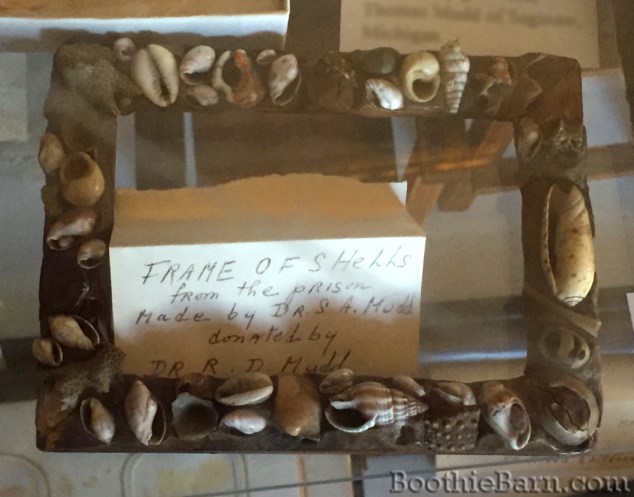
Prison life at Fort Jefferson, Dry Tortugas was a miserable affair.  From the food, to the weather, to the living conditions, it’s hard to imagine that anyone stationed there, guard or prisoner, found the now tropical paradise hospitable.  All those that sailed to the island fort became prisoners.  It appears that when the lives of the inhabitants were not in danger from disease or malnutrition, extreme boredom prevailed. The Lincoln assassination conspirators Dr. Mudd, Edman Spangler, Samuel Arnold, and Michael O’Laughlen fought against this boredom.  The assigned duties given to the men helped in some ways.  Dr. Mudd, while a trained surgeon who would be a nurse in the hospital and an emergency replacement during the Yellow Fever epidemic, spent a considerable amount of time with Edman Spangler in the carpentry shop on the island.  Through three and a half years, he honed his carpentry skills and created several beautiful items that are currently on display at the Dr. Samuel A. Mudd House Museum in Waldorf, MD.  One set of items that Dr. Mudd became effective at creating were canes.

In addition to these two canes on display at the Mudd house, the good doctor also created a cane for his cousin, Henry A. Clarke. When Dr. Mudd was struggling to find an attorney willing to take his case during the conspiracy trial, he reached out to Clarke who owned a Washington coal company. On May 10th, Col. Henry Burnett sent a letter to Clarke asking if he would be Mudd’s counsel. Clarke responded back truthfully that he was not an attorney but would be happy to help Dr. Mudd in securing counsel. By the time Clarke had responded, Dr. Mudd had already secured Thomas Ewing and Frederick Stone for his defense.

Clarke would later make an appearance at the trial testifying on Dr. Mudd’s behalf. Even though he couldn’t keep his cousin out of prison, the family story is that Clarke continued to advocate for Dr. Mudd’s release. As a result, Dr. Mudd presented a cane to Henry Clarke. A few years ago, the cane made an appearance on Antique Roadshow:

Dr. Mudd was not the only conspirator to make canes for family and friends.  His own mentor in the carpentry world, Edman Spangler, also created canes from the wood at Fort Jefferson:

The canes, cribbage boards, shell decorated boxes, and other feats of craftsmanship were all therapeutic ways for Dr. Mudd to feel productive. Had it not been for these minor, but important, outlets of purposefulness, the Lincoln assassination conspirators could easily have succumbed to insanity.

References:
The Dr. Samuel A. Mudd Research site by Robert Summers
The Evidence by Steers and Edwards
Genealogybank.com

Categories: History | Tags: , , , | 6 Comments

“An old codger like me” – Samuel Seymour, Eyewitness to History

Prologue: This post is dedicated to the memory of my grandfather, Robert James Taylor, who passed away on July 4, 2013, at the age of 95, a year after this post was written. Thanks for sparking my interest in the past, Umpa.


Today, June 20, 2012, my grandfather celebrates his 94th birthday. The son of an Irish immigrant and his Illinois-born wife, my grandfather was educated at Illinois Wesleyan University, served as a Captain in the Marines during WWII and the Korean War, and raised a family of three boys with my grandmother. To me, though, he has always been Umpa: the devoted church going grandfather who would take me fishing and was always working his garden. I never knew until I was older that he was a Marine, and while he would openly tell me stories about the war, it always brought tears to his eyes. My grandfather taught me that war was always a regrettable thing, even when it is justified. He was proud of his service to his country but would never glorify what he had experienced. Nowadays, his life has slowed down considerably. He talks less, sleeps more, but is still the kind and inquisitive grandfather I’ve always known. Unfortunately, he will be spending this birthday in the hospital. I’ve logged about 18 hours with him over the last two days after a recent medical setback. As a 94-year-old, it is to be expected. Nevertheless, he still enjoys sharing one fact about his life with the nurses that always throws them for a loop. When asked where he was born, he answers truthfully, “Nani-Tal, India.” The nurses briefly stare at him, before turning to us, his family members, with a worried look that this characteristically Caucasian man has gone senile. We, of course, respond in the affirmative, and recall how his parents were missionaries and that he and two of his siblings were born in India. My grandfather was almost three years old when the family returned to America. His memory of India is now just a few Christian hymns in the Hindi language that he sang as a child. Nevertheless, he can still recall all the lyrics to “Jesus Loves Me” in Hindi.

My 94-year-old grandfather’s ability to remember one of his earliest experiences mirrors that of another 94-year-old man who recounted his experience of Lincoln’s assassination.

Many of us have seen the following episode of the TV show, I’ve Got a Secret, which aired on February 9, 1956.  In it, the American viewing audience is presented with the last surviving witness to Abraham Lincoln’s assassination, 96-year-old Samuel J. Seymour of Baltimore. You will want to fast forward to the 11:57 mark in the video below:

In the video, the host mentions that they learned about Mr. Seymour due to an article written by him in The American Weekly magazine.  That article was published on February 7th of 1954, when Samuel Seymour was 94 years old.

After some searching, I found the original article by Mr. Seymour and transcribed it from the newspaper record.  Here it is in full:

I Saw Lincoln Shot

By Samuel J. Seymour

As told to Frances Spatz Leighton

The only living witness re-creates the drama of that tragic night

This is an eyewitness account of one of history’s great tragedies – the assassination of Abraham Lincoln – told by the only living witness to the fateful drama enacted at Ford’s Theater on the night of April 14th, 1865 – THE EDITORS

Even if I were to live another 94 years, I’d still never forget my first trip away from home as a little shaver five years old.

My father was overseer on the Goldsboro estate inTalbot County, Maryland, and it seems that he and Mr. Goldsboro has to go to Washington on business – something to do with the legal status of their 150 slaves. Mrs. Goldsboro asked if she couldn’t take me and my nurse, Sarah Cook, along with her and the men, for a little holiday.

We made the 150-mile trip by coach and team and I remember how stubborn those horses were about being loaded onto an old fashioned side-wheeler steamboat for part of the journey.

It was going on toward supper time – on Good Friday, April 14th, 1865 – when we finally pulled up in front of the biggest house I ever had seen. It looked to me like a thousand farmhouses all pushed together, but my father said it was a hotel.

I was scared. I had seen men with guns, all along the street, and every gun seemed to be aimed right at me. I was too little to realize that all of Washington was getting ready to celebrate because Lee has surrendered a few days earlier.

I complained tearfully that I couldn’t get out of the coach because my shirt was torn – anything to delay the dread moment – but Sarah dug into her bag and found a big safety pin.

“You hold still now, Sammy,” she said, “and I’ll fix the tear right away.” I shook so hard, from fright, that she accidentally stabbed me with the pin and I hollered, “I’ve been shot! I’ve been shot!”

When I finally had been rushed upstairs, shushed and scrubbed and put into fresh clothes, Mrs. Goldsboro said she had a wonderful surprise.

“Sammy, you and Sarah and I are going to a play tonight,” she explained. “A real play – and President Abraham Lincoln will be there.”

I thought a play would be a game like tag and I liked the idea. We waited a while outside the Ford Theater for tickets, then walked upstairs and sat in hard rattan-backed chairs.

Mrs. Goldsboro pointed directly across the theater to a colorfully draped box. “See those flags, Sammy?” she asked. “That’s where President Lincoln will sit.” When he finally did come in, she lifted me high so I could see. He was a tall, stern-looking man. I guess I just thought he looked stern because of his whiskers, because he was smiling and waving to the crowd.

When everyone sat down again and the actors started moving and talking, I began to get over the scared feeling I’d had ever since we arrived inWashington. But that was something I never should have done.

All of a sudden a shot rang out – a shot that always will be remembered – and someone in the President’s box screamed. I saw Lincoln slumped forward in his seat. People started milling around and I thought there’d been another accident when one man seemed to tumble over the balcony rail and land on the stage.

“Hurry, hurry, let’s go help the poor man who fell down,” I begged.

But by that time John Wilkes Booth, the assassin, had picked himself up and was running for dear life. He wasn’t caught until 12 days later when he was tracked to a barn where he was hiding.

Only a few people noticed the running man, but pandemonium broke loose in the theater, with everyone shouting:

“Lincoln’s shot! The President’s dead!”

Mrs. Goldsboro swept me into her arms and held me close and somehow we got outside the theater. That night I was shot 50 times, at least in my dreams – and I sometimes still relive the horror of Lincoln’s assassination, dozing in my rocker as an old codger like me is bound to do.”

Of the many firsthand accounts given in books (like We Saw Lincoln Shot by Timothy Good), I prefer this one by Mr. Seymour. There is an innocence in his account that can’t be found anywhere else. While Major Rathbone and others give more details regarding the actual event, young “Sammy” gives a unique perspective. We become more connected to this child and his young life. We can empathize with his sense of uncertain fear and even feel the disappointment he must have had when he experienced what a “play” truly was. Most of all, I marvel at Sammy’s kindness and compassion. Ignorant of the context of what had occurred, this boy only wanted to help the man who had fallen.

Mr. Seymour died two months after his appearance on I’ve Got a Secret, possibly related to his fall the day before the show. He died on April 13, 1956, just a day shy of the anniversary of the event he witnessed.  Mr. Seymour is buried in Loudon Park Cemetery in Baltimore, MD; however, his grave is unmarked.

References:
We Saw Lincoln Shot by Timothy Good
Mr. Seymour’s article in The American Weekly
Roger Norton’s Abraham Lincoln’s Assassination Research Site has a nice picture of Mr. Seymour

Categories: History | Tags: , , , | 9 Comments

Booth at Lincoln’s Second Inauguration

On March 4, 1865, President Abraham Lincoln was inaugurated for a second time following his reelection in November of 1864. With hopes that an end to the Civil War was in sight, Lincoln gave a historic speech addressing how the practice of slavery had caused the war, and expressing his hopes for a reconciliation between the two sides under a government free from this evil. Lincoln finished his speech with the iconic words:

“With malice toward none, with charity for all, with firmness in the right as God gives us to see the right, let us strive on to finish the work we are in, to bind up the nation’s wounds, to care for him who shall have borne the battle and for his widow and his orphan, to do all which may achieve and cherish a just and lasting peace among ourselves and with all nations.”

Noted photographer Alexander Gardner documented the scene of Lincoln’s second inauguration, much like he did four years earlier. Yet the circumstances were more difficult this time around. The day was mostly marked with overcast skies and drizzling rain. At some points, the sky would brighten and Gardner would attempt to photograph the scene. Yet, several of Gardner’s attempts resulted in less-than-ideal photographs of the President. Whether it was an incorrect focal length or issues developing the wet plate later, only a limited number of shots captured Lincoln well. As a result, you generally only see the image of Lincoln’s second inaugural that begins this post, as it was the best one that Gardner turned out (and even in that one, Lincoln is a bit blurry).

Yet there are a few other images of Lincoln’s second inauguration. Gardner attempted a series of photographs showing Lincoln seated at the front of the platform. The most successful attempt was the following, which shows the President seated next to his Vice Presidents, Andrew Johnson and Hannibal Hamlin.

This image probably does the best job of capturing Lincoln clearly. We benefit from the fact that Gardner used a large-format camera and wet plate photography, which results in incredible detail when done correctly. In many of Gardner’s images, even those where Lincoln is out of focus or blurred, members of the audience come through very clearly.

Among the crowded audience who gathered about the Capitol steps to hear Lincoln’s now-immortal words was the 26-year-old actor John Wilkes Booth. In a little over a month from when these photographs were taken, Booth would assassinate Lincoln at Ford’s Theatre.

John Wilkes Booth’s attendance at the Capitol during Lincoln’s second inauguration is referenced by the assassin himself. A little over a month later, Booth visited with an actor friend in New York named Samuel Knapp Chester. Booth had attempted to recruit Chester into his initial plot to abduct President Lincoln, but Chester had declined. On this visit, Booth convinced Chester that his plotting days were over. Still, Booth foreshadowed his true intent by saying to Chester, “What a splendid chance I had to kill the President on the 4th of March.” Booth clarified to Chester that he had received a “ticket to the stand on Inauguration day,” from his fiancée, Lucy Hale, the daughter of New Hampshire Senator John P. Hale. Booth was a celebrated actor who rubbed elbows with Washington elite. His presence on the stand at Lincoln’s inauguration would not have been odd in any way, especially if he had secured a ticket by way of a Senator’s daughter.

Combining the fact that John Wilkes Booth was present in the crowd at Abraham Lincoln’s second inauguration and the high level of detail afforded by Alexander Gardner’s photographs, the question becomes, “Can John Wilkes Booth be seen in any of the pictures of the event?”

In 1956, a 90-year-old photography historian and collector named Frederick Hill Meserve believed he had found the assassin amongst the audience. Using images of the inauguration from his private collection, he published his findings in the February 13, 1956, issue of Life Magazine. Meserve, as stated in the article, “spent 60 of his 90 years collecting photographs of the Civil War era” and devoted his entire life to searching for and cataloging all the images of Lincoln that existed. He had previously published his compendium of Lincoln images with author Carl Sandburg in 1944. The image Meserve used in his identification of Booth in the crowd was not one of the ones he had published earlier. Instead, it was one of the lesser-known photographs of the second inauguration that was not widely known because the figure of Lincoln appears to have been accidentally obliterated by a thumbprint during the development process of the original plate. Here is the image:

Meserve pointed out one of the figures, located on the platform above the President, wearing a top hat and a mustache:

In Meserve’s opinion, this figure was John Wilkes Booth. This was an intriguing idea from one of the country’s foremost experts on Lincoln photography. The figure does bear some resemblance to the actor-turned-assassin. But in the case of this particular image, the level of detail we need is still not quite there. I will also point out that Meserve went beyond identifying Booth in his Life Magazine article. He also identified Mary Todd Lincoln, Vice President Andrew Johnson, Lincoln’s friend and sometimes bodyguard Ward Hill Lamon, theater owner John T. Ford, and conspirator Lewis Powell. While I agree with his identification of Johnson and Lamon, these other identifications are far more questionable. For example, there is no evidence to support the idea that Lewis Powell was in D.C. at the time of the inauguration. While part of Booth’s plot by this time, he was residing in a boardinghouse in Baltimore, and we have no statement that places him amongst the crowd. The figure Meserve points to as Powell looks a fair deal like him, but he is not featured near Booth. Instead, Meserve points to one of the figures against the wall below Lincoln as possibly being the future attempted assassin of Secretary of State William Seward.

Frederick Meserve died in 1962. Three years later, his daughter. Dorothy Meserve Kunhardt (author of the children’s book Pat the Bunny), released a coffee table-sized book with her husband, Philip, called Twenty Days: A Narrative in Text and Pictures of the Assassination of Abraham Lincoln and the Twenty Days and Nights That Followed… The book utilized her father’s vast photography collection to tell the story of Lincoln’s death through images. In the book, she actually went a bit farther than her father when it came to identifying Booth and Powell at Lincoln’s second inauguration. Dorothy Kunhardt claimed to have identified several other members of Booth’s conspirators among the faces underneath the platform.

While intriguing, Kunhardt’s identification of the conspirators comes without evidence. Aside from Booth, we have no evidence that any of the other conspirators attended Lincoln’s inauguration. Historian Michael Kauffman points out in his book American Brutus that George Atzerodt had spent the previous night in Southern Maryland rowing across the Potomac, making it highly unlikely he would have been in D.C. at the time. Plus, in all the confessions Atzerodt later gave documenting the movements of his fellow conspirators, he never mentioned any of them being at the Capitol on this day. The same applies to John Surratt, who never mentioned witnessing the inauguration, despite later giving speeches about his involvement in Booth’s plot. In addition, most historians today consider Ford’s Theatre stagehand Edman Spangler innocent of any knowledge of Booth’s plot, making his inclusion in this supposed rogue’s gallery grouping fairly preposterous.

In the case of the conspirators, it appears that Meserve and Kunhardt were engaging in a bit of wishful thinking in their identifications. But what about the lead assassin? As we have seen, Booth acknowledged he was present for the event and was supposedly so close to Lincoln that he might have been able to kill the president if he had attempted the act. The figure Frederick Meserve pointed to is a possibility, but the detail is lacking.

Luckily, the image used by Meserve in his article is not the only one that appears to show this same figure. There is another Gardner photograph of the inauguration, one that is very similar to the most famous image of the event, but the focal point is off a bit so that Lincoln appears even blurrier.

While this makes for a poor image of Lincoln, the focus does give us a clearer image of the man just above Lincoln, whom Frederick Meserve identified as Booth:

This image still isn’t perfect, but it does give us more detail. There are certainly similarities between this man and the dapper, ivory-skinned, mustachioed actor who would later assassinate the President. In truth, it’s impossible to truly verify this man as Booth, but many have accepted Meserve’s identification. The textual evidence supports that John Wilkes Booth was there, and I am personally inclined to believe the basic resemblance in Meserve’s identification makes it possible that this could be John Wilkes Booth.

While many people have become aware of Booth’s possible inclusion in images of Abraham Lincoln’s second inaugural, most are unaware that multiple images of the event were taken and that there are differences between them. As a result, many look at the most famous image of the inauguration searching for Booth in the crowd. However, in the most prolific image of the inauguration, the one that begins this article, the man Meserved identified as Booth cannot be seen clearly. The figure is partially obscured by the gentlemen in front of him straining to hear. Only the figure’s hat and the top of his head are visible.

Since the “Booth” figure cannot be readily seen in the most famous image of the inauguration, many sources have selected a different man entirely and highlighted him as Booth. The Ford’s Theatre museum was once guilty of this. For several years, they had a large wall display of Lincoln’s second inauguration and included this inset:

The man they highlighted as Booth is not the same man we have seen in the other photos as being Booth. We know this because in the clearest picture of Meserve’s “Booth” the same man can be seen further down the line.

In my opinion, this figure bears even less resemblance to John Wilkes Booth than Meserve’s figure. This man has longer hair and appears to have a goatee or additional facial hair beyond Booth’s signature mustache. It also seems unlikely to me that Booth would have removed his hat during the proceedings. John Wilkes Booth was stylish and vain, retaining his fashion above all. While others might choose to remove their hats to perhaps better hear Lincoln’s words, such effort does not seem likely for the man who would soon kill him. Yet, it is this figure who is easily visible in the famous image of Lincoln’s second inauguration, who is highlighted on the Wikipedia page for John Wilkes Booth (and many other places online) as showing the future assassin eyeing his target. But you won’t see that insert at the Ford’s Theatre museum anymore. To their credit, they identified that there wasn’t any evidence to support the hatless man as Booth and changed their display. I only wish I could get them to do the same regarding the incorrect knife they have on display as Booth’s.

I hope that this post outlines the misconceptions about John Wilkes Booth at Lincoln’s second inauguration. We know he was there and witnessed the event. There is no guarantee that he is present in any of the inaugural photos, however. The identification made by Frederick Hill Meserve is a theory, like anything else. In my eyes, it is a decent one. The man Meserve says is Booth looks like Booth to me. I wouldn’t bet my life on it, but it’s a harmless enough theory to support.

References:
Frederick Hill Meserve’s original identification of Booth in Life magazine
Twenty Days by Dorothy Meserve Kunhardt and Philip B. Kunhardt, Jr.
The Photographs of Abraham Lincoln by Frederick Hill Meserve and Carl Sandburg

Categories: History | Tags: , , , , | 46 Comments

Blog at WordPress.com.