Monthly Archives: March 2025

Surratt Society’s Virtual Conference 4/5/2025

Today, the Surratt Society released details about its upcoming annual conference, which is taking place this Saturday, April 5, 2025. The conference will run from 2:00 to 4:30 pm Eastern time.

Prior to the COVID-19 pandemic, the annual Surratt Conferences were held in person in Prince George’s County, Maryland, with a slate of about six or so speakers and a dinner speaker. During and since the pandemic, however, the conference has operated in a virtual setting with two speakers over the course of an afternoon. These virtual conferences have been completely free to attend for anyone with a Zoom-compatible device. In prior years, you had to pre-register for the conference in order to be sent the Zoom link. This year, however, no pre-registration is necessary. I have copied over the link and Zoom instructions provided by the Society at the end of this post.

This year’s speakers are Dr. Paul Severance and Francis Gorman.

A professor of military science at the National Defense University, Dr. Paul Severance will speak about the 1865 trial of the Lincoln conspirators. For many years, Dr. Severance has been a devoted educator, giving tours of the restored courtroom of the conspirators at Fort Lesley J. McNair in Washington. I worked with Dr. Severance many times when I lived in the area and gave tours with him in the courtroom. I am looking forward to hearing his presentation on the trial.

A graduate of Georgetown University’s School of Foreign Service and Law Center, Francis “Frank” J. Gorman, practiced law as a trial and intellectual property attorney. A founder of the Gorman & Williams law firm, Frank was selected to represent Green Mount Cemetery in opposition to the efforts to exhume the body of John Wilkes Booth in 1995. With a team of history experts, including Michael Kauffman, Dr. Terry Alford, Steven Miller, Dr. James O. Hall, and Dr. William Hanchett, Frank successfully disproved the John Wilkes Booth escaped conspiracy theories in a court of law, and prevented the needless exhumation. Thirty years after that court case, Frank has written a book about his experiences and new discoveries that have further disproved the Finis Bates-backed conspiracy theories. At the conference, Frank will talk about his new book, Confronting Bad History: How a Lost Cause and Fraudulent Book Caused the John Wilkes Booth Exhumation Trial. I had the chance to read Frank’s manuscript before it was published, and I could not put it down. Be prepared for Frank to make an appearance here on LincolnConspirators.com in the near future to talk more about it.

Here is the Zoom meeting information provided on the Surratt Society’s Events page:

“The link is:

https://us02web.zoom.us/j/81547245578?pwd=oiHBmbayEaQEmwbit7cPYVfe4DzAZr.1

Meeting ID:  815 4724 5578

Passcode:  416937″

I am very excited about this lineup of speakers. I hope to (virtually) see you all on Saturday, April 5, from 2:00 – 4:30 pm!

Categories: History, News | Tags: , , , | Leave a comment

A Filthy Fortunes “Find”

While chatting on the phone today with my mom, she told me about seeing a show on the Discovery Channel recently called Filthy Fortunes. The reality show revolves around a team of people who clean out extremely cluttered rooms and homes, selling the items contained to hopefully pay for the clean up and make some profit. It’s essentially the TV show Hoarders but with an emphasis on looking for some treasure in the rough.

My mom said that in the episode she watched, the crew came across a John Wilkes Booth card of some sort that they were very excited about. She said it was signed by him and apparently went for a lot of money. I decided to look into the show and see what treasure they had found.

Here’s a clip from the show that they put on social media showing the discovery of the Booth card:

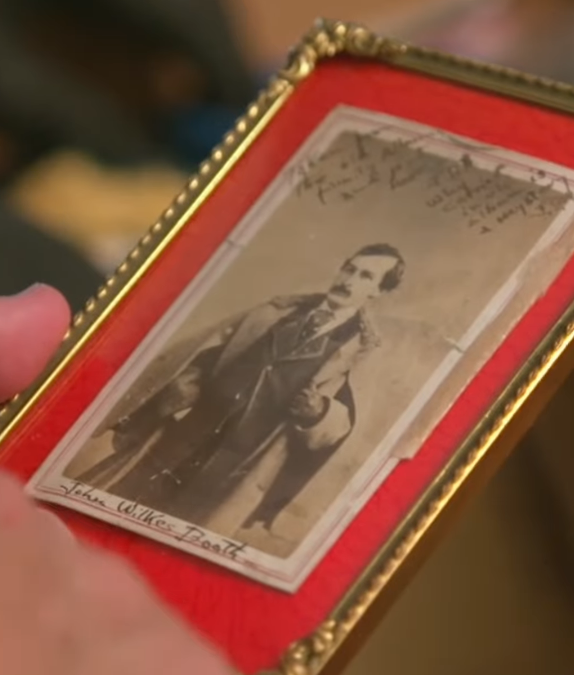
As I had suspected, what the clean-up crew found was a carte-de-visite photograph of John Wilkes Booth. These are not all that rare, as Booth was a famous actor who regularly had his picture taken. While there was a temporary halt on the sale of Booth’s photographs after the assassination, when this order was rescinded, many photographers flooded the market with photos of the assassin. There are many pictures of Booth, and the pose found by the cleaners, where he is wearing his fancy jacket, is one of the most common images of him.

The host of the show was very excited because he said the photo was signed by Booth at the bottom. Now, a genuine signed CDV of John Wilkes Booth would be worth quite a lot of money. An oversized clipped signature of Booth’s sold for over $17,000 a decade ago. Unfortunately for the host, this is clearly not signed by John Wilkes Booth. The writing looks nothing like Booth’s handwriting and is in print, not cursive. This isn’t the first person to confuse a labeled image of John Wilkes Booth with a signed one; they regularly pop up on eBay and other places. There is also some random text written on the top of the card, but again, not in Booth’s hand. This writing actually detracts from the value of the otherwise average Booth CDV. On eBay, you could maybe get $100 for it.

I found the rest of the episode online and got to the point where the host was revealing to the homeowner how much money they made selling the things they found in the house. The host documented the other things they had sold from the home, including misprinted stamps, a Mustang, and a coin collection. He then stated to the homeowner:

“The item that really put us over the hump was a signed John Wilkes Booth card. We sent it to auction and they estimated that it’ll be worth $10,000.”

He then stated that with the cash sale of the other items and the auction estimation, they made $28,000 from the items in the house. The cleaning cost was $10,000, leaving $18,000 profit. This was then split between the homeowner and the cleaning crew, 60-40. The host handed over a stack of cash to the homeowner, saying it was her $10,800 share. She was, of course, ecstatic to not only have her house cleaned out but to have made $10k in the process.

But did she?

Well, let’s look and see how much that “signed” John Wilkes Booth CDV actually brought when it was sold at auction in July of 2024.

It sold for $80. Not $8,000. Not $800. $80. And, actually, that is a pretty fair price for an average Booth CDV with random writing on it. Interestingly, the auction house that sold it did not attempt to portray this as a signed CDV. The description documents that John Wilkes Booth’s name on the bottom is “(not in his hand).” We can also see that the starting price for this CDV was set at $40, hardly an amount you would start at for a priceless relic like a genuine signed Booth item. So, where in the world did the host get the estimation of $10,000?

My guess is that when they shot the end of the episode, the production company had not yet reached out to any auction house. Instead, they just looked at some recent auction prices of genuine Booth signatures and letters and made a guess. If they did reach out to a real auction house, the auctioneers must have given them the $10k valuation sight unseen. I have a hard time believing any legitimate auctioneer would have thought this photograph had a genuine signature. Even a quick Google search would show that the printed name has nothing in common with the assassin’s autograph. You have to wonder how that homeowner felt when the production company eventually informed her that she was getting less than half of what they told her on camera since their $10,000 item only sold for $80.

This Booth CDV makes an appearance in the pilot episode of Filthy Fortunes. When I was trying to find a video of the show online, I came across a few interviews the main host had with media people and YouTubers during the promotional period before the show debuted. In some of those interviews he makes mention of this great John Wilkes Booth find. But his recollections of the actual item are wildly incorrect. The biggest issue is that the host clearly does not know the difference between a picture and a playbill. Here’s an assortment of his comments on the item from different interviews:

“…the most interesting thing we found this season was a John Wilkes Booth playbill, like an actual picture of John Wilkes Booth that he signed like not too long before he shot Lincoln…”

“…it’s a play- it’s a picture, basically like a tintype, so like a Polaroid, of John Wilkes Booth. It’s dated. He signed it. Cause he was an actor at the Ford theater there in D.C. And so we found like a playbill, with John Wilkes Booth’s signature, like three months before he shot Lincoln…”

“…a John Wilkes Booth card…it’s a playbill from the Ford’s theater with a picture signed by John Wilkes Booth and it was like six months before he shot Lincoln…Let me tell you that’s worth some real money…”

“…the coolest thing for me this season was a John Wilkes Booth playbill that was signed by John Wilkes Booth at the Ford theater…When I found the John Wilkes Booth card, I was like ‘I got a guy’ [to sell it to]…”

Perplexingly, in a far more casual and expletive-laden interview the host gave to a Twitch streamer, he recounts how he sold the Booth CDV to a private individual for $40,000. I’m going to embed that video below, but I am warning everyone that there is a lot of cursing throughout (because that’s how you get in cool with the youths, apparently). The video should start right at the beginning of their discussion of the Booth item:

I honestly have no idea what to make of this video and the claim that the host sold the CDV for $40,000. Fraudulent and fake things sell all the time in the auction world to people who don’t know any better. I know of one eBay seller who regularly has CDVs of Booth, the other Lincoln conspirators, and other famous people for sale that are terrible forgeries made by putting a modern printed picture in between two halves of genuine portrait or vignette-style CDVs with the original images removed. I highly doubt the Filthy Fortunes host acted in a malicious way like that. It’s far more likely that he truly thought he had a genuine signed Booth CDV when he found it because he doesn’t have the expertise to know the difference. His confusion over what a playbill looks like demonstrates that this area is not his forte.

In the end, all I can do is point to the auction listing showing that this labeled but not signed John Wilkes Booth image sold for $80. If the host actually sold it for $40,000 to a private individual, then he made the deal of a lifetime off of a real fool who didn’t do any due diligence. But I suspect that all of this story is bluster, intended to make the show seem more exciting by having an item appear far more valuable than it is. To borrow a phrase the youths on Twitch will understand, “it’s cap, fam.” (For my fellow non-Gen Zers, “cap” apparently means “a lie.”)

The lesson here is, as always, don’t believe what you see on “reality TV.”

Thanks, Mom, for giving me something to gripe about on the internet.

Categories: History, News | Tags: , , , | 3 Comments

Become a Patron!

When this blog first started in March of 2012, it was little more than a shelf where I could show off small research oddities and tidbits of information I came across during my own exploration into the subject of Abraham Lincoln’s assassination. I was still very new to the history field and unsure whether this hobby would turn into anything constructive. Since then, the community around this site has grown far beyond what I ever expected. As my followers have grown, I have worked hard to provide new and varied content, all with the aim of educating others about the events surrounding Lincoln’s assassination. I am very proud of what I have accomplished here on LincolnConspirators.com and, particularly, of the growing scholarship behind the posts and videos I have produced.

LincolnConspirators.com is not a commercial entity. I make no money to write or produce content for this site. I do not make any money from advertisements. In fact, I actually pay to keep ads off of this site. This website is a hobby and truly a labor of love for me, but there are real costs associated with owning, maintaining, and producing content for LincolnConspirators. In webhosting fees and research subscriptions alone, I spend $850 a year. This does not include the costs of new (and old) books or research and duplication fees from historic sites and museums. In addition, some of my special projects, especially my recent documentary series about the life of the Lincoln assassination conspirators at Fort Jefferson, have been quite costly to put together.

As many of you know, my background is that of an elementary school teacher. This is why LincolnConspirators.com is, and always will be, an educational resource open to all. Knowledge is power and even our uncomfortable past should be accessible to all. As I told my students when I was teaching, everyone has the capacity to enrich the world around them by sharing their unique knowledge, abilities, and stories with others. Over my career, I taught first, second, and third grades in Illinois and Maryland and worked as a reading interventionist here in Texas. Unfortunately, my teaching career ended when I was fired from the private school I worked at here in Texas because I spoke out against the banning of LGBTQ+ books at our local public library during a library board meeting. Since then, I have become a stay-at-home dad while trying to make some money on the side to help support our family.

To help offset the cost of running this website and to financially support my goal to write a book about the Lincoln assassination, I have launched a Patreon page for LincolnConspirators.com. Patreon is an online system that allows followers to provide financial support for the work being done by their favorite creators. The website operates a bit like TV  infomercials where you pledge to donate a certain amount each month. Patrons choose whatever amount they would like to give, and once a month, Patreon will charge that amount to your credit card and give it to your chosen creator. In essence, Patreon is a subscription service where your chosen monthly payment goes to a specific creator whose work you enjoy.

By becoming a patron of LincolnConspirators.com you will provide financial support for the work that I do. A pledge of any amount would help lift some of the financial burden of creating content for this site and help provide me with some financial breathing room as I actively work on my book. I am not expecting that I will ever be able to break even regarding the costs of my work, but every little bit would make it easier to continue sharing with you all the history that we find fascinating.

“But what’s in it for me?”

The great thing about Patreon is that it is more than just charity. The platform allows creators to provide exclusive, patron-only content for those who make a recurring monthly donation. By becoming a patron, you will receive access to content you won’t find anywhere else. This is a way for creators to thank the people financially supporting them and ensure they receive something in return for their support.

Patreon allows for a tiered system of support. Creators can provide more exclusive content based on how much a patron gives monthly. For my Patreon, I have created three tiers of support at different price points. Note that the tiers are cumulative, meaning that if you give at the highest priced tier, you not only receive its unique benefit, but all the benefits from the tiers below it. Here is a breakdown of the different tiers and the benefits patrons receive in each:


Tier 1: Family Circle

For $3 a month, you are a member of the Family Circle level of support. Patrons in the Family Circle will gain access to a weekly post on Patreon called, The Telegraph Office, in which I curate and share recent news stories relating to the Lincoln assassination from the past week and beyond. You’ll be well-informed of different talks, articles, auction items, and other connections being made out in the world to the death of Lincoln and the hunt for John Wilkes Booth. This post will be different each week as I comb through the news to find interesting stories to share and recount some upcoming anniversaries for the week ahead. For a free dispatch example from The Telegraph Office, click here.

Tier 2: Dress Circle

For $7 a month, you are a member of the Dress Circle level of support. In addition to the weekly offering from Telegraph Office, you will receive access to The Vault, a fortnightly post that highlights an artifact relating to the Lincoln assassination story. Objects in the vault are often more than they appear to be, so learn the history behind some of the hidden objects locked away in museums, private collections, or even those lost to time. Every so often, you will find yourself visiting a different kind of vault altogether, as the curator takes you on a field trip to the grave of a person connected to Lincoln’s death. The Vault is open to all for just the price of admission.

Tier 3: Orchestra Chairs

For a recurring donation of $15+ a month, you are a member of the Orchestra Chair level – the top tier of supporters to LincolnConspirators.com. Not only will you receive weekly dispatches from The Telegraph Office and fortnightly tours of The Vault, but you will also gain exclusive access to monthly videos from me, Dave Taylor, as I discuss my ongoing research for my book and other projects. You will receive exclusive early access to information and new historical discoveries well before anyone else. In addition, you can submit your own questions about the Lincoln assassination, which I will answer as a sort of community Q&A. At this tier of support, you will be an invaluable member of my history team.


Now, some of you longtime followers might be thinking this seems a bit familiar. That is because back in 2018, I started a Patreon when this website was still called BoothieBarn. Shortly after starting that Patreon, I was accepted into a Master’s degree program. The combination of my own classes on top of my job as an elementary school teacher significantly curtailed my ability to provide content to my patrons. I started to feel guilty for accepting donations when I just didn’t have the time to provide much in return. So, after only nine months, I shut that Patreon down.

It is now six years later, and I am in a much better position to provide consistent and valuable content to those who choose to support me financially. In these preliminary stages of my book research and writing, I’ve already come across many interesting side characters and stories I would love to share, especially since I don’t know when (or even if) my book will come to fruition. Having some financial support will help me and my family greatly as I devote so much of my time to a book project with so much uncertainty.

Thank you for considering becoming a patron of LincolnConspirators.com. To learn more, please click the “Become a Patron” button below to be taken to my Patreon page to read my story. There you will find information on how the Patreon system works and how to sign up to become a patron.

Even if you don’t have the means to contribute, I appreciate your continued support of my efforts exploring the history of the Lincoln assassination.

Sincerely,

Dave Taylor

Categories: History, News | Tags: , , , , , | 9 Comments

The Pursuit of John Wilkes Booth Game Review

The Pursuit of John Wilkes Booth is a brand new board game published by the company Blue Panther. In the game, you take on the role of government detectives attempting to track down John Wilkes Booth after the assassination of Abraham Lincoln. The goal of the game is to capture or kill Booth before he escapes out of the country or out west.

I preordered a copy of this game last month and received it earlier this week. Since then, I have played the game four times, three times using the default solo player mode, and once using the two player cooperative mode with my wife, Jen. The game also features a two-player competitive mode, where each player is trying to be the first to find Booth to claim the reward money for themselves, along with a two (or three) player mode where one player can play as Booth, attempting to elude the pursuers.

As a preface for this review, I want to note that while I enjoy board games, I would not consider myself a big board game player. I enjoy the classics like Monopoly and we often play more modern games like Wingspan and Pandemic. However, sometimes I struggle with the complexity of more modern games, especially those with many rules and complicated strategy. From the preorder images showing the two instruction manuals and all the cards and pieces, I knew that The Pursuit of John Wilkes Booth would challenge me in the beginning (and it did). However, I will say that after a couple of hours, even a dummy like me eventually got the play sequence down and had a good time.

The board for this game is actually a canvas-like map showing Washington, D.C. in the center, with different possible escape paths for Booth emanating out. While we know that the real Booth made his escape south in the direction of Richmond, that is one of six different routes Booth can take in this game. In addition to the main six escape paths, there are many connecting trails in gray that he can use to jump from one escape route to another. Booth’s movements in each game are dictated by the drawing of random trail direction cards, which means that no two games will be the same.

A single turn in this game consists of three phases. During the first phase, a random trail card is placed face down demonstrating Booth’s escape progress. If the player does not find and capture/kill Booth before the ninth trail card is placed (or tenth if you are playing easy mode or a two player game), then Booth escapes and the game is lost. The goal is to determine Booth’s path and catch up to him before it is too late.

In order to flip over each of Booth’s trail cards to determine his direction of travel, the player needs to complete tasks in Washington, D.C. and its surroundings during each phase. These replicate the investigation that occurred in the aftermath of Lincoln’s death. As one successfully completes “Leads” in different areas of the city, you acquire clue chips. Once you get enough clue chips, you are able to flip over one of Booth’s trail cards and start the chase. The player essentially controls a group of detectives, policemen, and cavalry, who help to fulfill leads, to earn clues, in order to determine Booth’s path and chase after him.

While Booth only advances one trail card during the first phase of a turn, he does not sit by helplessly during the other two phases in a turn. During phases two and three, Booth acquires cards of his own. These consist of “Search,” “Raid,” and “Play Now” cards which give Booth advantages when the player finally catches up with him. In this way, the player might determine exactly where Booth is on the board and catch up to him, but Booth’s deck may give him advantages that make your search for him fail, requiring you to try again during the next phase.

Not to be outdone, the player also has access to their own deck of helpful cards. During any phase, a player may choose to draw two cards from the “Stanton” deck rather than moving their pieces or investigating a lead. Stanton cards usually give advantages to the player like bringing in more detectives or allowing them to draw extra clue chips. A Stanton card can also be sacrificed to remove a card from Booth’s deck, helping to even out the odds when the final confrontation comes.

When you are able to track Booth and move a detective piece to his location, you have to successfully complete a two-stage process to win. While you know what city or zone Booth is in, you have to search and find him there first. The more detectives, cavalry, and police you have on site, the greater your search ability becomes. Certain detectives and Stanton cards can also help. It’s a battle between the player and Booth with his acquired deck to see who ends up with the most points. If Booth bests you, you fail to find him that phase and may even lose a detective in the process. If you are able to locate him, then the final stage begins: a raid on Booth. Once again, it’s a battle of points as Booth uses his own acquired weapons or accomplices in an attempt to fend off the attack by your detectives, cavalry, and police. If you lose the raid, prepare for casualties on your side. If you manage to overpower him, however, Booth is captured or killed and the player wins the game.

As stated before, unless you are already a gamer, there is a pretty large learning curve for The Pursuit of John Wilkes Booth. While I have played four games so far, I wouldn’t really count my first play through as a real game. I was constantly referring to the rulebook, and even after I finished (I lost) I realized that there were several mechanics I had completely forgotten about which would have made the game easier. I actually wrote a few reminders for myself on a notecard of important things you might forget about or miss. This made my subsequent games much easier.

For my second game, I played the two-player cooperative mode with Jen. The co-op mode plays pretty much the same as the solo mode. Armed with experience from my first slow run through and my little notecard, we were very successful. We managed to track Booth to Philadelphia and succeeded in our search to find him. However, when we conducted our raid on his position, our numbers weren’t high enough for an outright win. Instead, we ended up killing his accomplice George Atzerodt, and Booth escaped. Luckily, during the next turn, we caught up to him again, and since he had used all of his deck cards attempting to thwart us during the previous turn, we easily found and overpowered him resulting in his capture and imprisonment.

Our The Pursuit of John Wilkes Booth game board at the end of a successful two-player cooperative game. The Booth meeple token is shown in the Old Capitol Prison with David Herold and Lewis Powell.

My two subsequent solo games today both resulted in failures. In one, Booth escaped up to Canada with George Atzerodt after I failed to successfully search for him south of Detroit. In the second game, I managed to catch up to him on the very last phase before I would lose the game by placing the ninth trail card. He was in New York and I felt good because I was there with two detectives and three cavalry. Unfortunately, it had taken me so long to find him that Booth had acquired a sizable deck of cards and two accomplices (George and David Herold). In the end, his search points outnumbered my own and he escaped.
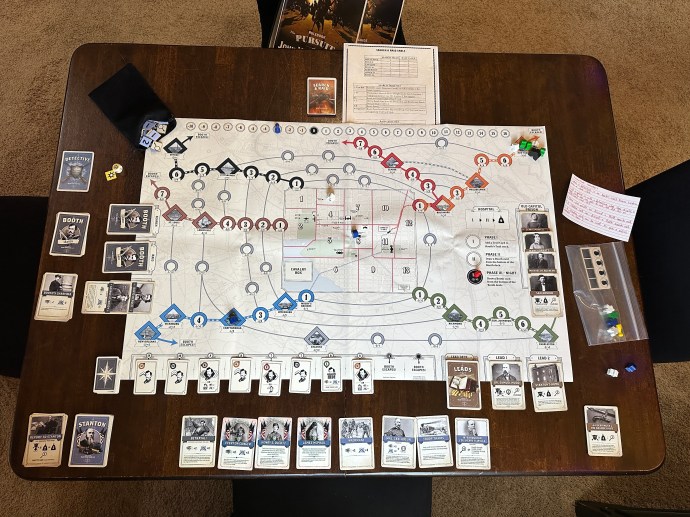
The end of a solo player game in which John Wilkes Booth escaped via New York.

In this particular game, I was thwarted by less than helpful Lead cards, which limited my ability to acquire clue chips to flip over Booth’s trail. For a long time, I had Samuel Arnold as a lead card. However, in order to resolve him you first have to complete either the National Hotel or Michael O’Laughlen card. You are only given two lead cards at a time and they have to be fulfilled before a new one can take its place. It took most of the game to finally get the Michael O’Laughlen card so I could then revolve the Arnold card. Since this meant I couldn’t acquire as many clue chips, it took me too long to locate Booth’s path and catch up to him to beat the game before it ended. Though I did have a nail-biting finish there.

As I hope you can tell, I enjoy this game very much. It was definitely intimidating to learn and I wish some parts of the rulebook and player’s guide were a bit clearer, but with persistence it is possible for even a gaming newbie to learn how to play. I found it very helpful to watch this video of one of the game’s designers doing a playtest of the game during the prototype stage a year ago. It really helped me to see the game being played rather than just trying to understand it by reading the rulebook.

I was also very impressed by the historical flavor given on the cards and in the manuals for this game. It is clear that the game designers, Wes Crawford and Ryan Heilman, did their research on the Lincoln assassination story. The graphics look good, and each card has small text in italics that gives the historical background of the card. For example, here is the Leads card for Dr. Samuel Mudd:

I appreciate not only the historical text at the bottom of the card, but the thought process that went into how to resolve this lead card. While most leads are found within different sections of Washington, D.C., and are resolved just with a detective, this card requires both a detective and a cavalry to be present at Green 2 in order to acquire the two clue chips and place Dr. Mudd in prison. On the overall map, the green escape path replicates the actual path Booth took and the section circle could represent Southern Maryland. So the designers have accurately placed Dr. Mudd where he would be on this map and how it took both detectives and cavalry to find and arrest the doctor. There are other impressive details like this in the game. The John Surratt lead card, for example, requires you to be in Elmira, NY, and for it to be within the first four turns of the game. If you pull that card after the fourth turn, Surratt has already made his way to Canada, so you can’t capture him anymore. Similarly, you can’t acquire the Lewis Powell card if you have already arrested Mary Surratt, since he was arrested at Mary Surratt’s boardinghouse and you already have her locked up. These details aren’t stated in the game, but if you know the story of Lincoln’s assassination they make sense, and I love that the designers included them.

When I first got a Google Alert that mentioned this game, I had high hopes but tried to keep my expectations in check. A few years ago, I was involved with a different company that attempted to bring a Lincoln assassination-based board game to market. I acted as a historical consultant for them before it became clear that they weren’t actually interested in the history and merely wanted to skin their already completed game in Lincoln assassination figures, even though it didn’t really work. That’s when I bowed out. So having been burned once regarding a Lincoln assassination based game, I wasn’t sure how this would turn out.

This is why I am so pleased with The Pursuit of John Wilkes Booth. It’s a compelling, history-driven game that is also a lot of fun to play. The solo mode is very engaging and Jen and I both enjoyed the two-player cooperative mode. I think we’ll play cooperatively a bit more before trying to compete against each other or try our hand at being Booth, but I love that those modes are also available. Since Booth’s escape route is different and random each time, there is so much replay value. It’s a challenging game and you will definitely lose more than you will win, but that makes the times you successfully capture Booth even more rewarding.

I’ll catch you next time, Mr. Booth.

If you enjoy history and board games, I highly recommend you pick up The Pursuit of John Wilkes Booth. At $70 plus shipping the game is a bit on the expensive side, but I feel that it is worth it, especially since Blue Panther prints and manufactures their games right here in America. Here’s a link if you want to purchase your own copy of The Pursuit of John Wilkes Booth. I’m really enjoying this game, and I think you will, too.

Categories: History, News | Tags: , , , | 6 Comments

Blog at WordPress.com.