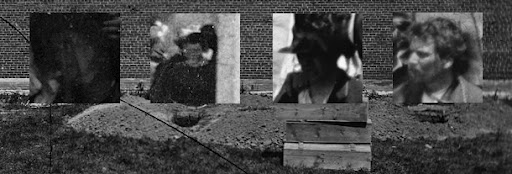
Posts Tagged With: Surratt

“Thus perished four…”

The day after the four conspirators were hanged, one soldier penned the following letter to his family back home in New York:

“Camp Stoneman  D.C.

July 8th 1865

Darlings at home

Before you receive this you will probably have read all about the execution of the conspirator’s at the Washington Penitentiary yesterday.  My regiment was on duty immediately in the yard and around the gallows.  Consequently I had a fine view of the preparation and the final execution of the criminals.  The yard was an enclosure by high brick walls and buildings of probably a half acre of ground.  The gallows was erected at one corner about 30 feet from a door which lead into it from the prison.  The platform was about ten feet high and the beam from which the ropes was suspended was about 10 feet above the platform.  That portion of the platform for 4 feet which was a sort of trap door hung upon hinges and supported by a single prop which was to be knocked out from under them by a sort of battering ram.  The prisoners were accompanied to the gallows by the officers in charge of the execution and their spiritual advisers.  Who in behalf of each thanked the officers and soldiers who had charge of them for this uniform kindness to them.  And after praying with them (and I never heard more eloquent and stirring appeals made to a throne of diving grace) they were caused to stand up on the fatal trap, where their arms were tightly tied behind them and their legs tied at the ankle and knees – the cap drawn over their face the rope adjusted and drawn tight around the neck the signal given and four unhappy victims were suspended in the air by the neck.  I stood very near on horse-back where I had a good opportunity to see every motion.  I did not discover the least motion of a single muscle on Mrs. Surratt – and but very slight on Atzerodt.  Payne and Harrold did not pass off so quickly.  Harrold showing signs of life for nearly five minutes and Payne for full seven minutes.  After hanging for the space of 20 or 30 minutes they were taken down, laid in rough boxes, and buried near the foot of the gallows.  Thus perished four of the greatest criminals our land has ever produced.  And my only regret is that the balance of the band had not shared the same fate.  It seemed hard indeed to see a person bearing the almost divine shape of woman lead out by men alone executed and laid away with none but the hands of rough soldiers to care for her.  I never before saw such picture of absolute despair and fear upon the face of a human being.  Mrs. Surratt was nearly unable to stand.  In fact Payne was the only one of the party that showed any signs of courage or manliness.  I see by the papers today that the clergymen who attended them express much hope that they passed from this to a better world.  If so, how much better than they to their intended victims whom they endeavored to send into the presence of their God with one moment’s preparation.  I hope it will be my fortune to witness the execution of Jeff. Davis, & then shall I, indeed, feel that the rebellion is crushed.  And when you hear any one say that Jeff. will never be hung, “that Andrew Johnson is President and that he is supported by officers who are good and true,” in such hands we are safe.  The day has come when we have in authority those who care more for their country than they do for themselves or party.  And I trust that it may be long before any others shall obtain the reins of Government and seek again to draw us down to ruin.

Then I have written you a good long letter, at least, a long one.  And shall have but very little room for anything else – though as tomorrow is Sunday I presume I shall write again.  I wrote you a good long love letter but a day or two ago, as I shall not mail this till evening perhaps I will write a little more before I send it.

Give my love to all the friends.  Kiss the dear children for me.  Good day to you and God bless you all.

Most affectionately,

S.D. Stiles”

The author of this account is Sampson D. Stiles who was a member of the New York Cavalry.  The photographic record does not show any soldiers on horseback as Stiles states he was, but it is know that General Hartranft requested cavalry members to report to him:

“Mil. Prison Wash. Arsenal

July 6th, 1865

Colonel-

I will require a Company of Cavalry in addition to the twenty sent me today.  Will you be kind enough to order them to report to me at 8 o’clock tomorrow morning.  I will need them only during the day.

Very Respectfully – Your Obt. Servt. –

Bvt. Maj. Genl. Gov. Com’dr. M.P.

Colonel Taylor

A.A.G. –Dept.Wash.-”

So while we see no mounted soldiers in the execution photos, the request for Cavalry soldiers and the details in Stiles’ letter home gives the strong impression that he was there.
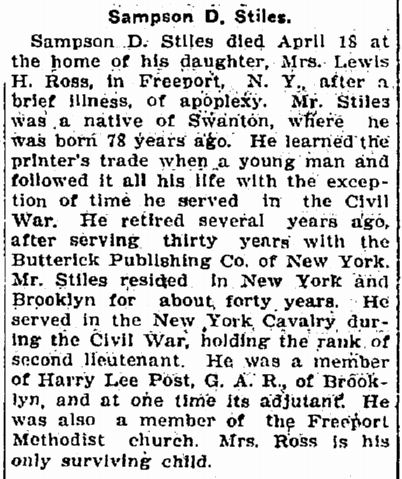
Sampson Stiles’ 1905 obituary in a Vermont paper

References:
Stiles’ account comes from the James O. Hall research papers
The Lincoln Assassination Conspirators – Their Confinement and Execution, as Recorded in the Letterbook of John Frederick Hartranft edited by Edward Steers and Harold Holzer
Categories: Uncategorized | Tags: , , , , | 7 Comments

Visit the Surratt Tavern in…Chicago, IL?

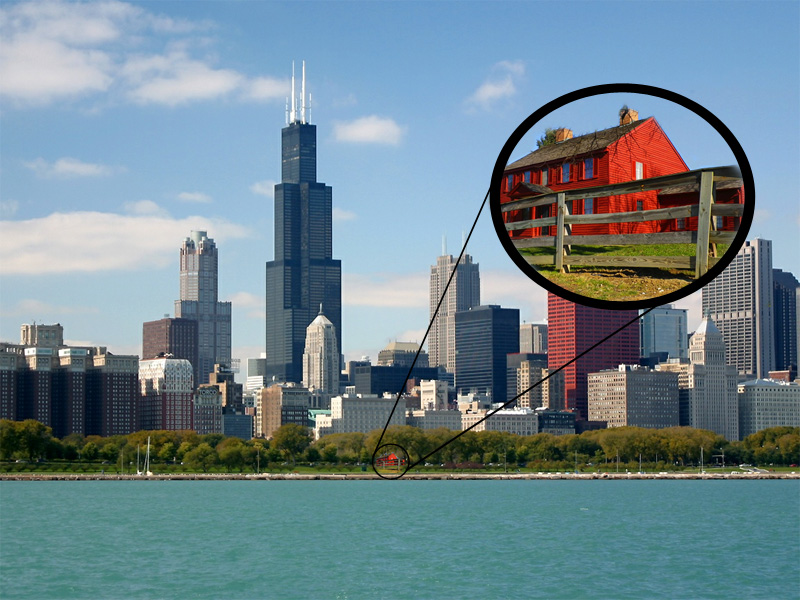
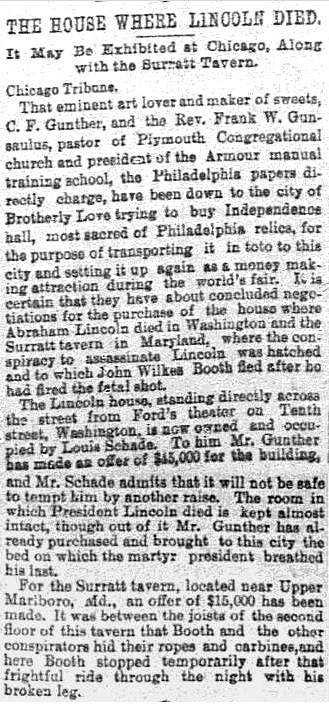
If wealthy candy confectioner and noted collector Charles Gunther had gotten his way, Chicago would have become the home of many transplanted historical sites:

If relocating entire buildings like this sounds like an impossible feat, know that Charles Gunther had already done it once.  In the late 1880’s he purchased the Libby Prison from Richmond, Virginia.  He dismantled the prison, transported it to his hometown of Chicago, and rebuilt it there.  The Libby Prison Museum operated from 1889 to 1895 before decreasing visitors forced Gunther to dismantle it.  When this article was written in 1893 it is likely Gunther was hoping to reinvigorate his museum by creating an entire campus of historic sites.

As we know, Gunther never managed to purchase Independence Hall, the Petersen House, or the Surratt Tavern.  Despite his generous offer to Louis Schade, the Petersen house was eventually sold to the federal government instead.  Had the Petersen House been sold to Gunther, he could have reunited the building with some of the items that were there when Lincoln died.  The bed upon which Lincoln died and many other articles from the Petersen house were acquired by Gunther in 1889.  When Gunther died, the Chicago Historical Society purchased most of his extensive collection.  This is the reason why Lincoln’s true deathbed is in the Chicago History Museum and not in Washington, D.C.

I believe Charles Gunther’s proposed acquisition of these historic sites allows for a very entertaining “what if”.  Imagine what it would be like to look out a window of the Surratt Tavern and see the house where Lincoln died.  Imagine the historical DisneyWorld that could have existed in Chicago.  Instead of Mickey Mouse ears, visitor would purchase powdered wigs at the “Ye Olde Independence Hall Gift Shop” before taking the monorail to the “Lincoln Assassination Pavilion”.  Had this eccentric collector been able to build his dream, how differently our nation’s history would be interpreted today.

References:
The Chicago Historical Society has a nice website recounting Charles Gunther’s collection and Libby Prison Museum.

Categories: Uncategorized | Tags: , , , | 10 Comments

Surratt’s Wanted Photo

A few days ago Roger Norton left the following comment on this blog:

“Dave, please excuse going off topic.  But I am looking for a younger pair of eyes on this one.  On my Mary Surratt page at http://rogerjnorton.com/Lincoln26.html I have a photo identified as Isaac Surratt.  Basically it’s Laurie, Joan Chaconas, and I against the world on this one – do you think that is Isaac or is it really just another photo of John?  What do younger eyes see?  The one author I can find that agrees with Laurie, Joan, and me is Roy Chamlee.”

The picture Mr. Norton is referencing is John Surratt’s wanted poster photo:

The picture used in the wanted poster came from the Surratt boardinghouse after it was searched.

It has been proposed, as Roger states, that the picture is not of John but rather of his brother Isaac.  It’s a hard point to prove because while there are a few photos of John in his younger years to compare it to, there is only one known photograph of Isaac Surrat known to exist.  Still, it’s an interesting possibility and one worthy of dicussion.

So, what do you think? Does this wanted poster photo look more like John or Isaac? Post your views in the comment section below.  I’ll wait a while and then chime in with my opinion.

Categories: Uncategorized | Tags: | 20 Comments

7/7/1865

I watched them lead him out the door,
As he exited his cell.
I followed them, as he had asked,
To give his last farewell.

“A boy” I thought of him at first,
When I was called to pray,
But with death’s knocking out in the yard,
I saw a man today.

While saddened by his coming death,
He confessed to me his crime:
“I helped a man who killed a man.
Where will I spend all time?”

I said I could not answer him,
To God he must appeal.
We sat there in redemptive prayer,
And begged his soul to heal.

So while his frame may falter,
During these, his last grains of life,
On the gallows he’ll stand, with his clenched hands,
A man, adverse to strife.

Fictional poem from the perspective of Rev. Dr. Mark Olds, David Herold’s spiritual advisor on the scaffold.

Justified or not, four individuals paid the ultimate price for their involvement with John Wilkes Booth.  Those saved from execution faced their own mortality when they heard the drops fall and would carry the stigma of their association for the rest of their lives.  Lincoln’s assassination killed not only the President and the innocence of our nation, but also the lives of the misguided supporters who knew not what they were doing.

Categories: Uncategorized | Tags: , , , , | 16 Comments

On this date: May 1st, 1976

The Surratt House Museum in Clinton, Maryland opened for public tours.

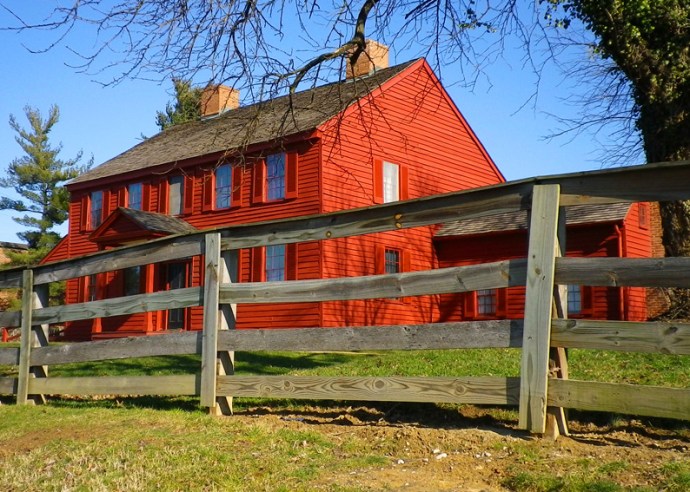
The house and tavern, formerly the property of Mary Surratt and a stopping point for John Wilkes Booth on his escape south, was donated by its owner to the Maryland National Capital Park and Planning Commission in 1964.  The work on restoring the house led to the founding of the Surratt Society, an organization devoted to furthering the study of the Lincoln assassination through trained guides for the museum, a monthly newsletter (the Surratt Courier), a yearly conference on the assassination, and the coveted John Wilkes Booth Escape Route Tours in the spring and fall.  The campus also houses the James O. Hall Research Center, the first (and often best) stop for research about the Lincoln assassination.  Visit Surratt.org to view their many wonderful events for the year.

References:
Surratt House Museum: A Page in American History by Laurie Verge and Joan Chaconas

Categories: Uncategorized | Tags: , | Leave a comment

Resurrecting Gravestones

April 14th is the 147th anniversary of Lincoln’s assassination.  Several generations have passed in that time.  Most recently, we mourned the passing of the last of Dr. Mudd’s grandchildren, succinctly showing the time that has elapsed since the great crime.  As has been done for ages, we mark our lost generations with gravestones.  They are a reminder of their time on earth and their influence on others.  Unfortunately the stones on which names are placed are not impervious to time’s unceasing march.  Water, wind, heat and cold, erase names and dates.  Markers stand as unreadable, phantom reminders of people and lives unknown.  Along with the elements, humans, both directly and inadvertently damage stones.  Markers are chipped, broken or fallen by human hands.  For many of these stones, this is the end.  Without families aware of their destruction, they remain broken, fallen, and forgotten.

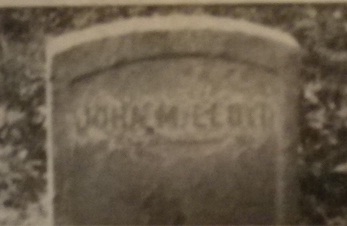
For some related to the Lincoln assassination this is the case.  John M. Lloyd is one example.  Lloyd was Mrs. Surratt’s tenant occupying her Tavern in Surrattsville (then Robeysville), MD.  One the day of the assassination, Lloyd testified that Mary told him, “I want you to have those shooting irons ready: there will be parties here to-night who will call for them.”  The shooting irons referred to were Spencer Carbines that were hidden at the Surratt Tavern during the proposed kidnapping plot.  In addition Mary gave Lloyd a package wrapped in paper later found to be field glasses.  Later that night, Booth and Herold stopped by the Tavern, took one of the carbines and the field glasses.  Lloyd was a key witness against Mary Surratt at the Conspiracy trial.  Lloyd would later die an accidental death in 1892:

“He was in the construction business and died of an accident that occurred on one of his building projects. He wasn’t satisfied with some work that had been done and went up on a scaffold to inspect it. Near the other end of the scaffold flooring a load of bricks had just been deposited. As he reached the scaffold and stood on it, the boards gave way, and he fell to the ground. The bricks tumbling down upon him crushed his head, kidneys, and other parts of his body.”

John M. Lloyd's gravestone circa January 1969. Courtesy of the Surratt House Museum

Lloyd was laid to rest in Mount Olivet Cemetery in D.C.  This is same cemetery in which Mary Surratt is buried.  He was buried in December of 1892 and his marker was standing until it fell some time in 1969.  Today, his plot is unmarked – a shining example of the many who have fallen and have been forgotten. Correction: I have been informed by gravestone expert Richard Smyth that, as of 2008, Lloyd’s marker was still on his grave.  When Rich visited Mount Olivet, he had to dig the stone out and remove the dirt and grass that had grown over it.  The current condition of the stone is unknown.

There are also those to whom, markers were never created.  In these instances we are sometimes fortunate to have cemetery records to tell us who has been placed where.  This is the case of the Surratt Society’s current drive to place a marker on the grave of Frederick Aiken.  Aiken was one of the lawyers who defended Mary Surratt at the Conspiracy trial.  A tremendous amount of research into Mr. Aiken’s life was done by researcher Christine Christensen.  Her 28 page biography about this man’s extraordinary life is available through the Surratt House Museum and has been the catalyst for soliciting donations to mark his grave.  He is currently unmarked in Georgetown’s Oak Hill Cemetery:

A stone bearing his name, dates and a quote given by him at the trial will be put up once enough donations are received.

Finally, there are grave stones that have been resurrected so to speak.  These are stones that have been broken or worn, but have been fortunate enough to have been replaced.  Mary Surratt and Dr. Mudd are two examples of resurrected gravestones.

May Surratt was originally buried next to the gallows on which she died, in the yard of the Old Arsenal prison.  Eventually, her body was released to her family and she was interred at Mount Olivet.  For almost 100 years she was marked by this stone:

Then, around the 1970’s, this headstone was broken.  The original headstone is currently in pieces in storage at the Surratt House Museum.  They received the remnants from Boothie researcher John Brennan who asked and was permitted to have the broken gravestone.  Mary’s stone was replaced and this is the one that stands there today:

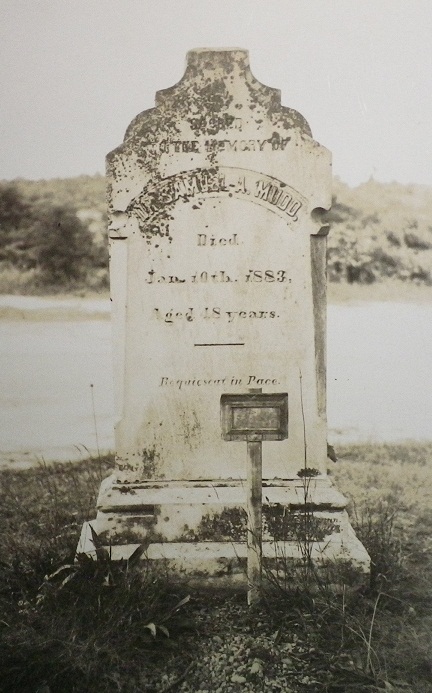
Dr. Mudd’s grave has a similar story.  Dr. Mudd died in 1883 at the age of 49.  He was buried at St. Mary’s Catholic Church in Bryantown, MD.  From this point until 1940, Dr. Mudd had this gravestone:

As you can see, over time, part of the stone became moss covered.  In addition, this stone mistakenly puts the doctor’s age as 48 when he was truly 49.  Lastly, this stone originally had a cross at the top that was broken off.  In 1940, Mudd descendants placed a new gravestone on Dr. Mudd’s:

Dr. Mudd’s old stone is currently on display behind the Dr. Samuel Mudd House in one of the stables:

There are many individuals related to the Lincoln assassination who are without markers.  For the key conspirators, this was done to avoid either vandalism against them or reverence for them.  It was smart then, as retribution against their final resting place was a true worry.  But 147 years have passed since their actions.  The trot of time allows us to see them as people, and all people deserve to be recognized for their time on Earth.  Hopefully, with the help of organizations like the Surratt Society and private history-minded individuals, more Lincoln assassination figures will have their final resting places marked or resurrected.

References:
“That Man Lloyd” by Laurie Verge, April 1988, Surratt Courier
Finding Frederick by Christine R. Christensen

Categories: Uncategorized | Tags: , , , , | 5 Comments

Blog at WordPress.com.