Posts Tagged With: Petersen House

Osborn Oldroyd and his Lincoln Museums

The Abraham Lincoln Home in Springfield, IL and the Petersen House in Washington, D.C. have shared similar histories.

Lincoln Petersen Home

  • Both homes witnessed the death of a Lincoln:

On February 1st, 1850, Eddie Lincoln, the second son of Abraham and Mary Todd, died at the age of 3 at the Lincoln Home in Springfield.

On April 15th, 1865 at 7:22 am, President Abraham Lincoln died at the age of 56 at the Petersen House in Washington, D.C.

  • Both homes had few owners:

The Lincoln Home was built in 1839 for the Reverend Charles Dresser.  The Lincolns bought it from him in 1844.  Robert Todd Lincoln inherited the property from his parents and he subsequently gave it to the government in 1887.  This gives the Lincoln home two owners, Rev. Dresser and the Lincoln family, before it was purchased by the government.

The Petersen House was commissioned by William and Anna Petersen in 1849 and built that same year.  When they died in 1871, the house was inherited by their children.  They sold the house to Louis Schade in 1878.  By 1896, Louis Schade sold the house to the government for $30,000.  This gives the Petersen House two owners, the Petersens and Louis Schade, before it was purchased by the government.

  • Both homes had considerable remodeling done when their namesakes lived there:

The Lincoln Home had about 5 renovations while the Lincolns lived there.  Most drastically was the alteration of the home from a 1 ½ story structure to a full 2 story home, as it still is today.

The room that would later be known as the room where Lincoln died, was not even part of the Petersen House when it was originally built.  That addition was put on in 1858.  Fire gutted it in 1863 and William Petersen rebuilt it that same year.

  • Both homes had renters:

When Abraham Lincoln was elected President and moved into the White House, he rented out his Springfield home.  When Robert Todd gained ownership of the place, he continued the practice of renting the house out until he gave it to the government.

The Petersens ran their home as a boarding house for many years.  From Congressmen to soldiers, to actors, they rented out rooms to  many needy Washingtonians.

  • Lastly, both homes shared a long-term occupant, Osborn Hamilton Ingham Oldroyd:
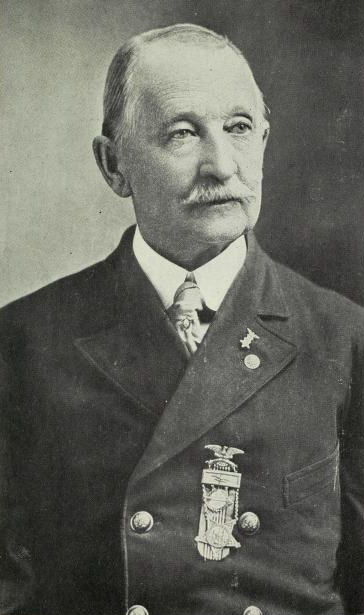
Osborn Oldroyd

Osborn Oldroyd was a Civil War veteran and a devoted collector of Lincoln memorabilia.  In 1883, 41 year-old Oldroyd succeeded in fulfilling the dream of any man who idols another.  Robert Todd Lincoln made Oldroyd the fifth renter of the Lincoln Home in Springfield since his father left the city to claim the Presidency.  Into this historic house, Oldroyd brought his vast collection of nearly 2,000 Lincoln items.  As had been commonplace since the death of Lincoln, many visitors came to call on the Lincoln Home, seeking to visit the home of the great martyr.  Oldroyd let them in like all of his predecessors had, but was the first to charge them admission.  He turned his collection and rented space in a Lincoln Museum.  Robert Todd accepted this exploitation as long as Oldroyd paid his rent, however, by 1885, Oldroyd was starting to fall behind his payments.  Despite not paying him, Robert Todd did not want to bring a lawsuit against Oldroyd as he feared it, “may easily cause me more personal annoyance than the loss of ten times the money.”  Rumors spread that Oldroyd was also cutting off parts of the curtains, wallpaper, and flooring, selling them as souvenirs.  Robert Todd was getting angry with his tenant whom he referred to as a “dead beat” and “rascal”, when an Illinois legislative committee approached him in 1887 to purchase the Lincoln Home.  A similar offer had been given to him in 1883, but at that time he had declined.  Even though, Robert Todd was fairly certain Oldroyd had been the catalyst for this offer, he decided to donate the property to the state of Illinois.  His donation contained two caveats, however.  “…Said homestead shall be, forever, kept in good repair and free of access to the public.”  This latter requirement was probably meant as a final jab towards his “rascal” of a tenant and his entrepreneurial exploits.  Regardless, Osborn Oldroyd was hired by the state of Illinois to be the first custodian of the house and gave him a salary of $1,000 per year.  Oldroyd undoubtedly used this salary to increase his collection at every turn.

Oldroyd’s tenure at the Lincoln Home came to an end in 1893 when he was fired by recently elected Gov. John Peter Altgeld.  Altgeld replaced him with a political friend named Herman Hofferkamp.  Out of a cushy job and a free place to live, Oldroyd was in trouble.  Meanwhile, in Washington, D.C., the Schade family had moved out of the Petersen House apparently fed up with the number of visitors constantly asking to see the death room of the President.  They leased the building to the Memorial Association of the District of Columbia, a group formed by Congress the year before.   When and how Oldroyd managed to convinced this group to make him custodian of the Petersen House is unknown.  According to a biography about Oldroyd written when he was alive, in 1893 Oldroyd moved his collection to the Petersen House, “at the request” of the association.  The earliest account the NPS has managed to find of Oldroyd residing at the Petersen House is June of 1898.  This was after the government purchased the house outright from the Schades in 1896.  So, whether Oldroyd went straight from the Lincoln Home to the Petersen House, or whether he had five years in between, he ultimately found a new location to show off his collection.

While he lived rent free at the Petersen House, Oldroyd did not receive a salary there.  Instead, he got back to his roots and was allowed to charge admission to his museum.  He made the whole first floor of the house his exhibit floor and he and his family lived upstairs.  The first floor of the Petersen House contained considerably less real estate than what he had previously used to showcase his collection at the Lincoln Home.  He covered practically every surface of the Peterson House with material to make up for it.  Oldroyd also had a lot of changes made to the building while he lived there.  Most noticeably, he had the back wall of the room where Lincoln died, removed.

The following are some pictures of the interior of the Petersen House when it housed Osborn Oldroyd’s Lincoln Museum:

Petersen Museum 1922

This picture was taken from within the front parlor of the Petersen House facing towards the rear parlor.  The door to the right leads into the hallway with the room where Lincoln died at one end and the entrance to the Petersen House at the other.

Oldroyd Museum 1

This photo was taken from within the rear parlor of the Petersen House in the direction of the front parlor.  This photo shows only the front parlor.

Oldroyd Museum 2

This photo was taken from the entrance of the room where Lincoln died. The bed Lincoln died in would have been located in the bottom right hand corner of this photo.
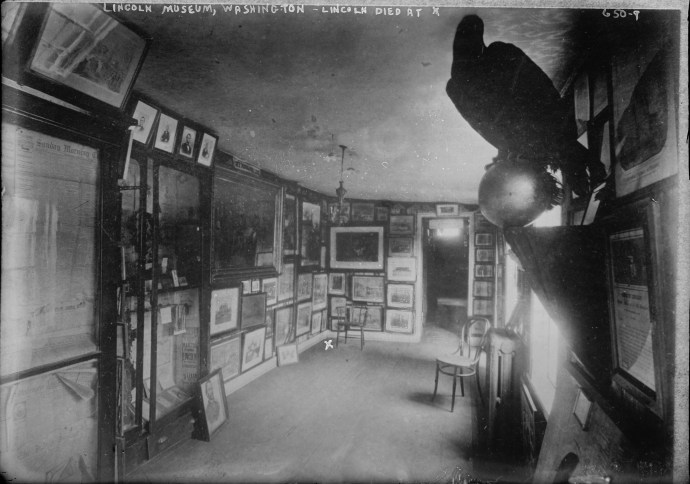
The white X marks the spot where the bed Lincoln died in was.

This photo was taken from the rear of the room where Lincoln died in the direction of hallway and Petersen House entrance. The X marks the location of Lincoln’s deathbed.
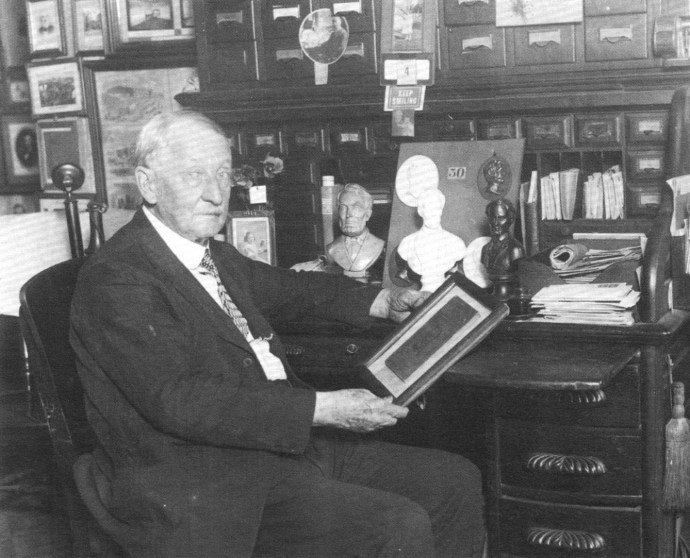
Oldroyd in his museum

During his tenure at the Petersen House, Oldroyd continued to collect and correspond with many individuals associated with Lincoln’s life and death.  In 1901, after walking the escape route of Lincoln’s assassin on foot with a camera, he published his book, “The Assassination of Abraham Lincoln”.  This volume contains many of the earliest photographs we have of different parts of the escape route.

Oldroyd walking the route

By 1926, after about 30 years curating his collection at Petersen House, Oldroyd sought the help of Congressman Henry Rathbone of Illinois, to insure its preservation.  The son of Henry Rathbone and Clara Harris, the ill fated pair who joined Mr. and Mrs. Lincoln at Ford’s Theatre that night, managed to pass a bill in Congress authorizing the purchasing of Oldroyd’s collection.  Experts at the Smithsonian noted that the collection “was of little practical value”.  Despite this, Oldroyd was paid $50,000.  Oldroyd later stated that he had been offered far greater amounts for the collection by private individuals but that he wanted the collection to be in the hands of the government so that it would be preserved and enjoyed by the public for years to come.  When offered continued curatorship over the collection Oldroyd replied, “the responsibility would be too much for me to assume at my age of eighty-four years.”  Oldroyd was then given the key to the Petersen House and told that he was free to come and go as he pleased and that his accustom chair would always be there for him.

Osborn Hamilton Ingham Oldroyd died four years later in 1930.  He  is buried next to his wife of over 54 years, Lida, at Rock Creek Cemetery in Washington, D.C.
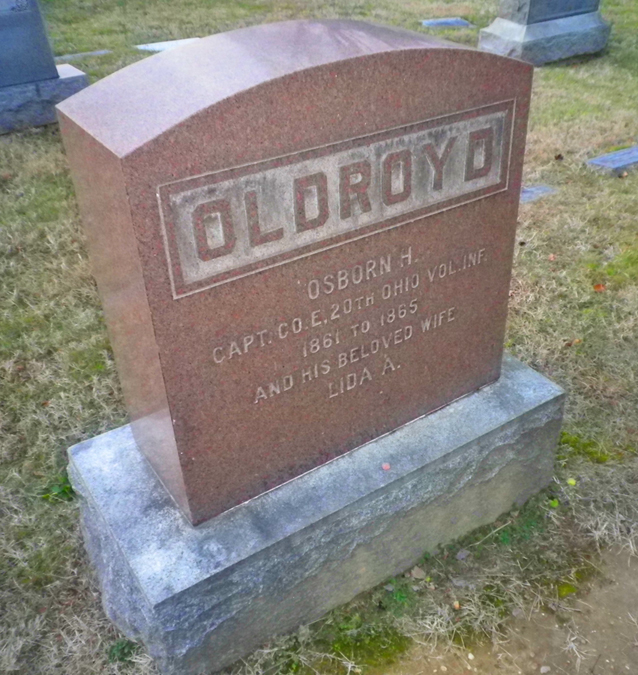
Oldroyd's grave

He may have been a “rascal” as Robert Todd Lincoln called him, but Osborn Oldroyd was also the epitome of a collector.  He devoted his whole life to acquiring everything relating to Abraham Lincoln.  For nearly half of his life, Osborn Oldroyd made his home in houses relating to the 16th President.  To the collection and study of Lincoln, Osborn Oldroyd’s name is unavoidable, particularly in the study of his assassination.  I find it entirely appropriate then, that in this picture of Rep. Henry Rathbone in front of the Petersen House Lincoln Museum, the presence of Osborn Oldroyd in his favored setting is enshrined forever:

Rathbone in front of Oldroyd's Petersen

Oldroyd in the window

References:
House Where Lincoln Died Historic Structures Report by the National Parks Service
Life of Osborn H. Oldroyd by William Burton Benham
Giant in the Shadows: The Life of Robert Todd Lincoln by Jason Emerson
Lincoln Home National Historic Site
The Lincoln Assassination: Where Are They Now? by Jim Garrett and Rich Smyth

Categories: Uncategorized | Tags: , , , | 14 Comments

Petersen House Damages

Aftermath Petersen House

There are several blood relics associated with Abraham Lincoln’s assassination: swatches of Laura Keene’s bloodied dress, playbills and misc papers dipped in Lincoln’s blood as he was carried from Ford’s, and the remnants of the physicians’ cuffs and clothing at Lincoln’s death-bed.  The most intact blood relics, however, come from the Petersen House itself.  From pillows, to sheets, to towels, the Petersens sacrificed a great deal of their household furnishings for the dying President.  In the aftermath, they experienced more loss as relic hunters seized upon their boarding house.  As William Clark, the man who was renting the room in which Lincoln died but was absent the nightof the 14th, wrote to his sister on April 19, 1865:

“Everybody has a great desire to obtain some momento from my room so that whoever comes in has to be closely watched for fear they will steal something.”

The number of items we have today regarding Lincoln’s last moments demonstrates that there was considerable loss on the part of the Petersens. After a few months had passed for national grieving, the Petersens appealed to the government:
Petersen's claim Pacific Commerical Advertiser 9-16-1865
Adjusted for inflation, $550 in 1865 is equal to about $8,000 today. Michael Kauffman, author of American Brutus, states in his book that he could find no record that the Petersens were ever awarded compensation for their claim.   Part of me feels sorry that the Petersens gave so much for the dying President and got nothing in return, while the other part of me feels that the eternal preservation of their former home and name as a part of a national park may be compensation enough.

References:
American Brutus by Michael Kauffman
Pacific Commerical Advertiser 9-16-1865

Categories: Uncategorized | Tags: , | 10 Comments

Going the Extra Mile…and Then Some

One practically required aspect of studying the Lincoln assassination is to at one point retrace John Wilkes Booth’s route as he escaped south. Nowadays, this is generally done either by yourself in a car, or with a group in a bus and narrator.  The fact is tracing the escape route is really a necessity for all of those interested in the Lincoln assassination. The miraculous invention of the automobile allows us to complete an only slightly abridged version of Booth’s twelve day escape in a mere 12 hours.  However, retracing Booth’s footsteps is not a modern occurrence.  A mere 10 days after his death at the Garrett’s barn, the first official retracing of the route occurred when Lieut. Luther Baker traveled down Booth’s route looking for suspects and items. From that day on, countless people have retraced the escape route by a variety of means. So much of our knowledge, in fact, is based on the early accounts of individuals who retraced Booth’s escape route by foot. One such individual, from whom we get a lot of our knowledge about the escape route, was Osborn Oldroyd.  A noted Lincoln collector who lived in both Lincoln’s home in Springfield, IL and the Petersen House where Lincoln died, Oldroyd retraced Booth’s steps on foot through Maryland and Virginia. Oldroyd brought along a camera, photographing his many stops and, in 1901, published his book containing his travels and a history of the assassination called, The Assassination of Abraham Lincoln: Flight, Pursuit, Capture, and Punishment of the Conspirators.  Oldroyd’s book and walk is very useful and is still cited and read today.

Though such a pedestrian journey commencing at Ford’s Theatre and ending at the Garrett’s farm near Port Royal, VA, seems momentous, this trip was just a drop in the bucket for Mr. Oldroyd. As it turns out, Mr. Oldroyd was an enthusiastic walker as this article from 1913 shows:

Oldroyd takes a walk Evening Star Nov 5 1913

Oldroyd in Newark

For those of you who are interested, I’ve figured out a way to “one up” Osborn Oldroyd.  All you have to do is walk the distance between two of Osborn Oldroyd’s former homes, the Lincoln home in Springfield to the Petersen house in D.C.  According to Google, the walking distance is 756 miles and would only take 249 hours to complete.  Dig out those Nikes folks!

Categories: Uncategorized | Tags: , , | 1 Comment

At Lincoln’s Deathbed

When the unconscious form of Abraham Lincoln was brought out of Ford’s Theatre onto Tenth St., the men carrying the President were unsure of their destination.  The street was chaotic and getting crowded with countless individuals having been drawn to Ford’s doors after hearing the dreadful news being shouted through the streets.  Many would later claim to have been one of the men who transported the Great Emancipator’s frame out of Ford’s and onto the street.  So many in fact, that he only way all of the accounts could be true is if Abraham Lincoln was “crowd surfed” away from the theatre.  The commotion of the citizens and soldiers on Tenth street startled a young boarder across the way named Henry Safford.  Having spent the previous night doing his part, “with the rest of the multitude in the celebration of Lee’s surrender,” Safford was preparing for a restful evening in his rented room on the second floor of the Petersen house.  He threw open the window and called to the crowd of former Ford’s audience members, inquiring about what had occurred.  Their reply of, “The President’s been shot,” startled the 25 year-old man.  Safford was soon down at the door of the house, watching the crowd and keeping a close eye on Ford’s entrance for signs of a wounded, or dead, President.  When the soldiers carrying Lincoln finally emerged, Safford, noticing their lack of a set destination called out, “Bring him in here!”  Lincoln’s body was transferred inside of the Petersen house, and Safford led the troops into a back bedroom on the first floor.  Though Safford would have been more than happy to surrender his own bed and room for the President, climbing another set of stairs to the second floor would have been too inconvenient.  Safford, and other boarders in the Petersen house, would spend the night assisting the doctors by providing hot water and mustard plasters.

Henry Safford

Abraham Lincoln died in the Petersen House at around 7:22 am on Saturday, April 15th.  With his death, a martyr and a shrine were born.  On Sunday morning, 24 hours after Lincoln’s death, an artist by the name of Albert Berghaus arrived in Washington. Berghaus was an illustrator for Frank Leslie’s Illustrated Newspaper and specialized in created sketches of historical events from eyewitnesses.  These sketches would be transformed into woodcuts and then published.  Berghaus created this sketch of the events at Ford’s Theatre:

Albert Berghaus’ sketch of the events at Ford’s Theatre

In addition, Berghaus visited the Petersen House in hopes of sketching the room and scene of Lincoln’s demise.  He employed the help of Petersen’s boarders to describe the individuals who were present in Lincoln’s final moments.  His final sketch which was published in the April 29th issue of Frank Leslie’s Illustrated Newspaper was this:

“The Dying Moments of President Lincoln” by Albert Berghaus

The drawing was combined with the following affidavit:

“We the undersigned inmates of 453 Tenth street, Washington, D.C., the house in which President Lincoln died and being present at his death, do hereby certify that the sketches of Mr. Albert Berghaus are correct.

Henry Ulke
Julius Ulke
W. Peterson [sic]
W. Clarke [sic]
Thomas Proctor
H. S. Saffard [sic]”

In recognition for their help in helping him create the sketch as accurately as possible, Berhaus included five out of the six above named men in his drawing:

Julius and Henry Ulke – Brothers, photographers, and natural history buffs. It was said the Ulke’s room in the Petersen house would have been unfit for the President as there were too many beetle specimens and scientific instruments cluttering up the space.

William Petersen – German tailor and owner of the house. It was written that Petersen was a great admirer of Andrew Johnson due to the fact that he had been a tailor himself who rose to such a high position in life.

Thomas Proctor – A 17 year-old clerk for the War department.

Henry Safford – 25 year-old War department clerk. According to one source, when Edwin Stanton requested a man trained in short hand to take down statements, Safford recommended a nearby neighbor Corporal James Tanner.

The only member of the Petersen household not illustrated by Berghaus was William Clark, a 23 year-old clerk in the Quartermaster’s department.  This will come into play later.

Countless other artists, period and modern, would draw their own interpretations on Lincoln’s death chamber.  Every drawing, including Berghaus’, would place too many people in the small room.  The 17’ by 9 ½’ back bedroom of the Petersen house has been coined the “rubber room” due to its ability to expand and contain so many people all at the same time.  While Berghaus’ drawing was cited by the Petersen house residents as being the most accurate – mainly due to Berghaus’ level of detail in duplicating the details in the room – Henry Safford was honest about the rubbery-ness in the drawing: “Not all of the noted men pictured were present at the time, but had been within a few hours of the death of Lincoln.”

Fast-forward fifty-six years.  In 1921, the only remaining Petersen house resident was Thomas Proctor.

Old Thomas Proctor

Proctor had moved from Washington, D.C. and had established himself as a prominent lawyer in New York.  He married, was widowed, and in the early 1900’s began a gradual mental decline.  By 1915, he had lost all of his money and had become an inmate of New York’s Blackwell’s Island, a prison and poorhouse.  Still, some of his old friends and acquaintances remembered the stories he would tell of Lincoln’s last night.  On Friday, September 30th, 1921, Thomas Proctor was visited by a reporter from the Associated Press.  They spoke of his experiences half a century before.  The next day, a news article was published across the nation:

Apparently the poor pauper Thomas Proctor was the gracious man who gave up his bed for the dying President.  After reading this story, another living witness to the events of the Petersen house was intrigued.  Dr. Charles Leale, the young army surgeon who first tended to the wounded President, arranged a visit with Mr. Proctor:

As this article demonstrates, Thomas Proctor’s mental state is not what it once was.  Dr. Leale, though older than Thomas Proctor, must have observed the fragile mind of the man he conversed with.  This visit was obviously short, and consisted of Dr. Leale leaving with little in the way of reminiscences.

This news regarding Thomas Proctor as the tenant of the bed in which Lincoln died, was the start of a controversy that stretched nationwide.  At first, some papers tried to completely blow off Proctor, stating that his whole story was the invention of a troubled mind.  Then, when Berghaus’ engraving came forward as evidence to Proctor’s attendance in the Petersen house, many papers declared him vindicated.  Still the debate continued, with two other individuals claiming to have been the occupant of the bed in which Lincoln died.  The most convincing of these claimants was the late William Clark, whose face is not included in the Berghaus engraving but whose name accompanies the affidavit attached to it. Though Clark had died in 1888, his friends wrote to the newspapers about how he was the rightful occupant of the bed and room in which Lincoln died.   Suddenly, 56 yeasr after the fact, there were two legitimate groups vying for the honor of knowing the man who gave up his bed for Lincoln.  The friends of Thomas Proctor used Bergahus’ engraving as evidence, while the friends of William Clark used a letter written by Clark a few days after the assassination as their evidence:

“…The same mattress is on my bed and the same coverlid covers me nightly that covered him while dying…”

The correct answer, as many reading this already know, is that the room and bed in which Lincoln died belonged to William Clark.  The debate that surrounded Thomas Proctor was probably not his own doing.  As we can see from his interview with Leale, Proctor needed to be led in even basic conversation.  The memory of his friends were mistaken that Proctor owned the bed in which the President died and therefore led the practically senile man to that conclusion.  In support of this hypothesis is an 1899 article written about Proctor in which he correctly admits that the room and bed in which Lincoln died belonged to Clark.  In fact, through his own 1899 article and an 1895 article written by Henry Safford, we learn that Thomas Proctor and Henry Safford were roommates in the Petersen’s second floor apartment.  Proctor was there and helped attend to the President, but the honor of the death room belonged to William Clark.

Yet the question remains, why is it that Proctor and all the other members of the Petersen house are included in Berghaus’ sketch, and yet William Clark, the tenant of the sacred room is not?  Berghaus sketched all of Clark’s belongings in the room with such detail, and yet the man who lived there was not included.  In Clark’s letter to his sister, the same one in which he talks about sleeping in the bed where the President expired, he relates the following:

“I was engaged nearly all of Sunday with one of Frank Leslie’s special artists, aiding him in making a correct drawing of the last moments of Mr. Lincoln.  As I knew the position of every one present, he succeeded in executing a fine sketch which will appear in their paper the last of this week.  He intends from the same drawing to have some fine large steel engraving executed.  He also took a sketch of nearly every article in my room which will appear in their paper.  He wished to mention the names of all pictures in the room, particularly the photographs of yourself, Clara and Nannie, but I told him he must not do that as they were members of my family and I did not wish them to be made public.  He also urged me to give him my picture, or at least to allow him to take my sketch, but I could not see that either.”

William Clark

What is interesting here is that Clark seems to have been the only hold out in posing for the sketch.  To me, this seems odd.  Why wouldn’t Clark allow himself to be saved for posterity along with the others who aided the president in his final moments?  For one, Clark was not in his room when the President arrived.  After Clark’s passing, his family attempted to alter the record of his involvement.  They told Lincoln biographer Ida Tarbell, that it was William Clark who told the soldiers to bring Lincoln to the Petersen house.  This was incorrect, and Safford wrote as much to a newspaper after Tarbell’s biography was released.  What’s more, Safford included a letter written to him by Thomas Proctor when the latter was in perfect health and memory:

“Mr. Clark, as you know, of course, was not at the Petersen house – on the evening, or during the night, or any part of it, of Lincoln’s death.  To the best of my recollection he did not show up till the Sunday morning following.  I am positive, beyond a shadow of a doubt, that Mr. Clark was not in the Petersen house at any time during the period in which Lincoln or Lincoln’s body was there, unless he was hidden away somewhere below the first floor, where it would be very difficult for even a cat to secrete itself.”

Safford agrees with Proctor’s idea that Clark was never in the house when Lincoln was there.  The article ends with:

“Mr. Safford thinks that it is quite possible that Mr. Clark wrote letters home giving the impression that he was present at the time of the death.  In fact, he remembers that on Clark’s return to Washington from his visit, that he (Safford) showed Clark a letter which he had written to his relatives and that Clark said he liked it and believed that he would write about the same thing to his own people.  It is possible that he did this, and thus caused the misunderstanding.”

If we are to believe Henry Safford and the younger version Thomas Proctor, William Clark was not present at Lincoln’s death.  He did not return to the Petersen house until the morning hours of Sunday the 16th.  He arrived in time to hear the stories of what had occurred from the Ulkes, William Petersen, Safford and Proctor.  When Albert Berghaus arrived to sketch the room, Clark helped in detailing the many artifacts in his room.  However, when Berghaus sketched those who were present for the event, he did not sketch Clark.  In his letter to his family, Clark said this was by his choice but what if Berghaus chose not to sketch Clark because he knew Clark was not there when Lincoln died?  We are left with two views:

1. William Clark was the only honest man who boarded in the Petersen house with Henry Safford and Thomas Proctor spending years after his death trying to discredit him.  In addition, he must also have been the most humble man in the Petersen house since he was the only one to deny having his face saved for posterity in Berghaus’ sketch.

2. William Clark embellished his involvement in Lincoln’s death to include more than, “he died in my room and bed”.  He listened to the stories from those who were present and placed himself in the narrative.  When Albert Berghaus arrived at the house the day after Lincoln’s death, Clark told him the truth, that he was not there, and therefore was not included in the sketch.

I leave it to the reader to decide what view they feel is most likely.

Epilogue
In the end, the debate about whose bed Lincoln died in sort of puttered out.  The Sunday Herald did a wonderful job of getting to the facts and declared the old memory of Thomas Proctor to have been in error.  Some other newspapers kept up their support for the pauper who gave his bed for the President, but probably just for the headline.  In the end, the mistake was a blessing for the old and confused Thomas Proctor.  The attention that was drawn to his story and involvement in history led to an outpouring of sympathy for his living conditions.  Through the help of a Rev. Sydney Usher, Thomas Proctor was invited to relocate from the New York City poorhouse.  A month after his story first ran he found a new home at the St. Andrew’s Brotherhood Home in Gibsonia, PA.  According to a news article, “In his new home, the aged lawyer will be permitted to enjoy many comforts of which he has been deprived…”

Though Thomas Proctor did not rent the room or bed in which Lincoln died, he was a participant in the events that occurred in the Petersen house that night.  Along with the Ulke brothers and Henry Safford, Proctor helped the doctors in providing hot water and fulfilling other requests.  I have not yet been able to locate when Thomas Proctor died or where he is buried, but it can be assumed that he spent his last years enjoying charity and assistance similar to that he gave the President from those at the St. Andrew’s Brotherhood home.

Not only did Proctor’s mistaken story benefit himself, but it also was used as a seemingly effective advertising campaign for one creative insurance company:

References:
Many articles were consulted to form this post:
Henry Safford’s 1895 account
Thomas Proctor’s 1899 account
Henry Safford’s 1906 account dismissing Clark’s involvement
New York Times article supporting mistaken Thomas Proctor
Mistaken Petersen daughter stating Lincoln died in her bed
Using Safford’s material to reveal Proctor’s error
The Sunday Herald’s article conclusively proving William Clark owned the room and bed
Most images come from PictureHistory.com

Categories: Uncategorized | Tags: , , , , , , , | 9 Comments

Visit the Surratt Tavern in…Chicago, IL?

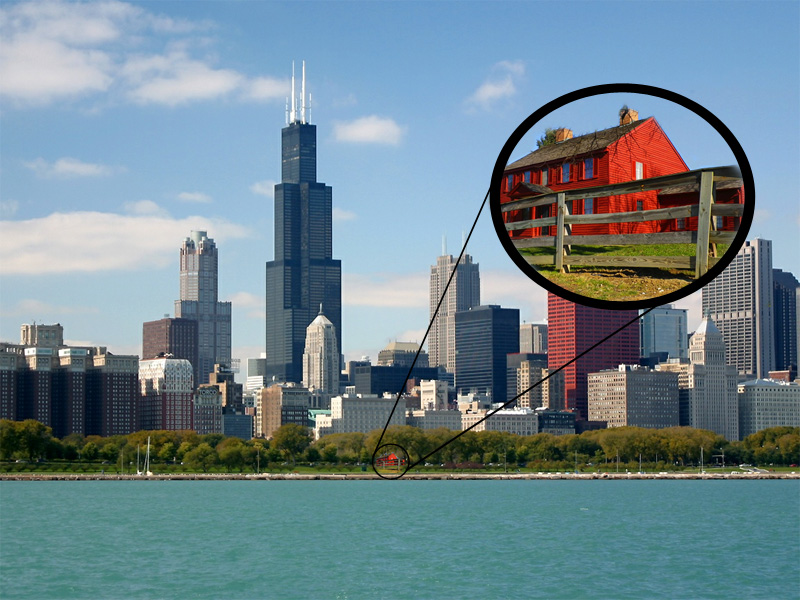
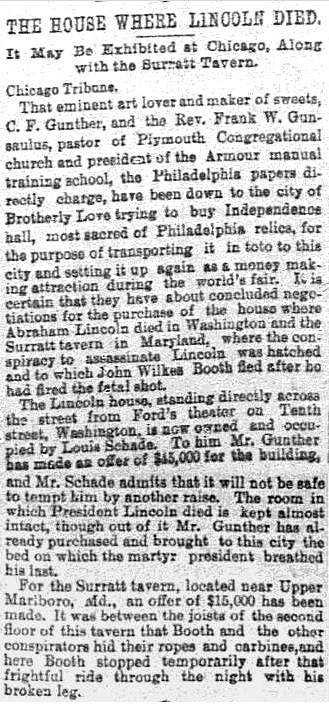
If wealthy candy confectioner and noted collector Charles Gunther had gotten his way, Chicago would have become the home of many transplanted historical sites:

If relocating entire buildings like this sounds like an impossible feat, know that Charles Gunther had already done it once.  In the late 1880’s he purchased the Libby Prison from Richmond, Virginia.  He dismantled the prison, transported it to his hometown of Chicago, and rebuilt it there.  The Libby Prison Museum operated from 1889 to 1895 before decreasing visitors forced Gunther to dismantle it.  When this article was written in 1893 it is likely Gunther was hoping to reinvigorate his museum by creating an entire campus of historic sites.

As we know, Gunther never managed to purchase Independence Hall, the Petersen House, or the Surratt Tavern.  Despite his generous offer to Louis Schade, the Petersen house was eventually sold to the federal government instead.  Had the Petersen House been sold to Gunther, he could have reunited the building with some of the items that were there when Lincoln died.  The bed upon which Lincoln died and many other articles from the Petersen house were acquired by Gunther in 1889.  When Gunther died, the Chicago Historical Society purchased most of his extensive collection.  This is the reason why Lincoln’s true deathbed is in the Chicago History Museum and not in Washington, D.C.

I believe Charles Gunther’s proposed acquisition of these historic sites allows for a very entertaining “what if”.  Imagine what it would be like to look out a window of the Surratt Tavern and see the house where Lincoln died.  Imagine the historical DisneyWorld that could have existed in Chicago.  Instead of Mickey Mouse ears, visitor would purchase powdered wigs at the “Ye Olde Independence Hall Gift Shop” before taking the monorail to the “Lincoln Assassination Pavilion”.  Had this eccentric collector been able to build his dream, how differently our nation’s history would be interpreted today.

References:
The Chicago Historical Society has a nice website recounting Charles Gunther’s collection and Libby Prison Museum.

Categories: Uncategorized | Tags: , , , | 10 Comments

Louis Schade, Esquire

While researching for my last post about George Atzerodt’s burial, I came across an interesting character by the name of Louis Schade.  Mr. Schade happened to make his way into the Lincoln assassination realm in a couple of ways.

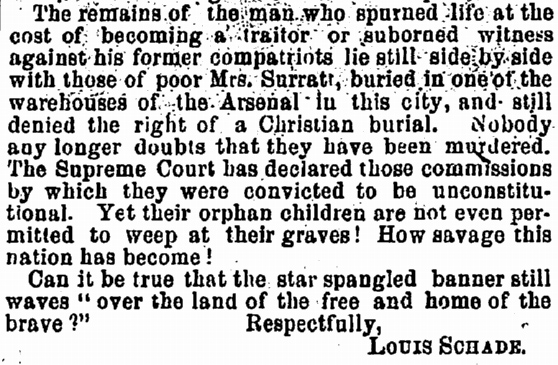
Louis F. Schade was a born in1829 in Berlin, Germany.  He studied law at the University of Berlin.  As a student, he took an active part in the failed unification of the German states known as the Revolution of 1848.  He fled to America shortly thereafter.  In 1855, Schade found himself in Chicago under the employ of Senator Stephen A. Douglas.  Schade not only visited German districts in Illinois making speeches in support of Douglas, but also became the editor of two of Douglas’ papers, “The National German Democrat” and “The National Union”.  He was admitted to the bar, becoming a certified lawyer in 1858.  After Douglas won the Illinois state Senate seat against his opponent, Abraham Lincoln, Schade returned to Washington, D.C. and practiced law.  A large client of his was the United States Brewer’s Association and Schade became an outspoken advocate against the temperance movement.  He gained nation-wide fame, however, in 1865, when he agreed to represent Captain Henry Wirz, commander of the Andersonville prison.  Schade would come to truly believe in his client’s innocence and even after Wirz’ execution, he would write publicly about the tragedy.  A few years later he would not only lament the injustice of Wirz’s execution, but the treatment of his body:

Come February of 1869, when President Andrew Johnson is evoking his presidential privilege of writing pardons without fear of political reprisals, Schade applies for the body of Henry Wirz.  It is granted and Schade arranges for his late client to be buried in Mount Olivet cemetery in D.C.  In a twist of fate, Mary Surratt would be buried here too, reuniting the pair yet again.

But the body of Henry Wirz was not the only one Louis Schade helped removed from the Arsenal grounds.  On behalf of another client, Victoria Atzerodt, Schade wrote to Andrew Johnson asking for George’s body.  He wrote in part that, “the present enlightened age…will not permit the mediaeval and barbaric custom of seeking revenge on a handful of dust and ashes.”  In addition to Schade’s appeal, John Atzerodt wrote his own letter to President Johnson asking for George’s body:

A few days later, Louis Schade and John Atzerodt would visit Andrew Johnson in person to receive the signed order for George’s remains:

So, Schade helped to rebury two executed criminals from the grounds of the Old Arsenal prison.  Louis Schade’s connection to Lincoln’s assassination does not end there, however.

On October 18, 1871, a recent widow in Washington, D.C., passed away.  Her husband had died only a few months earlier of a laudanum overdose.  The pair had left their children without a will.  To raise money, the heirs of the family sold some of the furniture in the house.  A bureau, gas jet, rocking chair, an engraving, and a bed were all sold at auction.  The family was able to retain possession of the house where they had lived, though.  It was a three story brick row house in downtown D.C.  But it was also much more than that.  It was the house where Abraham Lincoln had died, also called the Petersen House after the family that built and owned it.

The Petersen House circa 1883

By 1878, the Petersen heirs decided it was time to sell the house.  Return Louis Schade.  By this time, Schade had reignited his skills as a newspaper editor and had started his own paper, The Washington Sentinel.  It was a Democratic paper that Schade used as an outlet for his own views.  He devoted a whole back page to beer advertisements to support his client, the Brewer’s Association.  As a German immigrant he wrote largely in support of more lenient immigration policies.  The Sentinel also contained a great deal of international coverage for a paper its size.  Schade was a successful editor and lawyer in 1878, and the Petersens probably had no problem selling their shrine of a house to him.  On November 25, 1878 Schade and his wife bought the Petersen house for $4,500, a little over $100,000 in today’s currency.

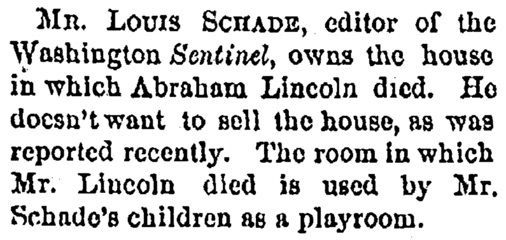
The Schade family would enjoy living at the Petersen house, at first.  Louis moved the office of his newspaper to the front of the basement.  The room where Lincoln died became a playroom for the children:

Eventually though, the Schades would tire of the many visitors that wished to gain entry into their historic home.  By 1893, the family had moved out of the house and leased it to the Memorial Association of D.C.  The association invited a tenant named Osborn Oldroyd to live in and showcase his extensive Lincoln collection inside the Petersen house.  Finally, on June 29th, 1896, the federal government purchased the Petersen House from Louis Schade for $30,000.  That is equivalent to over $775,000 in today’s money.  Louis Schade definitely made a tidy profit on his historic investment.

The noted editor and lawyer, Louis Frederick Schade died on February 25th, 1903.  He is buried in D.C.’s Prospect Hill Cemetery.  Prospect Hill, a largely German cemetery, is located right next to Glenwood Cemetery, the proposed yet abandoned burial location for George Atzerodt.

Louis Schade gained notoriety for his defense of Henry Wirz and his long career as a newspaper editor.  Yet he also managed to entwine himself in the epilogue of Lincoln’s assassination.  He helped to bury a conspirator and bought the house where Lincoln died.  He remains a minor, yet interesting side figure in history.

References:
Newspaper article abstracts were retrieved from GenealogyBank.com
William A. Petersen House – House Where Lincoln Died Historic Structure Report by the National Park Service
They Have Killed Papa Dead by Anthony Pitch
The Papers of Andrew Johnson: September 1868 – April 1869
Andrew Johnson: A Biographical Companion by Glenna Schroeder-Lein
Washington Sentinel by the Library of Congress
There are wonderful pictures of Louis Schade on his FindAGrave page.

Categories: Uncategorized | Tags: , , | 10 Comments

Blog at WordPress.com.