Posts Tagged With: Petersen House

“President Lincoln Is Dead: The New York Herald Reports the Assassination” at the Newseum

Located on the corner of Pennsylvania Avenue and 6th Street in northwest D.C., the Newseum is an impressive institution devoted to the evolution of news reporting and the importance of free press in a society. The seven floor museum contains impressive permanent exhibits relating to some of the most news worthy events in American and world history. There are also many galleries in the museum which house an array of different temporary exhibits. When I visited Washington, D.C. for the first time in 2009, I made sure to tour the Newseum due to the fact that they were displaying a temporary exhibition based around James Swanson’s book, Manhunt. One of my very first posts on this site recounted that wonderful exhibit.
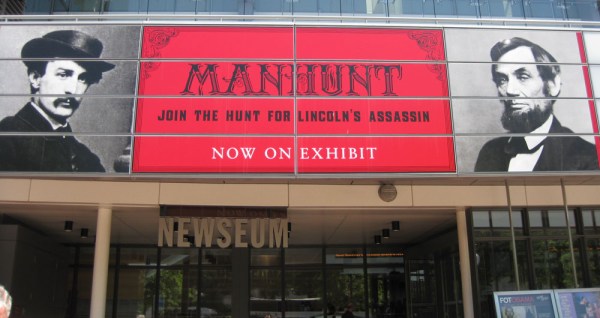
Since that time (and my subsequent move to Maryland), I have made many visits to the Newseum.  Their exhibits are fascinating and it is a wonderful place to bring guests from out of town.  As you might expect, there are several permanent items on display at the Newseum related to Lincoln’s assassination that I see each time I am there.  One permanent, 80 foot long display on the top terrace overlooks Pennsylvania Avenue and recounts the history of Washington’s most famous street.
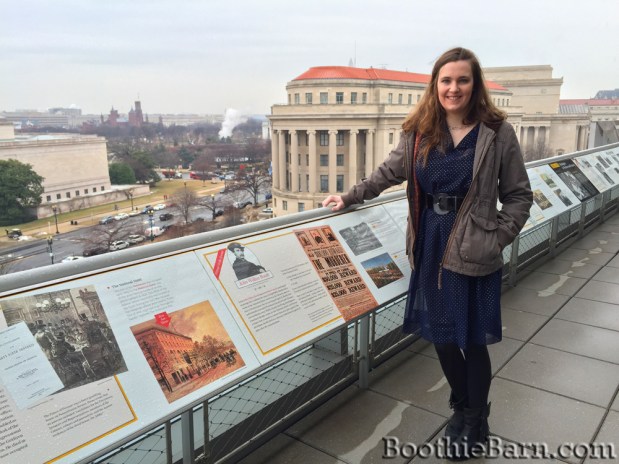
Newseum Terrace

The display also points out that the site currently occupied by the Newseum was once the home to the National Hotel, the preferred hotel of John Wilkes Booth when he was in Washington.

The Newseum collection also contains different newspapers, both physical and digital, that cover the assassination of Abraham Lincoln:

However for this year, the 150th anniversary of the assassination of Abraham Lincoln, the Newseum has created a very special exhibition:
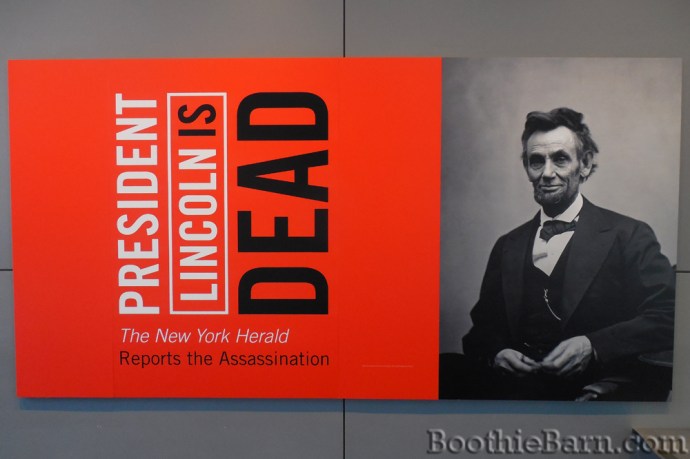
New York Herald Exhibit Newseum

President Lincoln Is Dead: The New York Herald Reports the Assassination” is a detailed look at how one of the most widely read newspapers in the country covered the events of April 14, 1865.  Over a period of 18 hours following the shot at Ford’s Theatre, the New York Herald would publish an unprecedented seven special editions, each with new information regarding the President and Secretary of State’s conditions and the subsequent search for their assassins.  The Newseum may very well be the only institution in the world that contains copies of each of the seven editions of the New York Herald from that tumultuous time.


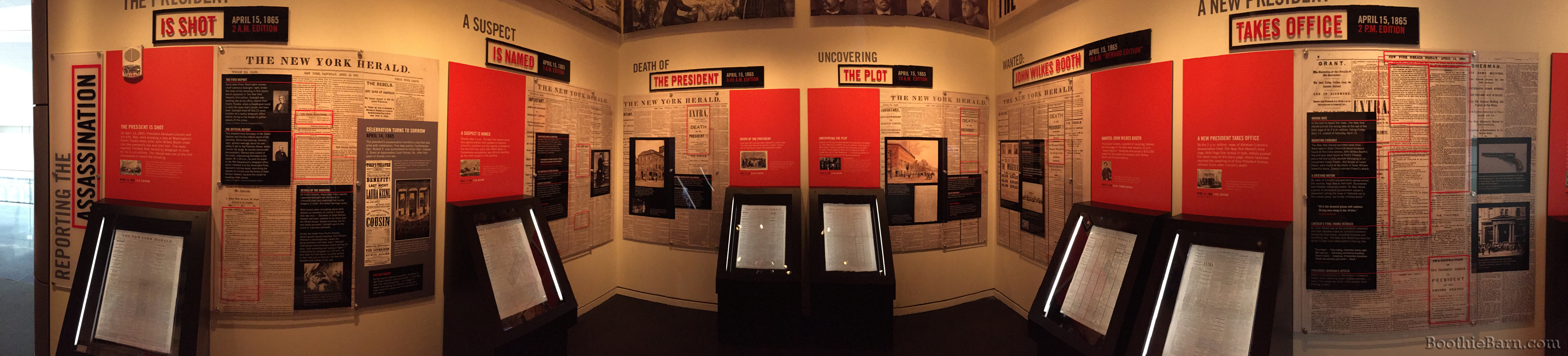
Coverage Chronologically
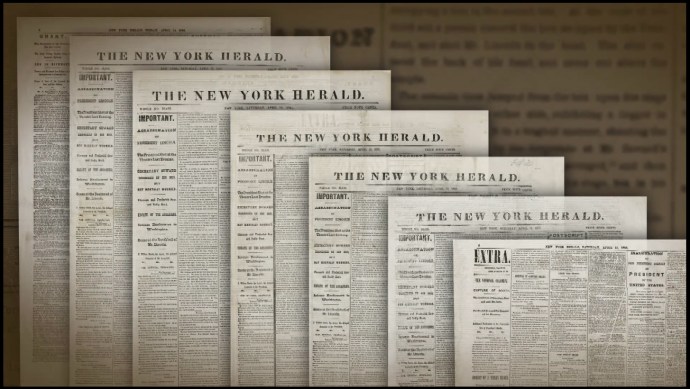
 
Seven Issues of New York Herald Newseum

The current exhibit at the Newseum contains an original of each of these editions paired with large wall displays that highlight the differences and additions between them.

2:00 AM edition:
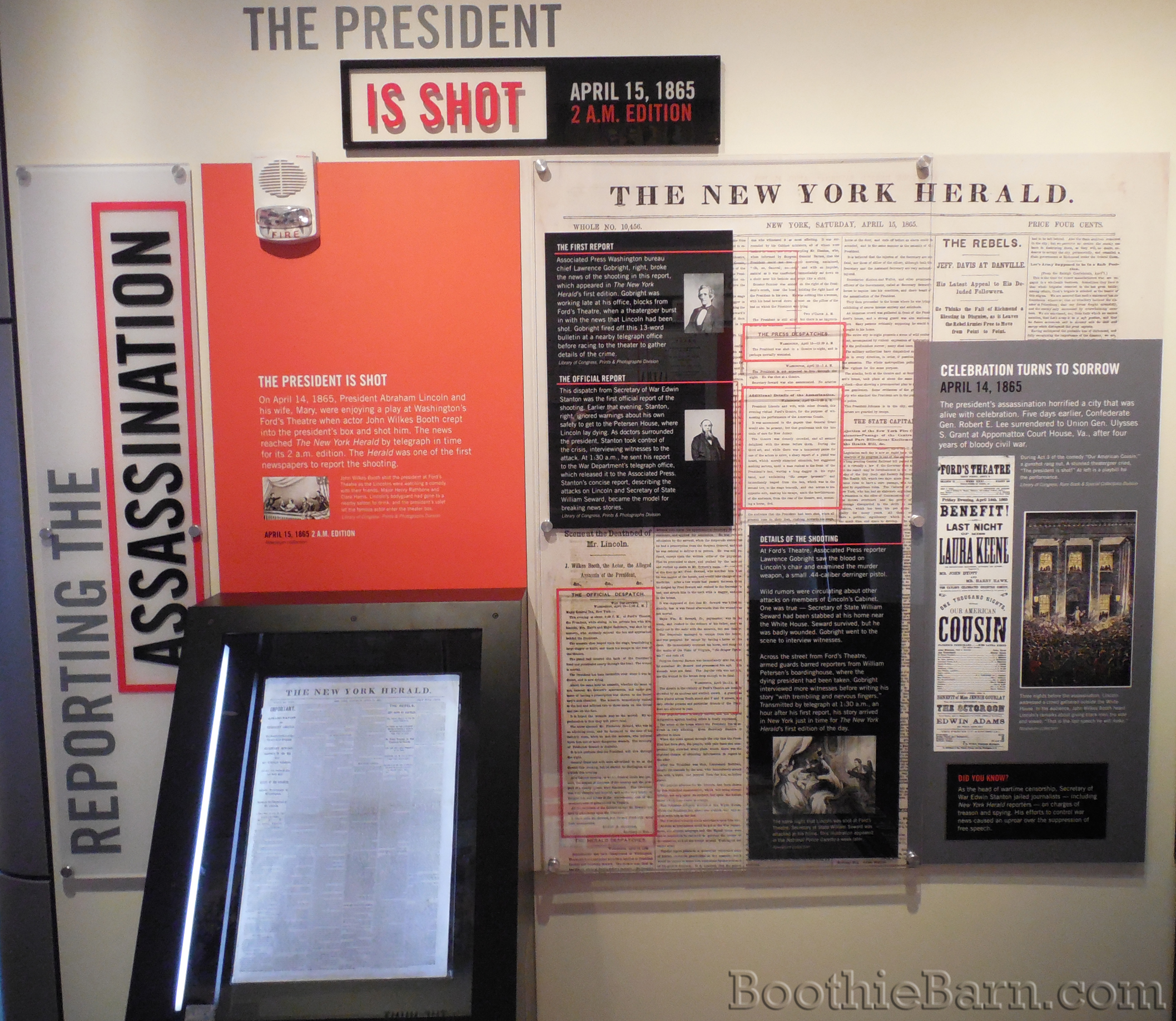
NYH 2 am edition Newseum

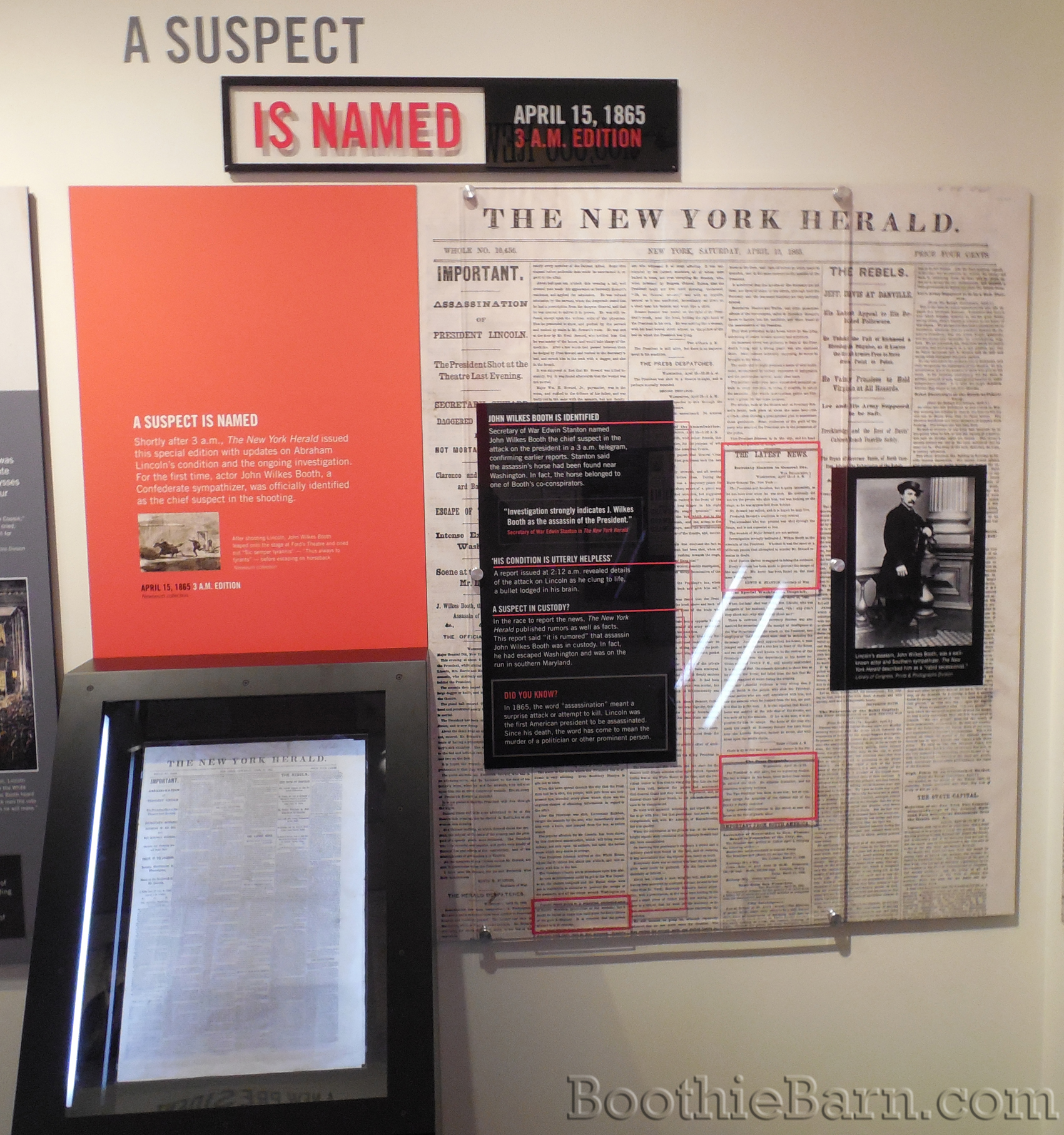
3:00 AM edition:

NYH 3 am edition Newseum

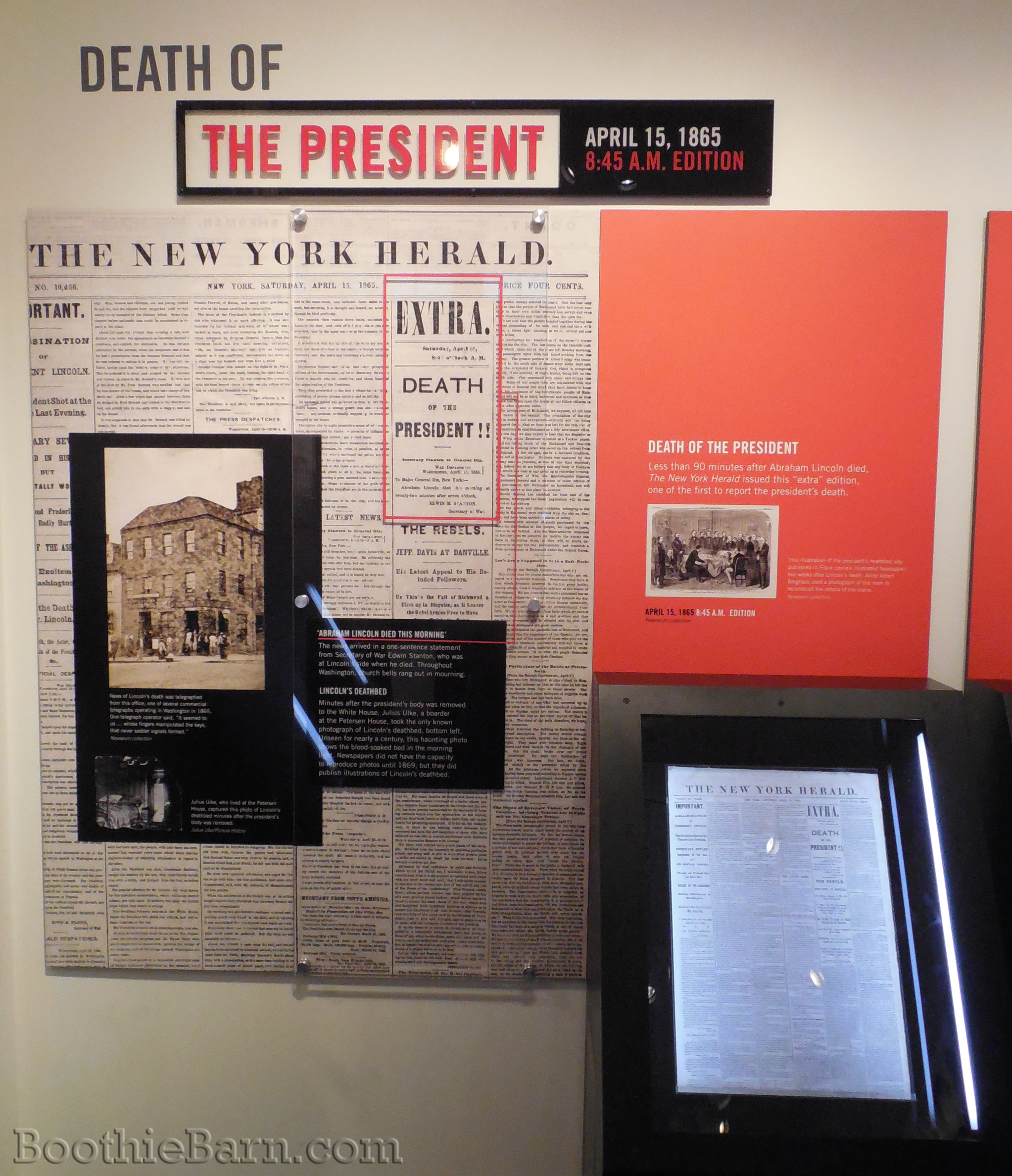
8:45 AM edition:

NYH 8 am edition Newseum

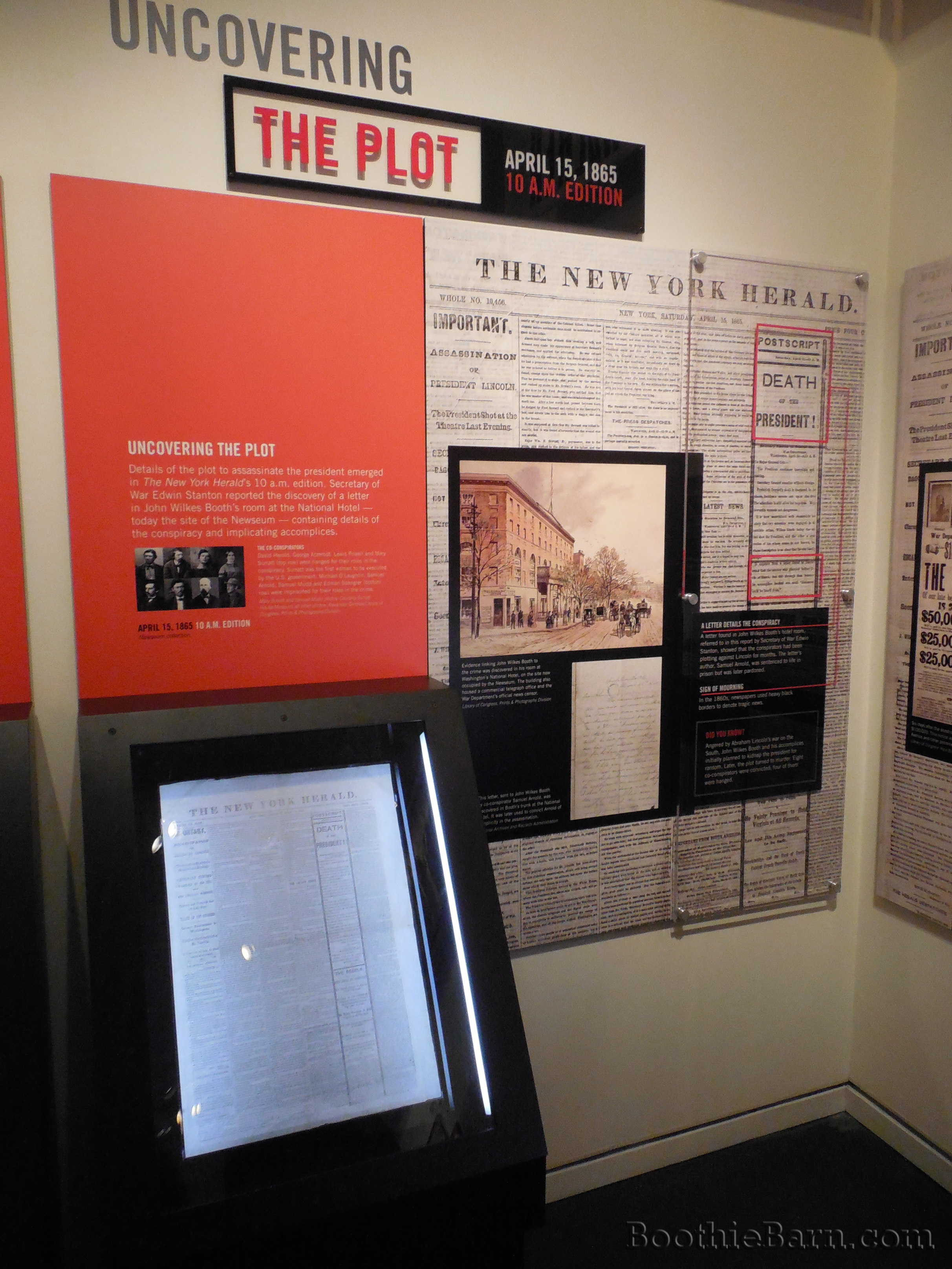
10:00 AM edition:

NYH 10 am Uncovering the Plot edition Newseum

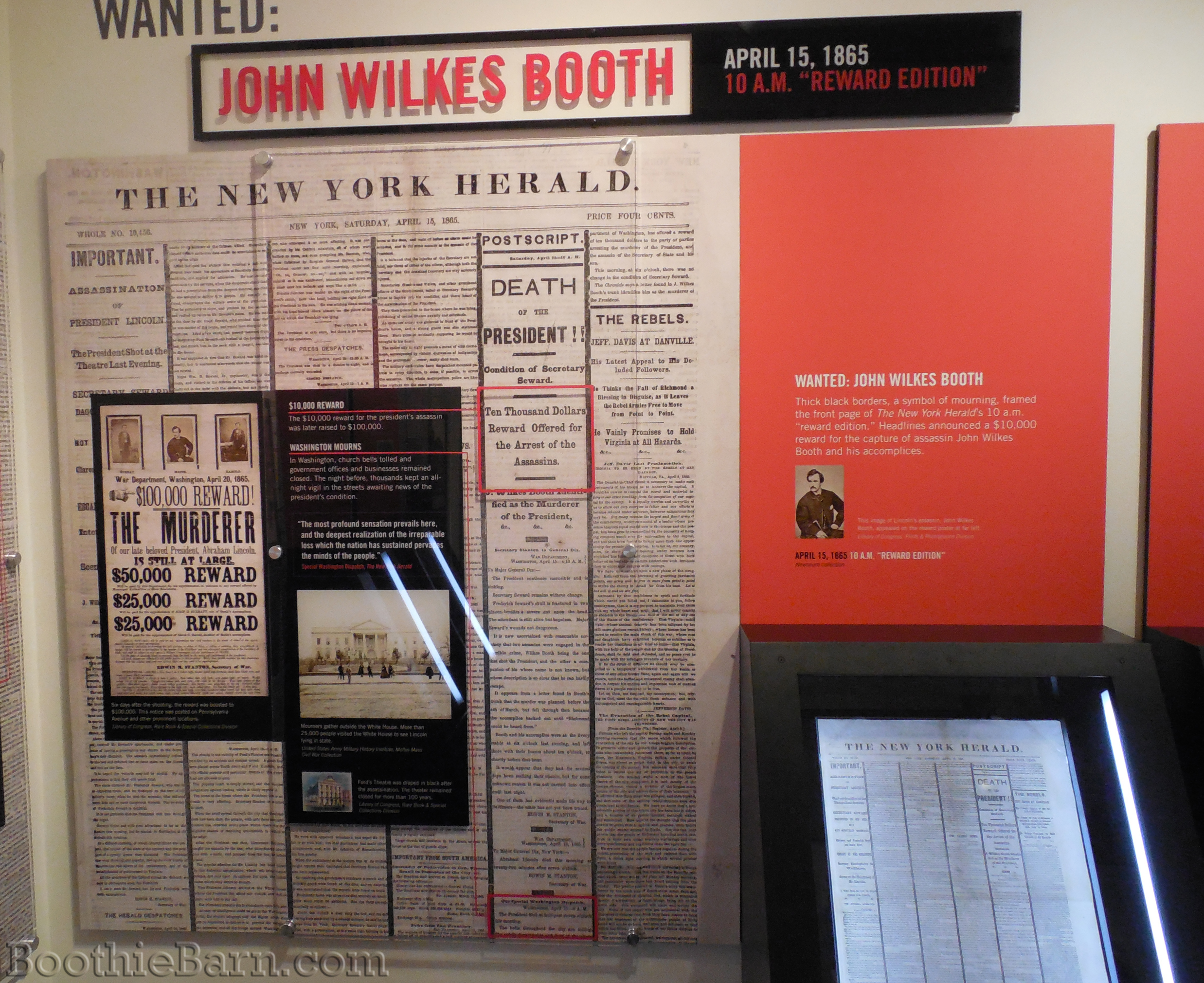
10:00 AM “Reward” edition:

NYH 10 am Reward edition Newseum

2:00 PM edition:

NYH 2 pm edition Newseum

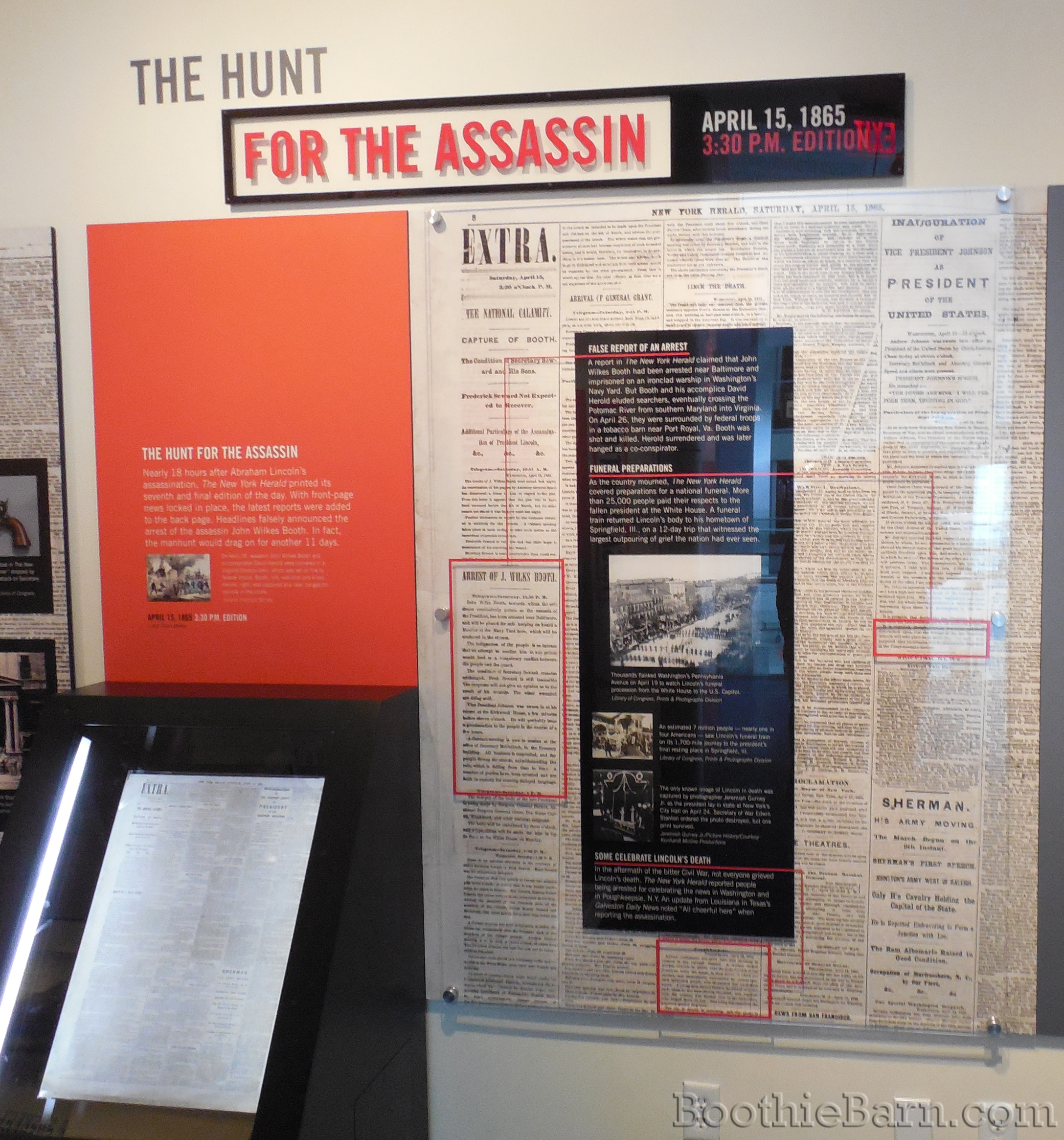
3:30 PM edition:

NYH 3 pm edition Newseum

Click to Enlarge

Click to Enlarge


Floor to Ceiling Coverage

 
While the “President Lincoln Is Dead: The New York Herald Reports the Assassination” exhibit is only contained in one small room of the Newseum, there is no wasted space.  Even the floor and ceiling contain displays.  On the floor is a map of Civil War Washington with labelled sites relating to the assassination:
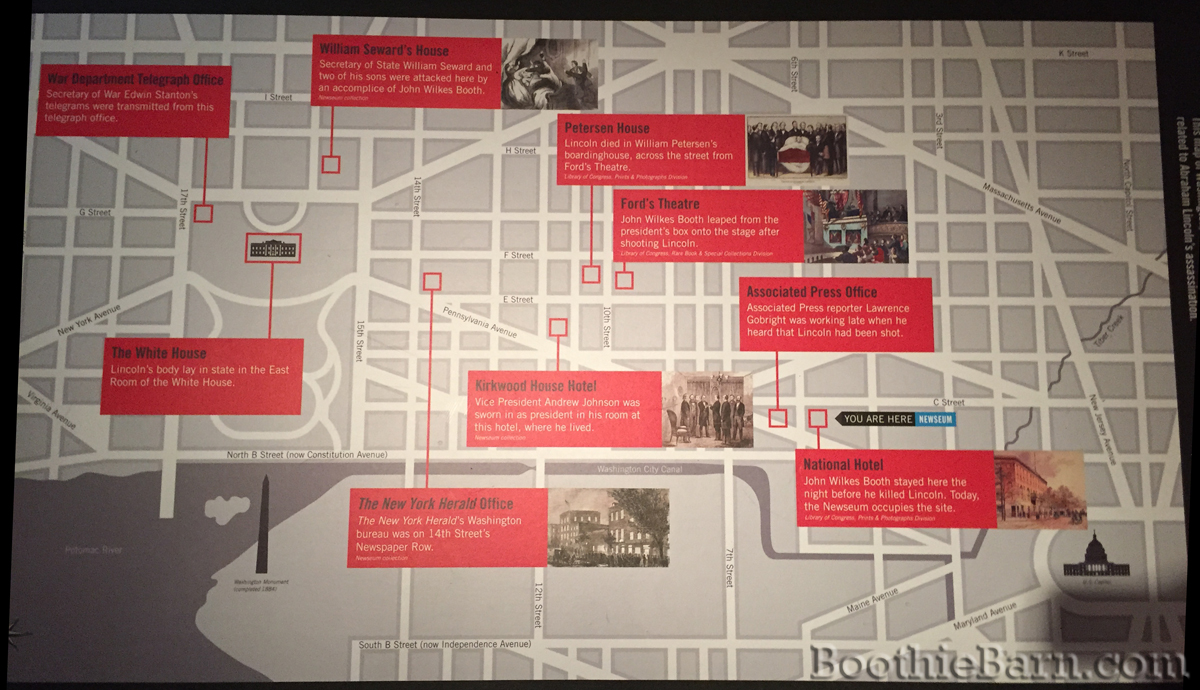
Floor map Newseum

Meanwhile the ceiling is festooned with wonderful banners (several of which I wish I could own myself) relating to the assassination:

Click to enlarge

Click to enlarge


The Stories Behind the Story

 
The displays not only provide commentary on the evolving story of how the country came to learn the details of Lincoln’s assassination, but they also introduce us to the people involved in reporting the news.  One of my favorite stories is that of Associated Press reporter, Lawrence Gobright who was responsible for the very first telegraphic dispatch covering Lincoln’s assassination:

First dispatch Newseum

In 1869, Gobright would recollect his actions that night:

“On the night of the 14th of April, I was sitting in my office alone, everything quiet : and having filed, as I thought, my last despatch, I picked up an afternoon paper, to see what especial news it contained. While looking over its columns, a hasty step was heard at the entrance of the door, and a gentleman addressed me, in a hurried and excited manner, informing me that the President had been assassinated, and telling me to come with him! I at first could scarcely believe the intelligence. But I obeyed the summons. He had been to the theatre with a lady, and directly after the tragedy at that place, had brought out the lady, placed her at his side in his carriage, and driven directly to me. I then first went to the telegraph office, sent a short ” special,” and promised soon to give the particulars. Taking a seat in the hack, we drove back to the theatre and alighted; the gentleman giving directions to the driver to convey the lady to her home.

The gentleman and myself procured an entrance to the theatre, where we found everybody in great excitement. The wounded President had been removed to the house of Mr. Peterson [sic], who lived nearly opposite to the theatre. When we reached the box, we saw the chair in which the President sat at the time of the assassination; and, although the gas had for the greater part been turned off, we discovered blood upon it…

Lawrence Gobright

Lawrence Gobright

My friend having been present during the performance, and being a valuable source of news, I held him firmly by the arm, for fear that I might lose him in the crowd. After gathering all the points we could, we came out of the theatre, when we heard that Secretary Seward had also been assassinated. I recollect replying that this rumor probably was an echo from the theatre; but wishing to be satisfied as to its truth or falsity, I called a hack, and my companion and myself drove to the Secretary’s residence. We found a guard at the door, but had little trouble in entering the house. Some of the neighbors were there, but they were so much excited that they could not tell an intelligent story, and the colored boy, by whom Paine was met when he insisted on going up to the Secretary’s room, was scarcely able to talk. We did all we could to get at the truth of the story, and when we left the premises, had confused ideas of the events of the night. Next we went to the President’s house. A military guard was at the door. It was then, for the first time, we learned that the President had not been brought home. Vague rumors were in circulation that attempts had been made on the lives of Vice-President Johnson and others, but they could not be traced to a reliable source. We returned to Mr. Peterson’s house, but were not permitted to make our way through the military guard to inquire into the condition of the President. Nor at that time was it certainly known who was the assassin of President Lincoln. Some few persons said he resembled Booth, while others appeared to be confident as to the identity.

Returning to the office, I commenced writing a full account of that night’s dread occurrences. While thus engaged, several gentlemen who had been at the theatre came in, and, by questioning them, I obtained additional particulars. Among my visitors was Speaker Colfax, and as he was going to see Mr. Lincoln, I asked him to give me a paragraph on that interesting branch of the subject. At a subsequent hour, he did so. Meanwhile I carefully wrote my despatch, though with trembling and nervous fingers, and, under all the exciting circumstances, I was afterward surprised that I had succeeded in approximating so closely to all the facts in those dark transactions…”
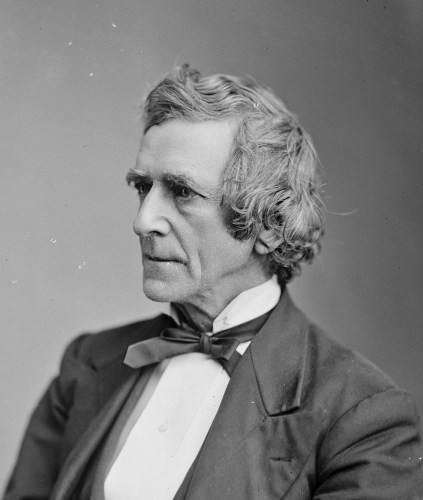
In addition to his quick reporting and continual dispatches throughout the night, Gobright also holds a place in history due to his brief custodianship over the derringer that was used to kill Abraham Lincoln.

Edwin Pitts holding the Derringer 1

After shooting Lincoln with the single shot pistol, John Wilkes Booth immediately dropped the gun onto the floor of the theater box. Somehow it went unnoticed during the chaos that ensued in the small box as physicians entered to care for the mortally wounded president. One of the men who had entered the box along with the physicians was a man named William Kent. Kent would later claim it was his penknife that was used to cut the collar from around Lincoln’s neck. After departing the theater that night, Kent discovered he had lost his keys and so returned to the theater and gained entry into the now empty box. He was searching for his keys when his foot struck something. Lawrence Gobright had also just arrived in the box to report on the scene of the crime:

“A man [Kent] standing by picked up Booth’s pistol from the floor, when I exclaimed to the crowd below that the weapon had been found and placed in my possession. An officer of the navy — whose name I do not now remember — demanded that I should give it to him ; but this I refused to do, preferring to make Major Richards, the head of the police, the custodian of the weapon, which I did soon after my announcement.”

As stated, Gobright did turn the derringer over to the Metropolitan Police and William Kent identified it on April 15th:

William Kent statement


Don’t Believe Everything you Read in the Newspapers

 
The New York Herald exhibit at the Newseum also demonstrates how the newspapers covering Lincoln’s assassination made the same mistake as some modern journalists by printing unreliable or unsubstantiated claims in hopes of being the first to provide their audience with an exclusive.
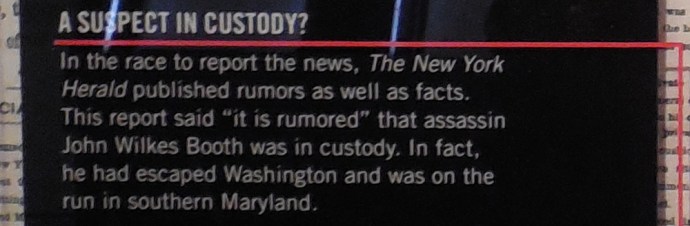
Booth in custody Newseum

Rumors and speculation would fill every mouth, diary, and newspaper for the next twelve days as the entire country searched for John Wilkes Booth.

In addition to misinformation that was printed in a rush, the New York Herald exhibit at the Newseum also brings attention to later instances that have caused unintended deception.  The New York Herald’s coverage of Lincoln’s assassination was so wide spread that even many years later, the paper was still very well connected to the event in the minds of the public.  Many advertisers attempted to benefit from this connection by creating their own, custom reprints of editions of the New York Herald.  On the face of it, the reprints appeared genuine though some, like the one below, included engravings that were never in the originals.  No matter how real they looked however, hidden either in the text of the front page or within the interior pages were advertisements for the latest miracle tonic, liniment, or some other product.

Fake NYH Newseum

This type of “historical advertising” was very popular in the late 19th and early 20th century.  People were more likely to hold on to the advertisement if it had something compelling on it.  Another example of this type of advertising is this reproduction CDV of John Wilkes Booth’s escape on a bag for dysentery syrup:

John Wilkes Booth Dysentery Syrup

While the newspapers were well known to be advertisements in their day, as time has passed reproductions like the one above have fooled many unknowing treasure seekers into thinking they have a genuine (and pricey) piece of American history. Most of the time, however, a careful read through (especially of the interior pages which are usually just full page ads for the product) will reveal it is a reproduction.  You can see a small sampling of some of the many advertising reproductions of the assassination editions of the New York Herald here.


Plan Your Visit

 
I highly recommend a visit to the “President Lincoln Is Dead: The New York Herald Reports the Assassination” exhibit at the Newseum.  It is located on the 4th floor of the museum which is open daily from 9:00 am to 5:00 pm.  Tickets to the Newseum cost $23 for adults and allow you to return the next day for free.  While this price may seem a bit expensive compared to the federally funded museums in D.C. that offer free admission, the Newseum has many wonderful galleries and exhibits that make the price more than worth it.  This special New York Herald exhibit only runs until January 10, 2016 so be sure to visit the Newseum before it is gone.

https://www.youtube.com/watch?t=36&v=q2wjySTZFUg

References:
President Lincoln Is Dead: The New York Herald Reports the Assassination at the Newseum
Recollection of men and things at Washington during the third of a century by Lawrence Gobright (1869)
National Archives
Library of Congress

Categories: Uncategorized | Tags: , , , , , , , , , | 3 Comments

Make Plans to Visit Ford’s Theatre on April 14th

One week from today will be the 150th anniversary of Abraham Lincoln’s assassination.  Appropriately, Ford’s Theatre will be marking the occasion with a Lincoln Tribute.  The Tribute will consist of a 36 hour period of nonstop activities including orators reciting some of Lincoln’s favorite poetry, speakers discussing his legacy, a special performance leading up to the moment of his assassination, reenactors recreating the solemn death watch, and a wreath laying ceremony at 7:22 am on April 15th.  The Lincoln Tribute will, I’m sure, prove to be a particularly fitting vigil for our 16th President.

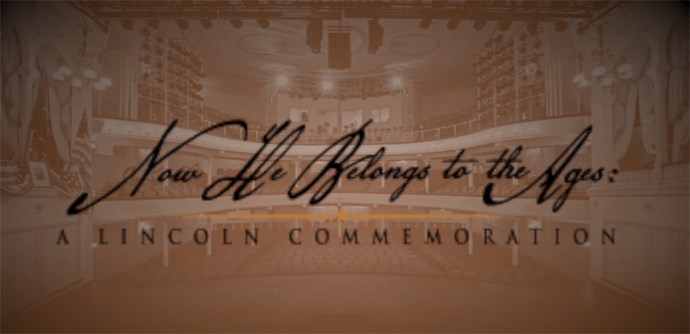
Perhaps the culminating piece of the Tribute is the special performance planned inside of Ford’s Theatre starting at 9:00 pm EST.  The program is entitled, “Now He Belongs to the Ages: A Lincoln Commemoration“.  Ford’s Theatre is describing the commemoration thusly:

Now he belongs to the ages

Ford’s Theatre will present a moving commemorative tribute to President Abraham Lincoln, 150 years to the day since his assassination. This evening event will include readings of Lincoln’s words and stories, Civil War-era music, excerpts from Lincoln’s favorite theatre and operas, and more. The event seeks to remind us that we not only lost a president; we lost a man who treasured his family, his friends and his country with a love so strong it could hold the Union together.

Tickets for the commemoration program sold out within minutes but those who do travel to D.C. can still share in the experience by viewing the commemoration with others at the nearby National Portrait Gallery.

For those who do not live in, or cannot make it to, the Washington, D.C. area, Ford’s Theatre has partnered with UStream to stream the commemoration online for free.

As cozy as it might sound watching the commemoration from the confines of your own home, I want to encourage you all, especially those of you in the D.C. metro area, to come out and be a part of the Lincoln Tribute and Commemoration in person.  I can think of no better way to truly immerse yourself in history.  Ford’s Theatre is providing a unique and once in a lifetime opportunity to essentially travel back in time.  Costumed reenactors will allow you to experience first hand what it was like in the hours leading up to and following Lincoln’s death.  As someone who has taken the opportunity to reenact a portion of this story, trust me when I say that immersing yourself in the history is an unparalleled learning experience.  I wouldn’t miss this exclusive chance to “live through” Lincoln’s assassination.

Free Ticket Giveaway!

To further motivate you all to make plans to visit Ford’s Theatre on April 14th and 15th, I have two (2) extra commemoration tickets that I will be giving away that night.  The winner of these tickets will be able to view the 9 pm program, “Now He Belongs to the Ages: A Lincoln Commemoration” from inside Ford’s Theatre rather than the streaming version at the Portrait Gallery.  Instead of giving them away in a contest ahead of time, I will be bringing the two extra tickets along with me when I attend the Lincoln Tribute on the evening of April 14th.  At a certain point before the show’s debut, I will send out a tweet on my @BoothieBarn Twitter page.  This tweet will contain a clue as to my location on the Ford’s Theatre campus.  The first person to find me and ask me for the tickets after I send out the tweet, will win the tickets.

So please, make plans to attend the Lincoln Tribute at Ford’s Theatre between April 14th and 15th.  It truly is going to be a once in a lifetime event that you won’t want to miss.  And, if you’re lucky and keep an eye on my Twitter page, you could win two free tickets to the “Now He Belongs to the Ages: A Lincoln Commemoration” going on at 9:00 pm at Ford’s Theatre.

Categories: Uncategorized | Tags: , , , , , | 5 Comments

Photo of the Day: Petersen House (1921)

After the shooting at Ford’s Theatre, the scene on Tenth Street was a picture of agitated solemnity.  Many of those who had been present in the theater were now anxiously waiting just outside its doors for word regarding the President’s condition.  As the news was passed down the Washington streets, others migrated towards the scene, hoping to get the latest information for themselves.  Many, if not all, of those who traveled to the theater that night hoped that the news being passed around was false.  Perhaps the President was fine and the rumors of his being shot were untrue.  As the newcomers arrived however, and they started hearing accounts from witnesses, their hopes would have inevitably changed.  Faced with the realization that the President had, indeed, been shot, their hearts would then pray that their leader was not gravely injured by an assassin’s bullet.

The sight of the unresponsive President being carried, borne by loving hands, out of the theater and into the street would have dashed the hopes and prayers of those present.  The somber truth of President’s condition would have been obvious to everyone, as drops of his blood spilled onto the dirt street.

One of the men viewing this tragic scene was Henry Safford, a boarder who lived across the street from Ford’s Theatre at the boardinghouse of William and Anna Petersen.  Noticing that those carrying the President were unsure where to take him, Safford called out, “Bring him in here.”  With those four words, the Petersen House became an integral part of history and would forever be known as “The House Where Lincoln Died”.

Petersen House 1920 - 1922 BoothieBarn

This picture, previously unpublished, shows the Petersen House between the years of 1920 and 1922.  At that point the building was owned by the government with Lincoln collector Osborn Oldroyd as its tenant and caretaker.  Oldroyd operated his Lincoln museum out of the Petersen House.  At the time this picture was taken, it cost 27¢ (with 3¢ tax) to visit the museum.

You can read more about:

Categories: Uncategorized | Tags: , , , | 13 Comments

Reagan Library’s former Lincoln Exhibit

Reagan Library Lincoln Exhibit catalog

From June through September of 2013, the Ronald Reagan Presidential Library in Simi Valley, California hosted an exhibit entitled, “A. Lincoln: Railsplitter to Rushmore“. The exhibit showcased a multitude of objects borrowed from the collections of private individuals; institutions like the Abraham Lincoln Presidential Library and Museum, Library of Congress, Smithsonian, and Ford’s Theatre; and even the production designers of Dreamworks Pictures who produced Steven Spielberg’s Lincoln. Over 250 unique artifacts relating to Lincoln’s life and presidency were on display along with sets from the Lincoln movie like this one of Lincoln’s office:

Lincoln Office Set Regan Library 2013

Appropriately, one room of the exhibition was devoted to the assassination and death of Abraham Lincoln.  Here is a nice panorama of the exhibit room showing the recreated bedroom of the Petersen House, a mock up of the Ford’s Theatre box, and a replica of President Lincoln’s casket:

Click to enlarge

Click to enlarge

Here is a slideshow which further highlights the artifacts and displays from the assassination gallery:

This slideshow requires JavaScript.

A few of the artifacts that were on display came from the Ford’s Theatre collection.  These included a Confederate cipher machine, a ticket to Ford’s Theatre, a key to a cell that imprisoned on of the Lincoln conspirators, and some funerary items.  One of Ford’s Theatre most iconic items was also loaned to the Reagan Library for the exhibit; a blood stained pillow from the death chamber of the President.

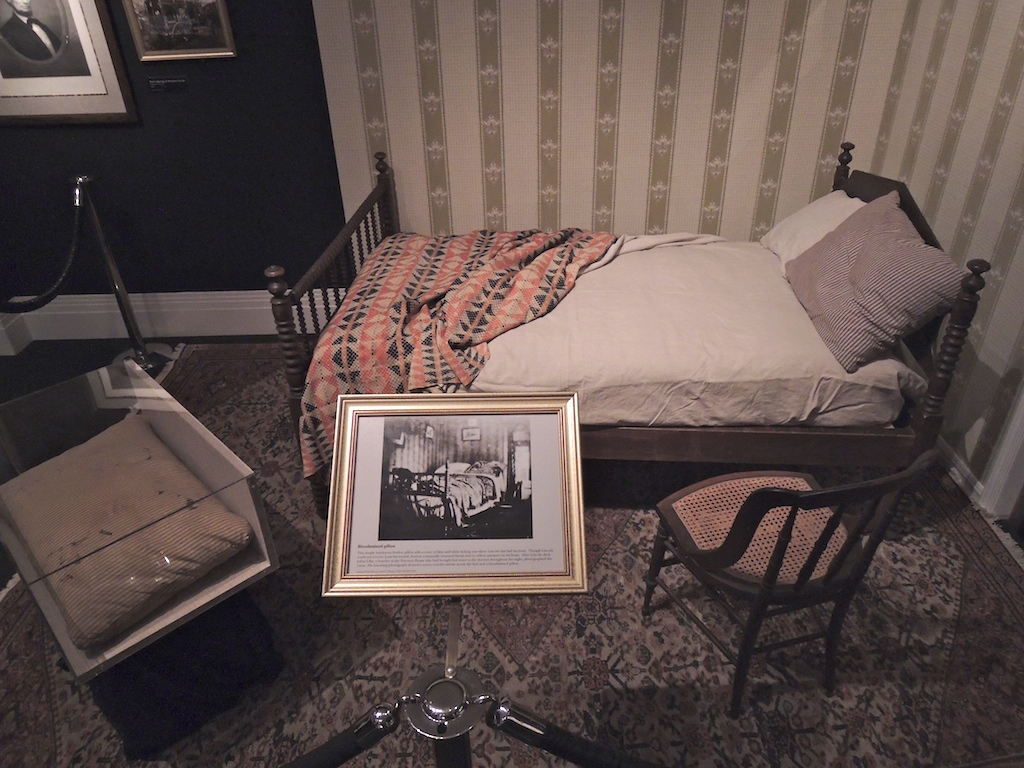
Petersen bedroom Assassination Exhibit Reagan Library

The Reagan Library’s recreation of the death chamber of Abraham Lincoln in the Petersen House. An authentic blood stained pillow from that night can be seen in a display to the left.

These images, sent to me by Carolyn Mitchell of the Spirits of Tudor Hall, show the blood stained pillow further:

Blood stained pillow Mitchell 1

Blood stained pillow Mitchell 2

Under this lighting, it’s hard to see the actual blood stains on the pillow.  The obvious dark splotches are not blood stains but ink stains that occurred long after Lincoln’s death and before modern artifact preservation techniques.  For many years, this pillow was on display at the Petersen House in Washington, D.C.  Today, however, the artifact is too fragile to be on display without a climate controlled display as seen here.  I’ve been told by a National Park Service employee that the pillow is so delicate that you could poke your finger straight through the pillow with ease.  Another, less fragile, pillow from Lincoln’s deathbed is on display in the basement museum of Ford’s Theatre.

References:
Ronald Reagan Presidential Foundation and Library
A. Lincoln: Railsplitter to Rushmore Exhibit Catalog
Ford’s Theatre NPS
A huge belated thank you to Carolyn Mitchell who visited the exhibit and sent me photographs and a copy of the exhibit catalog.  You’re the best, Carolyn!

Categories: Uncategorized | Tags: , , , , | 3 Comments

The Memorials on Tenth St.

Today, Ford’s Theatre and the Petersen House across the street constitute the “Ford’s Theatre National Historic Site”.  Operated by the National Park Service in partnership with the Ford’s Theatre Society, both buildings exist for the purpose of educating the public about Lincoln’s last hours.  Standing as they are today, it is sometimes difficult to imagine that, historically, they have not always been dedicated to serving Lincoln’s memory.  In fact, it was not until several years after Lincoln’s death that an effort was made to commemorate these buildings in anyway.  The modern museums of Ford’s Theatre and the Petersen House started off quite humbly as mere memorial plaques.

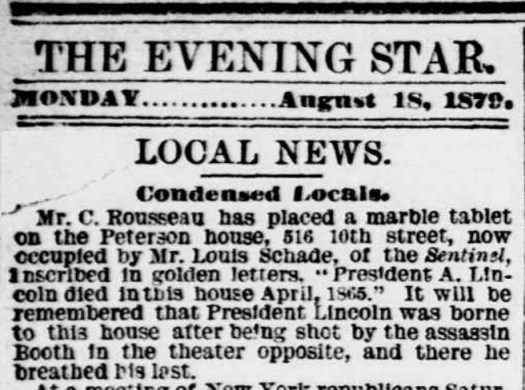
While the site of Lincoln’s assassination and the house in which he died were well known and hardly forgotten sites of Washington history, there was no move to commemorate either one of the buildings until nearly 14 years after the Great Emancipator’s death.  The first building to receive some sort of physical recognition was the Petersen House.  In 1879, it was the home of lawyer and newspaper publisher, Louis Schade.  You can read more about Mr. Schade and his connections to the assassination story HERE.  Schade had bought the Petersen House from the Petersen heirs in 1878.  In August of 1879, a couple of newspaper articles announced the installation of a marble tablet on the exterior wall of the Petersen House commemorating the historic nature of the house:

1879 marble tablet at Petersen House 2

1879 Marble tablet at Petersen House

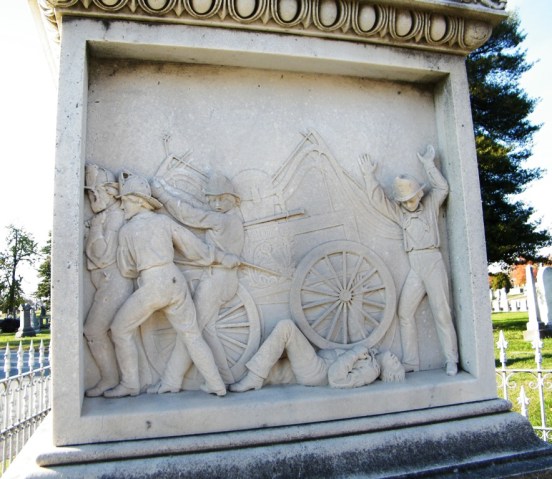
As reported, the tablet was created and put up by a private citizen, Charles Rousseau.  Mr. Rousseau was a Belgian native who learned the art of sculpture at the Royal Academy of Fine Arts in Brussels.  He made his living carving tombstones and was quite talented at it.  One of Charles Rousseau’s creations is this tombstone for Benjamin Grenup, believed to be the first Washington, D.C. fireman to have been killed in the line of duty when he was run over by the fire wagon:

Charles Rousseau Benjamin Grenup

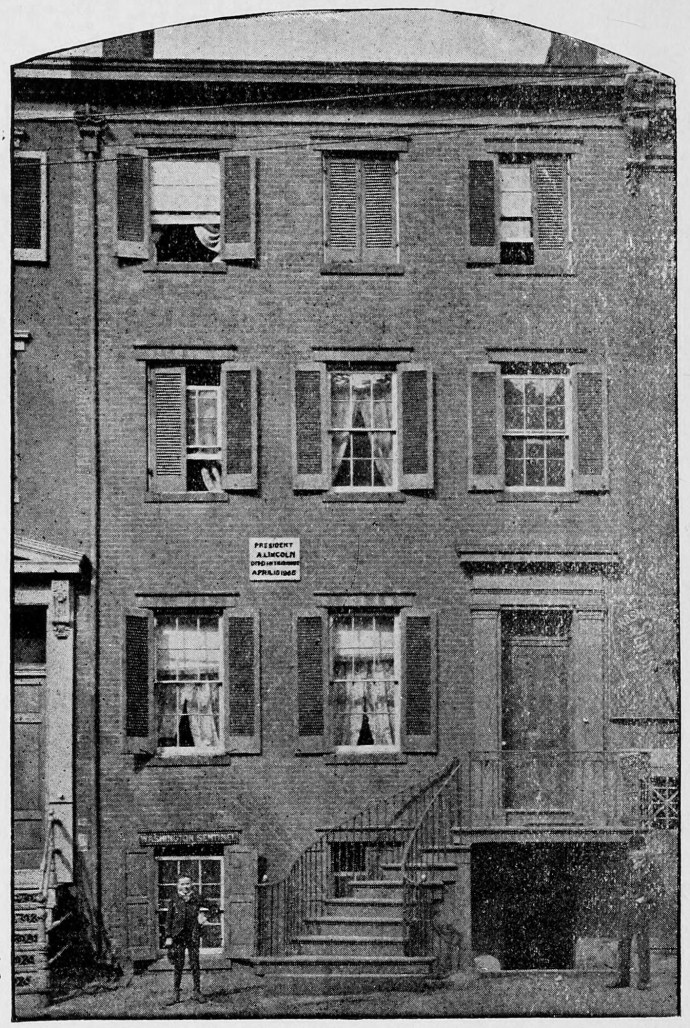
Whether Mr. Rousseau took it upon himself to make a tablet for the Petersen House, or whether Schade commissioned it, is not known.  Regardless, the tablet with its gold lettering was installed high on the exterior wall, far out of reach.  Here is a picture of the Petersen House as it appeared when Schade lived there as published in John E. Buckingham’s 1894 book, Reminiscences and Souvenirs of the Assassination of Abraham Lincoln:

Petersen House Buckingham 1894

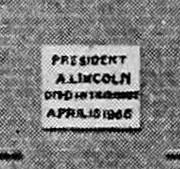
In the image, Buckingham retouched the tablet to make lettering readable:

Buckingham Marble Petersen tablet 1894

This marble tablet remained the only marker on the site for many years.  After the house was sold by Schade to the federal government in 1896, Osborn Oldroyd became its curator and started displaying his Lincoln collection inside.

Petersen House w Oldroyd Marble Tablet

As time went by, the small marble tablet began competing with Oldroyd’s large signs hawking admission to the house to see his collection.

Petersen House Oldroyd Tablet

Almost 30 years passed and the small marble tablet remained fixed high on the exterior.

Petersen Original Marble Tablet Transcription

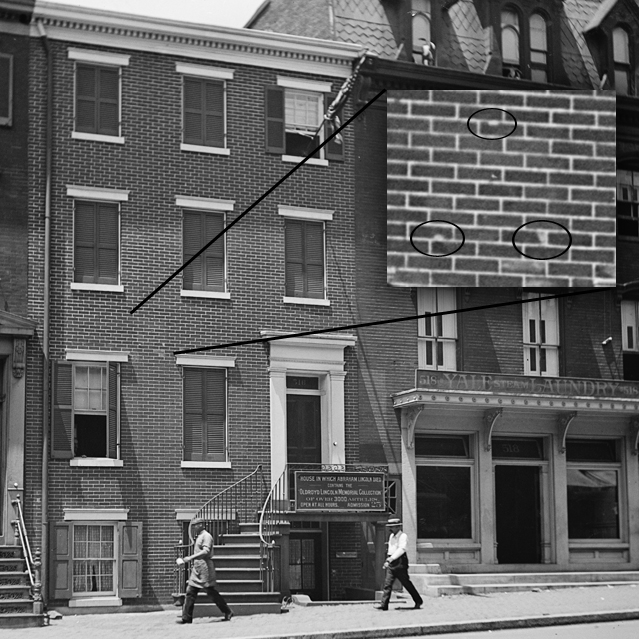
However, by 1909 the marble tablet was no longer on display.  Photographs during this time only show the three holes and the discoloration of the bricks from where the tablet had hung for so many years.

Petersen House No tablet

Whether Rousseau’s tablet fell or was purposefully removed is unknown. One text states that the tablet was removed because of complaints from visitors who stated it was placed too high up on the wall to read easily. If this is correct, perhaps Oldroyd felt his large museum signs provided the necessary information. Regardless, for a time in the early 1900’s, the only memorials on the Petersen House were the advertising for the Oldroyd collection of Lincolniana.

Meanwhile, across the street, the edifice that witnessed the horrible crime of April 14th, 1865, remained bare of any memorials. No private citizen had adorned the exterior wall of “Old Ford’s Theatre” like Charles Rousseau had done for the Petersen House. Instead, the building had been transformed into an office building, suffered a tragic collapse of the interior in 1893, and talks of demolishing it reappeared every few years or so in the press. Through it all, however, the scene of the crime remained.

It was not until 58 years after the death of Abraham Lincoln that a group of citizens decided it was time to commemorate the site of Lincoln’s assassination. The group, established by the Commissioners of the District of Columbia, was called the Citizens Committee of Historic Sites. With the help of the commissioners, the committee appealed for funds from Congress for the, “erection of suitable tablets to mark historical places in the District of Columbia”. For several years the committee was appropriated $500 and placed bronze plaques at various sites in D.C. On February 28, 1923, their appropriations were renewed and the committee started the design of two new plaques. One plaque was going to take the place of Rousseau’s marble tablet on the Petersen House while the other was to be placed on the long neglected Ford’s Theatre.

The formal unveiling of the new plaques occurred on April 29th, 1924.  I quote from the 1925 book, Abraham Lincoln in the National Capital by Allen C. Clark:

The exercises began at 3 o’clock in the afternoon. The invocation was by the Rt. Rev. Mongr. Cornelius F. Thomas. A History of the Ford Theatre Site was presented by Allen C. Clark. Eloquent addresses were made by the Hon. Henry R. Rathbone and by Frederick L. Fishback, Esq., of the Washington Bar. Mr. Rathbone vividly described and minutely, the scene of assassination. Mr. Fishback touchingly told of the last hours and of the funeral journey to Springfield. The tablet on the Ford Theatre site was revealed by Miss Maud Burr Morris; and Mrs. Osborne H. Oldroyd drew the cord which held the drapery to the tablet on the house where Lincoln died. It was the American flag which draped the tablets. The band from the Military School under the direction of Prof. W. J. Stannard interspersed selections. Frederick D. Owen was in charge of arrangements. Allen C. Clark presided.

As mentioned in the above quote, one of the speakers at the ceremony for the plaques was Representative Henry Riggs Rathbone.  Rep. Rathbone’s father was Henry Reed Rathbone, the army Major who was present in the box when Lincoln was assassinated.  Though the exact details of what he stated do not appear to have been recorded, the ceremony was attended by over 200 people.

Ford's and PetersenTablets - Washington Post 4-30-1924

In addition to this newspaper article from the Washington Post, there is also the following photograph of Rep. Rathbone speaking at the ceremony.  This fascinating photograph of a Rathbone speaking in front of Ford’s Theatre was the genesis for this post:

HEC/32200/32290a.tif

Rep. Henry Riggs Rathbone speaking at the unveiling of the memorial plaques on Ford’s Theatre and the Petersen House on April 29, 1924. Click to greatly enlarge. LOC

The plaque that the Committee of Historic Sites placed on the Petersen House still stands on the house today.  It is located at a much more readable level than its predecessor, now hanging between the basement and first floor.

Petersen House with plaque

Petersen House Plaque

The plaque on Ford’s Theatre hung on the exterior of the building for many years, marking the location of the great crime of ’65.

HEC/32200/32290a.tif

In the early 1960’s public support swelled to restore Ford’s Theatre to its former glory as a working theatre and a Lincoln museum.  During the periods of restoration and construction the plaque was taken down for obvious reasons.

Ford's during reconstruction no plaque NPS

When the newly restored Ford’s Theatre was unveiled in 1968, the plaque hung by the Committee of Historic Sites in 1924 was not restored to its place.  While the exact location of the Ford’s Theatre plaque is not known to this author at this time, it is likely that it entered the collection of the National Park Service and is being safely stored away.

The historic nature of a location is rarely appreciated in its time.  In most instances, plaques are markers to note where something historic once was but is no longer.  For many years it was a strong possibility that Ford’s Theatre or the Petersen House could be sold and torn down.  If events had played out differently, the magnificence that is Ford’s Theatre or the emotional impact that is the Petersen House would have been reduced to raised lettering on a piece of bronze.  We are fortunate that the generations that came before us had the forethought to preserve and protect these sites so that they may be enjoyed today.  Still, we also must remember that, like Rome, the structures we respect were not built in a day. The glorious museums on Tenth St. were founded on the actions of private citizens like ourselves and some memorial words on a tablet.

References:
Abraham Lincoln in the National Capital by Allen C. Clark
Restoration of Ford’s Theatre by George Olszewski
William A. Petersen House: House Where Lincoln Died – Historic Structure Report by the National Park Service
GenealogyBank.com
Washington Post
Library of Congress
Meserve Collection
Reminiscences and Souvenirs of the Assassination of Abraham Lincoln by J. E. Buckingham, Sr. (1894)
National Park Service

Categories: Uncategorized | Tags: , , , , | 6 Comments

Alonzo Chappel’s The Last Hours of Abraham Lincoln

After being fatally shot at Ford’s Theatre, the unconscious body of our 16th President was carefully carried across the street to the home of William Petersen.  He was brought into the bedroom of boarder William Clark, who was out of town for the night, and laid diagonally across the bed.  It would be in this room that Abraham Lincoln would pass away at 7:22 am the next morning.  During the almost nine hours that Lincoln spent in the Petersen boardinghouse, dozens of Washington’s elite made an appearance at his death chamber to pay their last respects.

Room In Which Lincoln Died

 Those who have visited the restored Petersen House across from Ford’s know that the room the President died in is small.  It measures 9′ 11″ wide by 17′ 11″ long.  Despite its small size, the room in which Lincoln died has gained the moniker of the “Rubber Room”.  This is due to the way in which the small room stretched to unrecognizable proportions in the various engravings, lithographs, and prints that were made following Lincoln’s death.  There’s a wonderful chapter in the edited book, The Lincoln Assassination: Crime & Punishment, Myth & Memory by Lincoln authors Harold Holzer and Frank Williams that explores the “Rubber Room” phenomenon in detail.  In summation, the various artists of deathbed illustrations were forced to make the room appear larger and larger in order to cram more and more dignitaries  into one, defining scene.  Here are just a few depictions of how the small bedroom photographed above became a massive hall for the mourners.

Death of Abraham Lincoln Kellogg

Death bed of Lincoiln Brett

Death of Lincoln Ritchie

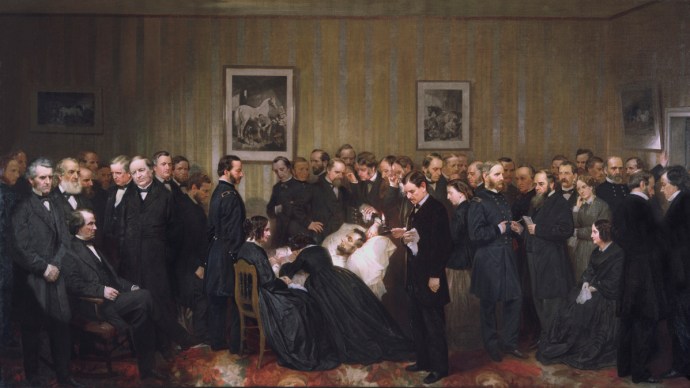
As fancifully large as these depictions are, they all pale in comparison with the magnitude of a painting by Alonzo Chappel.  His piece was a collaboration with another man by the name of John B. Bachelder, who served as the massive painting’s designer.  Entitled, The Last Hours of Abraham Lincoln, Chappel and Bachelder wanted to depict all of the notable people who visited Lincoln that night at the same time and, in doing so, stretched the rubber room into unparalleled proportions:

The Last House of Abraham Lincoln by Alonzo Chappel (Click to enlarge)

The Last House of Abraham Lincoln by Alonzo Chappel (Click to see an enlarged view)

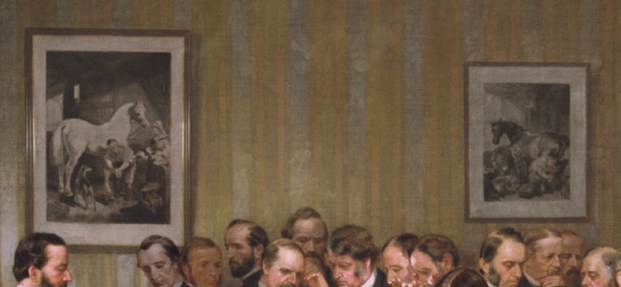
In all, the painting contains the images of 47 people in the back bedroom of the Petersen House.  The room has grown so much to accommodate all of these souls, that the walls started duplicating themselves.  It appears that the known lithograph that hung in the room “The Village Blacksmith” gave birth to a smaller, mirrored version of itself as the walls stretched out:

The Village Blacksmith & son Chappel

Just for fun, let’s say that all of the individuals pictured in Chappel’s painting were present in Lincoln’s death room at the same time.  Using modern measurements, William Clark’s room has an area of 177 square feet.  We’ll subtract 20 square feet for the bed on which Lincoln died since that is the only piece of furniture that we know had to remain in the room.  That leaves us with 157 square feet.  We’ll divide that by the 46 visitors in Chappel’s painting (we’re not including Lincoln since he was laying on the bed).  That gives everyone in the room a cozy 3.4 square feet all to themselves.  To give you some perspective, in a well ventilated, outdoor setting like a crowded rock concert, the accepted bare minimum amount of space per person is 7 square feet. For many interior settings the common rule of thumb is at least 9 square feet per person.  If everyone in this painting tried to get into William Clark’s room at the same time, they would be literally crammed together like sardines in a can.   What’s more, this imaginary calculation does not include the other furniture in the room, the large amount of space that the women’s hoop skirts would require, and the measurements by Osborn Oldroyd which, if correct, would lower the room’s original square footage from 177 sq. ft. to 161.5 sq. ft.

Despite the laughable morphing power of the small bedroom, Chappel’s painting was considered one of the best depictions of the death chamber of Abraham Lincoln.  The details for each person were exquisitely done and so life like.  Of course, there was a very good reason why Chappel was able to paint such realistic versions of the many people who visited Lincoln that night.  The designer of the piece, John Bachelder, had convinced many of the people in the painting to sit for photographs in the poses that Chappel wanted to paint.  Notable figures like Andrew Johnson, Edwin Stanton and even Robert Todd Lincoln posed in Mathew Brady’s studio in ways that the painting would later recreate.

Robert Todd Lincoln Alonzo Chappel

In addition to the cabinet members and politicians who posed for Bachelder and Chappel, there were also two individuals whose presence at the Petersen House was never questioned but, for some reason, they did not appear in other depictions of the President’s death.  These two neglected people were Mr. and Mrs. Lincoln’s guests for the evening, Major Henry Rathbone and Clara Harris.

Major Henry Rathbone and Clara Harris (composite by the author)

Major Henry Rathbone and Clara Harris (composite by the author)

Both Henry and Clara posed for their own photographs and were worked into the painting.  Clara is given a degree of prominence in the painting standing just behind the grieving Robert Todd Lincoln:

Clara Harris in Chappel's Last Hours

Henry, on the other hand, is removed from the chair he posed in and is literally sidelined to the far left of the painting.  He is almost obscured by the dark edge and frame, perhaps an ironic foreshadowing of the darkness that would later compel him to murder Clara and try to take his own life.

Major Rathbone in Chappel's Last Hours

Alonzo Chappel’s work, The Last Hours of Abraham Lincoln, is a work of contradiction.  The painting simultaneously contains the most detailed and accurate depictions of the individuals who visited the dying President while also demonstrating extreme hyperbole and imprecision with the seemingly ever expanding walls of William Clark’s bedroom.  It’s a beautiful yet unbelievable painting and it exemplifies the “Rubber Room” phenomenon in a truly unsurpassed way.

References:
Civil War Art Entry for The Last Hours of Abraham Lincoln
Library of Congress print of The Last Hours of Abraham Lincoln (slight differences)
Looking For Lincoln: The Making of an American Icon by the Kunhardts
The Lincoln Assassination: Crime & Punishment, Myth & Memory edited by Harold Holzer, Craig Symonds, and Frank Williams

Categories: Uncategorized | Tags: , , | 5 Comments

Lincoln Assassination sites via View-Master

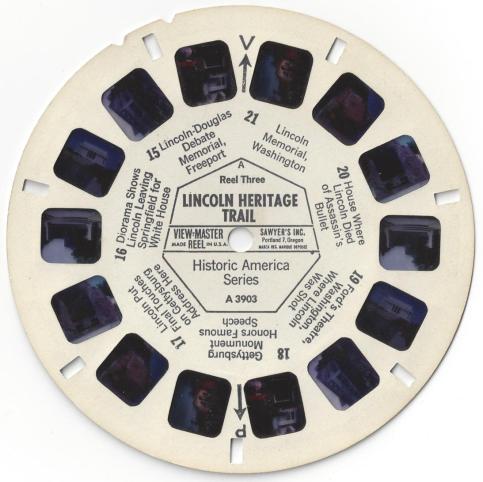
One of the great things about being home for the holidays is the chance to engage in some nostalgia. Today, I was looking through some of the old toys that my siblings and I played with as kids. My eyes came across a large container full of old View-Master cards. I found my favorite reels containing images of Mickey Mouse, Muppets, Snoopy, and other childhood characters. After playfully clicking through and looking at the familiar 3D images, I discovered some non-familiar View-Master reels. We probably inherited from my grandparents collection and it’s doubtful that I ever took any interest in these, non character, related reels as a child. Among the different views of national parks and seascapes was a set of three reels entitled the, “Lincoln Heritage Trail”.

Lincoln viewmaster

Though I have not been able to come up with a date for the images or the reels, there were two pictures from the reels that connect to Lincoln’s assassination.

Photo Dec 25, 8 53 21 PM

Ford’s Theatre from the “Lincoln Heritage Trail” View-Master reel

Photo Dec 25, 8 54 23 PM

Petersen House from the “Lincoln Heritage Trail” View-Master reel

I put the other 19 images from the “Lincoln Heritage Trail” View-Master reels up on Roger Norton’s Abraham Lincoln Discussion Symposium. Check them out here.

Categories: Uncategorized | Tags: , | 6 Comments

Corporal Tanner’s Letter

James Tanner in 1889

James Tanner in 1889

As Abraham Lincoln lay dying at the Petersen boardinghouse, the investigation was already underway in the parlor.  Under the order of Secretary Stanton, witnesses were interviewed and their testimony taken.  Finding the process of taking their testimony down in longhand to be too time consuming, the call went out for someone who knew phonography (shorthand). It was discovered that a boarder at the house adjacent to the Petersen House had studied phonography.  His name was Corporal James Tanner.  Tanner had been seriously wounded at Bull Run when a fragment of shell ripped through his lower legs:

“The boys picked me up,” Tanner recalled, and, “laid me on a blanket – no stretcher being available – and twisted a musket in on each side and lifted me to their shoulders.  Neither of my legs had been entirely severed; my feet were hanging by shreds of flesh.  The blanket was short, and lying on it on my face, I looked under and saw my feet dangling by the skin as they hung off of the other end.  Some kind hearted soul gently lifted them and laid them on the edge of the blanket.”

In the field hospital, both of Tanner’s legs were amputated four inches below the knee.  Tanner was exceeding lucky to survive the recovery process for such a wound.  When he returned to civilian life, he was equipped with artificial legs and learned to walk again with the use of a cane to help steady himself.  He entered business school and studied shorthand.  On April 14th, 1865, Tanner was residing in Washington, D.C. working for the Ordinance Bureau of the War department.

Tanner took the testimony of six witnesses, Alfred Cloughly, Lt. A. M. S. Crawford, Harry Hawk, James C. Ferguson, Henry B. Philips, and Col. George V. Rutherford that fateful night.  Two days after the President’s death, Tanner wrote a letter to a friend in which he recounted his involvement that night.  That letter, which follows below, contains an interesting glimpse at the activities inside the Petersen House and the duties of Corporal Tanner:

Ordnance Office, War Department,

Washington, April 17, 1865.

Friend Walch:

Your very welcome letter was duly received by me and now I will steal a few minutes from my duties in the office to answer it.

Of course, you must know as much as I do about the terrible events which have happened in this city during the past few days. I have nothing else to write about so I will give you a few ideas about that, perhaps, which you have not yet got from the papers.

Last Friday night a friend invited me to attend the theatre with him, which I did. I would have preferred the play at Ford’s Theatre, where the President was shot, but my friend chose the play at Grover’s, which was ‘Aladdin, or the Wonderful Lamp.’ While sitting there witnessing the play about ten o’clock or rather a little after, the entrance door was thrown open and a man exclaimed, “President Lincoln is assassinated in his private box at Ford’s!” Instantly all was excitement and a terrible rush commenced and someone cried out, “Sit down, it is a ruse of the pickpockets.” The audience generally agreed to this, for the most of them sat down, and the play went on; soon, however, a gentleman came out from behind the scenes and informed us that the sad news was too true. We instantly dispersed.

On going out in the street we were horrified to learn that Mr. Seward had been attacked and severely injured while in bed at his house. Myself and friend went up to Willard’s, which is a short distance above Grover’s, to learn what we could, but could learn nothing there. The people were terribly excited. Ford’s Theatre is on Tenth St. between E and F. Grover’s is on the Avenue near Fourteenth St. and just below Willard’s; it is about four blocks up from Ford’s. My boarding house is right opposite Ford’s Theatre. We then got on the cars and went down to Tenth St. and up Tenth St. to Ford’s and to my boarding house. There was an immense throng there, very quiet yet very much excited; the street was crowded and I only got across on account of my boarding there. The President had been carried into the adjoining house to where I board; I went up to my room on the second floor and out on the balcony which nearly overhangs the door of Mr. Peterson’s house. Members of the cabinet, the chief justice, Generals Halleck, Meiggs, Augur and others were going in and out, all looking anxious and sorrow-stricken. By leaning over the railing I could learn from time to time of His Excellency’s condition, and soon learned that there was no hope of him. Soon they commenced taking testimony in the room adjoining where he lay, before Chief Justice Carter, and General Halleck called for a reporter: no one was on hand, but one of the head clerks in our office, who boarded there, knew I could write shorthand and he told the General so, and he bade him call me, so he came to the door and asked me to come down and report the testimony. I went down and the General passed me in, as the house was strictly guarded, of course. I went into a room between the rear room and the front room. Mrs. Lincoln was in the front room weeping as though her heart would break. In the back room lay His Excellency breathing hard, and with every breath a groan. In the room where I was, were Generals Halleck, Meiggs, Augur and others, all of the cabinet excepting Mr. Seward, Chief Justice Chase and Chief Justice Carter of the District of Columbia, Andrew Johnson and many other distinguished men. A solemn silence pervaded the whole throng; it was a terrible moment. Never in my life was I surrounded by half so impressive circumstances. Opposite me at the table where I sat writing- sat Secretary Stanton writing dispatches to General Dix and others, and giving orders for the guarding of Ford’s and the surrounding country. At the left of me was Judge Carter propounding the questions to the witnesses whose answers I was jotting down in Standard Phonography. I was so excited when I commenced that I am afraid that it did not much resemble Standard Phonography or any other kind, but I could read it readily afterward, so what was the difference? In fifteen minutes I had testimony enough down to hang Wilkes Booth, the assassin, higher than ever Haman hung. I was writing shorthand for about an hour and a half, when I commenced transcribing it. I thought I had been writing about two hours when I looked at the clock and it marked half past four A.M. I commenced writing about 12 M. I could not believe that it was so late, but my watch corroborated it. The surrounding circumstances had so engrossed my attention that I had not noticed the flight of time. In the front room Mrs. Lincoln was uttering the most heartbroken exclamations all the night long. As she passed through the hall back to the parlor after she had taken leave of the President for the last time, as she went by my door I heard her moan, “O, my God, and have I given my husband to die,” and I tell you I never heard so much agony in so few words. The President was still alive, but sinking fast. He had been utterly unconscious from the time the shot struck him and remained so until he breathed his last. At 6:45 Saturday morning I finished my notes and passed into the back room where the President lay; it was very evident that he could not last long. There was no crowd in the room, which was very small, but I approached quite near the bed on which so much greatness lay, fast losing its hold on this world. The head of the bed was toward the door; at the head stood Cap. Robert Lincoln weeping on the shoulder of Senator Sumner. General Halleck stood just behind Robert Lincoln and I stood just to the left of General Halleck and between him and General Meiggs. Secretary Stanton was there trying every way to be calm and yet he was very much moved. The utmost silence prevailed, broken only by the sound of strong men’s sobs. It was a solemn time, I assure you. The President breathed heavily until a few minutes before he breathed his last, then his breath came easily and he passed off very quietly.

As soon as he was dead Rev. Dr. Gurley, who has been the President’s pastor since his sojourn in this city, offered up a very impressive prayer. I grasped for my pencil which was in my pocket, as I wished to secure his words, but I was very much disappointed to find that my pencil had been broken in my’ pocket. I could have taken it very easily as he spoke very favorably for reporting. The friends dispersed, Mrs. Lincoln and family going to the White House, which she had left the night before to attend the theatre with him who never returned to it except in his coffin.

Secretary Stanton told me to take charge of the testimony I had taken, so I went up to my room and took a copy of it, as I wished to keep both my notes and the original copy which I had made while there in the house. They will ever be cherished monuments to me of the awful night and the circumstances with which I found myself so unexpectedly surrounded and which will not soon be forgotten.

Saturday night I took the copy I had made to the Secretary’s house, but as he was asleep I did not see him, so I left them with my card. I tell you, I would not regret the time and money I have spent on Phonography if it never brought me more than it did that night, for that brought me the privilege of standing by the deathbed of the most remarkable man of modern times and one who will live in the annals of his country as long as she continues to have a history.

Frank Leslie’s Illustrated will have a good picture of the building there made celebrated by this sad event on that evening. I saw the sketch made by the artist of the theatre, and it was very correct, indeed. He also sketched the inside of the room where the President died, also the outside of the building, as well as the adjoining buildings on both sides. You will see the house I board in has a balcony along the front of the two rooms on the second floor; I occupy both of those rooms.

Drawing of the Peterson house from Frank Leslie's  Illustrated Weekly 5/20/1865.  Corporal Tanner's room and balcony are visible on the building next door.

Drawing of the Peterson house from Frank Leslie’s Illustrated Weekly 5/20/1865. Corporal Tanner’s room and balcony are visible on the building next door.

You can imagine the feeling here by judging of the feeling in your own place, only it is the more horrifying from the fact that the President lived in our midst and was universally beloved by the People.

This morning there was published in the Chronicle the statement of one of the witnesses whom I reported, Mr. James B. Ferguson. You will doubtless see it in your papers as it is most important. I have an idea, which is gaining ground here, and that is that the assassin had assistance in the theatre, and that the President was invited there for the express purpose of assassinating him. The theatre is very strictly guarded now night and day.

Very truly your friend,

James Tanner.

References:
The Life of Abraham Lincoln by William Barton
While Lincoln Lay Dying by The Union League of Philadelphia

Categories: Uncategorized | Tags: , | 10 Comments

Blog at WordPress.com.