Posts Tagged With: Media

The Assassination in Comic Books

The assassination of Abraham Lincoln at the hands of John Wilkes Booth was a defining moment of American history.  It was a national tragedy the likes of which we had never experienced.  It turned Lincoln into a martyr and changed the course our country would take after a devastating Civil War.  For this reason, the assassination of Abraham Lincoln has become perfect fodder for the imaginative minds of comic book writers.  Through this artful medium, Lincoln’s assassination has been remembered, revised, and completely reinvented to match the worlds in which superheroes like Superman, Batman, The Flash, and others exist.  Most references to the assassination in comic books are brief but a select few have devoted serious attention to America’s great drama of April 14th, 1865.

The Assassination Remembered

Several comic books briefly mention the assassination of Abraham Lincoln as it occurred.  Occasionally, the main character is somehow thrown back through time or enters a parallel world to witness it.  They may interact in the narrative, but the ending is still the same.

  • Superman’s young photographer friend from the Daily Planet, Jimmy Olsen, is thrown back in time to the night Lincoln is assassinated in this comic from 1968:

  • The assassination of Lincoln is remembered in a flashback in a Batman comic from 2003: 
The Assassination Revised

While reminding us all of the past is nice, it isn’t very superhero-y.  More often, the death of President Lincoln is averted due to the help of a hero, or because this is a parallel world where his assassination never occurred in the first place.

  • Superman saves Lincoln just in time in a comic from 1961.  He later discovers he is in a parallel world and history is unchanged in the “real” world.

  • In this West Coast Avengers comic from 1990, Lincoln is able to thwart his own assassination by quick reflexes. Sadly, this is just a parallel world which is destroyed by the man impersonating Major Rathbone.

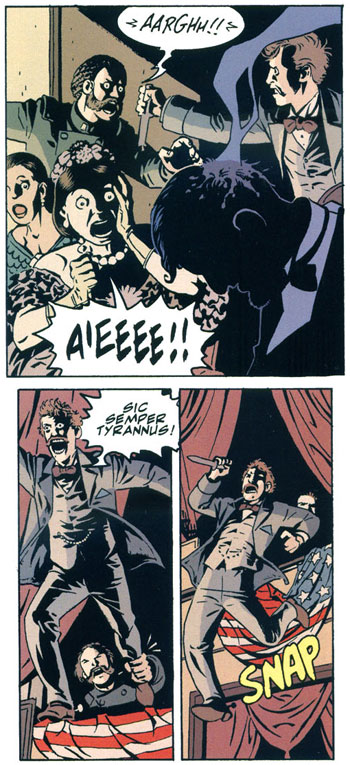
  • Quick thinking on Civil War Superman’s part saves the President while Booth is impaled by his own knife in this comic from 2003.
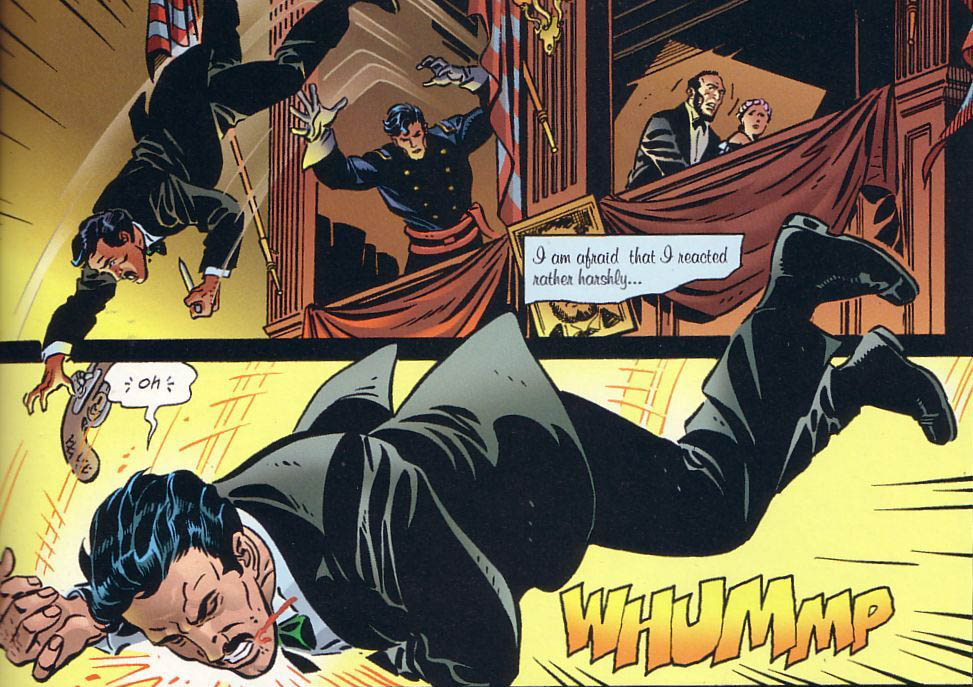
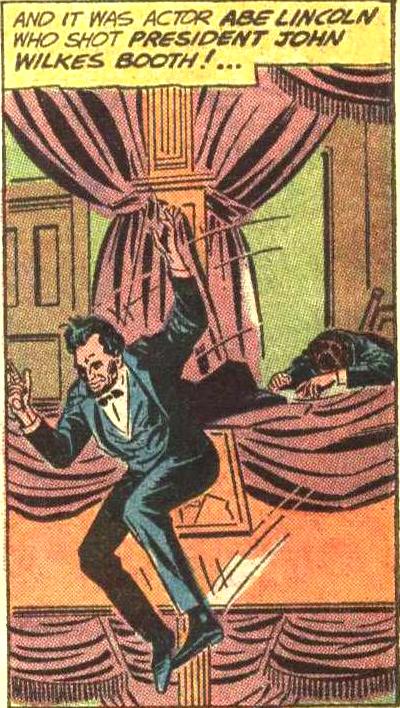
  • An actor who closely resembles Abraham Lincoln is somehow sent back in history to the most inconvenient time for him in this standalone comic from 1956.

The Assassination Reinvented

In these versions, the normal history is changed drastically for the comic book world.

  • In a parallel world visited by the Justice League of America in 1964, the villain and victim are switched.
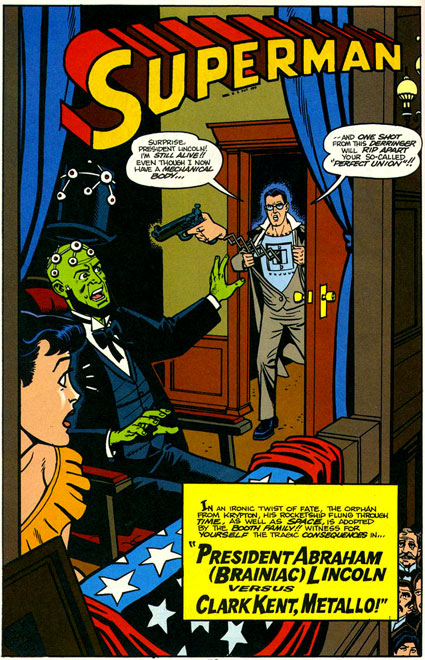
  • In this one shot cover parody from 1999, an alternate Superman is sent to Earth to be raised by the Booth family.  Don’t ask me about the green “Brainiac” Lincoln or the half robot Superman with a derringer in his chest.  I don’t get it either.
  • In this portion of the TV show Batman: The Brave and the Bold, Batman and Abe fight against a “steampunked” John Wilkes Booth:

As entertaining as that rendition is, however, my favorite incarnation of the assassination of Abraham Lincoln in the comic book realm is this 1971 issue of The Flash:

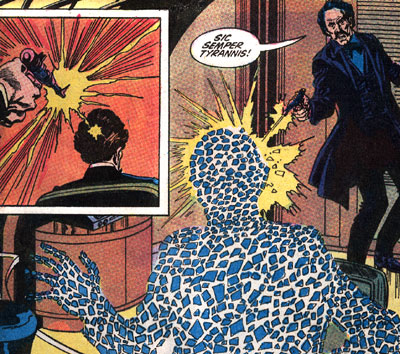
From what I can gather from sources online, the Flash travels forward in time to the year 2971.  He enters a world which once contained a united Earth.  However a dispute has broken out between Earth East and Earth West and there is Civil War once again.  The beginning of the comic leads with a future Lincoln getting disintegrated by a future John Wilkes Booth.

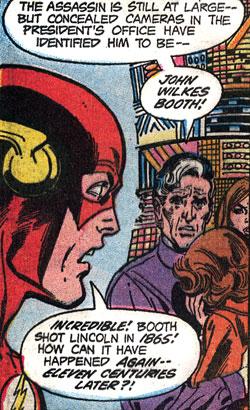
The Flash is rightly confused by how this is possible.
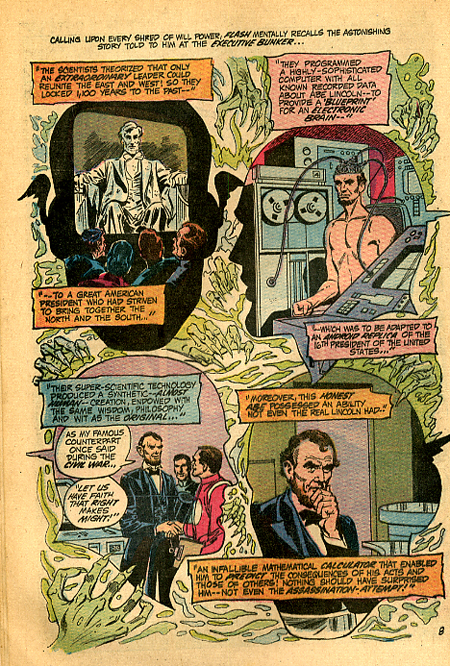
It turns out the future scientists created a robotic Abraham Lincoln to lead them through the Civil War.  He contained Lincoln’s wit and wisdom, and also the ability to calculate the consequences of people’s actions.
Booth makes his escape to Earth East using a jet suit.

The Flash chases after him, but gets trapped when Booth ties him up with a future chain that squeezes him harder and harder.

Booth jets off again to meet his master, an evil mastermind named Bekor.  He turns over the murder weapon he used to kill Lincoln to Bekor.  Bekor betrays Booth and shoots him with the disintegrator.  Bye Bye, Booth.  When Bekor kills Booth though, Robot Abraham Lincoln remerges out of the gun.  Apparently, using his robot brain, Lincoln predicted someone would try to take his life.  So he carried around his anti-disintegrator pocket watch.

He turns the table on Bekor using his good old fashioned wrestling skills.

By then, The Flash has managed to escape the squeezing chains and rushes to Bekor’s lair.  He manages to get Lincoln out of the lair before it self-destructs.  Lincoln continues as President of Earth, using his 19th century wisdom to lead this troubled, 30th century world.  This is a fun and entertaining reinvention of the assassination of Lincoln.

There are many other comic books that include references to the assassination of Abraham Lincoln with more coming out every year.  As long as Abraham Lincoln continues to be an important part of the American story, his death will continue to find a place within their multicolored pages.

Categories: Uncategorized | Tags: , , , | 12 Comments

Davy Herold on Alphas

In addition to my interest in history, I am also a bit of a nerd in other, more traditional ways (shocking, I know).  Specifically, I’m a fan of several science fiction shows.  Today, I was catching up on a few episodes of the SyFy television show Alphas.  For non-nerds, Alphas is a TV show about people who have superhuman abilities.  It’s essentially X-Men but with more realistic and believable abilities.  Recently, the good Alphas have been trying to track and capture the leader of the bad Alphas.  He is a man by the name of Stanton Parish.  His Alpha ability is perfect control of his brain which manifests in his ability to slow down his aging process and heal his body.  The team was able to find images of him dating back to the Civil War and how old he really is has yet to be determined:

Alphas’ “Stanton Parish”

While watching it today, there was a second when the leader of the good Alphas, Dr. Rosen, was flipping through his materials on Stanton Parish.  There was a quick shot of an image that looked strangely familiar.  I rewound the video (you got to love the “On Demand” feature), and paused it.  I could see then that the producers of the show had taken the head of the Stanton Parish character and had Photoshopped it onto the body of the Lincoln assassination conspirator, David Herold:

Alphas’ “Stanton Parish” on David Herold’s body. The untouched photo of Davy is included for comparison.

I had a good chuckle over this strange cameo appearance by Davy Herold.  References to the assassination can be found in the most unlikeliest of places.

Categories: Uncategorized | Tags: , | 2 Comments

Nettie Mudd on the Airwaves

Nettie Mudd Monroe From Robert Summers' Dr. Samuel A. Mudd Research Site

Nettie Mudd Monroe From Robert Summers’ Dr. Samuel A. Mudd Research Site

In 1938, at the age of sixty, Dr. Mudd’s youngest daughter Mary Eleanor, better known as “Nettie” made a special vocal appearance during the intermission of Lux Radio’s production of The Prisoner of Shark Island:

The Prisoner of Shark Island radio drama was based off of the 1936 film of the same name starring Warner Baxter.  The film and radio shows are highly fictionalized versions of Dr. Mudd’s involvement in Lincoln’s assassination and life imprisoned on Fort Jefferson, Dry Tortugas.  In these highly popular renditions, Dr. Mudd is portrayed as a completely innocent country doctor who knew nothing of the men who stopped at his house during the early morning hours of April 15th, 1865.  While wholly inaccurate, these revisions to history and the efforts of Mudd descendants like Nettie and Dr. Richard Dyer Mudd helped to turn public sympathy to Dr. Mudd’s favor.  To this day, historians still have to compete with this inaccurate “legend of Dr. Mudd” when trying to accurately explain Dr. Mudd’s relationship to John Wilkes Booth and the events that led to Lincoln’s death.

References:
Nettie Mudd from the Dr. Samuel A. Mudd Research Site

Categories: Uncategorized | Tags: , | 13 Comments

Touched by an Angel

If you have the time, I invite you all to watch this 1998 episode of Touched by an Angel entitled “Beautiful Dreamer”. In it, Della Reese’s character recounts the assassination of Lincoln through the experiences of her fellow angels, who were there at the time.  The show is filled with artistic and spiritual license (it is Touched by an Angel, after all), but it still provides an entertaining and fairly accurate representation of Lincoln’s death.  While Booth is portrayed more drunken than sinister, the writers of the show still gave him wonderful dialogue with the angel, Andrew, explaining his motivations and beliefs.  It is a unique portrayal of Booth that actually leaves us feeling sorry for him rather than hatred.   What’s more, it’s clear the producers did their homework.  They stunningly recreated the façade of Ford’s Theatre, the presidential box, and even included auxiliary characters by name like Laura Keene, Peter Taltavull, and John Parker.  In my opinion, this dramatization of Lincoln’s assassination from the mainstream media is one worth watching.

Categories: Uncategorized | Tags: , , | 7 Comments

“An old codger like me” – Samuel Seymour, Eyewitness to History

Prologue: This post is dedicated to the memory of my grandfather, Robert James Taylor, who passed away on July 4, 2013, at the age of 95, a year after this post was written. Thanks for sparking my interest in the past, Umpa.


Today, June 20, 2012, my grandfather celebrates his 94th birthday. The son of an Irish immigrant and his Illinois-born wife, my grandfather was educated at Illinois Wesleyan University, served as a Captain in the Marines during WWII and the Korean War, and raised a family of three boys with my grandmother. To me, though, he has always been Umpa: the devoted church going grandfather who would take me fishing and was always working his garden. I never knew until I was older that he was a Marine, and while he would openly tell me stories about the war, it always brought tears to his eyes. My grandfather taught me that war was always a regrettable thing, even when it is justified. He was proud of his service to his country but would never glorify what he had experienced. Nowadays, his life has slowed down considerably. He talks less, sleeps more, but is still the kind and inquisitive grandfather I’ve always known. Unfortunately, he will be spending this birthday in the hospital. I’ve logged about 18 hours with him over the last two days after a recent medical setback. As a 94-year-old, it is to be expected. Nevertheless, he still enjoys sharing one fact about his life with the nurses that always throws them for a loop. When asked where he was born, he answers truthfully, “Nani-Tal, India.” The nurses briefly stare at him, before turning to us, his family members, with a worried look that this characteristically Caucasian man has gone senile. We, of course, respond in the affirmative, and recall how his parents were missionaries and that he and two of his siblings were born in India. My grandfather was almost three years old when the family returned to America. His memory of India is now just a few Christian hymns in the Hindi language that he sang as a child. Nevertheless, he can still recall all the lyrics to “Jesus Loves Me” in Hindi.

My 94-year-old grandfather’s ability to remember one of his earliest experiences mirrors that of another 94-year-old man who recounted his experience of Lincoln’s assassination.

Many of us have seen the following episode of the TV show, I’ve Got a Secret, which aired on February 9, 1956.  In it, the American viewing audience is presented with the last surviving witness to Abraham Lincoln’s assassination, 96-year-old Samuel J. Seymour of Baltimore. You will want to fast forward to the 11:57 mark in the video below:

In the video, the host mentions that they learned about Mr. Seymour due to an article written by him in The American Weekly magazine.  That article was published on February 7th of 1954, when Samuel Seymour was 94 years old.

After some searching, I found the original article by Mr. Seymour and transcribed it from the newspaper record.  Here it is in full:

I Saw Lincoln Shot

By Samuel J. Seymour

As told to Frances Spatz Leighton

The only living witness re-creates the drama of that tragic night

This is an eyewitness account of one of history’s great tragedies – the assassination of Abraham Lincoln – told by the only living witness to the fateful drama enacted at Ford’s Theater on the night of April 14th, 1865 – THE EDITORS

Even if I were to live another 94 years, I’d still never forget my first trip away from home as a little shaver five years old.

My father was overseer on the Goldsboro estate inTalbot County, Maryland, and it seems that he and Mr. Goldsboro has to go to Washington on business – something to do with the legal status of their 150 slaves. Mrs. Goldsboro asked if she couldn’t take me and my nurse, Sarah Cook, along with her and the men, for a little holiday.

We made the 150-mile trip by coach and team and I remember how stubborn those horses were about being loaded onto an old fashioned side-wheeler steamboat for part of the journey.

It was going on toward supper time – on Good Friday, April 14th, 1865 – when we finally pulled up in front of the biggest house I ever had seen. It looked to me like a thousand farmhouses all pushed together, but my father said it was a hotel.

I was scared. I had seen men with guns, all along the street, and every gun seemed to be aimed right at me. I was too little to realize that all of Washington was getting ready to celebrate because Lee has surrendered a few days earlier.

I complained tearfully that I couldn’t get out of the coach because my shirt was torn – anything to delay the dread moment – but Sarah dug into her bag and found a big safety pin.

“You hold still now, Sammy,” she said, “and I’ll fix the tear right away.” I shook so hard, from fright, that she accidentally stabbed me with the pin and I hollered, “I’ve been shot! I’ve been shot!”

When I finally had been rushed upstairs, shushed and scrubbed and put into fresh clothes, Mrs. Goldsboro said she had a wonderful surprise.

“Sammy, you and Sarah and I are going to a play tonight,” she explained. “A real play – and President Abraham Lincoln will be there.”

I thought a play would be a game like tag and I liked the idea. We waited a while outside the Ford Theater for tickets, then walked upstairs and sat in hard rattan-backed chairs.

Mrs. Goldsboro pointed directly across the theater to a colorfully draped box. “See those flags, Sammy?” she asked. “That’s where President Lincoln will sit.” When he finally did come in, she lifted me high so I could see. He was a tall, stern-looking man. I guess I just thought he looked stern because of his whiskers, because he was smiling and waving to the crowd.

When everyone sat down again and the actors started moving and talking, I began to get over the scared feeling I’d had ever since we arrived inWashington. But that was something I never should have done.

All of a sudden a shot rang out – a shot that always will be remembered – and someone in the President’s box screamed. I saw Lincoln slumped forward in his seat. People started milling around and I thought there’d been another accident when one man seemed to tumble over the balcony rail and land on the stage.

“Hurry, hurry, let’s go help the poor man who fell down,” I begged.

But by that time John Wilkes Booth, the assassin, had picked himself up and was running for dear life. He wasn’t caught until 12 days later when he was tracked to a barn where he was hiding.

Only a few people noticed the running man, but pandemonium broke loose in the theater, with everyone shouting:

“Lincoln’s shot! The President’s dead!”

Mrs. Goldsboro swept me into her arms and held me close and somehow we got outside the theater. That night I was shot 50 times, at least in my dreams – and I sometimes still relive the horror of Lincoln’s assassination, dozing in my rocker as an old codger like me is bound to do.”

Of the many firsthand accounts given in books (like We Saw Lincoln Shot by Timothy Good), I prefer this one by Mr. Seymour. There is an innocence in his account that can’t be found anywhere else. While Major Rathbone and others give more details regarding the actual event, young “Sammy” gives a unique perspective. We become more connected to this child and his young life. We can empathize with his sense of uncertain fear and even feel the disappointment he must have had when he experienced what a “play” truly was. Most of all, I marvel at Sammy’s kindness and compassion. Ignorant of the context of what had occurred, this boy only wanted to help the man who had fallen.

Mr. Seymour died two months after his appearance on I’ve Got a Secret, possibly related to his fall the day before the show. He died on April 13, 1956, just a day shy of the anniversary of the event he witnessed.  Mr. Seymour is buried in Loudon Park Cemetery in Baltimore, MD; however, his grave is unmarked.

References:
We Saw Lincoln Shot by Timothy Good
Mr. Seymour’s article in The American Weekly
Roger Norton’s Abraham Lincoln’s Assassination Research Site has a nice picture of Mr. Seymour

Categories: History | Tags: , , , | 8 Comments

Blog at WordPress.com.