Posts Tagged With: JWB

JWB and Grover Cleveland: Drunks

The night of Tuesday September 17th, 1895 proved to be a busy (and historic) one for the Chicago police department:

Let the romps of “J. Wilkes Booth” and “G. Cleveland” be a lesson to us all – no matter how dead or distinguished you might be, there’s no controlling how the “spirits” might move you.

References:
The Daily Inter Ocean – Sept. 19, 1895
The steamer that “J. Wilkes Booth” was the cook for, “The City of Traverse”, spent its twilight years as an illegal gambling ship.

Categories: Uncategorized | Tags: , | 1 Comment

Some Real Booth Mummies

Finis Bates spent many misguided years trying to convince the world that John Wilkes Booth escaped death at Garrett’s farm. He displayed the mummified remains of David E. George and tricked people into believing the body’s convoluted identity trail from David George, to John St. Helen, to John Wilkes Booth. Bates created convincing pseudo-history with a dead body as an effective centerpiece. However, long before the real John Wilkes Booth was even born, the Booth family had a legitimate connection with mummies.  I quote from Asia Booth Clarke’s book, Booth Memorials: Passages, Incidents, and Anecdotes of Junius Brutus Booth (The Elder):

“About this time [1833] my father [Junius Brutus Booth] purchased two Egyptian mummies, with a view of presenting them to General Jackson. They were to be sent to the Hermitage; but, finding that they were such rare specimens, it was suggested that they should be reserved for the Museum in Washington, for which Mr. Varden was then collecting curiosities. The mummies were priests of the god “Apis; ” and, on examination, the papyrus manuscripts, although in excellent and legible order, proved to be of such antiquity that it was impossible for the literati of that day to translate their meaning.

Languages, like nations and religions, take their turns and seem to prove the mutability of nature. Mr. Varden’s design being ineffectual, the mummies were subsequently deposited in the Patent Office, Washington, and removed thence to the Smithsonian Institute.”

The eccentric Junius, was one of contradictory tendencies at times.  He cherished life in all forms, forbidding the killing of animals in his home and following the practically unheard of practice of vegetarianism.  At the same time though, he was friends with people like Sam Houston and Andrew Jackson.  Original Boothie John C. Brennan once said how odd a gift he thought the mummies to be for Jackson as Jackson wasquite good at, “shooting people and producing his own cadavers”.  The actor who wept during his organized funeral for dozens of killed pigeons, did not have the same reverence, it seems, for the remains of the long dead Egyptians.

According to Michael Kauffman in his book American Brutus, no donation record can be found for Junius’ mummies at the Smithsonian.  Nevertheless, as I visited the Smithsonian’s National Museum of Natural History and explored the Ancient Egypt exhibit today, I couldn’t help but wonder if one of the mummies on display once belonged to Junius Brutus Booth.  At least then there would be a real “Booth Mummy”.

John Wilkes Booth looking for his father’s donated pair of mummies in the Smithsonian.

References:
Booth Memorials: Passages, Incidents, and Anecdotes of Junius Brutus Booth (The Elder) by Asia Booth Clarke
American Brutus by Michael Kauffman
The photo of JWB in the Smithsonian was taken using the Augmented Reality function of Michael Kauffman’s new publication, In the Footsteps of an Assassin.  After purchasing the book, smartphone users are able to download an app which provides tour commentary on the go.  It also includes four augmented reality photo ops in which an overlay of Lincoln, Mary Todd, JWB or Lewis Powell, can be added before taking any picture.  Now, I can take snap a photo of Booth anywhere, without any photo editing required.

Categories: Uncategorized | Tags: , , | 6 Comments

One Rough Romeo

John Wilkes Booth was well known for his devotion to the physicality of the characters he portrayed.  While his elocution of Shakespearian parts required additional training, audiences would still come out in droves to witness Booth leap and fight with unbridled passion.  It was Booth’s energy that made him a star.  Even Edwin remarked at his brother’s ability by stating, “When time and study round his rough edges he’ll bid them all ‘stand apart.’” Edwin paraphrases a line from Richard II that states, “Stand all apart, and show fair duty to his majesty” displaying his belief that his brother had the makings to be a prince of the stage as well.

Nevertheless, John’s vigor proved trying to many of the actors and actresses with whom he shared the stage.  Catherine Reignolds-Winslow, an actress who played with John Wilkes in Boston, wrote of him in her memoirs:

“As an actor he had more of the native fire and fury of his great father than any of his family, but he was as undisciplined on the stage as off.  When he fought, it was no stage fight.  If his antagonist did not strain his nerve and skill, he would either be forced over the stage into the orchestra as happened, I believe, once or twice; or cut and hurt, as almost always happened.  He told me that he generally slept smothered in steak or oysters to cure his own bruises after Richard the Third, because he necessarily got as good as he gave, – in fact more, for though an excellent swordsman, in his blind passion he constantly cut himself. How he threw me about! Once even knocked me down, picking me up again with a regret as quick as his dramatic impulse had been vehement. In Othello, when, with, fiery remorse, he rushed to the bed of Desdemona after the murder, I used to gather myself together and hold my breath, lest the bang his cimeter gave when he threw himself at me should force me back to life with a shriek.

The sharp dagger seemed so dangerous an implement in the hands of such a desperado that I lent him my own – a spring dagger, with a blunt edge, which is forced back into its handle if it is actually struck against an object. In the last scene of Romeo and Juliet, one night, I vividly recall how the buttons at his cuff caught my hair, and in trying to tear them out he trod on my dress and rent it so as to make it utterly useless afterward; and in his last struggle literally shook me out of my shoes! The curtain fell on Romeo with a sprained thumb, a good deal of hair on his sleeve, Juliet in rags and two white satin shoes lying in the corner of the stage!”

So, while Booth was known to be a heart breaker to the women he wooed off of the stage, it appears he was known as a bit of a bone breaker to those he encountered on it.

One interesting note in Catherine Reignolds-Winslow’s memoirs is the mention of her lending him a collapsible dagger.  A similar dagger from the Booth family and apparently used by John Wilkes once belonged to Dr. John Lattimer and was sold at auction in 2008.  If true, perhaps other leading ladies began requiring Booth to use such a prop in hopes that they might avoid further harm at his hands.

References:
My Thoughts Be Bloody by Nora Titone
Yesterdays with Actors by Catherine Mary Reignolds-Winslow

Categories: Uncategorized | Tags: , | 3 Comments

Shooting Booth

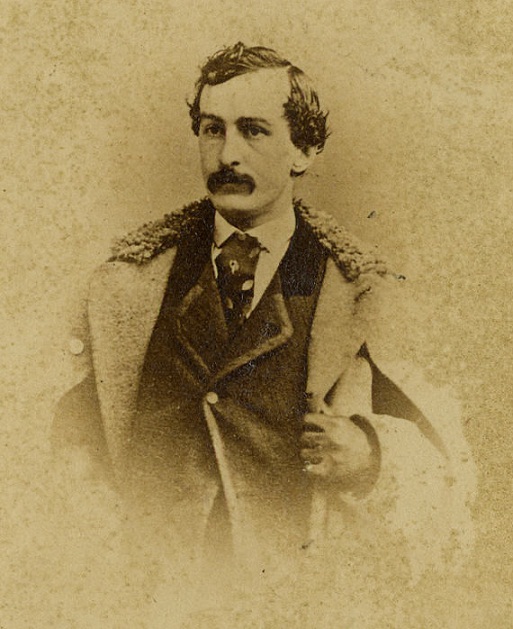
While Boston Corbett has entered history as the man who avenged Abraham Lincoln in the morning hours of April 26th, 1865, Booth had another bullet enter his body some time before that date.  This shooting was courtesy of his own manager and agent, Matthew W. Canning.

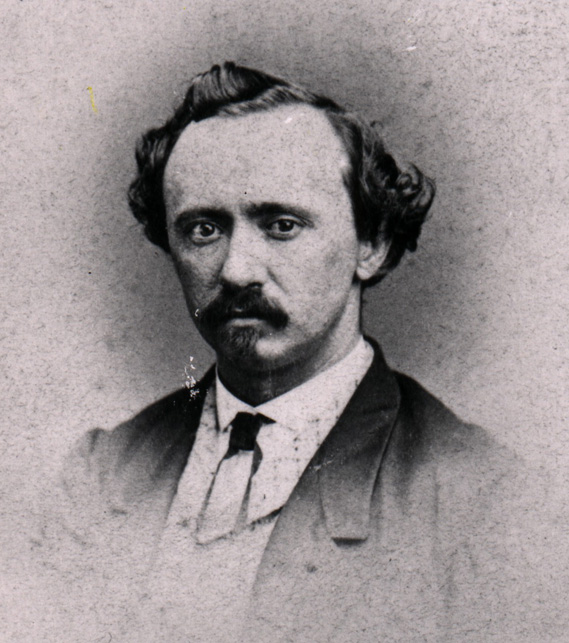
Matthew W. Canning

By 1860, John Wilkes Booth had started to tire of playing supernumerary parts.  The pay was very small, and he longed to be recognized as a talented actor.  His brother, Edwin Booth, was being lauded as his father’s creative heir and was enjoying life as a bona fide star.  While lacking the training his older brother received through his father’s tutelage, Wilkes believed himself to be on par with his famous brother.  He set out for his own “star” tour.  The theatrical star system of the day allowed the lead actor and actress to receive a part of the profits for each performance, rather than a small set salary for the season that the stock actors received.  Being the son of the great tragedian Junius Brutus Booth and brother to the successful Edwin, Wilkes had an easier time than most finding himself an agent.  Despite his amateurish experience, his Booth name was guaranteed to bring in patrons.  Wilkes was invited to play as a star by a former Philadelphia lawyer turned theatrical manager, Matthew Canning.

Matthew W. Canning was in the process of building his own theatre in Montgomery, Alabama and saw the benefits of having a Booth as his star.

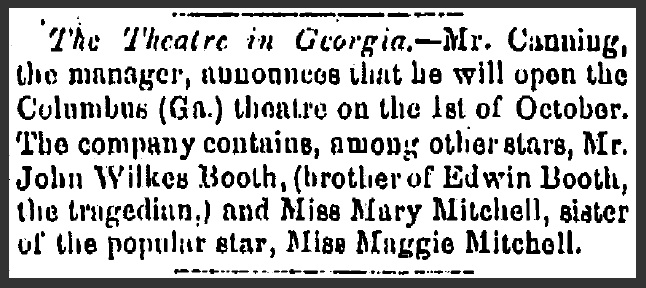
Before his own theatre opened, however, the Canning Dramatic Company toured the southern states starting in Columbus, Georgia.  The other actors in the company included the sisters Maggie, Mary, and Emma Mitchell and Samuel Knapp Chester, a man Booth later would attempt to include in his conspiracy.  Perhaps to save the Booth name for his own theatre’s success, Canning continued to bill John Wilkes Booth under his stage name, “J. B. Wilkes”.  While the lineage of the Canning Dramatic Company’s lead was becoming less and less of a secret with the press and the public, during the troupe’s entire run in Columbus, “Mr. Wilkes” was the star.

Mr. Wilkes’ first performance as a star occurred on October 1, 1860, playing Romeo to Maggie Mitchell’s Juliet.  His time in Columbus proved a success, with newspapers speaking of the company being, “much superior” from Canning’s last troupe and citing that, “Mr. Wilkes and Miss Mitchell are highly complimented.”  For an actor who had a shaky start as a stock player, Booth’s first star tour was everything he could have hoped for.  Until the night of October 12th that is, when Canning shot Booth.

The exact details on how the shooting occurred are varied.  A newspaper of the day, stated, “Mr. John Wilkes Booth was accidentally shot in the thigh at Cook’s Hotel.  Mr. Booth and Mr. Canning were practicing with a pistol, when it went off in Mr. Canning’s hand as he was letting down the hammer, inflicting a flesh wound in Mr. Booth’s thigh.”  A more amusing, though less likely account comes from The Mad Booths of Maryland by Stanley Kimmel: “The night he was to play Hamlet another actor was with him in his dressing room when Canning entered and jokingly threatened to shoot both of them.  The gun unexpectedly exploded and Wilkes ‘was shot in the rear.’”

The most reliable account, while written years after the fact and probably embellished with age, comes from Matthew Canning himself.  On January 19th, 1886 George Alfred Townsend, better known as GATH, published an interview he had with Matthew Canning in the Cincinnati Enquirer:

“No doubt your readers smile at me for having so often in this correspondence brought up incidents concerning John Brown and Booth, the assassin.  The fact is that I have just got off my hands a piece of literary work concerning these parties, which has taken so much investigation that I have at times discharged my findings into correspondences.  I shall not have the amiable defect of Lot’s wife in ever looking behind me, and therefore, these notes will end with the work for which they were obtained.

Yesterday I saw Matthew Canning, who started with Booth on a starring tour as his manager, and he said to me as follows: ‘Edwin Booth asked me to give his brother Wilkes a star.  He was not, strictly speaking, a star: he was a member of my stock company and played as a star, but of course he did not get the profits a star would receive.  I had a little circuit in the Southern States, with Montgomery for its chief center, and I was building a theater down there when I happened to shoot John Booth.  I can tell you about that curious incident.  Booth was one of the best shots in the profession, and his special passion was his physical training and strength.  That may have led him into the crime in the way he committed it.  When I took him out he was quite a young fellow, and had been known in the profession before as Mr. Wilkes.  I made it a point with Edwin Booth that he should play under his family name, as it would draw me money.  We were at Columbus, Ga., and my theater was not finished and had given me a great deal of trouble.

‘I went into my room one day, and he said to me: ‘Now, you must let me nurse you.  You are fagged out.’ I told him I only wanted to go to sleep.  I laid down on the bed and was in a doze when he saw my pistol in my rear pocket.  Every body carried weapons down in that country, and so did I.  Seeing the pistol, Booth yielded to his passion for arms, and he drew it out of my pocket.  I could feel it glide from me, but was in that state that I did not resist or rise.  Although he had just said that I wanted rest and sleep, he pointed the pistol at an iron mark on a wall opposite and discharged it right there in the room.  Of course I sprang up, complaining that he excited me by that explosion.  He then said he wanted another shot, and I objected; but he seemed to have his mind on firing again to show his accuracy of aim.  The pistol had got rusted, and when I gave him a cartridge to put in it, it would not fit easily.  He took his knife and began to scrape the pistol and the cartridge, and while in the act of doing it, down came the lock in my hand and discharged the pistol, and the ball struck him in the side, barely missing the femoral artery and it lodged in his body.  We thought he would die, but he recovered in a few weeks.”

The wound Booth received from Canning was not just a flesh wound as the newspaper stated and would lay him up for some time.  Starting from the night of the accident until Booth’s return, the lead roles were played by John W. Albaugh, Canning’s stage and acting manager.  This gave Albaugh the opportunity to act alongside Mary Mitchell, the woman who would later become his wife.

On October 19th, seven days after Booth was shot, Canning scheduled a benefit in his honor where he would receive most of the proceeds of the show.  It is likely Canning was attempting to assuage his guilt for shooting and disabling his lead actor.  Unfortunately, inclement weather in Columbus kept even the heartiest of theatre-goers away on the 19th, and so the benefit was rescheduled for the next day.  This was the company’s last day in Columbus and they performed Julius Caesar.  Booth’s injury kept him from performing in the whole play but, as a gesture of thanks for the city that supported him and celebrated him in his first starring engagement, Booth took the stage and recited Mark Anthony’s pivotal, “Friends, Romans, countrymen, lend me your ears,” speech.

From Georgia, the Canning Dramatic Company travelled to Montgomery, Alabama to perform in Matthew Canning’s own, appropriately named, Montgomery Theatre.  Though advertisements promised “Mr. John Wilkes” would make his debut on the 23rd of October, the night came and went without his appearance on stage.  The notoriously agile and active player was still not physically healed enough to perform.   He would not make his Montgomery debut until October 29th when he played the role of Pescara in The Apostate.
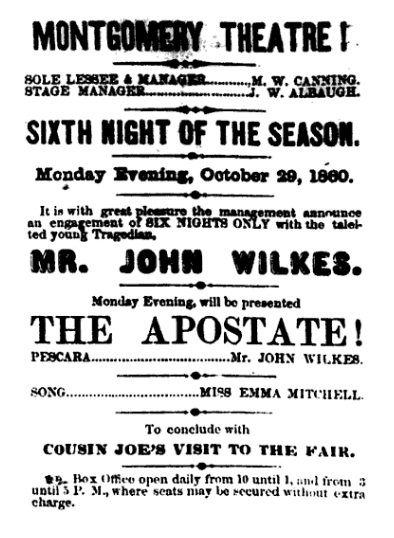
Though his wound forced him to be a little more reserved than his normal acting habits, the Montgomery audiences supported this young and talented actor.  When Booth played Hamlet, Canning’s theatre was filled to the brim with patrons.  Everyone came to see the son of Junius Brutus Booth, rival of Edwin Booth, and most agreed that, while he needed some refinement, he carried his father’s torch well.  During all of this time, however, John was still billed as “Mr. Wilkes”.

It does not appear that the transition from “Mr. Wilkes” to “J. Wilkes Booth” was instigated by John.  In fact, his star billing as “Mr. Wilkes” for weeks shows that he wanted to be celebrated for his own abilities.  In the end, John did not take the Booth name back; rather it was justly given to him.  The first billing of him as J. Wilkes Booth occurred on December 1st, when Maggie Mitchell presented a benefit in his honor.

His fellow actors had conferred his Booth name upon him and, after receiving such admiration in his first tour, he believed it to have been rightly bestowed.  He had proven himself worthy of the name Booth and would keep it for the rest of his career.

By mid-December, Booth’s time with Canning’s company was up.  He returned to Philadelphia to rest at the home his brother Edwin had rented for their mother and siblings.  Asia wrote to a friend on December 16th that, “John Booth is at home.  He is looking well but his wound is not entirely healed yet – he still carries the ball in him.”  With Canning as his agent, Booth accepted starring engagements in northern cities like Albany and Portland, Maine.  Eventually, he would become a hugely successful star and become his own agent, no longer needing Matthew Canning’s services.  Before that occurred however, the two men shared another experience that involved Booth shedding some blood:

The following is the continuation of GATH’s 1886 interview with Canning:

“Somewhere about 1862 I was playing Booth in Washington City, and he began to have a boil on the side of his neck.  It grew more and more inflamed, and at last was discernible from the house, and on his fine, youthful skin it made a bad impression.  So I said to him one morning: ‘Come here, John, and take a ride with me.  It is none of your business where I am going.’ I drove him to the house of Dr. May, a surgeon, and took him in there.  May looked at his neck and said: ‘Why, this is a tumor.  You will have to submit to an operation to be relieved of it.’ Booth said he would sit right down there and have it cut out.  The doctor said to him: ‘Young man, this is no trifling matter.  You will have to come when we are ready for you, when I have an assistant here.’

‘No,’ said Booth, ‘You can cut it out right now.  Here is Canning, who will be your assistant.’ He threw himself across a chair and leaned his head on the chair-back so as to throw up his neck.  ‘Now cut away,’ said he.  The doctor told me that if I was to assist in the operation that I must pull back the skin or flesh as he cut.  The first wipe he made with his knife nearly made me fall on the floor fainting.  The black blood gushed out, and he seemed to have cut the man’s neck partly off.  Booth did not move, but his skin turned as white as the wall.  The doctor continued to cut, and notified me that I was a remarkable assistant for an amateur.  Meantime my stomach was all giving away.  The first thing that happened was I rolled over and fell on the floor, and Booth from loss of blood reeled and fell off the chair.  When he came to the doctor told me that I was not as much of an assistant as he thought I was going to turn out to be.  Booth was laid up for about a month…”

This impromptu surgery left a discernible scar upon Booth’s neck.  That scar would be identified by Dr. May during Booth’s autopsy and is one of the many details that prove that Booth did not escape.

Dr. John Frederick May

As stated, Booth and Canning would part ways when Booth felt comfortable on his own.  Though occasionally Booth would still contact Canning to help him make engagements.  Matthew Canning’s last meeting with Booth occurred in December of 1864.

During that time, Canning was in Philadelphia, as the agent to Vestvale, the actress.  Booth was in the city as well and asked Canning for a favor.  At that time, Canning was a bit perturbed at Booth as he had made several engagements on his behalf that Booth had cancelled.  As we know now, Booth’s mind was no longer on acting but on his “oil speculations” i.e. kidnapping President Lincoln.  He had already gained the support of two of his childhood friends, Michael O’Laughlen and Samuel Arnold, for the endeavor.  His next target was a friend from his initial days with Canning.  Booth wanted Samuel Knapp Chester in his conspiracy.

Samuel Knapp Chester

During their conversations, Booth spoke to Canning about his recent visit with Chester in New York.  He found out truthfully, that Chester was unhappy at his current theatre in New York, but lacked the ability to change it.  Chester was not a star like Booth and had a harder time finding engagements.  Booth had revealed to Chester his idea to kidnap Lincoln and ferry him into the open arms of the Confederacy.  Chester had refused to join his plot, but Booth was not a man to give up easily.  He hoped that assisting Chester in his career would motivate him to reconsider.  So, under the guise of a helpful friend, Booth asked Matthew Canning to convince John T. Ford to engage him at one of his theatres.  Ford owned theatres in Baltimore and Washington, which would bring Chester closer physically into the realm of the conspiracy.  Booth, desperate to get on Chester’s good side promised Canning he would, “give [him] anything if he would see Ford.”  After some convincing, Canning agreed to do what he could.  At first Ford was hesitant but a recent party had cancelled on him and so Chester was hired to take their place.  Canning wrote to Booth of his probable success in finding Chester a job at Ford’s.  He received a telegram back from Booth stating, “Don’t fail to hush that matter at once.”  This response puzzled Canning.  Did Booth mean to stop pursuing it because Chester had reconsidered?  He wrote Booth asking for clarification.  Booth responded back with, “The telegraph operator is an ass, he telegraphed ‘don’t fail to hush the matter’ when I wrote ‘fail to push the matter.’”

Despite being grateful to Booth for getting him a new engagement, Samuel Chester remained unmoved in his views on the kidnapping plot.  He would have nothing to do with it.

After Booth assassinated Lincoln, everyone relating to him was rounded up, including Matthew Canning.  Canning had the luck of being arrested in Philadelphia by a former actor turned solider with whom he was friendly.  Canning immediately wrote out a statement regarding his history with Booth.  While arrested on the night of April 15th, Canning was allowed to retrace his footsteps and collect signed affidavits to his recent whereabouts in the presence of Capt. John Jack, the former actor.  Only after all of this was done was Canning sent to Washington.  He was placed in the Old Capitol Prison and shared a room with John Ford.  His thorough paperwork helped him and he was released from prison on April 28th upon taking the oath of allegiance.

Canning died on August 30th, 1890 at the age of sixty.  He was a theatrical manager and agent to the end, dying in a New York hotel room while managing his “The Blue and the Gray” acting company.  His body was shipped back to his native Philadelphia and he was buried in Woodlands Cemetery there.

While Canning may have felt guilty in 1860 for accidentally shooting his star and main attraction, after the events of April 1865 he may have adopted the same “what if” beliefs as another veteran actor:

“‘If’ that shot had been fatal he would not have lived to plunge his country into the depths of despair and mourning, nor crushed with most poignant anguish those who loved him best; he would not have lived to ‘pour the sweet milk of concord into hell’, to fire the shot that shook the foundation rock upon which his country lived.”

References:
GATH’s Special Dispatch to the Enquirer – Cincinnati Enquirer, Jan 19, 1886
Lust for Fame: The Stage Career of John Wilkes Booth by Gordon Samples
The Lincoln Assassination: The Evidence by William Edwards and Ed Steers
“Right or Wrong, God Judge Me”: The Writings of John Wilkes Booth by John Rhodehamel and Louise Taper
The Mad Booths of Maryland by Stanley Kimmel
Article images from GenealogyBank.com
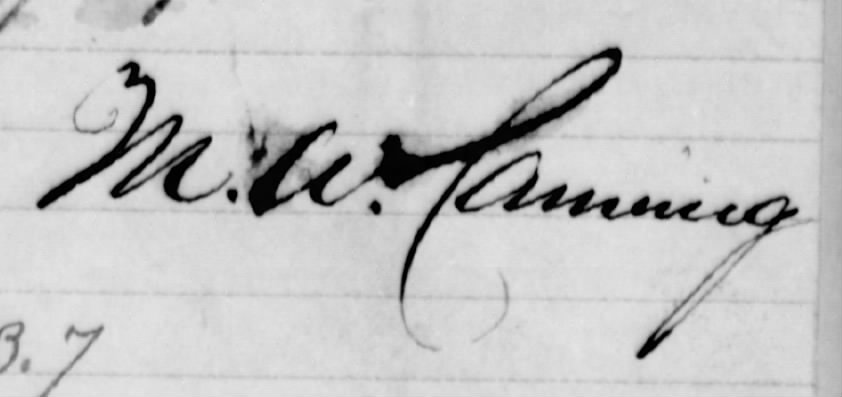
Matthew Canning’s handwritten affidavits are available on Fold3.com in the Turner/Baker papers (must be a paying member to view)
The article containing the ending quote is here.
An additional article recounting Matthew Canning’s arrest is here.

Categories: Uncategorized | Tags: , , , , , | 13 Comments

Touched by an Angel

If you have the time, I invite you all to watch this 1998 episode of Touched by an Angel entitled “Beautiful Dreamer”. In it, Della Reese’s character recounts the assassination of Lincoln through the experiences of her fellow angels, who were there at the time.  The show is filled with artistic and spiritual license (it is Touched by an Angel, after all), but it still provides an entertaining and fairly accurate representation of Lincoln’s death.  While Booth is portrayed more drunken than sinister, the writers of the show still gave him wonderful dialogue with the angel, Andrew, explaining his motivations and beliefs.  It is a unique portrayal of Booth that actually leaves us feeling sorry for him rather than hatred.   What’s more, it’s clear the producers did their homework.  They stunningly recreated the façade of Ford’s Theatre, the presidential box, and even included auxiliary characters by name like Laura Keene, Peter Taltavull, and John Parker.  In my opinion, this dramatization of Lincoln’s assassination from the mainstream media is one worth watching.

Categories: Uncategorized | Tags: , , | 7 Comments

Mail for Mr. Booth

Previously, I posted about one of the letters that was found in Booth’s room at the National Hotel.  As a popular actor, Booth received many letters from friends, fans, and theatre owners.  Another letter found in Booth’s room is the following from McVicker’s Theatre in Chicago:

“Chicago, Dec. 25, 1864

Friend Booth,
What do you say to filling three weeks with me May 29th?  I have not yet filled your time in January and see no chance of doing so with an attraction equal to yourself.  There are plenty of little fish but I don’t want them if I can help it.  So as you can’t come then come at the above date.
With a Merry Christmas and Happy New Year.
Yours Truly,
McVicker”

While Booth’s ability as an actor has been questioned by many authors, he nevertheless had the ability to draw a crowd.  This letter appears to state that Booth was, at one time, asked to play in Chicago in January of 1865 and declined the invitation.  Historically, McVicker’s had been very kind the John Wilkes Booth.  In January of 1862, he made his premiere there selling out the 2,500 seat theatre.  He would return there several times over the next two years.  But, as the years turned from 1864 to 1865, Booth’s mind was on other aspects.  He had suffered large losses in his oil ventures but told family and friends of his success.  He spoke of big plans that would allow him to retire from acting for good.  While wanting of money, an engagement in Chicago would separate him for too long from his new plan and target: Abraham Lincoln.

What makes this letter interesting is not just the content, but also the envelope that held it:

We can see that the letter was originally addressed to “J.Wilkes Booth, 28 East 19th St., New York”.  Written along the left hand side, in McVicker’s handwriting is the note, “forward if from home”.  McVicker had initially sent the letter to the Booth home in New York.

In September of 1863, Edwin Booth purchased the house on 19th St. near Gramercy Park in New York City as a permanent residence for his family.  Mary Ann, Rosalie, and Edwin’s daughter Edwina, lived there year round.  During breaks in touring and when the theatrical season ended, Edwin and John would both reside in the house.  Despite the brothers’ desire to keep the peace in the presence of their mother, the close quarters caused Edwin and John to engage in many arguments, usually stemming from their opposite political beliefs.  In late November of 1864, Edwin finally had enough of his brother’s secessionist talk, and kicked him out of the house.  Booth would briefly stay with his sister Asia in Philadelphia, before moving to Washington.

As the note on the envelope requested, someone in the Booth’s New York house forwarded the letter to John in Washington, D.C.  Specifically, they sent it to Ford’s Theatre.  Noted actors received liberties at theatres and receiving mail was one of them.  Harry Clay Ford, treasurer of the theatre, recounted the morning of April 14th, when Booth, once again, received his mail at the theatre:

“When [Booth] came there I do not know whether he asked for a letter or not, but Mr. Raybold ran into the office and brought him out a letter.  He generally had his letters directed to the theatre…He then commence[d] opening his letter.  Then I left for a while and went into the office.  On coming out again, I found him seated on the steps where he was on Thursday, the steps leading into the office…I think he was reading the letter then.  He did not make any remark in reference to the letter.  I do not know whether the letter consisted of two or three sheets written over.  It was notepaper I think; appeared to be written all over both sheets.  I don’t recollect positively, but I think the writing was rather large.  If I remember right it was zigzag all full of writing.  Did not see any blank on it al all.  He had not finished the letter when I left him.  Was reading it still.”

Harry Ford provides a tremendous amount of detail regarding Booth’s letter.  It seems that this was done to direct attention away from the fact that it was probably him (or someone in his office) that divulged to Booth that Lincolnwas coming.

How our history could be different if, on April 14th, 1865,  Booth had not received a similarly addressed letter like the one above.  He may have continued on past Ford’s never knowing Lincoln was going to be there that night.

References:
My Thoughts Be Bloody by Nora Titone
The Lincoln Assassination – The Evidence by William Edwards and Ed Steers

Categories: Uncategorized | Tags: , , | 1 Comment

Thoughts From Major Rathbone

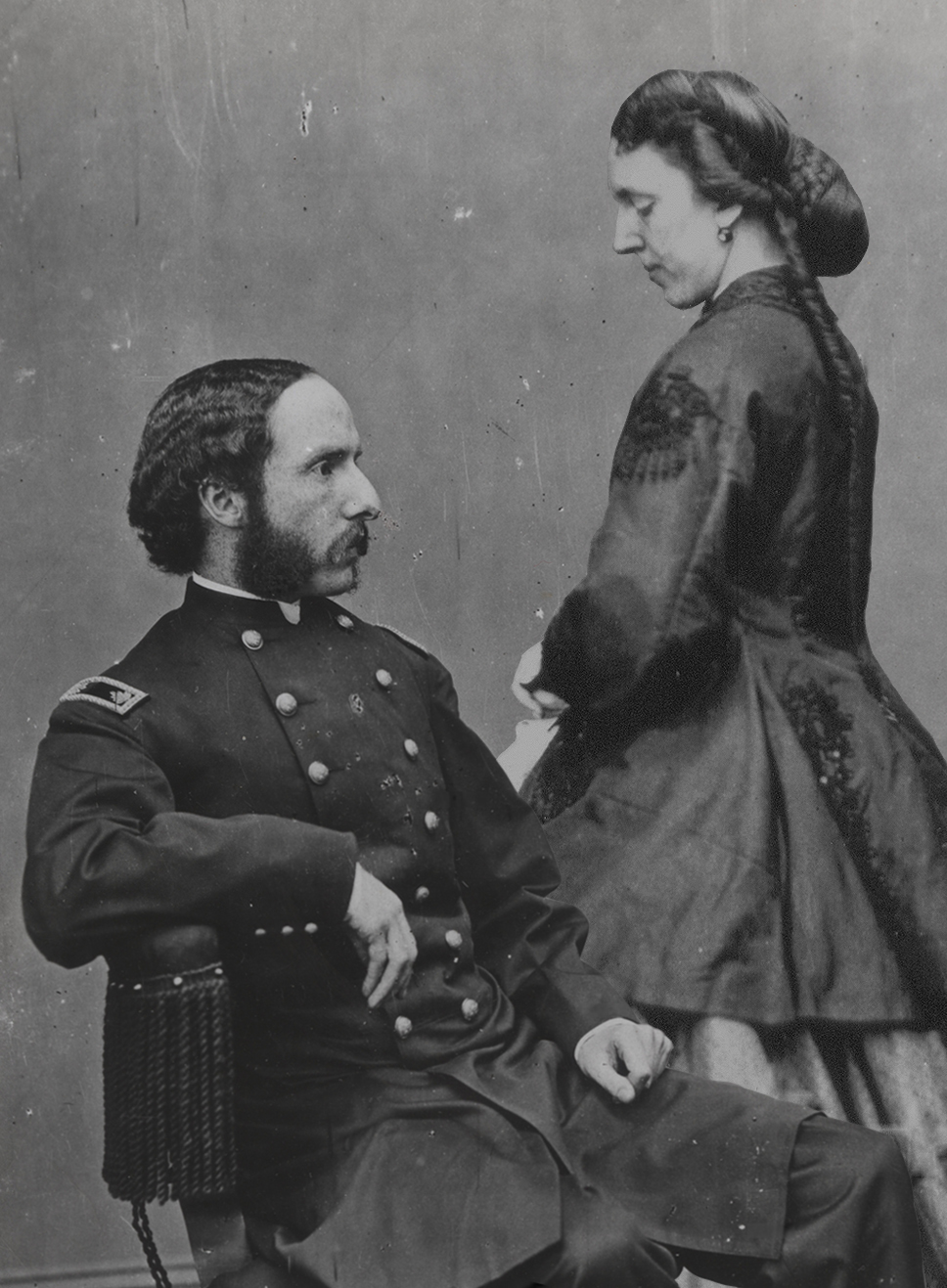
When Booth’s dark deed was committed at Ford’s, no one had a closer seat to the action than the occupants of the theatre box. Mary Todd Lincoln, Clara Harris, and her fiancée and stepbrother Major Henry Rathbone, had the horror of watching the scene play out within arm’s length. Shortly after the crime, Henry Rathbone gave a lengthy and detailed statement recalling the events as he remembered them. Rathbone’s account (which can be read here) provides a wonderful description of the scene of the crime and his activities after the shot was fired. While a re-reading of Rathbone’s account doesn’t provide any ground breaking new claims, it does contain a few details worthy of address and consideration. This post will discuss two minor details set forth by Rathbone in his testimony.

Major Henry Rathbone and Clara Harris (composite by the author)

After Booth shot Lincoln, Major Rathbone, alarmed by the report of a pistol and cloud of powder in the box, raised himself and attempted to subdue the assailant. During the struggle Booth thrust at Rathbone with his knife, which Rathbone parried upwards. In the course of this parry, Rathbone received a deep cut on his left arm between his elbow and his shoulder. It was a painful blow that knocked Rathbone back a bit. At this moment, free from grappling with Rathbone, Booth moved to the front of the theatre box, and leapt over it.

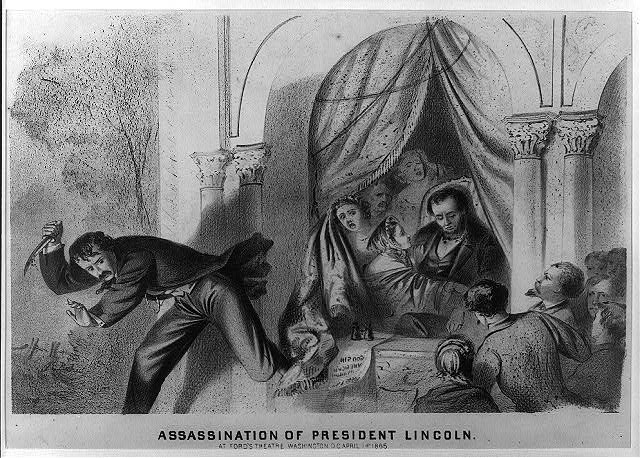
Many witnesses at the time said that Booth’s jump from the box was a noticeably ungraceful one. One eye witness account stated that, “He did not strike the stage fairly on his feet, but appeared to stumble slightly.” Immediately following the events, several others described similar stumbles Booth made upon reaching the stage.

A quite ungraceful engraving of Booth’s jump from the box

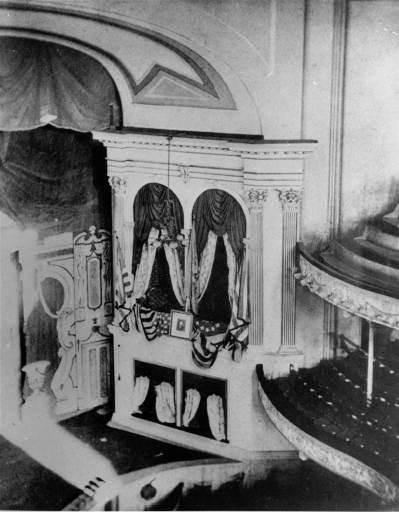
Granted, the distance he leapt was twelve feet off the ground and it can be a hard landing for any man to make properly. In his act of jumping, Booth disturbed the flags decorating the box. This, of course, makes perfect sense. The flags decorating the box were merely attached to the outside and weren’t expected to be moved during the President’s attendance. Instead of jumping straight from inside the box down to the stage in a hurdler’s motion, Booth likely leapt over the railing of the box, paused briefly on the small ledge on the other side, and then jumped down. This small ledge is where many flags were resting and draped about. A witness at Ford’s described that, during the jump, Booth, “partially t[ore] down the flag”.

Photograph of the box shortly a day or two after the assassination. Notice the partially pulled down flags.

Another witness had a similar account about his riding spur getting caught up in the decorations, causing his awkward fall. The American mythos of the assassination states that, while jumping, Booth was tangled in an American flag causing him to land poorly onto the stage and breaking his leg. In his diary, the vain Booth, probably attempting to save face for his less than perfect “performance”, claimed that in jumping from the box he broke his leg. Most Boothies accept this as fact while also entertaining the idea set forth by author Michael Kauffman that Booth broke his leg later that night, when his horse fell on him during the rough ride south. With it being impossible to prove one theory over another, historians just pick the idea they like better and concede that differences of opinion exist on the matter.

What is not really debated is that Booth fell uneasily upon the stage, making one of his worst entrances ever. While the flags generally receive the attention for causing Booth’s missteps, Rathbone’s account provides another possible reason:

“The man rushed to front of the box and [I] endeavored to seize him again but only caught his clothes as he was leaping… The clothes, as [I] believe, were torn in this attempt to seize him.”

While Rathbone gets credit for struggling with Booth and sacrificing his own arm attempting to subdue him, is it possible that Rathbone was also the reason Booth landed so hard upon the stage? As Booth was making his jump, could the grasp of Major Rathbone on his clothes have thrown the actor’s balance off and caused his clumsy landing? Further, if this is indeed when Booth broke his leg, effectively slowing down his escape, could it be Rathbone and not the flags, that deserve the credit? These questions and the overall scenario produced by them are merely items to contemplate and I make no claims of them being in anyway definitive.

A second item Rathbone mentions in his testimony is about the set up of the box itself. From the beginning Rathbone gives a wonderful description of the box and the locations of the parties therein. From his description the following diagram of the box seems to correct display the set up:

Booth entered the box through the outer passageway door marked H on the diagram. Remember, during normal nights the box in which the President’s party occupied severed as two boxes. A partition would separate it into two smaller boxes. That is why there are two doors inside the passageway. The door marked as G, was actually the closest door to the President, but was closed during the whole night. It was the entrance to Box 7. The Presidential party and Booth all entered the box through door F. That was the door to Box 8.

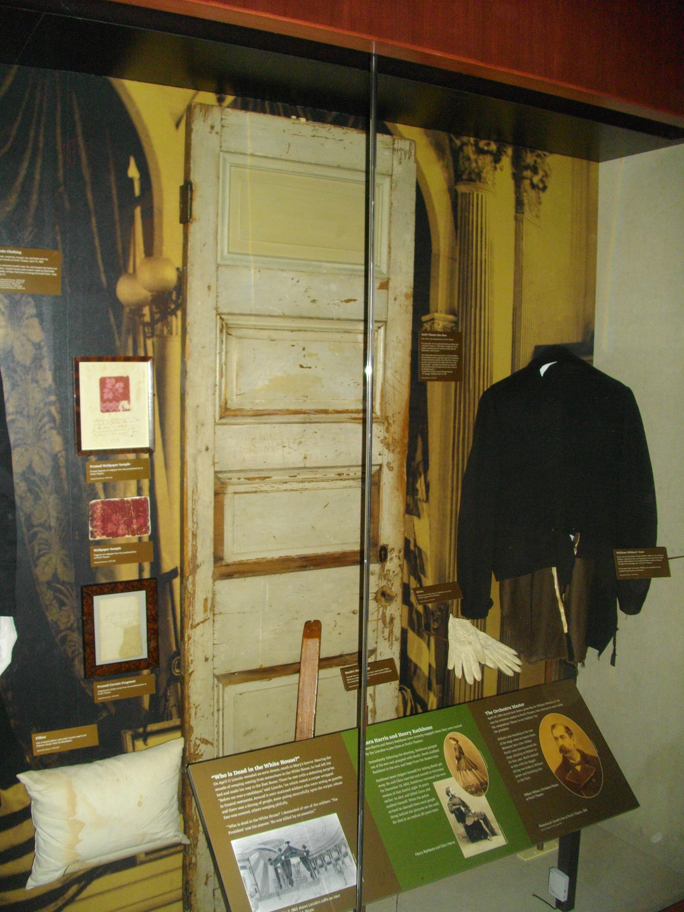
This inner door to Box 7 is on display at in the Ford’s Theatre Museum.

This door has a unique feature as it has a peep hole bored into. For many years it was written that this hole was bored by John Wilkes Booth on the morning of the assassination. After learning about Lincoln’s attendance that night, Booth did enter the theatre and found a wooden bar with which to jam the outer door so that it could not be opened. The wooden bar can be seen in the above picture sticking out from the bottom of the door. It was assumed that during this prep work, that he also bored a hole into the door in order to have an eye on the President before entering the box.

A letter written by Frank Ford (son of Harry Clay Ford, the theatre’s treasurer) denounced this idea. Frank stated that his father ordered the hole to be bored into the door so that the President’s guard, and others employed in their duties for the government or theatre, could look in on the President and his party instead of barging in straight away and disturbing them. Frank quotes his father as saying, “John Booth had too much to do that day other than to go around boring holes in theatre doors.” However, a period statement from Harry Ford has him saying, “Did not notice a hole in the door or in the wall. Did not take particular notice of the wall or door however.” So the mystery regarding the hole remains.

Even if this hole was bored at the bequest of the Ford’s, Booth still used it to eye the President before making his move, right? Not necessarily. According to Rathbone:

“The distance between the President as he sat and the door was about four or five feet. The door, according to [my] recollection, was not closed during the evening.”

Rathbone claims that the door to Box 8 was never closed during the performance. If this is the case, Booth may not have used the peephole to spy on the President through Box 7. After entering the passageway door, Booth stealthily put the wooden bar in place to “lock” the outside door, and either peered through the slightly open Box 8 door into the box, or just waited until the lines of the play were right to bust in and get his first real view. With all eyes directed on stage and not towards the rear, it seems that Booth could have been standing in the shadows of the passageway eyeing the President for some time before he acted. If Rathbone is to be believed and the door was open during the performance, the image of Booth before he shot Lincoln could change. Instead of a man hiding behind door 7 nervously peeking at his target through a hole, Booth becomes a shadowy figure, standing motionless in the doorway to box 8 eyeing his prey. To me the latter image is in line with Booth’s brazen persona. He brought an unreliable single shot derringer to kill the President, assured that he would succeed. I have no problem picturing this arrogant Booth, lurking near an open door a few feet away from the President, coiled like a viper waiting to strike.

Again, these small pieces of Rathbone’s account are posted here merely to initiate contemplation and conversation. Feel free to post your thoughts about them by clicking on the “comment” button below.

References:
The Lincoln Assassination – The Evidence by William Edwards and Ed Steers
We Saw Lincoln Shot by Timothy S. Good

Categories: Uncategorized | Tags: , , , | 20 Comments

The Passionate Booths

When John Wilkes Booth pulled the trigger on his derringer, he released not only a lead ball, but also the pent up angst and fervor that had darkened his soul.  His deed was misguided and barbaric; however, in his eyes, it was justified.  As a son, an actor, and an American, John Wilkes Booth was fuelled by his passions.  While he won acclaim for his ability to direct his passions on the stage, they were not products of the stage.  He inherited these passions from his forefathers and, mixed with his own experiences, channeled them on that fateful night.

Much has been written about John Wilkes Booth’s father, Junius Brutus Booth.  The noted tragedian was the greatest of his generation and developed many peculiarities that has provided rich fodder for writers.  The book My Thoughts be Bloody by Nora Titone provides a wonderful look at the romantic side of Junius Brutus Booth.  Junius was a proponent of Lord Byron’s free love philosophy.  He won over his mistress and mother of his theatrical clan, Mary Ann Holmes, with volumes of Byron’s work and notes of his affection.  Despite being married to another woman and having two children with her (only one of which survived infancy), Junius was enamored with Mary Ann and, together, the pair ran off to America.  Love and the pleasures of the flesh were Junius Brutus Booth’s first passion.

In fact, his passion in this area started before he had even met his first wife, Adelaide.  As a mere boy, Junius had engaged his passions.  I quote from the book, Prince of Players: Edwin Booth by Eleanor Ruggles:

“Junius Brutus Booth was thirteen when a neighbor’s servant girl accused him of having got her ‘in the family way’ and was hurriedly paid off. He was seventeen and had enlisted as a midshipman on the brig Boxer when he was kept from sailing by a court summons to answer the same charge made by another servant girl, employed in the Booths’ own house. Richard Booth went into court himself to be Junius’ lawyer and defended him hotly, but the father and son lost their case and the father was compelled to pay up again.”

Drawing of Junius Brutus Booth in 1817

The above, modern account is greatly contrasted by another.  A book was published in 1817 called, Memoirs of Junius Brutus Booth: From his Birth to the Present Time.  The book is an early testament to the genius of the young actor.  Written by his fans during the heyday of his English popularity (before he met Mary Ann Holmes and ran away with her), the book recounts the matter in the most predisposed, yet eloquent, manner possible:

“He then became desirous of learning the art of printing, but soon relinquished it for the law, which again he quitted from an inclination to become a sculptor, and he pursued the first steps towards that divine art very assiduously, with the intention of entertaining it as a profession.  But here his views were interrupted by an occurrence of rather an extraordinary nature.  Our hero, for so we must now emphatically call him, was accused of a degree of susceptibility towards that sex, whose charms form the great stimulus – the bright reward of every act in which the heart of man takes part, rarely exemplified at his age.  He was charged by a frail nymph with a deed – of which she could no longer conceal the evidence.  His father, astonished at this deposition to his son’s precocity, was at first disposed to wear the aspect of displeasure; but relying on the sagacity and experience of the Bench on these subjects, he determined to answer it by taking his child in his hand, and presenting him to the Justices, merely ask their worships whether they thought the fact came within the limits of probability, or even possibility.  They, however, decreed that he should wear this attestation of his persuasive powers – or this stain on the pudency of his boyhood, (as it will be variously interpreted by various commentators) for the remainder of his life.

The consequence of this decision, and the subsequent anger of his father, was that, being unable to raise the supplies necessary on this emergency, he was forced to resort to stratagem to elude the vigilance of the parish officers, (which, when in the pursuit of gain, or in the prevention of loss, is not often found napping), and mounting a high brick-wall, he baffled his pursuers, and for nine months escaped this attack on his purse, or rather his father’s; – he was at length, however, discovered, and obliged to make the usual amende.”

As Junius grew older, his passions shifted from matters of the heart, towards that of the bottle.  Mirroring his son to a less extreme, Junius let his passions overwhelm him and lead him to his own destruction.

John Wilkes Booth’s father was not the only passionate forefather.  Richard Booth, Junius’ father and John Wilkes’ grandfather, had his own obsession.  Many of us know how Richard Booth hung a portrait of George Washington in his London home and required visitors to bow before it.  In his youth, however, Richard Booth took a much more active role in demonstrating his commitment to America.  I quote from The Edler and Younger Booth by Asia (Booth) Clarke:

“Richard Booth, the father of the subject of the present sketch, was educated for the law; but, becoming infatuated with Republicanism, he left home, in company with his cousin John Brevitt, to embark for America (then at war with England), determined to fight in her cause. Booth was taken prisoner and brought back toEngland, where he subsequently devoted himself to the acquirement of knowledge and the practice of his profession…”

In their attempt to join the Americans in their fight for independence, Richard Booth and John Brevitt wrote to a Member of Parliament noted for his support of the American Revolution, asking for a letter of introduction on their behalf.  The man they wrote to would later be honored by the Booth family by giving his name to one of Richard’s grandson’s: John Wilkes.

“To John Wilkes, Esq., Princes Court, Westminster.
Paris, Oct. 28th, ’77.
Sir, — You will certainly be much surprised at the receipt of this letter, which comes from two persons of whom you cannot possibly have the least knowledge, who yet at the same time claim the Honour of being of the same Family as yourself. Our conduct has certainly been in some respects reprehensible, for too rashly putting in execution a project we had for a long time conceived. But as it was thro’ an ardent desire to serve in the Glorious cause of Freedom, of which you have always been Fam’d for being the Strict and great Defender, we trust the request we are about to make will be paid regard to. As Englishmen, it may be urged that we are not altogether Justified in taking arms against our native Country, but we hope such a vague argument will have no weight with a Gentleman of your well-known abilities; for as that country has almost parted with all its Rights, which have been given up to the present Tyrannic Government, it must be thought the Duty of every true Briton to assist those who oppose oppression and lawless Tyranny. And as the people of America are composed of men who have still the spirit of their brave Forefathers remaining, it becomes all who are Englishmen to exert their utmost efforts in their behalf, leaving their Country for that purpose; being no more (as we presume) than the Romans, in the war between Octavius and Anthony on the one part, and those illustrious worthys, Brutus and Cassius, on the other, going from the army of the Tyrants to serve in that of the latter, and therefore equally justifiable.

‘Dulce et Decorum est pro patria mori,
Sed pro Libertate mori, Dulcissimum est.’

The manner in which we have conducted ourselves has been so very extraordinary as to be scarcely credible, but we are assured the Bearer of this Letter will convince you of its Authenticity. In short, we leftEngland, and all the advantageous prospects we had there, purposely to go and serve in the Army of the Sons of Liberty, the brave Americans. In order to complete the Enterprise we came from London under a pretence of going on a party of pleasure to the Camp at Warley Common, but instead of proceeding thither, we went immediately for Margate and thence to Ostend, and have since arrived here, where we came to wait upon the Gentlemen who are Agents for the Congress in America, in order to the full completion of our Design of getting appointed officers in the Provincial Service, but for that purpose have since found it necessary to procure a Letter of recommendation from some Gentleman in the Interest of Liberty in England, and understand from Mr. Arthur Lee (who has promised to interest himself greatly in our behalf), that no recommendation will be of more service to us than yours. Our request therefore is, that you will condescend to give one in our favour, directed to that Gentleman at the “Hotel de la Reine, la Rue des Bons Enfants, a Paris,” which you will please to deliver to the Bearer hereof, as soon as possibly convenient. And the favour will be gratefully remembered, and the name of Wilkes be always held in the greatest respect and veneration.
Your most and obed’ Serv’ts at command,
R. Booth.
John Brevitt”

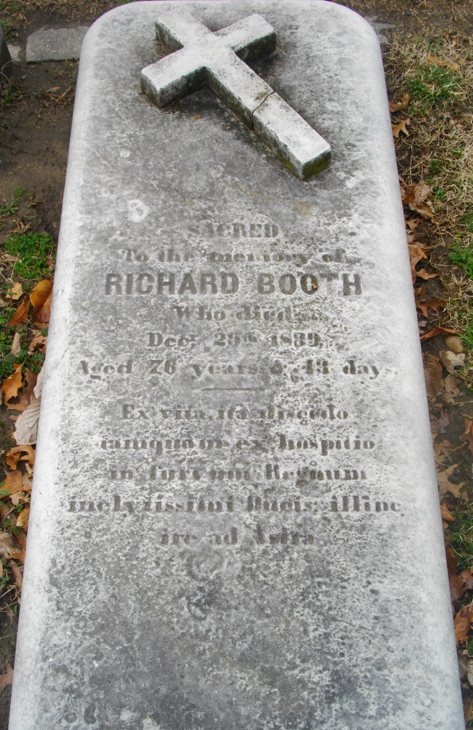
Richard Booth’s Grave

These elder Booths, Richard and Junius, tread a path that their progeny, John, would later follow.  From Richard, John Wilkes inherited a revolutionary spirit.  From Junius, he learned to submit himself to his passions regardless of the consequences.   Combined with the tyrannicidal nature of Shakespeare and the bloodiness of the Civil War, John acted according to his beliefs.

Ultimately, in his own horrific way, John Wilkes Booth upheld the passion of the Booth name.

References:
The Edler and Younger Booth by Asia Clarke
Memoirs of Junius Brutus Booth: From his Birth to the Present Time
Prince of Players: Edwin Booth by Eleanor Ruggles
My Thoughts Be Bloody by Nora Titone

Categories: Uncategorized | Tags: , | 3 Comments

Blog at WordPress.com.