In 1979, Richard and Kellie Gutman published their compendium of known Booth photographs. John Wilkes Booth Himself contains over 40 images of the assassin. Since the book’s publication, several other images of Booth have been discovered, demonstrating the idea that treasures are still out there waiting to be found.
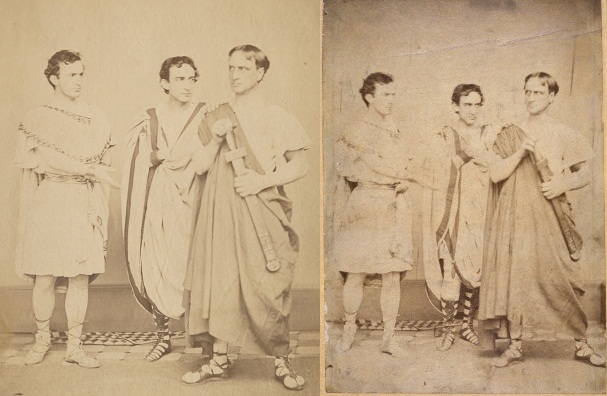
Due to space constraints, the Gutmans were not able to include all the variations that exist for their numbered photographs of John Wilkes Booth. The following are two such examples of the minor variations that exist in even the well-known photos of Booth. See if you can spot the differences:
This first image was probably taken with a multi-lens or stereograph camera. The stereograph image would be used to create a 3-D image when developed as a stereoview card and viewed with a stereoscope. The second image of the Booth brothers preparing for their Shakespeare statue benefit, is a different, but similar, pose from the original.
John Wilkes Booth loved having his picture taken and by taking notice of the specific details in his pictures we can learn more about his self image and vanity.
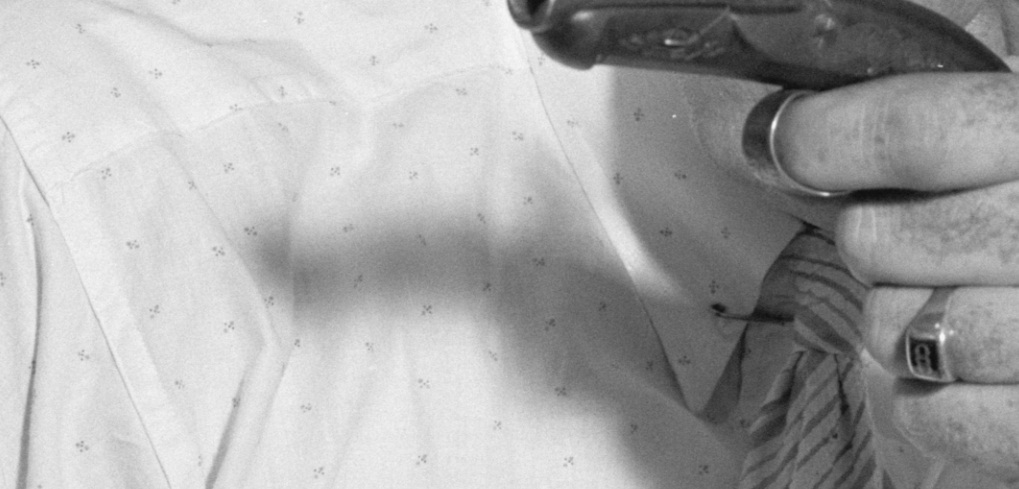
A couple of weeks ago, I posted this 1937 photograph of Edwin B. Pitts, Chief Clerk of the Judge Advocate General’s Office, posing with John Wilkes Booth’s gun:
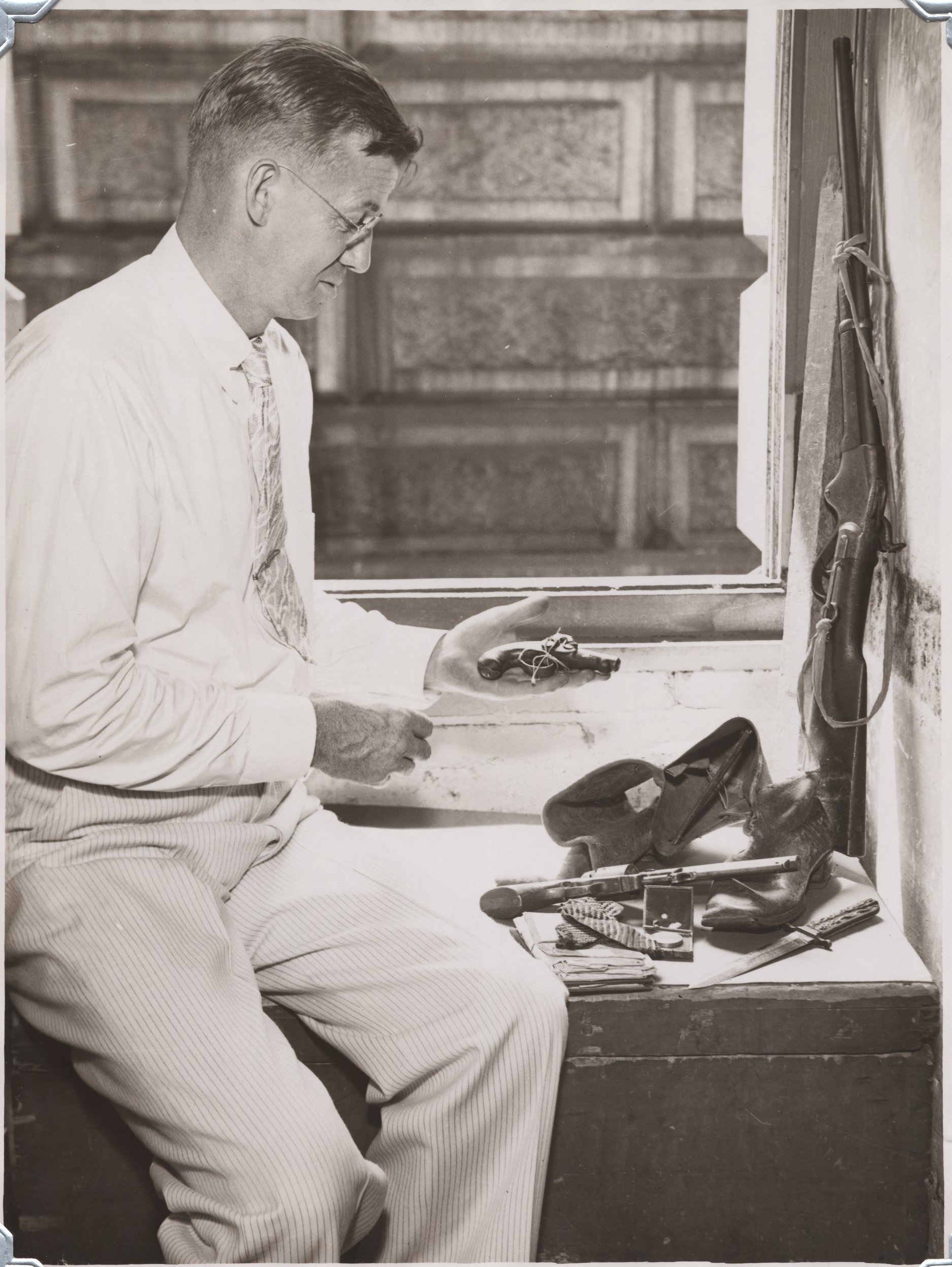
Today, I stumbled upon another image of Edwin Pitts with Booth’s derringer:
This image of Edwin Pitts also provides a nice look at some of the other assassination related artifacts.
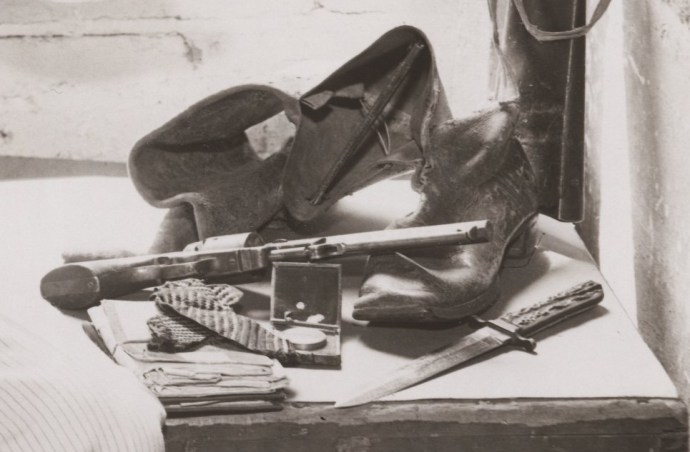
The above portion of the image shows the Spencer carbine retrieved by Booth and Herold at the Surratt Tavern and the wooden bar used to block the door into the box at Ford’s Theatre.
Among the items shown above are Booth’s boot and compass. There is also the tie attributed to George Atzerodt and a pack of papers that looks like it could be Booth’s diary. I’m not sure which pistol that is, but it could be one of Booth’s. The knife shown is the etched “Liberty” knife that, while currently on display at Ford’s Theatre as Booth’s knife, was not recovered from his body at Garrett’s farm.
After finding two different images of Edwin Pitts holding Booth’s gun, I’m wondering how often Mr. Pitts took the relic out of storage to pose with it for curious photographers.
This is one of those relics that I would love to get my hands on today:
In case you were wondering, the chain of custody on this relic is good. Don Ashley was married to Louise “Ruddy” Garrett. Ruddy was the daughter of Robert Clarence Garrett, who was seven years old when Booth died on his father’s farm. Don and Ruddy never had children so what happened to the pillow after their deaths remains a mystery.
The assassination of Abraham Lincoln at the hands of John Wilkes Booth was a defining moment of American history. It was a national tragedy the likes of which we had never experienced. It turned Lincoln into a martyr and changed the course our country would take after a devastating Civil War. For this reason, the assassination of Abraham Lincoln has become perfect fodder for the imaginative minds of comic book writers. Through this artful medium, Lincoln’s assassination has been remembered, revised, and completely reinvented to match the worlds in which superheroes like Superman, Batman, The Flash, and others exist. Most references to the assassination in comic books are brief but a select few have devoted serious attention to America’s great drama of April 14th, 1865.
The Assassination Remembered
Several comic books briefly mention the assassination of Abraham Lincoln as it occurred. Occasionally, the main character is somehow thrown back through time or enters a parallel world to witness it. They may interact in the narrative, but the ending is still the same.
Superman’s young photographer friend from the Daily Planet, Jimmy Olsen, is thrown back in time to the night Lincoln is assassinated in this comic from 1968:
The assassination of Lincoln is remembered in a flashback in a Batman comic from 2003:
The Assassination Revised
While reminding us all of the past is nice, it isn’t very superhero-y. More often, the death of President Lincoln is averted due to the help of a hero, or because this is a parallel world where his assassination never occurred in the first place.
Superman saves Lincoln just in time in a comic from 1961. He later discovers he is in a parallel world and history is unchanged in the “real” world.
In this West Coast Avengers comic from 1990, Lincoln is able to thwart his own assassination by quick reflexes. Sadly, this is just a parallel world which is destroyed by the man impersonating Major Rathbone.
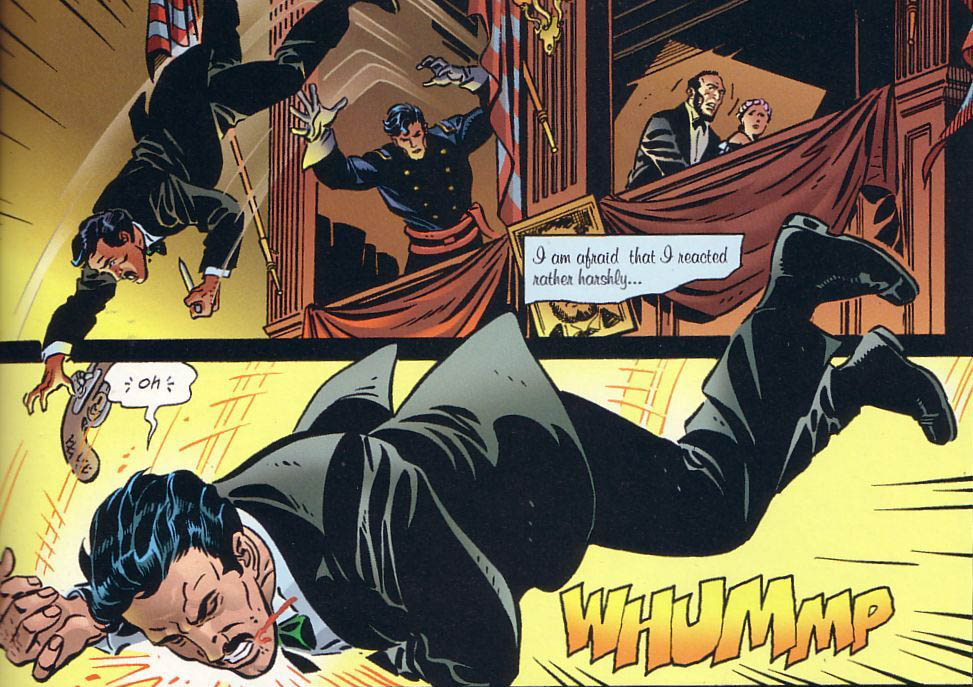
Quick thinking on Civil War Superman’s part saves the President while Booth is impaled by his own knife in this comic from 2003.
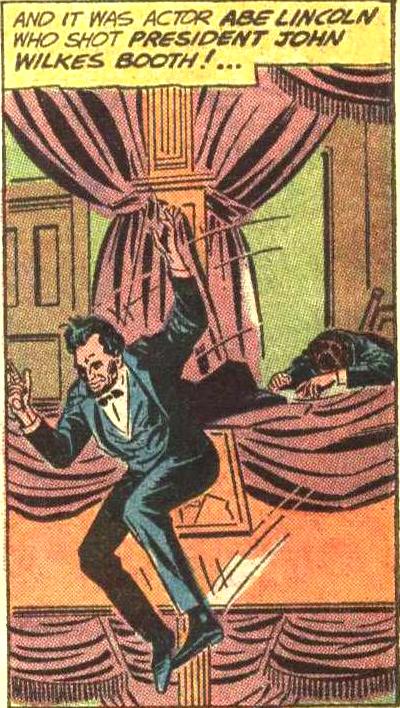
An actor who closely resembles Abraham Lincoln is somehow sent back in history to the most inconvenient time for him in this standalone comic from 1956.
The Assassination Reinvented
In these versions, the normal history is changed drastically for the comic book world.
In a parallel world visited by the Justice League of America in 1964, the villain and victim are switched.
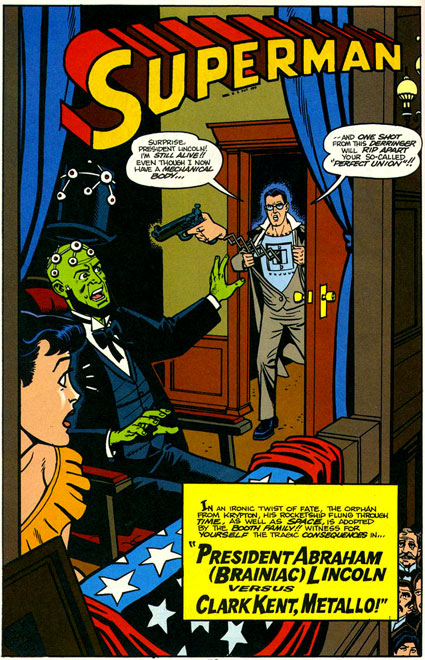
In this one shot cover parody from 1999, an alternate Superman is sent to Earth to be raised by the Booth family. Don’t ask me about the green “Brainiac” Lincoln or the half robot Superman with a derringer in his chest. I don’t get it either.
In this portion of the TV show Batman: The Brave and the Bold, Batman and Abe fight against a “steampunked” John Wilkes Booth:
As entertaining as that rendition is, however, my favorite incarnation of the assassination of Abraham Lincoln in the comic book realm is this 1971 issue of The Flash:
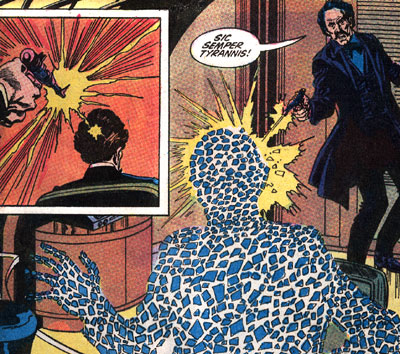
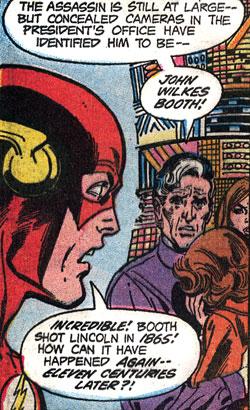
From what I can gather from sources online, the Flash travels forward in time to the year 2971. He enters a world which once contained a united Earth. However a dispute has broken out between Earth East and Earth West and there is Civil War once again. The beginning of the comic leads with a future Lincoln getting disintegrated by a future John Wilkes Booth.
The Flash is rightly confused by how this is possible.
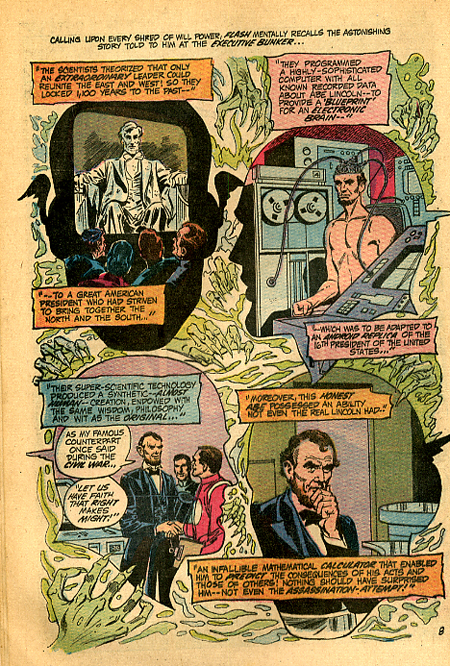
It turns out the future scientists created a robotic Abraham Lincoln to lead them through the Civil War. He contained Lincoln’s wit and wisdom, and also the ability to calculate the consequences of people’s actions.
Booth makes his escape to Earth East using a jet suit.
The Flash chases after him, but gets trapped when Booth ties him up with a future chain that squeezes him harder and harder.
Booth jets off again to meet his master, an evil mastermind named Bekor. He turns over the murder weapon he used to kill Lincoln to Bekor. Bekor betrays Booth and shoots him with the disintegrator. Bye Bye, Booth. When Bekor kills Booth though, Robot Abraham Lincoln remerges out of the gun. Apparently, using his robot brain, Lincoln predicted someone would try to take his life. So he carried around his anti-disintegrator pocket watch.
He turns the table on Bekor using his good old fashioned wrestling skills.
By then, The Flash has managed to escape the squeezing chains and rushes to Bekor’s lair. He manages to get Lincoln out of the lair before it self-destructs. Lincoln continues as President of Earth, using his 19th century wisdom to lead this troubled, 30th century world. This is a fun and entertaining reinvention of the assassination of Lincoln.
There are many other comic books that include references to the assassination of Abraham Lincoln with more coming out every year. As long as Abraham Lincoln continues to be an important part of the American story, his death will continue to find a place within their multicolored pages.
When it comes to researching and writing about the assassination, I am a very visual person. I actively seek out and like to include pictures in as many of my posts as possible. Images contain a life and message all their own. So often though, we as human beings gloss over visual information quickly. As an elementary teacher, I even witness this with my young readers. Children are so eager to read quickly and efficiently like adults, that they start abandoning the pictures in their stories. They ignore the photographs and pictures, opting instead to race through and finish. As adults we do the same. Efficiency runs our lives with nary a moment devoted to the mere act of looking closely at anything. So, from time to time, I will be combating this with a simple post of a photograph. I invite you to take some time to really see it. Take an actual 60 second long minute, and really look at the image. Let it bring questions into your mind. Reflect on the feelings it might draw out of you. Put it in its proper context as a moment in time, and not just as a graphic on a computer screen.
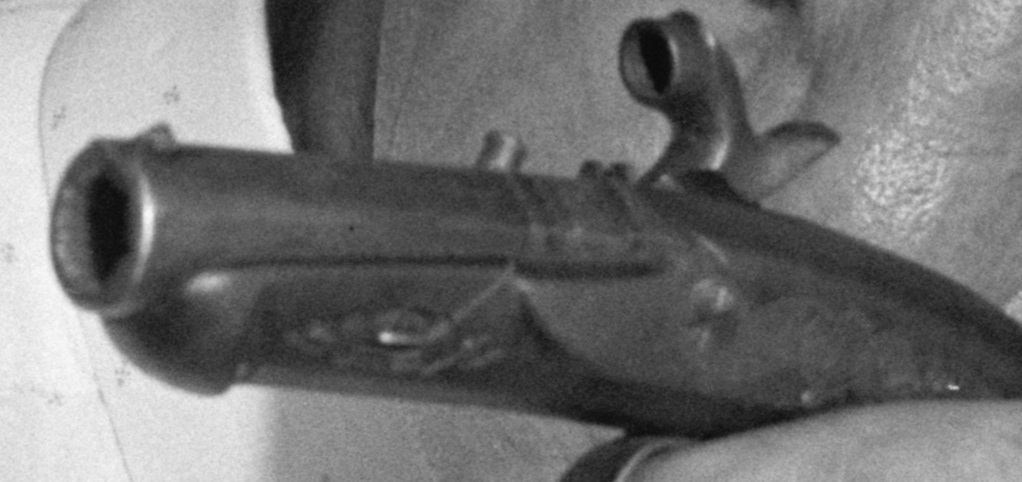
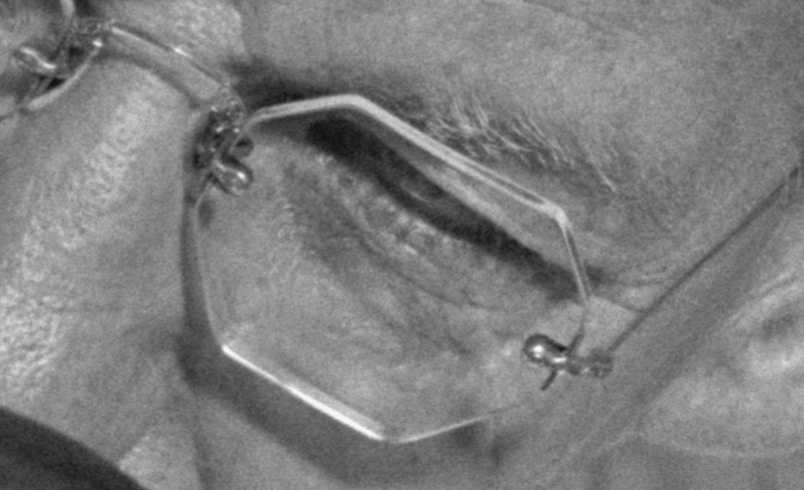
Today, I’m putting up a picture of a man holding John Wilkes Booth’s gun. I’ve seen the gun many times and this specific photo as well, but when I really take the time to see it, this image speaks to me: “This man in the photo chose to hold the gun. With or without prompting, he posed himself into an aiming position with it. This item was used to kill the President and this man is holding it centimeters from his face. His eye is drawing an imaginary line down its barrel. What does he see in its sights? How did he feel when he posed for this? Is the gun like a toy to him? Has he been around it so long that the impact of what it did has worn off? Or is he trying to get into the mindset of the man who pulled the trigger?…”
When you look at this picture, I hope it affects you in some way, if only for a minute.
August 10th, 1937
Edwin B. Pitts, Chief Clerk of the Judge Advocate General’s Office, poses holding Booth’s derringer:
Reader Richard Petersen asked this excellent question on my last post about Silas Cobb:
Question. What was the protocol for Booth and Herold in crossing the bridge? Could they ride across or did they have to dismount and walk?
I believe this to be a very good question and worthy of discussion. The record of what transpired at the Navy Yard Bridge comes from the official statement and the conspiracy trial testimony of Sgt. Silas Cobb. In his statement to authorities specifically, Cobb gives wonderful details about the two riders who crossed his lines. For example, we learn that Booth was wearing a “soft black or dark brown felt hat” and that “his hands were very white, and he had no gloves on”. Cobb even provided details about Booth’s voice stating it was, “rather light, and high-keyed”. For Davy Herold, Cobb described him as wearing, “a light coat, light pants, and a snuff colored felt hat, of rather a light shade.” He even let us know that Davy was, “the heavier of the two”. When it comes to the actual method of crossing the bridge, Cobb does not give specific detail. This is probably due to the fact that crossing people over the bridge was so commonplace to Cobb, that he didn’t consider the way in which Booth and Herold did it to be any more notable than any other person. He does provide a few statements that we can piece together though, to paint a seemingly accurate picture of what the process was.
When both men approached the bridge, the sentry challenged them (assumedly by asking “Halt, who goes there?” or “Friend or Foe”). Booth and Herold both replied “a friend” and Cobb began his interrogation of them. In the trial testimony, Cobb is asked a question about his encounter with Herold:
Q. Did you have a good view of his face? Was there a light?
A. I did. I brought him up before the guard-house door, so that the light shone full in his face and on his horse.
So we know that Cobb moved Davy to be in view of a light. Unfortunately, this statement is inconclusive regarding whether or not Davy was still on horseback, or on foot next to his horse. However, a little while after this, Cobb is asked about Davy’s size:
Q. How would he compare in size with the last man on the row in the prisoner’s dock? [David E. Herold, who stood up for identification.]
A. He is very near the size, but I should think taller, although I could not tell it on the horse; and he had a lighter complexion than that man.
The darken part is very important. Cobb, the man who provided so many details about the men who he crossed over the bridge, was unsure about Davy’s height. It appears his explanation for this is because the Davy stayed on his horse and so Cobb was not able to accurately compare Herold on his horse with Herold on the prisoner dock. This testimony appears to favor Booth and Herold remaining on their horses.
Cobb gives us a bit more (though still not as much as we’d like) with regard to Booth’s crossing:
“He then turned and crossed the bridge; his horse was restive and he held him in and walked him accross the bridge; he was in my sight until after passing the other side of the draw. I do not know with what speed he rode after that.”
During my first few readings of this, I pictured Booth walking his horse as a man would walk a dog. In my eyes it appeared as if Booth (who apparently showed no physical pain supporting Michael Kauffman’s theory that he broke his leg later in a horse fall) kept his horse close to him and acted like a child crossing the street by walking his bicycle. Upon further reading and trying to put myself into the correct 19th century equestrian mindset though, I read this now as Booth riding his horse at a walking pace across the bridge. The last phrase, “I do not know with what speed he rode after that,” implies to me that Booth was already riding his horse and not walking it on foot. I want to believe the detail oriented Cobb would have stated something along the lines of “he remounted his horse” if Booth was actually walking alongside it beforehand.
There is no specific statement by Cobb saying that Booth and Herold ever dismounted their horses. In addition, the few details that Cobb does give regarding the process appears to imply that they remained in their mounts during their entire time they conversed with him. There is no smoking gun or definite answer to Richard’s question, but I believe the majority of the evidence points to Booth and Herold staying on their horses when they crossed the Navy Yard Bridge.
On April 14th, 1865, Sgt. Silas Tower Cobb was in charge of the Army’s guard detail over the Navy Yard bridge leading out of D.C.
The Navy Yard Bridge in 1862
During that night, he was approached by three individual riders all looking to be crossed over the bridge. As a proper guard he interrogated the men asking them where they were going, why they waited until after 9:00 pm to depart, and what their names were. The first man replied he was going to his home in Charles County, MD, “close to Beantown”. He pleaded ignorant of the rule forbidding passage over the bridge after 9:00 and stated that, “It is a dark road, and I thought if I waited a spell I would have the moon”. Sgt Cobb was hesitant to let him pass but the man who gave his name as Booth seemed proper enough and his answers had been satisfactory. While Cobb’s standing orders had been that no person was allowed to cross the bridge between 9:00 pm and sunrise, the enforcement of these orders had been more lax as the war had dwindled down. Sgt. Cobb unwittingly allowed the assassin of Lincoln to cross his line. Not long after this, another man rode up giving his name as Smith. He told Cobb he was heading home to White Plains. Again, Silas Cobb informed the man that passage over the bridge after 9:00 o’clock was forbidden. Smith replied, “I stopped to see a woman on Capitol Hill, and couldn’t get off before.” Though this man did not appear as proper as the first man, he allowed him to cross the bridge as well. Sgt. Cobb had unwittingly allowed David Herold, one of the Booth’s accomplices, to cross his line. History repeated itself as a third horseman appeared. This man asked Cobb if he had passed a man on a horse fitting the description of “Smith”. Cobb replied in the affirmative. The third man told Cobb he was a stableman, and that “Smith” had run off with one of his horses. The stableman, John Fletcher, asked for permission to cross and give chase. Cobb told him that while he would be allowed to cross out of the city, he would not be permitted to return until daybreak. Fletcher decided the idea of spending all night stranded outside of the city looking for a lost horse was an unappealing one and returned to the city to report his loss to the police.
Though Cobb was later in deep dung for allowing two conspirators in Lincoln’s assassination escape over his bridge, he never suffered court martial for his actions. He testified at the trial of the conspirators and was honorably discharged from the army in September of 1865. He assumedly returned to his hometown of Holliston, Massachusetts. Two years later, however he met his end at the age of 29 while traveling in Michigan:
Silas Cobb’s death as reported in the Lowell Daily Citizen on November 11, 1867
Silas Cobb’s death as reported in the Jackson Citizen on November 19th, 1867
It is one of those odd twists of fate that the man who permitted the river crossings of two Lincoln assassination conspirators would meet his end in his own unfortunate attempt.
“Joseph Pinkney Parker was born in Coffee County, Alabama in 1839. He had just finished as a student at Spring Hill Academy when the War broke out. He left immediately for the front, leaving behind him on a well-stocked plantation, his sister and the slaves which every well-to-do Alabaman possessed at that time. Four years later, he returned to find his farm overgrown with weeds, his stock and his slaves disappeared and his sister embittered by her treatment received at the hands of the Northern soldiers. The property was soon eaten up by taxes, so he took a position as a “walker” on the railroad tracks carrying with him maul and spikes to keep the tracks repaired.
He became a school teacher, but the parents of the children were too poor to pay the salary, or even to clothe the pupils properly. As years went on, he did regain some of his financial position and built for himself and his family a very comfortable home in Troy, just a block or two from the famous trace which Andrew Jackson used in his battles against the Indians in Florida.
Pink was a devout member of the Baptist Church. He never called his wife anything but “Darling” and taught his children to do the same. He became a police officer in the little town of Troy and a much-respected citizen. But he had one obsession which was so deeply instilled in him that he never was able to overcome it; a deep and lasting hate for the North, its people, and particularly for the man who was the sixteenth President of the United States ; a man so great that, today, Abraham Lincoln is revered in the South, together with the famous champion of the Lost Cause, Robert E. Lee.
As Pink Parker went on nursing his wrath from year to year, the North and the name of Lincoln would cause him to burst forth into the most impassioned flights of profanity which not merely astonished but shocked his friends. The pastor of the Baptist Church labored with him to stop these outbursts. But they continued and Pink was finally removed from the church rolls for his profanity. Rather ruefully, Pink remarked to a friend, “It wasn’t quite fair. I know all the deacons in that church and any one of them can cuss better than I can.”
Time went on and each succeeding April 15, Pink would make for himself a paper badge indicating that this date was the “Anniversary of the Death of Old Abe Lincoln.” Years passed, the idea came into his head that he would erect a monument to the memory of John Wilkes Booth. Apparently, he did not share this intention with anyone, so it was a surprise to the citizens of Troy when this monument, some four feet high, was erected in the yard of Pink’s home. His neighbors did not like the idea, but they did like Pink Parker. The strange thing about the erection of this monument is the fact that it was not erected until 1906, in spite of the fact that the newspapers of the 20’s stated that it had been erected by popular subscription by the citizens of Troy in 1866.
Pink Parker on April 15th, 1906 – The day he erected his monument to Booth. Notice his paper badge celebrating the 41st anniversary of Lincoln’s death.
No one paid much attention to the monument. Automobiles were not as plentiful as they are today and traffic did not flow through Troy as it does now. Pink was pretty proud of his handiwork and he used to regale his grandsons with the story of his sending President Theodore Roosevelt a postcard inviting him to come and visit the monument. He further informed the President that while he couldn’t furnish a carriage for him, he would get him a dray hauled by a couple of mules.
When Pink’s grandsons would twit him on the fact that he might not be able to get along with the Yankees he found in Heaven, his eyes would twinkle and he would say, “Well, I don’t suppose I will find enough up there to bother me.”
When, in 1921, Mrs. C. D. Brooks, who at the time was the president of the Woman’s League of Republican Voters in Alabama, heard of this monument, her pride for the state of Alabama was so strong that she began immediately to have the monument destroyed. Mrs. Brooks received letters from all over the country supporting her stand. One of the most interesting letters which came to her was dated June 8, 1921, El Paso, Texas, from Alexander Donald McEvoy, who states that “in the year 1879, I met Booth in Buenos Aires, Argentine Republic.” That letter would have pleased Pink Parker, for he always maintained that Booth was not the man whom Boston Corbett shot.
But three or four years prior to 1921, some boys pulled down the monument for a Hallowe’en stunt. No one had ever bothered to replace it. In 1922 after the death of Mr. Parker in December, 1921, his sons had the stone taken out to the monument works where the scars made by souvenir hunters were removed, together with the legend concerning John Wilkes Booth. The monument was then re-set as a memorial to Joseph Pinkney Parker.”
Pink Parker’s re-etched gravestone.
The preceding came from the 1951 booklet entitled, A Monument to the Memory of John Wilkes Booth. The author gained his information from two of Pink Parker’s grandsons.





 Among the items shown above are Booth’s boot and compass. There is also the tie attributed to George Atzerodt and a pack of papers that looks like it could be Booth’s diary. I’m not sure which pistol that is, but it could be one of Booth’s. The knife shown is the etched “Liberty” knife that, while currently on display at Ford’s Theatre as Booth’s knife, was not recovered from his body at Garrett’s farm.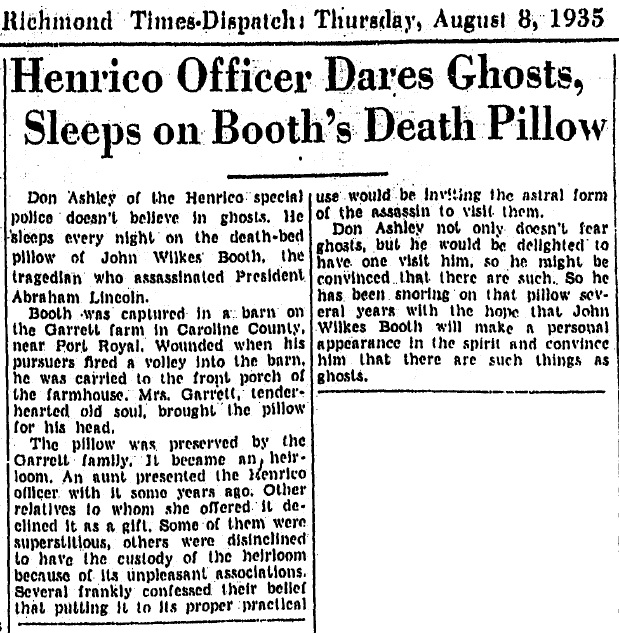












 LincolnConspirators.com
Recent Comments