Posts Tagged With: John Wilkes Booth

John Wilkes Booth at the Parker House Hotel

In 1988, Lincoln assassination researchers General William Tidwell, James O. Hall, and David Gaddy published a book called Come Retribution: The Confederate Secret Service and the Assassination of Lincoln. The volume was the first book of its kind, attempting to unravel the activities of the Confederate Secret Service during the Civil War. The trio documented many plots and instances of guerrilla warfare that Confederate agents undertook to undermine the Union war effort and support the goals of the Rebel South. In addition to documenting the South’s spying apparatus, the authors revitalized the belief of the Union government in 1865, which posited that the Confederate government was behind John Wilkes Booth’s plot against Abraham Lincoln. 

There is no denying that John Wilkes Booth had several intriguing interactions with those involved in some way with secret Confederate activities. His conspirator in the kidnapping plot, John Surratt, was a known Confederate courier, helping to transport mail and people across the line between Union and Confederate territory. In October of 1864, while working on his plan to abduct Lincoln, Booth traveled to Montreal, Canada, a hotbed of Confederate intrigue, where it was claimed he met with high-ranking Confederate officials stationed there. At the trial of the Lincoln conspirators, a group of witnesses gave damning testimony regarding Booth’s familiarity with members of the Confederate leadership in Canada. The belief of the federal government was that the assassin was following the directive of Confederate leaders and that they were as much to blame for the murder of Lincoln as John Wilkes Booth. 

However, despite the strong belief that the Confederate government was the moving spirit of Booth’s plot, concrete evidence proving such a connection has never quite materialized. Most of the witnesses who placed Booth with high-ranking Confederate officials in Canada were later proven to have committed perjury and been bribed to provide their false testimony. No document from the Confederate government mentions Booth, nor were any documents connecting him to the Confederacy found among Booth’s papers after his crime. John Surratt denied that his foray with Booth was in any way connected with his activities as a rebel courier. 

While Booth undoubtedly had flirtations with Confederates and clearly assembled a gang of Confederate sympathizers to help him in his plan, the smoking gun proving that John Wilkes Booth was acting as an authorized agent of the Confederacy remains elusive. 

Even with acknowledging the lack of definitive proof, Tidwell, Hall, and Gaddy proceeded to build a circumstantial case attempting to prove the Confederacy culpable for Lincoln’s death. One piece of evidence the men pointed to revolved around a trip John Wilkes Booth took to the Parker House hotel in Boston, Massachusetts, in July of 1864.

Part of Come Retribution discusses a Confederate attempt to utilize biological warfare against the Union. Several boxes of clothing “infected” with Yellow Fever were sent to northern cities in an effort to start an outbreak of the deadly disease. Luckily, the plot proved unsuccessful as the medicinal knowledge of the day was unaware that Yellow Fever is not contagious but is spread through the bites of infected mosquitoes. Still, this attempt to poison Northern cities was a significant escalation, and the plot was discussed at the trial of the Lincoln conspirators to show how the Confederacy had been willing to commit terrible deeds to win the war.

Details of the Yellow Fever plot piqued the interest of a man named Cordial Crane, who was an official of the Custom House in Boston, Massachusetts. The trunks of yellow fever clothing had made their way through the port of Boston, and one of the conspirators in the plot was said to have stayed at the Parker House hotel in Boston during the shipping process. Acting under his own initiative, Crane went and consulted the hotel register for the Parker House. While he was not able to find any evidence of the Yellow Fever conspirator in the ledger book, he did note the appearance of John Wilkes Booth’s name. I’ll let Come Retribution take it from here:

“…He [found] J. Wilkes Booth on the Parker House register for 26 July 1864 along with three men from Canada and one from Baltimore. Crane’s suspicions were aroused. He copied the entries and sent a letter dated 30 May 1865 to Secretary of War Edwin M. Stanton. He listed the names “Charles R. Hunter, Toronto, CW [Canada West], J Wilkes Booth, A. J. Bursted, Baltimore, H. V. Clinton, Hamilton, CW, R. A. Leech, Montreal.” In his letter to Stanton, Crane wrote that he sent the “names as a remarkable circumstance that representatives from the where named places should arrive and meet at the Parker House at about the same time Harris was on his way to Halifax with his clothing.” Crane put the emphasis in his letter on “Harris” and the supposedly infected clothing. No investigation was made into the other names on the Parker House register. After all, Booth was dead and the War Department already had information about the “yellow fever plot.” Crane’s letter was filed and not followed up.

Now, more than a century later, the gathering at the Parker House can be construed differently. It has all the earmarks of a conference with an agenda. The inference is that agents of the Confederate apparatus in Canada had a need to discuss something with Booth. Capturing Lincoln? Within a few weeks Booth was in Baltimore recruiting others for just such a scheme and had closed out his Pennsylvania oil operations. The inference becomes stronger as a result of a careful search of records in Toronto, Baltimore, Hamilton, and Montreal. No trace of Hunter, Bursted, and Leech was found. The names appear to be aliases.

The man using the name “H. V. Clinton” did turn up in a not unexpected place. Such a man registered at the St. Lawrence Hall, Montreal, on 28 May 1864. Instead of listing himself as from Hamilton, CW, he gave his home address as St. Louis, Missouri. He was back at the St. Lawrence Hall on 24 August 1864, again entering his name on the register as “H. V. Clinton, St. Louis.” A thorough search of St. Louis records from the 1850-1870 period was made. “H. V. Clinton” was not found.”

Now this is an example of where I believe Tidwell, Hall, and Gaddy go too far astray with their suppositions and theories in hopes of proving their overall thesis. With nothing but transferred names from a hotel registry, they have concocted a scenario in which Booth engaged in a meeting with these fellow hotel guests, and that the purpose of this meeting was the actor’s recruitment into an abduction plot against the President. The main evidence of this scenario is the trio’s belief that the names used in the register are aliases, and thus, proof of the men being Confederate agents. Yet this is a laughable conclusion to make without evidence. A researcher’s inability to find more information about a person listed in a hotel registry doesn’t prove the person used an alias. Once you start down that route, you might as well put on your tinfoil hat because then every name is an alias.

Tidwell, Hall, and Gaddy were good researchers, to be sure, but they were as capable of making mistakes and missing things as anyone. One thing that they, and other researchers since, have missed is the fact that they have transcribed one of the names from Crane’s list incorrectly. His list doesn’t include the name Charles R. Hunter, but rather the name “Chas R Winter.”

Above is the original handwritten letter that Crane sent to Edwin Stanton. A microfilmed version of the letter is contained in the Lincoln Assassination Evidence collection housed at the National Archives, and that entire collection is digitized and viewable at Fold3.com. At the bottom of the first page, Crane lists the first of five names he copied from the Parker House hotel registry dated July 26, 1864.

Now, looking at it quickly, I can understand why Tidwell, Hall, and Gaddy read this as “Charles R Hunter, Toronto CW.” The first letter of the last name certainly seems like an H with an incomplete crossbar. We’ll get to that later. Instead, look at the second letter in the last name. Tidwell, Hall, and Gaddy transcribed this letter as a “u”, but there is clearly a dot floating above it indicating the letter is actually an “i”. An “i” is also the only way that the rest of the word “-nter” would work, since a cursive “n” had two bumps and a ‘u” would steal one of these bumps to make the downstroke. William Edwards and Edward Steers, in their edited printed volume of the evidence agrees that this second letter is an “i” and they transcribe the name as “Chas R Hinter.” However, I believe the name is actually “Winter” with the “W” somewhat hastily drawn. For comparison, look at the way Crane writes Booth’s middle name.

Note how the “W” in Wilkes starts with a little flag or serif before starting the down stroke. The first letter in Charles’s last name also starts with a flag-like serif (admittedly, a somewhat smaller one). Returning to “Wilkes’ we can see how Crane’s downstroke immediately angles upwards and then falls again to make the middle of the “W.” However, rather than bringing the final stroke completely back to the top to complete the capital “W,” this final stroke is significantly shortened and connects directly into the next letter, an “i.” When I taught cursive to my third graders, I always taught them that a capital W doesn’t connect to the rest of the word, but Crane has made his own shortcut of sorts. We can see the same basic formation later on the second page when Crane writes about “the sad tragedy at Washington.” Again, the capital W starts with a decorative serif (this time it’s not connected to the main letter) and the final stroke of the W is almost non existent as it merges into the “a.” Looking back at Charles’s name we see the small flag, the downward stroke and then the start of the upward angled stroke before the line breaks. It could have been that the pen Crane was using was misbehaving, or he failed to put enough pressure during this stroke, which is why it cuts off. Still, we then have the downstroke and the significantly shortened final upstroke that goes into the “i” instead. For those who might still believe this letter is meant to be an “H,” look at the other examples of capital Hs in the letter. There is no starting serif, no upward diagonal. Crane forms the middle of his H by making a loop in his second vertical line. There is no evidence of an attempt to “loop” the downward stroke before the “i.” The name is not Charles Hunter or Charles Hinter, but Charles Winter.

While Tidwell, Hall, and Gaddy may not have been able to find a Charles R. Hunter living in Toronto, there was a Charles R. Winter who lived there. Charles Robinson Winter was born in Barnstaple, England, in 1832. His older brother immigrated to Canada in the late 1840s, and Charles eventually followed him. Charles R Winter from Toronto is included in the arrivals list for the Royal Hotel in Hamilton, Ontario, on May 17, 1864. In January 1865, he married a fellow English native turned Canadian resident, Elizabeth A. Baker, at the home of her brother in Toronto. In the 1871 and 1881 censuses, Winter is listed as an “agent” and directories specify him as a “manufacturer’s agent,” a role that would require a lot of travel. In fact, in the 1868 Toronto directory, his occupation is listed as “traveller.” Now, I can’t prove that this Charles R. Winter is the same one as the one who checked into the Parker House hotel in Boston on July 26, 1864, but I feel that this is more of a possibility than this name being an alias. Winter died in 1899 and is buried in Toronto.

The final name on Crane’s list is “R. A. Leech Montreal.” Though it’s spelled a tiny bit differently, through some research, I pretty quickly found a Robert A. Leach who resided in Montreal during this time period.
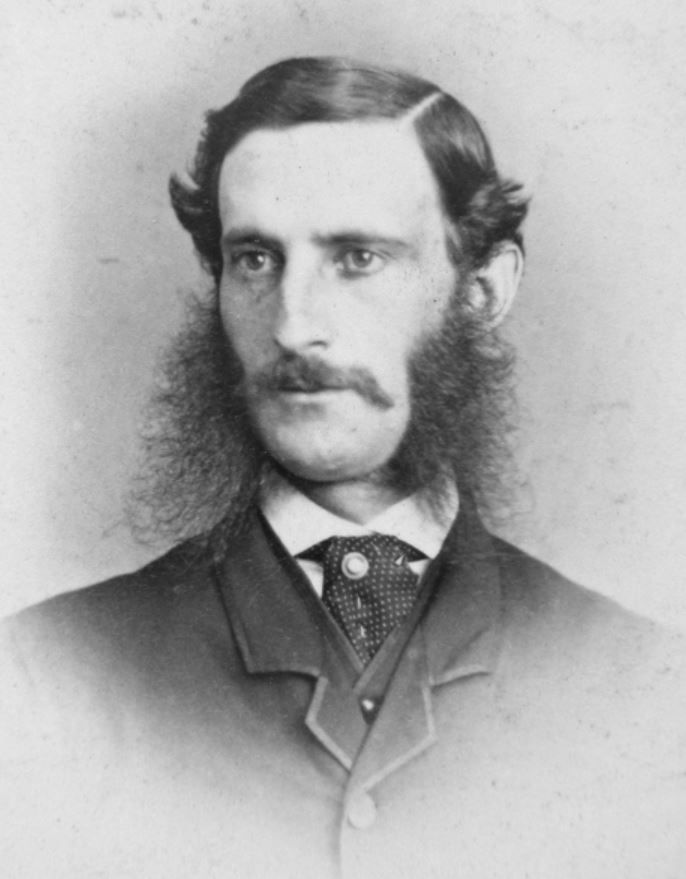
Robert A. Leach (according to an image on FindaGrave)

Robert A. Leach was a young lawyer from Montreal. He is found in the 1864 Montreal directory as the “R” in “R & D Leach, Advocates.” This was a firm he shared with his brother David. Both were the elder sons of William Turnbull Leach, the archdeacon of Montreal’s St. George Church. Robert A. Leach died from an unspecified illness in 1871 at the age of 32. He is buried in Montreal. Again, I feel the possibility that the R A Leech in Crane’s letter is more likely to have been Robert A. Leach than an alias of a Confederate agent.

Now I wish I could say that I’ve found prospective identities for each of the names on the list. While I definitely have a step up over Tidwell, Hal, and Gaddy, who worked in the pre-Internet age, the remaining two names on the list have mostly eluded my own searches.

However, it’s clear from Crane’s letter that he had a hard time deciphering the last name of the man from Baltimore. Come Retribution only provides Crane’s first guess, “A J Bursted,” but the original letter shows Crane adding “(or Rursted)” after this entry, showing his uncertainty. “Bursted” and “Rursted” are not surnames for anyone. It is unlikely a person would have used such a nonexistent last name, even as an alias. It is far more likely that Crane just couldn’t read the poor handwriting of the entry. The last name might have been Bustard, Buster, Bumstead, or something else entirely. With only the initials “A. J.” (if even those are accurate), we don’t know what first names to search. Unfortunately, we cannot go back to the original records ourselves to try our hand at deciphering these names. The original registers for the Parker House hotel during this period no longer exist. All we have is this small snapshot from Crane, which doesn’t even specify if these were the only names entered into the register on July 26, 1864. It seems unlikely that a busy metropolitan hotel like the Parker House would only gain five guests over the whole day. It seems more likely that these were the only names Crane recorded because he was looking for a connection to Canada.
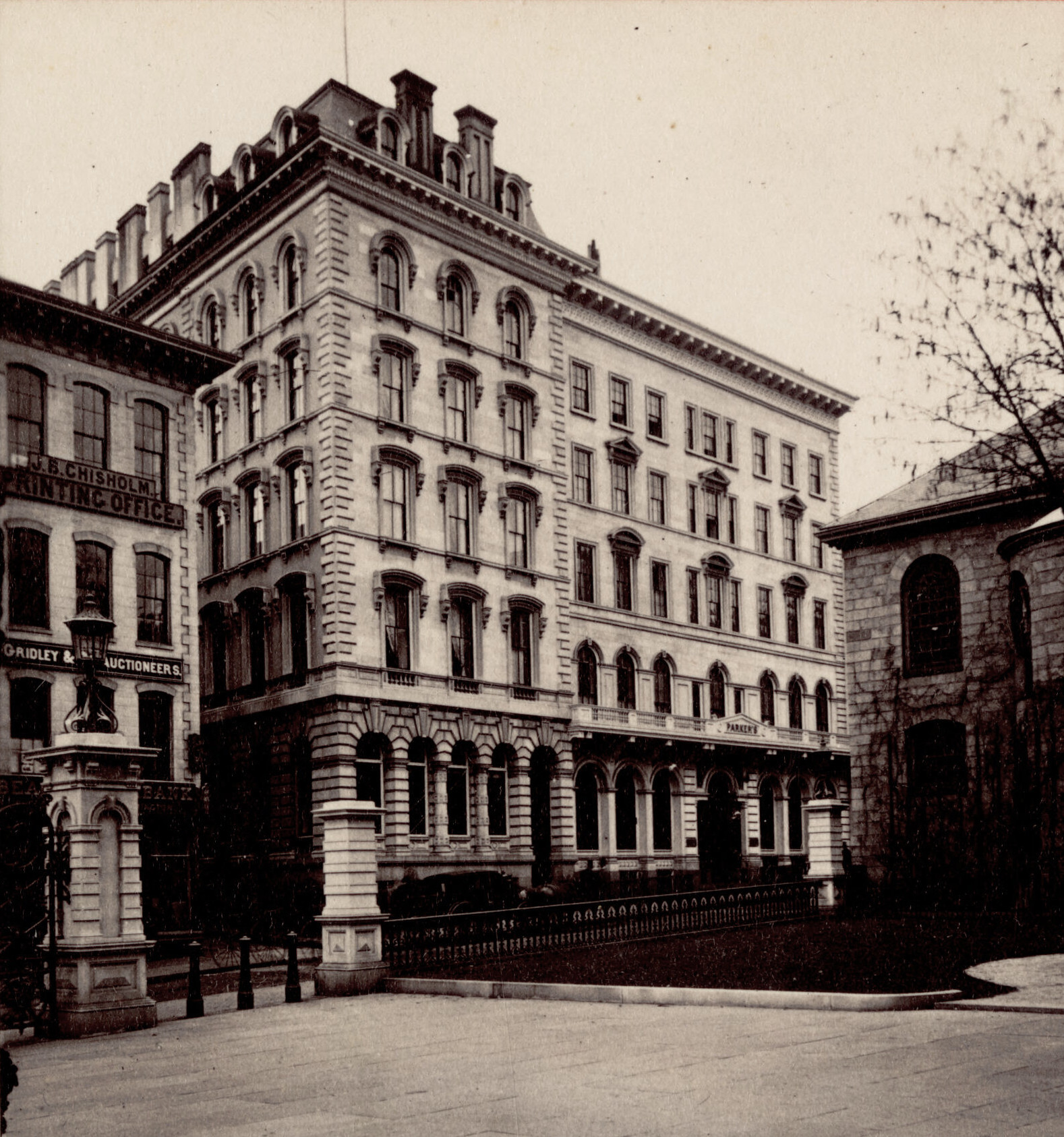
The Parker House hotel in Boston

But let’s still look at “H V Clinton” of Hamilton, Canada West. This name is seemingly the linchpin of Come Retribution’s theory that the names on the list are all aliases. As they note, the name “H V Clinton” also appears on the register for the St. Lawrence Hall hotel in Montreal in 1864. That hotel was known to cater to many Confederate agents and sympathizers. It was said that the St. Lawrence Hall was the only hotel in Canada to serve mint juleps, a favored drink among the plantation South. I’ll admit that I have not been able to find an “H. V.” Clinton living in Hamilton, Ontario. However, I did find a whole family of Clintons, with different initials, who lived in the area. James H. and William Wesley Clinton were farmers who resided in the Oneida Township of Haldimand County, Ontario. Haldimand County abuts the city of Hamilton, and the distance between downtown Hamilton and the Oneida Township is about 18 miles. A resident of this rural area would likely provide their place of residence as Hamilton on a hotel register in the same way Booth regularly registered in hotels as being from Baltimore rather than Bel Air. While Booth had also lived in Baltimore as a child, once his father died in 1852, he never resided in Baltimore again. The Booths didn’t even have a home there after the 1850s. If I were to try to find John Wilkes Booth in Baltimore records during the 1860s, I would fail. In the 1860 census, the Booths are all enumerated as living in Philadelphia. During the summer of 1864, he resided with his brother Edwin in New York City. Yet, to Booth, he was “from” Baltimore, and that’s why he would sign hotel registers that way. H V Clinton from Hamilton, Ontario, might have followed the same course. There was a man named William Clinton who lived in Hamilton and worked as a saw-filer in 1863 and beyond. Granted, none of these individuals appear to match the given initials  “H. V.”, but remember that we are trusting Cordial Crane that he transcribed the right letters. Regardless, there were Clintons living in and around Hamilton, Ontario, during the 1860s who could represent the man who checked into the Parker House.

What of the mysterious H.V. Clinton, who checked into the St. Lawrence Hall in Montreal in 1864? As Come Retribution notes, this Clinton wrote his place of residence as St. Louis, Missouri. He checked in on May 28, July 8, and August 24. For some reason, the Come Retribution authors neglected to mention the July 8 entry, despite their having been aware of it. On that day, H V Clinton checked in at 7:30 pm. Earlier that same day, an entire party from St. Louis had also checked in. This party was headed by “Mr and Mrs Garneau,” their two children, a nurse, and two other guests: a “Miss Withington” and a “Miss Clinton.” The Garneaus were Joseph and Mary Garneau. Joseph was a Montreal native who immigrated to the States and settled in St. Louis. There, he established a bakery that grew into one of the largest factories for baked goods in the U.S. He produced crackers in huge quantities and helped supply the Union with crackers and hardtack during the war. Mrs. Garneau’s maiden name was Withington, and the Miss Withington who joined them was her younger sister, Emily Withington. The names of this party can also be found in a newspaper article published in Buffalo, New York, on July 6. It appears that the Garneau party traveled part of the distance from St. Louis to Montreal aboard a boat called the Badger State commanded by Captain James Beckwith. The article contained a thank you to Captain Beckwith and a positive review of the journey that the boat provided. Included in the signatories of the article are the names Joseph Garneau, Mrs. Joseph Garneau, Miss E Withinton [sic], and Miss Maggie Clinton. I have been unable to determine the relationship between this Maggie Clinton and the Garneaus. 

The St. Lawrence Hall hotel in Montreal

Still, the arrival of H V Clinton, also from St. Louis, to the same Montreal hotel, on the same day as the Garneau party featuring Maggie Clinton, definitely seems to be connected. In addition, Come Retribution fails to mention that when H V Clinton returned to the St. Lawrence Hall hotel on August 24, he was not alone. That time, he checked in with “Miss Kate Clinton,” also from St. Louis. The two were put in adjoining rooms. All of this makes me think there was some sort of family connection between H V, Maggie, and Kate Clinton, and that they were also somehow connected to the cracker magnate, Joseph Garneau, who was originally from Montreal. 

As Come Retribution mentions, searches for H V Clinton in St. Louis, Missouri, fail to provide identifying information. There were definitely Clintons living in St. Louis in 1864. So far, I have only been able to find one instance of an H V Clinton in St. Louis. It was common practice in days gone by to publish lists of unclaimed letters held by the post office in the newspaper. Many people addressed their letters with just the name of the recipient and the city or town where they resided, rather than a full street address. It was then up to the recipient to go to the post office and inquire about any letters for them to receive their mail. To illustrate this, here’s the envelope to a letter John Wilkes Booth wrote. It gives the addressee’s name but merely directs it to the post office where it would have to be picked up.

If a person did not pick up their mail from the post office after a certain period of time, postmasters would publish a list in the paper, hopefully informing the recipient that they have mail waiting for them. The name H. V. Clinton is featured on such a list in the St. Louis Globe Democrat newspaper on September 15, 1866. It’s worth noting that this date is well after the end of the Civil War. If the name H V Clinton were indeed an alias, there would have been no need to continue using it after 1865. It seems more likely that H V Clinton was a resident of St. Louis in the 1860s, albeit one that is difficult to track down. 

During my research, I stumbled across other H V Clintons in the 1860s that could possibly be the same person, but their connection to St. Louis is unproven. There was an H V Clinton living in Carroll Parish, Louisiana, through the 1860s. A H V Clinton and his wife from Indiana visited Newport, Rhode Island, in 1862. Henry V. Clinton, residing in Newport, advertised for a nanny to accompany him and his young son on a year-long trip to Europe in 1864. There’s no way to prove or disprove that any of these are the same H V Clinton.

In the same way, we cannot prove that the H V Clinton from Hamilton, Ontario, who signed the Parker House hotel registry in Boston on July 26, 1864, is the same H V Clinton from St. Louis, Missouri, that thrice signed the St. Lawrence Hall register in Montreal in May, July, and August of 1864. The difficulty in finding either of these men does not prove they are the same person or, even more, that they were an alias for a Confederate agent who subsequently recruited Booth into the plot to kidnap Lincoln. 

In the credit of Tidwell, Hall, and Gaddy, when they wrote Come Retribution, they were understandably intrigued by the fact that Booth made a seemingly random visit to Boston in the summer of 1864. In June of that year, he had been tending to his failing oil investments in Pennsylvania before arriving and spending weeks with his family in New York City and in New London, Connecticut. This register entry of a trip to Boston was a mystery, and, following Cordial Crane’s suspicions, the trio made a conspiracy out of it.

However, just about a month before Come Retribution was published, a new and exciting discovery was made. Six letters written by the assassin between June 7 and the end of August 1864 were made known to historians. Booth had written the letters to a 16-year-old Boston girl by the name of Isabel Sumner. The actor had likely met the girl during his long engagement in Boston earlier that spring. From the tone and content of these letters it is clear that Booth was smitten with the young woman, so much so that he even gifted her a pearl ring with the inscription “J.W.B. to I.S.” Though it does not appear that their romance lasted beyond the summer, young Ms. Sumner retained this cache of letters, the ring, and photographs of the actor, even after he murdered the President. These items were passed down through members of her family until her descendants revealed them and sold the lot in 1988 to collector Louise Taper. James O. Hall, when in the process of helping to facilitate the sale of the letters to Taper, even wrote to the Sumner descendant offering to send a copy of his soon-to-be-published book, Come Retribution. Had the Sumner letters been known a year earlier, the contents may have caused Hall to see Booth’s Boston trip in a less conspiratorial light. 

Isabel Sumner

On July 24, 1864, Booth wrote to Isabel Sumner from his brother’s home in New York City. That letter was sealed in the envelope previously shown above. The smitten Booth apologized to Isabel for coming on so strong with his many love letters and feared he had scared her off. He apologized for his intensity and vowed not to write her another letter until he heard from her. Yet, despite this vow, it’s clear Booth was unwilling to wait for a response. He ended his letter with, “Remember, dear friend not to let anyone see my letters. I will come at once to Boston.” Two days after writing this letter, Booth checked into the Parker House hotel in Boston. 

Seen in its proper context, there is no mystery regarding Booth’s visit to Boston in July of 1864. The man was clearly smitten with 16-year-old Isabel Sumner and traveled from New York to Boston to see her. His own written words betray his purpose. His trip to Boston was not of a conspiratorial nature, but one of desire. 

In the years since Come Retribution was published, several authors have taken up Tidwell, Hall, and Gaddy’s thesis, transforming what the trio presented as couched theories into near certainties. The late John Fazio, author of Decapitating the Union, was the greatest master of this. In his section about Booth’s visit to the Parker House he stated uneqivialy (and without evidence) that Booth, “met with three Confederate agents from Canada and one from Baltimore” and that “this meeting was the first, or at least one of the first, that John had with Confederate agents and that many more followed.” Yet, as can be seen, there is no evidence that Booth took part in a Confederate conference at the Parker House hotel in Boston. The underlying “support” for this is that some of the men who also checked into the hotel on this date were from Canada, and researchers of the past couldn’t find out more about them. 

As I stated at the beginning of the post, John Wilkes Booth did have some legitimate and intriguing connections with members of the Confederate underground. But we must also remember that much of this underground was not the same as the official Confederate Secret Service, which enacted authorized missions. Confederate sympathizers often acted in the same way as modern terrorist cells. They had the same ultimate goal to help the Confederacy and win the war, but not every action completed by these groups was controlled by or even known to the Confederate government. 

Ultimately, I believe that Booth was speaking honestly when he closed his manifesto for the kidnapping plot, identifying himself as “A Confederate doing duty upon his own responsibility, J. Wilkes Booth.” But even those who believe that the Confederate government may have had a hand in Booth’s plots against Lincoln, it is important to be realistic about the evidence supporting this. There is nothing to support the idea that John Wilkes Booth met with Confederate agents at the Parker House hotel in July 1864. 


If you found this post interesting and want to support my research and writing, please consider joining my Patreon page. For just $3 or more a month, you get access to a weekly newsletter that keeps you up to date on all things Lincoln assassination-related. For $7 or more a month, you also get access to exclusive fortnightly posts delving into the history of artifacts relating to the assassination story, and for $15 or more a month, you get monthly videos from me where I share new research discoveries and answer your questions about this history. The contributions of patrons help cover my research subscriptions and associated website costs. For example, the All Access Membership subscription to Ancestry.com (which was needed to consult Canadian and other international records in the writing of this post) costs about $500 a year, so every little bit helps. Click here or on the icon below to learn more about my Patreon.

Categories: History | Tags: , , , , | 7 Comments

The Ides of April Podcast

In the world of podcasts, there are many episodes and series about the Lincoln assassination. I’ve been a guest on a few podcasts talking about this history. My favorite has been the series of Vanished episodes that dealt with the Booth escaped justice theory. Admittedly, part of what makes it my favorite is that it is how I met my wife, Jen, who is one of the podcast’s co-hosts. But we also spent a lot of time diving into the history of the Finis Bates story and ripping it to pieces, which was cathartic in the same way reading Frank Gorman’s recent book is. I’ve also enjoyed speaking with the duo of Mary and Darin on The Civil War Breakfast Club podcast about all things Lincoln assassination.

While these are examples of good podcasts that work hard to present accurate history, not all podcasts are created equal. The format is open to anyone with a microphone and the ability to upload their audio file to the internet. Because of this, there is a wide range of quality in podcasts that suit different tastes and levels of knowledge. Not too long ago, a somewhat “known” podcast did a series on the Lincoln assassination that received a lot of exposure. Though I don’t listen to many podcasts myself, I decided to give it a listen. After 10 minutes, I had to turn it off. It was the format of one guy essentially reading Wikipedia about the Lincoln assassination and his “bros” cracking jokes about it in a crass manner. Definitely not a style for me.

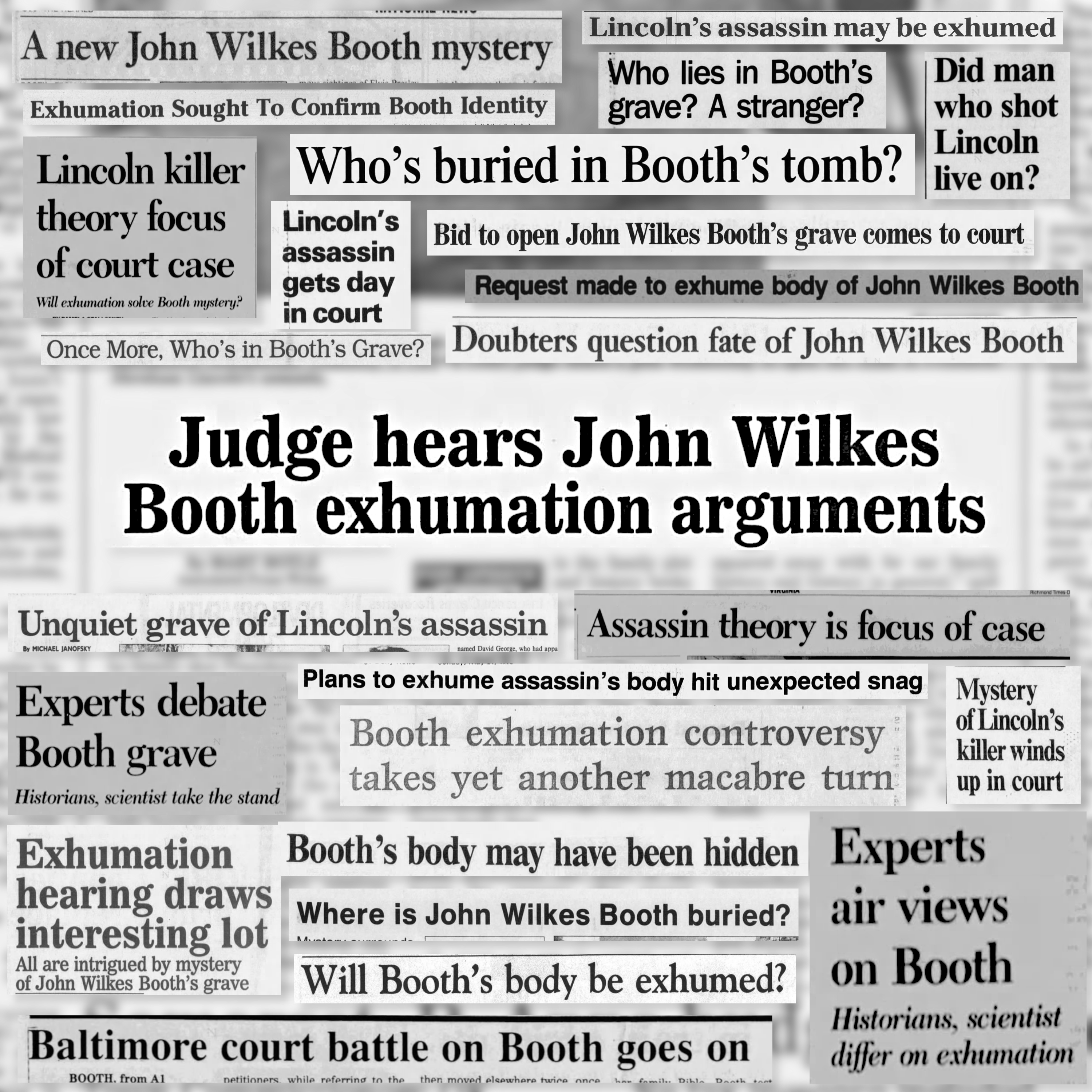
Then, a couple of weeks ago, I saw this announcement from Variety that actor Alec Baldwin would soon be hosting an eight-part podcast series about the Lincoln assassination and the hunt for John Wilkes Booth. As of this post’s publication, three episodes of the series have been released. It’s called The Ides of April, and while the majority of the narration is done by Baldwin, the show does feature audio clips from historians Harold Holzer, Walter Stahr, and Terry Alford. It was hearing and recognizing Dr. Alford’s voice in the trailer for the podcast that got me interested. As the author of the biography, Fortune’s Fool: The Life of John Wilkes Booth, and a member of the group that defended Green Mount Cemetery in 1995 from conspiracy theorists who wanted to exhume Booth’s body, I’m always interested in what Dr. Alford has to say about Booth and the assassination.

The Ides of April isn’t a perfect podcast. The graphics used for the title and episode cards have that soulless look that all AI-generated art does. The text that Baldwin reads can be a bit repetitive at times and isn’t always historically accurate. The podcast highlights many of the same questionable conclusions that many online sources do, such as Edwin and John Wilkes being bitter rivals. The episode titles, while evocative, are never explained or referenced. With that being said, Alec Baldwin, as a narrator, has a compelling voice that keeps you engaged, and the clips from the historians really help round out the rough spots in the text.

All in all, I’ve been casually enjoying the podcast so far. I don’t think it will break any new ground, but it’s a good-sounding, condensed account of the story we all know, featuring some impressive historians in the Lincoln field like Dr. Alford. If you want something to listen to while driving or doing chores around the house, you might enjoy the show as well. Perhaps you’ll be like me and play the game of “that’s not quite right” as you listen.

The Ides of April can be found wherever you listen to podcasts. They also have a YouTube channel where you can listen to the episodes. Here’s the link to the YouTube playlist of episodes. Remember that the series is still ongoing, with new episodes dropping on Wednesdays until the last one is scheduled to be released on September 3, 2025.

Categories: History, News | Tags: , , , , | 4 Comments

Campfire Tales about Old Joe Zisgen by Steven G. Miller

With the success of his post earlier this month, I’m happy to report that Steve Miller is making a return appearance. This time, Steve shares a new discovery he has just made bout the fate of one of the members of the patrol that cornered Lincoln’s assassin.


Campfire Tales about Old Joe Zisgen

By Steven G. Miller

In my portion of the Booth Exhumation reunion that was recently hosted by Dave and posted on this site, I mentioned that Joseph Zisgen had never spoken about the death of Booth so far as I was aware.

Wouldn’t you know it, just over a month after I made that statement, I stumbled onto such an account!

Who was Joseph Zisgen? A brief biography of “Old Joe” was contained in this obituary:

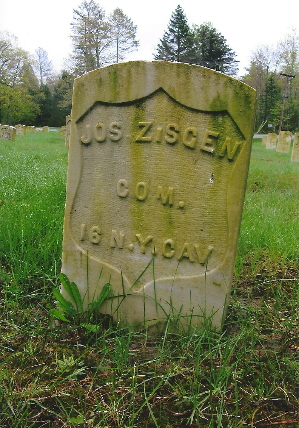
“The death of Joseph Zisgen occurred in the hospital here Thursday after a long illness. He was born in Germany and had been a resident of this country since boyhood. He served in Co. M, 16th. N.Y. Cav., and in Co. G, 3d N. Y. Pro. Cav. during the Civil War. He was admitted to the Branch from New York City, Dec. 14, 1871, and was one of the oldest members of the Branch. Mr. Zisgen was one of the party who captured John Wilkes Booth, the assassin of President Lincoln, and he received $2000 of the reward, it is said on good authority. He had been a member of the Branch so many years that all knew “Joe” and he had become a ‘character.’”

Zisgen’s grave in Maine from FindaGrave.com

His share of the Booth-Herold Reward money was actually $1,654.83, and he received it in August 1866. There has always been a minor mystery (in my mind, at least) about what became of the money. That amount was enough to set someone up with a comfortable life. Joe didn’t seem to have any health issues until old age, yet he ended up in the Soldiers and Sailors Home. It seems that the article I found solves that question.

The author of the article was Josiah Smith Maxcy (1854-1936), the son of a wealthy businessman from Gardiner, Maine. Maxcy went on to great success as a banker, railway executive, and, finally, the president of the Maine Trust Banking Company and Gardiner General Hospital. Always fond of his hometown, Maxcy also presented a speech on Gardiner’s early history for its centennial celebration in 1903.

In his article, Maxcy recounts how, when he was a teenager, he and others had gone camping on the shores of Boothbay Harbor one summer and became aware of the potential for establishing a campground on Squirrel Island in the Gulf of Maine. Eventually, the property came up for sale, and Maxcy and a group invested in the site and established a colony on the land. It became a successful summer getaway, and Maxcy was one of the officers of the organization.

He gives a history of the resort and the people involved in its creation, but digresses to tell a story which he describes as “an incident of that camping trip (in the summer of 1873), which was of much interest.”

Here’s the interesting part of Maxcy’s article:

“A Civil War Veteran

“Near our tent was another occupied by about a dozen Civil War veterans from the Government House at Togus, and one of their number, a German, was a member of the squad that captured J. Wilkes Booth, He graphically described the pursuit and capture, the burning barn and the paleness of Booth, leaning on his crutch, and of his being shot against orders by Boston Corbitt. Then he told of receiving his share of the reward, of becoming gloriously drunk, of walking thru the streets of New York and meeting an organ grinder with his monkey, of purchasing the outfit for a fabulous sum, of the monkey going up a conductor into window for a tip, of his encounter with a pet bull pup, of the soldier and the dog’s owner engaging in a free fight, of finding himself next morning locked in a cell, and nearly destitute of money. He was taken before a magistrate, and the reward was paid to the Judge, saloons, organ-grinder, jail inmates and magistrate who got it all.”

Though he does not identify the soldier by name, Maxcy was undoubtedly referring to Joseph Zisgen, of the Garrett’s Farm patrol. Now we know we apparently know what happened to his bounty money! Other troopers who received a share of the War Department Reward applied it to boring things: houses, farms, raising families, and starting a modest business or two. If this story is true, here we seem to have one who blew it on a drunken bender and a furry little critter.

Wasn’t it Billy Rose who cautioned: “Never invest in anything that eats or needs painting”? Joe should have heeded this advice.

References:
“A Historical Sketch by Josiah S. Maxcy of Gardiner. Mr. Maxcy Recalls His Own Experiences and Searches thru the Records for Matters of Fact and History,” Sun-Journal (Lewiston, ME), August 20, 1921.
“National Home. Joseph Zisgen,” Kennebec (ME) Journal, January 9, 1914.

Categories: History, Steven G. Miller | Tags: , , , | Leave a comment

John Wilkes Booth Exhumation Trial 30th Anniversary Panel

On May 17, 1995, a historic trial began in the Circuit Court of Baltimore City. The case revolved around a legal petition to exhume the remains of John Wilkes Booth from Green Mount Cemetery. The petition was the culmination of years of effort on the part of two historical researchers who believed that the assassin of Lincoln was not killed at the Garrett farm on April 26, 1865, but instead escaped justice and lived for many years under assumed identities. The main support for this theory was a 1907 book called The Escape and Suicide of John Wilkes Booth, written by a man named Finis Bates who claimed to have met an incognito Booth in Texas in the 1870s. Despite the numerous factual and logical errors in the book, many people wanted to believe the tall tale, and the story of Booth’s escape from justice became folklore akin to sightings of the deceased Elvis Presley. In 1991, this fringe theory rose in prominence when it was featured on the TV series Unsolved Mysteries with Robert Stack. The increase in exposure motivated the two leading proponents of the theory to seek legal recourse to prove their claims. Green Mount Cemetery opposed the exhumation, both on the merits of the conspiracy theory and also due to the researchers having no connection to the deceased.

The attorney for the researchers then found two distant Booth relatives and convinced them to become involved. The names of the researchers were swapped with those of the distant Booth relatives, and the petition to exhume was refiled. Green Mount Cemetery still opposed the exhumation request, and so a trial was set to evaluate the merits of the petitioners’ case.

The trial consisted of four days of testimony, with 16 witnesses taking the stand. The trial was overseen by Judge Joseph Kaplan and occurred in Courthouse East on Calvert and Fayette Streets in Baltimore. Green Mount Cemetery was represented by attorney Francis J. Gorman from the newly formed law firm of Gorman and Williams. Frank assembled a group of Lincoln assassination historians and an expert on exhumations to discuss the validity of the petitioners’ factual and scientific arguments. The petitioners were represented by attorney Mark Zaid.

At the end of 2024, Frank Gorman published a book entitled Confronting Bad History: How a Lost Cause and Fraudulent Booth Caused the John Wilkes Booth Exhumation Trial. In this book, Frank not only expertly documents the exhumation trial and its proceedings in an engaging way, but he also provides some vital context regarding the character of Finis Bates and his book. After sharing in some conversations with Frank about his wonderful new book, I volunteered the idea of trying to put together a reunion panel of sorts to mark the 30th anniversary of the exhumation trial in 2025. Through calls and emails, Frank was able to convince four witnesses from the 1995 trial to take part in the reunion. Though I had no involvement in the original case, I was honored to be asked by Frank to moderate the discussion. Due to the geographical distances between the different participants, we decided to conduct this reunion virtually over Zoom.

The participants of this reunion panel were:

In the end, the panel lasted a little over three hours as we delved into several aspects of the trial and the research behind it. For the ease of viewing, I have divided it into three segments, which you can watch below.

I hope that you enjoy watching this reunion panel as much as I enjoyed moderating it. By watching these videos and reading Frank Gorman’s book, you are helping to confront bad history.

Categories: History, News | Tags: , , , , , | 1 Comment

An Interview with the Creators of The Pursuit of John Wilkes Booth

On the 160th anniversary of Abraham Lincoln’s assassination, I sat down with Ryan Heilman and Wes Crawford from Wharf Rat Games. These two are the designers and creators of the new board game, The Pursuit of John Wilkes Booth, published by Blue Panther LLC. We had an excellent discussion about the history behind this Lincoln assassination-themed game, the process of designing and developing board games, and how board games can be a form of public history. Check out the video of our talk below:

To read my earlier review of The Pursuit of John Wilkes Booth, click here. To purchase your own copy of this unique board game, you can order it from the publisher, Blue Panther LLC, by clicking the image below.

Categories: History, News | Tags: , , , | 1 Comment

A Filthy Fortunes “Find”

While chatting on the phone today with my mom, she told me about seeing a show on the Discovery Channel recently called Filthy Fortunes. The reality show revolves around a team of people who clean out extremely cluttered rooms and homes, selling the items contained to hopefully pay for the clean up and make some profit. It’s essentially the TV show Hoarders but with an emphasis on looking for some treasure in the rough.

My mom said that in the episode she watched, the crew came across a John Wilkes Booth card of some sort that they were very excited about. She said it was signed by him and apparently went for a lot of money. I decided to look into the show and see what treasure they had found.

Here’s a clip from the show that they put on social media showing the discovery of the Booth card:

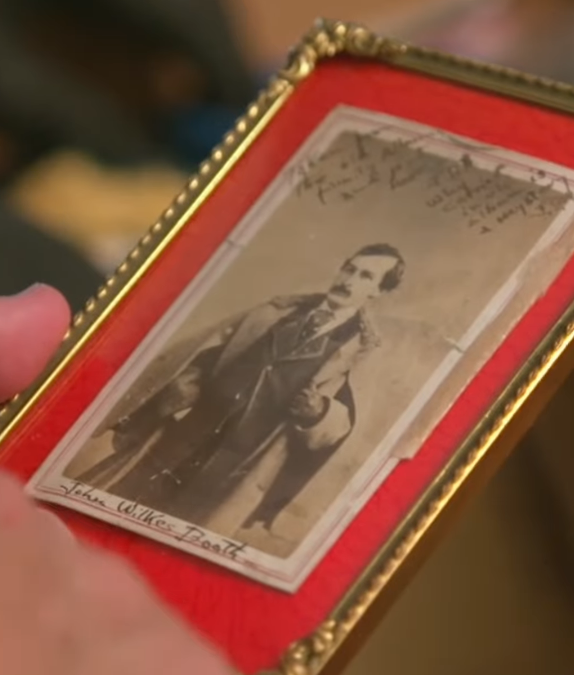
As I had suspected, what the clean-up crew found was a carte-de-visite photograph of John Wilkes Booth. These are not all that rare, as Booth was a famous actor who regularly had his picture taken. While there was a temporary halt on the sale of Booth’s photographs after the assassination, when this order was rescinded, many photographers flooded the market with photos of the assassin. There are many pictures of Booth, and the pose found by the cleaners, where he is wearing his fancy jacket, is one of the most common images of him.

The host of the show was very excited because he said the photo was signed by Booth at the bottom. Now, a genuine signed CDV of John Wilkes Booth would be worth quite a lot of money. An oversized clipped signature of Booth’s sold for over $17,000 a decade ago. Unfortunately for the host, this is clearly not signed by John Wilkes Booth. The writing looks nothing like Booth’s handwriting and is in print, not cursive. This isn’t the first person to confuse a labeled image of John Wilkes Booth with a signed one; they regularly pop up on eBay and other places. There is also some random text written on the top of the card, but again, not in Booth’s hand. This writing actually detracts from the value of the otherwise average Booth CDV. On eBay, you could maybe get $100 for it.

I found the rest of the episode online and got to the point where the host was revealing to the homeowner how much money they made selling the things they found in the house. The host documented the other things they had sold from the home, including misprinted stamps, a Mustang, and a coin collection. He then stated to the homeowner:

“The item that really put us over the hump was a signed John Wilkes Booth card. We sent it to auction and they estimated that it’ll be worth $10,000.”

He then stated that with the cash sale of the other items and the auction estimation, they made $28,000 from the items in the house. The cleaning cost was $10,000, leaving $18,000 profit. This was then split between the homeowner and the cleaning crew, 60-40. The host handed over a stack of cash to the homeowner, saying it was her $10,800 share. She was, of course, ecstatic to not only have her house cleaned out but to have made $10k in the process.

But did she?

Well, let’s look and see how much that “signed” John Wilkes Booth CDV actually brought when it was sold at auction in July of 2024.

It sold for $80. Not $8,000. Not $800. $80. And, actually, that is a pretty fair price for an average Booth CDV with random writing on it. Interestingly, the auction house that sold it did not attempt to portray this as a signed CDV. The description documents that John Wilkes Booth’s name on the bottom is “(not in his hand).” We can also see that the starting price for this CDV was set at $40, hardly an amount you would start at for a priceless relic like a genuine signed Booth item. So, where in the world did the host get the estimation of $10,000?

My guess is that when they shot the end of the episode, the production company had not yet reached out to any auction house. Instead, they just looked at some recent auction prices of genuine Booth signatures and letters and made a guess. If they did reach out to a real auction house, the auctioneers must have given them the $10k valuation sight unseen. I have a hard time believing any legitimate auctioneer would have thought this photograph had a genuine signature. Even a quick Google search would show that the printed name has nothing in common with the assassin’s autograph. You have to wonder how that homeowner felt when the production company eventually informed her that she was getting less than half of what they told her on camera since their $10,000 item only sold for $80.

This Booth CDV makes an appearance in the pilot episode of Filthy Fortunes. When I was trying to find a video of the show online, I came across a few interviews the main host had with media people and YouTubers during the promotional period before the show debuted. In some of those interviews he makes mention of this great John Wilkes Booth find. But his recollections of the actual item are wildly incorrect. The biggest issue is that the host clearly does not know the difference between a picture and a playbill. Here’s an assortment of his comments on the item from different interviews:

“…the most interesting thing we found this season was a John Wilkes Booth playbill, like an actual picture of John Wilkes Booth that he signed like not too long before he shot Lincoln…”

“…it’s a play- it’s a picture, basically like a tintype, so like a Polaroid, of John Wilkes Booth. It’s dated. He signed it. Cause he was an actor at the Ford theater there in D.C. And so we found like a playbill, with John Wilkes Booth’s signature, like three months before he shot Lincoln…”

“…a John Wilkes Booth card…it’s a playbill from the Ford’s theater with a picture signed by John Wilkes Booth and it was like six months before he shot Lincoln…Let me tell you that’s worth some real money…”

“…the coolest thing for me this season was a John Wilkes Booth playbill that was signed by John Wilkes Booth at the Ford theater…When I found the John Wilkes Booth card, I was like ‘I got a guy’ [to sell it to]…”

Perplexingly, in a far more casual and expletive-laden interview the host gave to a Twitch streamer, he recounts how he sold the Booth CDV to a private individual for $40,000. I’m going to embed that video below, but I am warning everyone that there is a lot of cursing throughout (because that’s how you get in cool with the youths, apparently). The video should start right at the beginning of their discussion of the Booth item:

I honestly have no idea what to make of this video and the claim that the host sold the CDV for $40,000. Fraudulent and fake things sell all the time in the auction world to people who don’t know any better. I know of one eBay seller who regularly has CDVs of Booth, the other Lincoln conspirators, and other famous people for sale that are terrible forgeries made by putting a modern printed picture in between two halves of genuine portrait or vignette-style CDVs with the original images removed. I highly doubt the Filthy Fortunes host acted in a malicious way like that. It’s far more likely that he truly thought he had a genuine signed Booth CDV when he found it because he doesn’t have the expertise to know the difference. His confusion over what a playbill looks like demonstrates that this area is not his forte.

In the end, all I can do is point to the auction listing showing that this labeled but not signed John Wilkes Booth image sold for $80. If the host actually sold it for $40,000 to a private individual, then he made the deal of a lifetime off of a real fool who didn’t do any due diligence. But I suspect that all of this story is bluster, intended to make the show seem more exciting by having an item appear far more valuable than it is. To borrow a phrase the youths on Twitch will understand, “it’s cap, fam.” (For my fellow non-Gen Zers, “cap” apparently means “a lie.”)

The lesson here is, as always, don’t believe what you see on “reality TV.”

Thanks, Mom, for giving me something to gripe about on the internet.

Categories: History, News | Tags: , , , | 4 Comments

The Pursuit of John Wilkes Booth Game Review

The Pursuit of John Wilkes Booth is a brand new board game published by the company Blue Panther. In the game, you take on the role of government detectives attempting to track down John Wilkes Booth after the assassination of Abraham Lincoln. The goal of the game is to capture or kill Booth before he escapes out of the country or out west.

I preordered a copy of this game last month and received it earlier this week. Since then, I have played the game four times, three times using the default solo player mode, and once using the two player cooperative mode with my wife, Jen. The game also features a two-player competitive mode, where each player is trying to be the first to find Booth to claim the reward money for themselves, along with a two (or three) player mode where one player can play as Booth, attempting to elude the pursuers.

As a preface for this review, I want to note that while I enjoy board games, I would not consider myself a big board game player. I enjoy the classics like Monopoly and we often play more modern games like Wingspan and Pandemic. However, sometimes I struggle with the complexity of more modern games, especially those with many rules and complicated strategy. From the preorder images showing the two instruction manuals and all the cards and pieces, I knew that The Pursuit of John Wilkes Booth would challenge me in the beginning (and it did). However, I will say that after a couple of hours, even a dummy like me eventually got the play sequence down and had a good time.

The board for this game is actually a canvas-like map showing Washington, D.C. in the center, with different possible escape paths for Booth emanating out. While we know that the real Booth made his escape south in the direction of Richmond, that is one of six different routes Booth can take in this game. In addition to the main six escape paths, there are many connecting trails in gray that he can use to jump from one escape route to another. Booth’s movements in each game are dictated by the drawing of random trail direction cards, which means that no two games will be the same.

A single turn in this game consists of three phases. During the first phase, a random trail card is placed face down demonstrating Booth’s escape progress. If the player does not find and capture/kill Booth before the ninth trail card is placed (or tenth if you are playing easy mode or a two player game), then Booth escapes and the game is lost. The goal is to determine Booth’s path and catch up to him before it is too late.

In order to flip over each of Booth’s trail cards to determine his direction of travel, the player needs to complete tasks in Washington, D.C. and its surroundings during each phase. These replicate the investigation that occurred in the aftermath of Lincoln’s death. As one successfully completes “Leads” in different areas of the city, you acquire clue chips. Once you get enough clue chips, you are able to flip over one of Booth’s trail cards and start the chase. The player essentially controls a group of detectives, policemen, and cavalry, who help to fulfill leads, to earn clues, in order to determine Booth’s path and chase after him.

While Booth only advances one trail card during the first phase of a turn, he does not sit by helplessly during the other two phases in a turn. During phases two and three, Booth acquires cards of his own. These consist of “Search,” “Raid,” and “Play Now” cards which give Booth advantages when the player finally catches up with him. In this way, the player might determine exactly where Booth is on the board and catch up to him, but Booth’s deck may give him advantages that make your search for him fail, requiring you to try again during the next phase.

Not to be outdone, the player also has access to their own deck of helpful cards. During any phase, a player may choose to draw two cards from the “Stanton” deck rather than moving their pieces or investigating a lead. Stanton cards usually give advantages to the player like bringing in more detectives or allowing them to draw extra clue chips. A Stanton card can also be sacrificed to remove a card from Booth’s deck, helping to even out the odds when the final confrontation comes.

When you are able to track Booth and move a detective piece to his location, you have to successfully complete a two-stage process to win. While you know what city or zone Booth is in, you have to search and find him there first. The more detectives, cavalry, and police you have on site, the greater your search ability becomes. Certain detectives and Stanton cards can also help. It’s a battle between the player and Booth with his acquired deck to see who ends up with the most points. If Booth bests you, you fail to find him that phase and may even lose a detective in the process. If you are able to locate him, then the final stage begins: a raid on Booth. Once again, it’s a battle of points as Booth uses his own acquired weapons or accomplices in an attempt to fend off the attack by your detectives, cavalry, and police. If you lose the raid, prepare for casualties on your side. If you manage to overpower him, however, Booth is captured or killed and the player wins the game.

As stated before, unless you are already a gamer, there is a pretty large learning curve for The Pursuit of John Wilkes Booth. While I have played four games so far, I wouldn’t really count my first play through as a real game. I was constantly referring to the rulebook, and even after I finished (I lost) I realized that there were several mechanics I had completely forgotten about which would have made the game easier. I actually wrote a few reminders for myself on a notecard of important things you might forget about or miss. This made my subsequent games much easier.

For my second game, I played the two-player cooperative mode with Jen. The co-op mode plays pretty much the same as the solo mode. Armed with experience from my first slow run through and my little notecard, we were very successful. We managed to track Booth to Philadelphia and succeeded in our search to find him. However, when we conducted our raid on his position, our numbers weren’t high enough for an outright win. Instead, we ended up killing his accomplice George Atzerodt, and Booth escaped. Luckily, during the next turn, we caught up to him again, and since he had used all of his deck cards attempting to thwart us during the previous turn, we easily found and overpowered him resulting in his capture and imprisonment.

Our The Pursuit of John Wilkes Booth game board at the end of a successful two-player cooperative game. The Booth meeple token is shown in the Old Capitol Prison with David Herold and Lewis Powell.

My two subsequent solo games today both resulted in failures. In one, Booth escaped up to Canada with George Atzerodt after I failed to successfully search for him south of Detroit. In the second game, I managed to catch up to him on the very last phase before I would lose the game by placing the ninth trail card. He was in New York and I felt good because I was there with two detectives and three cavalry. Unfortunately, it had taken me so long to find him that Booth had acquired a sizable deck of cards and two accomplices (George and David Herold). In the end, his search points outnumbered my own and he escaped.

The end of a solo player game in which John Wilkes Booth escaped via New York.

In this particular game, I was thwarted by less than helpful Lead cards, which limited my ability to acquire clue chips to flip over Booth’s trail. For a long time, I had Samuel Arnold as a lead card. However, in order to resolve him you first have to complete either the National Hotel or Michael O’Laughlen card. You are only given two lead cards at a time and they have to be fulfilled before a new one can take its place. It took most of the game to finally get the Michael O’Laughlen card so I could then revolve the Arnold card. Since this meant I couldn’t acquire as many clue chips, it took me too long to locate Booth’s path and catch up to him to beat the game before it ended. Though I did have a nail-biting finish there.

As I hope you can tell, I enjoy this game very much. It was definitely intimidating to learn and I wish some parts of the rulebook and player’s guide were a bit clearer, but with persistence it is possible for even a gaming newbie to learn how to play. I found it very helpful to watch this video of one of the game’s designers doing a playtest of the game during the prototype stage a year ago. It really helped me to see the game being played rather than just trying to understand it by reading the rulebook.

I was also very impressed by the historical flavor given on the cards and in the manuals for this game. It is clear that the game designers, Wes Crawford and Ryan Heilman, did their research on the Lincoln assassination story. The graphics look good, and each card has small text in italics that gives the historical background of the card. For example, here is the Leads card for Dr. Samuel Mudd:

I appreciate not only the historical text at the bottom of the card, but the thought process that went into how to resolve this lead card. While most leads are found within different sections of Washington, D.C., and are resolved just with a detective, this card requires both a detective and a cavalry to be present at Green 2 in order to acquire the two clue chips and place Dr. Mudd in prison. On the overall map, the green escape path replicates the actual path Booth took and the section circle could represent Southern Maryland. So the designers have accurately placed Dr. Mudd where he would be on this map and how it took both detectives and cavalry to find and arrest the doctor. There are other impressive details like this in the game. The John Surratt lead card, for example, requires you to be in Elmira, NY, and for it to be within the first four turns of the game. If you pull that card after the fourth turn, Surratt has already made his way to Canada, so you can’t capture him anymore. Similarly, you can’t acquire the Lewis Powell card if you have already arrested Mary Surratt, since he was arrested at Mary Surratt’s boardinghouse and you already have her locked up. These details aren’t stated in the game, but if you know the story of Lincoln’s assassination they make sense, and I love that the designers included them.

When I first got a Google Alert that mentioned this game, I had high hopes but tried to keep my expectations in check. A few years ago, I was involved with a different company that attempted to bring a Lincoln assassination-based board game to market. I acted as a historical consultant for them before it became clear that they weren’t actually interested in the history and merely wanted to skin their already completed game in Lincoln assassination figures, even though it didn’t really work. That’s when I bowed out. So having been burned once regarding a Lincoln assassination based game, I wasn’t sure how this would turn out.

This is why I am so pleased with The Pursuit of John Wilkes Booth. It’s a compelling, history-driven game that is also a lot of fun to play. The solo mode is very engaging and Jen and I both enjoyed the two-player cooperative mode. I think we’ll play cooperatively a bit more before trying to compete against each other or try our hand at being Booth, but I love that those modes are also available. Since Booth’s escape route is different and random each time, there is so much replay value. It’s a challenging game and you will definitely lose more than you will win, but that makes the times you successfully capture Booth even more rewarding.

I’ll catch you next time, Mr. Booth.

If you enjoy history and board games, I highly recommend you pick up The Pursuit of John Wilkes Booth. At $70 plus shipping the game is a bit on the expensive side, but I feel that it is worth it, especially since Blue Panther prints and manufactures their games right here in America. Here’s a link if you want to purchase your own copy of The Pursuit of John Wilkes Booth. I’m really enjoying this game, and I think you will, too.

Categories: History, News | Tags: , , , | 6 Comments

An Edman Spangler Anniversary

Today, February 7, 2025, is the 150th anniversary of the death of Edman Spangler. A carpenter and stagehand at Ford’s Theatre, Spangler was convicted of being a conspirator in John Wilkes Booth’s plot against Abraham Lincoln. Sentenced to six years of imprisonment at Fort Jefferson in the Dry Tortugas, Spangler was pardoned by President Andrew Johnson in 1869. After returning home, Spangler returned to working for John T. Ford at his theater in Baltimore. However, a fire gutted the Holliday Street Theater in 1873, leaving Spangler out of a job. He ended up traveling down to Charles County, Maryland, to the home of his former cellmate, Dr. Samuel Mudd. Though the two men had never met each other prior to their arrest and trial, they had bonded during their years together at Fort Jefferson. Dr. Mudd welcomed Spangler into his home with open arms and even gave him some acreage on the farm property for Spangler to work and live on. Spangler died at the age of 49 after contracting an illness in a heavy and cold rain. The Mudd family had their friend buried in a local cemetery, the original St. Peter’s Church Cemetery, which also held the grave of Mrs. Mudd’s father.

Of the nine Lincoln conspirators that were tried in 1865 and 1867, Edman Spangler is the one for which there is the least amount of evidence connecting him to the assassination. Spangler was mostly in the wrong place at the wrong time and was also unfortunate enough to be friendly with the wrong person: John Wilkes Booth. Upon arriving at the backstage door of Ford’s Theatre, Booth called for Spangler to hold his horse. Spangler quickly delegated the task to a less critical Ford’s Theatre employee before returning to his duties shifting scenes. After the shot rang out and the assassin ran out the backstage door, a confused Spangler was unsure what had occurred. When another stagehand suggested that it was Booth who had committed the crime, Spangler cautioned the man not to jump to conclusions or say anything that might slander an innocent man. When it was later firmly established that his friend, Booth, had committed the terrible deed, his words and actions came to be seen as conspiratorial. Investigators felt that Booth must have had an “inside man” at Ford’s Theatre in order to ensure his success, and so Spangler became that man in their eyes.

In reality, there is no conclusive evidence that Spangler knew anything of Booth’s plot against Lincoln. The two men were friendly and had a history dating back to when Spangler helped to construct the Booth family home of Tudor Hall in Bel Air. Spangler assisted Booth by constructing a stable for him in the alley behind the theater, and he was certainly pro-Confederate in his leanings. However, there is no strong evidence that Booth entrusted Spangler with the details of his plot. Instead, it appears that Booth felt bad for the trouble his actions brought to Spangler. After Booth was killed on April 26, 1865, his accomplice David Herold was taken into custody and transported up to Washington. During his integration by the authorities, Herold stated that Booth had told him during their escape that “There was a man at the theatre that held his horse that he was quite sorry for.” While Herold didn’t recall his name at the time, he recounted that “Booth said it [i.e. the act of holding the horse] might get him [Spangler] into difficulty.”

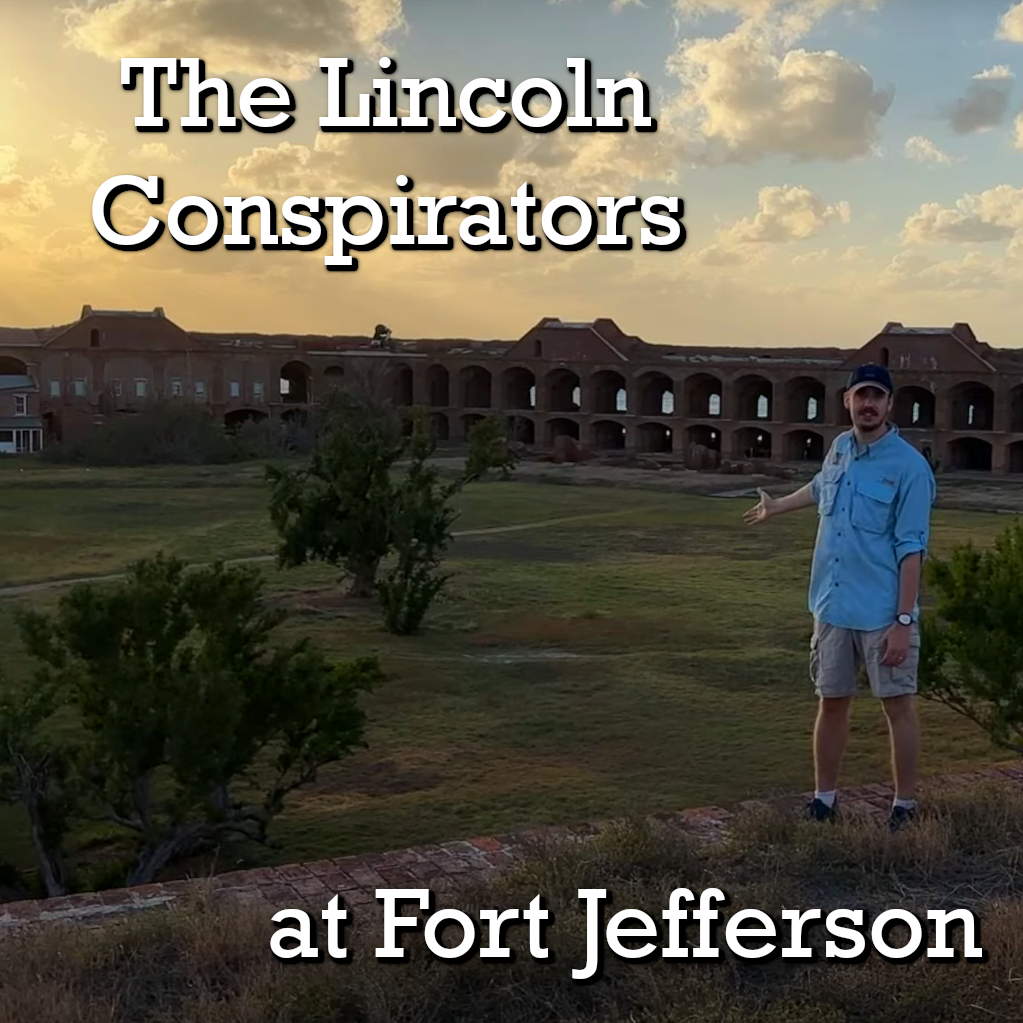
That act did, indeed, get Spangler into difficulty. Yet even the term of his jail sentence of six years demonstrates how poor the evidence was in trying to connect Spangler to the plot. All of the other conspirators tried alongside him were sentenced to death or life in prison, making Spangler’s punishment a “slap on the wrist” by comparison. However, as my recent documentary series on The Lincoln Conspirators at Fort Jefferson shows, life was incredibly difficult for Spangler and the other men sentenced to the Dry Tortugas.

In memory of the innocent Lincoln conspirator on the 150th anniversary of his death, here are three letters Edman Spangler wrote from prison during the time when Yellow Fever struck the fort. They were written to unknown friends of Spangler’s in Baltimore and then published in the newspapers. From other writing samples of Spangler’s, we know that he struggled with spelling and grammar. However, these three letters contain relatively few mistakes, implying that he may have been assisted in their writing by his cellmates or that perhaps his letters were cleaned up by the newspaper editors. Regardless, they give a brief peek into the life of Edman Spangler during the most terrifying portion of his imprisonment.


Fort Jefferson, Fla

Sept. 6, 1867

I am well at present, but don’t know how long it will last, for we have the yellow fever here, and there are two or three dying every day, and I am busy working in the carpenter’s shop, making coffins day and night, and I don’t know when my time will come. They don’t last more than a few hours. I will enclose a few moss pictures for you, and I will send you a barrel of coral, if I don’t get the yellow fever and die; but there are ten chances to one if I ever see you again. It is very desperate here. The doctor of the post is very sick with it, and there is no doctor here but Dr. Mudd, and he volunteered his services, and has made a good hit of it. We have lost no cases with him yet.

With love all,

Edman Spangler


Fort Jefferson, Florida

September 23, 1867

I have received the barrel of potatoes and am very thankful for them. We have drawn but a half bushel of potatoes from the government since the first of January. We have bought some at Key West, for which we paid seven and eight dollars per barrel. There are some seven of us in one mess; we do not eat with the other prisoners. We have the yellow fever here very bad. We had a doctor that came from Washington: he got it and died: his name was J. Sims Smith. He has a wife and two children. Dr. Mudd was in charge for a few days, and was very successful, and then they got a doctor from Key West; but Dr. Mudd is still in the hospital attending to the sick, and I am in the carpenter shop making coffins for those that die. While I am writing they have burned all the beds that belonged to every one that got sick, and all their clothing. We have a dreadful time of it here. There is no use of getting frightened at it; we must stand up and face the music.

Since writing the above, one of Dr. Smith’s children has died, Lieutenants Solam and Ohr, Major Stone’s wife and Michael O’Laughlin.


Fort Jefferson, Florida

Sept. 24

Poor Michael O’Laughlin, my friend and room-mate died at 7 o’clock yesterday of yellow fever, and during the 24 hours, seven others passed from life to eternity. The fever has assumed a more malignant type. There is but one officer for duty at the post, the others having died or now lying ill with the fever. Lieut. Gordon, taken two days ago, is now lying in a critical condition. From all I can learn, we have had 280 cases, out of which so far thirty have died. Some are even taken with it the second time, and from appearances, and from what the Doctor says, we shall always have it here – the thermometer never falling below 63 degrees. I have not been attacked yet, but may be at any moment, in which case I thought it best to forward to you and my family small mementoes, should I die of the fever. Arnold has had it, and has fully recovered, yet remains in a very weak condition. Something should be done, if possible, towards obtaining our removal from this den of pestilence and death to some more healthy place. Nearly all the late cases are of a very malignant type, scarcely any recovering.


Sources:
“Letter from Spangler,” New York Times, September 22, 1867, 3.
“Letters from the Dry Tortugas,” Baltimore Sun, October 11, 1867, 1.

Categories: History, The Lincoln Conspirators at Fort Jefferson | Tags: , , , , , , | 4 Comments

Blog at WordPress.com.