Posts Tagged With: Herold

Mrs. Quesenberry’s Statement

On May 16th, 1865, Elizabeth Quesenberry gave the following statement to authorities:

“The day that the person I now supposed to be Herold came to my house was on Sunday, the 23rd of April, about one o’clock P.M. He asked my daughter to see the lady of the house, and on being informed that I was absent asked whether I could be sent for. She told him that if he could wait she thought I could. He then remarked to my daughter ‘I suppose you ladies pleasure of good deal on the river.’ my daughter answered ‘No, as we have no boat’. He said that he had crossed the river the night before and had left a very nice little boat by the river bank, which the young ladies could have if they wished. I returned very shortly, and he on seeing me asked if I could not furnish him with a conveyance to take him up the country. I told him no, and asked why he could not walk. She said that he could walk, but his brother was setting down by the river could not, for his horse had fallen and broken his leg; from the way in which he said this, I got the impression that they had both been riding the same horse. He said they were both escaped prisoners, and asked if I could not sell them a horse. I said no, that if I was inclined to assist them I could give them a horse, but that I was not inclined to assist them. He seemed surprised that I was not willing to assist him. I told him that he must go away. He went off very much put out. He went across the field in the direction where I supposed his brother was. I then called to him and asked him if he had anything to eat. He said no and I told him I would go to the house and send him something to eat. I went to the house and after my dinner was over I sent by Thomas Harbin, whom I supposed was a soldier, something to eat. Mr. Harbin, and a Mr. Baden, whom I also suppose was a soldier, came to my house. They had been there before; they had come to my house immediately after the fall of Richmond and they remained there until Mr. Baden was brought to Washington, and Mr. Harbin was there when I left. Harbin returned in about half an hour, and said that she had seen the party the food was for, going on horseback towards Dr. Stewart’s house, and that they told him they were going there. I understood that the horses were furnished by an old man named Bryan never saw the parties afterwards. I became alarmed and suspecting that something was wrong, determined for my own protection to signal to the gunboats, and did hoist a signal and remained there three hours, but they did not come to me. I did not report it to any officer of the government has I had no opportunity to do so and in the meantime I had heard that after they left Dr. Stewart’s they had crossed the Rappahannock at Port Royal and that the soldiers were in pursuit.
E. R. Quesenberry”

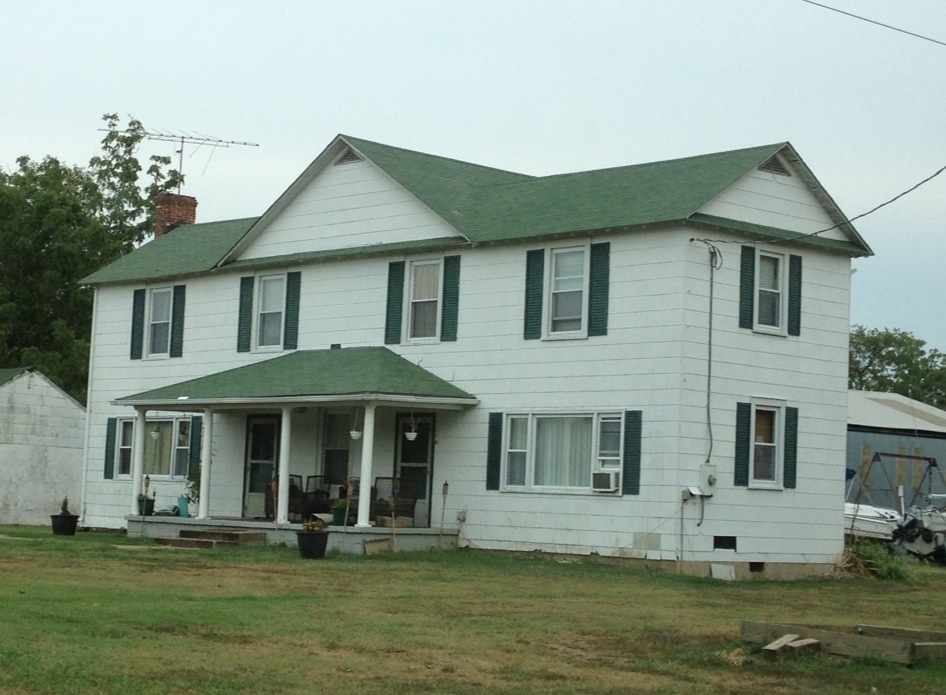
Mrs. Quesenberry’s home then:

20121016-224107.jpg

Mrs. Quesenberry’s home today:

20121016-224130.jpg

References:
American Brutus by Michael Kauffman
The Evidence by Edwards and Steers

Categories: Uncategorized | Tags: , , | 17 Comments

Crossing the Bridge

Reader Richard Petersen asked this excellent question on my last post about Silas Cobb:

Question. What was the protocol for Booth and Herold in crossing the bridge? Could they ride across or did they have to dismount and walk?

I believe this to be a very good question and worthy of discussion. The record of what transpired at the Navy Yard Bridge comes from the official statement and the conspiracy trial testimony of Sgt. Silas Cobb. In his statement to authorities specifically, Cobb gives wonderful details about the two riders who crossed his lines. For example, we learn that Booth was wearing a “soft black or dark brown felt hat” and that “his hands were very white, and he had no gloves on”. Cobb even provided details about Booth’s voice stating it was, “rather light, and high-keyed”. For Davy Herold, Cobb described him as wearing, “a light coat, light pants, and a snuff colored felt hat, of rather a light shade.” He even let us know that Davy was, “the heavier of the two”. When it comes to the actual method of crossing the bridge, Cobb does not give specific detail. This is probably due to the fact that crossing people over the bridge was so commonplace to Cobb, that he didn’t consider the way in which Booth and Herold did it to be any more notable than any other person. He does provide a few statements that we can piece together though, to paint a seemingly accurate picture of what the process was.

When both men approached the bridge, the sentry challenged them (assumedly by asking “Halt, who goes there?” or “Friend or Foe”). Booth and Herold both replied “a friend” and Cobb began his interrogation of them. In the trial testimony, Cobb is asked a question about his encounter with Herold:

Q. Did you have a good view of his face? Was there a light?

A. I did. I brought him up before the guard-house door, so that the light shone full in his face and on his horse.

So we know that Cobb moved Davy to be in view of a light. Unfortunately, this statement is inconclusive regarding whether or not Davy was still on horseback, or on foot next to his horse. However, a little while after this, Cobb is asked about Davy’s size:

Q. How would he compare in size with the last man on the row in the prisoner’s dock? [David E. Herold, who stood up for identification.]

A. He is very near the size, but I should think taller, although I could not tell it on the horse; and he had a lighter complexion than that man.

The darken part is very important. Cobb, the man who provided so many details about the men who he crossed over the bridge, was unsure about Davy’s height. It appears his explanation for this is because the Davy stayed on his horse and so Cobb was not able to accurately compare Herold on his horse with Herold on the prisoner dock. This testimony appears to favor Booth and Herold remaining on their horses.

Cobb gives us a bit more (though still not as much as we’d like) with regard to Booth’s crossing:

“He then turned and crossed the bridge; his horse was restive and he held him in and walked him accross the bridge; he was in my sight until after passing the other side of the draw. I do not know with what speed he rode after that.”

During my first few readings of this, I pictured Booth walking his horse as a man would walk a dog. In my eyes it appeared as if Booth (who apparently showed no physical pain supporting Michael Kauffman’s theory that he broke his leg later in a horse fall) kept his horse close to him and acted like a child crossing the street by walking his bicycle. Upon further reading and trying to put myself into the correct 19th century equestrian mindset though, I read this now as Booth riding his horse at a walking pace across the bridge. The last phrase, “I do not know with what speed he rode after that,” implies to me that Booth was already riding his horse and not walking it on foot. I want to believe the detail oriented Cobb would have stated something along the lines of “he remounted his horse” if Booth was actually walking alongside it beforehand.

There is no specific statement by Cobb saying that Booth and Herold ever dismounted their horses. In addition, the few details that Cobb does give regarding the process appears to imply that they remained in their mounts during their entire time they conversed with him. There is no smoking gun or definite answer to Richard’s question, but I believe the majority of the evidence points to Booth and Herold staying on their horses when they crossed the Navy Yard Bridge.

What do you think?

Booth making his escape on horseback.

References:
The Evidence by Williams and Steers
Poore’s version of the Conspiracy Trial (Vol 1)

Categories: Uncategorized | Tags: , , , | 16 Comments

The Ironic Death of Silas Cobb

On April 14th, 1865, Sgt. Silas Tower Cobb was in charge of the Army’s guard detail over the Navy Yard bridge leading out of D.C. 

The Navy Yard Bridge in 1862

During that night, he was approached by three individual riders all looking to be crossed over the bridge.  As a proper guard he interrogated the men asking them where they were going, why they waited until after 9:00 pm to depart, and what their names were.  The first man replied he was going to his home in Charles County, MD, “close to Beantown”.  He pleaded ignorant of the rule forbidding passage over the bridge after 9:00 and stated that, “It is a dark road, and I thought if I waited a spell I would have the moon”.  Sgt Cobb was hesitant to let him pass but the man who gave his name as Booth seemed proper enough and his answers had been satisfactory.  While Cobb’s standing orders had been that no person was allowed to cross the bridge between 9:00 pm and sunrise, the enforcement of these orders had been more lax as the war had dwindled down.  Sgt. Cobb unwittingly allowed the assassin of Lincoln to cross his line.  Not long after this, another man rode up giving his name as Smith.  He told Cobb he was heading home to White Plains.  Again, Silas Cobb informed the man that passage over the bridge after 9:00 o’clock was forbidden.  Smith replied, “I stopped to see a woman on Capitol Hill, and couldn’t get off before.”  Though this man did not appear as proper as the first man, he allowed him to cross the bridge as well.  Sgt. Cobb had unwittingly allowed David Herold, one of the Booth’s accomplices, to cross his line.  History repeated itself as a third horseman appeared.  This man asked Cobb if he had passed a man on a horse fitting the description of “Smith”.  Cobb replied in the affirmative.  The third man told Cobb he was a stableman, and that “Smith” had run off with one of his horses.  The stableman, John Fletcher, asked for permission to cross and give chase.  Cobb told him that while he would be allowed to cross out of the city, he would not be permitted to return until daybreak.  Fletcher decided the idea of spending all night stranded outside of the city looking for a lost horse was an unappealing one and returned to the city to report his loss to the police.

Though Cobb was later in deep dung for allowing two conspirators in Lincoln’s assassination escape over his bridge, he never suffered court martial for his actions.  He testified at the trial of the conspirators and was honorably discharged from the army in September of 1865.  He assumedly returned to his hometown of Holliston, Massachusetts.  Two years later, however he met his end at the age of 29 while traveling in Michigan:

Silas Cobb’s death as reported in the Lowell Daily Citizen on November 11, 1867

Silas Cobb’s death as reported in the Jackson Citizen on November 19th, 1867

It is one of those odd twists of fate that the man who permitted the river crossings of two Lincoln assassination conspirators would meet his end in his own unfortunate attempt.

References:
Silas Cobb’s FindaGrave page
The Evidence by Williams and Steers

Categories: Uncategorized | Tags: , , , | 14 Comments

Davy Herold on Alphas

In addition to my interest in history, I am also a bit of a nerd in other, more traditional ways (shocking, I know).  Specifically, I’m a fan of several science fiction shows.  Today, I was catching up on a few episodes of the SyFy television show Alphas.  For non-nerds, Alphas is a TV show about people who have superhuman abilities.  It’s essentially X-Men but with more realistic and believable abilities.  Recently, the good Alphas have been trying to track and capture the leader of the bad Alphas.  He is a man by the name of Stanton Parish.  His Alpha ability is perfect control of his brain which manifests in his ability to slow down his aging process and heal his body.  The team was able to find images of him dating back to the Civil War and how old he really is has yet to be determined:

Alphas’ “Stanton Parish”

While watching it today, there was a second when the leader of the good Alphas, Dr. Rosen, was flipping through his materials on Stanton Parish.  There was a quick shot of an image that looked strangely familiar.  I rewound the video (you got to love the “On Demand” feature), and paused it.  I could see then that the producers of the show had taken the head of the Stanton Parish character and had Photoshopped it onto the body of the Lincoln assassination conspirator, David Herold:

Alphas’ “Stanton Parish” on David Herold’s body. The untouched photo of Davy is included for comparison.

I had a good chuckle over this strange cameo appearance by Davy Herold.  References to the assassination can be found in the most unlikeliest of places.

Categories: Uncategorized | Tags: , | 2 Comments

“Thus perished four…”

The day after the four conspirators were hanged, one soldier penned the following letter to his family back home in New York:

“Camp Stoneman  D.C.

July 8th 1865

Darlings at home

Before you receive this you will probably have read all about the execution of the conspirator’s at the Washington Penitentiary yesterday.  My regiment was on duty immediately in the yard and around the gallows.  Consequently I had a fine view of the preparation and the final execution of the criminals.  The yard was an enclosure by high brick walls and buildings of probably a half acre of ground.  The gallows was erected at one corner about 30 feet from a door which lead into it from the prison.  The platform was about ten feet high and the beam from which the ropes was suspended was about 10 feet above the platform.  That portion of the platform for 4 feet which was a sort of trap door hung upon hinges and supported by a single prop which was to be knocked out from under them by a sort of battering ram.  The prisoners were accompanied to the gallows by the officers in charge of the execution and their spiritual advisers.  Who in behalf of each thanked the officers and soldiers who had charge of them for this uniform kindness to them.  And after praying with them (and I never heard more eloquent and stirring appeals made to a throne of diving grace) they were caused to stand up on the fatal trap, where their arms were tightly tied behind them and their legs tied at the ankle and knees – the cap drawn over their face the rope adjusted and drawn tight around the neck the signal given and four unhappy victims were suspended in the air by the neck.  I stood very near on horse-back where I had a good opportunity to see every motion.  I did not discover the least motion of a single muscle on Mrs. Surratt – and but very slight on Atzerodt.  Payne and Harrold did not pass off so quickly.  Harrold showing signs of life for nearly five minutes and Payne for full seven minutes.  After hanging for the space of 20 or 30 minutes they were taken down, laid in rough boxes, and buried near the foot of the gallows.  Thus perished four of the greatest criminals our land has ever produced.  And my only regret is that the balance of the band had not shared the same fate.  It seemed hard indeed to see a person bearing the almost divine shape of woman lead out by men alone executed and laid away with none but the hands of rough soldiers to care for her.  I never before saw such picture of absolute despair and fear upon the face of a human being.  Mrs. Surratt was nearly unable to stand.  In fact Payne was the only one of the party that showed any signs of courage or manliness.  I see by the papers today that the clergymen who attended them express much hope that they passed from this to a better world.  If so, how much better than they to their intended victims whom they endeavored to send into the presence of their God with one moment’s preparation.  I hope it will be my fortune to witness the execution of Jeff. Davis, & then shall I, indeed, feel that the rebellion is crushed.  And when you hear any one say that Jeff. will never be hung, “that Andrew Johnson is President and that he is supported by officers who are good and true,” in such hands we are safe.  The day has come when we have in authority those who care more for their country than they do for themselves or party.  And I trust that it may be long before any others shall obtain the reins of Government and seek again to draw us down to ruin.

Then I have written you a good long letter, at least, a long one.  And shall have but very little room for anything else – though as tomorrow is Sunday I presume I shall write again.  I wrote you a good long love letter but a day or two ago, as I shall not mail this till evening perhaps I will write a little more before I send it.

Give my love to all the friends.  Kiss the dear children for me.  Good day to you and God bless you all.

Most affectionately,

S.D. Stiles”

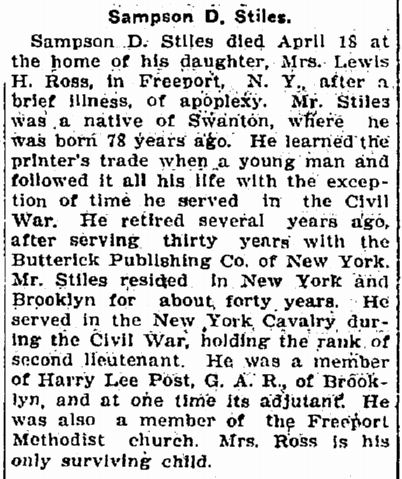
The author of this account is Sampson D. Stiles who was a member of the New York Cavalry.  The photographic record does not show any soldiers on horseback as Stiles states he was, but it is know that General Hartranft requested cavalry members to report to him:

“Mil. Prison Wash. Arsenal

July 6th, 1865

Colonel-

I will require a Company of Cavalry in addition to the twenty sent me today.  Will you be kind enough to order them to report to me at 8 o’clock tomorrow morning.  I will need them only during the day.

Very Respectfully – Your Obt. Servt. –

Bvt. Maj. Genl. Gov. Com’dr. M.P.

Colonel Taylor

A.A.G. –Dept.Wash.-”

So while we see no mounted soldiers in the execution photos, the request for Cavalry soldiers and the details in Stiles’ letter home gives the strong impression that he was there.

Sampson Stiles’ 1905 obituary in a Vermont paper

References:
Stiles’ account comes from the James O. Hall research papers
The Lincoln Assassination Conspirators – Their Confinement and Execution, as Recorded in the Letterbook of John Frederick Hartranft edited by Edward Steers and Harold Holzer

Categories: Uncategorized | Tags: , , , , | 7 Comments

7/7/1865

I watched them lead him out the door,
As he exited his cell.
I followed them, as he had asked,
To give his last farewell.

“A boy” I thought of him at first,
When I was called to pray,
But with death’s knocking out in the yard,
I saw a man today.

While saddened by his coming death,
He confessed to me his crime:
“I helped a man who killed a man.
Where will I spend all time?”

I said I could not answer him,
To God he must appeal.
We sat there in redemptive prayer,
And begged his soul to heal.

So while his frame may falter,
During these, his last grains of life,
On the gallows he’ll stand, with his clenched hands,
A man, adverse to strife.

Fictional poem from the perspective of Rev. Dr. Mark Olds, David Herold’s spiritual advisor on the scaffold.

Justified or not, four individuals paid the ultimate price for their involvement with John Wilkes Booth.  Those saved from execution faced their own mortality when they heard the drops fall and would carry the stigma of their association for the rest of their lives.  Lincoln’s assassination killed not only the President and the innocence of our nation, but also the lives of the misguided supporters who knew not what they were doing.

Categories: Uncategorized | Tags: , , , , | 16 Comments

On this date: June 16th, 1842

Conspirator David Edgar Herold was born in Washington, D.C.

David Herold was the son of Adam George and Mary (Porter) Herold.  He attended Gonzaga College High School, Rittenhouse Academy, and Georgetown College.  Davy studied pharmacology and was employed as a druggist’s assistant and clerk when he became part of John Wilkes Booth’s plot.  He enjoyed hunting and had learned the routes and trails of Southern Maryland well during his hunting excursions.  This made Davy a perfect guide for Booth’s escape.  At the time of the assassination Davy was just 22 years old.

Davy’s true activities on the night of the 14th are hard to pin down.  It is most commonly written that he escorted Lewis Powell to the Seward house, and then fled when the onslaught began.  Another theory is that he was a point man – directing Powell to Seward’s and then returning to the Kirkwood house to see if Atzerodt had completed his assault on the Vice President.  Lastly, in his confession Atzerodt states that he refused to kill the Vice President, and that it was Davy who was assigned to do so in his place.

What we do know for certain is that stable man John Fletcher saw Davy Herold riding his horse around the time that the assassination occurred.  Fletcher chased after him as Davy was supposed to have returned his rented horse hours ago.  First Fletcher chased him on foot before going to his stables to get a horse for the pursuit.  When Fletcher came to the Navy Yard bridge he learned from the leader of the guard house, Silas Cobb, that Davy had already passed over the bridge.  Cobb told Fletcher he could pass and cross the bridge, but that he would not be allowed to return over it until daybreak.  At this point Fletcher gave up his pursuit.  Davy caught up with Booth who had crossed the bridge before him.  Davy would stay by Booth’s side during their entire escape.  In the end, Davy surrendered himself to the Garrett’s Farm patrol.  Davy was brought back to D.C. and placed on the ironclad ship the Montauk.  Then he was transferred to the Old Arsenal Penitentiary.  Davy celebrated his twenty-third birthday behind those bars and in the midst of the conspiracy trial.  Two of his sisters, Jane and Kate, gained passed to visit him two days later on June, 18th.  They sat and spoke with him in the courtroom from three o’clock until six o’clock.  Davy’s sisters had visited him in prison at least four times prior to this, making him one of the more visited conspirators after Anna Surratt’s attendance of her mother.

David Herold was found guilty on all counts against him except having conspired with Edman Spangler.  He was sentenced to hang and the sentence was carried out on July 7th.

His body was released back to the Herold family in February of 1869 and he was interred in Congressional Cemetery in Washington D.C.  He is buried underneath his sister Jane in the family plot, bearing no headstone of his own.

The press of 1865 was not kind to David Herold.  He was denounced as an idiot boy, with no sense or intelligence of his own.  They portrayed Davy as Booth’s lapdog.  While Davy did display a great deal of devotion to Booth, he was also an intelligent and crafty young man.  Upon his capture, Davy expertly avoided his interrogator’s attempt to implicate him further.  In addition, while on the run, Davy displayed his own creativity and intelligence by co-authoring a poem with Booth.  Instead of an autograph, he and Booth presented Willie Jett the following poem.  Davy wrote the second half:

“He put aside the dainty bribe
The little proffered hand
Albeit he held it in his thought
The dearest in the land
Not sharply nor with sudden heart
But with regretful grace
Meanwhile the shadow of his pain
Fell white upon his face

Dark daughter of the Sultry South
Thy dangerous eyes & lips
Essayed to win the prize and leave
Dear honor we Eclipse
She shyly clung upon his brow
He stayed now at the door
I could not love thee, dear so much
Loved I not Honor more.
Adieu, forever mine, my dear
Adieu forever more!”

Today marks the 170th anniversary of David Herold’s birth.  To me, Davy was a well educated, well off, young man who truly believed in the cause Booth expounded.  Davy was the only surviving son in a home filled with daughters and he longed for adventure.  In Booth’s ideas he found a cause to fight for, an adventure to pursue.  While those ideas were proven to be wrong and misguided, he believed in them nevertheless.  As with the others in Booth’s clan, Davy wanted to make a difference.  So on this, the day of his birth, we remember a man who choose his actions poorly, but do so with the best of intentions.

David Herold’s Signature

References:
Original document images are from Fold3.com
American Brutus by Michael Kauffman
The Lincoln Assassination Conspirators: Their Confinement and Execution, as Recorded in the Letterbook of John Frederick Hartranft by Ed Steers and Harold Holzer

Categories: Uncategorized | Tags: , | 19 Comments

A jaunt through Congressional Cemetery

Congressional Cemetery is a beautiful cemetery located in Washington D.C. along the coast of the Anacostia River.  This 35 acre cemetery is a National Historic Landmark and contains over 22,000 interments.  On a walk through the cemetery today, here are some of graves of people related to the Lincoln assassination:

Emerick Hansell:

Hansell was a State Department messenger whose main duties were ferrying messages between the State department and the Secretary of State, William Seward.  After the Secretary’s carriage accident, Hansell was helping to keep an eye on the wounded Seward.  On the night of April 14th, Hansell was lodging at the Seward house.  The noise from Powell’s assassination attempt awoke him, and, as he was heading down the stairs to raise the alarm, Powell overtook him and stabbed him in the back.  Hansell was one of the five wounded victims from that night.  He is buried here at Congressional with his first wife, Elizabeth.

Peter (Pedro) Taltavull:

A Spanish immigrant, Taltavull co-owned The Star Saloon.  The Star Saloon was the tavern adjoining Ford’s Theatre and was one of the places where Booth had a drink before shooting Lincoln.  While he did not serve during the Civil War, Taltavull was also in the US Marine Corp Band for over 20 years.

Charles Forbes:

Forbes was a footman for Lincoln’s carriage.  As the stone states, Forbes was the only one sitting outside of the President’s box during his time at Ford’s Theatre.  Forbes was not a bodyguard and had no instructions against letting people into the President’s box.  In fact, he let a messenger in to see the President prior to Booth’s arrival.  Booth presented Forbes with a card, and Forbes easily allowed the famous and innocently looking actor into the President’s box.

There is a wonderful story from Thomas Pendel’s book, Thirty-Six Years in the White House, demonstrating Lincoln’s sense of humor and relationship with Forbes:

“On one occasion, President Lincoln, when riding near the Soldiers’ Home, said to his footman, named Charles Forbes, who had but recently come from Ireland, “What kind of fruit do you have in Ireland, Charles?” To which Charles replied, “Mr. President, we have a good many kinds of fruit: gooseberries, pears, apples, and the like.” The President then asked, “Have you tasted any of our American fruits?” Charles said he had not, and the President told Burke, the coachman, to drive under a persimmon tree by the roadside. Standing up in the open carriage, he pulled off some of the green fruit, giving some of it to Burke and some to Charles, with the advice that the latter try some of it. Charles, taking some of the green fruit in his hand, commenced to eat, when to his astonishment he found that he could hardly open his mouth. Trying his best to spit it out, he yelled, “Mr. President I am poisoned!” Mr. Lincoln fairly fell back in his carriage and rolled with laughter.

This story was afterward told by the coachman, justifying himself upon the grounds that it was too good to keep.”

Hester A. Butler:

Ms. Butler’s connection to the Lincoln assassination is a relatively distant one.  Butler is her maiden name which she and her children reverted back to after the death of her husband.  At the time of Lincoln’s assassination, Hester’s husband, John, was a detective on the staff of Maryland provost marshal James L. McPhail.  Before that he was in the carriage business in the city of Port Tobacco.  John owned his carriage business with his brother, George Atzerodt.  This made Hester Atzerodt nee Butler, the sister-in-law of the would be assassin of Andrew Johnson.  After the death of her husband John, Hester and her children freed themselves from the stigma of the Atzerodt name by changing back to Butler.  Hester, along with two of her children are buried at Congressional.

David Herold:

The only conspirator buried at Congressional is Davy Herold.  After being executed on July 7th, 1865, Davy, the other conspirators, John Wilkes Booth, and Andersonville Prison commander Henry Wirtz, were all buried on the Arsenal grounds.  Eventually, the Herold family received permission to retrieve Davy’s body from the Arsenal.  He was reburied in the Herold family plot in Congressional in February of 1869.  His specific grave is unmarked, but his unmarried sister, Elizabeth Jane, was buried right on top of him in 1903.  The rightmost headstone in this picture is Elizabeth Jane’s, and is therefore the only marker for Davy.  At least for now…

References:
Congressional Cemetery Website
Thirty-six years in the White House by Thomas F. Pendel

Categories: Uncategorized | Tags: , , | 3 Comments

Blog at WordPress.com.