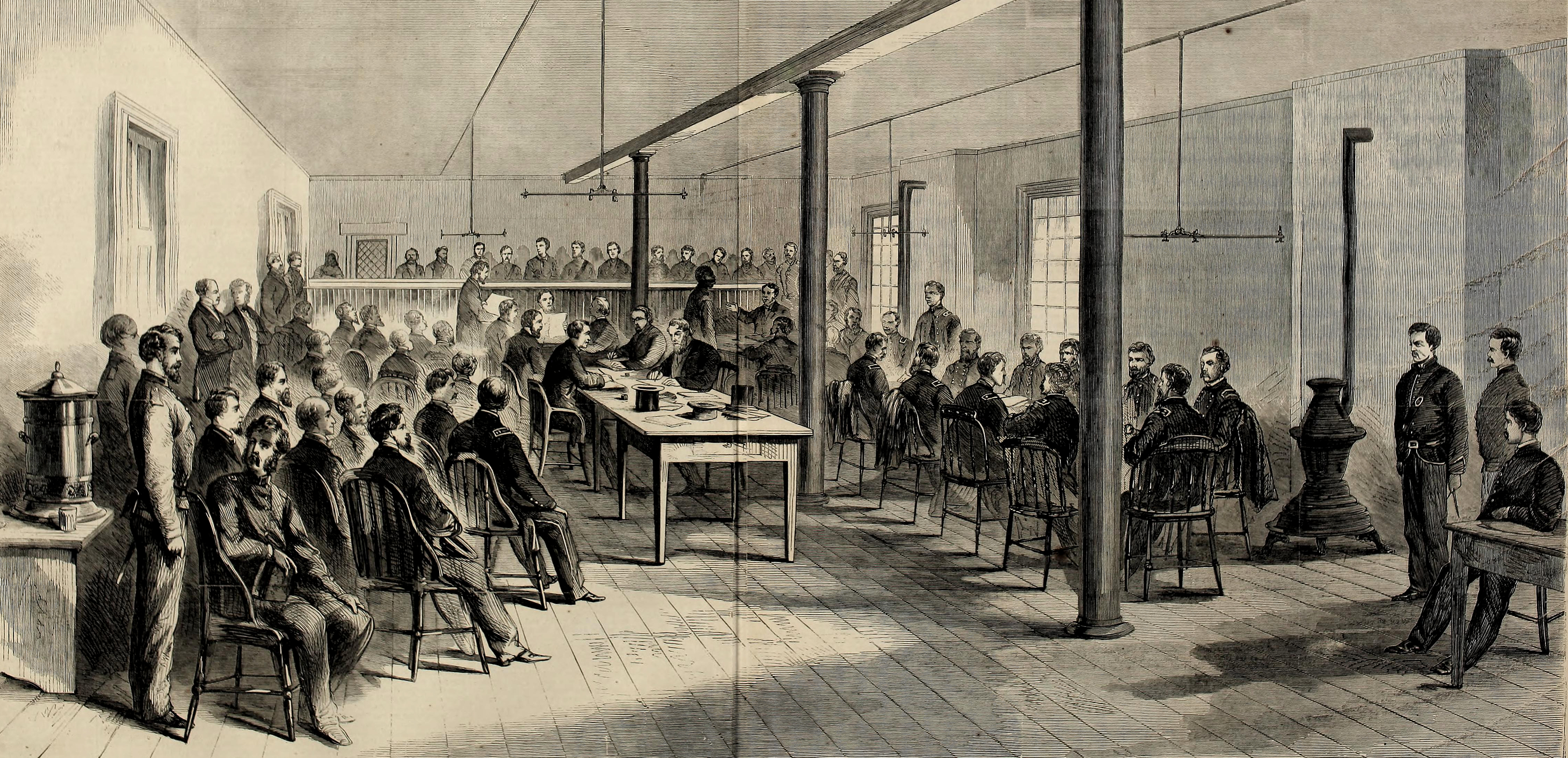
From the prosecution’s point of view, the trial of the Lincoln assassination conspirators had essentially two main goals. The first goal was to prove the guilt of the 7 men and 1 woman put on trial for complicity in the death of the President. The second goal of the trial was to put forth evidence to show that the assassination was sanctioned and supported by the leaders of the Confederate States of America. Establishing the Confederacy’s involvement proved a far harder task than the trying of the conspirators. In the end, the prosecution was hampered by unreliable and perjured testimony ultimately leaving the question of Confederate involvement in Lincoln’s death to be a much debated topic even 150 years later.
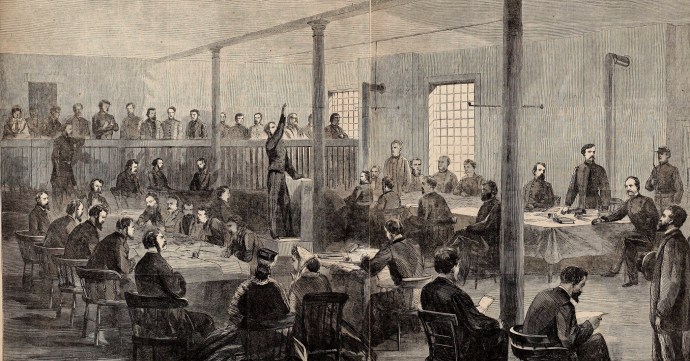
The prosecution’s method of connecting the Confederacy to Lincoln’s assassination can be best described as “quantity over quality”. They brought out a multitude of witnesses and evidence to make damning claims about John Wilkes Booth’s Confederate involvement but very little of it holds up under scrutiny. For example, the very first witness called the stand was a former Confederate soldier named Henry Von Steinaecker. He testified about having met John Wilkes Booth in Virginia in 1863 and that, at that time, Booth was in communication with high ranking Confederate officials plotting the assassination of Lincoln. As the first witness on the first day of the trial, the prosecution was setting the tone for the entire proceeding. At the time of Steinaecker’s testimony, not all of the conspirators had defense attorneys and the lawyers that were present did not believe such testimony had much to do with their clients. There was no cross examination done on Steinaecker.

When, later in the trial, the defense tried to recall Steinaecker, they were told by Judge Advocate General Joseph Holt that Steinaecker could not be located. In the end the defense called Steinaecker’s superiors in the Confederacy and both men testified that very little of what Steinaecker had testified to was true. Steinaecker had actually been a deserter from both the Union and Confederate armies and was serving a three year prison sentence in Fort Delaware when Lincoln was assassinated. Despite having written letters to both Lincoln and the Judge Advocate General asking to be released and offering his services, it was only after Lincoln’s death that Steinaecker wrote to the Judge Advocate General with his vital information about Booth and Confederate officials. After testifying Steinaecker was released from prison and disappeared. Steinaecker was the first of many prosecution witnesses who made grandiose claims about John Wilkes Booth and the Confederacy only to have his testimony questioned or disproven later.
In addition to using unreliable witnesses, the prosecution also presented material evidence in hopes of proving Confederate involvement in Lincoln’s death. Perhaps one of the most misunderstood pieces of material evidence the prosecution brought forth to tie Booth to the Confederacy was the assassin’s so-called “Confederate” cipher.

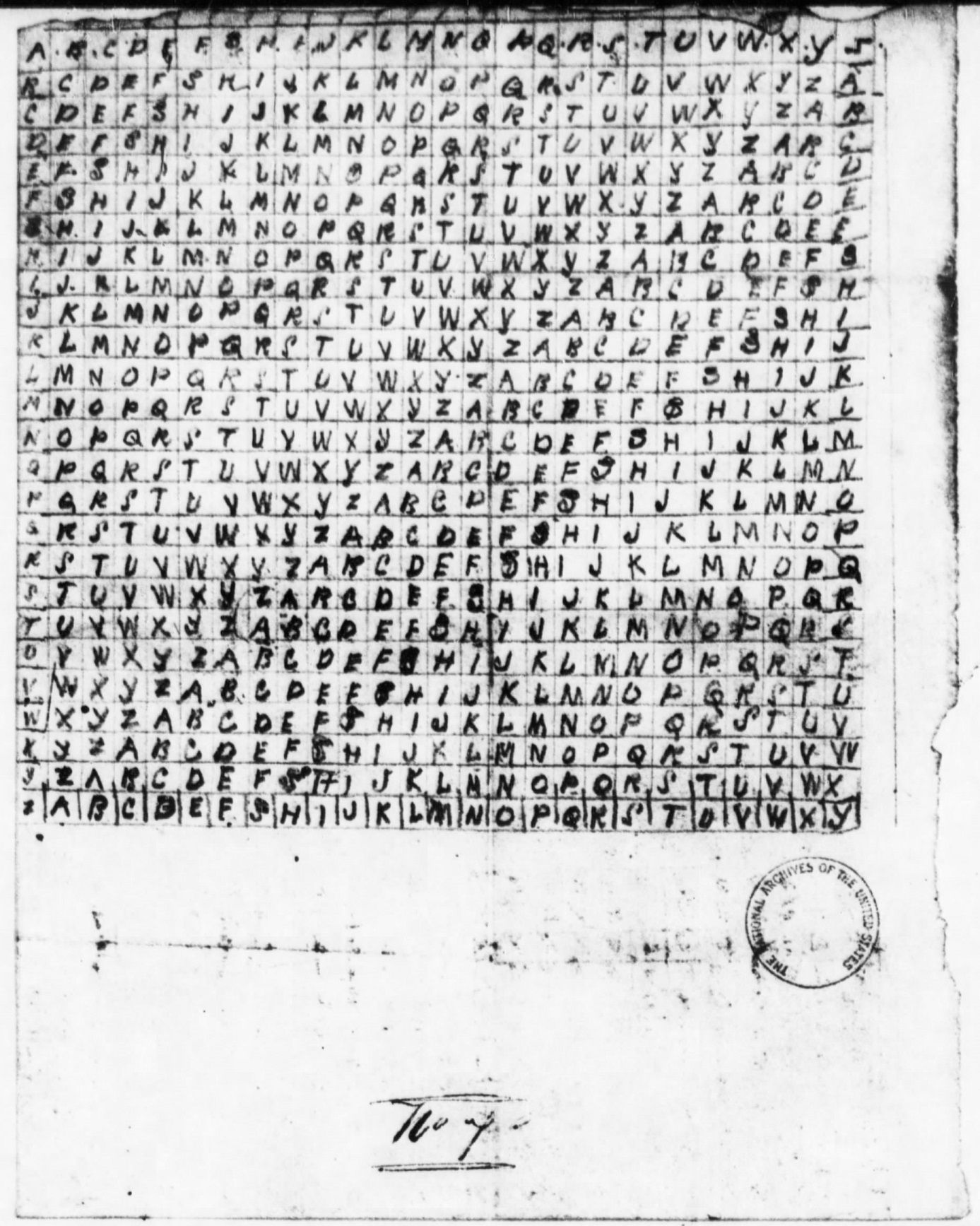
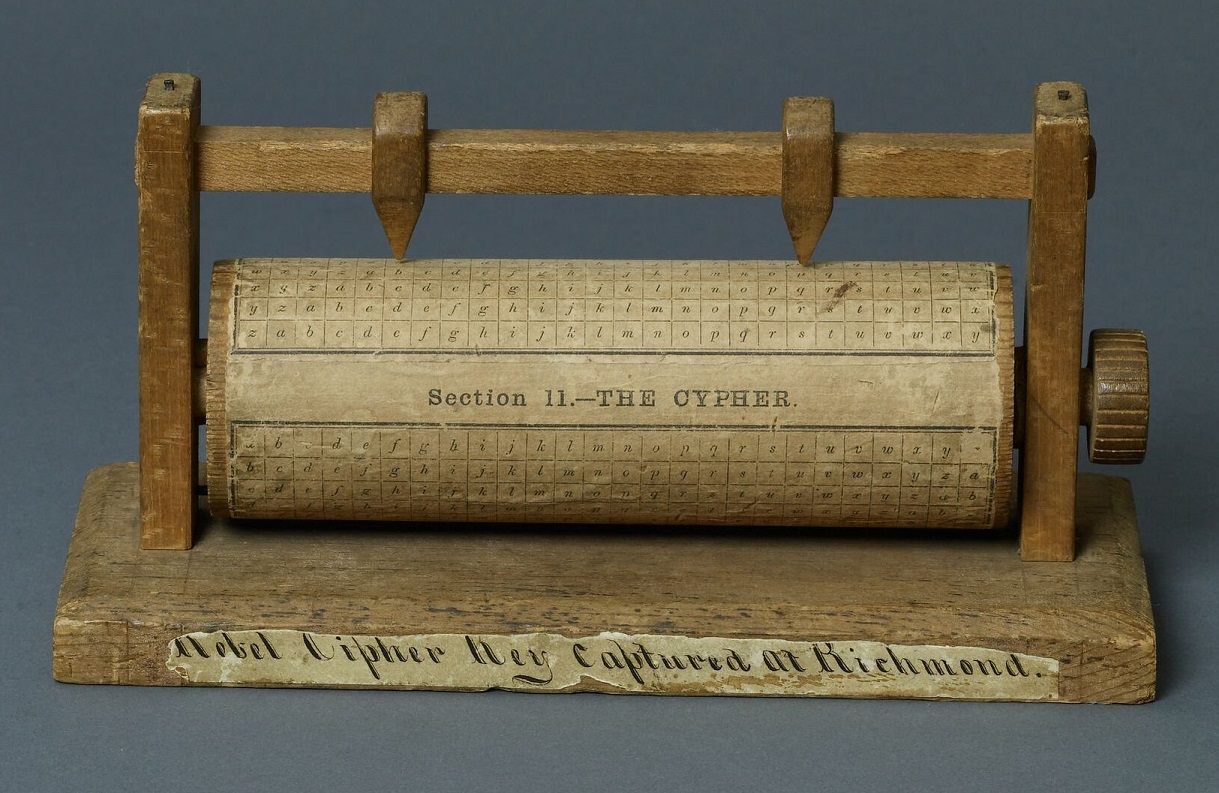
After the assassination of Lincoln, John Wilkes Booth’s rented room at the National Hotel was searched. Among his papers, most of which were mundane letters and memorandum, was this cipher which was written in Booth’s own hand. At the trial of the conspirators, this cipher was entered into evidence as Exhibit 7 and was portrayed as a physical link between John Wilkes Booth and the Confederate secret service. In addition to this paper cipher, the prosecution also entered into evidence a large cipher cylinder seized from the office of Confederate Secretary of State Judah P. Benjamin in Richmond.
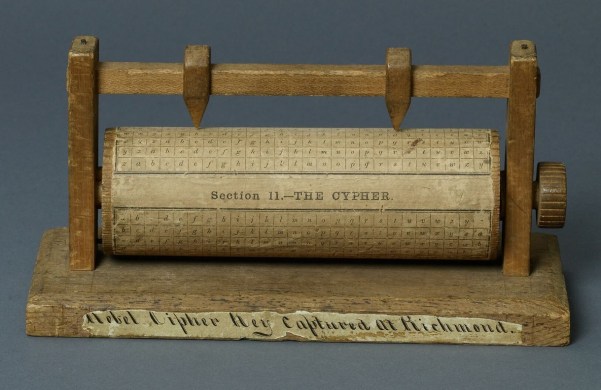
Thomas Eckert, the assistant Secretary of War under Edwin Stanton, was called to testify about these two ciphers. He stated that both the paper cipher found in Booth’s belongings and the cylinder found in Richmond were the same. Eckert then presented copies of Confederate letters that the War Department had intercepted during the war that had been written using the same cipher.
Taken at face value, this cipher found among John Wilkes Booth’s papers seems like a very damning piece of evidence. Eckert, the Union’s chief codemaker, testified that Booth’s cipher was the very same as the one used by the Confederacy, which seems to definitely prove that John Wilkes Booth must have had a strong connection to the Confederate States. In the years since the trial, John Wilkes Booth’s “Confederate” cipher has been used by different authors in their arguments that the Confederacy sanctioned Lincoln’s murder.
However, just like the testimony of Henry Von Steinaecker, the conclusiveness of Booth’s cipher connecting him to the Confederacy doesn’t really hold up under scrutiny.
First off, the handwritten, alphabetic note found in John Wilkes Booth’s room is called a Vigenère table. The table is a tool used in order to encrypt and decrypt a message using a Vigenère cipher. It is true that the Confederacy did use a Vigenère cipher to encrypt secret messages during the war and that, fundamentally, Booth’s table is the same as the cylinder found in Richmond. But before making any conclusions it is important to understand how a Vigenère cipher works.
If you were to receive an encrypted note that had been written with a Vigenère cipher, you would be faced with something like this:
ISATFIOJXSFOFGLEOQBWISDUBUXCAUXWZDLTPCHAIKOLUPXOFLTPCGK
To anyone who intercepted your note, this message would appear to be lines of complete gibberish. Even if the person intercepting your note realized it was written in a code of some kind, they would almost certainly fail at decoding it.
In order to decrypt the note a person needs two things. The first thing would be a Vigenère table, much like the one found in Booth’s room. A Vigenère table is little more than the alphabet, written on 26 lines, with each new line being offset by one letter from the previous line. The Vigenère table is a tool used to help decrypt the message. The second requirement for decrypting a Vigenère cipher is knowing the keyword or phrase that was used to create the message. Let’s look at an example of how a message written in a Vigenère cipher could be decrypted using a table and keyword.
Let’s say that I wrote this coded message to you:
O W A V U Z G Z N B T R D G S M N V F P N M M
In order to decrypt this message you would already need to be aware of the keyword or phrase that was used in making it. This was generally a word or phrase that had been agreed upon ahead of time or had been sent separately. It wouldn’t be very secure for the writer of the message to include the keyword with the encrypted message. For this message let’s say that our previously agreed upon keyword is: LINCOLN
Your first step towards decrypting this message would be to write the keyword LINCOLN, one letter at a time, above the ciphered text. When done, it would look like this:

Notice that you might run out of message before the whole keyword is completely used again, this is not a problem.
Each letter of the encrypted message now has two corresponding letters: the keyword letter and the original letter. Now all you need in order to decipher the message is your Vigenère table. Here is a more legible version of a Vigenère table, identical to the one Booth wrote.

For deciphering, you first use the keyword letter to find the right column on your Vigenère table. Then you move down the column until you find the corresponding message letter. This will give you the correct row. You move across that row to its beginning to find the first letter of the decrypted message.
So, in the example above, you would find the column that starts with L since our keyword, LINCOLN, starts with L. Then you move down the L column until you get to the letter O, which is the first letter in the message. Once you find O in the L column, you follow that row back to the beginning which shows you that it is in the D row. This tells you that the first letter in our message should be D.

To find the second letter in our message you would need to start in the I column since the second letter in LINCOLN is I. Then you would travel down the I column until you reach W, the letter in the original message. From there you follow the row back and discover the second letter in our message should be O.
This process of finding the keyword letter column, locating the encrypted letter in the column, then tracing the row back to learn the correct decrypted letter, is repeated for the remaining characters in the message. If you want to, grab a piece of paper and try to decipher the rest of the message yourself. When you’re ready to check your work, highlight the black text box below to reveal the decrypted message or scroll down to the first comment of this post.
DONT GO TO FORDS THEATRE ABE
Creating a message using a Vigenère cipher is very much the same as decrypting one. First you would write out the text you want to encrypt and place the keyword or phrase above it, letter by letter. Then, using the Vigenère table, you would located the correct column based on the keyword letter and the correct row based on the message letter. Where the corresponding column and row intersect gives you the encrypted letter for your coded message.
As far as creating secret messages go, a Vigenère cipher is a strong method of encoding as it really requires knowledge of the keyword in order to decode the message. In our example only the word LINCOLN as the keyword would result in the correct decryption. Deciphering a message without the keyword is technically possible, but very difficult to do. Ciphers with shorter keywords are more prone to codebreaking techniques that look for patterns and use math. But longer keywords or phrases strengthen the already strong encryption. The Confederacy utilized several key phrases for their Vigenère ciphers including OUR DESTINY IS ONE and COMPLETE VICTORY. COME RETRIBUTION was the key phrase used in Confederate ciphers in the final months of the war. It is important to point out that Vigenère ciphers were not a Confederate invention. This method of cryptography dates back to the 1500s and had long been prized as a code immune to being broken. This is why the Confederates used Vigenère ciphers in their secretive correspondences.

Going back to John Wilkes Booth, we find that it is accurate to say that the Vigenère table found among Booth’s papers matches the Vigenère cylinder found in Richmond. However the reason they are the same is because both the table and the cylinder utilize the same method of encryption. While every Vigenère cipher uses the Vigenère table to encrypt and decrypt a message, it is nothing more than a translation table. You can use the Vigenère table to encrypt a message using an infinite number of keywords. Claiming that Booth’s possession of a Vigenère table is iron clad evidence of his complicity with the Confederacy is akin to claiming that a specified individual is in cahoots with members of the Mafia because they both have the same numbers to choose from when they enter their PIN numbers at the ATM. They are using the same tool to encrypt information, but that alone does not prove anything.
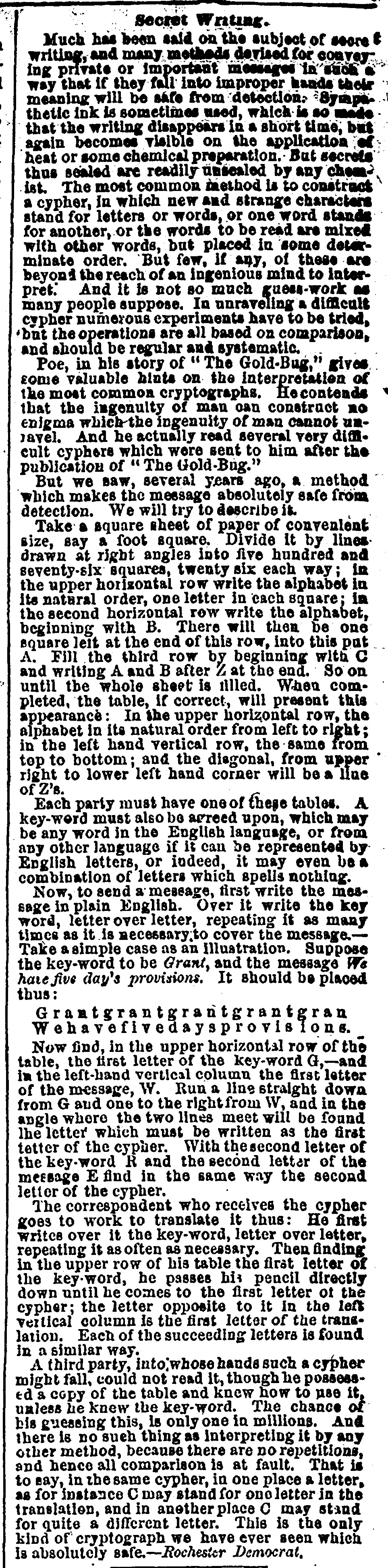
“Still,” you might be thinking to yourself, “how does John Wilkes Booth even have knowledge of this secret agent stuff if he’s not working with Confederacy?” As pointed out above, the Confederacy did not invent the Vigenère cipher. Nor was knowledge of this cipher in any way a state secret. In fact, as the Civil War went on, the general public became more and more interested in the topic of codes and cryptography. In the same way that schoolchildren enjoy writing secret messages to their friends, writing in code became a fun activity with the Vigenère cipher described openly in this regard. Below is the beginning of 1864 article from the Newark Daily Advertiser explaining the exact process of creating a table and how to go about composing a message using the Vigenère cipher. Click the sample below for the full article.

As this article demonstrates, the Vigenère cipher was not an obscure method of cryptography known only to the Confederacy. It was an old but still relatively well-known method of composing encrypted messages.
We don’t know how John Wilkes Booth learned about the Vigenère cipher but it is clear that it appealed to his delusions of grandeur. After learning the Vigenère cipher, Booth reacted not like a trusted Confederate agent, but like an excited schoolboy. In Asia Booth’s book about her brother, she described how, in November of 1864, John Wilkes wanted to teach her the cipher but she did not like the propriety of it:
“He sat late with me on one of these nights – the last – and said to me, ‘Let me show you the cipher.’
When I understood what he meant, I said, ‘No, I shall not consent to any knowledge of that kind.’
But he added, ‘I might possibly need to communicate with you about my money affairs, and there is no need to let everyone know what I am worth.'”

Asia still did not consent to learning the cipher and the subject was dropped. This interchange, in which Booth is trying to brag to his sister about something that appears clandestine, seems to fit the self-aggrandizing that John Wilkes Booth demonstrated. It seems perfectly appropriate to his character for him to have learned something in the realm of cryptography in order to brag about it and show it off later. How could Booth have been trusted by Confederate officials with genuine Confederate keywords and phrases if he was so willing to teach the process to his own sister? In my opinion, Booth’s Vigenère table was just another prop he used to help him play the part of a secret agent because he had no such role in real life.
There is no evidence that John Wilkes Booth used his Vigenère table to encrypt or decrypt messages from the Confederacy or its leaders. There is no evidence that Booth was ever in possession of official Confederate keywords or phrases. The government did not find anything in Booth’s papers that was written in any code that would have used the Vigenère table. Nor have any historians, to my knowledge, ever found anything in the papers of the Confederacy that could be considered an encrypted message from Booth.
Like a lot of the evidence dealing with the Confederacy at the trial of the conspirators, John Wilkes Booth’s “Confederate” cipher is far less definitive than what was testified to. Rather than proving a direct, physical link between Booth and high ranking Confederate officials in Richmond, Booth’s Vigenère table only proves that the assassin at one point dabbled in a fairly common method of encryption. The prosecution failed to address that Booth did not possess any official Confederate keywords or messages and sought, instead, to incriminate the Confederacy by pointing out that Booth had the same ability to write in cipher as they did. However, possessing the same tool does not prove conspiracy. Unlike the prosecutors of the trial of the conspirators, we have the benefit of time and objectivity to thoroughly investigate pieces of evidence. John Wilkes Booth’s Vigenère table is an interesting document, but it is conclusive of nothing other than the assassin’s own enigmatic nature.

If, like BOOTH, you want to play around a bit more with a Vigenère cipher, feel free to decrypt the first example of ciphered text that I included in this post. The keyword for it isn’t hard to find.













 LincolnConspirators.com
Recent Comments