Posts Tagged With: Booth Family

Viewing Junius’ Body

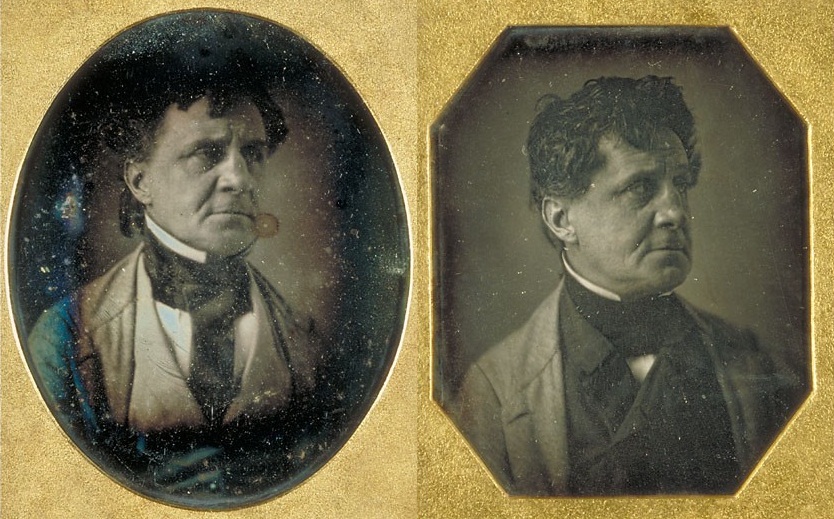
Two images of Junius Brutus Booth from the Harvard Theatre Collection

“On reaching Cincinnati, the masons had the body embalmed in a metallic coffin and deposited in the Baptist vault. My mother was telegraphed for and arrived in Cincinnati expecting to find my father very ill, — the second dispatch, announcing his decease not reaching Baltimore until her departure from that city. She returned home as soon as possible, bringing the body with her for interment. For three days the house where the body lay was thronged with people of every class. The walls of the parlors were draped with white, covering pictures and mirrors, and all ornaments removed excepting a marble figure of Shakespeare, which was placed near the coffin, and seemed gazing down at the form beneath. The face, under the glass plate, was very calm and beautiful, and the brown hair more thickly strewn with white than when we saw it last; the gray eyes were partly visible between the half-shut lids; and the lips, retaining their life-like color, were smilingly closed. Such a placidity and repose pervaded the whole countenance that we felt how easy the transition must have been from suffering life to this calm sleep. How often we had found him at rest with just this look upon his face, and had stepped softly not to disturb him! Now its perfect naturalness occasioned doubt in many minds, and physicians were sent for to satisfy us whether this w as really death or a trance. The hope was futile and vain, but while it animated the hearts that suffered, it had become as powerful as life.”

-Asia Booth Clarke on her father’s death in Booth Memorials:Passages, incidents, and anecdotes in the life of Junius Brutus Booth

Categories: Uncategorized | Tags: | 3 Comments

Variations on Booth’s Photos

In 1979, Richard and Kellie Gutman published their compendium of known Booth photographs. John Wilkes Booth Himself contains over 40 images of the assassin. Since the book’s publication, several other images of Booth have been discovered, demonstrating the idea that treasures are still out there waiting to be found.

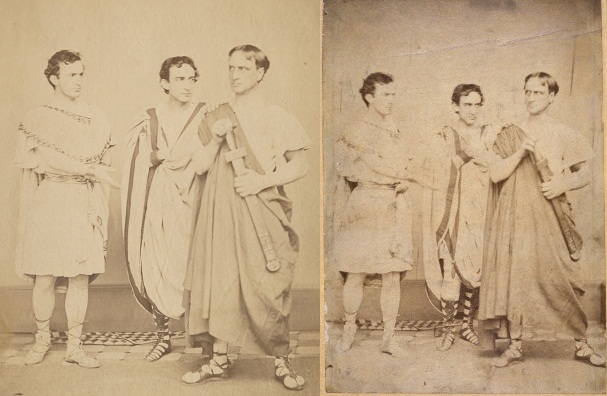
Due to space constraints, the Gutmans were not able to include all the variations that exist for their numbered photographs of John Wilkes Booth. The following are two such examples of the minor variations that exist in even the well-known photos of Booth. See if you can spot the differences:

This first image was probably taken with a multi-lens or stereograph camera. The stereograph image would be used to create a 3-D image when developed as a stereoview card and viewed with a stereoscope. The second image of the Booth brothers preparing for their Shakespeare statue benefit, is a different, but similar, pose from the original.

John Wilkes Booth loved having his picture taken and by taking notice of the specific details in his pictures we can learn more about his self image and vanity.

References:
John Wilkes Booth Himself by Richard and Kellie Gutman

Categories: Uncategorized | Tags: , | 17 Comments

The End of Edwin

After a long career on the American stage, Edwin Thomas Booth retired from the acting in 1888. He spent his declining years in his private room above The Players club that he founded. By 1893, his health had worsened considerably. The events of his life had aged him far beyond his 59 years, with insomnia and lifelong tobacco use taking their toll as well.

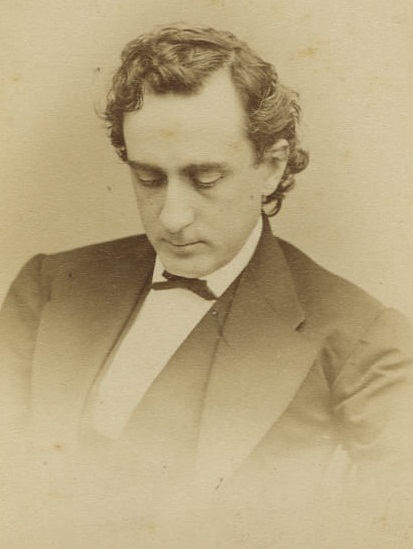
A photo of Edwin Booth taken in 1892. This is probably one of the last ever taken of him.

In the days prior to his death, Edwin was visited by many of his acting contemporaries. One such visitor was the comedian Joseph Jefferson who found early fame by debuting as Asa Trenchard in the play “Our American Cousin” in 1858. The actor (who was actually 3 years older than Edwin) visited Booth two days before his death:

On June 7th, 1893, Edwin fulfilled his New Year’s Eve prediction that, “You drink tonight to my health. A year from tonight you will drink to my memory.” He passed away at around 1:00 o’clock in the morning – a time he had witnessed often in his solitude. Edwin Booth died during his own “vulture hours” and the world lost the greatest actor of the day. Joseph Jefferson was elected president of The Players following Booth’s death and would serve until his own demise.

References:
My Thoughts Be Bloody by Nora Titone
The article was found through Genealogybank.com
The image of Booth in 1892 comes from the Harvard Theatre Collection

Categories: Uncategorized | Tags: | 17 Comments

Some Real Booth Mummies

Finis Bates spent many misguided years trying to convince the world that John Wilkes Booth escaped death at Garrett’s farm. He displayed the mummified remains of David E. George and tricked people into believing the body’s convoluted identity trail from David George, to John St. Helen, to John Wilkes Booth. Bates created convincing pseudo-history with a dead body as an effective centerpiece. However, long before the real John Wilkes Booth was even born, the Booth family had a legitimate connection with mummies.  I quote from Asia Booth Clarke’s book, Booth Memorials: Passages, Incidents, and Anecdotes of Junius Brutus Booth (The Elder):

“About this time [1833] my father [Junius Brutus Booth] purchased two Egyptian mummies, with a view of presenting them to General Jackson. They were to be sent to the Hermitage; but, finding that they were such rare specimens, it was suggested that they should be reserved for the Museum in Washington, for which Mr. Varden was then collecting curiosities. The mummies were priests of the god “Apis; ” and, on examination, the papyrus manuscripts, although in excellent and legible order, proved to be of such antiquity that it was impossible for the literati of that day to translate their meaning.

Languages, like nations and religions, take their turns and seem to prove the mutability of nature. Mr. Varden’s design being ineffectual, the mummies were subsequently deposited in the Patent Office, Washington, and removed thence to the Smithsonian Institute.”

The eccentric Junius, was one of contradictory tendencies at times.  He cherished life in all forms, forbidding the killing of animals in his home and following the practically unheard of practice of vegetarianism.  At the same time though, he was friends with people like Sam Houston and Andrew Jackson.  Original Boothie John C. Brennan once said how odd a gift he thought the mummies to be for Jackson as Jackson wasquite good at, “shooting people and producing his own cadavers”.  The actor who wept during his organized funeral for dozens of killed pigeons, did not have the same reverence, it seems, for the remains of the long dead Egyptians.

According to Michael Kauffman in his book American Brutus, no donation record can be found for Junius’ mummies at the Smithsonian.  Nevertheless, as I visited the Smithsonian’s National Museum of Natural History and explored the Ancient Egypt exhibit today, I couldn’t help but wonder if one of the mummies on display once belonged to Junius Brutus Booth.  At least then there would be a real “Booth Mummy”.

John Wilkes Booth looking for his father’s donated pair of mummies in the Smithsonian.

References:
Booth Memorials: Passages, Incidents, and Anecdotes of Junius Brutus Booth (The Elder) by Asia Booth Clarke
American Brutus by Michael Kauffman
The photo of JWB in the Smithsonian was taken using the Augmented Reality function of Michael Kauffman’s new publication, In the Footsteps of an Assassin.  After purchasing the book, smartphone users are able to download an app which provides tour commentary on the go.  It also includes four augmented reality photo ops in which an overlay of Lincoln, Mary Todd, JWB or Lewis Powell, can be added before taking any picture.  Now, I can take snap a photo of Booth anywhere, without any photo editing required.

Categories: Uncategorized | Tags: , , | 6 Comments

Booth and Lincoln

“In 1863 or 1864, Robert [Todd Lincoln], on vacation from Harvard, was traveling from New York to Washington and waiting at the train station at Jersey City, New Jersey. While standing in line for tickets on a station platform, Robert was pressed by the crowd against the waiting train – which than began to move forward – and he fell into the narrow space between the train and the platform. He was helpless to escape when a hand grabbed his coat collar and pulled him up onto the platform. Robert turned to find his rescuer to be Edwin Booth, America’s most revered stage actor who was traveling to Richmond, Virginia with his friend John T. Ford (owner of Ford’s Theatre in Washington, D.C.) to fulfill an engagement. Robert recognized the actor and thanked him by name. ‘I was probably saved by [Mr. Booth] from a very bad injury if not something more.”…Robert later wrote that although he never again met Edwin Booth in person, he always had a “most grateful recollection of his prompt action on my behalf.'”

The story above is a fairly well known and publicized coincidence between a Booth and a Lincoln. The book I quoted from is Jason Emerson’s biography of Robert Todd Lincoln, Giant in the Shadows: The Life of Robert T. Lincoln. Mr. Emerson was a speaker at the 2011 Surratt Society Conference in which he discussed this encounter between the two men. He recounted that, as time progressed, the story of Edwin saving Robert Todd, became more and more grandiose. In one version of the tale, Robert Todd was supposedly knocked unconscious by the fall and Edwin pulled up his limp body. The most extreme incarnation though, was the one that had Robert Todd Lincoln oblivious to the fact that he was on a set of train track as a train came barreling down towards him. With almost superhero speed, Edwin Booth then ran forward and leapt into the air, tackling Robert out of the way of the train just in time.

A Reader’s Digest illustration of the Booth-Lincoln encounter

Though that last version had very little basis in fact, the true story continues to be told over and over by many newspapers, magazines and websites, due the palatable irony that surrounds the characters. We all know how this Good Samaritan tale would one day be eclipsed by a different “Booth and Lincoln” story.

References:
Giant in the Shadows: The Life of Robert T. Lincoln by Jason Emerson

Categories: Uncategorized | Tags: , | 4 Comments

Junius and Jackson

Tragedian Junius Brutus Booth, Sr., and President Andrew Jackson

Did John Wilkes Booth’s father, Junius Brutus Booth, Sr., write a letter threatening President Andrew Jackson’s life?  PBS’ History Detectives investigate:

Click here to watch the “Booth Letter” episode on PBS.org

This episode features author Gene Smith.  Mr. Smith wrote a wonderful biography of the Booth family entitled, American Gothic: the Story of America’s Legendary Theatrical family, Junius, Edwin, and John Wilkes Booth.  I decided to post this video after learning the sad news that Mr. Smith passed away on July 25th.  His book was one of the first “Boothie” books I ever read, and it drew me more and more into the assassination story.  Thank you, Mr. Smith.

Categories: Uncategorized | Tags: , , | 7 Comments

Newish News

Most of what follows is probably already known to those who regularly read this blog.  Nevertheless here’s some newish news on the Lincoln assassination front.

Booth reading the news

 1.  New Site

When it comes to learning about Abraham Lincoln’s life, there really is no better resource than the Abraham Lincoln Research Site run by Roger Norton.  The website at http://rogerjnorton.com is actually composed of three equally valuable sections: the life of Abraham Lincoln, the life of Mary Todd Lincoln, and Lincoln’s assassination.  The proprietor of the site is Roger Norton, a retired Illinois social studies teacher.  His website is the top choice for students, both young and old, to learn about Lincoln.  In 2006, his site received the prestigious honor of being completely archived by the Library of Congress.  Just as the LOC archives and preserves movies and TV shows deemed culturally significant, Mr. Norton’s site was archived for all time due to its educational significance.  It is a very high honor for an individual’s site to achieve and speaks to the quality of Mr. Norton’s work.

Recently, Mr. Norton has expanded his website to now include a public forum.  The Lincoln Discussion Symposium is open to all who wish to discuss the many aspects of Abraham Lincoln.  It is a collaborative community where amateurs and experts alike can post questions and comments regarding our 16th President.  Due to the large amount of traffic Mr. Norton receives from students in the school setting, forum members are expected to be courteous and respectful in their remarks.  While it is still growing, the forum already houses a wonderful community of experts from the Lincoln community eager to answer questions and take part in discussions.  I, myself, am a member there and endorse it fully.  While my main interest lies in Lincoln’s assassination, the forum has already taught me so much that I didn’t know about the living Lincoln.  Membership is growing every day, so I invite you all to visit the Lincoln Discussion Symposium and join the wonderful community of learners.

2.  New Links

On the right side of the blog you might have noticed a list of “Links to Learn More”.  Here I have placed links to some of the best websites out there for Lincoln assassination material.  Hovering over each link will give you a short description of the site.  To this list, I have recently added two new links.  The first is the above mentioned Lincoln Discussion Symposium.  The second is the Facebook page for the Spirits of Tudor Hall.  The Tudor Hall estate was the Booth family homestead in Maryland.  The theatrical patriarch of the Booth clan, Junius Brutus bought the land when he and Mary Ann Holmes emigrated from England.  The Booth family originally lived in a log cabin on the property before Junius commissioned the building of the beautiful Tudor Hall manor house in the fall of 1851.  Sadly, Junius never got to live in the main house as he died while on tour on November 30th 1852.  The Booth family lived on the Tudor Hall property on and off from 1822 to 1858.  Nowadays, Tudor Hall is used as an office for the Harford County Center for the Arts.  It is also home to the Junius B. Booth Society.   The house is open on select weekends for public tours about the Booth family and the history of Tudor Hall.  The Spirits of Tudor Hall Facebook page advertises the house’s tour dates and times, along with highlighting wonderful pictures and articles on the Booth family (including some from here, Woot!).  If I was a member of Facebook, I would Share it/Like it/Poke it/Friend it/Hug it/High Five it, whatever it is that you young people do there.  One thing they are advertising on Tudor Hall’s behalf is the sale of a genuine brick from a Tudor Hall chimney.  While the bricks can’t be completely authenticated to when the Booths lived there, it’s still a relic you can own dating back to Edwin Booth’s lifetime.  Add the Spirits of Tudor Hall Facebook page to your favorites today.

3.  New(ish) Books

I am happy to report that William Edwards’ book, The Lincoln Assassination – The Reward Files, is now available for purchase as an ebook through GoogleBooks.  Previously released as a book on CD-ROM, Mr.  Edwards has revamped his collection of primary source documents into a searchable ebook.  The Reward Files hold many details about the military’s search for Booth and contains firsthand accounts (like Samuel Arnold’s confession) not found in other sources.  This text along with The Evidence and the Court Transcripts, make up the trilogy of the government’s primary documents into the assassination of Abraham Lincoln.

Also, Ed Steers, the noted Lincoln author and co-author on The Evidence with William Edwards, has also just released an updated Kindle ebook version of his popular booklet, The Escape and Capture of John Wilkes Booth.  Mr. Steers originally posted the news of his revised book on the Lincoln Discussion Symposium.

Well, that’s all the newish news that’s fit to print.  Back to our regularly scheduled programming.

Categories: Uncategorized | Tags: , , , , | 10 Comments

The Player and the President

In Chicago’s Lincoln Park, there stands a magnificent bronze sculpture of Abraham Lincoln.

The statue was erected by Augustus Saint-Gaudens in 1887.  Saint-Gaudens was a celebrated sculptor and a member of Edwin Booth’s exclusive club, The Players.  This statue is one of the most celebrated of the 16th President and replicas of it are located in Springfield, Mexico City, and London.

While countless individuals have visited this sculpture since its unveiling, none have done so with the same degree of personal angst as Edwin Booth.  A witness to the event described the visit of the Player to the statue of the fallen President

“When I was a boy, I lived in Chicago near Lincoln park.  Once when Edwin Booth was playing in the city, I went with another boy to hear ‘Hamlet’.  I was permitted to spend the night at my friend;s house but went home for breakfast.

At that early hour Lincoln park was deserted, but as I drew near Saint-Gaudens’ great statue of Lincoln, I saw a carriage approach, driven by a negro coachman.  It stopped before the statue, the door opened and out stepped – Edwin Booth.  Curious to see what would happen, I stepped behind a clump of shrubbery where I might watch, unobserved.

The great actor stood for a moment before the wonderful bronze, with his head bared.  Then he took a rose from his buttonhole and laid [it] at the base of the statue.  He entered the carriage and was driven away, utterly unconscious that the incident had been witnessed by one who would ever after cherish its memory.”

Though the writer of the above account is unknown, it is likely that it was written by George Middleton, a playwright who later became a member of The Players.  A similar version of this account is attributed to him in the book, A Certain Club:

“Over him constantly appeared to hang the memory of his family’s disgrace.  George Middleton, one of the earliest Players, who had met Booth at his father’s home, recalled coming upon him accidentally in the Chicago park where Augustus Saint-Gaudens’ statue of Lincoln had recently been unveiled.  Booth had driven alone in a carriage to see it.  Getting out, he did not notice Middleton and, looking around, observed no one else.  With bared head, he contemplated Lincoln’s sorrowful face for a long time, then plucked a flower from his buttonhole and placed it at the statue’s feet.  Returning to the carriage, he turned and made a gesture of sorrow and infinite regret, climbed in and drove away.”

While Edwin Booth was celebrated as the greatest tragedian of his generation, he was forever haunted by his brother’s horrible crime.  Recent conspiracy theorists have called for the exhumation of Edwin Booth’s remains in order to “prove” genetically that John Wilkes Booth wasn’t killed on April 26th, 1865.  Not only do they ignore and manipulate the thorough documentation of John Wilkes’ death at the Garrett’s farm, but they now desire to desecrate the grave of his noble brother in order to “prove” their misconceptions.  I would ask all who may choose to support their plans to read this account.  Understand the lifetime of personal suffering all the Booths were forced to endure after John Wilkes’ act.  Though it is unfortunate, history will always remember John’s anger over Edwin’s talent.  The last ounce of respect we can give to Edwin is to let him rest in peace.  His life was marred by his brother.  Let us not dishonor him further in death.

References:
My Thoughts Be Bloody by Nora Titone
A Certain Club: One Hundred Years of The Players by John William Tebbel
A Tribute to Lincoln – The Pittsburgh Press (5/2/1915)

Categories: Uncategorized | Tags: , | 9 Comments

Blog at WordPress.com.