Posts Tagged With: Abraham Lincoln

Following Orders: The Arrest and Case of John McCall, Assassination Sympathizer

Recently, there was a comment posted by Gary Goodenow in the Grave Thursday entry for General Dodd relating a story about a possible relative of Gen. Dodd’s who participated in the execution of King Charles I of England, and was later executed himself for treason by the restored King Charles II. Gary mentions that the colonel in question attempted to use the defense that he was following the command of his superior when he participated the Charles I’s trial and death. This defense did not succeed for Col. Axtell. However, the idea of a “following orders” defense reminded me of another legal case related to the Lincoln assassination. It was a case brought forward by a man named John McCall who lived in Mendocino County, California.
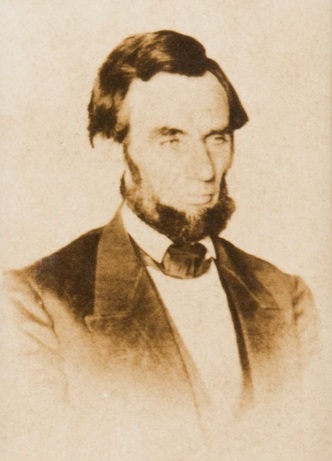
Abraham Lincoln Bierstadt

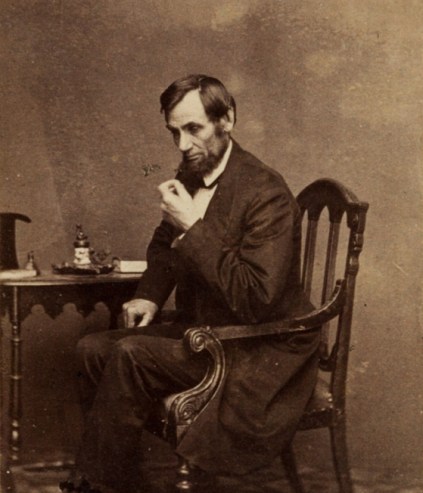
Abraham Lincoln in September of 1861

Before getting to Mr. McCall, however, some background knowledge on a specific legal aspect of the Civil War is necessary. During the Civil War, President Abraham Lincoln suspended the writ of habeas corpus. Habeas corpus, which is Latin for “you may have the body”, is the right for an individual detained by an authority to appear before a court in order to contest the reasons for their continued detainment. In its simplest sense, habeas corpus prevents authorities from locking people away for indefinite periods of time without charge or trial. According to the U.S. Constitution the only time habeas corpus can be suspended is “when in Cases of Rebellion or Invasion the public Safety may require it.” So, when Lincoln suspended the writ in 1861, it could be argued that he was in his legal right, due to the open rebellion of the Confederacy. However, the above quote about when one can suspend the writ is detailed in the Constitution under the section describing the powers of Congress, not the executive branch.

Chief Justice of the Supreme Court Roger Taney

Chief Justice of the Supreme Court Roger Taney

The debate over who had the power to suspend the writ of habeas corpus loomed large in the early Civil War years. Lincoln’s actions were challenged by those who had been imprisoned for their southern sympathies and continually held. Chief Justice of the Supreme Court Roger Taney staunchly believed that the executive branch had no legal right to suspend the writ, while Lincoln argued that since the rebellion began when Congress was in recess he had the right to suspend the writ in their absence. Eventually, on March 3, 1863, Congress passed the Habeas Corpus Suspension Act, which retroactively gave the President the authority to suspend habeas corpus for the duration of the rebellion and protected the President and his subordinates from any liability for their previous actions:

“SEC. 4. And be it further enacted, That any order of the President, or under his authority, made at any time during the existence of the present rebellion, shall be a defence in all Courts to any action or prosecution, civil or criminal, pending or to be commenced, for any search, seizure, arrest, or imprisonment, made, done, or committed, or acts omitted to be done, under and by virtue of such order, or under color of any law of Congress; and such defence may be made by special plea, or under the general issue.”

Lincoln then paired this act with a proclamation of his own on September 15, 1863, declaring the classes of people who could be arrested and held under the suspension of habeas corpus:

“Whereas, in the judgment of the President, the public safety does require that the privilege of the said writ shall now be suspended throughout the United States in the cases where, by the authority of the President of the United States, military, naval, and civil officers of the United States, or any of them, hold persons under their command or in their custody, either as prisoners of war, spies, or aiders or abettors of the enemy, or officers, soldiers, or seamen enrolled or drafted or mustered or enlisted in or belonging to the land or naval forces of the United States, or as deserters therefrom, or otherwise amenable to military law or the rules and articles of war or the rules or regulations prescribed for the military or naval services by authority of the President of the United States. or for resisting a draft, or for any other offense against the military or naval service”

In short, Lincoln’s proclamation gave military officers the authority to hold without charge or trial those they believed were prisoners of war, spies, deserters, draft dodgers, and aiders or abettors, even if the belief could not be proven. The act of March of 1863, subsequently protected the officers from liability in enacting this authority.

Lincoln assassinated headline San Fran

When Lincoln was assassinated on April 14, 1865, the news spread around the country. In some of the western states and territories the reactions to Lincoln’s death were mixed, especially due to the unique blend of Northerners and Southerners who had moved there. It was not uncommon to find ardent Unionists and Confederates living in the same small area.

This was the case in an area of northern California called Potter Valley in Mendocino County. The valley was split in its sympathies with those with Southern sympathies settling in the upper part of the valley and those with Union sympathies in the lower part. The original school in Potter Valley had been built in the Southern leaning upper part and, during the Civil War, a second school was built in the Unionist lower part to ensure that the different students in the area received the appropriate political education.

When the news of Lincoln’s death arrived in Potter Valley there were those who mourned the fallen leader with intense grief, and those who greeted the news with great joy. One of those joyful men was an older resident of the valley named John McCall.

McCall was about 60 years old and originally from Tennessee. At least twice in April of 1865, McCall made statements while on the public road in Potter Valley about his satisfaction with Lincoln’s death. According to Unionist witnesses who later reported on him, McCall stated that, “Lincoln was shot, and that the damned old son of a bitch should have been shot long ago, and that some more of his kind would go the same way shortly.” A few days later, McCall followed up on this line of thinking and stated, “That he did not believe that General Lee had surrendered, and believed that General Lee was still carrying on the war; and that he did not believe for a long time after hearing of the president’s assassination that it was true; and said, I am only afraid that it is not so – if three or four more of the leaders of the abolition party were killed it would be a good thing, as it would be the downfall of that party.”

These words would be John McCall’s downfall. Others around the country were learning the danger of speaking positively about Lincoln’s death. The backlash against those who celebrated Lincoln’s death was intense. Mob justice was prevalent with some supporters of Lincoln’s death being swiftly lynched. Even those in isolated towns would band together to punish those gloating rebels.
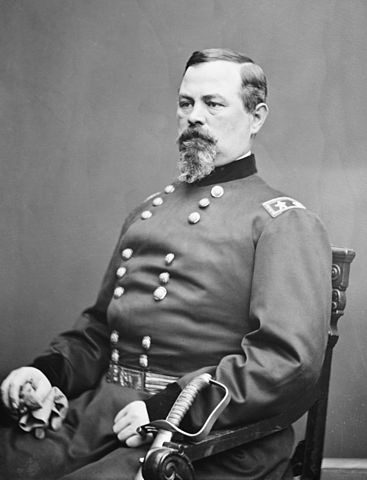
Maj. Gen. Irvin McDowell

Maj. Gen. Irvin McDowell

On April 17, 1865, a general order was sent out by Union Major General Irvin McDowell who was the commander of the Department of the Pacific stationed in San Francisco. General Order 27 stated the following:

“It has come to the knowledge of the major-general commanding that there have been found within the department persons so utterly infamous as to exult over the assassination of the President. Such persons become virtually accessories after the fact, and will at once be arrested by any officer or provost-marshal or member of the police having knowledge of the case. Any paper so offending or expressing any sympathy in anyway whatever with the act will be at once seized and suppressed.”

With this order, Gen. McDowell was essentially authorizing the arrest of any person in his district who was demonstrating joy in Lincoln’s death.  Whether he knew of this order or not, John McCall made himself susceptible to its consequences with his words on April 20th and April 29th. On June 1, 1865, John McCall saw Union troops riding up to his farm and found himself under arrest. The arresting officer was Captain Charles D. Douglas who was the commander of Fort Wright, located almost 60 miles north of Potter Valley.

McCall was not the only seditious citizen arrested that day. Captain Douglas also arrested men by the names of Andrew J. LaFever, Simon Wurtenberg and Thaddeus Dashiell, all of whom had spoken positively of Lincoln’s death with Dashiell having given a celebratory Rebel Yell at the news. Also arrested was the teacher of the Confederate leaning upper school, a Miss Harriet Buster, who allegedly stomped on the American flag after hearing of Lee’s surrender to Grant. Miss Buster was released shortly after her arrest and the men were marched three miles to an adobe hut where they spent the night under confinement.

Thaddeus Dashiell and Andrew LaFever, two of John McCall's fellow prisoners, in their later years.

Thaddeus Dashiell and Andrew LaFever, two of John McCall’s fellow prisoners, in their later years.

The next day the soldiers and their prisoners made the trek of almost 60 miles north to Fort Wright. There were not enough animals for all of the men to ride and so John McCall and the other prisoners had to walk for most of the way. They passed through the mountains which were high and cold, and had to endure a hail storm as they went. They finally arrived at Fort Wright at between 10 o’clock and 11 o’clock at night. At Fort Wright the men met another prisoner, named James Patrick, in identical circumstances. They slept that night, cold and wet, on the floor of the guard house. The gang stayed at Fort Wright for three days, during which time one of the men, Andrew LaFever took the oath of allegiance and was released. Whether the oath was offered to the others is unknown.

From Fort Wright the prisoners were taken by mule to Fort Bragg, a coastal town some 75 miles away. Traveling over mountains meant it took two days to make the trip, but by the evening of June 7th, they arrived in Fort Bragg. McCall would later describe each leg of the journey as being “pulled, dragged and hauled” across the roughest of terrain.

The men were placed on a lumber schooner called the Albion at nearby Noyo Harbor but, due to rough waters, the schooner failed to depart as planned on June 9th. The next day it successfully began its sail to San Francisco. Fellow prisoner Thad Dashiell described the trip: “The schooner barreled down the coast, one time out of sight of land, most of the time in sight of the coast.” Upon arriving in San Francisco on June 11th, Dashiell and the other prisoners were surprised to find that, for the first time, their guards held their revolvers on them with “pistols cocked, fingers on the trigger.”

McCall, Dashiell, Wurtenberg, and Patrick were marched at gunpoint through the streets of San Francisco to the provost marshal’s office. They were placed in a 10 x 12 ft guardhouse which was “a very filthy place,” Dashiell recalled. The men were handcuffed for the first time and spent two days in the provost marshal’s guardhouse. Captain Douglas, who had escorted the prisoners the entire distance, relinquished his custody of the men to the provost marshal and would make his was back to Fort Wright.

Alcatraz Island circa 1869

Alcatraz Island circa 1869

On June 13th, the four men were put in a small boat and transferred to Fort Alcatraz. At Alcatraz they were given hard labor. According to Dashiell, they were, “put to work breaking rocks into small pieces” alongside military prisoners and endured many hardships. McCall would later state that, “My arm was rubbed raw in one place. I asked for a change of irons. They would not get me any.”

The disloyal men from Mendocino County spent six days doing hard labor at Alcatraz. They managed to acquire the services of a lawyer and, despite the suspension of habeas corpus that could have kept them there indefinitely, the lawyer managed to persuade the provost marshal to release them. They were removed from Alcatraz and had to spend one final night at the provost marshal’s guardhouse with drunken soldiers before they were allowed to take the oath of allegiance. Upon taking the oath, John McCall, Thad Dashiell, Simon Wurtenberg, and James Patrick were released and began the long journey back to their homes in Potter Valley about 140 miles away.

One would think that the story would end there and that the disloyal secessionists got what they deserved for celebrating at a time of national tragedy. But John McCall was very angry about the treatment he had endured and did not believe that his arrest was justified. By October of 1865, John McCall announced that he was bringing a suit against Captain Douglas and General McDowell seeking damages of $100,000.

Alcatraz suit 10-12-1865

The announcement of the case received wide press with some newspapers announcing that, rather than suing, McCall should, “consider himself very fortunate that he escaped a justly deserved hanging.”

Immediately though, John McCall’s case against Gen. McDowell and Cap. Douglas hit a snag. According to Section 5 of the Habeas Corpus Suspension Act passed by Congress in March of 1863, any suit brought against authorities in regards to habeas corpus was to be taken up by the Circuit Court and not by the state courts. McCall, likely hoping to receive a jury trial which would be more sympathetic to his cause, petitioned heavily that his case not be taken to the Circuit Court level where only a judge would decide his case. McCall’s lawyer challenged Congress’ authority to circumvent the lower state courts. On September 17, 1866, McCall’s motion to keep the trial at the state level with a jury was denied.

While McCall was waiting to hear about his motion to keep his case at the state level, an act was passed by Congress to further clarify the legal protections granted to authorities during the suspension of habeas corpus. The act, passed on May 11, 1866, granted protection to those who had carried out an order, “written or verbal, general or special, issued by the President or Secretary of War, or by any military officer of the United States holding command of the department, district, or place within which such acts . . . were done or omitted to be done.” This act, meant to help and clarify the defense of military officers, would actually cause trouble for one of the defendants in McCall’s case.

In March of 1867, all of the evidence and testimony for the case was taken. Captain Douglas testified about his role in arresting and transporting McCall stating that no deliberate malice was done to the prisoners while he was in charge of them. General McDowell also testified, acknowledging that he gave the order to arrest those celebrating Lincoln’s demise. “I issued this order,” McDowell said, “and I think it quieted the country. And there would have been bloodshed. I think this order saved the lives if not the property of prominent citizens of the city.” Thaddeus Dashiell testified on John McCall’s behalf about the circumstances surrounding their arrest and imprisonment.

Judge Matthew Deady

Judge Matthew Deady

On Friday, April 5, 1867, the case McCall v McDowell et al was argued before Judge Matthew Deady of the U.S. Circuit Court in San Francisco. McCall’s attorney, Henry Irving, made the case that his client’s utterances were not enough evidence to suspect him of being an “aider and abettor” of the Confederacy and thus he did not fall under President Lincoln’s September of 1863 proclamation as a class of citizen eligible for arrest without the benefit of habeas corpus. Irving also argued that Gen. McDowell had not been authorized by the President or Secretary of War to issue the order to arrest assassination sympathizers, a condition seemingly necessary in order to protect him from legal action according the act of May 11, 1866. At the end of the day, Judge Deady announced that a decision would come at the end of the month because the, “points involved were of paramount importance.”

On April 26, 1867, Judge Deady announced his decision on McCall’s case. Judge Deady threw out McCall’s case against Captain Douglas due to the March 3, 1863 Congressional Act and act of May 11, 1866 which protected subordinates following the orders of their superiors. It was not proven that Douglas had acted with malice towards his prisoners and thus he was completely free from any liability. The acts from Congress protected Captain Douglas for having “only followed orders”.
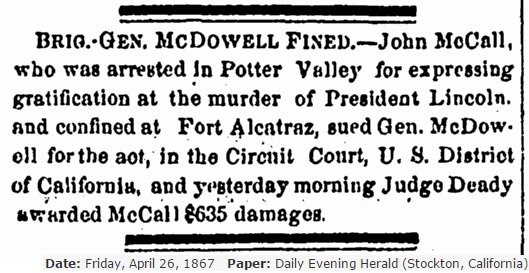
Gen McDowell Fined

Surprisingly, however, Deady found that General McDowell was liable for the false imprisonment of John McCall. He agreed with McCall’s attorney that the act of May 11, 1866 did not protect McDowell from liability since McDowell was not given any orders by either the President or the Secretary of War to issue the arrest of assassination sympathizers in his district. So while Captain Douglas was protected for following the order, Gen. McDowell was not protected for issuing it.

Deady did acknowledge that McDowell was acting for the safety of the public when issuing the order and not out of malice, but contended that he was still subject to legal action due to that order. Deady reassessed the possible damages owed to McCall and decided that he deserved compensation for the money he spent during his time of confinement and an additional $500 for his pain and suffering. In the end, it was the judgement of the court that General Irvin McDowell was to pay $635 to the plaintiff, John McCall.

The judgement rocked California. No one had expected John McCall to win his suit against the military authorities who had once imprisoned him. Newspapers reported the names of other former imprisoned rebels who were preparing their own suits against General McDowell and commanders in other districts. Editorial letters denouncing Deady’s decision and poking holes in his logic filled the news. To military leaders out west, the decision of McCall v McDowell was a terrifying one.

More suits against McDowell to come

Though not the $100,000 he wanted, John McCall was no doubt happy about his success against the military might of the abolition party. This last rebel victory, however, would be extremely short lived. For even as Judge Deady was deciding in John McCall’s favor in the west, back east an act had already passed Congress which would overrule it.

On March 2, 1867, Congress passed an act establishing the validity and conclusivity of all acts and proclamations of the President regarding martial law and the suspension of habeas corpus from March of 1861 to July of 1866. In addition, the act specifically fills in the gap of protection that Judge Deady observed, by declaring that, “all officers and other persons in the service of the United States, or who acted in aid thereof, acting in the premises shall be held prima facie to have been authorized by the President”. In other words, this act maintained General McDowell’s authority to issue orders as he saw fit and that all such orders had the implied approval of the President.

The awareness of this act of Congress did not reach California until early May. When the news did arrive, it was immediately picked up by the newspapers. It was reported that, “under this law, which has only been received within a day, Judge Deady himself would have decided for the defendant.”

In the end, General McDowell’s attorneys appealed Deady’s ruling based on this newly passed act of Congress, and the decision was overruled. John McCall never received a cent from General McDowell and any planned suits against him by other formerly imprisoned rebels were ended.

Unfortunately, John McCall sort of drifted back into obscurity after that. I have been unable to find any record of his later life and death. General Irvin McDowell died in 1885 and is buried at the San Francisco National Cemetery. His subordinate, Captain Charles Douglas, died in 1913 and is buried in Monterey, California. McCall’s neighbor and fellow prisoner, Thaddeus Dashiell, is buried right back in Potter Valley where it all started. Dashiell was elected twice as a county supervisor for Mendocino County and in his later years started to vote Republican. Asked by his friends why he would begin voting for the party of Lincoln, the elder Dashiell would say that he had, “packed sand at Alcatraz for the privilege of expressing any political opinion,” he wanted.
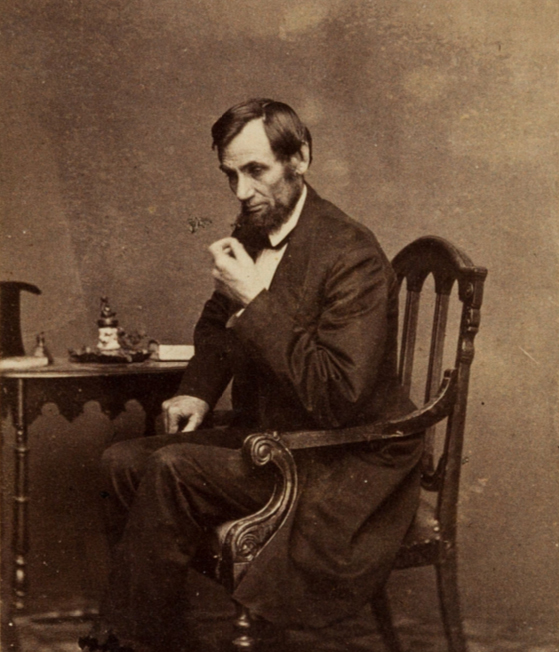
Abraham Lincoln Thinking

Lincoln’s suspension of the writ of habeas corpus continues to be one of the most debated parts of his legacy. Though he had reason for suspending one of the most important personal liberties, it was not an easy decision to make. In addition to stripping away a crucial right of every citizen, suspending habeas corpus also removed one of our national protections against the creation of a despotism. That is why our Constitution only allows for its suspension during times of rebellion and invasion. Even in those cases, however, stripping personal freedoms can be a slippery slope. The not so distant past of the world demonstrates the damage that can occur when those in authority are allowed to imprison individuals without charge or trial. While Captain Douglas may have not have committed a crime when he arrested John McCall, we all know the tragedies of history that can occur in countries where personal liberties are suspended by those “only following orders”.

References:
McCall v. McDowell et al – Judge Deady’s full decision on the case is a fascinating read
The Privilege of Expressing My Opinion: Regionalism and Free Speech in Civil War California by Ronald Cannon
An ‘Un-Lincoln’ story for Abe’s birthday weekend by Gaye LeBaron
An Act relating to Habeas Corpus, and regulating Judicial Proceedings in Certain Cases, March 3, 1863
Proclamation 104 – Suspending the Writ of Habeas Corpus Throughout the United States, September 15, 1863
The Act of May 11, 1866
The Act of March 2, 1867
NPS – Alcatraz Island
Library of Congress Prints and Photographs Division
Heritage Auctions
GenealogyBank.com
FindaGrave.com
Thank you, Gary, for inspiring this post with your comment

Categories: History | Tags: , , | 2 Comments

“The Murderer: John Wilkes Booth and the Plot Against Lincoln” at the ALPLM

Almost a year ago, I was contacted by representatives from the Abraham Lincoln Presidential Library and Museum in Springfield, Illinois. Though I was right in the middle of setting up my classroom for a new school year (at a brand new school, and grade, actually), I dropped everything to take the call from employees of such an esteemed institution. As part of their volunteer educational programming, the ALPLM asked me if I would be willing to come to Springfield in the upcoming year and give a talk about the assassin of President Lincoln. I suppose it is not difficult to ascertain what my response was. After a few victory laps around my minefield of classroom, I settled in for the long wait until summer.

Dave Taylor at the ALPLM 6-29-2016

Less than a month ago, on June 29, I was humbled to present my speech, “The Murderer: John Wilkes Booth and the Plot Against Lincoln” for the wonderful folks at the ALPLM. The museum was kind enough to record my presentation and put it on YouTube, and so I have embedded the video below. It misses some of the fancy animations I included in my PowerPoint but is of far better quality than I could have ever done. The video below includes the lively question and answer session that followed the speech where we cover several other Lincoln assassination topics beyond John Wilkes Booth.

In addition to the speech, I spent my time in Springfield visiting the Lincoln sites and viewing several of the ALPLM’s assassination related letters and artifacts. Altogether, the speech and visit to the ALPLM are among the highlights of my “career” as a “historian.” I would like to thank Jeremy Carrell, Barbara McKean, Samuel Wheeler, Dr. James Cornelius, David Grimm, and Chuck Hand for setting everything up and for their hospitality in, and around, the ALPLM.

It was truly an honor to speak at the ALPLM and, if you have the time, I hope you enjoy the speech below.

Categories: History, News | Tags: , , , , | 20 Comments

“To Whom it May Concern”

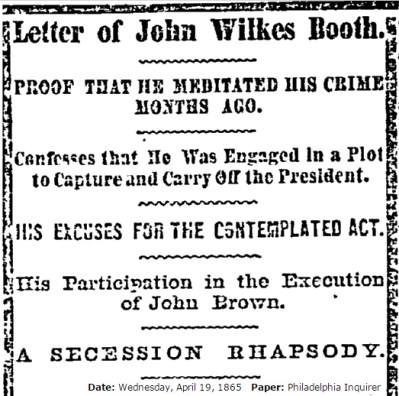
On this date in 1865, the Philadelphia Inquirer published a telling letter written by John Wilkes Booth, the recent assassin of President Lincoln.

To Whom is Published

The letter is known to readers of the Lincoln assassination story as John Wilkes Booth’s, “To Whom it May Concern” letter. Its title is derived from the letter’s greeting which was appropriated by Booth from a letter written by Lincoln in July of 1864. At that time, a small delegation of “peace emissaries” representing the Confederacy had approached the Union government under the guise of facilitating a cessation of hostilities and possible re-unification of the nation under the condition that they be allowed to continue the practice of slavery. It was a difficult period in the war and Lincoln himself knew his chance of winning re-election later that year was slim. Knowing that Lincoln would never agree to their terms, the so-called “Niagara Falls peace conference” was a piece of propaganda for the Confederacy, which was more aimed to further diminish Lincoln’s approval and chance of re-election. Lincoln was likely well aware of conference’s true purpose and wrote to the “peace emissaries” that any discussion of peace must include the “abandonment of slavery”.

Abraham Lincoln

Abraham Lincoln

Knowing that his position would be viewed and lamented as stubbornness by the Confederacy and by the Democrats running against him, Lincoln decided to add further insult to injury by refusing to address the emissaries by name. Instead, Lincoln wrote his note “To Whom it May Concern,” diminishing the importance and respectability of the so-called “peace emissaries.” John Wilkes Booth subsequently used this somewhat insulting address in his own explanatory letter that follows.

The letter was published due to the efforts of Booth’s brother-in-law, John Sleeper Clarke. Following the assassination of Lincoln, Clarke and his wife, Asia Booth, recalled that John Wilkes had left a package of papers in the safe of their home in Philadelphia. Upon opening the package they found this letter, another addressed to his mother, Mary Ann Booth, and some oil stocks. As more and more Booths arrived at the Clarkes’ home (Mary Ann came from New York very soon after hearing the tragic news in order to comfort Asia, who was pregnant, and Junius Jr. arrived from an acting engagement in Cincinnati to be with the family), John Sleeper thought that the letters would be of help in proving the family’s innocence as to John’s plan. Clarke had copies made of both the To Whom it May Concern letter and the one addressed to Mrs. Booth. Then, accompanied by a member of the Philadelphia press corps, Clarke went to the office of William Millward, the Provost Marshal of Philadelphia.

John Sleeper Clarke

John Sleeper Clarke

Clarke asked the Marshal for permission to publish the letters and the circumstances surrounding their discovery in order to demonstrate that the family had no foreknowledge of John Wilkes’ crime. Millward approved the publication of the To Whom it May Concern letter for the next day but not the letter that John Wilkes wrote to his mother. Millward did not want anything published that might garner sympathy for the assassin. This was a let down to Clarke, as Booth’s letter to his mother more effectively demonstrated how completely unaware the family was as to John Wilkes’ intentions. While the To Whom it May Concern letter was published, it did not assuage the suspicion on the Booth family. Shortly after the letter was published, both John Sleeper Clarke and Junius Brutus Booth, Jr. were arrested and taken down to Washington, D.C. The youngest Booth, Joseph, would also be arrested leaving Edwin as the only male Booth not to be locked up. This series of events greatly bothered Clarke, who would complain about his improper treatment and the favored treatment of Edwin for the rest of his days. The assassination and the events that followed it marked the beginning of John Sleeper Clarke rejecting all things Booth, including his wife, Asia, whom he would grow to loathe.

Though not dated besides the year, Booth’s letter was likely written just following Lincoln’s miraculous re-election in November of 1864. The letter lays out John Wilkes Booth’s political and ideological beliefs and provides his reasons for his plan to abduct President Lincoln. Booth had started, sort of halfheartedly at first, to assemble a crew of conspirators in the summer of 1864 with the idea of abducting the President and taking him South. In this manner, Booth hoped to use Lincoln as a hostage to reinstate the prisoner exchange program between the Union and the Confederacy. This idea took on an increased importance in Booth’s mind after Lincoln’s surprise re-election on November 8, 1864. Immediately following this date, John Wilkes Booth began acting more in earnest and less than a week after the election, he was in Southern Maryland scouting the area and looking for others who might help him in his plot.

John Wilkes Booth Gutman 27

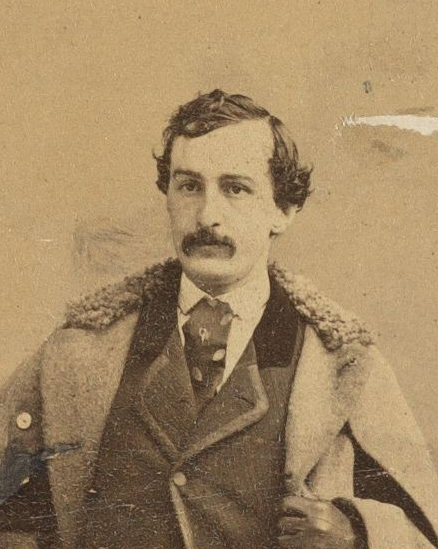
John Wilkes Booth

This letter, therefore, was written right at the beginning of Booth’s plot to abduct the President. It contains perhaps the most honest look into the mind and thoughts of John Wilkes Booth. In less than six months after this letter was written, the same motivations that led Booth to consider abduction, led him to assassinate Abraham Lincoln.

"To Whom It May Concern" 1864 RG 60 Department of Justice Segregated Documents from Attorney General Letters Received, 1809-1870 Box 4 ReDiscovery Identifier: 6542

My Dear Sir                                                                                                                  1864.

You may use this, as you think best. But as some, may wish to know the when, the who, and the why, and as I know not, how, to direct, I give it (in the words of your master)

“To whom it may concern”

Right, or wrong, God, judge me, not man. For be my motive good or bad, of one thing I am sure, the lasting condemnation of the North.

I love peace more than life. Have loved the Union beyond expression. For four years have I waited, hoped, and prayed, for the dark clouds to break, and for the restoration of our former sunshine. To wait longer, would be a crime. All hope for peace is dead. My prayers have proved as idle as my hopes. ‘God’s’ will be done: I go to see, and share the bitter end.

I have ever held the South were right. The very nomination of Abraham Lincoln four years ago, spoke plainly – war – war upon Southern rights and institutions, his election proved it. “Await an overt act.” Yes till you are bound and plundered. What folly. The South were wise. Who thinks of argument and patience when the finger of his enemy presses on the trigger. In a foreign war, I too could

To Whom it May Concern Letter Page 1 NARA

say, “Country right or wrong”, but in a struggle such as ours (where the brother tries to pierce the brothers heart) for God’s sake choose the right. When a country such as ours like this, spurns justice from her side, she forfeits the allegiance of every honest freeman, and should leave him untrammeled by any fealty soever, to act, as his conscience may approve.

People of the North, to hate tyranny to love liberty and justice, to strike at wrong and oppression, was the teaching of our fathers. The study of our early history will not let me forget it. And may it never.

This country was formed for the white not for the black man. And looking upon African slavery from the same stand-point, held by those noble framers of our Constitution, I for one, have ever considered it, one of the greatest blessings (both for themselves and us,) that God ever bestowed upon a favored nation. Witness heretofore our wealth and power, witness their elevation in happiness and enlightenment above their race, elsewhere. I have lived among it most of my life and have seen less harsh treatment from master to man, than I have beheld in the North from father to son. Yet Heaven

To Whom it May Concern Letter Page 2 NARA

knows no one would be willing to do, more for the negro race than I. Could I but see a way to still better their condition. But Lincoln’s policy is only preparing the way, for their total annihilation. The South are not, nor have they been, fighting for the continuance of slavery, the first battle of Bull-run did away with that idea. Their causes since for war, have been as noble, and greater far than those that urged our fathers on. Even should we allow, they were wrong at the beginning of this contest, cruelty and injustice, have made the wrong become the right. And they stand now (before the wonder and admiration of the world,) as a noble band of patriotic heroes. Hereafter, reading of their deeds, Thermopylae will be forgotten.

When I aided in the capture and the g execution of John Brown, (who was a murderer on our Western Border, and who was fairly tried and convicted, – before an impartial judge & jury – of treason, – and who by the way has since been made a God – I was proud of my little share in the transaction, for I deemed it my duty and that I was helping our common country to perform an act of justice. But what was a crime in poor John Brown, is now considered (by themselves) as the greatest and only virtue, of the whole

To Whom it May Concern Letter Page 3 NARA

Republican party. Strange transmigration. Vice to become a virtue. Simply because more indulge in it. I thought then, as now, that the abolitionists, were the only traitors in the land, and that the entire party deserved the fate of poor old Brown. Not because they wish to abolish slavery, but on account of the means they have ever used endeavored to use, to effect that abolition. If Brown were living, I doubt if he himself would set slavery, against the Union. Most, in or many, in the North do, And openly curse the Union, if the South are to return and retain a single right guaranteed them by every tie which we once revered as sacred. The south can make no choice. It is either extermination, or slavery for themselves, (worse than death) to draw from. I would know my choice.

I have, also, studied hard to discover upon what grounds, the rights of a state to secede have been denied, when our very name (United States) and the Declaration of Independence, both provide for secession. But there is no time for words. I write in haste. I know how foolish I shall be deemed, for undertaking such a step, as this, where on the one side, I have many friends, and everything to make me happy. Where my profession alone has gained me an income of more than twenty thousand dollars a year. And where my great personal ambition in my profession has such a great field for labor. On the other hand- the south have

To Whom it May Concern Letter Page 4 NARA

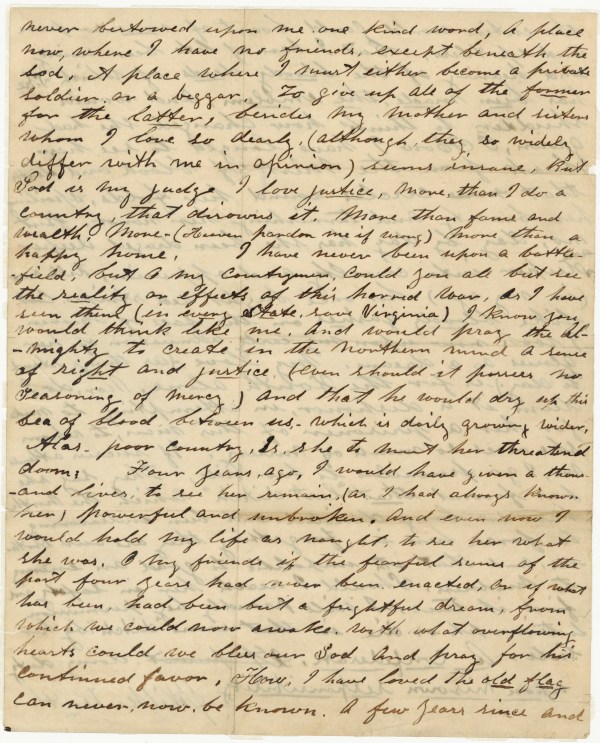
never bestowed upon me one kind word. A place now, where I have no friends, except beneath the sod. A place where I must become either become a private soldier, or a beggar. To give up all of the former for the latter, besides my mother and sisters whom I love so dearly, (although they so widely differ with me in opinion) seems insane. But God is my judge. I love justice, more than I do a country, that disowns it. More than fame and wealth. More – (Heaven pardon me if wrong) more than a happy home. I have never been upon a battlefield, but O my countrymen, could you all but see the reality or effects of this horrid war, as I have seen them (in every State, save Virginia) I know you would think like me. And would pray the Almighty to create in the Northern mind a sense of right and justice, (even should it possess no seasoning of mercy), and that he would dry up this sea of blood between us, – which is daily growing wider.

Alas, poor country, is, she to meet her threatened doom. Four years ago I would have given a thousand lives to see her remain, (as I had always known her) powerful and unbroken. And even now I would hold my life as naught, to see her what she was. O my friends if the fearful scenes of the past four years had never been enacted, or if what had been, had been but a frightful dream, from which we could now awake, with what overflowing hearts could we bless our God and pray for his continued favor. How I have loved the old flag can never, now, be known. A few years since and

To Whom it May Concern Letter Page 5 NARA

the entire world could boast of none so pure and spotless. But I have of late been seeing and hearing of the bloody deeds of which she has been made, the emblem, and would shudder to think how changed she had grown. O How I have longed to see her break from the mist of blood and death that now circles round her folds, spoiling her beauty and tarnishing her honor. But no, day by day has she been draged deeper and deeper into cruelty and oppression, till now (in my eyes) her once bright-red stripes look like bloody gashes on the face of Heaven. I look now upon my early admiration of her glories as a dream. My love, (as things stand to day,) is for the South alone. Nor, do I deem it a dishonor, in attempting to make for her a prisoner of this man, to whom she owes so much of misery. If success attends me, I go penniless to her side. They say she has found that “last ditch” which the North have so long derided, and been endeavoring to force her in, forgetting they are our brothers, and that its impolitic to goad an enemy to madness. Should I reach her in safety and find it true, I will proudly beg permission to triumph or die in that same “ditch” by her side.

A Confederate, at present doing duty upon his own responsibility

J WilkesBooth

To Whom it May Concern Letter Page 6 NARA

References:
“Right or Wrong, God Judge Me” : The Writings of John Wilkes Booth edited by John Rhodehamel and Louise Taper
NARA

Categories: History | Tags: , , , , , | 9 Comments

Booth at Lincoln’s Second Inauguration

On March 4, 1865, President Abraham Lincoln was inaugurated for a second time following his reelection in November of 1864. With hopes that an end to the Civil War was in sight, Lincoln gave a historic speech addressing how the practice of slavery had caused the war, and expressing his hopes for a reconciliation between the two sides under a government free from this evil. Lincoln finished his speech with the iconic words:

“With malice toward none, with charity for all, with firmness in the right as God gives us to see the right, let us strive on to finish the work we are in, to bind up the nation’s wounds, to care for him who shall have borne the battle and for his widow and his orphan, to do all which may achieve and cherish a just and lasting peace among ourselves and with all nations.”

Noted photographer Alexander Gardner documented the scene of Lincoln’s second inauguration, much like he did four years earlier. Yet the circumstances were more difficult this time around. The day was mostly marked with overcast skies and drizzling rain. At some points, the sky would brighten and Gardner would attempt to photograph the scene. Yet, several of Gardner’s attempts resulted in less-than-ideal photographs of the President. Whether it was an incorrect focal length or issues developing the wet plate later, only a limited number of shots captured Lincoln well. As a result, you generally only see the image of Lincoln’s second inaugural that begins this post, as it was the best one that Gardner turned out (and even in that one, Lincoln is a bit blurry).

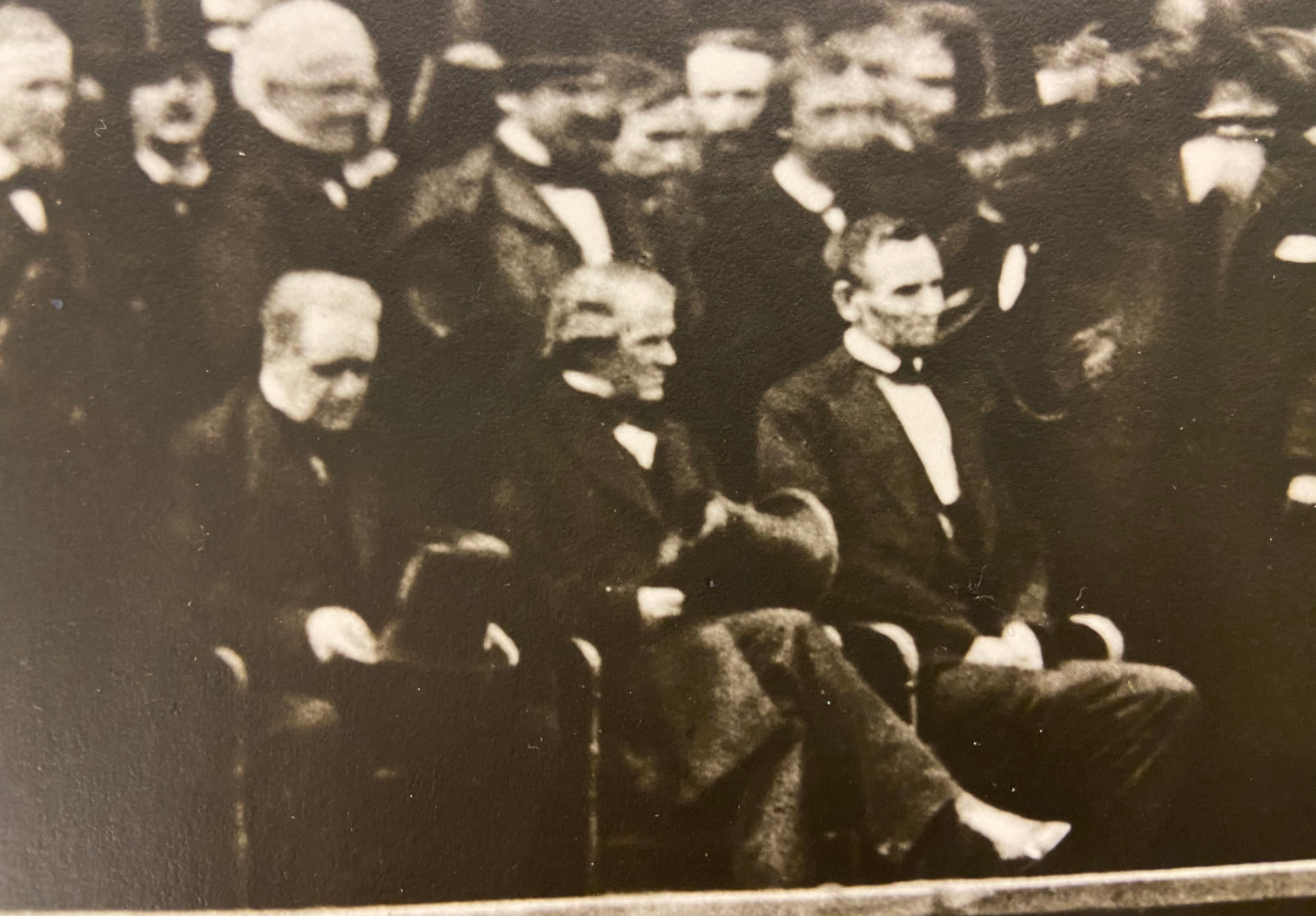
Yet there are a few other images of Lincoln’s second inauguration. Gardner attempted a series of photographs showing Lincoln seated at the front of the platform. The most successful attempt was the following, which shows the President seated next to his Vice Presidents, Andrew Johnson and Hannibal Hamlin.

This image probably does the best job of capturing Lincoln clearly. We benefit from the fact that Gardner used a large-format camera and wet plate photography, which results in incredible detail when done correctly. In many of Gardner’s images, even those where Lincoln is out of focus or blurred, members of the audience come through very clearly.

Among the crowded audience who gathered about the Capitol steps to hear Lincoln’s now-immortal words was the 26-year-old actor John Wilkes Booth. In a little over a month from when these photographs were taken, Booth would assassinate Lincoln at Ford’s Theatre.

John Wilkes Booth’s attendance at the Capitol during Lincoln’s second inauguration is referenced by the assassin himself. A little over a month later, Booth visited with an actor friend in New York named Samuel Knapp Chester. Booth had attempted to recruit Chester into his initial plot to abduct President Lincoln, but Chester had declined. On this visit, Booth convinced Chester that his plotting days were over. Still, Booth foreshadowed his true intent by saying to Chester, “What a splendid chance I had to kill the President on the 4th of March.” Booth clarified to Chester that he had received a “ticket to the stand on Inauguration day,” from his fiancée, Lucy Hale, the daughter of New Hampshire Senator John P. Hale. Booth was a celebrated actor who rubbed elbows with Washington elite. His presence on the stand at Lincoln’s inauguration would not have been odd in any way, especially if he had secured a ticket by way of a Senator’s daughter.

Combining the fact that John Wilkes Booth was present in the crowd at Abraham Lincoln’s second inauguration and the high level of detail afforded by Alexander Gardner’s photographs, the question becomes, “Can John Wilkes Booth be seen in any of the pictures of the event?”

In 1956, a 90-year-old photography historian and collector named Frederick Hill Meserve believed he had found the assassin amongst the audience. Using images of the inauguration from his private collection, he published his findings in the February 13, 1956, issue of Life Magazine. Meserve, as stated in the article, “spent 60 of his 90 years collecting photographs of the Civil War era” and devoted his entire life to searching for and cataloging all the images of Lincoln that existed. He had previously published his compendium of Lincoln images with author Carl Sandburg in 1944. The image Meserve used in his identification of Booth in the crowd was not one of the ones he had published earlier. Instead, it was one of the lesser-known photographs of the second inauguration that was not widely known because the figure of Lincoln appears to have been accidentally obliterated by a thumbprint during the development process of the original plate. Here is the image:

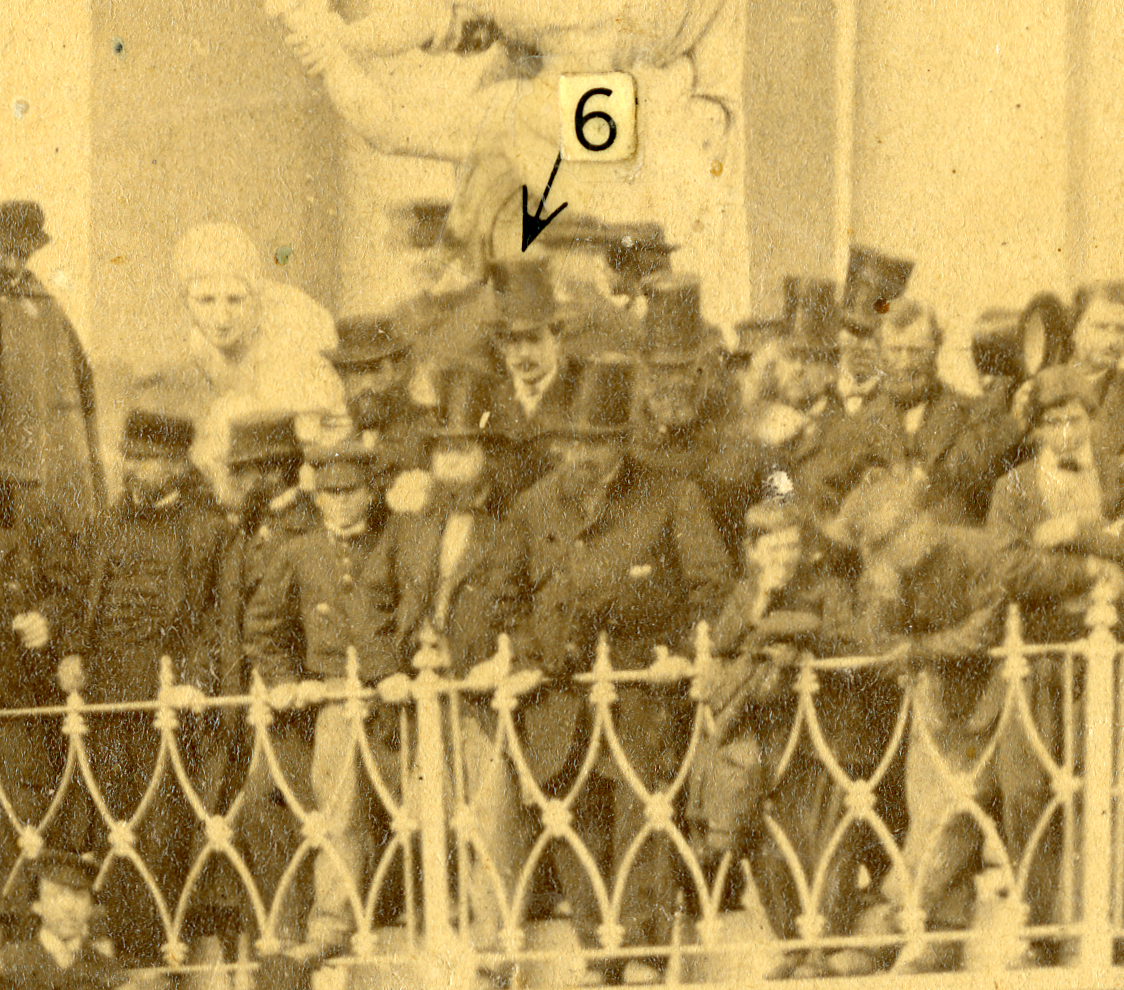
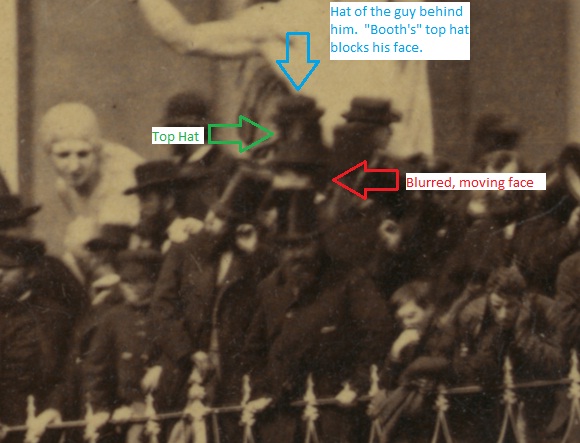
Meserve pointed out one of the figures, located on the platform above the President, wearing a top hat and a mustache:

In Meserve’s opinion, this figure was John Wilkes Booth. This was an intriguing idea from one of the country’s foremost experts on Lincoln photography. The figure does bear some resemblance to the actor-turned-assassin. But in the case of this particular image, the level of detail we need is still not quite there. I will also point out that Meserve went beyond identifying Booth in his Life Magazine article. He also identified Mary Todd Lincoln, Vice President Andrew Johnson, Lincoln’s friend and sometimes bodyguard Ward Hill Lamon, theater owner John T. Ford, and conspirator Lewis Powell. While I agree with his identification of Johnson and Lamon, these other identifications are far more questionable. For example, there is no evidence to support the idea that Lewis Powell was in D.C. at the time of the inauguration. While part of Booth’s plot by this time, he was residing in a boardinghouse in Baltimore, and we have no statement that places him amongst the crowd. The figure Meserve points to as Powell looks a fair deal like him, but he is not featured near Booth. Instead, Meserve points to one of the figures against the wall below Lincoln as possibly being the future attempted assassin of Secretary of State William Seward.

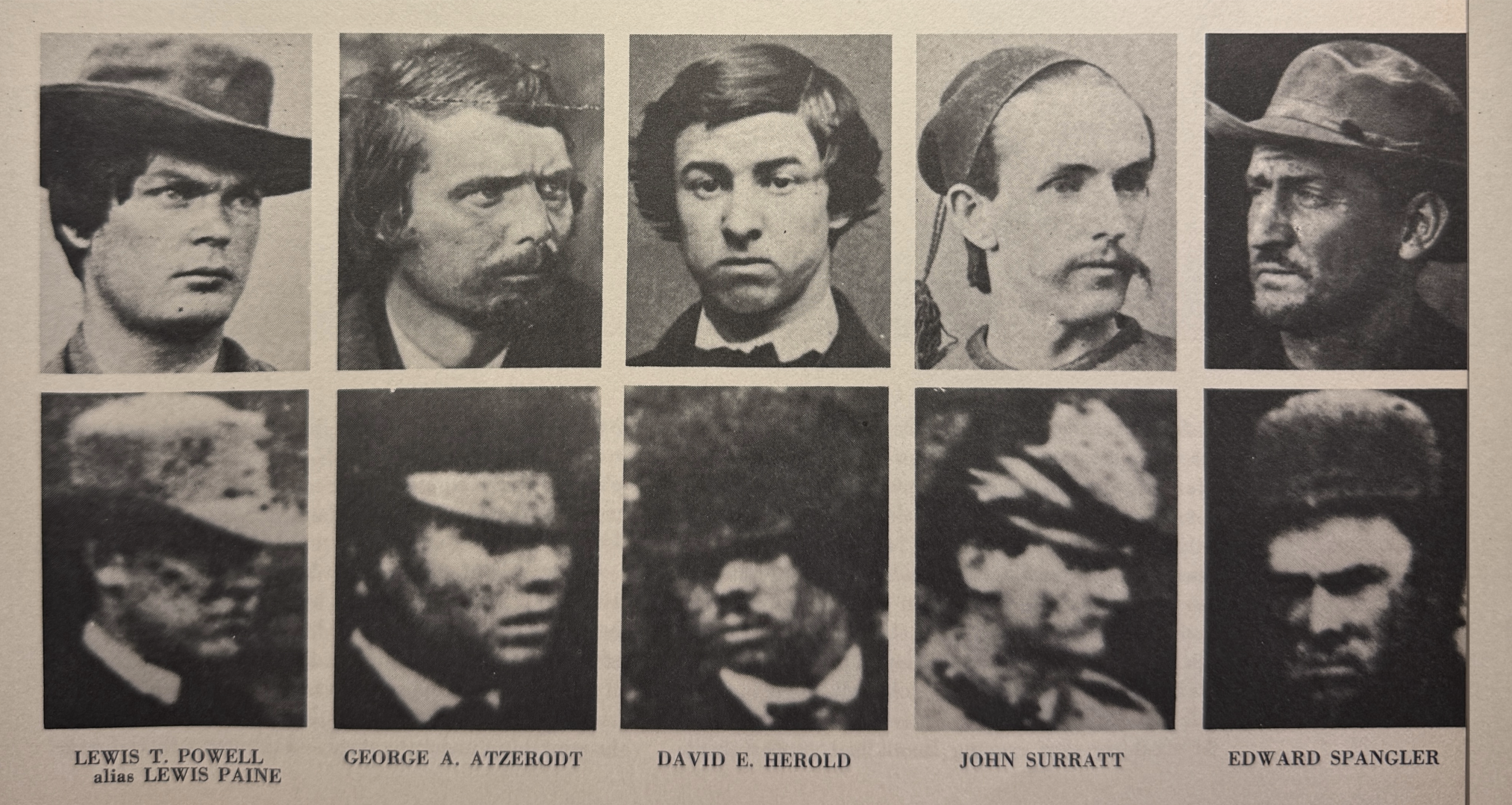
Frederick Meserve died in 1962. Three years later, his daughter. Dorothy Meserve Kunhardt (author of the children’s book Pat the Bunny), released a coffee table-sized book with her husband, Philip, called Twenty Days: A Narrative in Text and Pictures of the Assassination of Abraham Lincoln and the Twenty Days and Nights That Followed… The book utilized her father’s vast photography collection to tell the story of Lincoln’s death through images. In the book, she actually went a bit farther than her father when it came to identifying Booth and Powell at Lincoln’s second inauguration. Dorothy Kunhardt claimed to have identified several other members of Booth’s conspirators among the faces underneath the platform.

While intriguing, Kunhardt’s identification of the conspirators comes without evidence. Aside from Booth, we have no evidence that any of the other conspirators attended Lincoln’s inauguration. Historian Michael Kauffman points out in his book American Brutus that George Atzerodt had spent the previous night in Southern Maryland rowing across the Potomac, making it highly unlikely he would have been in D.C. at the time. Plus, in all the confessions Atzerodt later gave documenting the movements of his fellow conspirators, he never mentioned any of them being at the Capitol on this day. The same applies to John Surratt, who never mentioned witnessing the inauguration, despite later giving speeches about his involvement in Booth’s plot. In addition, most historians today consider Ford’s Theatre stagehand Edman Spangler innocent of any knowledge of Booth’s plot, making his inclusion in this supposed rogue’s gallery grouping fairly preposterous.

In the case of the conspirators, it appears that Meserve and Kunhardt were engaging in a bit of wishful thinking in their identifications. But what about the lead assassin? As we have seen, Booth acknowledged he was present for the event and was supposedly so close to Lincoln that he might have been able to kill the president if he had attempted the act. The figure Frederick Meserve pointed to is a possibility, but the detail is lacking.

Luckily, the image used by Meserve in his article is not the only one that appears to show this same figure. There is another Gardner photograph of the inauguration, one that is very similar to the most famous image of the event, but the focal point is off a bit so that Lincoln appears even blurrier.

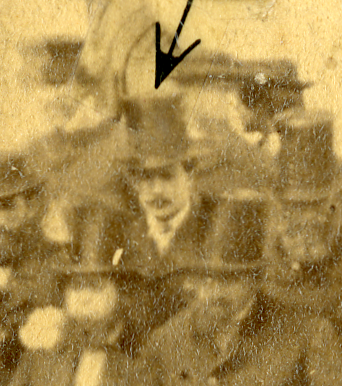
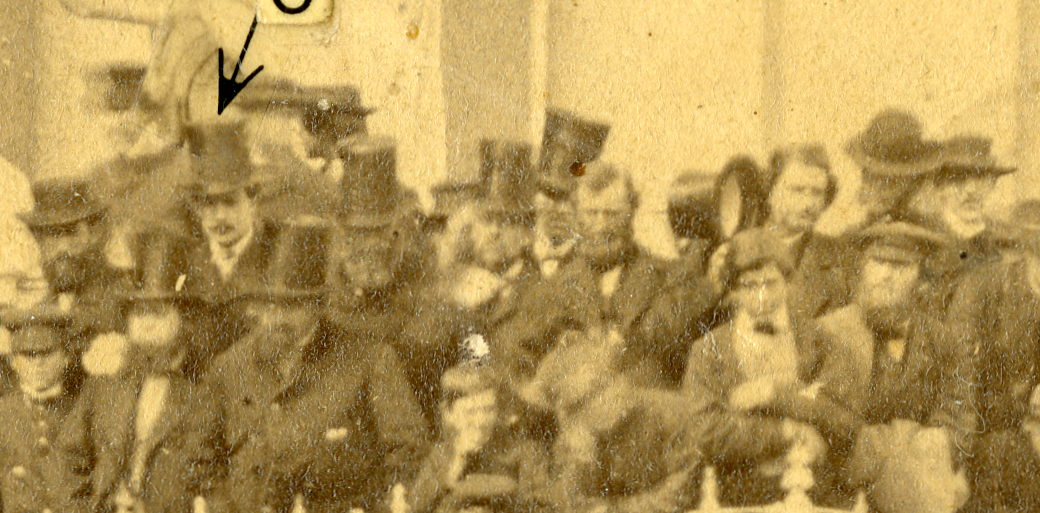
While this makes for a poor image of Lincoln, the focus does give us a clearer image of the man just above Lincoln, whom Frederick Meserve identified as Booth:

This image still isn’t perfect, but it does give us more detail. There are certainly similarities between this man and the dapper, ivory-skinned, mustachioed actor who would later assassinate the President. In truth, it’s impossible to truly verify this man as Booth, but many have accepted Meserve’s identification. The textual evidence supports that John Wilkes Booth was there, and I am personally inclined to believe the basic resemblance in Meserve’s identification makes it possible that this could be John Wilkes Booth.

While many people have become aware of Booth’s possible inclusion in images of Abraham Lincoln’s second inaugural, most are unaware that multiple images of the event were taken and that there are differences between them. As a result, many look at the most famous image of the inauguration searching for Booth in the crowd. However, in the most prolific image of the inauguration, the one that begins this article, the man Meserved identified as Booth cannot be seen clearly. The figure is partially obscured by the gentlemen in front of him straining to hear. Only the figure’s hat and the top of his head are visible.

Since the “Booth” figure cannot be readily seen in the most famous image of the inauguration, many sources have selected a different man entirely and highlighted him as Booth. The Ford’s Theatre museum was once guilty of this. For several years, they had a large wall display of Lincoln’s second inauguration and included this inset:

The man they highlighted as Booth is not the same man we have seen in the other photos as being Booth. We know this because in the clearest picture of Meserve’s “Booth” the same man can be seen further down the line.

In my opinion, this figure bears even less resemblance to John Wilkes Booth than Meserve’s figure. This man has longer hair and appears to have a goatee or additional facial hair beyond Booth’s signature mustache. It also seems unlikely to me that Booth would have removed his hat during the proceedings. John Wilkes Booth was stylish and vain, retaining his fashion above all. While others might choose to remove their hats to perhaps better hear Lincoln’s words, such effort does not seem likely for the man who would soon kill him. Yet, it is this figure who is easily visible in the famous image of Lincoln’s second inauguration, who is highlighted on the Wikipedia page for John Wilkes Booth (and many other places online) as showing the future assassin eyeing his target. But you won’t see that insert at the Ford’s Theatre museum anymore. To their credit, they identified that there wasn’t any evidence to support the hatless man as Booth and changed their display. I only wish I could get them to do the same regarding the incorrect knife they have on display as Booth’s.

I hope that this post outlines the misconceptions about John Wilkes Booth at Lincoln’s second inauguration. We know he was there and witnessed the event. There is no guarantee that he is present in any of the inaugural photos, however. The identification made by Frederick Hill Meserve is a theory, like anything else. In my eyes, it is a decent one. The man Meserve says is Booth looks like Booth to me. I wouldn’t bet my life on it, but it’s a harmless enough theory to support.

References:
Frederick Hill Meserve’s original identification of Booth in Life magazine
Twenty Days by Dorothy Meserve Kunhardt and Philip B. Kunhardt, Jr.
The Photographs of Abraham Lincoln by Frederick Hill Meserve and Carl Sandburg

Categories: History | Tags: , , , , | 46 Comments

Blog at WordPress.com.