
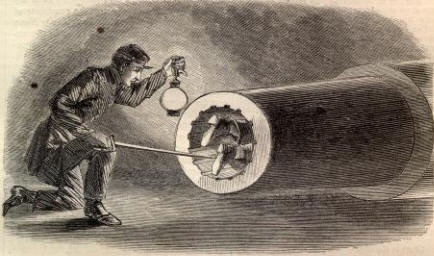
This engraving from Harper’s Weekly shows a fanciful depiction of Dr. Mudd’s real life escape attempt from Fort Jefferson, Dry Tortugas.
When the sentences came in for the Lincoln assassination conspirators, Samuel Arnold, Michael O’Laughlen, Edman Spangler, and Dr. Samuel Mudd all received imprisonment. Arnold and O’Laughlen were given life sentences for their involvement in plotting the kidnapping of the late President with John Wilkes Booth. Though the kidnapping never occurred, the law of conspiracy made them accountable for when the plot turned to assassination. Ned Spangler received a comparatively light sentence of 6 years for essentially being an acquaintance of Booth’s and helping to hold his horse. Dr. Mudd was also given a life sentence for aiding Booth during his escape by fixing his leg and for lying to investigators about his previous relationship with him. The four were shipped to Fort Jefferson, an isolated fort located on the Dry Tortugas islands off the coast of Florida, to carry out their terms.
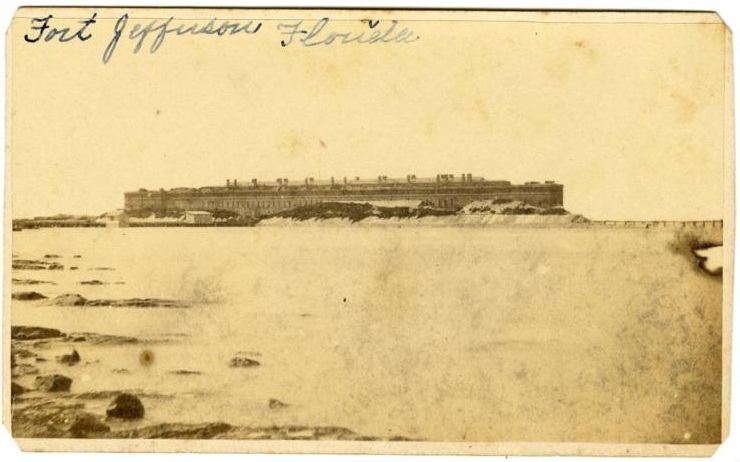
Fort Jefferson CDV
The conspirators were not prepared for prison life at Fort Jefferson, Dry Tortugas. The living conditions were harsh. Disease ran rampant with scurvy, dysentery, bone fever, diarrhea and other chronic problems being common among the inmates and guards. While Dr. Mudd and the other conspirators were treated as equally as the other prisoners upon their initial arrival, the pitiable conditions and rotting food was too much for the Maryland doctor. The real straw that broke the camel’s back, however, was the upcoming change of personnel on the Fort. From the conspirators’ arrival in July until near the end of September, they were commanded over by the 110th and the 161st N. Y. Volunteers. Come September, the 161st N. Y. was being relieved by the 82nd U.S. Colored Infantry. Dr. Mudd was a former slave owner and held racial views that were a product of that. Further, as a conspirator in the Great Emancipator’s death, Dr. Mudd also feared retribution or mistreatment by the incoming soldiers. These factors, along with his being away from his family and the amenities of home, drove Dr. Mudd to orchestrate his escape from the his island prison.
In the brief two months the conspirators had been there, “thirty or forty” other prisoners successfully escaped according to Dr. Mudd’s writings. Most found freedom by hiding themselves on the steamer ships that brought supplies to the island. One steamer known to Mudd, the Thomas A. Scott, had previously visited the island and left with eight prisoners secreted upon it. To Mudd, this ship seemed to be the best method of escape.
The good doctor was clever to avoid any suspicion prior to engaging his plans. He did not tell anyone, not even his fellow conspirators, of his idea. Moreover, knowing that all of his mail was read by his captors before being transmitted, Dr. Mudd openly denounced the idea of escaping in a letter he sent to his wife just a couple weeks before he made the attempt:
“I have had several opportunities to make my escape, but knowing, or believing, it would show guilt, I have resolved to remain peaceable and quiet, and allow the Government the full exercise of its power, justice and clemency. Should I take French leave, it would amount to expatriation, which I don’t feel disposed to do at present.”
In preparation, Dr. Mudd made friends with a crew member on the Thomas A. Scott, Henry Kelly. Kelly was a young man of about 18 and, with the assumed promise of payment for his assistance, he agreed to help hide and care for Dr. Mudd during his escape. With an inside man aboard, Dr. Mudd’s plan was set.
Since Fort Jefferson was such an isolated prison, the inmates were granted greater liberties of freedom than would be found at other penitentiaries. When not tending to their assigned duties (at that time Mudd was a nurse in the prison hospital), the prisoners were allowed almost complete access to the island. They were expected to sleep within the walls of the fort, but they did not have a “bed check” as prisoners today would have. The only time considerable attention was given to prisoners exiting the fort, was on days when a ship was departing the island. On those days it was forbidden to leave the grounds of the fort until the ship had left.
Therefore, on the day before the Thos. A. Scott’s arrival, Dr. Mudd freely left the confines of the fort in the evening and slept outside of it, in a shed. The next morning, September 25th, he changed his clothing from prisoner garb into one of the suits he had brought with him. He then took advantage of the hustle and bustle of the crew removing supplies from the Scott and slipped his way down into the lower hold of the ship near the coal bunkers. Here he hid himself, under a platform between two cross beams.
Unfortunately for Dr. Mudd, he was too well known to the officers of the prison. Had he been a lowly thief or murderer, he may not have been recognized by the military storekeeper of the fort, a Mr. Jackson, who was overseeing the removal of supplies. As a Lincoln conspirator though, Mudd lacked the anonymity of a common criminal. Mr. Jackson immediately reported to the post commander that Dr. Mudd, “had gone below and had not come up again.”
A short search was then conducted aboard the Scott. While Dr. Mudd’s own accounts lack the details of his discovery, several newspaper articles reported that he was found after an officer was, “running his saber under an old box in the coal bunker” when “the cold steel coming into contact with the latter end of Dr. Mudd, made him cry out and come out.”
Dr. Mudd was immediately re-arrested and interrogated. A quick search was made on the Fort to locate O’Laughlen, Arnold and Spangler, but all three were found inside the walls and ignorant of Dr. Mudd’s actions. Upon the threat of being shot, Dr. Mudd informed on his would be confederate, Henry Kelly. Kelly was arrested and imprisoned as the Thomas A. Scott departed the island. According to Dr. Mudd, “they were so much rejoiced at finding me, they did not care to look much farther; the consequence was, the boat went off and carried away four other prisoners, who no doubt will make good their escape.”
In his own words, Dr. Mudd explained the punishments he faced for his actions: “For attempting to make my escape, I was put in the guard-house, with chains on hands and feet, and closely confined for two days. An order then came from the Major for me to be put to hard labor, wheeling sand. I was placed under a boss, who put me to cleaning old bricks. I worked hard all day, and came very near finishing one brick. The order also directs the Provost Marshal to have me closely confined on the arrival of every steamer and until she departs.”
Dr. Mudd wrote a letter to the commanding officer of the fort apologizing for his attempt to escape. While in this note he stated that, “before I was detected I had made up my mind to return if I could do so without being observed by the guards,” it is more likely that he was angry at failing in his attempt. In an October 18th letter to his wife, Dr. Mudd expressed his true feelings on the matter: “Do not view my act with dishonor. I am a prisoner under guard, not under a parole, and under no obligations to remain if I can successfully evade and free myself.”
One item that Dr. Mudd did seem to feel guilty about was his betrayal of Henry Kelly. In his note to the commander he took full responsibility for the attempt and stated that, while Kelly had promised to help him escape, he actually took no part in it. This did not seem to help Kelly’s case as he was being held just like Dr. Mudd until the commander figured out what to do with him. As a civilian, Kelly could have been transferred to the authorities in nearby Key West, or, as some newspapers reported, he could be forced to endure imprisonment right there in Fort Jefferson. While the commander of the Fort was waiting on instructions for Henry Kelly, he was briefly imprisoned with Mudd in the guardhouse. During that time, Kelly forgave Mudd for informing on him, and stated that the commander was “a fool to think they could hold him upon this island.” How true this would prove to be. Five days after Mudd’s escape attempt, Kelly was imprisoned in “the dungeon” with a thief named Smith. Though both were clad in wrist and ankle chains, the pair managed an exciting escape. Somehow Kelly and Smith freed themselves from their chains and broke out of the iron grated window in their cell. They then lowered themselves down by using the same chains. From there they robbed the civilian merchant on the island of $50, some clothing, and enough canned fruits and meats to last their journey. With supplies in tow, they stole a boat and made their escape onto the water. Dr. Mudd reflected, “The authorities are no doubt much disappointed and chagrined at this unexpected occurrence. I feel much relieved.”
While other prisoners would continue to make their escape from Fort Jefferson, Dr. Mudd never attempted to do so again. On October 18th, Dr. Mudd and the other Lincoln conspirators found themselves placed into “the dungeon” that Kelly had escaped from. The military had picked up on a rumor that a plot was being formed to free the conspirators. While the rumor had no substance, it still led to the men being confined to the most secure part of the fort. The living conditions for the men worsened considerably there, and they were not relieved of the squalor until the end of January, 1866. After that experience, it appears Dr. Mudd accepted the impossibility of his successful escape. While he still longed for home, he would not risk the punishment for another failed attempt. Moreover, he accepted his connection to the three other men that were imprisoned with him. Though they were strangers to him prior to the trial, they now shared the same fate, good or bad. For his own sake, and for theirs, Dr. Mudd would never try to escape again.
References:
The Assassin’s Doctor by Robert K. Summers
Mr. Summers’ book is the book on Dr. Mudd. He also runs the best website on Dr. Mudd. His book was the prime source for information on the doctor’s escape.
Mudd, N. (1906). The Life of Dr. Samuel A. Mudd. Washington: Neale Publishing Company.
(1865, October 9). Details of Dr. Mudd’s Attempted Escape. New York Herald-Tribune.
(1865, October 12). Attempted Escape of Dr. Mudd. Providence Evening Press.
More thanks go to Robert K. Summers. In addition to his wonderful book and unparalleled Mudd website, Mr. Summers visited the National Archives on the author’s behalf looking for more information about Mudd’s escape.















 LincolnConspirators.com
Recent Comments