Davy Herold on Alphas

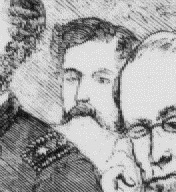
In addition to my interest in history, I am also a bit of a nerd in other, more traditional ways (shocking, I know).  Specifically, I’m a fan of several science fiction shows.  Today, I was catching up on a few episodes of the SyFy television show Alphas.  For non-nerds, Alphas is a TV show about people who have superhuman abilities.  It’s essentially X-Men but with more realistic and believable abilities.  Recently, the good Alphas have been trying to track and capture the leader of the bad Alphas.  He is a man by the name of Stanton Parish.  His Alpha ability is perfect control of his brain which manifests in his ability to slow down his aging process and heal his body.  The team was able to find images of him dating back to the Civil War and how old he really is has yet to be determined:

Alphas’ “Stanton Parish”

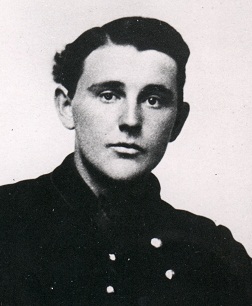
While watching it today, there was a second when the leader of the good Alphas, Dr. Rosen, was flipping through his materials on Stanton Parish.  There was a quick shot of an image that looked strangely familiar.  I rewound the video (you got to love the “On Demand” feature), and paused it.  I could see then that the producers of the show had taken the head of the Stanton Parish character and had Photoshopped it onto the body of the Lincoln assassination conspirator, David Herold:

Alphas’ “Stanton Parish” on David Herold’s body. The untouched photo of Davy is included for comparison.

I had a good chuckle over this strange cameo appearance by Davy Herold.  References to the assassination can be found in the most unlikeliest of places.

Categories: Uncategorized | Tags: , | 2 Comments

Nettie Mudd on the Airwaves

Nettie Mudd Monroe From Robert Summers' Dr. Samuel A. Mudd Research Site

Nettie Mudd Monroe From Robert Summers’ Dr. Samuel A. Mudd Research Site

In 1938, at the age of sixty, Dr. Mudd’s youngest daughter Mary Eleanor, better known as “Nettie” made a special vocal appearance during the intermission of Lux Radio’s production of The Prisoner of Shark Island:

The Prisoner of Shark Island radio drama was based off of the 1936 film of the same name starring Warner Baxter.  The film and radio shows are highly fictionalized versions of Dr. Mudd’s involvement in Lincoln’s assassination and life imprisoned on Fort Jefferson, Dry Tortugas.  In these highly popular renditions, Dr. Mudd is portrayed as a completely innocent country doctor who knew nothing of the men who stopped at his house during the early morning hours of April 15th, 1865.  While wholly inaccurate, these revisions to history and the efforts of Mudd descendants like Nettie and Dr. Richard Dyer Mudd helped to turn public sympathy to Dr. Mudd’s favor.  To this day, historians still have to compete with this inaccurate “legend of Dr. Mudd” when trying to accurately explain Dr. Mudd’s relationship to John Wilkes Booth and the events that led to Lincoln’s death.

References:
Nettie Mudd from the Dr. Samuel A. Mudd Research Site

Categories: Uncategorized | Tags: , | 13 Comments

The Story of Pink Parker and his Booth Memorial

Former John Wilkes Booth Memorial in Troy, AL

“Joseph Pinkney Parker was born in Coffee County, Alabama in 1839. He had just finished as a student at Spring Hill Academy when the War broke out. He left immediately for the front, leaving behind him on a well-stocked plantation, his sister and the slaves which every well-to-do Alabaman possessed at that time. Four years later, he returned to find his farm overgrown with weeds, his stock and his slaves disappeared and his sister embittered by her treatment received at the hands of the Northern soldiers. The property was soon eaten up by taxes, so he took a position as a “walker” on the railroad tracks carrying with him maul and spikes to keep the tracks repaired.

He became a school teacher, but the parents of the children were too poor to pay the salary, or even to clothe the pupils properly. As years went on, he did regain some of his financial position and built for himself and his family a very comfortable home in Troy, just a block or two from the famous trace which Andrew Jackson used in his battles against the Indians in Florida.

Pink was a devout member of the Baptist Church. He never called his wife anything but “Darling” and taught his children to do the same. He became a police officer in the little town of Troy and a much-respected citizen. But he had one obsession which was so deeply instilled in him that he never was able to overcome it; a deep and lasting hate for the North, its people, and particularly for the man who was the sixteenth President of the United States ; a man so great that, today, Abraham Lincoln is revered in the South, together with the famous champion of the Lost Cause, Robert E. Lee.

As Pink Parker went on nursing his wrath from year to year, the North and the name of Lincoln would cause him to burst forth into the most impassioned flights of profanity which not merely astonished but shocked his friends. The pastor of the Baptist Church labored with him to stop these outbursts. But they continued and Pink was finally removed from the church rolls for his profanity. Rather ruefully, Pink remarked to a friend, “It wasn’t quite fair. I know all the deacons in that church and any one of them can cuss better than I can.”

Time went on and each succeeding April 15, Pink would make for himself a paper badge indicating that this date was the “Anniversary of the Death of Old Abe Lincoln.” Years passed, the idea came into his head that he would erect a monument to the memory of John Wilkes Booth. Apparently, he did not share this intention with anyone, so it was a surprise to the citizens of Troy when this monument, some four feet high, was erected in the yard of Pink’s home. His neighbors did not like the idea, but they did like Pink Parker. The strange thing about the erection of this monument is the fact that it was not erected until 1906, in spite of the fact that the newspapers of the 20’s stated that it had been erected by popular subscription by the citizens of Troy in 1866.

Pink Parker on April 15th, 1906 - The day he erected his monument to Booth.  Notice his paper badge celebrating the 41st anniversary of Lincoln's death.

Pink Parker on April 15th, 1906 – The day he erected his monument to Booth. Notice his paper badge celebrating the 41st anniversary of Lincoln’s death.

No one paid much attention to the monument. Automobiles were not as plentiful as they are today and traffic did not flow through Troy as it does now. Pink was pretty proud of his handiwork and he used to regale his grandsons with the story of his sending President Theodore Roosevelt a postcard inviting him to come and visit the monument. He further informed the President that while he couldn’t furnish a carriage for him, he would get him a dray hauled by a couple of mules.

When Pink’s grandsons would twit him on the fact that he might not be able to get along with the Yankees he found in Heaven, his eyes would twinkle and he would say, “Well, I don’t suppose I will find enough up there to bother me.”

When, in 1921, Mrs. C. D. Brooks, who at the time was the president of the Woman’s League of Republican Voters in Alabama, heard of this monument, her pride for the state of Alabama was so strong that she began immediately to have the monument destroyed. Mrs. Brooks received letters from all over the country supporting her stand. One of the most interesting letters which came to her was dated June 8, 1921, El Paso, Texas, from Alexander Donald McEvoy, who states that “in the year 1879, I met Booth in Buenos Aires, Argentine Republic.” That letter would have pleased Pink Parker, for he always maintained that Booth was not the man whom Boston Corbett shot.

But three or four years prior to 1921, some boys pulled down the monument for a Hallowe’en stunt. No one had ever bothered to replace it. In 1922 after the death of Mr. Parker in December, 1921, his sons had the stone taken out to the monument works where the scars made by souvenir hunters were removed, together with the legend concerning John Wilkes Booth. The monument was then re-set as a memorial to Joseph Pinkney Parker.”

Pink Parker’s re-etched gravestone.

The preceding came from the 1951 booklet entitled, A Monument to the Memory of John Wilkes Booth. The author gained his information from two of Pink Parker’s grandsons.

References:
A Monument to the Memory of John Wilkes Booth by Stewart W. McClelland (1951)

Categories: Uncategorized | Tags: , , | 9 Comments

JWB and Grover Cleveland: Drunks

The night of Tuesday September 17th, 1895 proved to be a busy (and historic) one for the Chicago police department:

Let the romps of “J. Wilkes Booth” and “G. Cleveland” be a lesson to us all – no matter how dead or distinguished you might be, there’s no controlling how the “spirits” might move you.

References:
The Daily Inter Ocean – Sept. 19, 1895
The steamer that “J. Wilkes Booth” was the cook for, “The City of Traverse”, spent its twilight years as an illegal gambling ship.

Categories: Uncategorized | Tags: , | 1 Comment

At Lincoln’s Deathbed

When the unconscious form of Abraham Lincoln was brought out of Ford’s Theatre onto Tenth St., the men carrying the President were unsure of their destination.  The street was chaotic and getting crowded with countless individuals having been drawn to Ford’s doors after hearing the dreadful news being shouted through the streets.  Many would later claim to have been one of the men who transported the Great Emancipator’s frame out of Ford’s and onto the street.  So many in fact, that he only way all of the accounts could be true is if Abraham Lincoln was “crowd surfed” away from the theatre.  The commotion of the citizens and soldiers on Tenth street startled a young boarder across the way named Henry Safford.  Having spent the previous night doing his part, “with the rest of the multitude in the celebration of Lee’s surrender,” Safford was preparing for a restful evening in his rented room on the second floor of the Petersen house.  He threw open the window and called to the crowd of former Ford’s audience members, inquiring about what had occurred.  Their reply of, “The President’s been shot,” startled the 25 year-old man.  Safford was soon down at the door of the house, watching the crowd and keeping a close eye on Ford’s entrance for signs of a wounded, or dead, President.  When the soldiers carrying Lincoln finally emerged, Safford, noticing their lack of a set destination called out, “Bring him in here!”  Lincoln’s body was transferred inside of the Petersen house, and Safford led the troops into a back bedroom on the first floor.  Though Safford would have been more than happy to surrender his own bed and room for the President, climbing another set of stairs to the second floor would have been too inconvenient.  Safford, and other boarders in the Petersen house, would spend the night assisting the doctors by providing hot water and mustard plasters.

Henry Safford

Abraham Lincoln died in the Petersen House at around 7:22 am on Saturday, April 15th.  With his death, a martyr and a shrine were born.  On Sunday morning, 24 hours after Lincoln’s death, an artist by the name of Albert Berghaus arrived in Washington. Berghaus was an illustrator for Frank Leslie’s Illustrated Newspaper and specialized in created sketches of historical events from eyewitnesses.  These sketches would be transformed into woodcuts and then published.  Berghaus created this sketch of the events at Ford’s Theatre:

Albert Berghaus’ sketch of the events at Ford’s Theatre

In addition, Berghaus visited the Petersen House in hopes of sketching the room and scene of Lincoln’s demise.  He employed the help of Petersen’s boarders to describe the individuals who were present in Lincoln’s final moments.  His final sketch which was published in the April 29th issue of Frank Leslie’s Illustrated Newspaper was this:

“The Dying Moments of President Lincoln” by Albert Berghaus

The drawing was combined with the following affidavit:

“We the undersigned inmates of 453 Tenth street, Washington, D.C., the house in which President Lincoln died and being present at his death, do hereby certify that the sketches of Mr. Albert Berghaus are correct.

Henry Ulke
Julius Ulke
W. Peterson [sic]
W. Clarke [sic]
Thomas Proctor
H. S. Saffard [sic]”

In recognition for their help in helping him create the sketch as accurately as possible, Berhaus included five out of the six above named men in his drawing:

Julius and Henry Ulke – Brothers, photographers, and natural history buffs. It was said the Ulke’s room in the Petersen house would have been unfit for the President as there were too many beetle specimens and scientific instruments cluttering up the space.

William Petersen – German tailor and owner of the house. It was written that Petersen was a great admirer of Andrew Johnson due to the fact that he had been a tailor himself who rose to such a high position in life.

Thomas Proctor – A 17 year-old clerk for the War department.

Henry Safford – 25 year-old War department clerk. According to one source, when Edwin Stanton requested a man trained in short hand to take down statements, Safford recommended a nearby neighbor Corporal James Tanner.

The only member of the Petersen household not illustrated by Berghaus was William Clark, a 23 year-old clerk in the Quartermaster’s department.  This will come into play later.

Countless other artists, period and modern, would draw their own interpretations on Lincoln’s death chamber.  Every drawing, including Berghaus’, would place too many people in the small room.  The 17’ by 9 ½’ back bedroom of the Petersen house has been coined the “rubber room” due to its ability to expand and contain so many people all at the same time.  While Berghaus’ drawing was cited by the Petersen house residents as being the most accurate – mainly due to Berghaus’ level of detail in duplicating the details in the room – Henry Safford was honest about the rubbery-ness in the drawing: “Not all of the noted men pictured were present at the time, but had been within a few hours of the death of Lincoln.”

Fast-forward fifty-six years.  In 1921, the only remaining Petersen house resident was Thomas Proctor.

Old Thomas Proctor

Proctor had moved from Washington, D.C. and had established himself as a prominent lawyer in New York.  He married, was widowed, and in the early 1900’s began a gradual mental decline.  By 1915, he had lost all of his money and had become an inmate of New York’s Blackwell’s Island, a prison and poorhouse.  Still, some of his old friends and acquaintances remembered the stories he would tell of Lincoln’s last night.  On Friday, September 30th, 1921, Thomas Proctor was visited by a reporter from the Associated Press.  They spoke of his experiences half a century before.  The next day, a news article was published across the nation:

Apparently the poor pauper Thomas Proctor was the gracious man who gave up his bed for the dying President.  After reading this story, another living witness to the events of the Petersen house was intrigued.  Dr. Charles Leale, the young army surgeon who first tended to the wounded President, arranged a visit with Mr. Proctor:

As this article demonstrates, Thomas Proctor’s mental state is not what it once was.  Dr. Leale, though older than Thomas Proctor, must have observed the fragile mind of the man he conversed with.  This visit was obviously short, and consisted of Dr. Leale leaving with little in the way of reminiscences.

This news regarding Thomas Proctor as the tenant of the bed in which Lincoln died, was the start of a controversy that stretched nationwide.  At first, some papers tried to completely blow off Proctor, stating that his whole story was the invention of a troubled mind.  Then, when Berghaus’ engraving came forward as evidence to Proctor’s attendance in the Petersen house, many papers declared him vindicated.  Still the debate continued, with two other individuals claiming to have been the occupant of the bed in which Lincoln died.  The most convincing of these claimants was the late William Clark, whose face is not included in the Berghaus engraving but whose name accompanies the affidavit attached to it. Though Clark had died in 1888, his friends wrote to the newspapers about how he was the rightful occupant of the bed and room in which Lincoln died.   Suddenly, 56 yeasr after the fact, there were two legitimate groups vying for the honor of knowing the man who gave up his bed for Lincoln.  The friends of Thomas Proctor used Bergahus’ engraving as evidence, while the friends of William Clark used a letter written by Clark a few days after the assassination as their evidence:

“…The same mattress is on my bed and the same coverlid covers me nightly that covered him while dying…”

The correct answer, as many reading this already know, is that the room and bed in which Lincoln died belonged to William Clark.  The debate that surrounded Thomas Proctor was probably not his own doing.  As we can see from his interview with Leale, Proctor needed to be led in even basic conversation.  The memory of his friends were mistaken that Proctor owned the bed in which the President died and therefore led the practically senile man to that conclusion.  In support of this hypothesis is an 1899 article written about Proctor in which he correctly admits that the room and bed in which Lincoln died belonged to Clark.  In fact, through his own 1899 article and an 1895 article written by Henry Safford, we learn that Thomas Proctor and Henry Safford were roommates in the Petersen’s second floor apartment.  Proctor was there and helped attend to the President, but the honor of the death room belonged to William Clark.

Yet the question remains, why is it that Proctor and all the other members of the Petersen house are included in Berghaus’ sketch, and yet William Clark, the tenant of the sacred room is not?  Berghaus sketched all of Clark’s belongings in the room with such detail, and yet the man who lived there was not included.  In Clark’s letter to his sister, the same one in which he talks about sleeping in the bed where the President expired, he relates the following:

“I was engaged nearly all of Sunday with one of Frank Leslie’s special artists, aiding him in making a correct drawing of the last moments of Mr. Lincoln.  As I knew the position of every one present, he succeeded in executing a fine sketch which will appear in their paper the last of this week.  He intends from the same drawing to have some fine large steel engraving executed.  He also took a sketch of nearly every article in my room which will appear in their paper.  He wished to mention the names of all pictures in the room, particularly the photographs of yourself, Clara and Nannie, but I told him he must not do that as they were members of my family and I did not wish them to be made public.  He also urged me to give him my picture, or at least to allow him to take my sketch, but I could not see that either.”

William Clark

What is interesting here is that Clark seems to have been the only hold out in posing for the sketch.  To me, this seems odd.  Why wouldn’t Clark allow himself to be saved for posterity along with the others who aided the president in his final moments?  For one, Clark was not in his room when the President arrived.  After Clark’s passing, his family attempted to alter the record of his involvement.  They told Lincoln biographer Ida Tarbell, that it was William Clark who told the soldiers to bring Lincoln to the Petersen house.  This was incorrect, and Safford wrote as much to a newspaper after Tarbell’s biography was released.  What’s more, Safford included a letter written to him by Thomas Proctor when the latter was in perfect health and memory:

“Mr. Clark, as you know, of course, was not at the Petersen house – on the evening, or during the night, or any part of it, of Lincoln’s death.  To the best of my recollection he did not show up till the Sunday morning following.  I am positive, beyond a shadow of a doubt, that Mr. Clark was not in the Petersen house at any time during the period in which Lincoln or Lincoln’s body was there, unless he was hidden away somewhere below the first floor, where it would be very difficult for even a cat to secrete itself.”

Safford agrees with Proctor’s idea that Clark was never in the house when Lincoln was there.  The article ends with:

“Mr. Safford thinks that it is quite possible that Mr. Clark wrote letters home giving the impression that he was present at the time of the death.  In fact, he remembers that on Clark’s return to Washington from his visit, that he (Safford) showed Clark a letter which he had written to his relatives and that Clark said he liked it and believed that he would write about the same thing to his own people.  It is possible that he did this, and thus caused the misunderstanding.”

If we are to believe Henry Safford and the younger version Thomas Proctor, William Clark was not present at Lincoln’s death.  He did not return to the Petersen house until the morning hours of Sunday the 16th.  He arrived in time to hear the stories of what had occurred from the Ulkes, William Petersen, Safford and Proctor.  When Albert Berghaus arrived to sketch the room, Clark helped in detailing the many artifacts in his room.  However, when Berghaus sketched those who were present for the event, he did not sketch Clark.  In his letter to his family, Clark said this was by his choice but what if Berghaus chose not to sketch Clark because he knew Clark was not there when Lincoln died?  We are left with two views:

1. William Clark was the only honest man who boarded in the Petersen house with Henry Safford and Thomas Proctor spending years after his death trying to discredit him.  In addition, he must also have been the most humble man in the Petersen house since he was the only one to deny having his face saved for posterity in Berghaus’ sketch.

2. William Clark embellished his involvement in Lincoln’s death to include more than, “he died in my room and bed”.  He listened to the stories from those who were present and placed himself in the narrative.  When Albert Berghaus arrived at the house the day after Lincoln’s death, Clark told him the truth, that he was not there, and therefore was not included in the sketch.

I leave it to the reader to decide what view they feel is most likely.

Epilogue
In the end, the debate about whose bed Lincoln died in sort of puttered out.  The Sunday Herald did a wonderful job of getting to the facts and declared the old memory of Thomas Proctor to have been in error.  Some other newspapers kept up their support for the pauper who gave his bed for the President, but probably just for the headline.  In the end, the mistake was a blessing for the old and confused Thomas Proctor.  The attention that was drawn to his story and involvement in history led to an outpouring of sympathy for his living conditions.  Through the help of a Rev. Sydney Usher, Thomas Proctor was invited to relocate from the New York City poorhouse.  A month after his story first ran he found a new home at the St. Andrew’s Brotherhood Home in Gibsonia, PA.  According to a news article, “In his new home, the aged lawyer will be permitted to enjoy many comforts of which he has been deprived…”

Though Thomas Proctor did not rent the room or bed in which Lincoln died, he was a participant in the events that occurred in the Petersen house that night.  Along with the Ulke brothers and Henry Safford, Proctor helped the doctors in providing hot water and fulfilling other requests.  I have not yet been able to locate when Thomas Proctor died or where he is buried, but it can be assumed that he spent his last years enjoying charity and assistance similar to that he gave the President from those at the St. Andrew’s Brotherhood home.

Not only did Proctor’s mistaken story benefit himself, but it also was used as a seemingly effective advertising campaign for one creative insurance company:

References:
Many articles were consulted to form this post:
Henry Safford’s 1895 account
Thomas Proctor’s 1899 account
Henry Safford’s 1906 account dismissing Clark’s involvement
New York Times article supporting mistaken Thomas Proctor
Mistaken Petersen daughter stating Lincoln died in her bed
Using Safford’s material to reveal Proctor’s error
The Sunday Herald’s article conclusively proving William Clark owned the room and bed
Most images come from PictureHistory.com

Categories: Uncategorized | Tags: , , , , , , , | 9 Comments

The Tauberts of St. Paul’s

Yesterday, I graciously received the cemetery records of St. Paul’s cemetery from Sandy Harper, church historian of Martini Lutheran Church.  Through the collaborative research of Sandy and the many others who particpate in this site, we have dissected the previously held belief that conspirator George Atzerodt was secretly buried in St. Paul’s cemetery.  Here are the facts we have managed to establish together:

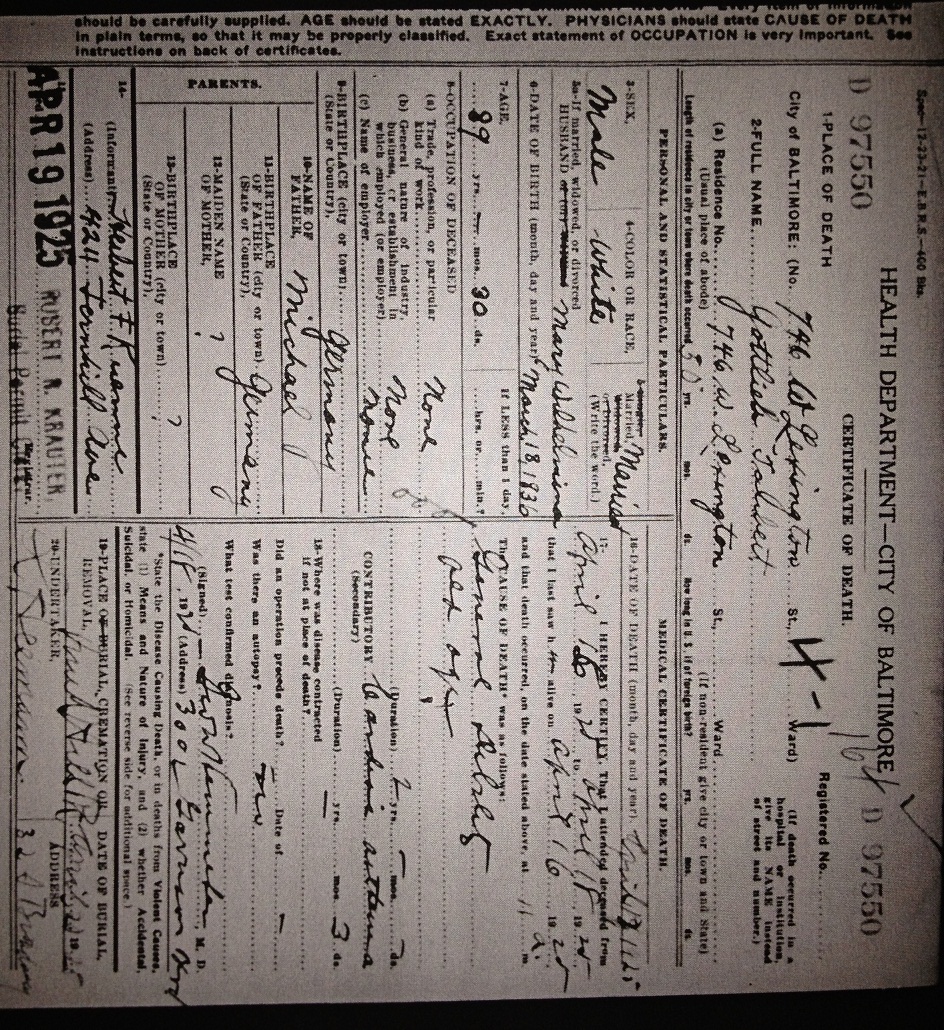
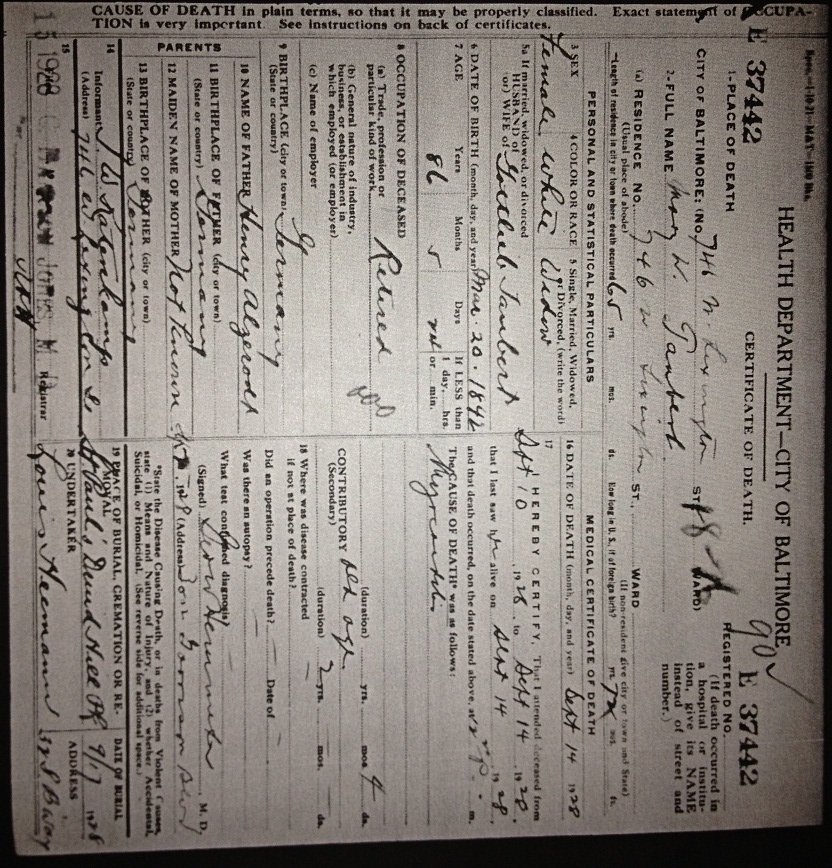
1.  Gottlieb Taubert was the brother-in-law of Geroge Atzerodt.  He married George’s sister, Marion “Mary” Atzerodt.  Gottlieb was a member of Martini Lutheran Church and purchased a plot at St. Paul’s and buried two young children there prior to 1869.

2.  Victoria Atzerodt, George’s mother was buried in the Taubert plot in 1886.

Victoria Atzerodt’s death record from Martini Lutheran Church

3.  Gottlieb Taubert died in 1925 and was buried in the lot.

Gottlieb Taubert’s death record from Martini Lutheran Church

Gottlieb Taubert’s death certificate

4.  Mary (Atzerodt) Taubert died in 1928 and was buried in the lot.

Mary (Atzerodt) Taubert death record from Martini Lutheran Church

Mary (Atzerodt) Taubert’s death certificate

The remaining burial in question was the one that occurred on February 19th, 1869.  It had been believed that George was secretly buried in the Taubert plot on this date.  However, through the insights of Ms. Harper and the church’s verifying records, we now know that the burial on this date was not of the 29 [30] year old brother-in-law of Gottlieb Taubert, but the 29 day old child of Gottlieb Taubert.  The dead child’s name was Freidrich Gottlieb Herman Taubert:

Friedrich Taubert’s death record from Martini Lutheran Church

From these records, I feel comfortable saying that there is no longer any credible evidence that George Atzerodt is buried in St. Paul’s Cemetery in Baltimore. While his mother and sister are buried there, the final resting place of George is still a mystery. The last records place him in a holding vault at Glenwood Cemetery. Hopefully continual research will be able to reveal his grave.

References:
We are all indebited to Sandy Harper for volunteering her knowledge and records about St. Paul’s.
Thank you to everyone who has participated in our conversations and added so many more details to George’s time at Glenwood.

Categories: Uncategorized | Tags: , , , , | 10 Comments

It was Stanton!

Don’t worry, I’m not going to try to convince you all that Secretary of War Edwin Stanton was behind Lincoln’s assassination.  Lincoln’s “Mars” was crucial in the hours after the President was shot in starting the investigation into his death.  The two men had a deep, profound respect for each other – a product of four years of war.  Nevertheless, some still believe that Stanton had a hand in Lincoln’s death.  Apparently even some of Stanton’s contemporaries suspected he was involved, too.  One person believed it so much, that he created the following:

I snapped this pictures out of an auction catalog with the following description:

It is interesting to think of the individual who painstakingly engraved the death of the conspirators on a plaque of ivory only to turn it into a platform for condemning the Secretary of War.

Categories: Uncategorized | Tags: , , | 8 Comments

Charles County Wanderings

While this post doesn’t contain much in the way of new material or research, I hope the following pictures of assassination related places and things are, nevertheless, enjoyable and informative.

After leaving Spangler’s grave, I continued my trek around Charles County, MD.  My next stop was Rich Hill, the home of Colonel Samuel Cox:

As you can see, Rich Hill is in delapidated condition. Neglect is taking a toll on this historic house.

From Rich Hill, I traveled down the road to the “Pine Thicket”:

Booth and Herold moved around in this pine thicket while Thomas Jones kept them hidden from federal troops. The first place Jones met the pair in the thicket was near an old hollowed out stump that was used as a point for the Confederate mail line. The Collis house was later built on this spot. I drove down the dead end street near these signs and visited the Collis house. Next door to the home I was previously shown to be the Collis house however, there is a house that also looks very similar to the engraving in Thomas Jones’ book:

So at this point I’m not sure where the real Collis house might be. Either way a small part of the pine thicket still exists, right across from the Bel Alton post office.

From here I decided to travel to Port Tobacco to see if I could sneak in a tour of the reconstructed Port Tobacco Courthouse. I passed this sign while heading there:

While the Courthouse building was open, there were many people setting up for a wedding reception so I quickly made my leave:

From Port Tobacco I took a non-Boothie stop to the Thomas Stone National Historic Site. Thomas Stone was a Maryland signer of the Declaration of Independence and his home, Habre-De-Venture, is a National Park. The property is quite beautiful and it was a wonderful day to go walking around their nature trail.

The Stone family cemetery with Habre-De-Venture in the background

I chatted with the NPS ranger in the Thomas Stone visitor’s center for awhile and learned that she was friends of the Wearmouths, authors of Charles County history books. The pair, John and Roberta, wrote many books including ones about Port Tobacco, Thomas Jones and collected abstracts from the Port Tobacco Times newspaper. They had previously run a small antique store out of their home called, “Stone’s Throw”. She called the Wearmouths and I was invited over to see one antique related to a place I had already visited that day. I traveled to the Wearmouth’s house (literally a stone’s throw from the National Park) and chatted briefly with John and Roberta about their books. I was then showed the antique I had heard about, a piece that had once belonged to Samuel Cox, Jr. and was once housed at Rich Hill:

China cabinet owned by Samuel Cox, Jr.

This large, oak, china cabinet with curved glass is circa 1895 and is from Baltimore or D.C. The piece was shipped to Bel Alton on the Baltimore and Potomac Rail Road. The back of the piece is stenciled “S. Cox Bel Alton” to assure correct delivery off of the train. The Wearmouths bought it from an antique dealer who had acquired it from a lady who lived a few doors down from Rich Hill.

After all this I was pretty tired, so my impromptu trip around Charles County, Maryland came to an end.

P.S. Apparently while I was off driving around, you all were visiting my blog.  Today was a record day with over 310 visitors! Thanks!

Categories: Uncategorized | Tags: , , , , | 3 Comments

Blog at WordPress.com.