John Wilkes Booth in the Woods: Part 5

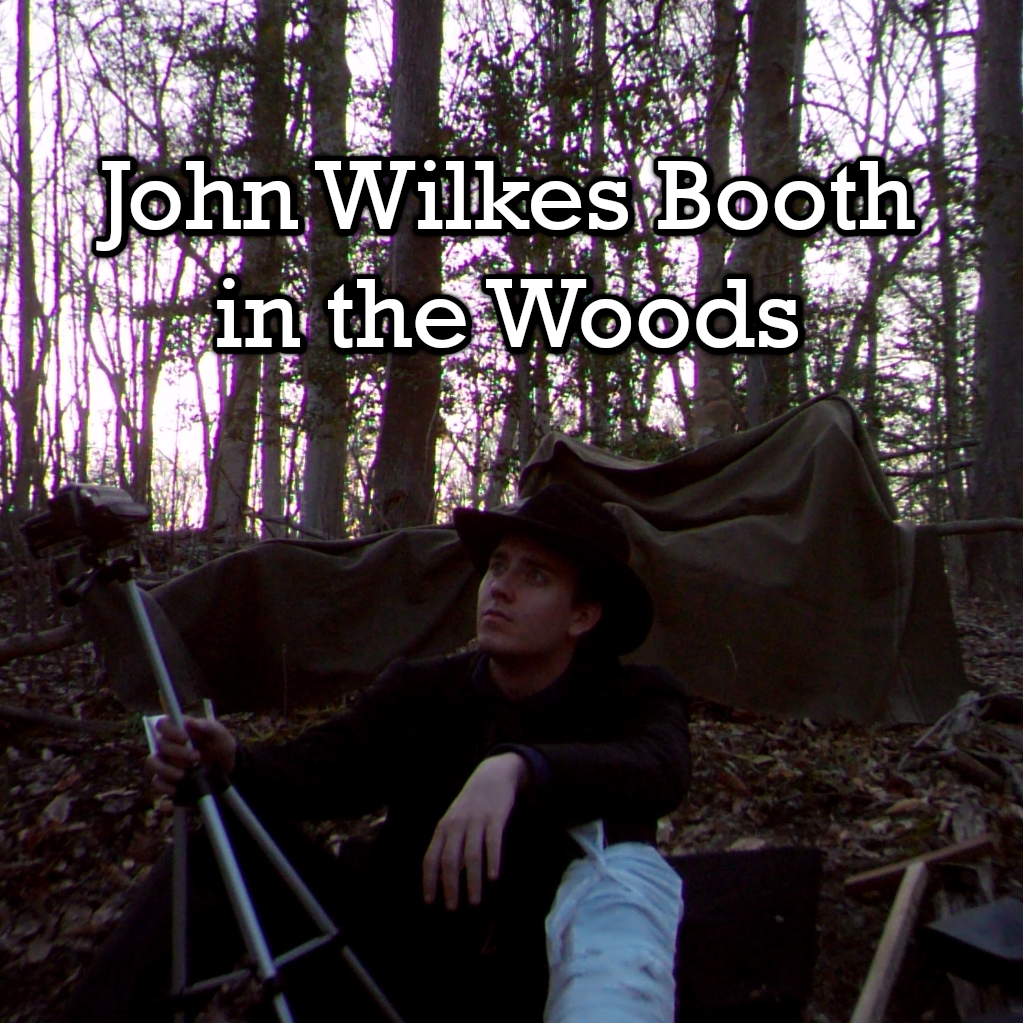
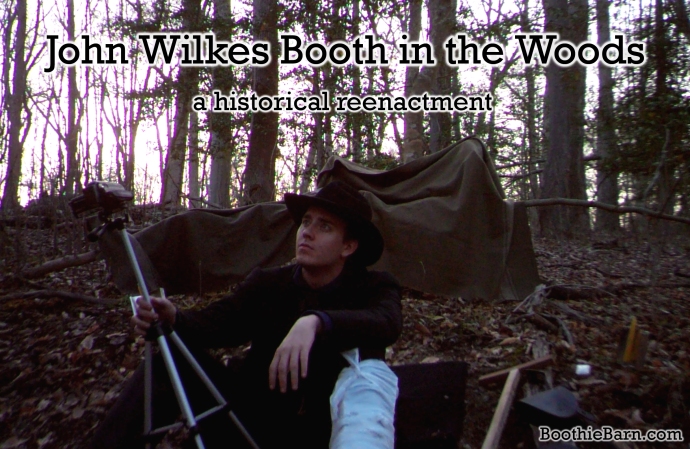
Part 5 of my series John Wilkes Booth in the Woods is edited and uploaded!  To watch it, click on the image below and scroll down, or, to watch the video right on YouTube, click HERE.

John Wilkes Booth in the Woods

I apologize for the delay between the previous installments and this one.  I was having computer issues which prevented me from editing and rendering videos.  Now, thanks to my brother, my computer is fixed and the rest of the videos should be completed and shared in a more timely manner.  Thank you for understanding.


Categories: Uncategorized | Tags: , , , , , , , | Leave a comment

Booth and “the Glorious Cause of Freedom”

Independence Day is a day to remember and give thanks to our forefathers who, in the face of immeasurable odds and conflict, acted with conviction to establish the blessings of freedom that we treasure today.  Our American struggle for Independence not only established the idea of democracy for our country, but changed the course of civilization around the world as others followed suit.  There are many heroes that come to mind with regards to our struggle for freedom, with our Founding Fathers and their Declaration of Independence being the center of our celebrations today.

In 1777, the appeal of Independence and the valiant struggle by the American colonies was foremost on the mind of a 22 year-old London native.  The young man decided to submit to the allure and adventure of what he called “the Glorious Cause of Freedom”.  He sought to enlist on the side of the Americans in their struggle against his homeland.  This man, who was so enamored with the concept of democracy and freedom, was Richard Booth, grandfather of the assassin John Wilkes Booth.

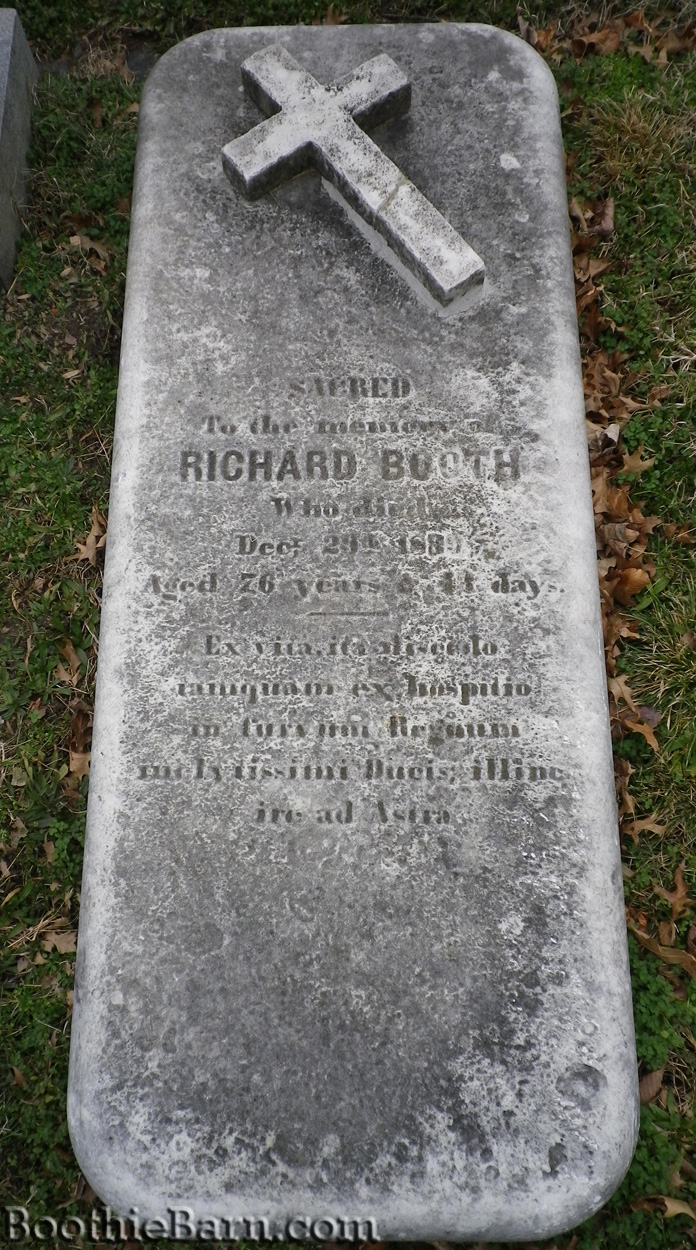
Richard Booth's grave

Richard Booth was joined in his endeavor by his cousin, John Brevitt.  The two young men left London and arrived in the coastal town of Margate.  From there they found passage across the English Channel to Ostend, Belgium.  From Belgium they traveled to Paris, France where they met with representatives from America and expressed their desire to become officers in the Continental Army.   Booth and Brevitt were informed that, before they would be allowed to enlist and be transported to America, they must first procure a letter of introduction from a prominent supporter of the American cause in England.  The pair then wrote to John Wilkes, a radical member of Parliament who opposed the war with America.  Their letter, asking Wilkes (who they claimed was a distant relative of theirs) for a letter on their behalf is reproduced below:

“To John Wilkes, Esq., Princes Court, Westminster.
Paris, Oct. 28th, ’77.

Sir, — You will certainly be much surprised at the receipt of this letter, which comes from two persons of whom you cannot possibly have the least knowledge, who yet at the same time claim the Honour of being of the same Family as yourself. Our conduct has certainly been in some respects reprehensible, for too rashly putting in execution a project we had for a long time conceived. But as it was thro’ an ardent desire to serve in the Glorious cause of Freedom, of which you have always been Fam’d for being the Strict and great Defender, we trust the request we are about to make will be paid regard to. As Englishmen, it may be urged that we are not altogether Justified in taking arms against our native Country, but we hope such a vague argument will have no weight with a Gentleman of your well-known abilities; for as that country has almost parted with all its Rights, which have been given up to the present Tyrannic Government, it must be thought the Duty of every true Briton to assist those who oppose oppression and lawless Tyranny. And as the people of America are composed of men who have still the spirit of their brave Forefathers remaining, it becomes all who are Englishmen to exert their utmost efforts in their behalf, leaving their Country for that purpose; being no more (as we presume) than the Romans, in the war between Octavius and Anthony on the one part, and those illustrious worthys, Brutus and Cassius, on the other, going from the army of the Tyrants to serve in that of the latter, and therefore equally justifiable.

‘Dulce et Decorum est pro patria mori,
Sed pro Libertate mori, Dulcissimum est.’

The manner in which we have conducted ourselves has been so very extraordinary as to be scarcely credible, but we are assured the Bearer of this Letter will convince you of its Authenticity. In short, we left England, and all the advantageous prospects we had there, purposely to go and serve in the Army of the Sons of Liberty, the brave Americans. In order to complete the Enterprise we came from London under a pretence of going on a party of pleasure to the Camp at Warley Common, but instead of proceeding thither, we went immediately for Margate and thence to Ostend, and have since arrived here, where we came to wait upon the Gentlemen who are Agents for the Congress in America, in order to the full completion of our Design of getting appointed officers in the Provincial Service, but for that purpose have since found it necessary to procure a Letter of recommendation from some Gentleman in the Interest of Liberty in England, and understand from Mr. Arthur Lee (who has promised to interest himself greatly in our behalf), that no recommendation will be of more service to us than yours. Our request therefore is, that you will condescend to give one in our favour, directed to that Gentleman at the “Hotel de la Reine, la Rue des Bons Enfants, a Paris,” which you will please to deliver to the Bearer hereof, as soon as possibly convenient. And the favour will be gratefully remembered, and the name of Wilkes be always held in the greatest respect and veneration.

Your most and obed’ Serv’ts at command,
R. Booth.
John Brevitt”

The Latin quote in their letter translates roughly to, “It is sweet and honorable to die for the fatherland, but to die for liberty is the most cherished.”

The pair were hopeful that Wilkes would oblige them and that, his letter of recommendation in hand, they would soon be off to the colonies to join in the fight.  This was not to be, however.  Instead, perhaps showing concern for the reckless youth, Wilkes forwarded the boys’ letter to Richard’s father, John Booth.  John Booth hired agents to retrieve the boys and they returned them to London.  John Booth then wrote a letter to John Wilkes, apologizing for the impudence of his son and nephew and the overt manner in which they discussed Wilkes’ sympathy with the treasonous colonies.  Through the letter, however, it appears that John Booth shared his son’s sympathies and admiration for Wilkes’ views and the American plight:

“To John Wilkes, Esqr.
Nov. 5th, 1777.

Sir, — I cannot but express the deepest concern when I reflect on the Imprudence of my Son and Nephew, in taking the liberty of addressing you without your first being apprised of it and your approbation for so doing. My uneasiness is not a little heightened when I consider to what Length their unguarded youth may lead them, and the various expressions which their thoughtless Pens may have made use of. I must assure you, sir, nothing could be more foreign to mine and to their Mother’s inclinations, nor could anything stimulate them to it but their looking up to you as the sacred Protector of the greatest Blessing on Earth, fair Freedom, and your invariable struggles for the Protection of it.

I cannot, however, but flatter myself that should at any Time a correspondence take place between you and Mr. Lee, and these two youths be the subject of it, that you would speak of them as children of those who stood foremost in Friendship for you, and who are not a little happy in the connection of Blood with which we stand.

. . . These youths, sir, have, as you are pleased to observe, to lament their not being personally known to you ; but I bless God, the best of characters can be had of them from Persons of the greatest merit and Fortune.

Your ob’dt humble S’rv’t,

John Booth.”

In addition to this letter, John Booth, who was a silversmith, sent Wilkes a plate and assured him that he would be happy to use his influence to help Wilkes in any way possible.

With Richard’s hopes of joining in the fight for Independence dashed, he took up the study of the law.  He never lost his love for the American republic, however.  His son, Junius Brutus Booth, recalled an incident in his own youth where he, too, sought adventure and wished to join the British Navy.  At that time Britain and America were engaged in the War of 1812 and Richard forbade his son from joining the British fleet:

“My father who was what is called then a hot headed Yankee or American being resolved that I never should be at odds with the Country which he in his youthful days had formed in his mind’s eye as being the grand desideratum or Heaven of all men.”

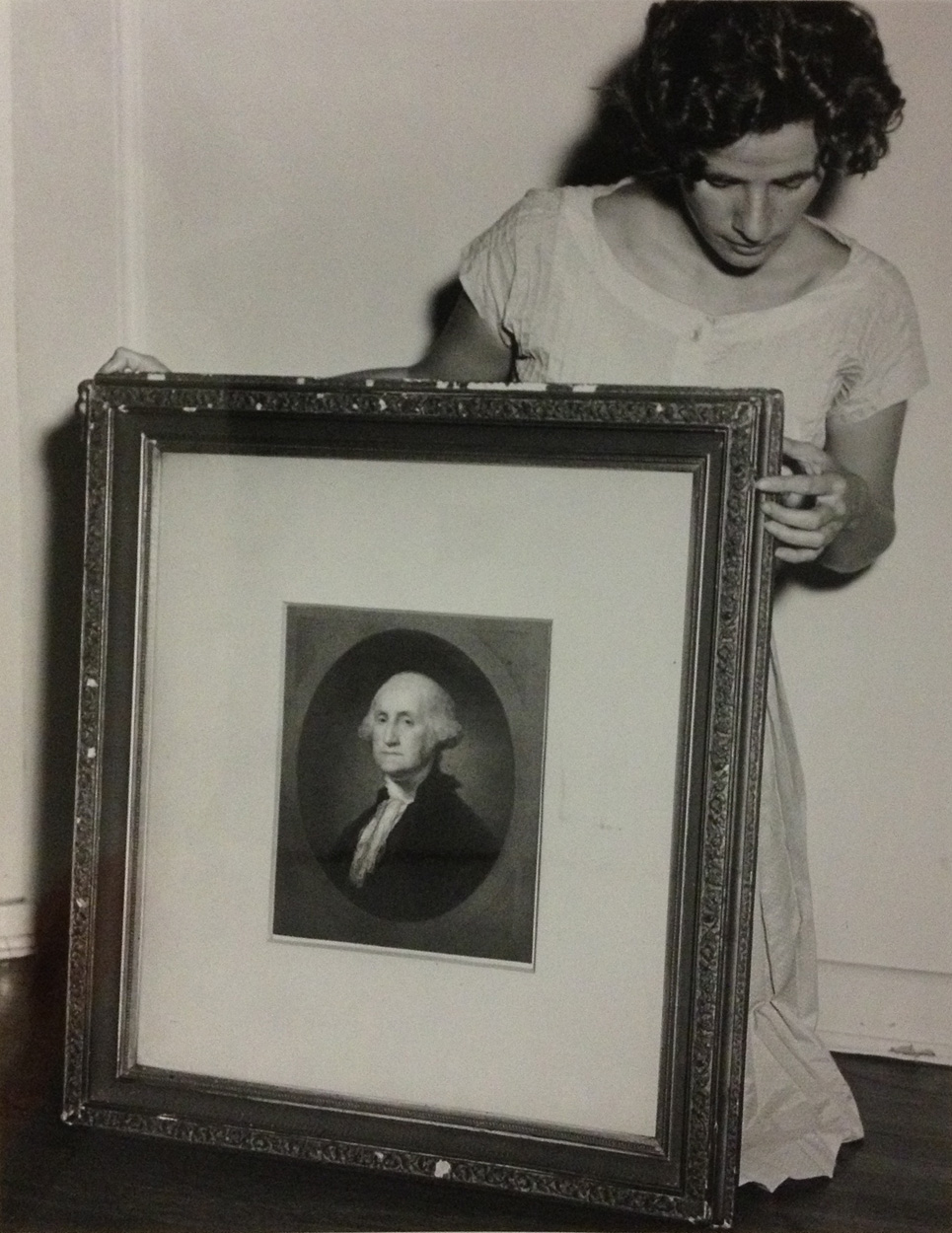
Junius also recounts his father’s “idolatry” for all things America, which “tended in a great measure to render him unpopular amidst the circle of those who but for that would have been his patrons. The picture of General Washington that hung up in our parlour and which was as ’twere a rarity amongst many of the Londoners was an object all around him friend or foe he insisted should be looked at with hat off and bowed to occasionally.”

Rich Booth revered America and General Washington so much, he had Washington's portrait displayed in his London home and would make visitors bow towards it.  This portrait of Washington decorated the box at Ford's Theatre when Richard's grandson, John Wilkes Booth, assassinated Abraham Lincoln.

Richard Booth revered America and General Washington so much, he had Washington’s portrait displayed in his London home and would make visitors bow towards it. This portrait of Washington decorated the box at Ford’s Theatre when Richard’s grandson, John Wilkes Booth, assassinated Abraham Lincoln.

In the years after his son Junius found fame and success in America with his “wife” Mary Ann Holmes, Richard felt confident to finally immigrate to the land he adored so much.  He took up residence at the family home at Tudor Hall for a time, before finding his own lodging in nearby Bel Air.

Today, Richard Booth, a man who truly loved the spirit and promise of American liberty, is buried in the Booth family plot in Baltimore’s Green Mount Cemetery.  This would be patriot rests appropriately under the land that he forever held in high esteem.

References:
The Elder and Younger Booth by Asia Booth Clarke
Letter written by Junius Brutus Booth, May 1st, 1839
Art Loux Archives

Categories: Uncategorized | Tags: | 1 Comment

General Lew Wallace Study & Museum

In the city of Crawfordsville, Indiana, surrounded by modern houses, well kept yards, and the friendly people that the rural Midwest breeds, there lies a a building and museum dedicated to a man who lived a fascinating and multifaceted life.  His name was Lew Wallace and he lived from 1827 to 1905.

Gen Lew Wallace NARA

Wallace achieved early fame by becoming the youngest Major General in the Union Army during the Civil War.  His valiant command at the Battle of Monocacy, while a loss for the Union, delayed Confederate General Jubal Early’s forces long enough for the proper reinforcements to arrive in Washington D.C., which later prevented Early from taking the nation’s capital.  Following the Civil War, Lew Wallace was appointed the Governor of the New Mexico Territory, and then the U.S. Minister to Turkey.  In Turkey, Wallace broke traditional social customs and diplomatic protocol by asking to shake hands with Sultan Abdul Hamid II.  Surprisingly the Sultan consented and from this unique start blossomed a mutual respect and friendship between the two men.  Wallace was an avid reader, fisherman, painter, and would-be inventor.

As remarkable as these accomplishments are, however, Wallace’s great fame comes from his literary contributions.  One of his books, in particular, made him a household name in the 19th century and granted him immense wealth and prestige.  The book has been adapted for the stage, radio, television, and four motion pictures, the most famous being Charlton Heston’s 1959 version.  This book is Ben-Hur: A Tale of the Christ.  It was the best selling American novel from its publication in 1880 until 1936, when it was replaced by Gone With the Wind.  To date, Ben-Hur has never been out of print.

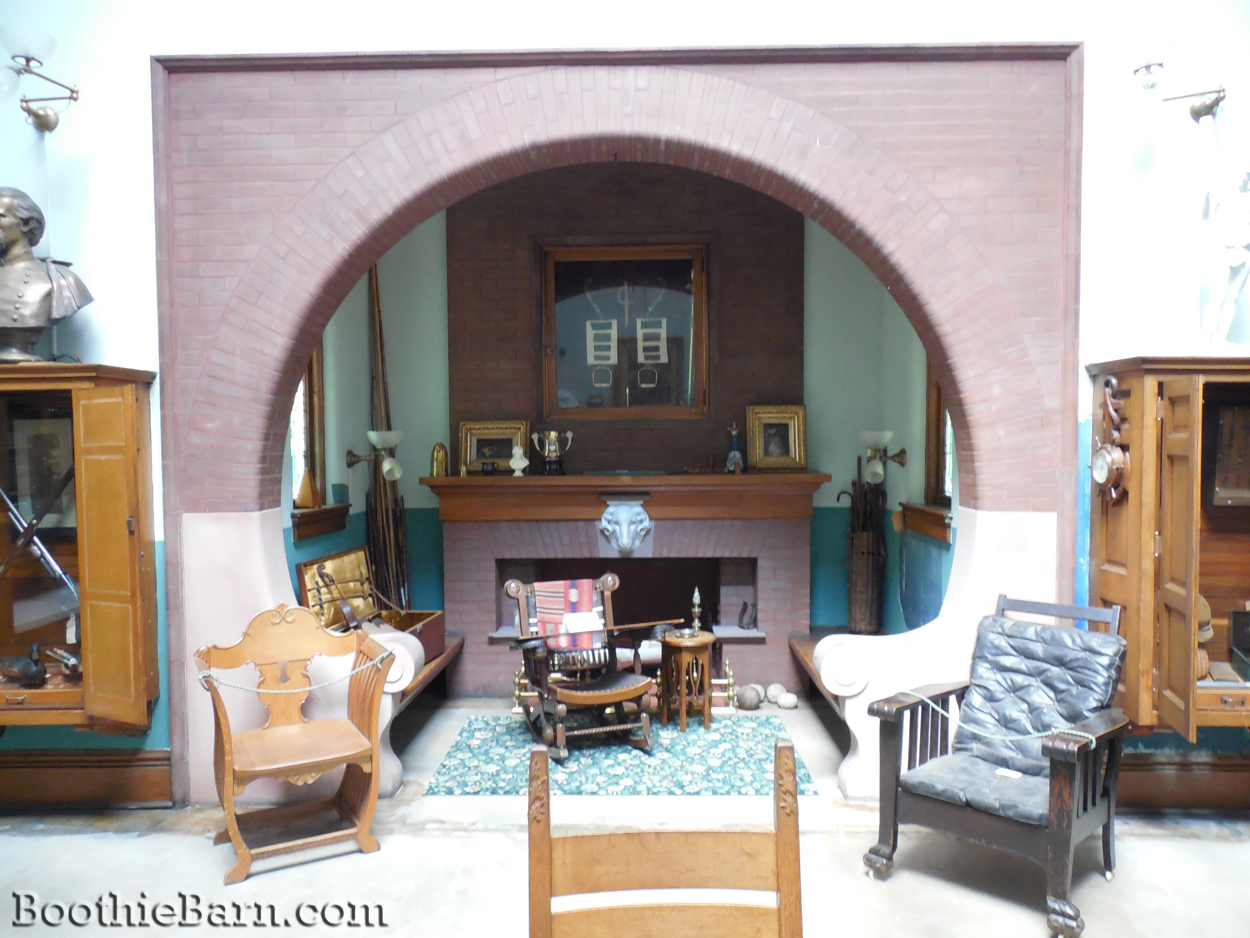
Lew Wallace wrote much of Ben-Hur while sitting under a tree at his Crawfordsville home.  After its success, Wallace decided to build himself a study, away from his main house, in which he could write, research, and tinker with his other interests.  The study took three years to build and was completed in 1898.  Today, the study is a museum relating to the life of Lew Wallace, the solider, diplomat, and author:

Lew Wallace Study 1

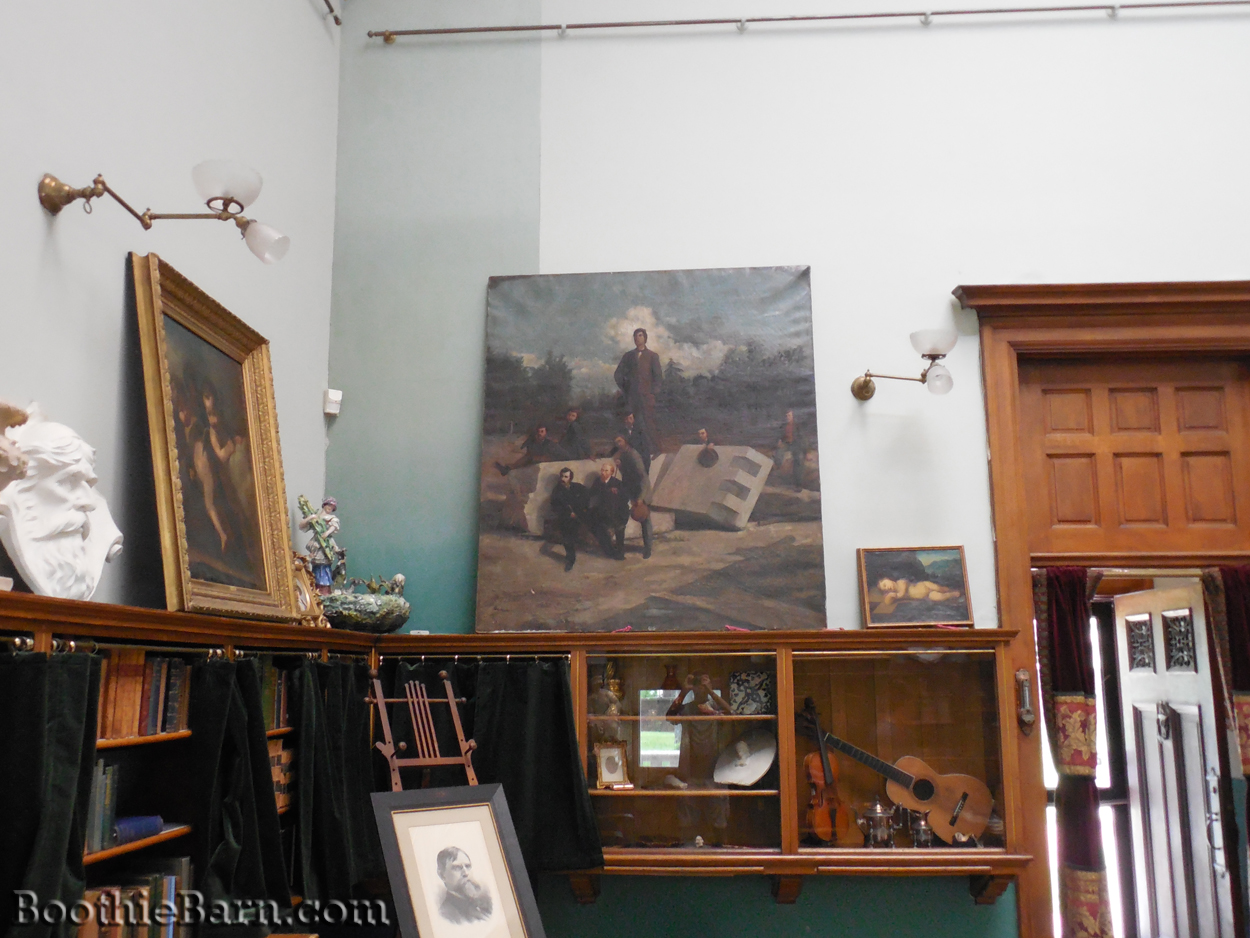
The exterior of the study is a mixture of different architectural styles, many gleamed from Wallace’s time in Turkey.  The interior of the study is basically one large room with a fireplace alcove, a small room to the side in which Wallace would nap, and a set of stairs which leads down to the basement which held the furnace, bathroom, and electrical system in Wallace’s day.  To use a colloquialism, this study was Wallace’s “man cave”.  It was the home of Wallace’s many passions and hobbies.  There are shelves all around the room containing his huge collection of books and research materials that he used in his writing.  The walls are covered with paintings he owned and ones he painted himself.  There are cases for his hunting and fishing gear and his other experimental hobbies like sculpting and violin making.

Interior Lew Wallace Study 3

Books and paintings on one wall of the Lew Wallace Study in Crawfordsville, Indiana. The painting on the left was painted by Lew Wallace himself and the center painting was a gift to him from the Sultan of Turkey.

Interior Lew Wallace Study 1

Interior Lew Wallace Study 2

The chair closest to the fireplace was the chair in which Lew Wallace wrote much of Ben-Hur in.

While Lew Wallace may be best known for Ben-Hur, he also was involved in the Lincoln assassination story.  General Wallace was one of the nine members of the military commission which tried the Lincoln assassination conspirators:

Part of the military commission which tried the Lincoln conspirators.  Lew Wallace is seated, second from the right. NARA

Part of the military commission which tried the Lincoln conspirators. Lew Wallace is seated, second from the right. NARA

During the trial, Wallace passed the time by making sketches of all the Lincoln conspirators (except Mrs. Surratt).  Those sketches, which show a great degree of talent, are now housed at the Indiana Historical Society, but are reproduced below:

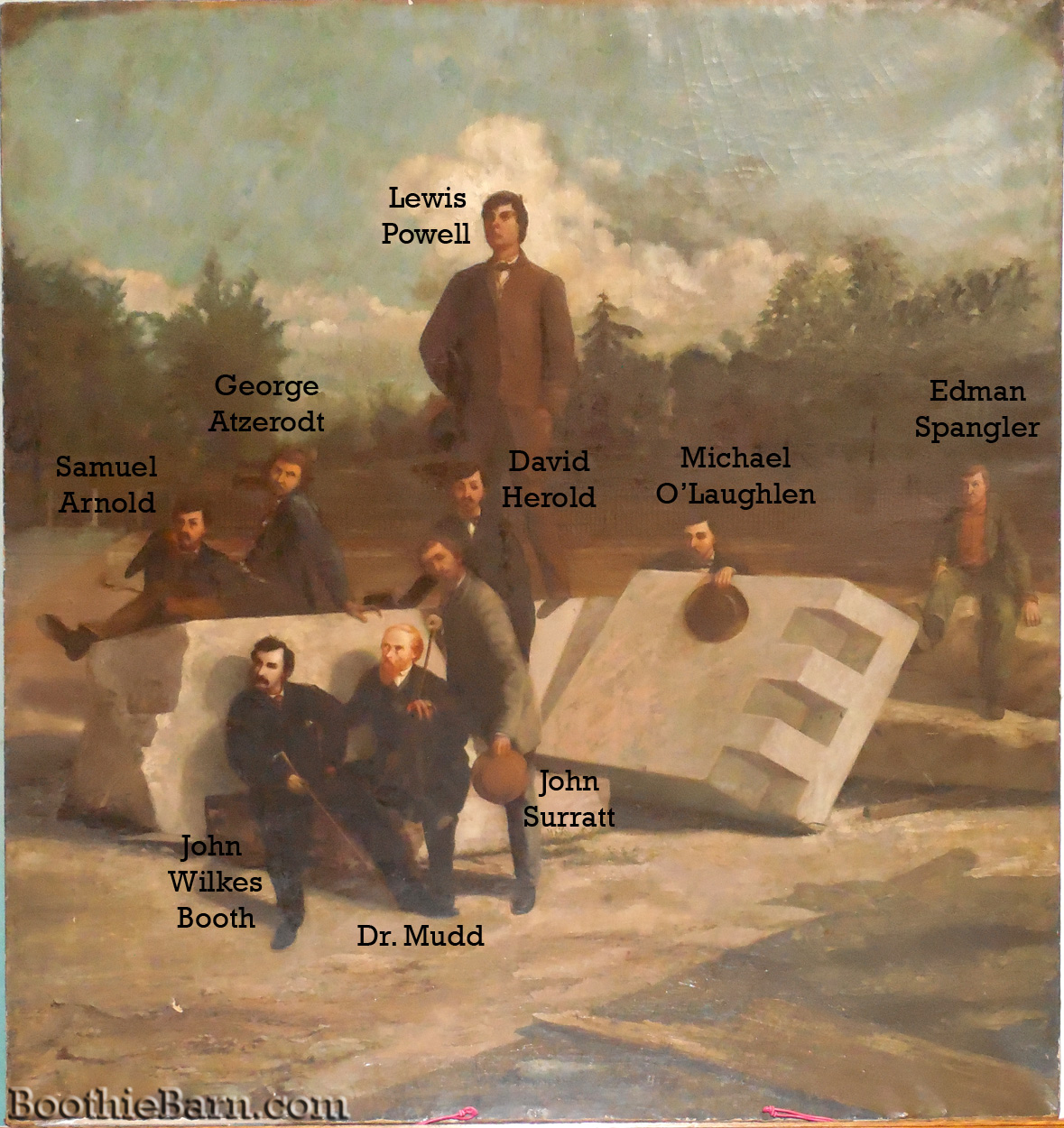
Wallace would later use these sketches as models for a painting.  That painting, known as “The Conspirators”, but actually unnamed and unsigned by Wallace is housed in the study:

The Conspirators in the Lew Wallace Study 3

In addition to the conspirators he made life sketches of during the trial, Lew Wallace also included depictions of John Wilkes Booth and John Surratt.  The painting is said to be of the conspirators present at Abraham Lincoln’s second inauguration.  While Booth was present at the inauguration, it is unlikely any of the others were.

The Conspirators in the Lew Wallace Study Labeled

It is a very large painting, measuring 60″ by 66.5″.  It dwarfs over all the other works of art in the study.

The Conspirators in the Lew Wallace Study 1

In Wallace’s time, he had the painting displayed on an easel in a corner of the room.  Due to concerns for its safety, the study currently puts it up and out of reach.

Study during Wallace's day

This photograph of Lew Wallace’s study during his life, shows the painting of the conspirators with a prominent place on an easel.

Over the years, the painting of the conspirators has darkened.  General Wallace likely contributed to this due to his avid smoking habit.  The study hopes to restore the painting, along with some of the ornate designs on the interior of the study.

If you’re in the area of Crawfordsville, Indiana, a stop at the General Lew Wallace Study & Museum is definitely worth it.  For $5 admission you are presented with an introductory video about Lew Wallace’s life and then are given a personalized tour of the study by one of the knowledgeable  guides.  You are also free to roam around the grounds and visitor center free of charge.  The study also has brochures giving directions to Lew Wallace’s grave which is only 3 or so miles from the study.

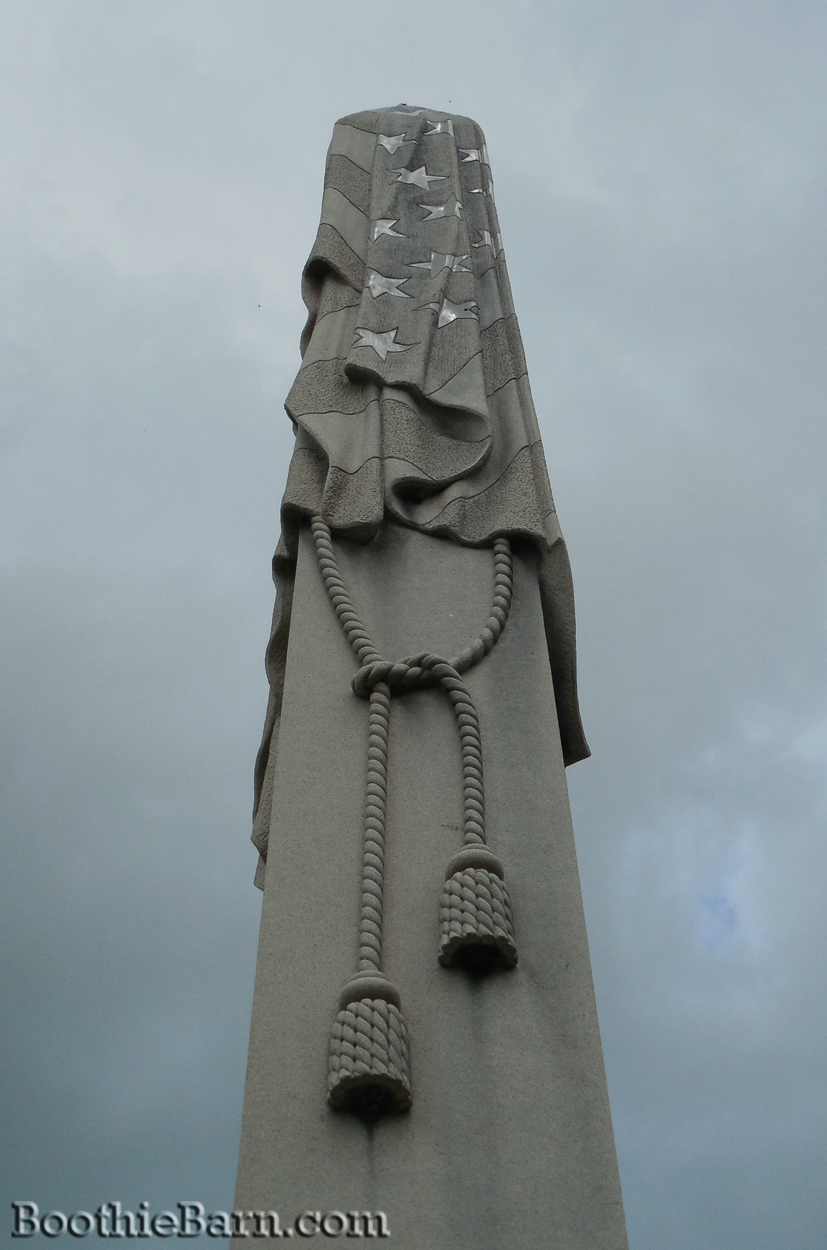
Lew Wallace Grave 1

It appears to be the tallest monument in the whole cemetery and the top of the obelisk is carved to look like there is a flag draped on it.

Lew Wallace Grave 3

Lew Wallace lived a unique life and his former study in Crawfordsville does a great job of educating its visitors about his accomplishments and legacy.  For more information, visit their website: http://www.ben-hur.com

Lew Wallace Grave 2

References:
Thanks to the participants of Roger Norton’s Lincoln Discussion Symposium from whom I first learned of this museum and decided to visit.
General Lew Wallace Study & Museum
Indiana Historical Society

Categories: Uncategorized | Tags: , , | 18 Comments

New Gallery – Junius Brutus Booth, Jr.

As the eldest child of Junius Brutus Booth and Mary Ann Holmes, Junius Brutus Booth, Jr. never achieved the fame (or infamy) of his brothers Edwin and John Wilkes but was a moderately successful actor and theatrical manager in his own right.   During the Civil War, he shared his brother John’s sympathies for the Confederacy and, unlike Edwin, June was imprisoned for suspicion following John’s assassination of Lincoln.  More than anything else, however, June was his father’s son.  In his later years, he resembled his father so closely that many images of June are convincingly mislabeled as Junius, Sr.  He also followed in his father’s footsteps when it came to his martial relationships.  June abandoned his first wife and assumed child, just like his father did, and ran off with a younger actress to California.  He had one child by her before her death in 1859.  In 1867, June married Agnes Perry who bore him four boys, two of which died during childhood.  All of June’s children (and all of his wives for that matter) became actors to various degrees of fame.  They all seemed to have money troubles at some point in their lives, with the pressures of debt causing one of his sons, Junius Brutus Booth III, to kill his wife and commit suicide.
Wives and Children of Junius Brutus Booth, Jr
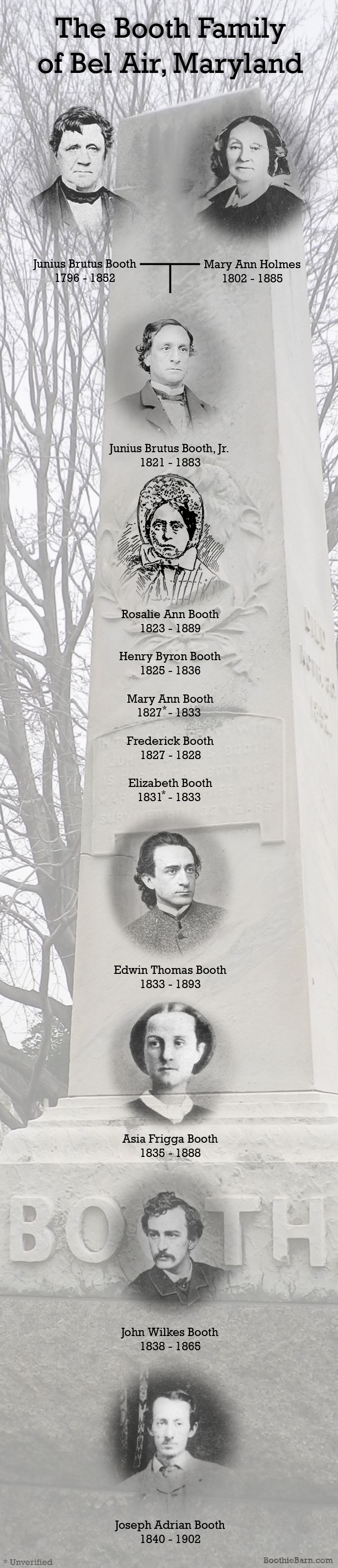
The newest Picture Gallery here on BoothieBarn has to do with Junius Brutus Booth, Jr. and his family.  To visit the gallery, click HERE or on Junius, Jr.’s picture in the image below:


Click for Junius Brutus Booth Click for Mary Ann Holmes Booth Click for Junius Brutus Booth, Jr. Click for Rosalie Ann Booth Click for the Booth children Click for Edwin Thomas Booth Click for John Wilkes Booth Click for Joseph Adrian Booth
Categories: Uncategorized | Tags: | 4 Comments

John Wilkes Booth’s Vertebrae

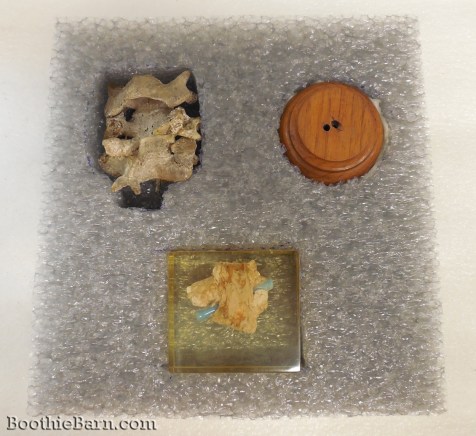
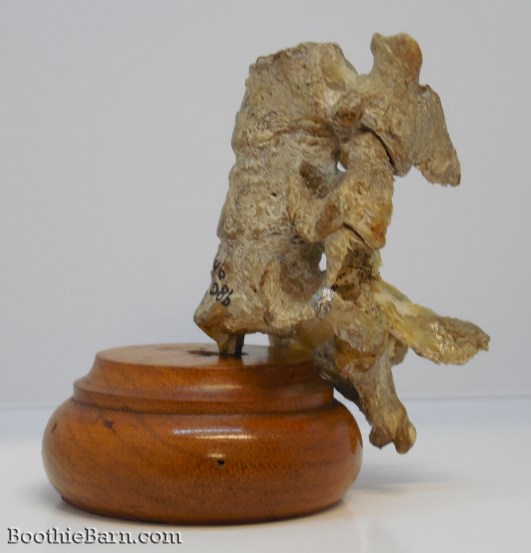
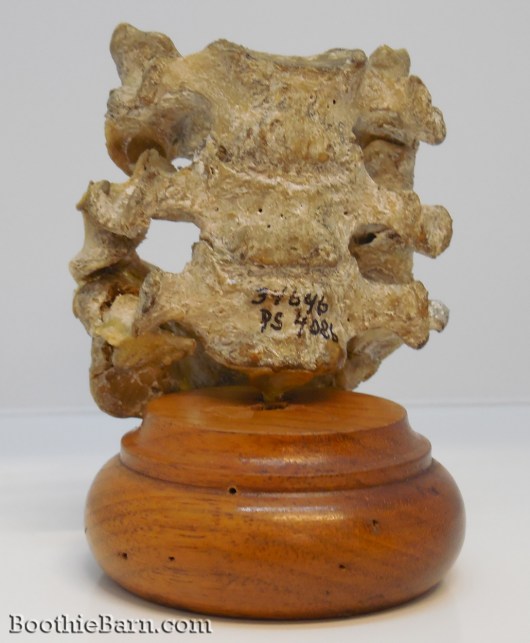
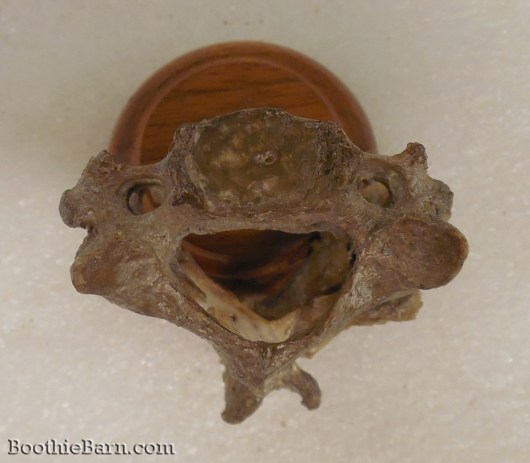
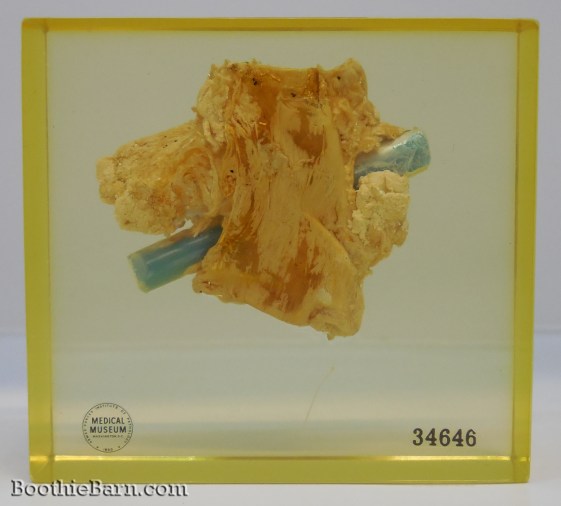
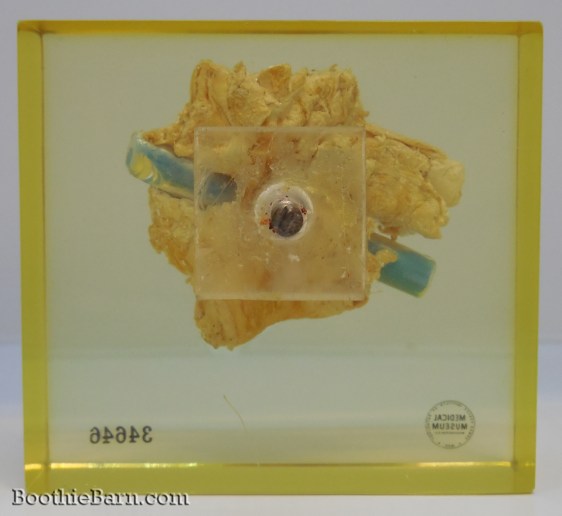
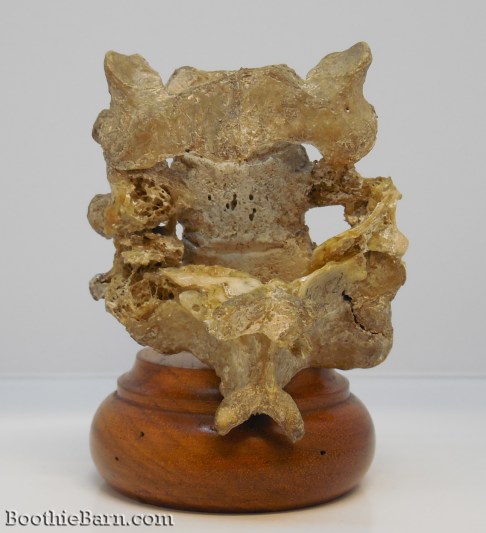
Not long ago, I visited the National Museum of Health and Medicine in Silver Spring, Maryland.  I wrote a post for this site which highlighted the connection between the museum (which at one time was called the Army Medical Museum and housed inside of Ford’s Theatre) and the assassination story, including the assassination related artifacts contained in the museum.  You can read that article by clicking HERE.  There were a couple of items that I was very interested in seeing, but they were not on display during my initial visit.  I made a return trip to the NMHM, having secured a research appointment to see some artifacts in storage there.  The artifacts I saw consisted of John Wilkes Booth’s third, fourth, and fifth cervical vertebrae, along with a piece of his spinal cord and tissue:

John Wilkes Booth Vertebrae and Spinal Cord

John Wilkes Booth's vertebrae 5

John Wilkes Booth's vertebrae 3

John Wilkes Booth's vertebrae 2

John Wilkes Booth's vertebrae 4

John Wilkes Booth's Spinal Cord 1

John Wilkes Booth's Spinal Cord 2

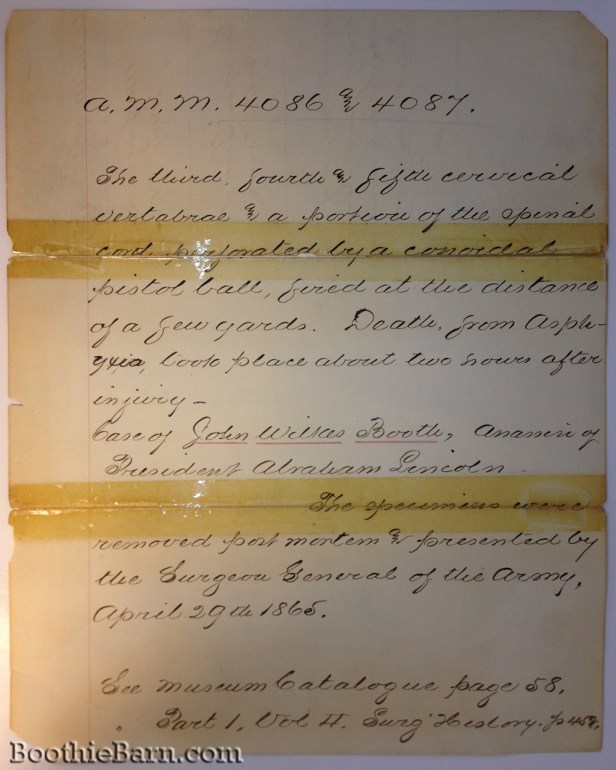
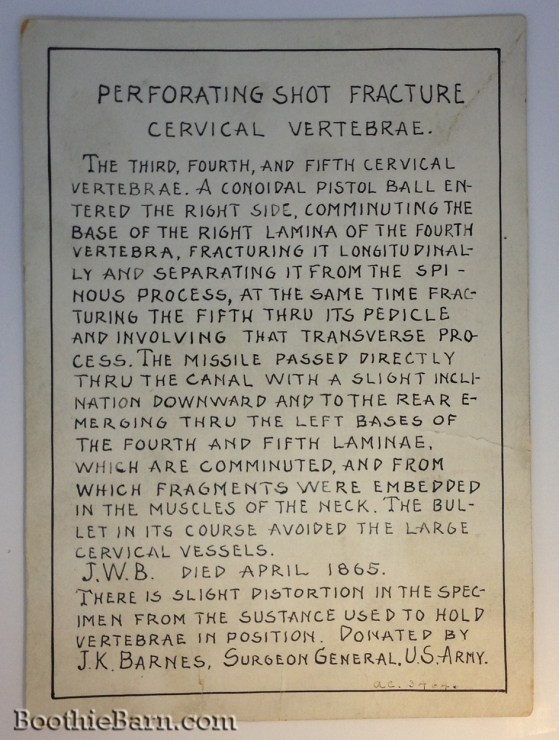
These pieces were removed from John Wilkes Booth during his autopsy aboard the USS Montauk.  The autopsy was preformed by Surgeon General Joseph K. Barnes and Dr. Janiver Woodward on April 27.  Two days later, on April 29, Dr. Barnes donated these pieces of Booth to the Army Medical Museum.  Here is some paperwork that went along with them:

Booth vertebrae paperwork

Description of Booth's Vertebrae

For convenience, here’s a transcript of the autopsy report written by Surgeon General Barnes.  The original is in the National Archives.

“Surgeon General’s Office
Washington City, D.C.
April 27th, 1865
Hon: E.M. Stanton
Secretary of War
Sir,

I have the honor to report that in compliance with your orders, assisted by Dr. Woodward, USA, I made at 2 pm this day, a postmortem examination of the body of J. Wilkes Booth, lying on board the Monitor Montauk off the Navy Yard.

The left leg and foot were encased in an appliance of splints and bandages, upon the removal of which, a fracture of the fibula (small bone of the leg) 3 inches above the ankle joint, accompanied by considerable ecchymosis, was discovered.

The cause of death was a gun shot wound in the neck – the ball entering just behind the sterno-cleido muscle – 2-1/2 inches above the clavicle – passing through the bony bridge of fourth and fifth cervical vertebrae – severing the spinal chord and passing out through the body of the sterno-cleido of the right side, 3 inches above the clavicle.

Paralysis of the entire body was immediate, and all the horrors of consciousness of suffering and death must have been present to the assassin during the two hours he lingered.

Very respectfully
Your obt servt.
J. K. Barnes
Surgeon General”

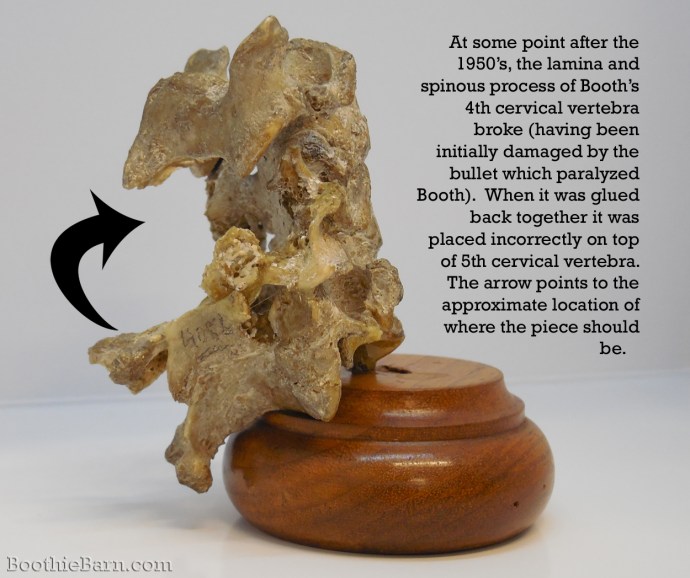
Those with medical expertise might have noticed that Booth’s vertebrae don’t look quite right. That is because, at some point after the 1950’s or so, the specimen broke. A piece of the fourth cervical vertebra broke off and it is likely that even when it was improperly repaired, a piece was still missing.

John Wilkes Booth's broken vetebrae

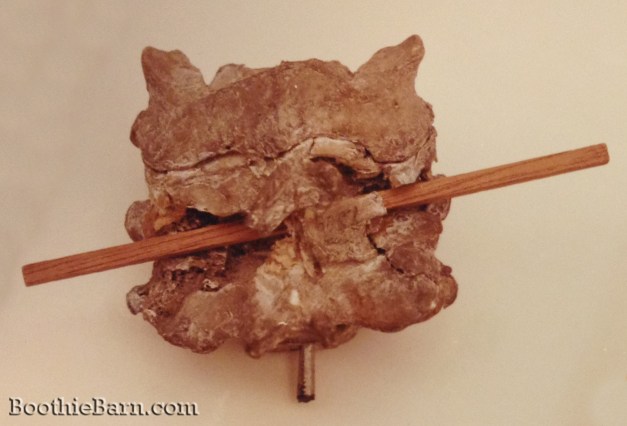
Here are two other pictures, one which shows the vertebrae before the break occurred and how it appears today for comparison.  Unfortunately, the angles are not the same between the two pictures:

John Wilkes Booth Vertebrae pre-break

John Wilkes Booth's vertebrae 1

While the National Museum of Health and Medicine expertly safeguards the artifact in order to prevent any future damage, there are those who are determined to destroy it further.  The advocates of this are the misguided escape theorists who believe that John Wilkes Booth did not die on April 26, 1865 and, instead, believe an impractical conspiracy was expertly enacted by “the government”.  Most of them have fallen for Finis Bates’ book and mummy sideshow which, while interesting in their own rights, are easily disproved.  Still, certain forces continually seek to gain approval from the NMHM to “sample” (i.e. drill a piece out of) the vertebrae in an attempt to extract DNA from it.  From there they hope to commit an even bigger moral crime  by exhuming the body of Edwin Booth, the greatest actor of the 19th century, in order to get a sample from him to compare the two.  To me, the proposed exhumation of Edwin, a man who suffered immense tragedy due to his brother’s crime and for the rest of his days was plagued with guilt and melancholy, is nothing short of morally reprehensible.  Desecrating the final resting place of the greatest Hamlet of all time just to appease those who refuse to acknowledge the mountain of evidence against them, is even worse than the destruction of this priceless artifact.  Even so, vertebrae are not good candidates for DNA extraction due to the type of bone desired for such an analysis.  In order to get a viable DNA sample, one cannot simply chip off a small piece from the side, but, instead, would need to drill into the thickest part of the vertebrae a good distance, causing severe damage to the specimen.  Luckily the National Museum for Health and Medicine understands this fully and continues to refuse any proposals that would place this artifact at risk, even when the escape theorists try to get their congressmen involved.  One of the more recent attempts occurred last year and was covered by newspapers and online articles which tricked unknowing individuals into thinking the case had merit.  Did people claim to have seen, or even been, John Wilkes Booth after his death in April of 1865? Of course, but people have also claimed to have seen (or been) Louis XVII, Elvis and even Adolf Hitler long after their deaths.  The John Wilkes Booth escape theory is an interesting sidebar, a form of pseudo-history as it were, that can be studied and enjoyed as the fanciful story it is.  However, when people actually start believing this pseudo-history and attempt to desecrate the grave of an innocent man or destroy a one-of-a-kind artifact in our nation’s museums, they are not to be humored any longer.

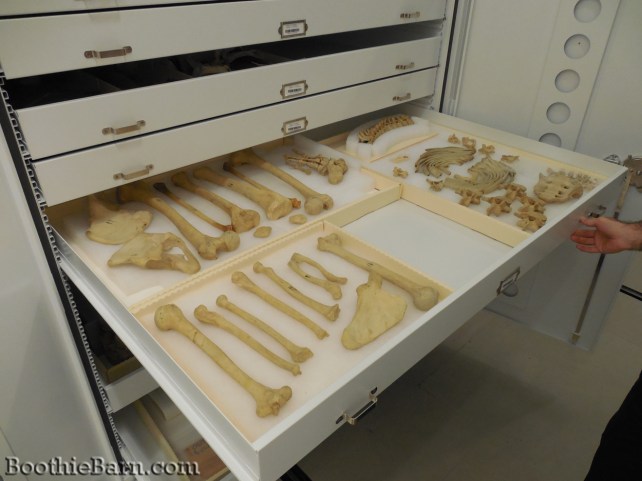
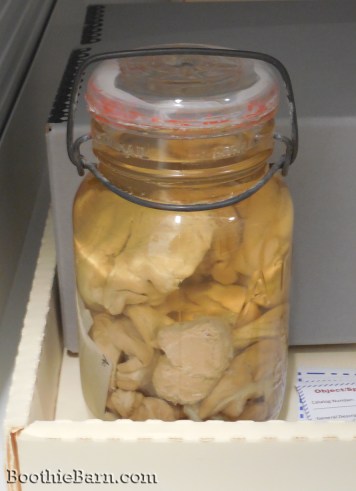
According to the National Museum of Health and Medicine they are not expecting to put the Booth items on display any time in the near future.  They remain in storage, in a drawer close to the near complete skeleton (and brain) of Charles Guiteau, the assassin of President James Garfield:

Charles Guiteau's skeleton NMHM

Charles Guiteau's brain NMHM

References:
National Museum of Health and Medicine
The Body in the Barn: The Controversy Over the Death of John Wilkes Booth by the Surratt Society 

Categories: Uncategorized | Tags: , , | 15 Comments

New Gallery – Mary Ann Holmes Booth

Mary Ann Holmes was born in 1802 to Robert and Sarah Holmes.  Her father was a seedsman and owned a plant nursery in Lambeth, a borough in South London.  It is often written that Mary Ann was a flower girl, selling flowers in front of the London theaters like Eliza Doolittle from the play Pygmalion.  It is uncertain how truthful this claim is.  Most flower girls of the day were orphans who lived on the street or the product of neglectful parents.  Some even used the guise of selling flowers as a front for prostitution.  Given that Mary Ann’s father seemed to be moderately successful in his business it seems more likely that Mary Ann assisted her father in his nursery and that the term “flower girl” is a bit misleading.

When and how Mary Ann Holmes met Junius Brutus Booth is also a bit of a mystery.  On Junius Brutus Booth’s account book for 1820, someone (likely his daughter Asia) marked an X on October 9, 1820 and wrote, “The night mother first saw my father”.  Junius played King Lear that night in Reading, a city some 35 miles away from London.  Why Mary Ann would have been so far from her London home that night is unknown, but it is possible that the Holmeses had relatives in Reading.  Junius was still married to his first wife Adelaide and had a son at this point, but he found himself quickly smitten by the 18 year-old Mary Ann.  She found herself being wooed by the 24 year-old actor who sent her constant letters and books by the poet Lord Byron.  Their courtship was brief and in January of 1821, the couple ran away together.  They first spent time visiting two cities in Northern France.  They then returned to England and set sail for the islands of the Caribbean, where Junius would tour.  On route the boat stopped at the Island of Madeira, a Portuguese territory off the coast of Morocco.  The couple fell in love with the island and stayed there for several weeks.  When they decided to leave they booked passage on the schooner “Two Brothers” and this time their destination had changed.  When they got off the boat on June 30, 1831, Junius Brutus Booth and Mary Ann Holmes were in America.

In America, Mary Ann gave birth to ten children, spanning a theatrical dynasty.  For over 54 years she witnessed her family’s immense success and incomprehensible  tragedies.  She outlived her husband by over 30 years and buried six of her children.

The newest Picture Gallery contains images relating to the life and Mary Ann Booth nee Holmes.  To visit the gallery, click on Mary Ann’s picture on the image below or click HERE.

Mary Ann Holmes Booth Pictures

Click for Junius Brutus Booth Click for Mary Ann Holmes Booth Click for Junius Brutus Booth, Jr. Click for Rosalie Ann Booth Click for the Booth children Click for Edwin Thomas Booth Click for John Wilkes Booth Click for Joseph Adrian Booth

References:
Junius Brutus Booth: Theatrical Prometheus by Stephen M. Archer
“Mary Ann Doolittle? The “Flower Girl” Myth of the Booths’ Mother” by Deirdre Barber Kincaid, Surratt Courier, March 2004

Categories: Uncategorized | Tags: | 7 Comments

Junius Brutus Booth and the Fat Girl

Junius Brutus Booth was a mad theatrical genius and victim of severe mood swings. After one engrossing performance he had a chance meeting with a professional sideshow performer in the cramped backstage area. The result is documented as follows:

Junius Booth and the Fat Girl 1851

The real name of the “fat girl” who crossed paths with Booth was Hannah Crouse. From the age of 6, Hannah’s immense weight was commented on in newspapers and she soon found herself making a living as a traveling human oddity. Here is a newspaper advertisement from a time she was exhibiting herself in Washingon, D.C.

Hannah Crouse

As Hannah grew older, her weight did as well. A 1854 advertisement for the then 20 year-old girl, highlighted that she was:

“The youngest of all the Large Women, very intelligent and active, and weighing more than any other woman ever known – but she really does not weigh more than 900 pounds. We challenge the world to produce her equal.”

As time went on, Hannah Crouse was sometimes confused with another famous “Large Woman” of the era, Hannah Perkins. Ms. Perkins achieved even greater fame by touring with P. T. Barnum. She ended up marrying another performer named John Battersby who exhibited himself as the “Living Skeleton”.

Hannah and John Battersby

While Hannah Crouse survived her backstage encounter with the confused and frenzied Junius Brutus Booth, undoubtedly her immense weight contributed to her early demise. Hannah Crouse died in August of 1856 at the age of 21 or 22.

Categories: Uncategorized | Tags: | 5 Comments

New Gallery: Junius Brutus Booth

Junius Brutus Booth was the patriarch of the Maryland Booths.  Born in England, he achieved early fame in London theaters rivaling the biggest stars of the day.  He immigrated to America with his love, Mary Ann Holmes, fleeing his from his real wife and eyeing even greater success in this country.  America welcomed him with open arms and for decades he toured the nation as a unparalleled theatrical genius.  With genius also came madness.  Junius was known to be so passionate and enveloped in the characters he portrayed that, mixed with increasing bouts of drunkedness, he often blurred the line between his real life and the dramatic characters he played on the stage.  This caused stress for the Booth family but, when sober, Junius was a very devoted husband and father.  He inspired three of his sons to make theater their career and influenced generations of actors.  The newest Picture Gallery here on BoothieBarn is devoted to this passionate leader of the Booth Family, Junius Brutus Booth.

To visit the Junius Brutus Booth Gallery, click on Junius Brutus Booth’s picture on the image below or click HERE.  In time I’ll be creating other galleries for the rest of the Booths.

To learn more about Junius, read Dr. Stephen Archer’s unparalleled biography, Junius Brutus Booth: Theatrical Prometheus


Click for Junius Brutus Booth Click for Mary Ann Holmes Booth Click for Junius Brutus Booth, Jr. Click for Rosalie Ann Booth Click for the Booth children Click for Edwin Thomas Booth Click for John Wilkes Booth Click for Joseph Adrian Booth
Categories: Uncategorized | Tags: | 3 Comments

Blog at WordPress.com.