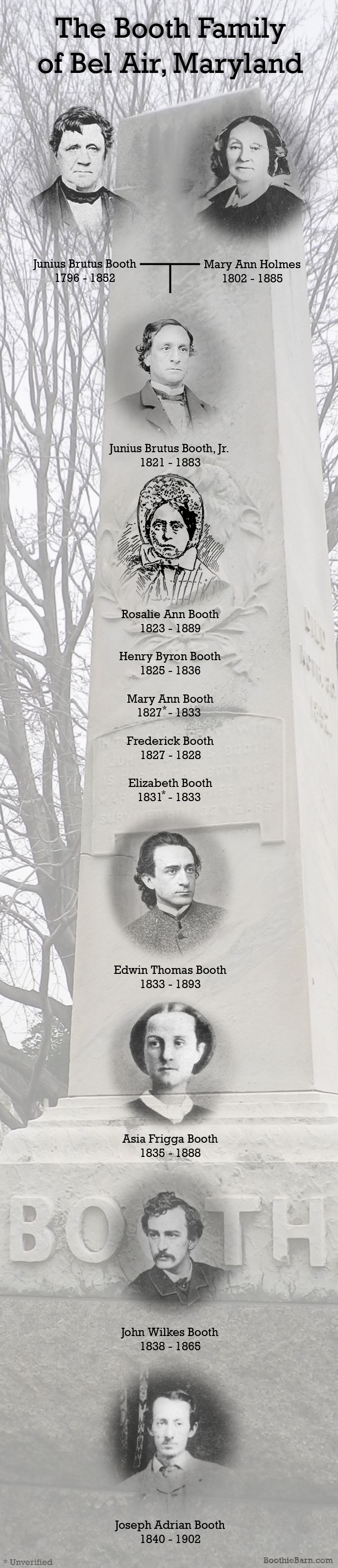
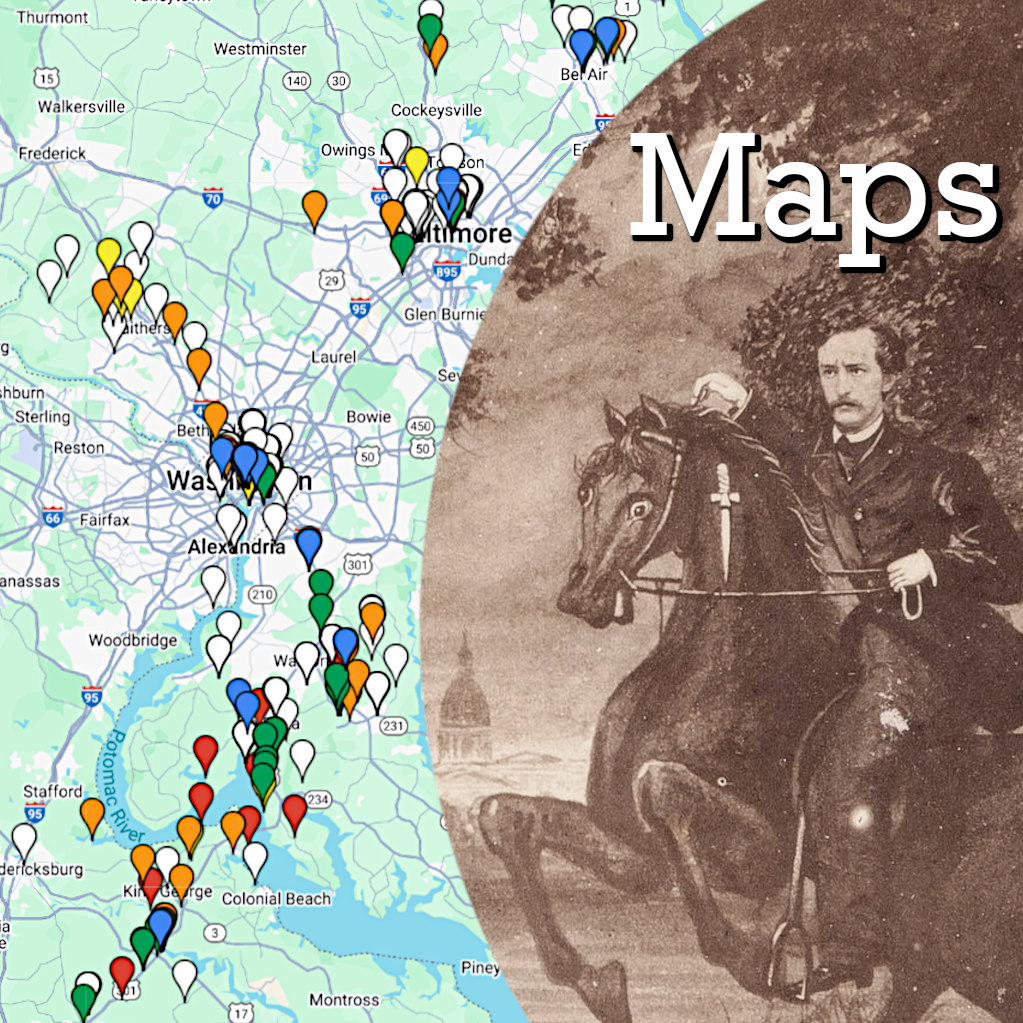
New Gallery – Junius Brutus Booth, Jr.

As the eldest child of Junius Brutus Booth and Mary Ann Holmes, Junius Brutus Booth, Jr. never achieved the fame (or infamy) of his brothers Edwin and John Wilkes but was a moderately successful actor and theatrical manager in his own right.   During the Civil War, he shared his brother John’s sympathies for the Confederacy and, unlike Edwin, June was imprisoned for suspicion following John’s assassination of Lincoln.  More than anything else, however, June was his father’s son.  In his later years, he resembled his father so closely that many images of June are convincingly mislabeled as Junius, Sr.  He also followed in his father’s footsteps when it came to his martial relationships.  June abandoned his first wife and assumed child, just like his father did, and ran off with a younger actress to California.  He had one child by her before her death in 1859.  In 1867, June married Agnes Perry who bore him four boys, two of which died during childhood.  All of June’s children (and all of his wives for that matter) became actors to various degrees of fame.  They all seemed to have money troubles at some point in their lives, with the pressures of debt causing one of his sons, Junius Brutus Booth III, to kill his wife and commit suicide.

Wives and Children of Junius Brutus Booth, Jr

The newest Picture Gallery here on BoothieBarn has to do with Junius Brutus Booth, Jr. and his family.  To visit the gallery, click HERE or on Junius, Jr.’s picture in the image below:


Click for Junius Brutus Booth Click for Mary Ann Holmes Booth Click for Junius Brutus Booth, Jr. Click for Rosalie Ann Booth Click for the Booth children Click for Edwin Thomas Booth Click for John Wilkes Booth Click for Joseph Adrian Booth
Categories: Uncategorized | Tags: | 4 Comments

John Wilkes Booth’s Vertebrae

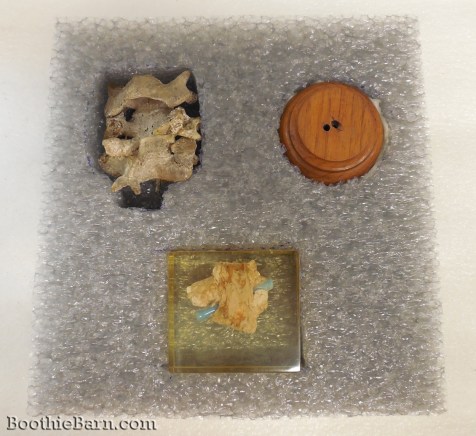
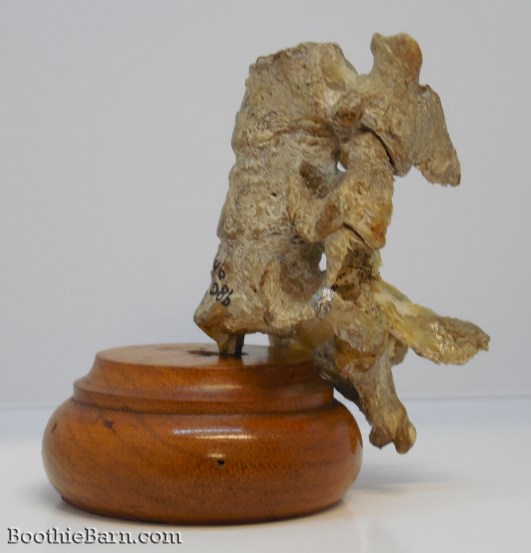
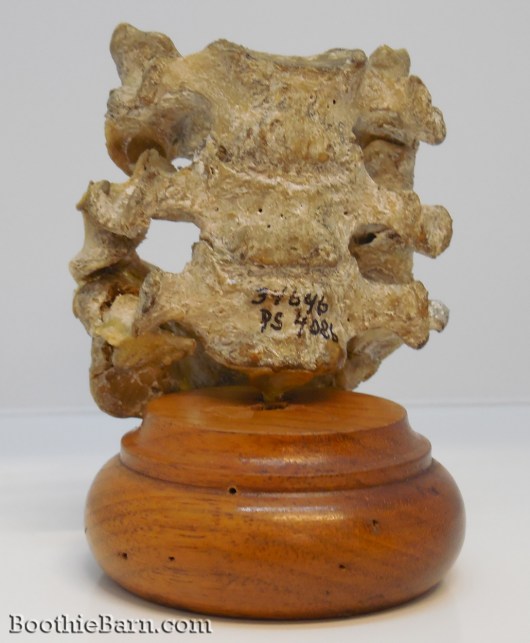
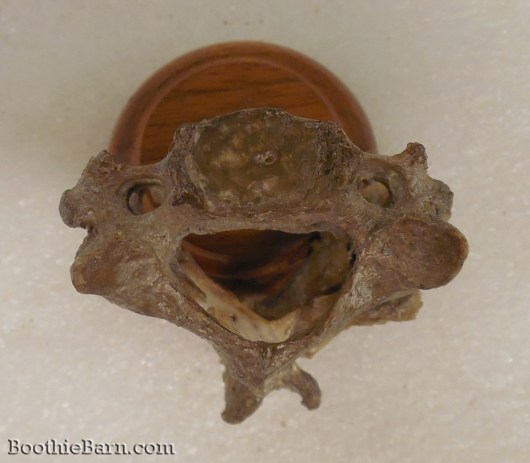
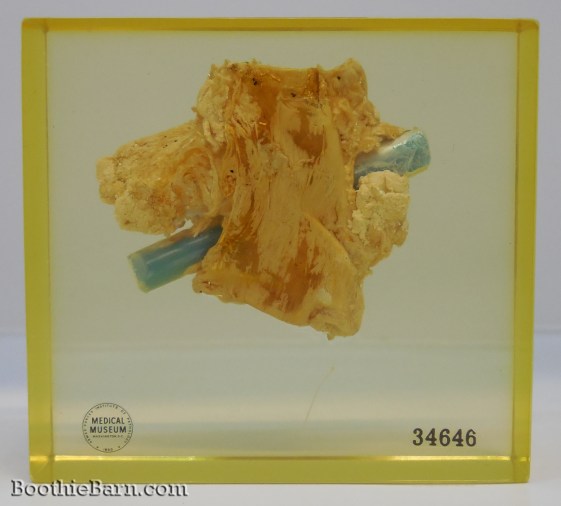
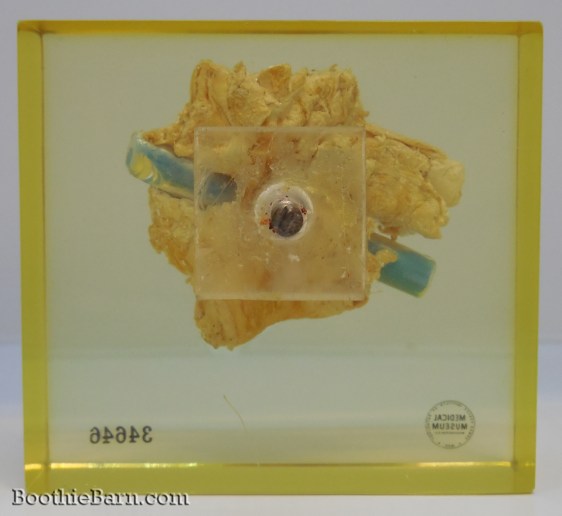
Not long ago, I visited the National Museum of Health and Medicine in Silver Spring, Maryland.  I wrote a post for this site which highlighted the connection between the museum (which at one time was called the Army Medical Museum and housed inside of Ford’s Theatre) and the assassination story, including the assassination related artifacts contained in the museum.  You can read that article by clicking HERE.  There were a couple of items that I was very interested in seeing, but they were not on display during my initial visit.  I made a return trip to the NMHM, having secured a research appointment to see some artifacts in storage there.  The artifacts I saw consisted of John Wilkes Booth’s third, fourth, and fifth cervical vertebrae, along with a piece of his spinal cord and tissue:

John Wilkes Booth Vertebrae and Spinal Cord

John Wilkes Booth's vertebrae 5

John Wilkes Booth's vertebrae 3

John Wilkes Booth's vertebrae 2

John Wilkes Booth's vertebrae 4

John Wilkes Booth's Spinal Cord 1

John Wilkes Booth's Spinal Cord 2

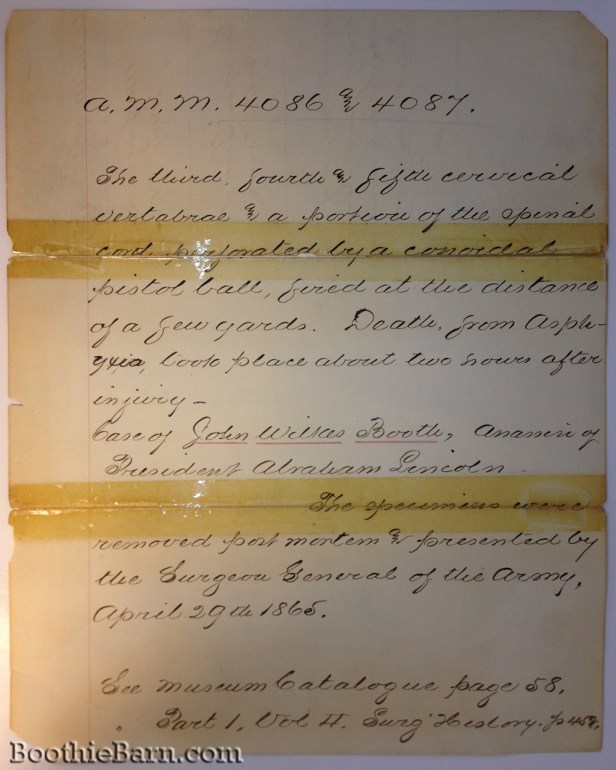
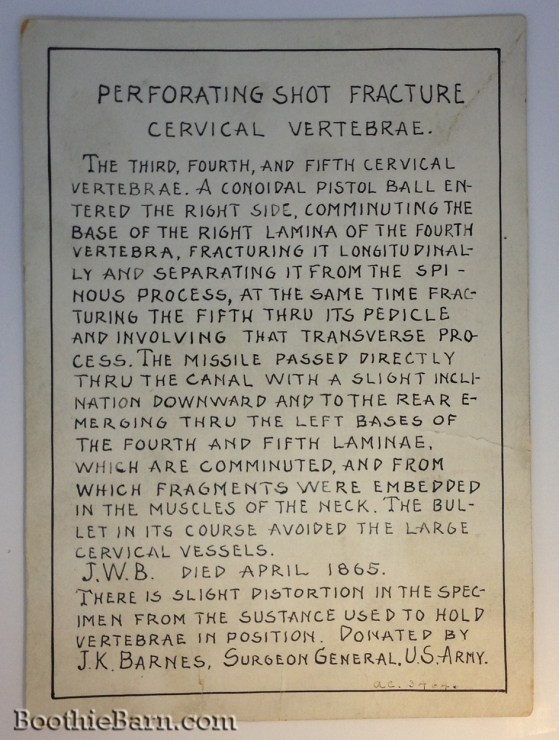
These pieces were removed from John Wilkes Booth during his autopsy aboard the USS Montauk.  The autopsy was preformed by Surgeon General Joseph K. Barnes and Dr. Janiver Woodward on April 27.  Two days later, on April 29, Dr. Barnes donated these pieces of Booth to the Army Medical Museum.  Here is some paperwork that went along with them:

Booth vertebrae paperwork

Description of Booth's Vertebrae

For convenience, here’s a transcript of the autopsy report written by Surgeon General Barnes.  The original is in the National Archives.

“Surgeon General’s Office
Washington City, D.C.
April 27th, 1865
Hon: E.M. Stanton
Secretary of War
Sir,

I have the honor to report that in compliance with your orders, assisted by Dr. Woodward, USA, I made at 2 pm this day, a postmortem examination of the body of J. Wilkes Booth, lying on board the Monitor Montauk off the Navy Yard.

The left leg and foot were encased in an appliance of splints and bandages, upon the removal of which, a fracture of the fibula (small bone of the leg) 3 inches above the ankle joint, accompanied by considerable ecchymosis, was discovered.

The cause of death was a gun shot wound in the neck – the ball entering just behind the sterno-cleido muscle – 2-1/2 inches above the clavicle – passing through the bony bridge of fourth and fifth cervical vertebrae – severing the spinal chord and passing out through the body of the sterno-cleido of the right side, 3 inches above the clavicle.

Paralysis of the entire body was immediate, and all the horrors of consciousness of suffering and death must have been present to the assassin during the two hours he lingered.

Very respectfully
Your obt servt.
J. K. Barnes
Surgeon General”

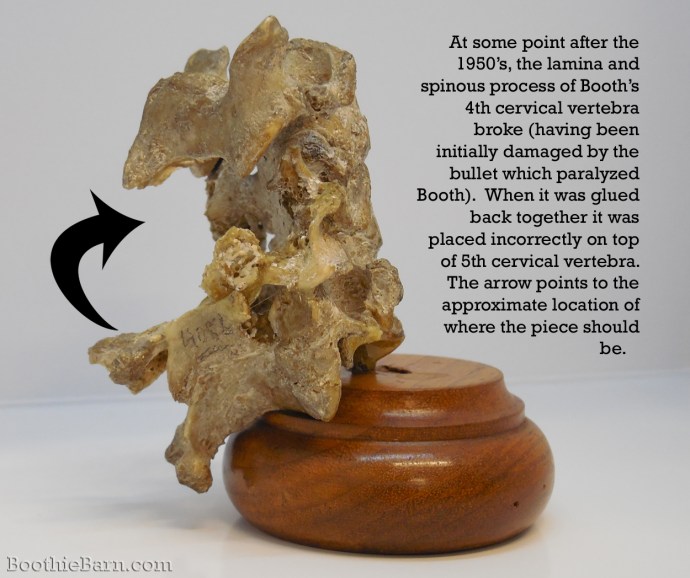
Those with medical expertise might have noticed that Booth’s vertebrae don’t look quite right. That is because, at some point after the 1950’s or so, the specimen broke. A piece of the fourth cervical vertebra broke off and it is likely that even when it was improperly repaired, a piece was still missing.

John Wilkes Booth's broken vetebrae

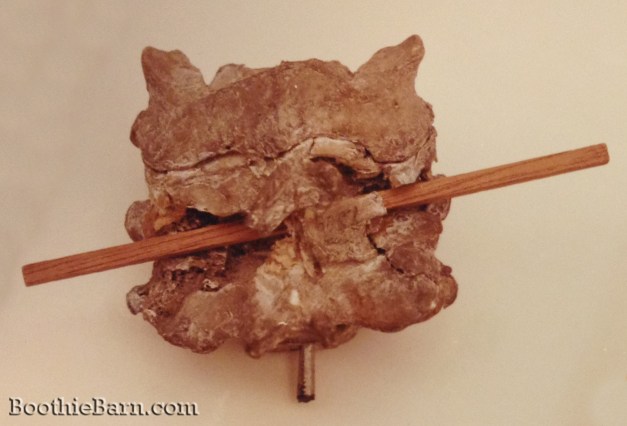
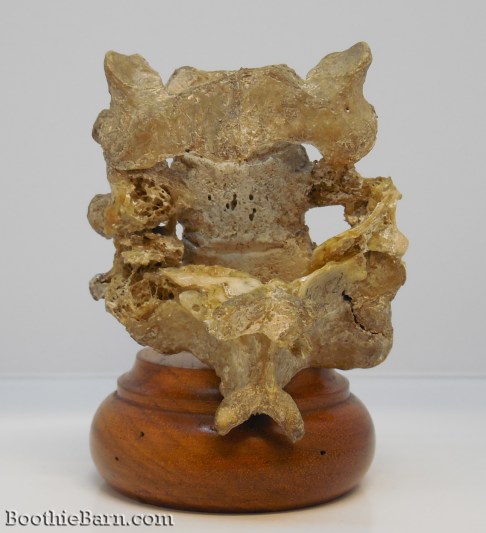
Here are two other pictures, one which shows the vertebrae before the break occurred and how it appears today for comparison.  Unfortunately, the angles are not the same between the two pictures:

John Wilkes Booth Vertebrae pre-break

John Wilkes Booth's vertebrae 1

While the National Museum of Health and Medicine expertly safeguards the artifact in order to prevent any future damage, there are those who are determined to destroy it further.  The advocates of this are the misguided escape theorists who believe that John Wilkes Booth did not die on April 26, 1865 and, instead, believe an impractical conspiracy was expertly enacted by “the government”.  Most of them have fallen for Finis Bates’ book and mummy sideshow which, while interesting in their own rights, are easily disproved.  Still, certain forces continually seek to gain approval from the NMHM to “sample” (i.e. drill a piece out of) the vertebrae in an attempt to extract DNA from it.  From there they hope to commit an even bigger moral crime  by exhuming the body of Edwin Booth, the greatest actor of the 19th century, in order to get a sample from him to compare the two.  To me, the proposed exhumation of Edwin, a man who suffered immense tragedy due to his brother’s crime and for the rest of his days was plagued with guilt and melancholy, is nothing short of morally reprehensible.  Desecrating the final resting place of the greatest Hamlet of all time just to appease those who refuse to acknowledge the mountain of evidence against them, is even worse than the destruction of this priceless artifact.  Even so, vertebrae are not good candidates for DNA extraction due to the type of bone desired for such an analysis.  In order to get a viable DNA sample, one cannot simply chip off a small piece from the side, but, instead, would need to drill into the thickest part of the vertebrae a good distance, causing severe damage to the specimen.  Luckily the National Museum for Health and Medicine understands this fully and continues to refuse any proposals that would place this artifact at risk, even when the escape theorists try to get their congressmen involved.  One of the more recent attempts occurred last year and was covered by newspapers and online articles which tricked unknowing individuals into thinking the case had merit.  Did people claim to have seen, or even been, John Wilkes Booth after his death in April of 1865? Of course, but people have also claimed to have seen (or been) Louis XVII, Elvis and even Adolf Hitler long after their deaths.  The John Wilkes Booth escape theory is an interesting sidebar, a form of pseudo-history as it were, that can be studied and enjoyed as the fanciful story it is.  However, when people actually start believing this pseudo-history and attempt to desecrate the grave of an innocent man or destroy a one-of-a-kind artifact in our nation’s museums, they are not to be humored any longer.

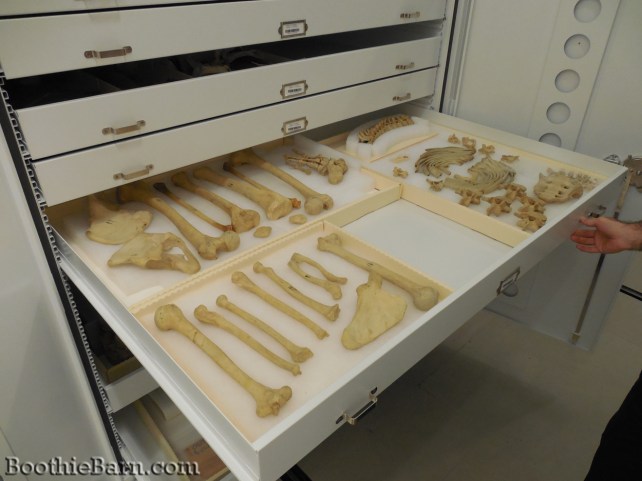
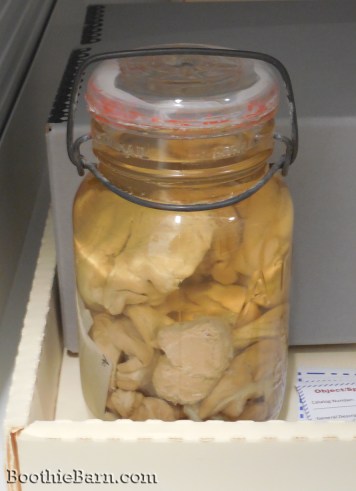
According to the National Museum of Health and Medicine they are not expecting to put the Booth items on display any time in the near future.  They remain in storage, in a drawer close to the near complete skeleton (and brain) of Charles Guiteau, the assassin of President James Garfield:

Charles Guiteau's skeleton NMHM

Charles Guiteau's brain NMHM

References:
National Museum of Health and Medicine
The Body in the Barn: The Controversy Over the Death of John Wilkes Booth by the Surratt Society 

Categories: Uncategorized | Tags: , , | 15 Comments

New Gallery – Mary Ann Holmes Booth

Mary Ann Holmes was born in 1802 to Robert and Sarah Holmes.  Her father was a seedsman and owned a plant nursery in Lambeth, a borough in South London.  It is often written that Mary Ann was a flower girl, selling flowers in front of the London theaters like Eliza Doolittle from the play Pygmalion.  It is uncertain how truthful this claim is.  Most flower girls of the day were orphans who lived on the street or the product of neglectful parents.  Some even used the guise of selling flowers as a front for prostitution.  Given that Mary Ann’s father seemed to be moderately successful in his business it seems more likely that Mary Ann assisted her father in his nursery and that the term “flower girl” is a bit misleading.

When and how Mary Ann Holmes met Junius Brutus Booth is also a bit of a mystery.  On Junius Brutus Booth’s account book for 1820, someone (likely his daughter Asia) marked an X on October 9, 1820 and wrote, “The night mother first saw my father”.  Junius played King Lear that night in Reading, a city some 35 miles away from London.  Why Mary Ann would have been so far from her London home that night is unknown, but it is possible that the Holmeses had relatives in Reading.  Junius was still married to his first wife Adelaide and had a son at this point, but he found himself quickly smitten by the 18 year-old Mary Ann.  She found herself being wooed by the 24 year-old actor who sent her constant letters and books by the poet Lord Byron.  Their courtship was brief and in January of 1821, the couple ran away together.  They first spent time visiting two cities in Northern France.  They then returned to England and set sail for the islands of the Caribbean, where Junius would tour.  On route the boat stopped at the Island of Madeira, a Portuguese territory off the coast of Morocco.  The couple fell in love with the island and stayed there for several weeks.  When they decided to leave they booked passage on the schooner “Two Brothers” and this time their destination had changed.  When they got off the boat on June 30, 1831, Junius Brutus Booth and Mary Ann Holmes were in America.

In America, Mary Ann gave birth to ten children, spanning a theatrical dynasty.  For over 54 years she witnessed her family’s immense success and incomprehensible  tragedies.  She outlived her husband by over 30 years and buried six of her children.

The newest Picture Gallery contains images relating to the life and Mary Ann Booth nee Holmes.  To visit the gallery, click on Mary Ann’s picture on the image below or click HERE.

Mary Ann Holmes Booth Pictures

Click for Junius Brutus Booth Click for Mary Ann Holmes Booth Click for Junius Brutus Booth, Jr. Click for Rosalie Ann Booth Click for the Booth children Click for Edwin Thomas Booth Click for John Wilkes Booth Click for Joseph Adrian Booth

References:
Junius Brutus Booth: Theatrical Prometheus by Stephen M. Archer
“Mary Ann Doolittle? The “Flower Girl” Myth of the Booths’ Mother” by Deirdre Barber Kincaid, Surratt Courier, March 2004

Categories: Uncategorized | Tags: | 7 Comments

Junius Brutus Booth and the Fat Girl

Junius Brutus Booth was a mad theatrical genius and victim of severe mood swings. After one engrossing performance he had a chance meeting with a professional sideshow performer in the cramped backstage area. The result is documented as follows:

Junius Booth and the Fat Girl 1851

The real name of the “fat girl” who crossed paths with Booth was Hannah Crouse. From the age of 6, Hannah’s immense weight was commented on in newspapers and she soon found herself making a living as a traveling human oddity. Here is a newspaper advertisement from a time she was exhibiting herself in Washingon, D.C.

Hannah Crouse

As Hannah grew older, her weight did as well. A 1854 advertisement for the then 20 year-old girl, highlighted that she was:

“The youngest of all the Large Women, very intelligent and active, and weighing more than any other woman ever known – but she really does not weigh more than 900 pounds. We challenge the world to produce her equal.”

As time went on, Hannah Crouse was sometimes confused with another famous “Large Woman” of the era, Hannah Perkins. Ms. Perkins achieved even greater fame by touring with P. T. Barnum. She ended up marrying another performer named John Battersby who exhibited himself as the “Living Skeleton”.

Hannah and John Battersby

While Hannah Crouse survived her backstage encounter with the confused and frenzied Junius Brutus Booth, undoubtedly her immense weight contributed to her early demise. Hannah Crouse died in August of 1856 at the age of 21 or 22.

Categories: Uncategorized | Tags: | 5 Comments

New Gallery: Junius Brutus Booth

Junius Brutus Booth was the patriarch of the Maryland Booths.  Born in England, he achieved early fame in London theaters rivaling the biggest stars of the day.  He immigrated to America with his love, Mary Ann Holmes, fleeing his from his real wife and eyeing even greater success in this country.  America welcomed him with open arms and for decades he toured the nation as a unparalleled theatrical genius.  With genius also came madness.  Junius was known to be so passionate and enveloped in the characters he portrayed that, mixed with increasing bouts of drunkedness, he often blurred the line between his real life and the dramatic characters he played on the stage.  This caused stress for the Booth family but, when sober, Junius was a very devoted husband and father.  He inspired three of his sons to make theater their career and influenced generations of actors.  The newest Picture Gallery here on BoothieBarn is devoted to this passionate leader of the Booth Family, Junius Brutus Booth.

To visit the Junius Brutus Booth Gallery, click on Junius Brutus Booth’s picture on the image below or click HERE.  In time I’ll be creating other galleries for the rest of the Booths.

To learn more about Junius, read Dr. Stephen Archer’s unparalleled biography, Junius Brutus Booth: Theatrical Prometheus


Click for Junius Brutus Booth Click for Mary Ann Holmes Booth Click for Junius Brutus Booth, Jr. Click for Rosalie Ann Booth Click for the Booth children Click for Edwin Thomas Booth Click for John Wilkes Booth Click for Joseph Adrian Booth
Categories: Uncategorized | Tags: | 3 Comments

The Mystery of the Booth Epitaphs in Green Mount Cemetery by John C. Brennan

In the age before home computers and the internet, John Calder Brennan was the first search engine.  His passion for investigation and gift for correspondence allowed him to find the answer to any question posed to him.  And, like a search engine, John C. Brennan was a selfless sharer.  When he found a new piece of information about the Lincoln assassination, Mr. Brennan immediately took out his typewriter and carbon paper and sent out a dozen copies to the people on his Boothie mailing list.  For the more personal touch, “John C. Brennan in Laurel, Maryland” would often narrate the information using a system of 10 or more tape recorders connected together.  Though he never published his own book, Mr. Brennan’s name can be found in the acknowledgements of many.  He passed away in 1996 at the age of 87.

John C. Brennan dowsing for John Wilkes' grave on the Booth family plot in Green Mount Cemetery in 1988.

John C. Brennan dowsing for John Wilkes’ grave on the Booth family plot in Green Mount Cemetery in 1988.

In going through some of the files given to me by the late Art Loux, I stumbled across an extremely well researched and well written article composed by Mr. Brennan in 1990.  It appears that sometime in 1988 a gentleman wrote a letter to Mr. Brennan asking about the Booth family monument in Green Mount Cemetery.  He wanted to know whether the obelisk on the grave today was the original that had been changed over the years or was a new one.  As usual, Mr. Brennan went to work.  He wrote letters to dozens of people and organizations gathering information.  He scoured books and newspapers.  After two years, he had detailed the unique saga of the Booth family monument.  He wrote up his research in an article which he intended to submit to the Maryland Historical Society for inclusion in their monthly publication.  From what I can tell, either Mr. Brennan did not submit his article or the Society decided not to publish it.

Below I present a transcription of Mr. Brennan’s article, knowing that he would approve of it being shared.  In this way the search engines that followed him can make it available to the entire world, and not limited to carbon paper.


 The Mystery of the Booth Epitaphs in Green Mount Cemetery

by John C. Brennan


Junius Brutus Booth, the great Shakespearean actor, died in 1852 while en route from the West Coast to his home in Baltimore1.  His widow undoubtedly chose to bury him in Baltimore Cemetery at the eastern end of North Avenue for the reason that he had had his father, Richard Booth, reburied there the preceding year2.

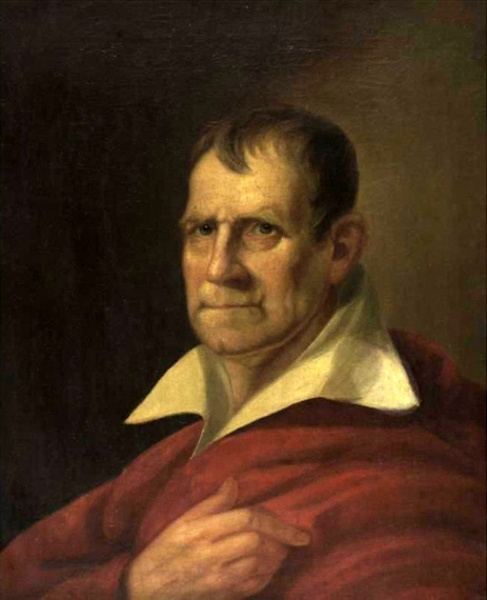
Painting of Junius Brutus Booth, father of the Maryland Booths

Painting of Junius Brutus Booth, father of the Maryland Booths

Edwin Booth, the nineteen-year-old second eldest son, who invariably took on all the family’s problems, was also a notable Shakespearean  actor, ultimately rivaling if not surpassing his father in celebrity.  Edwin was on tour when his father died, and did not return from Australia via the West Coast until 1855, evidently well-heeled from his stage appearances3.  He soon commissioned a distinguished Boston sculptor, Joseph Carew, to carve the dignified and stately (and expensive) monument that, shipped down to Baltimore by water, was erected on his father’s grave4 on May 1, 1858, the parent’s 62nd birthday.  Because the elder Booth had attained such eminence incident to his stage successes (as well as notoriety because of his eccentricities and escapades), details of the monument, including its precise measurements were thought newsworthy enough to be carried by an 1858 theatrical magazine5, all measurements proving to be the same today as they were originally.

Another not quite so detailed description of the Booth monument was published in an article appearing in the New York Times of August 7, 1858, about two months after its erection in Baltimore Cemetery, the writer being one Adam Badeau, a close friend of Edwin’s who later became a member of General Ulysses S. Grant’s staff6.  Badeau wrote that:

“On our way to town [from Tudor Hall, the Booth home near Bel Air, Maryland] we stopped at the cemetery where the worthy son of such a father had erected a beautiful and costly monument to the memory of the great actor whom he resembles.  ‘Tis an obelisk of polished Italian marble, on  a pedestal of undressed granite, some twenty feet high, and the work of Carew, the eminent Boston sculptor.  On one side are the dates of the birth and death of the tragedian, with his name in full; on another, simply the word Booth; on the third is a medallion head, full of character and beauty, both as a work of art, and as the representation of a noble, soulful face – ’tis extremely like the profile of the son.  The third side also bears this inscription [and hereinafter the inscription will be referred to as Epitaph No. 1]:

“His life was gentle; and the elements
So mixed in him, that Nature might stand up,
And say to all the world — This was a man.”

It is not anywhere stated that this first epitaph was applied in bas relief form, which it probably was inasmuch as Edwin seemed to prefer raised lettering and likenesses — as witness the present-day outsized word BOOTH, the writings on all three sides of the obelisk, the graceful frame enclosing the epitaph, and the embossed portrait of Junius Brutus.

How long it took Edwin to wake up to the fact that the Shakespearean quotation constituting Epitaph No. 1 was a thoroughly stereotyped vague one that could be used for any male decedent, and did not begin to reflect his father’s universally recognized status, is not known but, as will be seen below, he “came to” early in 1869 and used an original and eminently appropriate one (on a new, freshly carved obelisk) incident to the disassembly of the monument and its re-erection in Green Mount Cemetery7.

The tragic disruption in the lives of all the Booths was of course caused by John Wilkes Booth’s murderous act of April 14, 1865. Retribution was exacted of the assassin at the Garrett farm near Port Royal, Virginia, on April 26, and his body, held captive by the Federal government, was originally rumored to have been buried in the ocean or in the Potomac River8.  Eventually the family learned that Wilkes’ remains had been secretly interred under the floor of a building at the Old Arsenal Prison (Now Fort Lesley J. McNair) in southwest Washington, D.C.9

The unbelievable coincidence that Edwin Booth had once saved the life of the Lincolns’ son, Robert Todd, by pulling him out of the path of an oncoming train10, had undoubtedly been made known to General Grant by his aide, the previously mentioned Adam Badeau, and Grant, probably at Badeau’s insistence, had written Edwin to say that, if at any time he could be of service, he would.

Adam Badeau and General Grant

Adam Badeau and General Grant

Relying on this commitment, Edwin wrote Grant in September 1867, asking his intercession for the release of his brother’s body — which request Grant ignored.  A second request of February 15, 186911, made by Edwin direct to President Andrew Johnson, received prompt and favorable consideration, whereupon Edwin immediately began planning to establish a family lot in Green Mount in which Wilkes would be one of the first occupants.  He purchased two adjoining lots for $250 in  the name of his mother, Mrs. Mary Ann Booth, and a few years later made another payment of $100 for perpetual care12.

At the time of Junius Brutus Booth’s death in 1852, a man named William Thompson, editor of the Washington News newspaper, wrote Edwin’s beautiful and highly literate sister, Asia, a very kind letter enclosing an epitaph “which he hoped would be thought worthy to be placed upon his [Junius’] monument.” “My brother, Edwin,” Asia revealed, “at a much later period13 was pleased to have it carved on the the monument he erected to his father’s memory.” (The outstandingly apt lines, which follow, will hereinafter be referred to as Epitaph No. 2.)

“Behold the spot where Genius lies,
O, drop a tear when talent dies;
Of Tragedy the mighty chief,
The power to please surpass’d belief,
Hic jacet, matchless Booth.”

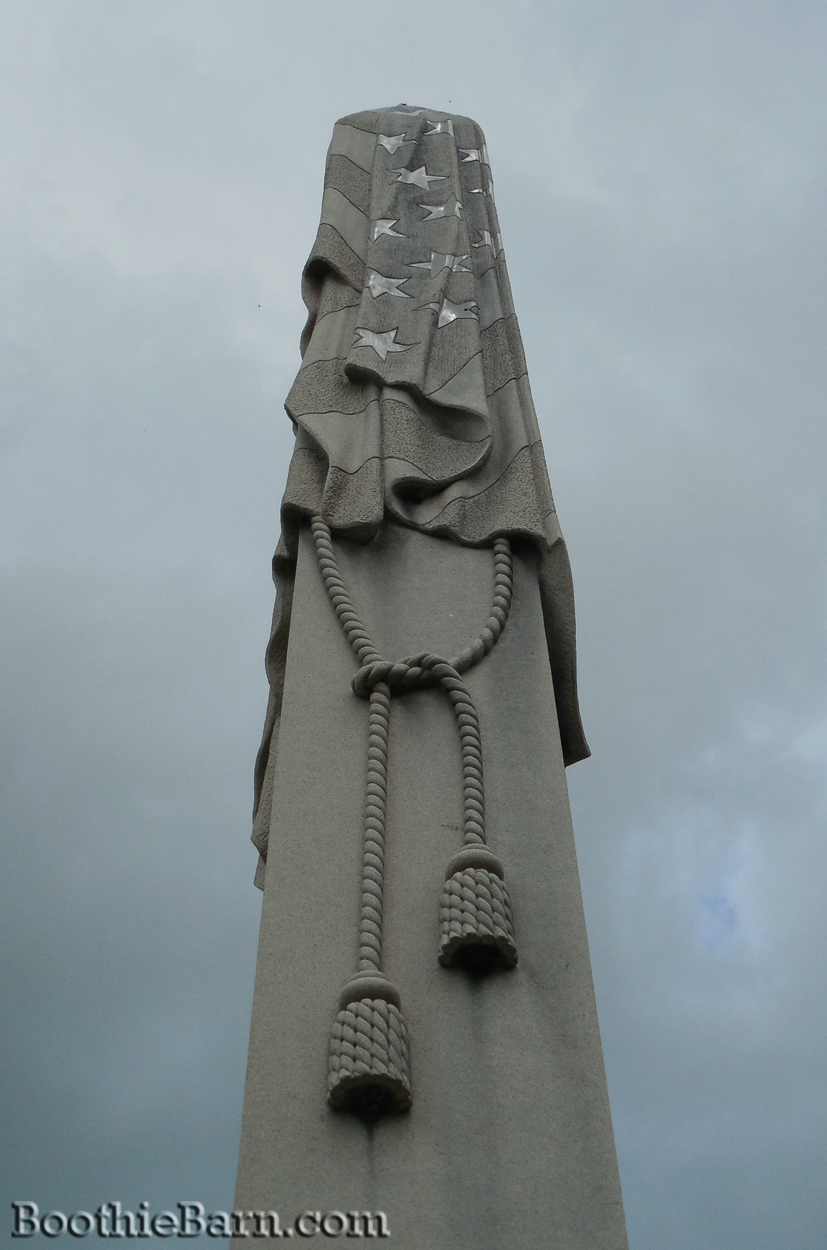
The 1869 re-erection of the monument in Green Mount, using an identically carved nine-foot obelisk to bear the beautiful poem just quoted, constitutes the first of Edwin’s two successful attempts to preserve unaltered the majestic original lines and appearance of the 1858 Carew sculpturing.  Fortunately for the sake of pictorial evidence a long search for a likeness of the monument before the third and final legend was applied yielded an 1875 woodcut of a distant but clean-cut view that is reproduced herewith14, and there is firm documentation that the shaft still bore Epitaph No 2 (Behold the spot, etc.) up to late 188515.

Booth grave Scribner's April 1875

As flattering and biographically accurate as the poetic Epitaph No. 2 was, Edwin felt forced, for a compelling reason, to discard it and arrange to have Epitaph No. 3, the final one, embossed on another sculptured obelisk after his mother’s death.

Here it becomes necessary to interrupt the continuity of this recital to state that there is still to be seen in Baltimore’s New Cathedral (Catholic) Cemetery a legible upright stone marking the grave of a woman whose maiden name was Mary Christine Adelaide Delannoy16, whom Junius Brutus Booth at age nineteen married in England in 1815, proclaiming that at the time of her death in 1858 she was the “wife of Junius Brutus Booth, tragedian.”

BOOTH, ADELAIDE - LOUDON PARK

This Belgian wife had previously cast a blight on the name of Edwin’s mother and on the legitimacy of her offspring during the time that she, Adelaide, was establishing residence in Baltimore preparatory to suing Junius for divorce in 1851 shortly before his death.  Adelaide alleged that her husband, Junius, had lived for many years past with a woman (Mary Ann Holmes) by whom he had a large family of children17.  The divorce was duly granted, and Junius and Mary Ann then became husband and wife on John Wilkes’ thirteenth birthday, May 10, 1851.  So, upon the death of his beloved mother in late 1885 Edwin felt constrained to place in marble on the third obelisk (in bas relief) an inconspicuous five-line assertion (replacing the five-line poem) that he mother was in fact his father’s “wife”:

“In the same grave with
Junius Brutus Booth,
Is buried the body of
Mary Ann, his wife, who
Survived him 33 years.”18

The Baltimore American’s account of Mrs. Booth’s funeral (she died in New York on October 22, 188519) quoted in full the soon to be replaced, captivating Epitaph No. 2 beginning “Behold the spot where Genius lies.”

In winding down this article it may be worthwhile to give the gist of what utilizing logic and common sense, it seeks to prove — that there was no way in the world in which Edwin Booth could have effected the described change in epitaphs without having commissioned experienced and artistic marblemen, of which there was certainly no shortage in Baltimore in the Victorian period, to produce identical reproductions of the Carew shaft.

An informal poll taken in writing among a half dozen knowledgeable and seasoned graveyard buffs, all frequent visitors to Green Mount and the Booth lot, confirms the certainty that the original obelisk could not possibly have been sandblasted or shaved or chiseled and still maintain, as it does, its 1858 measurements.  The base of the present shaft still fits precisely on what seems to be the original badly eroded and weatherized marble seat20.

If there was anything that the Booths sought to avoid after the Lincoln assassination it was publicity about their personal lives and activities, and in his changing the obelisk inscriptions Edwin must have gone to great pains to preserve secrecy and avoid arousing the curiosity of the press21.  The way he went about doing what he did was much, too much, for the author of the most detailed and authoritative book on Wilkes’ death and burials, George S. Bryan’s The Great American Myth22 , which volume carries a full photograph of the monument but otherwise omits all mention of it in the text.  The late Stanley Kimmel, who spent six years in research before writing his classic The Mad Booths of Maryland23 revealed himself to be completely baffled by the changes in inscriptions — touching only gingerly on one of them and in doing so perpetrating a first-class non sequitur24. A third intriguing and highly readable account of practically every aspect of the Lincoln assassination is Theodore Roscoe’s The Web of Conspiracy, whose 560 pages fail even to mention Green Mount Cemetery25.

The canvass made of graveyard buffs seeking agreement or disagreement with this hard-to-believe solution to the epitaphs mystery also asked for guesstimates as to which are the most-visited graves of famous/infamous people in the United States.  John Wilkes Booth came out fifth in this survey of opinions, with those topping him being the Unknown Soldier and President Kennedy in Arlington Cemetery, President Abraham Lincoln in Springfield, Illinois, and Elvis Presley in Memphis, Tennessee.  Along with the magnificent assortment  of sunlit photographs illustrating Green Mount’s centennial hardback of 1938 (Wilkes would also have been 100 in 1938), the noted Baltimore historian Gerald W. Johnson wrote on page 33 that Green Mount began to take on national and international note when the elder Booth was buried there.  Certainly Mr. Johnson knew, and well knew, that it was not (and is not) Junius Brutus Booth who attracts constant visitors to Green Mount, but the elder Booth’s beloved and errant son, the ill-starred assassin, John Wilkes Booth.

Footnotes:
1 – 5
5 – 14
14 – 20
20 – 21
21 – 25


Addendum by Dave:

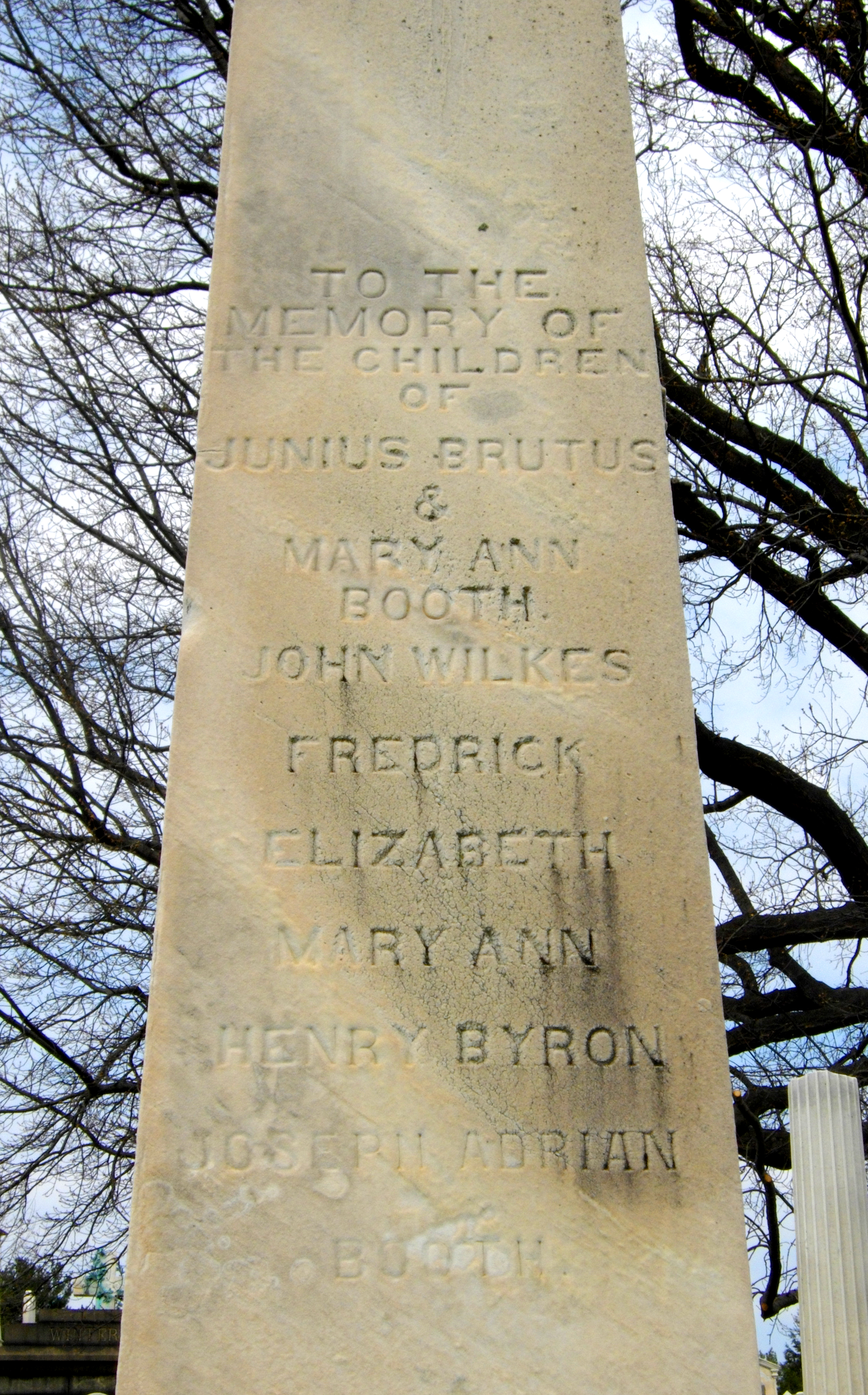
As stated in the article the current obelisk is the third one commissioned by Edwin Booth.  Each time Edwin had the epitaph changed he required the construction of a new, but nearly identical stone.  All the lettering on the monument is in bas relief except for the back, which lists some of the children of Junius and Mary who were buried there.

Back of the Booth monument

The fact that this lettering is not in bas relief like the rest of the monument makes it seem like this side was carved in later.  Additional clues makes it likely that additional carving was done a second time after Joseph Booth died.  Here’s the likely scenario:

At some point after the final obelisk was erected around 1885/86 some member of the Booth family thought it would be wise to put the names of the four Booth children who died in childhood onto it.  Three of these children, Frederick, Mary Ann, and Elizabeth had been interred here in 1869, while the fourth, Henry Byron, had been buried in England.  Though some say his body was also brought back at a later date I have yet to find conclusive evidence for this.  Regardless, since carving the stone could be done without moving it, this was chosen instead of creating a fourth obelisk in order to have the names in bas relief.  Looking at the spacing it seems clear that the stone was likely carved:

“To the
Memory of
the Children
of
Junius Brutus
&
Mary Ann
Booth


Frederick

Elizabeth

Mary Ann

Henry Byron”

This order makes sense since this was the order in which the children died.  If you pretend John Wilkes’ name is not there you can see that there was supposed to be a nice space between the parents’ and the children’s names.   It does not appear that either Joe’s name or John Wilkes’ name were on the stone at first.  Joe was the longest living of the Booth children and died in 1902.  Upon his death he was buried in the family plot and has his own stone just like Asia and Rosalie.  Someone, however, thought his name should be added to the list on the obelisk even though none of the other Booth children who had grown to adulthood were on there.  The person who most likely did this was Cora Mitchell Booth, Joe’s second wife and cousin.  Not only did she add Joe’s name to the bottom of the list but also, for some inexplicable reason, she also took pity on the long dead John Wilkes and had his name squeezed in near the top.  Cora Mitchell Booth was the last person to be buried in the Booth lot when she died in  1936 and she has a stone beside her husband, Joseph, and infant son.

Categories: Uncategorized | Tags: | 5 Comments

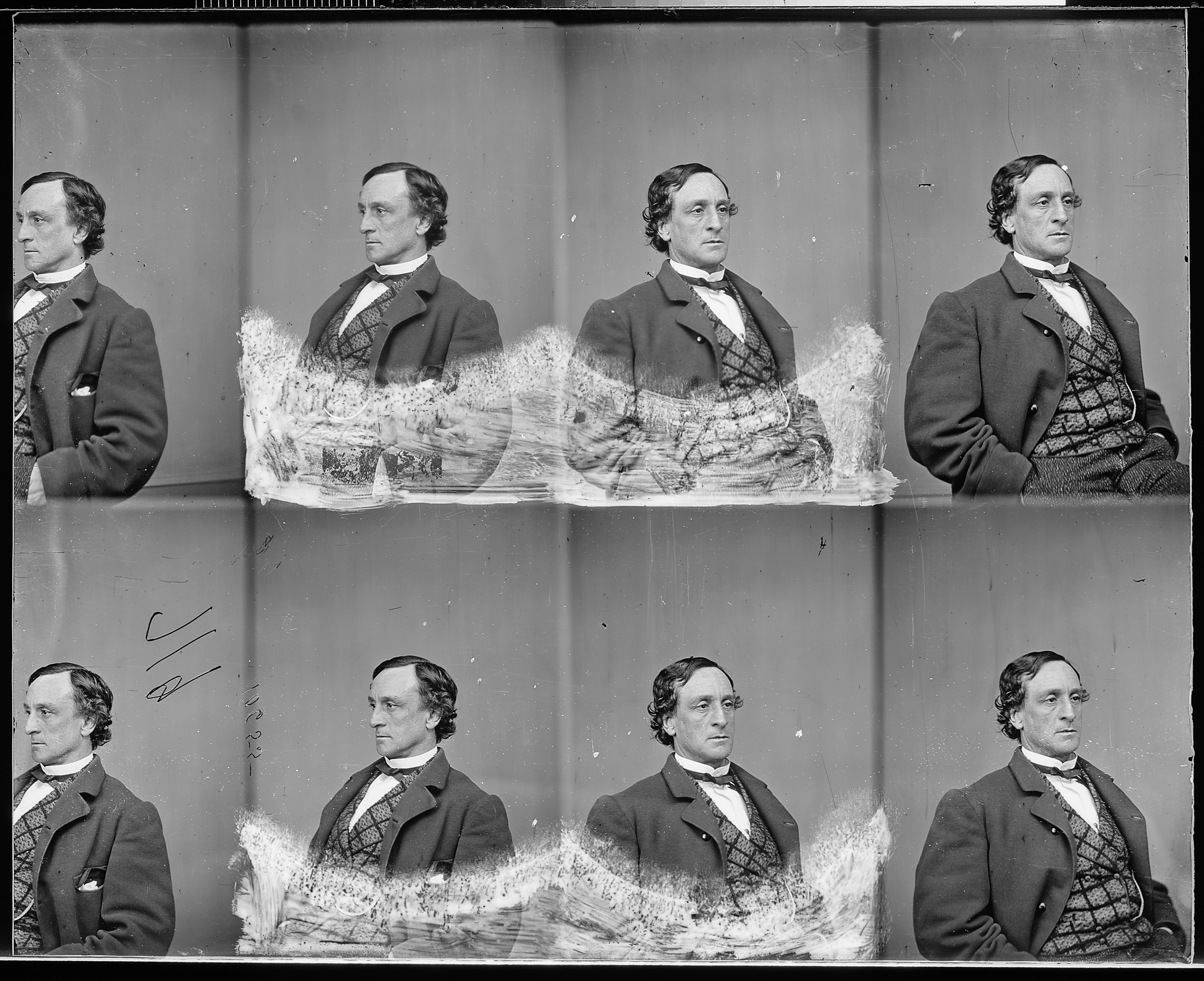
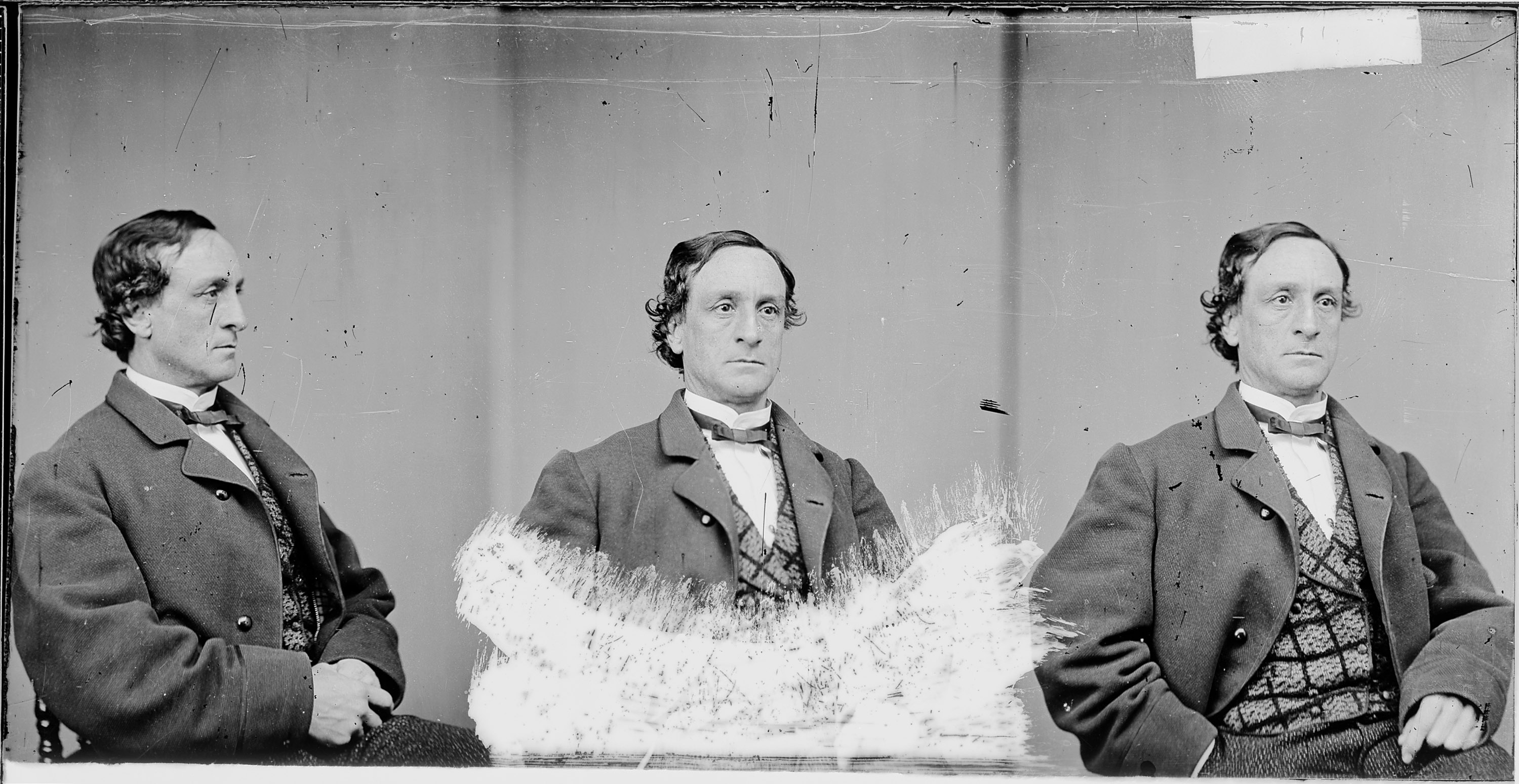
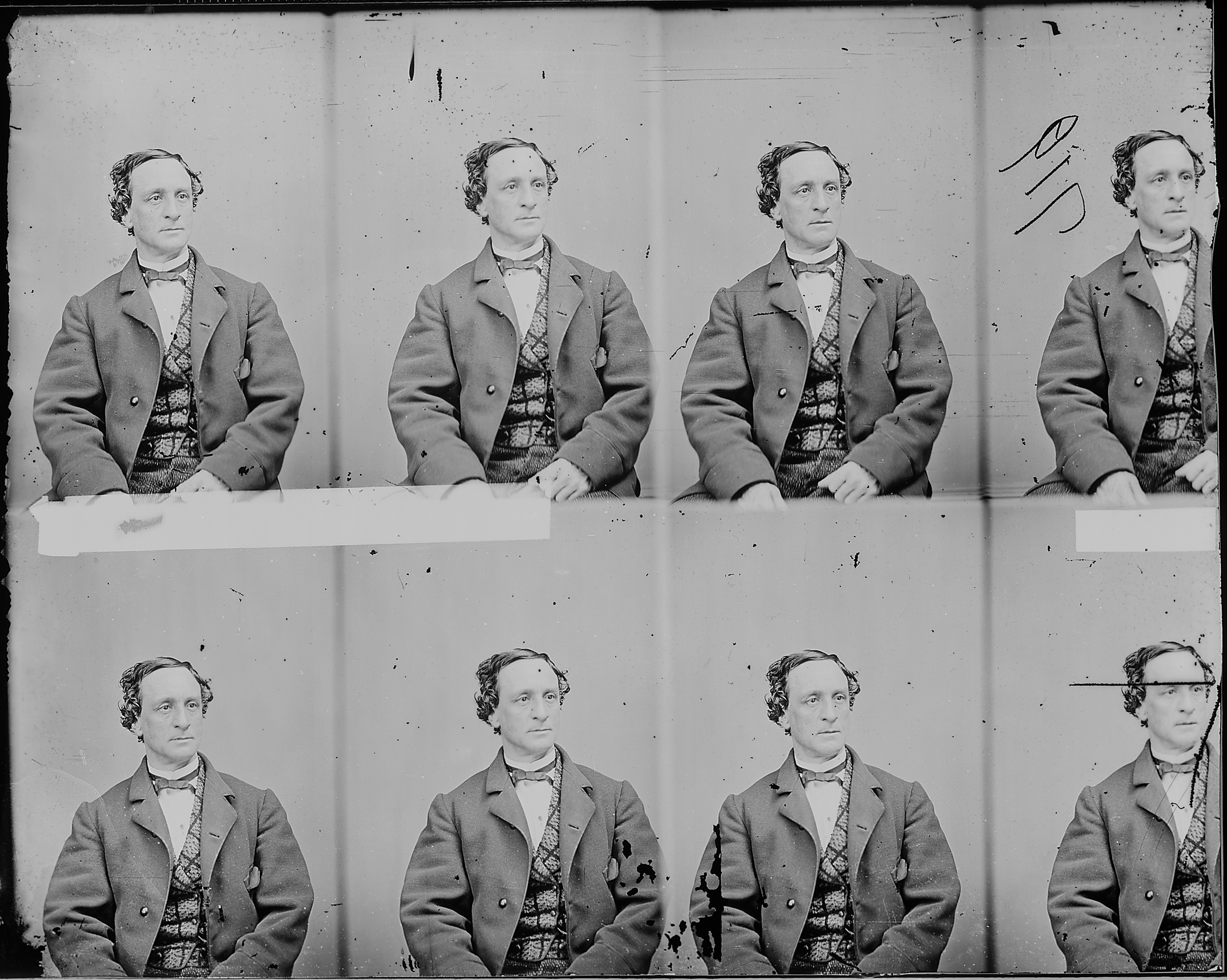
Photo of the Day: Junius Brutus Booth, Jr.

Junius Brutus Booth, Jr. was the eldest child born to Junius Brutus Booth and Mary Ann Holmes.  June, as he was called by the family, attempted to follow in his father’s theatrical footsteps, but seemingly lacked the “spark of genius” that made his father a star.  June was a full 11 years older than his brother Edwin and 16 years older than John Wilkes.  He was soon eclipsed professionally by his younger brothers’ talent, and later, infamy.  Nevertheless, June made a career out of the theater both onstage as an actor and offstage as a theatrical manager.  The following pictures of June were taken by Mathew Brady’s Studio at around the time of the Civil War. Click them to enlarge the images.

Landscape Landscape Landscape

Image Sources: National Archives


Categories: Uncategorized | Tags: | 1 Comment

The National Museum of Health and Medicine and the Lincoln Assassination

The National Museum of Health and Medicine is a medical museum located in Silver Spring, Maryland.  The museum has a long history and was originally founded during the Civil War as the Army Medical Museum.  Its original purpose was to be a repository for, “all specimens of morbid anatomy, surgical or medical, which may be regarded as valuable; together with projectiles and foreign bodies removed, and such other matters as may prove of interest in the study of military medicine or surgery.” Since its founding to today, the museum has amassed a collection of nearly 25 million medical artifacts.  Though less than 1% of the collection is on display at the Silver Spring facility due to space constraints, the museum is, nevertheless, filled to the brim.  Walking into the museum, guests quickly come face to face with medical oddities and fascinating exhibits.  A wonderful museum in its own right, the NMHM has also become intimately connected with the story Lincoln’s assassination through the years.

A Place to Rest My Bones

Having been founded during the Civil War, the collection grew rapidly during its first few years as surgeons on the field of battle began sending in specimens.  By 1866, the museum was on its third home in Washington, D.C. and required even more space.  Luckily for them, on April 6, 1866, an Act of Congress was passed providing for the purchase of a building “for the deposit and safekeeping of documentary papers relative to the soldiers of the army of the United States and of the Museum of the Medical and Surgical Department of the Army.”  The chosen building was Ford’s Theatre the site of Abraham Lincoln’s assassination almost a year before.

Ford's Theatre Army Medical Museum Label

The building was closed down by the U.S. government in the aftermath of the assassination.  Though the building was returned to John T. Ford for a time, public outcry and threats to burn the building if it was once again opened as a theater forced the government to seize the building permanently.  At first they rented it from Ford before buying it straight out thanks to the approval of the above mentioned Act of Congress.  The interior of the building was remodeled from a theater into a three story office building.  On December 22, 1866, the top floor of Ford’s Theatre officially became the Army Medical Museum’s fourth home.
Here are some pictures of the interior of the Army Medical Museum when it was held on the third floor of Ford’s Theatre.  Most of these come from the blog “A Repository for Bottled Monsters” which is written by a former archivist of the museum:

This slideshow requires JavaScript.

By 1887, the museum had once again outgrown its surroundings and moved into a building made solely for its purpose. This brought an end to the Army Medical Museum’s occupation of Ford’s Theatre. In hindsight the move in 1887 proved lucky. Six years later, in 1893, poor workmanship by a crew excavating in the basement of Ford’s caused a structural pier to give way, causing a 40 foot section of all three floors to come crashing down, killing over 20 government clerks and wounding many others.

Booth’s Spine Tingling Return

When it was housed inside Ford’s Theatre, the Army Medical Museum was a popular tourist destination in Washington. The museum saw about 40,000 visitors in 1881 alone.  In 1873, a book was published called, Ten Years in Washington: Life and Scenes in the National Capital as a Woman Sees Them by Mary Clemmer Ames.  In her book, Ms. Ames described a visit to the Army Medical Museum and points out the many oddities on display.  The book also contains this engraving of the museum inside of Ford’s:
Army Medical Museum in Ford's Theatre engraving 1873

As part of her description of some of the artifacts, Ms. Ames states the following:

“Amid the thousands of mounted specimens in glass cases, which reveal the freaks of bullets and cannon-shot, we come to one which would scarcely arrest the attention of a casual observer. It is simply three human vertebra mounted on a stand and numbered 4,086. Beside it hangs a glass phial, marked 4,087, filled with alcohol, in which floats a nebulse of white matter. The official catalogue contains the following records of these apparently uninteresting specimens:

‘No. 4,086. — The third, fourth and fifth cervical vertebrae. A conoidal carbine [sic] ball entered the right side, comminuting the base of the right lamina of the fourth vertebrae, fracturing it longitudinally and separating it from the spinous process, at the same time fracturing the fifth through its pedicles, and involving that transverse process. The missile passed directly through the canal, with a slight inclination downward and to the rear, emerging through the left bases of the fourth and fifth laminse, which are comminuted, and from which fragments were embedded in the muscles of the neck. The bullet, in its course, avoided the large cervical vessels. From a case where death occurred in a few hours after injury, April 26, 1865.’

‘No. 4,087.— A portion of the spinal-cord from the cervical region, transversely perforated from right to left by a carbine [sic] bullet, which fractured the laminse of the fourth and fifth vertebrae. The cord is much torn and is discolored by blood. From a case where death occurred a few hours after injury, April 26, 1865.’

Such are the colorless scientific records of the death wounds of John Wilkes Booth. All that remains of him above the grave finds its perpetual place a few feet above the spot where he shot down his illustrious victim.”

After John Wilkes Booth was killed at the Garrett farm, his body was brought back to Washington and deposited aboard the ironclad ship, the U.S.S. Montauk. It was there that Booth’s autopsy was performed. The body was thoroughly identified and the section of Booth’s vertebrae, through which Boston Corbett’s pistol ball had passed, was removed. In addition, an inspection of Booth’s broken leg was made and, for some reason, his thoracic cavity was opened. Shortly after the autopsy was performed, Booth’s body was taken to the Arsenal Penitentiary and secretly buried. In 1869, Booth’s body and the bodies of the executed conspirators were released to their families.  Booth’s vertebrae along with a piece of his spinal cord, however, found their way into the collection of the Army Medical Museum and were in the collection by 1866 according to one of the museum’s collection catalogs. John Wilkes Booth’s vertebrae and spinal cord were publicly on display at Ford’s Theatre in 1873 when Ms. Ames visited. Here is an 1873 engraving of the bones that she included in her book:

Booth's Vertebrae drawing Ten Years in Washington

The vertebrae and spinal cord of John Wilkes Booth are still part of the collection of the National Museum of Health and Medicine though they are not currently on display at the Silver Spring facility.  Here is a picture of the specimens taken a few years ago by the AP:

Booth vertebrae spine AP

I am hoping to make an appointment to view the vertebrae and piece of spinal cord in person and to look through the NMHM’s records regarding this artifact.  Hopefully a follow up will be posted at a later date. UPDATE: Click here to read about my research visit with John Wilkes Booth’s vertebrae.

When Powell Lost his Head

At the same time that John Wilkes Booth was assassinating President Lincoln at Ford’s Theatre, conspirator Lewis Powell was attacking William Seward, the Secretary of State, in his home.  Powell stabbed and bludgeoned five people in the Secretary’s home, but, miraculously, they all survived their brushes with death.  Powell was tried with the other conspirators and executed on July 7, 1865.  His body was immediately buried next to the gallows on the Arsenal Penitentiary grounds.

9 The Pine Boxes

In 1867, Powell’s body was disinterred and reburied in a trench that was dug inside a warehouse on the Aresnal property.  There he was joined by the bodies of fellow conspirators John Wilkes Booth (minus his vertebrae), David Herold, George Atzerodt, and Mary Surratt.  The trench also contained the remains of Andersonville Prison commandant Henry Wirz who had been executed for his wartime crimes in November of 1865.  In the waning hours of Andrew Johnson’s presidency in February of 1869, Johnson finally consented to the release of the conspirators’ bodies to their respective families.  The bodies of Booth, Herold, Surratt, Atzerodt, and Wirz were all claimed and reburied by their families.  Powell’s family, who had previously tried to claim the remains and had been denied, were not made aware that they could now take possession of their kin.  For a year, Powell’s body remained the only one still buried on the Arsenal grounds.  Finally, in February of 1870, an undertaker named Joseph Gawler (who also handled the reburial of David Herold) took possession of Powell’s body and had it buried secretly in one of D.C.’s cemeteries.  1870 newspaper accounts stated that, “family and friends could find his grave by contacting him [Gawler] as he had a record of where he is buried.”  The Powell family, who had moved a few times in Florida since Lewis’ death, apparently never heard the news.

The location of Powell’s remains from 1870 onward is a little fuzzy, but an extremely probable series of events was determined by Lewis Powell’s biographer, Betty Ownsbey, in an article she wrote for the October 2012 edition of the Surratt Courier entitled, “And Now – The Rest of the Story: The Search for the Rest of the Remains of Lewis “Paine” Powell“.  Using newspaper sources and cemetery records, it appears that Powell was originally transported from the Arsenal and interred in Graceland Cemetery.  At some point between 1870 and 1884 Powell was removed from Graceland and placed in Holmead Cemetery.  Not long after he was placed there, Holmead Cemetery was discontinued as it was considered a public health hazard.  The land was slated to be sold and developed in January of 1885.  Families with means disinterred their loved ones from Holmead and reburied them elsewhere.  All the unclaimed bodies still left in Holmead were exhumed in December of  1884 and dumped into a mass grave at nearby Rock Creek Cemetery.  Joseph Gawler was one of the undertakers who assisted with this endeavor.  By 1884 it had been almost 20 years since Lewis Powell’s death and it must have been very clear to Gawler that no one was coming for the body and that he was not going to be paid for the work he had done keeping track of it over the years.  It is with a very high likelihood that Gawler added Lewis Powell’s remains to the mass grave at Rock Creek and his body is there today in Section K, Lot 23.

The assumed resting place of Lewis Powell's body, Section K, Lot 23 in D.C.'s Rock Creek Cemetery

The assumed resting place of Lewis Powell’s body, Section K, Lot 23 in D.C.’s Rock Creek Cemetery (approximate location)

While Lewis Powell’s body may be at Rock Creek Cemetery, his head definitely isn’t.  The conspirators were not embalmed upon their deaths and through their subsequently reburials, their bodies were consistently exposed to oxygen which accelerated their decay.  The connective tissues of Powell’s head and neck, likely damaged by his hanging in 1865, would have quickly decomposed away separating his head from the body.  According to newspaper accounts, a few of the conspirator’s heads were separated from their bodies when they were disinterred in 1869.  Almost 20 years of decomposition later would have essentially stripped the bone of all tissues.  Therefore, when Joseph Gawler or his associates opened Powell’s casket at Holmead in 1884, it would have been a very easy task for them to collect the skull and take it.  That is exactly what occurred for on January 13, 1885, the Army Medical Museum added a new artifact to their collection.  Numbered 2244, the anonymous donation was entered into their catalog as a, “Skull of a white male.” A short description followed:

“P. Hung at Washington, D.C., for the attempted assassination of Secretary of State, W. H. Seward, in April, 1865.”

Powell's skull entry Army Medical Museum catalog

The museum, still located inside of Ford’s Theatre in 1885, now held the remains of not only the assassin of President Lincoln, but the would be assassin of his Secretary of State.

Lewis Powell's Skull Ownsbey

Unlike John Wilkes Booth’s vertebrae and spinal cord, Lewis Powell’s skull is no longer in the collection of the National Museum of Health and Medicine.  In 1898, the skull was transferred, along with many Native American remains, to the Smithsonian Institution.  For about 94 years the skull sat in storage in the Smithsonian’s Anthropology department.  In 1990, the Native American Graves and Repatriation Act became law.  The act required any institutions that accepted federal funding to return Native American cultural items, including remains, to their appropriate tribes.  In adherence to this law, the Smithsonian began the process of going through their collections.  In 1993, a government anthropologist named Stuart Speaker, who had once worked at Ford’s Theatre, discovered Lewis Powell’s skull among a collection of Native American remains.  Assassination researchers Michael Kauffman, Betty Ownsbey, and James O. Hall were brought in to help identify the skull:

Authors Michael Kauffman and Betty Ownsbey with Lewis Powell's skull

Authors Michael Kauffman and Betty Ownsbey with Lewis Powell’s skull

On November 11, 1994, one hundred and twenty-nine years after his death, a part of Lewis Powell was finally buried by his living relatives.  His skull rests today at Geneva Cemetery in Geneva, FL, next to the grave of his mother.

Relics of a Martyr

If you were to take a  visit to the National Museum of Health and Medicine today, you would come across an exhibit case entitled, Lincoln’s Last Hours.

NMHM Lincoln's Last Hours exhibit

This exhibit contains several artifacts relating to the death and autopsy of President Lincoln.  The items on display include the Nélaton probe used on the dying president to trace the path and depth of his wound, a snippet of his hair taken at his deathbed, fragments of his skull taken at his autopsy, a shirt cuffed stained with Lincoln’s blood, and  the bullet that ended his life.  The exhibit case also contains a plate that was given to Surgeon General Barnes by William Seward as a thank you for tending to his wounds at the hands of Lewis Powell.  Here is a slideshow of the artifacts on display:

This slideshow requires JavaScript.

Most of these Lincoln relics did not come into the collection of the medical museum until around WWII. Prior to that, the pieces were held by the War Department as the bullet which killed the president had actually been an exhibit at the trial of the conspirators in 1865. In 1940 the bullet, skull fragments, and probe were transferred from the Judge Advocate General’s office to the newly created “Lincoln Museum”. This museum was housed inside of Ford’s Theatre and contained Osborn Oldroyd’s collection of Lincolniana. While the Lincoln Museum kept most of the items given to them by the JAG office (including the murder weapon), they decided against retaining these, almost literal, blood relics of Abraham Lincoln. They were transferred from Ford’s to the Army Medical Museum. Further research is needed to determine exactly when they entered the collection but it is likely that, for the briefest of time, these pieces of Abraham Lincoln were housed at Ford’s Theatre.

Conclusion

The National Museum of Health and Medicine is a modern treasure that tells the story of America’s medical past, present, and future. If you get a chance, visit the NMHM.  They are a free museum open every single day (except Christmas) from 10:00 am to 5:30 pm. During its lifetime, the museum has crossed paths with the Lincoln assassination story several times.  It was the first museum to be housed inside of Ford’s Theatre, it reunited a piece of the assassin with one of his conspirators at the scene of the crime, and, today, it displays relics of our 16th President.

References:
National Museum of Health and Medicine History
A Repository for Bottled Monsters
NMHM’s Flicker page
Ten Years in Washington: Life and Scenes in the National Capital as a Woman Sees Them by Mary Clemmer Ames
Alias “Paine”: Lewis Thornton Powell, the Mystery Man of the Lincoln Conspiracy by Betty Ownsbey
And Now – The Rest of the Story: The Search for the Rest of the Remains of Lewis “Paine” Powell” by Betty Ownsbey, Surratt Courier, Oct. 2012
Army Medical Museum Collection, Anatomical Section IV Logbook (MM 8759-3)
The Lincoln Assassination: Where are They Now? A Guide to the Burial Places of Individuals Connected to the Lincoln Assassination in Washington, D.C. by Jim Garrett and Richard Smyth

A very special thanks to Betty Ownsbey for talking me through the saga of Lewis Powell’s burials and for providing the pictures of his skull.

Categories: Uncategorized | Tags: , , , , , | 20 Comments

Blog at WordPress.com.