Jeff. Davis’s Final Secret Mission by Steven G. Miller

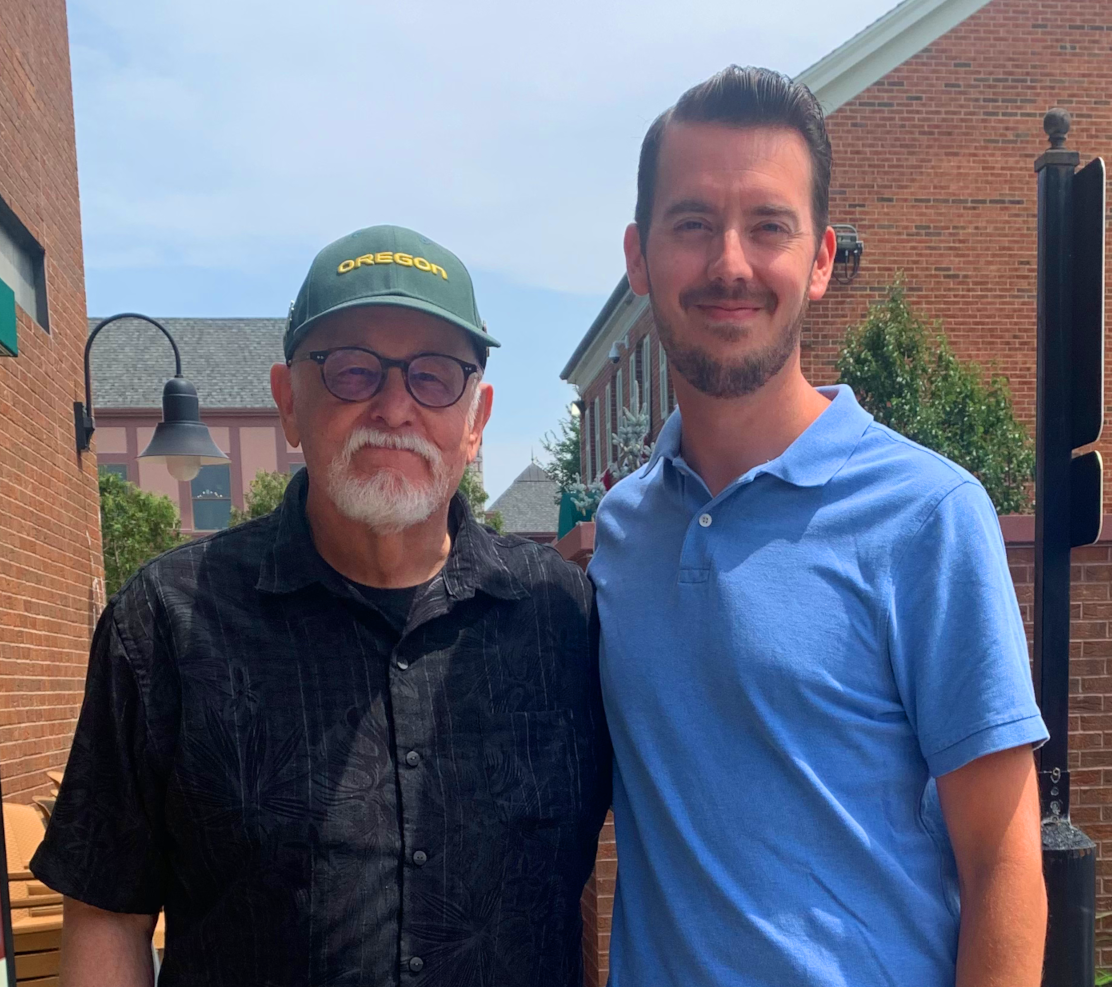
During my high school and college years, I had a growing interest in the Lincoln assassination. With the help of an online forum on the subject, I quickly found myself going deeper and deeper into this historical rabbit hole. While I had a friendly group of online acquaintances who shared this historical interest, I had never met any of them in person. At that time, I lived in Illinois and had only taken a single trip out east with my dad to visit D.C. and sites related to Lincoln’s death. Luckily for me, one of my new online friends was also a resident of Illinois and lived only about an hour and a half away. So, in November of 2010, he and I arranged to meet at a brunch place to “talk shop.”  This is how I came to become friends with Steven G. Miller.
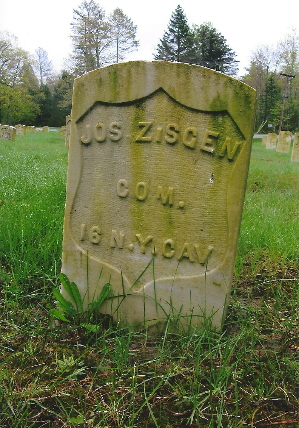
For those of you who watched my recent Booth exhumation trial reunion videos, Steve Miller should be a familiar name and face to you. Steve is a self-proclaimed “specialist” in the Lincoln assassination field. He has an intense interest in the members of the 16th New York Cavalry who tracked down and killed John Wilkes Booth. He has been researching and writing about the life of the main Lincoln Avenger, Sgt. Boston Corbett, for decades. There is no one on this planet with greater knowledge of the hunt for Booth than Mr. Miller. And, despite his claims of only being a specialist, Steve’s knowledge about many other aspects of the Lincoln assassination story is strong. Steve actually discovered an unpublished photograph of John Wilkes Booth and regularly delves into newspaper archives looking for new and interesting tidbits in this vast story of ours.

I was incredibly fortunate to have Steve as my guide into the world of the Lincoln assassination. He has amazing stories working with past greats of the field, and he was also incredibly generous with his research and his knowledge. I was constantly peppering him with questions in those early years, and he was always willing to dig into something for me. Our communications slowed down a bit after my move to Maryland, but around the time of my divorce and the pandemic in 2020, Steve and I started talking more often. Today, I speak to Mr. Miller on a weekly basis (if not more) and consider him a dear friend.

I write this narrative introduction not only to share my appreciation for Steve, but also to butter him up in hopes I can wrangle him into becoming an occasional contributor to LincolnConspirators.com. Steve has explored many interesting side stories that I think readers of this site would love. What follows is an article that Steve wrote concerning an intriguing newspaper article he came across a few months ago. I hope you all enjoy it, and I hope it’s the first of many articles on here from my mentor, Steve Miller.


Jeff. Davis’s Final Secret Mission.

By Steven G. Miller

Lake Villa, IL

Dave Taylor from LincolnConspirators.com and I often share historical goodies, those things that we have found in our research that interest or excite us. More times than not, our collaboration helps fill in gaps and answer questions that have stymied one (or both) of us.

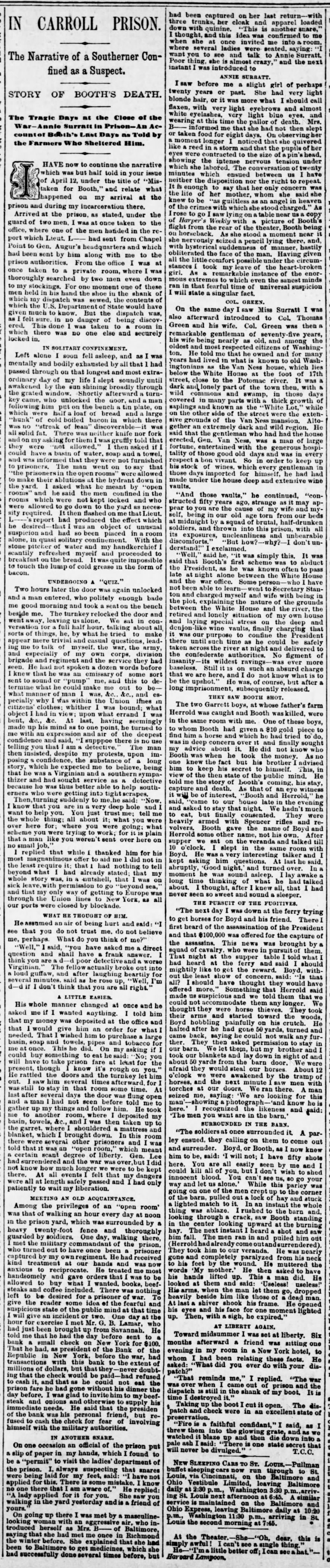
Such it was, recently, when I found a long two-part article in the digital archives of the Washington Evening Star. It was the account by a former Confederate officer, identified only as “T.C.C” in the article, of a secret mission entrusted to hm by Confederate President Jefferson Davis and Secretary of State Judah Benjamin. The writer claimed that he was an invalid soldier who was in Richmond in early 1865 and that he was called to a meeting of those two officials, who were busy sorting through government files in preparation for the abandonment of Richmond.

He related that he was asked if he would carry a secret message through the blockade to Confederate representatives Mason and Slidell in England. He agreed and set out, he states, from Richmond on April 2 to head overland to Canada, where he could catch a ship across the Atlantic. The message he was given was written in cypher on “silk paper” and along with it was a draft for expenses on the funds held by the rebel commissioners in Montreal. They were “sewed up in the shank of a pair of boots.”

“T.C.C.” recounts that he left Richmond by train and continued mostly on foot northward. He crossed the Potomac at night and was taken in tow by rebel operatives. He made slow progress and was only in “T.B.” on April 10th. He was, he claimed, onboard a Washington-bound stagecoach when he was scooped up by the Yankee cavalry operating out of Chapel Point.

He identified himself to the soldiers as a former rebel officer who was bound for Canada with intentions of heading for Europe. They questioned him at length and searched him, but failed to find the secret stash. He was still in the guard house when the news of Lincoln’s assassination arrived a few days later.

Fearing for his life and realizing, “I am the object of suspicion,” he spent several anxious days and nights. Luckily for him, the secret in his boot remained safe. He was ordered to be sent to Washington, where his story could be checked out. He was taken on horseback and in a wagon and had several tense moments when crowds of angry citizens spotted him and asked whether he was one of the conspirators.

General Augur’s officers questioned him and, though they didn’t punch holes in his story, they sent him on to Carroll Prison. He was first put in solitary confinement, but he had outside connections and was thus able to obtain money to make his jail stay more comfortable. He was granted access to the “open room” and could communicate with other prisoners. He recounts being “pumped” for information by prison spies, whom he outsmarted, and then having encounters with several people involved tangentially in the assassination story.

The two articles I found were:

 “T.C.C.,” “Mistaken for Booth. From Richmond to Washington Just Twenty-five Years Ago. A Close Shave for Life. A Thrilling Incident of the War—Sequel to the Assassination of President Lincoln—The Evacuation of Richmond—A Secret Message,” Evening Star (Washington, DC), April 12, 1890.

“T.C.C.,” “In Carroll Prison. The Narrative of a Southerner Confined as a Suspect. Story of Booth’s Death. The Tragic Days at the Close of the War—Annie Surratt in Prison—An Account of Booth’s Last Days as Told by the Farmers Who Sheltered Him,” Evening Star (Washington, DC), May 24, 1890.

Dave and I decided to try to verify this account. What interested us especially was the story he told about meeting Annie Surratt in Carroll Prison. If true, it sheds new light on her ordeal and reactions while being held as a material witness.

My efforts to identify “T.C.C.” drew a blank, but Dave –ace researcher that he is – was able, we believe, to figure out who the author of these accounts was. He texted me saying: “Pretty sure the author of those articles is a Georgian named Theodore Cooke Cone. I found the name “T. C. Cone” in a list of Prisoners of War. It states he was arrested on April 10, 1865 in “T.B. Md” and he was released on May 9, 1865. Cone is also listed as being in the “Invalid Corps, CSA.”

As Dave said, “The service record for Theodore C. Cone shows he was retired from being a Captain with the 10th Georgia Infantry due to medical issues in Nov. of 1864 and was in Richmond at the time. While the article gives Jan. 1865, as the time of the author’s invalidity, it still seems to add up.”

Cone was the oldest son of Hon. Francis H. Cone (1797-1859), judge of the Georgia Superior Court and a state senator. The Cone family owned Ringgold, a sprawling 1,185-acre plantation which produced a variety of crops and was home to many slaves. Following in his father’s footsteps, Theodore became a lawyer and had a thriving practice. He became wealthy upon the death of the judge in 1859 and the sale of Ringgold.

When the Secession crisis flared up in 1860, T.C. Cone was an outspoken “fire-eater” who actively supported the CSA once it was established. In 1861, when the governor of Georgia failed to supply weapons for the local volunteer unit that Cone had helped raise, Cone wrote to Jefferson Davis personally asking for guns. It was granted.

The 10th Georgia was in many battles, including Gettysburg, and Cone was a popular captain of the regiment. As noted above, he was released from service in the latter part of 1864 due to unspecified medical issues. He retired to Richmond instead of returning to his home state. There, he came to the attention of a staffer in the Confederate White House and was invited to meet the chief executive and Secretary Benjamin.

Cone never made it to England, however, and his mission was scrapped after his stay in prison. In his Star articles, he recounts that he was in New York City a few months after his release from Yankee jail. As he recounted his exploits to a friend, the question arose about what happened to the message.

“That reminds me,” Cone said, “the dispatch is still in the shank of my boot. It is time I destroyed it.” He cut the boot open and saw that “the dispatch and check were in an excellent state of preservation.” He threw them onto the fire in the grate and commented as they went up in smoke: “That is one state secret that will never be divulged.”

Not only was Cone involved in this one last attempt by Davis to communicate with the agents in England, but he was also scooped up in the dragnet for the assassins of President Lincoln.

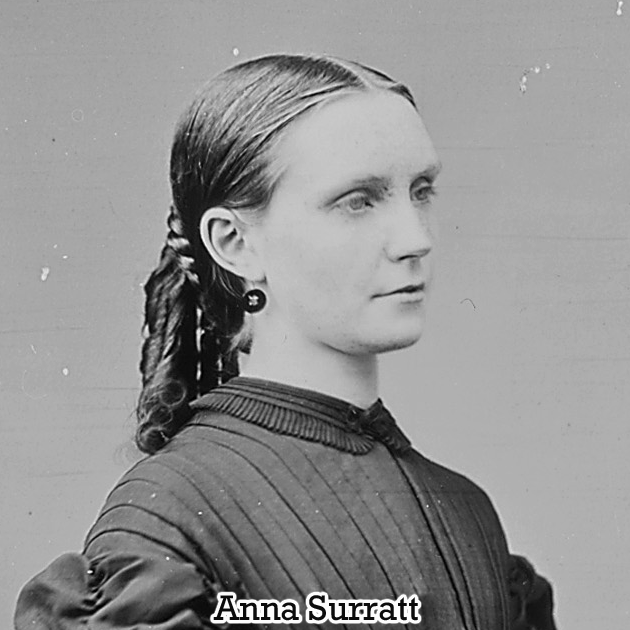
He tells of a prison meeting he had with Annie Surratt, the daughter of Mrs. Mary Surratt, who was then under arrest for conspiracy to kill President Lincoln.

Here’s what he wrote about this encounter:

“On one occasion an official of the prison put a slip of paper in my hands, which I found to be a “permit” to visit the ladies’ department of the prison. I, always suspecting that snares were being laid for my feet, said “I have not applied for this. There must be some mistake. I know no one there that I am aware of.” He replied: “A lady applied for it for you. She saw you walking in the yard yesterday and is a friend of yours.”

“On going up there I was met by a masculine-looking woman with an aggressive air, who introduced herself as Mrs. B—— of Baltimore, saying that she had met me once in Richmond the winter before. She explained that she had been to Baltimore to get medicines, which she had successfully done several times before, but had been captured on her last return—with three trunks, her cloak and apparel loaded with quinine. “This is another snare,” I thought, and this idea was confirmed to me when she at once invited me into a room, where several ladies were seated, saying: “I want you to see and talk to Annie Surratt. Poor thing, she is almost crazy,” and the next instant I was introduced to

ANNIE SURRATT

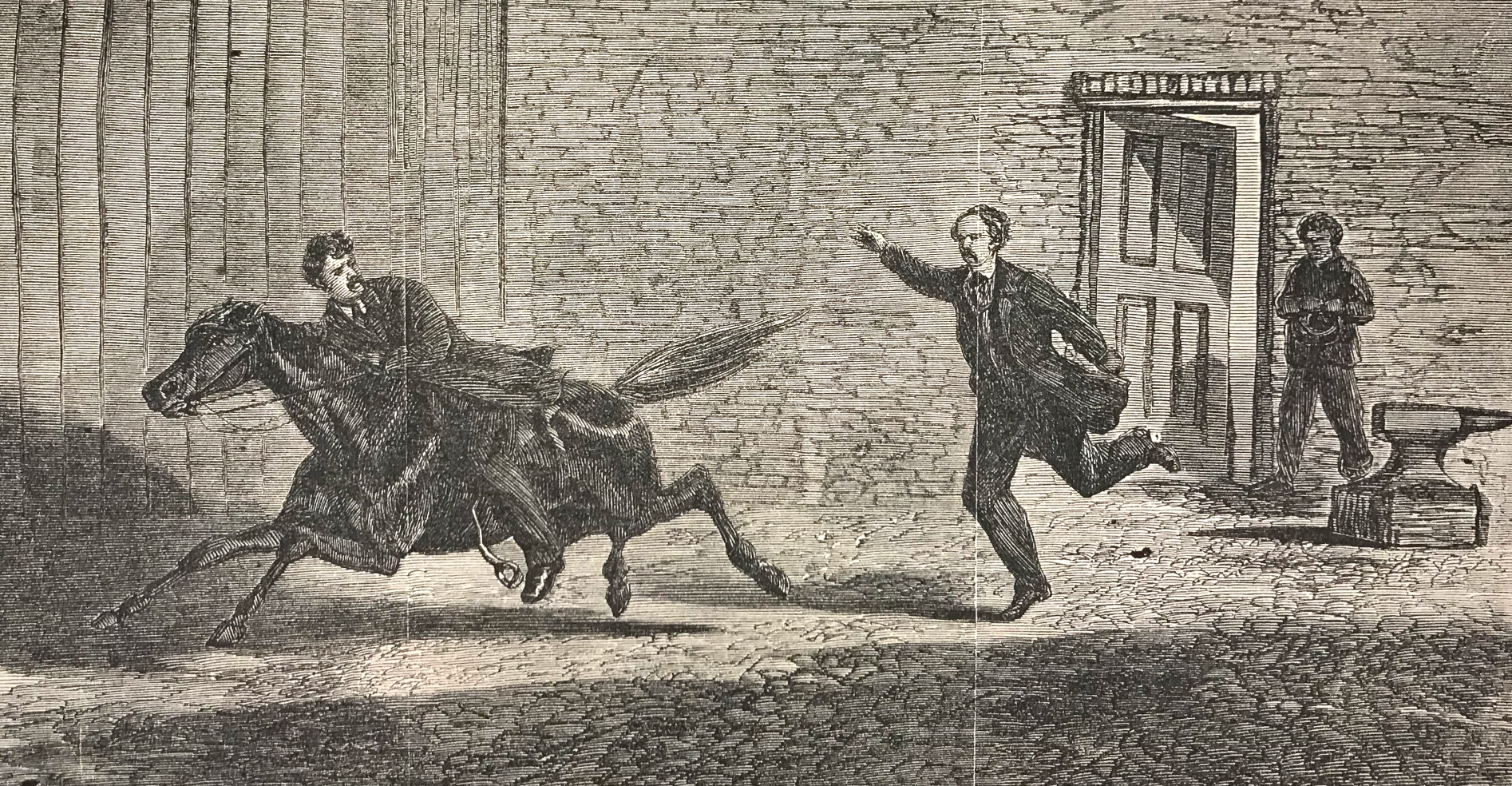
“I saw before me a slight girl of perhaps twenty years or past. She had very light blonde hair or it was more what I should call flaxen, with very light eyebrows and almost white eyelashes, very light blue eyes, and wearing at this time the pallor of death. Mrs. B— informed me that she had not then slept or taken food for eight days. On observing her a moment longer, I noticed that she quivered like a reed in a storm and that the pupils of her eyes were contracted to the size of a pin’s head, showing the intense nervous tension under which she labored. The conversation of twenty minutes which ensued between us I have neither the disposition nor the right to repeat. It is enough to say that her only concern was the life of her mother, whom she said she knew to be “as guiltless as an angel in heaven of the crimes of which she stood charged,” As I rose to go I saw lying on a table near us a copy of Harper’s Weekly with a picture of Booth’s flight from the rear of theater, Booth being on horseback. As she stood a moment near it, she nervously seized a pencil lying there, and, with hysterical suddenness of manner, hastily obliterated the face of the man. Having given all the little comfort possible under the circumstances I took my leave of the heart-broken girl. As a remarkable instance of the enormous extremes to which even the sanest minds ran in that fearful time of universal suspicion, I will state a simple fact.”

I don’t recall reading any comments about Annie Surratt in prison. And this new story about a final secret mission from Jeff Davis is new, too. The obvious take away from Cone’s story is that it was good that the Union authorities did not search him sufficiently enough to find the documents from Davis. It’s not hard to imagine what would have happened if Col. Baker had discovered that Annie Surratt – who was allowed to see her mother from time to time – was in unmonitored direct communication with an agent from the president of the CSA. It seems obvious that Cone and Annie Surratt would have been put in solitary confinement in the Old Capitol under close guard. The implication – unfounded according to Cone’s account—was that Davis was issuing orders directly to Mrs. Surratt in jail via his personal agent. This would have ended up in a charging indictment for Mrs. Surratt and for Davis. The conspiracy trial managers could never find a direct connection between Davis and any of the conspirators. It could have been argued in court that this was the smoking gun.

This apparently is the print of Booth on horseback that Annie Surratt defaced. Note: It actually comes from the May 13, 1865, issue of Frank Leslie’s Illustrated Newspaper, not Harper’s Weekly.

Categories: History, Steven G. Miller | Tags: , , | 3 Comments

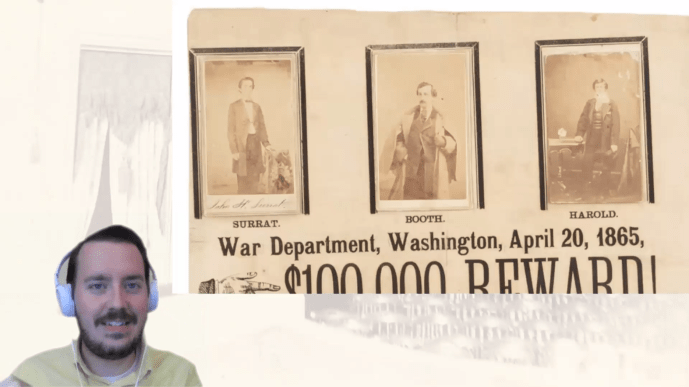
John Wilkes Booth Exhumation Trial 30th Anniversary Panel

On May 17, 1995, a historic trial began in the Circuit Court of Baltimore City. The case revolved around a legal petition to exhume the remains of John Wilkes Booth from Green Mount Cemetery. The petition was the culmination of years of effort on the part of two historical researchers who believed that the assassin of Lincoln was not killed at the Garrett farm on April 26, 1865, but instead escaped justice and lived for many years under assumed identities. The main support for this theory was a 1907 book called The Escape and Suicide of John Wilkes Booth, written by a man named Finis Bates who claimed to have met an incognito Booth in Texas in the 1870s. Despite the numerous factual and logical errors in the book, many people wanted to believe the tall tale, and the story of Booth’s escape from justice became folklore akin to sightings of the deceased Elvis Presley. In 1991, this fringe theory rose in prominence when it was featured on the TV series Unsolved Mysteries with Robert Stack. The increase in exposure motivated the two leading proponents of the theory to seek legal recourse to prove their claims. Green Mount Cemetery opposed the exhumation, both on the merits of the conspiracy theory and also due to the researchers having no connection to the deceased.

The attorney for the researchers then found two distant Booth relatives and convinced them to become involved. The names of the researchers were swapped with those of the distant Booth relatives, and the petition to exhume was refiled. Green Mount Cemetery still opposed the exhumation request, and so a trial was set to evaluate the merits of the petitioners’ case.

The trial consisted of four days of testimony, with 16 witnesses taking the stand. The trial was overseen by Judge Joseph Kaplan and occurred in Courthouse East on Calvert and Fayette Streets in Baltimore. Green Mount Cemetery was represented by attorney Francis J. Gorman from the newly formed law firm of Gorman and Williams. Frank assembled a group of Lincoln assassination historians and an expert on exhumations to discuss the validity of the petitioners’ factual and scientific arguments. The petitioners were represented by attorney Mark Zaid.

At the end of 2024, Frank Gorman published a book entitled Confronting Bad History: How a Lost Cause and Fraudulent Booth Caused the John Wilkes Booth Exhumation Trial. In this book, Frank not only expertly documents the exhumation trial and its proceedings in an engaging way, but he also provides some vital context regarding the character of Finis Bates and his book. After sharing in some conversations with Frank about his wonderful new book, I volunteered the idea of trying to put together a reunion panel of sorts to mark the 30th anniversary of the exhumation trial in 2025. Through calls and emails, Frank was able to convince four witnesses from the 1995 trial to take part in the reunion. Though I had no involvement in the original case, I was honored to be asked by Frank to moderate the discussion. Due to the geographical distances between the different participants, we decided to conduct this reunion virtually over Zoom.

The participants of this reunion panel were:

In the end, the panel lasted a little over three hours as we delved into several aspects of the trial and the research behind it. For the ease of viewing, I have divided it into three segments, which you can watch below.

I hope that you enjoy watching this reunion panel as much as I enjoyed moderating it. By watching these videos and reading Frank Gorman’s book, you are helping to confront bad history.

Categories: History, News | Tags: , , , , , | 1 Comment

Grant Hall Open House 5/3/25

This Saturday, May 3, 2025, will be the quarterly open house of Grant Hall.

Grant Hall is the restored courtroom of the Lincoln conspirators located on Fort Lesley J. McNair in Washington, D.C. The open houses are a chance to see the room in which the conspirators were tried, check out special exhibits on the subject of Lincoln’s death, and interact with docents who can teach you about the trial of the century. When I lived in the area, I used to volunteer at the open houses, and my good friend Bob Bowser still makes appearances there as Dr. Mudd. Dr. Paul Severance, a speaker at this year’s virtual Surratt Society conference, is also a regular docent, dressed as General Winfield Scott Hancock.

As an active military base, the courtroom is only accessible to the public four times a year, so you definitely want to take advantage of this opportunity if you can. Information on how to register for the open house (which you must do to gain access to the base) can be found here.

For those of you, like me, who live far away from Grant Hall and can’t make the open house, you might enjoy a series of speeches given on the subject of the trial and courtroom that were given on the 150th anniversary of the trial back in 2015. Here are links to the talks given by Michael Kauffman, John Elliott, Barry Cauchon, and Betty Ownsbey.

If you want to stay up to date on different events like this, talks, anniversaries, auction items, and news revolving around the Lincoln assassination, please consider becoming a member of my Patreon. For just $3 a month, you will receive a weekly post about all of this and more! At the $7 per month level, you also get access to fortnightly posts highlighting unique Lincoln assassination objects hidden away in museum vaults and private collections. And at the $15 a month level, you get all of these benefits plus monthly videos delving into different aspects of the story and answering your questions. Any support you can give to help keep the lights on here at LincolnConspirators.com and support me as I work on writing my book bringing Black voices back into the Lincoln assassination story would be greatly appreciated. There’s already a good deal of content available at the LincolnConspirators Patreon that I hope you’ll check out.

Categories: History, News | Tags: , | 2 Comments

Help Get Rich Hill Over the Finish Line

Rich Hill is a historic home located in Bel Alton, Charles County, Maryland. Built in 1729, the house has some amazing Revolutionary War connections. It was the birthplace of Dr. Gustavus Brown, a doctor of George Washington’s who tended to the Father of Our Country on his deathbed. It was also the birthplace of Margaret Brown, the wife of Declaration of Independence signer Thomas Stone. During the Civil War era, the home was owned by Samuel Cox. After having his broken leg tended to by Dr. Mudd, John Wilkes Booth and his accomplice David Herold made their way to Rich Hill, looking for assistance from Cox during their escape. According to Oswell Swan, the Black man who, unaware of their identity, guided the assassins to Rich Hill, Booth and Herold spent a few hours inside Rich Hill before they were hidden in a nearby pine thicket by Cox’s farm overseer.

Rich Hill is the second oldest standing house in Charles County. Up until a few years ago, however, things were looking bleak for this truly exceptional property. Years of neglect had left the home in a sad state of affairs. I remember visiting the house in 2011 when there was no front door and the insides had been trashed by vandals. It truly looked like this house was destined to collapse, much like the Garrett home where Lincoln’s assassin eventually died.

Rich Hill as it appeared in 2011

However, in 2014, an effort was undertaken by the Historical Society of Charles County and the Charles County Government to save this unique piece of history. The county government acquired the property from the owner, and the process was started to stabilize and restore the home. It has been a long process, but through private donations, grants, and a state of Maryland bond of $600,000, the home has been successfully stabilized, a new roof has been added, and the exterior of the home is now completely restored.

Rich Hill in 2025

The only work that remains is to finish the interior of the building. Unfortunately, the state bond funds have been exhausted. While the county government has also been a great partner over the years, it is also unable to provide additional funding for the interior of the house. They will, however, continue to own the site and take care of its maintenance, landscaping, and utilities. Earlier this year, the Charles County Government signed an updated memorandum of understanding with the Historical Society of Charles County, effectively placing the historical society in charge of financing and completing the work.

Recent actions at the federal level have significantly decreased the amount of funds available for historic preservation grants. The Historical Society of Charles County is attempting to raise $150,000 in order to get Rich Hill over the finish line. This final push will pay for the electrical, insulation, HVAC, drywall, painting, and other finishing touches for the interior of Rich Hill.

Once the interior is done, the house will finally be ready to open as a new museum. The Friends of Rich Hill committee group has been hard at work over the past decade, acquiring furnishings, artwork, portraits, and exhibits to tell the story of this historic house and the men and women who lived here. Already, the site is conducting outreach with interpretive signs that discuss the history of the house, the lives of enslaved men and women who lived here, and Charles County’s role in Revolutionary and Civil War history. After a decade of hard work, the end is finally in sight, and Rich Hill is so close to opening its doors as a museum.

If you can, please consider donating to the Historical Society of Charles County to help support their efforts to finish the restoration of Rich Hill. The historical society is a 501c3 non-profit, and all donations are tax-deductible.

You can make an online donation to the Historical Society via PayPal by clicking here or on the image below.

You can also mail a donation to the following address:

The Historical Society of Charles County
PO Box 2806
La Plata, Maryland 20646

As an original member of the Friends of Rich Hill Steering Committee, I hope you’ll consider giving whatever you can to help turn Rich Hill into a museum. Even a few bucks will help. I will be donating all the proceeds from my Patreon for this month (April 2025) to Rich Hill as my way of paying it forward.

With just one more push, we can help bring a new museum to the John Wilkes Booth escape route. And while other museums like the Surratt Tavern and the Dr. Mudd house really only have the Lincoln assassination story going for them, Rich Hill also has some really cool Revolutionary War history that deserves to be told. Thanks for donating.

Categories: History, News | Tags: , | 1 Comment

An Interview with the Creators of The Pursuit of John Wilkes Booth

On the 160th anniversary of Abraham Lincoln’s assassination, I sat down with Ryan Heilman and Wes Crawford from Wharf Rat Games. These two are the designers and creators of the new board game, The Pursuit of John Wilkes Booth, published by Blue Panther LLC. We had an excellent discussion about the history behind this Lincoln assassination-themed game, the process of designing and developing board games, and how board games can be a form of public history. Check out the video of our talk below:

To read my earlier review of The Pursuit of John Wilkes Booth, click here. To purchase your own copy of this unique board game, you can order it from the publisher, Blue Panther LLC, by clicking the image below.

Categories: History, News | Tags: , , , | 1 Comment

The Unfinished Work

Today is the 160th anniversary of the assassination of Abraham Lincoln. It is a day where we reflect on the legacy of Abraham Lincoln and the effect his untimely death had on the course of our nation. Though occurring over a century and a half ago, we still feel the ramifications of his loss during such a crucial moment in our national identity. We entered a dark age under the administration of Andrew Johnson, who painstakingly fought against and dismantled protections for Black Americans and other marginalized groups. We now endure yet another dark age under the current administration, which strives to whitewash our country’s history into fables of “American exceptionalism” while once again attacking efforts of justice and equity toward marginalized groups like immigrants and transgender people.

On this anniversary, I want to share with you all my ongoing book project. For a long time, I did not feel there was any need to write a book of my own. The definitive books on the Lincoln assassination story had all already been written. While I enjoyed pulling out and highlighting various side stories here on this blog, no unified book idea was ever forthcoming.

That changed in the past year. I reexamined the tapestry that is the Lincoln assassination story and found a thread that I wanted to follow. As I explored this thread, I found that it branched out in numerous paths throughout the entire piece. It was an integral part of the weaving, interconnected with the whole in countless, inumerable ways. If one were to remove this thread and its many outshoots, the entire tapestry would fall apart. That unifying thread in the story of Abraham Lincoln’s assassination was the presence and voices of Black Americans.

“We colored people believe Mr. Lincoln to be the best friend that we had. I would go to the point of my life to find out the murderers.”

This quote comes from a man named John Miles. He, along with another Black stagehand named Joe Simms, worked up in the fly loft of Ford’s Theatre. Their duties were to raise and lower the curtain and stage borders during each night’s performance. They witnessed the assassination of Lincoln firsthand, gave multiple statements to the investigating authorities, and even testified at the trial of the Lincoln conspirators. In the majority of books on Lincoln’s assassination, their names are entirely absent or relegated to just a handful of obscure footnotes. They are just two of the Black voices of the past who deserve to be heard.

In recent years, significant progress has been made to bring Black voices back to the forefront when it comes to the life of Abraham Lincoln. In 2018, historian Kate Masur edited a reprint of John Washington’s 1942 book They Knew Lincoln, documenting the stories of Black Americans who encountered and influenced the Lincolns. In 2024, historian Leonne M. Hudson published Black Americans in Mourning: Reactions to the Assassination of Abraham Lincoln, which highlights the unique grief felt and expressed by Black Americans in the aftermath of Lincoln’s death. Even the 2024 AppleTV+ miniseries Manhunt, based on the book by James L. Swanson, reimagined its source material in order to emphasize the lives of Black Americans and their struggles during Reconstruction. While great strides have been made to bring Black voices back into the events before and after Lincoln’s death, their stories continue to be vastly underrepresented in coverage of Lincoln’s assassination and the escape of the assassin. 

Mary Swann

The purpose of my book project is to restore the voices of Black women and men to the narrative of the Lincoln assassination story. These are the forgotten lives of Black people who experienced and impacted one of the most dramatic events in our nation’s history. From witnessing the shooting of Lincoln, encountering the lead assassin during his escape, and assisting in the arrest and conviction of his conspirators, Black Americans played a crucial role in the meting out of justice. Rather than being condemned to the footnotes, this book hopes to tell the story of Lincoln’s death from the perspective of men and women profoundly and personally impacted by the country’s national tragedy. 

Identification of Lewis Powell by William Bell

In 2013, theater historian Thomas A. Bogar published a book about the actors and stagehands present at Ford’s Theatre on the night of April 14, 1865. The final work bears the title Backstage at the Lincoln Assassination, a suggestion by his publisher. During the writing process, however, Bogar had a different name in mind. He wanted to call the book Walking Shadows, a reference to the famous line in Macbeth, which goes: “Life’s but a walking shadow, a poor player that struts and frets his hour upon the stage and then is heard no more.” It was an appropriate descriptor for the employees of Ford’s Theatre, who would otherwise have faded into anonymity if not for their association with that tragic night.

Henry Woodland

The same “walking shadow” metaphor is also painfully appropriate for the lives of the Black women and men who found themselves thrust into the drama of Lincoln’s assassination. These people had already been considered little more than walking shadows by the white supremacist environment that governed their lives. Largely barred from educational opportunities due to their race and economic status, they found employment as laborers, laundresses, servants, or farmhands. Black Americans toiled to support themselves and their families, and many were forced to live transient lives to make ends meet.  

To study the Black experience in America, especially during the time around the Civil War, is a study in sad frustration. There is an immense scarcity of records surrounding Black Americans indicative of the country’s institutionalized racism during this period and beyond. For most of the figures in my book project, very little biographical information is known. What we know of them and their stories is primarily derived from limited statements and testimonies they gave about their experiences. Despite the best efforts and intentions to tell their stories as accurately as possible, our view of these men and women will always remain tragically incomplete.

However, the scarcity of records and the incomplete picture they give about the people they discuss should not stop us from attempting to restore their voices to the historical narrative. Even those whose names are not known and were merely referred to as “negro” or “boy” by the investigating authorities deserve to have their contributions and personhood restored to them. The prejudice and institutional racism of the past attempted to purposely write Black voices out of the history of Lincoln’s assassination. My hope is that this book project will restore them to their rightful place. 

No historical record on any subject will ever be considered complete. Doing history is the act of searching, discovering, evaluating, and then reevaluating. I hope to help the reader reevaluate the story they thought they knew through the eyes of those who have been largely hidden away for 160 years. The goal is to not only provide a much-needed perspective on the story of Lincoln’s assassination but to engage in a small act of historical justice for the men and women whose voices have been silenced for too long.

This is the unfinished work that I am dedicating myself to on the anniversary of Lincoln’s assassination. Any American history devoid of the indivisible threads of Black History, Women’s History, Native American History, LGTBQ+ History, and countless others is not true history at all. We must be honest about the oppression built into our past and our present. Only when we actively acknowledge and address our greatest moral failures and tragedies can we hope to grow from them.

Categories: History | Tags: , , | 15 Comments

Take the Dr. Mudd House Walking Tour!

Yesterday marked the opening of the Dr. Samuel A. Mudd House Museum for the 2025 season. A few months ago, I put up a post encouraging everyone to visit and, if possible, volunteer at this wonderful museum that has grown so much in the last few years.

With the season now open, I wanted to give a little more advertising for one of the Mudd house’s special walking tours that will be happening this coming weekend, April 12 & 13, 2025. This special tour is called “Use all Efforts to Secure Him” and takes participants down the path John Wilkes Booth took away from the Mudd House and into the Zekiah swamp. This tour also highlights the search that took place around the Mudd property by the investigating authorities. This walking tour is only offered a few times each season, with this weekend marking the closest option to the anniversary of the events 160 years ago. I highly encourage anyone in the area to take part in this walking tour of the Mudd property. Lead docent Bob Bowser does a phenomenal job and there are brand new interpretive signs throughout the property to check out. Here’s the post from the Dr. Mudd House website with the details. Sign up to receive updates and emails from the Mudd website while you’re at it so you can keep up to date on all things Mudd.

Categories: History | Tags: , | 1 Comment

Surratt Society’s Virtual Conference 4/5/2025

Today, the Surratt Society released details about its upcoming annual conference, which is taking place this Saturday, April 5, 2025. The conference will run from 2:00 to 4:30 pm Eastern time.

Prior to the COVID-19 pandemic, the annual Surratt Conferences were held in person in Prince George’s County, Maryland, with a slate of about six or so speakers and a dinner speaker. During and since the pandemic, however, the conference has operated in a virtual setting with two speakers over the course of an afternoon. These virtual conferences have been completely free to attend for anyone with a Zoom-compatible device. In prior years, you had to pre-register for the conference in order to be sent the Zoom link. This year, however, no pre-registration is necessary. I have copied over the link and Zoom instructions provided by the Society at the end of this post.

This year’s speakers are Dr. Paul Severance and Francis Gorman.

A professor of military science at the National Defense University, Dr. Paul Severance will speak about the 1865 trial of the Lincoln conspirators. For many years, Dr. Severance has been a devoted educator, giving tours of the restored courtroom of the conspirators at Fort Lesley J. McNair in Washington. I worked with Dr. Severance many times when I lived in the area and gave tours with him in the courtroom. I am looking forward to hearing his presentation on the trial.

A graduate of Georgetown University’s School of Foreign Service and Law Center, Francis “Frank” J. Gorman, practiced law as a trial and intellectual property attorney. A founder of the Gorman & Williams law firm, Frank was selected to represent Green Mount Cemetery in opposition to the efforts to exhume the body of John Wilkes Booth in 1995. With a team of history experts, including Michael Kauffman, Dr. Terry Alford, Steven Miller, Dr. James O. Hall, and Dr. William Hanchett, Frank successfully disproved the John Wilkes Booth escaped conspiracy theories in a court of law, and prevented the needless exhumation. Thirty years after that court case, Frank has written a book about his experiences and new discoveries that have further disproved the Finis Bates-backed conspiracy theories. At the conference, Frank will talk about his new book, Confronting Bad History: How a Lost Cause and Fraudulent Book Caused the John Wilkes Booth Exhumation Trial. I had the chance to read Frank’s manuscript before it was published, and I could not put it down. Be prepared for Frank to make an appearance here on LincolnConspirators.com in the near future to talk more about it.

Here is the Zoom meeting information provided on the Surratt Society’s Events page:

“The link is:

https://us02web.zoom.us/j/81547245578?pwd=oiHBmbayEaQEmwbit7cPYVfe4DzAZr.1

Meeting ID:  815 4724 5578

Passcode:  416937″

I am very excited about this lineup of speakers. I hope to (virtually) see you all on Saturday, April 5, from 2:00 – 4:30 pm!

Categories: History, News | Tags: , , , | Leave a comment

Blog at WordPress.com.