

Uncategorized
“So great was their rage”
When John Wilkes Booth committed his act, the uproar from the general public was swift and vicious. In D.C. angry crowds surrounded confederate prisons like the Old Capitol ready to jump any new prisoner brought in. Countless individuals who bore a resemblance to Booth were mobbed with many suffering beatings courtesy of their doppelganger. The fury extended beyond D.C. when people woke up to the news of Lincoln’s assassination on April 15th. On that morning Junius Brutus Booth, Jr., the 43 year old brother of John Wilkes, awoke to find the horrifying truth of his kin’s deed. The following is an article originally from the Louisville Courier Journal (reprinted in the August 30, 1884 edition of the Knowersville Enterprise) giving an account of how June learned of his brother’s act.

Narrow Escape of Booth’s Brother
“One of the most exciting mobs I ever saw was the one which attempted to hand Junius Brutus Booth at Cincinnati the morning after Lincoln’s assassination.”
Emile Buelier was the speaker. He made the remark in conversation with some friends last evening.
“I was then a clerk at the Burnet house,” he continued. “I had gone there with Captain Silas Miller, who had purchased it just prior to that time. Junius Booth was billed to play there, and arrived at the hotel on the evening when his brother shot Lincoln.
He came down stairs the next morning, and after breakfast was on the point of going out to take a stroll. I had just heard a few minutes before that the people were in a tumult, and had torn down his bills all over the city. He came up to the desk and, as he did so, I informed him that I thought it would be best for him not to go out in the streets. He looked at me in astonishment, and asked what I meant.
‘Haven’t you heard the news?’ said I. He replied that he had not. I didn’t like to say any more, and he walked off, looking greatly puzzled.
Going to a friend, who was standing near, he asked, in a rather excited manner what was that young man meaning by talking that way, and wanted to know if I wasn’t crazy. The man told him no, that I was a clerk.
More mystified than ever he returned and demanded my reason for the remark. I saw then that he was in ignorance of the tragedy, and reluctantly informed him that his brother had killed the President.
He was the most horrified man that I ever saw, and for the moment he was overcome with shock. I suggested to him that it would be better to go to his room, and he did so, being accompanied by one or two of his friends.
He had scarcely gone up-stairs before the room was filled with people. The mob was fully 500 in number and wanted to find Booth. They were perfectly furious, and it was the greatest difficulty that we checked them by the story that their intended victim had left the house. They would have hung him in a minute if they could have laid hands on him, so great was their rage.
They returned almost immediately, but by this time we had removed Booth from his room to that of a friend. The mob watched the house so closely that it was four or five days before he had a chance to leave. We finally smuggled him away however.
I’ve seen four or five different accounts of that circumstance, but none of them were correct. The story that he was disguised as a woman to effect his escape is all wrong. He left in ordinary clothing.”

When it was safe, Junius traveled from Cincinnati to Philadelphia to his sister Asia’s house. It was here on April 25th that Junius and Asia’s husband John Sleeper Clarke were arrested. They were transported back to D.C. and detained at the Old Capitol Prison. The authorities had found a letter written by Junius to his brother encouraging him to give up in the oil business which had cost him so much. This brotherly advice was misinterpreted by the government as a code for the assassination plot and so Junius was tracked down. Though imprisoned, he was given some preferential treatment as the Secretary of War ordered that he would not be placed in irons like many of the other prisoners. In prison he gave several statements complying with the authorities completely. He was eventually released on June 2nd.
References
Knowersville Enterprise (8/30/1884)
The Lincoln Assassination: The Evidence by William Edwards and Ed Steers
Why Lincoln and Booth are Intertwined
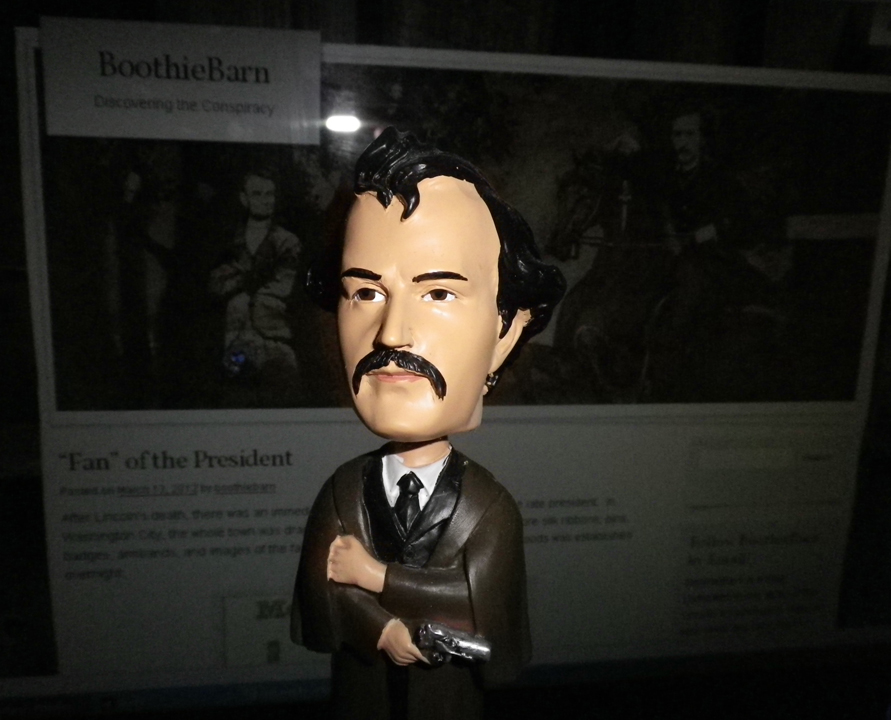
Recently, there has been a minor controversy regarding the sale of John Wilkes Booth bobblehead dolls. A reporter from The Evening Sun of Hanover, PA, received an anonymous complaint about the dolls being sold at the Gettysburg National Military Park gift shop. When he inquired about them, the gift shop removed them from their shelves within a couple of days. Shortly thereafter, without any noted complaints or inquires, the Abraham Lincoln Museum and Library in Springfield, IL, followed suit and removed the bobbleheads from their gift shop.
What interests me the most about this controversy is how people have reacted to the dolls. The original article notes that, “At first, the bobblehead drew chuckles from some of the students. But most reconsidered that reaction when asked to comment.” This “chuckling” reaction would be the one I would expect from most people. As a bobblehead doll, it is made to be a gag gift. People either like them enough to buy them, or they move on, instantly forgetting them.
When probed about the dolls, the students being interviewed responded with the remarks akin to, “Yes, I suppose it is wrong to make them.” What changed their minds? A few seconds earlier they were chuckling at the John Wilkes Booth bobblehead, and now they are calling for its immediate removal. Their new-found disgust is a product of their education about Lincoln. It is this education that we all receive. We rightfully idolize and revere Lincoln for his strengths and courage as president. He freed the slaves, kept the nation together and paid for it all with his life. All of these things are true, but, in order to keep Lincoln as the penultimate American president, we all ignore the complexity of his death. The man who killed him was a crazy, racist, cold-blooded killer. We simplify Lincoln’s death into its simplest but, inherently, incorrect terms. Did Booth commit an atrocious deed that should be condemned? Of course. However, we should not dismiss his importance to the Lincoln we know and love.
This is the fine line that “Boothies” walk pursuing our interest. As those who study the assassination, we look at the factors and motivations of Booth and other groups, North and South, who wished for and plotted to end Lincoln’s life. While Lincoln was a great man and a great president, he was also one of our most hated presidents. This version of Lincoln was buried and forgotten with Booth’s body. One bullet, fueled by the anguish of the ravaged South, transformed Lincoln into a saint. Booth should be studied not only for this crucial act, but for the complexity of his character that led him to such a crime.
Of all the reactions given in the articles and comments regarding the bobbleheads, I am slightly disappointed on a purely scholarly level with Mr. Harold Holzer’s quote in which he states that selling the John Wilkes Booth bobbleheads are, “…like selling Lee Harvey Oswald stuffed dolls at the Kennedy Center.” While both Lincoln and Kennedy’s assassinations were traumatic events in our history, the men who committed them were polar opposites. The times and events they lived through defined them as uniquely troubled individuals and each had vastly different motivations for their crimes. By painting these two assassins with the same brush, we actually diminish the honored men they killed. The story of Lincoln’s assassination is a dark one and an unpleasant one. However, looking at the men and women who conspired to kill Lincoln helps us better understand the harsh period of time in which Lincoln lived and led a nation.
According to the original Evening Sun article, 11 out of the 12 people interviewed stated that the Booth bobblehead was inappropriate. The sole hold out was a 15-year-old boy who stated, “It’s a part of history and we can’t just ignore it because it’s a bad part.”
I couldn’t agree more:
References:
Evening Sun articles: 1, 2, 3
Abraham Lincoln Museum and Library article
“Fan” of the President
After Lincoln’s death, there was an immediate demand for items that mourned the late president. In Washington City, the whole town was draped in black mourning crepe. Citizens wore silk ribbons, pins, badges, armbands, and images of the fallen president. An industry of mourning goods was established overnight.

Harper's Weekly advertisement for Lincoln mourning badges.
One of the most beautiful Lincoln mourning artifacts that has survived the years, is an elegant, 22” diameter, mourning fan:


The fan is titled, “To the Martyr of his Country, Abraham Lincoln” and was created by a Central American maker who had purchased the rights from an American firm. On the front, the fan shows Lincoln, surrounded by angels and cherubs, with Spanish memorial songs on the edges near the fan guards. On the back, near the guards, the hand painted fan displays the battle of the Monitor and Merrimac along with a depiction of Richmondburning. The back of the fan also displays five neatly drawn and painted scenes from the assassination of the president:

Booth, Mary Surratt, and other conspirators (one of which is probably Lewis Powell) conspiring to kill Lincoln.
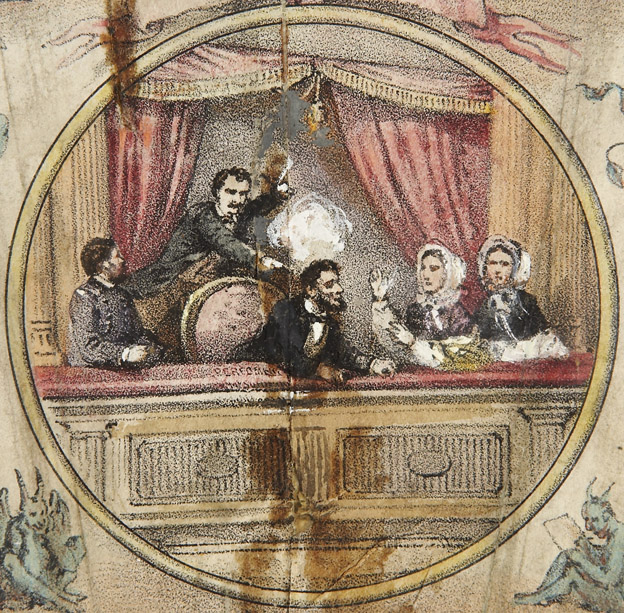
Booth shooting President Lincoln.

Laura Keene and others putting on the play Our American Cousin at Ford's Theatre right before the President is killed.

Booth makes his escape south on horseback.

Cornered at Garrett's barn, Booth is shot and killed.
The fan was designed to not only be a fashionable piece, but also a means of self protection and therefore holds two surprises in its design. In the base of one of the guards, there is a small, hinged area in which a lady could conceal poison. If this did not work, or, if the lady needed a more direct approach, the same fan guard houses a concealed knife that could be retracted and hidden from sight.

This fan had originally belonged to Father Robert Keesler, one of the original “Boothies”. A truly kind and generous man, he allowed the fan to be displayed at the Surratt House Museum as one of their centerpiece artifacts in their exhibit on Victorian mourning customs. Father Keesler later gave this ornate fan as a present to Dr. John Lattimer, an esteemed Lincoln author and collector. When part of Dr. Lattimer’s Lincoln collection was sold at auction in 2008, this fan went for $15,535. It was last in the possession of the Abraham Lincoln Book Shop in Chicago Illinois. They were asking $19,500 for this extraordinary piece of Lincoln mourning history.
References:
The image of the article regarding mourning badges comes from Lincoln’s Assassins: Their Trial and Execution by James Swanson and Daniel Weinberg. Several other mourning items can be found in this book.
Abraham Lincoln Book Shop
The Escape Attempt of Dr. Mudd
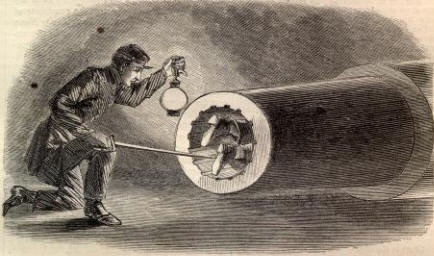
This engraving from Harper’s Weekly shows a fanciful depiction of Dr. Mudd’s real life escape attempt from Fort Jefferson, Dry Tortugas.
When the sentences came in for the Lincoln assassination conspirators, Samuel Arnold, Michael O’Laughlen, Edman Spangler, and Dr. Samuel Mudd all received imprisonment. Arnold and O’Laughlen were given life sentences for their involvement in plotting the kidnapping of the late President with John Wilkes Booth. Though the kidnapping never occurred, the law of conspiracy made them accountable for when the plot turned to assassination. Ned Spangler received a comparatively light sentence of 6 years for essentially being an acquaintance of Booth’s and helping to hold his horse. Dr. Mudd was also given a life sentence for aiding Booth during his escape by fixing his leg and for lying to investigators about his previous relationship with him. The four were shipped to Fort Jefferson, an isolated fort located on the Dry Tortugas islands off the coast of Florida, to carry out their terms.
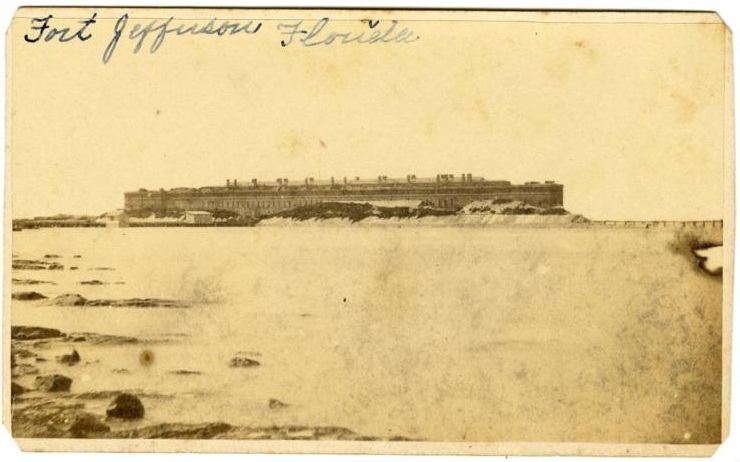
Fort Jefferson CDV
The conspirators were not prepared for prison life at Fort Jefferson, Dry Tortugas. The living conditions were harsh. Disease ran rampant with scurvy, dysentery, bone fever, diarrhea and other chronic problems being common among the inmates and guards. While Dr. Mudd and the other conspirators were treated as equally as the other prisoners upon their initial arrival, the pitiable conditions and rotting food was too much for the Maryland doctor. The real straw that broke the camel’s back, however, was the upcoming change of personnel on the Fort. From the conspirators’ arrival in July until near the end of September, they were commanded over by the 110th and the 161st N. Y. Volunteers. Come September, the 161st N. Y. was being relieved by the 82nd U.S. Colored Infantry. Dr. Mudd was a former slave owner and held racial views that were a product of that. Further, as a conspirator in the Great Emancipator’s death, Dr. Mudd also feared retribution or mistreatment by the incoming soldiers. These factors, along with his being away from his family and the amenities of home, drove Dr. Mudd to orchestrate his escape from the his island prison.
In the brief two months the conspirators had been there, “thirty or forty” other prisoners successfully escaped according to Dr. Mudd’s writings. Most found freedom by hiding themselves on the steamer ships that brought supplies to the island. One steamer known to Mudd, the Thomas A. Scott, had previously visited the island and left with eight prisoners secreted upon it. To Mudd, this ship seemed to be the best method of escape.
The good doctor was clever to avoid any suspicion prior to engaging his plans. He did not tell anyone, not even his fellow conspirators, of his idea. Moreover, knowing that all of his mail was read by his captors before being transmitted, Dr. Mudd openly denounced the idea of escaping in a letter he sent to his wife just a couple weeks before he made the attempt:
“I have had several opportunities to make my escape, but knowing, or believing, it would show guilt, I have resolved to remain peaceable and quiet, and allow the Government the full exercise of its power, justice and clemency. Should I take French leave, it would amount to expatriation, which I don’t feel disposed to do at present.”
In preparation, Dr. Mudd made friends with a crew member on the Thomas A. Scott, Henry Kelly. Kelly was a young man of about 18 and, with the assumed promise of payment for his assistance, he agreed to help hide and care for Dr. Mudd during his escape. With an inside man aboard, Dr. Mudd’s plan was set.
Since Fort Jefferson was such an isolated prison, the inmates were granted greater liberties of freedom than would be found at other penitentiaries. When not tending to their assigned duties (at that time Mudd was a nurse in the prison hospital), the prisoners were allowed almost complete access to the island. They were expected to sleep within the walls of the fort, but they did not have a “bed check” as prisoners today would have. The only time considerable attention was given to prisoners exiting the fort, was on days when a ship was departing the island. On those days it was forbidden to leave the grounds of the fort until the ship had left.
Therefore, on the day before the Thos. A. Scott’s arrival, Dr. Mudd freely left the confines of the fort in the evening and slept outside of it, in a shed. The next morning, September 25th, he changed his clothing from prisoner garb into one of the suits he had brought with him. He then took advantage of the hustle and bustle of the crew removing supplies from the Scott and slipped his way down into the lower hold of the ship near the coal bunkers. Here he hid himself, under a platform between two cross beams.
Unfortunately for Dr. Mudd, he was too well known to the officers of the prison. Had he been a lowly thief or murderer, he may not have been recognized by the military storekeeper of the fort, a Mr. Jackson, who was overseeing the removal of supplies. As a Lincoln conspirator though, Mudd lacked the anonymity of a common criminal. Mr. Jackson immediately reported to the post commander that Dr. Mudd, “had gone below and had not come up again.”
A short search was then conducted aboard the Scott. While Dr. Mudd’s own accounts lack the details of his discovery, several newspaper articles reported that he was found after an officer was, “running his saber under an old box in the coal bunker” when “the cold steel coming into contact with the latter end of Dr. Mudd, made him cry out and come out.”
Dr. Mudd was immediately re-arrested and interrogated. A quick search was made on the Fort to locate O’Laughlen, Arnold and Spangler, but all three were found inside the walls and ignorant of Dr. Mudd’s actions. Upon the threat of being shot, Dr. Mudd informed on his would be confederate, Henry Kelly. Kelly was arrested and imprisoned as the Thomas A. Scott departed the island. According to Dr. Mudd, “they were so much rejoiced at finding me, they did not care to look much farther; the consequence was, the boat went off and carried away four other prisoners, who no doubt will make good their escape.”
In his own words, Dr. Mudd explained the punishments he faced for his actions: “For attempting to make my escape, I was put in the guard-house, with chains on hands and feet, and closely confined for two days. An order then came from the Major for me to be put to hard labor, wheeling sand. I was placed under a boss, who put me to cleaning old bricks. I worked hard all day, and came very near finishing one brick. The order also directs the Provost Marshal to have me closely confined on the arrival of every steamer and until she departs.”
Dr. Mudd wrote a letter to the commanding officer of the fort apologizing for his attempt to escape. While in this note he stated that, “before I was detected I had made up my mind to return if I could do so without being observed by the guards,” it is more likely that he was angry at failing in his attempt. In an October 18th letter to his wife, Dr. Mudd expressed his true feelings on the matter: “Do not view my act with dishonor. I am a prisoner under guard, not under a parole, and under no obligations to remain if I can successfully evade and free myself.”
One item that Dr. Mudd did seem to feel guilty about was his betrayal of Henry Kelly. In his note to the commander he took full responsibility for the attempt and stated that, while Kelly had promised to help him escape, he actually took no part in it. This did not seem to help Kelly’s case as he was being held just like Dr. Mudd until the commander figured out what to do with him. As a civilian, Kelly could have been transferred to the authorities in nearby Key West, or, as some newspapers reported, he could be forced to endure imprisonment right there in Fort Jefferson. While the commander of the Fort was waiting on instructions for Henry Kelly, he was briefly imprisoned with Mudd in the guardhouse. During that time, Kelly forgave Mudd for informing on him, and stated that the commander was “a fool to think they could hold him upon this island.” How true this would prove to be. Five days after Mudd’s escape attempt, Kelly was imprisoned in “the dungeon” with a thief named Smith. Though both were clad in wrist and ankle chains, the pair managed an exciting escape. Somehow Kelly and Smith freed themselves from their chains and broke out of the iron grated window in their cell. They then lowered themselves down by using the same chains. From there they robbed the civilian merchant on the island of $50, some clothing, and enough canned fruits and meats to last their journey. With supplies in tow, they stole a boat and made their escape onto the water. Dr. Mudd reflected, “The authorities are no doubt much disappointed and chagrined at this unexpected occurrence. I feel much relieved.”
While other prisoners would continue to make their escape from Fort Jefferson, Dr. Mudd never attempted to do so again. On October 18th, Dr. Mudd and the other Lincoln conspirators found themselves placed into “the dungeon” that Kelly had escaped from. The military had picked up on a rumor that a plot was being formed to free the conspirators. While the rumor had no substance, it still led to the men being confined to the most secure part of the fort. The living conditions for the men worsened considerably there, and they were not relieved of the squalor until the end of January, 1866. After that experience, it appears Dr. Mudd accepted the impossibility of his successful escape. While he still longed for home, he would not risk the punishment for another failed attempt. Moreover, he accepted his connection to the three other men that were imprisoned with him. Though they were strangers to him prior to the trial, they now shared the same fate, good or bad. For his own sake, and for theirs, Dr. Mudd would never try to escape again.
References:
The Assassin’s Doctor by Robert K. Summers
Mr. Summers’ book is the book on Dr. Mudd. He also runs the best website on Dr. Mudd. His book was the prime source for information on the doctor’s escape.
Mudd, N. (1906). The Life of Dr. Samuel A. Mudd. Washington: Neale Publishing Company.
(1865, October 9). Details of Dr. Mudd’s Attempted Escape. New York Herald-Tribune.
(1865, October 12). Attempted Escape of Dr. Mudd. Providence Evening Press.
More thanks go to Robert K. Summers. In addition to his wonderful book and unparalleled Mudd website, Mr. Summers visited the National Archives on the author’s behalf looking for more information about Mudd’s escape.
A quick note from Thomas Jones
In this undated mini-letter (or lengthy autograph), Thomas Austin Jones succinctly attests to his role in hiding the aiding the fugitives.
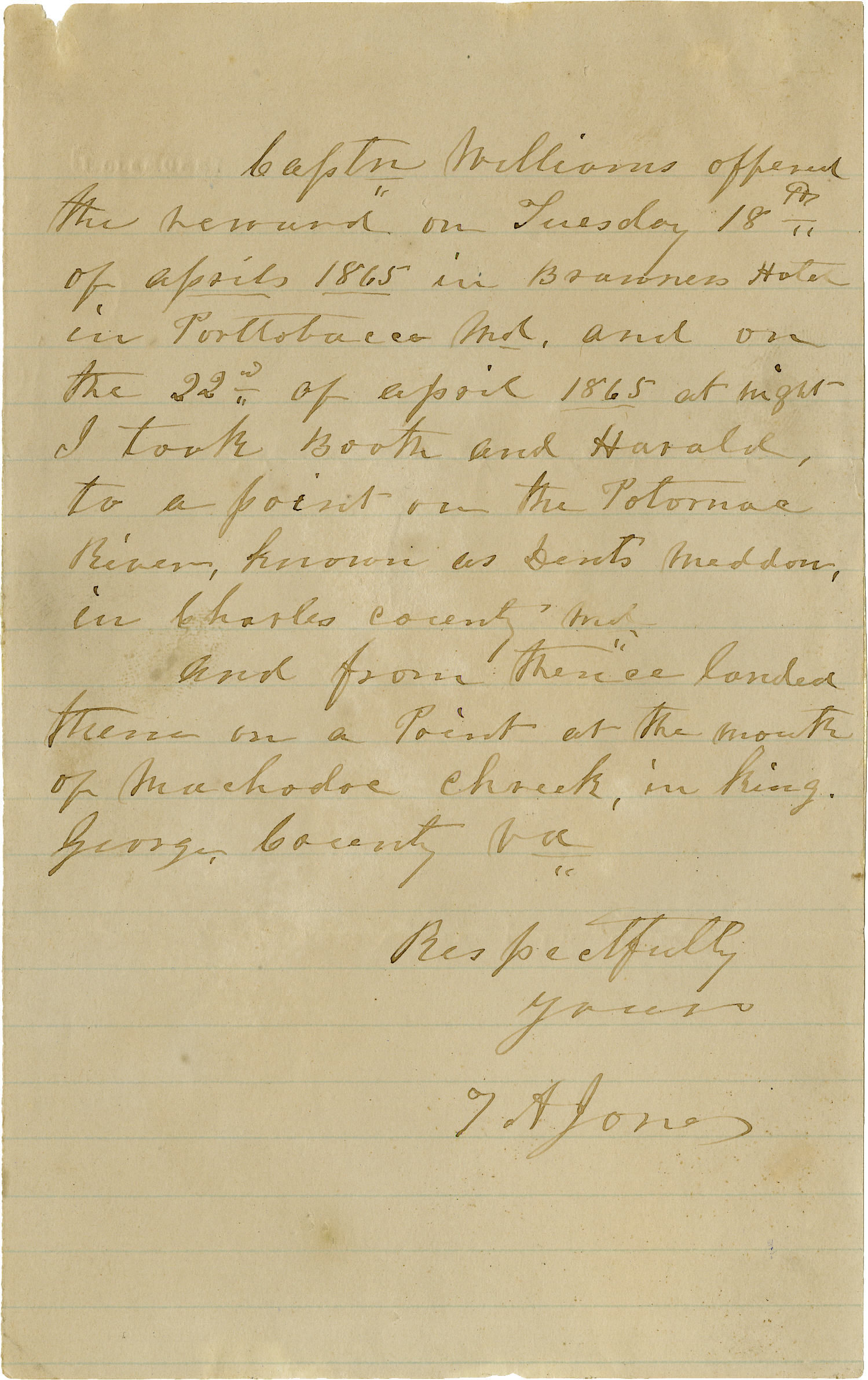
“Captn Williams offered the reward on Tuesday 18th of April 1865 in Brawner’s Hotel in Port Tobacco,Md.And on the 22d of April 1865 at night I took Booth and Harold to a point on thePotomac River, known as Dent’s Meadow, in Charles County, Md.
And from thence landed them on a Point at the mouth of Machodoc Chreek, in King George County, Va.
Respectfully yours
T. A. Jones”
Manhunt: The Exhibit
In 2001, James Swanson and Daniel Weinberg released their book, Lincoln’s Assassins: Their Trial and Execution. This coffee table sized book by Swanson, a D.C. attorney, and Weinberg, owner of the Abraham Lincoln Book Shop in Chicago, contains both men’s impressive collection of artifacts, documents, and images involving Lincoln’s assassination. In addition, the pair found other noteworthy items in other private collection and museums to include in this visual tour of the assassination. It is a truly wonderful picture book that should be in every assassination library. In 2006, James Swanson once again entered the spotlight when he released his assassination book, Manhunt: The Twelve Day Chase for Lincoln’s Killer. The book became a New York Times bestseller due to its appealing, fiction-like writing style. The book’s popularity led to a temporary exhibit at the Newseum in Washington, D.C. In this exhibit, many of Swanson’s artifacts were on display. The exhibit has since closed, but I was able to visit it in May of 2009. For those of you who were not able to see it, here are some of the highlights:
Click the images to enlarge them
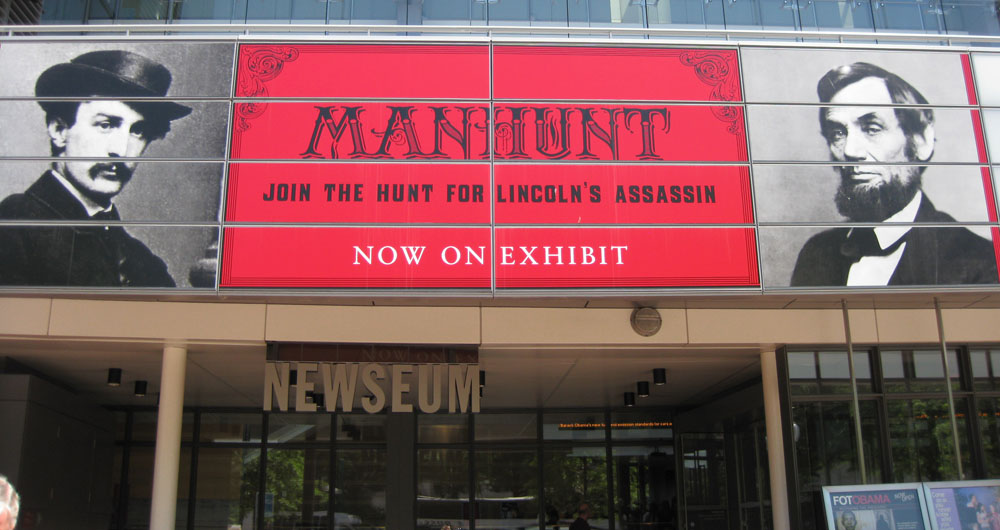
Advertising for the exhibit outside the Newseum.

The "Jumbotron" inside the Newseum cycled through a taped message about the exhibit.

The room containing the Manhunt exhibit.

The room had wonderfully bright displays of each of the conspirators...

...and the events.
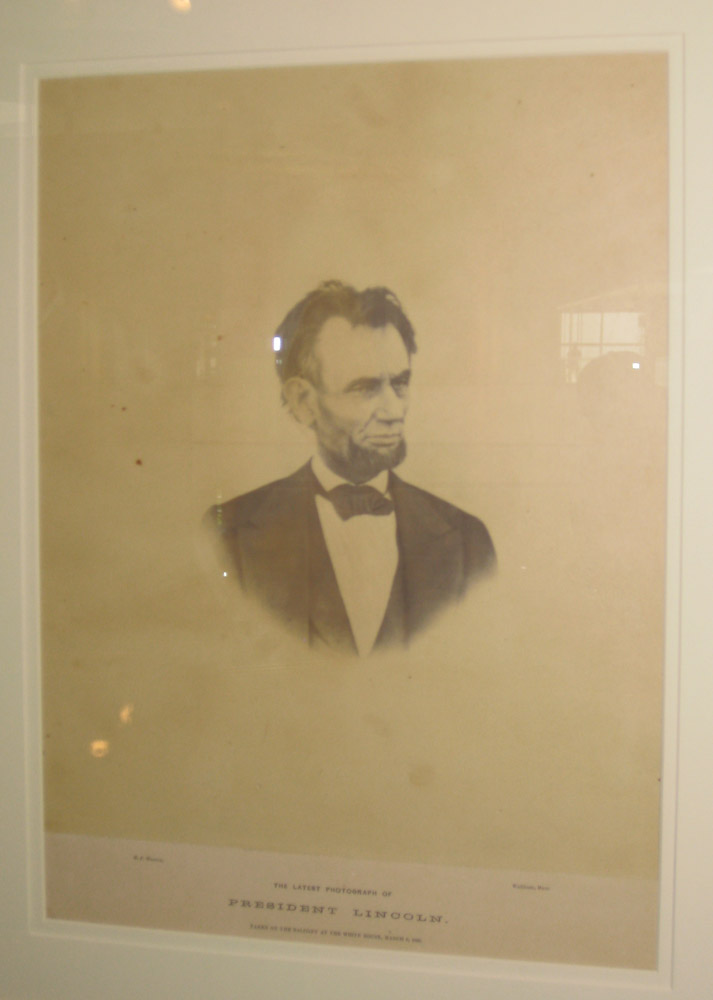
Some of the artifacts displayed included the last photograph of Lincoln.

Prints and photographs of Booth.
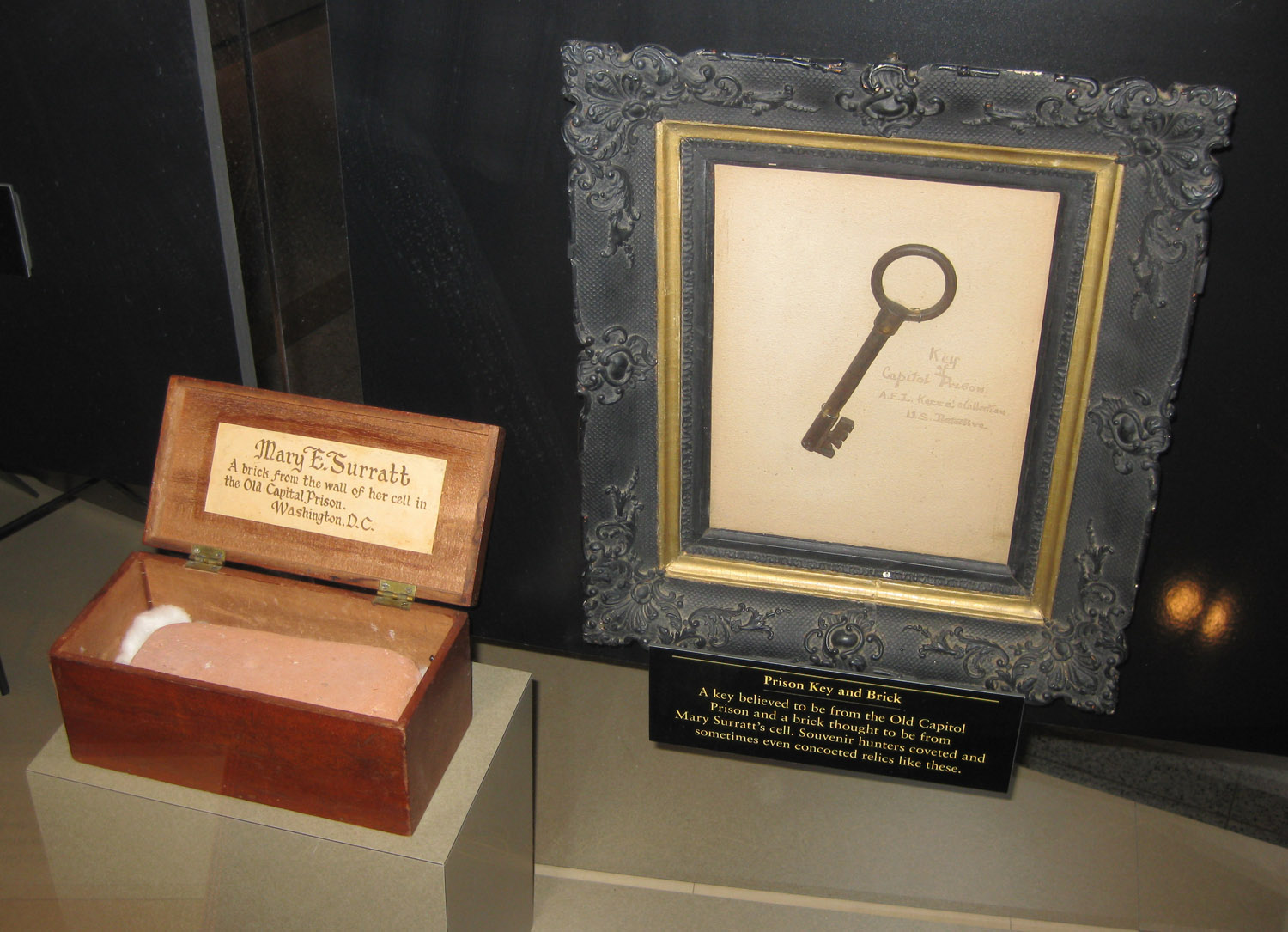
A key and brick from the Old Capitol prison which housed Mary Surratt along with many other witnesses and suspects.

A broadside about Booth's death.

A photograph and brick from Booth's favorite hotel, The National. The Newseum now occupies the same site where the National once stood.

An original (not a later reprint, I confirmed) playbill from Our American Cousin.

A period map showing D.C. and Booth's escape route.
While a little small for my liking (we could always use more assassination artifacts, after all), the exhibit did a great job showcasing Swanson’s book and collection.
A bit of levity…

The real reason it took Booth and Herold two tries to reach Virginia
Support the Research

Lincoln Assassination Tours.com



 LincolnConspirators.com
Recent Comments