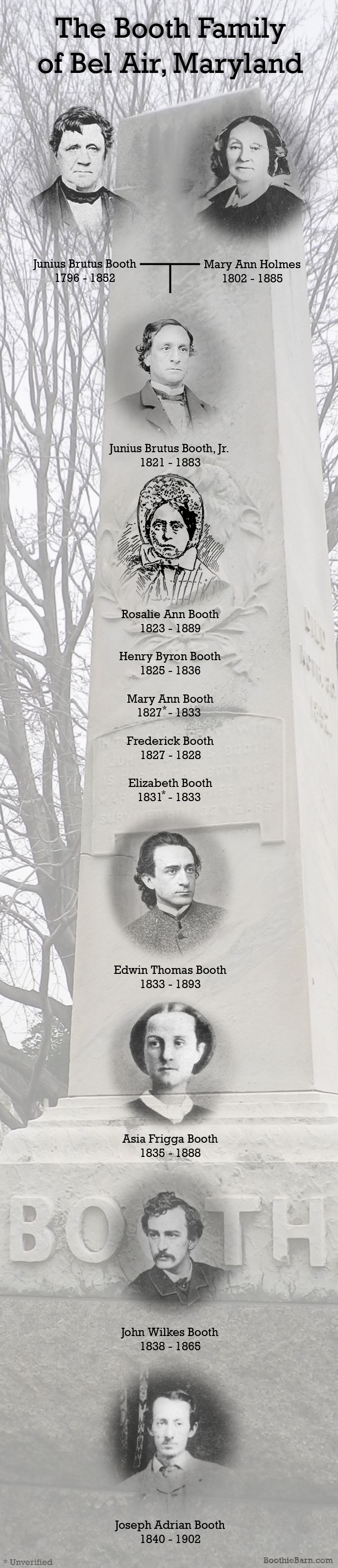
Henry Byron Booth was the third child of Junius Brutus Booth and Mary Ann Holmes. He lived a short life, dying from smallpox at the age of 11. His early death prevented him from knowing his two youngest siblings, John Wilkes and Joseph Adrian. You can read more about Henry Byron’s brief life in this prior post and by visiting the Booth Children Picture Gallery.
Though only a little is known about Henry Byron, it is clear that he was much loved by his family. After the young boy’s death, his father, Junius, admitted that Henry had been his favorite child writing, “Guess what his loss has been to us – So proud as I was of him above all others.”
Almost forty-five years after his death, Henry Byron’s mother, Mary Ann, still mourned him. When her granddaughter, Edwina Booth, wrote of the rough time she, her father, and ailing step-mother were having on their visit to England, Mary Ann wrote of her last, tragic visit to her homeland:
 Dear Child how I do wish you were more comfortable & back again in America after going so far & ^not^ seeing the half I wanted you to see, but it is so like my last trip to England, it was nothing but misfortune & death of my dear Boy Henry. that cast a gloom over everything.
Mary Ann Booth to Edwina Booth, April 21, 1881
Practically nothing remains to mark Henry Byron’s existence aside from his name carved on the reverse of the Booth obelisk in Green Mount Cemetery. His real grave was destroyed when the English cemetery he was buried in was transformed into a park in the late 1890’s. It is for this reason that any item relating to Henry Byron is an exciting, and rare, find.
The Helen Menken Collection is a privately held theater collection in New York. The collection contains several Junius Brutus Booth letters and playbills. The letters were at one time consulted by Dr. Stephen Archer who provided transcriptions of many of them in his wonderful book, Junius Brutus Booth: Theatrical Prometheus. One letter that Dr. Archer decided not to include in his book was an October 26, 1834 letter from Junius to his father Richard. At the time Junius was in Boston with Mary Ann and the children. His note to his father, still at the family farm in Maryland, provides instructions to their servant, Joe Hall, regarding the care of the farm’s animals and upcoming crops. It is a plain enough letter demonstrating Junius’ operation of his farm while acting on tour. It has little insight to offer which is probably why Dr. Archer chose not to include it in his book on Junius.
However, for individuals like me with a growing interest in the entire Booth clan, this letter has an exciting addendum. Junius ends the letter with the following sentence, “Henry wishes to write two lines in this letter which will be seen beneath.” Then, below Junius’ signature, the following note can be seen:

Though the letter has been torn and part of it has been lost, with the script of a nine year-old Henry appears to write:
Dear Grandfather
We hope you are w[ell?]
Joe [?] and all the stock [?]
Peacock & the other hor[ses?]
God bless you
Yours ever
Henry Byron
While some words may be difficult to make out, his signature is large and bold, demonstrating significant practice at getting it right:
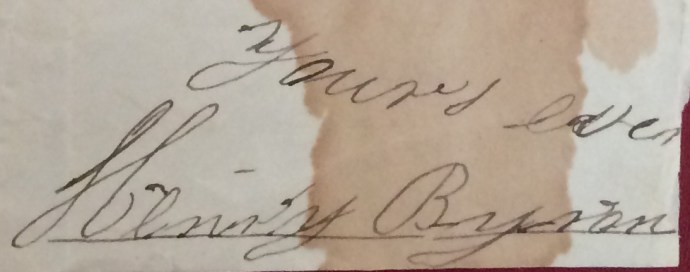
The existence of this note is exciting not only because it is likely the only surviving document written by Henry Byron Booth, but also because, even in its short and incomplete state, it mentions another member of the Booth family: Peacock the pony.
In January of 1821 when Junius Brutus Booth (then married to Adelaide Delannoy and with a young son named Richard) decided to run off to America with Mary Ann, the two started their journey from the English town of Deal. While in Deal, Junius purchased a piebald pony named Peacock. Piebald is a coloration pattern of white (or non-pigmentation) with dark spots or patches on top. Dalmatians, for example are extremely piebald. As a neighbor of the Booths recalled later, Peacock’s, “color was in blocks, white squares with bright bay squares.”
From Deal, Junius, Mary Ann, and Peacock traveled to the Island of Madeira, a Portuguese colonized isle off the coast of Morocco. Madeira was a common stopping place for ships before setting across the Atlantic. The young couple was so entranced by the beautiful island that they decided to stay for awhile. Years later, their daughter Asia described the attention little Peacock received as her parents vacationed on Madeira:
“They remained for several weeks at Madeira; and, as horses were exceedingly rare on the island (oxen and mules being used on the mountains to carry freight, etc.), Peacock created great excitement. Sums of money were offered for him, but my father declined parting with his new favorite; and in April, he took passage for himself, wife, and pony by the schooner Two Brothers for America.”
Peacock the pony served his master well for many years in America. Junius would often ride Peacock to nearby Baltimore and even hitch him up to his wagon with a larger horse for trips to Philadelphia. Even though Peacock was small, “Every horse was scared that met with him,” recalled a neighbor.
Ella Mahoney, who later owned the Booth home of Tudor Hall and ran it as a museum, wrote a story about how Junius reacted to Peacock’s ultimate death:
“I often heard it related of him that coming home on one occasion, he found the little horse Peacock, now quite aged, dead. He sent for several of his neighbors (my uncle among them), and going to the house forced Mrs. Booth, terror-stricken, to sit on the horse, wrapped in a sheet, while he walking around with a gun on his arm, read a funeral service. Two of the neighbors whom Joe had hastened to bring, arriving, one attracted his attention, while the other going quietly up behind, pinioned his arms, rendering him harmless. Instead of struggling or growing angry, he dropped the gun and remarked, “Well, you’ve got me, come to the house and have a drink.” But later in the day he disappeared, and the next day was quite ill.”
Like so many stories about “crazy Junius”, this story is probably exaggerated. After his father’s death, John Wilkes Booth would lament, “We know that two-thirds of the funny anecdotes about our own father are disgraceful falsehoods.” Still it is likely that Junius, a life long lover of animals, was deeply saddened by the loss of his prized pony Peacock. Peacock was a living memory of Junius’ “honeymoon” with Mary Ann and, as this note from Henry Byron appears to prove, was well loved by all.
This note nicely reminds us of the lives of two forgotten members of the Booth family: Henry Byron Booth and Peacock the pony.
References:
Helen Menken Collection
Junius Brutus Booth: Theatrical Prometheus by Stephen Archer
The Elder and Younger Booth by Asia Booth Clarke
John Wilkes Booth: A Sister’s Memoir by Asia Booth Clarke edited by Terry Alford
ALPLM







 LincolnConspirators.com
Recent Comments