Uncategorized

The Case Against Dr. Mudd

While I take a sympathetic and pragmatic approach to Dr. Mudd when it comes to his knowledge of the assassination of Lincoln, from time to time I think it’s important to point out the fallacy of the “simple, country doctor” mystique that has crept up around him.  The following is an excerpt from Dr. Edward Steers, Jr.’s wonderful book, His Name is Still Mudd.  It succinctly states the evidence demonstrating Dr. Mudd’s involvement in John Wilkes Booth’s initial plot to abduct President Lincoln.  What follows after is an account written by George Alfred Townsend, GATH, in which the meeting between Dr. Mudd, Booth and Thomas Harbin is described.

dr-mudd-1-oldroyd

Mudd’s knowledge of, and acquaintance with John Wilkes Booth:

      1.  The meeting in November 1864, in which Booth is first introduced to Mudd at St. Mary’s Church in Bryantown.
          2.  The meeting at the Bryantown Tavern in mid-December 1864, (December 17-21) where Dr. Mudd introduced Booth to Thomas Harbin [see account of this meeting below], and when Booth spent the night at Mudd’s house and later purchased the one-eyed horse from his neighbor, George Gardiner

3.  The December 23, 1864 trip to Washington where Mudd meets Booth at the National Hotel and introduces him to Confederate agent John H. Surratt, Jr.

Whether Mudd knew that Booth murdered Lincoln, and when he knew it:

          1. Samuel Mudd’s statement that he heard of the assassination while in Bryantown on Saturday afternoon (April 15th)
          2. Francis R. Farrell’s testimony in which he states that Mudd told both himself, and John F. Hardy on Saturday afternoon that a man named Booth had murdered Lincoln.
          3. Samuel Cox, Jr.’s statement that Mudd told him, in 1877, that while in Bryantown on Saturday afternoon, April 15th, Mudd had heard of the assassination of President Lincoln, and that John Wilkes Booth was the assassin.
          4. Samuel Cox, Jr.’s statement that Mudd told him that when he learned Booth was the assassin he returned home and ordered Booth out of his house.
          5. Captain George W. Dutton’s affidavit that Mudd told him on July 22, 1865, that he knew it was Booth whose leg he had set at his home on Saturday, April 15th.

Evidence linking Mudd to Booth’s conspiracy to capture President Lincoln:

        1. Mudd’s introduction of Thomas Harbin to Booth.
        2. Mudd’s introduction of John H. Surratt, Jr. to Booth.
        3. Samuel Cox, Jr.’s statement which quotes Mudd as saying that he went into Bryantown on Saturday, April 15th, to mail contraband letters which he had received earlier.
        4. George Atzerodt’s “lost confession” in which Atzerodt states that Booth had sent provisions to Dr. Mudd’s house to be used for their flight to Virginia.
        5. Dr. Richard Stuart’s deposition which states that Herold had told him that Dr. Mudd had referred Booth and Herold to Dr. Stuart, implying that Booth would receive medical assistance.
        6. William Bryant’s statement that the two fugitives were referred to Dr. Stuart for medical assistance.”

 – Dr. Edward Steers, Jr. in His Name is Still Mudd

Thomas Harbin

Thomas Harbin

“After church that day Booth went into Bryantown, a mile or two distant, and in plain sight, and was introduced by Dr. Mudd at the village hotel to Mr. Thomas Harbin, the Marylander, who was the principal signal officer or spy with the lower Maryland counties.

Toward the close of the war rigorous policing of the lower Maryland country was relaxed or dispensed with, as the enemy had been pushed south of the James River and seldom molested the Potomac paris.  Harbin, whom I talked to at great length just before he died, about 1885, gave me particulars concerning Booth, which would now be past discovering.  He told me that in Bryantown, at the tavern, Dr. Mudd introduced him to Booth, and said that Mr. Booth wanted some private conversation with Harbin; they took a room on the second floor, where Booth went through the thespian motions of pacing and watching the hallways and escapements.  He then outlined a scheme of seizing Abraham Lincoln and delivering him up the same evening in Virginia.  He said that he had come down to that country to invite co-operation and partners, and intimated that there was not only glory, but profit in the undertaking.

Harbin was a cool man who had seen many liars and rogues go to and fro on that illegal border and he sat down Booth as a crazy fellow, but at the same time said that he would give his co-operation.”

GATH dispatch, Cincinnati Enquirer, April 18th, 1892
Categories: Uncategorized | Tags: | 16 Comments

OTD: Edwin Booth Gets Shot At

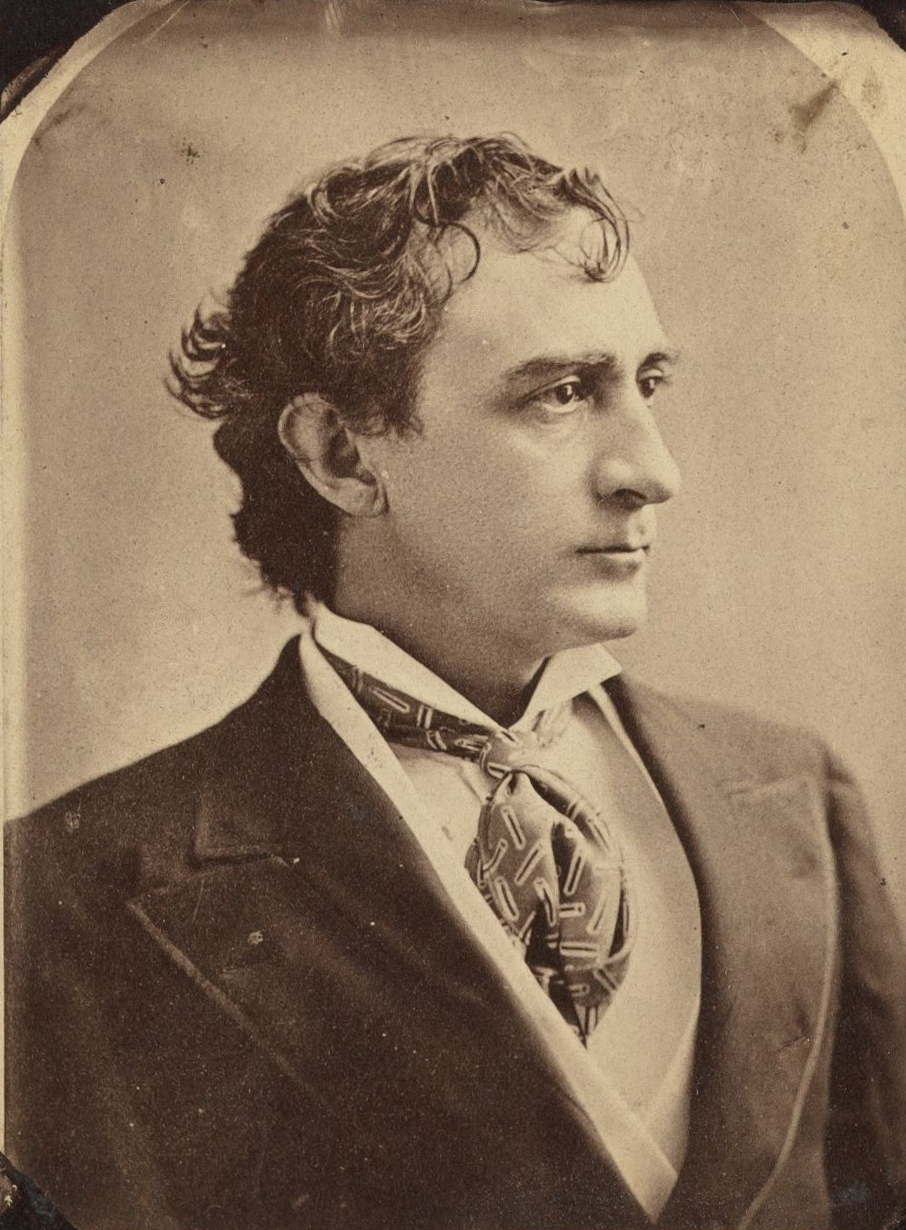
On this date, April 23rd, in 1879, Edwin Booth performed Richard II at McVicker’s Theatre in Chicago.

Edwin Booth in 1879

Edwin Booth in 1879

While performing the final solioquy of Richard II on Shakespeare’s birthday, Edwin altered his normal practice of sitting throughout the speech and for no clear reason felt compelled to stand.

“He leaned himself over to steady himself as he got up.  As he did so, a bullet whizzed over his head.  Another shot was fired, and looking up, he saw a man standing in the gallery, pistol in hand, ready to pull the trigger once more, had he not been prevented by several persons from behind who seized his arms.  Edwin walked calmly to the front of the stage, pointed him out, and cried, ‘Arrest that man!’  For a few moments, the audience was panic-striken, but was quieted after the would-be-murderer had been taken from the house.  Edwin addressed them, saying he wished to speak with his wife who was backstage and would then finish the performance.”

The Booth family was shaken by the events at McVicker’s and may have believed the attempt on Edwin’s life was a latent revenge act for Wilkes’ assassination of Lincoln.

Stay tuned for more to come about the culprit behind this attempt on Edwin Booth’s life…

References:
 The Mad Booths of Maryland by Stanley Kimmel

Categories: Uncategorized | Tags: | 8 Comments

Ugolino

Yesterday, April 20, marked the 188th anniversary of the debut of a new play on the American stage. Though practically forgotten today, the tragedy Ugolino debuted yesterday in 1825. The story is a dark one. The main character, Ugolino, is a passionate man who has lost all sense of reason due to his love for Angelica. When he finds that Angelica’s heart is desired by another man, the Marquis di Serassi, he kills this rival beau in a jealous rage. Overcome with madness, he slays his own beloved Angelica before regaining his senses. Ugolino, while clutching Angelica’s bleeding corpse to his chest, demands of the audience:

“Was it not well done? Look here! She loved me… and I killed her!”

While overwrought with his own grief and guilt, Ugolino is questioned by angry Venetians. “Accursed wretch,” they cry, “What moved thee to act?” Ugolino answers with:

“What mov’d me to it? To murder him who sacrificed my peace?

This was the crowning crime! This was Hell’s greatest triumph

…Dost thou not know me? Tis Despair

From the abyss of ever-burning Hell,

Where on the footstool of the great fiend’s throne,

I sit and form dark snares for wavering souls!”

Ugolino, in his final scene of this bloody drama, steps forward, his sword upraised, ready to plunge the blade into his chest, and shrieks, “Come my bride…to Hell’s center! In my heart I plunge this reeking sword!” The play ends with Ugolino’s suicide.

The original debut on April 20, 1825 was at Philadelphia’s Arch Street Theatre and was a benefit for Mr. Henry Wallack, with him and his wife playing Ugolino and Angelica.

Henry Wallack

Henry Wallack

Of the play, one critic wrote:

Ugolino,” [is] one of the best productions of the modern stage, a work possessing great poetry of diction and nervousness of style… This play is published, easily accessible, and worthy a place in every library.”

Though celebrated by some, Ugolino did not become a house hold name. From its initial April 20, 1825 debut onward, it was produced quite sparingly. In the years that followed, the actor John Randolph Scott seemed to be the only one who made it part of his repertoire.

John Randolph Scott

John Randolph Scott

Ugolino October 19th 1839 New York Evening Post

It was performed by Scott at the Bowery Theatre and Chatham Theatre in New York City. When J. R. Scott died in 1856, the play saw even less exposure.

Therefore when the young tragedian John Wilkes Booth decided to use Ugolino as his benefit piece for the end of his Boston Museum run in March of 1864, you can understand why this Boston Daily Evening reporter had never heard of it:

Wilkes in Ugolino March 27 1864 Boston Daily Evening

John Wilkes was not the first Booth to perform in Ugolino. In December of 1849, Clementine DeBar Booth, the first wife of Junius Brutus Booth, Jr., performed the play alongside J. R. Scott at Howard’s Athenaeum in Boston.

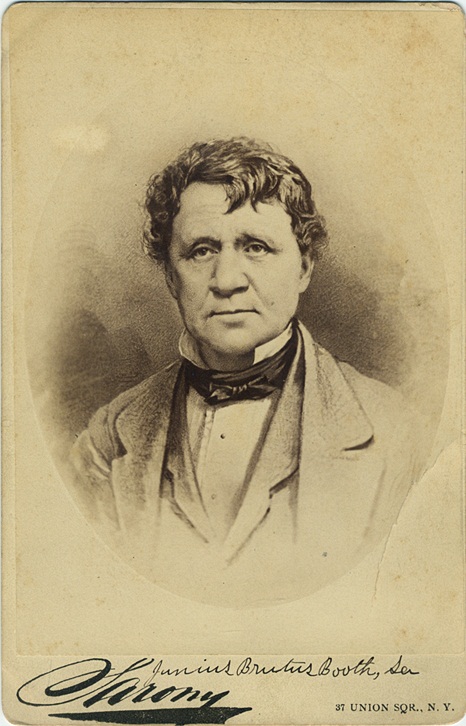
While John Wilkes did choose to perform Ugolino as a benefit due to a family connection, it was not this coincidental connection to his former sister-in-law. Rather, John Wilkes Booth decided to perform the little known play Ugolino because of his connection to the playwright. Ugolino was written by his father, Junius Brutus Booth, Sr.

Wilkes in  Ugolino Ad 1

Junius Brutus Booth, Sr.

Junius Brutus Booth, Sr.

Ugolino is believed to be the only play that Junius Brutus Booth, arguably the best tragedian of his generation, ever wrote. What’s more, I have yet to find any source saying that Junius performed in or even had a chance to see his own work on stage. When Wallack put it on as a benefit in Philadelphia in 1825, Junius was performing in Baltimore. When Junius’ friend J. R. Scott was reviving it in New York during September of 1834, Junius was himself busy performing elsewhere. If Junius had the chance to attend one of the rare dramatizations of his work, it does not appear to be documented.

Despite the positive critiques of the play, I think it is safe to say that those reviewing Ugolino were more in awe of its creator than his product. In her book, My Thoughts Be Bloody, author Nora Titone describes Ugolino as a “blood bath”. Junius Brutus Booth’s biographer, Stephen Archer, stated that Ugolino, “was in the flamboyant tradition of the times,” but, “failed to win a lasting place on American stages.”

Despite its violence and bloodshed however, Junius Brutus Booth’s masterpiece still contains some touchingly poetic lines:

“Let us part,

Since part we must, like brothers and like friends,

Who bent on travel, thus dividing stray,

As Fortune or as Fancy leads the way,

Far off, yet not forgotten, though apart,

Dwelling together in each other’s heart.”

Though time robs us of experiencing Junius Brutus Booth’s true theatrical gifts first hand, these few lines are a fitting self-epitaph to his effect on theatre history.

References:
Junius Brutus Booth: Theatrical Prometheus by Stephen Archer (1992)
My Thoughts Be Bloody by Nora Titone (2010)
A Record of the Boston Stage by William W. Clapp, Jr. (1853)
Genealogybank.com

Categories: Uncategorized | Tags: | 5 Comments

Petersen House Damages

Aftermath Petersen House

There are several blood relics associated with Abraham Lincoln’s assassination: swatches of Laura Keene’s bloodied dress, playbills and misc papers dipped in Lincoln’s blood as he was carried from Ford’s, and the remnants of the physicians’ cuffs and clothing at Lincoln’s death-bed.  The most intact blood relics, however, come from the Petersen House itself.  From pillows, to sheets, to towels, the Petersens sacrificed a great deal of their household furnishings for the dying President.  In the aftermath, they experienced more loss as relic hunters seized upon their boarding house.  As William Clark, the man who was renting the room in which Lincoln died but was absent the nightof the 14th, wrote to his sister on April 19, 1865:

“Everybody has a great desire to obtain some momento from my room so that whoever comes in has to be closely watched for fear they will steal something.”

The number of items we have today regarding Lincoln’s last moments demonstrates that there was considerable loss on the part of the Petersens. After a few months had passed for national grieving, the Petersens appealed to the government:
Petersen's claim Pacific Commerical Advertiser 9-16-1865
Adjusted for inflation, $550 in 1865 is equal to about $8,000 today. Michael Kauffman, author of American Brutus, states in his book that he could find no record that the Petersens were ever awarded compensation for their claim.   Part of me feels sorry that the Petersens gave so much for the dying President and got nothing in return, while the other part of me feels that the eternal preservation of their former home and name as a part of a national park may be compensation enough.

References:
American Brutus by Michael Kauffman
Pacific Commerical Advertiser 9-16-1865

Categories: Uncategorized | Tags: , | 10 Comments

Imprisoned at the Old Capitol Prison

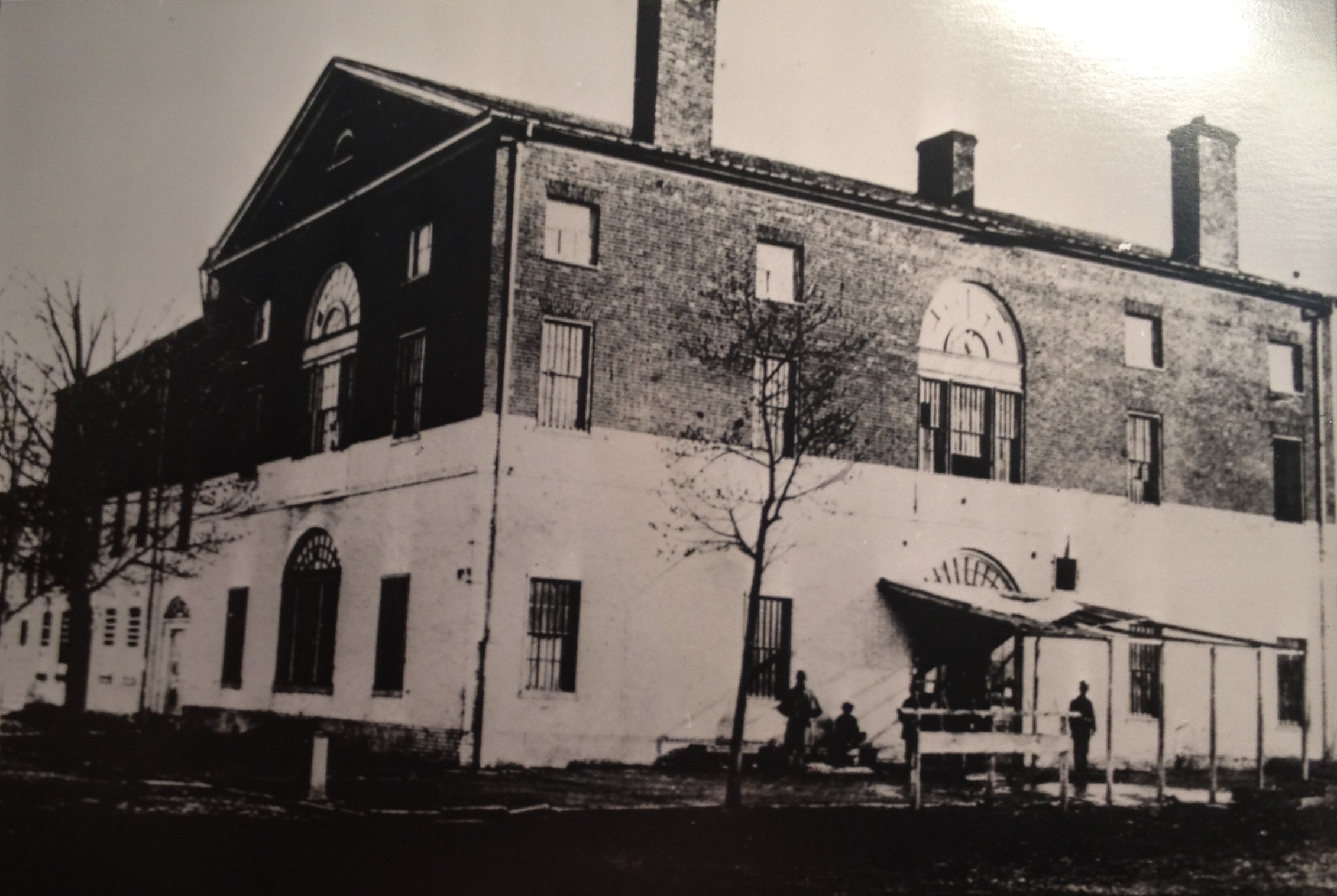
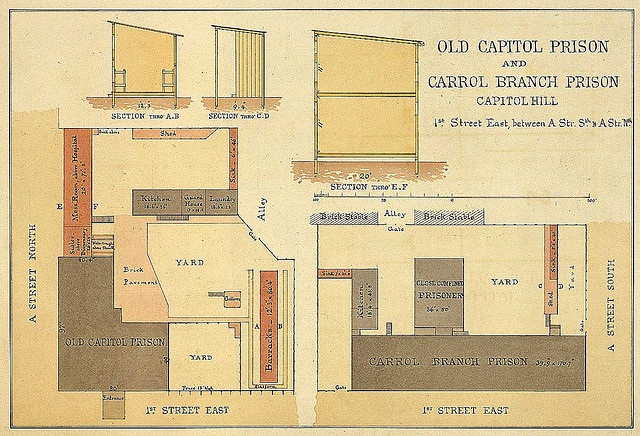
Right now, 148 years ago, John Wilkes Booth and Davy Herold are hiding in the pine thicket not far from Samuel Cox’s plantation, Rich Hill. They are being aided by Thomas Jones, who is providing them with food, water, and newspapers. Eventually, Thomas Jones will help send the pair across the Potomac river into Virginia. Though unable to prove anything against him, Jones would be arrested and imprisoned into the Old Capitol Prison in Washington. Here, he will be joined by several other individuals who had run ins with Booth and Herold during their escape. Some will become witnesses at the trial. One, Dr. Mudd, will become a conspirator. Some others, like Jones and Cox, will eventually be released with their true involvement unknown to the military commission. Here’s a list of people related to Booth and Herold’s escape who were imprisoned at the Old Capitol Prison.

Old Capitol Prison 1

Name Date Committed Age Occupation Residence Date Captured Where Captured Charges Notes
Bryant, William May 3 Farmer King George County, VA May 1 Mathias Point Held as witness by order of Secretary of War Released June 7 order General Baker
Cox, Samuel April 26 46 Farmer Charles County, MD April 24 Charles County, MD By order Col. Foster’s investigating committee Released June 3 on oath – order General Augur
Davis, Thomas April 24 18 Farmer[Dr. Mudd’s farmhand] Charles County, MD April 24 Charles County, MD For Major Turner’s investigation Released May 18 by order General Augur
Garrett, John May 6 24 Clerk Caroline County, VA April 26 Caroline County, VA Committed by order Col. Burnett orders Released May 8, order Secretary of War thru Col. Baker
Garrett, William May 6 20 Farmer Caroline County, VA April 26 Caroline County, VA Committed by order Col. Burnett orders Released May 8, order Secretary of War thru Col. Baker
Jones, Thomas A. April 27 45 Farmer Charles County, MD April 23 Charles County, MD Col Foster’s orders Released May 29 on parole to appear and answer charges when requested
Lloyd, John M April 23 41 Tavern keeper Surrattsville, MD April 23 Near T.B., MD For Major Turner’s investigation. Released June 30 order of Secretary of War on file
Lucas, William May 3 65 Farmer King George County, VA May 1 Mathias Point, VA Held as witness Released June 7, General Augur
Mudd, Samuel A. April 24 30 Dr. Charles County, MD April 21? Charles County, MD For M. I. Comm. Transfer to custody of Col. Baker, Agt. War Department
Rollins, William May 4 46 Farmer King George County, VA May 1 Mathias Point, VA Held as witness Released June 7. Delivered to Col. Baker to be returned over to civil authorities
Swan, Oswell (colored) April 27 30 Farmer Near Bryantown April 24 (or 21?) Near Bryantown Col. Foster Released May 18 Gen. Augur
Stewart [sic], Richard H. May 5 59 Physician King George County, VA May 6 King George County, VA Order Col. Baker Released June 7 by order Gen. Parke
Washington, Frank (colored) April 24 53 [Dr. Mudd’s farmhand] Charles County, MD April 24 Charles County, MD For investigation of Commission Released Gen Augur May 18

Old Capitol Prison Map

Categories: Uncategorized | Tags: , | 13 Comments

April 14th, 2013

On this, the 148th anniversary of  Lincoln’s assassination, I reflect on my own interest in the tragedy at Ford’s Theatre.  In high school, I was in speech and drama.  One day, a good friend of mine who had soundtracks to many musicals, starting playing Assassins by Stephen Sondheim in his car.  At first I thought, “what a dark thing to write a musical about”.  However, as I listened deeply to the lyrics, I was struck by how little I knew about the history of the people I heard.  The songs spoke of their misguided hopes and I was convinced to learn more about these people I knew little to nothing about.  I had heard of John Wilkes Booth of course, but only as the crazy, racist actor who shot Lincoln.  Beyond that, he was a mystery to me.  The more I read about Booth, the more I felt him to be such an oddity compared to the other Assassins.  In his song, entitled “The Ballad of Booth”, he sings of his crime, “Let them cry ‘dirty traitor’, they will understand it later.”

Despite all of the books that I’ve read on the subject since hearing this song for the first time, I still don’t truly understand what made Booth commit his deed.  There are many wonderful books that expertly dissect Booth, and the authors provide wonderful insights as to why he acted as he did.  However, the more I read, the more impossible I find it to put Booth into just one of these corners.  That is what keeps me drawn to this history.  Even after all this time, Booth and his band of conspirators are still an enigma to me.  So I will continue to read and learn about them.  This is what helps keep Lincoln’s legacy alive, in my eyes.  When we dismiss the men and women involved in the ‘dreadful affair’, we allow Lincoln to die.  When we claim to know all we need to know about the Lincoln assassination, we end his story.  So while my interest in Lincoln may be focused on the final chapter of his life, to me, that chapter will never close.  As long as others feel the same as I do, then Abraham Lincoln will never die.

Categories: Uncategorized | Tags: , , | 6 Comments

Chimney House and Atzerodt’s Carriage Shop

Last weekend, in a bit of serendipitous luck, I visited the village of Port Tobacco and saw that the home of Chimney House was having an open house. Oddly enough, I had met the realtors for Chimney House last August while antiquing with Herb Collins in Tappahannock, VA.  Jay and his wife Mary Lilly are not only the realtors for Chimney House, but Mr. Lilly is also the president of the Society for the Restoration of Port Tobacco.  I was invited in by the Lillys and we proceeded to tour the house.  At the end of the day, I was in awe of Chimney House’s size, beauty, and impeccable furnishings.   Here are some of the pictures I took of the of the house:

This slideshow requires JavaScript.

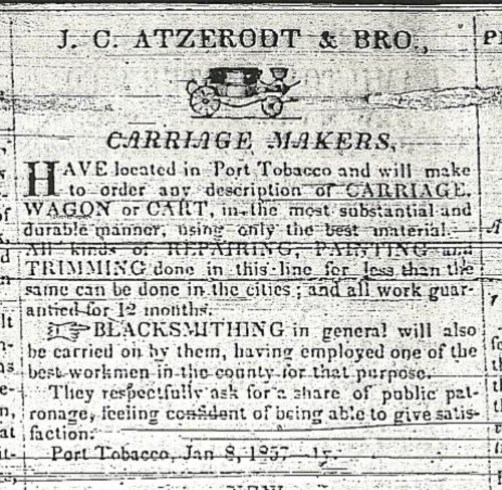
Now, Chimney House is more than just a period building in historic Port Tobacco, Maryland.  It also connects to George Atzerodt who made his home and business in Port Tobacco.  In 1857, George Atzerodt and his brother John moved to Port Tobacco and began operating a carriage shop in town.

Atzerodt Carriage Shop Advertisement 1857

When the war came, the brothers closed down the business as John found a job working for the Maryland Provost Marshal as a detective.  Living in Port Tobacco, George found himself in the company of a twice widowed woman by the name of Elizabeth Adams Boswell.  She is better known to assassination historians as Rose Wheeler, an amalgamation of her former husbands’ last names (Charles Wheeler and Henry Rose).  George had one child by Mrs. Wheeler, a girl named Edith.  George and Rose lived together as common law man and wife until George was pulled into Booth’s conspiracy.  Mrs. Wheeler even visited George at the Arsenal Penitentiary before he was executed for his involvement in the tragedy at Washington.

So where does Chimney House play a role?  Well, at one point columnist and author George Alfred Townsend, better known by his nom de plume: GATH, visited and sketched Chimney House in Port Tobacco.  In his sketch of the house, GATH included a small outbuilding near the Chimney House which he attributed to be the Atzerodts’ carriage shop.  With very few others of his day taking an interest in George’s life prior to his non attempt on Andrew  Johnson, GATH’s drawing has been taken as correct.  With Chimney House lasting the tests of time, people could point to the area behind the house as the location of George’s former shop.

GATH's sketch of Chimney House with Atzerodt's carriage shop in the rear

GATH’s sketch of Chimney House with Atzerodt’s carriage shop in the rear

However, between 2007 and 2010 Port Tobacco underwent a major archaeological project funded in part by a $60,000 Preserve America grant from the NPS.  Though no longer updated, the website for the Port Tobacco Archaeological Project has some tremendous information regarding the wonderful work that was done there.  One area that the project leaders wanted to work on was to attempt to find the Atzerodts’ carriage shop.  On a cold December day in 2007, the team made a few shovel test pits (STPs) behind Chimney House looking for evidence of the former carriage shop structure.

That was near the end of the season, and the workers restarted their work in March of 2008.  Here is a report of their efforts:

“Yesterday we set out to finish what we had started. It was warm and sunny so the conditions seemed right. But it did not take us long to realize that the rear yard of the Chimney House is just too marshy for shovel testing to work. Determined, we excavated a few STPs but soon hit wet clays and sands with little soil development above them. The digging was difficult, the screening was difficult, and there just was not enough artifact content to draw any conclusions. We stopped digging and spent a bit of time wondering why anyone would build in this marshy area.”

The archaeological team was starting to have doubts about the long-held “behind Chimney House” theory.  Here’s another look into their thought processes from September of 2008 after still coming up empty behind Chimney House:

“Look at the sketch again. Notice anything else odd about it? In all the photos we have of Chimney House, not one of them has a covered front porch on it or even what appear to be remnants of one. If this sketch was done in 1885 and our earliest photographs of the house are in the early 1900’s (roughly 1910), then it was torn down before. Could this be a journalist’s imagination just trying to make the house look in better condition than it was? Remember that most of Port Tobacco was in shambles after the Civil War as people migrated out of town. Is the repair/paint shop located behind Chimney House?”

With no archaeological evidence to support it, the team did not believe the Atzerodts’ shop was behind Chimney House.  In September of 2010, as the team leader was completing his report for the Preserve America grant, he reported his belief of the true location of the Atzerodts’ carriage shop:

“Today, while working on our final report for the Preserve America grant, which funded our exploration of Civil War era Port Tobacco, I put together several bits of information that resulted in the formulation of a hypothesis: the Atzerodt carriage shop and the house in which George Atzerodt lived with Mrs. Elizabeth Wheeler might have been leased from wheelwright Griffin Carter, and that property lies on the east side of Chapel Point Road, where we have not undertaken any archaeological investigations, directly across from the road that runs west to the courthouse.”

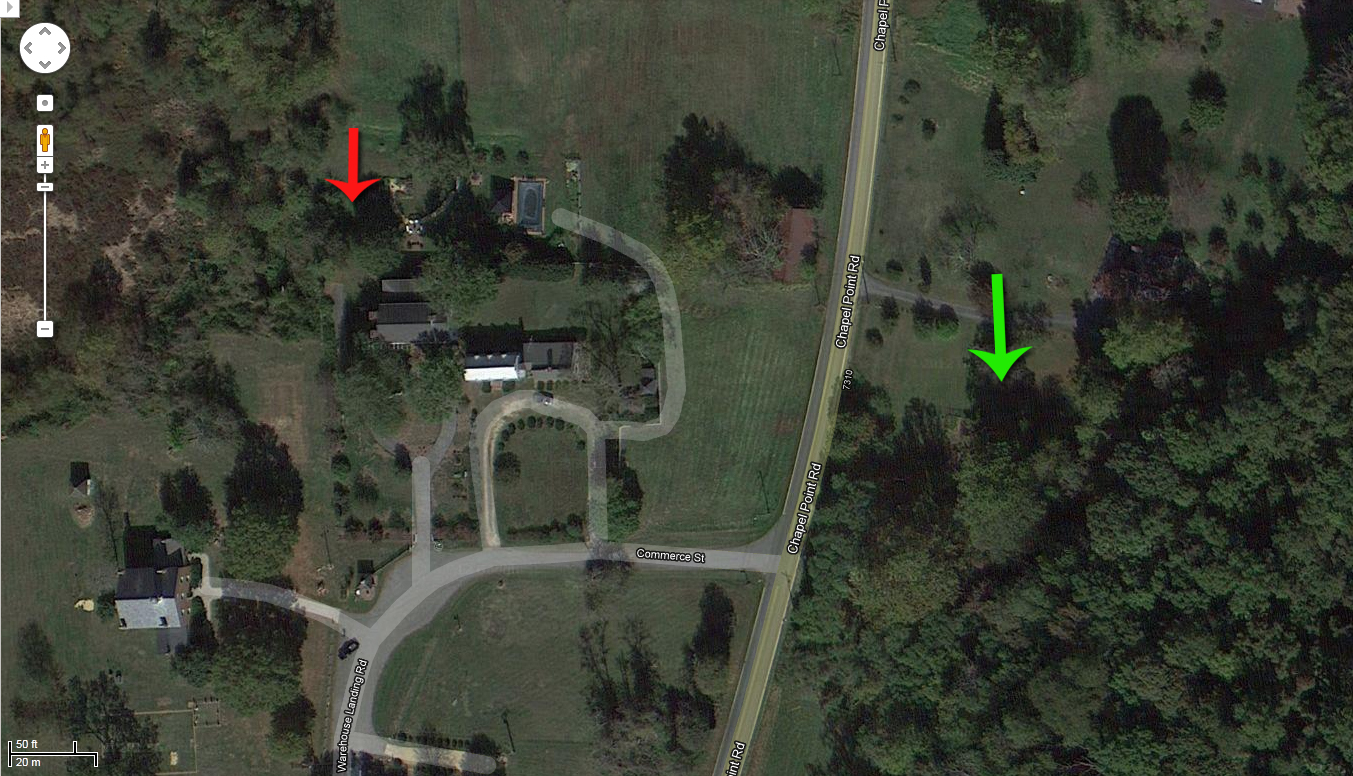
You can read more about his hypothesis here, here, and on page 38 of this.  Here’s an aerial shot showing the area.

Atzerodt's Carriage Shop Theory

The red arrow marks the land behind Chimney House where the team found no evidence of any shops whatsoever.  The green arrow points out the general area where the team leader now suspects George Atzerodt’s shop actually was.

However, even if George’s shop was not behind Chimney House, it is my belief that Rose Wheeler, her daughters including Edith, and maybe even George himself, slept in Chimney House.  Mrs. Wheeler’s maiden name was Boswell.  Her brother, William Boswell, purchased Chimney House in 1859 and it didn’t leave the family until 1904 when it was sold by his daughter.  In the 1870 and 1880 census, one of Mrs. Wheeler’s daughters from her first marriage is living with William Boswell in Chimney House.  To me, it seems reasonable that William Boswell would invite his twice widowed sister and her children to live with him in Chimney House, at least for a while.  Whether he would allow George Atzerodt into his home would be a different matter.

Chimney House is a truly beautiful piece of history in Port Tobacco, and yet another interesting sidebar in the Lincoln assassination story.

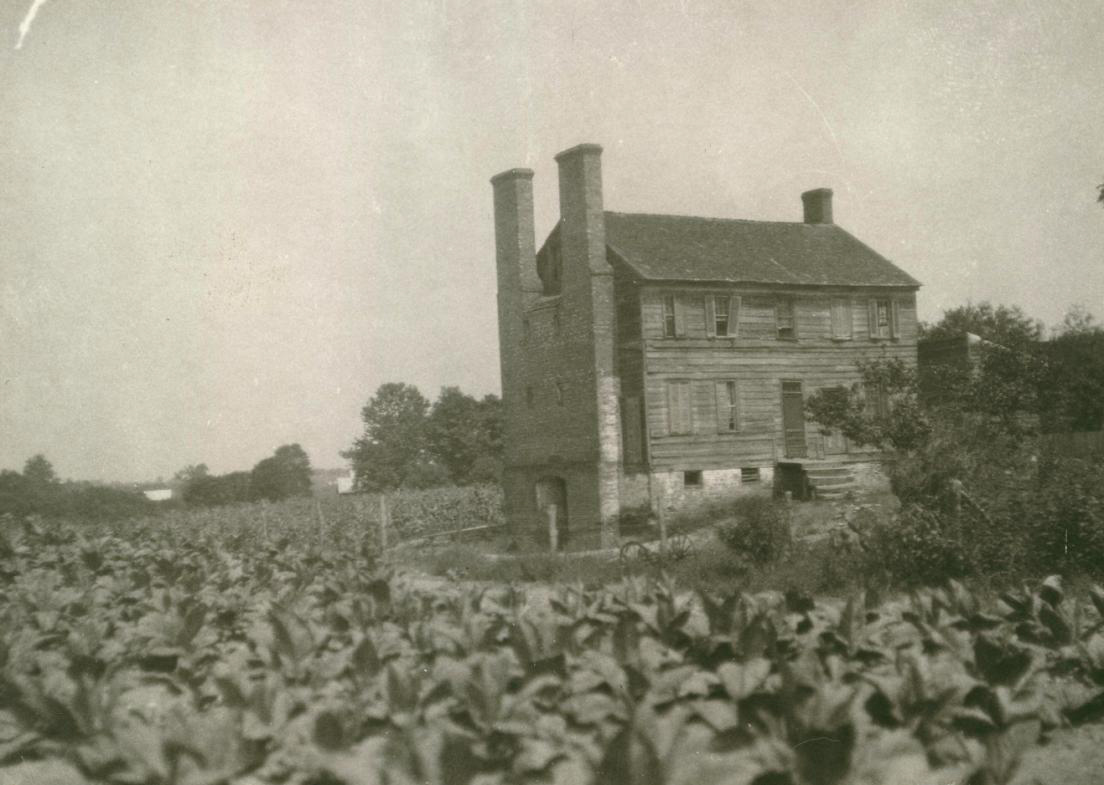
Port Tobacco's Chimney House  surrounded by tobacco plants circa 1930

Port Tobacco’s Chimney House surrounded by tobacco plants circa 1930

References:
Port Tobacco Archaeological Project
Society for the Restoration of Port Tobacco
Times of Port Tobacco by John and Roberta Wearmouth
Thomas A. Jones, Chief Agent of the Confederate Secret Service in Maryland by John and Roberta Wearmouth

Categories: Uncategorized | Tags: , | 13 Comments

New Gallery – Fake Conspirators

As you probably could have guessed, I have been on spring break from school during this last week.  During this time off, I entertained my parents who flew in from Illinois.  I’ve been living in Maryland for eight months now and this was the first time that they have been able to come out and see my place.  I gave them a poor man’s Booth Escape Route Tour, and we spent some days doing Southern Maryland things before heading into D.C.  When they departed, I was able to spend a day researching the files at Ford’s Theatre which I have never done before but thoroughly enjoyed. Since then, I’ve been doing my best to update this site.

Alas, today is the last day of my spring break.  Still I was able to create and put up one more Picture Gallery, albeit a smaller one from the Davy Herold gallery from yesterday.  While these galleries do not contain much in the way of new research, it still takes a considerable amount of time to find appropriate pictures, locate the highest quality versions of them, perform any minor picture editing needed in Photoshop, upload them to this site, write descriptions and citations for them, and then post about them.  I hope that you all are enjoying the galleries as they have been added, as it is my hope, above all else, for this site to be a resource.

The newest Picture Gallery is one that features images from the two Fake Conspirators who were photographed by Alexander Gardner aboard the iron clad monitors: Ernest Hartman Richter and Joao Celestino (aka John M. Celeste).

Ernest Hartman Richter was arrested in his home in Germantown, MD when detectives found his cousin, conspirator George Atzerodt, sleeping there.  Richter, who went by his middle name, Hartman, made the mistake of trying to protect his cousin and originally told invstigators that Atzerodt wasn’t there.  He was brought back to Washington, imprisoned aboard the U.S.S. Saugus, and photographed by Alexander Gardner on April 25th.  After that, he was sent to the Arsenal Penitentiary, transferred to the Old Capitol Prison, and eventually released.

Joao M. Celestino was a Portuguese ship captain who had his schooner and valuables confiscated by the U.S. government in 1864 for running the blockade.  He held a strong hatred for Secretary of State William Seward, whom he blamed for his losses.  The night of the assassination, he was heard to say he wanted to kill Secretary Seward.  After Lewis Powell attempted to do just so later that evening, people remembered his remarks, and Celestino was arrested and placed aboard the Saugus before being moved to the U.S.S. Montauk.  He had his photographs taken on April 27th with conspirator David Herold, who had just been captured.  Celestino was transferred to the Arsenal as well, before being released, himself.

These are the Fake Conspirators – the men whose faces are preserved alongside those of John Wilkes Booth’s inner circle.  They are a farmer protecting his cousin and ship captain with a justifiable grudge against William Seward.  Click here to see the new Fake Conspirators Picture Gallery!

References:
Inside the Walls – 13 Days Aboard the Monitors by John Elliott and Barry Cauchon
Conspiracy: The Portuguese Arressted in Connection with Lincoln’s Assassination by Pedro Jorge Castro

Categories: Uncategorized | Tags: , | 5 Comments

Blog at WordPress.com.