Today, as the New England region of the United States recovers from what is being called the “Blizzard of 2015”, I am reminded of another historic winter storm. To many in the Midwest, the winter of 1863/64 became frozen in their minds as one of the worst winters ever experienced. Between December and January, temperatures rarely went above freezing. On December 18, 1863, for example, Fort Kearny, Kansas, reported a temperature of 25 degrees below zero with snow four to five feet deep in places. New Year’s Day, 1864, brought along a massive blizzard for the Midwest, with places like Minneapolis, Minnesota, seeing a high of 25 degrees below zero that day.
It was around this time that John Wilkes Booth, a now successful and celebrated actor, was performing in Leavenworth, Kansas. He had been delayed in arriving at Leavenworth from his former engagement in Cleveland, Ohio, appropriately due to snow. However, this minor delay of a day would amount to nothing compared to what was in store for the actor.

Booth finished his engagement in Leavenworth on December 31. During his time there, critics spoke of his talents:
“Mr. Booth has not only genius, but careful culture and trained power of intellect. There is no actor now on the stage who displays so much of dramatic force and insight as Mr. J. Wilkes Booth, except, perhaps, for his brother Edwin. There is no imitation on the part of the junior, either to his renowned father or his now famous brother. He has a grace and charm all his own, though resembling them in genius, skill and painstaking care, with which his characters are presented on the stage.”
John Wilkes Booth set off from Leavenworth on January 1, 1864. In the morning, he made a brief visit to Fort Leavenworth, a few miles north of the city, to see some friends. This trip occurred on one of the coldest days on record and at a time when newspapers were describing the terrible winds thusly: “Ah, this is a blessed cold snap! Patient old Job may have seen colder weather, but he never undertook to walk up Sixth street facing such a wind as we felt yesterday. Not he. His reputation for patience would have been blasted. God help the shivering poor.” Booth later wrote of having “an ear frost bitten” by the time he arrived at the Fort.
Accompanying Booth during this western trip was a young, black man, possibly named Leav, about whom practically nothing is known other than he served as Booth’s valet and servant. Upon leaving Fort Leavenworth for the journey back to town in order to catch the ferry, Booth gave Leav some items to carry, including his pocket flask. Booth wrote the sorrowing effects of this decision in a letter to the man with whom he had been boarding with in Leavenworth:

Portion of a John Wilkes Booth letter in which he recounts the loss of his flask in the snow.
“After giving my boy my flask to keep for me, I started for a run and made the river (four miles) on foot. I run without a stop all the way. I then found my boy had lost that treasured flask. I had to pay five dollars for a bare-backed horse to hunt for it. I returned within sight of the Fort and judge my dismay upon arriving to see a waggon just crushing my best friend. But I kissed him in his last moments by pressing the snow to my lips over which he had spilled his noble blood.”
Some have tried to use this visual of the actor, mourning the destruction of his flask and sucking the last bit of its spilled contents from the snow, as evidence that Booth was an alcoholic. While possible, I view the scene as entirely appropriate given Booth’s dramatic flair in a moment when the outside conditions so desperately warranted the “warming” effects of alcohol. Saddened as he was, things were still only going to get worse for the actor.
When Booth returned to the boat landing, he found that ice had prevented the ship from reaching the shore. Booth, along with others, helped to cut the ice in order to allow the boat to dock. The ship then took him across the Missouri River, and he slept that night across the river from Leavenworth in the town of Weston, Missouri. His end goal was St. Louis, where he was booked at Ben DeBar’s theater starting on January 5. On the morning of January 2, he boarded a train at Weston and took it north about 35 miles to St. Joseph. From there, he was hoping to catch a train with the Hannibal and St. Joseph Railroad, which would take him eastbound towards St. Louis. The weather, however, had other plans.
The blizzard of 1863/1864, known as “The Big Snow” by those who lived through it, occurred over an area of 3,000 miles, hitting a large portion of Illinois, Iowa, and Missouri. As one Missouri citizen later recalled, “a terrible snow storm set in and continued with unabated fury for forty-eight hours.” Near St. Joseph, the ground was covered with snow to a depth of about 27 inches, but areas east of St. Joseph had been hit even worse. Huge snow drifts occurred, completely covering the railroad tracks. Not one, not two, but eight trains along the Hannibal and St. Joseph Railroad were trapped in the snow, some buried up to thirty feet in it. The closest trapped train was only about 19 miles east of St. Joseph. All were unlikely to be freed anytime soon.

The cover of the January 23, 1864, edition of Harper’s Weekly shows the condition of railroads across the Midwest.
By the time Booth had arrived at St. Joseph, no train had traversed the Hannibal and St. Joseph rails for the past week. Booth, like everyone else who came to St. Joseph hoping to go east, was completely snowbound. Local newspapers printed a report, later to be proven entirely too optimistic, that the train line might be up and running again in four days. With no other options available to him, Booth found a room at the now wholly overcrowded Pacific House hotel in St. Joseph.
Booth spent his first full day in St. Joseph on Sunday, January 3. Even after only a day, Booth likely empathized with the local newspaper, which wrote, “We are ‘in the wilderness,’ and can’t see any way to get out.”
On Monday, January 4, Booth’s reputation had caught up to him. After becoming aware that the famous tragedian was effectively stuck in their city, citizens of St. Joseph wrote a letter to Booth asking him to perform for them in some capacity. They wrote:
“J. Wilkes Booth, Esq., Pacific House:
Sir:
The Undersigned, citizens and travelers detained here, having learned that you were making a short visit to this city and entertaining a high appreciation of your ability as a tragedian, would most respectfully but earnestly request that you would favor us with a public reading from any of your favorite authors, at any time and place most convenient for you. When and where we pledge you an appreciative audience”
The request was then signed by 70 citizens and guests of St. Joseph, including the mayor. Booth, later wrote to a friend that he was down to his last cent in St. Joseph, and so he heartily agreed to the public’s demand of him. He wrote the following response to the invitation:
“Gentlemen:
Your flattering request has just been recieved and I endeavor to show my appreciation of it, by the promptness of my compliance. I have gained some little reputation as an actor, but a dramatic reading I have never attempted. I know there is a wide distinction as in the latter case, it is impossible to identify ones-self with any single character. But as I live to please my ones, I will do all in my power to please the kind friends I have met in St. Joseph.
I will therefore designate Tuesday evening, Jan. 5th, at Corby’s Hall. I am
Very Respectfully,
J. Wilkes Booth”
Despite his assertions to the contrary, Booth had, in fact, performed public recitations before. When he ran off with the Richmond Grays to attend the execution of John Brown, he had entertained his fellow soldiers with readings. That was, however, over four years ago when he was still but a novice actor.
The next day’s newspaper advertised the performance as its lead article, with the newspaper’s ironic political sentiments being the only thing preceding it in the issue.
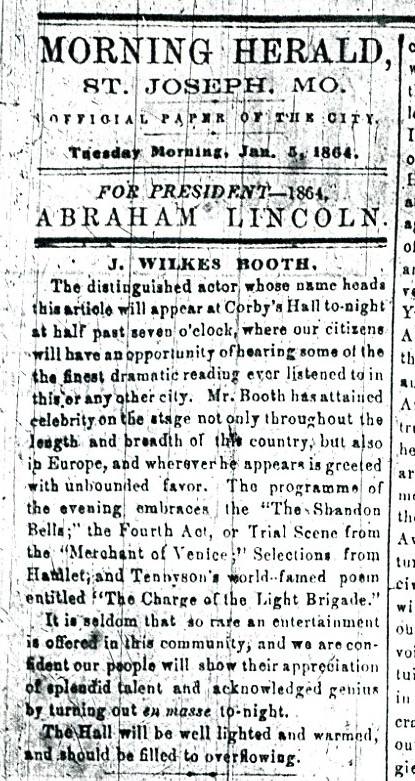
In addition to reciting pieces contained in the article above, John Wilkes also took this chance to recite one of his favorite, and entirely appropriate, poems, “Beautiful Snow.” The newspapers hailed the performance the next day, stating:
“The dramatic reading of this celebrated actor last evening was well attended and gave universal satisfaction. The Hall was well filled, but it was so very cold that everybody found it almost impossible to be comfortable. The selections of the reader were all rendered in a captial style, but we were particularly pleased with ‘Once I was Pure [Beautiful Snow]‘ and the ‘Charge of the Light Brigade.’ Our citizens would greet Mr. Booth with a crowded house could he be persuaded to repeat the entertainment.”
Booth did not perform again in St. Joseph despite the newspaper’s suggestion. It might have had something to do with the condition of the audience, which the newspaper scolded for their behavior during his recitations:
“It is inexplicable why full grown men will go about in a hall on such an occasion as that of last night, stamping like elephants, and moving chairs as though they were anvils. A trifle of good breeding is a capital thing to be used in keeping a hall quiet. Stupid dolts who go thundering about the world, to the disgust of every sensible person, should be debarred from the privileges of Corby’s Hall during dramatic readings.”
Booth received $150 from the performance, which was greatly needed. Days were still passing with little sign that the trains would start running again. On Thursday, January 7, the temperature in St. Joseph at 9:00 am was twenty-one degrees below zero. Some days were better than others, however, with the newspaper celebrating the reappearance of the sun despite the “crisp, cold day”.
By Friday, January 8, it was clear that everyone was suffering from the prolonged freeze. The newspaper lamented, “Well, this is a big storm. In the memory of man, no such cold weather and no such fall of snow has been known as we are now suffering in. Hundreds of travelers are here, weatherbound.” An earlier report stated, “Our people are in a terrible fix. The snow has effectually shut us out from ‘all the world and the rest of mankind,’ and there is no prospect of relief.” John Wilkes Booth was now three days overdue for his engagement in St. Louis, 300 miles away. A man arrived in St. Joseph and related that he had taken the train west from Macon, the transfer point to St. Louis. The train made it west until Breckenridge, where the other stopped trains and snow prevented it from going further. Booth, realizing that if he could make it to Breckenridge, 60 miles to the east, he could catch the working trains to Macon and then St. Louis, decided to put an end to his snowy vacation in St. Joseph. With $100 of the money he had received from his public reading, Booth hired a four-horse sleigh to take him the 60 miles to Breckenridge. He departed on January 8, after spending about five and a half days in St. Joseph, Missouri.
The exact details of Booth’s journey by sleigh are not known for sure. He later wrote to his friend John Ellsler of the journey:
“[The performance at St. Joseph] gave me $150. with which I hired a sleigh and came 100 miles over the plains. Four days and nights in the largest snow drifts I ever saw Its a long story which I want to tell you when I see you, but I will say this that I never knew what hardship was till then.”
There are two individuals who, many years later, gave accounts regarding Booth’s time in the snow. One of them was William D. Bassett, then a 16-year-old railroad telegraph operator stationed in Cameron, Missouri. Around the turn of the century, various newspaper articles were published featuring Bassett’s recollections of The Big Snow. Bassett stated that he shared his comfortable room at the Cameron depot with Booth after Booth arrived, along with this theatrical troupe, in Cameron by train. The way Bassett portrays it, Booth was never trapped at St. Joseph, but, instead, with him at Cameron. All of this is suspect and is contrary to the facts. However, it is possible that Bassett has some truth in his accounts. Perhaps, Booth, while on his four-day sleigh journey to Breckenridge, stopped in Cameron to rest for a day or two and found hospitality with young Bassett in the depot. Cameron was just about halfway between St. Joseph and Breckenridge, making it an extremely appropriate spot to rest before moving on. In Bassett’s recollections of their time together, he states that Booth was fond of literature and that the pair spent some time reading Victor Hugo’s Les Misérables together. Booth was also apparently quite entertained when, upon visiting the local bar one morning, he found a captive audience of customers waiting patiently as the bartender was attempting to thaw out bottles of whiskey that had frozen solid.
Probably the most entertaining of Bassett’s recollections involves Booth’s interactions with the children of Cameron. From other accounts, we know that John Wilkes Booth was very fond of children and was fairly gifted at conversing with them. According to Bassett:
“Several little children played around the depot everyday while Booth was there, and with these innocent creatures he soon became a prime favorite. He would teach them games and engage in snowball battles with them. Sometimes they would all join against him and give him much the worst of it, but he took it all in perfect good nature, and was as rollicking and boisterous as the best of them. For many weeks after his departure the little girls and boys would ask me when ‘Mr. Boots’ was coming back.”
A newspaper article containing Bassett’s memories, published in 1901, includes this wonderful drawing of the event.

Even if Bassett’s accounts are untrue, I have no problem believing that, at some point in his life, whether it be during the many days he spent at St. Joseph or a previous snowy winter, John Wilkes Booth engaged some local children in a snowball fight. His affinity for children makes this a very likely scenario.
One of the other individuals who later spoke of Booth’s time in the snow was an actress named Mrs. McKee Rankin. According to an article by her published in 1909, she heard Booth recount some of the struggles he faced during his sleigh ride to Breckenridge. It is very difficult to put any reliability in her account, however. Not only was it published 45 years after the event, but Mrs. Rankin also admits that she is remembering the story told by Booth to a friend while she was listening through a transom in a different room. The account is filled with factual errors regarding the events and, in truth, is barely worth the paper it is written on. However, it is still an extremely entertaining read. Surprisingly, the one thing Mrs. Rankin does get right is the inclusion of Booth’s otherwise forgotten servant. She recalls an exciting tale in which Booth and Leav hire a horse named “The Girl” to lead their sleigh. At one point, it is so dark that the men went right over a snow drift, sending them flying from the sleigh. As Mrs. Rankin wrote it, after the accident, poor Leav was like a cartoon character with his head and body buried while his legs and feet stuck out of the snow. Booth pulled him out, and together they righted the sleigh. Leav was freezing cold and buried himself under robes and blankets on the sleigh. While Booth recovered himself, he bent down to get a drink of whiskey from a jug they had brought along, only to find that it had broken. After lighting a half-broken cigar, Booth heard footsteps approaching. He tried to rouse Leav, but at that point, Leav was unconscious, wrapped in the sleigh. As the footsteps got closer, Booth drew long on his cigar, hoping to see something in the darkness. Then he felt the panting of an animal before him and saw two balls of fire reflecting in the eyes of an animal before him. It was a wolf! In that instant, the “heroic” Booth grabbed the broken piece of whiskey jug and brought it down right onto the head of the beast. Before getting a chance to see how many wolves were out there, “The Girl” let out a yelp and, with a bound, was pulling the sleigh away at top speed. According to Mrs. Rankin, the horse, at a dead run, didn’t stop until they reached their destination.
While it’s safe to say that probably none of Mrs. Rankin’s account is true, it is at least possible that Booth said some of these falsehoods to make a good story. In fact, another actor by the name of Edwin Adams recalled another likely case of Booth adding flourish to a story:
“I heard [Booth] boasting over a long and tedious journey from Leavenworth across the prairies in a sleigh to St. Louis and after of having threatened a conductor’s life, who had stopped his train on account of the great depth of snow, and that by placing a pistol to his head, made him continue his journey.”
The truth of Booth’s journey, however, is far less flashy. On Monday, January 11, John Wilkes Booth, his servant, and his sleigh team had made the cold trek of sixty miles from St. Joseph to Breckenridge. The tracks on the Hannibal and St. Joseph Railroad were clear from that point eastward. Booth caught the first train he could eastward. At Macon, he transferred from the Hannibal and St. Joseph Railroad to the Northern Missouri Line. This line took him southeast, all the way to his destination of St. Louis.
He opened at the St. Louis Theatre on Tuesday, January 12, exhausted but not wanting to lose any more days from his engagement. The Big Snow had caused him to lose seven days of performances—and pay. The toils of his journey had taken much out of him. One of the stock actors in the company later wrote, “[Booth] told me of his hardships in coming down from [St. Joseph] to fill his date in St. Louis, and that he had made the greater part of the journey in sleds…He looked worn out, dejected and as melancholy as the dull, gray sky above us…After ordering beer, he sat gloomily and silent for a time, and upon my asking him the cause, he smilingly answered that no doubt it was the rough experience he had passed through lately.” Booth would only perform five times in St. Louis before he had to move on to his next engagement in Louisville, Kentucky.
Just as the residents of Boston will long remember the Blizzard of 2015, so did John Wilkes Booth retain a memory of his run-in with the Big Snow of 1863/64. He spent just under a week snowbound in St. Joseph, Missouri, and, when he could take it no longer, he braved the harsh weather by sleigh for four days. In less than a year and a half, John Wilkes Booth would again be braving the elements for a chance at freedom as he ran for twelve days, attempting to flee one of the largest manhunts in American history.
References:
John Wilkes Booth: Day by Day by Art Loux
“Right or Wrong, God Judge Me”: The Writings of John Wilkes Booth edited by John Rhodehamel and Louise Taper
January 1, 1864 – January 9, 1864 editions of the St. Joseph Morning Herald
Snowbound with John Wilkes Booth at Cameron, MO by William F. Bassett in The St. Louis Republic Magazine, August 4, 1901
The News of Lincoln’s Death by Mrs. McKee Rankin
The Lincoln Assassination: The Evidence edited by William Edwards
Recollections of an Old Actor by Charles A. Krone
Harper’s Weekly
The Art Loux Archive
GenealogyBank.com



















Recent Comments