
I’m so fortunate to have a wealth of friends and colleagues willing to contribute posts here on LincolnConspirators.com as I spend more time working on my book. This post is written by Richard Sloan. He has been involved in the assassination for decades. In many ways, this blog is following in Richard’s footsteps as he wrote and mailed out his own Lincoln assassination newsletter from 1976 to 1981. Called The Lincoln Log, Richard’s Xeroxed sheets were filled with new articles and reports from fellow researchers on their discoveries. Richard was essentially blogging about the Lincoln assassination before the internet was a thing. I met Richard at the first Surratt Society conference I attended. Just a couple of years later, he took a chance and had me take part in a panel discussion in New York alongside Michael Kauffman and Kate Clifford Larson.

Richard acted as our moderator, and I was definitely out of my league compared to those two great historians, but it was a truly wonderful experience. Since then, Richard and I have been regular email correspondents. After I published my post last year about The Twilight Zone episode, “Back There,” Richard inquired if I’d ever write something about Lincoln lobby cards. Knowing his expertise in Lincoln in the media and his own large collection of Lincoln lobby cards, I told him that only he could do the matter justice. I’m so pleased to present Richard’s piece about Abraham Lincoln movie lobby cards, illustrated with some selections from his vast collection.
Lincoln Movie Lobby Cards
By Richard Sloan
Readers of Dave’s blog may wonder why this topic could be of interest. Since 1955, when I was eleven years old, and read the Reader’s Digest version of Jim Bishop’s The Day Lincoln Was Shot, I’ve been very interested in both our 16th President’s life and his assassination. In 1976, I became passionately interested in how both subjects have been depicted in the theatre arts – early melodramas, radio, movies, and television. My penchant for collecting items on these subjects began shortly thereafter. It now includes videos, reviews, clippings, autographs, scripts, playbills, publicity photos, and movie lobby cards. For those of you too young to know what lobby cards are, they are colorful scenes from silent movies and “talkies” that were printed on heavy 11” x 14” card stock. With the aim of luring pedestrians into buying movie tickets, posters were displayed outside theaters with banners reading “NOW PLAYING!” Scenes from upcoming features were displayed inside the theatres’ lobbies, (hence the term “Lobby cards”) with the banners reading “COMING SOON!” These cards were usually framed and covered with picture glass to protect them, but sometimes a lazy theatre manager would merely have them crudely pinned upon a wall with thumb tacks.
Lobby cards were produced in sets of eight. Back in the days of black & white silent movies, the studios colored them to make them more attractive to would-be theatre patrons. Film historians estimate that 90 percent of silent films have been lost, simply because they were made on nitrate stock that caused them to eventually disintegrate. They are called “lost films.” Lobby cards from these films are the only evidence of what they looked like. Mark Reinhart’s encyclopedic book Abraham Lincoln on Screen (now in its third edition) lists fifty-three silent films in which Lincoln is depicted, and he writes that over half of them are “lost.”
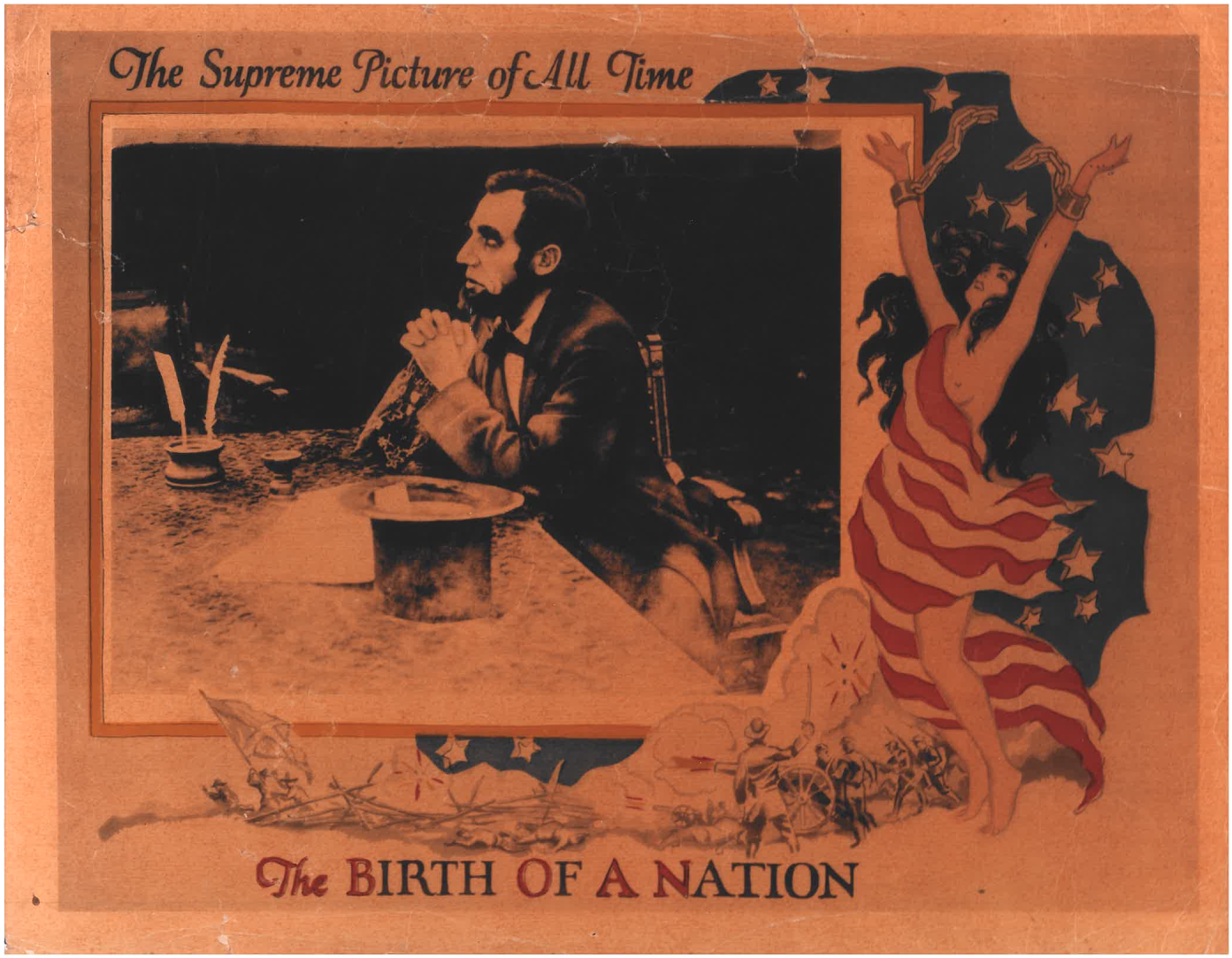
When a first-run film played out its engagement in one theatre, its lobby cards were returned to the film’s distributor together with the films for use in another theatre. And when a movie completed its run altogether, the lobby cards no longer served any purpose. They were either thrown out or given away. Sometimes, dealers in movie ephemera would get their hands on them. Others survived by sheer chance, tucked away in an attic or kept by an actor as a memento of their careers. No one could imagine that some of them would ever become valuable collectibles. The most valuable of all the Lincoln lobby cards are the one from The Birth of a Nation (1915), showing Joseph Henabery praying as Lincoln, and the one from The Littlest Rebel (1935), showing a charming (but fictitious) scene between Shirley Temple and Frank McGlynn, who played Lincoln. When these cards were sold at auction, collectors with deep pockets (that’s not me!) won them. Fortunately, faithful reproductions of these two cards can now be purchased easily on eBay for very affordable prices.

Some movie distributors contracted for films to be re-released a decade or so after their initial release (before television came along), giving new audiences the opportunity of seeing them for the first time. In such cases, an entirely new series of lobby cards were issued, usually containing different scenes than the original cards did. For collectors who can’t afford the originals, these re-issues can sometimes be more affordable. Small words in red at the bottom of these cards state either “re-release” or just the letter “R.”
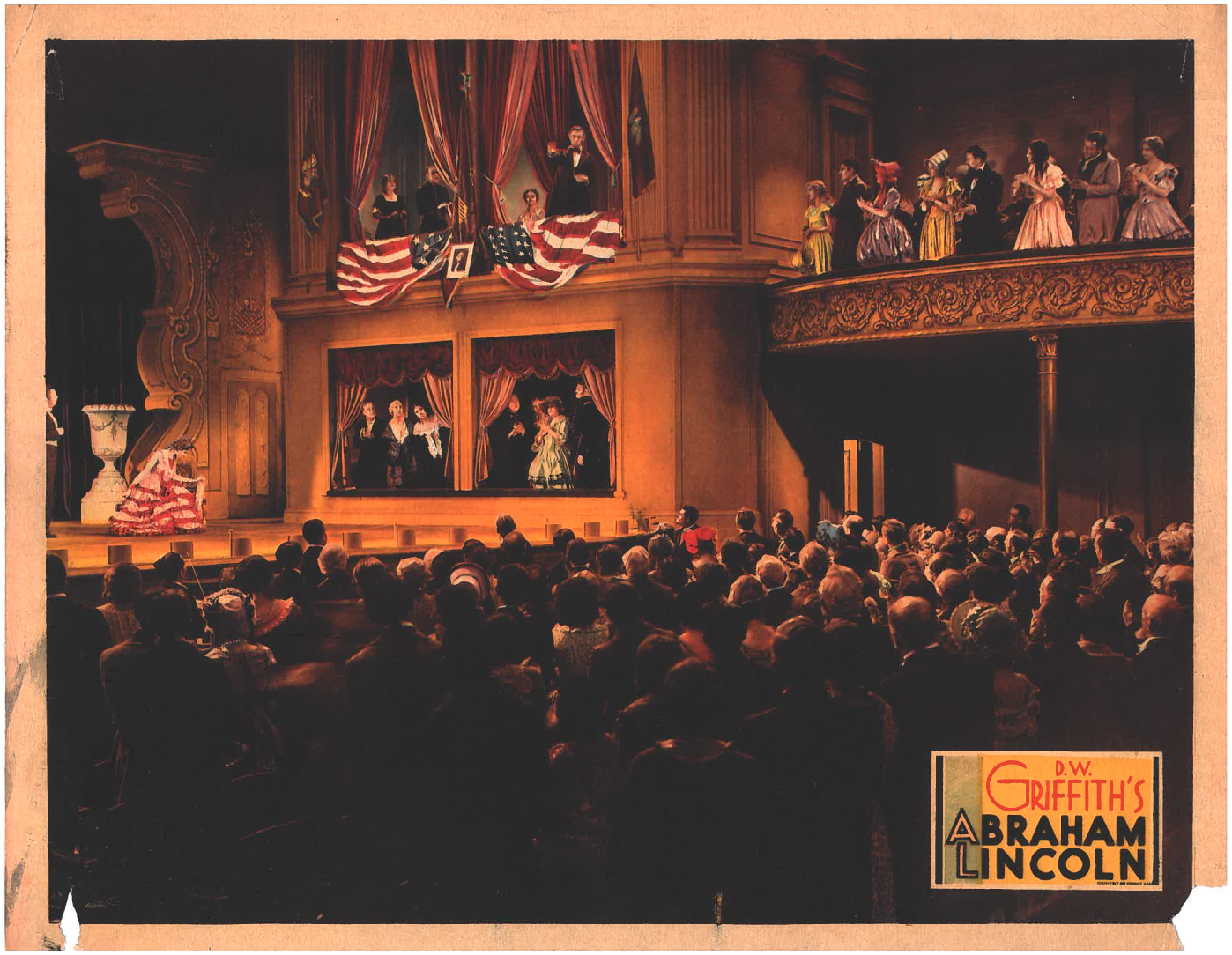
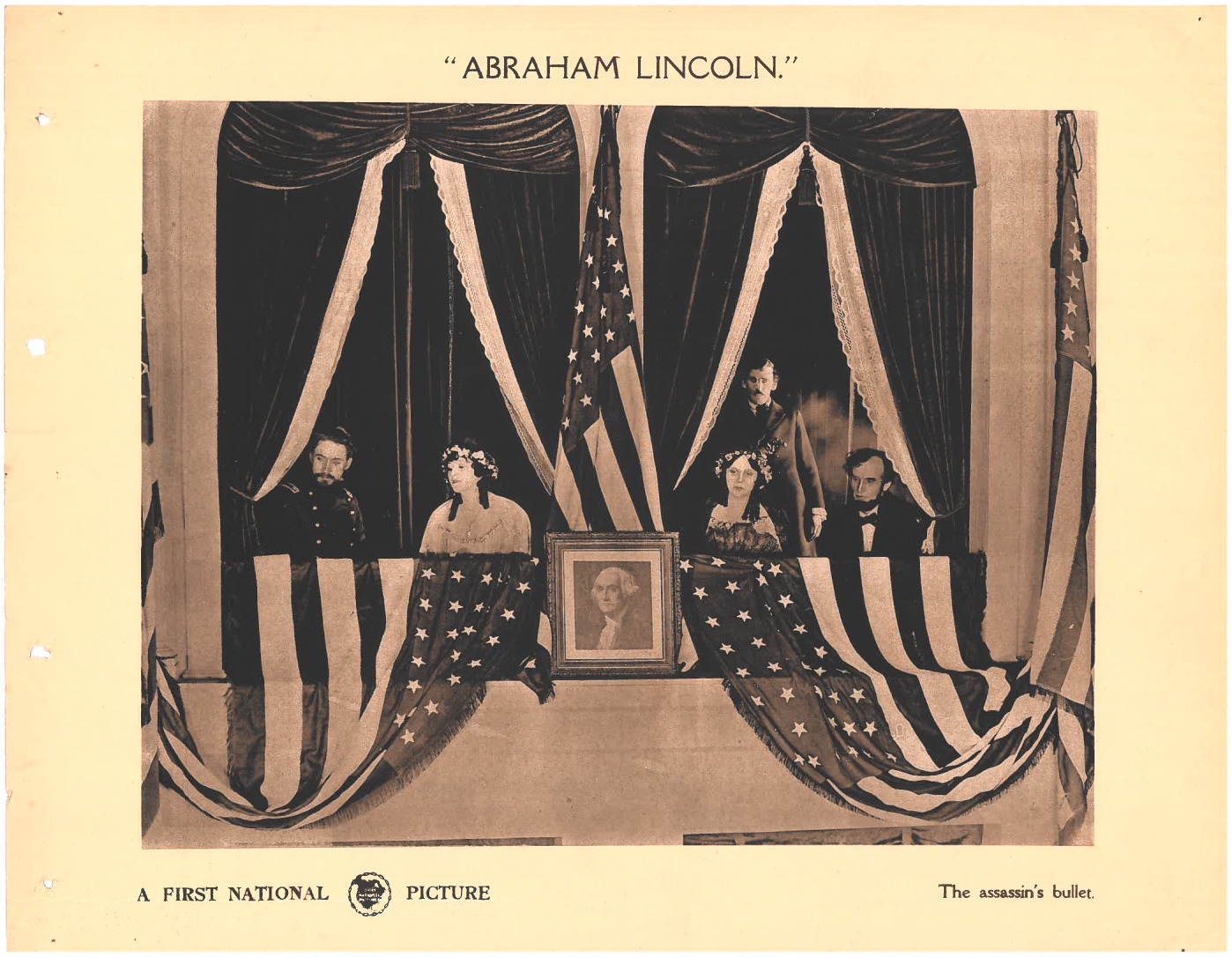
I was first introduced to the lobby card genre by William Kaland, a retired executive producer at Westinghouse Broadcasting. Bill was a student and collector of Lincoln and the Civil War. In 1958, he and Mathew Brady biographer Roy Meredith produced an award-winning TV series about the Civil War. Twenty years later, he became a dear friend and the guiding spirit behind the founding of the Lincoln Group of New York. During one of my visits with Bill in his Manhattan home, I mentioned to him my interest in Lincoln movies. He got up and pulled out a huge folder from a cabinet. Inside were a dozen old lobby cards that included four extremely rare ones from Benjamin Chapin’s nine “Lincoln Cycle” silent films. Six of them were from D.W. Griffith’s 1930 “talkie,” Abraham Lincoln.

They had all been from black & white movies, but they had been tinted by the studios. The one from Griffith’s film showed Ian Keith as Booth about to shoot Walter Houston as Lincoln. It was beautifully colored. I had never seen lobby cards before, and I was immediately “hooked” on the genre. Sadly, Bill died in 1983, and his widow sold his entire collection at auction. I’ll give you one guess who bought his lobby cards.

I then set my sights on finding the remaining three lobby cards from the Griffith film, as well as those that promoted my two favorite Lincoln films. These were the 1936 film, The Prisoner of Shark Island (which was directed by John Ford and starred Warner Baxter, Gloria Stuart, and John Carradine), and Ford’s 1939 film, Young Mr. Lincoln (which starred Henry Fonda). I expanded my search for all the other Lincoln movie lobby cards. It was a great treasure hunt. Over the next many years, I found all of the lobby cards from the “talkies” in which Lincoln appeared, with one exception — a colored one for Young Mr. Lincoln with the name of the movie prominently displayed at the top. Such cards are known as “title” cards, while the other seven cards in the sets are called “scene” cards.
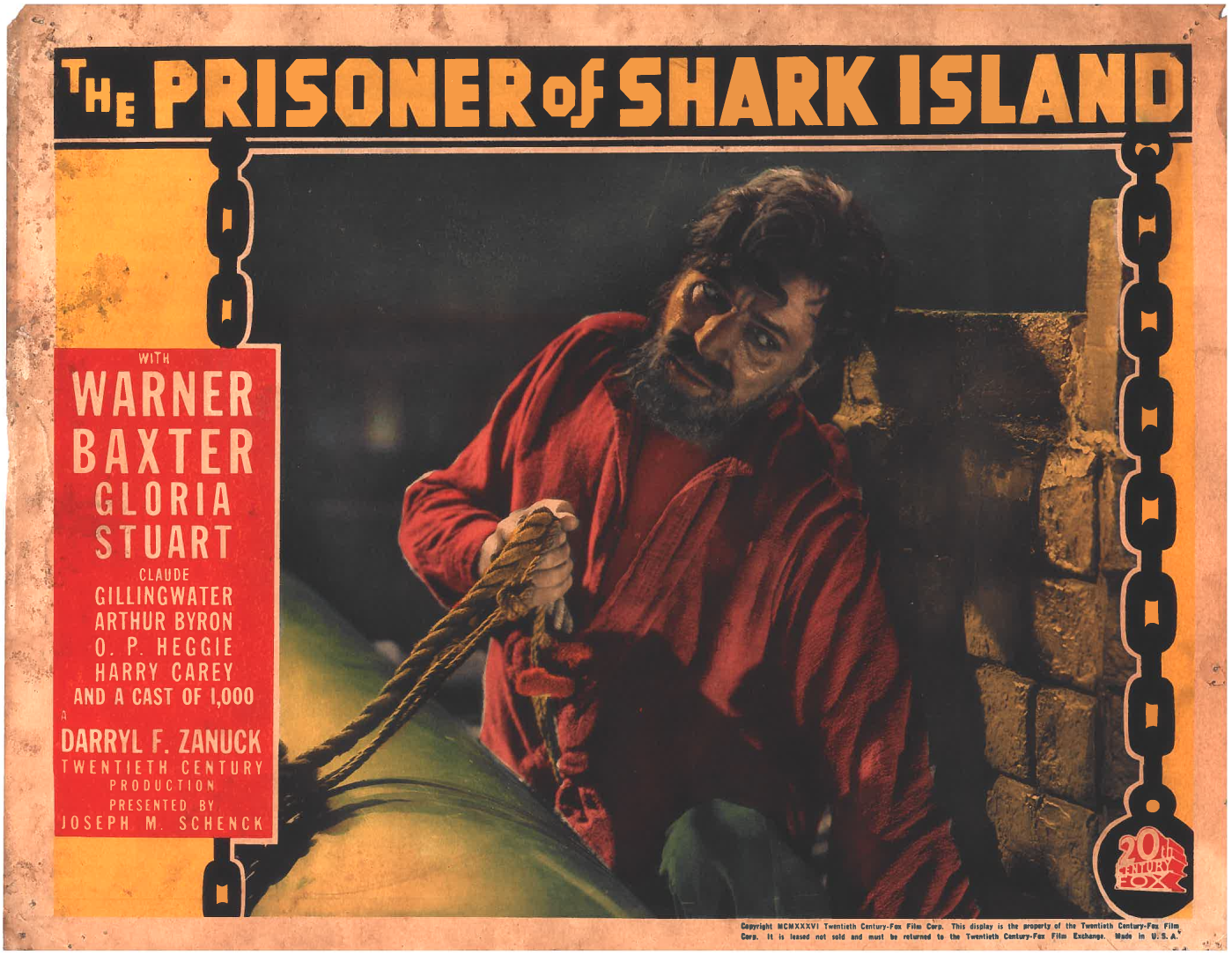
The first card I located was the title card for Prisoner of Shark Island, although it was only a photocopy. The corners on the original had a dozen holes, the result of it having once been mounted in a theatre lobby with thumbtacks. The original title card eluded me for thirty-five years. In the meantime, I found the other seven cards. Then one day, I finally found the original title card on eBay. I bought it immediately, and when it arrived, I found it to be in mint condition except for one thing –it had a dozen pinholes in the four corners. I raced upstairs to get my album of cards from the movie, and lo and behold, not only did it have the same number of pinholes in each corner, but they were in the same haphazard arrangement! It was my newly acquired title card that had been used to create the photocopy I had bought over thirty-five years earlier!
I also have original lobby cards from the “lost” 1924 silent film, The Dramatic Life of Abraham Lincoln, the very first feature-length movie about Lincoln’s life. It starred Lincoln look-alike George Billings, a house painter who had to be given acting lessons! I found them on eBay, too. The lobby cards for it were issued in both black and white and in color, which is most unusual. I have some of each. Modern-day copies of two of the tinted ones from this “lost” film can now be bought on eBay for only $3.28, from a seller in Australia. Included among my other Lincoln-related lobby cards are the original set of cards from Griffith’s Abraham Lincoln and the ones from the later re-issue, all with different scenes than the original cards. I have Abe Lincoln in Illinois, which starred Raymond Massey, The Tall Target, in which Lincoln only appeared in the last scene, and Prince of Players, which was the first time the assassination and Booth’s capture appeared in color – and in Cinemascope.

Lobby cards are now a thing of the past. They’ve been replaced in theatre lobbies by seven-foot high cardboard cutouts! However, there are still plenty of them for sale. If you should ever come across my missing title card for Young Mr. Lincoln, please let me know!
– Richard Sloan





 LincolnConspirators.com
Very interesting Rich! Thanks for posting.
BTW – Richard is also an expert on the Lind erg baby kidnapping once bribing the current (many years ago) tenants of Bruno Hauptmann’s house to let him in to see it. Bruno had hidden ransom money in the kitchen cabinets!
Now I know what a lobby card is. I had no idea.
Very interesting story Richard. And absolutely amazing that you were able to find your missing original lobby cards on eBay!