Posts Tagged With: Lincoln

Alonzo Chappel’s The Last Hours of Abraham Lincoln

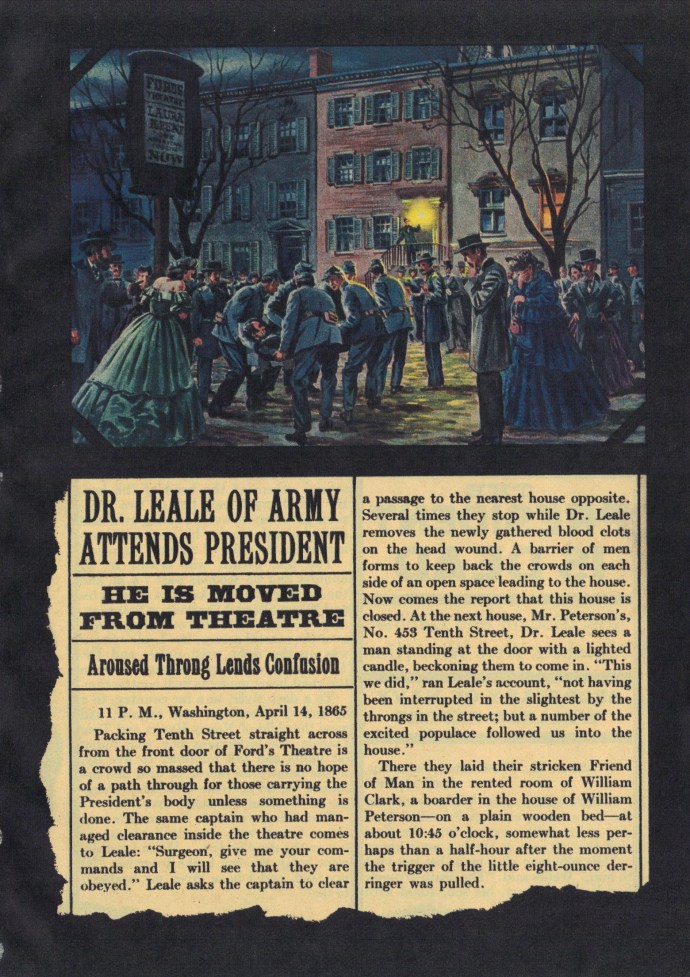
After being fatally shot at Ford’s Theatre, the unconscious body of our 16th President was carefully carried across the street to the home of William Petersen.  He was brought into the bedroom of boarder William Clark, who was out of town for the night, and laid diagonally across the bed.  It would be in this room that Abraham Lincoln would pass away at 7:22 am the next morning.  During the almost nine hours that Lincoln spent in the Petersen boardinghouse, dozens of Washington’s elite made an appearance at his death chamber to pay their last respects.

Room In Which Lincoln Died

 Those who have visited the restored Petersen House across from Ford’s know that the room the President died in is small.  It measures 9′ 11″ wide by 17′ 11″ long.  Despite its small size, the room in which Lincoln died has gained the moniker of the “Rubber Room”.  This is due to the way in which the small room stretched to unrecognizable proportions in the various engravings, lithographs, and prints that were made following Lincoln’s death.  There’s a wonderful chapter in the edited book, The Lincoln Assassination: Crime & Punishment, Myth & Memory by Lincoln authors Harold Holzer and Frank Williams that explores the “Rubber Room” phenomenon in detail.  In summation, the various artists of deathbed illustrations were forced to make the room appear larger and larger in order to cram more and more dignitaries  into one, defining scene.  Here are just a few depictions of how the small bedroom photographed above became a massive hall for the mourners.

Death of Abraham Lincoln Kellogg

Death bed of Lincoiln Brett

Death of Lincoln Ritchie

As fancifully large as these depictions are, they all pale in comparison with the magnitude of a painting by Alonzo Chappel.  His piece was a collaboration with another man by the name of John B. Bachelder, who served as the massive painting’s designer.  Entitled, The Last Hours of Abraham Lincoln, Chappel and Bachelder wanted to depict all of the notable people who visited Lincoln that night at the same time and, in doing so, stretched the rubber room into unparalleled proportions:
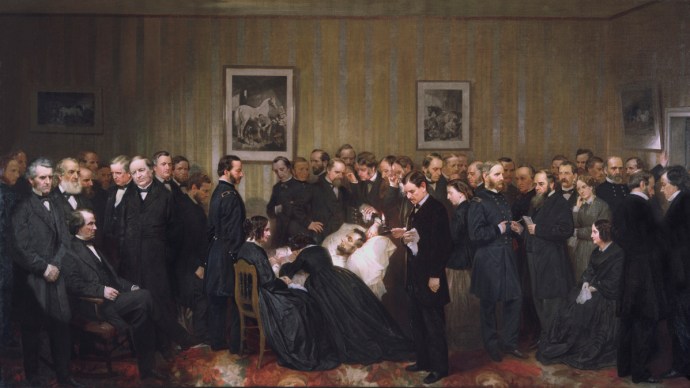
The Last House of Abraham Lincoln by Alonzo Chappel (Click to enlarge)

The Last House of Abraham Lincoln by Alonzo Chappel (Click to see an enlarged view)

In all, the painting contains the images of 47 people in the back bedroom of the Petersen House.  The room has grown so much to accommodate all of these souls, that the walls started duplicating themselves.  It appears that the known lithograph that hung in the room “The Village Blacksmith” gave birth to a smaller, mirrored version of itself as the walls stretched out:
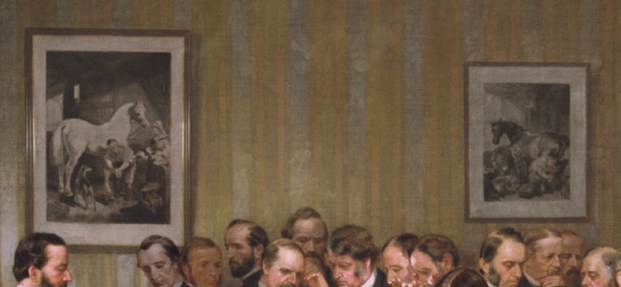
The Village Blacksmith & son Chappel

Just for fun, let’s say that all of the individuals pictured in Chappel’s painting were present in Lincoln’s death room at the same time.  Using modern measurements, William Clark’s room has an area of 177 square feet.  We’ll subtract 20 square feet for the bed on which Lincoln died since that is the only piece of furniture that we know had to remain in the room.  That leaves us with 157 square feet.  We’ll divide that by the 46 visitors in Chappel’s painting (we’re not including Lincoln since he was laying on the bed).  That gives everyone in the room a cozy 3.4 square feet all to themselves.  To give you some perspective, in a well ventilated, outdoor setting like a crowded rock concert, the accepted bare minimum amount of space per person is 7 square feet. For many interior settings the common rule of thumb is at least 9 square feet per person.  If everyone in this painting tried to get into William Clark’s room at the same time, they would be literally crammed together like sardines in a can.   What’s more, this imaginary calculation does not include the other furniture in the room, the large amount of space that the women’s hoop skirts would require, and the measurements by Osborn Oldroyd which, if correct, would lower the room’s original square footage from 177 sq. ft. to 161.5 sq. ft.

Despite the laughable morphing power of the small bedroom, Chappel’s painting was considered one of the best depictions of the death chamber of Abraham Lincoln.  The details for each person were exquisitely done and so life like.  Of course, there was a very good reason why Chappel was able to paint such realistic versions of the many people who visited Lincoln that night.  The designer of the piece, John Bachelder, had convinced many of the people in the painting to sit for photographs in the poses that Chappel wanted to paint.  Notable figures like Andrew Johnson, Edwin Stanton and even Robert Todd Lincoln posed in Mathew Brady’s studio in ways that the painting would later recreate.

Robert Todd Lincoln Alonzo Chappel

In addition to the cabinet members and politicians who posed for Bachelder and Chappel, there were also two individuals whose presence at the Petersen House was never questioned but, for some reason, they did not appear in other depictions of the President’s death.  These two neglected people were Mr. and Mrs. Lincoln’s guests for the evening, Major Henry Rathbone and Clara Harris.

Major Henry Rathbone and Clara Harris (composite by the author)

Major Henry Rathbone and Clara Harris (composite by the author)

Both Henry and Clara posed for their own photographs and were worked into the painting.  Clara is given a degree of prominence in the painting standing just behind the grieving Robert Todd Lincoln:

Clara Harris in Chappel's Last Hours

Henry, on the other hand, is removed from the chair he posed in and is literally sidelined to the far left of the painting.  He is almost obscured by the dark edge and frame, perhaps an ironic foreshadowing of the darkness that would later compel him to murder Clara and try to take his own life.

Major Rathbone in Chappel's Last Hours

Alonzo Chappel’s work, The Last Hours of Abraham Lincoln, is a work of contradiction.  The painting simultaneously contains the most detailed and accurate depictions of the individuals who visited the dying President while also demonstrating extreme hyperbole and imprecision with the seemingly ever expanding walls of William Clark’s bedroom.  It’s a beautiful yet unbelievable painting and it exemplifies the “Rubber Room” phenomenon in a truly unsurpassed way.

References:
Civil War Art Entry for The Last Hours of Abraham Lincoln
Library of Congress print of The Last Hours of Abraham Lincoln (slight differences)
Looking For Lincoln: The Making of an American Icon by the Kunhardts
The Lincoln Assassination: Crime & Punishment, Myth & Memory edited by Harold Holzer, Craig Symonds, and Frank Williams

Categories: Uncategorized | Tags: , , | 5 Comments

Grover’s Theatre and the Lincoln Assassination

Ford’s Theatre was not the only theatre in Washington, D.C. visited by President Lincoln and his family.  Here are some interesting facts about the National Theatre owned by Leonard Grover.

Grover's National Theatre

The rivalry between the Ford and Grover

There had been a friendly rivalry between Leonard Grover and John T. Ford ever since Ford opened his first theatre in Washington in 1861.  The huge increase in population in Washington D.C. during the Civil War allowed both theatres, and their owners, to prosper.  Still, the two men attempted to one up each other in their attempts to get a bigger piece of the pie.  After the burning of Ford’s old theatre, he rebuilt, creating a smaller, but far more luxurious and comfortable theatre.  This was at odds with Grover’s, whose theatre which was described as,  “an ice vault in winter, and a sweatbox in summer”.  Grover advertised his theatre as the capital’s only “Union” playhouse, highlighting John Ford’s more “Secesh” sentiments.  Both houses had vied for Mr. and Mrs. Lincoln’s attendance on April 14th, 1865, but it was Ford’s Theatre, with Laura Keene’s Our American Cousin, that won the honor.

Tad Lincoln Attended Grover’s on April 14th

Unlike his parents, Tad Lincoln was more interested in seeing “Aladdin” at Grover’s Theatre on April 14th, 1865.  It was there that poor Tad learned of his father’s assassination.  Another individual who was attending Grover’s that night was Corporal James Tanner, a wounded Union veteran whose training in shorthand would prove invaluable later.  Tanner described the moment when the news of Lincoln’s assassination reached the theatre:

“While sitting there witnessing the play about ten o’clock or rather a little after, the entrance door was thrown open and a man exclaimed, “President Lincoln is assassinated in his private box at Ford’s!” Instantly all was excitement and a terrible rush commenced and someone cried out, “Sit down, it is a ruse of the pickpockets.” The audience generally agreed to this, for the most of them sat down, and the play went on; soon, however, a gentleman came out from behind the scenes and informed us that the sad news was too true. We instantly dispersed.”

Tad, quite distraught over the shocking news about his father, was quickly removed from Grover’s and taken to the White House. White House doorkeeper, Thomas Pendel, recalled what happened when Tad returned home:

“Poor little Tad returned from the National Theatre and entered through the east door of the basement of the White House. He came up the stairway and ran to me, while I was in the main vestibule, standing at the window, and before he got to me he burst out crying, “O Tom Pen! Tom Pen! They have killed papa dead. They’ve killed papa dead!” and burst out crying again.

I put my arm around him and drew him up to me, and tried to pacify him as best I could. I tried to divert his attention to other things, but every now and then he would burst out crying again, and repeat over and over, “Oh, they’ve killed papa dead! They’ve killed papa dead!”

At nearly twelve o’clock that night I got Tad somewhat pacified, and took him into the President’s room, which is in the southwest portion of the building. I turned down the cover of his little bed, and he undressed and got in. I covered him up and laid down beside him, put my arm around him, and talked to him until he fell into a sound sleep.”

Tad Lincoln

Tad Lincoln

Leonard Grover Wasn’t in Town

At the time of the assassination neither John T. Ford or Leonard Grover, were at their namesake theatres.  Each man owned or leased other theatres in other cities and were tending to business elsewhere.  John T. Ford was in Richmond at the time of the assassination and Leonard Grover was in New York.  After the news had reached Grover’s Theatre and the building had emptied, Charles Dwight Hess, the manager of Grover’s Theatre, sent a telegram to Leonard Grover in New York.  Grover later recalled:

“On that eventful day I was in New York, busily getting ready for my approaching Easter season of opera at the Academy of Music. I had passed a laborious day and retired an early hour, at the old Metropolitan Hotel. I was soundly sleeping when a sharp rap at the door awoke me, and some one called, ”Mr. Grover, here’s a telegram for you.” Thinking it was the usual message from one of the theaters (for I was then managing a Philadelphia theater as well) which would simply convey the amount of the receipts of the house, I called back: “Stick it under the door.” But the rapping continued with vigor, and there were calls, ”Mr. Grover, Mr. Grover, please come to the door!”

I arose, hastily opened the door, when the light disclosed the long hall compactly crowded with people. Naturally, I was astonished. A message was handed to me with the request: “Please open that telegram and tell us if it’s true.” I opened it and read:

“President Lincoln shot to-night at Ford’s Theatre. Thank God it wasn’t ours. C. D. Hess.”

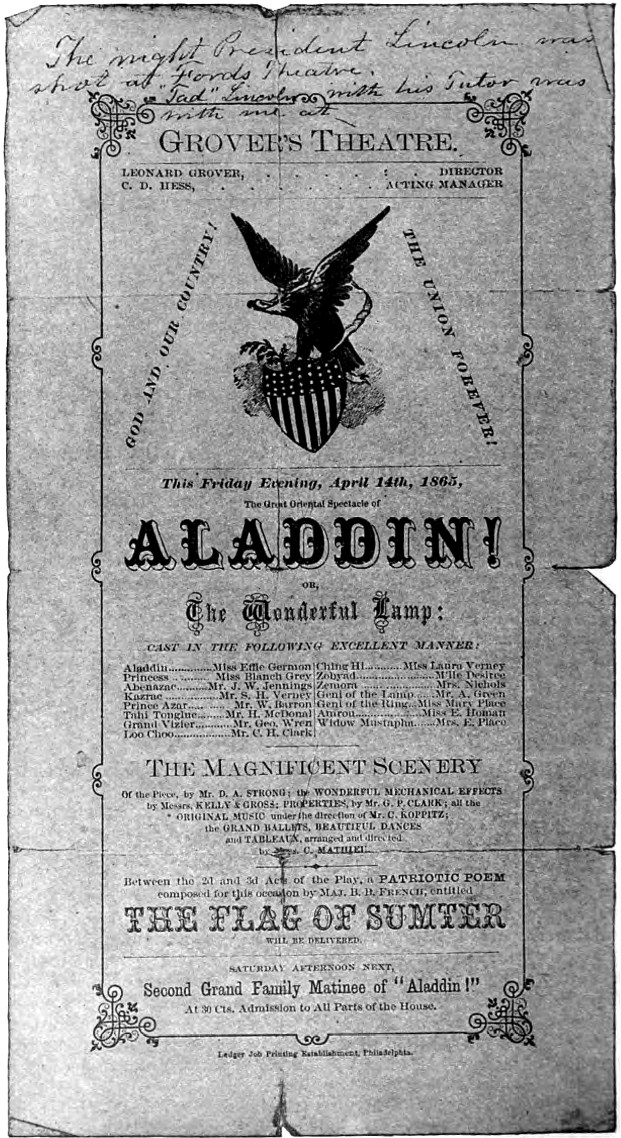
What follows is a copy of the Grover’s Theatre playbill that was used for the April 14th, performance of “Aladdin”.

Aladdin Playbill

The handwritten text at the top reads, “The night President Lincoln was shot at Fords Theatre. “Tad” Lincoln with his Tutor was with me at -“. Though the playbill is credited as belonging to Leonard Grover, we know Grover was not at his theatre at the time of the assassination. It is likely that this playbill was actually owned by Charles D. Hess, the manager of Grover’s who as present at theatre and shared the news with the audience.

The Assassination could have been at Grover’s Theatre

In April of 1909, two articles were published in Century Magazine which theorized that Lincoln still would have been assassinated even if he had attended Grover’s Theatre that night instead of Ford’s. For a wonderful recounting of this theory, please visit the corresponding page on Roger Norton’s Lincoln Assassination Research Site.

Booth carried Aladdin with him

When John Wilkes Booth was cornered and killed at the Garrett farm, the detectives thoroughly searched his person, removing any papers and objects they could find. Inside his small memorandum book (better known as his diary), they found five photographs.  One of the photographs was of this woman:

Effie Germon CDV

Her name is Effie Germon and she was an actress friend of John Wilkes Booth. If you look at the playbill for Grover’s production of “Aladdin” you can find her name.  She was the star of the night, portraying the eponymous Aladdin.

References:
Backstage at the Lincoln Assassination by Thomas Bogar
Thirty-Six Years in the White House by Thomas Pendel
“What if the Lincolns had attended the play at Grover’s Theatre” by Roger Norton
Lincoln’s Interest in the Theatre by Leonard Grover
“Lincoln and Wilkes Booth as Seen on the Day of the Assassination” by M. Helen Palmes Moss as printed in the Century Magazine (April, 1909).

Categories: Uncategorized | Tags: , | 6 Comments

11/22/1963

Today marks the 50th anniversary of the assassination of President Kennedy. While I was not yet born when the horrific events in Dallas transpired, through the recent media coverage leading up to the anniversary, I have watched the interviews of many individuals who were present that day. These “living connections” to an event that shocked the nation are eye opening to say the least. Even 50 years onward, the death of a President has left a lasting and emotional impression on so many.

The passage of time has eliminated the “living connection” to the assassination of Abraham Lincoln. While books and articles provide us with the written words of the nation’s grief, hearing those words spoken with the cadence and emotion of one who lived through those days is something that cannot be duplicated. Being so far removed from Lincoln’s assassination gives us the benefit of objectivity, yes, but it also naturally diminishes the impact.

So today, as so many reflect on the events of 11/22/1963, I can’t help but think of the past generations who reflected on 4/14/1865 with the same shock, the same confusion, and the same grief for their fallen leader.

Kennedy Belongs to the Ages

Categories: Uncategorized | Tags: | 2 Comments

Harper Goff’s Blood on the Moon

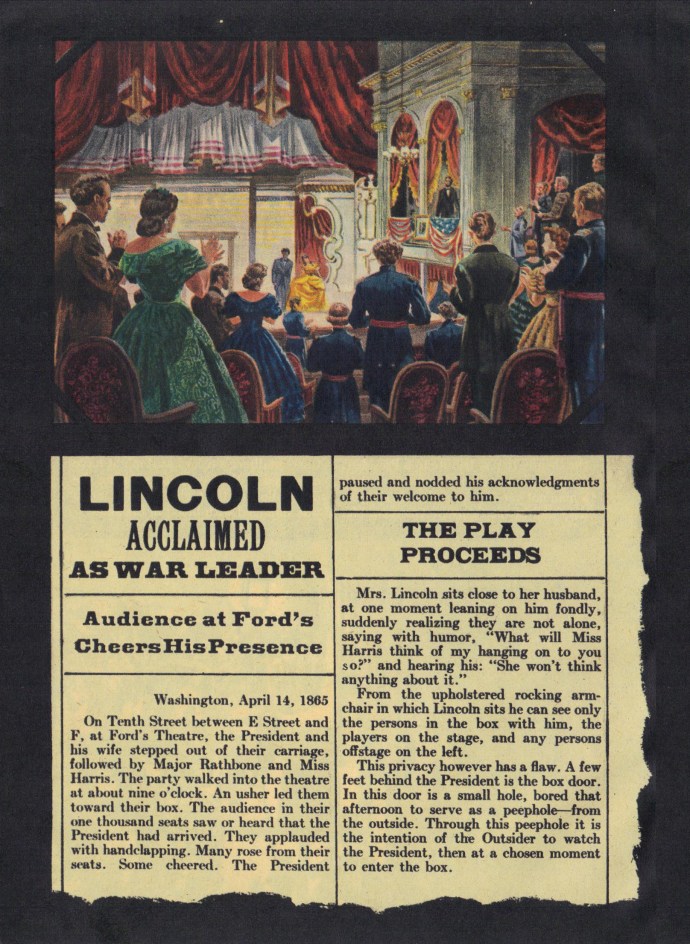
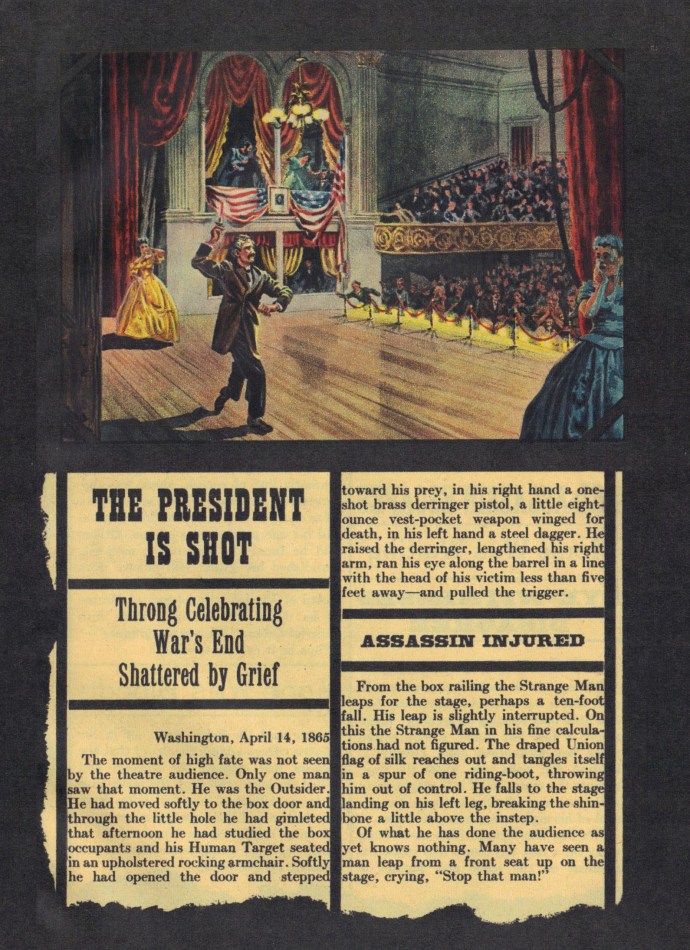
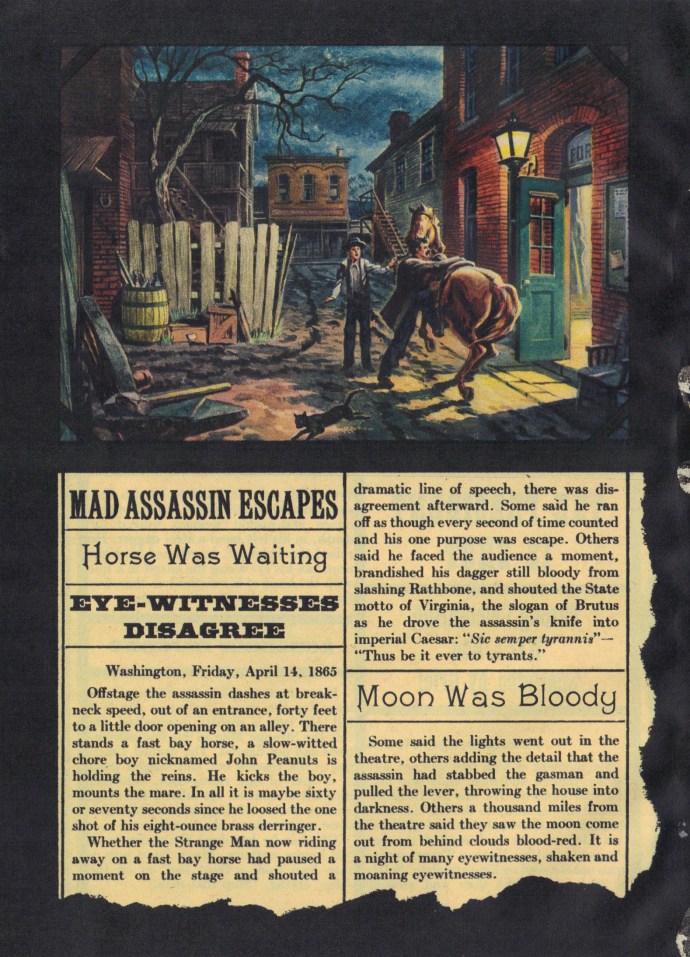
In the February of 1946 edition of Coronet (a Reader’s Digest like magazine), a condensed version of the Lincoln assassination story was published.  Entitled, “Blood on the Moon”, the brief, 8 page article was based on Carl Sandburg’s chapter of the same name in his biography of Abraham Lincoln.  While the article itself is little more than a rehash of the traditional story, the illustrations that accompany it are fairly impressive.  They were created by artist Harper Goff, who is known for his artistic direction for films such as the Walt Disney classic 20,000 Leagues Under the Sea and Willy Wonka and the Chocolate Factory.  What follows is the article from Coronet, featuring Sandburg’s text and Goff’s illustrations:

Blood on the Moon Goff 1

Blood on the Moon Goff 2

Blood on the Moon Goff 3

Blood on the Moon Goff 4

Blood on the Moon Goff 5

Blood on the Moon Goff 6

Blood on the Moon Goff 7

Blood on the Moon Goff 8

References:
“Blood on the Moon”, Coronet, February 1946,

Categories: Uncategorized | Tags: , | 6 Comments

Remarks on the First Anniversary of Lincoln’s Death

On Saturday, April 14th, 1866, the House of Representatives convened at noon to mark the first anniversary of the assassination of Abraham Lincoln.  After the standard prayer from the House chaplain, a Representative from Ohio took the podium to address his peers with the following oration:

Mr. Speaker, I desire to move that this House do now adjourn. And before the vote upon that motion is taken, I desire to say a few words.

This day, Mr. Speaker-, will be sadly memorable so long as this nation shall endure, which God grant maybe “till the last syllable of recorded time,” when the volume of human history shall be sealed up and delivered to the omnipotent Judge.

In all future time, on the recurrence of this day, I doubt not that the citizens of this Republic will meet in solemn assembly to reflect on the life and character of Abraham Lincoln, and the awful, tragic event of April 14, 1865— an event unparalleled in the history of nations, certainly unparalleled in our own. It is eminently proper that this House should this day place upon its records a memorial of that event.

The last five years have been marked by wonderful developments of individual character. Thousands of our people, before unknown to fame, have taken their places in history, crowned with immortal honors. In thousands of humble homes are dwelling heroes and patriots, whose names shall never die.

But greatest among all these great developments were the character and fame of Abraham Lincoln, whose loss the Nation still deplores. His character is aptly described in the words of England’s great Laureate — written thirty years ago —in which he traces the upward steps of some—

“Divinely gifted man,
Whose life in low estate began,
And on a simple village green ;

Who breaks his birth’s invidious bar,
And grasps the skirts of happy chance,
And breasts the blows of circumstance,
And grapples with his evil star;

Who makes, by force, his merit known,
And lives to clutch the golden keys
To mold a mighty State’s decrees,
And shape the whisper of the throne;

And moving up, from high to higher,
Becomes on Fortune’s crowning slope,
The pillar of a People’s hope,
The center of a World’s desire.”

Such a life and character will be treasured forever as the sacred possession of the American people and of mankind.

In the great drama of the rebellion, there were two acts. The first was the war, with its battles and its sieges, victories and defeats, its sufferings and tears.

That act was closing one year ago to-night, and just as the curtain was lifting on the second and final act – the restoration of peace and liberty – just as the curtain was rising upon new characters and new events, the evil spirit of the rebellion, in the fury of despair, nerved and directed the hand of an assassin to strike the chief character in both.

It was no one man who killed Abraham Lincoln; it was the embodied spirit of treason and slavery; inspired with fearful and despairing hate, that struck him down in the moment of the Nation’s supremest joy.

Sir, there are times in the history of men and nations, when they stand so near the veil that separates mortals from the immortals; time from eternity, and men from their God, that they can almost hear the beatings and feel the pulsations of the heart of the Infinite.

Through such a time has this Nation passed. When two hundred and fifty thousand brave spirits passed from the field of honor through that thin veil in the presence of God, and when at last its parting folds admitted the martyr
President to the company of these dead heroes of the Republic, the Nation stood so near the veil that the whispers of God were heard by the children of men.

Awe-stricken by His voice, the American people knelt in tearful reverence, and made a solemn covenant with Him and with each other, that this Nation should be saved from its enemies; that all its glories should be restored, and, on the ruins of slavery and treason, the temples of freedom and justice should be built and should survive forever.

It remains for us, consecrated by that great event and under a covenant with God, to keep that faith, to go forward in the great work until it shall be completed.

Following the lead of that great man, and obeying the high behests of God, let us remember that —

“He has sounded forth a trumpet that shall never call retreat ;
He is sifting out the hearts of men before His judgment seat ;
Be swift, my soul, to answer Him, be jubilant my feet,
For God is marching on.”

I move, Sir, that this House do now adjourn.

The House adjourned at fifteen minutes past noon, their memorial to President Lincoln having been their only reason for convening.

Those beautiful words, strengthened at the end by a quote from The Battle Hymn of the Republic, were spoken by Representative James A. Garfield.  In 1881, President James Garfield would be slain by an assassin’s bullet, becoming our nation’s second martyred leader.  In a book published after Garfield’s own assassination, the author used a portion of Garfield’s above words above to eulogize the recently fallen leader.  The casket lying in state at the top of this post was President Garfield’s, not Lincoln’s.

Today, a copy of Garfield’s remarks owned by the 20th President himself can be purchased for $9,500 on eBay.

References:
Remarks of Hon. James A. Garfield, in the House of Representatives, April 14, 1866, on the first anniversary of the death of Abraham Lincoln

Categories: Uncategorized | Tags: | 2 Comments

Corporal Tanner’s Letter

James Tanner in 1889

James Tanner in 1889

As Abraham Lincoln lay dying at the Petersen boardinghouse, the investigation was already underway in the parlor.  Under the order of Secretary Stanton, witnesses were interviewed and their testimony taken.  Finding the process of taking their testimony down in longhand to be too time consuming, the call went out for someone who knew phonography (shorthand). It was discovered that a boarder at the house adjacent to the Petersen House had studied phonography.  His name was Corporal James Tanner.  Tanner had been seriously wounded at Bull Run when a fragment of shell ripped through his lower legs:

“The boys picked me up,” Tanner recalled, and, “laid me on a blanket – no stretcher being available – and twisted a musket in on each side and lifted me to their shoulders.  Neither of my legs had been entirely severed; my feet were hanging by shreds of flesh.  The blanket was short, and lying on it on my face, I looked under and saw my feet dangling by the skin as they hung off of the other end.  Some kind hearted soul gently lifted them and laid them on the edge of the blanket.”

In the field hospital, both of Tanner’s legs were amputated four inches below the knee.  Tanner was exceeding lucky to survive the recovery process for such a wound.  When he returned to civilian life, he was equipped with artificial legs and learned to walk again with the use of a cane to help steady himself.  He entered business school and studied shorthand.  On April 14th, 1865, Tanner was residing in Washington, D.C. working for the Ordinance Bureau of the War department.

Tanner took the testimony of six witnesses, Alfred Cloughly, Lt. A. M. S. Crawford, Harry Hawk, James C. Ferguson, Henry B. Philips, and Col. George V. Rutherford that fateful night.  Two days after the President’s death, Tanner wrote a letter to a friend in which he recounted his involvement that night.  That letter, which follows below, contains an interesting glimpse at the activities inside the Petersen House and the duties of Corporal Tanner:

Ordnance Office, War Department,

Washington, April 17, 1865.

Friend Walch:

Your very welcome letter was duly received by me and now I will steal a few minutes from my duties in the office to answer it.

Of course, you must know as much as I do about the terrible events which have happened in this city during the past few days. I have nothing else to write about so I will give you a few ideas about that, perhaps, which you have not yet got from the papers.

Last Friday night a friend invited me to attend the theatre with him, which I did. I would have preferred the play at Ford’s Theatre, where the President was shot, but my friend chose the play at Grover’s, which was ‘Aladdin, or the Wonderful Lamp.’ While sitting there witnessing the play about ten o’clock or rather a little after, the entrance door was thrown open and a man exclaimed, “President Lincoln is assassinated in his private box at Ford’s!” Instantly all was excitement and a terrible rush commenced and someone cried out, “Sit down, it is a ruse of the pickpockets.” The audience generally agreed to this, for the most of them sat down, and the play went on; soon, however, a gentleman came out from behind the scenes and informed us that the sad news was too true. We instantly dispersed.

On going out in the street we were horrified to learn that Mr. Seward had been attacked and severely injured while in bed at his house. Myself and friend went up to Willard’s, which is a short distance above Grover’s, to learn what we could, but could learn nothing there. The people were terribly excited. Ford’s Theatre is on Tenth St. between E and F. Grover’s is on the Avenue near Fourteenth St. and just below Willard’s; it is about four blocks up from Ford’s. My boarding house is right opposite Ford’s Theatre. We then got on the cars and went down to Tenth St. and up Tenth St. to Ford’s and to my boarding house. There was an immense throng there, very quiet yet very much excited; the street was crowded and I only got across on account of my boarding there. The President had been carried into the adjoining house to where I board; I went up to my room on the second floor and out on the balcony which nearly overhangs the door of Mr. Peterson’s house. Members of the cabinet, the chief justice, Generals Halleck, Meiggs, Augur and others were going in and out, all looking anxious and sorrow-stricken. By leaning over the railing I could learn from time to time of His Excellency’s condition, and soon learned that there was no hope of him. Soon they commenced taking testimony in the room adjoining where he lay, before Chief Justice Carter, and General Halleck called for a reporter: no one was on hand, but one of the head clerks in our office, who boarded there, knew I could write shorthand and he told the General so, and he bade him call me, so he came to the door and asked me to come down and report the testimony. I went down and the General passed me in, as the house was strictly guarded, of course. I went into a room between the rear room and the front room. Mrs. Lincoln was in the front room weeping as though her heart would break. In the back room lay His Excellency breathing hard, and with every breath a groan. In the room where I was, were Generals Halleck, Meiggs, Augur and others, all of the cabinet excepting Mr. Seward, Chief Justice Chase and Chief Justice Carter of the District of Columbia, Andrew Johnson and many other distinguished men. A solemn silence pervaded the whole throng; it was a terrible moment. Never in my life was I surrounded by half so impressive circumstances. Opposite me at the table where I sat writing- sat Secretary Stanton writing dispatches to General Dix and others, and giving orders for the guarding of Ford’s and the surrounding country. At the left of me was Judge Carter propounding the questions to the witnesses whose answers I was jotting down in Standard Phonography. I was so excited when I commenced that I am afraid that it did not much resemble Standard Phonography or any other kind, but I could read it readily afterward, so what was the difference? In fifteen minutes I had testimony enough down to hang Wilkes Booth, the assassin, higher than ever Haman hung. I was writing shorthand for about an hour and a half, when I commenced transcribing it. I thought I had been writing about two hours when I looked at the clock and it marked half past four A.M. I commenced writing about 12 M. I could not believe that it was so late, but my watch corroborated it. The surrounding circumstances had so engrossed my attention that I had not noticed the flight of time. In the front room Mrs. Lincoln was uttering the most heartbroken exclamations all the night long. As she passed through the hall back to the parlor after she had taken leave of the President for the last time, as she went by my door I heard her moan, “O, my God, and have I given my husband to die,” and I tell you I never heard so much agony in so few words. The President was still alive, but sinking fast. He had been utterly unconscious from the time the shot struck him and remained so until he breathed his last. At 6:45 Saturday morning I finished my notes and passed into the back room where the President lay; it was very evident that he could not last long. There was no crowd in the room, which was very small, but I approached quite near the bed on which so much greatness lay, fast losing its hold on this world. The head of the bed was toward the door; at the head stood Cap. Robert Lincoln weeping on the shoulder of Senator Sumner. General Halleck stood just behind Robert Lincoln and I stood just to the left of General Halleck and between him and General Meiggs. Secretary Stanton was there trying every way to be calm and yet he was very much moved. The utmost silence prevailed, broken only by the sound of strong men’s sobs. It was a solemn time, I assure you. The President breathed heavily until a few minutes before he breathed his last, then his breath came easily and he passed off very quietly.

As soon as he was dead Rev. Dr. Gurley, who has been the President’s pastor since his sojourn in this city, offered up a very impressive prayer. I grasped for my pencil which was in my pocket, as I wished to secure his words, but I was very much disappointed to find that my pencil had been broken in my’ pocket. I could have taken it very easily as he spoke very favorably for reporting. The friends dispersed, Mrs. Lincoln and family going to the White House, which she had left the night before to attend the theatre with him who never returned to it except in his coffin.

Secretary Stanton told me to take charge of the testimony I had taken, so I went up to my room and took a copy of it, as I wished to keep both my notes and the original copy which I had made while there in the house. They will ever be cherished monuments to me of the awful night and the circumstances with which I found myself so unexpectedly surrounded and which will not soon be forgotten.

Saturday night I took the copy I had made to the Secretary’s house, but as he was asleep I did not see him, so I left them with my card. I tell you, I would not regret the time and money I have spent on Phonography if it never brought me more than it did that night, for that brought me the privilege of standing by the deathbed of the most remarkable man of modern times and one who will live in the annals of his country as long as she continues to have a history.

Frank Leslie’s Illustrated will have a good picture of the building there made celebrated by this sad event on that evening. I saw the sketch made by the artist of the theatre, and it was very correct, indeed. He also sketched the inside of the room where the President died, also the outside of the building, as well as the adjoining buildings on both sides. You will see the house I board in has a balcony along the front of the two rooms on the second floor; I occupy both of those rooms.

Drawing of the Peterson house from Frank Leslie's  Illustrated Weekly 5/20/1865.  Corporal Tanner's room and balcony are visible on the building next door.

Drawing of the Peterson house from Frank Leslie’s Illustrated Weekly 5/20/1865. Corporal Tanner’s room and balcony are visible on the building next door.

You can imagine the feeling here by judging of the feeling in your own place, only it is the more horrifying from the fact that the President lived in our midst and was universally beloved by the People.

This morning there was published in the Chronicle the statement of one of the witnesses whom I reported, Mr. James B. Ferguson. You will doubtless see it in your papers as it is most important. I have an idea, which is gaining ground here, and that is that the assassin had assistance in the theatre, and that the President was invited there for the express purpose of assassinating him. The theatre is very strictly guarded now night and day.

Very truly your friend,

James Tanner.

References:
The Life of Abraham Lincoln by William Barton
While Lincoln Lay Dying by The Union League of Philadelphia

Categories: Uncategorized | Tags: , | 10 Comments

Booth From the Great Beyond

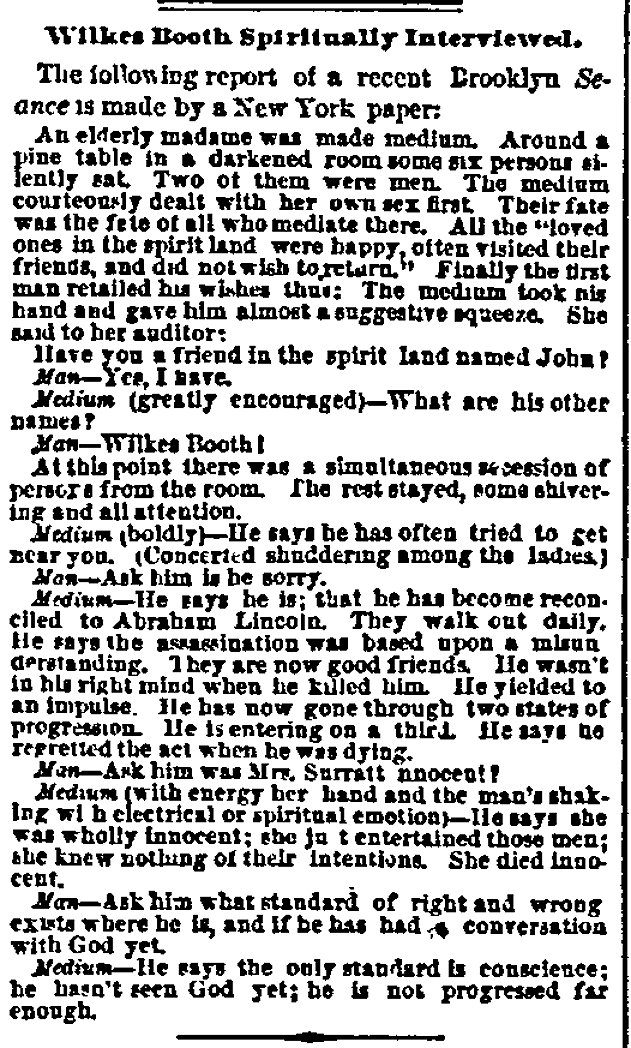
While researching Edwin Booth in 1870, I stumbled across this article about his dead brother that I knew I had to share:

Talking With John Wilkes Booth's Spirit

I think it’s great that John Wilkes Booth and Abraham Lincoln were able to work out their differences in death. I’m sure their daily walks on the other side are filled with interesting and lively discussions highlighted, of course, by the shared laughter of the two “good friends”. In truth we should have known that, given the chance, Lincoln and Booth would have been friends. Look at how attentively Lincoln’s spirit followed Booth after the latter murdered the former:

Assassin's Vison

Clearly Lincoln was waiting patiently for his walking buddy to arrive so the two could work things out.

This article reminded me of another instance where Booth’s spirit is resurrected, as it were.

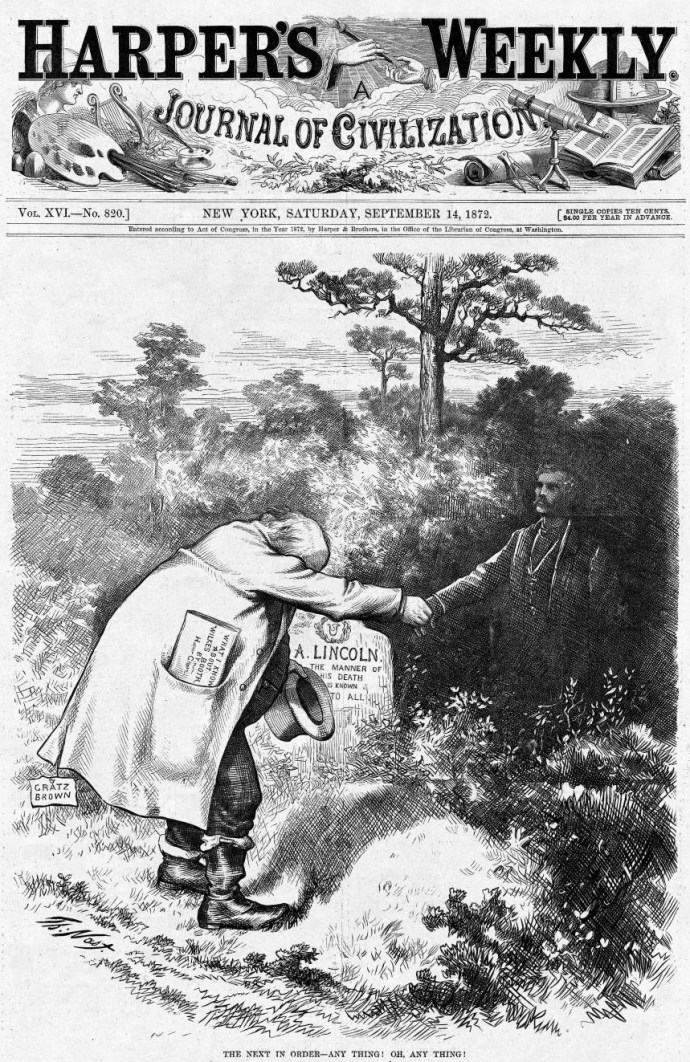
1872 Harper's Weekly political cartoon by Thomas Nast showing Presidential candidate Horace Greeley shaking hands with John Wilkes Booth's spirit over Abraham Lincoln's grave.  Due, in part, to Nast's severe character assassination of Greeley through his cartoons, Greeley lost the election to U.S. Grant.

The 1872 presidential election was between incumbent U.S. Grant and the candidate Horace Greeley. Greeley was the founder and editor of the New York Tribune, and one of the most outspoken abolitionists leading up to the Civil War. During and after the Civil War, Greeley’s views often seemed contradictory.  Though ardently opposed to slavery, he attempted to pursue a peace policy with the Confederacy in 1863/1864.  During Reconstruction he sided with the Radical Republicans and pursued harsh policies for ex-Confederates with simultaneously signing a bond for the release of Jefferson Davis.   He supported Grant in the 1868 election, but became unhappy with his presidency.  He broke away from the Republican party and helped form the Liberal Republican party.  The Liberal Republicans made Greeley their candidate for the President in the 1872.  The Democratic party at that time consisted of mainly Copperheads and former Confederates.  Desperate to get Grant out of the White House, the Democratic party also endorsed Greeley as their candidate too.  Greeley was now aligned with a party he had fought against for years.

Republican supporters of President Grant like artist Thomas Nast seized upon the illogical pairing of Greeley and the Democrats.  Nast proceeded on a campaign of character assassination through his cartoons, demonstrating Greeley’s willingness to side with anyone in order to get votes.  The above cartoon showing Greeley shaking hands with John Wilkes Booth over Lincoln’s grave, is one of several in a series demonstrating Greeley’s willingness to ignore travesties of the past to win the election.  You can see more of Nast’s political cartoons about Greeley on this fascinating site.

Not only did Horace Greeley lose the election of 1872 to Grant, but he also died between the popular vote and the electoral college.  Perhaps he and Thomas Nast took a page out of Booth and Lincoln’s book and are up there now, taking a walk and working out their differences.

References:
Daily Eagle, 9-19-1870
Harper’s Weekly, 9-14-1872
Cartoonist Thomas Nast vs. Candidate Horace Greeley

Categories: Uncategorized | Tags: , | 4 Comments

Osborn Oldroyd and his Lincoln Museums

The Abraham Lincoln Home in Springfield, IL and the Petersen House in Washington, D.C. have shared similar histories.

Lincoln Petersen Home

  • Both homes witnessed the death of a Lincoln:

On February 1st, 1850, Eddie Lincoln, the second son of Abraham and Mary Todd, died at the age of 3 at the Lincoln Home in Springfield.

On April 15th, 1865 at 7:22 am, President Abraham Lincoln died at the age of 56 at the Petersen House in Washington, D.C.

  • Both homes had few owners:

The Lincoln Home was built in 1839 for the Reverend Charles Dresser.  The Lincolns bought it from him in 1844.  Robert Todd Lincoln inherited the property from his parents and he subsequently gave it to the government in 1887.  This gives the Lincoln home two owners, Rev. Dresser and the Lincoln family, before it was purchased by the government.

The Petersen House was commissioned by William and Anna Petersen in 1849 and built that same year.  When they died in 1871, the house was inherited by their children.  They sold the house to Louis Schade in 1878.  By 1896, Louis Schade sold the house to the government for $30,000.  This gives the Petersen House two owners, the Petersens and Louis Schade, before it was purchased by the government.

  • Both homes had considerable remodeling done when their namesakes lived there:

The Lincoln Home had about 5 renovations while the Lincolns lived there.  Most drastically was the alteration of the home from a 1 ½ story structure to a full 2 story home, as it still is today.

The room that would later be known as the room where Lincoln died, was not even part of the Petersen House when it was originally built.  That addition was put on in 1858.  Fire gutted it in 1863 and William Petersen rebuilt it that same year.

  • Both homes had renters:

When Abraham Lincoln was elected President and moved into the White House, he rented out his Springfield home.  When Robert Todd gained ownership of the place, he continued the practice of renting the house out until he gave it to the government.

The Petersens ran their home as a boarding house for many years.  From Congressmen to soldiers, to actors, they rented out rooms to  many needy Washingtonians.

  • Lastly, both homes shared a long-term occupant, Osborn Hamilton Ingham Oldroyd:

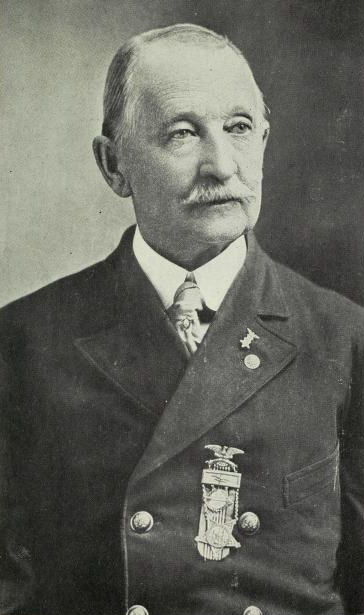
Osborn Oldroyd

Osborn Oldroyd was a Civil War veteran and a devoted collector of Lincoln memorabilia.  In 1883, 41 year-old Oldroyd succeeded in fulfilling the dream of any man who idols another.  Robert Todd Lincoln made Oldroyd the fifth renter of the Lincoln Home in Springfield since his father left the city to claim the Presidency.  Into this historic house, Oldroyd brought his vast collection of nearly 2,000 Lincoln items.  As had been commonplace since the death of Lincoln, many visitors came to call on the Lincoln Home, seeking to visit the home of the great martyr.  Oldroyd let them in like all of his predecessors had, but was the first to charge them admission.  He turned his collection and rented space in a Lincoln Museum.  Robert Todd accepted this exploitation as long as Oldroyd paid his rent, however, by 1885, Oldroyd was starting to fall behind his payments.  Despite not paying him, Robert Todd did not want to bring a lawsuit against Oldroyd as he feared it, “may easily cause me more personal annoyance than the loss of ten times the money.”  Rumors spread that Oldroyd was also cutting off parts of the curtains, wallpaper, and flooring, selling them as souvenirs.  Robert Todd was getting angry with his tenant whom he referred to as a “dead beat” and “rascal”, when an Illinois legislative committee approached him in 1887 to purchase the Lincoln Home.  A similar offer had been given to him in 1883, but at that time he had declined.  Even though, Robert Todd was fairly certain Oldroyd had been the catalyst for this offer, he decided to donate the property to the state of Illinois.  His donation contained two caveats, however.  “…Said homestead shall be, forever, kept in good repair and free of access to the public.”  This latter requirement was probably meant as a final jab towards his “rascal” of a tenant and his entrepreneurial exploits.  Regardless, Osborn Oldroyd was hired by the state of Illinois to be the first custodian of the house and gave him a salary of $1,000 per year.  Oldroyd undoubtedly used this salary to increase his collection at every turn.

Oldroyd’s tenure at the Lincoln Home came to an end in 1893 when he was fired by recently elected Gov. John Peter Altgeld.  Altgeld replaced him with a political friend named Herman Hofferkamp.  Out of a cushy job and a free place to live, Oldroyd was in trouble.  Meanwhile, in Washington, D.C., the Schade family had moved out of the Petersen House apparently fed up with the number of visitors constantly asking to see the death room of the President.  They leased the building to the Memorial Association of the District of Columbia, a group formed by Congress the year before.   When and how Oldroyd managed to convinced this group to make him custodian of the Petersen House is unknown.  According to a biography about Oldroyd written when he was alive, in 1893 Oldroyd moved his collection to the Petersen House, “at the request” of the association.  The earliest account the NPS has managed to find of Oldroyd residing at the Petersen House is June of 1898.  This was after the government purchased the house outright from the Schades in 1896.  So, whether Oldroyd went straight from the Lincoln Home to the Petersen House, or whether he had five years in between, he ultimately found a new location to show off his collection.

While he lived rent free at the Petersen House, Oldroyd did not receive a salary there.  Instead, he got back to his roots and was allowed to charge admission to his museum.  He made the whole first floor of the house his exhibit floor and he and his family lived upstairs.  The first floor of the Petersen House contained considerably less real estate than what he had previously used to showcase his collection at the Lincoln Home.  He covered practically every surface of the Peterson House with material to make up for it.  Oldroyd also had a lot of changes made to the building while he lived there.  Most noticeably, he had the back wall of the room where Lincoln died, removed.

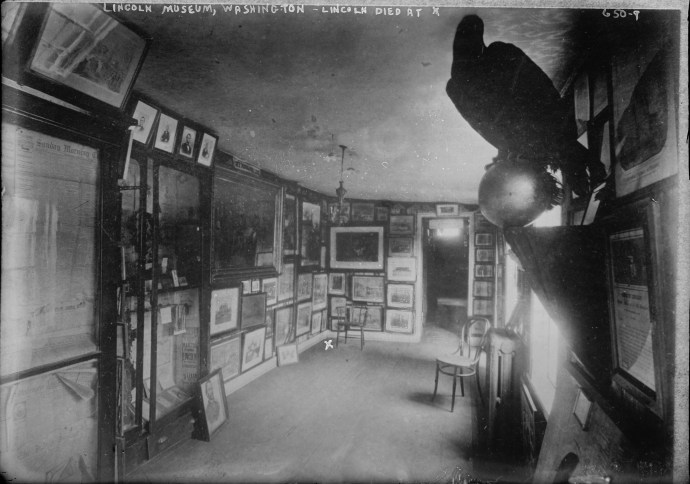
The following are some pictures of the interior of the Petersen House when it housed Osborn Oldroyd’s Lincoln Museum:

Petersen Museum 1922

This picture was taken from within the front parlor of the Petersen House facing towards the rear parlor.  The door to the right leads into the hallway with the room where Lincoln died at one end and the entrance to the Petersen House at the other.

Oldroyd Museum 1

This photo was taken from within the rear parlor of the Petersen House in the direction of the front parlor.  This photo shows only the front parlor.

Oldroyd Museum 2

This photo was taken from the entrance of the room where Lincoln died. The bed Lincoln died in would have been located in the bottom right hand corner of this photo.

The white X marks the spot where the bed Lincoln died in was.

This photo was taken from the rear of the room where Lincoln died in the direction of hallway and Petersen House entrance. The X marks the location of Lincoln’s deathbed.

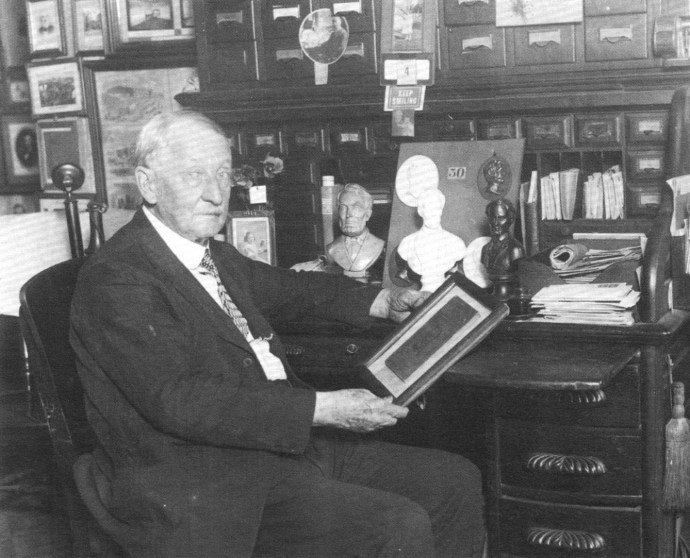
Oldroyd in his museum

During his tenure at the Petersen House, Oldroyd continued to collect and correspond with many individuals associated with Lincoln’s life and death.  In 1901, after walking the escape route of Lincoln’s assassin on foot with a camera, he published his book, “The Assassination of Abraham Lincoln”.  This volume contains many of the earliest photographs we have of different parts of the escape route.

Oldroyd walking the route

By 1926, after about 30 years curating his collection at Petersen House, Oldroyd sought the help of Congressman Henry Rathbone of Illinois, to insure its preservation.  The son of Henry Rathbone and Clara Harris, the ill fated pair who joined Mr. and Mrs. Lincoln at Ford’s Theatre that night, managed to pass a bill in Congress authorizing the purchasing of Oldroyd’s collection.  Experts at the Smithsonian noted that the collection “was of little practical value”.  Despite this, Oldroyd was paid $50,000.  Oldroyd later stated that he had been offered far greater amounts for the collection by private individuals but that he wanted the collection to be in the hands of the government so that it would be preserved and enjoyed by the public for years to come.  When offered continued curatorship over the collection Oldroyd replied, “the responsibility would be too much for me to assume at my age of eighty-four years.”  Oldroyd was then given the key to the Petersen House and told that he was free to come and go as he pleased and that his accustom chair would always be there for him.

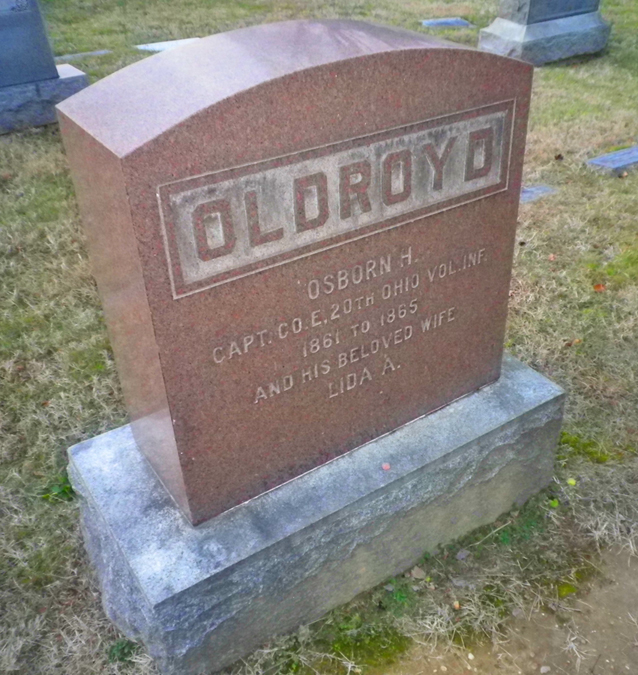
Osborn Hamilton Ingham Oldroyd died four years later in 1930.  He  is buried next to his wife of over 54 years, Lida, at Rock Creek Cemetery in Washington, D.C.

Oldroyd's grave

He may have been a “rascal” as Robert Todd Lincoln called him, but Osborn Oldroyd was also the epitome of a collector.  He devoted his whole life to acquiring everything relating to Abraham Lincoln.  For nearly half of his life, Osborn Oldroyd made his home in houses relating to the 16th President.  To the collection and study of Lincoln, Osborn Oldroyd’s name is unavoidable, particularly in the study of his assassination.  I find it entirely appropriate then, that in this picture of Rep. Henry Rathbone in front of the Petersen House Lincoln Museum, the presence of Osborn Oldroyd in his favored setting is enshrined forever:

Rathbone in front of Oldroyd's Petersen

Oldroyd in the window

References:
House Where Lincoln Died Historic Structures Report by the National Parks Service
Life of Osborn H. Oldroyd by William Burton Benham
Giant in the Shadows: The Life of Robert Todd Lincoln by Jason Emerson
Lincoln Home National Historic Site
The Lincoln Assassination: Where Are They Now? by Jim Garrett and Rich Smyth

Categories: Uncategorized | Tags: , , , | 14 Comments

Blog at WordPress.com.