
Like so many across our country and world, I wish a very Happy Birthday to President Jimmy Carter! On October 1, 2024, President Carter became the first U.S. President to live to the age of 100.
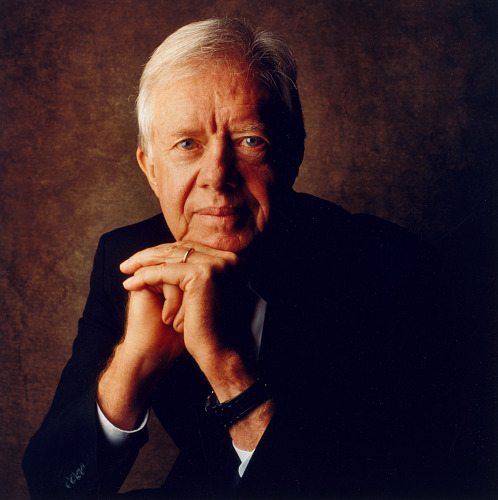
While President Carter’s time in office was limited to a single term, his positive influence on the world has been lifelong. Jimmy Carter is the definition of a humanitarian, advocating for peace, aid, and health for all people of the world. Carter’s post-presidency life has been filled with service, from negotiating treaties and using diplomatic channels to secure the release of American political prisoners held overseas to selflessly working well into his 90s to physically construct homes with Habitat for Humanity.
In a time when so many politicians denigrate immigrants, the poor, and the downtrodden, Jimmy Carter has worked to raise them up. In a time when religion has been fashioned into a weapon to justify atrocities and bigotry, Jimmy Carter has lived a life of faith and love for all. In a time when people advocate turning our back on the world and seek their own selfish wants at the cost of all others, Jimmy Carter has represented the noble good that can be done when we come together and embrace the global brotherhood of man.

Jimmy Carter reminds us that true leaders care about others. His life of service is the much-needed antidote to the venom that has infected our country of late. In a world of selfish Trumpism that cheers the worst impulses of humanity, Jimmy Carter represents the “better angels of our nature” that Abraham Lincoln once spoke about.
Jimmy Carter was born fifty-nine years after the assassination of President Lincoln. While I don’t feel that I need to justify a post about a man who has so justly earned the respect of his country, President Carter does have a few connections to the subject of this blog. One of them comes by way of another centenarian.
Dr. Richard D. Mudd was the grandson of Dr. Samuel Mudd. He was born in 1901 and died in 2002 at the age of 101. Richard spent his whole life advocating for the innocence of his grandfather. He was constantly writing letters to his Representatives and Senators, hoping for some measure that could overturn Dr. Samuel Mudd’s conviction. When those efforts stalled, Richard made inroads in other ways, like successfully getting a plaque installed at Fort Jefferson highlighting Dr. Mudd’s heroic activities during the 1867 yellow fever epidemic that, ultimately, helped grant him a pardon. While I firmly disagree with Richard’s interpretations of his ancestor’s actions and involvement in Lincoln’s assassination, I respect the way he tirelessly advocated for his beliefs. In addition to his Congressmen, Richard Mudd wrote to the chief executives themselves. Richard received responses from Nixon and Reagan, both telling him that nothing could be done to change history, especially since his grandfather had accepted a pardon (and the implied guilt that comes along with the acceptance).
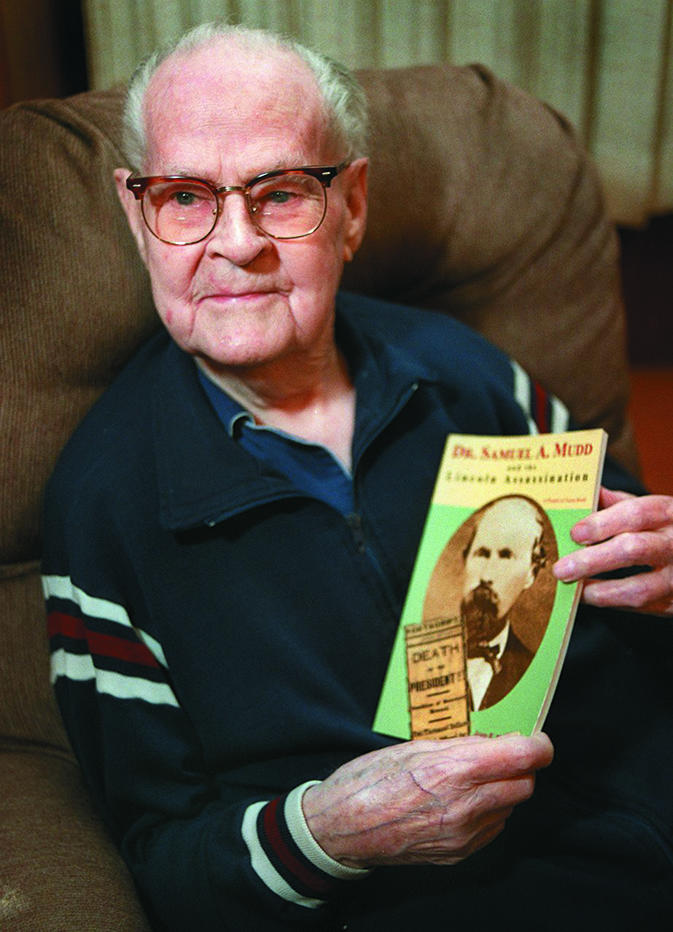
Dr. Richard Mudd
Jimmy Carter also sent Richard Mudd a letter. Like his predecessor and successor, President Carter informed Richard Mudd that nothing could be done to overturn his grandfather’s conviction. However, Jimmy Carter went a bit beyond what other Presidents had done. In his compassion, President Carter expressed his own personal belief that Dr. Mudd was only guilty of aiding and abetting John Wilkes Booth and David Herold after the assassination and not of being a party in the conspiracy that led to Lincoln’s death. In coming to this conclusion, President Carter cited Andrew Johnson’s own pardon of Dr. Mudd, in which Lincoln’s successor seemed to express some doubt as to Dr. Mudd’s proven culpability. What follows is a transcript of Jimmy Carter’s letter to Dr. Richard Mudd in answer to Richard’s many entreaties.
The White House
Washington
July 24, 1979To Dr. Richard Mudd
I am aware of your efforts to clear the name of your grandfather, Dr. Samuel Alexander Mudd, who set the broken leg of President Lincoln’s assassin, John Wilkes Booth, and who was himself convicted as a conspirator in the assassination. Your persistence in these efforts, extending over more than half a century, is a tribute to your sense of familial love and dedication and is a credit to the great principles upon which our nation was founded.
Your petition and the petitions submitted to me on behalf of your grandfather by numerous members of Congress, several state legislatures, historians and private citizens have been exhaustively considered by my staff over the past two years. Regrettably, I am advised that the findings of guilt and the sentence of the military commission that tried Dr. Mudd in 1865 are binding and conclusive judgments, and that there is no authority under law by which I, as President, could set aside his conviction. All legal authority vested in the President to act in this case was exercised when President Andrew Johnson granted Dr. Mudd a full and unconditional pardon on February 8, 1869.
Nevertheless, I want to express my personal opinion that the declarations made by President Johnson in pardoning Dr. Mudd substantially discredit the validity of the military commission’s judgment.
While a pardon is considered a statement of forgiveness and not innocence, the Johnson pardon goes beyond a mere absolution of the crimes for which Dr. Mudd was convicted. The pardon states that Dr. Mudd’s guilt was limited to aiding the escape of President Lincoln’s assassins and did not involve any other participation or complicity in the assassination plot itself — the crime for which Dr. Mudd was actually convicted. But President Johnson went on to express his doubt concerning even Dr. Mudd’s criminal guilt of aiding Lincoln’s assassins in their escape by stating:
” … it is represented to me by intelligent and respectable members of the medical profession that the circumstances of the surgical aid to the escaping of the assassin and the imputed concealment of his flight are deserving of a lenient construction, as within the obligations of professional duty and, thus, inadequate evidence of a guilty sympathy with the crime or the criminal;
“And… in other respects the evidence, imputing such guilty sympathy or purpose of aid in defeat of justice, leaves room for uncertainty as to the true measure and nature of the complicity of the said Samuel A. Mudd in the attempted escape of said assassins…”
A careful reading of the information provided to me about this case led to my personal agreement with the findings of President Johnson. I am hopeful that these conclusions will be given widespread circulation which will restore dignity to your grandfather’s name and clear the Mudd family name of any negative connotation or implied lack of honor.
Sincerely,
Jimmy Carter
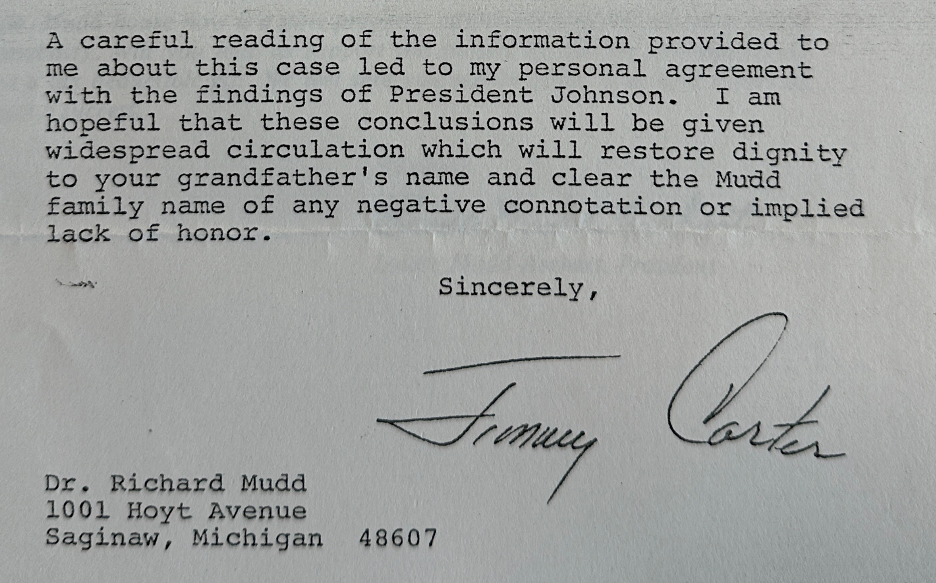
Despite a couple more decades of trying, this letter proved to be the best result Richard Mudd attained in his quest to exonerate his ancestor. Legally, this letter changed nothing about Dr. Mudd’s guilt, but it was a moral victory of sorts. A sitting President had expressed his belief that Dr. Mudd had been innocent of the crime he was convicted of. Even today, this letter from President Carter is something that certain members of the Mudd family point to to support their case.
Now, I very much disagree with President Carter regarding Dr. Mudd’s involvement in John Wilkes Booth’s plot, but I also recognize that Carter was not an assassination historian. He was the chief executive, taking time out of his busy schedule to respond to a man who had spent the last two years recruiting Representatives and sending petitions concerning a matter of family honor. Knowing that nothing could be done to provide Richard with the result he wanted, President Carter did his best to mitigate the disappointment by volunteering his own opinion on the matter. Even this letter demonstrates Jimmy Carter’s empathy and consideration for a fellow citizen.
A year and a half before writing his letter to Richard Mudd, Jimmy Carter attended a gala celebrating the 10th anniversary of the reopening of Ford’s Theatre as a working theater. While the old Ford’s Theatre building had housed a Lincoln museum since the 1930s, it wasn’t until the 1960s that the building was reconstructed to its 1865 appearance. The restored Ford’s Theatre had its debut performance on January 30, 1968, with Lady Bird Johnson in the audience without President Johnson. President Nixon never visited Ford’s Theatre during his Presidency. On April 17, 1975, President Gerald Ford attended James Whitmore’s one-man play “Give ’em Hell, Harry” about the life of President Harry Truman.
When President and Mrs. Carter attended the 10th-anniversary gala at Ford’s Theatre on January 29, 1978, he was only the second sitting President to see a show at Ford’s Theatre since Abraham Lincoln. More importantly, this event marked the start of a tradition. Starting with Jimmy Carter in 1978, every sitting president has attended a nonpartisan gala night of speeches and entertainment at Ford’s Theatre.

President and Mrs. Carter attend Ford’s Theatre on January 29, 1978.
Just before heading off to Ford’s Theatre for its 10th-anniversary gala, President Carter hosted a reception at the White House for the invited guests. As part of his remarks for the evening, President Carter thanked the crowd for their support of Ford’s Theatre and for their “generosity in keeping it a live tribute to the past and an opportunity for the future.” Despite the tragedy that had occurred at the site, Carter expressed his admiration that Ford’s Theatre had been reopened, noting that:
“It wasn’t the character of Lincoln to have a source of entertainment, tragedy, and humor kept closed and isolated from the people of our Nation. And so a unique occurrence has been recognized tonight that happened 10 years ago, when a national historical site was opened, not as a museum, a closed or a dead thing just to be looked at and admired, but an open and a live thing which is the source of both entertainment and inspiration for us all.”
After thanking select people for their efforts in bringing back live theater to Ford’s, Carter ended his remarks by saying:
“So, as a southerner, as a President, I would like to say that I’m very proud of all of you for helping to unite the consciousness of our Nation to remember the past, but also to prepare for the future with confidence and also with pleasure. That’s the way President Lincoln would have liked it. And you’ve honored him in performing as you have in keeping Ford Theatre alive.”
When President Carter entered home hospice care in February of 2023 at the age of 98, it seemed unlikely that he would make it to this milestone age. When his beloved wife of 77 years, Rosalynn, passed in November of 2023, it was also feared that grief might take its toll. Amazingly, however, Jimmy Carter continues to bless this earth with his presence.
In truth, 100 years is an arbitrary number. If Jimmy Carter had passed last year, five years, or even two decades ago, his good deeds would have still been a testament to his character. On his 100th birthday, we celebrate not just the impressive number of years President Carter has lived, but the positive impact he packed into each and every one of those years.
Happy Birthday, President Carter. In addition to the well-deserved praise you will receive today, I sincerely hope you get your birthday wish of making it to November 5 so that you can cast your vote for the next leader of this country.




 LincolnConspirators.com
Recent Comments