“A short distance beyond, on the same side of the road, I recognized the historic Surratt House. It is nestled in a clump of beautiful trees, and I venture to say that the occupants of the house in war times would not recognize the place. The owner of it, Mr. J. W. Wheatley, was sitting on the front porch, and as I walked up and told him my business, stating that I wanted to stop with him until the next day, he at once made me feel at home. The sign at the corner of the house reads: “Village Hotel.” The farm originally contained 168 acres. The Surratts sold it to John Hunter, and at his death it was left to Mrs. Addison, a relative, and she sold 117 acres to Mr. Wheatley ten years ago. At that time it was a perfect wilderness, grown over with pines and underbrush, but with liberal expenditure of money and time it now has no superior in southern Maryland. Every foot of ground, with the exception of a small piece of timber, is under cultivation. The house faces to the west, and a halt runs through the center. The room at the northwest corner is used as the barroom, and the one adjoining on the east for card-playing, etc. It was through the barroom door, leading out to the north end of the house, that Lloyd, the tenant, handed the carbine and whisky to Booth and Herold. The room in which Lloyd secreted them when John Surratt left them in his care an unfinished one, was upstairs, but has been finished since Mr. Wheatley became possessor of the house. I obtained some good views with my Kodak of the most interesting places around the house — the back door where Lloyd stopped on his return from Marlboro on the afternoon of the assassination, and handed his fish in the kitchen door, and where Mrs. Surratt met him and told him to be sure and be at home that night, for the guns that had been left with him would be called for.”
The above was written by assassination author and collector Osborn Oldroyd in his 1901 book, The Assassination of Abraham Lincoln. He visited the Surratt House, met its owner at the time, Mr. Wheatley (pictured), and apparently took several pictures of the building. Following Mr. Oldroyd’s lead, the newest Picture Gallery here on BoothieBarn consists of images relating to Mary Surratt’s former house and tavern. Once a brief stop for the assassin and his accomplice it is now the site of the restored Surratt House Museum.
This morning I arose bright and early. My reasoning for doing so was not the same as many others today. I was not out hunting for an elusive deal or special discount sale. Rather I woke early today to meet up with fellow Lincoln assassination researcher and author, Jim Garrett, for a day long Boothie “field trip”. Together, Jim and I travelled down into Caroline County, Virginia to socialize with a couple of her noted residents and to investigate some Lincoln assassination sites in the area.
While driving down to Caroline County, Jim and I made a stop over in King George County to see the site of William McDaniel’s house. William McDaniel is not featured in many assassination books as his connection to the story seems to be solely through family lore. The book Come Retribution by authors Tidwell, Hall, and Gaddy contains a single sentence mentioning McDaniel, “At Office Hall, they [Booth, Herold and Charley Lucas] stopped for food at the home of William McDaniel.” Though there does not seem to be any physical documentation for this visit, a phone conversation in the 1980’s between King George historian John Stanton and a McDaniel descendant also supported the family’s belief that someone, possibly the servants at the McDaniel house, fed Booth and Herold a meal on April 24th.
While we hardly have ironclad proof of the incident occurring, it is a harmless enough piece of oral tradition to pass on. Jim showed me the spot on which the McDaniel house used to stand, the site having originally been shown to him by Elizabeth Lee, another King George County historian and head of the local historical society. The house that is on the site today was built on the foundation of the former McDaniel house:
Site of the McDaniel House where is claimed John Wilkes Booth and David Herold were fed a meal while travelling through King George County on April 24th, 1865.
Our next stop was Green Falls, the home of Caroline County historian and former Smithsonian curator, Herb Collins. I’ve highlighted Mr. Collins and his remarkable career on my site before and you can read about him here. At Herb’s house, we were joined by Betty Ownsbey, the immensely delightful author and biographer of conspirator Lewis Powell. Herb and Betty had never met before, but before too long, those two native Virginians were finishing each other’s sentences and having a grand time talking about the Old Dominion and its sites.
From Herb’s we travelled up to Port Royal and were met by Port Royal historian and long time resident Cleo Coleman. Being as gracious as she is, Cleo was kind enough to open up the Port Royal Museum of American History for us. Though I had visited the museum when it first opened up last year, neither Jim or Betty had ever been there. Since my first visit they have increased their collection thanks, in part, to the continued generosity of Herb Collins, and acquired more display cases to showcase their treasures. I took a couple pictures of their John Wilkes Booth in Caroline display:
The Port Royal Museum of American History is open on Saturdays from 10 am to 4 pm. Please find the time to visit and support this wonderful fledging museum.
From the museum, Cleo took us over to the Port Royal Portrait Gallery, which contains many paintings of notable citizens of Caroline County:
The only Lincoln assassination related face in the gallery is that of Richard Henry Garrett, the owner the farm on which Booth died:
After John Wilkes Booth, David Herold, and Confederate soldiers Bainbridge, Ruggles and Willie Jett, crossed the Rappahannock river ferry into Port Royal, Jett proceeded to the home of the Peyton family. Jett not only wanted to visit the family, but was also looking for someone who would take in the wounded Booth for the night. He asked, the lady of the house, Miss Sarah Jane Peyton, if she would not mind entertaining and lodging a wounded Confederate soldier. At first she agreed and Booth was led inside and rested on a lounge. Not long after this, Miss Peyton, changed her mind and asked Jett to find another place for “Mr. Boyd”.
Front porch of the Peyton house
Willie Jett asked Miss Peyton if she thought her neighbor, a Mr. Catlett, would take the men in. She said she did not know and so Willie Jett went across the street to check. He discovered that Mr. Catlett was not at home.
The Catlett house, across the street from the Peyton home.
According to Willie Jett, Miss Peyton then said to the men, “You can get him in anywhere up the road; Mr. Garrett’s or anywhere else.” Then the men rode further up the road, eventually depositing Booth off at the Garretts.
While Jett’s attempts at dropping Booth off at the Peyton and Catlett homes are the only two supported by documentation by Jett, local lore in Port Royal states that Jett attempted at least two more houses before deciding that the Garrett’s would be the best bet. One of the house supposed to have been visited by Jett after the Peyton and Catlett homes is the Murray House, further down King Street.
The last place Jett attempted to drop off Booth according to local tradition was the Dickerson house at the end of King’s street.
While we were all in the Portrait Gallery, Cleo was kind enough to recount her personal knowledge of the Dickerson house and the local lore around it:
Ultimately, here’s a map of the different stops (some documented, some not) that Jett made with Booth trying to find a temporary respite for him:
After enjoying the paintings at the Port Royal portrait gallery, our group of five had lunch at a local restaurant with a nice view of the river:
The Rappahannock river will Belle Grove visible on the Port Conway shore.
Following lunch we bade our goodbye to Cleo, our Port Royal hostess, and to Betty, who had to return home. One of the things on Jim’s wish list for this trip was to find the location of Mrs. Virginia Clarke’s home south of Bowling Green. After dropping Booth off at the Garrett’s, Willie Jett proceeded to the Star Hotel in Bowling Green where he spent the night. Herold, Bainbridge and Ruggles continued on further to Mrs. Clarke’s home and that is where they spent the night on April 24th. Virginia’s son had served in the Confederacy and Ruggles and Bainbridge knew the Clarkes from his service with them.
Herb Collins is a walking encyclopedia and his recent book, Caroline County Virginia Estates; Residences and Historic Sites, demonstrates his immense knowledge of the area and its history. With Herb as our navigator, we quickly came across the location of Mrs. Clarke’s house. The home, gone since at least the 1960’s, has been replaced now by a large pond.
The site of the former Clarke house in Caroline County, VA
The gate to the Clarke house once stood here.
After visiting the site of the Clarke home we went back to Green Falls and said goodbye to Herb. On our way back, utilizing yet another of Herb’s books and his personal guidance, we stopped at Greenlawn Cemetery and found Virginia Clarke’s grave:
As the sun was going down, Jim and I returned to Port Royal to take a few pictures before departing for Maryland shores. Our journey today proved to be an enlightening and enjoyable one. We got to learn from and chat with our immensely knowledgeable friends in Virginia. For our next field trip, Jim and I are hoping to see if we can arrange passage onto Fort A. P. Hill in Caroline County to visit the site where the house of ill repute, “The Trappe” once stood. Herold, Jett, Bainbridge, and Ruggles visited the Trappe after dropping Booth off at the Garretts and before they found lodging for the night. We’ll keep you informed.
In the true spirit of Black Friday, however, why not purchase Jim and his co-author Rich Smyth’s grave book and the upcoming second edition of Betty’s Lewis Powell book. They’d make wonderful Christmas gifts.
Photography as we know it was only about 40 years old when Abraham Lincoln was assassinated. Though some photographers had risked life and limb taking battlefield shots of the Civil War, the bulk of a photographer’s business consisted of portraits in their studio. In the aftermath of Lincoln’s assassination photographers like Matthew Brady and Alexander Gardner took photographs of Ford’s Theatre, the conspirators, and the hanging of the condemned. When it came to the escape route, however, no cameras attempted to make the trip. Granted, in those early days no one was completely sure of the route Booth took or of all the places he visited before his death at the Garrett farm. Newspapermen travelled the route and drew sketches, many of which were later turned into engravings, but none of these can truly capture the detail of a location as well as a camera can. However, the bulky nature of early photography equipment (such as the required glass plates) made photographing the escape route an undesirable endeavor.
So, what are the earliest photographs we have of the escape route? The most readily available ones were done by Osborn Oldroyd in 1901, 36 years after Lincoln’s death. Armed with the newly invented “Brownie” camera from Kodak, Oldroyd walked and photographed the route. Oldroyd’s book, The Assassination of Abraham Lincoln, is still so popular and historically valuable thanks, in part, to his many photographs of the escape route.
Osborn Oldroyd, most likely with his Brownie camera in his pack
But Oldroyd was not the first to photograph the sites of Booth’s escape. In 1888, Kodak, and it’s founder George Eastman, had released the first box camera using the recently invented “roll” of film. Like the Brownie that followed, these original Kodak cameras allowed individuals to take their pictures and then mail in their film to Kodak to be developed. These first, mass market cameras produced a circular image while the later Brownie created a rectangular exposure.
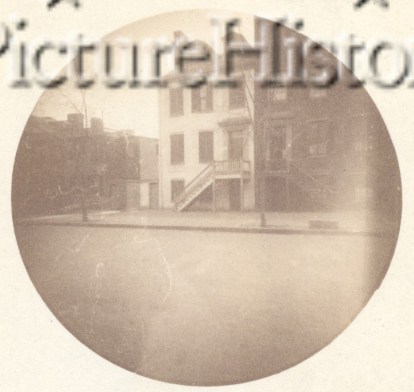
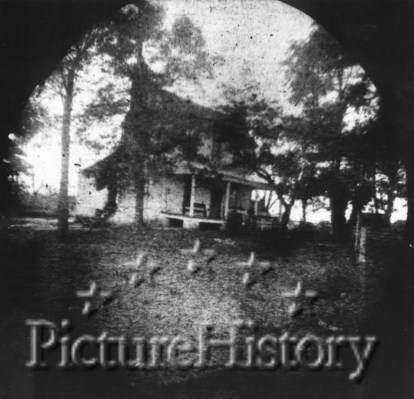
Sometime between 1893 and 1895, a writer for Century Magazine either commissioned someone or took a Kodak camera for a walk himself and photographed part of the escape route. The writer’s name was Victor L. Mason, and here are some of his pictures:
Mrs. Surratt’s boarding house circa 1895
The Surratt Tavern circa 1895
Dr. Mudd’s house circa 1895
The Garrett house circa 1895
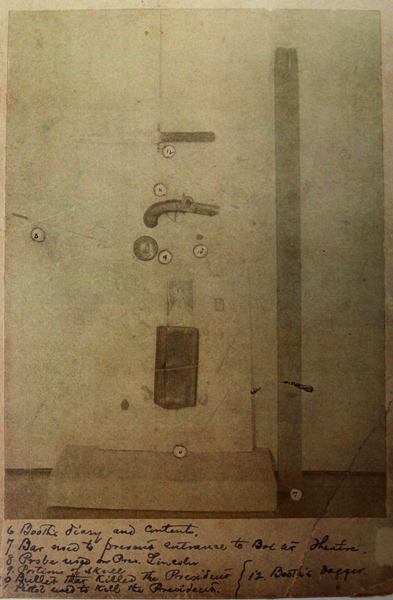
Victor Mason was working on an article about Lincoln’s assassination for Century Magazine. In addition to these exterior shots of the escape route with a Kodak, Mason also used a more professional camera to take images of several of the trial exhibits in storage at the War Department such as this one:
In April of 1896, Victor Mason’s article, Four Lincoln Conspiracies, was published in Century Magazine. Click here to view the article and look through the pages. You will notice that while photographs of the conspirators and the relics of the assassination are replicated in the article, the photos of the escape route are not. Instead, the article contains several drawings of each escape route location “Drawn by Harry Fenn” “From a Recent Photograph.” Look at the drawings for the Surratt boarding house, the Surratt Tavern, Dr. Mudd’s House, and the Garrett house, and you will see that they are exact matches to the photos above. It’s clear that Mason’s photographs were turned into these drawings. Due to this, we can surmise that Mason also photographed Bryantown, Huckleberry, and Cleydael, since there are drawings of those places in the article too.
To my knowledge, these circa 1895 images are the earliest photographs of the escape route. If any one knows otherwise, or has copies of these images (especially the “missing” ones of Bryantown, Huckleberry, and Cleydael), please comment below or shoot me a message at boothiebarn (at) gmail (dot) com.
Yesterday, I visited Dent’s Meadow, the spot where John Wilkes Booth and David E. Herold first set across the Potomac River. What follows is the short video clip that I made while standing on that Maryland shoreline:
Further images will come later as I complete a Crossing the Potomac Picture Gallery. In the meantime, here is an animated image of the spot in 1901 and now:
EDIT: One reader was a little confused regarding the location where I shot my video versus the location of Henry Woodland in the photograph taken by Osborn Oldroyd in 1901. I created this little map to hopefully alleviate that confusion:
“As I was in the act of shoving the boat off Booth exclaimed, “Wait a minute, old fellow.” He then offered me some money. I took eighteen dollars, the price of the boat I knew I would never see again. He wanted me to take more, but I said no, what I had done was not for money. In a voice choked with emotion he said, “God bless you, my dear friend, for all you have done for me. Good-bye, old fellow.” I pushed the boat off and it glided out of sight into the darkness. I stood on the shore and listened till the sound of the oars died away in the distance and then climbed the hill and took my way home.”
These are the words written by Thomas A. Jones as he recounted the night he put John Wilkes Booth and David E. Herold onto the Potomac River. For days, Jones had tended to the fugitives as they remained hidden from Union troops in a pine thicket. Finally, on the night of April 20th, 1865, Jones brought them to a boat on the bank of the Potomac and directed them to the Virginian shore. However, Booth and Herold did not greet the morning sun of April 21st on Virginian land. Rather, they found themselves making landfall in Maryland, further away from their intended destination than before.
When it comes to the escape route of John Wilkes Booth, millions of people visit Ford’s Theatre in Washington, D.C. every year. Ten thousand visit the Surratt House Museum in Clinton, MD. Thousands visit the Dr. Mudd House, and a few hundred participate in the John Wilkes Booth Escape Route Bus Tours put on by the Surratt House. The B.E.R.T. (Booth escape route tour)provides you with the most bang for your buck, but still has the limitations of fitting the entire route (and return trip) into a 12 hour tour. Due to this, some of the minor places in the escape are left unseen. The place where John Wilkes Booth and David E. Herold found themselves on the morning of April 21s and where they stayed until dusk of April 22nd, is one of these unseen places. Today, I wanted to rectify this and see if I could at least get close to this forgotten stop during the escape.
After Booth and Herold left Thomas Jones and ventured into the Potomac, something occurred to steer the men off course. Thomas Jones attributed the flood tide and unfriendly currents as to the reason why Booth and Herold did not keep to their course. Booth dramatically wrote in his diary, “After being hunted like a dog through swamps, woods, and last night being chased by gunboats till I was forced to return wet, cold, and starving, with every man’s hand against me, I am here in despair.” Booth may be exaggerating the reason for their return to Maryland, but something, manmade or otherwise, kept the pair from making it to Mrs. Quesenberry’s. Instead, Booth and Herold arrived northwest from their departure point and landed in Nanjemoy Creek. The exact point the two men made landfall in Nanjemoy Creek is unknown. On the map above you will see two creeks on the eastern side of Nanjemoy Creek. They are Burgess Creek (with Gumtree Cove at its mouth) to the north and King’s Creek to the south. Booth and Herold rowed into one of these creeks and hid their boat among the marshy shores. I’m of the opinion that the pair entered King’s Creek,but, again, there is no documentation one way or the other. According to reporter George Alfred Townsend (GATH) in 1884, it was after beaching the boat that, Booth and Herold, “discovered a house nearby, to which Herold made his way, the latter saw something familiar about the place, he knowing all that country well.” The pair had inadvertently reached the farm of Peregrine Davis, a verbose character in Charles County who was described by General Hooker as, “one of the noisiest” rebels in the area. The land was called Indiantown Farm, and it was tended by Davis’ son-in-law, John J. Hughes, who lived on the property with his family. Booth and Herold would spend about 36 hours on Indiantown property.
The exact details of this 36 hour layover are very much lacking. As author William Tidwell wrote, after the death of Booth, “It became common knowledge in Charles County, Maryland that Booth had visited Indiantown, occupied by Peregrine Davis’ son-in-law, John J. Hughes. Unfortunately there is no contemporary documentation of the visit.” What we know about Booth and Herold and their inadvertent return to the Maryland is largely based on three sources: David Herold’s statement after his arrest, GATH’s 1884 account of Booth crossing the Potomac, and family lore from the Hughes family.
David Herold’s Account:
After Davy Herold was arrested at the Garrett Farm, he gave a lengthy statement while imprisoned. Davy is evasive and cunning in what he tells the investigators, mixing a tale of truth and lies. Nevertheless, Davy does provide period documentation that he and Booth did not cross the river the first time and made land at Nanjemoy:
“…We started to cross the Potomac. It was very foggy. We got along the Maryland shore to Nanjemoy Creek, and went to a man’s house and wanted to buy some bread. He said he hadn’t baked, and would not bake any. He said he had nothing to drink either. I said we were wet and would like to have something to drink. I had a bottle, and asked if he would sell me some whiskey. He said he would not do it. Booth gave the man’s little boy a quarter of a dollar for filling the bottle with milk…”
Taking Davy Herold at his word would imply that John Hughes provided no aid to the fugitives at all. According to Davy, Hughes refused to give them, literally, bread and water. However, we cannot take David Herold at his word. This is the same man who claimed not to have known about the assassination until later and was then forcibly coerced by Booth to accompany him. While not trustworthy, Davy does provide evidence that there was some interaction between Hughes and the fugitives.
GATH’s article:
In April 1884, Century Magazine ran George Alfred Townsend’s article, “How Wilkes Booth Crossed the Potomac“. The article was mostly about Thomas Jones and the assistance he gave Booth and Herold in the pines and then, sending them across. GATH interviewed Jones and got the story from him. GATH was also a successful reporter who had a long history reporting on the assassination. In addition to the piece I quote before, GATH wrote the following regarding Booth and Herold on the Nanjemoy Creek shores:
“It was the residence of Col. John J. Hughes, near Nanjemoy Stores, in Maryland, directly west of Pope’s Creek, about eight or nine miles. The Potomac is here so wide, and has so many broad inlets, that in the darkness the Virginia shore and the Maryland shore seem the same. Herold went up to the house and asked for food, and said that Booth was in the marsh nearby, where they had pulled up the boat out of observation. The good man of the house was much disturbed, but gave Herold food…The keeper of the house at Nanjemoy became frightened after they left, and rode into Port Tobacco and told his lawyer of the circumstance, who took him at once before a Federal officer.”
In GATH’s account, Hughes provided food to the pair. GATH also mentions that John J. Hughes later went to Port Tobacco to report the men. While there is no documentation to support that Hughes talked to officials about the men at his house, there was a letter that the provost marshal of Washington received from a man named William R. Wilmer of Port Tobacco. In the letter, Mr. Wilmer recalled that on Friday, April 21st, he saw two men in Nanjemoy Creek, one of whom answered to the description of John Wilkes Booth. By the time the letter got to the provost marshal, Booth had already been cornered and killed, so the matter was not investigated further. However, it is possible that this report from Mr. Wilmer is the one that GATH is recalling. John J. Hughes had studied law and passed the bar himself, so it unlikely that he would have needed to consult a lawyer as GATH claims.
3. Family Lore of the Hughes family:
John J. Hughes
In 1975, assassination researcher James O. Hall interviewed one of John J. Hughes’ grandsons. According to the family story given to him, Booth and Herold did not make their presence known to the family members in the house, but somehow made contact with John J. Hughes. Hughes, uncomfortable with having the men stay at his house, allowed the pair to stay in a nearby slave cabin near the water’s edge. Hughes proceeded to take food out to the pair without the rest of the family knowing it.
By putting these different pieces together, it is possible to make a probable accounting of Booth and Herold’s time at Indiantown farm. After coming ashore and pulling up their boat, Booth had Herold make his way towards the nearest house, while the former stayed at the boat with his broken leg. Herold recognized the farm from his hunting days and somehow, secretively or otherwise, made contact with John J. Hughes. Hughes did not want the men at his house but allowed them to stay nearby in the slave quarters. During the course of the two days and one night Booth and Herold stayed there, Hughes brought the pair food and water. The fugitives may have had interactions with Hughes’ children or former slaves, as presented in Davy’s statement, or they were completely hidden from the family. After dusk on April 22nd, Booth and Herold pushed off from the Nanjemoy Creek shores, leaving John J. Hughes and Indiantown Farm behind.
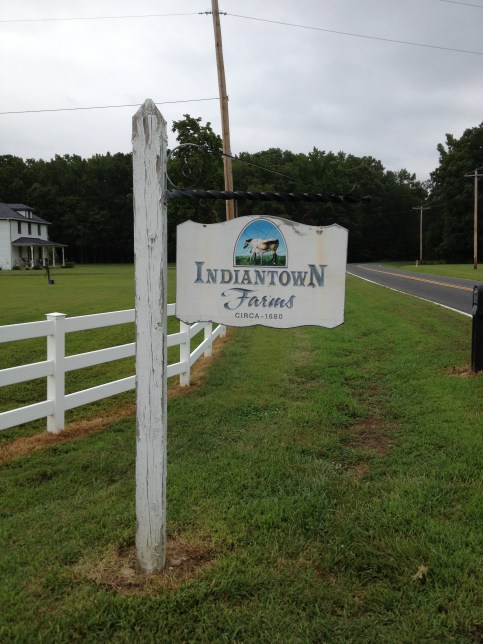
With this history in my head today, I made my way down the peninsula created by Nanjemoy Creek and the Potomac River. From looking at a map, I noticed that “Blossom Point Rd.” would take me all the way down the peninsula. I planned to drive to the end of the road, hop out of my car, and take a few pictures of the shore where the Potomac meets Nanjemoy Creek. It wouldn’t be exactly where Booth and Herold landed, but it would be as close to the water as I could get. On my way back north, I planned on taking a picture of the sign for Indiantown Farms, which, like it was in 1865, is privately owned. The entrance to the farm is about a mile and a half from the water, so I knew I wouldn’t see anything except for the sign.
Though the map showed a clear road straight down to the point of the peninsula and, in truth, it probably goes there, the map did not warn me that three miles from the end of the peninsula northward is the property of the U.S. Army and is used for ordinance testing and the like. When I was presented with a fancy looking gate bearing signs stating, “Restricted Access”, I quickly turned around. I was going to have to settle for just pictures of the Indiantown Farm sign.
As I pulled my car off the road and walked towards the sign to take a picture I made eye contact with, a very kind woman who had just finished her laborious work of weed whacking a long stretch of perfectly manicured white fence, and her granddaughter. I walked up and introduced myself, asking them if I was indeed on the same property John Wilkes Booth was said to have temporarily stayed on. They replied that it was and, with their own generosity of spirit shining through, they offered to give this stranger before them a tour of the property. I was ecstatic by the offer and graciously took them up on it.
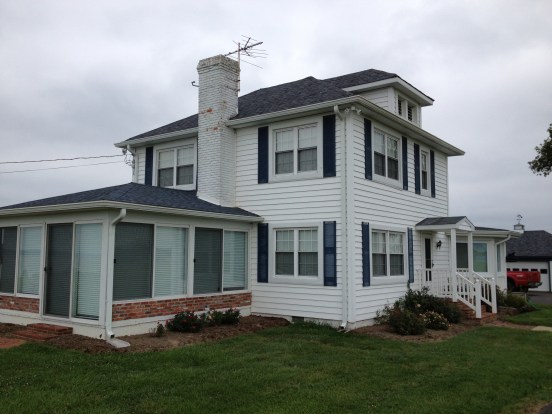
As I got in their truck and we proceeded to drive the mile and half to the water’s edge, I was struck by how much nature was around me. I saw countless deer, eagles, ospreys, kestrels, rabbits, and songbirds among the hay fields. My host was very generous in sharing what she knew about the history of the place. When we got to the water’s edge, she pointed out to me the house that is believed to have been where John J. Hughes and his family would have been living when Booth showed up. She was not certain that it was the same house, but recounted that they believed it was. While there have obviously been several additions made to the house, the chimney looks to old enough to me.
The assumed former home of John J. Hughes on the Indiantown property. The entrance to Burgess Creek by way of Gumtree Cove is to the left of the house. Burgess Creek is one of the two possible creeks that Booth and Herold could have landed at.
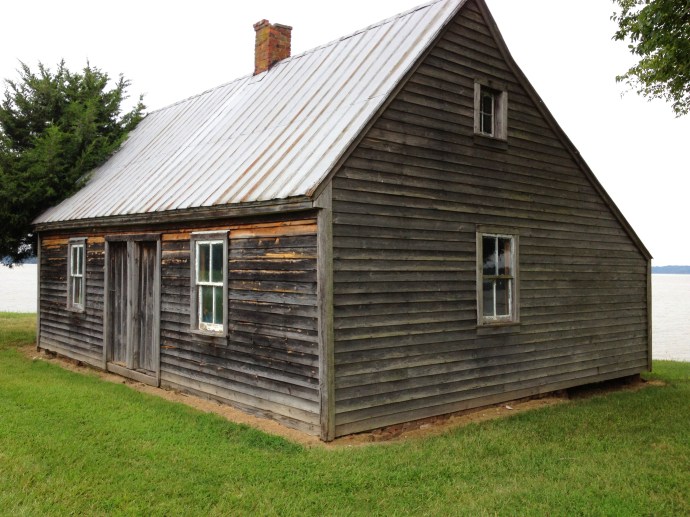
From the main home (which, by the way, has one of the most splendid view of the water I have ever seen) we proceeded to a place that I had seen a picture of once, but could not believe still existed: the slave cabin where Booth and Herold are said to have slept and spent time in.
The slave cabin that Booth and Herold are said to have slept in.
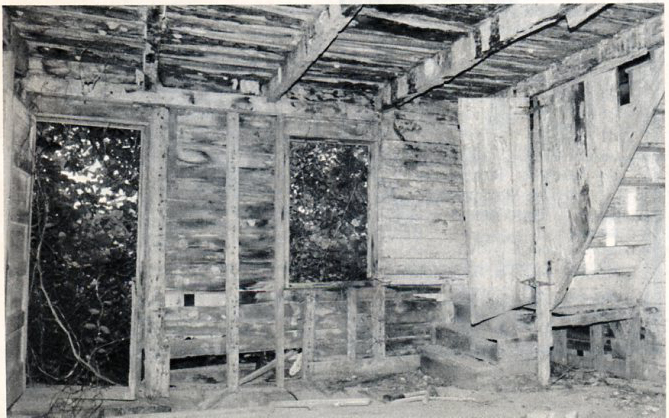
In the June, 1990 issue of Blue & Gray Magazine, author Michael Kauffman included this picture of the inside of the cabin: Since that time, the exterior of the cabin has been restored. The following are some of the pictures and a short video I took of the interior of this cabin:
View of Nanjemoy Creek from one of the cabin’s windows.
After departing the cabin, my host took me to where King’s Creek border’s the property. The marshy landscape of the creek and its relatively close distance to the main house and slave cabin, makes me think this was the place where Booth and Herold would have hidden their boat. My host stated that she often goes kayaking here and that Booth and Herold could have easily rowed their boat into King’s Creek and hidden it among the marshy shores. Once on land and beyond the few trees around the shore, John Hughes’ house would have been easily visible to them.
The entrance to King’s Creek from Nanjemoy Creek. King’s Creek is south of Indiantown and the supposed Booth cabin.
King’s Creek
Indiantown Farm is a quiet and tranquil place (at least when the nearby military facility isn’t blasting, my host told me). With a roof over his head and some time to rest, it seems logical that the John Wilkes Booth would take out his pocket diary and write. His last entry was dated as “Friday, 21” and, if he was being true in his dating, that would have placed his writing at Indiantown.
The Booth cabin with the Hughes house in the background.
As I departed Indiantown Farm, I thanked my generous host immensely. She was hoping to learn more about the role Indiantown Farm had in John Wilkes Booth’s escape, and so I gave her my website’s name and told her that I would be blogging about my trip later that day. I hope that I have done a decent enough job here of presenting what little is known about Booth and Herold’s largely unknown layover at Indiantown.
Indiantown Farm will continue to be one of the unseen places of John Wilkes Booth’s escape. However, today we were able to see that the history that still exists, thanks to the kindness and openness of those who live there.
My recent walking tour from Dr. Mudd’s house forced me to do some research on the man who was hired by John Wilkes Booth and David E. Herold to guide them across the swamp, Oswell S. Swann. As I mentioned in one of the videos, his name varies greatly in different texts and records: Oswell, Oswald, Ausy, Aussie, Oscar, Osborn, Ozzy, etc. He was born in Maryland in about 1835 and was a Wesort. A Wesort is a member of a group of people with tri-racial ancestry; Native American, Caucasian, and African American. Director of the Surratt House Museum, Laurie Verge, gives a good history of the Wesorts here.
According to Oswell Swann’s statement, he had heard about the murder of the President when Booth and Herold arrived at his house. However, he had no way of knowing that the two strangers before him were the parties responsible. It was around 9:00 pm on April 15th when Booth and Herold came up to Swann who was on foot. They asked him the way to Mr. [William] Burtles place, “Hogan’s Folly”. Burtles was a known Confederate sympathizer and his farm was used on occasion to shelter Confederate agents. Burtles’ home was only about two miles from Swann’s and the pair offered Swann $2 to guide them there. Before leaving Swann’s house, the pair asked Swann if he had any whiskey. As corroborated by David Herold in his account, Swann gave them whiskey and bread before mounting his own horse to leave. On route to Burtles’, the pair changed their minds. “They asked me if I could take them to Capt. Cox, if so they would give me $5 more.” Swann agreed to this and proceeded to take them, via Centerville Rd. (modern Route 6), across the swamp to Samuel Cox’s home of Rich Hill.
While en route, the small man, David Herold, did the talking. Noticing the crutch with the other man (Booth), “The small man said that the other man broke his leg.” Unlike the bragging the pair had done about their deed to John Lloyd at Surrattsville, it is extremely unlikely that Booth and Herold told Swann, a descendent of slaves, that the former had assassinated the Great Emancipator. If they had, the best case would have been that Swann would flee, leaving them again lost and without a necessary guide. For their own benefit, they would keep quiet to Swann about what Booth had done.
Just before reaching Cox’s house, however, Davy Herold made a threatening remark to Swann, perhaps hoping to keep him from telling anyone about this little nighttime sojourn. “Don’t you say anything. If you tell that you saw anybody you will not live long.” This was probably Swann’s first hint that there was something nefarious about these men. But Swann was a modest tobacco farmer with a wife and eight children. With so many mouths to feed he needed the money that these two men offered him for the simple job of taking them from one place to another, even if they did threaten him.
Booth, Herold, and Swann got to Rich Hill around midnight and Swann states the pair were welcomed in by Samuel Cox and stayed inside for 3 or 4 hours. Swann waited patiently by the horses during this time, not because of any devotion to the men, but because he had yet to be paid! When Booth and Herold emerged from the house hours later, they put on a masterful charade for Swann’s benefit. The pair acted disgruntled as if they had been turned away. One of the men said, “I thought Cox was a man of Southern feeling.” Swann helped Booth mount his horse again and then managed to get the money owed to him. Perhaps hoping to undo their earlier threat and eliminate Swann’s suspicion of them, Booth and Herold paid Swann $12 for his help, $5 more than what they had agreed to on route. Once he had his money, Swann departed, leaving Booth and Herold mounted but still in Cox’s yard. Booth and Herold were subsequently escorted by the overseer of Cox’s farm, Franklin Robey, to the nearby pine thicket, where they awaited Thomas Jones. Swann returned home, seemingly unaware that he had just aided the assassins of the President.
Such unawareness could not have lasted long, however. As troops poured into Bryantown over the next few days, Swann must have thought about the two suspicious men who called upon him. But still, one of the men had a broken leg and neither of the suspects to that point were described as lame. It wasn’t until the 18th that detectives first looked into the report of two suspicious men had called upon Dr. Mudd to treat a broken leg. They returned to further question Mudd on the 21st and during this visit found the boot Mudd had removed from the injured man and noticed the name J. Wilkes inscribed on it. This was the first direct piece of proof that the man with the broken leg at Dr. Mudd’s was the assassin, John Wilkes Booth.
The inside of Booth’s boot. It is inscribed, “Henry Luz, Maker, 445 Broadway, J. Wilkes”
The news undoubtedly spread like wildfire and increased their patrols around Bryantown and the surrounding area looking for the fugitives. It was in the evening of April 23rd that Oswell Swann, now fully aware of the identity of the men he aided, went to a friend in Bryantown by the name of Joseph Padgett, so that he may help him alert the authorities of the information he possessed. No threat of retribution on Herold’s part or an extra $5 from Booth would keep him silent. He went to Colonel Wells in Bryantown and told him how he unknowingly led the fugitives to Samuel Cox’s house. At about midnight on the 23rd, the troops, led by Oswell Swann, departed Bryantown for Rich Hill. They arrived there at about daybreak and arrested Samuel Cox. Cox and his servant girl Mary Swann (no relation to Oswell) denied that Booth and Herold were ever permitted entry into the house. History would prove that they both lied and that Oswell told the truth. Nevertheless, like several others who unknowingly aided the conspirators, Swann was arrested and held in Bryantown until the 27th when he was forwarded up to Washington and held in the Old Capitol Prison. He was finally released on May 18th and returned home.
After the trial was over, and the government opened up applications for those feeling they deserved a portion of generous reward money, an anonymous letter was sent to the War Department suggesting that Oswell Swann was deserving of some compensation:
“Bryantown, Md.
Sept. 1865
Respected Sir,
In awarding & making provision of the reward offered for the providing and giving information relative to the assassins of the late beloved President Lincoln Is not Oswell Swann entitled to a portion; the moment he was aware that Booth & Herold past his house and pressed him in there service he gave information to the proper authorities that they had past the neighborhood of there place and crossed the Potomac which accelerated & hasten there arrest. Oswell Swann is an honest, correct man and deserves well.”
Perhaps this letter was commissioned by Swann himself to get a share of the reward money. Or maybe his friend Joseph Padgett, who had helped Swann give his information to the authorities, felt compelled to write on his behalf after seeing the misfortune and imprisonment that befell the, “honest, correct man.” Swann did not receive any reward money, but it is nice to think that some anonymous neighbor in Bryantown thought him deserving of some.
The location of Oswell Swann’s house at the corner of Cracklingtown Road and Burnt Store Road near Hughesville, MD
Oswell Swann died on May 2nd, 1890 at the age of 55. According to the death certificate he had been living in D.C. for the past ten years, residing off of Pomeroy Rd. in Anacostia. It took me forever to decipher the cause of death which ended up being the Greek word for tuberculosis. In a bit of serendipitous luck for me, as I was working on all of this, I got a call from Jim Garrett. Jim Garrett and his co-author Rich Smyth (both of whom are big supporters and commenters here on BoothieBarn) wrote the book, The Lincoln Assassination: Where Are They Now?, which documents the burial places of people associated with Lincoln’s death. Jim was out and about in DC when he called me, and I told him that I was looking at the death certificate for Oswell Swann which stated he was buried at Mt. Olivet cemetery. Mt. Olivet is the final resting place of Mary Surratt and John Lloyd among others. Jim was kind enough to stop by Mt. Olivet to check out the lead that Oswell Swann may be there. Jim and a cemetery employee had to go into the old, old books but, with the date of burial I provided him, they managed to find that Oswell is indeed buried in Mt. Olivet. It will take further digging to find out which specific section of the cemetery he is in. Oswell must have been close to destitute when he died as his grave is marked as a “free grave site” in the record books. Due to this, Oswell Swann’s grave will have no marker or headstone on it.
In 1869, a correspondent to the Cincinnati Commercial newspaper visited the country that I walked through a few days ago. There he spoke with, “an intelligent gentleman, living in the neighborhood of Doctor Mudd.” This correspondent’s unnamed informant recounted, with only limited accuracy, the story of Oswell Swann. Part of his narrative, however, correctly summarizes Swann and his role in Booth and Heorld’s escape. Of the terrain the fugitives found themselves in, the man stated, “Any one who has seen the country and appreciated its wild network of roads, can understand the demand [for a guide].” Booth and Herold had become lost, disorientated and needed help from anyone they could find to get them across the Zekiah Swamp. It was this need and sheer bad luck that brought Booth and Herold to Oswell Swann’s door. Enticed by an easy way to make some money, Oswell Swann agreed to take the two strangers where they wanted to go, “not knowing, of course, the sort of work he was contracting for.” Oswell Swann made an anonymous deal with the Devil, as it were, and though Swann tried his best afterwards to help the soldiers track him down, he still spent about a month in prison for it.
John Wilkes Booth and David E. Herold left the home of Dr. Samuel A. Mudd between 4:00 and 5:00 pm on the evening of April 15th, 1865. At about 9:00 pm they arrived at the home of Oswell Swann. The pair hired Swann to take them across the Zekiah Swamp to Rich Hill, and home of Confederate sympathizer, Samuel Cox. Today, I attempted to walk the route that Booth and Herold took after departing Mudd’s until they showed up at Oswell Swann’s. What followers are videos and pictures of that trip. I hope you all enjoy following me as I walk in the footsteps of the assassin.
There are a total of 17 videos that I made to document my walk.
Part 1: Dr. Mudd’s House
Part 2: The Path Behind the Mudd House
Part 3: Walking the Path
Part 4: The Path goes into the Swamp
Part 5: Back tracking on the Path
Part 6: Walking Away from the Mudd House
Part 7: A Possible Oak Hill
Part 8: The Probable Oak Hill
Part 9: Electus Thomas’ Account
Part 10: The Road to Bryantown
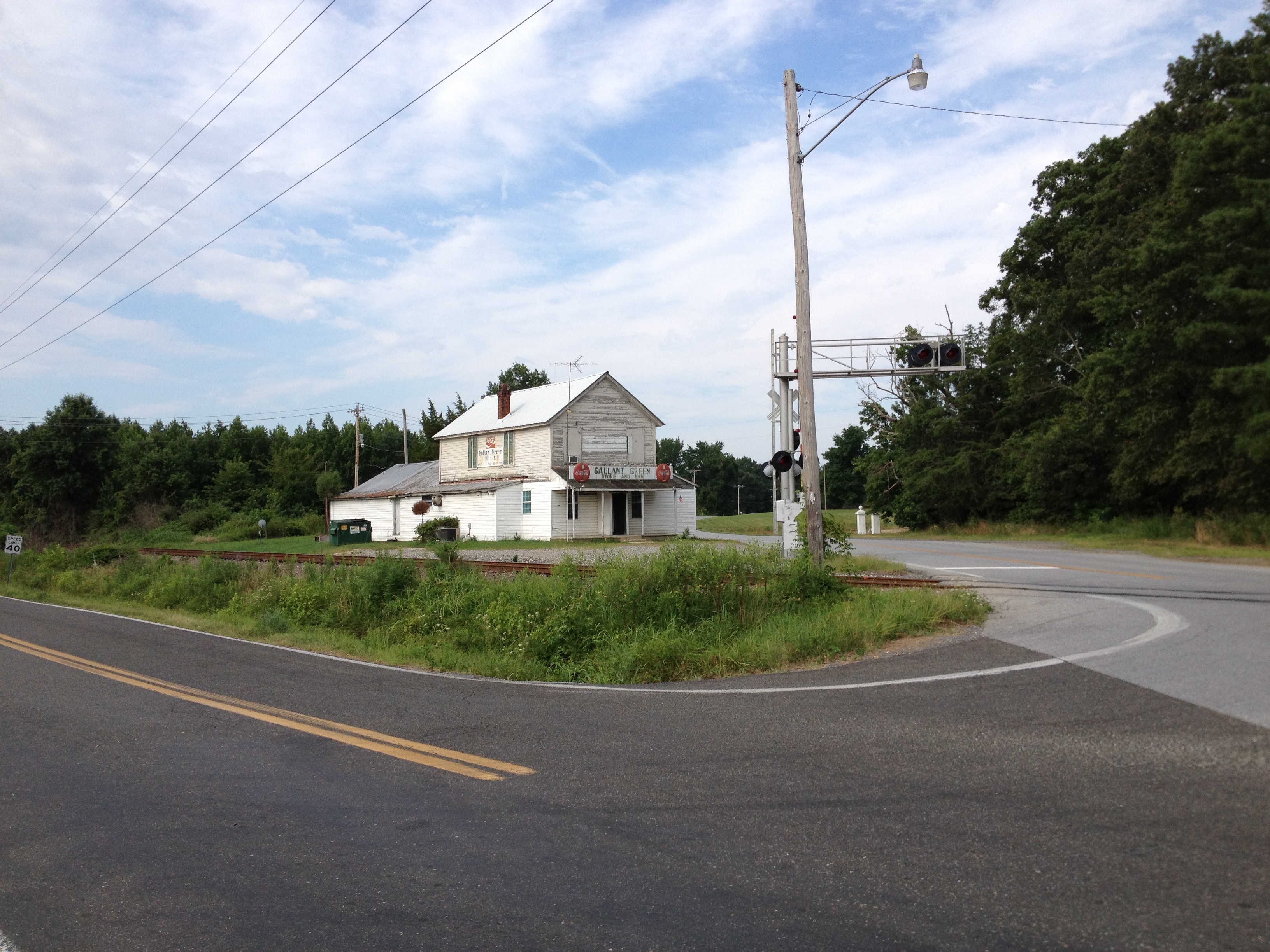
Part 11: Gallant Green Road
Part 12: Joseph Cantor’s Place
Part 13: Cracklingtown Road
Part 14: Oswell Swann’s Place
Part 15: With Swann as their Guide
Part 16: The Road to Rich Hill
Part 17: The End
Epilogue:
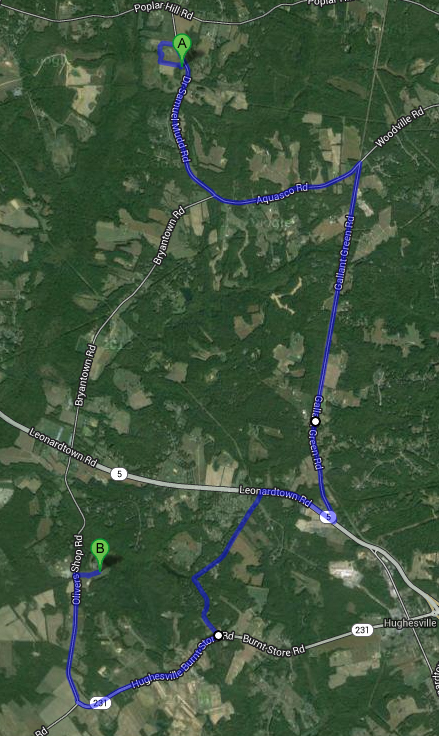
So, two bottles of water, two granola bars, and two extra socks later, I completed the journey. In the end, my planned walk of 11.5 miles turned out to be about 13 miles or so. The following is a map showing my route with Point A being Dr. Mudd’s House, and Point B being St. Mary’s Church where I left my car.
The walk was fun but I have several giant blisters on my feet. I’m hobbling around the house now like an infirmed old man and I predict that may remain for a day or so. Next time, I’ll be sure to buy better shoes preferably with gel insoles.
As I said in the last video, I’m open to viewer ideas regarding my next trek. In the comment section below, feel free to give me your ideas for parts of the escape route I could recreate. Thank you all for your support and encouragement on my little walks. It really helps keep me motivated.
Due to the success of my first attempt at walking part of the escape route a month ago, tomorrow (7/24) I will be undergoing another journey to walk in the footsteps of the assassin. Tomorrow’s walk will be far longer than my last one but with more water and milder weather I’m confident I can make it. My walk tomorrow will recreate John Wilkes Booth and David Herold’s movements from the time period of about 5:00 pm to 9:00 pm on Saturday, April 15th, 1865. I will start, like the assassins, by leaving the home of Dr. Samuel A. Mudd who had set Booth’s broken leg and allowed him to rest in his home during the day. From Mudd’s I will follow the approximate route that Booth and Herold took until they showed up at the home of Oswell Swann, whom they subsequently hired as their guide to take them to Rich Hill. Here’s an 1866 map with a modern map fading up and down on it showing the sites I will visit tomorrow:
(If the image above isn’t animated, click it)
The 1866 map isn’t completely scaled with the modern map, but the sites I highlighted are in the correct places on the 1866 map. I already have different texts and accounts packed up in my backpack to read along the way as I document the walk with video. I’ll be getting an early start so I’m hoping to have everything posted up on here around evening time, but we will see how tired I am. Here’s hoping there’s no surprise rain tomorrow.

was sitting on the front porch, and as I walked up and told him my business, stating that I wanted to stop with him until the next day, he at once made me feel at home. The sign at the corner of the house reads: “Village Hotel.” The farm originally contained 168 acres. The Surratts sold it to John Hunter, and at his death it was left to Mrs. Addison, a relative, and she sold 117 acres to Mr. Wheatley ten years ago. At that time it was a perfect wilderness, grown over with pines and underbrush, but with liberal expenditure of money and time it now has no superior in southern Maryland. Every foot of ground, with the exception of a small piece of timber, is under cultivation. The house faces to the west, and a halt runs through the center. The room at the northwest corner is used as the barroom, and the one adjoining on the east for card-playing, etc. It was through the barroom door, leading out to the north end of the house, that Lloyd, the tenant, handed the carbine and whisky to Booth and Herold. The room in which Lloyd secreted them when John Surratt left them in his care an unfinished one, was upstairs, but has been finished since Mr. Wheatley became possessor of the house. I obtained some good views with my Kodak of the most interesting places around the house — the back door where Lloyd stopped on his return from Marlboro on the afternoon of the assassination, and handed his fish in the kitchen door, and where Mrs. Surratt met him and told him to be sure and be at home that night, for the guns that had been left with him would be called for.”























 LincolnConspirators.com
Recent Comments