Posts Tagged With: Booth Family

BoothieBarn Live on Fox 5!

This morning at 7:30 am EST, I was interviewed along with Tim Morgan, the Chief of Tourism and Special Events for Charles County, MD, about the escape and death of John Wilkes Booth on Fox 5 in D.C. It was my first time on live television and definitely an exciting experience for me. Here’s a capture of the interview:

UPDATE: Fox 5 has put up a much better version of the interview on their website.  Watch it here: http://www.myfoxdc.com/clip/11429378/talking-john-wilkes-booth39s-escape-with-tim-morgan-and-dave-taylor

Admittedly, I made a couple slip ups during the interview. I caught myself after accidentally saying that Dr. Mudd broke John Wilkes Booth’s leg rather than setting Booth’s broken leg. I also gave the wrong weekend for the upcoming Symposium at Tudor Hall. That symposium is taking place on May 9th and you should all sign up for it today!

Well, I’m off to Port Royal now. At 2:00 pm we are having an unveiling ceremony at the Port Royal Museum of American History. We will be unveiling the new highway marker that has been placed near the site of John Wilkes Booth’s death, 150 years ago today. Keep an eye on my Twitter for details.

Categories: Uncategorized | Tags: , , , , , , , , | 9 Comments

#Todayin1865 and #Surratt15 on Twitter

Twitter_Icon

It has been just over a year since I joined Twitter with the username, @BoothieBarn.  I will be honest and say that, at first, I questioned whether this “social media” site would truly benefit me or my blog in anyway.  The Lincoln assassination is hardly a common topic in typical social media interactions.  As opposed to animations of cats or angry rantings about politics, celebrities, sports, etc., I wanted to hold my Twitter account to the same standard as this site.  My goal was to provide educational and informative tweets about Lincoln assassination topics, articles, and events.  So, uncertain if I would sink or swim, I decided to test the waters and see what this Twitter thing was truly like.

I’m happy to say that, time and time again, my decision to join Twitter has proved to be a wonderful choice.  Through Twitter, I have discovered a brand new world of connected history.  Devoted historians, both professional and amateur, use Twitter to share their discoveries and new thinking about the past.  I have used this “social media” site to connect with individuals, organizations, and museums around the country in meaningful and collaborative ways.  I’ve learned so much about a huge range of topics far beyond the Lincoln assassination.

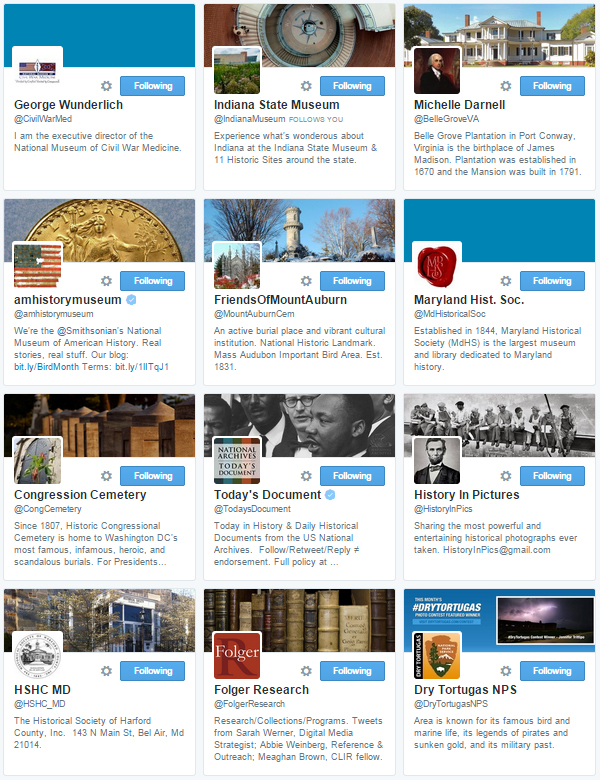
Here's a small sample of the different people/organizations I follow on Twitter.

Here’s a small sampling of some of the different people/organizations I follow using Twitter.

The reason I state all of this is twofold.  First, I say all of this to slightly motivate you, my blog readers, into thinking about joining Twitter yourself.  Trust me when I say that Twitter is far more than inane, juvenile chatter about TV shows and celebrities.  If you follow the right people and groups, Twitter can be as educational as a text book.  It’s completely free to join and you don’t even have to tweet anything yourself.  You can just register, select or search for people to follow, and watch as your Twitter feed provides you with updates when those people tweet something.  The more you explore the more you’ll find that many of your favorite museums or groups are on Twitter providing great material to the masses.

The second reason I am saying all of this is to make you aware that Twitter is a great resource for Lincoln assassination content.  Between Ford’s Theatre (@fordstheatre), the Spirits of Tudor Hall (@SpiritsTH), and me (@BoothieBarn), I can promise you consistent updates about things going on in the field.  This is particularly true now thanks to a wonderful initiative started by the Ford’s Theatre Society.

#Todayin1865

A couple weeks back, Ford’s Theatre started a hashtag called #Todayin1865.  By putting a hashtag (#) in front of a word or phrase in Twitter, you create a searchable link for other tweets with the same phrase.  Therefore, by clicking the hashtagged phrase, #Todayin1865, you can quickly find all other tweets that contain that phrase.  Ford’s Theatre has been using that hashtag to tweet about Lincoln’s final days before his assassination.  I have jumped on the bandwagon, so to speak, and I have also started using the #Todayin1865 hashtag to discuss the activities of John Wilkes Booth and his conspirators during this time 150 years ago.  While real life events have kept me from tweeting with this hashtag everyday, I am making a strong effort to keep up at least until Booth’s death on April 26th.

#Surratt15

Another hashtag that I will be using soon is #Surratt15.  This hashtag is in connection with the 2015 Surratt Society Lincoln Assassination Conference happening this weekend in Clinton, Maryland.  For those of you who can’t make it, I will be tweeting quotes from the different speakers and events during the weekend conference.  Check my Twitter account often this weekend and follow what occurs at this annual Boothie get together.


The best way to keep apprised of what I (and others) tweet is to join Twitter and follow me, but here are all three ways you can stay connected.

1.  Bookmark my Twitter page

You can bookmark my Twitter profile page on your computer or phone and manually check it for new tweets.  My profile page is:

https://twitter.com/BoothieBarn

2. Check my Twitter feed on the side of this page

You can always catch up on my tweets when you’re visiting this site.  There is a Twitter widget on the main page.  My most recent tweets should show up on the right underneath the most recent comments here on BoothieBarn.

Twitter widget 2


3. Join Twitter and Follow @BoothieBarn

This is the best way to go.  Even if you don’t want to make tweets, having an account allows you to get notifications every time I tweet a tweet.  Setting up an account is quick, easy, and free.  Sign up at Twitter.com and start connecting with others.


At the very least, I hope you’ll try checking out my Twitter feed in the coming months.  I will be very busy for the foreseeable future with different activities and events relating to the 150th of Lincoln’s assassination.  This will severely limit the time I have to write full posts for this blog, which generally take me awhile to do.  To make up for it, I’ll be doing a lot of tweeting about the things I’m up to and John Wilkes Booth’s activities #Todayin1865.

It’s an exciting time to be a Boothie, and I hope you’ll join me in using Twitter to expand awareness and knowledge about this pivotal point in American history.

Sincerely,

Dave @BoothieBarn

Categories: Uncategorized | Tags: , , , , , | 2 Comments

Register for the 2015 Tudor Hall Symposium!

This year marks the 150th anniversary of the end of the Civil War and the assassination of Abraham Lincoln.  In the coming weeks I will be posting about some of the events planned to mark the occasion.  Remember to check out the Calendar section of BoothieBarn for more events, including some smaller events that might be happening in your area. 


As has become fairly apparent by my recent postings, I have developed a deep interest in the Booth family of Bel Air, Maryland. While this site is still devoted to exploring all aspects of Lincoln’s assassination, I have discovered that the familial background of the Booths is a fascinating sidebar. Looking at the lives and interactions between the members of the Booth family provides a great deal of insight into the path that led John Wilkes Booth to go from actor to assassin, family to fiend. Therefore, I am extremely excited for the upcoming Tudor Hall Symposium. This is a one time only event taking place on May 9, 2015. I’ll let the release from the Spirits of Tudor Hall group explain:

2015 Tudor Hall Symposium Graphic

We’re very excited to announce that the Junius B. Booth Society (JBBS) and the Historical Society of Harford County (HSHC) are holding a one day, one-of-a kind symposium on Saturday, May 9, 2015, titled Tudor Hall, the Booths of Maryland and the Civil War from 8:00 AM to 4:45 PM at the Bel Air Armory in Bel Air, MD. Tudor Hall, the home of the theatrical Booths of Maryland, a short distance away will be open to the attendees following the symposium for tours till 7 PM. We are holding this timely symposium to commemorate the 150th anniversary of the Lincoln Assassination and the end of the Civil War. The symposium will explore the complex theatrical Booths— who left their mark on America forever (good and bad), the history of Tudor Hall and the attitudes of Marylanders during the Civil War. As was true with many Maryland families during the Civil War; the Booths were truly a house divided. This is a fundraiser and the proceeds will be split between JBBS and HSHC. All proceeds to JBBS will be used for turning Tudor Hall into a museum.

We have a spectacular line-up of nationally recognized speakers on this fascinating subject:

Fortune’s Fool: The Life of John Wilkes Booth
By Terry Alford, author of Fortune’s Fool: The Biography of John Wilkes Booth. Terry Alford is a Professor of History at Northern Virginia Community College and is a recognized expert on John Wilkes Booth. His long awaited comprehensive biography of John Wilkes Booth, researched for decades, will be released early in 2015.

Edwin Booth During the Civil War
By Daniel J. Watermeier, author of American Tragedian: The Life of Edwin Booth. Daniel J. Watermeier has, through decades of tireless research paired with his own sharp insight, put together the most complete Edwin Booth biography to date. Watermeier’s book offers an in-depth look at the triumphal career and tumultuous life of one of the American stage’s most celebrated figures. His book is scheduled for release early in 2015. Daniel’s talk will focus on Edwin Booth during the Civil war.

A Brief Introduction to Tudor Hall
By Jim Garrett, author of The Lincoln Assassination: Where Are They Now? Jim is a recognized historian of the Lincoln Assassination and a tour guide at Ford’s Theatre in Washington, D.C. and gives special talks at Tudor Hall. Jim’s talk will focus on the history of Tudor Hall, home of the theatrical Booths of Maryland.

Booth’s Backstage Friends at Ford’s
By Thomas A. Bogar, author of Backstage at the Lincoln Assassination: The Untold Story of the Actors and Stagehands at Ford’s Theatre.Thomas Bogar tells the untold story of Lincoln’s assassination: the forty-six stage hands, actors, and theater workers on hand for the bewildering events in the theater that night, and what each of them witnessed in the chaos-streaked hours before John Wilkes Booth was discovered to be the culprit.

John Wilkes Booth and the Knights of the Golden Circle
By David C. Keehn, author of Knights of the Golden Circle: Secret Empire, Southern Secession, Civil War. David C. Keehn’s book provides the first comprehensive analysis of the Knights of the Golden Circle, a secret southern society that initially sought to establish a slave-holding empire in the Golden Circle region of Mexico, the Caribbean, and Central America. Keehn reveals the complex history of this mysterious group (John Wilkes Booth was a member), including its involvement in the secession movement and the Civil War. David’s talk will focus on John Wilkes Booth and his involvement in the Knights of the Golden Circle.

Agenda
Saturday, May 9, 2015
8:00-8:45 AM   Registration and continental breakfast
8:45 AM   Opening remarks
8:55 AM    Morning Session
Fortune’s Fool: The Life of John Wilkes Booth by Terry Alford
Edwin Booth During the Civil War by Daniel Watermeier
A Brief Introduction to Tudor Hall by Jim Garrett
12:10-1:45 PM   Lunch on your own at area restaurants or bring your own lunch.
1:45 PM   Afternoon Session
Booth’s Backstage Friends at Ford’s by Thomas Bogar
John Wilkes Booth and the Knights of the Golden Circle by David Keehn
Speakers’ Panel (speakers answer questions from audience and each other)
4:45 PM   Closing remarks

Following the closing remarks the first floor of Tudor Hall is open to attendees till 7 PM.

Fees for Symposium 
Early Registration until April 24, 2015 ─$65.00
Includes continental breakfast and afternoon refreshments.
Registration after April 24, 2015 ─$75.00

The speakers’ books will be for sale at the symposium.

The symposium will be held at: 
Bel Air Armory
37 N. Main Street
Bel Air, MD 21014
Handicapped access
Limited parking is available in the back. Parking is also available nearby at the Historical Society of Harford County at 143 N. Main Street and on the street.

How to Register:

You can register for the May 9, 2015 Tudor Hall Symposium in Bel Air, Maryland two different ways.

1. Register online and pay with PayPal (or with a credit card) through the Historical Society of Harford County website

  • Visit the Events page of the Historical Society of Harford County website by clicking HERE
  • Scroll down until you see the event details:Online registration for the 2015 Tudor Hall Symposium
  • Click on the “Buy Now” bottom to open the PayPal page to complete your registration and order:Checkout for 2015 Tudor Hall Symposium

2. Register by mail and pay by check

  • Download the registration form by clicking HERE
  • Print the form, fill it out, and mail it with your check payable to The Historical Society of Harford County to:

The Historical Society of Harford County
143 N. Main Street
Bel Air, MD 21014
Attn: 2015 Symposium


Please consider registering for this one time only Tudor Hall Symposium. All the proceeds from the event will go to the Junius Brutus Booth Society, a group that has done tremendous work in transforming Tudor Hall into a Booth family museum.  In the three years I’ve lived in Maryland I’ve seen this group improve Tudor Hall time and time again.  They deserve all the support they can get for their efforts to bring the story of the Maryland Booths to the masses.  I, of course, will be attending the symposium and I can’t wait to see you there.

So register now and mark your calendar for the Tudor Hall, the Booths of Maryland and the Civil War Symposium on May 9, 2015!

Categories: Uncategorized | Tags: , | 3 Comments

Henry Byron Booth & Peacock

Henry Byron Booth was the third child of Junius Brutus Booth and Mary Ann Holmes.  He lived a short life, dying from smallpox at the age of 11.  His early death prevented him from knowing his two youngest siblings, John Wilkes and Joseph Adrian.  You can read more about Henry Byron’s brief life in this prior post and by visiting the Booth Children Picture Gallery.

Though only a little is known about Henry Byron, it is clear that he was much loved by his family.  After the young boy’s death, his father, Junius, admitted that Henry had been his favorite child writing, “Guess what his loss has been to us – So proud as I was of him above all others.”

Almost forty-five years after his death, Henry Byron’s mother, Mary Ann, still mourned him.  When her granddaughter, Edwina Booth, wrote of the rough time she, her father, and ailing step-mother were having on their visit to England, Mary Ann wrote of her last, tragic visit to her homeland:

Mary Ann to Edwina in London regarding Henry Byron ALPLM Dear Child how I do wish you were more comfortable & back again in America after going so far & ^not^ seeing the half I wanted you to see, but it is so like my last trip to England, it was nothing but misfortune & death of my dear Boy Henry. that cast a gloom over everything.

Mary Ann Booth to Edwina Booth, April 21, 1881

Practically nothing remains to mark Henry Byron’s existence aside from his name carved on the reverse of the Booth obelisk in Green Mount Cemetery.  His real grave was destroyed when the English cemetery he was buried in was transformed into a park in the late 1890’s.  It is for this reason that any item relating to Henry Byron is an exciting, and rare, find.

The Helen Menken Collection is a privately held theater collection in New York. The collection contains several Junius Brutus Booth letters and playbills. The letters were at one time consulted by Dr. Stephen Archer who provided transcriptions of many of them in his wonderful book, Junius Brutus Booth: Theatrical Prometheus. One letter that Dr. Archer decided not to include in his book was an October 26, 1834 letter from Junius to his father Richard. At the time Junius was in Boston with Mary Ann and the children. His note to his father, still at the family farm in Maryland, provides instructions to their servant, Joe Hall, regarding the care of the farm’s animals and upcoming crops. It is a plain enough letter demonstrating Junius’ operation of his farm while acting on tour. It has little insight to offer which is probably why Dr. Archer chose not to include it in his book on Junius.

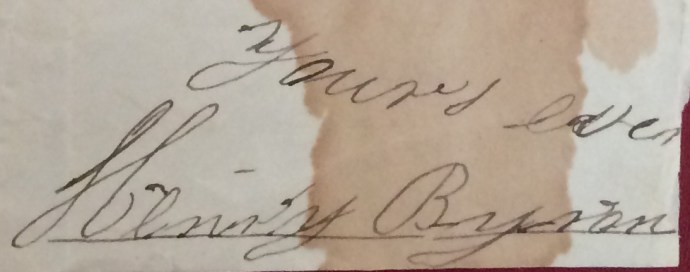
However, for individuals like me with a growing interest in the entire Booth clan, this letter has an exciting addendum.  Junius ends the letter with the following sentence, “Henry wishes to write two lines in this letter which will be seen beneath.”  Then, below Junius’ signature, the following note can be seen:

Henry Byron's note10-26-1834 cropped

Though the letter has been torn and part of it has been lost, with the script of a nine year-old Henry appears to write:

Dear Grandfather
We hope you are w[ell?]
Joe [?] and all the stock [?]
Peacock & the other hor[ses?]
God bless you
Yours ever
Henry Byron

While some words may be difficult to make out, his signature is large and bold, demonstrating significant practice at getting it right:
Henry Byron's signature 10-26-1834

The existence of this note is exciting not only because it is likely the only surviving document written by Henry Byron Booth, but also because, even in its short and incomplete state, it mentions another member of the Booth family: Peacock the pony.

In January of 1821 when Junius Brutus Booth (then married to Adelaide Delannoy and with a young son named Richard) decided to run off to America with Mary Ann, the two started their journey from the English town of Deal.  While in Deal, Junius purchased a piebald pony named Peacock.  Piebald is a coloration pattern of white (or non-pigmentation) with dark spots or patches on top.  Dalmatians, for example are extremely piebald. As a neighbor of the Booths recalled later, Peacock’s, “color was in blocks, white squares with bright bay squares.”

From Deal, Junius, Mary Ann, and Peacock traveled to the Island of Madeira, a Portuguese colonized isle off the coast of Morocco.  Madeira was a common stopping place for ships before setting across the Atlantic.  The young couple was so entranced by the beautiful island that they decided to stay for awhile.  Years later, their daughter Asia described the attention little Peacock received as her parents vacationed on Madeira:

“They remained for several weeks at Madeira; and, as horses were exceedingly rare on the island (oxen and mules being used on the mountains to carry freight, etc.), Peacock created great excitement. Sums of money were offered for him, but my father declined parting with his new favorite; and in April, he took passage for himself, wife, and pony by the schooner Two Brothers for America.”

Peacock the pony served his master well for many years in America.  Junius would often ride Peacock to nearby Baltimore and even hitch him up to his wagon with a larger horse for trips to Philadelphia.  Even though Peacock was small, “Every horse was scared that met with him,” recalled a neighbor.

Ella Mahoney, who later owned the Booth home of Tudor Hall and ran it as a museum, wrote a story about how Junius reacted to Peacock’s ultimate death:

“I often heard it related of him that coming home on one occasion, he found the little horse Peacock, now quite aged, dead. He sent for several of his neighbors (my uncle among them), and going to the house forced Mrs. Booth, terror-stricken, to sit on the horse, wrapped in a sheet, while he walk­ing around with a gun on his arm, read a funeral service. Two of the neighbors whom Joe had hastened to bring, arriving, one attracted his attention, while the other going quietly up behind, pinioned his arms, rendering him harmless. Instead of struggling or growing angry, he dropped the gun and remarked, “Well, you’ve got me, come to the house and have a drink.” But later in the day he disappeared, and the next day was quite ill.”

Like so many stories about “crazy Junius”, this story is probably exaggerated.  After his father’s death, John Wilkes Booth would lament, “We know that two-thirds of the funny anecdotes about our own father are disgraceful falsehoods.”   Still it is likely that Junius, a life long lover of animals, was deeply saddened by the loss of his prized pony Peacock.  Peacock was a living memory of Junius’ “honeymoon” with Mary Ann and, as this note from Henry Byron appears to prove, was well loved by all.

This note nicely reminds us of the lives of two forgotten members of the Booth family: Henry Byron Booth and Peacock the pony.

References:
Helen Menken Collection
Junius Brutus Booth: Theatrical Prometheus by Stephen Archer
The Elder and Younger Booth by Asia Booth Clarke
John Wilkes Booth: A Sister’s Memoir by Asia Booth Clarke edited by Terry Alford
ALPLM

Categories: Uncategorized | Tags: , | 6 Comments

New Gallery: Joseph Adrian Booth


Joseph Adrian Booth The Players

Joseph Adrian Booth, born on February 8, 1840, was the youngest child of Junius Brutus Booth and Mary Ann Holmes.  His middle name of Adrian was selected in honor of his eldest brother Junius, Jr., 18 years his senior, who was quite skilled at performing the character of Adrian De Mauprat in the play Richelieu.  Joe spent his boyhood at different schools (often joined by his brother John Wilkes) and on the family farm at Tudor Hall.  When Joe came of age, he had limited aspirations.  With assistance from his brother Edwin, Joe became a treasurer at a theater in Baltimore.  During the next theatrical season he accompanied Edwin on tour, occasionally filling in on stage with minor roles.  Unlike his brothers however, Joe did not take to acting and never attempted to make a livelihood out of it.  Instead, Joe decided to pursue a career in medicine.  In the fall of 1860, he enrolled at the Medical College of South Carolina.  He seemed happy with his choice of profession and, for the first time, appeared to have a path in life.  The outbreak of the Civil War, however, threw a wrench in his plans.  Joseph was in Charleston when the attack on Fort Sumter occurred on April 12, 1861.  Following in the footsteps of his older brother John Wilkes who left his acting engagement in 1859 to soldier at the execution of John Brown, Joseph entered the fray, albeit briefly, to assist as an army surgeon during the attack.  He may have been influenced to do so by his mentor, Dr. Columbus DaVega, who designed and ran a floating hospital for the attacking Confederate troops.  Though the documentation is lacking, it is entirely possible that Joseph assisted Dr. DaVega on his floating hospital during the siege on Fort Sumter.  Joe’s service with the Confederacy was short lived however, and, after the medical college had been shut done due to the upcoming war, he returned back north.

For a time he may have joined up with his brother John Wilkes, accompanying him on tour as he had with Edwin a couple of years before. By early 1862, however, Joseph Booth ran off and disappeared for a time.  He left home with barely a note to explain himself.  The family was unsure if he had enlisted in the army, run off, or even committed suicide.  He showed up a couple months later in England, where Edwin was touring for a year.  While there he had hoped to see his grandmother, but she had passed away before he had arrived.  He was, however, the first of the Booths to meet his brand new niece Edwina, who had been born in England in December of 1861.  Joe, who enjoyed changing how he said certain words, called her Ed-wine-a, like the beverage. Edwin and Joe visited Paris together as Edwin unsuccessfully searched for a theater there to engage him.  By July 15, 1862, Joe was off again, this time he headed for Australia.  When later asked his reasons for going to Australia, Joe responded, “I went out there with this quite boyish freak to make my fortune. I tried mining for a time. Was on a sheep and cattle station, northern part – clerk in the station.”  Joe stayed in Australia for quite some time, much to the lament of his mother.  A poor correspondent, Mary Ann Booth worried daily about her youngest son:

“…Rosalie went yesterday to Blockley post office – but no letters – I saw the [ship] Africa brought the Australian mails – but I don’t know of what date, so I thought there might be one for me – its 6 months today since Joseph left Gravesend [England] – but as no one saw him off how can we be sure that he went there I do think it was the cruelest thing that could be, Josey to throw himself away as he has done and make us all so very miserable he is hardly ever out of my thoughts by day, & at night I dream of him.”

Eventually Joe tired of life in Australia but he was still not ready to come home.  It’s possible that Joe was enacting this long journey in order to avoid the Union draft at home.  Though he would later claim to have been neutral when it came to the war, his brief service with the Confederacy may have made him unwilling to fight for the Union.  When he did leave Australia, he set sail for California.  His eldest brother Junius was living in California at the time and with his help, Joe found work as a mail carrier for Well’s Fargo in San Francisco.  June departed California with his family not long after Joe’s arrival leaving Joe alone again.  Joe worked for Well’s Fargo for about a year before tiring of the work.  He spoke thusly about it, “I disliked the business very much.  The city is very hilly, and I had a great part of the city to go over.  I was on foot.  Had to carry a great many letters around.”  Joe quit Well’s Fargo and decided he finally wanted to come home.

Joe departed California for the long journey to New York on April 13, 1865.  The next day, his brother John Wilkes Booth assassinated the President.  Joe’s boat arrived in Panama on May 2nd.  Joe and the other passengers learned then that the President had been assassinated by a man named Booth.  Joe, however was not worried as there were many people with the last name of Booth.  From the Pacific side of Panama it was necessary to board a train to cross the isthmus and catch a different ship on the Atlantic side.  Sometime during the train ride across Panama, Joe learned that the man named Booth who had assassinated Lincoln was, in fact, his own brother.  A fellow passenger wrote sympathetically of the impact this news had on Joe:

“He said to me oh it is awful to think that my brother should be guilty of such a horrid crime, he said also that his brother must have been crazy to have committed such a deed, and said it would drive him mad. he was very much depressed in spirits and wanted me to be with him all the time to cheer him up. He also said that he wished he was dead and often spoke of his mother and said that this was a dreadful blow for her at her time of life and said that this would blight the future of the rest of the family. He seemed to be very much affected during the rest of the voyage and as we occupied the same berth he would nestle up to me and ask me to be his friend and to stand by him as he felt almost heart broken and friendless.”

While en route to New York, the authorities had learned of Joe’s suspicious departure from California the day before his brother shot the President.  When his ship arrived in New York on May 11th, Joseph Booth was arrested and interrogated the next day.  In his lengthy interrogation, Joe stated that he had very little correspondence with his brother over the past three years and know absolutely nothing about his plot.  Joe also explained his long absence from home.

Examination of Joseph Adrian Booth 5-12-1865

The entire interrogation can be read starting here on Fold3.com (with a paid membership) or as an appendix in the book, John Wilkes Booth: A Sister’s Memoir by Asia Booth Clarke edited by Terry Alford. General John Dix conducted the interrogation, and telegraphed to Secretary of War Edwin Stanton that he had found, “nothing to justify his detention.” Joe was then released and went home to his mourning family.


A future post will detail more about Joseph Adrian Booth, especially his post assassination life. In the meantime, you can learn more about the youngest Booth sibling by checking out his new Picture Gallery!

Sadly, there are only two known images of Joseph Booth.  All the other images in the Joseph Adrian Booth Picture Gallery contain stories and documentation relating to his life.  Remember to click on an image to open its attachment page which contains a description about it.  You can also open the image full size by clicking the image’s dimensions on the top of its attachment page.

To visit the Joseph Adrian Booth Gallery, click HERE or on Joseph’s picture in the image below:

References:
John Wilkes Booth’s Enigmatic Brother Joseph by John C. Brennan
The Youngest Brother – Joseph Booth by Tom Fink
John Wilkes Booth: A Sister’s Memoir by Asia Booth Clarke edited by Terry Alford
Edwin Booth: A Biography and Performance History by Arthur Bloom
Junius Brutus Booth: Theatrical Prometheus by Stephen M. Archer
John Wilkes Booth: Day by Day by Art Loux

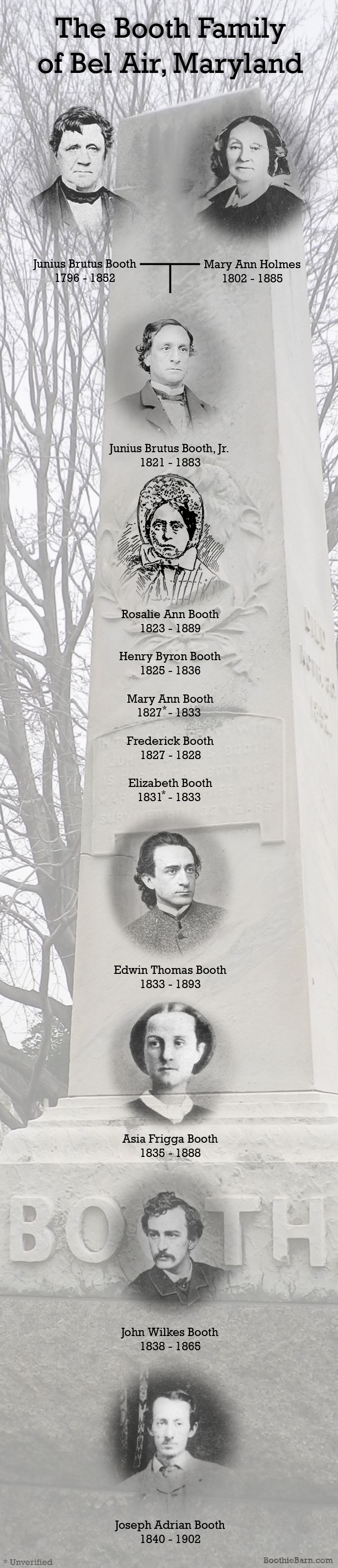
Click for Junius Brutus Booth Click for Mary Ann Holmes Booth Click for Junius Brutus Booth, Jr. Click for Rosalie Ann Booth Click for the Booth children Click for Edwin Thomas Booth Click for John Wilkes Booth Click for Joseph Adrian Booth
Categories: Uncategorized | Tags: , | 6 Comments

New Gallery – Asia Booth Clarke

Asia Booth Clarke 1

Asia Frigga Booth was the youngest daughter of Junius Brutus Booth and Mary Ann Holmes.  She was born on the Booth family farm in Harford County, MD, on November 20, 1835.  While growing up in the secluded wilderness of their Tudor Hall home, Asia grew very close to her younger brother, John Wilkes.  The two would often play, with Asia acting as Wilkes’ first acting teacher by helping him run lines and practice his elocution.  Asia was described by those who knew her as, “beautiful”, “educated and mathematical”, and “strong-minded”.  She was courted for years by a family friend named John Sleeper.  He, like the Booth sons, wanted a career in the theater.  In order to avoid the connotation that a performance by him would put an audience to sleep, he changed his named to John Sleeper Clarke.  The two married in 1859.  At first, life for the two was good.  Clarke and Asia’s rising acting brother, Edwin, were close business partners and friends.  Asia and Clarke had three children by 1865, all of whom were all named after various members of the Booth family.  The eldest, Asia Dorothy, named for her mother, was nicknamed “Dollie”.  Their next child, Edwin Booth Clarke, was named for his uncle and went by the nickname “Teddy”.  Another daughter Adrienne, received her name from Asia’s youngest brother, Joseph Adrian.

The assassination of Abraham Lincoln by the hands of her favorite brother, John Wilkes, was a massive blow to Asia and her family.  John Sleeper Clarke was imprisoned for a time and pregnant Asia was put under house arrest.  Hoping to do something to redeem the family name, Asia set her sights on a long forgotten project she had once started: writing a biography about her father.  She plunged back into her work, attempting to forget the tragedy that had befallen her.  In August of 1865, she gave birth to twins, Creston and Lillian.  By December she had finished her biography of Junius Sr. and it was published under the title, Booth memorials : Passages, incidents, and anecdotes in the life of Junius Brutus Booth (the Elder) by His Daughter.

In 1867, another son, Wilfred, was born.  Despite the passage of time, Asia still felt the stigma of her brother’s crime and Clarke discovered he had strong star power on the London stage.  Asia agreed to move the family there, despite their strained relationship.  She hoped that England would give her the fresh air and foreign setting she needed to start over.  Asia and her children depart America in 1868.  Asia wrote that she expected to be gone for two or three years.  In fact, she would never see her homeland again.

Life in England lost its appeal fairly quickly to Asia and her relationship with Clarke continued to sour.  The pair had three more children in England, all of which died, furthering Asia’s grief and separating her even more from her husband.  In 1874, she began writing a biography of her misguided brother, John Wilkes.  It contained her memories of his younger days and painted a far more human picture of the man who assassinated Lincoln.  She knew, however, that this sympathetic view of her brother would never be tolerated during her lifetime and so put the biography aside to be published after her death.

In the 1880’s Asia finished a book entitled, The Elder and Younger Booth, which detailed the careers of her father, Junius, and her brother, Edwin.  By this point Clarke was making regular trips back to the States to perform with Asia being left behind in England.  She referred to Clarke as “a bachelor in all but name” and described his hatred for her and the Booth name.

Asia Booth Clarke died on May 16, 1888 at the age of 52.  Before her death she made Clarke promise to return her body to America so that she could be buried in the family plot in Baltimore.  This was done and Asia Booth now lies with her parents and siblings in Green Mount Cemetery. Clarke would later die in England and is buried there.

Two of Asia and Clarke’s children followed the family tradition and became actors.  Creston and Wilfred Clarke both had decent careers upon the American stage and vaudeville.

Asia’s secret biography of her brother was given to a family friend upon her death due to her fears that Clarke would destroy it.  It was not published until 1938, sixty years after Asia’s death.  Though more a collection of Asia’s pleasant memories of her brother than a true biography, the book provides a unique and much needed view of John Wilkes’ early life and interactions with his family.

While Asia Booth never found fame (or infamy) like her other siblings, she remains a valuable chronicler of their achievements.

The newest Picture Gallery here on BoothieBarn has to do with Asia Booth Clarke and her family.  To visit the gallery, click HERE or on Asia’s picture in the image below:

References:
John Wilkes Booth: A Sister’s Memoir by Asia Booth Clarke edited by Terry Alford

Click for Junius Brutus Booth Click for Mary Ann Holmes Booth Click for Junius Brutus Booth, Jr. Click for Rosalie Ann Booth Click for the Booth children Click for Edwin Thomas Booth Click for John Wilkes Booth Click for Joseph Adrian Booth
Categories: Uncategorized | Tags: , , | 6 Comments

The Death of Amelia Booth

Collaboration in the research community is a truly wonderful thing. I would wager that the best books on any subject share one common trait: a lengthy acknowledgements section. When your subject is as vast and as multifaceted as the Lincoln assassination, it’s impossible to truly go it alone.  Thanks to the internet, connections are made between people and facts all the time, expanding our collective knowledge in ways we never thought possible.  Some of my proudest moments have been when this blog has able to facilitate a discussion that has changed our understanding of event (like when we determined that conspirator George Atzerodt is NOT buried under the name “Gottlieb Taubert” in St. Paul’s Cemetery as was previously thought).  Therefore it is always a highlight to receive an email out of the blue from someone who has found a valuable piece of information and wants to share it.

Amelia Portia Adelaide Booth was the first child of Junius Brutus Booth and his first wife, Marie Christine Adelaide Delannoy. While this should conceivably mean she was the first child born to Junius Brutus Booth (the man who would later sire the assassin, John Wilkes Booth) this is probably not the case.  Prior to his introduction to Adelaide the young and amorous Junius was not once, but twice sued for paternity in London courts.  Junius’ propensity for passion even prevents Amelia from being accurately described as his first legitimate child.  He married Adelaide Delannoy on May 8th, 1815 but Amelia was born not even five months later on October 5th.  As an aside this means that out of the 12 children sired by Junius Brutus Booth (plus two more if the above mentioned paternity suits are accurate), only one could truly be considered legitimate.  All of his children with Mary Ann Holmes were born out of wedlock since he was still married to Adelaide at the time.  This leaves his second son with Adelaide, Richard, his sole legitimate heir.

I have mentioned Amelia Portia Booth a couple times here and there especially in reference to her father’s early life. In one post I lamented that so little was known about her since she died in infancy.  Even the date of her death was unknown to me.  However, thanks to a generous email from a fellow researcher we now have an exact date of death for Junius’ little girl.

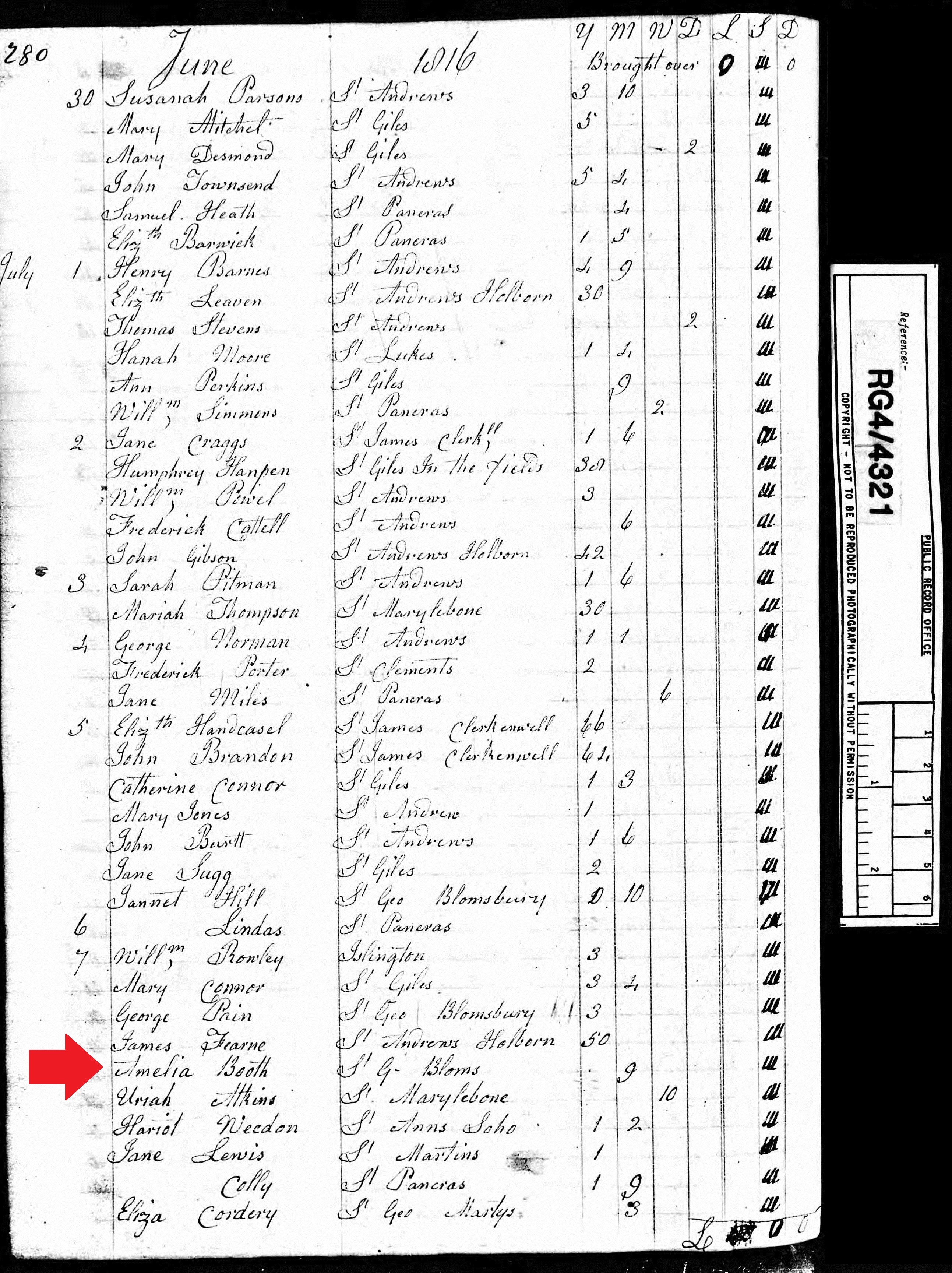
According to the England & Wales Non-Conformist and Non-Parochial Registers accessed via Ancestry.com, an “Amelia Booth” died on July 7th, 1816 at the age of 9 months. Her parish is recorded as St. George’s, Bloomsbury which is the same parish she was baptized in.

Click for full page record.

Click for full page record.

The benefactor of this information is New York Times bestselling author Jennifer Chiaverini who has written several novels including Mrs. Lincoln’s Dressmaker and Mrs. Lincoln’s Rival. She stumbled across my page and this piece of information while conducting research for a future novel she is working on which will include the Booth family.  My deepest thanks go to Ms. Chiaverini for sharing this discovery with us.

References:
England & Wales Non-Conformist and Non-Parochial Registers accessed via Ancestry.com
Jennifer Chiaverini

Categories: Uncategorized | Tags: | 4 Comments

When is Edwin Booth’s Birthday?

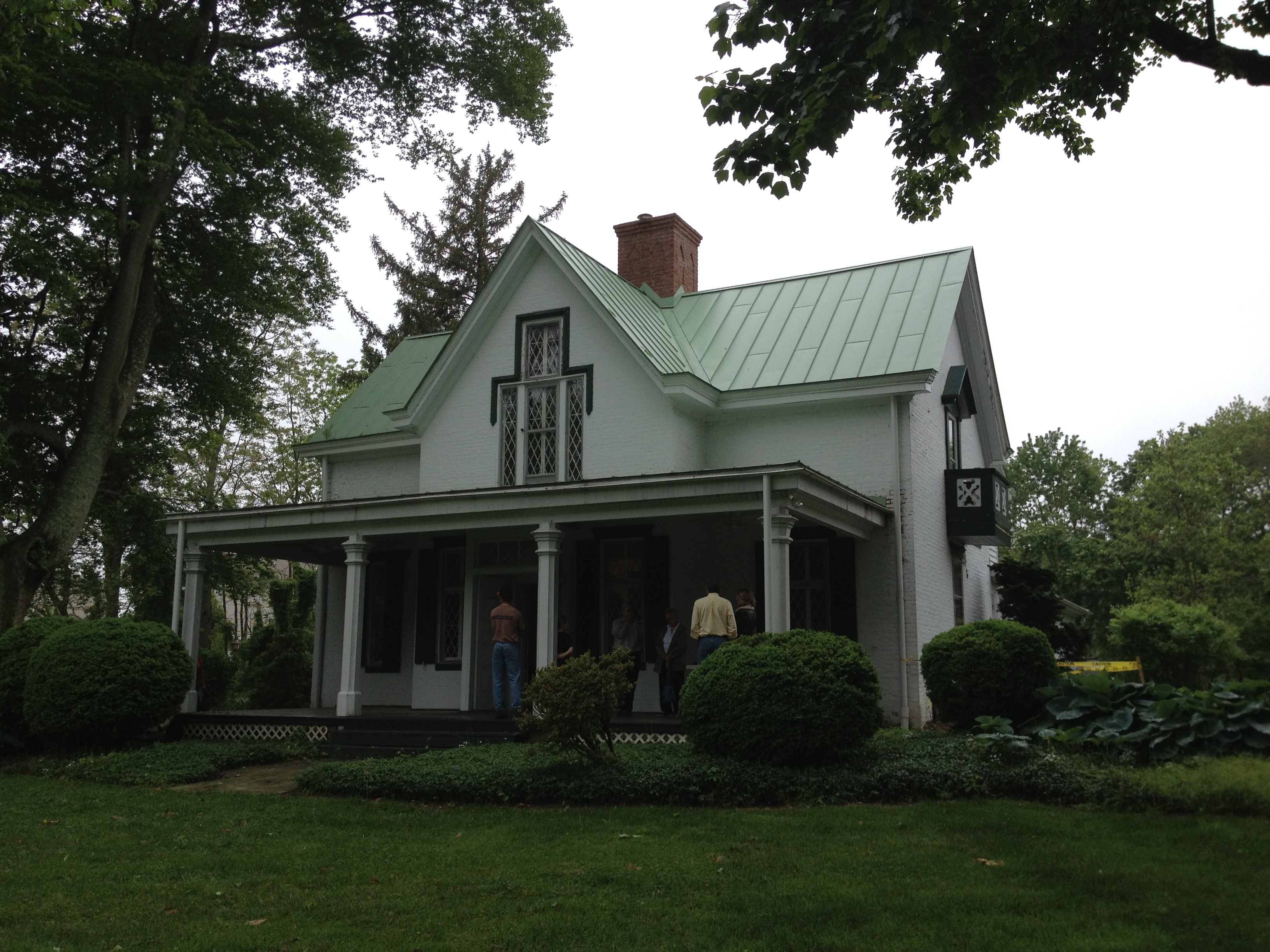
The Junius Brutus Booth Society is a wonderful organization that works to educate the public and scholars about the illustrious Booth family. Their main venue for doing so is the Booth family home in Harford County, Maryland: Tudor Hall.

Tudor Hall

In addition to the superb Spirits of Tudor Hall Facebook page and blog, the JBB Society also publishes a quarterly newsletter for members.  For the low membership price of $12 a year you are not only supporting a hardworking organization that is effectively transforming Tudor Hall into a preeminent Booth family museum but you also receive impressive scholarship in the form of the newsletter, Booth History Spotlight.  For example, the Fall 2014 newsletter contains part one of an in depth look at the life of Dr. Joseph Booth, Edwin’s dedication address for an Edgar Allen Poe Memorial, an account of Edwin’s final days, a recipe written by Edwina Booth, and information about future tours and talks at Tudor Hall and beyond. Each issue also contains a small part called “The Spotlight Quiz”. This quiz takes the form of a piece of trivia which tests and informs you about a member of the Booth family. Today’s post was inspired by this issue’s Spotlight quiz:

IMG_5509

Now this question seems easy enough, already giving you the month of Edwin’s birth. Off the top of my head, I knew Edwin was born during a spectacular meteor shower but I’ve never been good at memorizing exact dates. My response was sometime in mid-November.

The newsletter gives the answer, “Edwin Thomas Booth was born at the Booth family farm on November 13, 1833.” But is this true?

Oddly enough when it comes to the exact birthdate of the world’s greatest Hamlet, the biggest theatrical star of his generation, Edwin’s exact date of birth is a little unclear.  Back in 2011, Tom Fink, president of the Junius Brutus Booth Society, wrote a piece about how even Edwin Booth was unsure of his birthdate.  I quote from Tom’s article which you can read in its entirety here:

“Edwin Booth wasn’t sure of the exact date of his birth at the property of Tudor Hall. His mother and older brother Junius, Jr. disagree on the day he was born. In a letter to his daughter, Edwina, dated November 14, 1869 describes his dilemma:

My Own Daughter,
Your dear letter with the pretty book-mark (“I love you”) came safely last night, just in time. It seems there is some doubt as to the exact date of my arrival here. Grandma says I was born on the night of the great “star shower” in 1883, and insists that it was November 15; but Uncle June says he remembers well—both my birth and the “Star Shower” occurred on November 13, 1833. So you see, I do not know which is the day—for, although I was there, I was too young to pay attention to such weighty matters, and can’t remember much about it. However, your little present, which I shall always cherish, my darling, came in good season for either day…”

It is interesting to note that Mary Ann Booth was always convinced that her son was born on November 15th. Not only does Edwin mention this in the above quoted 1869 letter to Edwina, but Mrs. Booth makes the same claim in her own letter to Edwina in November of 1875:

MAB to Edwina 11-9-1875 Taper Re Edwin's birthdate

“You will soon have your Papa in Philadelphia. I think, next Monday is your Papas birthday. I always keep it on the 15th of Nov – that was the day of his birth – but someone has changed it to the 13th.”

As much as I would like to support Mrs. Booth and her claim of November 15th as her son’s birthdate, it doesn’t seem to be correct. As Tom goes on to say in his article, the great Leonid meteor shower of 1833 that both Mary Ann Booth and her eldest son June agreed Edwin was born under occurred during the night of November 12 – 13th. If Edwin was born on the 15th, then he would have missed the prophetic celestial event by two days. It is for this reason that November 13th (June’s pick) is widely accepted as Edwin’s true birthdate and is more than likely correct.

JBB and Edwin Folger

So yes, the answer to this Booth History Spotlight quiz, is true. However, like so many things about the Booth family and the Lincoln assassination, this fun exercise serves to remind us that we must take time to question and find the evidence for every assumption we make.  Even something we take for granted, like a birthdate, can have a far more complicated story than we know.

References:
The Question of Edwin Booth’s Birthday by Tom Fink
Junius Brutus Booth Society
Spirits of Tudor Hall
The Taper Collection

Categories: Uncategorized | Tags: | 3 Comments

Blog at WordPress.com.