Ford’s New Center

The Ford’s Theatre Center for Education and Leadership opened on February 12th of this year.  The building, adjacent to the Petersen House where Lincoln died, continues the message of Lincoln’s legacy after his death.  The Center has four floors open to the public.  The first floor is the lobby and gift shop while the second holds space for temporary exhibits.  The third floor is deemed the “Legacy Gallery” which shows the many ways in which Lincoln has become ingrained in our culture and how his words affect us today.  While very nice and good, as a person interested in the Lincoln assassination, it is the 4th floor, named the “Aftermath Gallery” that I wish to discuss.

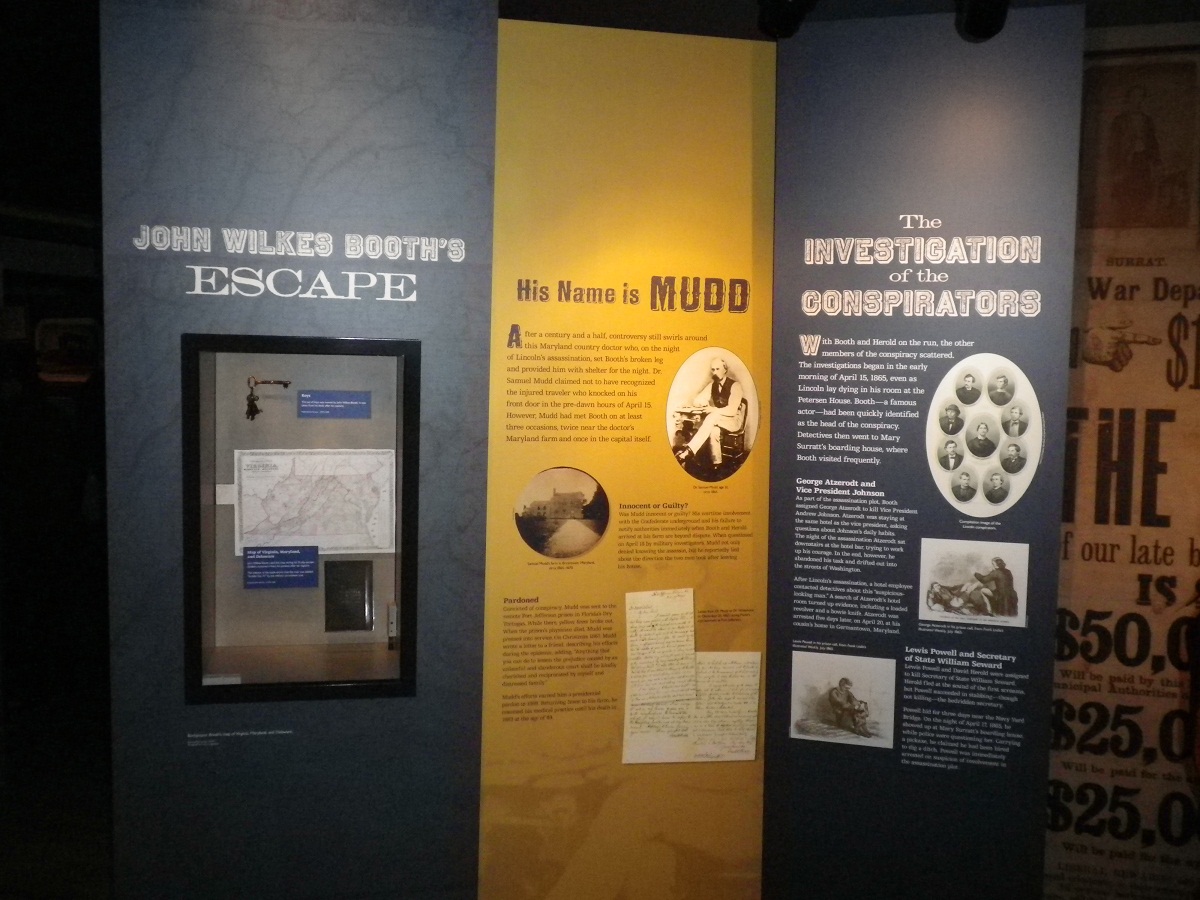
Visitors exit the Petersen House and travel via elevator to the 4th floor of the Center and work their way down.  On this floor you begin by viewing the turmoil that occurred on the morning of April 15th when the nation woke to the news of Lincoln’s death.  There is a recreation of the train car that took Lincoln’s body back to Springfield as well as an interactive map of the route.  Past this, are several wall displays recounting the manhunt for Booth and the imprisonment, trial, and execution of the conspirators:
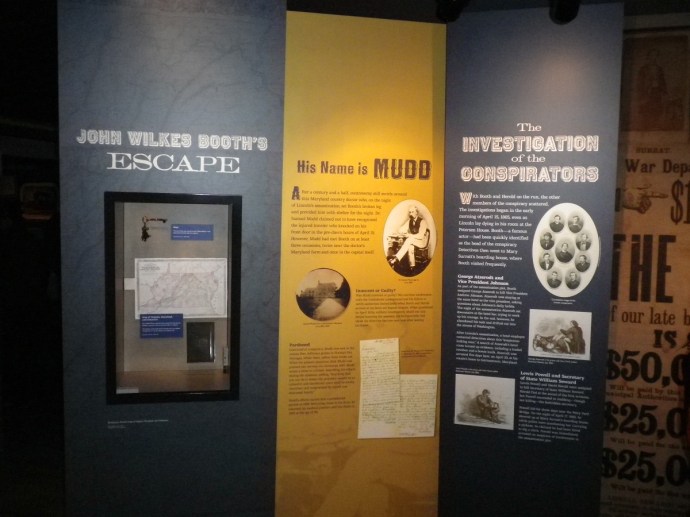
Before approaching the stairs down to the next level, there is a recreation of the tobacco barn with audio and visual effects to show Booth’s last few moments before being shot.

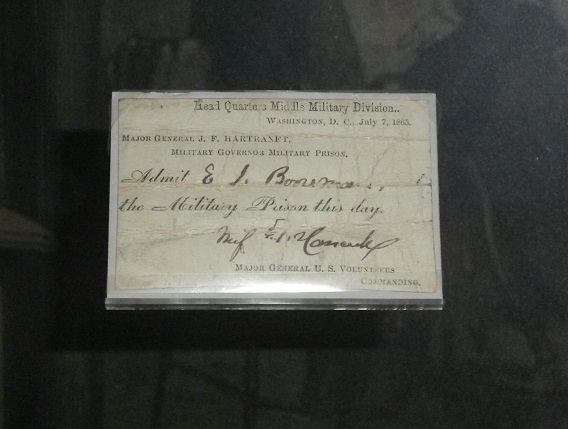
As always, it is the artifacts and relics of the assassination that draws my interest.  They have a pass to witness the execution of the conspirators on July 7th, 1865:
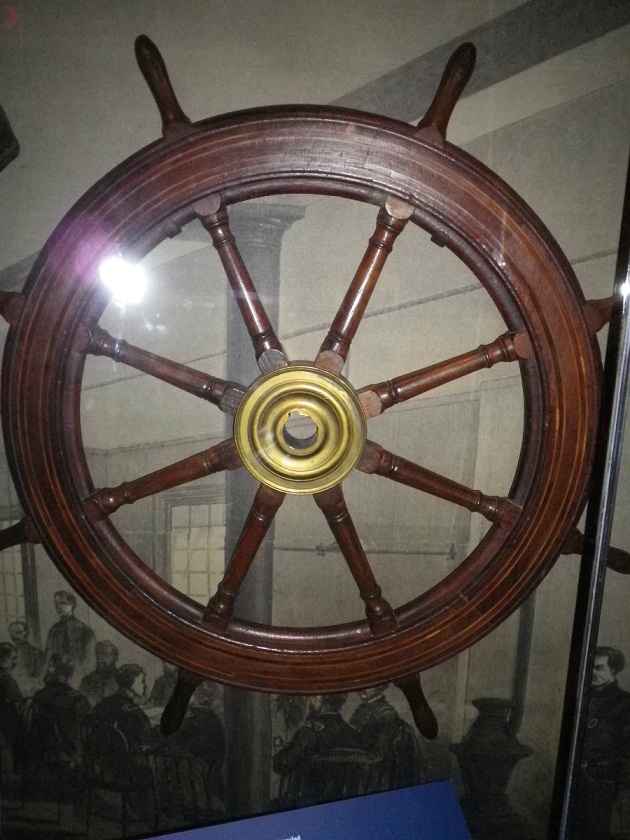
A steering wheel from the USS Montauk:
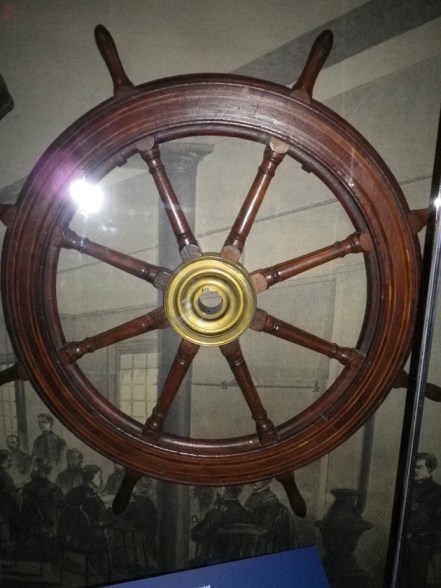
The USS Montauk and the USS Saugus were ironclad monitors which housed the conspirators during the initial investigation and arrests.  The Montauk held George Atzerodt, Edman Spangler, David Herold, John Wilkes Booth’s body, and Joao Celestino, an unrelated Portuguese sea captain.

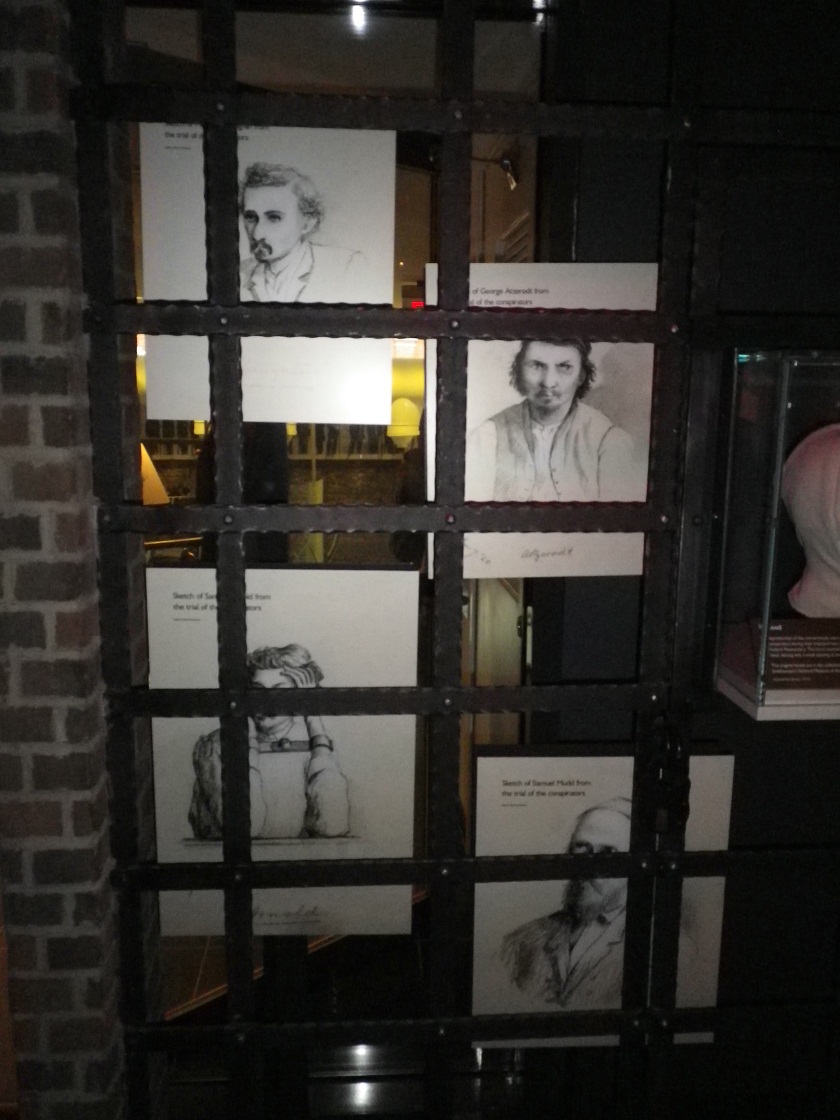
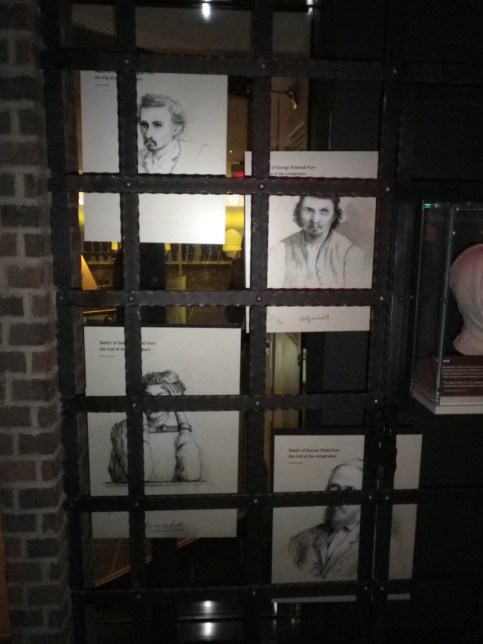
The gallery also has a nice display of the sketches military commission member Lew Wallace drew of the conspirators during the trial:
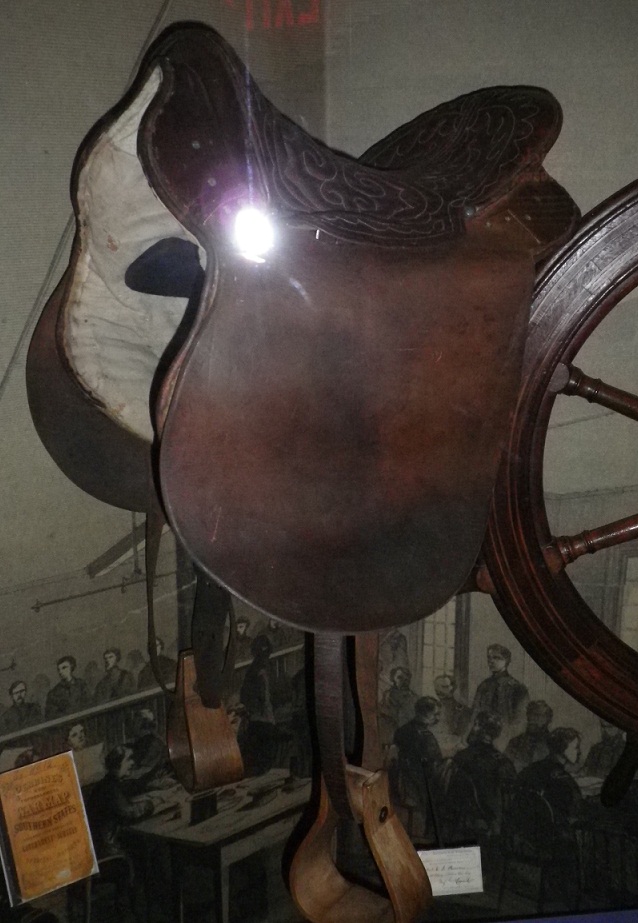
The Center also has on display Lewis Powell’s saddle:

Powell used this saddle on the night he attacked Secretary of State William Seward.  Powell biographer, Betty Ownsbey, was the first to see that this item was mislabeled as being owned by Booth (it was owned by George Atzerodt) and that it was improperly displayed.  The stirrups were shown under the saddle flap instead of over them, which would make a very uncomfortable ride for the horse.  After being made aware of the mistake, Ford’s has gladly fixed this and is now correctly displaying the beautiful saddle
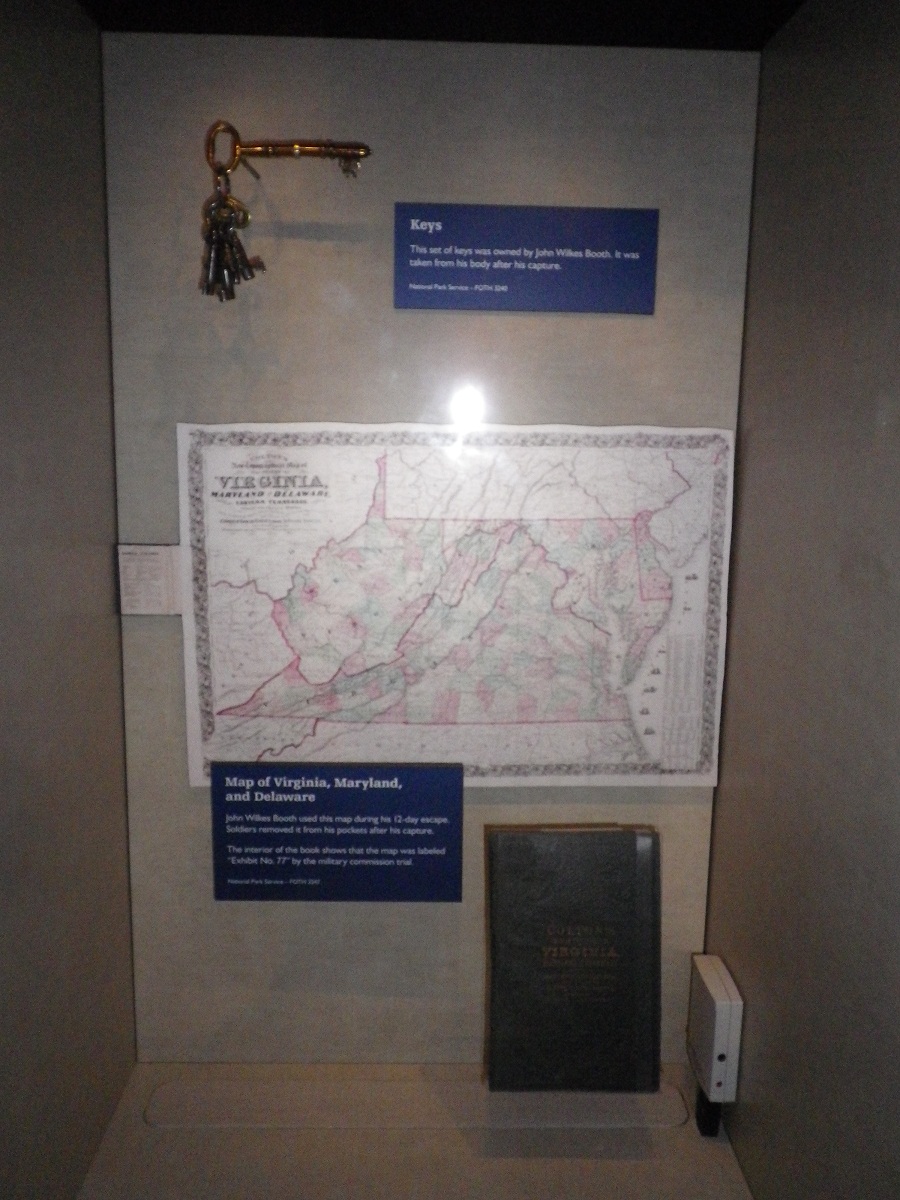
There is also an entire display case in the “Aftermath Gallery” with artifacts that I believe to be mislabeled:
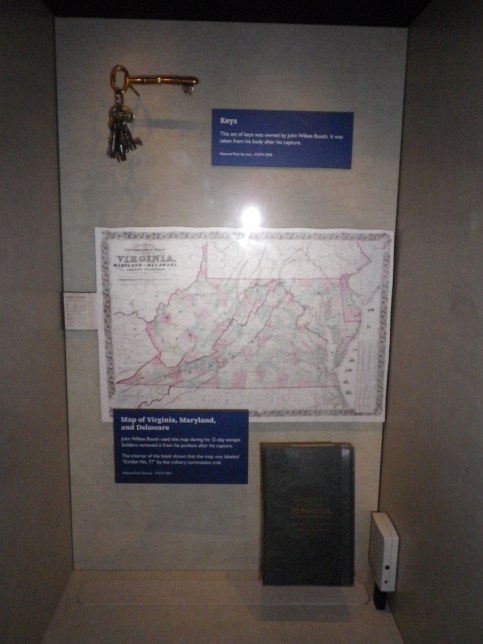
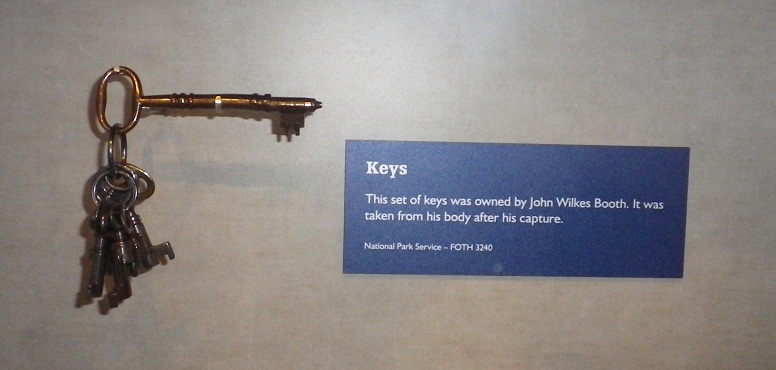
The display has two items, a set of keys and a map.  The keys are labeled as, “being owned by John Wilkes Booth” and being, “taken from his body after his capture.”
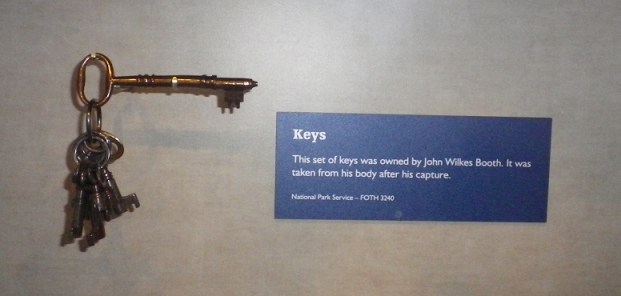
I do not believe that this is the case.  The War Department had these keys before they had even found John Wilkes Booth.  An April 24th inventory list of evidence cites, “No. 9 Envelope containing silver pencil, and a bunch of keys belonging to David Herold.”  These keys contained Davy’s key to his house and other places.  On the morning of April 15th, Detectives James McDevitt, John Clarvoe, and John Waite, along with Lewis Weichmann, visited the home of Mrs. Herold.  Here, they obtained two photographs of David Herold.  They also recovered these keys and a silver pencil.  According to a statement by Jane E. Herold, Davy, “…had to get home at 10 o’clock.  If not he would be locked out.  Always when he came he had a night key, but momma took it away from him…” While McDevitt and the others made mention of the photographs as they hoped it would increase their chances of getting some reward money, they didn’t mention the keys as they were not noteworthy.  In addition, if you read through the statements of people at Garrett’s barn when Booth was cornered and killed, none of them ever mention keys being taken from Booth’s body.  At the trials, individuals like Conger and Baker give very detailed lists of what they took off of Booth’s body, with no keys being mentioned.  Regardless, these keys could not have come off of Booth’s body as the government had them two days before Booth and Davy were found.

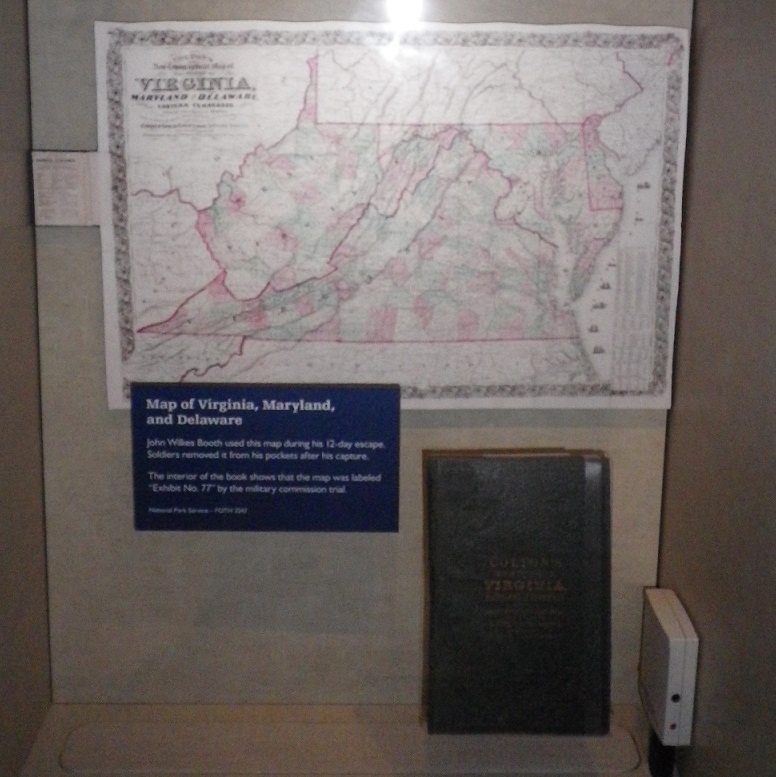
The other item in this display case is a map of Virginia, Maryland, and Delaware.  The label for it states the following, “John Wilkes Booth used this map during his 12-day escape.  Soldiers removed it from his pockets after his escape.  The interior of the book shows that the map was labeled, ‘Exhibit No. 77’ by the military commission trial.”
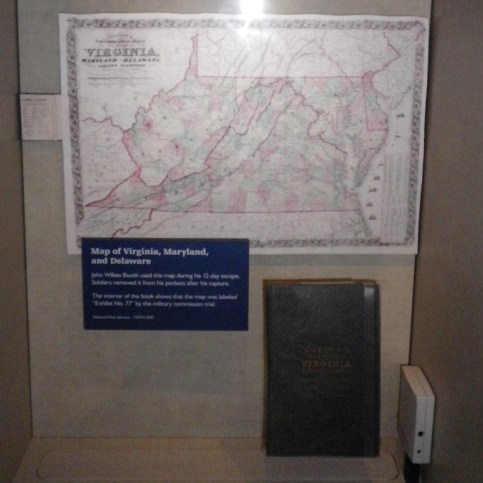
I believe that this label is also wrong.  Now it is true that Booth and Davy had a map with them during their escape.  That map was taken off of Davy, not Booth, when he surrendered at Garrett’s barn.  Unfortunately, this is not the map taken from Davy either.  On June 3rd, Dr. Joseph H. Blanford, brother-in-law to Dr. Mudd, retook the stand at the conspiracy trial.  The following is part of the interchange that occurred in Dr. Blandford’s testimony:

“Q. (Exhibiting a map to the witness.) Will you examine this map, and state to the Court whether the several localities that I have spoken of, and the roads, are properly marked upon it?
A. I think they are, as nearly as can be ascertained from this map; the roads not having been drawn upon it originally. The roads here, as drawn in ink, to the best of my knowledge, are the proper roads; and they would take those places in their route.
Q. Will you state whether you have examined that map before, and indicated the lines and points marked in ink upon it?
A. Yes, sir.
Q. Show to the Court, on the map, where Surrattsville, Dr. Mudd’s house, and Pope’s Creek, are.
Assistant Judge Advocate Bingham. If he is going to do that, let him write them down at once on the map.
The witness. They are already written here. Dr. Mudd’s house, T. B. and other points on the road are correctly stated.
(The map referred to was offered in evidence without objection and is marked Exhibit No. 77.)”

To preclude the idea that the map shown to Dr. Blanford was the same one recovered from Davy, we have the following testimony from Everton Conger:

“Q. What articles did you take from Herold? Anything?
A. A little piece of a map of the State of Virginia, and a part of the Chesapeake Bay on it.
Q. Do you remember whether that map embraced the region of country where they were?
A. It did. It embraced that region of country known in Virginia as the “Northern Neck.”
Q. Was it a map prepared in pencil?
A. No, sir.
Q. Was it a regular map?
A. Part of an old school map; a map that had originally been five or six inches square.
Q. (Exhibiting a map.) Is that it?
A. Yes, sir: that is it.
Q. That embraces the region of country in which they were captured?
A. Yes, sir. That is the only property I found on Herold.
Q. Look at this pocket compass. (Exhibiting a pocket compass.)
A. That was taken from Booth’s pocket, just as it is now, with the candle grease on it and all.
(The map and compass were offered in evidence without objection, and are marked Exhibit No. 38.)”

So Davy’s map, along with Booth’s compass, was entered into evidence as Exhibit #38.  Therefore, the map on display at Ford’s, marked as Exhibit #77, was not recovered from either Booth or Herold at Garrett’s.  Instead this map was used by Thomas Ewing during his defense of Dr. Mudd.

Ultimately, while the Ford’s Theatre Center for Education and Leadership has wonderful potential, I personally would care to see more space devoted to their true role in history, Lincoln’s assassination.  I understand that Ford’s has a fine line to walk in educating the public about Lincoln’s assassination, while not supporting the act.  Their big museum does this by presenting Lincoln’s entire term of office inclduign the assassination.  While this affords less space towards assassination related things, it also allows them to operate without appearing biased.  In my opinion though, people come to Ford’s because they want to learn about Lincoln’s death.  While a sad time in our history, I would prefer more attention in this area.  Regardless, as a center for education, it is Ford’s duty to present history as accurately as possible.   I hope that these artifacts will be looked into further.

References:
A Peek Inside the Walls: 13 Days Aboard the Monitors by John E. Elliott and Barry M. Cauchon
The Lincoln Assassination: The Evidence by William C. Edwards and Edward Steers, Jr.

Categories: Uncategorized | Tags: , , | 4 Comments

George in Georgetown

On the morning of April 15th, George Atzerodt awoke in a daze.  He found himself at the Pennsylvania House hotel having spent the previous night wandering around trying to come to terms with his failed role in the assassination and the consequences that would soon follow.  He registered at the Pennsylvania and shared the room with a stranger he met on the street, Samuel Thomas.  Atzerodt awoke early and left the hotel, without paying his share.  He began his trek to Georgetown.

At around 8:00 am, George walked into the storefront of Matthews & Knowles, a dealer of, “fine teas and choice groceries for the family”.  He approached the clerk, John L. Caldwell, a man he was acquainted with from his time in Montgomery County.  In the need of funds, George asked Caldwell if he would purchase his watch from him.  Caldwell, having a watch already, declined George’s offer.  “’Well,’ said he, ‘I want to borrow $10.  I have not any money.  I am going to my uncle’s.  You let me have the $10 and I will leave my revolver with you, and I will send you the money or bring it to you next week.’”   Caldwell gave George the $10 and kept his gun (No. 499, Cooper Firearm Mfg. Co., Frankford, Phila.).

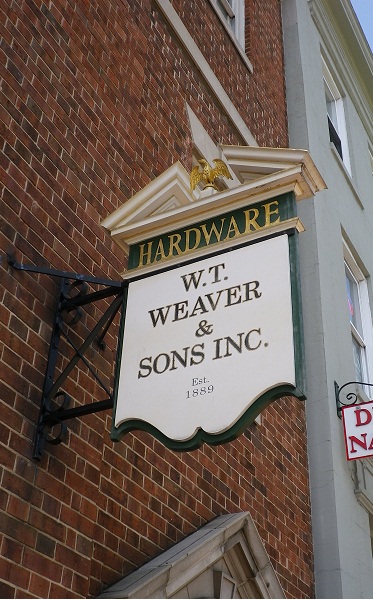
The location of the Matthew and Knowles store was located at 49 High Street in Georgetown.  Today the building still stands at 1202 Wisconsin Avenue with the W. T. Weaver and Sons Hardware store occupying the same spot:

Building that once housed the Matthew and Knowles shop where Atzerodt pawned his gun.

Current occupant of the Matthew and Knowles store.

After pawning his revolver, Atzerodt then walked a few blocks up High street (now Wisconsin avenue), and visited in the home of Lucinda Metz.  Lucinda Metz was a 44 year old widow with four children who had known George from his time in Montgomery County.  Known as Andrew Atwood to her, he visited with the widow and had breakfast with her before heading for the stage coach to take him to his cousin Hartman Richter’s.  Mrs. Metz’ house still stands today near the corner of Wisconsin and P streets:

Lucinda Metz' house.

References:
The Escape and Capture of George A. Atzerodt
Jim Garrett, my generous tour guide to these and many other Georgetown sites

Categories: Uncategorized | Tags: , | 6 Comments

Booth: A Favor-able Man

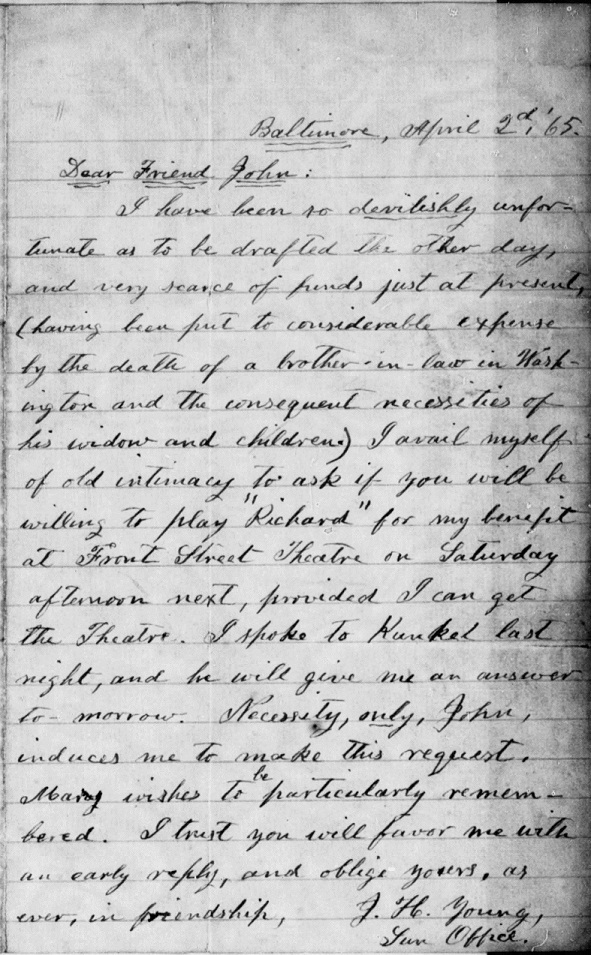
During the course of the investigation, Booth’s room at the National was searched.  In the room, the investigators discovered a treasure trove of materials in Booth’s theatrical trunk.  Several of the documents in Booth’s trunk were used in the investigation and even in the trial.  The “Sam” letter written by Samuel Arnold was one such important discovery.   Some other papers were unrelated to Booth’s plot.  The following is a letter written by an actor, J.H. Young, asking Booth for a favor, twelve days prior to his assassination of Lincoln:

“Baltimore, April 2nd, ’65

Dear Friend John:

I have been so devilishly unfortunate as to be drafted the other day, and very scarce of funds just at present, (having been put to considerable expense by the death of a brother-in-law in Washington and the consequent necessities of his widow and children.)  I avail myself of old intimacy to ask if you will be willing to play “Richard” for my benefit at Front Street Theatre on Saturday afternoon next, provided I can get the Theatre.  I spoke to Kunkel last night, and he will give me an answer tomorrow.  Necessity, only, John, induces me to make this request.  Mary wishes to be particularly remembered.  I trust you will favor me with an early reply, and oblige yours, as ever, in friendship.

J. H. Young,

Sun Office.”

It is unlikely that Young went to war, seeing as Richmond fell and Lee surrendered to Grant shortly after this letter was written.

While Booth did not perform a benefit for Young, this letter still presents a look at how well Booth was viewed by his acting peers.  Young clearly thought Booth was a talented and popular enough actor to bring in a crowd, thus gaining him significant funds.   In addition, Booth had a reputation for generosity which made him a likely candidate to help out a fellow thespian.  Had his mind not been on other pursuits, it is probable that he would have come out of “retirement” to help Mr. Young.

References:
American Brutus by Michael Kauffman

Categories: Uncategorized | Tags: | 10 Comments

Delays, Delays

Categories: Uncategorized | Tags: , , | Leave a comment

“So great was their rage”

When John Wilkes Booth committed his act, the uproar from the general public was swift and vicious.  In D.C. angry crowds surrounded confederate prisons like the Old Capitol ready to jump any new prisoner brought in.  Countless individuals who bore a resemblance to Booth were mobbed with many suffering beatings courtesy of their doppelganger.   The fury extended beyond D.C. when people woke up to the news of Lincoln’s assassination on April 15th.  On that morning Junius Brutus Booth, Jr., the 43 year old brother of John Wilkes, awoke to find the horrifying truth of his kin’s deed.  The following is an article originally from the Louisville Courier Journal (reprinted in the August 30, 1884 edition of the Knowersville Enterprise) giving an account of how June learned of his brother’s act.

Narrow Escape of Booth’s Brother

“One of the most exciting mobs I ever saw was the one which attempted to hand Junius Brutus Booth at Cincinnati the morning after Lincoln’s assassination.”

Emile Buelier was the speaker.  He made the remark in conversation with some friends last evening.

“I was then a clerk at the Burnet house,” he continued.  “I had gone there with Captain Silas Miller, who had purchased it just prior to that time.  Junius Booth was billed to play there, and arrived at the hotel on the evening when his brother shot Lincoln.

He came down stairs the next morning, and after breakfast was on the point of going out to take a stroll.  I had just heard a few minutes before that the people were in a tumult, and had torn down his bills all over the city.  He came up to the desk and, as he did so, I informed him that I thought it would be best for him not to go out in the streets.  He looked at me in astonishment, and asked what I meant.

‘Haven’t you heard the news?’ said I.  He replied that he had not.  I didn’t like to say any more, and he walked off, looking greatly puzzled.

Going to a friend, who was standing near, he asked, in a rather excited manner what was that young man meaning by talking that way, and wanted to know if I wasn’t crazy.  The man told him no, that I was a clerk.

More mystified than ever he returned and demanded my reason for the remark.  I saw then that he was in ignorance of the tragedy, and reluctantly informed him that his brother had killed the President.

He was the most horrified man that I ever saw, and for the moment he was overcome with shock.  I suggested to him that it would be better to go to his room, and he did so, being accompanied by one or two of his friends.

He had scarcely gone up-stairs before the room was filled with people.  The mob was fully 500 in number and wanted to find Booth.  They were perfectly furious, and it was the greatest difficulty that we checked them by the story that their intended victim had left the house.  They would have hung him in a minute if they could have laid hands on him, so great was their rage.

They returned almost immediately, but by this time we had removed Booth from his room to that of a friend.  The mob watched the house so closely that it was four or five days before he had a chance to leave.  We finally smuggled him away however.

I’ve seen four or five different accounts of that circumstance, but none of them were correct.  The story that he was disguised as a woman to effect his escape is all wrong.  He left in ordinary clothing.”

When it was safe, Junius traveled from Cincinnati to Philadelphia to his sister Asia’s house.  It was here on April 25th that Junius and Asia’s husband John Sleeper Clarke were arrested.  They were transported back to D.C. and detained at the Old Capitol Prison.  The authorities had found a letter written by Junius to his brother encouraging him to give up in the oil business which had cost him so much.  This brotherly advice was misinterpreted by the government as a code for the assassination plot and so Junius was tracked down.  Though imprisoned, he was given some preferential treatment as the Secretary of War ordered that he would not be placed in irons like many of the other prisoners.  In prison he gave several statements complying with the authorities completely.  He was eventually released on June 2nd.

References
Knowersville Enterprise (8/30/1884)
The Lincoln Assassination: The Evidence by William Edwards and Ed Steers

Categories: Uncategorized | Tags: , | 3 Comments

Why Lincoln and Booth are Intertwined

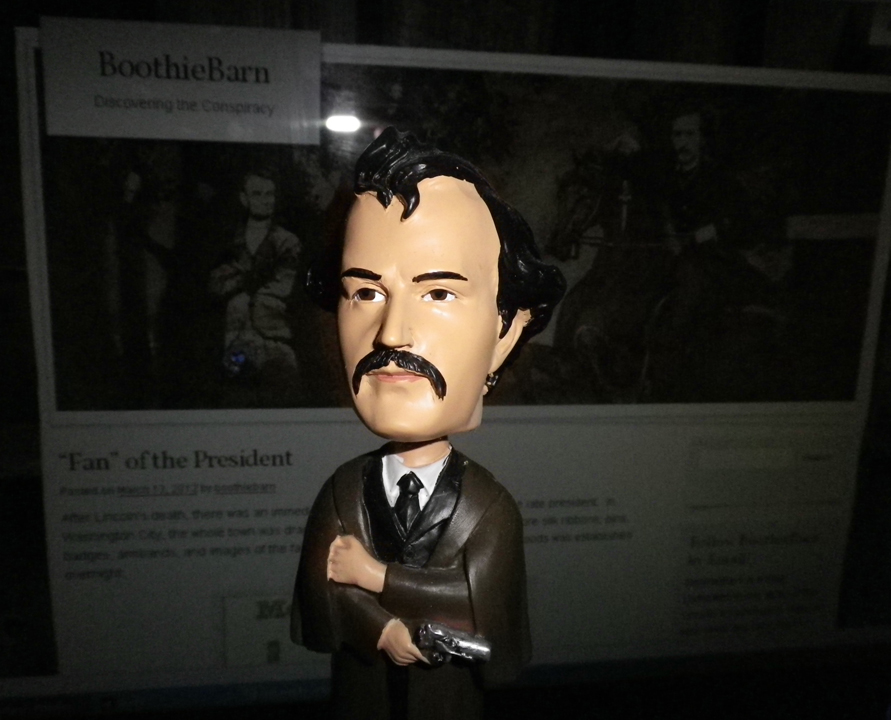
Recently, there has been a minor controversy regarding the sale of John Wilkes Booth bobblehead dolls.  A reporter from The Evening Sun of Hanover, PA, received an anonymous complaint about the dolls being sold at the Gettysburg National Military Park gift shop.  When he inquired about them, the gift shop removed them from their shelves within a couple of days.  Shortly thereafter, without any noted complaints or inquires, the Abraham Lincoln Museum and Library in Springfield, IL, followed suit and removed the bobbleheads from their gift shop.

What interests me the most about this controversy is how people have reacted to the dolls.  The original article notes that, “At first, the bobblehead drew chuckles from some of the students. But most reconsidered that reaction when asked to comment.”  This “chuckling” reaction would be the one I would expect from most people.  As a bobblehead doll, it is made to be a gag gift.  People either like them enough to buy them, or they move on, instantly forgetting them.

When probed about the dolls, the students being interviewed responded with the remarks akin to, “Yes, I suppose it is wrong to make them.” What changed their minds?  A few seconds earlier they were chuckling at the John Wilkes Booth bobblehead, and now they are calling for its immediate removal.  Their new-found disgust is a product of their education about Lincoln.  It is this education that we all receive.  We rightfully idolize and revere Lincoln for his strengths and courage as president.  He freed the slaves, kept the nation together and paid for it all with his life.  All of these things are true, but, in order to keep Lincoln as  the penultimate American president, we all ignore the complexity of his death.  The man who killed him was a crazy, racist, cold-blooded killer.  We simplify Lincoln’s death into its simplest but, inherently, incorrect terms.  Did Booth commit an atrocious deed that should be condemned?  Of course.  However, we should not dismiss his importance to the Lincoln we know and love.

This is the fine line that “Boothies” walk pursuing our interest.  As those who study the assassination, we look at the factors and motivations of Booth and other groups, North and South, who wished for and plotted to end Lincoln’s life.  While Lincoln was a great man and a great president, he was also one of our most hated presidents.  This version of Lincoln was buried and forgotten with Booth’s body.  One bullet, fueled by the anguish of the ravaged South, transformed Lincoln into a saint.  Booth should be studied not only for this crucial act, but for the complexity of his character that led him to such a crime.

Of all the reactions given in the articles and comments regarding the bobbleheads, I am slightly disappointed on a purely scholarly level with Mr. Harold Holzer’s quote in which he states that selling the John Wilkes Booth bobbleheads are, “…like selling Lee Harvey Oswald stuffed dolls at the Kennedy Center.”  While both Lincoln and Kennedy’s assassinations were traumatic events in our history, the men who committed them were polar opposites.  The times and events they lived through defined them as uniquely troubled individuals and each had vastly different motivations for their crimes.  By painting these two assassins with the same brush, we actually diminish the honored men they killed.  The story of Lincoln’s assassination is a dark one and an unpleasant one.  However, looking at the men and women who conspired to kill Lincoln helps us better understand the harsh period of time in which Lincoln lived and led a nation.

According to the original Evening Sun article, 11 out of the 12 people interviewed stated that the Booth bobblehead was inappropriate.  The sole hold out was a 15-year-old boy who stated, “It’s a part of history and we can’t just ignore it because it’s a bad part.”

I couldn’t agree more:

References:
Evening Sun articles: 1, 2, 3
Abraham Lincoln Museum and Library article

Categories: Uncategorized | Tags: , , , | 1 Comment

“Fan” of the President

After Lincoln’s death, there was an immediate demand for items that mourned the late president.  In Washington City, the whole town was draped in black mourning crepe.  Citizens wore silk ribbons, pins, badges, armbands, and images of the fallen president.  An industry of mourning goods was established overnight.

Harper's Weekly advertisement for Lincoln mourning badges.

One of the most beautiful Lincoln mourning artifacts that has survived the years, is an elegant, 22” diameter, mourning fan:

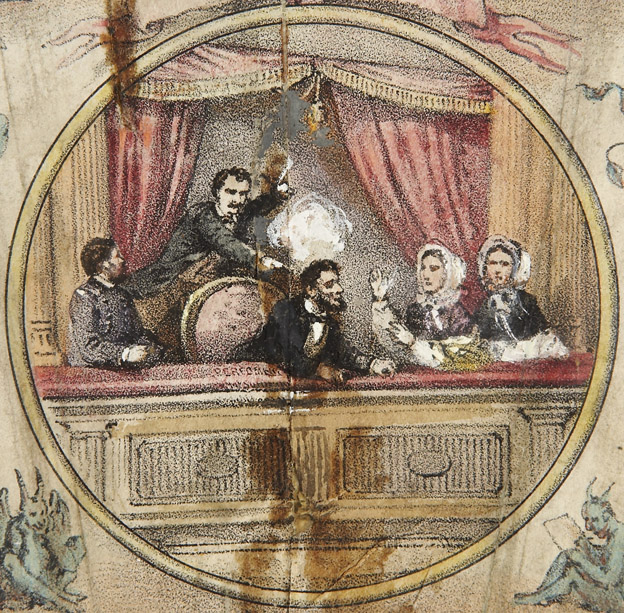
The fan is titled, “To the Martyr of his Country, Abraham Lincoln” and was created by a Central American maker who had purchased the rights from an American firm.  On the front, the fan shows Lincoln, surrounded by angels and cherubs, with Spanish memorial songs on the edges near the fan guards.  On the back, near the guards, the hand painted fan displays the battle of the Monitor and Merrimac along with a depiction of Richmondburning.  The back of the fan also displays five neatly drawn and painted scenes from the assassination of the president:

Booth, Mary Surratt, and other conspirators (one of which is probably Lewis Powell) conspiring to kill Lincoln.

Booth shooting President Lincoln.

Laura Keene and others putting on the play Our American Cousin at Ford's Theatre right before the President is killed.

Booth makes his escape south on horseback.

Cornered at Garrett's barn, Booth is shot and killed.

The fan was designed to not only be a fashionable piece, but also a means of self protection and therefore holds two surprises in its design.  In the base of one of the guards, there is a small, hinged area in which a lady could conceal poison.  If this did not work, or, if the lady needed a more direct approach, the same fan guard houses a concealed knife that could be retracted and hidden from sight.

This fan had originally belonged to Father Robert Keesler, one of the original “Boothies”.  A truly kind and generous man, he allowed the fan to be displayed at the Surratt House Museum as one of their centerpiece artifacts in their exhibit on Victorian mourning customs.  Father Keesler later gave this ornate fan as a present to Dr. John Lattimer, an esteemed Lincoln author and collector.  When part of Dr. Lattimer’s Lincoln collection was sold at auction in 2008, this fan went for $15,535.  It was last in the possession of the Abraham Lincoln Book Shop in Chicago Illinois.  They were asking $19,500 for this extraordinary piece of Lincoln mourning history.

References:
The image of the article regarding mourning badges comes from Lincoln’s Assassins: Their Trial and Execution by James Swanson and Daniel Weinberg.  Several other mourning items can be found in this book.
Abraham Lincoln Book Shop

Categories: Uncategorized | Tags: | 2 Comments

The Escape Attempt of Dr. Mudd

This engraving from Harper’s Weekly shows a fanciful depiction of Dr. Mudd’s real life escape attempt from Fort Jefferson, Dry Tortugas.

When the sentences came in for the Lincoln assassination conspirators, Samuel Arnold, Michael O’Laughlen, Edman Spangler, and Dr. Samuel Mudd all received imprisonment. Arnold and O’Laughlen were given life sentences for their involvement in plotting the kidnapping of the late President with John Wilkes Booth. Though the kidnapping never occurred, the law of conspiracy made them accountable for when the plot turned to assassination. Ned Spangler received a comparatively light sentence of 6 years for essentially being an acquaintance of Booth’s and helping to hold his horse. Dr. Mudd was also given a life sentence for aiding Booth during his escape by fixing his leg and for lying to investigators about his previous relationship with him. The four were shipped to Fort Jefferson, an isolated fort located on the Dry Tortugas islands off the coast of Florida, to carry out their terms.

Fort Jefferson CDV

The conspirators were not prepared for prison life at Fort Jefferson, Dry Tortugas. The living conditions were harsh. Disease ran rampant with scurvy, dysentery, bone fever, diarrhea and other chronic problems being common among the inmates and guards. While Dr. Mudd and the other conspirators were treated as equally as the other prisoners upon their initial arrival, the pitiable conditions and rotting food was too much for the Maryland doctor. The real straw that broke the camel’s back, however, was the upcoming change of personnel on the Fort. From the conspirators’ arrival in July until near the end of September, they were commanded over by the 110th and the 161st N. Y. Volunteers. Come September, the 161st N. Y. was being relieved by the 82nd U.S. Colored Infantry. Dr. Mudd was a former slave owner and held racial views that were a product of that. Further, as a conspirator in the Great Emancipator’s death, Dr. Mudd also feared retribution or mistreatment by the incoming soldiers. These factors, along with his being away from his family and the amenities of home, drove Dr. Mudd to orchestrate his escape from the his island prison.

In the brief two months the conspirators had been there, “thirty or forty” other prisoners successfully escaped according to Dr. Mudd’s writings. Most found freedom by hiding themselves on the steamer ships that brought supplies to the island. One steamer known to Mudd, the Thomas A. Scott, had previously visited the island and left with eight prisoners secreted upon it. To Mudd, this ship seemed to be the best method of escape.

The good doctor was clever to avoid any suspicion prior to engaging his plans. He did not tell anyone, not even his fellow conspirators, of his idea. Moreover, knowing that all of his mail was read by his captors before being transmitted, Dr. Mudd openly denounced the idea of escaping in a letter he sent to his wife just a couple weeks before he made the attempt:

“I have had several opportunities to make my escape, but knowing, or believing, it would show guilt, I have resolved to remain peaceable and quiet, and allow the Government the full exercise of its power, justice and clemency. Should I take French leave, it would amount to expatriation, which I don’t feel disposed to do at present.”

In preparation, Dr. Mudd made friends with a crew member on the Thomas A. Scott, Henry Kelly. Kelly was a young man of about 18 and, with the assumed promise of payment for his assistance, he agreed to help hide and care for Dr. Mudd during his escape. With an inside man aboard, Dr. Mudd’s plan was set.

Since Fort Jefferson was such an isolated prison, the inmates were granted greater liberties of freedom than would be found at other penitentiaries. When not tending to their assigned duties (at that time Mudd was a nurse in the prison hospital), the prisoners were allowed almost complete access to the island. They were expected to sleep within the walls of the fort, but they did not have a “bed check” as prisoners today would have. The only time considerable attention was given to prisoners exiting the fort, was on days when a ship was departing the island. On those days it was forbidden to leave the grounds of the fort until the ship had left.

Therefore, on the day before the Thos. A. Scott’s arrival, Dr. Mudd freely left the confines of the fort in the evening and slept outside of it, in a shed. The next morning, September 25th, he changed his clothing from prisoner garb into one of the suits he had brought with him. He then took advantage of the hustle and bustle of the crew removing supplies from the Scott and slipped his way down into the lower hold of the ship near the coal bunkers. Here he hid himself, under a platform between two cross beams.

Unfortunately for Dr. Mudd, he was too well known to the officers of the prison. Had he been a lowly thief or murderer, he may not have been recognized by the military storekeeper of the fort, a Mr. Jackson, who was overseeing the removal of supplies. As a Lincoln conspirator though, Mudd lacked the anonymity of a common criminal. Mr. Jackson immediately reported to the post commander that Dr. Mudd, “had gone below and had not come up again.”

A short search was then conducted aboard the Scott. While Dr. Mudd’s own accounts lack the details of his discovery, several newspaper articles reported that he was found after an officer was, “running his saber under an old box in the coal bunker” when “the cold steel coming into contact with the latter end of Dr. Mudd, made him cry out and come out.”

Dr. Mudd was immediately re-arrested and interrogated. A quick search was made on the Fort to locate O’Laughlen, Arnold and Spangler, but all three were found inside the walls and ignorant of Dr. Mudd’s actions. Upon the threat of being shot, Dr. Mudd informed on his would be confederate, Henry Kelly. Kelly was arrested and imprisoned as the Thomas A. Scott departed the island. According to Dr. Mudd, “they were so much rejoiced at finding me, they did not care to look much farther; the consequence was, the boat went off and carried away four other prisoners, who no doubt will make good their escape.”

In his own words, Dr. Mudd explained the punishments he faced for his actions: “For attempting to make my escape, I was put in the guard-house, with chains on hands and feet, and closely confined for two days. An order then came from the Major for me to be put to hard labor, wheeling sand. I was placed under a boss, who put me to cleaning old bricks. I worked hard all day, and came very near finishing one brick. The order also directs the Provost Marshal to have me closely confined on the arrival of every steamer and until she departs.”

Dr. Mudd wrote a letter to the commanding officer of the fort apologizing for his attempt to escape. While in this note he stated that, “before I was detected I had made up my mind to return if I could do so without being observed by the guards,” it is more likely that he was angry at failing in his attempt. In an October 18th letter to his wife, Dr. Mudd expressed his true feelings on the matter: “Do not view my act with dishonor. I am a prisoner under guard, not under a parole, and under no obligations to remain if I can successfully evade and free myself.”

One item that Dr. Mudd did seem to feel guilty about was his betrayal of Henry Kelly. In his note to the commander he took full responsibility for the attempt and stated that, while Kelly had promised to help him escape, he actually took no part in it. This did not seem to help Kelly’s case as he was being held just like Dr. Mudd until the commander figured out what to do with him. As a civilian, Kelly could have been transferred to the authorities in nearby Key West, or, as some newspapers reported, he could be forced to endure imprisonment right there in Fort Jefferson. While the commander of the Fort was waiting on instructions for Henry Kelly, he was briefly imprisoned with Mudd in the guardhouse. During that time, Kelly forgave Mudd for informing on him, and stated that the commander was “a fool to think they could hold him upon this island.” How true this would prove to be. Five days after Mudd’s escape attempt, Kelly was imprisoned in “the dungeon” with a thief named Smith. Though both were clad in wrist and ankle chains, the pair managed an exciting escape. Somehow Kelly and Smith freed themselves from their chains and broke out of the iron grated window in their cell. They then lowered themselves down by using the same chains. From there they robbed the civilian merchant on the island of $50, some clothing, and enough canned fruits and meats to last their journey. With supplies in tow, they stole a boat and made their escape onto the water. Dr. Mudd reflected, “The authorities are no doubt much disappointed and chagrined at this unexpected occurrence. I feel much relieved.”

While other prisoners would continue to make their escape from Fort Jefferson, Dr. Mudd never attempted to do so again. On October 18th, Dr. Mudd and the other Lincoln conspirators found themselves placed into “the dungeon” that Kelly had escaped from. The military had picked up on a rumor that a plot was being formed to free the conspirators. While the rumor had no substance, it still led to the men being confined to the most secure part of the fort. The living conditions for the men worsened considerably there, and they were not relieved of the squalor until the end of January, 1866. After that experience, it appears Dr. Mudd accepted the impossibility of his successful escape. While he still longed for home, he would not risk the punishment for another failed attempt. Moreover, he accepted his connection to the three other men that were imprisoned with him. Though they were strangers to him prior to the trial, they now shared the same fate, good or bad. For his own sake, and for theirs, Dr. Mudd would never try to escape again.

References:
The Assassin’s Doctor by Robert K. Summers
Mr. Summers’ book is the book on Dr. Mudd.  He also runs the best website on Dr. Mudd.  His book was the prime source for information on the doctor’s escape.
Mudd, N. (1906). The Life of Dr. Samuel A. Mudd. Washington: Neale Publishing Company.
(1865, October 9). Details of Dr. Mudd’s Attempted Escape. New York Herald-Tribune.
(1865, October 12). Attempted Escape of Dr. Mudd. Providence Evening Press.
More thanks go to Robert K. Summers. In addition to his wonderful book and unparalleled Mudd website, Mr. Summers visited the National Archives on the author’s behalf looking for more information about Mudd’s escape.

Categories: Uncategorized | Tags: , | 4 Comments

Blog at WordPress.com.