Crossing the Bridge

Reader Richard Petersen asked this excellent question on my last post about Silas Cobb:

Question. What was the protocol for Booth and Herold in crossing the bridge? Could they ride across or did they have to dismount and walk?

I believe this to be a very good question and worthy of discussion. The record of what transpired at the Navy Yard Bridge comes from the official statement and the conspiracy trial testimony of Sgt. Silas Cobb. In his statement to authorities specifically, Cobb gives wonderful details about the two riders who crossed his lines. For example, we learn that Booth was wearing a “soft black or dark brown felt hat” and that “his hands were very white, and he had no gloves on”. Cobb even provided details about Booth’s voice stating it was, “rather light, and high-keyed”. For Davy Herold, Cobb described him as wearing, “a light coat, light pants, and a snuff colored felt hat, of rather a light shade.” He even let us know that Davy was, “the heavier of the two”. When it comes to the actual method of crossing the bridge, Cobb does not give specific detail. This is probably due to the fact that crossing people over the bridge was so commonplace to Cobb, that he didn’t consider the way in which Booth and Herold did it to be any more notable than any other person. He does provide a few statements that we can piece together though, to paint a seemingly accurate picture of what the process was.

When both men approached the bridge, the sentry challenged them (assumedly by asking “Halt, who goes there?” or “Friend or Foe”). Booth and Herold both replied “a friend” and Cobb began his interrogation of them. In the trial testimony, Cobb is asked a question about his encounter with Herold:

Q. Did you have a good view of his face? Was there a light?

A. I did. I brought him up before the guard-house door, so that the light shone full in his face and on his horse.

So we know that Cobb moved Davy to be in view of a light. Unfortunately, this statement is inconclusive regarding whether or not Davy was still on horseback, or on foot next to his horse. However, a little while after this, Cobb is asked about Davy’s size:

Q. How would he compare in size with the last man on the row in the prisoner’s dock? [David E. Herold, who stood up for identification.]

A. He is very near the size, but I should think taller, although I could not tell it on the horse; and he had a lighter complexion than that man.

The darken part is very important. Cobb, the man who provided so many details about the men who he crossed over the bridge, was unsure about Davy’s height. It appears his explanation for this is because the Davy stayed on his horse and so Cobb was not able to accurately compare Herold on his horse with Herold on the prisoner dock. This testimony appears to favor Booth and Herold remaining on their horses.

Cobb gives us a bit more (though still not as much as we’d like) with regard to Booth’s crossing:

“He then turned and crossed the bridge; his horse was restive and he held him in and walked him accross the bridge; he was in my sight until after passing the other side of the draw. I do not know with what speed he rode after that.”

During my first few readings of this, I pictured Booth walking his horse as a man would walk a dog. In my eyes it appeared as if Booth (who apparently showed no physical pain supporting Michael Kauffman’s theory that he broke his leg later in a horse fall) kept his horse close to him and acted like a child crossing the street by walking his bicycle. Upon further reading and trying to put myself into the correct 19th century equestrian mindset though, I read this now as Booth riding his horse at a walking pace across the bridge. The last phrase, “I do not know with what speed he rode after that,” implies to me that Booth was already riding his horse and not walking it on foot. I want to believe the detail oriented Cobb would have stated something along the lines of “he remounted his horse” if Booth was actually walking alongside it beforehand.

There is no specific statement by Cobb saying that Booth and Herold ever dismounted their horses. In addition, the few details that Cobb does give regarding the process appears to imply that they remained in their mounts during their entire time they conversed with him. There is no smoking gun or definite answer to Richard’s question, but I believe the majority of the evidence points to Booth and Herold staying on their horses when they crossed the Navy Yard Bridge.

What do you think?

Booth making his escape on horseback.

References:
The Evidence by Williams and Steers
Poore’s version of the Conspiracy Trial (Vol 1)

Categories: Uncategorized | Tags: , , , | 16 Comments

The Ironic Death of Silas Cobb

On April 14th, 1865, Sgt. Silas Tower Cobb was in charge of the Army’s guard detail over the Navy Yard bridge leading out of D.C. 

The Navy Yard Bridge in 1862

During that night, he was approached by three individual riders all looking to be crossed over the bridge.  As a proper guard he interrogated the men asking them where they were going, why they waited until after 9:00 pm to depart, and what their names were.  The first man replied he was going to his home in Charles County, MD, “close to Beantown”.  He pleaded ignorant of the rule forbidding passage over the bridge after 9:00 and stated that, “It is a dark road, and I thought if I waited a spell I would have the moon”.  Sgt Cobb was hesitant to let him pass but the man who gave his name as Booth seemed proper enough and his answers had been satisfactory.  While Cobb’s standing orders had been that no person was allowed to cross the bridge between 9:00 pm and sunrise, the enforcement of these orders had been more lax as the war had dwindled down.  Sgt. Cobb unwittingly allowed the assassin of Lincoln to cross his line.  Not long after this, another man rode up giving his name as Smith.  He told Cobb he was heading home to White Plains.  Again, Silas Cobb informed the man that passage over the bridge after 9:00 o’clock was forbidden.  Smith replied, “I stopped to see a woman on Capitol Hill, and couldn’t get off before.”  Though this man did not appear as proper as the first man, he allowed him to cross the bridge as well.  Sgt. Cobb had unwittingly allowed David Herold, one of the Booth’s accomplices, to cross his line.  History repeated itself as a third horseman appeared.  This man asked Cobb if he had passed a man on a horse fitting the description of “Smith”.  Cobb replied in the affirmative.  The third man told Cobb he was a stableman, and that “Smith” had run off with one of his horses.  The stableman, John Fletcher, asked for permission to cross and give chase.  Cobb told him that while he would be allowed to cross out of the city, he would not be permitted to return until daybreak.  Fletcher decided the idea of spending all night stranded outside of the city looking for a lost horse was an unappealing one and returned to the city to report his loss to the police.

Though Cobb was later in deep dung for allowing two conspirators in Lincoln’s assassination escape over his bridge, he never suffered court martial for his actions.  He testified at the trial of the conspirators and was honorably discharged from the army in September of 1865.  He assumedly returned to his hometown of Holliston, Massachusetts.  Two years later, however he met his end at the age of 29 while traveling in Michigan:

Silas Cobb’s death as reported in the Lowell Daily Citizen on November 11, 1867

Silas Cobb’s death as reported in the Jackson Citizen on November 19th, 1867

It is one of those odd twists of fate that the man who permitted the river crossings of two Lincoln assassination conspirators would meet his end in his own unfortunate attempt.

References:
Silas Cobb’s FindaGrave page
The Evidence by Williams and Steers

Categories: Uncategorized | Tags: , , , | 14 Comments

Is this Sam Arnold?

While searching newspapers today, I stumbled across an article regarding Samuel Arnold’s 1902 newspaper serial about his involvement in the conspiracy to kidnap President Lincoln.  The completed serial ran in the Baltimore American and can be purchased in book form as Memoirs of a Lincoln Conspirator edited by Michael Kauffman.  What was new to me in this article was not the content, but rather an image of Sam Arnold that I had never seen previously:

Sam Arnold’s image in the December 7th, 1902 edition of the Dallas Morning News

At first, I thought it was a rather poor drawing by a Dallas newspaperman based off of Sam’s mug shot photo:

Sam Arnold’s Mug Shot

After a little bit of searching, I discovered the image in two other papers, both in Illinois, dated the 11th and 28th:

Sam Arnold image in the Rockford, IL Morning Star on December 28th, 1902

Then I found a slightly different, but similiar image of Sam Arnold in another 1902 newspaper:

Sam Arnold in the December 7th, 1902 edition of the Philadelphia Inquirer

To me, this version in the Inquirer appears to be the most lifelike and looks to be taken from a photo.  Alterations have been made to it, of course, but not to the same degree as the first few versions.  Still I cannot decide whether I think these images are based off a true, unknown image of Sam or if they are just an artist’s interpreation of Sam.  I’ve created a poll to get your feedback.  What do you think?

Categories: Uncategorized | Tags: | 5 Comments

A Plaque for Dr. Mudd

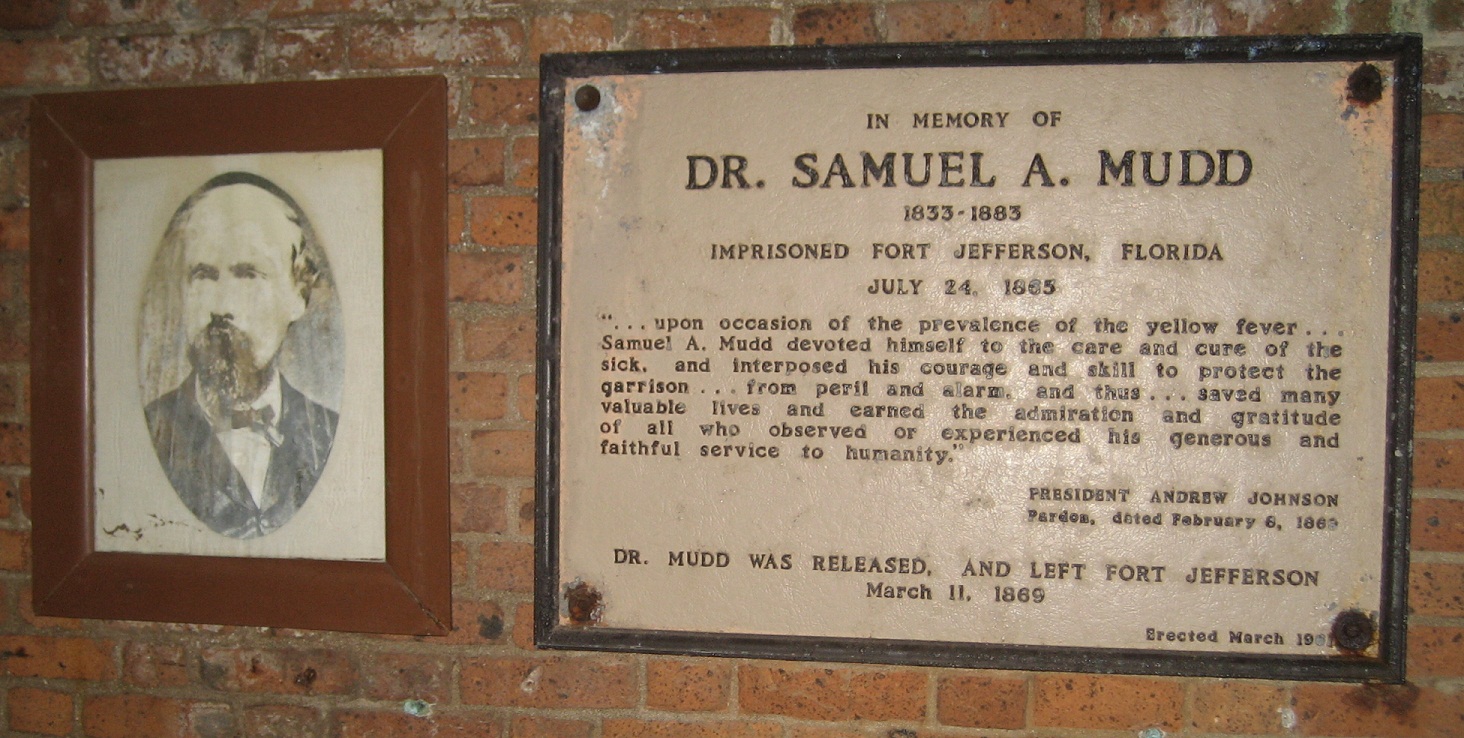
In the former cell of Dr. Samuel A. Mudd and the other Lincoln assassination conspirators in Fort Jefferson, there is a memorial plaque in honor of its most famous inmate:

The memorial was erected in March of 1961, and many newspapers of the day contained an Associated Press article regarding its dedication and the history of Dr. Mudd.

“In ceremonies yesterday at Key West – because Dry Tortugas was too inaccessible – the U.S. government dedicated a plaque to the memory of Dr. Mudd. The plaque itself is out on the Tortugas at Ft. Jefferson, a poorly preserved crumble of 40 million bricks which in Mudd’s day was a formidable federal penitentiary.”

Of those referenced in the newspaper article was a Saginaw, Michigan resident named Dr. Richard Dyer Mudd.  Dr. Richard Mudd was Dr. Samuel Mudd’s grandson and lifelong proponent of his innocence.  Dr. Richard Mudd stated that the plaque was:

“A tacit admission, at last, that my grandfather was convicted unjustly, that he did not conspire to kill the 16th President nor knowingly aid the man who did.”

The fact is though, while the government was willing to place a memorial to a doctor who bravely administered to many sick soldiers and inmates at the assumed risk of his own life, they were not comfortable declaring that Dr. Mudd was wrongfully imprisoned.  In fact, it took several years to get Dr. Mudd this memorial, and even then it was not what Dr. Richard Mudd truly hoped for.

The first attempt that I’ve been able to find regarding a public memorial for Dr. Mudd was in February of 1936, during the second session of the 74th Congress.   A West Virginian Representative named Jennings Randolph introduced House Joint Resolution 496 on February 24th.  It can be assumed that the catalyst for Rep. Randolph’s bill was the new movie, “The Prisoner of Shark Island”.  The film had its debut in New York on February 12th, 1936 and was released nationwide on February 28th.  Publicity about the movie was in many newspapers and each reiterated the popular view of Dr. Mudd’s complete innocence.

H. J. Res. 496 called for the “erection of a memorial to Dr. Samuel A. Mudd”.  It was first sent to the House’s Committee on Public Lands.  The Committee, in turn, contacted the Department of the Interior to gain their perspective on the idea.  On April 16th, the Department of the Interior sent back a letter in favor of the memorial stating, “The proposal to place a tablet to the memory of Dr. Mudd on the ruins of Fort Jefferson appears to have merit in view of the outstanding services performed at Fort Jefferson by this member of the medical profession.”  In addition, the Secretary of the Interior hoped that this tablet would, “increase the historical interest of old Fort Jefferson.”  With the blessing of the Department of the Interior (given the understanding that the House would set aside the funds to complete the memorial and not the DoI) the Committee on Public Lands reported back on the bill favorably on May 28th, 1936.

While it appeared that many in Congress were in favor of this memorial to Dr. Mudd, one outside group, “The Society for Correct Civil War Information” was not.  In one of their bulletins they wrote:

“This Resolution was so obviously a farcical gesture that we were remise in not listing it as one of the disloyal bills.  We erred in thinking that no member of the United States Congress would for one moment tolerate the idea of erecting a memorial to one of the conspirators against the life of Abraham Lincoln… If such a resolution passes the Congress, giving approval to assassination, the next logical step is a monument to John Wilkes Booth!”

While alarmist and hyperbolic in this edition, the Society for Correct Civil War Information did devote articles in a few other bulletins fighting against the popular belief that Dr. Mudd was a completely innocent country doctor.

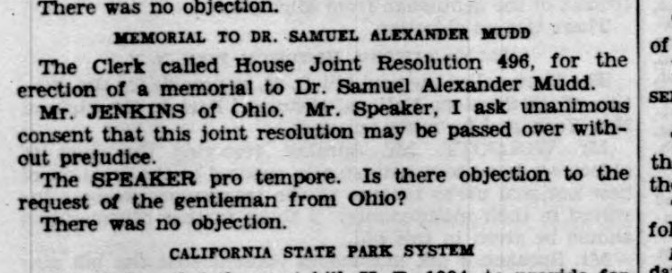
When the bill was finally called to question on June 15th, 1936, Representative Thomas Jenkins of Ohio asked the resolution to be passed over without prejudice:

Five days later was the last day of the 74th Congress.  H. J. Res. 496 died.

The next year, during the 75th Congress, Representative Randolph of West Virginia was at it again.  He introduced H. J. Res. 87 again calling for the “erection of a memorial to Dr. Samuel Alexander Mudd”.  The bill was, once again, sent to the Committee on Public Lands.  As before, The Society for Correct Civil War Information was on the offensive over this measure:

“H. J. R. 87 provides for the erection of a memorial to Dr. Samuel Alexander Mudd, and is similar to H. J. R. 496 in the last Congress. H. J. R. 87, introduced by Jennings Randolph (Congressional Record, p. 105), contains the same misstatement that “in recognition of Dr. Samuel Alexander Mudd’s innocence of the charges which resulted in his life imprisonment he was given a complete and unconditional pardon by President Andrew Johnson.” In the September (1936) bulletin we cite the text of President Johnson’s pardon of Dr. Mudd which concludes: “And whereas, upon consideration and examination of the record of said trial and conviction an of the evidence given at said trial I am satisfied that the guilt found by the said Judgment against Samuel A. Mudd was of the receiving, entertaining, harboring and concealing John Wilkes Booth and David E. Herold with the intent to aid, abet, and assist them in escaping from justice after the assassination of the late President of the United States, and not of any other or greater participation or complicity in said abominable crime,” and President Johnson further states “And whereas, in other respects the evidence imputing such guilty sympathy or purpose of aid in defeat of Justice, leaves room for uncertainty as to the true measure and nature of the complicity of the said Samuel A. Mudd in the attempted escape of said assassins.” The foregoing excerpts from President Johnson’s pardon show that he knew Dr. Mudd to be an accessory after the fact in harboring Booth and Herold, and it was on this specification and charge that he was found guilty. See Volume 121, page 699. Therefore to state that President Johnson pardoned Dr. Mudd because he was innocent of the charges that led to his Imprisonment and to seek a memorial to Dr. Mudd on that account is a conclusion and a purpose not justified by facts, and H. J. R. 496 was therefore properly stopped in Congress, for Dr. Mudd was not innocent of the crime for which he was convicted.”

This time, Representative Randolph’s bill never made it out of the Committee of Public Lands.  Again, the measure died.

Let’s fast forward now to 1959 and the 86th Congress.  Though The Prisoner of Shark Island is no longer on the minds of the American public, Dr. Richard D. Mudd has been working tirelessly to clear his grandfather’s name.  He entices his congressman, Representative Alvin Bentley of Michigan’s 8th district, to propose House Joint Resolution 80 entitled, “Providing for the erection of a memorial tablet at Garden Key, FLA., in honor of Dr. Samuel Alexander Mudd”.  Dr. Richard Mudd was 35 when the first few attempts to honor his grandfather failed, and this time he was determined to push it through.  In addition to Rep. Bentley of Michigan, Mudd instilled the help of Representative Dante Fascell of Florida.  Fort Jefferson was in Rep. Fascell’s district.  Fascell proposed a practically identical bill to Rep. Bentley’s, House  Joint Resolution 433.  Dr. Richard Mudd was doubling his odds at getting a memorial to his grandfather.

Rep. Bentley’s bill (H. J. R. 80) was sent to the Committee on Interior and Insular Affairs.  They contacted the Department of the Interior and received a very similar letter to the one received by the 1936 Congressmen:

“Although the providing of memorial treatment through markers, monuments, and scripture, is often inconsistent with this Department’s practice of administering historical areas in such a way as to preserve the historic scene, we do not feel the proposed tablet would be objectionable at Fort Jefferson.  We would point out, however, that a visitor center is being planned for the Fort Jefferson National Monument and that the entire history of the fort, including Dr. Mudd’s, will be told.”

With the approval of the Department of the Interior, the Committee reported favorably on H. J. R. 80… with one amendment.

Bentley’s original bill contained a long preamble declaring the many ways in which Dr. Mudd was innocent, falsely tried, and imprisoned.  Dr. Richard Mudd hoped the passing of this bill would set the precedent he desired to have his grandfather’s record officially expunged.  However, the Committee on Interior and Insular Affairs was not willing to set this precedent and therefore eliminated the entire preamble and changed the phrase in the resolution from “imprisoned for a crime which he did not commit” to just “imprisoned”.  The following shows their changes:

On August 31st, 1959 the amended bill was called to question.  There was no debate but Rep. Bentley used the time to reiterate his feelings about Dr. Mudd’s innocence, even though all declarations to the same had been removed from the bill:

From here, the bill reached the Senate where Senator Philip Hart of Michigan (another of Dr. Richard Mudd’s congressmen) also displayed his sympathies towards his constituent:

The bill, having passed the House and Senate was turned over to the President for final signature and approval.  On September 21st, 1959, President Einsenhower signed the bill into law.  Dr. Mudd got his memorial at last.

Dr. Richard Dyer Mudd had hoped that these efforts in the Congress would be his grandfather’s vindication.  In the newspaper article quoted at the beginning of this post, he called the memorial a “tacit admission” of his grandfather’s “unjust” conviction and innocence in “knowingly” aiding the man who killed the President.   This was not the case, however.  The Committee on Interior and Insular Affairs struck out the text, “covering controversial matters of history about which the committee has no expert knowledge and on which it does not wish to pass judgment.”  In the end, the committee succinctly summarized the reason for this memorial as being solely:

“A recognition of Dr. Mudd’s meritorious professional service as an imprisoned physician during the yellow fever epidemic of 1867.”

References:
The Congressional Records of 74th and 86th Congresses available online through Archive.org
Bulletins of The Society for Correct Civil War Information
1936 Report of the Committee on Public Lands
1959 Report of the Committee on Interior and Insular Affairs

Categories: Uncategorized | Tags: , | 4 Comments

Davy Herold on Alphas

In addition to my interest in history, I am also a bit of a nerd in other, more traditional ways (shocking, I know).  Specifically, I’m a fan of several science fiction shows.  Today, I was catching up on a few episodes of the SyFy television show Alphas.  For non-nerds, Alphas is a TV show about people who have superhuman abilities.  It’s essentially X-Men but with more realistic and believable abilities.  Recently, the good Alphas have been trying to track and capture the leader of the bad Alphas.  He is a man by the name of Stanton Parish.  His Alpha ability is perfect control of his brain which manifests in his ability to slow down his aging process and heal his body.  The team was able to find images of him dating back to the Civil War and how old he really is has yet to be determined:

Alphas’ “Stanton Parish”

While watching it today, there was a second when the leader of the good Alphas, Dr. Rosen, was flipping through his materials on Stanton Parish.  There was a quick shot of an image that looked strangely familiar.  I rewound the video (you got to love the “On Demand” feature), and paused it.  I could see then that the producers of the show had taken the head of the Stanton Parish character and had Photoshopped it onto the body of the Lincoln assassination conspirator, David Herold:

Alphas’ “Stanton Parish” on David Herold’s body. The untouched photo of Davy is included for comparison.

I had a good chuckle over this strange cameo appearance by Davy Herold.  References to the assassination can be found in the most unlikeliest of places.

Categories: Uncategorized | Tags: , | 2 Comments

Nettie Mudd on the Airwaves

Nettie Mudd Monroe From Robert Summers' Dr. Samuel A. Mudd Research Site

Nettie Mudd Monroe From Robert Summers’ Dr. Samuel A. Mudd Research Site

In 1938, at the age of sixty, Dr. Mudd’s youngest daughter Mary Eleanor, better known as “Nettie” made a special vocal appearance during the intermission of Lux Radio’s production of The Prisoner of Shark Island:

The Prisoner of Shark Island radio drama was based off of the 1936 film of the same name starring Warner Baxter.  The film and radio shows are highly fictionalized versions of Dr. Mudd’s involvement in Lincoln’s assassination and life imprisoned on Fort Jefferson, Dry Tortugas.  In these highly popular renditions, Dr. Mudd is portrayed as a completely innocent country doctor who knew nothing of the men who stopped at his house during the early morning hours of April 15th, 1865.  While wholly inaccurate, these revisions to history and the efforts of Mudd descendants like Nettie and Dr. Richard Dyer Mudd helped to turn public sympathy to Dr. Mudd’s favor.  To this day, historians still have to compete with this inaccurate “legend of Dr. Mudd” when trying to accurately explain Dr. Mudd’s relationship to John Wilkes Booth and the events that led to Lincoln’s death.

References:
Nettie Mudd from the Dr. Samuel A. Mudd Research Site

Categories: Uncategorized | Tags: , | 13 Comments

The Story of Pink Parker and his Booth Memorial

Former John Wilkes Booth Memorial in Troy, AL

“Joseph Pinkney Parker was born in Coffee County, Alabama in 1839. He had just finished as a student at Spring Hill Academy when the War broke out. He left immediately for the front, leaving behind him on a well-stocked plantation, his sister and the slaves which every well-to-do Alabaman possessed at that time. Four years later, he returned to find his farm overgrown with weeds, his stock and his slaves disappeared and his sister embittered by her treatment received at the hands of the Northern soldiers. The property was soon eaten up by taxes, so he took a position as a “walker” on the railroad tracks carrying with him maul and spikes to keep the tracks repaired.

He became a school teacher, but the parents of the children were too poor to pay the salary, or even to clothe the pupils properly. As years went on, he did regain some of his financial position and built for himself and his family a very comfortable home in Troy, just a block or two from the famous trace which Andrew Jackson used in his battles against the Indians in Florida.

Pink was a devout member of the Baptist Church. He never called his wife anything but “Darling” and taught his children to do the same. He became a police officer in the little town of Troy and a much-respected citizen. But he had one obsession which was so deeply instilled in him that he never was able to overcome it; a deep and lasting hate for the North, its people, and particularly for the man who was the sixteenth President of the United States ; a man so great that, today, Abraham Lincoln is revered in the South, together with the famous champion of the Lost Cause, Robert E. Lee.

As Pink Parker went on nursing his wrath from year to year, the North and the name of Lincoln would cause him to burst forth into the most impassioned flights of profanity which not merely astonished but shocked his friends. The pastor of the Baptist Church labored with him to stop these outbursts. But they continued and Pink was finally removed from the church rolls for his profanity. Rather ruefully, Pink remarked to a friend, “It wasn’t quite fair. I know all the deacons in that church and any one of them can cuss better than I can.”

Time went on and each succeeding April 15, Pink would make for himself a paper badge indicating that this date was the “Anniversary of the Death of Old Abe Lincoln.” Years passed, the idea came into his head that he would erect a monument to the memory of John Wilkes Booth. Apparently, he did not share this intention with anyone, so it was a surprise to the citizens of Troy when this monument, some four feet high, was erected in the yard of Pink’s home. His neighbors did not like the idea, but they did like Pink Parker. The strange thing about the erection of this monument is the fact that it was not erected until 1906, in spite of the fact that the newspapers of the 20’s stated that it had been erected by popular subscription by the citizens of Troy in 1866.

Pink Parker on April 15th, 1906 - The day he erected his monument to Booth.  Notice his paper badge celebrating the 41st anniversary of Lincoln's death.

Pink Parker on April 15th, 1906 – The day he erected his monument to Booth. Notice his paper badge celebrating the 41st anniversary of Lincoln’s death.

No one paid much attention to the monument. Automobiles were not as plentiful as they are today and traffic did not flow through Troy as it does now. Pink was pretty proud of his handiwork and he used to regale his grandsons with the story of his sending President Theodore Roosevelt a postcard inviting him to come and visit the monument. He further informed the President that while he couldn’t furnish a carriage for him, he would get him a dray hauled by a couple of mules.

When Pink’s grandsons would twit him on the fact that he might not be able to get along with the Yankees he found in Heaven, his eyes would twinkle and he would say, “Well, I don’t suppose I will find enough up there to bother me.”

When, in 1921, Mrs. C. D. Brooks, who at the time was the president of the Woman’s League of Republican Voters in Alabama, heard of this monument, her pride for the state of Alabama was so strong that she began immediately to have the monument destroyed. Mrs. Brooks received letters from all over the country supporting her stand. One of the most interesting letters which came to her was dated June 8, 1921, El Paso, Texas, from Alexander Donald McEvoy, who states that “in the year 1879, I met Booth in Buenos Aires, Argentine Republic.” That letter would have pleased Pink Parker, for he always maintained that Booth was not the man whom Boston Corbett shot.

But three or four years prior to 1921, some boys pulled down the monument for a Hallowe’en stunt. No one had ever bothered to replace it. In 1922 after the death of Mr. Parker in December, 1921, his sons had the stone taken out to the monument works where the scars made by souvenir hunters were removed, together with the legend concerning John Wilkes Booth. The monument was then re-set as a memorial to Joseph Pinkney Parker.”

Pink Parker’s re-etched gravestone.

The preceding came from the 1951 booklet entitled, A Monument to the Memory of John Wilkes Booth. The author gained his information from two of Pink Parker’s grandsons.

References:
A Monument to the Memory of John Wilkes Booth by Stewart W. McClelland (1951)

Categories: Uncategorized | Tags: , , | 9 Comments

JWB and Grover Cleveland: Drunks

The night of Tuesday September 17th, 1895 proved to be a busy (and historic) one for the Chicago police department:

Let the romps of “J. Wilkes Booth” and “G. Cleveland” be a lesson to us all – no matter how dead or distinguished you might be, there’s no controlling how the “spirits” might move you.

References:
The Daily Inter Ocean – Sept. 19, 1895
The steamer that “J. Wilkes Booth” was the cook for, “The City of Traverse”, spent its twilight years as an illegal gambling ship.

Categories: Uncategorized | Tags: , | 1 Comment

Blog at WordPress.com.