John Wilkes Booth and his Conspirators
Here’s my own addition to the conspirator collage family.
There are two well known compilation images of the conspirators. One is the “Ring of Conspirators” which is featured in the Benn Pitman version of the trial transcript.
The other is a CDV image entitled, “Booth & his Associates”
I took my inspiration from this latter image but made sure to add all of those tried for conspiracy in Lincoln’s assassination, including Dr. Mudd.
New Gallery – John Wilkes Booth Photographs
“…Would you be kind enough to ask Case to send me without a moment’s delay one dozen of my card photghs. The ones I want are those seated, with cane & black cravat He knows the ones I liked the best…This is very important As there are several parties whom I would like to give one.”
– Letter from John Wilkes Booth to Orlando Tompkins dated February 9th, 1865
Before assassinating President Lincoln, John Wilkes Booth was already a famous man. He was a leading actor of the American stage and his face was well known to a generation of theater goers. He was a handsome man, even being called the “handsomest man in Washington” in the hours leading up to the assassination. Women swooned over his looks and photographs of him were sought after. Booth not only gave photographs of himself as gifts and remembrances, but photographers and gallery owners sold his image to the public. After Booth assassinated Lincoln, demand for his picture increased by a factor of ten. Newspapers were full of advertisements offering the sale of his picture:
Secretary of War Edwin Stanton and others in the government likely found this clamoring for the assassin’s picture shameful and so, on May 2nd, the Middle Department of the Army issued a general order essentially banning the sale of Booth’s image in Washington and Maryland:
“The sale of portraits of any rebel officer or soldier, or of J. Wilkes Booth, the murderer of President Lincoln, is forbidden hereafter in this department. All commanding officers and provost-marshals are hereby ordered to take possession of such picture wherever found exposed for sale, and report the names of the parties so offending, who will be liable to arrest and imprisonment if again guilty of a violation of this order.”
Sale of Booth’s photographs outside of this department’s jurisdiction continued and, by May 26th, this order was rescinded and images of Booth were allowed to be sold in Washington again. Soon, carte-de-visites, or small card photographs, of Lincoln’s assassin filled album books nationwide. Some were appropriately defaced like the one at right while others were kept by silent sympathizers.
In 1979, authors Richard and Kellie Gutman published the book, John Wilkes Booth Himself. By working with many private collectors and institutions, the Gutmans had identified and collected all the known images of John Wilkes Booth and published them together in a volume. The book contained 44 images. Four of them are of illustrations or paintings based on a photo and one image, Gutman 1, has been proven not to be of Booth but rather of a friend of his, Richard M. Johnson. This leaves the book with 39 photographs of John Wilkes Booth. The Gutmans’ book is rare and highly sought after today as only 1,000 copies were printed in 1979. Since the release of their book, other photographs have been discovered of John Wilkes Booth. There are also small variations on the known photographs that can be found due to the type of camera used (stereoscopic) and small movements Booth made during a particular sitting of certain pose. The numeration given by the Gutmans in their book is the most common way to organize and differentiate between Booth’s many photographs.
The newest Picture Gallery here on BoothieBarn contains the photographs of John Wilkes Booth organized by Gutman number.
The images come from a variety of sources with the bulk of them stemming from online auctions. While sites like eBay can provide a nice showcase of original Booth images, they are also ripe with laughable images of mustachioed, curly haired gentlemen “proven” to be Booth. Most of these fakes are ignored but, occasionally, they attract far sighted fools and bring their crafty sellers a payday. The images in the John Wilkes Booth Photographs Picture Gallery are established and universally agreed upon images of Booth.
Click here to visit the new John Wilkes Booth Photographs Picture Gallery.
References:
John Wilkes Booth Himself by Richard and Kellie Gutman
“Right or Wrong, God Judge Me” The Writings of John Wilkes Booth edited by John Rhodehamel and Louise Taper
Rosalie Booth’s Letters
In November I posted a piece about Rosalie A. Booth, the sister of the assassin of President Lincoln. In that post, I included the full text of Rosalie’s letter that she wrote to her brother, Edwin, in 1860. That letter is housed in the New York Public Library and the text of it was published in the “Lincoln Log” in 1979. Here is the text of that letter:
Phil’a
March 12th
1860
Dear Ned
I received yours from Nashville dated the 7 inst. Asia has got a fine little girl and is doing pretty well so far. So you see you have won the bet. Clarke telegraphed you on Saturday. Asia wrote one day last week we both got our boxes and are very much pleased with them and I thank you a thousand times. Mother got a letter from June written on the 6th of Feb’y he got the check that she sent and was going to write to you at the same time. He was in good health but little Mary had a very bad cold. He sends his love to you and Joe. In regards to living in New York or Boston it does not make the slightest difference to me as all places are alike as I will have [to] live where Mother does (unless I get married, and have a house of my own but I don’t think that there is any danger of that yet awhile) Mother thinks that she ought to be where Joe is as he is the one that wants some one to take care of him. She [said] that John has been away from home so long that he can get along very well by himself. Love to Joe and tell him to find time to answer my letters. Sleeper says that he got something for Joe to do at the Arch if he has made up his mind to follow the stage. In regard to Wilkes’ fight at Richmond it was with a man named Pat Redford or Bedman in the box office who had insulted him several times before but he did not say what the insult was. He played Ludovico the other night for Julia Dean Hayne’s benefit and was the only one called before the curtain and had a 6 minute call. He seems very much pleased at it. He has got your letter was to answer it. Mother has just written to you and says she will tell you all about how she wants to live as for me all places are alike. Asia sends her love to you and Joe. I am glad that Joe succeeded so well in Biondello.
God bless you my dear Brother is the pray[er] of your loving sister
Rose A Booth
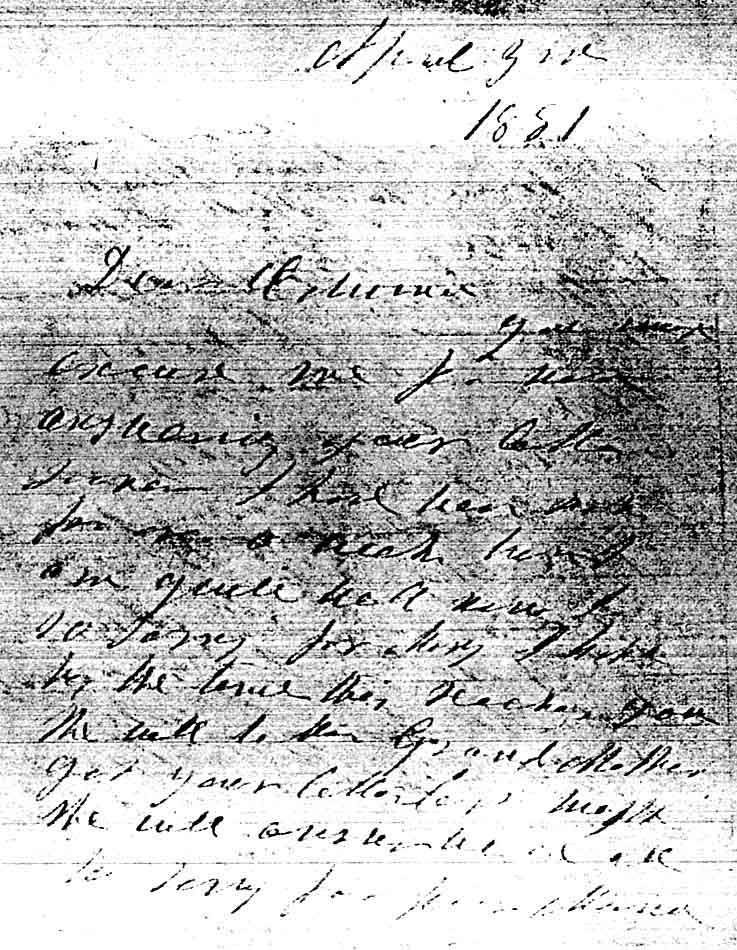
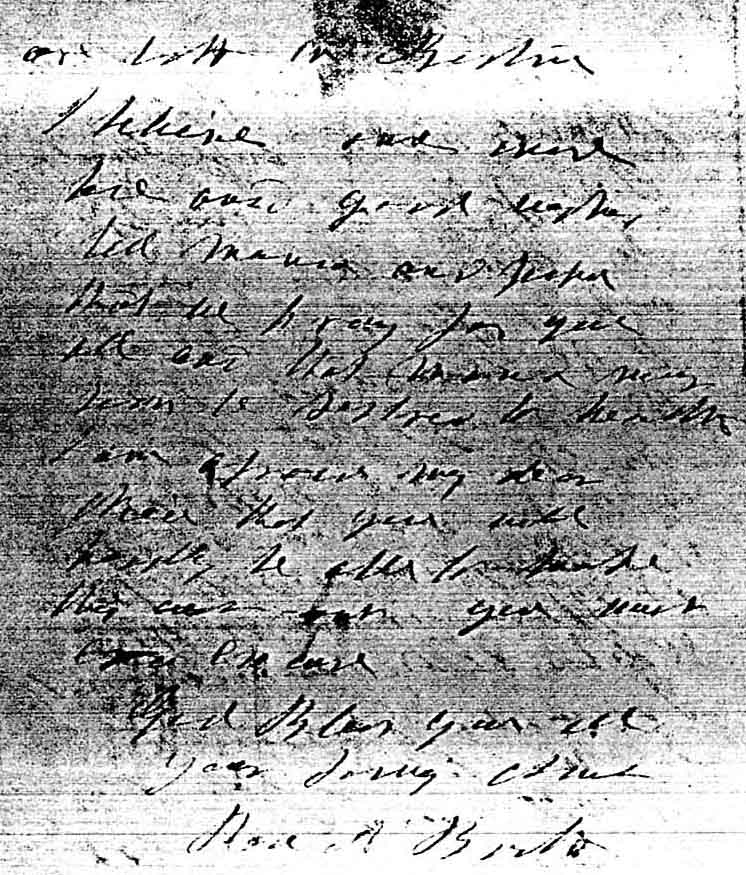
There is, however, at least one other letter written by Rosalie that still exists today. That letter, written by Rosalie to her niece, Edwina, is housed at the Hampden-Booth Library inside The Players Club in New York. I had discovered a poorly copied version of the letter online, but making a workable transcription from it was extremely difficult. On my own, I managed to transcribe bits and pieces of the letter that hardly added up to a quarter of its contents. After my initial post, I received an email from a fellow Lincoln assassination researcher named Kate Ramirez who resides in New York City. She graciously volunteered to visit The Players and attempt to transcribe the letter in person. I’m eternally grateful to Kate for giving so generously of her time and to the director of the Hampden-Booth Library, Ray Wemmlinger, for allowing her to view the document.
Unfortunately, even in person, Rosalie’s handwriting is very difficult to decipher. Kate was only able to make a partial transcription of the letter. By combining her efforts and the work I had previously done, we’ve managed to transcribe about three-fourths of the letter.
Before reading the letter, however, some background is required. Rose is writing this letter to her niece Edwina on April 3rd, 1881. At the time Edwina, her famous father Edwin, and his second wife Mary McVicker, are living abroad in England. Asia Booth Clarke, who had moved to England with her husband and children years before, had convinced her brother Edwin to make the journey across the Atlantic to perform for London audiences. The engagement only lasted about a year and, during this time, Mary McVicker’s health was failing. The family would return to America in the summer and Mary McVicker would die in November. Still, Edwina, her father, and stepmother, spent their time visiting with “Aunt Asia” and her children. Asia’s oldest child, Asia Dorothy Clarke, was nicknamed Dollie and she was only a couple years older than Edwina. Edwina and Dollie had another cousin, Marion, who was the daughter of their uncle Junius Brutus Booth, Jr. She was an actress and resided in America. Rose mentions news about Marion in her letter, but what she announces never actually came to pass.
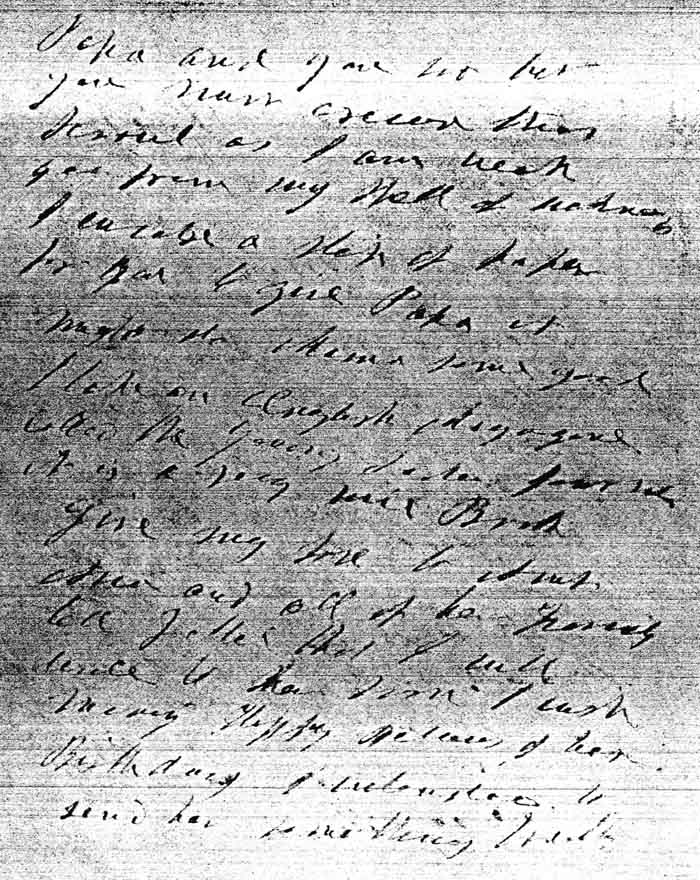
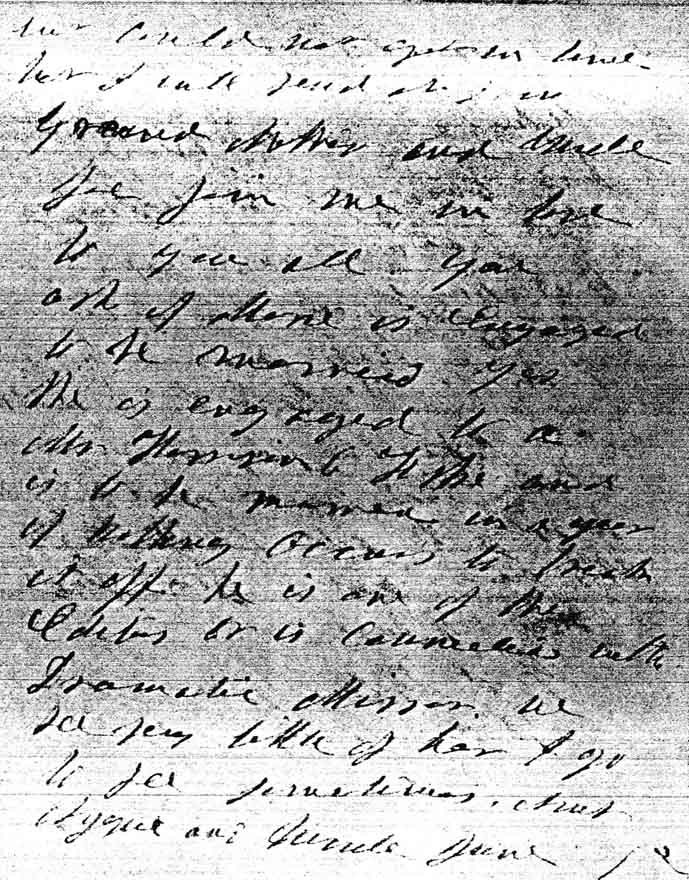
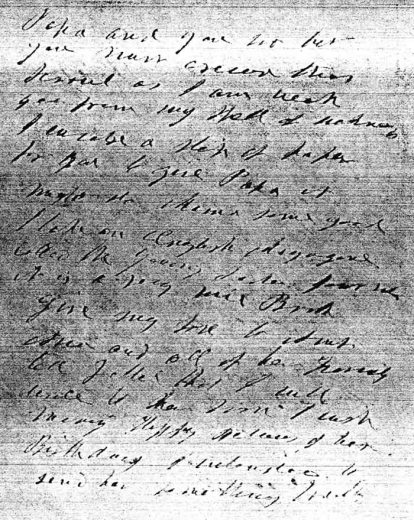
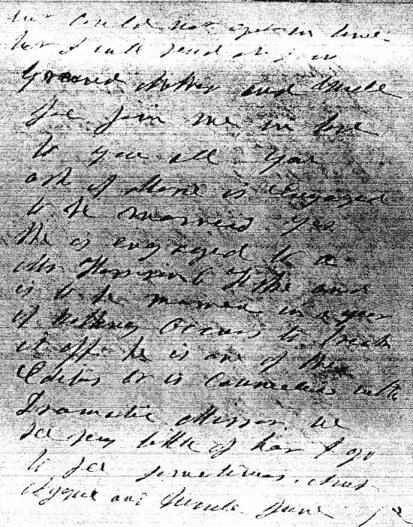
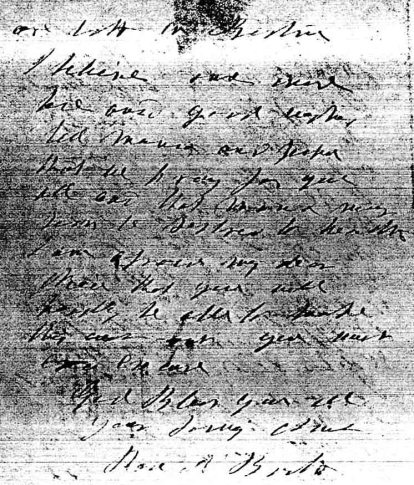
What follows is the partial transcription of Rosalie’s 1881 letter to Edwina, along with the poor quality images of each page. If you have any ideas for what missing words might be, or any corrections to the transcription thus far, please feel free to comment below. Perhaps, through teamwork, we can actually get this letter fully transcribed.
|
|
April 3rd 1881 Dear Edwina You must excuse me for not answering your letter sooner I have been sick for over a week but I am quite well now I’m so sorry for Mary I hope by the time this reaches you she will be ____ Grandmother got your letter last night she will answer ____ ____ ____ ____ for ____ ____
|
|
|
Papa and you let her
You must excuse this ____ as I am weak yet from my spell of ____ I enclose a slip of paper for you to give Papa it may do Mama some good I take an English ____ called The Young ____ ____ ____ it is a very nice B[roth or Brand] Give my love to Aunt Asia and all of her family Tell Dollie that I will write to her soon I wish Many Happy returns of her Birthday I intended to send her something ____
|
|
|
we could not get in time
____ I will send it soon Grand Mother and Uncle Joe join me in love to you all You ask if Marie is engaged to be married Yes she is engaged to a Mr. Harrison I believe and is to be married in a year if nothing occurs to break it off he is one of the Editors or is connected with Dramatic Mirror We see very little of her I go to see sometimes Aunt Aggie and Uncle June
|
|
|
are both in B(oston?)
I believe and there ____ ____ good ____ Tell Mama and Papa that we pray for you all and that Mama may soon be restored to health I am proud my dear Niece that you will happily be ____ ____ ____ they ____ ____ you ____ ____ ____ ____ God Bless you all Your loving Aunt Rose A. Booth
|
References:
Special thanks to Kate Ramirez for visiting The Players and for transcribing this letter.
Thanks to Jeff in the comments section for his input and help in transcribing.
John Surratt in The Days’ Doings
In December of 1870, John H. Surratt gave his first public lecture about his involvement with John Wilkes Booth and the plot to kidnap Abraham Lincoln. His hope was to turn his notoriety into a successful career as a lecturer. He gave speeches in Rockville, MD, New York, Baltimore and was scheduled to speak in Washington, D.C. when public outcry and his arrest put an end to dream vocation. In truth, his lecture did not provide any earth shattering revelations and the full text of his Rockville lecture can be read on Roger Norton’s Lincoln Assassination Research Site here.
Regardless, John Surratt’s lecture was newsworthy. It was particularly suited for an illustrated newspaper across the ocean called The Days’ Doings. The Days’ Doings was owned by Frank Leslie, the namesake of the American illustrated newspaper, Frank Leslie’s Illustrated Newspaper. Frank Leslie was a English immigrant and engraver whose real name was Henry Carter. While his American newspaper set the bar for quality for illustrated newspapers, The Days’ Doings was specifically made to fulfill the darker desires and interests of its readers. Joshua Brown, a historian on Frank Leslie and The Days’ Doings, said it best: “In short, with The Days’ Doings, Leslie could pursue a male readership with a repertoire of sex, scandal, sports, and violence that would have undermined the necessary propriety of his most valued publication.” As an example, I previously posted this cover from an issue of The Days’ Doings, which I think demonstrates the newspapers normal content:
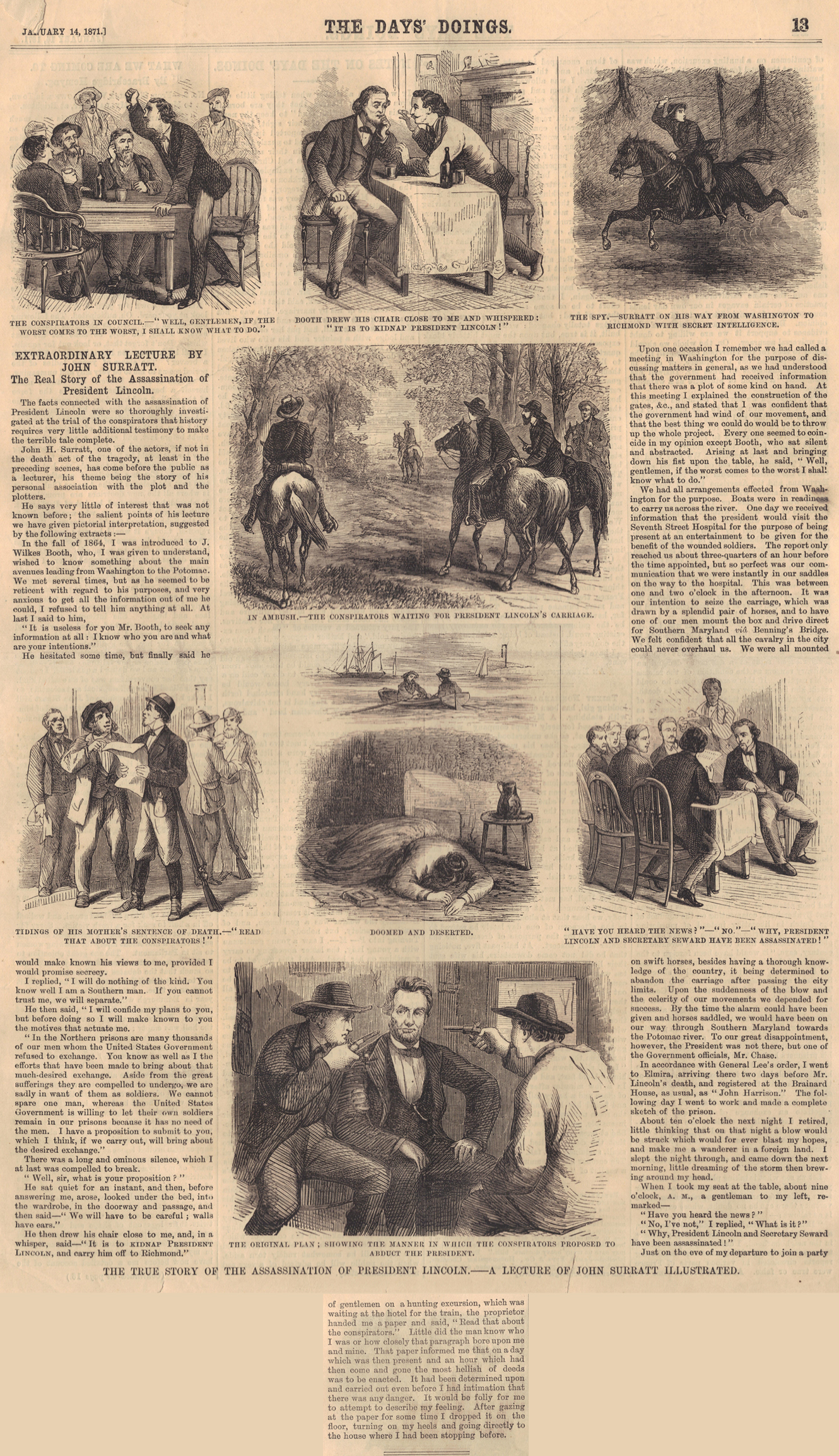
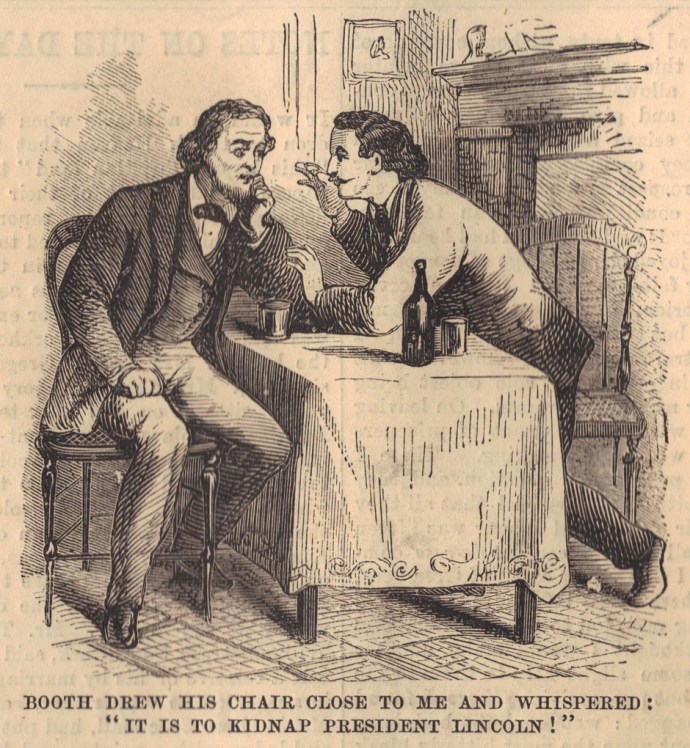
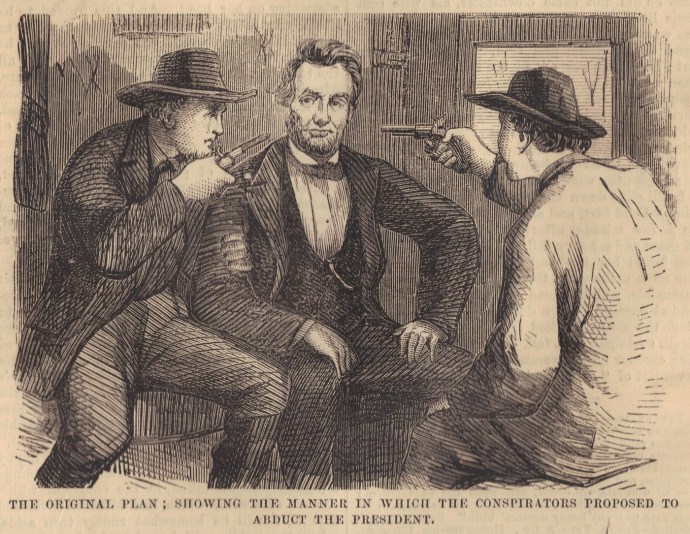
Publishing the words of John Surratt, an accomplice of the assassin, clearly fit the newspaper’s modus operandi. However, they found Surratt’s lecture too tame and lacking of drama. “He says very little of interest that was not known before,” the newspaper stated and, therefore, they supplemented the text by including several engravings: “The salient points of his lecture we have given pictorial interpretation”.
The article, which was published in The Days’ Doings on January 14th, 1871, contains a few abstracts from John Surratt’s lecture with far more space given to the lively “pictorial interpretations”:
References:
The Days’ Doings (January 14th, 1871) owned by Dave Taylor
Indiana Historical Society
The Days’ Doings: The Guilded Age in the Profane Pictorial Press by Joshua Brown
“That ghastly errand”
Some of the misinformation that exists out there regarding John Wilkes Booth’s death is the idea that the Booth family never identified his body. Conspiracy theorists use this incorrect idea to support their opinion that the man buried in the unmarked grave in the Booth family plot at Green Mount Cemetery is not Lincoln’s assassin. Like so much of the conspiracy theorists’ “evidence”, however, the truth easily dismisses the myths. The family did identify the body and they had no doubt in their minds as to who it was. In fact, during the time prior to Finis Bates’ conspiracy book about John St. Helen and David E. George, setting the record straight about the matter of identification didn’t even focus on John Wilkes. The following is a letter written by Edwina Booth Grossman, Edwin Booth’s daughter, to the editor of the Century Magazine, R. W. Gilder. In it, she requests that Gilder put something in print to set the record straight about which family member identified Wilkes’ remains. I find it humorous that, back then, the “controversy” was not about John Wilkes Booth’s body, but rather which Booth claimed him.
The Arlington
Washington, D.C.July 10, 1909
Dear Mr. Gilder,
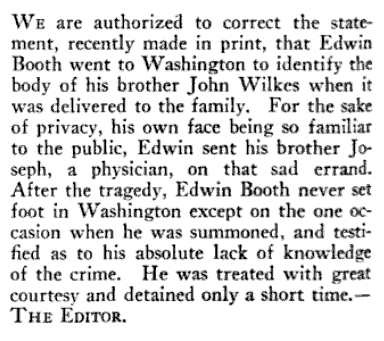
May I ask you to kindly correct a statement which has recently appeared in print viz, that my father went to Washington to identify the body of his brother John Wilkes when it was disinterred from beneath the Arsenal. I once asked my father if he had seen his brother’s body and he emphatically replied that he had sent his brother Joseph on that ghastly errand. This may not be of sufficient importance to the public at large, but as it means much to me, I am naturally anxious that a correct version of the incident be published. My father also told me that he never set foot in Washington since the day he was summoned thither by the authorities and courteously detained but a short time while giving testimony under oath as to his ignorance or knowledge of his brother’s crime. That having satisfied his inquisitors he was allowed to return at once to his broken hearted mother and to his home in New York. That is all the information I ever sought from my father on this painful subject.
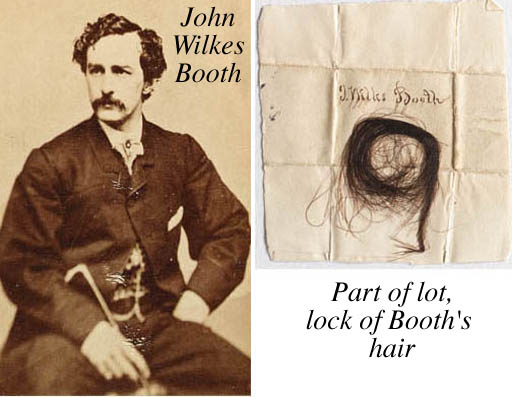
It may interest you to know that I found among my dear father’s private papers an envelope containing a lock of hair and a note on which were written the following lines:
“John Wilkes Booth’s hair cut by my brother on board the U.S.S. ‘Montauk’ at Washington, D.C., my brother William being in command of that vessel when Booth’s body was brought on board the ‘Montauk’.”
Signed
“Mary R Crowninshield”I have never heard of the lady in question and wonder if she is still alive! Perhaps you can inform me?
I am grateful that my beloved father is spared the anguish which the approaching Centenary of Abraham Lincoln would most assuredly have awakened in him. Although the tragedy of those awful days is scarcely within my recollection it has brought sorrow even unto the third generation and in these days of my enforced residence in Washington I am also sitting ‘within the shadow’
Believe me, dear Mr. Gilder
Most sincerely yours
Edwina Booth Grossman
Mr. Gilder fulfilled Edwina’s wishes and, in the April, 1909 edition of Century Magazine, at the end of an article about Edwin Booth and Lincoln, he published this note:
Also, back in 2000, this letter, along with the lock of Wilkes’ hair Edwina mentions, were sold at auction by Christie’s for $35,250.
References:
James O. Hall Research Papers
Century Magazine (April, 1909)
Christie’s
Dent’s Meadow 1-20-2014
Yesterday, I visited Loyola on the Potomac, the Jesuit Retreat House located in Faulkner, MD. Though I have been to the Retreat’s property several times in the past as part of the Surratt Society’s Booth Escape Route Tours and through my own arrangements, this was the first time that I have ever been inside of the Retreat House itself. I was graciously given a tour of the facility by the director as we discussed an upcoming “Boothie” project of mine. More on that will come later. After the very productive meeting, I walked down the trail that leads to the water’s edge. This, of course, is Dent’s Meadow, the point at which John Wilkes Booth and David Herold attempted to cross the Potomac River. For a refresher, here’s a video I shot discussing the location back in August:
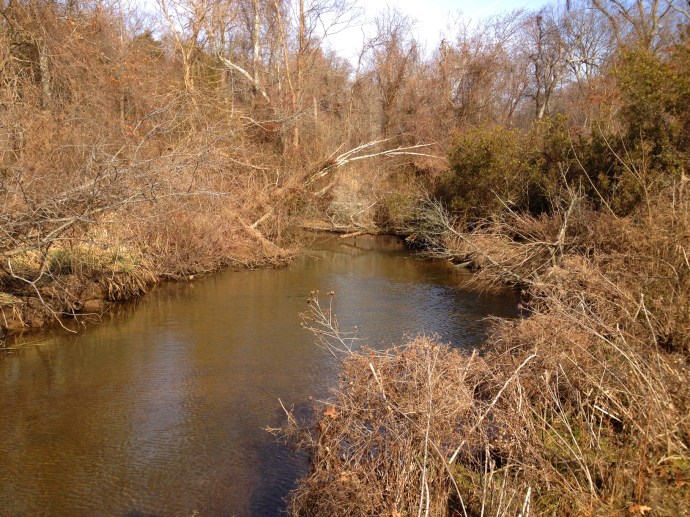
Though little has changed at the site since that video, there was less vegetation present due to the cold weather. So, I took the opportunity to make my way into some of the underbrush in order to take some pictures of the unnamed stream that Henry Woodland hid the boat in. Since it was low tide, there was plenty of beach and the mouth of the stream was quite small. Here are a few pictures I took yesterday:
I also took this panorama of the stream and then added the woodcut of Booth’s boat that appeared in Frank Leslie’s Illustrated newspaper. Click it to see it larger (and longer):
Lastly, back in August I wrote on a piece of driftwood the historical significant of the site. I was pleased to see that my homemade marker was still there:
Grover’s Theatre and the Lincoln Assassination
Ford’s Theatre was not the only theatre in Washington, D.C. visited by President Lincoln and his family. Here are some interesting facts about the National Theatre owned by Leonard Grover.
The rivalry between the Ford and Grover
There had been a friendly rivalry between Leonard Grover and John T. Ford ever since Ford opened his first theatre in Washington in 1861. The huge increase in population in Washington D.C. during the Civil War allowed both theatres, and their owners, to prosper. Still, the two men attempted to one up each other in their attempts to get a bigger piece of the pie. After the burning of Ford’s old theatre, he rebuilt, creating a smaller, but far more luxurious and comfortable theatre. This was at odds with Grover’s, whose theatre which was described as, “an ice vault in winter, and a sweatbox in summer”. Grover advertised his theatre as the capital’s only “Union” playhouse, highlighting John Ford’s more “Secesh” sentiments. Both houses had vied for Mr. and Mrs. Lincoln’s attendance on April 14th, 1865, but it was Ford’s Theatre, with Laura Keene’s Our American Cousin, that won the honor.
Tad Lincoln Attended Grover’s on April 14th
Unlike his parents, Tad Lincoln was more interested in seeing “Aladdin” at Grover’s Theatre on April 14th, 1865. It was there that poor Tad learned of his father’s assassination. Another individual who was attending Grover’s that night was Corporal James Tanner, a wounded Union veteran whose training in shorthand would prove invaluable later. Tanner described the moment when the news of Lincoln’s assassination reached the theatre:
“While sitting there witnessing the play about ten o’clock or rather a little after, the entrance door was thrown open and a man exclaimed, “President Lincoln is assassinated in his private box at Ford’s!” Instantly all was excitement and a terrible rush commenced and someone cried out, “Sit down, it is a ruse of the pickpockets.” The audience generally agreed to this, for the most of them sat down, and the play went on; soon, however, a gentleman came out from behind the scenes and informed us that the sad news was too true. We instantly dispersed.”
Tad, quite distraught over the shocking news about his father, was quickly removed from Grover’s and taken to the White House. White House doorkeeper, Thomas Pendel, recalled what happened when Tad returned home:
“Poor little Tad returned from the National Theatre and entered through the east door of the basement of the White House. He came up the stairway and ran to me, while I was in the main vestibule, standing at the window, and before he got to me he burst out crying, “O Tom Pen! Tom Pen! They have killed papa dead. They’ve killed papa dead!” and burst out crying again.
I put my arm around him and drew him up to me, and tried to pacify him as best I could. I tried to divert his attention to other things, but every now and then he would burst out crying again, and repeat over and over, “Oh, they’ve killed papa dead! They’ve killed papa dead!”
At nearly twelve o’clock that night I got Tad somewhat pacified, and took him into the President’s room, which is in the southwest portion of the building. I turned down the cover of his little bed, and he undressed and got in. I covered him up and laid down beside him, put my arm around him, and talked to him until he fell into a sound sleep.”
Leonard Grover Wasn’t in Town
At the time of the assassination neither John T. Ford or Leonard Grover, were at their namesake theatres. Each man owned or leased other theatres in other cities and were tending to business elsewhere. John T. Ford was in Richmond at the time of the assassination and Leonard Grover was in New York. After the news had reached Grover’s Theatre and the building had emptied, Charles Dwight Hess, the manager of Grover’s Theatre, sent a telegram to Leonard Grover in New York. Grover later recalled:
“On that eventful day I was in New York, busily getting ready for my approaching Easter season of opera at the Academy of Music. I had passed a laborious day and retired an early hour, at the old Metropolitan Hotel. I was soundly sleeping when a sharp rap at the door awoke me, and some one called, ”Mr. Grover, here’s a telegram for you.” Thinking it was the usual message from one of the theaters (for I was then managing a Philadelphia theater as well) which would simply convey the amount of the receipts of the house, I called back: “Stick it under the door.” But the rapping continued with vigor, and there were calls, ”Mr. Grover, Mr. Grover, please come to the door!”
I arose, hastily opened the door, when the light disclosed the long hall compactly crowded with people. Naturally, I was astonished. A message was handed to me with the request: “Please open that telegram and tell us if it’s true.” I opened it and read:
“President Lincoln shot to-night at Ford’s Theatre. Thank God it wasn’t ours. C. D. Hess.”
What follows is a copy of the Grover’s Theatre playbill that was used for the April 14th, performance of “Aladdin”.
The handwritten text at the top reads, “The night President Lincoln was shot at Fords Theatre. “Tad” Lincoln with his Tutor was with me at -“. Though the playbill is credited as belonging to Leonard Grover, we know Grover was not at his theatre at the time of the assassination. It is likely that this playbill was actually owned by Charles D. Hess, the manager of Grover’s who as present at theatre and shared the news with the audience.
The Assassination could have been at Grover’s Theatre
In April of 1909, two articles were published in Century Magazine which theorized that Lincoln still would have been assassinated even if he had attended Grover’s Theatre that night instead of Ford’s. For a wonderful recounting of this theory, please visit the corresponding page on Roger Norton’s Lincoln Assassination Research Site.
Booth carried Aladdin with him
When John Wilkes Booth was cornered and killed at the Garrett farm, the detectives thoroughly searched his person, removing any papers and objects they could find. Inside his small memorandum book (better known as his diary), they found five photographs. One of the photographs was of this woman:
Her name is Effie Germon and she was an actress friend of John Wilkes Booth. If you look at the playbill for Grover’s production of “Aladdin” you can find her name. She was the star of the night, portraying the eponymous Aladdin.
References:
Backstage at the Lincoln Assassination by Thomas Bogar
Thirty-Six Years in the White House by Thomas Pendel
“What if the Lincolns had attended the play at Grover’s Theatre” by Roger Norton
Lincoln’s Interest in the Theatre by Leonard Grover
“Lincoln and Wilkes Booth as Seen on the Day of the Assassination” by M. Helen Palmes Moss as printed in the Century Magazine (April, 1909).


Recent Comments