Julia Wilbur and the Saga of the Lincoln Assassination Conspirators

This is the second of two posts utilizing content gleaned from the diaries of Julia Ann Wilbur, a relief worker who lived in Alexandria, Virginia and Washington, D.C. during the Civil War. For biographical information on Julia Wilbur, as well as information regarding her diaries please read the first post titled, Julia Wilbur and the Mourning of Lincoln.


Witness to History: Julia Wilbur and the Saga of the Lincoln Assassination Conspirators

Source: Haverford College

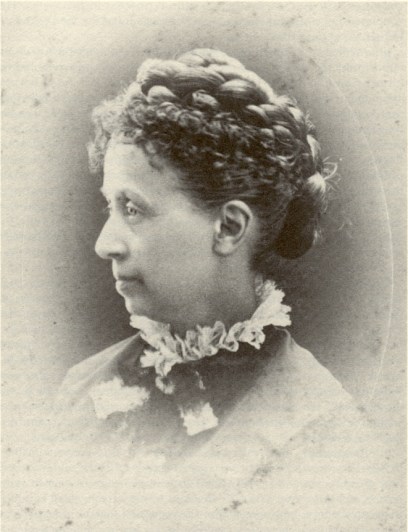
Julia Ann Wilbur, Source: Haverford College

When Abraham Lincoln’s assassination occurred on April 14, 1865, Julia Wilbur understood the impact it would have on the history of our country. When not working to provide relief to the thousand of newly freed African Americans residing in Alexandria and Washington, D.C., Julia Wilbur was a student of history. She traveled far and wide to visit places of historical importance, relished exploring the old burial grounds of a city, and found instances to mingle with those who were shaping her times. Therefore, she not only took the time to be a part of the mourning events for Abraham Lincoln, but she also went out of her way to document and even involve herself in the saga of the Lincoln assassination conspirators. The following are excerpts from Julia Wilbur’s diaries detailing her interactions with the assassination’s aftermath.

Reporting the News

Like many citizens around the country, Ms. Wilbur took to her diary to report the latest news about the hunt for Booth and his assassins. Sometimes the news was good. Other times, Ms. Wilbur reported on the gossip that was on the lips of everyone in Washington.

April 15, 1865:

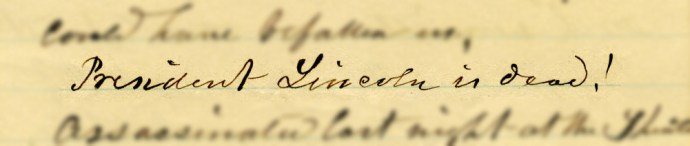
“President Lincoln is dead! Assassinated last night at the theater shot in the head by a person on the stage. The president lingered till 7 this A.M. so all hope is over. And Secretary Seward had his throat cut in bed in his own house, but he was alive at the last despatch. It is said an attempt was made on Sec. Stanton but he escaped. Many rumors are afloat, but the above is certain.

…Evening. Sec. Seward is comfortable, & may recover, his son Frederick is in a very critical condition, his son Clarence has only flesh wounds & is able to be about the house. There is a report that Boothe has been taken; that his horse threw him on 7th st. & he was taken into a house.— There is no doubt that it was intended to murder the President, the Vice Pres. all the members of the cabinet and Gen. Grant. & that the managers of the theater knew of it.”

April 16, 1865:

“Two Miss Ford’s were at the Theater at the time of the murder.”

[Note: These Miss Ford’s appear to be friends of Ms. Wilbur’s and unaffiliated with the Fords who owned Ford’s Theatre]

April 17, 1865:

“About noon we saw people going towards G. on the run. & we were told that two men had been found in a cellar dressed in women’s clothes. & it was thought they were the murderers, Miss H. & I walked up that way. They are probably deserters. We met them under guard; they were guilty looking fellows.

…We passed Seward’s House. A guard is placed all around it. & on the walk we were not allowed to go between the guard & the house. He was not told of the President’s death until yesterday. He seems to be improving. No news in particular. No trace of the murderers.”

Wilbur diary no trace of the murderers
April 18, 1865:

“Mr. Seward is no worse & Mr. F. Seward is improving.”

April 19, 1865:

“When Frances got ready about 12 M. we went out. (all about are posted notices, “$20,000 reward for the apprehension of the Murderer of the President.”)”

April 20, 1865:

“Numbers of persons have been arrested. but Booth has not been taken yet. Ford & others of the Theater have been arrested. The Theater is guarded or it would be torn down. If Booth is found & taken I think he will be torn to pieces. The feeling of vengeance is deep & settled.”

April 21, 1865:

“I went around by Ford’s Theater today. It is guarded by soldiers, or it wd. be torn down. There is great feeling against all concerned in it.— Mr. Peterson’s House opposite where the President died is an inferior 2 storybrick,—but the room in which he died will be kept sacred by the family. A number of persons have been arrested & there are many rumors; but Booth has not been taken yet.— Mr. Seward & son remain about the same.”

April 26, 1865:

“Report that Booth is taken.”

Learning of Booth’s Death from an Eyewitness

One of the more remarkable things in Ms. Wilbur’s diary is how she recounts the details of Booth’s capture and death. On April 27th she is able to give specifics of Booth’s death when such details did appear in papers until the next day. The reason for this is because Ms. Wilbur was able to hear the story firsthand from one of the soldiers of the 16th New York Cavalry, Emory Parady.

Pvt. Emory Parady in his later years

Pvt. Emory Parady in his later years

April 27, 1865:

“Booth was taken yesterday morning at 3 o clock, 3 miles from Port Royal on the Rappac., in a barn, by 25 of 16th. N.Y. Cav. & a few detectives. He was armed with 2 revolvers & 2 bowie knives & a carbine 7 shooter, all loaded. Harrold, an accomplice was with him. Neither wd. surrender until the barn was fired. Then Harrold gave himself up. & when Booth was about to fire at some of the party, he was shot in the head by Sargt. B. Corbett, & lived 2 ½ hrs. afterwards. He was sewed up in a blanket & brought up from Belle Plain to Navy Yd. in a boat this A.M. One of the capturers, Paredy, was here this P.M. & told us all about it.”

Collecting Relics

Julia Wilbur was fond of acquiring relics and would occasionally display her collection to visiting friends. The events of April 14th, motivated Ms. Wilbur to acquire some relics of the tragic event.

April 20, 1865:

“I purchased several pictures of the President, also Seward’s.

…Miss Josephine Slade gave me a piece of a white rosette worn by one of the pallbearers. Then Mrs. C. & I went to Harvey’s where the coffin was made. & obtained a piece of the black cloth with wh. the coffin was covered & pieces of the trimming. The gentleman who was at work upon the case for the coffin was very obliging & kind. This case is of black walnut, lined with black cloth, & a row of fringe around the top inside, I have also a piece of this box.”

April 21, 1865:

“Called on Mrs. Coleman. Then we went to Mr. Alexander’s & got some pieces of the cloth which covered the funeral Car. Then we saw an artist taking a Photograph of the car. which stood near the Coach Factory where it was made. We went there & Mrs. C. took of pieces of the cloth & alpaca. & a young man told us the Car would be broken up to day & he would save us a piece.

“…Then I went out again & obtained a board from the Funeral Car, which a workman was taking to pieces. & also some of the velvet of the covering. I intend to have this board made into a handsome box. & will make a pin cushion of the velvet.”

April 22, 1865:

“Went to see Mrs. Coleman. she gave me some of the hair of President Lincoln.”

May 2, 1865 (in Philadelphia):

“In all the shops are pictures of the President, & there are some of Booth.”

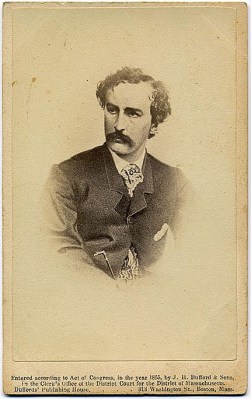
Booth drawing CDV 1865

October 12, 1865:

“Called at Ford’s Theater. got relic.”

October 18, 1865:

“Then Mrs. B. went with me to Ford’s Theater & we each obtained from Mr. Kinney who has charge of the building, a piece of the Presidents Box. The wood work where his knees rested when he was shot.”

A Visit to Richmond

Ms. Wilbur temporarily departed Washington in mid May of 1865. During that time she traveled to Richmond, with side trips to Petersburg and Appomattox, to provide relief work for the newly freed African Americans. Diary entries during her time in Richmond lament the poor living conditions of the black citizens and also discuss her own experiences in the city. One of my favorite anecdotes from that period is Ms. Wilbur’s recounting having tea with a family of free African Americans.

May 19, 1865:

“Took tea by invitation at Mr. Forrester’s. Quite a company. We drank from Jeff. Davis’s tea cups, eat with his knives & forks & eat strawberries & ice cream from his china saucers— I sat in the porch & looked at Jeff’s house not many rods distant, & tried to realize that I was in Richmond— The morning of the evacuation people fled & left their houses open. goods were scattered about the street, & Jeff’s servants gave this china to Mr. Forrester’s boys. That morning must have been one long to be remembered by those who were there. All night long there was commotion in the streets. Jeff. & his crew were getting away with their plunder.”

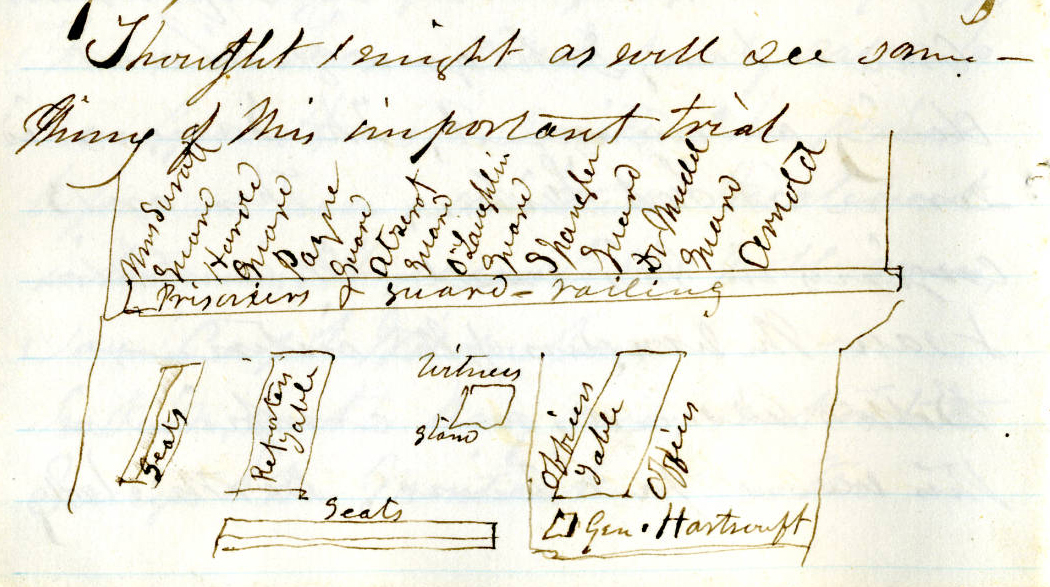
“Thought I might as well see some thing of this important trial”

Admission to the Conspiracy Trial

Ms. Wilbur returned to Washington, D.C. in mid-June.  Once back home, she quickly resumed her habit of engrossing herself in the historical proceedings happening around her. In June of 1865, such historical proceedings could only be the trial of the Lincoln conspirators. Before attending the trial however, Ms. Wilbur first visited the conspirators’ former site of incarceration.

June 17, 1865:

“In P.M. went to Navy Yard. Went on to the Saugus & the Montauk.

…The Saugus weighs 10 hundred & 30 tons, draws 13 ft. water & its huge revolving turret contains 2 guns wh. carry balls of 470 lbs. It is 150 ft. in length, pointed fore & aft & its 83 deck & sides plated with iron. The turret, pilot house— smokestack & hatchways are all that appear on deck & in an engagement not a man is visible. It has been struck with heavy balls & deep indentations have been made on the sides of the turret. Once a heavy Dahlgren gunboat during an engagement, The Saugus did service at Fort Fisher.— There are 13 engines in this vessel.

We went below & saw the wonders of the interior. Booth’s associates were confined on this vessel for a time. Booth’s body was placed on the Montauk before it was mysteriously disposed of.”

Then, on June 19th, Julia Wilbur attended the trial of the conspirators:

“At 8 went for Mrs. Colman & got note of introduction to Judge Holt from Judge Day & proceeded to the Penitentiary.

Thought I might as well see some thing of this important trial.

Mr. Clampitt read argument against Jurisdiction of Court by Reverdy Johnson.

It was very hot there. Mrs. Suratt was sick & was allowed to leave the room & then they adjourned till 2, & we left. Mrs. S. wore a veil over her face & also held a fan before it all the while.

Harold’s sisters (4) were in the room. The prisoners excepting Mrs. S. & O’Laughlin appeared quite unconcerned. They are all evidently of a low type of humanity. Great contrast to the fine, noble looking men that compose the court.”

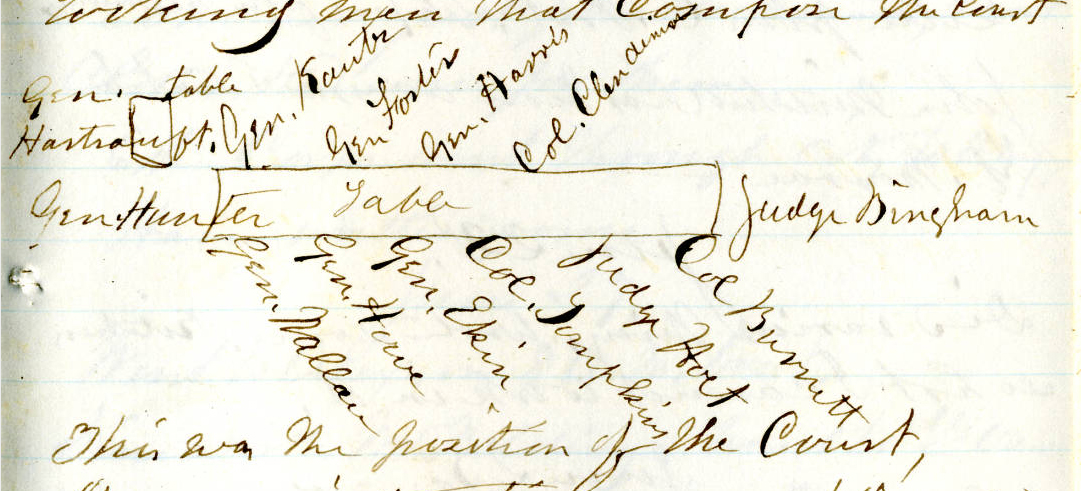
Ms. Wilbur’s diary entry concerning the courtroom is valuable not only due to the descriptions she gives of Mrs. Surratt and Michael O’Laughlen, but also because she took the time to sketch the layout of the court when she got home:

Wilbur diary Courtroom layout 1

Wilbur diary courtroom layout 2

“This was the position of the court.

It was an interesting scene, & I am glad I went, although it is so far, & so hot.”

These diagrams are fascinating and help us solidify the placement of the conspirators and members of the military commission in the court room.

Reporting on the Execution

It is likely that the excessive heat in the courtroom convinced Ms. Wilbur that she did not need to attend the trial again.  However, she did keep up with the proceedings and reported on the sentencing and execution of the conspirators (which she did not attend).

July 6, 1865:

“The conspirators have been sentenced. Payne, Harold, Atzerott & Mrs. Surratt are to be hung to morrow. O’Laughlin, Mudd, & Arnold to be imprisoned for life at hard labor, & Spangler to State prison for 6 yrs.”

July 7, 1865:

“Hottest morning yet. Martha ironed, & the whole house has been like an oven. It was too much for me. I could not work.— The days pass & nothing is accomplished— This eve. F & I took a walk.

— About 1 P.M. The executions took place in the Penitentiary Yard. A large number of people witnessed them. They were buried within a few feet of the gallows. It is all dreadful, but I think people breathe more freely now. They are convinced that Government means to punish those who deserve it. Jeff. Davis friends may feel a little uneasy hereafter.”

Facesofdeath

Unfortunately, it does not appear that Ms. Wilbur had any reaction to the death of Mary Surratt, a middle aged woman like herself.  In fact the very next day Ms. Wilbur mentions walking past Mrs. Surratt’s house without any commentary.

July 8, 1865:

“Then passed Mrs. Surratt’s house on the way to Mr. Lake’s, where we had a pleasant call.”

It’s likely that Ms. Wilbur agreed with Mrs. Surratt’s fate as Ms. Wilbur was very against those who held “secesh” sympathies.

Attending Henry Wirz’ Trial

Julia Wilbur continued her habit of attending historic trials in the city, by attending the trial of Andersonville prison commandant, Henry Wirz. After Henry Wirz’ execution she once again invoked the Lincoln conspirators:

November 11, 1865:

“Called at Mr. B’s office & saw Mr. & Mrs. Belden. Heard particulars of the Execution yesterday. Mr. B. gave me an Autograph Note of Henry Wirz, a lock of hair & a piece of the Gallows. I came only for the autograph. His body was mutilated after death, Kidneys were divided among 4 surgeons. Another person had a little finger, obtained under pretense of Post Mortem examination. Remainder of body buried in Yard of the Penetentiary near Atzerot. All this, & we claim to be civilized & human! If his body had been given up to his friends, it would be torn to pieces by the infuriated people.”

As we know Henry Wirz mingled with the bodies of the conspirators until 1869, when Andrew Johnson allowed the bodies of all those executed to be claimed by family. Wirz was buried in Mt. Olivet Cemetery, the same resting place of Mary Surratt.

Piece of Henry Wirz' Old Arsenal coffin in the collection of the Smithsonian's American History Museum.

Piece of Henry Wirz’ Old Arsenal coffin in the collection of the Smithsonian’s American History Museum.

In the Interim

By 1866, John Wilkes Booth and four of his conspirators were dead. The other four tried at the trial of the conspirators were serving sentences at Fort Jefferson off the coast of Florida.  As such there was a lull for a time during which Julia Wilbur reported next to nothing revolving around the events of April 14, 1865. Only a few brief mentions exist in her diary of 1866 and early 1867.

April 14, 1866:

“Anniversary of a sad day.

Departments have been closed, & flags are at half mast. No other observance. A year ago today I was in Alex. & could not get away. It was a sad time.”

April 28, 1866:

“Went to the Army Medical Museum. Many interesting in this Museum. Called on Mrs. Smith. She is ill. Went into Ford’s Theater. Not finished yet. It is intended for archives relating to the War of the Rebellion. The sad associations connected with it will make it an object of interest for generations to come.”

April 15, 1867:

“Anniversary of Death of Abraham Lincoln! Two years have passed rapidly away.”

On visiting the National Cemetery in Alexandria on May 12, 1867:

“There is also a monument to the memory of the 4 soldiers who lost their lives in pursuit of Booth the Assassin. They were drowned.”

Upon seeing Secretary War Edwin Stanton on May 27, 1867:

“Saw Sec. Stanton today, but how unlike the Sec. of War that I saw in his office in Oct. ’62. He was then in the vigor & prime of manhood. Hair & beard dark & abundant. But 5 years of War have made him 20 years older. He is thin, sallow, careworn. His locks are thin & gray. I never saw a greater change in any man in so few years.”

June 21, 1867:

“On return went into Ford’s Theater to see the Medical Museum.”

The Escaped Conspirator

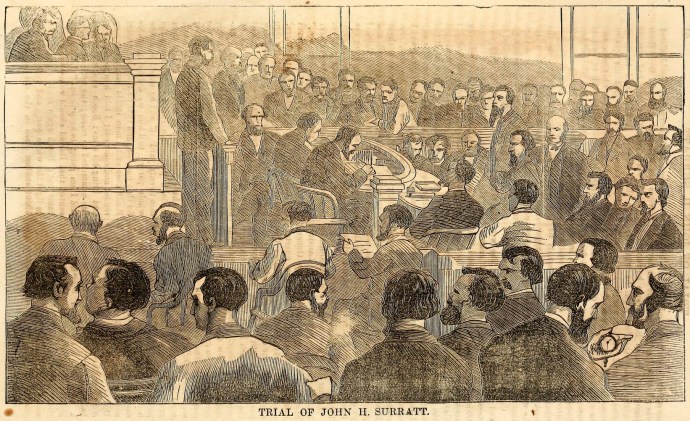
In late 1866, John H. Surratt, Jr. was finally captured after more than a year and a half on the run. Surratt had been an active member of John Wilkes Booth’s plot to abduct President Lincoln and take him south. His arrest in Alexandria, Egypt and extradition to the U.S., set in the motion the last judicial proceedings relating to Abraham Lincoln’s death.  Once again, Ms. Wilbur would be sure to take part in this event, attending John Surratt’s trial twice and providing some wonderful detail of the courtroom scene.

February 18, 1867:

“(Surratt arrived in Washington today, is in jail)”

June 19, 1867:

Surratt Trail Ticket

“Miss Evans & I went to Mr. B’s & he went with us to City Hall & got tickets of admittance for us to the Court Room. 6 ladies present besides ourselves. Surratt was brought in at 10, & the court was opened. Judge Fisher presiding. Witnesses examined were Carroll Hobart. Vt.; Char. H. Blinn, Vt.; Scipano Grillo, Saloon keeper at Ford’s Theater; John T. Tibbett mail carrier, & Sergt. Robt. H. Cooper. Examined by Edwards Pierpoint of N.Y, Atty, Carrington.

Surratt sat with his counsel, Bradly, he, a pale slender, young man, seemed to take an interest in all that was said. His mother’s name was mentioned often, & Tibbett said he had heard her say “she wd. give $1000 to any body who would kill Lincoln.” I could not feel much sympathy for him. They must have been a bad family.

But I think Surratt will never be punished. The Government will hardly dare do it after releasing Jeff Davis.

The room outside the bar was crowded, & this is the first day ladies have been seated inside the bar.

Miss Evans was never in a Court before, & we were both much interested.”

June 21, 1867:

“Frances & Miss Evans went to Surratt’s trial”

June 27, 1867:

John Surratt Trial Drawing

“Rose early. Worked till 9 A.M. Then went to Surratt’s trial at City Hall. Courtroom crowded. Judge Fisher presiding. Witnesses, 2 brothers Sowles, & Louis Weichman. He last boarded with Mrs. Surratt, was intimate with J.H. Surratt. His testimony was minute but of absorbing interest. Examined by Edwards Pierpoint. Bradly & Merrick, counsel for prisoner, are evil looking men.

Surratt looked less confident today than when I saw him a week ago yesterday.

When they were removing the handcuffs he breathed hard. Took his seat looking a little disturbed. His brother Isaac soon came & took a seat by him & they talked & laughed a few minutes.

Isaac looks like a hard case & quite unconcerned. It is very evident that J.H. Surratt was a conspirator & that the family were bad.

Wilbur diary Surratt was a conspirator

I would like to be here at the close of the trial, and hear the summing up.”

Unfortunately, Ms. Wilbur did not get her wish to witness the close of John Surratt’s trial. She was visiting back home near Avon, New York when the trial ended.

August 10, 1867:

“Papers from Washington.

Argument in Surratt case finished. Jury do not agree.”

August 12, 1867:

“Finished reading for Father Mr. Pierpointt’s argument in Surratt case to father. Very able argument.”

August 16, 1867:

“Jury discharged, could not agree, ([illegible]). Surratt remanded to jail.

Bradley has challenged Judge Fisher. Much excitement in W[ashington].”

Epilogue

While the period of assassination events effectively ended with the trial of John Surratt, Ms. Wilbur maintained diaries for the rest of her life.  There could be more passages in her diaries commenting on or recalling those tragic days. As stated in the prior post about Julia Wilbur and the Mourning of Lincoln, Julia Wilbur’s diaries have only been transcribed for the period of March 1860 until July of 1866. All entries in this post dated beyond July 1866, were discovered by meticulously reading through the digitized pages of Ms. Wilbur’s diaries located here. There are still many discoveries to be made in Julia Wilbur’s diaries and I encourage you all to follow Paula Whitacre’s blog to read more about the work being done on Julia Wilbur.

References:
Paula Whitacre’s Blog on Julia Wilbur
Transcriptions of Julia Wilbur’s Diaries from Alexandria Archaeology
Digitized pages of Julia Wilbur’s Diaries from Haverford College

Categories: Uncategorized | Tags: , , , , , , , , , , , , , , , , , | 16 Comments

Julia Wilbur and the Mourning of Lincoln

Julia Ann Wilbur was born in Avon, NY on August 8, 1815. She was brought up in a middle class Quaker household and became a teacher in the Rochester school system. In 1862, at the age of 47, Wilbur was asked by the Rochester Ladies Anti-Slavery Society to go south as a relief worker to aid escaped slaves. She relocated to Alexandria, Virginia where she distributed food, clothing, and supplies to the newly free. She also set up schooled, organized orphanages, and solicited for financial support for her projects from the elites in Alexandria and nearby Washington, D.C. In February of 1865, she moved to Washington, D.C. and would live there until her death in 1895. In the post Civil War years, Wilbur would work for the Freedmen’s Bureau before spending more than 30 years as a clerk in the Patent Office.

Source: Haverford College

Julia Ann Wilbur, Source: Haverford College

In addition to her fine work as a relief worker and, later, suffragette, Julia Wilbur was a detailed diarist. She kept journals spanning practically her entire life.  Not only would she keep small daily journals which allowed for a few lines per day, but Wilbur also maintained diaries of her own construction which allowed her the freedom to write as much as she desired for a set day. The originals of her diaries are housed at Haverford College in Haverford, PA, donated there by Wilbur’s great-nephew, a professor at Haverford.

Wilbur’s small daily diaries were initially microfilmed and sent to other institutions after their donation in the 1980’s. However, her larger, self constructed diaries containing far more detail were not “re-discovered” until about 2013. Using funds donated by Alexandria Archaeology and the group, Friends of Alexandria Archaeology, Haverford College scanned and digitized the large format Wilbur diaries from 1860 – 1873. From there, the Friends of Alexandria Archaeology group, headed by Wilbur researcher Paula Whiteacre, transcribed Wilbur’s 1860 – 1866 diaries into a searchable format.

At this past weekend’s Society for Women and the Civil War conference, Ms. Whiteacre presented an excellent history of Ms. Wilbur and the plethora of historical insight that is to be gained from her diaries.  After consulting Julia Wilbur’s diaries for myself, I discovered that Julia Wilbur had many interactions with aspects of Lincoln’s assassination. Two different pieces have been composed utilizing the Wilbur diaries. These piece contains the details of Julia Wilbur’s diaries in which she recounts the news of Lincoln’s assassination and subsequent funeral events in D.C.. A second post recounts her insight on the saga of the Lincoln assassination conspirators.


Witness to History: Julia Wilbur and the Mourning of Lincoln

The following are excerpts from the diary of Julia Wilbur, detailing the news of Lincoln’s assassination and the memorial events that took place in Washington, D.C. following his death.

Alexandria Reacts to Lincoln’s Death

Though Julia Wilbur had moved to Washington, D.C. in February of 1865, she was not actually in the city on the night of Lincoln’s assassination. She had traveled and spent the night at her old home of Alexandria. Therefore, on the morning of April 15th, Julia Wilbur witnessed how the news of Lincoln’s assassination settled over Alexandria:

“Alexandria VA. Apr. 15 th
93 Cameron St. 10 o clock A.M.

Oh. the bells are giving forth the saddest sound that I ever heard. Tolling, yes, tolling for what seems to us now as the greatest calamity that could have befallen us.

Wilbur Diary Lincoln is DeadPresident Lincoln is dead! Assassinated last night at the theater shot in the head by a person on the stage. The president lingered till 7 this A.M. so all hope is over. And Secretary Seward had his throat cut in bed in his own house, but he was alive at the last despatch. It is said an attempt was made on Sec. Stanton but he escaped. Many rumors are afloat, but the above is certain.

No boat not even a [?] is allowed to leave Alexandria & even Gen. Briggs was not allowed to go on the train this morning. I now regret exceedingly that I did not return to W[ashington, D.C.]. last night, but I remained to see the illumination. But there are precious few Union folks here if the houses of all such were illuminated last night. I never saw a city so dark before not even the lamps were lighted. There were to be fireworks on the cor. of King & Washington, but they were all exploded at once accidentally; & as we walked that way people were gathering in every direction, some were hurt. Hallowell Hosp. & hosp. opposite are illuminated very handsomely, & there was a bonfire in King St. & light appeared from a few dwellings. Many of the houses were entirely closed but through the crevices of others we could see people inside.

I was very, very tired last night. I slept with Mrs. Fish. About 6 o’clock this morning the sad news came to us. I could not believe it. Capt. Gale of Gen. Slough’s staff came from W. in the night. Every soldier is on duty now, & none are to be seen in the city. No persons are allowed to leave the city. It was raining hard but I thought I must go on the 8 o’clock boat, & did not learn till I had nearly reached the wharf that no boats were allowed to leave. I then came to see Mrs. Belding. Found her and Mr. B. at breakfast. Their smiling faces, looked out of place to me. They had not yet heard the bad news. Mr. Baker has been to the Telegraph office and learned that the President died at 7 this morning. I have been so fortunate as to get a paper, & all the particulars that have transpired are given. Mr. Belding has just come in and & says the secesh are being arrested. The military authorities have been very lenient with secesh lately. No passes have been required for a month or more.

Mr. B. says a wood train has just come in on the Orange & Alex. road, & report a large number of rebel cavalry at Burke’s Station. These are probably some of Lee’s men & horses that were given up by Grant or that Grant allowed Lee to retain. Mrs. Belden is not able to go out, I helped Mr. B. fix drapery over the windows. I called at Magnolia House. Mrs. P. & Mr. G. had just procured some black cambrick & were arranging it over the bow window.

…The Soldiers go to every secesh house & make the occupants put something black on the doors or windows. Then went to Dangerfields, & told them to put crape on the door, & after they left it was taken off. The soldiers went back & made them put it on again & told them if they took it off they would pull the house down. Then Dangerfield wrote to Gen. S. to ask to be excused from doing this, but the Gen. sent a piece of black cloth to him & said it must be put over the door. It would have been better if the soldiers had waited till all the Union folks had draped their houses, & then obliged the secesh to do the same, but they could not wait for orders. The soldiers have shot 2 or 3 men today expressing joy that Lincoln is dead.—The Mayor, Mr. Ware said to Mrs. Dogan today that “Lincoln died serving the devil”. This reached Gen. S. & he had an interview with Ware & there were some sharp words.

Evening. Sec. Seward is comfortable, & may recover, his son Frederick is in a very critical condition, his son Clarence has only flesh wounds & is able to be about the house. There is a report that Boothe has been taken; that his horse threw him on 7th st. & he was taken into a house.— There is no doubt that it was intended to murder the President, the Vice Pres. all the members of the cabinet and Gen. Grant. & that the managers of the theater knew of it.”

“Alexandria. Sunday Apr. 16.

Very bright. windy. Slept with Mrs. Fish & took breakfast with her this morning. Then I went to call on Aunt Lucinda. She was the picture of sorrow. She said she was all tore up, could’nt work, could’nt do any thing. She would put black on her house if it “took the last cent in her pocket.” I went around among the houses of the colored people. It was a touching sight to see a piece of black cloth on every cabin, shanty & shed. On some a simple bit of woolen or cotton, but the best they had. A young man spoke to me & the tears came into his eyes & said he, “I would rather have been shot myself than to have had our President killed. I would rather lose all my relations, I would rather lose my mother than to have him killed who sustained the country.” I am not ashamed to say that I wept with him. The colored people feel it so deeply. Every face is sad. They realize that they have lost a friend. They are in the habit of calling him Uncle Sam, & they now speak of “Uncle Sam’s being killed,” of Uncle Sam’s being shot by secesh.”— I think every dwelling house in the city has more or less black upon it. I called on Mrs. Dogan & she repeated to me what the Mayor said. She is so indignant.— I went with Louisa J. to Grace Ch. Hos. & to L’Ouverture. They all feel so deeply. They cannot express their feelings any more than we can. We all feel that we have lost; personally have lost a friend. There is no consolation to offer. We all suffer alike.”

Washington Reacts to Lincoln’s Death

On the afternoon of April 16th, Ms. Wilbur was allowed to catch a train into D.C. She compares how the reaction of Lincoln’s death was different between the two cities:

“How differently W. looks from Alex. only part of the houses are draped. People are going to & fro. talking & laughing. The air seems full of treason.

… One house on the Avenue was illuminated as soon as the President was shot, Officers went to the house but as the occupants were only women they were not arrested. Too bad. They should not have stopped to think whether they were men or women. Numbers have been heard to say that they are glad, that Lincoln ought to have been shot years ago. & they have not been arrested either. They would’nt stand much chance in Alex.”

“Monday, Apr. 17th, 1865,

… The houses in Georgetown are very generally hung with black. All the cabins & shanties of the colored people are. It was a nice ride, & it is refreshing to see green fields. & flowers, & trees beginning to look green. We brought home violets, houstonia & azalias. F. & I took walk on Avenue as far as President’s House. The pillars are covered with black, Mounted guards at the street gates allow no one to enter the grounds. — It looks like a sepulcher

Before this black never meant anything to me. I believe in it on this occasion. We passed Seward’s House. A guard is placed all around it. & on the walk we were not allowed to go between the guard & the house.

Wilbur diary Seward not told of Lincoln's death

He was not told of the President’s death until yesterday. He seems to be improving. No news in particular. No trace of the murderers…”

Viewing Lincoln’s Body in the White House

Julia Wilbur was one of the individuals who viewed Abraham Lincoln’s body as it lay in state in the White House:

“Tuesday, Apr. 18, 11 A.M.

We have taken a last look at the mortal remains of Abraham Lincoln.

The public will be admitted to day from half past 9 till 5 P.M.— Frances & I went shortly after 9. People were already waiting at the gates, & a line of 2 abreast was formed on the walk in front of the House & were to enter by the western gate. We were told that unless we fell into line we wd. not be likely to go in at all. So we placed our selves in the rear of several hundred people & waited for the time. This arrangement is very proper, for all is orderly & quiet & all; black & white have an equal chance. At 40 min. after 10 the gate was opened, Officers are placed all along the line. There are no black hangings until we reach the E. Room. We passed through the ante room, the hall & the Green room.

The windows of the East Room are draped with black berege[?]. The frames of the mirrors are draped with the same & the mirrors are covered with white berege, & all the gilding is shrouded in black. Chandelier also.

The catafalco is in the center of the room. It is 11 ft. high. 16 ft. deep & 10 ft. wide. The height of the base or step around the platform is 8 inches. The step is one foot in width, 2 ft. 6 in. higher is the surface upon which is placed the coffin, over this is a curved Canopy. The inside is lined with white satin fluted. The top is covered with the finest alpaca & festooned. The surface of the dais is covered with black broad cloth, bordered with heavy silk fringe. The Coffin is mahogany lined with lead & covered with black broad cloth, festooned & fastened with silver tacks, the edge has silver braid & tassels, each side has 4 massive handles & at the head & foot there are stars.

On the top is a row of silver tacks on each side. A silver plate encircled by a shield. The inside of the face lid is raised with white satin & trimmed with black & white braid & fastened in each corner with 4 silver stars. The rest of the Coffin is lined with box plaited satin. The pillow is of fine white silk.

The embalmed body is dressed in a full suit of black.

Wilbur diary Lincoln's face

His face is very white, but wears a natural expression. on the platform & surrounding the entire Coffin is a wreath of white flowers & evergreens.

We walked slowly through the room but were not allowed to stop a moment. If I cd. have stopped one minute! But the scene is one never to be forgotten although so hastily viewed.

The remains will be taken to the Capitol tomorrow. & remain there until the next morning. They are to be removed to Illinois.

When we came out on to the sidewalk the line of people extended to the corner near the State Dept. Colored people were mixed all the way through. & I heard nothing said that was out of place, all wore an air of seriousness. & no loud words were heard.

12 o’clock, Miss Moore has just come in. She succeeded in seeing the President, but was almost crushed in doing so. The pressure was immense. The Navy Yard Employees came in a body (about 2000) & they were allowed to go in. & the line of people on the side walk had to wait. There was some expressions of dissatisfaction. & some disturbance. They say the line now extends below the Treasury building.

Frances & I were fortunate in going as early as we did. There was no crowd & no pressure.

…Mr. Seward is no worse & Mr. F. Seward is improving

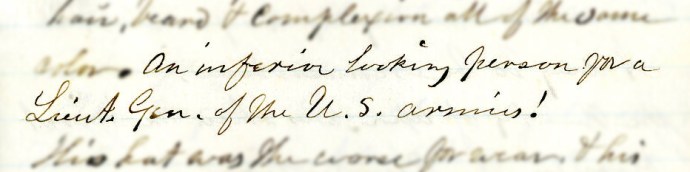
8 P.M. — warm. Went to Miss Flagler’s to dinner, & then walked down the Avenue to see the crowd at the gate waiting to go in & see the President. The Illinois delegation was pressing in & then the gate was shut, leaving on the outside one of the most democratic assemblages that I ever saw. There were not less than a half doz. Brig. Generals; & Majors, Colonels & Lieut. Cols. in abundance, & ladies with them all waiting for admittance. Some of these pushed through to the gate. Gen. Rawlins Chief of Gen. Grant’s staff was one of them. Some of them made two attempts & then gave it up. Oh, such tired looking people as stood in that column. but the gate was not opened again & the people began to disperse before I left. They looked so disappointed that I felt sorry for them. While standing there I saw a person pass who fixed my attention. I asked a soldier who it was. He said “Gen. Grant.” He walked leisurely on talking with a gentleman who accompanied him. I stepped along & walked by the side of Gen. Grant for several rods, but few persons on the side walk there. & I scrutinized him closely. He is only of medium size hair, beard & complexion all of the same color.

Wilbur diary describing Grant

An inferior looking person for a Lieut. Gen. of the U.S. armies! His hat was the worse for wear. & his entire dress had a dingy look. His shoulderstraps were much tarnished. & his 3 stars were not of the first magnitude as to brilliancy by any means. I am much gratified to have seen him. I did not expect to have such good luck.

…Dr. P. says he never saw such a pressure before. Women fainted, children screamed, & there was some rough talk & some abuse of cold . people, but not by the officers. Brigadiers & niggadears were all served alike. & this was worth seeing too.”

The Funeral Procession to the Capitol

Julia Wilbur witnessed and funeral procession for President Lincoln as his remains were taken to the Capitol:

“Washington D.C. 207 I Street.
Wednesday Apr. 19, 1865

A day to be remembered.
On the 19 of Apr. was shed the first blood in the Revolution.
On the 19th. of Apr. was shed the first blood in the Rebellion.
On the 19th. of April the remains of Abraham Lincoln were taken from the White House to the Capitol, to be removed thence to Springfield Illinois.

The funeral obsequies were the most remarkable that have ever occurred in this country It seemed a National tribute to departed worth. The procession was immense. & Penn. Av. from the War Dept. to the Capitol was occupied from curbstone to curbstone by the Military, &c. while the sidewalks were filled with spectators, also the windows & roofs of buildings.

… About 10 A.M. I went out with Mrs. F. around a few squares & by the White house, The various legations have displayed the flags of different nations. I have seen from the houses of the Ambassadors the Austrian, Brazilian, Spanish, Chilian, Russian, French, &c.

Upon the whole length of the Stone coping of the iron fence in front of the President’s house & war Dept. people were seated & all of 3/4 were Colored. It was a touching sight. As far as they could they had encircled the dwelling in which lay the remains of their murdered friend & such numbers of mournful faces I never saw before. Each one had done his or her best to make a respectable appearance.

When Frances got ready about 12 M. we went out.

Wilbur diary Wanted posters

(all about are posted notices, “$20,000 reward for the apprehension of the Murderer of the President.”)

We made our way to the bend in the St. just below the Treasury. where we could see the Avenue all the way to the Capitol. I obtained a seat on the curbstone & F. was just behind me. The sun shone very hot but otherwise it was as good a place as we could get.—The procession moved at 2 & was 1 ¾ hours in passing.

I have no heart to write any more to night. I feel crushed with a great misfortune. & this seems to be a general feeling. I have not seen a drunken person to day nor heard one unfriendly remark about the President.”

Viewing Lincoln’s Body in the Capitol

Ms. Wilbur once again viewed Lincoln’s remains, this time as he lay in state at the Capitol:

“207 I st. Apr. 20. 1865.

At half past 8 Mrs. Fish & I started for the Capitol. When we reached the east side a long column had already formed & we took our places in the rear but this was only for a moment. The Column lengthened rapidly & by the time we reached the steps, the rear of the Column extended to near the place where the Metro cars stop.

There were a large number of colored soldiers, artillerists, in the Column.

The pillars & the dome are draped & the Rotunda also. The large pictures are all covered with black, & the statues are shrouded in crape, except that of Washington who has simply a black scarf on it. There is no canopy over the platform on which the coffin is placed. The camellias are wilted, & it now seems like death.

We were not allowed to pause a moment but I observed all that I could in passing through.

Wilbur diary viewing Lincoln

He lies in solemn silence & thousands of sincere mourners will take a last look at the features of Abraham Lincoln today.

Several officers, a guard of honor I suppose, are seated near the coffin, & numerous guards are stationed all about. A great man has gone from us. & a nation feels the loss.

I purchased several pictures of the President, also Seward’s. Then went to Mrs. Coleman’s. She called at Mrs. Slade’s with me. Mrs. Slade is employed at the White House. & knows a good deal of its inner life. Mrs. Slade & Mrs. Keckley have been with Mrs. Lincoln nearly all the time since the murder, not as servants but as friends. Both colored women; & Mrs. Lincoln said she chose them because her husband was appreciated by the colored race; they (the colored people) understood him, Miss Josephine Slade gave me a piece of a white rosette worn by one of the pallbearers.

Since 10 o clock it has rained. How uncomfortable it will be for the people at the Capitol who are waiting to go in.

…It is now after 4 & I cannot set myself to work. I feel that a great calamity has befallen us, me, which has unfitted me for ordinary occupations.

…Evening

I have read an account of the transactions of yesterday in the Chronicle, “No monarch ever had such a funeral, It was not so elaborate or ornate as the pageant of Henry VIII. of Eng. or the return of Napoleon to France, but it was the proudest tribute ever paid to the memory of an American President. The suddenness & manner of his death intensified the National sorrow & called forth a burst of popular gratitude without parallel. It was a lovely day, The air was filled with perfumes & harmonies of spring. Crowds had come from all the States. The Govt . was typified in Andrew Johnson, The Army represented by Grant & his staff, the Navy by Farragut & his sea-lions, the Judiciary by Chase & his associates; the Cabinet, the Congress, the Deptmts, the freedmen, the released prisoners, the penitent rebels (?), the Clergy, the professions, the People, the base of the mighty Pyramid.” The colored societies appeared remarkably well, & a Colored regiment from the front reached 7th. St. at 2 o ’clock, wheeled into the avenue & headed the procession from thence to the Capitol. Eminently fit & proper as this was, the papers make no mention of it.”

Missing the Train

Julia Wilbur had hoped to be present when Lincoln’s funeral train departed D.C. for its long journey to Springfield, but did not make it there in time:

“Friday, Apr. 21st 1865,

This morning Frances & I went to the Depot, but the funeral train had left a few minutes before we got there.”


Julia Wilbur would continue to occasionally mention, small tidbits surrounding the national mourning for Lincoln. She would visit Philadelphia in late April and discuss the buildings in mourning there. She documented Lincoln’s arrival in his home state of Illinois based on the newspapers’ reporting the event. However, the bulk of Ms. Wilbur’s firsthand experiences in mourning Lincoln had passed when Lincoln’s body left D.C..

Julia Wilbur’s interactions with the assassination conspirators, however, had only just begun. Click to read about Julia Wilbur and the Saga of the Assassination Conspirators.

References:
Paula Whitacre
Transcriptions of Julia Wilbur’s Diaries from Alexandria Archaeology
Digitized pages of Julia Wilbur’s Diaries from Haverford College

Categories: Uncategorized | Tags: , | 17 Comments

An Assassination Vacation in the Midwest

I am visiting my family here in Illinois and decided to use the opportunity to make use of the newly updated Lincoln assassination maps here on BoothieBarn.  I planned and executed a two day excursion to visit some of the sites on the Lincoln Assassination in the Midwest map.  The following is an overview of my trip composed using the tweets I sent out en route along with a couple of short videos I made.

While the trip mainly consisted of two long days of driving, I enjoyed myself and it was a lot of fun to see so many Lincoln assassination places, graves, and artifacts all at once.  Thank you to the Historical Society of Quincy and Adams County, Mr. Blair Tarr, curator of the Kansas State Historical Society Museum, Nikaela Zimmerman, Barry Cauchon, and Steve Miller for all your help in making this trip possible.  Also, thank you to my parents for letting me use (and put a considerable number of miles on) their car.

Now you all get out there, take your own assassination vacation, and tell me about it in the comments below!

Categories: Uncategorized | Tags: , , , , , , , , , | 19 Comments

The 4th of July at Port Royal

Port Royal Event 7-4-2015

Every year for the past 16 years, Port Royal, Virginia has put on a celebratory Independence Day event.  The day is filled with musicians, Revolutionary and Civil War reenactors, speakers, 18th century dancers, bagpipers, and a formal reading of the Declaration of Independence. It is a wonder annual program and a great way to spend part of the 4th.  Here are a few pictures that I managed to take of the event:

This slideshow requires JavaScript.

This year, I had the honor of being asked to give a short speech.  Knowing my interest in the Lincoln assassination story, my fellow board members of Historic Port Royal asked me to speak on the topic of John Wilkes Booth.  I heartily agreed.  Later on though, as I was trying to prepare for my speech, I had a hard time reconciling the discussion of a Presidential assassin on the day of our country’s birth.  So, rather than discussing John Wilkes Booth, I decided to present a more Revolutionary tale.  Below is a video of the speech I presented.

I wish you all a very happy Independence Day.

Categories: Uncategorized | Tags: , , , | 11 Comments

Jumping John Surratt

After I posted about the update to the Maps section yesterday, Lincoln researcher Eva Lennartz of Germany made the following comment:

“I have a question – from Mr. Fazio’s new book I just “learned” Surratt’s leap over the balustrade was an embellishment (which would make sense to me). So you think it wasn’t?”

What follows is my response to Eva, which started as a comment but quickly grew into a post.


John Surratt's Leap 2

Eva,

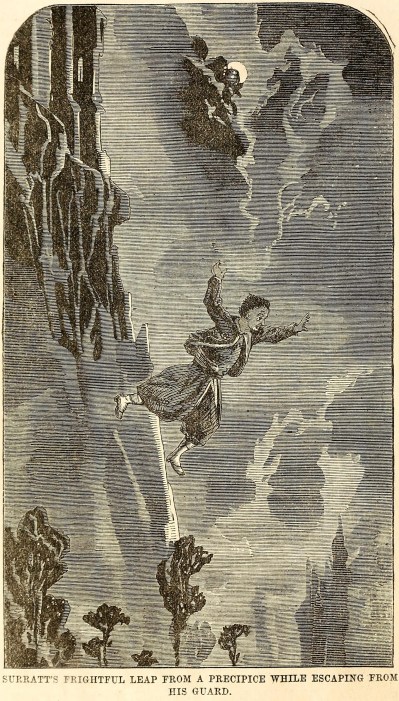
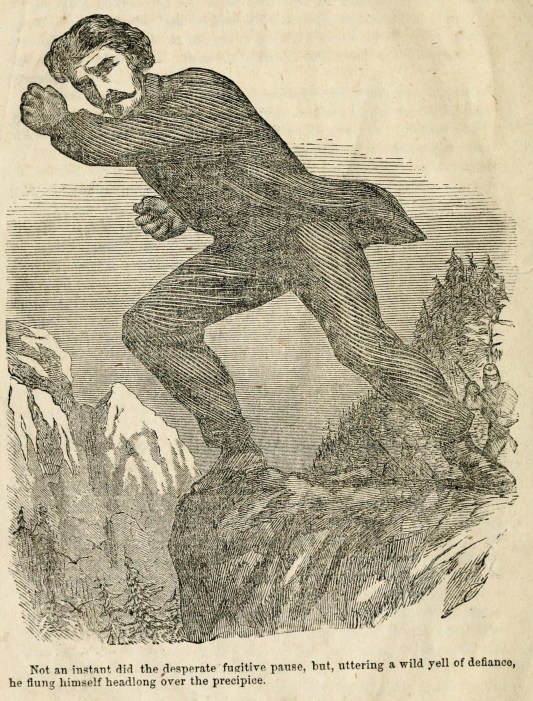
With regards to John Surratt’s leap from justice on November 8, 1866, there has been some embellishment done to the story (particularly in some of the fanciful penny dreadfuls, that illustrate this post), but records are clear that he did make the jump.

You’ll remember that John Surratt was most likely in Elmira, NY when the assassination occurred.  When he heard the news he fled up to Canada, where he was hidden away for the entirety of the trial of the conspirators.  In September of 1865, Surratt traveled from Montreal to Liverpool, England. From there he made his way to Rome where he enlisted in the Papal Zouaves (the Pope’s army) on December 11, 1865.  His alias was John Watson, a native of Scotland and he served in the Papal Zouaves until he was identified by a fellow zouave, Henri Beaumont de Ste. Marie.  Finally, on November 7, 1866, John Surratt was arrested by the Zouaves on the request of the American government and imprisoned for a night in the Zouave barracks in Veroli, then part of the Papal States.  On the morning of November 8th, Surratt was awaken by the guards, told he was going to be transported to Rome, given coffee and then marched with a guard of six men towards the barracks gate.  As the story goes, before reaching the gate John Surratt asked to use the privy which was located near the back of the barracks and overlooked a cliff leading down to the valley below.  He was given permission to use the privy and, upon being unescorted near the latrine, he vaulted over a balustrade and leapt over the cliff.  Let’s look at the reports and accounts of John Surratt’s escape.

Right after Surratt made the leap and escaped, the commander of the detachment in Veroli, Captain de Lambilly, sent a telegram to Velletri that was forwarded on to Rome. It said, “At the moment he left the prison, surrounded by six men as guards, Watson plunged into the ravine, more than a hundred feet deep, which defends the prison. Fifty zouaves are in pursuit.”

Later that day, when the pursuit of Surratt had failed to recapture him, Captain de Lambilly, would write about the circumstances further. “The gate of the prison opens on a platform which overlooks the country; a balustrade prevents promenaders from tumbling on the rocks, situated at least thirty-five feet below the windows of the prison…This perilous leap was, however, to be taken, to be crowned with success. In fact, Watson, who seemed quiet, seized the balustrade, made a leap, and cast himself into the void, falling on the uneven rocks, where he might have broken his bones a thousand times, and gained the depths of the valley”.

Probably the most helpful account, however, is one written by Colonel Allet, De Jambilly’s immediate superior. Allet was stationed in Velletri, some 70 km away from Veroli. After Surratt’s escape on November 8th he sent one of his men to Veroli to investigate. On November 9th, Allet wrote to his superior, the Pontifical Minister of War, what had been learned from the investigation: “I am assured the escape of Watson savors a prodigy. He leaped from height of twenty-three feet on a very narrow rock, beyond of which is a precipice. The filth from the barracks accumulated on the rock, and in this manner the wall of Watson was broken. Had he leaped a little further he would have fallen into the abyss.”

John Surratt's Leap 3

From the above records it seems a bit unclear the exact distance of Surratt’s leap. Regardless, there’s no doubt that Surratt made this perilous leap and was extremely lucky to have landed where he did. Had he missed the outcropping of filth covered rocks some 23 – 35 feet below, he surely would have perished in the fall. But that’s not to say that even the jump he made couldn’t have killed him. Even Captain de Jambilly was astonished that Surratt survived, “Lieutenant Monsley and I have examined the localities, and we asked ourselves how one could make such leaps without breaking arms and legs.”

Despite what Mr. Fazio might have you believe in his book, John Surratt did not land unscathed. He injured his arm and his back in the fall. That is why, when he reached the Italian city of Sora, Surratt sought medical treatment. From Sora he went to Naples where he was questioned and held by the authorities there. While there he passed himself off as a Canadian and told the Naples police that, “he had been in Rome ten months; that, being out of money, he enlisted in the Roman Zouaves, &c.; that he was put in prison for insubordination, from which he escaped, jumping from a window or high wall, in doing which he hurt his back and arm, both of which were injured.”

So, let’s look at the evidence. In supporting John Surratt’s leap we have multiple 1866 reports on the nature of his escape, and a supporting confession from John Surratt himself before any publication of the story occurred. On the side against him making the leap is a newspaper article from 1881 filled with the inaccuracies. You can read Mr. Lipman’s account for yourself HERE.

The account is filled with errors, but the one that makes it the most obvious that Lipman never met Surratt in the Zouaves is the fact that he gives the precise year of 1867 as when everything occurred. As we know, Surratt was back in America in 1867 as he was standing trial by then. Lipman shows some knowledge of the Italian territory (though his geography of Surratt’s whereabouts doesn’t exactly match the official record) which makes it possible that he could have been a member of the Zouaves himself. However, it seems that, after learning the details of John Surratt’s arrest from other zoauves or even just from the latter’s highly publicized trial, Lipman decided, years later, to falsely add himself to the narrative.

Is the story of John Surratt leaping over the balustrade at the Papal barracks in Veroil, Italy a dramatic one that is hard to believe? Absolutely, but it did happen.

John Surratt's Leap 1

Surratt had be on the run for over a year and a half before he was his arrested in Veroli. Did he plan his perilous escape while sitting in his cell the night before or did the idea just come to him as he walked near the barracks’ privy? Did Surratt take the plunge expecting to die in the attempt, or did he have faith he would live? How did his survival from such a death defying leap affect the rest of his escape and his life? These are the fascinating questions that I like to ponder.

I hope this helps, Eva. Remember to always question noncontemporary sources from people claiming to have been involved in historical events. The desire to be connected in someway to history can drive even the most decent and honest person to lie and exaggerate. Too often, authors are so determined to find proof of their claims that they suffer from confirmation bias, and put their faith in disreputable sources like these in order to “prove” their beliefs.

I would, however, be remiss if I did not include this final note on the subject. On April 8, 1867, a newspaper article was published in the New York Times entitled, “A Visit to Surratt”. The article recounts the visit of the newspaper corespondent to John Surratt’s jail cell, where the conspirator permitted an interview. You can read the full article HERE.

According to the article, while John Surratt was in prison in America he read, “with great apparent interest, the published accounts of his capture and escape.” The article then recounted the following regarding his famous leap:

Surratt recounts his escape 1867

So perhaps, Surratt’s magnificent jump was only a distance of twelve feet. By the time the other zouaves made it over to the balustrade and looked down he could have climbed down the extra ten or fifteen feet, which was then thought by those above to have been the distance he fell. We don’t know for sure. What we do know is that John Harrison Surratt did continue his flight from justice by taking a leap of faith in Veroli, Italy, only to be captured less than twenty days later, in Alexandria, Egypt.

References:
The Pursuit & Arrest of John H. Surratt: Despatches from the Official Record of the Assassination of Abraham Lincoln edited by Mark Wilson Seymour
John Surratt: The Lincoln Assassin Who Got Away by Michael Schein

Categories: Uncategorized | Tags: , , , | 13 Comments

Take an Assassination Vacation!

With summer in full swing, now is the time to get out there and take a vacation. Whether it be a lengthy week long trip to a city or shore far distant, or a day’s drive to a “not so nearby” locale, there’s nothing like the thrill of going somewhere new. For the historically minded, vacations often involve adventures such as visiting a museum, rediscovering a National Park, or just taking a selfie with a historical marker off the highway. No matter what form they may take, vacations allow us to make our own marks and memories in places outside our everyday lives.

I’ve long said that the story of Lincoln’s assassination is told all over this nation. I cannot tell you how many times I’ve been in the middle of nowhere when suddenly I find a reference to the assassination staring me right in the face. The impact of Lincoln’s death and the manhunt for John Wilkes Booth reached around the globe. Over the last week, I have been working diligently to update the Maps section of this website in order to demonstrate how far reaching it truly is. The result has been the creation of five new maps, four which cover the entirety of the United States and a fifth map representing the rest of the world. All of these maps provide the locations, a brief description and the exact GPS coordinates of different sites related in some way to the assassination of Abraham Lincoln and his assassin, John Wilkes Booth.

Lincoln Assassination Maps

The maps are still in the beginning stages. The 225 locations currently marked are little more than a drop in the bucket of the potential sites worldwide. Everyday, however, new sites pop into my head and I diligently research to determine their exact GPS coordinates. I’ve analyzed Civil War era maps to determine their modern counterparts, struggled with foreign languages in order to find international sites, and I have even spent hours staring at aerial pictures of cemeteries trying to determine the exact locations of specific graves. It is very slow work, but by pinpointing these sites with GPS coordinates, we can ensure that they will never be lost. The buildings and terrain around them may change but, with GPS, where they once stood can always be found.

With this in mind, I encourage you all to check out the newly updated Maps section of BoothieBarn. See if there’s something “not so nearby” that you might want to drive and see. Better yet, if you are already planning a trip somewhere, take a look and see if you’ll be passing by something assassination related. I mean what kid wouldn’t love to make a detour on their way to Disney World in order to visit a cemetery in Geneva, Florida? “Forget Cinderella’s Castle, Mommy. What I really want to see is the grave of Lewis Powell’s skull!”

So check out the Maps section here on BoothieBarn by clicking the image above. Then get out there and have yourself an assassination vacation!

Categories: Uncategorized | Tags: , , , , , | 9 Comments

Lloyd-ering around Banks O’Dee

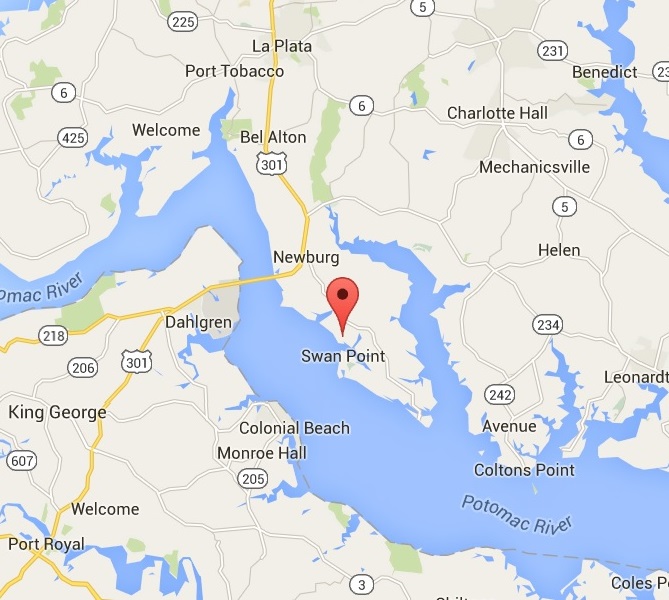
In Charles County, Maryland, located on the peninsula that is created by the merging of the Potomac and Wicomoco Rivers is a small rural area called Banks O’Dee:

Banks ODee, Maryland

The name Banks O’Dee or “The Banks of the Dee” was given its name by Welsh and Irish settlers to the region who named the area after the River Dee which forms part of the border between England and Wales. It is now, as it was then, a very small rural community with only a local road bearing the name Banks O’Dee Road to betray its existence. Yet, as we have often seen, even the most isolated and small communities can have connections to Lincoln’s assassination. Banks O’Dee, exemplifies this fact by having not one, but two associations to the great crime of April 14, 1865.

Mistaken Identi’Dee

After Lincoln’s assassination, the government mobilized troops and detectives to scour the entire region around Washington. Many men were sent into Southern Maryland which was a hotbed for Confederate sympathizers. Washington Provost Marshal, James R. O’Beirne, ordered several of his detectives into the region around Banks O’Dee in the search for John Wilkes Booth and David Herold in the hope that they had not yet crossed the Potomac River into Virginia. Three of O’Beirne’s detectives, Henry Bevans, Michael O’Callaghan, and Edward McHenry, were steamed in on April 19th to investigate the locals. Two the the detectives, McHenry and O’Callaghan, impersonated refugees and found themselves dining with a Banks O’Dee farmer by the named of Richard Claggett. During dinner, Claggett’s son revealed that at around 7:00 am on April 16th, he had seen two men in boat crossing over to a place on the Virginia shore called White Point (now Colonial Beach). The detectives passed this information along to O’Beirne and even crossed over the Potomac themselves in search for the two men in a boat, to no avail.

A farm near the water at Banks O'Dee. Thomas Harbin and Joseph Baden crossed the Potomac river near here on April 16, 1865.

A farm near the water at Banks O’Dee. Thomas Harbin and Joseph Baden crossed the Potomac river near here on April 16, 1865.

By April 24th days had gone by with no new credible sightings of Booth and Herold in Southern Maryland. O’Beirne, in the field himself at Port Tobacco, decided to once again bring the report of his detectives in Banks O’Dee to the attention of Lafayette Baker, head of the National Detective Police. Baker decided the report was now worth investigating further and approved the dispatch of men from the 16th New York Calvary to travel into the Northern Necks of Virginia in search of Booth and Herold. Two days later, this gamble paid off as the 16th New York cornered and killed John Wilkes Booth at the Garrett Farm in Caroline County, VA.

However, this report from Banks O’Dee of two men crossing over the Potomac in a boat on April 16th was a case of mistaken identity. From April 16 – 20, John Wilkes Booth and David Herold were hiding out in a pine thicket near Samuel Cox’s Rich Hill farm. The two men who did cross from Banks O’Dee on April 16th were actually Joseph Baden and Thomas Harbin. Harbin had been an early recruit into John Wilkes Booth’s abduction plot and, when the assassin did manage to cross the river, Harbin briefly assisted Booth onward to Dr. Stuart’s. Still, had Harbin and Baden not been seen by a farmer in Banks O’Dee who then blabbed the sighting to undercover government detectives, John Wilkes Booth may have been able to escape further south.

Lloyd-ering around Banks O’Dee

Banks O’Dee’s connection to the Lincoln assassination story stretches even further back than 1865.  In 1835, two large properties in the area were purchased by a man named Minchin Lloyd, Jr.  Mr. Lloyd’s father was an Irish immigrant who had set up his residence, and family, in Virginia and then in Port Tobacco, the county seat of Charles County.

Minchin Lloyd, Jr. was an enterprising businessman in Charles County, serving his county as a Deputy Sheriff and Deputy Tax Collector.  The second of six brothers, Minchin, Jr. had been entrusted by his siblings with many things of importance.  When his youngest brother Francis died, the financially successful Minchin inherited his entire estate.  He also inherited a large piece of his brother William’s estate when William died in 1833. William, who had been a businessman in Port Tobacco running a general store, also left two other things to his brother Minchin upon his death.  This two things were his two young sons.  Minchin became the guardian of William’s two children, Charles William and John Minchin Lloyd.

The latter name should sound familiar.  In 1865, John Minchin Lloyd would play a pivotal role in the assassination saga when, while renting Mary Surratt’s country tavern, John Wilkes Booth and David Herold arrived at the tavern, demanded the weapons that had been hidden there previously, and rode off after telling Lloyd they had assassinated President Lincoln.  John M. Lloyd would prove to be one of the government’s key witnesses against Mary Surratt at the trial of the conspirators and his testimony would help seal her fate.

When William died in 1833, John was 8 years old.  He and his younger brother went to live with his Uncle Minchin.  In 1835, Minchin bought a large (500+ acre) property near Banks O’Dee.  Minchin moved his whole family into a beautiful home which stood, “on an eminent hill in the center of the farm”.  The house was called Milton Hill and was constructed around 1792.  As a young boy of 11 years old, John is sure to have spent many days at Milton Hill with his uncle/adopted father.  John M. Lloyd grew up in the Banks O’Dee area and watched as the family acquired more land in the area.  Today a road, creek, and point in the region bear the Lloyd name and there are still descendants of the Lloyd family living in the area.  By about 1850, John M. Lloyd had left Banks O’Dee and had settled in Washington, D.C.  Lloyd became a brick layer, Washington Police Officer, and, later, unlucky tavern keeper.

Amazingly, the house in which a young John M. Lloyd lived still stands today in Banks O’Dee.  Milton Hill, which is private property, dates to about 1792.

Milton Hill, childhood home of John M Lloyd

Milton Hill, childhood home of John M. Lloyd

Epilogue

In addition to visiting Banks O’Dee and locating Milton Hall today,  I tried to determine the final resting place of John M. Lloyd’s father, William.  It seemed that the Lloyds often worshiped at St. Mary’s Church at Newport, the same church where Confederate agent Thomas Jones is buried.  I traveled to St. Mary’s in hopes there might be a few Lloyds there. In the end I found this stone which seems very promising:

The possible gravestone for William Lloyd, father of John M. Lloyd

The possible gravestone for William Lloyd, father of John M. Lloyd in St. Mary’s Church in Newport, MD

If this is the stone for “our” William Lloyd than it seems the phrase “like father, like son” is applicable even in death.  John M. Lloyd also has a small stone with only his name on it that has been knocked flat over the passage of time:

Grave of John M. Lloyd in Mt. Olivet Cemetery.

Grave of John M. Lloyd in Mt. Olivet Cemetery in Washington, D.C.

References:
The Lincoln Assassination Reward Files by William Edwards
The Lloyds of Southern Maryland by Daniel Lloyd

Categories: Uncategorized | Tags: , , , , , , , | 7 Comments

“President Lincoln Is Dead: The New York Herald Reports the Assassination” at the Newseum

Located on the corner of Pennsylvania Avenue and 6th Street in northwest D.C., the Newseum is an impressive institution devoted to the evolution of news reporting and the importance of free press in a society. The seven floor museum contains impressive permanent exhibits relating to some of the most news worthy events in American and world history. There are also many galleries in the museum which house an array of different temporary exhibits. When I visited Washington, D.C. for the first time in 2009, I made sure to tour the Newseum due to the fact that they were displaying a temporary exhibition based around James Swanson’s book, Manhunt. One of my very first posts on this site recounted that wonderful exhibit.

Since that time (and my subsequent move to Maryland), I have made many visits to the Newseum.  Their exhibits are fascinating and it is a wonderful place to bring guests from out of town.  As you might expect, there are several permanent items on display at the Newseum related to Lincoln’s assassination that I see each time I am there.  One permanent, 80 foot long display on the top terrace overlooks Pennsylvania Avenue and recounts the history of Washington’s most famous street.

Newseum Terrace

The display also points out that the site currently occupied by the Newseum was once the home to the National Hotel, the preferred hotel of John Wilkes Booth when he was in Washington.

The Newseum collection also contains different newspapers, both physical and digital, that cover the assassination of Abraham Lincoln:

However for this year, the 150th anniversary of the assassination of Abraham Lincoln, the Newseum has created a very special exhibition:

New York Herald Exhibit Newseum

President Lincoln Is Dead: The New York Herald Reports the Assassination” is a detailed look at how one of the most widely read newspapers in the country covered the events of April 14, 1865.  Over a period of 18 hours following the shot at Ford’s Theatre, the New York Herald would publish an unprecedented seven special editions, each with new information regarding the President and Secretary of State’s conditions and the subsequent search for their assassins.  The Newseum may very well be the only institution in the world that contains copies of each of the seven editions of the New York Herald from that tumultuous time.


Coverage Chronologically

 
Seven Issues of New York Herald Newseum

The current exhibit at the Newseum contains an original of each of these editions paired with large wall displays that highlight the differences and additions between them.

2:00 AM edition:

NYH 2 am edition Newseum

3:00 AM edition:

NYH 3 am edition Newseum

8:45 AM edition:

NYH 8 am edition Newseum

10:00 AM edition:

NYH 10 am Uncovering the Plot edition Newseum

10:00 AM “Reward” edition:

NYH 10 am Reward edition Newseum

2:00 PM edition:

NYH 2 pm edition Newseum

3:30 PM edition:

NYH 3 pm edition Newseum

Click to Enlarge

Click to Enlarge


Floor to Ceiling Coverage

 
While the “President Lincoln Is Dead: The New York Herald Reports the Assassination” exhibit is only contained in one small room of the Newseum, there is no wasted space.  Even the floor and ceiling contain displays.  On the floor is a map of Civil War Washington with labelled sites relating to the assassination:

Floor map Newseum

Meanwhile the ceiling is festooned with wonderful banners (several of which I wish I could own myself) relating to the assassination:

Click to enlarge

Click to enlarge


The Stories Behind the Story

 
The displays not only provide commentary on the evolving story of how the country came to learn the details of Lincoln’s assassination, but they also introduce us to the people involved in reporting the news.  One of my favorite stories is that of Associated Press reporter, Lawrence Gobright who was responsible for the very first telegraphic dispatch covering Lincoln’s assassination:

First dispatch Newseum

In 1869, Gobright would recollect his actions that night:

“On the night of the 14th of April, I was sitting in my office alone, everything quiet : and having filed, as I thought, my last despatch, I picked up an afternoon paper, to see what especial news it contained. While looking over its columns, a hasty step was heard at the entrance of the door, and a gentleman addressed me, in a hurried and excited manner, informing me that the President had been assassinated, and telling me to come with him! I at first could scarcely believe the intelligence. But I obeyed the summons. He had been to the theatre with a lady, and directly after the tragedy at that place, had brought out the lady, placed her at his side in his carriage, and driven directly to me. I then first went to the telegraph office, sent a short ” special,” and promised soon to give the particulars. Taking a seat in the hack, we drove back to the theatre and alighted; the gentleman giving directions to the driver to convey the lady to her home.

The gentleman and myself procured an entrance to the theatre, where we found everybody in great excitement. The wounded President had been removed to the house of Mr. Peterson [sic], who lived nearly opposite to the theatre. When we reached the box, we saw the chair in which the President sat at the time of the assassination; and, although the gas had for the greater part been turned off, we discovered blood upon it…

Lawrence Gobright

Lawrence Gobright

My friend having been present during the performance, and being a valuable source of news, I held him firmly by the arm, for fear that I might lose him in the crowd. After gathering all the points we could, we came out of the theatre, when we heard that Secretary Seward had also been assassinated. I recollect replying that this rumor probably was an echo from the theatre; but wishing to be satisfied as to its truth or falsity, I called a hack, and my companion and myself drove to the Secretary’s residence. We found a guard at the door, but had little trouble in entering the house. Some of the neighbors were there, but they were so much excited that they could not tell an intelligent story, and the colored boy, by whom Paine was met when he insisted on going up to the Secretary’s room, was scarcely able to talk. We did all we could to get at the truth of the story, and when we left the premises, had confused ideas of the events of the night. Next we went to the President’s house. A military guard was at the door. It was then, for the first time, we learned that the President had not been brought home. Vague rumors were in circulation that attempts had been made on the lives of Vice-President Johnson and others, but they could not be traced to a reliable source. We returned to Mr. Peterson’s house, but were not permitted to make our way through the military guard to inquire into the condition of the President. Nor at that time was it certainly known who was the assassin of President Lincoln. Some few persons said he resembled Booth, while others appeared to be confident as to the identity.

Returning to the office, I commenced writing a full account of that night’s dread occurrences. While thus engaged, several gentlemen who had been at the theatre came in, and, by questioning them, I obtained additional particulars. Among my visitors was Speaker Colfax, and as he was going to see Mr. Lincoln, I asked him to give me a paragraph on that interesting branch of the subject. At a subsequent hour, he did so. Meanwhile I carefully wrote my despatch, though with trembling and nervous fingers, and, under all the exciting circumstances, I was afterward surprised that I had succeeded in approximating so closely to all the facts in those dark transactions…”

In addition to his quick reporting and continual dispatches throughout the night, Gobright also holds a place in history due to his brief custodianship over the derringer that was used to kill Abraham Lincoln.

Edwin Pitts holding the Derringer 1

After shooting Lincoln with the single shot pistol, John Wilkes Booth immediately dropped the gun onto the floor of the theater box. Somehow it went unnoticed during the chaos that ensued in the small box as physicians entered to care for the mortally wounded president. One of the men who had entered the box along with the physicians was a man named William Kent. Kent would later claim it was his penknife that was used to cut the collar from around Lincoln’s neck. After departing the theater that night, Kent discovered he had lost his keys and so returned to the theater and gained entry into the now empty box. He was searching for his keys when his foot struck something. Lawrence Gobright had also just arrived in the box to report on the scene of the crime:

“A man [Kent] standing by picked up Booth’s pistol from the floor, when I exclaimed to the crowd below that the weapon had been found and placed in my possession. An officer of the navy — whose name I do not now remember — demanded that I should give it to him ; but this I refused to do, preferring to make Major Richards, the head of the police, the custodian of the weapon, which I did soon after my announcement.”

As stated, Gobright did turn the derringer over to the Metropolitan Police and William Kent identified it on April 15th:

William Kent statement


Don’t Believe Everything you Read in the Newspapers

 
The New York Herald exhibit at the Newseum also demonstrates how the newspapers covering Lincoln’s assassination made the same mistake as some modern journalists by printing unreliable or unsubstantiated claims in hopes of being the first to provide their audience with an exclusive.

Booth in custody Newseum

Rumors and speculation would fill every mouth, diary, and newspaper for the next twelve days as the entire country searched for John Wilkes Booth.

In addition to misinformation that was printed in a rush, the New York Herald exhibit at the Newseum also brings attention to later instances that have caused unintended deception.  The New York Herald’s coverage of Lincoln’s assassination was so wide spread that even many years later, the paper was still very well connected to the event in the minds of the public.  Many advertisers attempted to benefit from this connection by creating their own, custom reprints of editions of the New York Herald.  On the face of it, the reprints appeared genuine though some, like the one below, included engravings that were never in the originals.  No matter how real they looked however, hidden either in the text of the front page or within the interior pages were advertisements for the latest miracle tonic, liniment, or some other product.

Fake NYH Newseum

This type of “historical advertising” was very popular in the late 19th and early 20th century.  People were more likely to hold on to the advertisement if it had something compelling on it.  Another example of this type of advertising is this reproduction CDV of John Wilkes Booth’s escape on a bag for dysentery syrup:

John Wilkes Booth Dysentery Syrup

While the newspapers were well known to be advertisements in their day, as time has passed reproductions like the one above have fooled many unknowing treasure seekers into thinking they have a genuine (and pricey) piece of American history. Most of the time, however, a careful read through (especially of the interior pages which are usually just full page ads for the product) will reveal it is a reproduction.  You can see a small sampling of some of the many advertising reproductions of the assassination editions of the New York Herald here.


Plan Your Visit

 
I highly recommend a visit to the “President Lincoln Is Dead: The New York Herald Reports the Assassination” exhibit at the Newseum.  It is located on the 4th floor of the museum which is open daily from 9:00 am to 5:00 pm.  Tickets to the Newseum cost $23 for adults and allow you to return the next day for free.  While this price may seem a bit expensive compared to the federally funded museums in D.C. that offer free admission, the Newseum has many wonderful galleries and exhibits that make the price more than worth it.  This special New York Herald exhibit only runs until January 10, 2016 so be sure to visit the Newseum before it is gone.

References:
President Lincoln Is Dead: The New York Herald Reports the Assassination at the Newseum
Recollection of men and things at Washington during the third of a century by Lawrence Gobright (1869)
National Archives
Library of Congress

Categories: Uncategorized | Tags: , , , , , , , , , | 3 Comments

Blog at WordPress.com.