Uncategorized

The Passionate Booths

When John Wilkes Booth pulled the trigger on his derringer, he released not only a lead ball, but also the pent up angst and fervor that had darkened his soul.  His deed was misguided and barbaric; however, in his eyes, it was justified.  As a son, an actor, and an American, John Wilkes Booth was fuelled by his passions.  While he won acclaim for his ability to direct his passions on the stage, they were not products of the stage.  He inherited these passions from his forefathers and, mixed with his own experiences, channeled them on that fateful night.

Much has been written about John Wilkes Booth’s father, Junius Brutus Booth.  The noted tragedian was the greatest of his generation and developed many peculiarities that has provided rich fodder for writers.  The book My Thoughts be Bloody by Nora Titone provides a wonderful look at the romantic side of Junius Brutus Booth.  Junius was a proponent of Lord Byron’s free love philosophy.  He won over his mistress and mother of his theatrical clan, Mary Ann Holmes, with volumes of Byron’s work and notes of his affection.  Despite being married to another woman and having two children with her (only one of which survived infancy), Junius was enamored with Mary Ann and, together, the pair ran off to America.  Love and the pleasures of the flesh were Junius Brutus Booth’s first passion.

In fact, his passion in this area started before he had even met his first wife, Adelaide.  As a mere boy, Junius had engaged his passions.  I quote from the book, Prince of Players: Edwin Booth by Eleanor Ruggles:

“Junius Brutus Booth was thirteen when a neighbor’s servant girl accused him of having got her ‘in the family way’ and was hurriedly paid off. He was seventeen and had enlisted as a midshipman on the brig Boxer when he was kept from sailing by a court summons to answer the same charge made by another servant girl, employed in the Booths’ own house. Richard Booth went into court himself to be Junius’ lawyer and defended him hotly, but the father and son lost their case and the father was compelled to pay up again.”
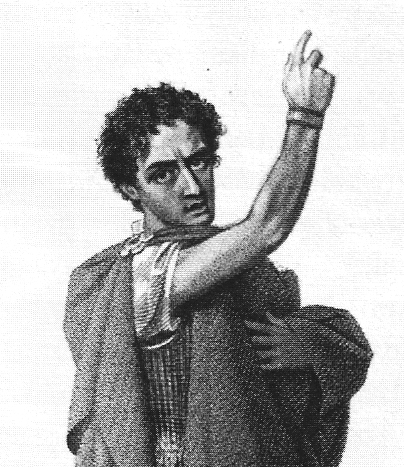
Drawing of Junius Brutus Booth in 1817

The above, modern account is greatly contrasted by another.  A book was published in 1817 called, Memoirs of Junius Brutus Booth: From his Birth to the Present Time.  The book is an early testament to the genius of the young actor.  Written by his fans during the heyday of his English popularity (before he met Mary Ann Holmes and ran away with her), the book recounts the matter in the most predisposed, yet eloquent, manner possible:

“He then became desirous of learning the art of printing, but soon relinquished it for the law, which again he quitted from an inclination to become a sculptor, and he pursued the first steps towards that divine art very assiduously, with the intention of entertaining it as a profession.  But here his views were interrupted by an occurrence of rather an extraordinary nature.  Our hero, for so we must now emphatically call him, was accused of a degree of susceptibility towards that sex, whose charms form the great stimulus – the bright reward of every act in which the heart of man takes part, rarely exemplified at his age.  He was charged by a frail nymph with a deed – of which she could no longer conceal the evidence.  His father, astonished at this deposition to his son’s precocity, was at first disposed to wear the aspect of displeasure; but relying on the sagacity and experience of the Bench on these subjects, he determined to answer it by taking his child in his hand, and presenting him to the Justices, merely ask their worships whether they thought the fact came within the limits of probability, or even possibility.  They, however, decreed that he should wear this attestation of his persuasive powers – or this stain on the pudency of his boyhood, (as it will be variously interpreted by various commentators) for the remainder of his life.

The consequence of this decision, and the subsequent anger of his father, was that, being unable to raise the supplies necessary on this emergency, he was forced to resort to stratagem to elude the vigilance of the parish officers, (which, when in the pursuit of gain, or in the prevention of loss, is not often found napping), and mounting a high brick-wall, he baffled his pursuers, and for nine months escaped this attack on his purse, or rather his father’s; – he was at length, however, discovered, and obliged to make the usual amende.”

As Junius grew older, his passions shifted from matters of the heart, towards that of the bottle.  Mirroring his son to a less extreme, Junius let his passions overwhelm him and lead him to his own destruction.

John Wilkes Booth’s father was not the only passionate forefather.  Richard Booth, Junius’ father and John Wilkes’ grandfather, had his own obsession.  Many of us know how Richard Booth hung a portrait of George Washington in his London home and required visitors to bow before it.  In his youth, however, Richard Booth took a much more active role in demonstrating his commitment to America.  I quote from The Edler and Younger Booth by Asia (Booth) Clarke:

“Richard Booth, the father of the subject of the present sketch, was educated for the law; but, becoming infatuated with Republicanism, he left home, in company with his cousin John Brevitt, to embark for America (then at war with England), determined to fight in her cause. Booth was taken prisoner and brought back toEngland, where he subsequently devoted himself to the acquirement of knowledge and the practice of his profession…”

In their attempt to join the Americans in their fight for independence, Richard Booth and John Brevitt wrote to a Member of Parliament noted for his support of the American Revolution, asking for a letter of introduction on their behalf.  The man they wrote to would later be honored by the Booth family by giving his name to one of Richard’s grandson’s: John Wilkes.

“To John Wilkes, Esq., Princes Court, Westminster.
Paris, Oct. 28th, ’77.
Sir, — You will certainly be much surprised at the receipt of this letter, which comes from two persons of whom you cannot possibly have the least knowledge, who yet at the same time claim the Honour of being of the same Family as yourself. Our conduct has certainly been in some respects reprehensible, for too rashly putting in execution a project we had for a long time conceived. But as it was thro’ an ardent desire to serve in the Glorious cause of Freedom, of which you have always been Fam’d for being the Strict and great Defender, we trust the request we are about to make will be paid regard to. As Englishmen, it may be urged that we are not altogether Justified in taking arms against our native Country, but we hope such a vague argument will have no weight with a Gentleman of your well-known abilities; for as that country has almost parted with all its Rights, which have been given up to the present Tyrannic Government, it must be thought the Duty of every true Briton to assist those who oppose oppression and lawless Tyranny. And as the people of America are composed of men who have still the spirit of their brave Forefathers remaining, it becomes all who are Englishmen to exert their utmost efforts in their behalf, leaving their Country for that purpose; being no more (as we presume) than the Romans, in the war between Octavius and Anthony on the one part, and those illustrious worthys, Brutus and Cassius, on the other, going from the army of the Tyrants to serve in that of the latter, and therefore equally justifiable.

‘Dulce et Decorum est pro patria mori,
Sed pro Libertate mori, Dulcissimum est.’

The manner in which we have conducted ourselves has been so very extraordinary as to be scarcely credible, but we are assured the Bearer of this Letter will convince you of its Authenticity. In short, we leftEngland, and all the advantageous prospects we had there, purposely to go and serve in the Army of the Sons of Liberty, the brave Americans. In order to complete the Enterprise we came from London under a pretence of going on a party of pleasure to the Camp at Warley Common, but instead of proceeding thither, we went immediately for Margate and thence to Ostend, and have since arrived here, where we came to wait upon the Gentlemen who are Agents for the Congress in America, in order to the full completion of our Design of getting appointed officers in the Provincial Service, but for that purpose have since found it necessary to procure a Letter of recommendation from some Gentleman in the Interest of Liberty in England, and understand from Mr. Arthur Lee (who has promised to interest himself greatly in our behalf), that no recommendation will be of more service to us than yours. Our request therefore is, that you will condescend to give one in our favour, directed to that Gentleman at the “Hotel de la Reine, la Rue des Bons Enfants, a Paris,” which you will please to deliver to the Bearer hereof, as soon as possibly convenient. And the favour will be gratefully remembered, and the name of Wilkes be always held in the greatest respect and veneration.
Your most and obed’ Serv’ts at command,
R. Booth.
John Brevitt”
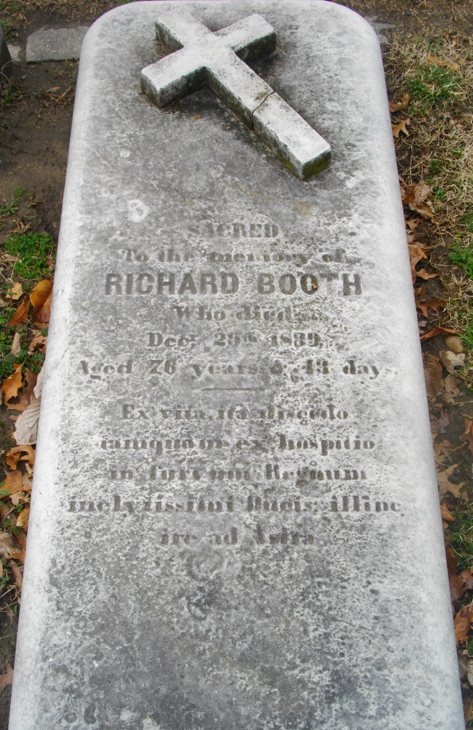
Richard Booth’s Grave

These elder Booths, Richard and Junius, tread a path that their progeny, John, would later follow.  From Richard, John Wilkes inherited a revolutionary spirit.  From Junius, he learned to submit himself to his passions regardless of the consequences.   Combined with the tyrannicidal nature of Shakespeare and the bloodiness of the Civil War, John acted according to his beliefs.

Ultimately, in his own horrific way, John Wilkes Booth upheld the passion of the Booth name.

References:
The Edler and Younger Booth by Asia Clarke
Memoirs of Junius Brutus Booth: From his Birth to the Present Time
Prince of Players: Edwin Booth by Eleanor Ruggles
My Thoughts Be Bloody by Nora Titone

Categories: Uncategorized | Tags: , | 3 Comments

The Assassination Playbills

Earlier, I introduced you to Henry Polkinhorn, a Washington, D.C. printer.  From his building on D Street, Polkinhorn printed newspapers, books, and a plethora of other custom items.  Of all the items he printed over the years, the most sought after item today is the playbill from Ford’s Theatre for April 14th, 1865.  In this post we will explore the details of Polkinhorn’s work, in order to identify genuine playbills and later reprints.

We will be utilizing the wonderful, but rare book, The Ford Theatre Lincoln Assassination Playbills: A Study by Walter C. Brenner.  Mr. Brenner privately printed this 16 page book in 1937.  In it he sorted out the many misconceptions about the playbills and, for the first time, created a tool for identifying and authenticating genuine playbills.  In the foreword of his book, Mr. Brenner wisely stated that, when attempting to authenticate a playbill as genuine, “source and pedigree must be disregarded,” and many, “will not prefer to do so.”  The simple truth is there is an exceedingly small possibility that genuine playbills still exist outside of libraries, museums, and private collections.  In fact, many libraries, museums, and private collections themselves don’t even have genuine playbills.  The best of provenance must be ignored when faced with the facts and details of the printed playbill.  The evidence within is unbiased and is merely for the benefit and education of those interested in the drama at Ford’s.

As stated before, Henry Polkinhorn was the regular printer for Ford’s playbills.  His association with the theatre started when John T. Ford took over the Tenth Street Bapist Church and started putting on musical performances:

Ford continued using Polkinhorn’s services when he renovated the church into Ford’s Atheneum:

When a fire destroyed most of the building in December of 1862, Polkinhorn helped his customer by purchasing stock so that he could build Ford’s New Theatre.  Ford continued to use Polkinhorn for his playbills and printed materials all the way until when the theatre closed for good after the events of April 14th, 1865:

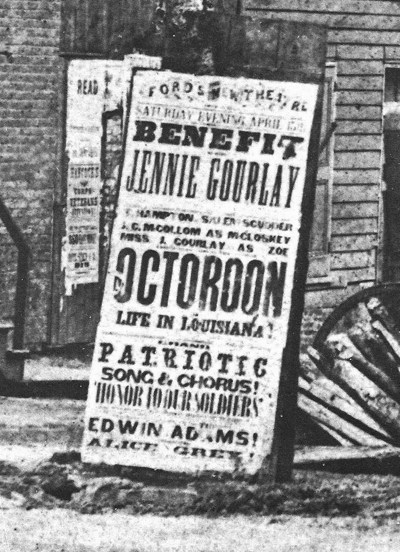
Large advertisement for Ford’s April 15th, 1865 performance of The Octoroon. The performance never occurred as the theatre was closed after Lincoln’s assassination.

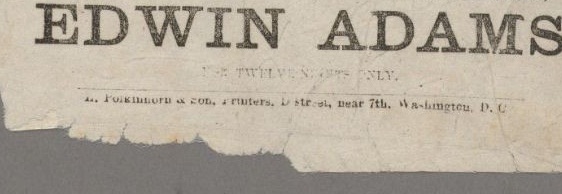
Therefore, when attempting to authenticate a playbill, it is important that it has been printed by “H. Polkinhorn & Son, Printers, D street, near 7th, Washington, D.C.”.  This is the final line on the playbill right at the bottom:

Now, just because a playbill says “H. Polkinhorn” at the bottom does not mean that it is genuine.  Practically all the later forgeries and reprints include the correct printer.

To Polkinhorn, printing the playbills for April 14th was just another job like the day before.  As a printer, he kept the previous day’s playbill set up on the press until he was given orders to change it, and then he changed only as much as was necessary.  This would save time in the printing process as long as the customer did not call for a completely redesigned playbill.  The Harvard Theatre Collection has the bound volume of playbills belonging to John B. Wright, the stage manager at Ford’s.  Looking at the playbills leading up to the 14th, Polkinhorn used the identical line of lettering for Laura Keene’s name on the 10th, 11th, 13th, and the 14th.  On the 12th, he had to resize her name to make room for an illustration on the playbill, but reverted back on the 13th.  On the morning of the 14th, Polkinhorn was printing the bills.  At around 10:30 am, Mrs. Lincoln’s messenger arrived at Ford’s to reserve the box for that night.  After this announcement happened, John Wright went to Polkinhorn’s printing shop to change the playbill.  Originally, there was going to be a special musical performance on the next night, April 15th.  On the large poster above you can see on the bottom the announcement for “Honor to Our Soldiers”.  This was a song written by Ford’s orchestra director William Withers.  With the announcement that Lincoln was attending that night, it was decided that the premiere of the song should coincide with the visit of their honored guest.  Therefore, Wright went to Polkinhorn’s to change the playbill to include mention of the song.  When Wright arrived, Polkinhorn altered the press to print the new bills.  Rather than throw out the bills Polkinhorn had already printed without the song, they were also used that night.  This is the reason why there are two issued of playbills for Our American Cousin:

Ford’s Theatre Playbills from April 14th, 1865

After Lincoln was killed, the theatre was shut down never to be used by Ford again.  Polkinhorn found that one of his most consistent clients no longer needed his services.  He removed the song playbill design off of the press and carried on with his business.  As time passed, people clamored for mementoes of the fallen President and the events at Ford’s Theatre.  John Buckingham was the door keeper at Ford’s on the night of the assassination.  In 1894, he published a short, illustrated book called Reminiscences and Souvenirs of the Assassination of Abraham Lincoln.  Before, publishing this book, however, Buckingham got into the business of reproducing playbills from that night.  When Buckingham first started printing his “souvenir” playbills is unknown.  The earliest I can confirm is by 1879, but it is likely he started much earlier than this.  One source states that the reprints were sold on the streets of Washington “a day or two after the tragedy”.  What is known is that when Buckingham decided to print his souvenirs he went right back to Polkinhorn’s printing company.  Richard Oliver Polkinhorn, Henry Polkinhorn’s nephew, is the one that helped him recreate the bills from that night.  Using Polkinhorn’s own press and type, the two printed copies and created an engraving of the first issue playbills.  Buckingham started selling the playbills as souvenirs.  At first, the reprinted bills had no markings to identify them as reprints.  Years later, Buckingham would start stamping them, “Lincoln Souvenir Engraving”, but by then countless numbers had made their way into the public and began masquerading as authentic bills.  Buckingham’s souvenir playbills look like this:

John E. Buckingham’s souvenir reprint playbill

So, there are two issues of authentic playbills printed on April 14th, 1865, and one version later printed by Ford’s doorman.  Buckingham only reprinted the first issue playbill and so the second issue, the one with “Honor to Our Soldiers”, has been saved from period forgeries.  Aside from contemporaneously forged examples, all second issue playbills that exist are most likely genuine.  For the first issue playbills, however, careful attention must be paid to identify Buckingham and other reprints.

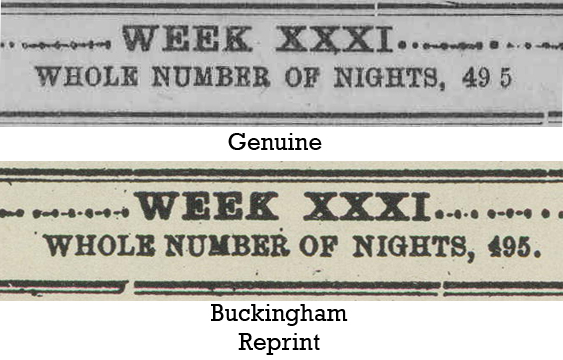
As well as John Buckingham and Richard Polkinhorn did in recreating the first issue playbills, the devil is in the details.  As we will see, Buckingham made his own mistakes and actually corrected mistakes that were present in the original bills, when making his copies.  A close look at a genuine bill and a Buckingham copy shows the differences.

The way we know that Buckingham used Polkinhorn’s own type and press is twofold.  First, on the back of an 1891 Buckingham reprint there is a stamped note from R. O. Polkinhorn citing his involvement in creating the copies.  Second, the type itself is a match for Polkinhorn’s press.  One way to identify a bill that used Polkinhorn’s press is the particular type that is used to create the words “THE OCTOROON”.  Other period reprints from other printers, like this one housed at the University of Delaware, did not have this specific font type.  This clearly identifies it as being from another printer entirely.

On the Buckingham reprints, however, “THE OCTOROON” is in the exact same type as on the original playbills, proving that Polkinhorn’s printing shop was used for the souvenirs.

The most obvious difference between a genuine first issue playbill and a reprint is the final “E” in LAURA KEENE.  In genuine bills, the final “E” is perfect.  This “E” is consistently undamaged on the previous Ford playbills from the week leading up to the assassination.  On the Buckingham reprints, however, the final “E” is marred:

Not only is the “E” damaged, but also the final letters and numbers on many of the lines.  According to Brenner this damage was caused by the gauge pins on the press getting in the way.  However it happened, it provides the most notable difference between a real playbill and a souvenir.

While the “E” was a mistake on the part of the printer, the pair also fixed mistakes from the original bill.  In the genuine first issue bills, right above “The OCTOROON”, it states, “When will be presented BOURCICAULT’S Great Sensation Drama,”.  This is a typo.  It should read “Great Sensational Drama”.  When Buckingham created his souvenirs he corrected it and changed it to the appropriate “Sensational” (See the Octoroon examples above).

In addition, the original bill had an accidental space at the top.  Under the heading it states, “WHOLE NUMBER OF NIGHTS 49 5”.  There is a space between the 9 and 5 in “49 5”.  Buckingham corrected this unnecessary space and changed it to “495”.

In Walter Brenner’s book, he identifies 14 minute differences between Buckingham’s reprint and genuine playbills.  From missing words to the vertical alignment of letters, he provides a chart of the changes.  If a playbill has correctly passed the above criteria, this book should be consulted and the rest of the details authenticated.

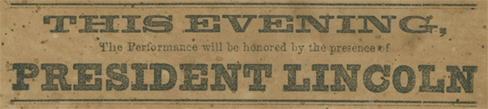
In addition to Buckingham’s souvenirs, many other printers and indiviudals of the period tried their hand at creating false bills.  Any playbill that bears the announcement that, “THIS EVENING The Performance will be honored by the presence of PRESIDENT LINCOLN” is a fake.

Forgery

As was mentioned earlier, the playbills were altered when it was ascertained that Lincoln and his guests were attending the night’s performance, however, they were only changed to include lines from the song “Honor to Our Soldiers” and not to announce his attendance.  Playbills containing Lincoln’s name are reprints from other printers, and not authentic.

While period fakes are common, there are also modern fakes that often trip people up.  Like Buckingham did so many years ago, museums sell reproduction playbills in their gift shops around the country.  Ford’s Theatre actually sells a reproduction of the Buckingham reprint.  It is attached to a reproduction wanted poster and costs $1.50.

The paper is browned and made to look old, too.  They are excellent reproductions but can add to the confusion when someone believes they have the genuine article.

When it comes to Ford’s Theatre playbills from April 14th, 1865, it is important to dismiss any stories of provenance until the bill is authenticated.  In Brenner’s book, he mentions a playbill with impeccable provenance.  Two signed affidavits accompany it; one written by the owner of the bill and another by John T. Ford himself.  In it he states, “I, John T. Ford on oath say that I presented Mr. A. K. Browne with a programme of the play of ‘Our American Cousin’ which I picked up near President Lincoln’s chair when he was assassinated…”  This superb provenance is a rare and valued thing for historical artifacts.  Unfortunately, the marred “E” on the playbill that accompanied these affidavits prove that it is not a genuine playbill, but instead a Buckingham reprint.  The best provenance in the world has to be ignored when faced with unbiased evidence.  Despite the affidavit to the contrary, John T. Ford was not even in D.C. when Lincoln was assassinated, and he did not arrive there until the Monday after the shooting.  Treasure seekers had cleaned out the theatre box long before he showed up.

As far as relics go, a genuine playbill is a treasured commodity.  On its face, it’s an advertisement for a night at the theatre.  In the context of history however, it exudes a sense of foreboding.  These playbills capture Lincoln’s assassination in a way that no other artifact can.  They are the last vestige of Lincoln as he lived, and the gateway to his immortality.  While reproductions have been made, only genuine playbills provide the emotional impact of that moment frozen in time.  They exist today as silent witnesses to Ford’s last great drama.

References:
The Ford Theatre Lincoln Assassination Playbills: A Study by Walter C. Brenner
Restoration of Ford’s Theatre by George Olszewski

Categories: Uncategorized | Tags: , , , , | 25 Comments

The Game of Operation – JWB Edition

While Booth’s “Wrenched Ankle” was easy to get, they never did find his “Charley Horse”

Categories: Uncategorized | Tags: , | Leave a comment

H. Polkinhorn, Printer

Often, I get caught up in the little people of the assassination story.  Those who had relatively minor roles seem to fascinate me for their trivial involvement in the great drama.  The first article I wrote for the Surratt Courier was about Emerick Hansell, the state department messenger wounded by Lewis Powell at Secretary Seward’s.  We know him merely because he was at the wrong place at the wrong time and got a knife in the back for it.  Nevertheless, it is the almost trivial characters of the story that continually draw me in.  This post is further proof of that.  For the past few weeks I have been researching a very minor figure to a great degree.  I contacted Harvard University for a picture, made inquiries through Ancestry to help figure out his genealogy, and searched newspaper records for hours on end.  Even while I was doing it, I couldn’t help but think, “Why are you going to all this trouble?  Who is going to care about the minor details of this minor character?”  In truth, I may be the only one who cares about this man and his background, but the search for knowledge is enough motivation for me.  Will it change our view of the assassination? No.  But in a field where the big picture is explored so many times, sometimes it’s just fun to get lost in the little things.  The following is what I have spent my time doing – researching a man who is barely on the cusp of the assassination story merely because I enjoy the hunt. 
 

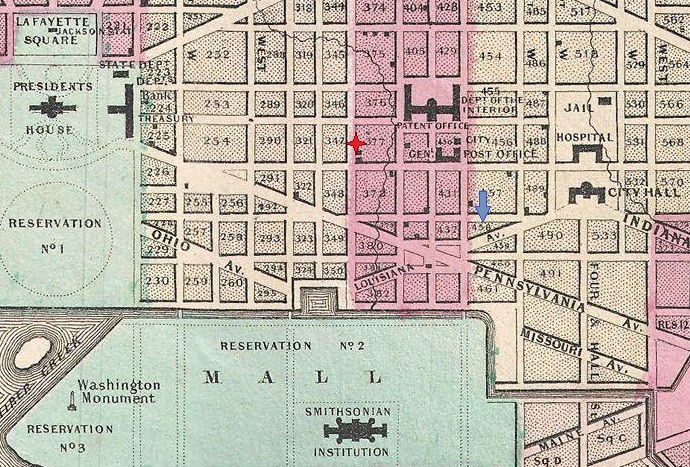
In the above map, the blue arrow points to 634 D Street NW in Washington, D.C., as it was in 1861.  During the Civil War era and for many years after it, this location held the prestigious and profitable printing company of Polkinhorn and Son.  Its founder was Henry Polkinhorn:

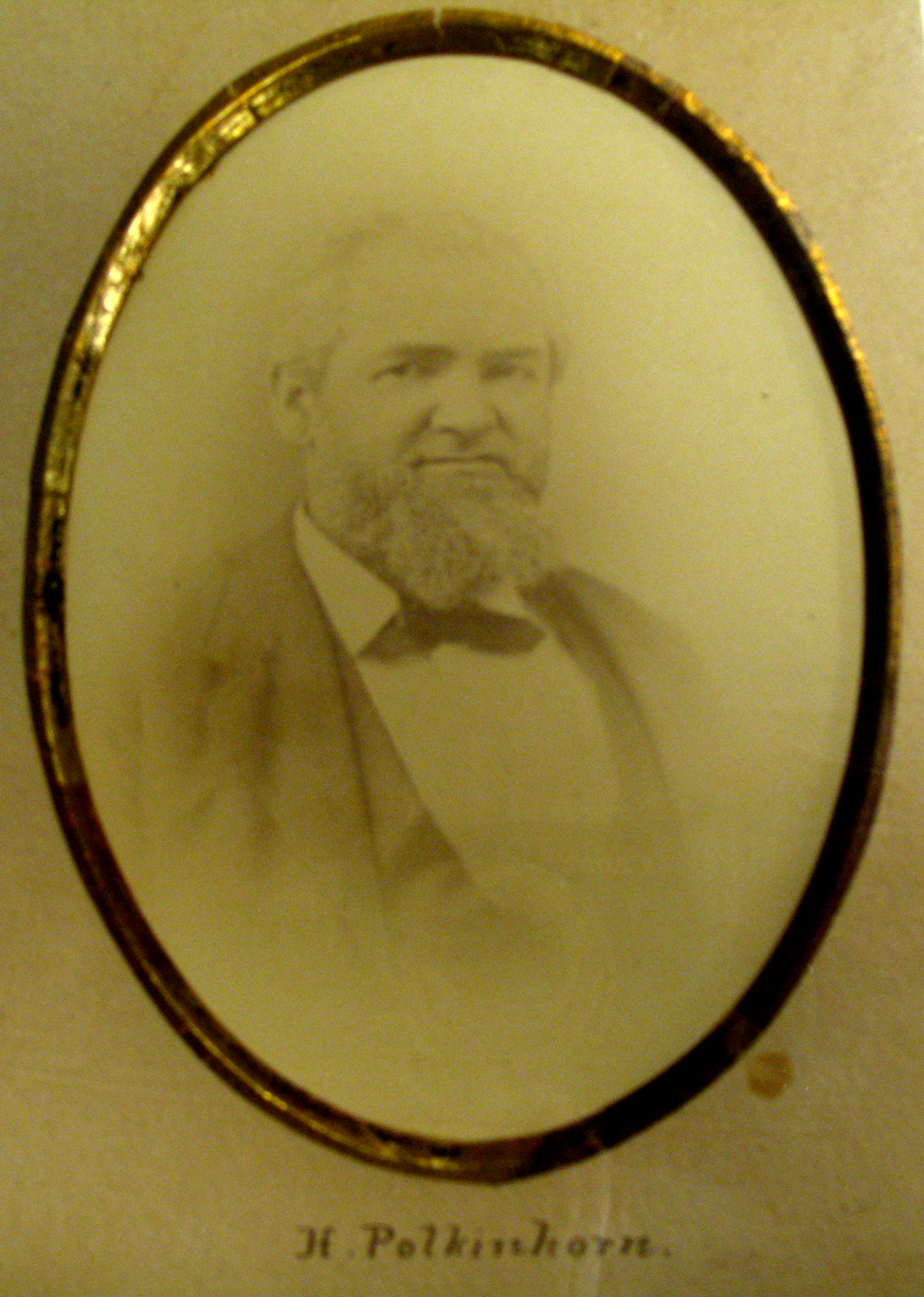
Henry Polkinhorn from the Harvard Theatre Collection

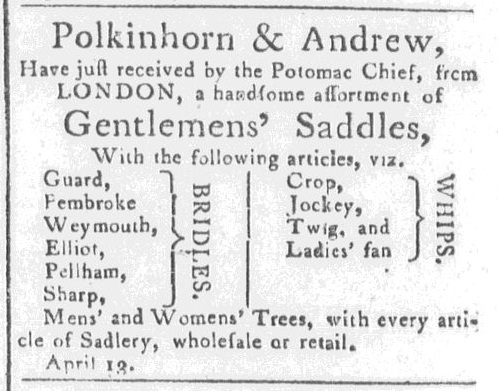
Henry Polkinhorn was born in 1813 in Baltimore.  His father, Henry, Sr., was an immigrant from England and a saddler by trade.  As a saddler in Baltimore, Henry Sr. was a very prosperous businessman himself:

A 1797 advertisement for Polkinhorn saddles

As a young man, Henry Polkinhorn, Jr relocated to D.C. and married Marianne Brown in 1839.  Together Henry and Marianne had six children.  Marianne died in 1857 and Henry married Rachel Ann Barnes less than two years later.    Differing from his father, Henry entered into the trade of a printer to support his growing family.   In his chosen occupation, Henry Polkinhorn was extremely successful.  After a few years of increasing success in his printing trade, Polkinhorn was able to erect his own building at 634 D Street NW between 6th and 7th streets.

It was a five story building in the Italianate style, which became very popular in the US after the late 1840’s.  Italianate buildings are noted for their bracket cornices and arched windows.  A newspaper article of the day described Polkinhorn’s building as having, “great height and [a] majestic appearance.”  Of the five stories, three of the floors were committed to Polkinhorn’s printing trade.  The second floor, in particular, was, “furnished with every facility for the execution for all descriptions of printing, both plain and ornamental.”  For his skills in printing and self-made success, Polkinhorn was very well respected by his peers.  The article honoring his building ended with, “We sincerely recommend the enterprising proprietor to the favorable notice of our citizens, as one, independent of his long established reputation, worthy of their highest consideration and esteem.”

As with all printers of the day, Polkinhorn ran a diversified printing company.  In each major area of his business, he printed materials connected to the assassination of Abraham Lincoln in 1865.  First, he printed newspapers.  Not only did he print them for others, he even started a couple on his own like Our Newspaper and the Constitutional Union.  Another newspaper he printed was the National Intelligencer.  The office of the Intelligencer was right across the street from Henry Polkinhorn’s printing office.  This provided steady income for Henry Polkinhorn and convenience for the Intelligencer management.  The Intelligencer also relates to the assassination of Lincoln, as it was one of the best newspapers for daily coverage of the trial of the conspirators.  Even to this day, issues of the National Intelligencer have been microfilmed by the National Archives and housed with the Lincoln assassination papers due to their relevance and content.  Polkinhorn would have even more connection with the Intelligencer after the trial was over.  By late 1868, the National Intelligencer was broke.  The owners, who had taken it over in 1865, had run it into the ground and owed thousands of dollars to many people.  The biggest debt they owed was to Henry Polkinhorn.  For his printing of their paper, they owed him over $50,000.  Fed up, he finally called to settle his tab.  With no money to pay him, the owners transferred the Intelligencer completely over to Polkinhorn.  Henry continued to make and print the Intelligencer until he himself was able to sell it off.  Shortly thereafter, the Intelligencer merged with the Washington Express and effectively died.

While newspapers provided daily work for Henry Polkinhorn, he was also well known for his book printing.  He devoted a whole floor in his five story building for Book and Job Printing.  Many famous and common citizens went to him to print their books.  An online search for “Polkinhorn printer” and alike will yield numerous nineteenth century books that were printed from his D street establishment.  On the brink of the Civil War, Polkinhorn printed, in book form, a letter by Joseph Holt explaining the dangers that were to come and his satisfaction that his own home state of Kentucky choose to stay with the Union.  Holt would later be named the Judge Advocate General, and chief prosecutor at the trial of the Lincoln conspirators.   During the trial, Polkinhorn printed many pamphlets containing the testimony of the trial pertaining to certain individuals like Dr. Mudd and Edman Spangler.  Polkinhorn also published Thomas Ewing’s argument against the jurisdiction of the military tribunal that tried the conspirators.  He also printed a plethora of other books on wide range of topics.  One book that sticks out is a doctor’s thesis about the dangers of cemeteries in populated areas.  The doctor blames many of the illnesses and sicknesses of those living in Georgetown on the nearby cemetery “Oak Hill”.  He called for the immediate closing of the cemetery and for the removal of the bodies.  When Henry Polkinhorn died in 1890, he was buried at Oak Hill.

While the newspaper and book printing jobs loosely connect him to the assassination of Lincoln, Henry Polkinhorn’s real relationship to the death of our 16th president is based on several individual pieces of paper, 18 inches long.  On top of his already multipurpose book and newspaper printing, Polkinhorn also has the honor of printing one of the most sought after relics of Lincoln’s assassination: the playbill from Our American Cousin.

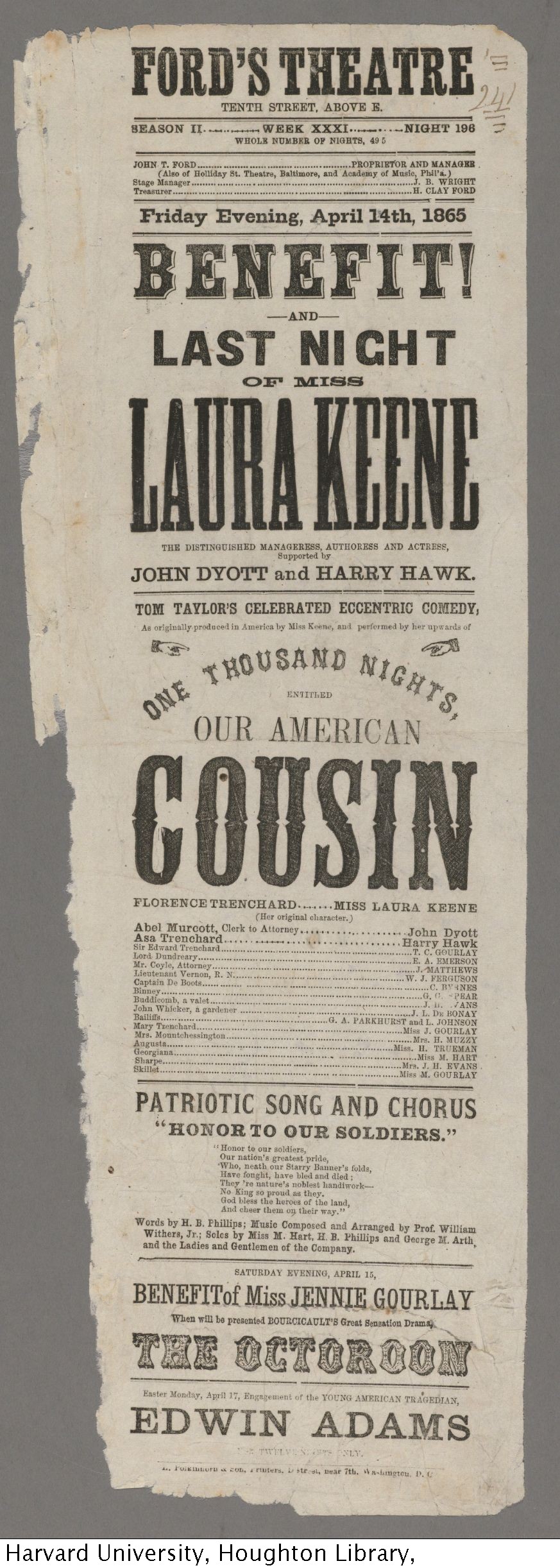
A true playbill from Ford’s Theatre on April 14th, 1865.

Polkinhorn’s was the “go to” establishment for Ford’s Theatre for their playbills.  The map that started this post has a red star marking where Ford’s Theatre is.  Polkinhorn’s office was less than a half mile away, making him a perfect place for the Ford’s to do their business.  In the Harvard Theatre Collection there is a ten by twenty inch bound volume of Ford’s Theatre playbills originally belonging to John B. Wright, stage manager at Ford’s.  The volume contains 193 playbills commencing from August of 1864 until the closing of the theatre after the events of April 14th, 1865.  A look at this volume shows that “H. Polkinhorn & Son” was the regular printer of the Ford’s Theatre playbills.  The “son” in “Polkinhorn & Son” was Henry’s son Samuel Polkinhorn.  After Henry retired, Samuel would partner up with his cousin, Richard Oliver Polkinhorn, who worked in the Polkinhorn building and was a talented printer in his own right.   “S & R. O. Polkinhorn, Printers” would last about a year before Samuel decided to bow out leaving his cousin as the sole owner of “R. O. Polkinhorn, Printer”.  Richard would create “R. O. Polkinhorn & Son” with his son Joseph and the Polkinhorn printing legacy would go on.

For a detailed look at the assassination playbills read the follow up post here.  What is important to know is that the only legitimate “Our American Cousin” playbills were printed by “H. Polkinhorn & Son”.  Any playbills bearing a different printer other than Polkinhorn are reprints or souvenirs.  Also, while Polkinhorn did print two different versions of the playbill, neither of them mention anything about President Lincoln.  Another printer named Brown would later print his own, slightly similar looking playbills announcing that “this evening the performance will be honored by the attendance of President Lincoln” and many people are fooled today into thinking they are legitimate, when they are not.

After retiring from the printing game, Henry Polkinhorn’s success allowed him to purchase a couple buildings and houses that he rented out.  In 1881, his own printing building (then being run by his nephew R. O. Polkinhorn) caught fire and the was severely damaged.  The entire fifth floor burned down, and was never replaced.  The rest of the building was repaired for a cost of around $20,000.

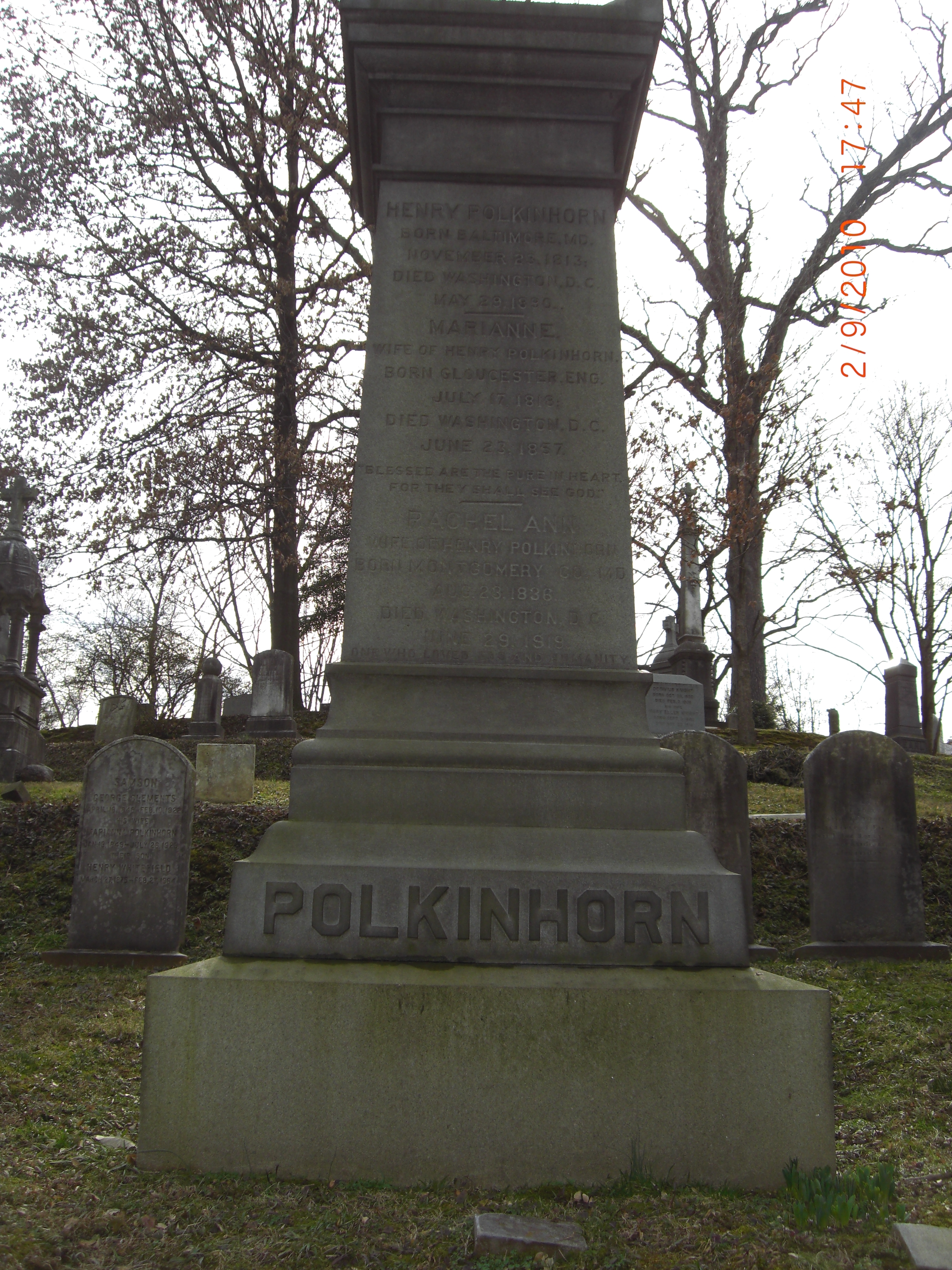
Henry Polkinhorn died on May 29th, 1890 at the age of 76.  He was interred at Oak Hill cemetery in lot #821.  Today, he rests there with his two wives and most of his children.

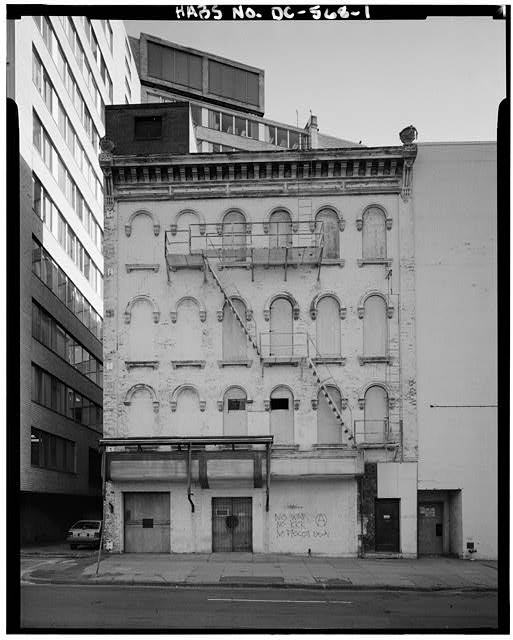
The Polkinhorn building, not far from Ford’s, survived until the late 1980’s when most of the block was torn down for redevelopment.

Polkinhorn Building in March of 1987 before being demolished.

At the end of it all, Henry Polkinhorn and his family represent the American dream in the best way.  His father imigrated from England, found success as a saddler, and saw his own son become one of the most respected printers in Washington, DC.

In his long and fruitful career, Henry Polkinhorn made a name for himself and today, at the bottom of one of the most sought after relics of the tragedy at Ford’s Theatre, that name get the final billing.

References:
I would like to thank Dale Stinchcomb at the Harvard Theatre Collection for the image of Mr. Polkinhorn, Kia Fennell for her assistance in figuring out his genealogy, and Rich Smyth for the picture of his grave.
Polkinhorn Building – Historic American Buildings Survey
The End of the National Intelligencer Article 1868-11-25
All newspaper clippings displayed above are from GenealogyBank.com

Categories: Uncategorized | Tags: , , , | 22 Comments

Michael O’Laughlen: Quilter

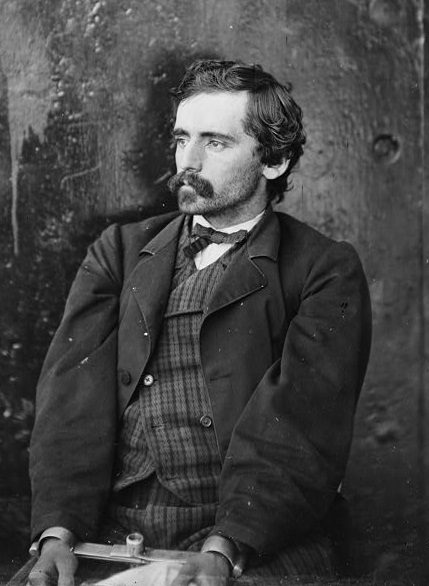
Of all the conspirators tried for Lincoln’s assassination, Michael O’Laughlen is probably the one that we know the least about.  His 1867 death at Fort Jefferson cut his life to a short 27 years.  The few things that we do know about him, come from the tireless research of Percy Martin, an original Boothie.  The most complete account of his involvement in the Lincoln conspiracy is written by Mr. Martin and is featured in Edward Steers’ edited version of the Pitman trial transcript.  While the details of his involvement are worthy of a post in and of themselves, such a post will have to wait for another day.  This one will focus on a more minute (and odd) detail about this elusive conspirator’s life: his early quilting experience.

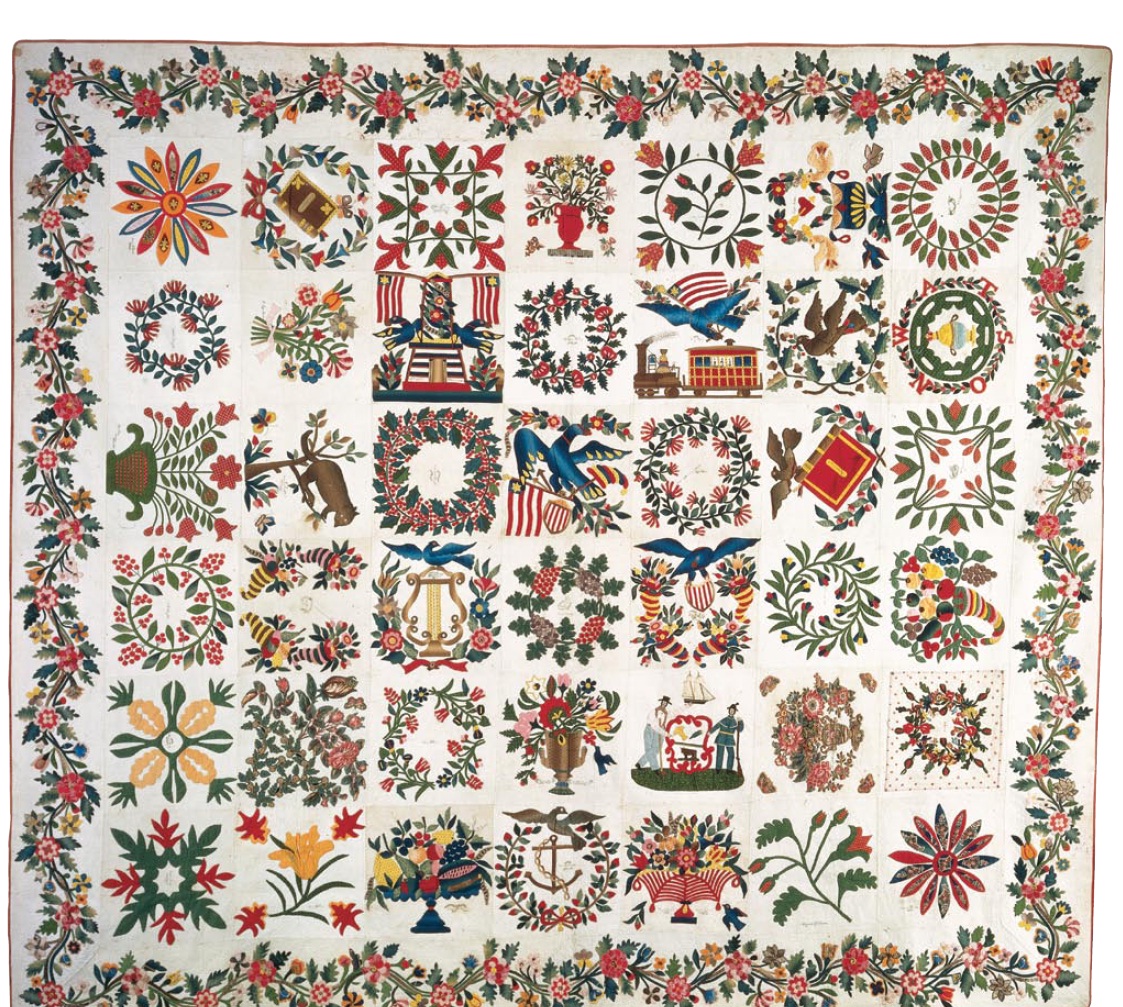
Michael O’Laughlen, Jr. (commonly spelled O’Laughlin) was born on June 3, 1840 in Baltimore.  He was the youngest surviving son of Michael O’Laughlen, Sr. and Mary Anne Wehner.  His mother, Mary Anne was born around 1812, and she was the daughter of Maria Bond and George Wehner.  George died in 1814 leaving Maria a widow with at least two small children to fend for.  Maria used her trade as a seamstress to bring in income.  Later, in 1832, Maria Wehner married a widower, Rev. Samuel Williams.  Samuel Williams was a Methodist minister and was around 23 years Maria’s senior.  Still, it is clear that Maria loved her new husband dearly as did many others who attended the Exeter Street Methodist church he preached at.  In 1846, Maria decided to create a present for her husband.  She decided on an album quilt in honor of his many years of service to the church and Exeter street community.  Maria organized many of her family and the neighbors to create, assemble, and sign their own applique squares to create a large, beautiful quilt.  The final product took over a year, and consisted of 42 individual squares that measured 107 ½“ by 119 ½“.

Sadly, Rev. Williams never saw the finished product, as he died in April of 1847.

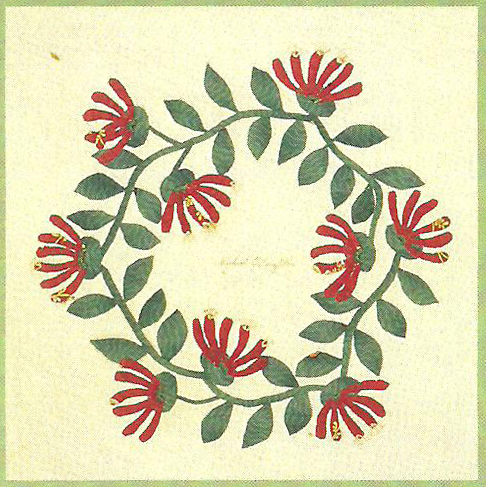
During the construction of the quilt, Maria Williams turned to her daughter Mary Anne to help her.  By this time Mary Anne had married Michael O’Laughlen, Sr., had five children by him (two of which died in infancy), and buried him upon his sudden death in 1843.  Mary, like her mother, adored her stepfather, Rev. Williams.  In fact, she and Michael O’Laughlen, Sr. named their first boy Samuel Williams O’Laughlen in honor of the good reverend.  She was more than happy to help her mother in creating a quilt in his honor.  Of the forty two squares in the quilt, Mary provided two of them: one bearing a raccoon in a tree, and one with a bird on top of a bible.  In addition, there are also four other applique squares from her children.  The eldest child, Maria Catherine O’Laughlen, provided two squares; an elaborate cherry wreath and a multicolored cornucopia.  Samuel Williams O’Laughlen provided a more basic cherry wreath.  And finally, her youngest child, Michael O’Laughlen, provided a simple honeysuckle wreath:

Honeysuckles by Michael O’Laughlen

Maria Williams died in 1863.  The quilt was given to Mary Anne O’Laughlen who gave it to her now only living son, Samuel Williams O’Laughlen.  It descended to his granddaughter, Carrie Serena O’Laughlen Wagner.  She donated the quilt to the Baltimore Museum of Art in 1985.   The Samuel Williams Quilt, as it is called, is considered a wonderful example of a quality “Baltimore album quilt”.  As a fundraising project for the Baltimore Museum of Art, in 1999 the Baltimore Applique Society began the task of reproducing the quilt in its entirety.  They traced, matched, and duplicated each design in detail.  The reproduction quilt went on display next to the original and to various quilt shows around the country, before it was raffled off in 2004.  Today, you can even buy the entire quilt 42 square pattern set through the Baltimore Museum of Art gift shop.  Better yet, you can actually purchase a pack of four of the squares that includes the O’Laughlen brothers’ cherry and honeysuckle wreaths.

Now, truthfully, it is unlikely that Michael O’Laughlen, six or seven at the time, actually sewed his own square.  In all likelihood, his and his brother’s squares were made by his mother who then attached their names to it.  Nevertheless, it is interesting to know that there is an elaborate quilt in existence bearing an applique square credited to Michael O’Laughlen, the conspirator.

References:
History of the Samuel Williams Quilt by the Balitmore Applique Society

Categories: Uncategorized | Tags: | 2 Comments

On this date: May 1st, 1976

The Surratt House Museum in Clinton, Maryland opened for public tours.

The house and tavern, formerly the property of Mary Surratt and a stopping point for John Wilkes Booth on his escape south, was donated by its owner to the Maryland National Capital Park and Planning Commission in 1964.  The work on restoring the house led to the founding of the Surratt Society, an organization devoted to furthering the study of the Lincoln assassination through trained guides for the museum, a monthly newsletter (the Surratt Courier), a yearly conference on the assassination, and the coveted John Wilkes Booth Escape Route Tours in the spring and fall.  The campus also houses the James O. Hall Research Center, the first (and often best) stop for research about the Lincoln assassination.  Visit Surratt.org to view their many wonderful events for the year.

References:
Surratt House Museum: A Page in American History by Laurie Verge and Joan Chaconas

Categories: Uncategorized | Tags: , | Leave a comment

The Lincoln Assassination Trial – The Court Transcripts

I have previously written about the wonderful resource tool that is, The Lincoln Assassination: The Evidence by William Edwards and Ed Steers. William Edwards went through and painstakingly transcribed the bulk of the National Archives’ record group M599, the government’s collected evidence after Lincoln’s assassination. With editorial annotations by Ed Steers, the book is the best tool for researching the Lincoln assassination primary sources. When used in conjunction with Fold3.com to view the documents themselves, the book becomes of even greater value.

While I could sing the accolades of The Evidence for hours, this post is actually about a new and equally wonderful resource by William Edwards, The Lincoln Assassination Trial – The Court Transcripts.

Now I know what you are thinking, “I already have a copy of the conspiracy trial. Why would I buy another one?” It is true that there are many editions and reprints of the conspiracy trial out there. There were three different versions of the trial (Pitman, Poore, and Peterson) and each have been reprinted many times over the years. Even William Edwards’ partner on The Evidence, Ed Steers, released his own reprint of the Pitman edition of the trial. However, as valuable as all of these versions are, William’s new eBook is better. Let me tell you why:

1. This transcription is the most accurate. This transcription was made straight from the microfilmed images of the court’s official copy of each day’s trial proceedings. The words and testimonies have not been summarized or altered in anyway. The words presented are exactly as they were written by the court’s team of stenographers in 1865.

2. This transcription is the most complete. While publisher Benjamin Perley Poore’s editions of the trial are equally accurate since they were taken from the same source material, they are also incomplete. His fourth and final volume of the trial transcript was never released due to a lack of public interest and low sales of the other volumes. Poore’s editions, therefore, are missing the testimonies of around twenty witnesses. In addition, Poore’s versions lack the closing arguments made by the prosecution and defense attorneys. These missing testimonies and closing arguments are found, in full, in this account.

3. This digitized version of the trial employs four different finding aids and is searchable. This digitized version of the trial makes reading and researching easy. Any part of the trial can be found based on section, NARA reel number, date of testimony, or witness name. Also, by pressing Ctrl+F while reading, you can do a search for any keyword in the entire trial.

Ultimately, if you are looking for a version of the conspiracy trial to purchase, look no further. If you already have a copy of the trial, you also need to get this version. For researching, there is no better version of the trial out there.

Buy it from Google Books today. You won’t regret it.

Categories: Uncategorized | Tags: , , | 9 Comments

On this date: April 17th, 1865

Lewis Powell was arrested at Mary Surratt’s boardinghouse on H street.  After wandering around D.C. since the night of the assassination, Powell had the dreadfully unlucky timing of showing up at Mrs. Surratt’s just as detectives were searching the place with orders to arrest the household.  When attempting to explain his arrival at the house at such a late hour, he claimed he had been hired by Mrs. Surratt to dig a gutter.  Even with a pick axe in hand and a torn off sleeve as a cap, his ruse was unconvincing and he was arrested.

From a friend, with thanks.

Categories: Uncategorized | Tags: , | Leave a comment

Blog at WordPress.com.