Author Archives: Dave Taylor

It was Stanton!

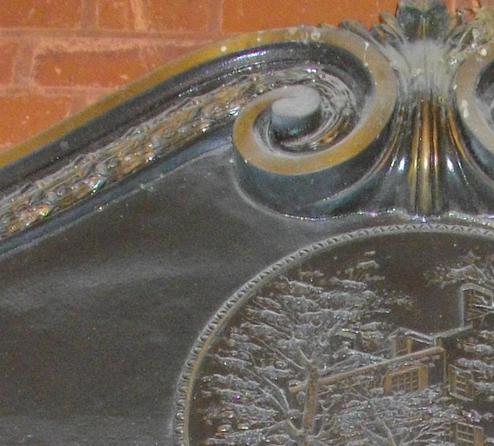
Don’t worry, I’m not going to try to convince you all that Secretary of War Edwin Stanton was behind Lincoln’s assassination.  Lincoln’s “Mars” was crucial in the hours after the President was shot in starting the investigation into his death.  The two men had a deep, profound respect for each other – a product of four years of war.  Nevertheless, some still believe that Stanton had a hand in Lincoln’s death.  Apparently even some of Stanton’s contemporaries suspected he was involved, too.  One person believed it so much, that he created the following:

I snapped this pictures out of an auction catalog with the following description:

It is interesting to think of the individual who painstakingly engraved the death of the conspirators on a plaque of ivory only to turn it into a platform for condemning the Secretary of War.

Categories: Uncategorized | Tags: , , | 8 Comments

Charles County Wanderings

While this post doesn’t contain much in the way of new material or research, I hope the following pictures of assassination related places and things are, nevertheless, enjoyable and informative.

After leaving Spangler’s grave, I continued my trek around Charles County, MD.  My next stop was Rich Hill, the home of Colonel Samuel Cox:

As you can see, Rich Hill is in delapidated condition. Neglect is taking a toll on this historic house.

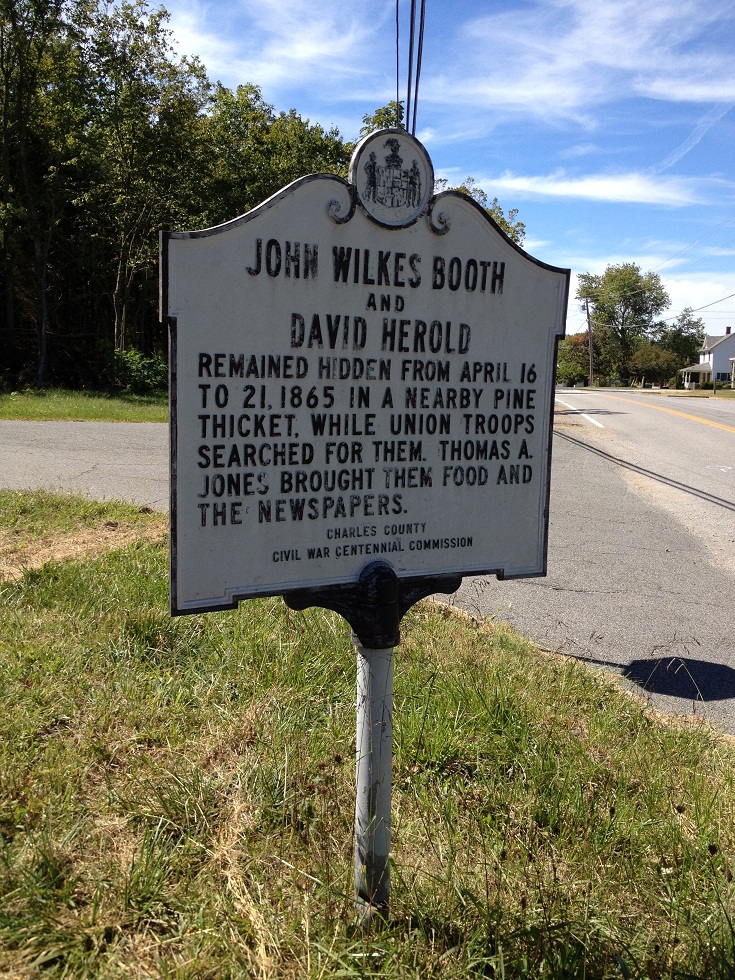
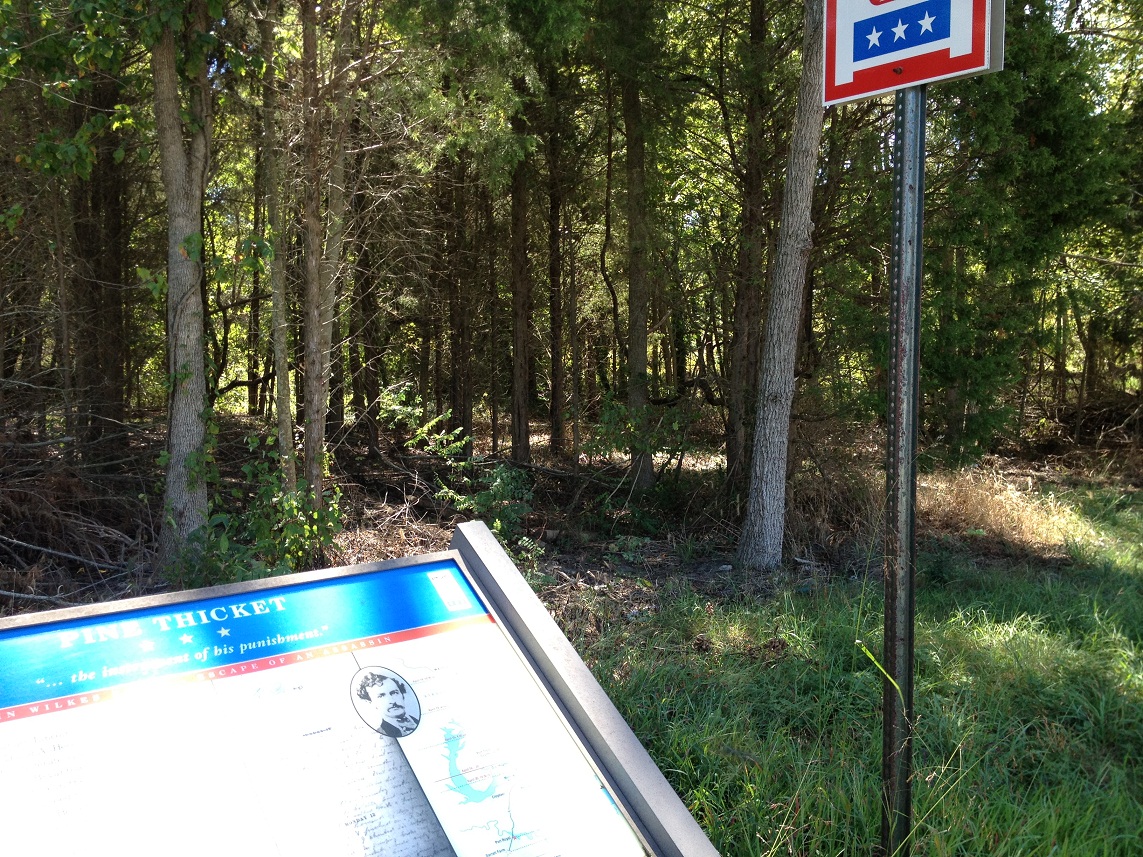
From Rich Hill, I traveled down the road to the “Pine Thicket”:

Booth and Herold moved around in this pine thicket while Thomas Jones kept them hidden from federal troops. The first place Jones met the pair in the thicket was near an old hollowed out stump that was used as a point for the Confederate mail line. The Collis house was later built on this spot. I drove down the dead end street near these signs and visited the Collis house. Next door to the home I was previously shown to be the Collis house however, there is a house that also looks very similar to the engraving in Thomas Jones’ book:

So at this point I’m not sure where the real Collis house might be. Either way a small part of the pine thicket still exists, right across from the Bel Alton post office.

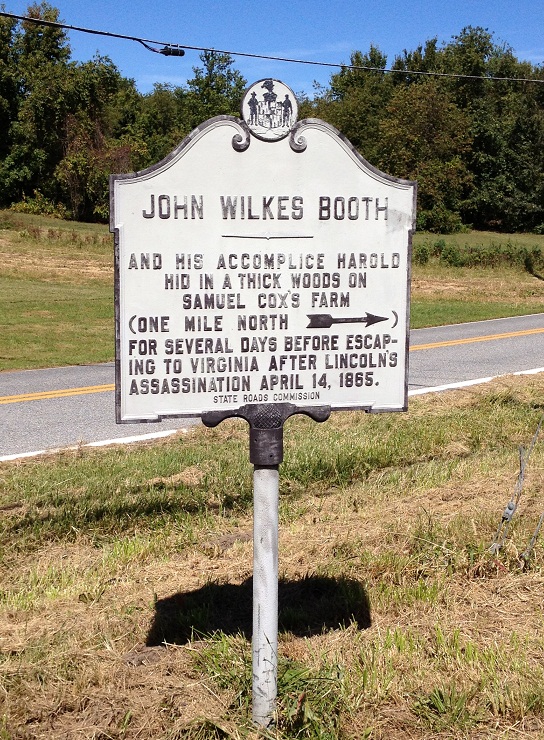
From here I decided to travel to Port Tobacco to see if I could sneak in a tour of the reconstructed Port Tobacco Courthouse. I passed this sign while heading there:

While the Courthouse building was open, there were many people setting up for a wedding reception so I quickly made my leave:

From Port Tobacco I took a non-Boothie stop to the Thomas Stone National Historic Site. Thomas Stone was a Maryland signer of the Declaration of Independence and his home, Habre-De-Venture, is a National Park. The property is quite beautiful and it was a wonderful day to go walking around their nature trail.

The Stone family cemetery with Habre-De-Venture in the background

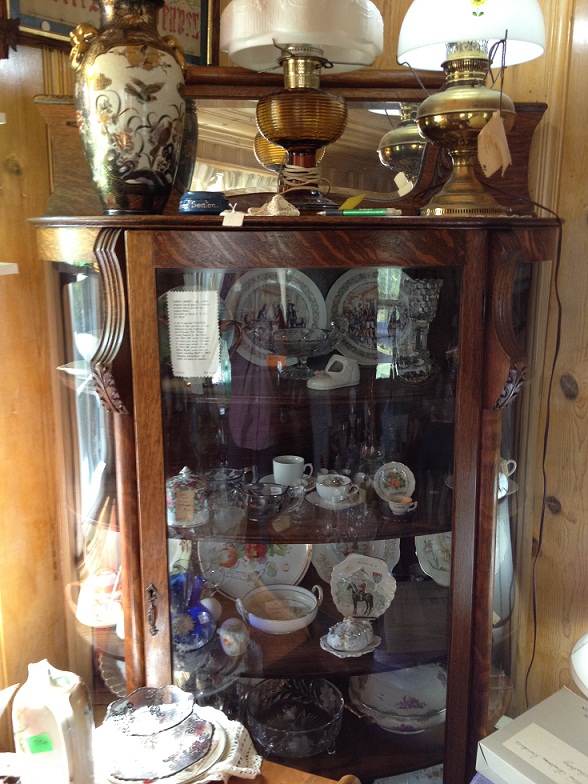
I chatted with the NPS ranger in the Thomas Stone visitor’s center for awhile and learned that she was friends of the Wearmouths, authors of Charles County history books. The pair, John and Roberta, wrote many books including ones about Port Tobacco, Thomas Jones and collected abstracts from the Port Tobacco Times newspaper. They had previously run a small antique store out of their home called, “Stone’s Throw”. She called the Wearmouths and I was invited over to see one antique related to a place I had already visited that day. I traveled to the Wearmouth’s house (literally a stone’s throw from the National Park) and chatted briefly with John and Roberta about their books. I was then showed the antique I had heard about, a piece that had once belonged to Samuel Cox, Jr. and was once housed at Rich Hill:

China cabinet owned by Samuel Cox, Jr.

This large, oak, china cabinet with curved glass is circa 1895 and is from Baltimore or D.C. The piece was shipped to Bel Alton on the Baltimore and Potomac Rail Road. The back of the piece is stenciled “S. Cox Bel Alton” to assure correct delivery off of the train. The Wearmouths bought it from an antique dealer who had acquired it from a lady who lived a few doors down from Rich Hill.

After all this I was pretty tired, so my impromptu trip around Charles County, Maryland came to an end.

P.S. Apparently while I was off driving around, you all were visiting my blog.  Today was a record day with over 310 visitors! Thanks!

Categories: Uncategorized | Tags: , , , , | 3 Comments

Spangler’s Stone

I’m currently driving around Charles County after standing in line at the Maryland DMV for a hour to learn I was just one ID short if getting my license transferred over. I’m posting from my phone so this will be short.

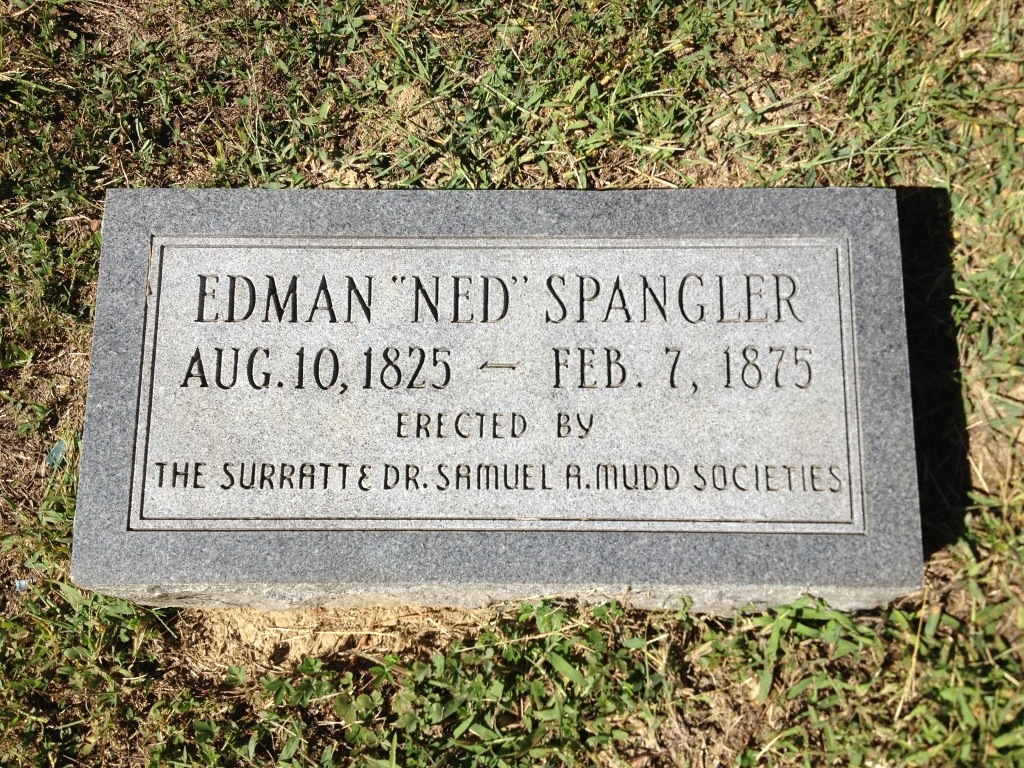
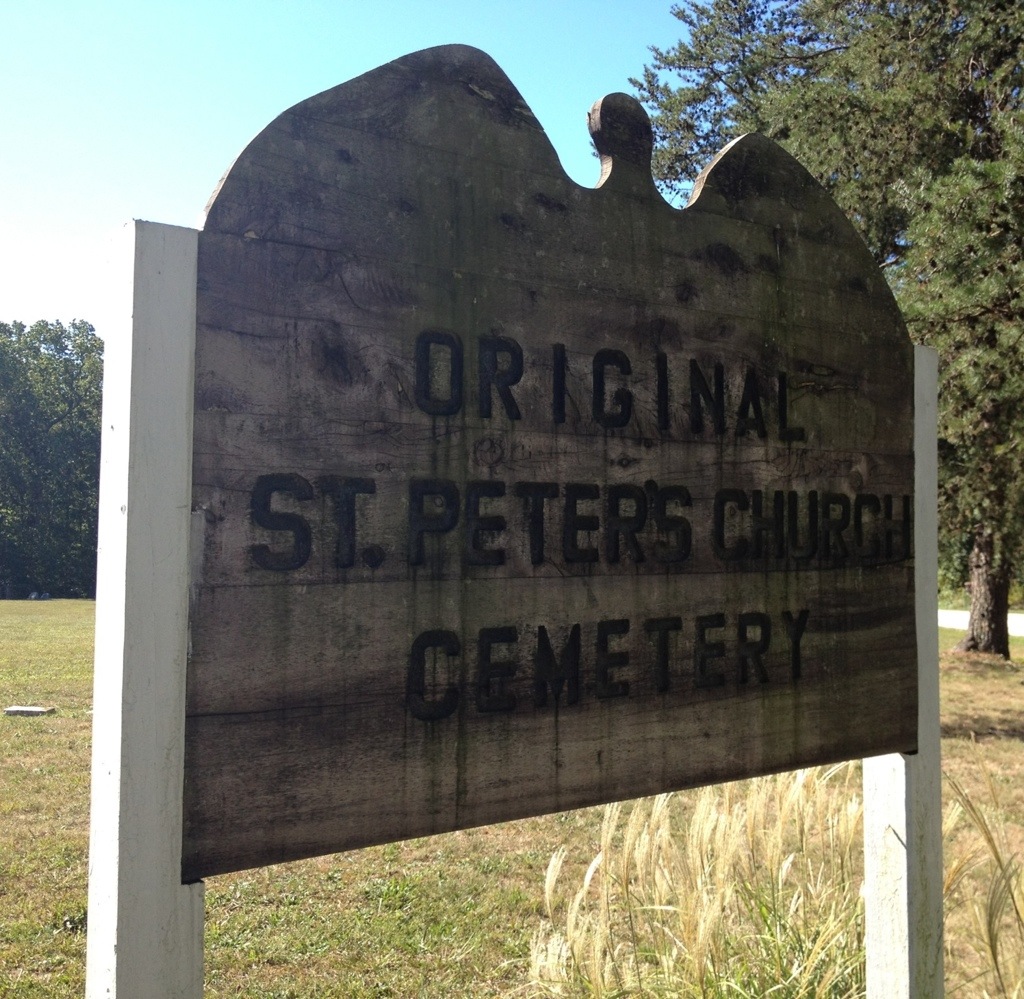
Below is a picture of Edman Spangler’s grave stone. Spangler is buried in the Original (Old) St. Peter’s Cemetery. Of all the conspirators, Spangler is agreed upon as being the most innocent. He had known the Booth family from his time helping to create Junius Brutus Booth’s Tudor Hall in Bel Air, Maryland. He built and attended to the stables behind Ford’s Theatre where Booth kept his horses. And on the night of the assassination Booth called for Spangler to hold his horse. Due to these facts and the mistaken testimony that Spangler had told another theater worker to keep quiet after the assassination, Spangler was tried as an accomplice. Even the military commission’s sentencing of six years in prison shows their relative belief of his innocence in the assassination plot. It seems that Spangler was just made and example of due to his acquaintance with John Wilkes Booth.

20120915-105747.jpg

20120915-105837.jpg

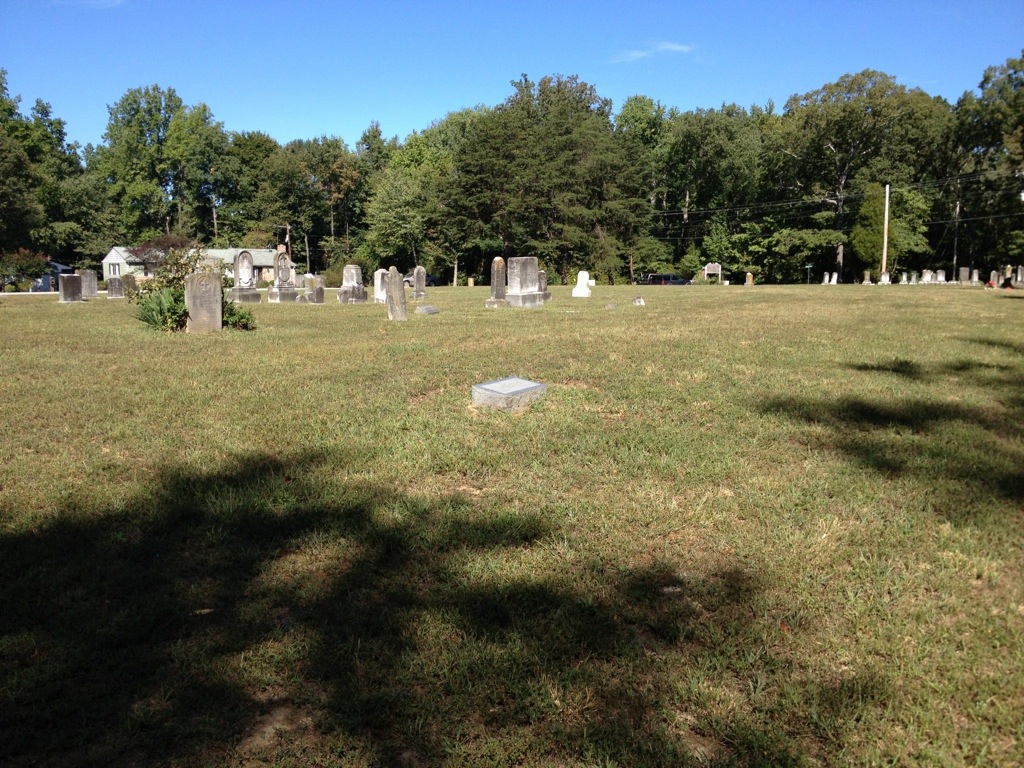
Spangler’s grave is located in the back corner of this small cemetery opposite the sign.

20120915-110008.jpg

Categories: Uncategorized | Tags: , | 6 Comments

10,000 *Woot*

I’m doing a little happy dance today as this blog has just reached the 10,000th visitor mark.  While it is a relatively low number compared to the popularity of several Lincoln sites (Roger Norton’s Abraham Lincoln Research Site is approaching 15 MILLION visitors!), I’m still proud that this site has garnered as much attention as it has in its short, six month existence.  When I started, I was so excited when I got my first blog “follower” and when I started getting almost 20 views a day.  Now I’m ecstatic to have 40 followers and averaging 75 views a day! 

I’d like to thank you all for coming to this site, reading what I have written, and adding your wonderful comments.  I feel so fortunate to have the support of so many fantastic websites, organizations, and people. 

Well that seems like enough self-indulgence for one day.  Thank all 10,000 of you for visiting BoothieBarn.com!

Categories: Uncategorized | Tags: | 23 Comments

Update: Finding George Atzerodt

UPDATE: We have verifying records as to the burial of a Taubert child in Feb. of 1869.  George is not in St. Paul’s.  Glenwood, here we come…

As is to be expected in the history field, no matter how confident you feel you “know” something, there’s always new information to be found.  In today’s case, I received some thorough and reliable comments on my previous post about George Atzerodt’s burial in St. Paul’s cemetery in Baltimore’s Druid Hill Park.  The following comment comes from Sandy Harper, church historian for Martini Lutheran Church.  Martini Lutheran is the caretaker of St. Paul’s:

“The child buried on Feb. 1869 was named Freidrich Gottleib Herman Taubert, he was 29 days old and his birth and death are in Martini Lutheran Church’s records.”

This February of 1869 burial was thought to be the secret burial of George Atzerodt.  Though this idea was partially at odds with the plot records as written in the book, Records of St. Paul’s Cemetery, in my previous post I did my best reconciling the idea that a 29 day-old child of Gottlieb Taubert was actually the 29 [30] year-old brother-in-law of Gottlieb Taubert: George Atzerodt.  Ms. Harper’s new information that it was, in fact, a coincidence that the Taubert’s were burying a child close to the same time that George was in need of re-interment, certainly requires us to continue to look elsewhere.  While I’d like to believe the research of the Boothies before me, the evidence against it is stacking up, with both the cemetery record book and the detailed information from Ms. Harper pointing towards a child not a conspirator being buried in St. Paul’s.

So, I attempted to retrace the body of George Atzerodt.  On my way home from work I called Glenwood Cemetery in DC.  The gentleman I spoke to was very knowledgeable reiterating the story that George was kept in a holding vault in Glenwood after being brought there by his brother John.  He told me that beyond that, they have no further records of what happened.  The reason for this, I was told, is that in the late 1800’s, a disgruntled board member of the cemetery stole the interment book for the first 7,000 burials in Glenwood.  He walked off with them in the middle of a meeting, never to return.  The interment information for George, if he was buried in Glenwood, would have been in this first book.  The gentleman also informed me that he was told upon his initial employment at Glenwood in 1995, that it was the belief of the cemetery that George was in Glenwood in an unmarked grave.  Glenwood believes George is buried in their cemetery, they just don’t know where.  When I asked if there would ever be a way to know for sure, I was told the only remaining chance would be for someone to sit down and look thorough their 14 books of plat maps.  Technically, George’s burial would have to be noted on a plat map to make sure no one attempted to bury a body where one already was.  The man I spoke to stated that in the seventeen years he’s worked there, he has yet to come across George in a plat map.  However, he also said he has never gone through looking for him specifically, merely that in the course of his other work, George’s name has yet to show up.

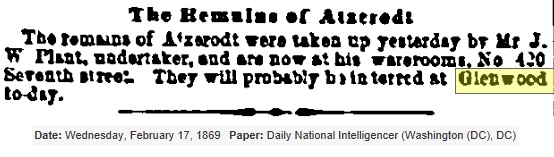
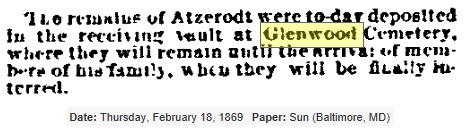
So the opinion of those working at Glenwood seems to be that George never left their cemetery.  I have to say that newspaper accounts of 1869 do seem to agree with them.  Several articles mention the undertaker that was used for Atzerodt’s remains and how his body was placed in Glenwood’s receiving vault:

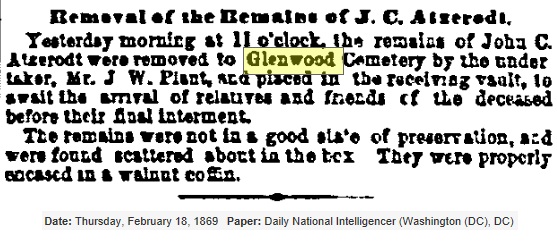
Despite the substitution of John’s name for his brother George, this article had the same information:

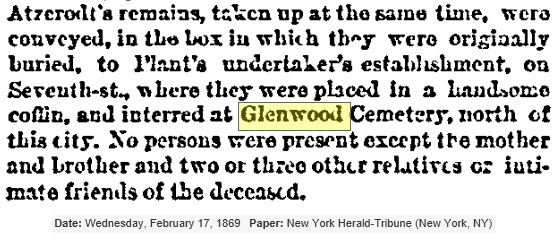
And lastly, this article mentions Atzerodt’s funeral in Glenwood:

The press of the day seemed to believe that George was buried in Glenwood.  As we know, though, they cannot always be reliable.

Just like we had for the St. Paul’s hypothesis, we are left with only circumstantial evidence regarding George’s final resting place being at Glenwood.  The last place to look for George seems to be Glenwood’s many plat maps.  However, even if a thorough search does not produce his name on a map, it is still possible that he is one of the unmarked, but occupied graves.  Sadly, it is unlikely that we will ever know for sure. Hopefully one day, I’ll make my way to Glenwood Cemetery to spend a day (or two) looking through their maps.

References:
Thank you to Sandy Harper for posting information about the Tauberts in St. Paul’s Cemetery.

Categories: Uncategorized | Tags: , , | 45 Comments

Some Real Booth Mummies

Finis Bates spent many misguided years trying to convince the world that John Wilkes Booth escaped death at Garrett’s farm. He displayed the mummified remains of David E. George and tricked people into believing the body’s convoluted identity trail from David George, to John St. Helen, to John Wilkes Booth. Bates created convincing pseudo-history with a dead body as an effective centerpiece. However, long before the real John Wilkes Booth was even born, the Booth family had a legitimate connection with mummies.  I quote from Asia Booth Clarke’s book, Booth Memorials: Passages, Incidents, and Anecdotes of Junius Brutus Booth (The Elder):

“About this time [1833] my father [Junius Brutus Booth] purchased two Egyptian mummies, with a view of presenting them to General Jackson. They were to be sent to the Hermitage; but, finding that they were such rare specimens, it was suggested that they should be reserved for the Museum in Washington, for which Mr. Varden was then collecting curiosities. The mummies were priests of the god “Apis; ” and, on examination, the papyrus manuscripts, although in excellent and legible order, proved to be of such antiquity that it was impossible for the literati of that day to translate their meaning.

Languages, like nations and religions, take their turns and seem to prove the mutability of nature. Mr. Varden’s design being ineffectual, the mummies were subsequently deposited in the Patent Office, Washington, and removed thence to the Smithsonian Institute.”

The eccentric Junius, was one of contradictory tendencies at times.  He cherished life in all forms, forbidding the killing of animals in his home and following the practically unheard of practice of vegetarianism.  At the same time though, he was friends with people like Sam Houston and Andrew Jackson.  Original Boothie John C. Brennan once said how odd a gift he thought the mummies to be for Jackson as Jackson wasquite good at, “shooting people and producing his own cadavers”.  The actor who wept during his organized funeral for dozens of killed pigeons, did not have the same reverence, it seems, for the remains of the long dead Egyptians.

According to Michael Kauffman in his book American Brutus, no donation record can be found for Junius’ mummies at the Smithsonian.  Nevertheless, as I visited the Smithsonian’s National Museum of Natural History and explored the Ancient Egypt exhibit today, I couldn’t help but wonder if one of the mummies on display once belonged to Junius Brutus Booth.  At least then there would be a real “Booth Mummy”.

John Wilkes Booth looking for his father’s donated pair of mummies in the Smithsonian.

References:
Booth Memorials: Passages, Incidents, and Anecdotes of Junius Brutus Booth (The Elder) by Asia Booth Clarke
American Brutus by Michael Kauffman
The photo of JWB in the Smithsonian was taken using the Augmented Reality function of Michael Kauffman’s new publication, In the Footsteps of an Assassin.  After purchasing the book, smartphone users are able to download an app which provides tour commentary on the go.  It also includes four augmented reality photo ops in which an overlay of Lincoln, Mary Todd, JWB or Lewis Powell, can be added before taking any picture.  Now, I can take snap a photo of Booth anywhere, without any photo editing required.

Categories: Uncategorized | Tags: , , | 6 Comments

Mystery Pictures Part II – Bits and Pieces

Time for a bit of trivia and entertainment here on BoothieBarn.  Try your best to see if you can figure out what is shown in each of the twelve pictures below.  This time, I have only given you bits and pieces of the entire item or place.   When you think you’ve got them all (or given up) click on the “Check Your Answers” link below.  Good luck!

Mystery Picture #1:

Mystery Picture #2:

Mystery Picture #3:

Mystery Picture #4:

Mystery Picture #5:

Mystery Picture #6:

Mystery Picture #7:

Mystery Picture #8:

Mystery Picture #9:

Mystery Picture #10:

Mystery Picture #11:

Mystery Picture #12:


Check Your Answers!

So, how did you do?

Categories: Uncategorized | Tags: | 6 Comments

Booth and Lincoln

“In 1863 or 1864, Robert [Todd Lincoln], on vacation from Harvard, was traveling from New York to Washington and waiting at the train station at Jersey City, New Jersey. While standing in line for tickets on a station platform, Robert was pressed by the crowd against the waiting train – which than began to move forward – and he fell into the narrow space between the train and the platform. He was helpless to escape when a hand grabbed his coat collar and pulled him up onto the platform. Robert turned to find his rescuer to be Edwin Booth, America’s most revered stage actor who was traveling to Richmond, Virginia with his friend John T. Ford (owner of Ford’s Theatre in Washington, D.C.) to fulfill an engagement. Robert recognized the actor and thanked him by name. ‘I was probably saved by [Mr. Booth] from a very bad injury if not something more.”…Robert later wrote that although he never again met Edwin Booth in person, he always had a “most grateful recollection of his prompt action on my behalf.'”

The story above is a fairly well known and publicized coincidence between a Booth and a Lincoln. The book I quoted from is Jason Emerson’s biography of Robert Todd Lincoln, Giant in the Shadows: The Life of Robert T. Lincoln. Mr. Emerson was a speaker at the 2011 Surratt Society Conference in which he discussed this encounter between the two men. He recounted that, as time progressed, the story of Edwin saving Robert Todd, became more and more grandiose. In one version of the tale, Robert Todd was supposedly knocked unconscious by the fall and Edwin pulled up his limp body. The most extreme incarnation though, was the one that had Robert Todd Lincoln oblivious to the fact that he was on a set of train track as a train came barreling down towards him. With almost superhero speed, Edwin Booth then ran forward and leapt into the air, tackling Robert out of the way of the train just in time.

A Reader’s Digest illustration of the Booth-Lincoln encounter

Though that last version had very little basis in fact, the true story continues to be told over and over by many newspapers, magazines and websites, due the palatable irony that surrounds the characters. We all know how this Good Samaritan tale would one day be eclipsed by a different “Booth and Lincoln” story.
References:
Giant in the Shadows: The Life of Robert T. Lincoln by Jason Emerson
Categories: Uncategorized | Tags: , | 4 Comments

Blog at WordPress.com.