Author Archives: Dave Taylor

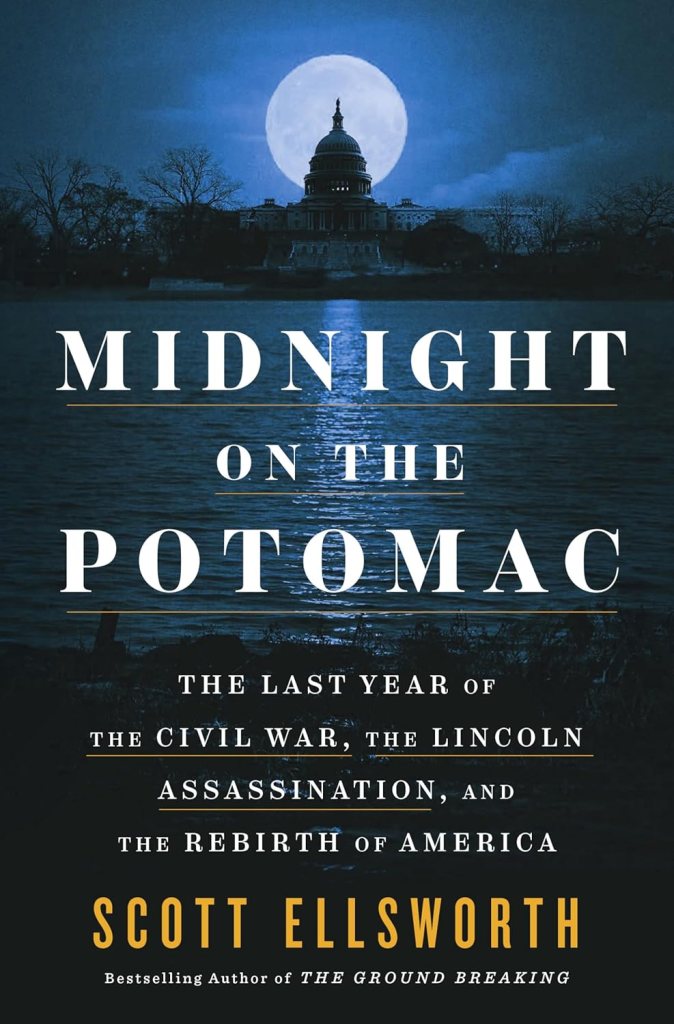
Midnight on the Potomac by Scott Ellsworth

In July of 2025, bestselling author Scott Ellsworth published his newest book, Midnight on the Potomac: The Last Year of the Civil War, The Lincoln Assassination, and the Rebirth of America. After devouring Dr. Ellsworth’s incredibly well-written and engaging book, I reached out to him seeing if he would be willing to sit down for a virtual interview about his work. Below you will find our talk where we discuss the end of the Civil War, the character of John Wilkes Booth, and the Confederate Secret Service.

I’m so grateful to Dr. Ellsworth for chatting with me and I hope you will all pick up your own copies of Midnight on the Potomac wherever you get your books. While Scott didn’t quite make a believer out of me when it comes to the Confederacy’s role in Lincoln’s death, his book provides many intriguing points to ponder. On top of all that, the book gives an engaging accounting of the final months of the Civil War that is impossible to put down.

Categories: History, News | Tags: , , , | 5 Comments

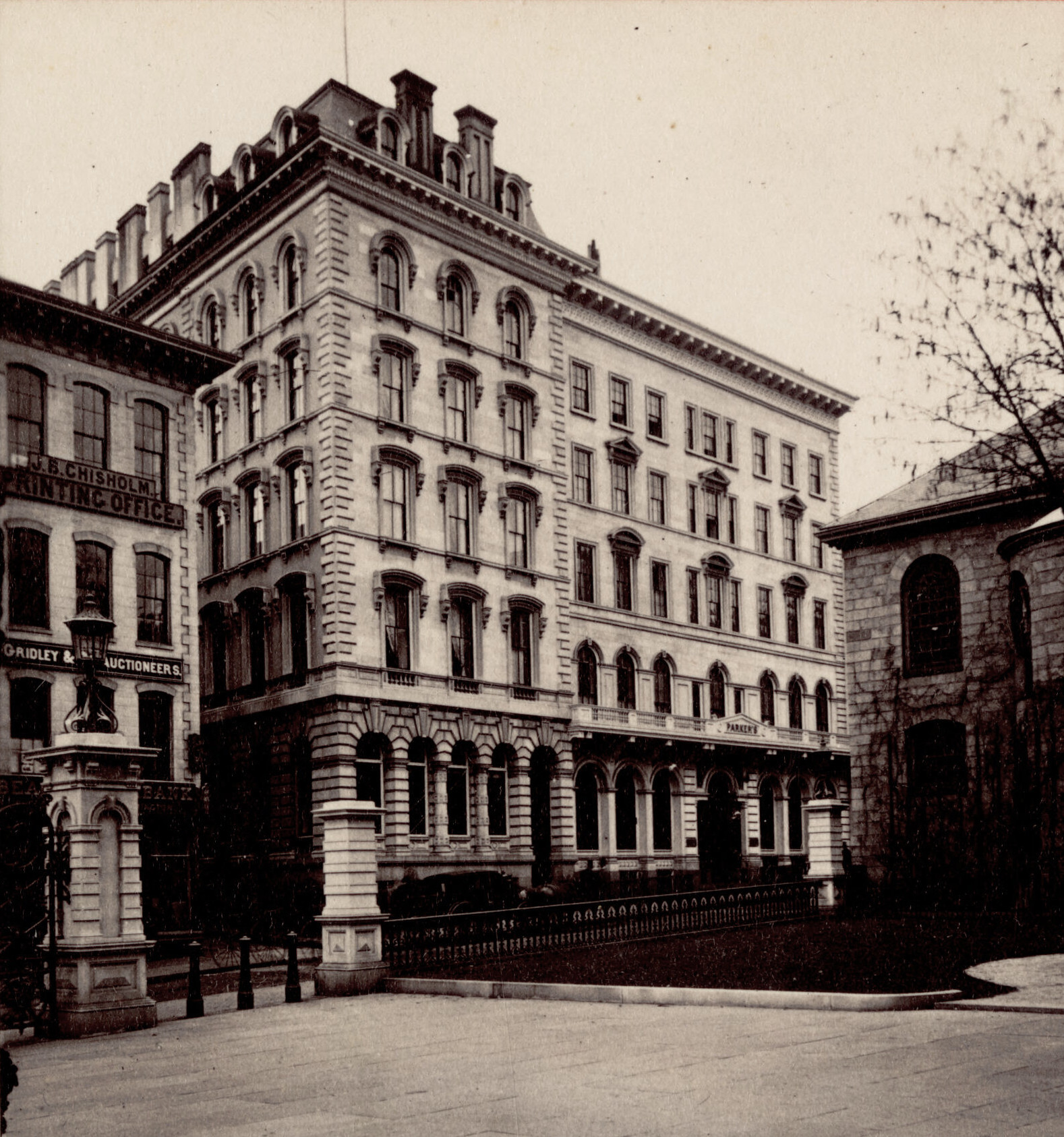
John Wilkes Booth at the Parker House Hotel

In 1988, Lincoln assassination researchers General William Tidwell, James O. Hall, and David Gaddy published a book called Come Retribution: The Confederate Secret Service and the Assassination of Lincoln. The volume was the first book of its kind, attempting to unravel the activities of the Confederate Secret Service during the Civil War. The trio documented many plots and instances of guerrilla warfare that Confederate agents undertook to undermine the Union war effort and support the goals of the Rebel South. In addition to documenting the South’s spying apparatus, the authors revitalized the belief of the Union government in 1865, which posited that the Confederate government was behind John Wilkes Booth’s plot against Abraham Lincoln. 

There is no denying that John Wilkes Booth had several intriguing interactions with those involved in some way with secret Confederate activities. His conspirator in the kidnapping plot, John Surratt, was a known Confederate courier, helping to transport mail and people across the line between Union and Confederate territory. In October of 1864, while working on his plan to abduct Lincoln, Booth traveled to Montreal, Canada, a hotbed of Confederate intrigue, where it was claimed he met with high-ranking Confederate officials stationed there. At the trial of the Lincoln conspirators, a group of witnesses gave damning testimony regarding Booth’s familiarity with members of the Confederate leadership in Canada. The belief of the federal government was that the assassin was following the directive of Confederate leaders and that they were as much to blame for the murder of Lincoln as John Wilkes Booth. 

However, despite the strong belief that the Confederate government was the moving spirit of Booth’s plot, concrete evidence proving such a connection has never quite materialized. Most of the witnesses who placed Booth with high-ranking Confederate officials in Canada were later proven to have committed perjury and been bribed to provide their false testimony. No document from the Confederate government mentions Booth, nor were any documents connecting him to the Confederacy found among Booth’s papers after his crime. John Surratt denied that his foray with Booth was in any way connected with his activities as a rebel courier. 

While Booth undoubtedly had flirtations with Confederates and clearly assembled a gang of Confederate sympathizers to help him in his plan, the smoking gun proving that John Wilkes Booth was acting as an authorized agent of the Confederacy remains elusive. 

Even with acknowledging the lack of definitive proof, Tidwell, Hall, and Gaddy proceeded to build a circumstantial case attempting to prove the Confederacy culpable for Lincoln’s death. One piece of evidence the men pointed to revolved around a trip John Wilkes Booth took to the Parker House hotel in Boston, Massachusetts, in July of 1864.

Part of Come Retribution discusses a Confederate attempt to utilize biological warfare against the Union. Several boxes of clothing “infected” with Yellow Fever were sent to northern cities in an effort to start an outbreak of the deadly disease. Luckily, the plot proved unsuccessful as the medicinal knowledge of the day was unaware that Yellow Fever is not contagious but is spread through the bites of infected mosquitoes. Still, this attempt to poison Northern cities was a significant escalation, and the plot was discussed at the trial of the Lincoln conspirators to show how the Confederacy had been willing to commit terrible deeds to win the war.

Details of the Yellow Fever plot piqued the interest of a man named Cordial Crane, who was an official of the Custom House in Boston, Massachusetts. The trunks of yellow fever clothing had made their way through the port of Boston, and one of the conspirators in the plot was said to have stayed at the Parker House hotel in Boston during the shipping process. Acting under his own initiative, Crane went and consulted the hotel register for the Parker House. While he was not able to find any evidence of the Yellow Fever conspirator in the ledger book, he did note the appearance of John Wilkes Booth’s name. I’ll let Come Retribution take it from here:

“…He [found] J. Wilkes Booth on the Parker House register for 26 July 1864 along with three men from Canada and one from Baltimore. Crane’s suspicions were aroused. He copied the entries and sent a letter dated 30 May 1865 to Secretary of War Edwin M. Stanton. He listed the names “Charles R. Hunter, Toronto, CW [Canada West], J Wilkes Booth, A. J. Bursted, Baltimore, H. V. Clinton, Hamilton, CW, R. A. Leech, Montreal.” In his letter to Stanton, Crane wrote that he sent the “names as a remarkable circumstance that representatives from the where named places should arrive and meet at the Parker House at about the same time Harris was on his way to Halifax with his clothing.” Crane put the emphasis in his letter on “Harris” and the supposedly infected clothing. No investigation was made into the other names on the Parker House register. After all, Booth was dead and the War Department already had information about the “yellow fever plot.” Crane’s letter was filed and not followed up.

Now, more than a century later, the gathering at the Parker House can be construed differently. It has all the earmarks of a conference with an agenda. The inference is that agents of the Confederate apparatus in Canada had a need to discuss something with Booth. Capturing Lincoln? Within a few weeks Booth was in Baltimore recruiting others for just such a scheme and had closed out his Pennsylvania oil operations. The inference becomes stronger as a result of a careful search of records in Toronto, Baltimore, Hamilton, and Montreal. No trace of Hunter, Bursted, and Leech was found. The names appear to be aliases.

The man using the name “H. V. Clinton” did turn up in a not unexpected place. Such a man registered at the St. Lawrence Hall, Montreal, on 28 May 1864. Instead of listing himself as from Hamilton, CW, he gave his home address as St. Louis, Missouri. He was back at the St. Lawrence Hall on 24 August 1864, again entering his name on the register as “H. V. Clinton, St. Louis.” A thorough search of St. Louis records from the 1850-1870 period was made. “H. V. Clinton” was not found.”

Now this is an example of where I believe Tidwell, Hall, and Gaddy go too far astray with their suppositions and theories in hopes of proving their overall thesis. With nothing but transferred names from a hotel registry, they have concocted a scenario in which Booth engaged in a meeting with these fellow hotel guests, and that the purpose of this meeting was the actor’s recruitment into an abduction plot against the President. The main evidence of this scenario is the trio’s belief that the names used in the register are aliases, and thus, proof of the men being Confederate agents. Yet this is a laughable conclusion to make without evidence. A researcher’s inability to find more information about a person listed in a hotel registry doesn’t prove the person used an alias. Once you start down that route, you might as well put on your tinfoil hat because then every name is an alias.

Tidwell, Hall, and Gaddy were good researchers, to be sure, but they were as capable of making mistakes and missing things as anyone. One thing that they, and other researchers since, have missed is the fact that they have transcribed one of the names from Crane’s list incorrectly. His list doesn’t include the name Charles R. Hunter, but rather the name “Chas R Winter.”

Above is the original handwritten letter that Crane sent to Edwin Stanton. A microfilmed version of the letter is contained in the Lincoln Assassination Evidence collection housed at the National Archives, and that entire collection is digitized and viewable at Fold3.com. At the bottom of the first page, Crane lists the first of five names he copied from the Parker House hotel registry dated July 26, 1864.

Now, looking at it quickly, I can understand why Tidwell, Hall, and Gaddy read this as “Charles R Hunter, Toronto CW.” The first letter of the last name certainly seems like an H with an incomplete crossbar. We’ll get to that later. Instead, look at the second letter in the last name. Tidwell, Hall, and Gaddy transcribed this letter as a “u”, but there is clearly a dot floating above it indicating the letter is actually an “i”. An “i” is also the only way that the rest of the word “-nter” would work, since a cursive “n” had two bumps and a ‘u” would steal one of these bumps to make the downstroke. William Edwards and Edward Steers, in their edited printed volume of the evidence agrees that this second letter is an “i” and they transcribe the name as “Chas R Hinter.” However, I believe the name is actually “Winter” with the “W” somewhat hastily drawn. For comparison, look at the way Crane writes Booth’s middle name.

Note how the “W” in Wilkes starts with a little flag or serif before starting the down stroke. The first letter in Charles’s last name also starts with a flag-like serif (admittedly, a somewhat smaller one). Returning to “Wilkes’ we can see how Crane’s downstroke immediately angles upwards and then falls again to make the middle of the “W.” However, rather than bringing the final stroke completely back to the top to complete the capital “W,” this final stroke is significantly shortened and connects directly into the next letter, an “i.” When I taught cursive to my third graders, I always taught them that a capital W doesn’t connect to the rest of the word, but Crane has made his own shortcut of sorts. We can see the same basic formation later on the second page when Crane writes about “the sad tragedy at Washington.” Again, the capital W starts with a decorative serif (this time it’s not connected to the main letter) and the final stroke of the W is almost non existent as it merges into the “a.” Looking back at Charles’s name we see the small flag, the downward stroke and then the start of the upward angled stroke before the line breaks. It could have been that the pen Crane was using was misbehaving, or he failed to put enough pressure during this stroke, which is why it cuts off. Still, we then have the downstroke and the significantly shortened final upstroke that goes into the “i” instead. For those who might still believe this letter is meant to be an “H,” look at the other examples of capital Hs in the letter. There is no starting serif, no upward diagonal. Crane forms the middle of his H by making a loop in his second vertical line. There is no evidence of an attempt to “loop” the downward stroke before the “i.” The name is not Charles Hunter or Charles Hinter, but Charles Winter.

While Tidwell, Hall, and Gaddy may not have been able to find a Charles R. Hunter living in Toronto, there was a Charles R. Winter who lived there. Charles Robinson Winter was born in Barnstaple, England, in 1832. His older brother immigrated to Canada in the late 1840s, and Charles eventually followed him. Charles R Winter from Toronto is included in the arrivals list for the Royal Hotel in Hamilton, Ontario, on May 17, 1864. In January 1865, he married a fellow English native turned Canadian resident, Elizabeth A. Baker, at the home of her brother in Toronto. In the 1871 and 1881 censuses, Winter is listed as an “agent” and directories specify him as a “manufacturer’s agent,” a role that would require a lot of travel. In fact, in the 1868 Toronto directory, his occupation is listed as “traveller.” Now, I can’t prove that this Charles R. Winter is the same one as the one who checked into the Parker House hotel in Boston on July 26, 1864, but I feel that this is more of a possibility than this name being an alias. Winter died in 1899 and is buried in Toronto.

The final name on Crane’s list is “R. A. Leech Montreal.” Though it’s spelled a tiny bit differently, through some research, I pretty quickly found a Robert A. Leach who resided in Montreal during this time period.

Robert A. Leach (according to an image on FindaGrave)

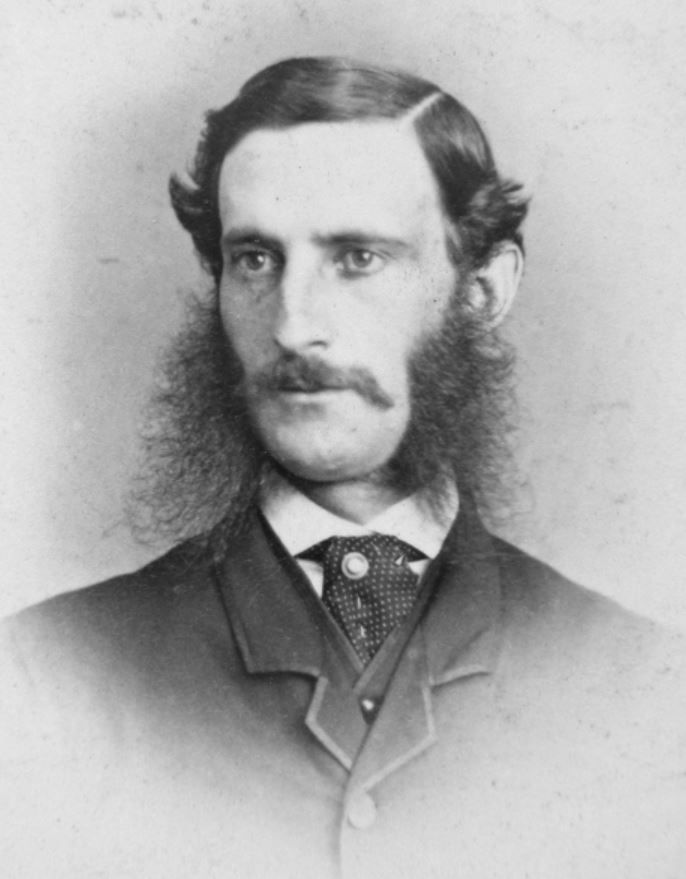
Robert A. Leach was a young lawyer from Montreal. He is found in the 1864 Montreal directory as the “R” in “R & D Leach, Advocates.” This was a firm he shared with his brother David. Both were the elder sons of William Turnbull Leach, the archdeacon of Montreal’s St. George Church. Robert A. Leach died from an unspecified illness in 1871 at the age of 32. He is buried in Montreal. Again, I feel the possibility that the R A Leech in Crane’s letter is more likely to have been Robert A. Leach than an alias of a Confederate agent.

Now I wish I could say that I’ve found prospective identities for each of the names on the list. While I definitely have a step up over Tidwell, Hal, and Gaddy, who worked in the pre-Internet age, the remaining two names on the list have mostly eluded my own searches.

However, it’s clear from Crane’s letter that he had a hard time deciphering the last name of the man from Baltimore. Come Retribution only provides Crane’s first guess, “A J Bursted,” but the original letter shows Crane adding “(or Rursted)” after this entry, showing his uncertainty. “Bursted” and “Rursted” are not surnames for anyone. It is unlikely a person would have used such a nonexistent last name, even as an alias. It is far more likely that Crane just couldn’t read the poor handwriting of the entry. The last name might have been Bustard, Buster, Bumstead, or something else entirely. With only the initials “A. J.” (if even those are accurate), we don’t know what first names to search. Unfortunately, we cannot go back to the original records ourselves to try our hand at deciphering these names. The original registers for the Parker House hotel during this period no longer exist. All we have is this small snapshot from Crane, which doesn’t even specify if these were the only names entered into the register on July 26, 1864. It seems unlikely that a busy metropolitan hotel like the Parker House would only gain five guests over the whole day. It seems more likely that these were the only names Crane recorded because he was looking for a connection to Canada.

The Parker House hotel in Boston

But let’s still look at “H V Clinton” of Hamilton, Canada West. This name is seemingly the linchpin of Come Retribution’s theory that the names on the list are all aliases. As they note, the name “H V Clinton” also appears on the register for the St. Lawrence Hall hotel in Montreal in 1864. That hotel was known to cater to many Confederate agents and sympathizers. It was said that the St. Lawrence Hall was the only hotel in Canada to serve mint juleps, a favored drink among the plantation South. I’ll admit that I have not been able to find an “H. V.” Clinton living in Hamilton, Ontario. However, I did find a whole family of Clintons, with different initials, who lived in the area. James H. and William Wesley Clinton were farmers who resided in the Oneida Township of Haldimand County, Ontario. Haldimand County abuts the city of Hamilton, and the distance between downtown Hamilton and the Oneida Township is about 18 miles. A resident of this rural area would likely provide their place of residence as Hamilton on a hotel register in the same way Booth regularly registered in hotels as being from Baltimore rather than Bel Air. While Booth had also lived in Baltimore as a child, once his father died in 1852, he never resided in Baltimore again. The Booths didn’t even have a home there after the 1850s. If I were to try to find John Wilkes Booth in Baltimore records during the 1860s, I would fail. In the 1860 census, the Booths are all enumerated as living in Philadelphia. During the summer of 1864, he resided with his brother Edwin in New York City. Yet, to Booth, he was “from” Baltimore, and that’s why he would sign hotel registers that way. H V Clinton from Hamilton, Ontario, might have followed the same course. There was a man named William Clinton who lived in Hamilton and worked as a saw-filer in 1863 and beyond. Granted, none of these individuals appear to match the given initials  “H. V.”, but remember that we are trusting Cordial Crane that he transcribed the right letters. Regardless, there were Clintons living in and around Hamilton, Ontario, during the 1860s who could represent the man who checked into the Parker House.

What of the mysterious H.V. Clinton, who checked into the St. Lawrence Hall in Montreal in 1864? As Come Retribution notes, this Clinton wrote his place of residence as St. Louis, Missouri. He checked in on May 28, July 8, and August 24. For some reason, the Come Retribution authors neglected to mention the July 8 entry, despite their having been aware of it. On that day, H V Clinton checked in at 7:30 pm. Earlier that same day, an entire party from St. Louis had also checked in. This party was headed by “Mr and Mrs Garneau,” their two children, a nurse, and two other guests: a “Miss Withington” and a “Miss Clinton.” The Garneaus were Joseph and Mary Garneau. Joseph was a Montreal native who immigrated to the States and settled in St. Louis. There, he established a bakery that grew into one of the largest factories for baked goods in the U.S. He produced crackers in huge quantities and helped supply the Union with crackers and hardtack during the war. Mrs. Garneau’s maiden name was Withington, and the Miss Withington who joined them was her younger sister, Emily Withington. The names of this party can also be found in a newspaper article published in Buffalo, New York, on July 6. It appears that the Garneau party traveled part of the distance from St. Louis to Montreal aboard a boat called the Badger State commanded by Captain James Beckwith. The article contained a thank you to Captain Beckwith and a positive review of the journey that the boat provided. Included in the signatories of the article are the names Joseph Garneau, Mrs. Joseph Garneau, Miss E Withinton [sic], and Miss Maggie Clinton. I have been unable to determine the relationship between this Maggie Clinton and the Garneaus. 

The St. Lawrence Hall hotel in Montreal

Still, the arrival of H V Clinton, also from St. Louis, to the same Montreal hotel, on the same day as the Garneau party featuring Maggie Clinton, definitely seems to be connected. In addition, Come Retribution fails to mention that when H V Clinton returned to the St. Lawrence Hall hotel on August 24, he was not alone. That time, he checked in with “Miss Kate Clinton,” also from St. Louis. The two were put in adjoining rooms. All of this makes me think there was some sort of family connection between H V, Maggie, and Kate Clinton, and that they were also somehow connected to the cracker magnate, Joseph Garneau, who was originally from Montreal. 

As Come Retribution mentions, searches for H V Clinton in St. Louis, Missouri, fail to provide identifying information. There were definitely Clintons living in St. Louis in 1864. So far, I have only been able to find one instance of an H V Clinton in St. Louis. It was common practice in days gone by to publish lists of unclaimed letters held by the post office in the newspaper. Many people addressed their letters with just the name of the recipient and the city or town where they resided, rather than a full street address. It was then up to the recipient to go to the post office and inquire about any letters for them to receive their mail. To illustrate this, here’s the envelope to a letter John Wilkes Booth wrote. It gives the addressee’s name but merely directs it to the post office where it would have to be picked up.

If a person did not pick up their mail from the post office after a certain period of time, postmasters would publish a list in the paper, hopefully informing the recipient that they have mail waiting for them. The name H. V. Clinton is featured on such a list in the St. Louis Globe Democrat newspaper on September 15, 1866. It’s worth noting that this date is well after the end of the Civil War. If the name H V Clinton were indeed an alias, there would have been no need to continue using it after 1865. It seems more likely that H V Clinton was a resident of St. Louis in the 1860s, albeit one that is difficult to track down. 

During my research, I stumbled across other H V Clintons in the 1860s that could possibly be the same person, but their connection to St. Louis is unproven. There was an H V Clinton living in Carroll Parish, Louisiana, through the 1860s. A H V Clinton and his wife from Indiana visited Newport, Rhode Island, in 1862. Henry V. Clinton, residing in Newport, advertised for a nanny to accompany him and his young son on a year-long trip to Europe in 1864. There’s no way to prove or disprove that any of these are the same H V Clinton.

In the same way, we cannot prove that the H V Clinton from Hamilton, Ontario, who signed the Parker House hotel registry in Boston on July 26, 1864, is the same H V Clinton from St. Louis, Missouri, that thrice signed the St. Lawrence Hall register in Montreal in May, July, and August of 1864. The difficulty in finding either of these men does not prove they are the same person or, even more, that they were an alias for a Confederate agent who subsequently recruited Booth into the plot to kidnap Lincoln. 

In the credit of Tidwell, Hall, and Gaddy, when they wrote Come Retribution, they were understandably intrigued by the fact that Booth made a seemingly random visit to Boston in the summer of 1864. In June of that year, he had been tending to his failing oil investments in Pennsylvania before arriving and spending weeks with his family in New York City and in New London, Connecticut. This register entry of a trip to Boston was a mystery, and, following Cordial Crane’s suspicions, the trio made a conspiracy out of it.

However, just about a month before Come Retribution was published, a new and exciting discovery was made. Six letters written by the assassin between June 7 and the end of August 1864 were made known to historians. Booth had written the letters to a 16-year-old Boston girl by the name of Isabel Sumner. The actor had likely met the girl during his long engagement in Boston earlier that spring. From the tone and content of these letters it is clear that Booth was smitten with the young woman, so much so that he even gifted her a pearl ring with the inscription “J.W.B. to I.S.” Though it does not appear that their romance lasted beyond the summer, young Ms. Sumner retained this cache of letters, the ring, and photographs of the actor, even after he murdered the President. These items were passed down through members of her family until her descendants revealed them and sold the lot in 1988 to collector Louise Taper. James O. Hall, when in the process of helping to facilitate the sale of the letters to Taper, even wrote to the Sumner descendant offering to send a copy of his soon-to-be-published book, Come Retribution. Had the Sumner letters been known a year earlier, the contents may have caused Hall to see Booth’s Boston trip in a less conspiratorial light. 

Isabel Sumner

On July 24, 1864, Booth wrote to Isabel Sumner from his brother’s home in New York City. That letter was sealed in the envelope previously shown above. The smitten Booth apologized to Isabel for coming on so strong with his many love letters and feared he had scared her off. He apologized for his intensity and vowed not to write her another letter until he heard from her. Yet, despite this vow, it’s clear Booth was unwilling to wait for a response. He ended his letter with, “Remember, dear friend not to let anyone see my letters. I will come at once to Boston.” Two days after writing this letter, Booth checked into the Parker House hotel in Boston. 

Seen in its proper context, there is no mystery regarding Booth’s visit to Boston in July of 1864. The man was clearly smitten with 16-year-old Isabel Sumner and traveled from New York to Boston to see her. His own written words betray his purpose. His trip to Boston was not of a conspiratorial nature, but one of desire. 

In the years since Come Retribution was published, several authors have taken up Tidwell, Hall, and Gaddy’s thesis, transforming what the trio presented as couched theories into near certainties. The late John Fazio, author of Decapitating the Union, was the greatest master of this. In his section about Booth’s visit to the Parker House he stated uneqivialy (and without evidence) that Booth, “met with three Confederate agents from Canada and one from Baltimore” and that “this meeting was the first, or at least one of the first, that John had with Confederate agents and that many more followed.” Yet, as can be seen, there is no evidence that Booth took part in a Confederate conference at the Parker House hotel in Boston. The underlying “support” for this is that some of the men who also checked into the hotel on this date were from Canada, and researchers of the past couldn’t find out more about them. 

As I stated at the beginning of the post, John Wilkes Booth did have some legitimate and intriguing connections with members of the Confederate underground. But we must also remember that much of this underground was not the same as the official Confederate Secret Service, which enacted authorized missions. Confederate sympathizers often acted in the same way as modern terrorist cells. They had the same ultimate goal to help the Confederacy and win the war, but not every action completed by these groups was controlled by or even known to the Confederate government. 

Ultimately, I believe that Booth was speaking honestly when he closed his manifesto for the kidnapping plot, identifying himself as “A Confederate doing duty upon his own responsibility, J. Wilkes Booth.” But even those who believe that the Confederate government may have had a hand in Booth’s plots against Lincoln, it is important to be realistic about the evidence supporting this. There is nothing to support the idea that John Wilkes Booth met with Confederate agents at the Parker House hotel in July 1864. 


If you found this post interesting and want to support my research and writing, please consider joining my Patreon page. For just $3 or more a month, you get access to a weekly newsletter that keeps you up to date on all things Lincoln assassination-related. For $7 or more a month, you also get access to exclusive fortnightly posts delving into the history of artifacts relating to the assassination story, and for $15 or more a month, you get monthly videos from me where I share new research discoveries and answer your questions about this history. The contributions of patrons help cover my research subscriptions and associated website costs. For example, the All Access Membership subscription to Ancestry.com (which was needed to consult Canadian and other international records in the writing of this post) costs about $500 a year, so every little bit helps. Click here or on the icon below to learn more about my Patreon.

Categories: History | Tags: , , , , | 7 Comments

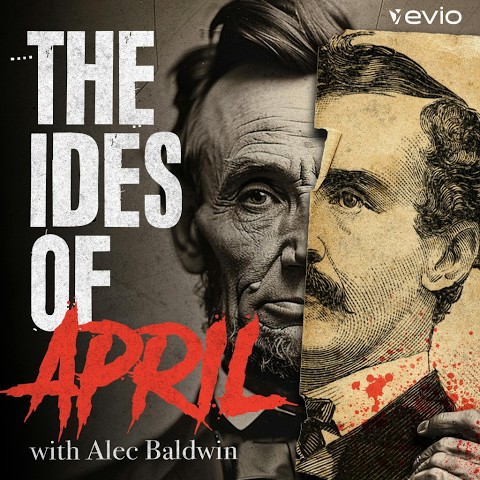
The Ides of April Podcast

In the world of podcasts, there are many episodes and series about the Lincoln assassination. I’ve been a guest on a few podcasts talking about this history. My favorite has been the series of Vanished episodes that dealt with the Booth escaped justice theory. Admittedly, part of what makes it my favorite is that it is how I met my wife, Jen, who is one of the podcast’s co-hosts. But we also spent a lot of time diving into the history of the Finis Bates story and ripping it to pieces, which was cathartic in the same way reading Frank Gorman’s recent book is. I’ve also enjoyed speaking with the duo of Mary and Darin on The Civil War Breakfast Club podcast about all things Lincoln assassination.

While these are examples of good podcasts that work hard to present accurate history, not all podcasts are created equal. The format is open to anyone with a microphone and the ability to upload their audio file to the internet. Because of this, there is a wide range of quality in podcasts that suit different tastes and levels of knowledge. Not too long ago, a somewhat “known” podcast did a series on the Lincoln assassination that received a lot of exposure. Though I don’t listen to many podcasts myself, I decided to give it a listen. After 10 minutes, I had to turn it off. It was the format of one guy essentially reading Wikipedia about the Lincoln assassination and his “bros” cracking jokes about it in a crass manner. Definitely not a style for me.

Then, a couple of weeks ago, I saw this announcement from Variety that actor Alec Baldwin would soon be hosting an eight-part podcast series about the Lincoln assassination and the hunt for John Wilkes Booth. As of this post’s publication, three episodes of the series have been released. It’s called The Ides of April, and while the majority of the narration is done by Baldwin, the show does feature audio clips from historians Harold Holzer, Walter Stahr, and Terry Alford. It was hearing and recognizing Dr. Alford’s voice in the trailer for the podcast that got me interested. As the author of the biography, Fortune’s Fool: The Life of John Wilkes Booth, and a member of the group that defended Green Mount Cemetery in 1995 from conspiracy theorists who wanted to exhume Booth’s body, I’m always interested in what Dr. Alford has to say about Booth and the assassination.

The Ides of April isn’t a perfect podcast. The graphics used for the title and episode cards have that soulless look that all AI-generated art does. The text that Baldwin reads can be a bit repetitive at times and isn’t always historically accurate. The podcast highlights many of the same questionable conclusions that many online sources do, such as Edwin and John Wilkes being bitter rivals. The episode titles, while evocative, are never explained or referenced. With that being said, Alec Baldwin, as a narrator, has a compelling voice that keeps you engaged, and the clips from the historians really help round out the rough spots in the text.

All in all, I’ve been casually enjoying the podcast so far. I don’t think it will break any new ground, but it’s a good-sounding, condensed account of the story we all know, featuring some impressive historians in the Lincoln field like Dr. Alford. If you want something to listen to while driving or doing chores around the house, you might enjoy the show as well. Perhaps you’ll be like me and play the game of “that’s not quite right” as you listen.

The Ides of April can be found wherever you listen to podcasts. They also have a YouTube channel where you can listen to the episodes. Here’s the link to the YouTube playlist of episodes. Remember that the series is still ongoing, with new episodes dropping on Wednesdays until the last one is scheduled to be released on September 3, 2025.

Categories: History, News | Tags: , , , , | 4 Comments

Lincoln Movie Lobby Cards by Richard Sloan

I’m so fortunate to have a wealth of friends and colleagues willing to contribute posts here on LincolnConspirators.com as I spend more time working on my book. This post is written by Richard Sloan. He has been involved in the assassination for decades. In many ways, this blog is following in Richard’s footsteps as he wrote and mailed out his own Lincoln assassination newsletter from 1976 to 1981. Called The Lincoln Log, Richard’s Xeroxed sheets were filled with new articles and reports from fellow researchers on their discoveries. Richard was essentially blogging about the Lincoln assassination before the internet was a thing. I met Richard at the first Surratt Society conference I attended. Just a couple of years later, he took a chance and had me take part in a panel discussion in New York alongside Michael Kauffman and Kate Clifford Larson.

Richard acted as our moderator, and I was definitely out of my league compared to those two great historians, but it was a truly wonderful experience. Since then, Richard and I have been regular email correspondents. After I published my post last year about The Twilight Zone episode, “Back There,” Richard inquired if I’d ever write something about Lincoln lobby cards. Knowing his expertise in Lincoln in the media and his own large collection of Lincoln lobby cards, I told him that only he could do the matter justice. I’m so pleased to present Richard’s piece about Abraham Lincoln movie lobby cards, illustrated with some selections from his vast collection.


Lincoln Movie Lobby Cards

By Richard Sloan

Readers of Dave’s blog may wonder why this topic could be of interest. Since 1955, when I was eleven years old, and read the Reader’s Digest version of Jim Bishop’s The Day Lincoln Was Shot, I’ve been very interested in both our 16th President’s life and his assassination. In 1976, I became passionately interested in how both subjects have been depicted in the theatre arts –  early melodramas, radio, movies, and television. My penchant for collecting items on these subjects began shortly thereafter.  It now includes videos, reviews, clippings, autographs, scripts, playbills, publicity photos, and movie lobby cards.  For those of you too young to know what lobby cards are, they are colorful scenes from silent movies and “talkies” that were printed on heavy 11” x 14” card stock. With the aim of luring pedestrians into buying movie tickets, posters were displayed outside theaters with banners reading “NOW PLAYING!” Scenes from upcoming features were displayed inside the theatres’ lobbies, (hence the term “Lobby cards”) with the banners reading “COMING SOON!” These cards were usually framed and covered with picture glass to protect them, but sometimes a lazy theatre manager would merely have them crudely pinned upon a wall with thumb tacks.
Lobby cards were produced in sets of eight. Back in the days of black & white silent movies, the studios colored them to make them more attractive to would-be theatre patrons. Film historians estimate that 90 percent of silent films have been lost, simply because they were made on nitrate stock that caused them to eventually disintegrate. They are called “lost films.” Lobby cards from these films are the only evidence of what they looked like. Mark Reinhart’s encyclopedic book Abraham Lincoln on Screen (now in its third edition) lists fifty-three silent films in which Lincoln is depicted, and he writes that over half of them are “lost.”

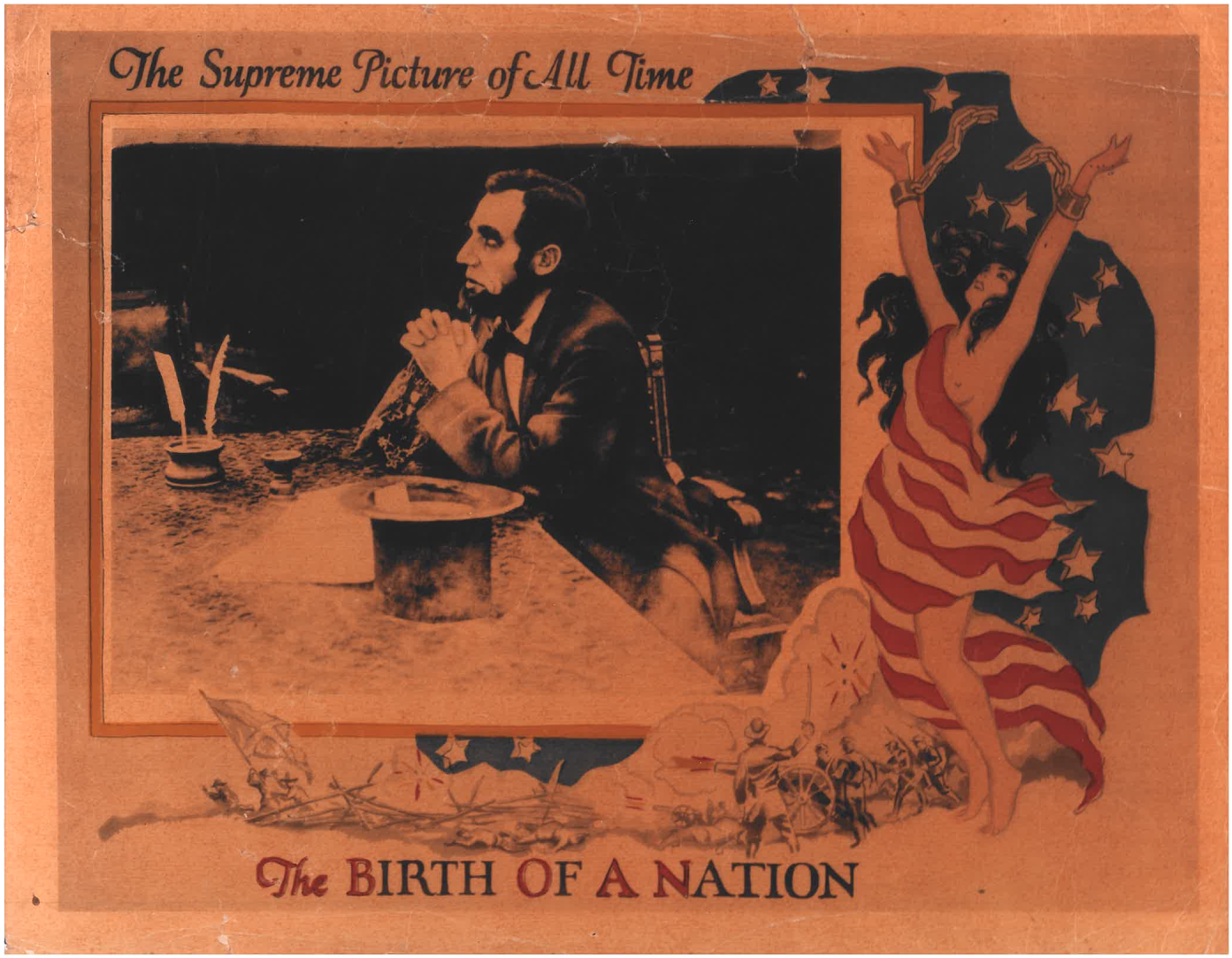
When a first-run film played out its engagement in one theatre, its lobby cards were returned to the film’s distributor together with the films for use in another theatre. And when a movie completed its run altogether, the lobby cards no longer served any purpose. They were either thrown out or given away. Sometimes, dealers in movie ephemera would get their hands on them. Others survived by sheer chance, tucked away in an attic or kept by an actor as a memento of their careers. No one could imagine that some of them would ever become valuable collectibles. The most valuable of all the Lincoln lobby cards are the one from The Birth of a Nation (1915), showing Joseph Henabery praying as Lincoln, and the one from The Littlest Rebel (1935), showing a charming (but fictitious) scene between Shirley Temple and Frank McGlynn, who played Lincoln. When these cards were sold at auction, collectors with deep pockets (that’s not me!) won them. Fortunately, faithful reproductions of these two cards can now be purchased easily on eBay for very affordable prices.

Some movie distributors contracted for films to be re-released a decade or so after their initial release (before television came along), giving new audiences the opportunity of seeing them for the first time. In such cases, an entirely new series of lobby cards were issued, usually containing different scenes than the original cards did. For collectors who can’t afford the originals, these re-issues can sometimes be more affordable.  Small words in red at the bottom of these cards state either “re-release” or just the letter “R.”

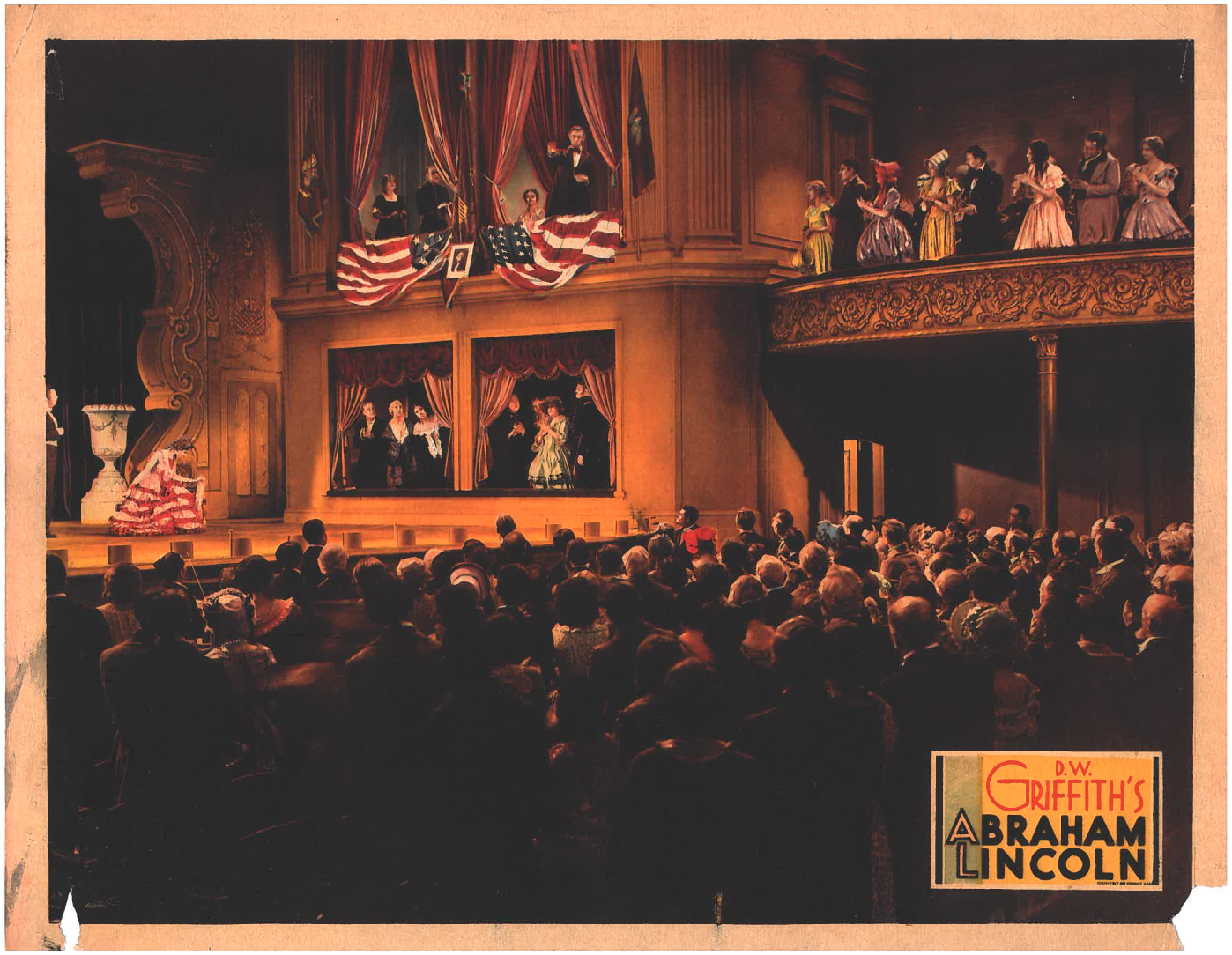
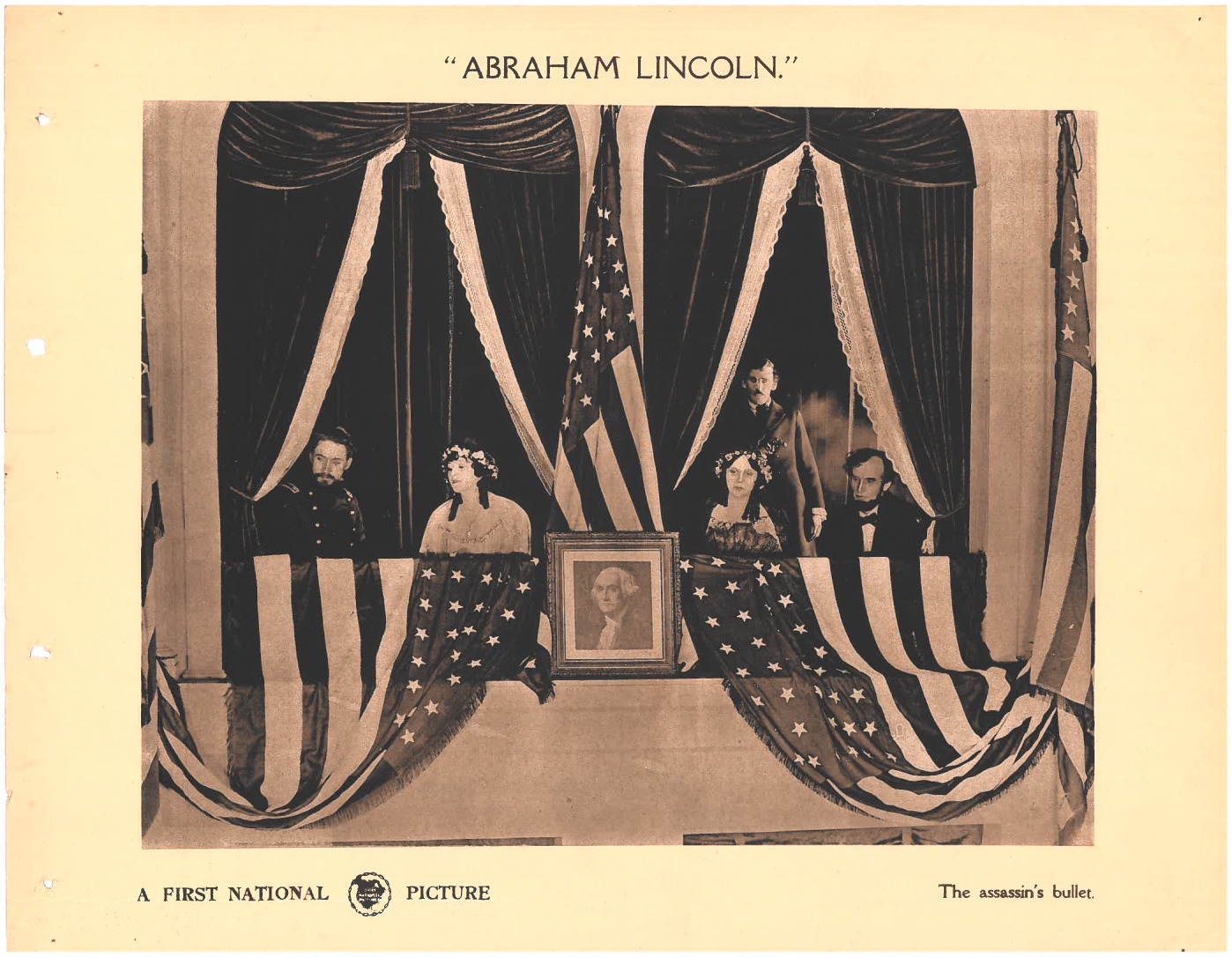
I was first introduced to the lobby card genre by William Kaland, a retired executive producer at Westinghouse Broadcasting. Bill was a student and collector of Lincoln and the Civil War. In 1958, he and Mathew Brady biographer Roy Meredith produced an award-winning TV series about the Civil War. Twenty years later, he became a dear friend and the guiding spirit behind the founding of the Lincoln Group of New York. During one of my visits with Bill in his Manhattan home, I mentioned to him my interest in Lincoln movies. He got up and pulled out a huge folder from a cabinet. Inside were a dozen old lobby cards that included four extremely rare ones from Benjamin Chapin’s nine “Lincoln Cycle” silent films. Six of them were from D.W. Griffith’s 1930 “talkie,” Abraham Lincoln.

They had all been from black & white movies, but they had been tinted by the studios. The one from Griffith’s film showed Ian Keith as Booth about to shoot Walter Houston as Lincoln. It was beautifully colored. I had never seen lobby cards before, and I was immediately “hooked” on the genre. Sadly, Bill died in 1983, and his widow sold his entire collection at auction. I’ll give you one guess who bought his lobby cards.

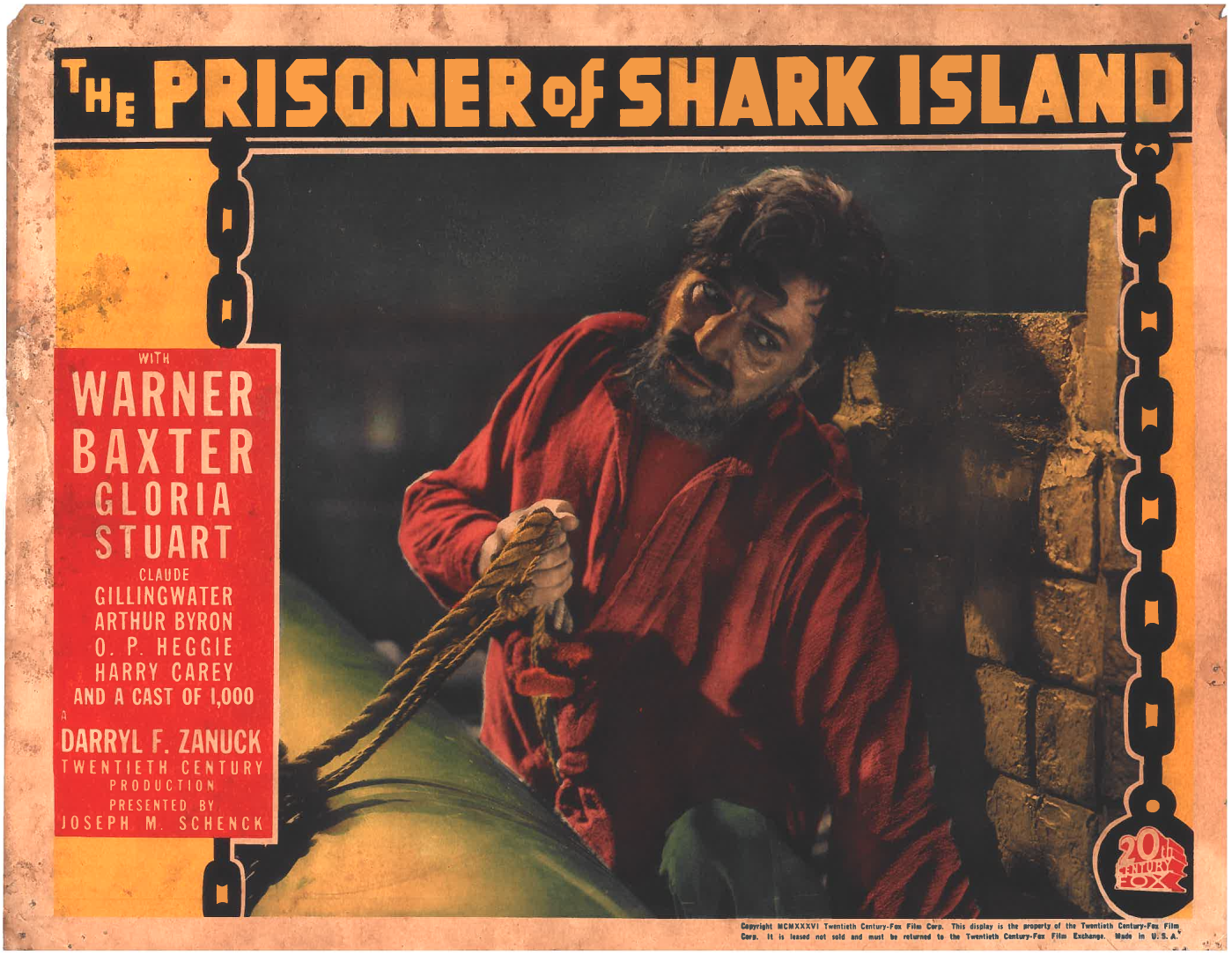
I then set my sights on finding the remaining three lobby cards from the Griffith film, as well as those that promoted my two favorite Lincoln films. These were the 1936 film, The Prisoner of Shark Island (which was directed by John Ford and starred Warner Baxter, Gloria Stuart, and John Carradine), and Ford’s 1939 film, Young Mr. Lincoln (which starred Henry Fonda). I expanded my search for all the other Lincoln movie lobby cards. It was a great treasure hunt. Over the next many years, I found all of the lobby cards from the “talkies” in which Lincoln appeared, with one exception — a colored one for Young Mr. Lincoln with the name of the movie prominently displayed at the top. Such cards are known as “title” cards, while the other seven cards in the sets are called “scene” cards.

The first card I located was the title card for Prisoner of Shark Island, although it was only a photocopy. The corners on the original had a dozen holes, the result of it having once been mounted in a theatre lobby with thumbtacks. The original title card eluded me for thirty-five years. In the meantime, I found the other seven cards. Then one day, I finally found the original title card on eBay. I bought it immediately, and when it arrived, I found it to be in mint condition except for one thing –it had a dozen pinholes in the four corners. I raced upstairs to get my album of cards from the movie, and lo and behold, not only did it have the same number of pinholes in each corner, but they were in the same haphazard arrangement! It was my newly acquired title card that had been used to create the photocopy I had bought over thirty-five years earlier!

I also have original lobby cards from the “lost” 1924 silent film, The Dramatic Life of Abraham Lincoln, the very first feature-length movie about Lincoln’s life. It starred Lincoln look-alike George Billings, a house painter who had to be given acting lessons! I found them on eBay, too. The lobby cards for it were issued in both black and white and in color, which is most unusual. I have some of each. Modern-day copies of two of the tinted ones from this “lost” film can now be bought on eBay for only $3.28,  from a seller in Australia. Included among my other Lincoln-related lobby cards are the original set of cards from Griffith’s Abraham Lincoln and the ones from the later re-issue, all with different scenes than the original cards. I have Abe Lincoln in Illinois, which starred Raymond Massey, The Tall Target, in which Lincoln only appeared in the last scene, and Prince of Players, which was the first time the assassination and Booth’s capture appeared in color – and in Cinemascope.

Lobby cards are now a thing of the past. They’ve been replaced in theatre lobbies by seven-foot high cardboard cutouts! However, there are still plenty of them for sale. If you should ever come across my missing title card for Young Mr. Lincoln, please let me know!

– Richard Sloan

Categories: History, Richard Sloan | Tags: , , | 3 Comments

Campfire Tales about Old Joe Zisgen by Steven G. Miller

With the success of his post earlier this month, I’m happy to report that Steve Miller is making a return appearance. This time, Steve shares a new discovery he has just made bout the fate of one of the members of the patrol that cornered Lincoln’s assassin.


Campfire Tales about Old Joe Zisgen

By Steven G. Miller

In my portion of the Booth Exhumation reunion that was recently hosted by Dave and posted on this site, I mentioned that Joseph Zisgen had never spoken about the death of Booth so far as I was aware.

Wouldn’t you know it, just over a month after I made that statement, I stumbled onto such an account!

Who was Joseph Zisgen? A brief biography of “Old Joe” was contained in this obituary:

“The death of Joseph Zisgen occurred in the hospital here Thursday after a long illness. He was born in Germany and had been a resident of this country since boyhood. He served in Co. M, 16th. N.Y. Cav., and in Co. G, 3d N. Y. Pro. Cav. during the Civil War. He was admitted to the Branch from New York City, Dec. 14, 1871, and was one of the oldest members of the Branch. Mr. Zisgen was one of the party who captured John Wilkes Booth, the assassin of President Lincoln, and he received $2000 of the reward, it is said on good authority. He had been a member of the Branch so many years that all knew “Joe” and he had become a ‘character.’”

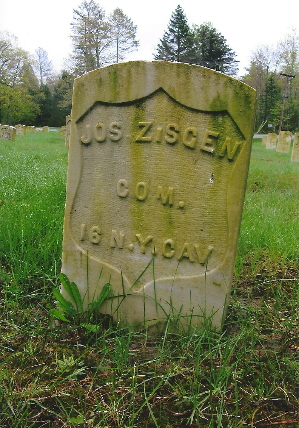
Zisgen’s grave in Maine from FindaGrave.com

His share of the Booth-Herold Reward money was actually $1,654.83, and he received it in August 1866. There has always been a minor mystery (in my mind, at least) about what became of the money. That amount was enough to set someone up with a comfortable life. Joe didn’t seem to have any health issues until old age, yet he ended up in the Soldiers and Sailors Home. It seems that the article I found solves that question.

The author of the article was Josiah Smith Maxcy (1854-1936), the son of a wealthy businessman from Gardiner, Maine. Maxcy went on to great success as a banker, railway executive, and, finally, the president of the Maine Trust Banking Company and Gardiner General Hospital. Always fond of his hometown, Maxcy also presented a speech on Gardiner’s early history for its centennial celebration in 1903.

In his article, Maxcy recounts how, when he was a teenager, he and others had gone camping on the shores of Boothbay Harbor one summer and became aware of the potential for establishing a campground on Squirrel Island in the Gulf of Maine. Eventually, the property came up for sale, and Maxcy and a group invested in the site and established a colony on the land. It became a successful summer getaway, and Maxcy was one of the officers of the organization.

He gives a history of the resort and the people involved in its creation, but digresses to tell a story which he describes as “an incident of that camping trip (in the summer of 1873), which was of much interest.”

Here’s the interesting part of Maxcy’s article:

“A Civil War Veteran

“Near our tent was another occupied by about a dozen Civil War veterans from the Government House at Togus, and one of their number, a German, was a member of the squad that captured J. Wilkes Booth, He graphically described the pursuit and capture, the burning barn and the paleness of Booth, leaning on his crutch, and of his being shot against orders by Boston Corbitt. Then he told of receiving his share of the reward, of becoming gloriously drunk, of walking thru the streets of New York and meeting an organ grinder with his monkey, of purchasing the outfit for a fabulous sum, of the monkey going up a conductor into window for a tip, of his encounter with a pet bull pup, of the soldier and the dog’s owner engaging in a free fight, of finding himself next morning locked in a cell, and nearly destitute of money. He was taken before a magistrate, and the reward was paid to the Judge, saloons, organ-grinder, jail inmates and magistrate who got it all.”

Though he does not identify the soldier by name, Maxcy was undoubtedly referring to Joseph Zisgen, of the Garrett’s Farm patrol. Now we know we apparently know what happened to his bounty money! Other troopers who received a share of the War Department Reward applied it to boring things: houses, farms, raising families, and starting a modest business or two. If this story is true, here we seem to have one who blew it on a drunken bender and a furry little critter.

Wasn’t it Billy Rose who cautioned: “Never invest in anything that eats or needs painting”? Joe should have heeded this advice.

References:
“A Historical Sketch by Josiah S. Maxcy of Gardiner. Mr. Maxcy Recalls His Own Experiences and Searches thru the Records for Matters of Fact and History,” Sun-Journal (Lewiston, ME), August 20, 1921.
“National Home. Joseph Zisgen,” Kennebec (ME) Journal, January 9, 1914.

Categories: History, Steven G. Miller | Tags: , , , | Leave a comment

More History from the LincolnConspirators Patreon


In March 2025, I started a Patreon page to solicit financial support for my efforts on LincolnConspirators.com and my ongoing book project. The Patreon has three different levels of support: the $3 a month Family Circle, the $7 a month Dress Circle, and the $15 a month Orchestra Chairs level. Each tier offers distinct perks that accumulate and stack on top of one another.

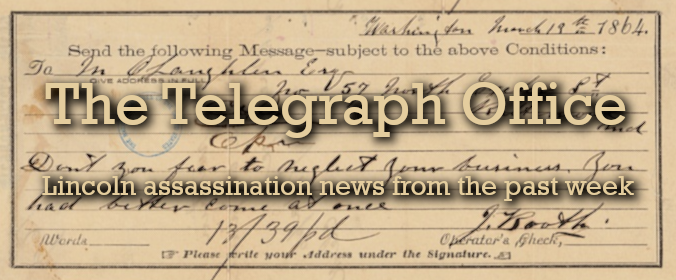
For $3 a month, you receive a weekly dispatch from The Telegraph Office. These are posts featuring Lincoln assassination-related news from the past week, upcoming events, a look at a unique auction item, and an anniversary of an event related to the assassination. When I first started the Patreon, I made the first Telegraph Office dispatch public and accessible to all so that prospective patrons could see what this offering looked like.

At that time, though, I did not provide samples of the benefits available at the higher tiers of support. This was because I was still fine-tuning everything in the beginning. However, it has now been over three months, and there are 40 posts on the Patreon page. Having built up a nice level of content to explore, I decided now would be a good time to show off examples of the benefits available for joining the Dress Circle and Orchestra Chairs levels.

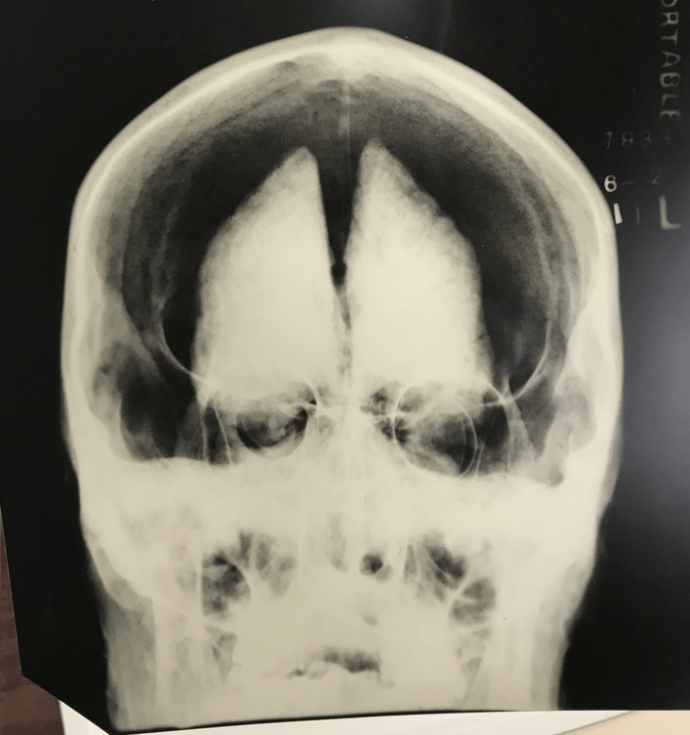
For the $7 a month Dress Circle level, you gain access to The Vault, fortnightly posts exploring artifacts related to the Lincoln assassination. Just today, I published the newest installment of The Vault – a look at X-rays from the so-called John Wilkes Booth mummy. Please click here or on the image below to check out this free offering into The Vault. Remember that subscribers to the Dress Circle also receive weekly dispatches from the Telegraph Office.

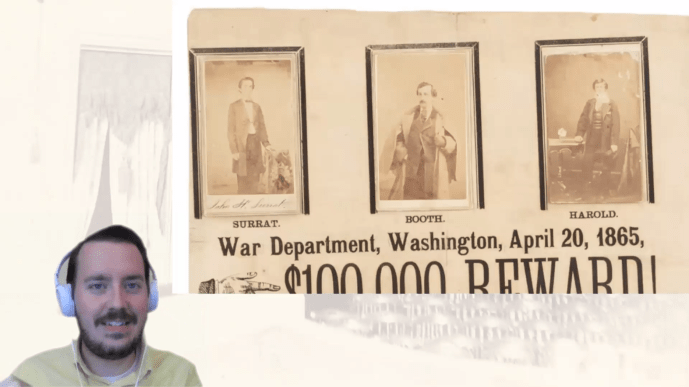
The Orchestra Chairs level is the top tier of support at $15 a month. Patrons at this level have the best seats in the house, not only getting weekly dispatches from the Telegraph Office and fortnightly visits to The Vault, but also getting access to exclusive monthly videos. These videos discuss my current research and discoveries while also providing personalized Q&A sessions for patrons at this level. I thoroughly enjoy putting these videos together. A few days ago, I published my June 2025 video for Orchestra Chair level patrons, and I am making it free for everyone to watch. Please click here or on the image below to check out this example of a monthly video at the Orchestra Chair level.

Even if you’re not in a position to support me financially, I hope that you’ll check out these examples of the work being done over on the LincolnConspirators Patreon page. And, if you are in a position to give, I hope you’ll consider becoming a patron. As you can see, I’m working hard to ensure that patrons receive a good value in return for their monthly donations.

With great appreciation,

Dave

Categories: History | Tags: , , | 2 Comments

Jeff. Davis’s Final Secret Mission by Steven G. Miller

During my high school and college years, I had a growing interest in the Lincoln assassination. With the help of an online forum on the subject, I quickly found myself going deeper and deeper into this historical rabbit hole. While I had a friendly group of online acquaintances who shared this historical interest, I had never met any of them in person. At that time, I lived in Illinois and had only taken a single trip out east with my dad to visit D.C. and sites related to Lincoln’s death. Luckily for me, one of my new online friends was also a resident of Illinois and lived only about an hour and a half away. So, in November of 2010, he and I arranged to meet at a brunch place to “talk shop.”  This is how I came to become friends with Steven G. Miller.

For those of you who watched my recent Booth exhumation trial reunion videos, Steve Miller should be a familiar name and face to you. Steve is a self-proclaimed “specialist” in the Lincoln assassination field. He has an intense interest in the members of the 16th New York Cavalry who tracked down and killed John Wilkes Booth. He has been researching and writing about the life of the main Lincoln Avenger, Sgt. Boston Corbett, for decades. There is no one on this planet with greater knowledge of the hunt for Booth than Mr. Miller. And, despite his claims of only being a specialist, Steve’s knowledge about many other aspects of the Lincoln assassination story is strong. Steve actually discovered an unpublished photograph of John Wilkes Booth and regularly delves into newspaper archives looking for new and interesting tidbits in this vast story of ours.

I was incredibly fortunate to have Steve as my guide into the world of the Lincoln assassination. He has amazing stories working with past greats of the field, and he was also incredibly generous with his research and his knowledge. I was constantly peppering him with questions in those early years, and he was always willing to dig into something for me. Our communications slowed down a bit after my move to Maryland, but around the time of my divorce and the pandemic in 2020, Steve and I started talking more often. Today, I speak to Mr. Miller on a weekly basis (if not more) and consider him a dear friend.

I write this narrative introduction not only to share my appreciation for Steve, but also to butter him up in hopes I can wrangle him into becoming an occasional contributor to LincolnConspirators.com. Steve has explored many interesting side stories that I think readers of this site would love. What follows is an article that Steve wrote concerning an intriguing newspaper article he came across a few months ago. I hope you all enjoy it, and I hope it’s the first of many articles on here from my mentor, Steve Miller.


Jeff. Davis’s Final Secret Mission.

By Steven G. Miller

Lake Villa, IL

Dave Taylor from LincolnConspirators.com and I often share historical goodies, those things that we have found in our research that interest or excite us. More times than not, our collaboration helps fill in gaps and answer questions that have stymied one (or both) of us.

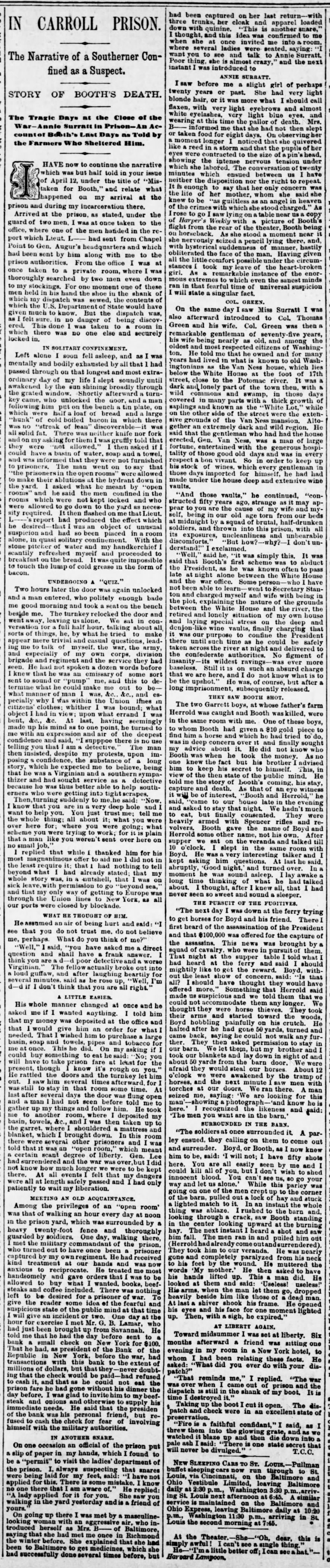
Such it was, recently, when I found a long two-part article in the digital archives of the Washington Evening Star. It was the account by a former Confederate officer, identified only as “T.C.C” in the article, of a secret mission entrusted to hm by Confederate President Jefferson Davis and Secretary of State Judah Benjamin. The writer claimed that he was an invalid soldier who was in Richmond in early 1865 and that he was called to a meeting of those two officials, who were busy sorting through government files in preparation for the abandonment of Richmond.

He related that he was asked if he would carry a secret message through the blockade to Confederate representatives Mason and Slidell in England. He agreed and set out, he states, from Richmond on April 2 to head overland to Canada, where he could catch a ship across the Atlantic. The message he was given was written in cypher on “silk paper” and along with it was a draft for expenses on the funds held by the rebel commissioners in Montreal. They were “sewed up in the shank of a pair of boots.”

“T.C.C.” recounts that he left Richmond by train and continued mostly on foot northward. He crossed the Potomac at night and was taken in tow by rebel operatives. He made slow progress and was only in “T.B.” on April 10th. He was, he claimed, onboard a Washington-bound stagecoach when he was scooped up by the Yankee cavalry operating out of Chapel Point.

He identified himself to the soldiers as a former rebel officer who was bound for Canada with intentions of heading for Europe. They questioned him at length and searched him, but failed to find the secret stash. He was still in the guard house when the news of Lincoln’s assassination arrived a few days later.

Fearing for his life and realizing, “I am the object of suspicion,” he spent several anxious days and nights. Luckily for him, the secret in his boot remained safe. He was ordered to be sent to Washington, where his story could be checked out. He was taken on horseback and in a wagon and had several tense moments when crowds of angry citizens spotted him and asked whether he was one of the conspirators.

General Augur’s officers questioned him and, though they didn’t punch holes in his story, they sent him on to Carroll Prison. He was first put in solitary confinement, but he had outside connections and was thus able to obtain money to make his jail stay more comfortable. He was granted access to the “open room” and could communicate with other prisoners. He recounts being “pumped” for information by prison spies, whom he outsmarted, and then having encounters with several people involved tangentially in the assassination story.

The two articles I found were:

 “T.C.C.,” “Mistaken for Booth. From Richmond to Washington Just Twenty-five Years Ago. A Close Shave for Life. A Thrilling Incident of the War—Sequel to the Assassination of President Lincoln—The Evacuation of Richmond—A Secret Message,” Evening Star (Washington, DC), April 12, 1890.

“T.C.C.,” “In Carroll Prison. The Narrative of a Southerner Confined as a Suspect. Story of Booth’s Death. The Tragic Days at the Close of the War—Annie Surratt in Prison—An Account of Booth’s Last Days as Told by the Farmers Who Sheltered Him,” Evening Star (Washington, DC), May 24, 1890.

Dave and I decided to try to verify this account. What interested us especially was the story he told about meeting Annie Surratt in Carroll Prison. If true, it sheds new light on her ordeal and reactions while being held as a material witness.

My efforts to identify “T.C.C.” drew a blank, but Dave –ace researcher that he is – was able, we believe, to figure out who the author of these accounts was. He texted me saying: “Pretty sure the author of those articles is a Georgian named Theodore Cooke Cone. I found the name “T. C. Cone” in a list of Prisoners of War. It states he was arrested on April 10, 1865 in “T.B. Md” and he was released on May 9, 1865. Cone is also listed as being in the “Invalid Corps, CSA.”

As Dave said, “The service record for Theodore C. Cone shows he was retired from being a Captain with the 10th Georgia Infantry due to medical issues in Nov. of 1864 and was in Richmond at the time. While the article gives Jan. 1865, as the time of the author’s invalidity, it still seems to add up.”

Cone was the oldest son of Hon. Francis H. Cone (1797-1859), judge of the Georgia Superior Court and a state senator. The Cone family owned Ringgold, a sprawling 1,185-acre plantation which produced a variety of crops and was home to many slaves. Following in his father’s footsteps, Theodore became a lawyer and had a thriving practice. He became wealthy upon the death of the judge in 1859 and the sale of Ringgold.

When the Secession crisis flared up in 1860, T.C. Cone was an outspoken “fire-eater” who actively supported the CSA once it was established. In 1861, when the governor of Georgia failed to supply weapons for the local volunteer unit that Cone had helped raise, Cone wrote to Jefferson Davis personally asking for guns. It was granted.

The 10th Georgia was in many battles, including Gettysburg, and Cone was a popular captain of the regiment. As noted above, he was released from service in the latter part of 1864 due to unspecified medical issues. He retired to Richmond instead of returning to his home state. There, he came to the attention of a staffer in the Confederate White House and was invited to meet the chief executive and Secretary Benjamin.

Cone never made it to England, however, and his mission was scrapped after his stay in prison. In his Star articles, he recounts that he was in New York City a few months after his release from Yankee jail. As he recounted his exploits to a friend, the question arose about what happened to the message.

“That reminds me,” Cone said, “the dispatch is still in the shank of my boot. It is time I destroyed it.” He cut the boot open and saw that “the dispatch and check were in an excellent state of preservation.” He threw them onto the fire in the grate and commented as they went up in smoke: “That is one state secret that will never be divulged.”

Not only was Cone involved in this one last attempt by Davis to communicate with the agents in England, but he was also scooped up in the dragnet for the assassins of President Lincoln.

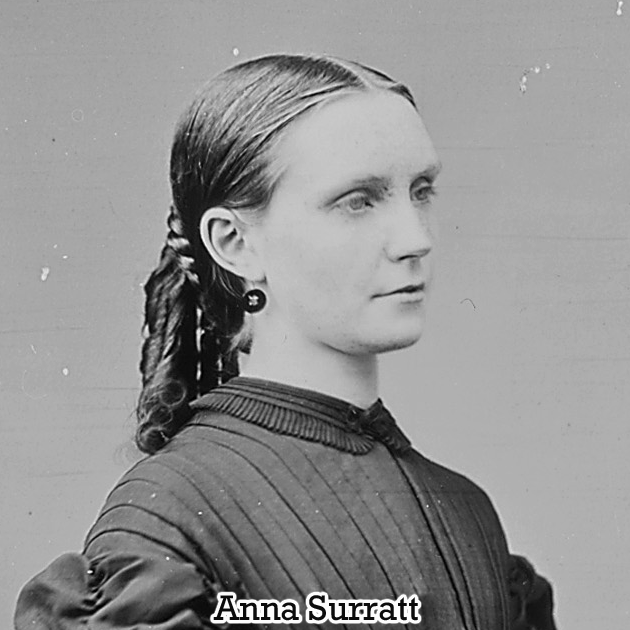
He tells of a prison meeting he had with Annie Surratt, the daughter of Mrs. Mary Surratt, who was then under arrest for conspiracy to kill President Lincoln.

Here’s what he wrote about this encounter:

“On one occasion an official of the prison put a slip of paper in my hands, which I found to be a “permit” to visit the ladies’ department of the prison. I, always suspecting that snares were being laid for my feet, said “I have not applied for this. There must be some mistake. I know no one there that I am aware of.” He replied: “A lady applied for it for you. She saw you walking in the yard yesterday and is a friend of yours.”

“On going up there I was met by a masculine-looking woman with an aggressive air, who introduced herself as Mrs. B—— of Baltimore, saying that she had met me once in Richmond the winter before. She explained that she had been to Baltimore to get medicines, which she had successfully done several times before, but had been captured on her last return—with three trunks, her cloak and apparel loaded with quinine. “This is another snare,” I thought, and this idea was confirmed to me when she at once invited me into a room, where several ladies were seated, saying: “I want you to see and talk to Annie Surratt. Poor thing, she is almost crazy,” and the next instant I was introduced to

ANNIE SURRATT

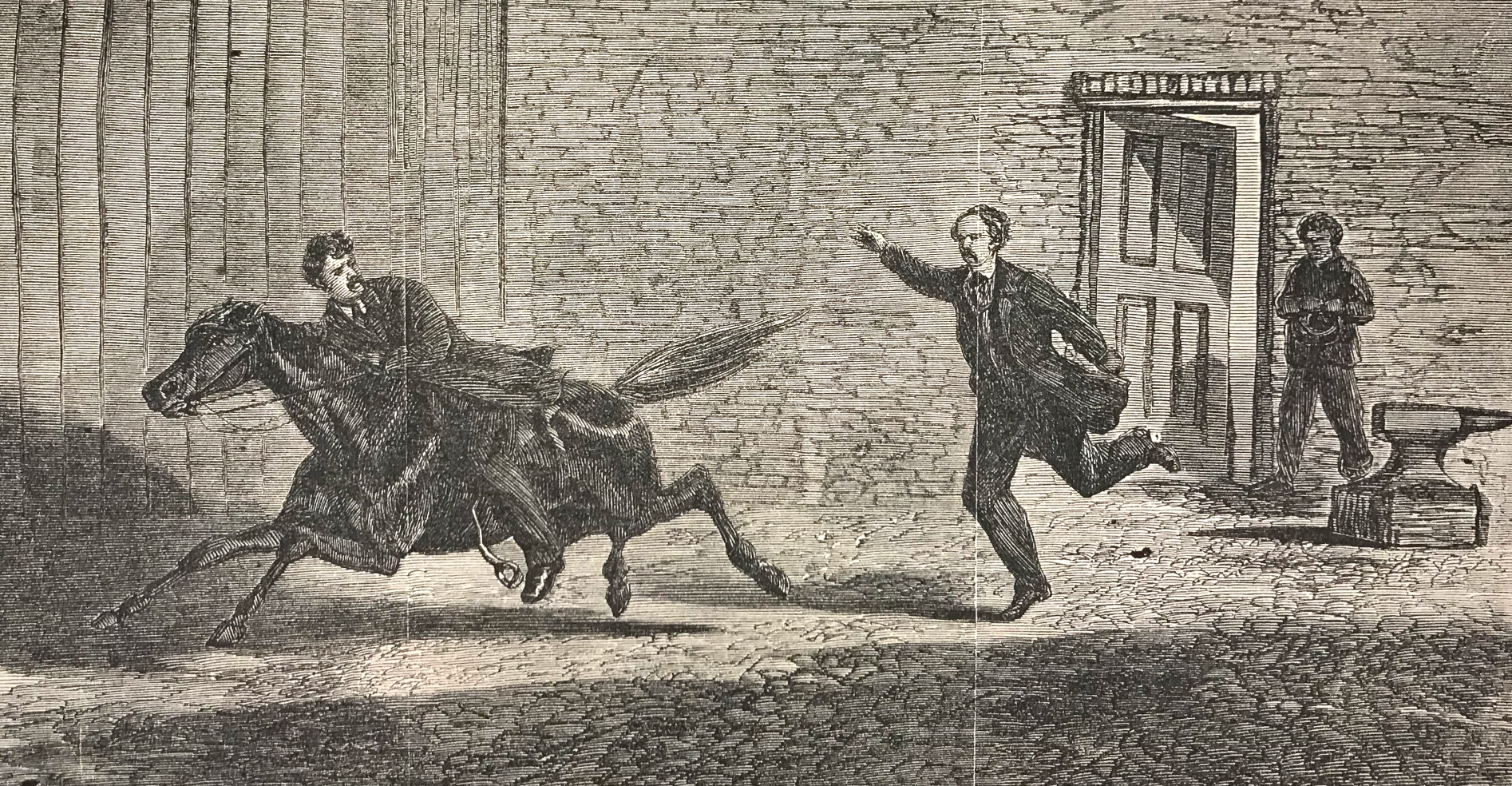
“I saw before me a slight girl of perhaps twenty years or past. She had very light blonde hair or it was more what I should call flaxen, with very light eyebrows and almost white eyelashes, very light blue eyes, and wearing at this time the pallor of death. Mrs. B— informed me that she had not then slept or taken food for eight days. On observing her a moment longer, I noticed that she quivered like a reed in a storm and that the pupils of her eyes were contracted to the size of a pin’s head, showing the intense nervous tension under which she labored. The conversation of twenty minutes which ensued between us I have neither the disposition nor the right to repeat. It is enough to say that her only concern was the life of her mother, whom she said she knew to be “as guiltless as an angel in heaven of the crimes of which she stood charged,” As I rose to go I saw lying on a table near us a copy of Harper’s Weekly with a picture of Booth’s flight from the rear of theater, Booth being on horseback. As she stood a moment near it, she nervously seized a pencil lying there, and, with hysterical suddenness of manner, hastily obliterated the face of the man. Having given all the little comfort possible under the circumstances I took my leave of the heart-broken girl. As a remarkable instance of the enormous extremes to which even the sanest minds ran in that fearful time of universal suspicion, I will state a simple fact.”

I don’t recall reading any comments about Annie Surratt in prison. And this new story about a final secret mission from Jeff Davis is new, too. The obvious take away from Cone’s story is that it was good that the Union authorities did not search him sufficiently enough to find the documents from Davis. It’s not hard to imagine what would have happened if Col. Baker had discovered that Annie Surratt – who was allowed to see her mother from time to time – was in unmonitored direct communication with an agent from the president of the CSA. It seems obvious that Cone and Annie Surratt would have been put in solitary confinement in the Old Capitol under close guard. The implication – unfounded according to Cone’s account—was that Davis was issuing orders directly to Mrs. Surratt in jail via his personal agent. This would have ended up in a charging indictment for Mrs. Surratt and for Davis. The conspiracy trial managers could never find a direct connection between Davis and any of the conspirators. It could have been argued in court that this was the smoking gun.

This apparently is the print of Booth on horseback that Annie Surratt defaced. Note: It actually comes from the May 13, 1865, issue of Frank Leslie’s Illustrated Newspaper, not Harper’s Weekly.

Categories: History, Steven G. Miller | Tags: , , | 3 Comments

John Wilkes Booth Exhumation Trial 30th Anniversary Panel

On May 17, 1995, a historic trial began in the Circuit Court of Baltimore City. The case revolved around a legal petition to exhume the remains of John Wilkes Booth from Green Mount Cemetery. The petition was the culmination of years of effort on the part of two historical researchers who believed that the assassin of Lincoln was not killed at the Garrett farm on April 26, 1865, but instead escaped justice and lived for many years under assumed identities. The main support for this theory was a 1907 book called The Escape and Suicide of John Wilkes Booth, written by a man named Finis Bates who claimed to have met an incognito Booth in Texas in the 1870s. Despite the numerous factual and logical errors in the book, many people wanted to believe the tall tale, and the story of Booth’s escape from justice became folklore akin to sightings of the deceased Elvis Presley. In 1991, this fringe theory rose in prominence when it was featured on the TV series Unsolved Mysteries with Robert Stack. The increase in exposure motivated the two leading proponents of the theory to seek legal recourse to prove their claims. Green Mount Cemetery opposed the exhumation, both on the merits of the conspiracy theory and also due to the researchers having no connection to the deceased.

The attorney for the researchers then found two distant Booth relatives and convinced them to become involved. The names of the researchers were swapped with those of the distant Booth relatives, and the petition to exhume was refiled. Green Mount Cemetery still opposed the exhumation request, and so a trial was set to evaluate the merits of the petitioners’ case.

The trial consisted of four days of testimony, with 16 witnesses taking the stand. The trial was overseen by Judge Joseph Kaplan and occurred in Courthouse East on Calvert and Fayette Streets in Baltimore. Green Mount Cemetery was represented by attorney Francis J. Gorman from the newly formed law firm of Gorman and Williams. Frank assembled a group of Lincoln assassination historians and an expert on exhumations to discuss the validity of the petitioners’ factual and scientific arguments. The petitioners were represented by attorney Mark Zaid.

At the end of 2024, Frank Gorman published a book entitled Confronting Bad History: How a Lost Cause and Fraudulent Booth Caused the John Wilkes Booth Exhumation Trial. In this book, Frank not only expertly documents the exhumation trial and its proceedings in an engaging way, but he also provides some vital context regarding the character of Finis Bates and his book. After sharing in some conversations with Frank about his wonderful new book, I volunteered the idea of trying to put together a reunion panel of sorts to mark the 30th anniversary of the exhumation trial in 2025. Through calls and emails, Frank was able to convince four witnesses from the 1995 trial to take part in the reunion. Though I had no involvement in the original case, I was honored to be asked by Frank to moderate the discussion. Due to the geographical distances between the different participants, we decided to conduct this reunion virtually over Zoom.

The participants of this reunion panel were:

In the end, the panel lasted a little over three hours as we delved into several aspects of the trial and the research behind it. For the ease of viewing, I have divided it into three segments, which you can watch below.

I hope that you enjoy watching this reunion panel as much as I enjoyed moderating it. By watching these videos and reading Frank Gorman’s book, you are helping to confront bad history.

Categories: History, News | Tags: , , , , , | 1 Comment

Blog at WordPress.com.