
With the success of his post earlier this month, I’m happy to report that Steve Miller is making a return appearance. This time, Steve shares a new discovery he has just made bout the fate of one of the members of the patrol that cornered Lincoln’s assassin.
Campfire Tales about Old Joe Zisgen
By Steven G. Miller
In my portion of the Booth Exhumation reunion that was recently hosted by Dave and posted on this site, I mentioned that Joseph Zisgen had never spoken about the death of Booth so far as I was aware.
Wouldn’t you know it, just over a month after I made that statement, I stumbled onto such an account!
Who was Joseph Zisgen? A brief biography of “Old Joe” was contained in this obituary:
“The death of Joseph Zisgen occurred in the hospital here Thursday after a long illness. He was born in Germany and had been a resident of this country since boyhood. He served in Co. M, 16th. N.Y. Cav., and in Co. G, 3d N. Y. Pro. Cav. during the Civil War. He was admitted to the Branch from New York City, Dec. 14, 1871, and was one of the oldest members of the Branch. Mr. Zisgen was one of the party who captured John Wilkes Booth, the assassin of President Lincoln, and he received $2000 of the reward, it is said on good authority. He had been a member of the Branch so many years that all knew “Joe” and he had become a ‘character.’”
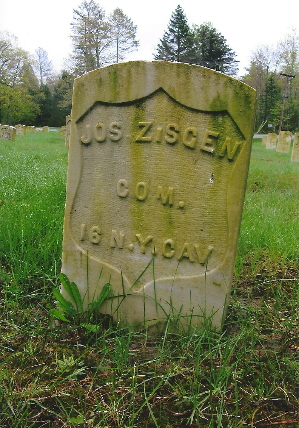
Zisgen’s grave in Maine from FindaGrave.com
His share of the Booth-Herold Reward money was actually $1,654.83, and he received it in August 1866. There has always been a minor mystery (in my mind, at least) about what became of the money. That amount was enough to set someone up with a comfortable life. Joe didn’t seem to have any health issues until old age, yet he ended up in the Soldiers and Sailors Home. It seems that the article I found solves that question.
The author of the article was Josiah Smith Maxcy (1854-1936), the son of a wealthy businessman from Gardiner, Maine. Maxcy went on to great success as a banker, railway executive, and, finally, the president of the Maine Trust Banking Company and Gardiner General Hospital. Always fond of his hometown, Maxcy also presented a speech on Gardiner’s early history for its centennial celebration in 1903.

In his article, Maxcy recounts how, when he was a teenager, he and others had gone camping on the shores of Boothbay Harbor one summer and became aware of the potential for establishing a campground on Squirrel Island in the Gulf of Maine. Eventually, the property came up for sale, and Maxcy and a group invested in the site and established a colony on the land. It became a successful summer getaway, and Maxcy was one of the officers of the organization.
He gives a history of the resort and the people involved in its creation, but digresses to tell a story which he describes as “an incident of that camping trip (in the summer of 1873), which was of much interest.”
Here’s the interesting part of Maxcy’s article:
“A Civil War Veteran
“Near our tent was another occupied by about a dozen Civil War veterans from the Government House at Togus, and one of their number, a German, was a member of the squad that captured J. Wilkes Booth, He graphically described the pursuit and capture, the burning barn and the paleness of Booth, leaning on his crutch, and of his being shot against orders by Boston Corbitt. Then he told of receiving his share of the reward, of becoming gloriously drunk, of walking thru the streets of New York and meeting an organ grinder with his monkey, of purchasing the outfit for a fabulous sum, of the monkey going up a conductor into window for a tip, of his encounter with a pet bull pup, of the soldier and the dog’s owner engaging in a free fight, of finding himself next morning locked in a cell, and nearly destitute of money. He was taken before a magistrate, and the reward was paid to the Judge, saloons, organ-grinder, jail inmates and magistrate who got it all.”
Though he does not identify the soldier by name, Maxcy was undoubtedly referring to Joseph Zisgen, of the Garrett’s Farm patrol. Now we know we apparently know what happened to his bounty money! Other troopers who received a share of the War Department Reward applied it to boring things: houses, farms, raising families, and starting a modest business or two. If this story is true, here we seem to have one who blew it on a drunken bender and a furry little critter.
Wasn’t it Billy Rose who cautioned: “Never invest in anything that eats or needs painting”? Joe should have heeded this advice.
References:
“A Historical Sketch by Josiah S. Maxcy of Gardiner. Mr. Maxcy Recalls His Own Experiences and Searches thru the Records for Matters of Fact and History,” Sun-Journal (Lewiston, ME), August 20, 1921.
“National Home. Joseph Zisgen,” Kennebec (ME) Journal, January 9, 1914.



 LincolnConspirators.com
Recent Comments