Monthly Archives: December 2013

“A Sure Defense: The Bowie Knife in America”

Earlier this year, I had the pleasure of writing a piece for Knife World magazine in which I discussed the bowie knives used by John Wilkes Booth and his conspirators.  The article, entitled, “Cloak and Daggers: Cutting Through the Confusion of the Lincoln Assassination Knives“, highlighted my conclusion that the knife currently on display at Ford’s Theatre as “Booth’s knife” is not the one taken from John Wilkes Booth’s body at the Garrett farm.  I am still working on convincing and motivating those in charge of the Ford’s Theatre museum to correct this mistake.
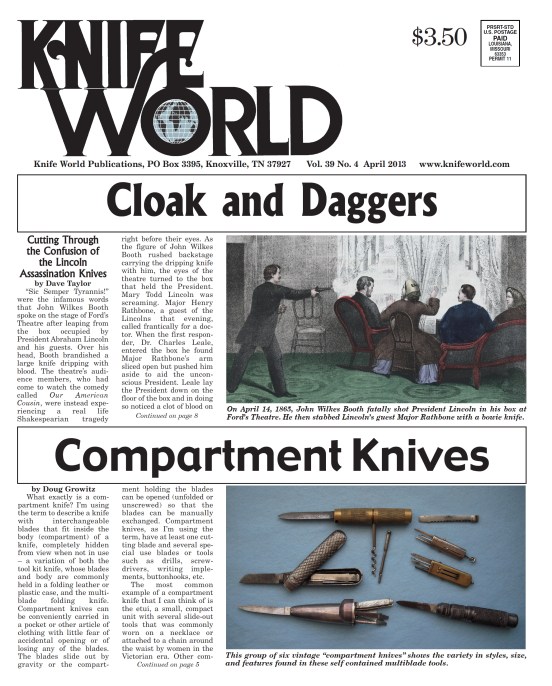
Cloak and Daggers Knife World April 2013

Since the article was published in April, I have kept in touch with the wonderfully nice editor of Knife World, Mark Zalesky.  Mark has been working exceedingly hard recently having been asked to guest curate an upcoming exhibit on the history of the bowie knife in America.  The exhibit, which is called “A Sure Defense: The Bowie Knife in America“, opens this Friday at the Historic Arkansas Museum in Little Rock.  I received this mailer today, advertising some of the events that will be occurring on Friday and Saturday to celebrate the opening of the exhibit:
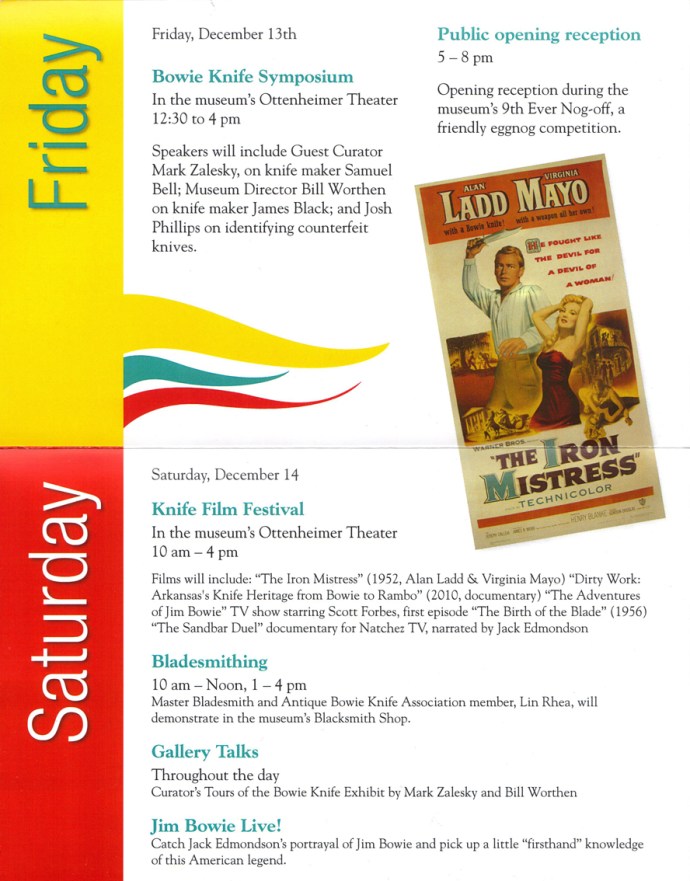
Bowie Knife Exhibit Events

I’m personally excited for this exhibition for two reasons. First of all, the press release for the exhibit, which can be read here, includes the following paragraph:

“Visitors to the public exhibit will have the opportunity to see knife designs associated with Alamo martyr James Bowie and his less famous brother Rezin, and to examine bowie knives once owned by such historic figures as Davy Crockett, Theodore Roosevelt, General Winfield Scott and John Fox “Bowie Knife” Potter. The role of the bowie knife in the Antebellum era is explored along with the Civil War and the opening of the west, and there’s a special focus on the role bowie knives played in the events surrounding the assassination of Abraham Lincoln.

Using resources such as my article for Knife World, Mark has created a nice display about the knives used by the conspirators. In it, he has been kind enough to give my conclusion regarding Booth’s knife further press and attention.

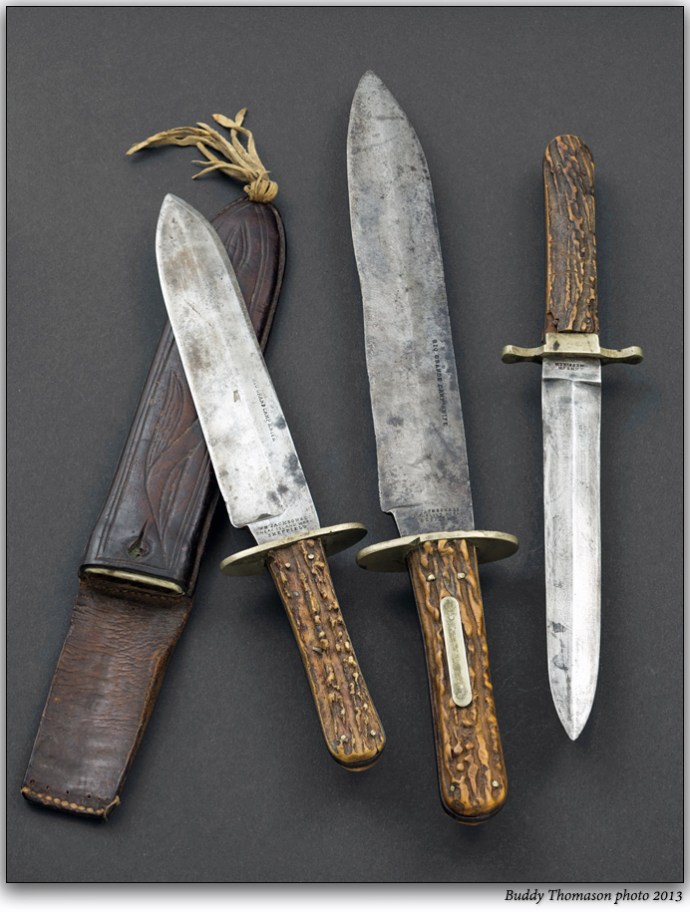
The knives in the Lincoln display for the bowie knife exhibit are period knives, identical to the ones used by the conspirators. They are the same, “make and model” as it were, as the ones on display at Ford’s Theatre and in storage at the NPS or Huntington Library. Here is a picture of “Lincoln knives” in the upcoming exhibit at the Historic Arkansas Museum:
Bowie Knives Exhibit Assassination knves

The rightmost knife above is identical to the “Liberty knife” currently on display at Ford’s Theatre as Booth’s knife. From my research I do not believe this knife was retrieved from Booth’s body as it claimed to have been by the display at Ford’s. Though I am not 100% certain of its origin, my hypothesis is that it came from Mary Surratt’s boarding house in D.C.

The middle knife is identical to the knife found in George Atzerodt’s rented room at the Kirkwood House hotel. David Herold was seen carrying this long knife in his boot during the day of the assassination and probably removed it when visiting in George’s room on that day.  It’s counterpart is on display at Ford’s Theatre.

The leftmost knife is identical to the knife Lewis Powell used to stab Secretary Seward and the knife retrieved from John Wilkes Booth when he was shot at the Garret farm.  Powell’s knife is in the Huntington Library in California.  Booth’s knife is in storage at the NPS’ Museum Resource Ceneter in Landover, Maryland.  I’m working on getting this knife out of storage and properly displayed at the Ford’s Theatre Museum.

It is also with a deal of pride that I state that the leftmost knife and sheath in the above picture, belong to me.  I bought the knife a few years ago, wanting a duplicate of the knife Booth used to stab Major Rathbone.  According to Mark, these “smaller” Rio Grand Camp knives are harder to find as most people want the big ones like the one in the middle.  During the course of our collaboration on the Knife World article, I told him I had an identical knife to Booth’s and he asked if I would consider lending it to the Historic Arkansas Museum for the exhibition.  Though I’m not sure if I will be able to, I’m hoping to find the time to make the journey to Arkansas to see my knife along with over 200 other bowie knives.

For anyone who may live around, or are planning a trip near Little Rock, the exhibit, “A Sure Defense: The Bowie Knife in America” runs from December 13th, 2013 until June 22nd, 2014 at the Historic Arkansas Museum. The Historic Arkansas Museum is open 9 a.m. – 5 p.m. Monday through Saturday, 1 – 5 p.m. on Sunday and admission to the galleries and parking are free.

For those who can’t make it to the museum, a full color catalog documenting this historic exhibit is planned, and will be available from the museum’s gift shop and online store some time in the near future.

I hope those of you in the area will check out the exhibit at the Historic Arkansas Museum. You can learn all about the fascinating history of the bowie knife and say “hi” to my knife and sheath while you are there.

References:
Historic Arkansas Museum
Mark Zalesky, guest curator of “A Sure Defense: The Bowie Knife in America

Categories: Uncategorized | Tags: , | 1 Comment

Rosalie’s Causes of Death

After my previous post about Rosalie Booth, John Wilkes’ largely forgotten sister, I sough the help of a medical professional to help explain to me her recorded causes of death.  The only doctor I know personally is Dr. Blaine Houmes, who just so happens to also be an accomplished researcher of Abraham Lincoln’s life and death.  Therefore, I took a break from sending him pictures of this mysterious rash I keep getting, to ask him to comment on Rosalie’s ailments.  Though I was expecting only a few words from the good doctor translating “bulbar paralysis” and “progressive spinal sclerosis” into layman’s terms, he was gracious enough to provide a very detailed explanation of these conditions and his thoughts on Rosalie’s state of health.  Instead of merely putting his reply in the comments to that post, I feel his response is worthy of a post of its own. The following explanation is courtesy of Dr. Houmes, who has my sincerest thanks for his expertise and help.

“Bulbar paralysis and progressive spinal sclerosis are two different entities and exhibit all the imagination and florid naming that Victorian medicine documented for disease patterns they largely didn’t understand. Neurology back then was quite primitive. These two diagnoses found on the death certificate involve a great deal of speculation figuring out what exactly is meant, but some explanation might be useful.

On the bottom of the brain is the brain stem, inside the skull. The brain stem is the part of the spinal cord which is a transition zone between the brain and the spinal cord in the backbone. From each side of the brain stem there are twelve pairs of cranial nerves exiting to different parts of the head, neck and certain internal organs. The nerves generally have two functions—sensation and/or motor (for movement), and they send signals as to how we perceive and actually move/operate/feel things with and in our bodies.

The nerves are numbered I through XII, and are (with simplified function): I Olfactory (smell), II Ophthalmic (vision), III (eye muscles), IV Trochlear (eye muscles), V Trigeminal (chews), VI Abducens (eye muscles), VII Facial (facial movement), VIII Auditory (hearing and balance), IX Glossopharyngeal (swallows), X Vagus (swallows, speech, chest/abdomen organ function), XI Accessory (turns head/shoulders), and XII Hypoglossal (tongue muscles).

Bulbar paralysis is the end stage of Bulbar palsy, involving the nerves IX, X, XI, and XII. This can be caused by genetic disorders, blood vessel problems (such as bleeding from stroke or trauma), degenerative diseases (ALS which is Lou Gehrig disease), inflammation or infection (including Polio, Lyme disease, and Guillain-Barre syndrome), Cancer/tumors, Toxins (botulism is a prime example–which plastic surgeons have discovered has magical properties in the form of Botox, much adored by actors and actresses), and autoimmune disorders (where the body starts making antibodies against itself). Those suffering from this malady have problems speaking, chewing food, swallowing, choking on liquids/saliva and they drool. Many eventually die from aspiration of food/saliva or from pneumonia.

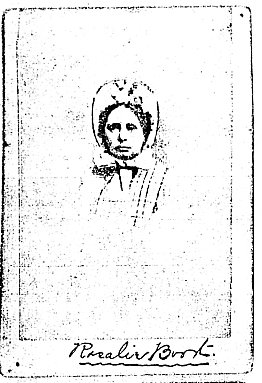
Rosalie Ann Booth photocopy of original image

Progressive Spinal sclerosis is “probably” either spinal stenosis, Multiple Sclerosis (MS, “The great crippler of young adults”), or ALS (“Lou Gehrig” disease).

Spinal stenosis is usually from arthritis and aging, either narrowing of the spinal canal (inside of a vertebra, which protects the spinal cord) or the small hole (foramina) on each side of the vertebra where a spinal cord nerve exits to the arm, torso, leg. This is a chronic, progressive disease with much back and leg pain, numbness, and tingling for most. Not everyone will feel the symptoms even if they have the problem.

Multiple Sclerosis is a disease where the fatty insulation cover of nerves (like the insulation for electrical wires) is destroyed, leaving large holes, gaps, and scars called plaques, which disrupt nerve signals to and from the brain. The disease can be gradual, rapidly progressive, or stable. It usually starts in people living in colder climates, starting between the ages of 20-40,and is twice as common in women than men. It causes problems everywhere in the body (along with great pain), and usually starts with sensory or motor symptoms.

The challenge in determining Ms. Booth’s disease is wondering whether the cause of death is from a congenital disorder (such as cerebral palsy, which can occur during pregnancy, childbirth, or up to three years of age) or of later onset. Plus when one sees the word “invalid,” what exactly does that mean? Was it of psychiatric origin, such as depression which can periodically get better and then worse? Was it a fairly mild form of intellectual disability (the current politically correct term for what was formerly called mental retardation)? What other diseases did she have–diabetes, high blood pressure? Her death certificate (viewed with a poorly reproduced copy) notes the cause of death–if correctly read–involved a process evolving over “about ten years.” Perhaps she had both chronic problems and then suffered a heart attack or stroke as the final insult to her body. This is certainly plausible; while living with her young brother Joe the month before her death, she was still up and able to answer the door when a visitor knocked, and then faced a brick heaved at her, along with a fusillade of rocks aimed at the house. Her cause of death remains a mystery.”


Categories: Uncategorized | Tags: | 6 Comments

Blog at WordPress.com.