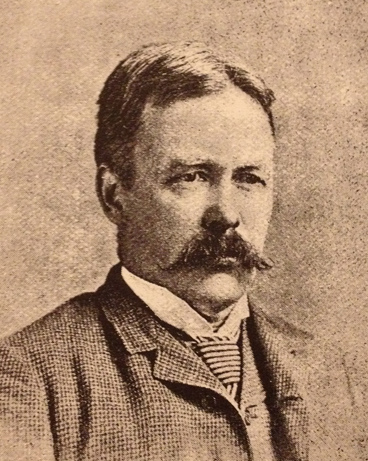
James Tanner in 1889
As Abraham Lincoln lay dying at the Petersen boardinghouse, the investigation was already underway in the parlor. Under the order of Secretary Stanton, witnesses were interviewed and their testimony taken. Finding the process of taking their testimony down in longhand to be too time consuming, the call went out for someone who knew phonography (shorthand). It was discovered that a boarder at the house adjacent to the Petersen House had studied phonography. His name was Corporal James Tanner. Tanner had been seriously wounded at Bull Run when a fragment of shell ripped through his lower legs:
“The boys picked me up,” Tanner recalled, and, “laid me on a blanket – no stretcher being available – and twisted a musket in on each side and lifted me to their shoulders. Neither of my legs had been entirely severed; my feet were hanging by shreds of flesh. The blanket was short, and lying on it on my face, I looked under and saw my feet dangling by the skin as they hung off of the other end. Some kind hearted soul gently lifted them and laid them on the edge of the blanket.”
In the field hospital, both of Tanner’s legs were amputated four inches below the knee. Tanner was exceeding lucky to survive the recovery process for such a wound. When he returned to civilian life, he was equipped with artificial legs and learned to walk again with the use of a cane to help steady himself. He entered business school and studied shorthand. On April 14th, 1865, Tanner was residing in Washington, D.C. working for the Ordinance Bureau of the War department.
Tanner took the testimony of six witnesses, Alfred Cloughly, Lt. A. M. S. Crawford, Harry Hawk, James C. Ferguson, Henry B. Philips, and Col. George V. Rutherford that fateful night. Two days after the President’s death, Tanner wrote a letter to a friend in which he recounted his involvement that night. That letter, which follows below, contains an interesting glimpse at the activities inside the Petersen House and the duties of Corporal Tanner:
Ordnance Office, War Department,
Washington, April 17, 1865.
Friend Walch:
Your very welcome letter was duly received by me and now I will steal a few minutes from my duties in the office to answer it.
Of course, you must know as much as I do about the terrible events which have happened in this city during the past few days. I have nothing else to write about so I will give you a few ideas about that, perhaps, which you have not yet got from the papers.
Last Friday night a friend invited me to attend the theatre with him, which I did. I would have preferred the play at Ford’s Theatre, where the President was shot, but my friend chose the play at Grover’s, which was ‘Aladdin, or the Wonderful Lamp.’ While sitting there witnessing the play about ten o’clock or rather a little after, the entrance door was thrown open and a man exclaimed, “President Lincoln is assassinated in his private box at Ford’s!” Instantly all was excitement and a terrible rush commenced and someone cried out, “Sit down, it is a ruse of the pickpockets.” The audience generally agreed to this, for the most of them sat down, and the play went on; soon, however, a gentleman came out from behind the scenes and informed us that the sad news was too true. We instantly dispersed.
On going out in the street we were horrified to learn that Mr. Seward had been attacked and severely injured while in bed at his house. Myself and friend went up to Willard’s, which is a short distance above Grover’s, to learn what we could, but could learn nothing there. The people were terribly excited. Ford’s Theatre is on Tenth St. between E and F. Grover’s is on the Avenue near Fourteenth St. and just below Willard’s; it is about four blocks up from Ford’s. My boarding house is right opposite Ford’s Theatre. We then got on the cars and went down to Tenth St. and up Tenth St. to Ford’s and to my boarding house. There was an immense throng there, very quiet yet very much excited; the street was crowded and I only got across on account of my boarding there. The President had been carried into the adjoining house to where I board; I went up to my room on the second floor and out on the balcony which nearly overhangs the door of Mr. Peterson’s house. Members of the cabinet, the chief justice, Generals Halleck, Meiggs, Augur and others were going in and out, all looking anxious and sorrow-stricken. By leaning over the railing I could learn from time to time of His Excellency’s condition, and soon learned that there was no hope of him. Soon they commenced taking testimony in the room adjoining where he lay, before Chief Justice Carter, and General Halleck called for a reporter: no one was on hand, but one of the head clerks in our office, who boarded there, knew I could write shorthand and he told the General so, and he bade him call me, so he came to the door and asked me to come down and report the testimony. I went down and the General passed me in, as the house was strictly guarded, of course. I went into a room between the rear room and the front room. Mrs. Lincoln was in the front room weeping as though her heart would break. In the back room lay His Excellency breathing hard, and with every breath a groan. In the room where I was, were Generals Halleck, Meiggs, Augur and others, all of the cabinet excepting Mr. Seward, Chief Justice Chase and Chief Justice Carter of the District of Columbia, Andrew Johnson and many other distinguished men. A solemn silence pervaded the whole throng; it was a terrible moment. Never in my life was I surrounded by half so impressive circumstances. Opposite me at the table where I sat writing- sat Secretary Stanton writing dispatches to General Dix and others, and giving orders for the guarding of Ford’s and the surrounding country. At the left of me was Judge Carter propounding the questions to the witnesses whose answers I was jotting down in Standard Phonography. I was so excited when I commenced that I am afraid that it did not much resemble Standard Phonography or any other kind, but I could read it readily afterward, so what was the difference? In fifteen minutes I had testimony enough down to hang Wilkes Booth, the assassin, higher than ever Haman hung. I was writing shorthand for about an hour and a half, when I commenced transcribing it. I thought I had been writing about two hours when I looked at the clock and it marked half past four A.M. I commenced writing about 12 M. I could not believe that it was so late, but my watch corroborated it. The surrounding circumstances had so engrossed my attention that I had not noticed the flight of time. In the front room Mrs. Lincoln was uttering the most heartbroken exclamations all the night long. As she passed through the hall back to the parlor after she had taken leave of the President for the last time, as she went by my door I heard her moan, “O, my God, and have I given my husband to die,” and I tell you I never heard so much agony in so few words. The President was still alive, but sinking fast. He had been utterly unconscious from the time the shot struck him and remained so until he breathed his last. At 6:45 Saturday morning I finished my notes and passed into the back room where the President lay; it was very evident that he could not last long. There was no crowd in the room, which was very small, but I approached quite near the bed on which so much greatness lay, fast losing its hold on this world. The head of the bed was toward the door; at the head stood Cap. Robert Lincoln weeping on the shoulder of Senator Sumner. General Halleck stood just behind Robert Lincoln and I stood just to the left of General Halleck and between him and General Meiggs. Secretary Stanton was there trying every way to be calm and yet he was very much moved. The utmost silence prevailed, broken only by the sound of strong men’s sobs. It was a solemn time, I assure you. The President breathed heavily until a few minutes before he breathed his last, then his breath came easily and he passed off very quietly.
As soon as he was dead Rev. Dr. Gurley, who has been the President’s pastor since his sojourn in this city, offered up a very impressive prayer. I grasped for my pencil which was in my pocket, as I wished to secure his words, but I was very much disappointed to find that my pencil had been broken in my’ pocket. I could have taken it very easily as he spoke very favorably for reporting. The friends dispersed, Mrs. Lincoln and family going to the White House, which she had left the night before to attend the theatre with him who never returned to it except in his coffin.
Secretary Stanton told me to take charge of the testimony I had taken, so I went up to my room and took a copy of it, as I wished to keep both my notes and the original copy which I had made while there in the house. They will ever be cherished monuments to me of the awful night and the circumstances with which I found myself so unexpectedly surrounded and which will not soon be forgotten.
Saturday night I took the copy I had made to the Secretary’s house, but as he was asleep I did not see him, so I left them with my card. I tell you, I would not regret the time and money I have spent on Phonography if it never brought me more than it did that night, for that brought me the privilege of standing by the deathbed of the most remarkable man of modern times and one who will live in the annals of his country as long as she continues to have a history.
Frank Leslie’s Illustrated will have a good picture of the building there made celebrated by this sad event on that evening. I saw the sketch made by the artist of the theatre, and it was very correct, indeed. He also sketched the inside of the room where the President died, also the outside of the building, as well as the adjoining buildings on both sides. You will see the house I board in has a balcony along the front of the two rooms on the second floor; I occupy both of those rooms.

Drawing of the Peterson house from Frank Leslie’s Illustrated Weekly 5/20/1865. Corporal Tanner’s room and balcony are visible on the building next door.
You can imagine the feeling here by judging of the feeling in your own place, only it is the more horrifying from the fact that the President lived in our midst and was universally beloved by the People.
This morning there was published in the Chronicle the statement of one of the witnesses whom I reported, Mr. James B. Ferguson. You will doubtless see it in your papers as it is most important. I have an idea, which is gaining ground here, and that is that the assassin had assistance in the theatre, and that the President was invited there for the express purpose of assassinating him. The theatre is very strictly guarded now night and day.
Very truly your friend,
James Tanner.
References:
The Life of Abraham Lincoln by William Barton
While Lincoln Lay Dying by The Union League of Philadelphia








 LincolnConspirators.com
Recent Comments