
On March 4, 1865, President Abraham Lincoln was inaugurated for a second time following his reelection in November of 1864. With hopes that an end to the Civil War was in sight, Lincoln gave a historic speech addressing how the practice of slavery had caused the war, and expressing his hopes for a reconciliation between the two sides under a government free from this evil. Lincoln finished his speech with the iconic words:
“With malice toward none, with charity for all, with firmness in the right as God gives us to see the right, let us strive on to finish the work we are in, to bind up the nation’s wounds, to care for him who shall have borne the battle and for his widow and his orphan, to do all which may achieve and cherish a just and lasting peace among ourselves and with all nations.”
Noted photographer Alexander Gardner documented the scene of Lincoln’s second inauguration, much like he did four years earlier. Yet the circumstances were more difficult this time around. The day was mostly marked with overcast skies and drizzling rain. At some points, the sky would brighten and Gardner would attempt to photograph the scene. Yet, several of Gardner’s attempts resulted in less-than-ideal photographs of the President. Whether it was an incorrect focal length or issues developing the wet plate later, only a limited number of shots captured Lincoln well. As a result, you generally only see the image of Lincoln’s second inaugural that begins this post, as it was the best one that Gardner turned out (and even in that one, Lincoln is a bit blurry).
Yet there are a few other images of Lincoln’s second inauguration. Gardner attempted a series of photographs showing Lincoln seated at the front of the platform. The most successful attempt was the following, which shows the President seated next to his Vice Presidents, Andrew Johnson and Hannibal Hamlin.

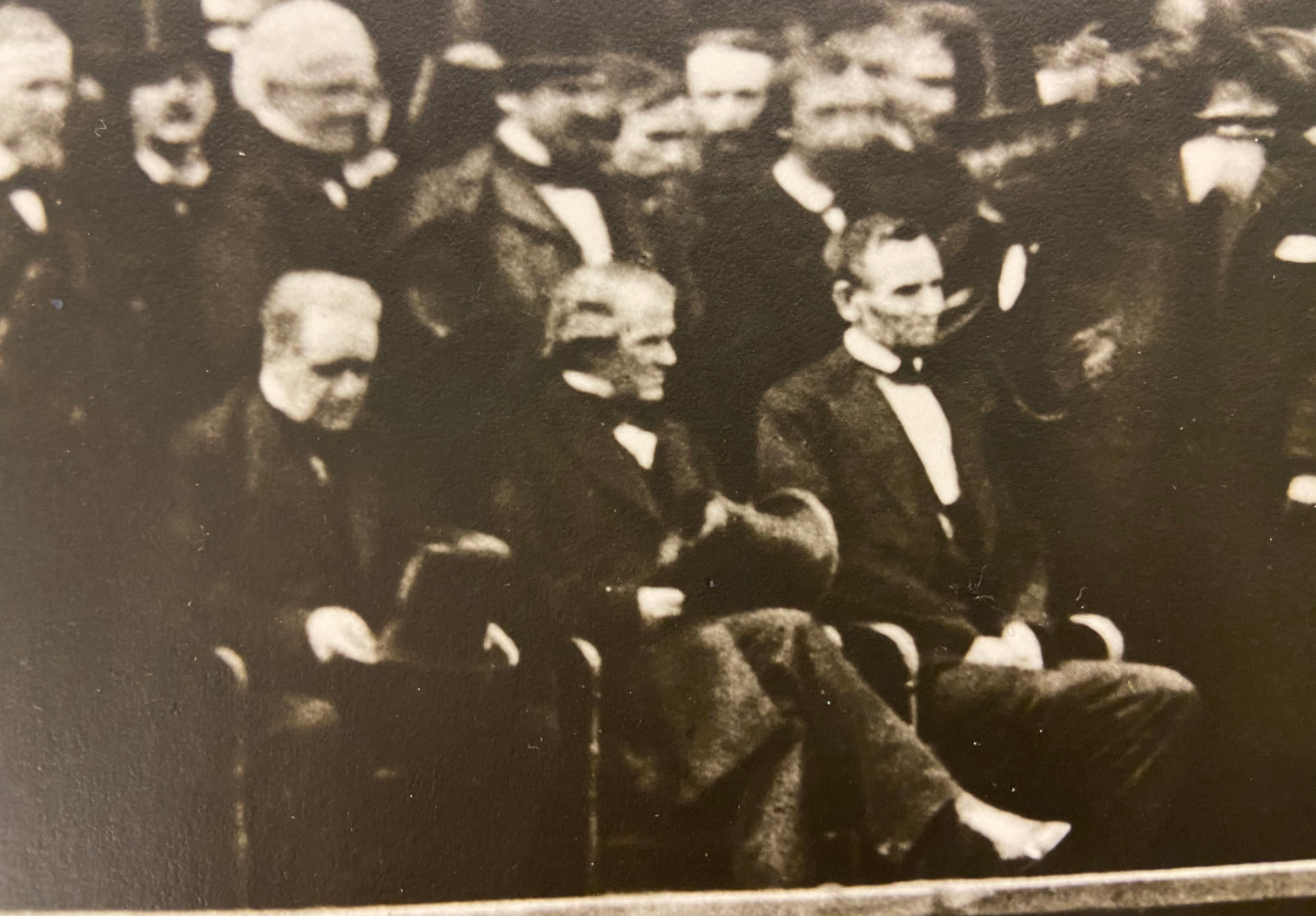
This image probably does the best job of capturing Lincoln clearly. We benefit from the fact that Gardner used a large-format camera and wet plate photography, which results in incredible detail when done correctly. In many of Gardner’s images, even those where Lincoln is out of focus or blurred, members of the audience come through very clearly.
Among the crowded audience who gathered about the Capitol steps to hear Lincoln’s now-immortal words was the 26-year-old actor John Wilkes Booth. In a little over a month from when these photographs were taken, Booth would assassinate Lincoln at Ford’s Theatre.
John Wilkes Booth’s attendance at the Capitol during Lincoln’s second inauguration is referenced by the assassin himself. A little over a month later, Booth visited with an actor friend in New York named Samuel Knapp Chester. Booth had attempted to recruit Chester into his initial plot to abduct President Lincoln, but Chester had declined. On this visit, Booth convinced Chester that his plotting days were over. Still, Booth foreshadowed his true intent by saying to Chester, “What a splendid chance I had to kill the President on the 4th of March.” Booth clarified to Chester that he had received a “ticket to the stand on Inauguration day,” from his fiancée, Lucy Hale, the daughter of New Hampshire Senator John P. Hale. Booth was a celebrated actor who rubbed elbows with Washington elite. His presence on the stand at Lincoln’s inauguration would not have been odd in any way, especially if he had secured a ticket by way of a Senator’s daughter.
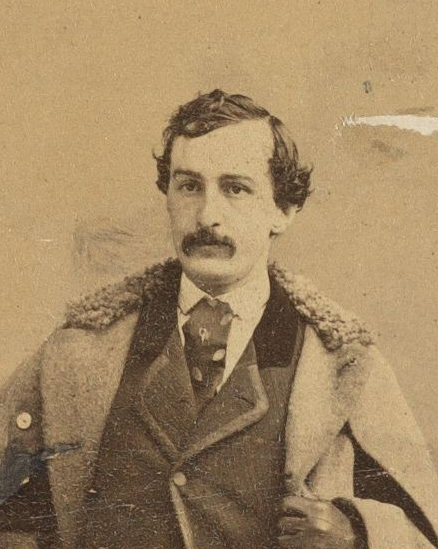
Combining the fact that John Wilkes Booth was present in the crowd at Abraham Lincoln’s second inauguration and the high level of detail afforded by Alexander Gardner’s photographs, the question becomes, “Can John Wilkes Booth be seen in any of the pictures of the event?”
In 1956, a 90-year-old photography historian and collector named Frederick Hill Meserve believed he had found the assassin amongst the audience. Using images of the inauguration from his private collection, he published his findings in the February 13, 1956, issue of Life Magazine. Meserve, as stated in the article, “spent 60 of his 90 years collecting photographs of the Civil War era” and devoted his entire life to searching for and cataloging all the images of Lincoln that existed. He had previously published his compendium of Lincoln images with author Carl Sandburg in 1944. The image Meserve used in his identification of Booth in the crowd was not one of the ones he had published earlier. Instead, it was one of the lesser-known photographs of the second inauguration that was not widely known because the figure of Lincoln appears to have been accidentally obliterated by a thumbprint during the development process of the original plate. Here is the image:

Meserve pointed out one of the figures, located on the platform above the President, wearing a top hat and a mustache:

In Meserve’s opinion, this figure was John Wilkes Booth. This was an intriguing idea from one of the country’s foremost experts on Lincoln photography. The figure does bear some resemblance to the actor-turned-assassin. But in the case of this particular image, the level of detail we need is still not quite there. I will also point out that Meserve went beyond identifying Booth in his Life Magazine article. He also identified Mary Todd Lincoln, Vice President Andrew Johnson, Lincoln’s friend and sometimes bodyguard Ward Hill Lamon, theater owner John T. Ford, and conspirator Lewis Powell. While I agree with his identification of Johnson and Lamon, these other identifications are far more questionable. For example, there is no evidence to support the idea that Lewis Powell was in D.C. at the time of the inauguration. While part of Booth’s plot by this time, he was residing in a boardinghouse in Baltimore, and we have no statement that places him amongst the crowd. The figure Meserve points to as Powell looks a fair deal like him, but he is not featured near Booth. Instead, Meserve points to one of the figures against the wall below Lincoln as possibly being the future attempted assassin of Secretary of State William Seward.
Frederick Meserve died in 1962. Three years later, his daughter. Dorothy Meserve Kunhardt (author of the children’s book Pat the Bunny), released a coffee table-sized book with her husband, Philip, called Twenty Days: A Narrative in Text and Pictures of the Assassination of Abraham Lincoln and the Twenty Days and Nights That Followed… The book utilized her father’s vast photography collection to tell the story of Lincoln’s death through images. In the book, she actually went a bit farther than her father when it came to identifying Booth and Powell at Lincoln’s second inauguration. Dorothy Kunhardt claimed to have identified several other members of Booth’s conspirators among the faces underneath the platform.
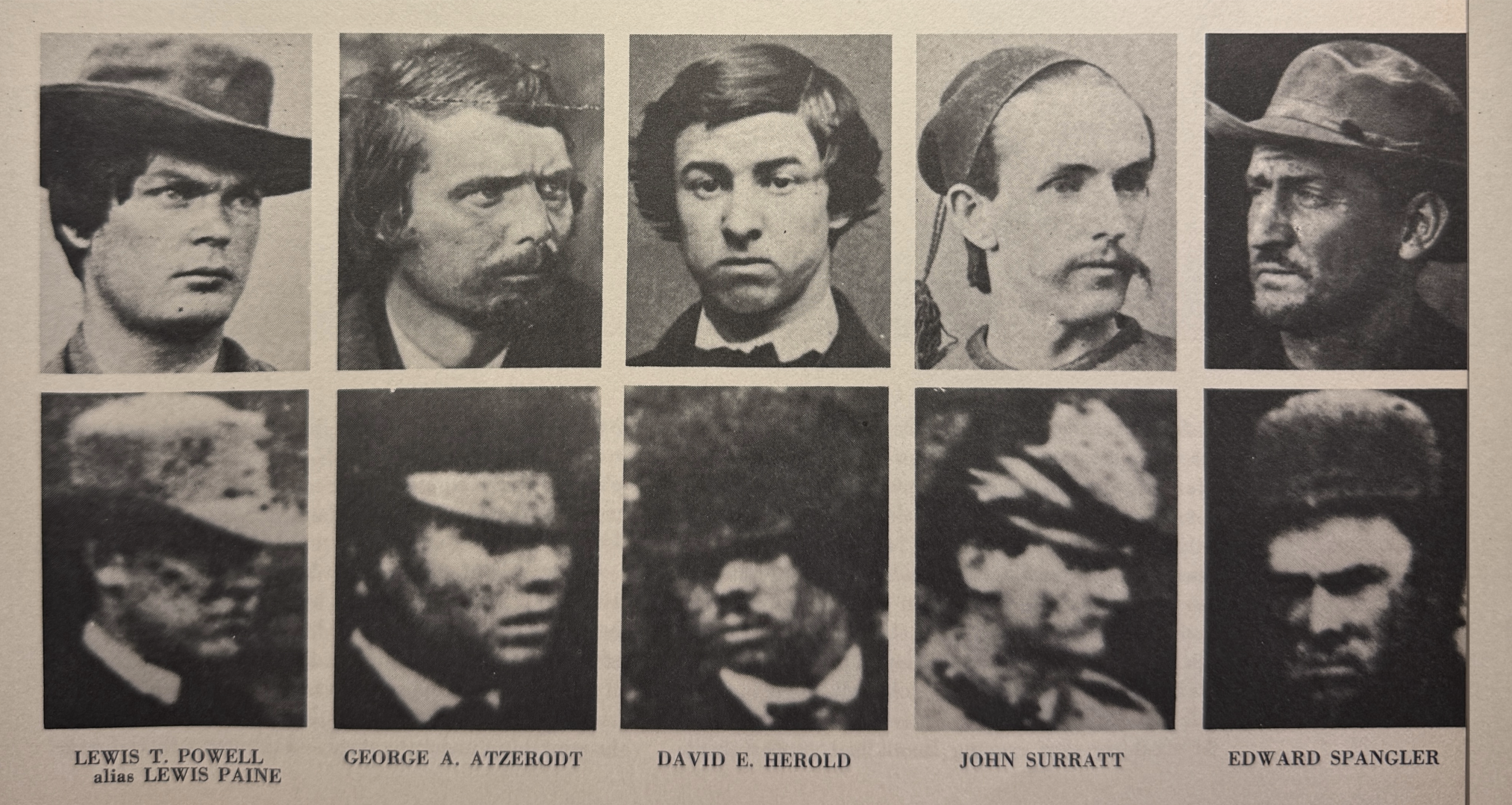
While intriguing, Kunhardt’s identification of the conspirators comes without evidence. Aside from Booth, we have no evidence that any of the other conspirators attended Lincoln’s inauguration. Historian Michael Kauffman points out in his book American Brutus that George Atzerodt had spent the previous night in Southern Maryland rowing across the Potomac, making it highly unlikely he would have been in D.C. at the time. Plus, in all the confessions Atzerodt later gave documenting the movements of his fellow conspirators, he never mentioned any of them being at the Capitol on this day. The same applies to John Surratt, who never mentioned witnessing the inauguration, despite later giving speeches about his involvement in Booth’s plot. In addition, most historians today consider Ford’s Theatre stagehand Edman Spangler innocent of any knowledge of Booth’s plot, making his inclusion in this supposed rogue’s gallery grouping fairly preposterous.
In the case of the conspirators, it appears that Meserve and Kunhardt were engaging in a bit of wishful thinking in their identifications. But what about the lead assassin? As we have seen, Booth acknowledged he was present for the event and was supposedly so close to Lincoln that he might have been able to kill the president if he had attempted the act. The figure Frederick Meserve pointed to is a possibility, but the detail is lacking.
Luckily, the image used by Meserve in his article is not the only one that appears to show this same figure. There is another Gardner photograph of the inauguration, one that is very similar to the most famous image of the event, but the focal point is off a bit so that Lincoln appears even blurrier.

While this makes for a poor image of Lincoln, the focus does give us a clearer image of the man just above Lincoln, whom Frederick Meserve identified as Booth:
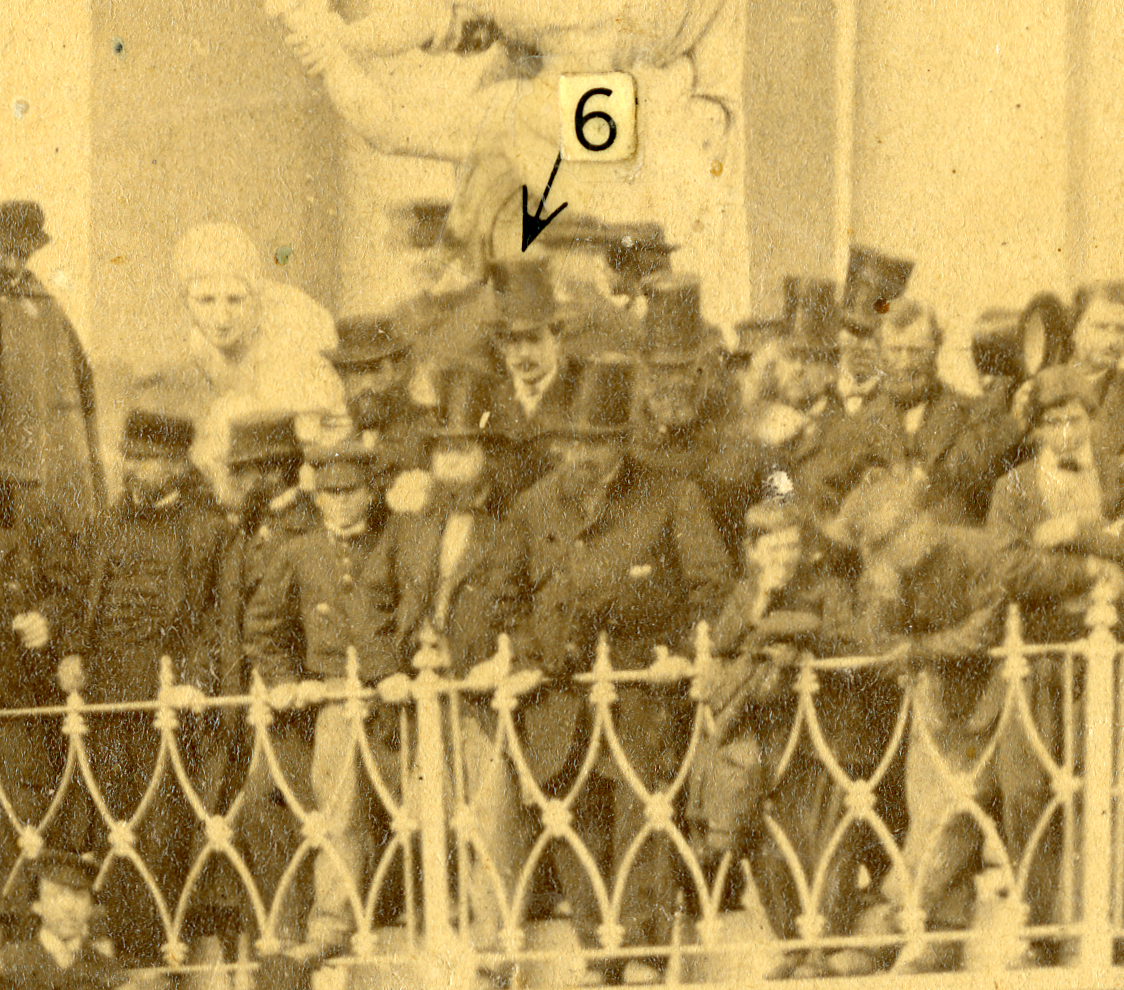
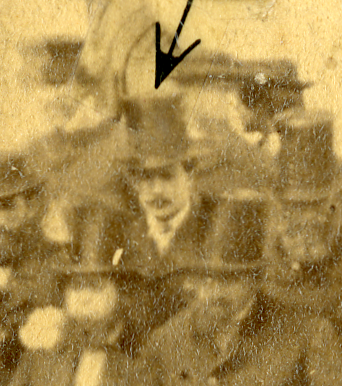
This image still isn’t perfect, but it does give us more detail. There are certainly similarities between this man and the dapper, ivory-skinned, mustachioed actor who would later assassinate the President. In truth, it’s impossible to truly verify this man as Booth, but many have accepted Meserve’s identification. The textual evidence supports that John Wilkes Booth was there, and I am personally inclined to believe the basic resemblance in Meserve’s identification makes it possible that this could be John Wilkes Booth.
While many people have become aware of Booth’s possible inclusion in images of Abraham Lincoln’s second inaugural, most are unaware that multiple images of the event were taken and that there are differences between them. As a result, many look at the most famous image of the inauguration searching for Booth in the crowd. However, in the most prolific image of the inauguration, the one that begins this article, the man Meserved identified as Booth cannot be seen clearly. The figure is partially obscured by the gentlemen in front of him straining to hear. Only the figure’s hat and the top of his head are visible.
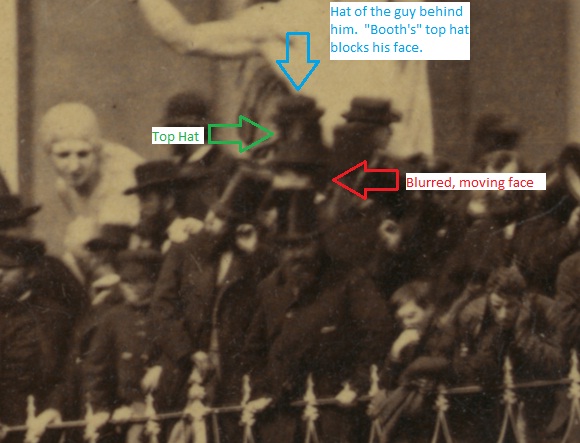
Since the “Booth” figure cannot be readily seen in the most famous image of the inauguration, many sources have selected a different man entirely and highlighted him as Booth. The Ford’s Theatre museum was once guilty of this. For several years, they had a large wall display of Lincoln’s second inauguration and included this inset:

The man they highlighted as Booth is not the same man we have seen in the other photos as being Booth. We know this because in the clearest picture of Meserve’s “Booth” the same man can be seen further down the line.
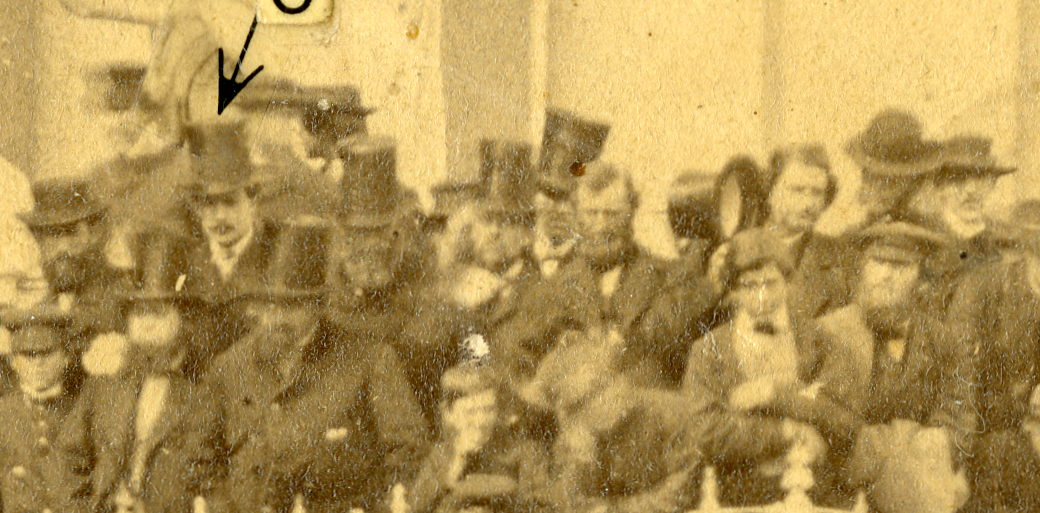
In my opinion, this figure bears even less resemblance to John Wilkes Booth than Meserve’s figure. This man has longer hair and appears to have a goatee or additional facial hair beyond Booth’s signature mustache. It also seems unlikely to me that Booth would have removed his hat during the proceedings. John Wilkes Booth was stylish and vain, retaining his fashion above all. While others might choose to remove their hats to perhaps better hear Lincoln’s words, such effort does not seem likely for the man who would soon kill him. Yet, it is this figure who is easily visible in the famous image of Lincoln’s second inauguration, who is highlighted on the Wikipedia page for John Wilkes Booth (and many other places online) as showing the future assassin eyeing his target. But you won’t see that insert at the Ford’s Theatre museum anymore. To their credit, they identified that there wasn’t any evidence to support the hatless man as Booth and changed their display. I only wish I could get them to do the same regarding the incorrect knife they have on display as Booth’s.
I hope that this post outlines the misconceptions about John Wilkes Booth at Lincoln’s second inauguration. We know he was there and witnessed the event. There is no guarantee that he is present in any of the inaugural photos, however. The identification made by Frederick Hill Meserve is a theory, like anything else. In my eyes, it is a decent one. The man Meserve says is Booth looks like Booth to me. I wouldn’t bet my life on it, but it’s a harmless enough theory to support.

References:
Frederick Hill Meserve’s original identification of Booth in Life magazine
Twenty Days by Dorothy Meserve Kunhardt and Philip B. Kunhardt, Jr.
The Photographs of Abraham Lincoln by Frederick Hill Meserve and Carl Sandburg





 LincolnConspirators.com
Great, great, interesting story. Thanks Dave. Please solve the mystery of what happened to Corbett’s pistol next.
Thank you kindly, Rich. There may even be other exposures of Lincoln second inauguration out there that show Booth even more clearly. For now these are the only ones I know of.
In regards to Corbett’s pistol, I figure if Mr. Miller hasn’t found it by now, it’s lost for good. It’s probably just in some generic gun collection somewhere with complete anonymity.
fantastic post! we share a passion for historic images. please check out the trailer for my upcoming film, Saving Lincoln at http://kck.st/RV4QOh
great information here…..i have wondered that about the famous lincoln image…..multiple sources have identified different people as booth…….even the pbs 2009 documentary that even features lincoln author james swanson in it even does the photo mix up thing.
Thanks… I helped in a minor way to back the production of Saving Lincoln and appreciate your scholarship.
Dave:
A question arises as to whom or which we shall give greater credence: unverified suppositions by some, e.g. the Kunhardts, that this or that person in the balcony is Booth, when even the Ford’s Theatre Museum is criticized for getting it wrong, and considering that there were thousands of men in Washington at that time and on that day who wore top hats and who were mustachioed, and probably thousands, too, who resembled Booth in some degree, or the “dozen or more affidavits” (per Oldroyd)attesting to the fact that the man who tried to break through the police cordon escorting the President from the Rotunda to the portico was Booth. The Kunhardts, it should be mentioned, believe they can identify Powell, Atzerodt, Herold, Surratt and even “Edward” (sic) Spangler (who was NOT a conspirator) in the Gardner photographs. It should be mentioned, too, that there is evidence elsewhere that the Confederate underground planned an attempt on Lincoln’s life on Inauguration Day. A dozen affidavits are entitled to more weight than guesswork, are they not?
John (C. Fazio)
No mention of the conspirators standing near the bottom of the platform where Lincoln spoke? Clearly, John Surratt, David Herald, George Atzerodt and possibly Edmund Spangler are seen.
While the book, Twenty Days by Dorothy Meserve Kunhardt expanded on her father’s identification and posits the other conspirators are present in the photos of Lincoln’s second inauguration, there is little evidence that any of the men were there. The men claimed to be Surratt, Herold, Atzerodt, etc. look very little like the conspirators.
I second Dave. This is especially true (for me anyway) due to the identification of Spangler being there with the others. Spangler was not part of this group; I don’t think he even met any of Booth’s “people” (other than Booth himself) until after he was arrested and imprisoned.
Pingback: The Day Lincoln Was Shot: A Visual – The Publican
A fascinating example of careful studying of photos and their presentation. I do believe Booth was at the inauguration, but I have reason to believe that he might have (at some point) been closer to Lincoln than these photos suggest (after all, he was separated by dozens of people on the balcony overlooking Lincoln and the dignitaries and the crowds blocking the exit from the balcony to the main balcony where Lincoln was delivering his speech.
A number of years ago a large hitherto undiscovered photo of Lincoln on the grandstand before delivering the speech finally showed up – showing his own beard trimmed far closer by his barber than normal. Although the images (by our standards) were blurry, Lincoln, Chief Justice Chase, outgoing Vice President Hannibal Hamlin, and Vice President Andrew Johnson were clearly visible and sitting together up front. But while I looked carefully at the picture, on the side (say within twenty-five feel of the President) is a top hatted man with a moustache who resembles Booth! If it was him, he did get within striking distance of Lincoln.
Could he have briefly actually been that close to the President? Well, if you think about it from the point of view of the date and Booth’s connections it was possible. Booth, at the time, was engaged to Lucy Hale, daughter of Senator John Hale of New Hampshire, who was a supporter of the administration. He could have gotten a pass for Booth to attend the inauguration, and Booth could have wandered down near the President, but possibly was asked to go to the smaller balcony because that was where his pass entitled him to stand.
Since the inauguration was in March 1865, the stigma of the assassination had naturally not been connected to Booth yet – it was six weeks later. His dislike of the North and Lincoln might have attracted some attention – but given his connection to the Hales it was somewhat muffled. Also, he had not yet given up on kidnapping Lincoln to help the Confederate cause. When he was near Lincoln (if it was Booth) he would not have been prepared to kill the President – he might just want a close look at him. His comments to Samuel Chester were basically given AFTER he heard the Second Inaugural Address, not before, and while he might detest Lincoln’s abolitionism he was not prepared for Lincoln coming out for support of African-American suffrage and equality. At that point Booth’s fanaticism would have started heading for more murderous solutions. But it still was concentrating on kidnapping until April 2, 1865 when Richmond fell, and April 9, 1865 when Lee surrendered. The scheme still had rapidly weakening possibilities until those dates. I don’t think on March 4, 1865 Booth was ready, despite physical proximity to Lincoln, to kill him.
Great detective work on JWB at Lincoln’s second Inaugural. I believe the man in that silk hat is Booth, and the man whose head is turned is also Booth. Congratulations on finding him in that shot. Also good of you to point out that “Killing Lincoln” did some photo magic and placed Booth elsewhere in the crowd. I detest that sort of thing. It was also done on a documentary a few years ago — perhaps “Stealing Lincoln’s Body” — they created a new image of Lincoln’s face in his casket at NY’s City Hall, and today it is widely shown and published as though it is a legitimate image of Lincoln in his casket, which it isn’t.
The same can be said about the close-up of Teddy and Elliot Roosevelt looking out the window at Lincoln’s funeral procession. That is also a photo shoppe-type product.
Pingback: 8 interesting facts about past presidential inaugurations | MGContentCenter.com
Pingback: 8 interesting facts about past presidential inaugurations | WRIC
Pingback: 8 interesting facts about past presidential inaugurations | WSLS
Pingback: 8 interesting facts about past presidential inaugurations | WTNH Connecticut News
Pingback: 8 interesting facts about past presidential inaugurations
Pingback: 8 interesting facts about past presidential inaugurations | WJHL
Pingback: 8 interesting facts about past presidential inaugurations | KRON4.com
Pingback: 8 interesting facts about past presidential inaugurations | WRBL
Pingback: 8 interesting facts about past presidential inaugurations | Stimulating Concepts
Pingback: 8 interesting facts about past presidential inaugurations | Upstate New York News
Pingback: 8 interesting facts about past presidential inaugurations | WKRN News 2
Pingback: 8 interesting facts about past presidential inaugurations | WANE
Pingback: 8 interesting facts about past presidential inaugurations | WAVY-TV
Pingback: 8 interesting facts about past presidential inaugurations | NEWS10 ABC
Pingback: 8 interesting facts about past presidential inaugurations | KSN-TV
Pingback: 8 interesting facts about past presidential inaugurations | WKBN.com
Pingback: 8 interesting facts about past presidential inaugurations | KXAN.com
Pingback: 8 interesting facts about past presidential inaugurations | WWLP.com
Pingback: 8 interesting facts about past presidential inaugurations | WSAV-TV
Pingback: 8 interesting facts about past presidential inaugurations | WPRI 12 Eyewitness News
Pingback: 8 interesting facts about past presidential inaugurations | KLFY
Pingback: 8 interesting facts about past presidential inaugurations | KWQC-TV6
Pingback: 8 interesting facts about past presidential inaugurations | WBTW.com
Pingback: 8 interesting facts about past presidential inaugurations | WDTN
Pingback: 8 interesting facts about past presidential inaugurations | WLNS
Pingback: 8 interesting facts about past presidential inaugurations | KOIN 6
Pingback: 8 interesting facts about past presidential inaugurations | WTHITV.com
Pingback: 8 interesting facts about past presidential inaugurations | KRQE News 13
Pingback: 8 interesting facts about past presidential inaugurations | NBC4i.com
Pingback: 8 interesting facts about past presidential inaugurations | fox43tv.com
Great information!
Was just reading Gore Vidal Lincoln and went to your site. The photos you’ve included are , indeed, chilling !
Pingback: Sam’s Friend | Webster Parish Journal
Pingback: A Second Manhunt Trailer | LincolnConspirators.com
Very thorough and interesting investigation into these inauguration photos. If we’re playing where Waldo though. . . what about the ghost of Edgar Allan Poe!? In the black and white Meserve photo he appears to be standing in front of the gentleman with the beige coat below the balcony. Dead ringer! Although I think Poe, if he’d been alive would definitely have brought his top hat. But Ghost Poe who knows? /jk