

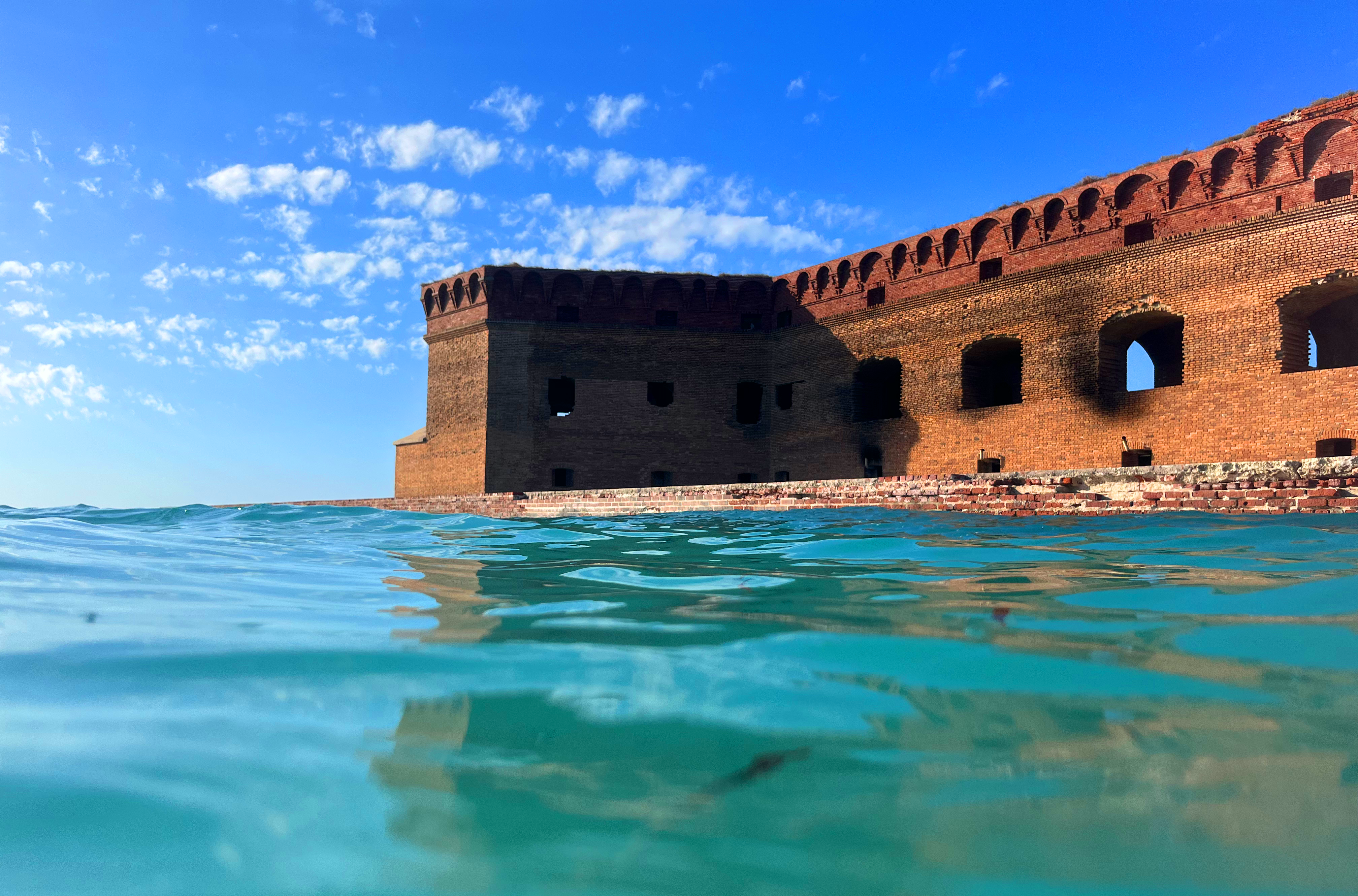
Slumbering in the midst of the Gulf of Mexico at the very end of the Florida Keys is a unique relic of the past. It is the largest brick masonry fort in the Western Hemisphere, built to guard America’s shipping lanes through the Gulf. During the Civil War, this southern fort stayed in Union hands and found a new purpose as an isolated prison. In 1865, Dr. Samuel A. Mudd, Samuel Arnold, Michael O’Laughlen, and Edman Spangler were convicted of assisting in the assassination of Abraham Lincoln and found themselves condemned to this lonely fortification. While all four men would eventually leave this place, one did so in a coffin.
In 2023, my wife Jen and I visited the Dry Tortugas and shot the following documentary about this beautiful yet deadly place. The following is the story of struggle, perseverance, survival, and loss experienced by those who found themselves placed here on America’s Gibraltar.
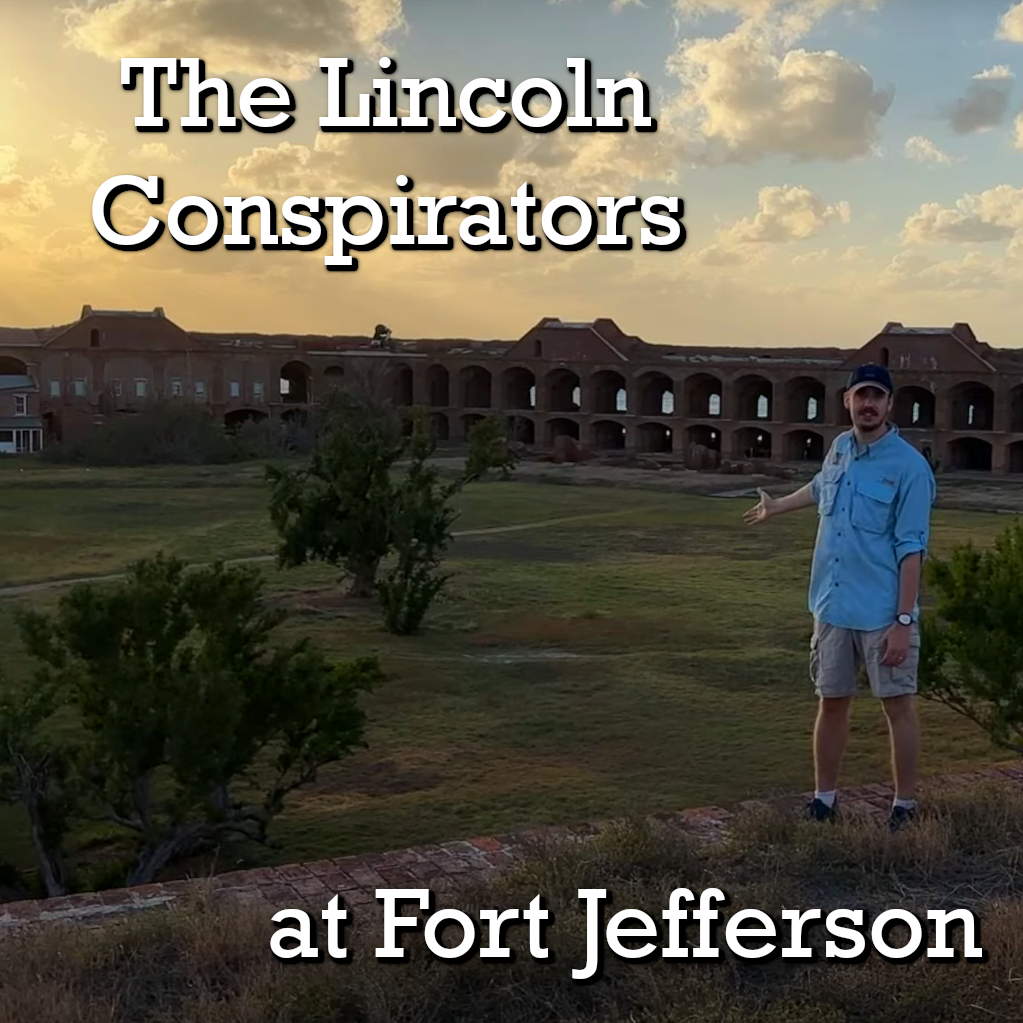
Watch the videos below and learn what life was like for the Lincoln Conspirators at Fort Jefferson.
Part 1: A Fort is Built
In the first part of the series, I discuss the location of Fort Jefferson in the Dry Tortugas, the construction of the fort, and the start of the Civil War.
Part 2: A Prison for the Lincoln Conspirators
The Civil War led to a significant change for Fort Jefferson. Rather than just being a military garrison on the gulf, the fort was transformed into an isolated island prison for disloyal and criminal Union soldiers sentenced by court-martial. In this installment, I discuss the use of the Dry Tortugas as a prison, the assassination of Abraham Lincoln, and the arrival of the four Lincoln conspirators sentenced to serve time at Fort Jefferson.
Part 3: Dr. Mudd’s Escape
After two months of being imprisoned at the Dry Tortugas, Dr. Samuel A. Mudd had come to a decision. He had witnessed first-hand other prisoners make their escape by stowing aboard the supply ships that visited the island. Motivated by racism, fear, and a strong desire to return home, Dr. Mudd decided to risk it all for freedom.
Part 4: The Dungeon
In the aftermath of Dr. Mudd’s escape attempt in 1865, the Lincoln conspirators found themselves removed from their regular cell in the second tier of the fort and placed into a locked room on the first floor. In this installment, we learn what life was like for the men in The Dungeon.
Part 5: Life and Death at the Fort
In this part of the series, we look at the everyday life of the Lincoln conspirators. We examine the daily struggles of insects, disease, and poor food which made it challenging to survive on such a distant and dangerous land. This part also looks at the few ways the conspirators occupied their time when not at work, including writing and creating woodworking projects to send home.
Part 6: Yellow Fever
Of all the diseases that threatened the residents of the Dry Tortugas, none were as terrifying as “Yellow Jack.” Fort Jefferson had previously fallen victim to the plague of yellow fever, which saw the victims’ skin become yellow and their vomit turn black. Starting in August of 1867, another yellow fever outbreak struck the fort. The epidemic ravaged the fort, killing many officers and even the prison doctor. In episode six of the series, we see how the different Lincoln conspirators fought against, endured, and even succumbed to this deadly disease.
Part 7: A Congressional Investigation
More than two years after Abraham Lincoln’s death, the surviving Lincoln conspirators were still the subject of interest at Fort Jefferson. In Washington, D.C., things between President Andrew Johnson and the Republican Party were reaching their boiling point, and efforts were underway to impeach the 17th President. As part of the evidence-gathering process, a Congressional committee was formed to investigate whether Johnson had played any role in the death of Abraham Lincoln. A representative was sent to Fort Jefferson to interview the conspirators about their (and possibly Johnson’s) involvement with John Wilkes Booth. In this penultimate episode of the series, we sit in on A Congressional Investigation.
Part 8: Freedom and Beyond
In the final part of the series, I discuss the legal efforts undertaken by the conspirators and their families to gain their release from prison. I also cover the rest of the conspirators’ lives and the transformation of the Dry Tortugas into a National Park.
Bonus Footage:
After editing the series together, there was still some footage left over that I wanted to include. I decided to create an extra video showing some of this extra footage. This bonus video contains a walk-through of Fort Jefferson, a visit to a grave in Key West, some underwater shots, bloopers, and still photographs.
Thank you all for watching my videos and learning about the conspirators’ time in the Dry Tortugas. This was a really fun project to complete and one that I had wanted to do for years. If you have an interest in the Lincoln assassination, visiting Fort Jefferson is not only a fascinating trip through history, but also a truly beautiful one. Jen and I are looking forward to returning to Fort Jefferson someday, where we can actually enjoy our vacation and disconnect from the world instead of shooting video footage all of the time.
If you have any questions about details from the videos, please feel free to comment on this page, and I’ll do my best to answer them.
Dave Taylor
2024
References:
Many books and primary documents were consulted for this series. While I do not have the space to list every source, the following books proved especially helpful in understanding the conspirators’ time at Fort Jefferson. I highly recommend these books to those interested in learning more about this aspect of the Lincoln assassination story.
- Dr. Samuel Mudd at Fort Jefferson by Robert Summers
- Memoirs of a Lincoln Conspirator edited by Michael Kauffman
- America’s Fortress: A History of Fort Jefferson, Dry Tortugas, Florida by Thomas Reid
- As Clear as Mudd! The Odyssey to Pardon Dr. Samuel A. Mudd by Robert J. Bowser (available in the giftshop of the Dr. Samuel A. Mudd House Museum)
- Pages from the Past: A Pictorial History of Fort Jefferson by Albert C. Manucy
Music credits: All of the music used in this documentary series was sourced from the public domain or Creative Commons. Of specific help in this project were the websites Ende.app and Pixabay.com, which provide royalty and copyright-free music.
Image credits: The bulk of the still images used in this series come from the National Park Service’s Dry Tortugas collection, digitized by the Open Parks Network. Additional images come from the Library of Congress, National Archives, University of Miami Libraries, and Florida Memory. The footage of The Prisoner of Shark Island is owned by Twentieth Century Fox. The footage of The Ordeal of Dr. Mudd is owned by CBS. All images and clips are used under fair use.





 LincolnConspirators.com
Outstanding presentation of some little known history! Thank you. I look forward to upcoming episodes.
I appreciate it, fellow Dave. My goal is to shed more light on the imprisonment of the conspirators and the Fort Jefferson, as a whole.
Hi! My name is Laurie Mudd-Trammell. I am the great great grand daughter of Dr. Sam Mudd. I have visited the fort two times, once with my grandfather, Richard D. Mudd, and the second time for the 150th anniversary of the release of Dr. Mudd from the prison. I enjoyed your first video and look forward to the next one! You are doing a good job!
Thank you, Laurie. I’m very much indebted to another relative of yours, Robert Summers, who is an author and great grandson of Dr. Mudd. His book, Dr. Samuel A. Mudd at Fort Jefferson is filled with great information that I utilized in this project. Thanks for watching.
Very well done, Dave!
Thank you, Eva! I hope all is well with you in Germany.
Nice job, Dave! Looks forward to the rest of the series.
Thank you, John. I hope you enjoy the future episodes.
A great start. Beautifully done. I look forward eagerly to the rest of the chapters! (Didn’t you get sunburned?) it would appear that you used a wireless RF mike, that you memorized your scenes, that your wife manned the camera, using a tripod, and listened to you at a great distance, knowing when it was time to zoom out. She, too, did a great job. Some the shots were beautifully composed. All of this looks so promising! As “Prisoner of shark Island” is one of my favorite films, I look forward to that chapter, too!
Thank you, Richard. Luckily, I avoided getting sunburned during our time at Fort Jefferson. It was bad enough having to to wear the same outfit for four days as we shot all this footage though. As you know, there are no showers for visitors to Fort Jefferson.
You’ve pretty much nailed our set-up. We shot everything on my iPhone on a tripod and with a wireless mic. During the second day of filming a wind gust knocked the tripod down and bent the microphone receiver where it connected to the phone. I had brought along an extra microphone, but only had one receiver. I was convinced we were sunk, but Jen fiddled with it and managed to get it working again. We had to check after every shot from then on as sometimes the audio cut out as a result. Luckily, we still managed to get everything we needed. Jen was amazing the whole trip and generously sacrificed her vacation time to helping me gather all of this footage. I owe her a return visit to the Dry Tortugas where we can really enjoy ourselves and not spend our days shooting video clips.
great work by both of you. Your research and delivery were wonderful. Some of those shots were beautifully composed. I eagerly look forward to the rest of the chapters! By the way, a big hello to Laurie. I was with her when she visited the fort with her grandpa. Wasn’t that a wonderful and historic day for us?!
Great effort! I first came across Dry Tortugas that had served as a prison with outbreak of Yellow Fever when I had seen the 1980 film “The Ordeal of Dr Mudd”. I subsequently read up about Dr.Mudd and his life in prison.
Looking forward to the rest of the season’s interesting “episodes”!
I’m glad you are enjoying it. In one of the later episodes I actually “borrow” some footage from The Ordeal of Dr. Mudd. So stayed tuned!
Really enjoying this, Dave! You and Jen are doing great work. Can’t wait for the next installment.
Thank you!
You and Jen have done a wonderful job. An edited version should be shown at the fort’s visitor center. Much appreciation, as always, for your efforts.
Thank you kindly, Dave. I doubt folks who are just taking a day trip to the Dry Tortugas would want to waste time listening to me blather on when they could be snorkeling or exploring. But hopefully folks planning a visit might stumble across this in order to get some insight about the place ahead of time.
I am thoroughly enjoying your videos at Fort Jefferson. Wonderful Job, thank you. I am a lifetime student/collector of Civil War and Lincoln assassination related artifacts. I have in my collection a card of pressed seaweed made by Dr. Mudd while a prisoner at Fort Jefferson and given to Samuel Buckwalter Co. M, 5th U.S. Artillery on February 12, 1867. I noticed in your “Yellow Fever” episode an image of the petition signed by many of the fort’s occupants to recognize the efforts of Dr. Mudd during the epidemic. I have been unable to find the list of names on that petition. I would be very grateful if you could share any information you may have as to where I might find those names or even a photograph of the original document. Thank you again for bringing history alive.
David,
Here is the link to part of Dr. Mudd’s pardon file which contains the signed petition from the soldiers stationed at the fort. The petition starts on page 18 of the pdf and runs through page 25: https://catalog.archives.gov/id/6704610
From a quick glance, I didn’t see the name of Samuel Buckwalter included in the list. Perhaps he had already been transferred from the Fort before the yellow fever came (hence the February gift from Dr. Mudd).
I’m glad you are enjoying the series. Would you be willing to share an image of your Dr. Mudd moss card for Samuel Buckwalter? I always enjoy seeing new artifacts like this.
Best,
Dave
Fantastic! Really enjoyed every ‘episode’. The “speedy walk-through” and other clips in the bonus footage at the end captured the essence of the place as it is in current times very well.
It’s obvious that producing this series has taken a great deal of effort. Congratulations on a job well done.
Thank you! I’m very pleased you enjoyed the series. The Dry Tortugas is a truly beautiful place with some fascinating history behind it. It was a lot of fun sharing this place with a wider audience.
Awesome as always! Thanks Dave!
Thank you, Rich! I’m quite proud of this project.
Dave I thoroughly enjoyed this series. It really brings a sense of perspective to an area of the assassination I’ll likely never see for myself. I really appreciate you putting it together.
Thank you for watching my series, John. This was a labor intensive project to research, shoot, and edit, but I’m very happy about how it all turned out. I’m glad that it helped you experience a new part of the Lincoln assassination story.