
Reader Richard Petersen asked this excellent question on my last post about Silas Cobb:
Question. What was the protocol for Booth and Herold in crossing the bridge? Could they ride across or did they have to dismount and walk?
I believe this to be a very good question and worthy of discussion. The record of what transpired at the Navy Yard Bridge comes from the official statement and the conspiracy trial testimony of Sgt. Silas Cobb. In his statement to authorities specifically, Cobb gives wonderful details about the two riders who crossed his lines. For example, we learn that Booth was wearing a “soft black or dark brown felt hat” and that “his hands were very white, and he had no gloves on”. Cobb even provided details about Booth’s voice stating it was, “rather light, and high-keyed”. For Davy Herold, Cobb described him as wearing, “a light coat, light pants, and a snuff colored felt hat, of rather a light shade.” He even let us know that Davy was, “the heavier of the two”. When it comes to the actual method of crossing the bridge, Cobb does not give specific detail. This is probably due to the fact that crossing people over the bridge was so commonplace to Cobb, that he didn’t consider the way in which Booth and Herold did it to be any more notable than any other person. He does provide a few statements that we can piece together though, to paint a seemingly accurate picture of what the process was.
When both men approached the bridge, the sentry challenged them (assumedly by asking “Halt, who goes there?” or “Friend or Foe”). Booth and Herold both replied “a friend” and Cobb began his interrogation of them. In the trial testimony, Cobb is asked a question about his encounter with Herold:
Q. Did you have a good view of his face? Was there a light?
A. I did. I brought him up before the guard-house door, so that the light shone full in his face and on his horse.
So we know that Cobb moved Davy to be in view of a light. Unfortunately, this statement is inconclusive regarding whether or not Davy was still on horseback, or on foot next to his horse. However, a little while after this, Cobb is asked about Davy’s size:
Q. How would he compare in size with the last man on the row in the prisoner’s dock? [David E. Herold, who stood up for identification.]
A. He is very near the size, but I should think taller, although I could not tell it on the horse; and he had a lighter complexion than that man.
The darken part is very important. Cobb, the man who provided so many details about the men who he crossed over the bridge, was unsure about Davy’s height. It appears his explanation for this is because the Davy stayed on his horse and so Cobb was not able to accurately compare Herold on his horse with Herold on the prisoner dock. This testimony appears to favor Booth and Herold remaining on their horses.
Cobb gives us a bit more (though still not as much as we’d like) with regard to Booth’s crossing:
“He then turned and crossed the bridge; his horse was restive and he held him in and walked him accross the bridge; he was in my sight until after passing the other side of the draw. I do not know with what speed he rode after that.”
During my first few readings of this, I pictured Booth walking his horse as a man would walk a dog. In my eyes it appeared as if Booth (who apparently showed no physical pain supporting Michael Kauffman’s theory that he broke his leg later in a horse fall) kept his horse close to him and acted like a child crossing the street by walking his bicycle. Upon further reading and trying to put myself into the correct 19th century equestrian mindset though, I read this now as Booth riding his horse at a walking pace across the bridge. The last phrase, “I do not know with what speed he rode after that,” implies to me that Booth was already riding his horse and not walking it on foot. I want to believe the detail oriented Cobb would have stated something along the lines of “he remounted his horse” if Booth was actually walking alongside it beforehand.
There is no specific statement by Cobb saying that Booth and Herold ever dismounted their horses. In addition, the few details that Cobb does give regarding the process appears to imply that they remained in their mounts during their entire time they conversed with him. There is no smoking gun or definite answer to Richard’s question, but I believe the majority of the evidence points to Booth and Herold staying on their horses when they crossed the Navy Yard Bridge.
What do you think?

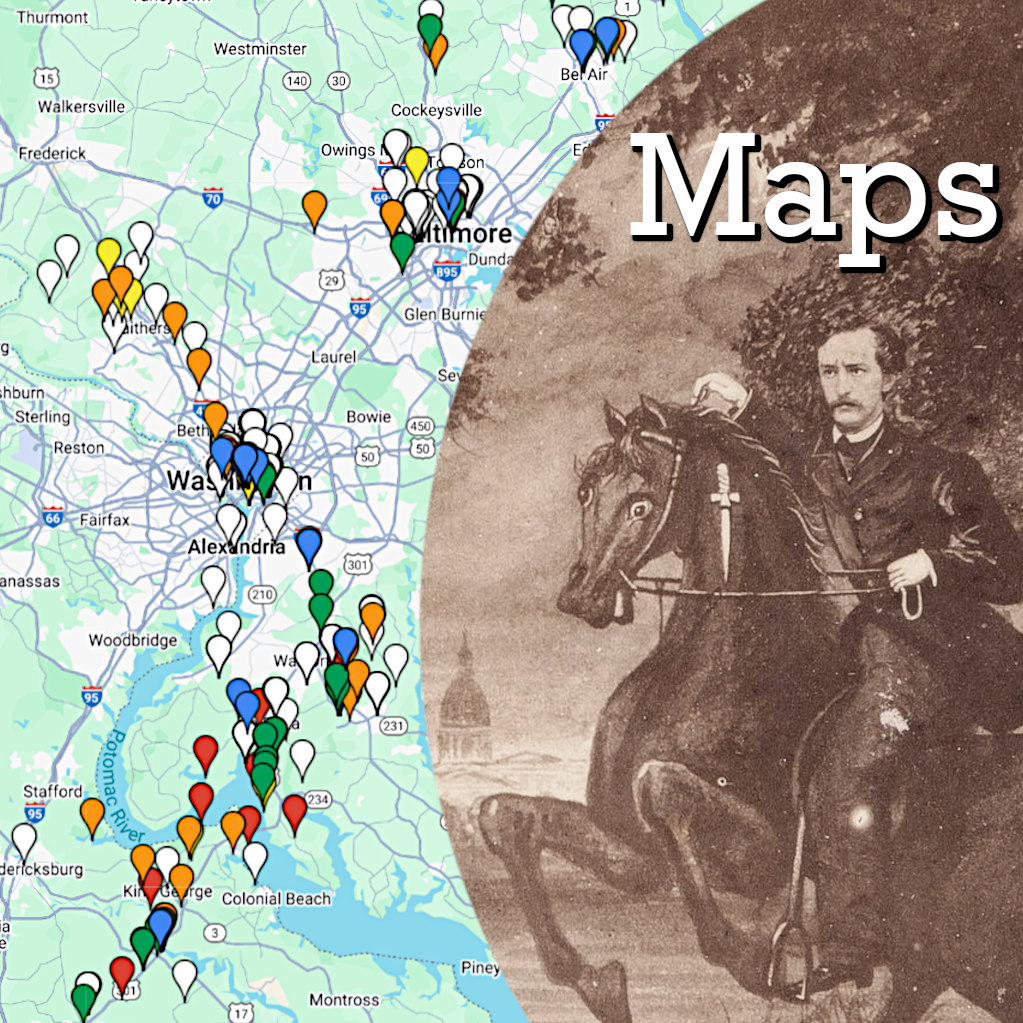
Booth making his escape on horseback.
References:
The Evidence by Williams and Steers
Poore’s version of the Conspiracy Trial (Vol 1)





 LincolnConspirators.com
Recent Comments