When John Wilkes Booth pulled the trigger on his derringer, he released not only a lead ball, but also the pent up angst and fervor that had darkened his soul. His deed was misguided and barbaric; however, in his eyes, it was justified. As a son, an actor, and an American, John Wilkes Booth was fuelled by his passions. While he won acclaim for his ability to direct his passions on the stage, they were not products of the stage. He inherited these passions from his forefathers and, mixed with his own experiences, channeled them on that fateful night.
Much has been written about John Wilkes Booth’s father, Junius Brutus Booth. The noted tragedian was the greatest of his generation and developed many peculiarities that has provided rich fodder for writers. The book My Thoughts be Bloody by Nora Titone provides a wonderful look at the romantic side of Junius Brutus Booth. Junius was a proponent of Lord Byron’s free love philosophy. He won over his mistress and mother of his theatrical clan, Mary Ann Holmes, with volumes of Byron’s work and notes of his affection. Despite being married to another woman and having two children with her (only one of which survived infancy), Junius was enamored with Mary Ann and, together, the pair ran off to America. Love and the pleasures of the flesh were Junius Brutus Booth’s first passion.
In fact, his passion in this area started before he had even met his first wife, Adelaide. As a mere boy, Junius had engaged his passions. I quote from the book, Prince of Players: Edwin Booth by Eleanor Ruggles:
“Junius Brutus Booth was thirteen when a neighbor’s servant girl accused him of having got her ‘in the family way’ and was hurriedly paid off. He was seventeen and had enlisted as a midshipman on the brig Boxer when he was kept from sailing by a court summons to answer the same charge made by another servant girl, employed in the Booths’ own house. Richard Booth went into court himself to be Junius’ lawyer and defended him hotly, but the father and son lost their case and the father was compelled to pay up again.”
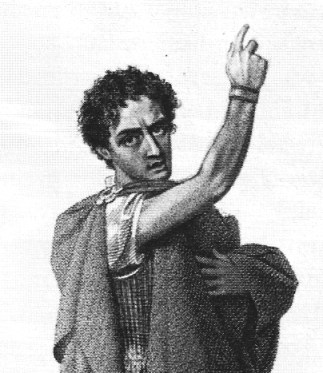
Drawing of Junius Brutus Booth in 1817
The above, modern account is greatly contrasted by another. A book was published in 1817 called, Memoirs of Junius Brutus Booth: From his Birth to the Present Time. The book is an early testament to the genius of the young actor. Written by his fans during the heyday of his English popularity (before he met Mary Ann Holmes and ran away with her), the book recounts the matter in the most predisposed, yet eloquent, manner possible:
“He then became desirous of learning the art of printing, but soon relinquished it for the law, which again he quitted from an inclination to become a sculptor, and he pursued the first steps towards that divine art very assiduously, with the intention of entertaining it as a profession. But here his views were interrupted by an occurrence of rather an extraordinary nature. Our hero, for so we must now emphatically call him, was accused of a degree of susceptibility towards that sex, whose charms form the great stimulus – the bright reward of every act in which the heart of man takes part, rarely exemplified at his age. He was charged by a frail nymph with a deed – of which she could no longer conceal the evidence. His father, astonished at this deposition to his son’s precocity, was at first disposed to wear the aspect of displeasure; but relying on the sagacity and experience of the Bench on these subjects, he determined to answer it by taking his child in his hand, and presenting him to the Justices, merely ask their worships whether they thought the fact came within the limits of probability, or even possibility. They, however, decreed that he should wear this attestation of his persuasive powers – or this stain on the pudency of his boyhood, (as it will be variously interpreted by various commentators) for the remainder of his life.
The consequence of this decision, and the subsequent anger of his father, was that, being unable to raise the supplies necessary on this emergency, he was forced to resort to stratagem to elude the vigilance of the parish officers, (which, when in the pursuit of gain, or in the prevention of loss, is not often found napping), and mounting a high brick-wall, he baffled his pursuers, and for nine months escaped this attack on his purse, or rather his father’s; – he was at length, however, discovered, and obliged to make the usual amende.”
As Junius grew older, his passions shifted from matters of the heart, towards that of the bottle. Mirroring his son to a less extreme, Junius let his passions overwhelm him and lead him to his own destruction.
John Wilkes Booth’s father was not the only passionate forefather. Richard Booth, Junius’ father and John Wilkes’ grandfather, had his own obsession. Many of us know how Richard Booth hung a portrait of George Washington in his London home and required visitors to bow before it. In his youth, however, Richard Booth took a much more active role in demonstrating his commitment to America. I quote from The Edler and Younger Booth by Asia (Booth) Clarke:
“Richard Booth, the father of the subject of the present sketch, was educated for the law; but, becoming infatuated with Republicanism, he left home, in company with his cousin John Brevitt, to embark for America (then at war with England), determined to fight in her cause. Booth was taken prisoner and brought back toEngland, where he subsequently devoted himself to the acquirement of knowledge and the practice of his profession…”
In their attempt to join the Americans in their fight for independence, Richard Booth and John Brevitt wrote to a Member of Parliament noted for his support of the American Revolution, asking for a letter of introduction on their behalf. The man they wrote to would later be honored by the Booth family by giving his name to one of Richard’s grandson’s: John Wilkes.
“To John Wilkes, Esq., Princes Court, Westminster.
Paris, Oct. 28th, ’77.
Sir, — You will certainly be much surprised at the receipt of this letter, which comes from two persons of whom you cannot possibly have the least knowledge, who yet at the same time claim the Honour of being of the same Family as yourself. Our conduct has certainly been in some respects reprehensible, for too rashly putting in execution a project we had for a long time conceived. But as it was thro’ an ardent desire to serve in the Glorious cause of Freedom, of which you have always been Fam’d for being the Strict and great Defender, we trust the request we are about to make will be paid regard to. As Englishmen, it may be urged that we are not altogether Justified in taking arms against our native Country, but we hope such a vague argument will have no weight with a Gentleman of your well-known abilities; for as that country has almost parted with all its Rights, which have been given up to the present Tyrannic Government, it must be thought the Duty of every true Briton to assist those who oppose oppression and lawless Tyranny. And as the people of America are composed of men who have still the spirit of their brave Forefathers remaining, it becomes all who are Englishmen to exert their utmost efforts in their behalf, leaving their Country for that purpose; being no more (as we presume) than the Romans, in the war between Octavius and Anthony on the one part, and those illustrious worthys, Brutus and Cassius, on the other, going from the army of the Tyrants to serve in that of the latter, and therefore equally justifiable.
‘Dulce et Decorum est pro patria mori,
Sed pro Libertate mori, Dulcissimum est.’
The manner in which we have conducted ourselves has been so very extraordinary as to be scarcely credible, but we are assured the Bearer of this Letter will convince you of its Authenticity. In short, we leftEngland, and all the advantageous prospects we had there, purposely to go and serve in the Army of the Sons of Liberty, the brave Americans. In order to complete the Enterprise we came from London under a pretence of going on a party of pleasure to the Camp at Warley Common, but instead of proceeding thither, we went immediately for Margate and thence to Ostend, and have since arrived here, where we came to wait upon the Gentlemen who are Agents for the Congress in America, in order to the full completion of our Design of getting appointed officers in the Provincial Service, but for that purpose have since found it necessary to procure a Letter of recommendation from some Gentleman in the Interest of Liberty in England, and understand from Mr. Arthur Lee (who has promised to interest himself greatly in our behalf), that no recommendation will be of more service to us than yours. Our request therefore is, that you will condescend to give one in our favour, directed to that Gentleman at the “Hotel de la Reine, la Rue des Bons Enfants, a Paris,” which you will please to deliver to the Bearer hereof, as soon as possibly convenient. And the favour will be gratefully remembered, and the name of Wilkes be always held in the greatest respect and veneration.
Your most and obed’ Serv’ts at command,
R. Booth.
John Brevitt”

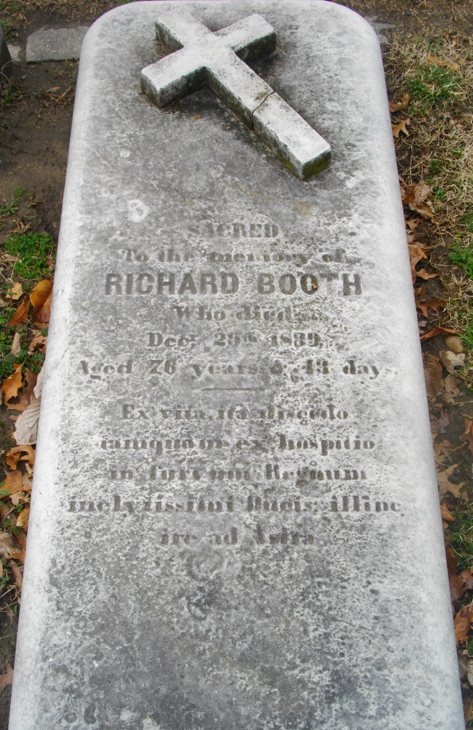
Richard Booth’s Grave
These elder Booths, Richard and Junius, tread a path that their progeny, John, would later follow. From Richard, John Wilkes inherited a revolutionary spirit. From Junius, he learned to submit himself to his passions regardless of the consequences. Combined with the tyrannicidal nature of Shakespeare and the bloodiness of the Civil War, John acted according to his beliefs.
Ultimately, in his own horrific way, John Wilkes Booth upheld the passion of the Booth name.
References:
The Edler and Younger Booth by Asia Clarke
Memoirs of Junius Brutus Booth: From his Birth to the Present Time
Prince of Players: Edwin Booth by Eleanor Ruggles
My Thoughts Be Bloody by Nora Titone






 LincolnConspirators.com
Recent Comments